




Abstract
This article is in our series on Winston Churchill's illnesses
Introduction
In 1969, the psychiatrist Anthony Storr published an essay Churchill: the Man,
1
reprinted in 1980 as the first chapter of his book, Churchill's Black Dog and Other Phenomena of the Human Mind.
2
This essay established very firmly in the public imagination that Sir Winston Churchill (Figure 1) suffered throughout his life from recurrent attacks of severe depression, or even manic depression (bipolar disease). Indeed, Churchill's depression is now taken for granted as being almost as much a fact of his biography as that he was born in 1874 and died in 1965.
Sir Winston Churchill ©Karsh of Ottowa.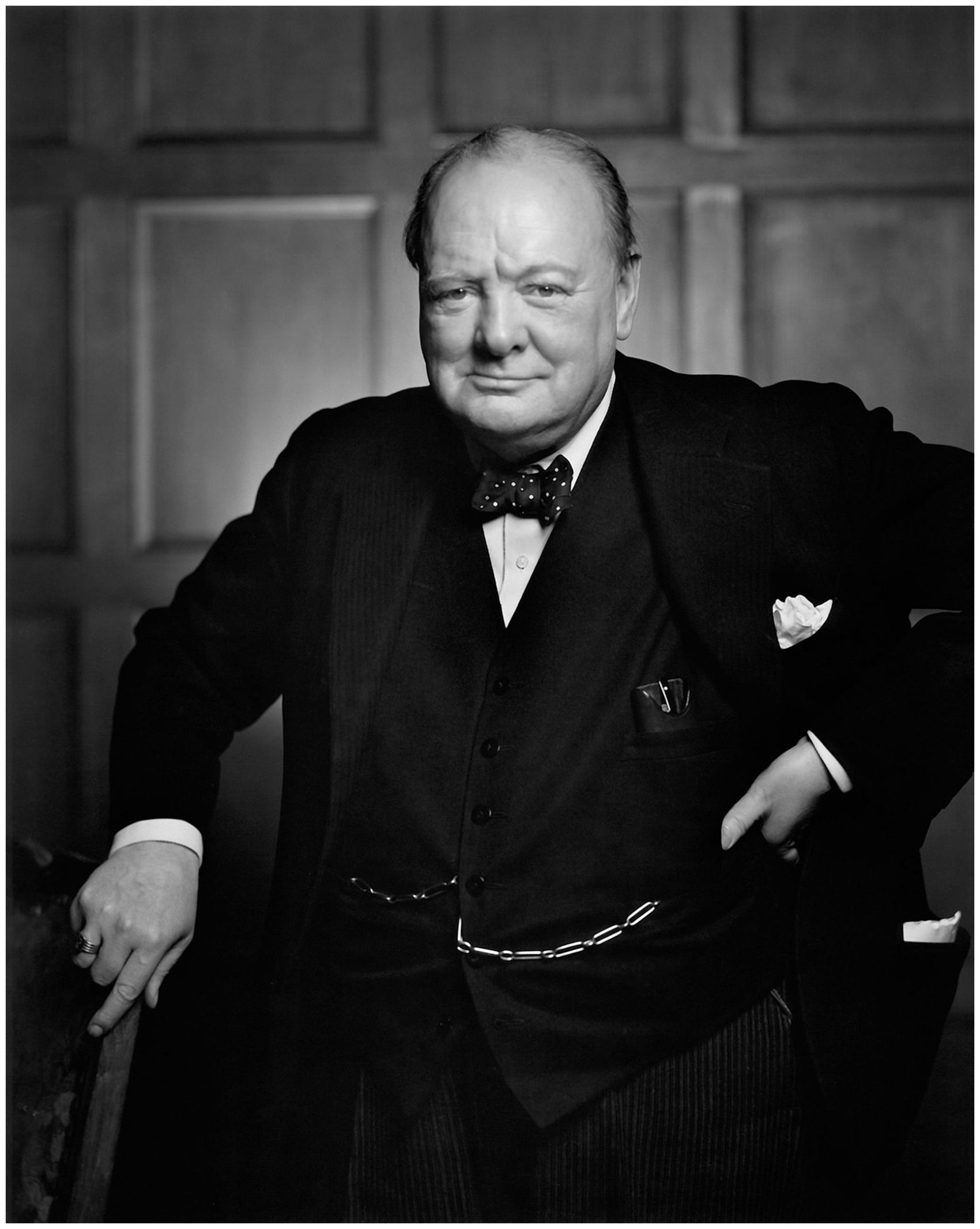
Storr begins his influential and seminal essay as follows: The psychiatrist who takes it upon himself to attempt a character study of an individual whom he has never met is engaged upon a project which is full of risk…psychiatrists who attempt biographical studies of great men are apt to allow theory to outrun discretion….
1
Not long afterwards, Storr's hypothesis continues, Lord Randolph died, and his son spent the rest of his life trying to come up to his deceased father's high standards of achievement in order to earn his love and approbation, a futile and impossible task of course because his father was dead. In the absence of demonstrative parental love, then, Winston Churchill was permanently insecure and tried to earn that love by exceptional activity and accomplishment, which caused him to be hyperactive except when it became obvious that such accomplishment would never make up for the absence of love, whereupon he became depressed. He therefore veered between hyperactivity and his Black Dog. Such is Storr's hypothesis. This is a plausible story, but of course much of the hypothesis is undermined if, in fact, Churchill did not suffer from serious depression.
Storr concluded: It is at this point that psychoanalytic insight reveals its inadequacy. For, although I believe that the evidence shows that the conclusions reached in this chapter are justified, we are still at a loss to explain Churchill's remarkable courage. In the course of his life he experienced many reverses: disappointments which might have embittered and defeated even a man who was not afflicted by the ‘Black Dog’. Yet his dogged determination, his resilience, and his courage enabled him, until old age, to conquer his own inner enemy, just as he defeated the foes of the country he loved so well.
1
Post and Robins
4
stated categorically: The best documented case of depression of a political leader is that of Winston Churchill [the authors reference Storr1,2 and Moran
5
to support this contention]…He ruefully characterized his depression as ‘my black dog’, a faithful companion, sometimes out of sight, but always returning.
Nassir Ghaemi, in a recent and best-selling book, titled A First-Rate Madness, 7 cites a lengthy passage from Storr's essay to buttress his argument that Churchill suffered from depression, to his and his country's advantage. It was, according to this author, Churchill's tendency to depression that made him a political realist during his years in the wilderness and during the rise of the Nazis, and he even goes so far as to claim that it was Churchill's depression that caused him to be in the wilderness in the first place.
In addition, other authors have drawn a similar conclusion without citing Storr. Andrew Solomon, in The Noonday Demon: An Anatomy of Depression, states that both Abraham Lincoln and Winston Churchill ‘suffered from depression (and used) their anxiety and their concern as the basis for their leadership’. 8 Andrew Norman, a medically qualified author, has argued in his book Winston Churchill: Portrait of an unquiet mind 9 that Churchill should be described as a ‘hypomanic-depressive’.
Some, including Best, have accepted that Churchill's ‘…most evident recurrent affliction was not physical but psychological: depression…its importance has been exaggerated’ and that ‘it never stopped him doing anything he wanted to do.’ 10 Most importantly, Attenborough (who has written a detailed rebuttal of the conclusions of Moran, Storr and others in Churchill and the ‘Black Dog’ of Depression 11 ) and Gilbert, Churchill's official biographers, have come to the conclusion that Churchill's ‘black dog’ was a transient, never significantly disabling, reaction to serious misfortunes for himself or for Britain and was insignificant when compared to Churchill's resilience, courage and leadership at times of major setback or crisis.11,12
Gilbert described Churchill as ‘A man often angered and saddened by the bad turn of events, but having unusual resilience to come back fighting within a short time; not someone incapacitated through mental ill-health or through excessive drinking.’ 12 This opinion was based on Gilbert's detailed assessment of the ‘daily records of the war years’ and beyond. But Gilbert's opinion also took note of the views of those closest to Churchill such as his daughter, Mary, and Sir John Colville, Churchill's Joint Principal Private Secretary, 1951–1955 (and Assistant Private Secretary 1940–1941 and 1943–1945). Both of these opinions are discussed further below.
So what is the evidence that Churchill suffered from repeated episodes of ‘black dog’, that is from a Major Depressive Disorder as defined in the fifth edition of the Diagnostic and Statistical Manual of the American Psychiatric Association (DSM-5) 13 or from a Bipolar I Disorder or from a Bipolar II Disorder?
Methods
Information was available from various sources. Foremost were those of Churchill's physicians: Lord Moran, Lord Brain, and Sir John Parkinson who have left clinical records. By courtesy of the present Lord Moran and the Library at the Wellcome Collection, we have had access to his grandfather's original papers, though Lord Moran's book on Sir Winston Churchill, The Struggle for Survival, 5 was the key publication cited by others. However, permission to include information not previously in the public domain was not granted by Lord Moran, though important information from the Archive has been published by Wilfred Attenborough 11 previously. The present Lord Brain (Michael Brain DM FRCP) has kindly allowed us full access to his father's clinical records held by the Royal College of Physicians. Sir John Parkinson's family have also given permission to include details from his medical reports on Churchill also held by the Royal College of Physicians. Lady Soames14,15 and Sarah Churchill 16 (Churchill's daughters) added further details, as did Sir Martin Gilbert12,17,18 (Churchill's main biographer) and Sir John Colville19–21 (Joint Principal Private Secretary).
‘Black dog’
According to the Oxford English Dictionary, 22 the first use of the phrase ‘black dog’ to describe melancholy and depression was in 1776 by Dr Samuel Johnson, the creator of the English Dictionary, who suffered from clinical depression. Johnson called his melancholia ‘the black dog’ in conversations and correspondence with his friends, including Hester Lynch Thrale (also known as Piozzi), whose diaries and correspondence are an important source of information about Johnson.
Evidence from Sir Winston Churchill
In none of Churchill's own published writings does the term ‘black dog’ occur, though the term can be found in a letter he sent to his wife dated 11 July 191123 and this is hinted at in a second letter dated 28 January 1916. 24
The first letter was written as Churchill was about to join his wife at the seaside. 23 Churchill reported that the wife of a cousin had been cured of depression by a doctor in Germany. ‘I think this man might be useful to me – if my black dog returns. He seems quite away from me now-it is such a relief. All the colours come back into the picture. Brightest of all your dear face-my darling.’ 23 This statement implies strongly that at some time in the past (‘quite away from me now’), Churchill had suffered from the ‘black dog’, which he equates to depression.
The second letter dated 28 January 1916 was written to his wife Clementine while Churchill was serving as battalion commander on the Western Front during WWI: You must not suppose that any of my depressions here have any relation to those terrible and reasonless depressions w[hic]h frighten me sometimes. I sorrow only for real things, for g[rea]t enterprises cast away needlessly—wantonly—for not having the power w[hic]h I c[oul]d use better than any other living Englishman to determine the war policy of Britain. It is painful at times; but it is bearable always. Otherwise my spirits are surprisingly good.
24
The memory of these events remained with Churchill for several decades. For example, during a debate in the House of Commons on corporeal punishment on 15 July 1948, Churchill said: I found it very distressing nearly 40 years ago to be at the Home Office. There is no post that I have occupied in Governments which I was more glad to leave. It was not so much taking the decisions in capital cases that oppressed me, although that was a painful duty. I used to read the letters of appeal written by convicts undergoing long or life sentences begging to be let out. This was for me an even more harassing task.
26
Lord Riddell (Managing Director of the News of the World) who played golf with Churchill twice weekly and met him frequently has offered an alternative explanation. Riddell recorded in his diary in 1911, ‘He is a charming companion, full of witty, amusing, unexpected sayings – never dull, never tedious. I find him a most considerate and loyal friend. He is also kind-hearted.’ 28 Before the public announcement, Churchill had confided in Riddell that ‘I am going to the Admiralty’ (Churchill became First Lord of the Admiralty on 24 October 1911). Riddell also recorded in his diary that Churchill was unhappy at the Home Office and that the recent strikes had caused him much ‘anxiety’, as he was ‘freely criticised by the Press and certain of his colleagues. The situation weighed upon him…Nevertheless, like all public men, he frequently alleged that, being concentrated on his job, he was not concerned with his critics’. 28
We deduce from this scanty evidence the possibility that Churchill suffered from non-occupationally disabling mild depression before 1911. There is no evidence to support a conclusion that Churchill suffered from prolonged and consistent low mood that interfered with his activities (and what activities!). These features were presumably the fleeting accesses of despair that can overtake anyone and do not constitute a diagnosis any more than accesses of joy constitute a diagnosis.
Churchill also wrote about the worry and mental overstrain in those who have to bear exceptional responsibilities and duties over a long period of time. Churchill proposed an eminently sensible and indeed insightful approach as to the nature of the interest that should be chosen to maintain mental equilibrium. In Churchill's case, of course, it was principally painting, which no doubt explains why the article was republished as the Introduction in Painting as a Pastime,
29
after first appearing in The Strand Magazine in December 1921: Many remedies are suggested for the avoidance of worry and mental overstrain by persons who, over prolonged periods, have to bear exceptional responsibilities and discharge duties upon a very large scale. Some advise exercise, and others, repose. Some counsel travel, and others, retreat. Some praise solitude, and others, gaiety. No doubt all these may play their part according to the individual temperament. But the element which is constant and common in all of them is Change. Change is the master key. A man can wear out a particular part of his mind by continually using it and tiring it, just in the same way as he can wear out the elbows of his coat. There is, however, this difference between the living cells of the brain and inanimate articles: one cannot mend the frayed elbows of a coat by rubbing the sleeves or shoulders; but the tired parts of the mind can be rested and strengthened, not merely by rest, but by using other parts.
29
Evidence from the Churchill family
Churchill's daughter, Mary [Lady Soames], has written: A lot has been made of the depressive side of his character by psychiatrists who were never in the same room with him. He himself talks of his black dog, and he did have times of depression, but marriage to my mother very largely kennelled the black dog. Of course, if you have a black dog it lurks somewhere in your nature and you never quite banish it; but I never saw him disarmed by depression.
30
[At] one of his birthdays a few years before [his death by which time Churchill was out of power and of little importance politically], in answer to my sister Diana's exclamation of wonderment at all the things he had done in his life, he said: ‘I have achieved a great deal to achieve nothing in the end.’
16
Evidence from Sir John Colville
Before considering Moran's description of Churchill's ‘black dog’, it is appropriate to place his comments in perspective. Colville was Churchill's Joint Principal Private Secretary from 1951 to 1955 and had been his Assistant Private Secretary from 1940 to 1941 and from 1943 to 1945. Colville had a particularly close relationship with Churchill and regularly liaised with Moran as Colville's Diaries
19
make clear. He has stated: Churchill was frankly sceptical of Moran's constant emphasis on psychology since he liked straightforward and uncomplicated explanations of men and behaviour. Moran was always trying to fathom the workings of his patient's mind, and he sometimes seemed to resent the fact that Churchill's policy was so often proven right. He used on occasion to speak of it with pitying contempt, but it was noticeable that when challenged he was unwilling or unable to propose an alternative. He claims in his book Churchill had none apart from him on whom to unburden his cares. My experience was entirely to the contrary: Churchill was prone to unburden himself, impulsively but never with self-pity, on all with whom he was intimate, and the more worried he was the more he did so, for, indiscreet as he could sometimes be himself, he trusted all too readily in the discretion of others.
20
I think Moran was baffled because obsessed by his own Anatomy of Courage [see
31
], he was always pursuing his favourite analytical researches from a basis which was false as far as Churchill was concerned. The subject had to be made to fit into the accepted framework, and he therefore satisfied himself that Churchill suffered from long fits of depression, was a prey to bad dreams and was deeply apprehensive. There are, I suppose, few if any normal human beings who are never depressed, and, though Churchill was the exception to many rules this was not one of them. But if there were times when he seemed moody and introspective, gaiety and ebullience were far more often the order of the day, and the sum was seldom long behind the clouds.
20
Of course we all have moments of depression, especially after breakfast. It was then that Moran would sometimes call to take his patient's pulse and hope to make a note of what was happening in the wide world. Churchill, not especially pleased to see any visitor at such an hour, might excuse a certain early-morning surliness by saying ‘I have got a black dog on my back today’. That was an expression much used by old-fashioned English nannies. Mine used to say to me, if I was grumpy, ‘You have got out of bed the wrong side’ or else ‘You have got a black dog on your back’. Doubtless Nanny Everest was accustomed to say the same to young Winston Churchill.
21
Evidence from Sir Anthony Montague Browne
In June 1955, Harold Macmillan (Foreign Secretary) decreed that Churchill could use the services of one of his former private secretaries, Anthony Montague Browne, on a part-time basis. 32 In August 1955, this arrangement was made official and Montague Browne was seconded from the Foreign Office. 33 As Lady Soames has stated, ‘I think I can say without exaggeration that, Clementine apart, AMB [Montague Browne] saw my father more continuously, both in what remained for him of public life and in private, than any other person’. 34
Montague Browne summarised this period:
35
During the ten years of WSC's retirement events in his life worthy of historical record inevitably became fewer…The reasons for this diminuendo are straightforward. His own health, though erratically resurgent, often to his doctor's surprise, was gradually deteriorating, and he was sadly aware that he had neither the mental muscle, the memory nor the energy to take up any sustained theme. But besides these decisive difficulties lay also his own profound melancholy at Britain's decline and the stormy and forbidding international outlook. This was not the ‘Black Dog’ of which many of WSC's biographers have written, which in thirteen years I never heard him mention and which allegedly was a subjective mood of deep depression, having little to do with outside events. It was an objective, detached and sadly logical reaction.
Evidence from Lord Moran
Moran was the first author to claim that Churchill suffered from the ‘black dog’. Moran had a long-term interest in the psychology of fear and courage; he even stated in his book The Anatomy of Courage 31 that it was ‘but a step to my book on Sir Winston Churchill where I set out to describe the effect of strain on an individual’. 36 Yet, despite this and his detailed descriptions of Churchill's illnesses, there is nothing in the 798 closely printed pages of Moran's book (or in the underlying archive) that remotely resembles the kind of mental state examination which a clinician uses, or ought to use, to establish a diagnosis of depression, even as a retrospective attempt. In addition, there is no evidence from these sources that Moran ever invited a psychiatrist to give a second opinion on Churchill. Nor is there any mention of such a professional encounter in Gilbert's detailed biography or the accompanying Companion volumes/Churchill Documents.
Furthermore, Moran never attempted to treat depression in his illustrious patient, which suggests he was hardly very concerned about it. Churchill did request that Moran prescribe a medicine to ensure that he gave a successful speech at the Conservative Party Conference at Margate on 10 October 1953 after he had suffered a stroke in June 1953. 37 In all probability Moran prescribed Edrisal (amfetamine sulfate 2.5 mg, aspirin 160 mg, phenacetin 160 mg; ‘minors’). 38 There is evidence that Moran prescribed the same dose of amfetamine sulfate before other major speeches which ‘completely cleared away the muzzy feeling’ in Churchill's head.39,40
There are in fact only 10 references, all of them brief, to the ‘black dog’, ‘black depression’, ‘depression’, ‘melancholy’ or ‘black moods’ in The Struggle for Survival. 5 The first mention is in the entry for 29 November 1943 during the Teheran Conference when Moran said that Churchill made a great effort to shake off the ‘black depression’ that had settled on him. 41 The second reference occurs on 14 August 1944 (which also includes a footnote to ‘black dog’ to explain Moran's use of the term). 42 The third (dated 13 September 1944) 43 is an exposition by Moran of what he considers to have been Churchill's unwillingness to admit any errors. The fourth (8 August 1945) relates to Churchill's feelings expressed to Moran two weeks after losing office. 44 The fifth reference is an undated note that Moran made that follows the entry for 4 January 1946 and relates to a perceived ‘state of melancholy’. 45 The sixth reference (6 July 1946) is a description by Moran that Churchill was in ‘one of his black moods’. 45 The seventh reference (21 March 1955) is a comment made by Jane Portal (now Lady Williams of Elvel), Churchill's secretary, to Moran. 46 The eighth reference relates to a discussion Moran had with Brendan Bracken (24 July 1958) on Churchill's personality where it is stated that the condition was inherited (‘the inborn melancholia of the Churchill blood’). 47 The ninth reference is to events on 4 June 1959 (entry 8 June 1959) when Churchill was considered by Moran to be ‘giving way to the Churchill melancholia’. 48 The tenth and final reference (9 June 1959) is to the rhetorical question, ‘Is Winston's black dog catching?’ 48
These entries will now be considered in greater detail.
Entry for 29 November 1943
During the Teheran Conference which began on 28 November 1943, Moran made a midnight call on Churchill to see if he needed anything. Churchill was discussing the future with Anthony Eden (Foreign Secretary) and Clark Kerr (British Ambassador to Russia). ‘The P.M. was talking in a tired, slow voice, with his eyes closed… [Churchill] stopped. “Charles hasn't a drink – When I consider the vast issues, I realize how inadequate we are…” Then he appeared to make a great effort to cast off the black depression that had settled on him.’ Although Moran expected to find Churchill in ‘poor fettle’ the following morning, ‘he seems to have dismissed the night's happenings as if they were only a bad dream’.
Entry for 14 August 1944 (probably 24 September 1944) 42
Storr relied heavily on the entry for 14 August 1944 in The Struggle for Survival,
42
when Churchill reminisced about his life more than 30 years before. Before this passage is discussed in detail, it should be recognised that Moran's book is not a contemporaneous diary record, as it appears superficially to be. The second Lord Moran acknowledged this in his Introduction to the first volume of the paperback edition, when he stated: So many people were unaware that ‘my diary’ was, in effect, shorthand for the notes my father jotted down at the time…The rather haphazard way in which the contemporary passages were assembled and the constant revision and rewriting…over a period of years sometimes made it difficult to determine what was written at the time and what was added later.
49
In the published entry for 14 August 1944, Moran recorded that: [The PM was in a speculative mood today.] ‘When I was young’
The second paragraph above is different in the handwritten entry, as notably it omits the question supposedly posed by Churchill: ‘Is much known about worry, Charles?’ Instead, the entry reads (underlining indicates the differences from the paragraph in the published version:
Colville recorded that: Mrs Churchill gave a cocktail party at 6.30. It was quite beautifully executed by the ship's stewards. This was followed by a domestic dinner party, about which the chef took special trouble and at which the P.M. and Mrs C., Tommy [Lt Cdr Thompson, Churchill's ADC], John [John Martin, Churchill's Principal Private Secretary] and myself, Joe Hollis [Col Leslie Hollis, Senior Assistant Secretary (Military) to the War Cabinet and Secretary to the Chiefs of Staff Committee], Lord Moran and Brig Whitby [Churchill's physicians
53
] were present. The PM regained some of his old spontaneous form and did not depend on reminiscences as much as he usually does now. He said that when he was Home Secretary his nerves were in a very bad state and he was assailed by worries in a way he never has been in the war. He then discovered that the best remedy was to write down on a piece of paper all the various matters which are troubling one; from which you it will appear that some are purely trivial, some are irremediable, and there are thus only one or two on which will need concentrate one's energies. Lord Moran said that when deterioration in a man set in the first things that went from him with those he had most recently learnt. Played bezique with the P.M. who was in very mellow mood, to 2:30 a.m.
52
Both the Colville diary entry for 24 September 1944 and the Moran handwritten note for the same date characterised the occasion in question as a dinner party. In contrast, the published entry for 14 August 1944 is quite different. There is no mention of a dinner with guests and, before John Martin (Principal Private Secretary) arrived, the passage reads as though Churchill and Moran were alone; Churchill was in ‘speculative mood’ and ‘ruminated’ before Moran. In contrast, Colville describes Churchill holding forth to his guests in characteristic style.
Moran adds a footnote to this entry. ‘Black Dog: Winston's name for the prolonged fits of depression from which he suffered.’ It should be noted that Moran defines ‘black dog’ as the ‘prolonged fits of depression from which he [Churchill] suffered’, not from which Churchill ‘had suffered’. In the composition of this entry and footnote, Moran seems to have been untroubled by this inconsistency. In the concluding chapter to The Struggle for Survival, Moran wrote, ‘But before the first World War he had learnt to disguise his natural apprehension and had managed to extirpate bouts of depression from his system.’ With this evidence, should Moran not more accurately have written: ‘prolonged fits of depression from which he had suffered before 1914’.
Commentary after 13 September 1944 43
Following the entry for 13 September 1944, Moran included some comments not linked to the date entry. Moran stated, ‘In his early days, as I have already recounted, he was afflicted by fits of depression that might last for months [our emphasis]. He called them the ‘black dog’. He dreaded these bouts and instinctively kept away from anyone or anything that seemed to bring them on.’ 43 Moran was not Churchill's physician at the relevant time, nor has he provided the evidence for this statement. Moran might have more accurately noted that the ‘fits of depression’, or ‘black dog’ which had settled on Churchill was not so black that he was unable to do his work and to sit in the House of Commons, nor was its level of severity such as to put him beyond the assistance of informal counselling from his wife Clemmie. These points suggest that the condition in question, whatever the precise medical diagnosis, was a mild one.
Entries for 2 August 1945 and 8 August 1945 44
Moran ‘found’ Churchill in the penthouse suite on the sixth floor of Claridge's Hotel on 2 August 1945 where Churchill was staying temporarily after losing the 1945 General Election. 44 Moran recorded that the sun was streaming into the bedroom. ‘It was very cheerful’ and attributed the following remarks to Churchill. ‘I don't like sleeping near a precipice like that’, pointing to the balcony. ‘I've no desire to quit the world’ he said with a grin, ‘but thoughts, desperate thoughts come into the head’.
In fact, careful research by Attenborough
54
has shown that the published account omits the following words from the manuscript book: Shakespeare. Don't tell anyone this.” [Note: the quotation marks are missing from the manuscript book before ”Don't].
As Attenborough has concluded: Churchill's association with Camrose at this date is almost certainly an indication that, regardless of variations in mood following the election defeat, Churchill was looking towards, and working towards, the rewards, material and psychological, of producing a worldwide bestseller, the Labour Government's taxation policy not withstanding.
54
In the entry for 8 August 1945, Churchill explains to Moran that he kept waking about 4 o'clock in the morning and had to take a ‘red’ (quinalbarbital 100 mg) to get to sleep, or ‘futile speculations’ filled his mind. ‘It's no use, Charles, pretending I'm not hard hit. I can't school myself to do nothing for the rest of my life … I get fits of depression. You know how my days were filled; now it has all gone. I go to bed at twelve o'clock. There is nothing to sit up for.’ 44 In reality, Churchill was still responding to hundreds of letter and planning his future as Party leader: ‘In the anxious days that lie ahead we shall need a strong and closely-knitted team.’ 55
Commentary after 4 January 1946 45
In an undated record in 1946, Moran recorded that Churchill:
…was troubled because he [Churchill] seemed to be sinking into a state of melancholy that I could not fully explain. I knew that he was beginning to feel his years, and that his physical powers were on the decline, which alone can completely change a man's outlook. Winston himself was sure he was despondent because he was nearly spent. 'I'm pretty well played out. I imagine when one folds up like that, this kind of business hit hits one harder. Is anything known about these things, Charles?’ But was there not something more behind this despair? Could it be the shock of his defeat had stirred up the inborn melancholia of the Churchill blood? Brendan, I remember, told me Winston's mood in 1915 when he had to leave the Government because he was held responsible for the failure of the attack on the Dardanelles. According to Brendan, Winston kept on saying to him – often several times in a day – 'I'm finished I'm finished'.
45
Entry for 6 July 1946 45
Moran recorded that when he called upon Churchill today ‘he seemed in poor heart–one of his black moods’. Churchill said, ‘I'm fed up. Victory has turned to sackcloth and ashes.’ 45 Churchill resigned as Prime Minister on 5 April 1955.
Entry for 21 March 1955 46
Jane Portal told Moran, ‘You will find the P.M. very depressed. He has given up reading the newspapers and sits about staring into space. They are really kicking him out.’ 46 Churchill resigned as Prime Minister on 5 April 1955.
Entry for 24 July 1958 47
In a conversation between Moran and Brendan Bracken (former MP, Churchill confidante and close friend) on 24 July 1958, at a time when Bracken was dying at home from carcinoma of the oesophagus (he died on 8 August 1958), Bracken stated: Have you read [A.L.] Rowse on The Later Churchills? …He says that of the last seven Dukes of Marlborough five suffered from melancholia…It has not been easy for him [Churchill]. You see, Charles, Winston has always been a ‘despairer’. Orpen [Sir William Orpen], who painted him after the Dardanelles, used to speak of the misery in his face.
47
He called him the man of misery. Winston was so sure then that he would take no further part in public life. There seemed nothing left to live for. It made him very sad. Then in his years in the wilderness, before the Second War, he kept saying: ‘I'm finished’. He said that about twice a day. He was quite certain that he would never get back to office…he missed the red [dispatch] boxes awfully. Winston has always been wretched unless he was occupied.
47
This strain of melancholy, a Churchill inheritance, is balanced in Winston by the physical and mental robustness of the Jeromes. There was in his formidable grandfather a touch of the frontiersman. When he had angered the mob he promptly put a machine-gun on the roof, which he himself could operate… The healthy bright red American blood cast out the Churchill melancholy. But not entirely. Winston has always been moody; used to call his fits of depression the ‘black dog’. At other times, as you know, he goes off into a kind of trance. I have seen him sit silent for several hours, and when he is like that only a few people can make him talk.
47
It seems improbable given the long and close relationship (35 years) between Bracken and Churchill that Bracken would focus on this aspect of Churchill's life without prompting, particularly as Churchill had visited him on three occasions while he was dying (27 June 1958, 18 July 1958, 31 July 1958 56 ), when as he was well aware, and as Bracken told Moran, ‘That's why as you say, he [Churchill] won't go near a hospital.’ 47
Entry for 8 June 1959 (relating to 4 June 1959) 48
The entry for 8 June records that Moran found Churchill ‘on Thursday’ (presumably 4 June) with a ‘glum face, brooding over his bed rest. I taxed him with giving way to his melancholia.’ 48 ‘Why do I get stuck down in the past? asked Churchill. Why do I keep going over and over these years when I know I cannot change anything? You, Charles, have spent your life puzzling how the mind works. You must know the answer.’
Entry for 9 June 1959 48
‘Is Winston's Black Dog catching?’ This rhetorical question is an opening statement to a discussion Moran had with Sir William Haley (Director General of the BBC [1944–1952] and Editor of The Times [1952–1966]) at Marshalls Manor, Moran's home. Moran states that Haley's ‘factual talk is the medicine I need when I am getting too introspective.’ This comment follows on from Moran's discussion with Churchill the previous day and suggests that their conversation was still on his mind.
Evidence from Churchill's other physicians
There is no suggestion in the medical records of other experienced physicians responsible for providing opinions on Churchill, notably Lord Brain, Sir John Parkinson and Dr Evan Bedford, that in their independent opinion Churchill suffered from, nor required treatment for, depression. However, when Brain assessed Churchill on the first of 20 occasions on 5 October 1949, he recorded: I should think from what Moran told me that Churchill is a cyclothyme. Apparently he was subject to depression in his earlier days. He has the drive and vitality and youthfulness of a cyclothyme. He works five or six hours a day at his book. He looks a little more than sixty at seventy-four.
57
Evidence from Violet Bonham Carter
In Violet Bonham Carter's memoir of Churchill between the years 1906 and 1916, she makes no mention of Churchill's supposed depression. Bonham Carter was not just another writer about Churchill: she was the grown-up daughter of the Prime Minister, Herbert Henry Asquith, at the time of Churchill's close association with him. She saw him frequently and was close to him, or at least as close as anyone could be. She says of him, inter alia:
He too had that irrational certainty about himself… A world in arms could not have shaken it….
58
And in spite of his dark moments of impatience and frustration sometimes verging on despair, I was conscious of his own ultimate confidence in himself. He had no doubts about his star.
59
His zest, vitality, activity and industry were inexhaustible. He seemed to be endowed by Nature with a double charge of life.
59
What is most noticeable, however, is not that Churchill despaired, but that he recovered very quickly from his despair. After his removal from the cabinet, Churchill went to the trenches in France as a Lt. Col. Of his farewell luncheon, Violet Bonham Carter says:
The rest of us [were] trying to ‘play up’ and hide our leaden hearts. Winston alone was at his gayest and best….
61
Discussion
We accept that it is generally unwise to speculate on the possible presence or absence of particular mental disorders in a person we have never met, especially when such speculations are heavily dependent upon the mainly theoretical considerations of others, who may also have not met that individual. The observations of family members, valued friends, colleagues or health professionals who have no particular experience or expertise in psychiatry can all be misleading. Contemporaneous accounts can be affected by inappropriate use of terminology. For example, the terms ‘melancholia’ and ‘rumination’, respectively, connote a particular condition and mental experience, which are understood rather differently by a psychiatrist and a member of the general public. Furthermore, the seemingly insightful self-reflections of an individual may be affected by the passage of time, as the recollection of a prevailing affect at a particular point is known to be questionable after a few months have passed.
However, based on the available medical (and non-medical) sources, we are not persuaded, even if others have been, that Churchill suffered from a Major Depressive Disorder or from Bipolar I Disorder (a manic episode, possibly preceded by or followed by a hypomanic episode or major depressive episode) or Bipolar II Disorder (a hypomanic episode and a major depressive episode), as defined in the fifth edition of the Diagnostic and Statistical Manual of the American Psychiatric Association (DSM-5). 13 Equally, there is no evidence that Churchill suffered from a Cyclothymic disorder as defined in DSM-5. 13 Both Bipolar II Disorder and Cyclothymic disorder are associated with hypomanic episodes, but in cyclothymic disorder depressive symptoms are less severe and do not meet full severity or duration criteria for a diagnosis of a depressive episode. In practice, it may be very difficult to differentiate the two disorders without monitoring the condition for a long period of time and gathering information from other sources such as family members. 62
It has also been suggested that there may be a multi-generational family history of ‘melancholia’ in Churchill, but although such a history is common in patients with bipolar disorder, it is itself insufficient to make a reliable diagnosis. The psychiatrist would also seek to establish whether other features are present which might support the bipolar disorder diagnosis. For example, clear evidence of at least one discrete period of mania with its unusual elation, marked over-activity, increased irritability and enhanced creativity, with observable features such as rapid speech, racing thoughts, distractibility and altered judgement, leading to substantial impairment and the perceived need for hospitalisation. Of course, some bipolar patients do not experience such typical manic episodes, but instead report rather milder and somewhat less impairing ‘hypomanic’ episodes. However, the accurate distinction of this pattern of recurring affective illness from the quotidian variation in the high-functioning cyclothymic personality can be difficult, and again could only be achieved through detailed interview.
To make the clinical diagnosis of a recurrent unipolar depressive disorder, a psychiatrist would look for evidence of an episodic condition characterised by discrete periods of upsetting and impairing depressive symptoms (particularly persistent and pervasive low mood, troublesome reduced motivation, and distressing loss of interests and decreased capacity for pleasure), present for more than two weeks, with intervening and often prolonged periods of relatively good mental health. Episodes of illness can occur either with or without preceding adverse life events or the presence of enduring difficulties, although in most patients there is a strong association between recent adverse experiences or persisting challenges and periods of depression.
Of course, absence of evidence is not proof of absence, but the onus is surely on those who make a diagnosis to provide the positive evidence for it. In reality, there are no gaps in Churchill's very heavily documented career sufficiently large to be explained by periods of major depressive disorder or bipolar disorder. Specifically, it is preposterous to suppose that Churchill was depressed in any serious sense during a tumultuous time in British politics during which he was President of the Board of Trade (1908–1910) or Home Secretary (1910–1911) and was instrumental in passing important reforms.
Churchill's reported periods of ‘black dog’ before 1911 may correspond to the ‘prolonged fits of depression’ reported second hand by Moran: but the exact nature of this ‘black dog’ is uncertain. Churchill notes that relief from these periods is associated with the experience of returning colours in a picture, which suggests the periods were characterised by anhedonia (loss of interest, pleasure and reward), but the duration of this anhedonic experience is not clear. When episodic and distressing anhedonia is reported by a patient, a psychiatrist would carefully establish whether other depressive symptoms (such as low mood, disturbed sleep or suicidal thoughts) occurred at the same time. If Churchill experienced such depressive symptoms before 1911, any associated impairment appears to have been limited, given his ability to respond effectively to extraordinary challenges then and over subsequent years.
For a man who went through the Battle of Omdurman, escaped as a prisoner of war with a death sentence on his head during the Boer War, had to deal with the siege of Sidney Street, sign death warrants, plan a major amphibious attack, deal with the economic problems of the 1920s, watch the blindness of his peers during the build-up to WWII, take over the leadership at a pretty low point, survive crushing reversals during the War, lose an election afterwards and become Prime Minister again at a time of declining powers, to name only a few incidents, not to have experienced periods of transient depression/despair would be remarkable to the point of being pathological.
Throughout his life, in fact, Churchill's despair – always in response to events – was quickly followed by recovery. The normal word for this is resilience, though some have hinted at manic defence. Moran even notes that he went to bed in despair and rose with optimism. If Churchill's thought is to be deemed a psychiatric symptom, then, all thought of whatever stripe, other than the most banal, is likewise to be considered a psychiatric symptom.
Although low doses of amfetamine given continuously may have some benefit in mild depression, intermittent prescribing of amfetamine sulfate 2.5 mg by Moran to clear the ‘muzzy feeling’ in Churchill's head before major speeches would offer no such benefit. Nor is there clinical evidence that the occasional use of amfetamines caused depressive symptoms in Churchill after it had been taken. Moreover, the first dose of amfetamine was not prescribed to Churchill until October 1953. The fact that Churchill had been prescribed a psychostimulant (amfetamine sulfate) and a barbiturate (quinalbarbital) for short-term management of inertia or insomnia is insufficient to support the diagnosis of a recurrent depressive disorder.
While it is true that some people drink because they are depressed, far more people are depressed because they drink. If Churchill had suffered from prolonged periods of consistently depressed mood, which we doubt he did, the quantity of alcohol that Churchill drank on a daily basis would be of importance. Although Churchill did not show any signs of dependence, his tolerance most probably would have been high. It is therefore very relevant that Montague Browne never saw Churchill drunk for 10 years or more at an age at which one might have expected his tolerance already to have declined. ‘I never saw him drunk, but enlivened, stimulated, sometimes eloquently impassioned in a theme after dinner.’ 33 Surely, Moran would have suggested that Churchill should eliminate or reduce his intake of alcohol if he considered there was a possibility that it was responsible for the ‘black dog’ which he had diagnosed. After all, Moran supported Hunt when he told Churchill to stop drinking when he suffered recurrent bouts of obstructive jaundice in 1958. 63 Based on Moran's published record of his professional encounters with Churchill, there is no support for the idea Moran would have been too respectful to have said anything about it to his patient.
Our view, then, is that the available evidence suggests that Churchill suffered no major psychiatric disorder, exceptional man as he undoubtedly was. Churchill ‘lived a life that was quite human and profoundly inspirational. He was a man with a huge personality who enjoyed life, family and the fulfilment of destiny, without the hobble of a debilitating mental illness. The myth of the ‘Black Dog’ as Churchill's metaphor for severe clinical mood disorder is just that – a myth’. 64
The question then arises as to why it should so rapidly and almost universally have been accepted that he did suffer from psychiatric disorder. In the first place, there is a general desire to pull great men down and give them feet of clay, to diminish them in some way, so that they may more approximate ourselves in size. But there is also a contrary desire, to elevate the psychiatrically disturbed so as to lessen the fear of mental illness and its associated stigma. If Churchill was psychiatrically ill, why fear psychiatric illness? Finally, there is the matter of psychiatric imperialism, which desires that all human conduct become a psychiatric symptom.
Churchill was exceptional, but he was normal.