




Abstract

This article is in our series on Winston Churchill's illnesses
Introduction
Churchill suffered his first stroke in August 1949, at the age of 74, probably due to a lesion affecting the posterior limb of the internal capsule. 1 On 29 December 1949, Churchill flew to Madeira for a working holiday with his wife, daughter Diana, literary assistant Bill Deakin, and personal secretaries Miss Sturdee and Miss Gilliatt. 2 Churchill had intended to stay in Madeira for several weeks but, while he was away, Clement Attlee (Prime Minister) announced that a General Election would be held on 23 February 1950. Churchill flew back to London on 12 January 1950 to commence electioneering. 2
Methods
Information regarding Churchill’s illnesses in 1950–1952 was available from various sources. Foremost were those of Churchill’s personal physician, Lord Moran,3–5 and Sir Russell Brain, the eminent neurologist whom Moran consulted. 6 By courtesy of the present Lord Moran and the Wellcome Library, we have had access to his grandfather’s original papers regarding this illness, though permission to include information not previously in the public domain was not granted. However, the present Lord Brain (Michael Brain DM FRCP) has kindly allowed us to cite clinical details from his father’s clinical records held by the Royal College of Physicians. Gilbert,7–9 Churchill’s main biographer, added further clinical details as did Colville (Joint Principal Private Secretary). 10
Assessment by Moran on 24 January 1950
On 24 January 1950, Churchill sent for Moran who visited his patient at once. Churchill explained to Moran, 3 ‘About an hour ago everything went misty. There was no warning. I could just read, with difficulty. What does it mean, Charles? Am I going to have another stroke?’ Moran 3 reassured Churchill, ‘You seem to get arterial spasms when you are very tired’. Churchill’s response, ‘You mustn’t frighten me’. 3
Assessments by Moran in February 1950
Moran next visited Churchill on the morning of 5 February 1950. The previous night Churchill had spoken to 5000 people at an election meeting in Leeds. ‘I felt invigorated by the meeting, brutalized as I am by fifty years of it. Of course, when it was all over I was tired.’ 3
Moran went to see Churchill again on 6 February because Miss Sturdee (Churchill’s secretary) had informed him that Churchill was taking on more speeches. After a speech in Manchester, Churchill planned to speak at Oldham and for Randolph (his son) at Plymouth.
3
Moran
3
attempted to persuade Churchill, without success, that it was unnecessary for him to stump the country making speeches when broadcasting was an option. Moran
3
wrote I begin to see that we must let things take their course. I must be sensible. After all, if anything does happen he would prefer to go out fighting a general election, with plenty of cheering and booing and heckling.
Assessments by Moran and Brain, May 1950
Moran assessed Churchill again on 25 May because the tightness over his shoulders had increased. ‘He can’t get the stroke out of his mind’, Moran 3 wrote. To reassure Churchill, Moran again invited Brain to give a second opinion. Brain 6 recorded that Churchill’s symptoms were unchanged and there were no abnormal physical signs. Brain 6 states that he had no further record of this meeting.
However, Moran 3 quotes Brain as stating to Churchill, ‘The cells in your brain which receive sensory messages from your shoulder are dead. That’s all. It’s a bit of luck that sensation only is affected.’ Beasley, a medical biographer of Churchill, has challenged the accuracy of Moran’s written record of Brain’s comments as he considered it inherently unlikely that an eminent neurologist would phrase his explanation in these terms. ‘It is difficult to imagine that dead sensory cells would transmit sensation of tightness or anything else.’ 11
Churchill, Moran and Brain at the Royal College of Physicians, 10 July 1951
Churchill was present for the unveiling of a portrait of Moran (Figure 1), painted by Professor Pietro Annigoni, at a Dinner held in the Library at the Royal College of Physicians in the presence of a large number of Fellows. Churchill received the first Honorary Fellowship of the College from Brain, now President in succession to Moran.
12
Portrait of Lord Moran by Professor Pietro Annigoni. © Royal College of Physicians.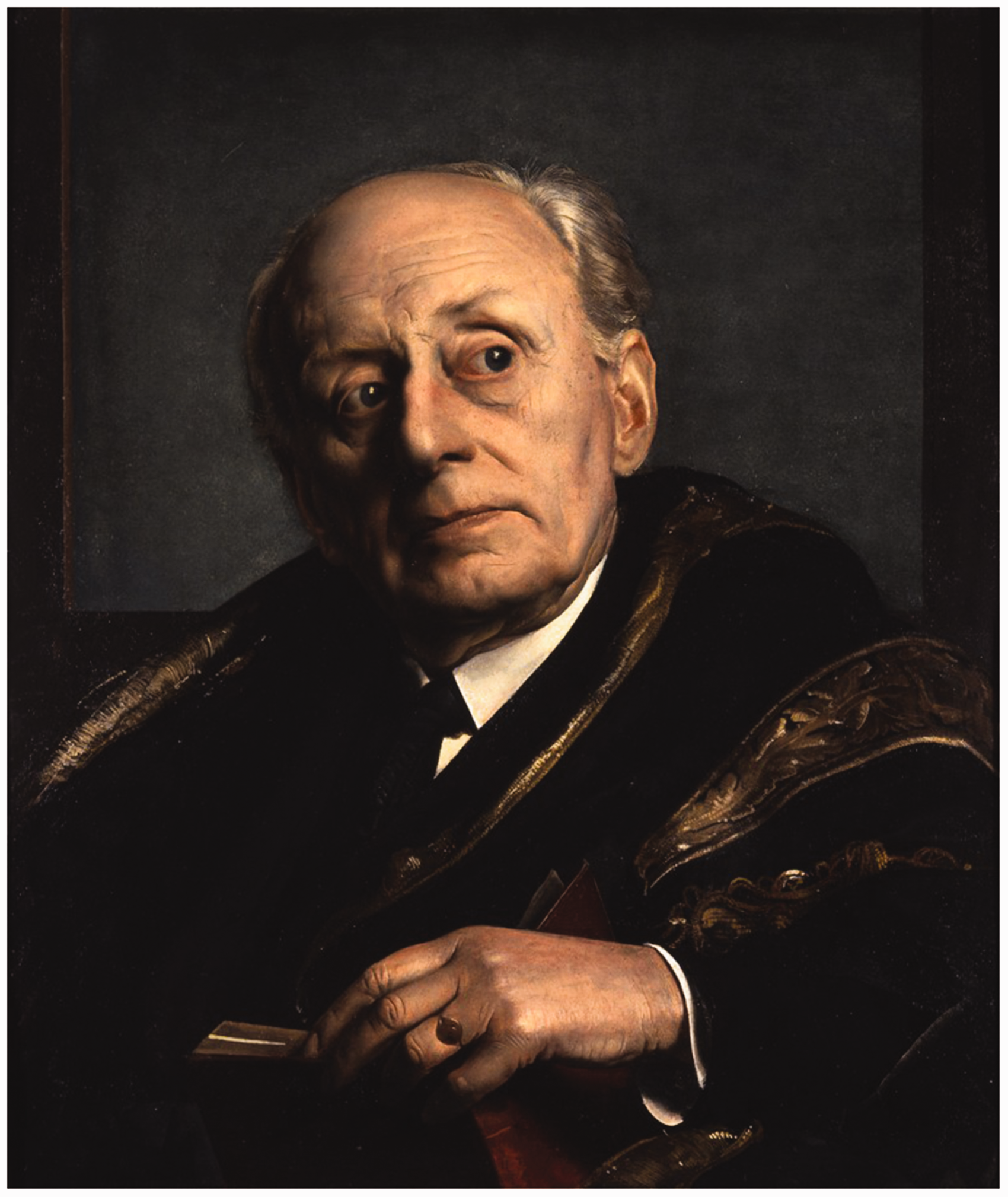
Brain
12
said, When I came to consider who should present Lord Moran with his portrait it was obvious that the ideal person would be Mr. Churchill. As a Fellow he could speak on behalf of Fellows and say better than any of us how much the College owes to the Past-President for his single-minded and devoted service through nine difficult and strenuous years. And he could also speak as a patient about his doctor … We share the whole nation’s debt to Lord Moran for his professional care of Mr. Churchill. Well, when I invited Mr. Churchill he said at once that he would come and we are all very grateful to him. Tonight we are honouring leadership, the nation’s leader and the leader of this College. A leader needs many virtues, but two pre-eminently – courage and imagination. The great leader is not a mere man of action: he is a man whose actions are informed by the sensibility of the artist. So in honouring Mr. Churchill we honour at the same time the statesman, the author and the artist, one whose words enliven our tongue and whose deeds will ever adorn our history. First of all I must thank you for according me an Honorary Fellowship of the Royal College of Physicians. I also had the honour to be made a surgeon eight years ago, and now I can practise, in an honorary fashion, the arts of surgery and medicine. Unless there is a very marked shortage of capable men in both these professions, I shall not press myself upon you. No doubt in these difficult times it will be a comfort not only to the profession but to the nation at large that you have me in reserve. Well, I know Charles Moran I would say almost as well as he knows me. He was for nine years President of your illustrious College. His war record is magnificent. In the first World War he won the MC and was mentioned in many dispatches and has Italian decorations all gained under the hard fire caused by the mistakes of our military experts in the first great struggle with which our generation has been afflicted. In the last war, Charles came with me wherever I went. That puts me in the position of the man who said one night, ‘I think my companion here ought to have the VC because he has been everywhere I have been.’ At any rate, we went for a good many long journeys by air at a time when the comforts of air travel had not been developed to the almost perfect state they have now … I am deeply indebted to him. … There are so many circumstances which contribute to the pleasure of my wife and myself. In the first place this is no common routine, for it has never been the custom of the College to have the portrait of every President painted. On the contrary, in the last fifty years only two Presidents have been hung on these walls. Again, when a whisper reached me what was afoot I wondered doubtfully whether there would be many subscribers … And yet more fellows have combined to make this gift, 364 in all, than were present at that record attendance [356 Fellows were present at the Comitia at which Brain was elected President in 1950]. Then, of course, it adds greatly to our delight that you have chosen to present this portrait on your behalf our most distinguished Fellow, Mr. Churchill …
12
Assessment by Moran, 11 October 1951
Churchill was assessed by Moran on 11 October. Churchill told Moran that he had a muzzy feeling in his head. ‘Oh, it’s nothing to do with alcohol; it comes on generally before luncheon. Aspirin helps it. If it’s due to circulation in my head, can’t you think out something, Charles, that would be more effective than aspirin?’ 5 Churchill went on, ‘I am not so sure as I was that I shall be able to see things through … I’m not afraid to die but I want to do this job properly.’ 5 Moran advised Churchill there was no treatment that would rejuvenate the circulation in his head. If Churchill wanted to stay the course, he must cut out things; he could not do everyone’s job as he had done in the war. 5
The Conservatives won the General Election on 25 October 1951 by 17 seats (Conservatives 321; Labour against 295; Liberals 6; others 3), and Churchill was again Prime Minister.
February 1952
On 6 February, King George VI died. When Colville
10
(Figure 2) went to the Prime Minister’s bedroom that morning, Churchill was sitting alone with tears in his eyes reading neither his official papers nor the newspapers. Colville
10
recorded that he had not realised how much the King meant to Churchill. Churchill summoned a cabinet that morning.
10
John Colville. © National Portrait Gallery (191323).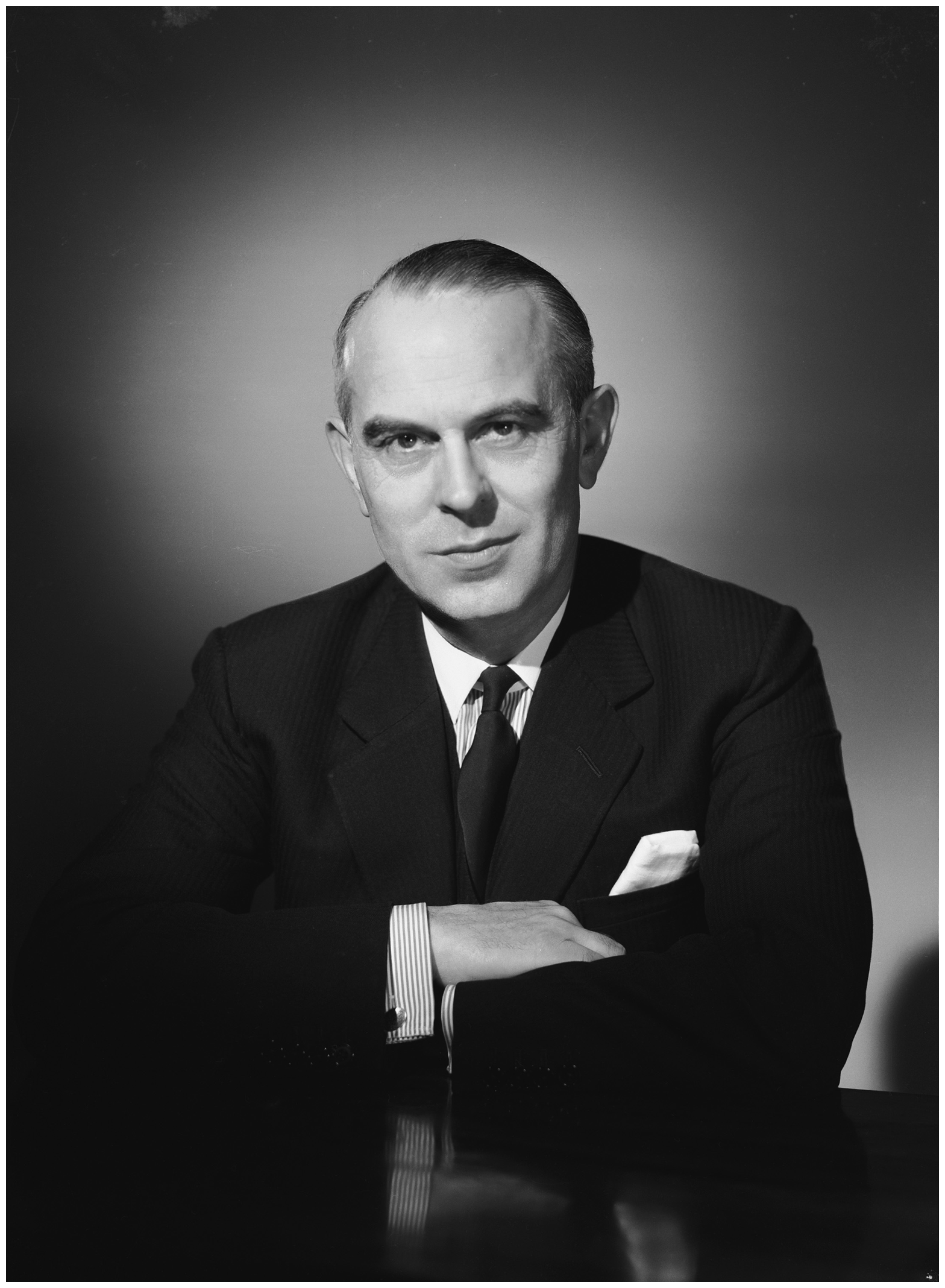
The King’s funeral was held at St George’s Windsor on 15 February. 10 Following the funeral, the postponed foreign affairs debate took place and Churchill ‘made a good but much interrupted speech, discrediting Attlee and Morrison and dumbfounding his attackers’. 10 The following week, Churchill gave a further speech in the defence debate which was followed by a ‘clever budget, slashing food subsidies but providing new incentives for hard work and overtime by lowering the bottom rates of income tax’. 10 All of this, Colville 10 considered, had been a severe strain on Churchill.
On the evening of 21 February, Moran received a telephone call inviting him to come to 28 Hyde Park Gate immediately.
4
On arrival, Moran discovered that this was the Cuban Embassy and Churchill had left earlier. Moran
4
proceeded to No. 10 (the Prime Minister’s residence) where he found Churchill sitting on his bed in his boiler suit. I am glad you have come. I took up the telephone when I woke an hour ago, and I couldn’t think of the words I wanted. Wrong words seemed to come into my head, but I was quite clear what was happening and did not say them. This went on for about three or four minutes. Then the operator asked, ‘Do you want the Private Office?’ What does it mean, Charles? Am I going to have a stroke? If this happened again I’d have to pull out. It might come on in a speech. That would be the end.
4
‘What shall I say if I run into Clemmie?’ Moran 4 asked. ‘Oh, come, we’ll go and tell her everything. She’s in bed with a cold’, responded Churchill. 4 Churchill told his wife what had happened; ‘she was grave but quite composed’. 4
Moran
4
recorded, I wanted to do a little hard thinking. In the past I have taken great risks when I let him carry on at Washington after the heart-attack [Churchill did not in fact suffer a heart attack
16
], and again at Monte Carlo, two and a half years ago, when he had a stroke (see Scadding and Vale
1
). But now something must be done.
Moran wrote that after he had slept on things there seemed only one course to take. If Churchill came safely through the next few days, he had got to square up to him after the Budget and persuade him to be sensible.
4
I don’t overrate my chances, but it is my job as his doctor. I think I know the turn of his mind as no one else does. I shall hate doing it, but it’s the only thing I can do for him.
4
Moran sought out Colville 10 on 22 February with the news that on the previous evening Churchill had suffered ‘a small arterial spasm’ which he considered might be the precursor of an immediate stroke; if not, it was at least a plain warning that if the pressure was not relaxed on Churchill, dire results would follow in six months or less. Moran 4 wanted political advice and so Colville 10 and Moran went to see Lord Salisbury (Lord President of the Council) two hours later. Moran 4 wrote that ‘… my first care must be not to put sharp weapons into the hands of anyone who might use them to hurt him [Churchill]’. 4 Moran 4 wanted to hear from someone in the Cabinet whether the duties of the Prime Minister could be cut, and he considered that Lord Salisbury was the most appropriate person to advise as ‘his complete detachment and single-mindedness, with his lack of personal ambition, give me a comfortable sense of security’. Colville 10 recalled Salisbury suggesting that Churchill might go to the Lords, leaving Eden (Foreign Secretary) to manage the Commons and thus Churchill would remain PM till after the Coronation in May 1953. Moran’s 4 account is that Salisbury said, ‘A Prime Minister cannot shed his responsibilities’.
Moran and Colville saw Sir Alan Lascelles, Private Secretary to the Sovereign, that afternoon at Buckingham Palace. Moran
4
began by admonishing Lascelles that if, when I had done, he felt that the P.M. ought to retire, he must forget what I had said; for if I could not help my patient I must see that nothing I said did him hurt. With that prelude I told my story. Well, listening to what you have told me, I would say at once the Prime Minister ought to resign and be content to be the elder statesman in the Commons or the Lords – better perhaps in the Lords. I have been expecting for some time to see you in this room. It is true that sometimes the Prime Minister is all on the spot, and then I say to myself: Why am I worrying? But at other times he doesn’t seem able to see the point of a discussion.
Moran
4
called on Churchill at Chartwell on 23 February. I did my stuff and was out of his room in five minutes. I knew he did not want to talk about what had happened, but I knew, too, that it was there at the back of his mind; he had been warned – and Winston is still quick enough to take his leads. He was subdued. I knew something had happened when I could not get my words on the telephone. I didn’t like it. I was frightened. Oh, not frightened … I’m not frightened of anything. But I’m all right now. Why, you couldn’t tell by examining me that anything had happened.
4
After Churchill had replied to Herbert Morrison’s speech (a vote of censure) on 26 February, he went to his room in the House, and Moran
4
joined him. Churchill told Moran
4
that, ‘I was alarmed at lunch-time; I seemed to have no wits, and I was very tired and shaky before getting up to speak, but I felt stronger as I got under way. Now I feel quite all right.’ As Gilbert
17
commented, On February 26 the powers of recuperation and the extraordinary determination of this man of seventy-seven were made abundantly clear to those who had known of his arterial spasm and discussed how to send him to the House of Lords. For it was only five days after the attack that Churchill spoke in the House of Commons on Foreign Affairs.
Moran called at No. 10 at about half-past five on 27 February, hoping to see Churchill before he retired for his rest. ‘I found him animated, very different from the subdued Winston whose future has never been out of my mind since the difficulty with the telephone.’ 4 Churchill explained, ‘You know, Charles, yesterday was a great success; the papers have been most kind.’ 4
Moran 4 next visited Churchill on 29 February after breakfast. Churchill said, ‘Since the speech I have felt better and more cheerful about things. During luncheon that day I was stupid, dull and muzzy, and I wondered if could make a speech at all. But we put them on their backs.’ 4 Moran enquired whether a long Cabinet tired him. ‘Oh, no, I get excited; my appetite thrives on what it feeds on. I get muzzy in the head about lunch-time, and then I get better as the day goes on.’ 4
March 1952
Moran called at No. 10 at nine on the morning of 6 March. Churchill was full of the debate in the House and told Moran,
4
You ought to read the papers. They are very interesting, if you like politics. The Bevan group sat all together in one part, and Attlee’s supporters were gathered together in another group. There they were, glowering at each other... The split might deepen and lead to a coalition. I should not be against it. I would retire if necessary.
Although on 1 March Churchill had handed over his Defence portfolio to Field Marshal Alexander, which would reduce his own workload considerably, it did not satisfy his doctor. Moran
4
wrote to Churchill on 12 March as follows: My dear Prime Minister, I have given careful thought to the significance of the little disturbance when you went to the telephone on February 21st. It was of the same nature as the sudden mistiness which you had within a fortnight of the Leeds speech in the 1950 election, namely due to spasm of the cerebral arteries. And these were first cousins of the blocking of a little artery at Monte Carlo in August, 1949. All three point to some instability in the cerebral circulation, which must be increased by excessive mental effort. On the other hand if it were possible to lighten the load without giving up being Prime Minister, which on medical grounds would not be wise at the moment, then you ought to be able to carry on more or less indefinitely. Of course if you would like confirmation of my interpretation of events, we could get Russell Brain at any time, but they are really capable of no other explanation. If there is any point that I have not made clear, I will of course come at any time you want. I feel sure that you would like the medical facts put down for your consideration. When I saw Clemmie about your deafness I told her my view. Charles. … was not angry when he got your letter; he just swept it aside. I mentioned the Lords, but he would not consider it. Charles, I’m glad you wrote. It may do good. Instead of going to the House this afternoon and listening to Mr. Thorneycroft [President of the Board of Trade], he has gone to bed.
On 23 March at 4 o’clock, Moran visited Churchill as he was about to lie down for his afternoon rest but the Prime Minister invited Moran to come to his room. As Churchill undressed, he said to Moran, ‘I have noticed a decline in mental and physical vigour. I require more prodding to mental effort.’ He smiled. I get a good deal of prodding. I forget names. I might even forget yours – people whose names I know as well as my own. I’m as quick at repartee in the House as ever I was. I enjoy Questions there. Do you think I ought to see Brain?
4
I’m halfway in my seventy-eighth year, and one can’t expect to live for ever. I really don’t think you need worry. I soon get tired physically; when I have fed the robin and the swans, and perhaps walked three-quarters of a mile, I have had enough. I dislike standing, except when making speeches.
4
Churchill’s doctors
Lord Moran (1882–1977)
Charles Wilson was appointed Dean of St Mary’s Medical School in 1920, a post he held until 1945. He became Churchill’s doctor on 24 May 1940 (two weeks into Churchill’s first term as Prime Minister) and remained his personal physician until Churchill’s death in 1965. 18 He accompanied Churchill on a number of overseas trips. For example, he treated Churchill for chest pain in December 1941 in Washington, 16 for pneumonia in London in February 1943, 19 for pneumonia and atrial fibrillation in Carthage in December 1943, 20 and for pneumonia in London in August 1944. 19 Moran was also summoned to Monte Carlo in 1949 when Churchill suffered his first stroke. 1
Wilson was knighted in 1938, created Baron Moran of Manton in the County of Wiltshire in 1943, and was appointed Treasurer (1938–1941) then President of the Royal College of Physicians of London (1941–1950). 18
Sir Russell Brain (1895–1966)
Russell Brain (Figure 3) was a consultant physician at the (then) London Hospital and the Maida Vale Hospital for nervous diseases. Brain earned his living primarily from his private practice in Harley Street as a consultant neurologist, and as the author of Diseases of the Nervous System, Clinical Neurology, and other medical and non-medical books.
6
He was the editor of the neurological journal, Brain, from 1954 until his death in December 1966. Brain was President of the Royal College of Physicians from 1950 to 1957, succeeding Moran on 3 April 1950.21,22 Brain had assessed Churchill previously at Moran’s request on 5 October 1949, 15 October 1949, and 8 December 1949.
1
Sir Russell Brain. © National Portrait Gallery (164682).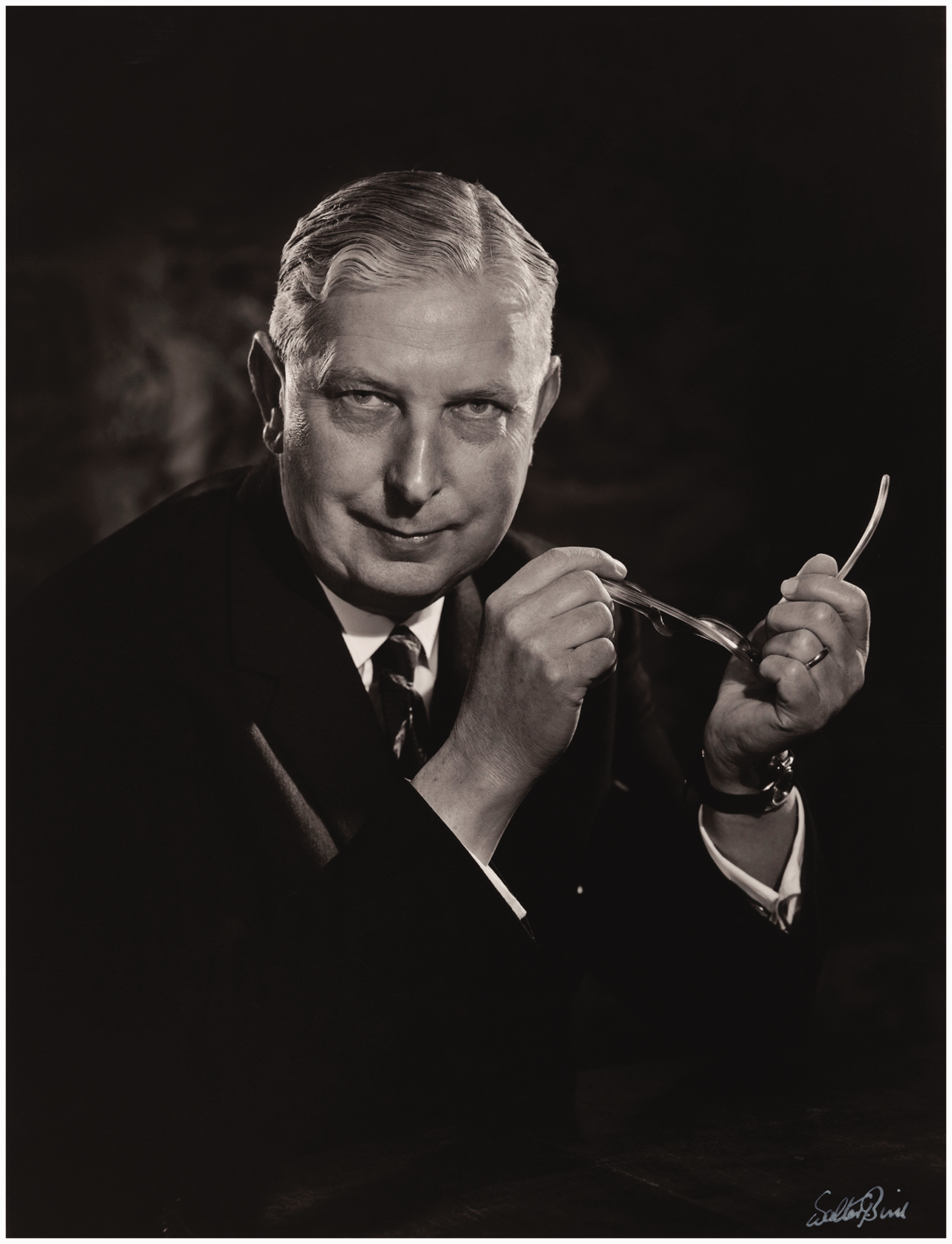
Brain was knighted in 1952, made a baronet on 29 June 1954, and on 26 January 1962 was created Baron Brain of Eynsham in the County of Oxford. In March 1964, he was elected a Fellow of the Royal Society.
Discussion
In the period January 1950–March 1952, covered by this paper, Churchill suffered two definite acute cerebrovascular episodes and reported intermittent symptoms indicative of cognitive deficit, though without obvious acute onset. In the first of the two acute episodes, occurring on 24 January 1950, Churchill’s description of his symptoms indicates either a visual problem (‘… everything went misty’) or perhaps less likely, a dyslexic deficit (‘I could just read with difficulty’). No examination findings were recorded by Moran, but the symptoms were apparently transient. On balance, it seems most likely that this was a transient ischaemic episode affecting either part of the visual radiation or the visual cortex, but without further details of exactly what Churchill meant when describing the symptom, this remains speculative. It is worth noting that Churchill was not seen by Brain in the immediate aftermath of this episode.
Brain was summoned by Moran in May 1950, at a time when Churchill reported increased tightness over his shoulders. Brain felt that his symptoms had not changed and a neurological examination was normal. Churchill was concerned about further strokes, but these bilateral symptoms at this time seem more likely to have had a musculoskeletal basis.
It is worth noting that Churchill’s speech at the Royal College of Physicians on 10 July 1951, accepting his Honorary Fellowship of the College, was amusing, witty and entirely appropriate, and demonstrated no impairment of language function or any other cognitive problem. It was vintage Churchill.
It is difficult to place an interpretation on the nature of Churchill’s complaint of a ‘muzzy head’ in October 1950, and the same complaint reported much later to Moran on 29 February 1952. From the information available now, it is not clear whether this symptom occurred on a daily basis or whether Churchill experienced it for days, weeks or possibly longer. Without the benefit of further documentation, one could speculate that this might have been a symptom of cognitive decline, but equally that it was non-specific. Support for the latter view is that the symptom was transient and stereotyped in its timing and duration, occurring recurrently at about lunchtime, and then resolving later in the day.
On 21 February 1952, it is clear that Churchill experienced an episode of expressive dysphasia lasting 3–4 min. This was due to left hemisphere ischaemia, most likely cortical in location with a thromboembolic basis. Moran’s explanation of the underlying pathology being likely to be arterial spasm would not be today’s preferred view. No mention is made of Churchill’s cardiac rhythm or blood pressure at the time of the transient neurological disturbances occurring on 24 January 1950 and 21 February 1952, and we should therefore assume that both were normal. Cerebral haemorrhage is a much less likely pathological basis for these mild transient neurological symptoms. Brain had examined Churchill in May 1950, some four months following the earlier transient ischaemic attack in January 1950, and did not remark specifically on the presence or absence of a carotid bruit, but as a famously meticulous and thorough clinician he would almost certainly have made this examination. It should be remembered that imaging of the carotid bifurcation with ultrasound was still some years away.
It is of interest that Brain was not invited by Moran to see Churchill between 25 May 1950 and 24 June 1953, and specifically, not at the time of the transient episode of dysphasia in February 1952 described here. As with the delayed involvement of Brain by Moran following the stroke in 1949, 1 it reflects the limited investigation of stroke possible and accepted clinical practice at the time.
Thus, by February 1952, Churchill had suffered a small completed stroke (the first, right-sided hemisensory disturbance in 1949) and two transient ischaemic attacks. One of the transient ischaemic attacks affected the circulation to the left cerebral hemisphere, but the localisation of the episode of ‘misty’ vision is uncertain.
In February 1952, Churchill remarked to Moran that ‘I keep having to make important decisions, terrible decisions. It never stops. It is worse than the war.’ It is a matter for speculation that Churchill was finding things more difficult either because he was by then some 10 years older, or that he had thrived particularly as a wartime prime minister, or that his cerebrovascular disease was already more widespread than was clinically obvious by that time; or perhaps a combination of all of these.
Although the episode of dysphasia on 21 February 1952 appeared to last only 3–4 min and resolve completely, Lascelles noted ‘… at other times he doesn’t seem able to see the point of a discussion’. Furthermore, Churchill told Moran 4 on 23 March 1952 that he had noticed ‘a decline in mental vigour … I forget names’.
Taken together, the evidence indicates that Churchill had acquired some permanent and increasing neurological deficit due to cerebrovascular disease between 1949 and March 1952. The fact that he was able to continue in public and political life at the highest level of functioning is a tribute to his remarkable pre-morbid abilities and what might be identified as considerable cognitive reserve, even in the face of advancing cerebrovascular disease.