




Abstract
Hiam et al.’s recent article in your journal drew widespread attention for its perspective on mortality in England and Wales in recent years.
1
In the opening paragraph of results, the paper states that: ‘
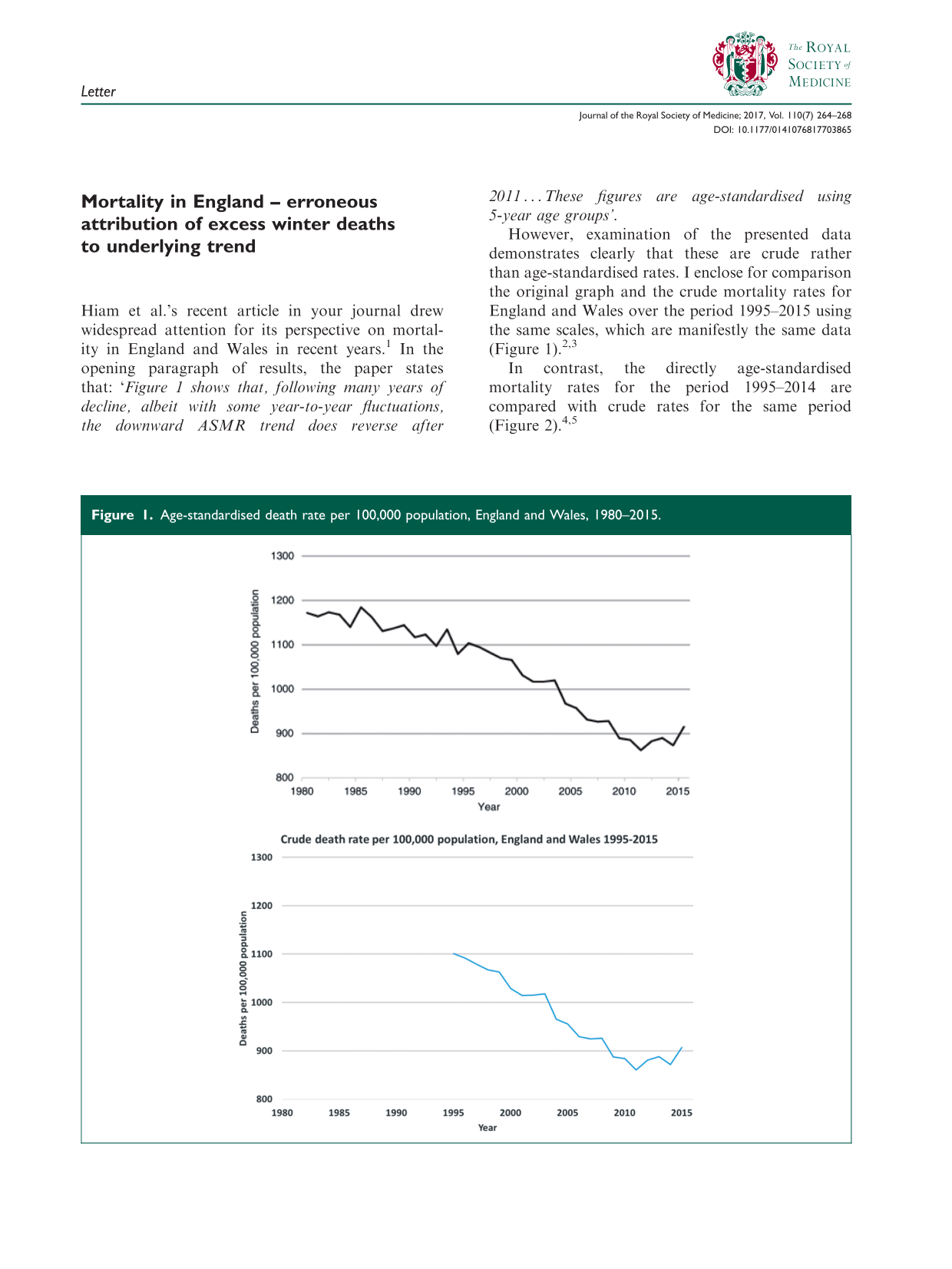
Figure 1
shows that, following many years of decline, albeit with some year-to-year fluctuations, the downward ASMR trend does reverse after 2011 … These figures are age-standardised using 5-year age groups’.
Age-standardised death rate per 100,000 population, England and Wales, 1980–2015.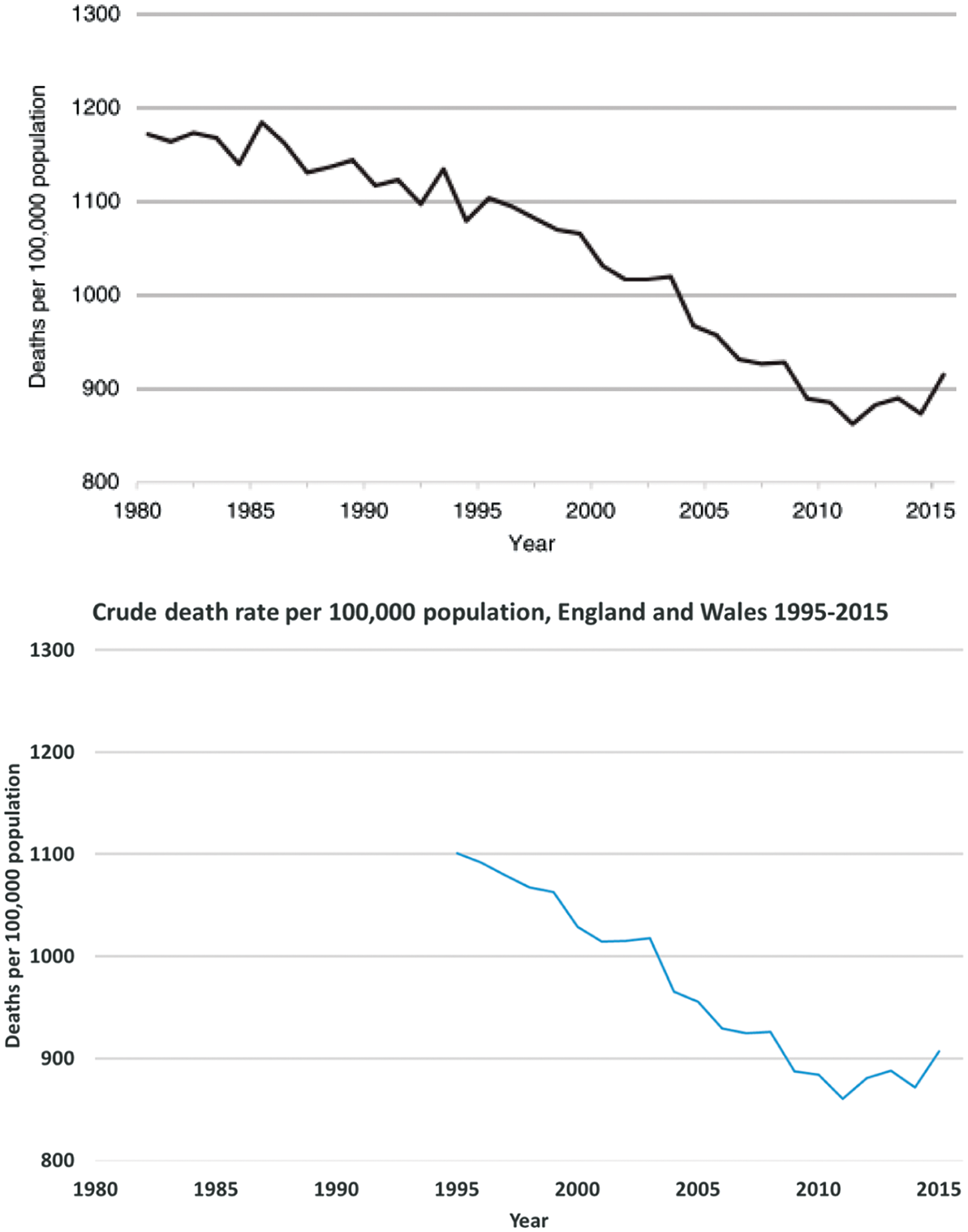
However, examination of the presented data demonstrates clearly that these are crude rather than age-standardised rates. I enclose for comparison the original graph and the crude mortality rates for England and Wales over the period 1995–2015 using the same scales, which are manifestly the same data (Figure 1).2,3
In contrast, the directly age-standardised mortality rates for the period 1995–2014 are compared with crude rates for the same period (Figure 2).4,5
Directly standardised mortality rate per 100,000 population, England and Wales 1995–2015 compared with crude mortality rate for the same period.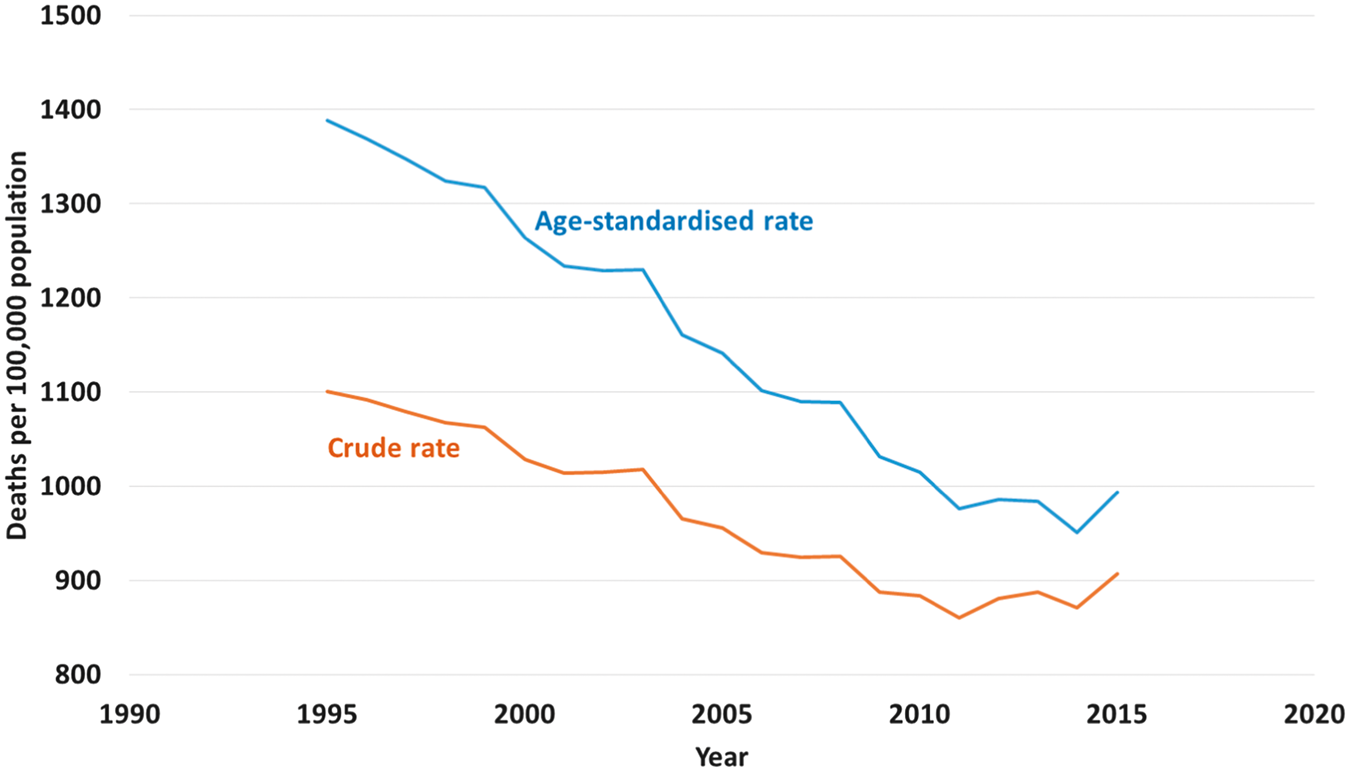
The argument that mortality rates reversed after 2011 is less persuasive when considered in the light of direct age-standardisation, and the visual appearance of a rise is heavily dependent upon the 2015 data point.
The paper also states that: ‘[Age-standardised mortality rate] … by 2015 … was higher than in any year since 2008 and was 4.8% higher than in 2014 and 2.8% higher than in 2013 … These figures are age-standardised using 5-year age groups’.
In fact, the quoted figures are only correct when comparing crude rates for England and Wales. The directly standardised rate for England and Wales was actually higher in every year up to and including 2010 – the 2015 rate was 4.5% higher than 2014 and 1% higher than 2013.
The excess of winter deaths in 2014–2015 – which hit a high of 43,850 for England in Wales in comparison to 17,310 in 2013–2014 – fell in 2015–2016 to 24,300, a figure lower than the average of the preceding 10 years. 6 This suggests that although the 2015 age-standardised mortality was certainly high when compared to trend, it will be very much closer to trend for 2016 data when they become available.
England and Wales, age-specific deaths, population estimates, rates and percentage increase 2014–2015.
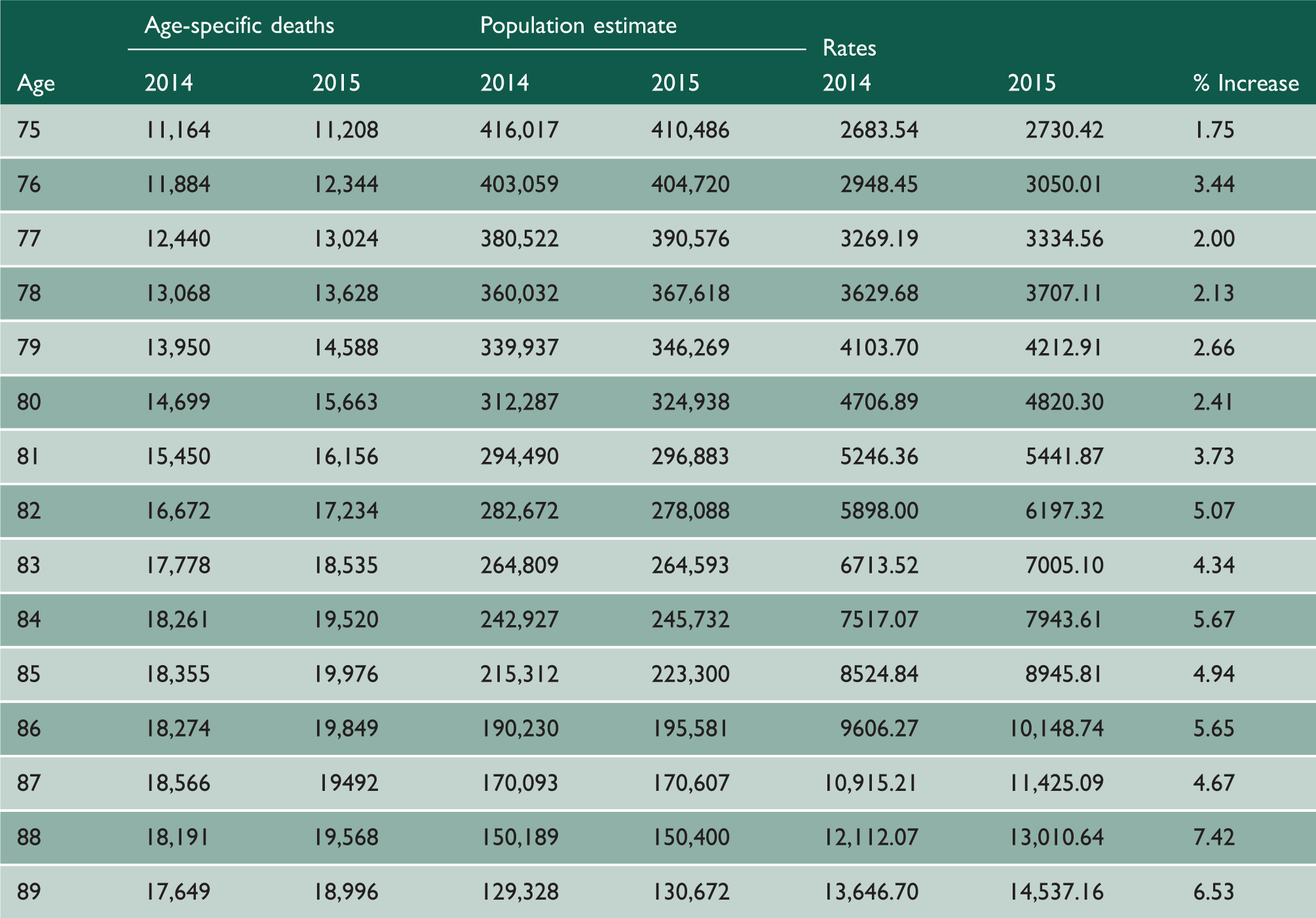
All data are for persons in England and Wales.
By applying the derived 2014 rates to 2015 population estimates, I find a figure for excess deaths of 21,231 for all ages, or 20,359 for ages 75 and over. In both instances, the 90+ deaths are aggregated and expressed as a rate using the 90+ population estimates as a denominator. This excess of deaths would be close to that reported for the high 2014–2015 excess winter deaths figure cited above, but falls considerably short of the 33,798 quoted in the paper.
Hiam et al.’s paper was widely reported in the press, but the data presented were incorrectly described, and the apparent rise since 2011 that they illustrate appears to have been over-interpreted.