




Abstract

One hundred years ago, from October 1915 to April 1916, Sir Ernest Shackleton and his men were forced to camp on ice floes in the Weddell Sea after the Endurance was crushed and sank. After escaping from the ice in three small open boats, the crew of the Endurance spent six months living under two of the boats on Elephant Island, while Sir Ernest with five companions sailed 800 miles in the third, and made the first crossing of the mountains and glaciers of South Georgia.
1
Frank Hurley (L) and Sir Ernest Shackleton on an ice-floe in the Weddell Sea. Image provided by the Scott Polar Research Institute, University of Cambridge.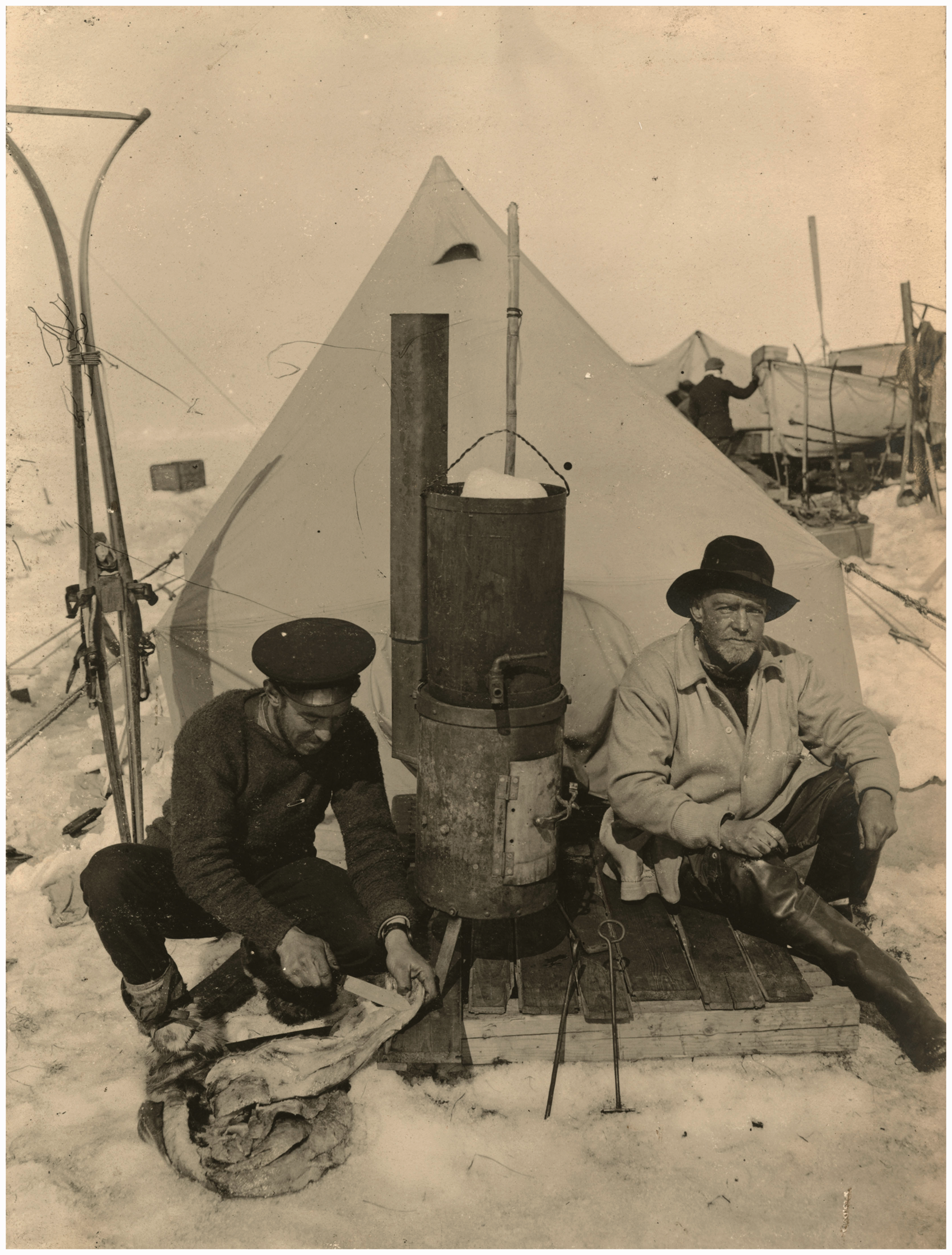
The Endurance expedition was the third of four expeditions towards Antarctica undertaken by Sir Ernest between 1901 and 1922 and was the only one during which he did not suffer a physical breakdown. We believe that his breakdowns were the result of a congenital cardiac defect.
The evidence rests mainly on diary entries made by Dr Eric Marshall, the medical officer on Shackleton’s second expedition to the Antarctic (1907–1909) in the Nimrod. On 20 January 1908, Dr Marshall wrote in his diary ‘Heard S was very unwell after pulling on a rope. Will not hold myself responsible until he allows me to examine him. Something wrong?’. 2 As medical officer, Dr Marshall was able to insist on an examination and on two occasions found a ‘pulmonary systolic murmur’. 3 Shackleton, Marshall, Wild and Adams sledged south, discovered the Beardmore Glacier and the Polar plateau, but realising they would perish from starvation if they carried on, turned back when about 100 miles from the Pole. Back on the Beardmore, some 380 miles from base, Dr Marshall wrote ‘Shacks collapsed after dinner tonight’, and the next day ‘Sh very unwell, walked by the sledge all day – Midday-Pulse on march thin & thready, irregular about 120’. 4 However, Shackleton recovered within a few days, and was one of the strongest of the party by the end of the journey, performing a forced march of thirty miles with Frank Wild to prevent the Nimrod leaving without them. 5
As well as the two episodes recorded by Dr Marshall, Sir Ernest suffered a breakdown in 1903, during his first Antarctic expedition in the Discovery. He was unable to pull the sledge, due to breathlessness and weakness, towards the end of a sledge journey southwards with Robert Scott and Edward Wilson. 6 Shackleton’s collapse was attributed to scurvy and ‘a sort of asthma’, 7 and he was invalided home against his will. Dr James McIlroy, medical officer on Shackleton’s third and fourth expeditions, told of two other incidents, one in 1919, during an expedition to Spitzbergen ‘ – when he [Shackleton] changed colour very badly – he had a very bad bout that time but he wouldn’t undress and let me listen to his heart’, and a similar episode in 1922 on Shackleton’s last expedition. 8
In our opinion, Sir Ernest’s history of acute attacks of breathlessness, weakness and colour change, and Dr Marshall’s findings of a murmur and an irregular pulse suggest episodes of a paroxysmal dysrhythmia and an underlying cardiac abnormality. A pulmonary systolic murmur is consistent with an ostium secundum atrial septal defect (ASD), and ASDs, if not closed, can present in early adulthood with episodes of breathlessness and weakness, due to paroxysmal atrial dysrhythmias. Shackleton was 28 years old at the time of his breakdown during the Discovery expedition.
Sir Ernest died at the age of 47 years, a few hours after arriving in Grytviken, South Georgia at the start of his fourth expedition in 1922. He complained of severe facial and back pain, unrelieved by aspirin, before suffering a terminal ‘severe paroxysm’. 9 Dr Alexander Macklin opened Sir Ernest’s chest to perform an embalming procedure by injecting formalin into the aorta, and wrote that he was able to see the heart, but no further pathological examination was feasible. Nevertheless, Dr Macklin was certain that the cause of death was ‘angina pectoris’ due to ‘pretty extensive atheroma of the coronary arteries’, 10 and this seems likely to be correct, since Shackleton was a heavy cigarette smoker for most of his life, and the symptoms sound ischaemic. 11 It is possible that the onset of a dysrhythmia may have contributed.
Dr Marshall and Dr McIlroy both mentioned that Sir Ernest did not want to allow an examination of his heart, and this seems to have been his usual attitude; indeed Roland Huntford claims that Shackleton contrived to avoid a medical before the Discovery expedition, 7 and wrote that ‘it was as if the one fear he knew was what might be discovered in his heart’. 12 Dr McIlroy alleged that Shackleton’s wife insisted he consult a heart specialist before undertaking his second expedition, because of his Discovery breakdown. However, according to Dr McIlroy ‘ – he went to see this specialist, but I think he examined the specialist instead of the specialist examining him! I know the fellow never got a chance of listening to his heart. He paid his five guineas, and out he came’. 8
Sir Ernest’s reluctance to be examined suggests that he was aware of his murmur; his father was a doctor. 13 Shackleton had to finance his expeditions by ‘hanging round the doors of rich men’, 14 a difficult task, and probably an impossible one had he allowed the possibility of a cardiac condition to be discussed.
Previous authors have wondered what was the matter with Shackleton. Dr Isobel Williams wrote ‘It is unclear what precisely the problem was’, 15 and Christopher Ralling suggested that there might be a connection between Sir Ernest’s heart murmur and his breakdown in 1903, but did not explain what that connection might be nor mention any of the other recorded breakdowns. 16 We believe that the evidence supports our contention that Shackleton’s repeated breakdowns were caused by dysrhythmias associated with an ASD.
Shackleton’s breakdowns during the southern journeys on his first and second expeditions were serious threats to his and his companions’ survival, but this did not deter him from leading two more expeditions. Some may feel that Sir Ernest was irresponsible in undertaking the leadership of Antarctic expeditions if he suspected a problem, but to paraphrase Dr Johnson, there is seldom a shortage of prudent people, while the great things are done by those who are prepared to take a risk. 17 Few would deny that the quality of Shackleton’s leadership during his third expedition 100 years ago was crucial to the survival of the party and remains an inspiration and example for generations to come.