




Abstract
Objectives
Norovirus infections pose great economic and disease burden to health systems around the world. This study quantifies the investments in norovirus research awarded to UK institutions over a 14-year time period.
Design
A systematic analysis of public and philanthropic infectious disease research investments awarded to UK institutions between 1997 and 2010.
Participants
None
Setting
UK institutions carrying out infectious disease research.
Main outcome measures
Total funding for infectious disease research, total funding for norovirus research, position of norovirus research along the R&D value chain.
Results
The total dataset consisted of 6165 studies with sum funding of £2.6 billion. Twelve norovirus studies were identified with a total funding of £5.1 million, 0.2% of the total dataset. Of these, eight were categorized as pre-clinical, three as intervention studies and one as implementation research. Median funding was £200,620.
Conclusions
Research funding for norovirus infections in the UK appears to be unacceptably low, given the burden of disease and disability produced by these infections. There is a clear need for new research initiatives along the R&D value chain: from pre-clinical through to implementation research, including trials to assess cost-effectiveness of infection control policies as well as clinical, public health and environmental interventions in hospitals, congregate settings and in the community.
Introduction
Norovirus is reportedly the most common enteric pathogen and a major cause of short-term illness in the UK. 1 Although norovirus infections, which cause vomiting and diarrhoea, are short-term and mostly self-limiting with symptoms that typically resolve within three or four days, they create much burden on the National Health System (NHS) in the UK. With a low infectious dose and short-lived immunity, faecal–oral transmission of norovirus is common. Outbreaks of norovirus infections, which can occur in almost any environment, including congregate settings such as hospital wards, cruise ships, schools and prisons, and typically occur during the winter months, are particularly difficult for healthcare services to deal with and may attract much media attention. Oysters are the vehicle for approximately 85% of norovirus (or suspected norovirus) outbreaks related to food. 1
Outbreaks in England are reported through the Hospital Outbreak Reporting Scheme and collated by Public Health England. Norovirus has been reported as being the most common enteric pathogen in the UK, with an incidence rate of 47 community cases per 1000 person-years and 2.1 general practitioner consultations per 1000 person-years, 2 though the annual incidence of norovirus is unpredictable. For example, there was a 39% reduction in reported norovirus outbreaks for the July 2010 to June 2011 season compared with the previous season (with a similar pattern in the laboratory reporting). 1 However, across the winter of 2012–2013, the number of reported norovirus infections increased compared to 2011–2012 figures, owing in part to a novel dominant circulating strain and an earlier start to the norovirus ‘season’. 3
In the UK national media, there has been wide coverage of these outbreaks which led to closure of hospital wards in the UK. 4 There has also been wide UK media coverage of the increased incidence of norovirus infections in the United States of America (USA). 5 The economic burden on the NHS of norovirus infections is significant, with an estimated cost to the NHS of around £100 million each year. 6
According to the 2010 Global Burden of Disease Study, diarrhoeal illnesses account for the fourth greatest disease burden globally (as measured in disability-adjusted life-years) across all communicable and non-communicable diseases. 7 However, there are no global estimates specifically on the disease burden of norovirus. This is thought to be for several reasons, including the difficult detection of the virus owing to an inability for propagation in cell culture, local genetic variations that complicates the use of commonly employed detection assays, limited reporting to health officials because of the acute and short-lasting nature of the disease, and a lack of standardization of diagnostic and surveillance programmes between countries. 8
Reports from the surveillance systems of selected countries suggest that norovirus is likely to be high burden worldwide. There are an estimated 20.9 million cases annually in the USA. 9 In Australia, norovirus infections were considered to be responsible for almost 80% of the non-foodborne outbreaks where the pathogen could be identified. 10 There are indications that the pathogens responsible for acute infectious diarrhoea can be responsible for the development of chronic gastrointestinal disorders. 11
We report here the research investments awarded to UK institutions on norovirus research, as part of the Research Investments in Global Health (ResIn) project. 12
Methods
The UK research institutions have been awarded around £2.6 billion of public and charitable funds to carry out infectious disease research over the 14-year period from 1997 to 2010. 13 For the original study, we systematically collated and analysed data on research awards from all the major funders of biomedical research, including the Medical Research Council, Wellcome Trust, Department of Health (and the National Institute of Health Research), other government departments, Bill and Melinda Gates Foundation, the European Commission and other charities that fund research. We included in our analysis all studies related to human infectious disease (including zoonoses), where the funding was awarded to a UK institution between 1997 and 2010. The final dataset contained information on 6170 studies, and these were categorized by several disease areas, themes and specific pathogens, and by type of science along the R&D value chain (pre-clinical, phase I–III trials, phase IV and intervention studies, implementation and operational research). No private sector funding was included in this analysis as the publicly available data are very limited from these sources and were considered to be under-representative. We excluded unfunded studies. We also excluded studies where funding was awarded to a non-UK institution that had UK partners. Analysis was carried out in Microsoft Excel and Access (versions 2000 and 2007) and Stata (version 11).
Results
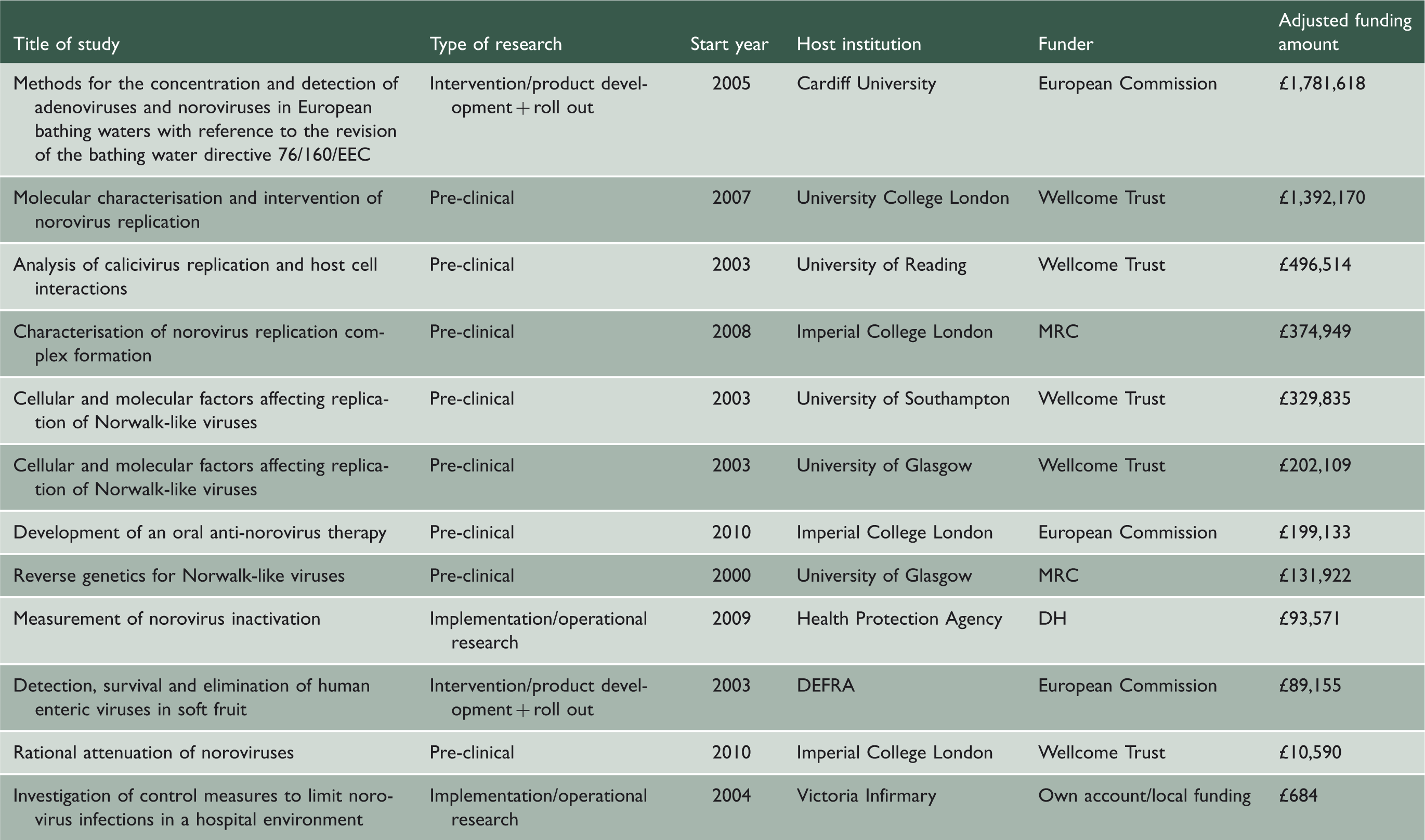
We identified just 12 infectious disease studies that were specifically related to norovirus research (Table 1), of which eight were categorized as pre-clinical, three as intervention studies and one as implementation research. The total funding for these 12 studies was £5.1 million (0.2% of total funding for infectious disease research in the study period), with mean funding per study of £425,188 (standard deviation £568372) and median funding of £200,620 (inter-quartile range £91362-435731). Nine studies were university-led (three by Imperial College London), one small study was led by a National Health Service Hospital Trust in England (with funding of just £684) and two were led by the Health Protection Agency (HPA, now Public Health England) and the Department for Environment, Food and Rural Affairs. The Wellcome Trust funded five studies (total investment of £2.4 million), European Commission three studies (£2.1 million), the MRC two studies (£506,871) and the Department of Health one study (£93,570). The funding source for the final study, which received £684 for a nosocomial hospital-based study, was identified as coming from the researchers undertaking the study or another local source. There is no clear temporal trend in awards (Figure 1).
Breakdown of investment in norovirus research by funder over time. Funding for studies related to norovirus research (1997–2010).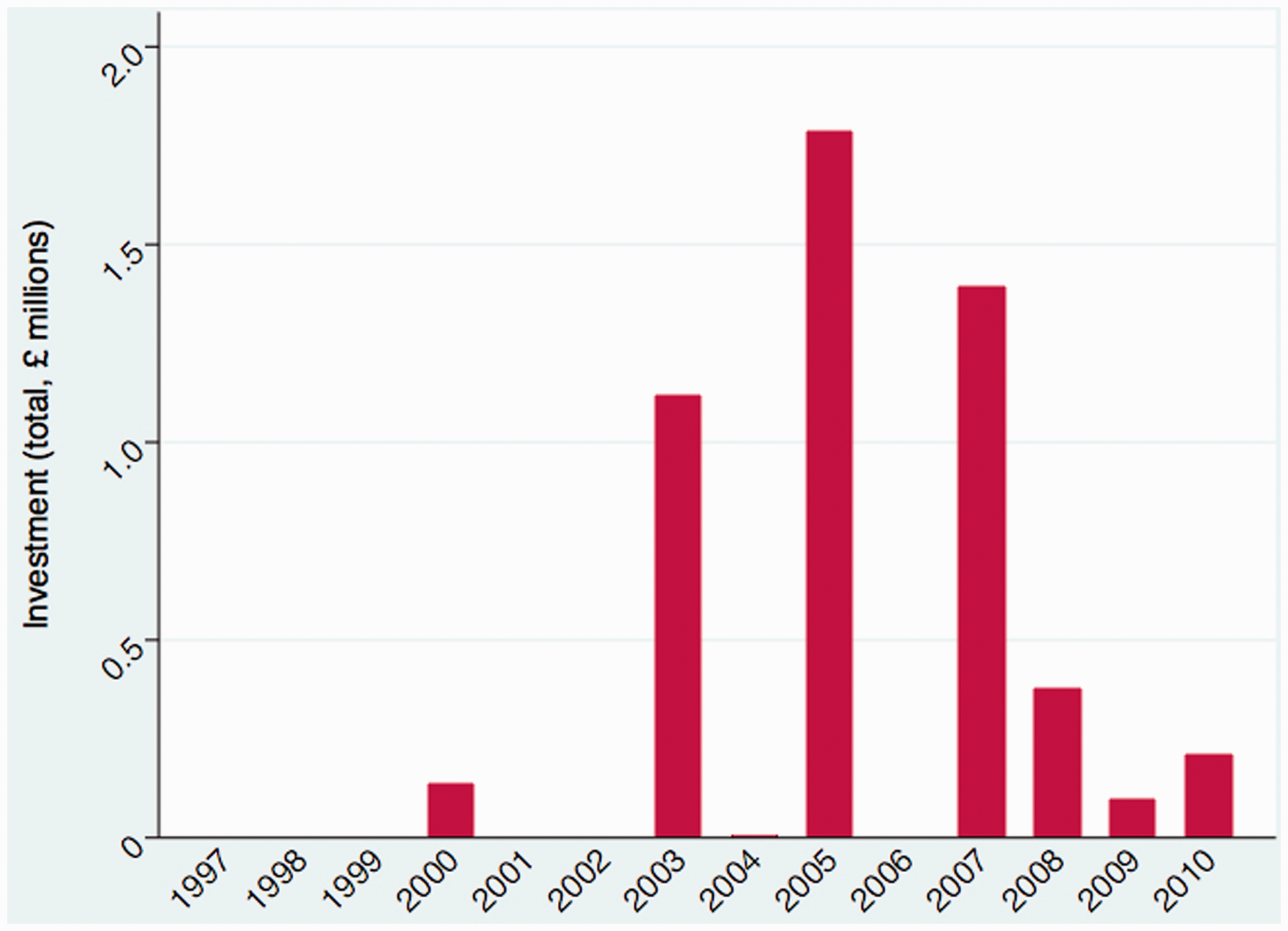
By comparison, over the study period, other enteric pathogens received far greater levels of investment, such as Salmonella (145 studies, total investments of £55.7 million) and Campylobacter (87 studies, £24.1 million). Investment for rotavirus-related research was £5.8 million across 18 studies.
The US National Institutes of Health has an online searchable database that documents their research investments. We searched this Reporter database, using ‘norovirus’ as a keyword for studies funded between 1997 and 2013. 14 The database query used this keyword to search project titles, abstracts and project terms associated with the studies. This search produced 275 awards with total investment of $127 million (mean funding per study $460,130, median funding $282,151, average total annual funding $7.4 million). All the identified studies were awarded to US-based institutions. We did not systematically categorize the quantity of each type of research that may be included along each part of the R&D value chain.
Discussion
Statement of principal findings
This study investigated norovirus research investments awarded to UK institutions between 1997 and 2010. Twelve norovirus studies were identified with a total funding of £5.1 million, 0.2% of the total dataset of all infectious disease research (6165 studies, sum funding of £2.6 billion). Of these, eight were categorized as pre-clinical, three as intervention studies and one as implementation research. Median funding was £200,620. This appears to be unacceptably low, given the burden of disease and disability of norovirus infections, and there a clear need for new research initiatives and prioritising by the funders.
Strengths and weaknesses of the study
Our analysis systematically describes infectious disease research funding awarded to UK institutions and specifically here the investments in norovirus research, and this is the first time such an analysis has been carried out in the UK. Mapping the funding landscape in this manner can allow funders and policymakers to learn how best to invest their limited resources in order to lead to optimal outputs and health outcomes both in the UK and globally. It promotes transparency and can help to reduce duplication of investments between local and international funders.
Our study has several limitations, which are discussed more fully elsewhere. 13 These include a lack of private sector funding, which has particular implications in areas such as vaccine development and diagnostics. Another limitation arises because it is difficult to assess associations with other areas of research that are not directly about norovirus, but which nonetheless have an impact, such as preventive measures relating to enteric diseases generally. We rely on the original data being accurate, no attempt was made to investigate any contribution of indirect and estate costs (including the introduction of full economic costing formulae in the UK), and we do not know how much money was forwarded to any collaborating partners. Creation of disease categories and allocation of studies to the categories is subjective.
Strengths and weaknesses in relation to other studies, discussing particularly any differences in results
There is no systematic analysis available globally for norovirus research, and thus we cannot undertake an international comparison. The G-FINDER 15 analysis by Policy Cures collect research data on neglected diseases, but this does not include norovirus.
Meaning of the study: possible implications for clinicians or policymakers
Institutions funding infectious disease research have not explicitly prioritized norovirus-related studies. There are challenges to pre-clinical norovirus-related research due to a lack of animal models and lack of a cell culture system. 8 Consequently, the knowledge relating to the pathogenesis of existing and emerging strains with increased virulence is limited. It appears as though the US National Institute for Health has made proportionately greater investment in norovirus than that received by UK institutions. This highlights how information on global funding of norovirus-related research is critical in order to identify funding gaps, better prioritise funding, and to help identify countries and institutions with strengths in norovirus-related research in pre-clinical work, clinical trials, intervention studies or operational research.
Unanswered questions and future research
Research investment is needed to develop new techniques for pre-clinical research and to employ recent technological advances in studies of viruses, including in gene sequencing. Furthermore, research funding is needed for intervention studies and implementation research to identify which infection control policies and clinical interventions as well as public health and environmental measures help to effectively address norovirus outbreaks. Global incidence and prevalence data are needed to better estimate the burden of disease and disability due to norovirus so that pathogen specific burden estimates can be developed by the Global Burden of Disease studies.
Conclusions
Research funding for norovirus infections appears to be unacceptably low, given the burden of disease and disability produced by these infections. There is a clear need for new research initiatives along the R&D value chain: from pre-clinical through to implementation research, including trials to assess cost-effectiveness of infection control policies as well as clinical, public health and environmental interventions in hospitals, congregate settings and in the community. Investment is needed to develop animal models and diagnostics tests to better characterise norovirus strains and investment in surveillance to better estimate disease burden in order to better target and prioritise future research funding.