




Abstract
If clinicians are to play a leading role in reducing risks to the fetus, they have to think outside the box. Improved pregnancy outcomes require that medical and health professionals, including midwives and nurses, work with others far beyond the confines of the antenatal clinic and the delivery room. For the WHO-estimated 200 million plus conceptions globally each year, 1 mostly among disadvantaged groups in disadvantaged (at-risk) areas, the first nine months of life are vulnerable to risks. These risks are not just medical, but also employment, agricultural, security, energy and climate risks. Improving care to reduce these varied risks to the fetus inside the womb challenges us to accept a very broad concept of integrated health 2 – drawing from expertise far outside the traditional medical specialties.
It is important to grasp this challenge. David Barker et al. 3 suggest that it is the creation of resilience (the ability to recover quickly from illness, change or misfortune) in the fetus while inside the womb, that prepares everyone, particularly those living and working in deprived and food insecure conditions, to face the vicissitudes and stresses of later life outside the womb. On the one hand, nutritional and hormonal factors may create resilience in the womb. On the other, social and environmental risks and hazards (whether from the husband’s job loss, an earthquake or from the sedative, thalidomide), affecting the mother-baby dyad during pregnancy, may reduce the resilience of the child in the next stages of life’s journey.
There is a definitional oversight in which the life of the child is inadvertently cut into two: the fetus or the ‘child inside’ and the ‘child outside’ the womb. This segmented definition should be replaced by a new inclusive way of thinking about ‘the unborn child’. The world has to be reminded that traditionally birth, or bher, as in child – ‘bearing’, began from the time of conception, when a mother bears a new life – a life at considerable risk.
Obstetric and gynaecological care for the fetus at risk inside the womb has considerable prospective implications after the child leaves the womb. Retrospectively, paediatric care has the remit of the ‘child’, or kilpei – meaning womb, and therefore the risks that affect the emergent child in the mother’s womb. Economic decision-makers may better understand the essence of the problem and opportunity here, by using the term ‘the unborn child’ for the ‘child inside the womb’.
In one light, economists have made major strides in both following and supporting the fetal origins hypothesis. They have described how the stress of a mother’s deprivation affects fetal outcomes. In turn, they show how these outcomes are strongly associated with long-term health risks in both childhood and adulthood. 4 Economists have demonstrated the high returns on funding investments for improving pregnancy outcomes like increased birth weight in low-income countries. 5 They have shown that reduced birth weights not only affect the length of life, but also the quality of life in terms of health, cognition, educational attainment, employment and productivity. 6 They have shown the many societal benefits for ‘outside the uterus life’, which are affected by the quality of the in utero experience.
In another light, however, economists continue to estimate their key poverty indicator, ‘life expectancy’, not at the time of the conception of life, but at the time of birth. 7 This anachronistic, economic definition of life expectancy unfortunately hardens the clinicians’ dichotomy of ‘fetus inside the womb, and live child outside the womb’. It also focuses only on the duration of life rather than the quality of life after birth. Most importantly, it hides the risks to the fetus. This cover-up of risks to the unborn child is particularly iniquitous for children born in areas increasingly at risk to disasters and already disadvantaged by poverty, hunger and social deprivation. Unless the World Bank rethinks its poverty indicator to include the life of the unborn child, millions of lives will continue to be unnecessarily maimed or killed through their definitional oversight.
An emotive exemplar of this issue is provided by an anthropologist’s op-ed, entitled: ‘Letter from an unborn child’ about a pregnant mother and her unborn child both being unnecessarily burned to death in a global garment factory in Bangladesh.
8
Clinical ob-gyn professionals may strain to discern the poor quality ultrasonogram of the garment worker’s womb and her 22-week-old fetus, shortly before their deaths in the factory fire (Figure 1). But, can they think ‘ultra’ or beyond the image? Can the uncanny shiver inside their Bangladesh-produced white coats provoke a greater empathy for their integrated care role? Can it invoke their corporate transnational social responsibility for the mother and her fetus? At present, the ob-gyn specialist’s end point of perception is the birth or transfer from ‘inside child’ to ‘outside child’. The anthropologist who filed the op-ed with the ultrasonogram image, never used the Latin clinical term ‘fetus’. Rather, she wrote of how the ‘unborn child’ had already provoked new emotional social relationships with and between the father, the mother and the wider family. Similarly, obstetricians and healthcare professionals should also think of the first nine months of life of the unborn child rather than the fetus. Their skills with forceps should be enhanced with penmanship and advocacy skills to get involved in the bigger picture.
Ultrasonogram at 20 weeks of a 22-week-old fetus burned alive with the mother in a private sector Bangladesh factory producing garments for global markets.8 (Both mother and fetus are at risk in the first nine months as they build resilience for life).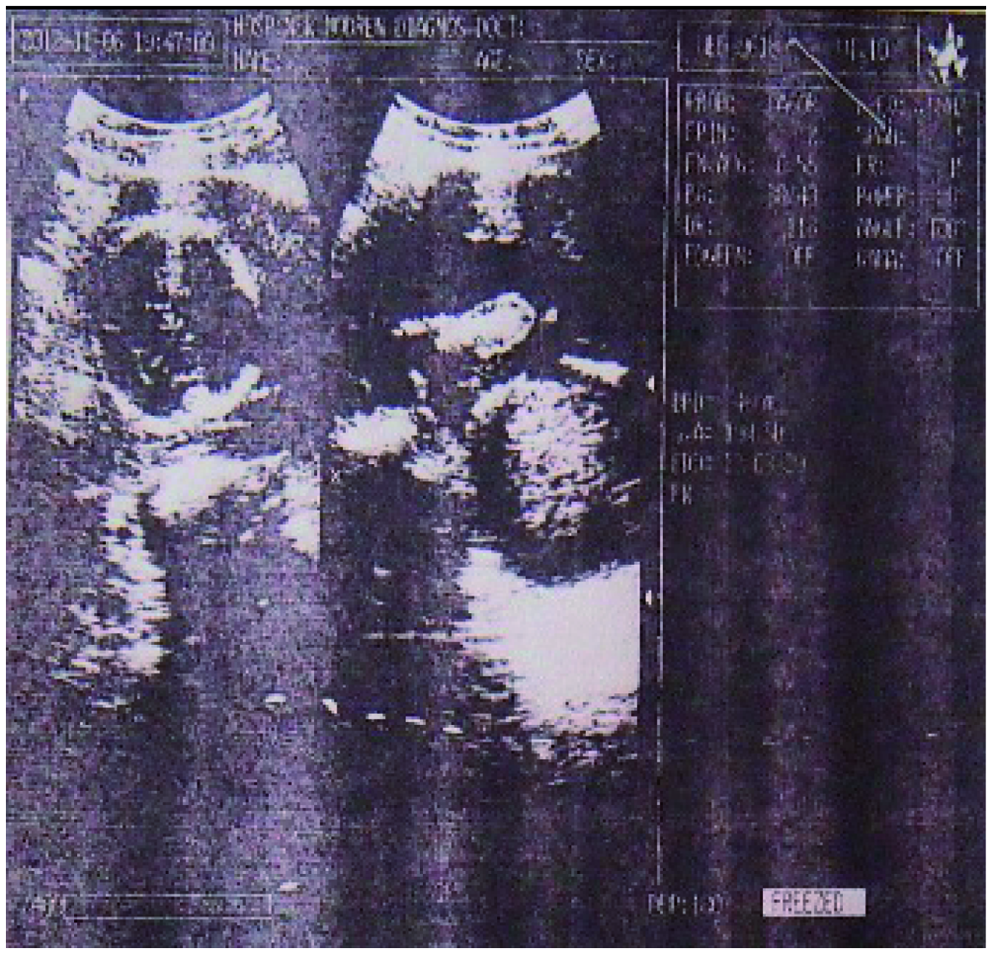
Now is the time for all health professionals to come together and emphasise the reduction of risks to the unborn child. The UN General Assembly has just this year, as part of the International Strategy for Disaster Reduction, ‘strongly encourage(d) giving appropriate consideration to disaster risk reduction and the building of resilience (the ability to recover) to disasters within the post-2015 development agenda’. 9 Disaster risk reduction is already committed to proofing hospitals and primary healthcare clinics. However, community-level antenatal care and public health efforts to deal with the broad gamut of environmental threats (e.g. indoor air pollution, flooding, or new labour-intensive agricultural and industrial technologies) to the mother and unborn child are still disregarded. Until now, the nine months between conception and birth when the mother builds the resilience of the unborn infant for later life are being ignored in the UN disaster and climate change discourse.10,11
Risks to the unborn infant potentially have a massive global impact. The annual burden of mortality and disability adjusted life years from mishaps to the estimated 200 million plus pregnancies, beggar comprehension. In contrast, the circa 30,000 ‘people … killed’ globally by natural disasters as recorded by the Centre for Research on the Epidemiology of Disasters 12 for UNISDR in 2011 represent only a very small proportion of the unnecessary deaths of unborn children in the world. Risks to the unborn child may contribute to still births, spontaneous abortions, pre-term and low birth weight risks, neonatal, infant and child mortality, consequent maternal mortality in the next generation, 13 and chronic disease in adults.
To prevent this global toll and to begin to reduce the reality of risks to the unborn infant, the medical, health and midwifery professions must together advocate concerted action to fill this gap of nine months of the in utero life of the unborn child, which is being ignored by so many organizations and policy-makers.
They must convince the UN International Strategy for Disaster Reduction to embrace the reduction of risks to the unborn infant and together with WHO, UNICEF, UNFPA, World Bank and ICRC ensure that unborn child risk reduction is central to risk reduction in the post-2015 framework. They must ensure that the United Nations and the Intergovernmental Panel on Climate Change include, in its Fifth Assessment Report when finalized in 2014, risks to the unborn child and consequent birth weight as a focus for Future Earth. Finally, they must negotiate with the World Bank and the International Financial Institutions, including the Global Fund to Fight AIDS, tuberculosis and malaria, to make funding investments to increase the capacity and clout of all involved with antenatal care to increase life expectancy calculated at the time of conception and the quality of life thereafter.
In summary then, integrated care to reduce risks to the unborn child must become a two-way process. On the one hand, medicine’s wider role must reach out to embrace economists, engineers and climatologists. On the other hand, economists, engineers and climatologists have to be persuaded by gynaecologists and obstetricians to see risk reduction for the unborn child and thus improved pregnancy outcomes as measurable performance indicators of their endeavours. Medical and health professionals have to convince investment bankers, politicians and project planners to view the outcome metric – the bright-eyed cry of the newborn child – as the human face of sustainability.