




Abstract
Most existing health-related quality of life research concerns the impact of disease on patients. However, in several medical specialties including dermatology, oncology, and physical and mental disability, studies have been carried out investigating the impact of disease on the lives of families of patients. The aim of this paper is to review the literature which relates to the impact of disease on family members of patients. The OVIDSP Medline was selected as the primary database, Searches were limited to sources published in English. 158 papers were identified for review. The definition of “family” varied across the literature, and a broad definition was accepted in this review. This review shows that a wide variety of aspects of family members’ lives can be affected, including emotional, financial, family relationships, education and work, leisure time, and social activities. Many of these themes are linked to one another, with themes including financial impact and social impact being linked to emotional impact. Some positive aspects were also identified from the literature, including family relationships growing stronger. Several instruments exist to measure the impact of illness on the family, and most are disease or specialty- specific. The impact of disease on families of patients is often unrecognised and underestimated. Taking into account the quality of life of families as well as patients can offer the clinician a unique insight into issues such as family relationships and the effect of treatment decisions on the patient's close social group of partner and family.
Introduction
Quality of life (QoL) of individuals is closely related to the QoL of those around them, includingpartners or parents 1 . Therefore, any chronic illness carries the potential to impact on the life of the family Compared to parents of healthy children, parents of children with chronic diseasereport lower self-development, restrictions on their well-being and emotional stability and lower levels of daily functioning. 2 Most studies on quality of life focus on assessing the quality of life of patients. Family quality of life has been explored in dermatology,3–9 oncology,10–21 and in the field of physical and mental disability,22–28 but little is known about the impact of disease on families of patients in many other specialties. Several key review articles have been written concerning the impact of illness on the quality of life of the partner, 1 the impact of cancer on the family,14,19 the carer burden in mental health illness, 22 the impact of chronic childhood illness on siblings, 29 and the impact of chronic disease in the elderly on the patient’s family. 30 Family members of patients are sometimes also carers, but those who do not act as carers are often still impacted. The aim of this paper is to review the literature relating to the impact of disease on all family members of patients, not just carers, and identify common themes. Instruments used to assess the quality of life of family members are also reviewed.
Methods
The OVIDSP Medline was selected as the primary database. This included the following resources: Cardiff University Books and Journals, PsycArticles, AMED (Allied and Complementary Medicine), British Nursing Index 1985-present, Embase 1947-present, HMIC (Health Management Information Consortium), ICONDA 1976 to June 2011, Medline In Process, Medline 1947-present, and PsycINFO 1806 to July Week 1 2011. A search of the Compendium of Quality of Life Instruments was also carried out.31,32 Searches were limited to sources published in English.
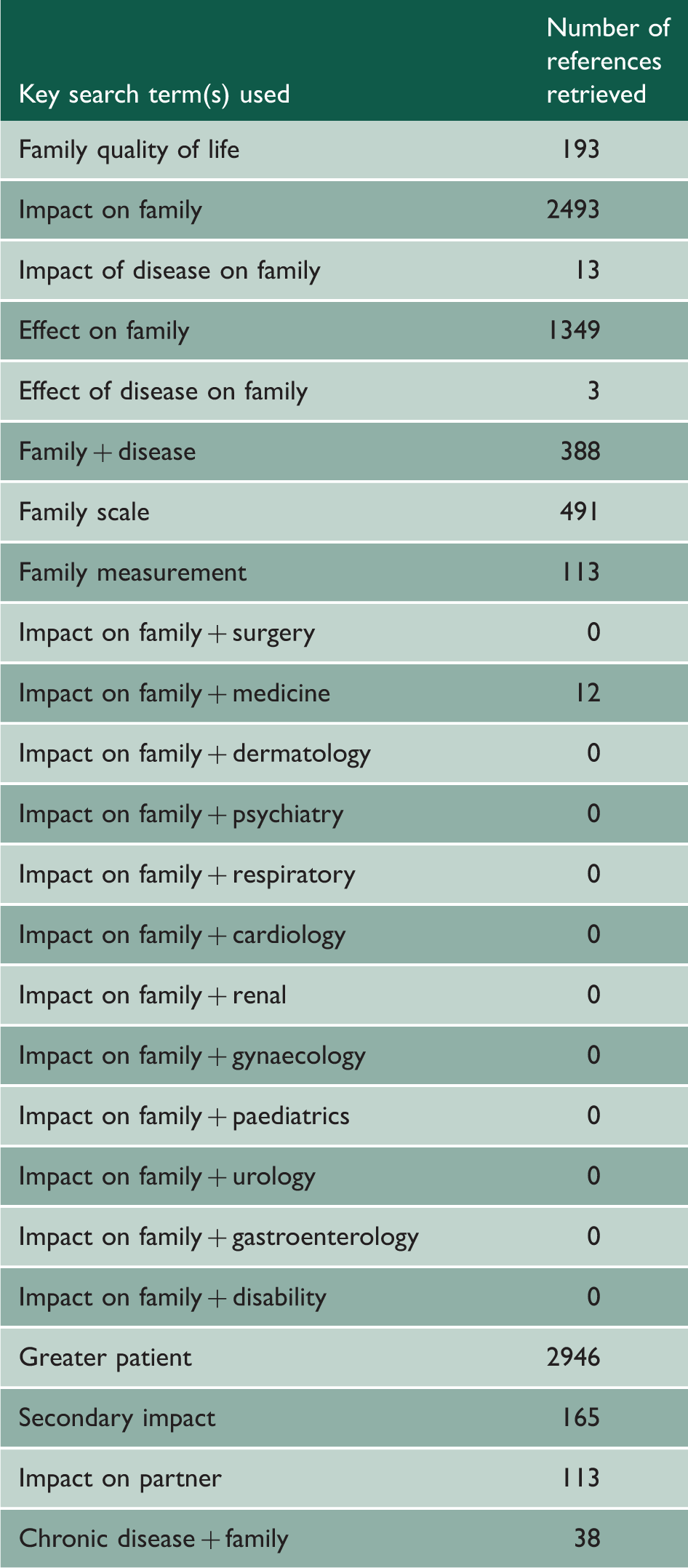
Results of key search terms.
Results
Search results
In total, 1517 abstracts were screened, and 158 were identified for review of the full paper. Of these, 63 articles highlighted at least one aspect which was not covered in other articles. Articles were rejected if, after fully reading them, their content was already covered by other articles. No sources were identified when combining the search term “impact on family” with several major medical specialties and only 13 sources were identified using the term “impact of disease on family” (Table 1). Several sources were rejected for use of the term “family” in an irrelevant context, for example articles about genetics.
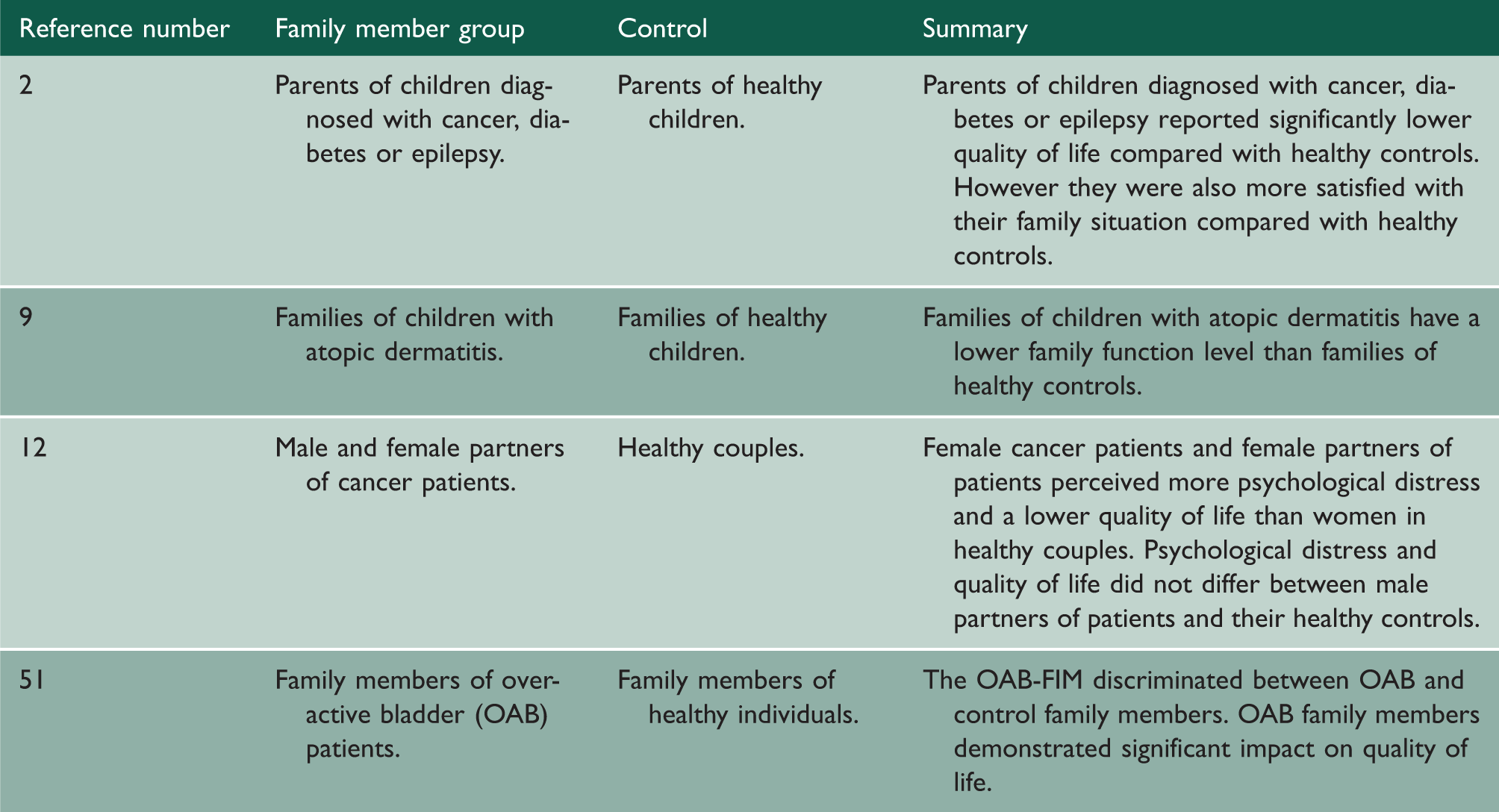
Summary of studies that included a control group.
Definition of Family
The term “family” is difficult to define. The mid 20th century concept of family, with heterosexual parents and offspring living under the same roof is now seldom used, and many authors now consciously use a wider definition of family. The dynamics between family members are constantly evolving and there is evidence of many diverse family types in modern western European society 33 . Poston et al. 34 define family as “people who think of themselves as part of the family, whether by blood or marriage or not, and who support and care for each other on a regular basis”, and this definition is thought to acknowledge the diverse social arrangements that may constitute a family. 35 In other studies, the terms “family”, “informal carer”, and “carer” are used interchangeably.20,36 For this review, we have taken a broad view of the term family and accepted each authors interpretation as valid. Where studies refer to carers, it was ensured that this related to family carers.
Key impact areas
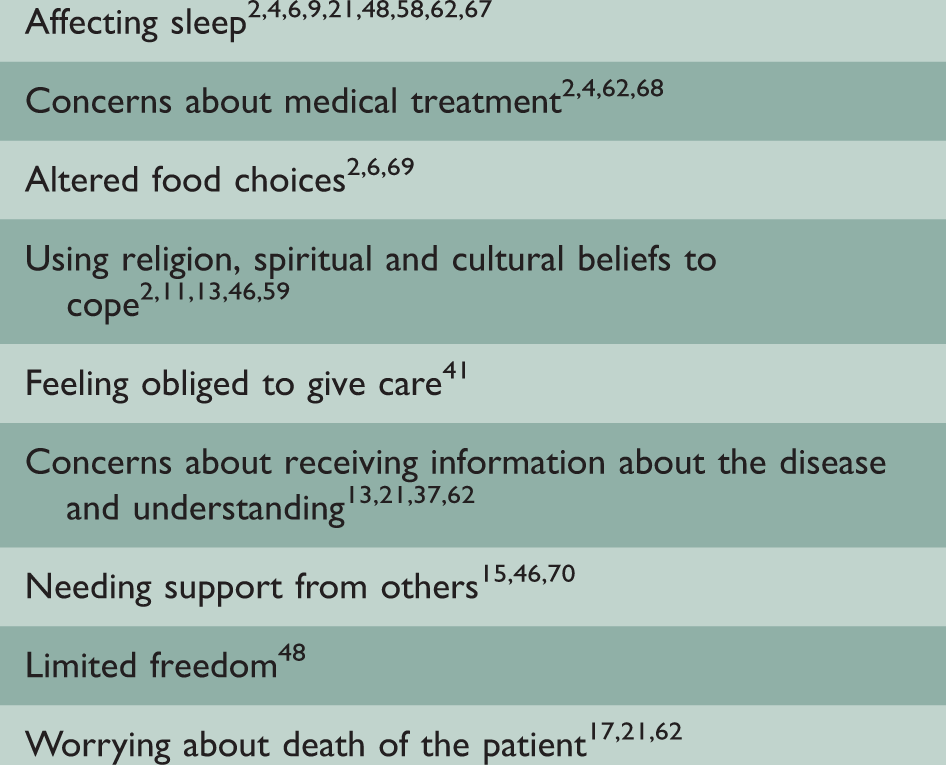
Most chronic diseases have similar effects on family members including psychological and emotional functioning, disruption of leisure activities, effect on interpersonal relationships, and financial resources (Figure 1). However there may be some aspects which attain dominance in one particular disease as compared to other diseases. Several common themes were identified from the studies reviewed. Leisure and social impact were reported separately in much of the literature, and hence are reported as separate themes. Further examples of less common themes mentioned are summarised in Table 3.
A man whose chronic disease is affecting the lives of his family. Examples of other ways disease impacts on the lives of family members.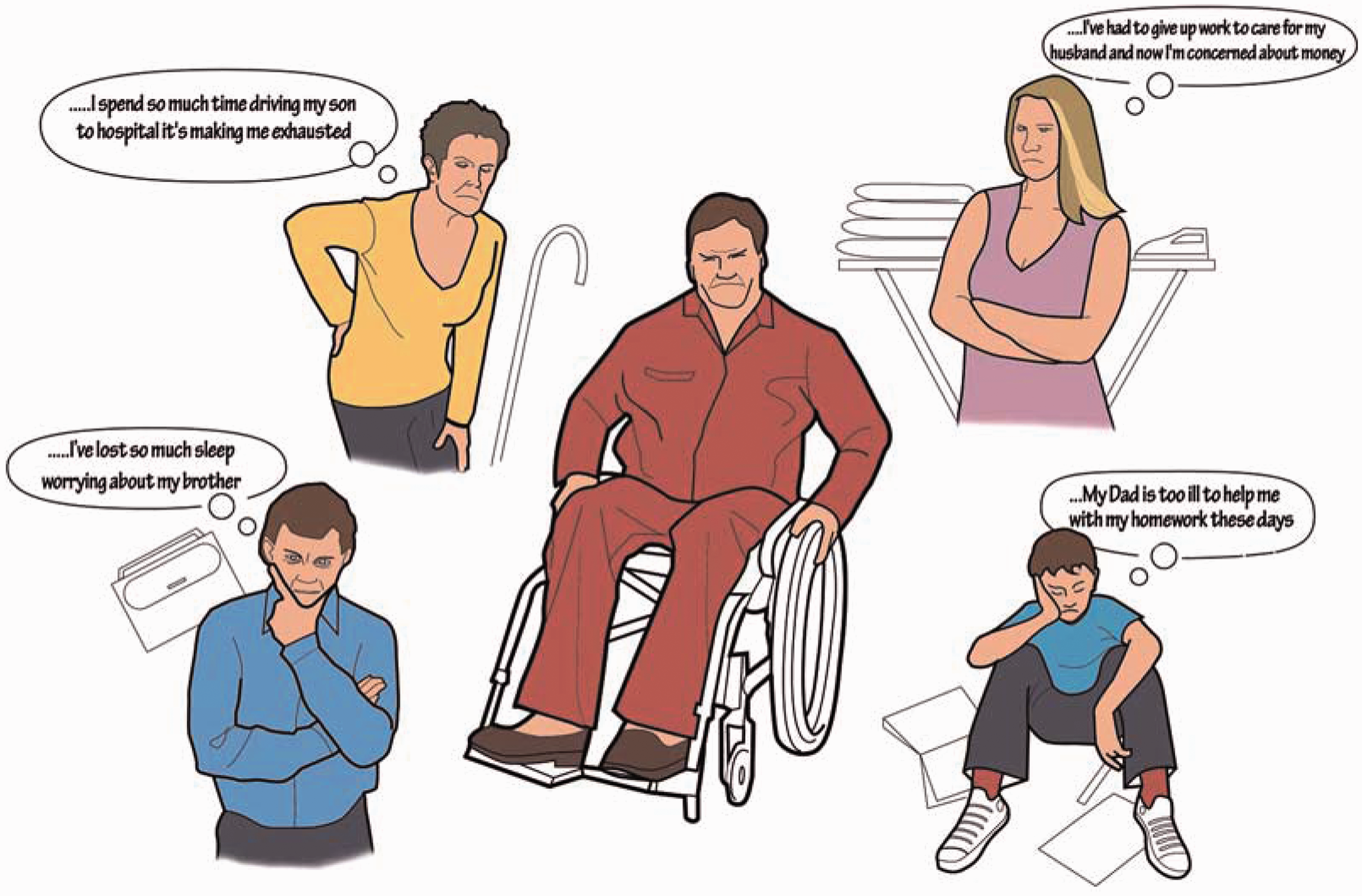
Emotional impact
Family members suffer greatly from the emotional effects of living with, and caring for, a relative with a disease, with the impact of some diseases being felt by every member of the family. 37 Emotional impact was the most common topic discussed in the literature. The psychological distress felt by family members often results from their feelings of helplessness and lack of control.3,38 Many different emotions are mentioned by family members; guilt, anger, worry, upset, frustration, embarrassment, despair, loss, relief. Each emotion affects family members in different ways and to different extents, often depending on the disease severity of the patient,39,40 and the period of time that has passed since the diagnosis. 13
Female partners of cancer patients had higher psychological distress than male partners. 12 However, no significant difference was seen between genders when measuring overall quality of life of relatives. There may be gender differences in responses to caregiving,16,19,41,42 although there was no difference in the well-being of partners of rheumatoid arthritis patients, based on the gender of the patient. 43 It is not just the parents and partners who are affected emotionally by a relative’s disease. 29 For example, siblings of children with pervasive developmental disorder suffered from “significant adjustment problems” compared to a control group. 24
Financial impact
One of the greatest burdens on family members of patients is the financial cost to the family. 44 This can include treatment costs, transport to appointments, the cost of hiring a carer, and adapting their home environment. In a Canadian study, 45 families spent on average C$624 per month on care or support for the patient with an intellectual disability; many described not having any money left at the end of the month. In a similar USA study, the financial impact on families caring for patients with dementia varied from US$3630 to US$17700 depending on the severity of the patient’s dementia. 46
The financial strains felt by family members of patients often lead to stress and worry. Family members of dermatology patients increase their working hours in order to support their family financially, and many need state benefits to cover the extra costs which may lead to compromises for other family members. 3 When caring for a child with cerebral palsy, providing even the basic necessities put financial pressure on the parents, 47 and accessing funding was also challenging, which again increased stress and emotional effects. The difficulties involved in accessing funding are greater in low income families, who often receive minimal support and face greater problems with social functioning and relationships. 48
Impact on family relationships
Family members of patients experience a negative effect on their family relationships, both between the relative and the patient, and between other members of the family as a result of the patient’s illness. Poor family relationships do not bode well for chronic disease management regardless of the disease and often family members find relationships difficult as they do not know how to emotionally support each other. 49 Family members of patients with multiple sclerosis reported negative effects on their relationships with each other, resulting in arguments, tension, and a lack of understanding of each other’s feelings. 37 In particular, relatives struggle to deal with patients whose beliefs, outlook, and behaviour have altered as a consequence of their disease. There was little time for relationships between other members of the family. For example, Golics et al. 50 found that 38% of adolescents with dermatological conditions felt that their family relationships had been affected as a result of their condition.
Partners of patients experience a negative effect on their sex lives as a result of the patient’s disease,often as a result of the patient’s symptoms 51 or not having time to spend together as a couple due to another family member’s illness. 3 It can lead to friction between couples, and in some cases can lead to the breakdown of relationships, or partners seeking sexual encounters outside the relationship.3,6
However, in some families relationships can grow stronger, 52 as the family members work together to help each other and become more closely knit. In families with a child with an intellectual disability, the majority were taking the initiative to maintain good family relations, and engaging in family activities to encourage this. 45 An increase in family closeness was also found in families of cancer survivors; one husband of a survivor said “I look at life differently after that. I feel much closer to her.” 15
Education and work
Living with, or caring for, a relative with a disease can have a large impact on the education and careers of family members. This could include disruption of school work in siblings or children of the patients, or the employment of adults being affected and the burden of care placed upon them. Some families of children with disabilities 45 felt that some of their family members would not be able to attend work or school in the near future. One family member is quoted: “The unpredictable natures of our children’s health and lives does not often fit with a typical, progressive work profile”. 45 In eight of the 34 families studied, one or both parents had given up an education or career to care for their child with a disability. 40% of family members of dermatology patients felt that their employment was affected by their family member’s skin condition. 3 Reasons included needing to look after the patient, attendinghospital appointments, and emotional effects affecting work. Looking after a patient with cancer can also have a huge impact on a family member’s work on a day-to-day basis. 20 Family member carers were reporting late for work, missing work, spending time at work talking on the telephone to their relative and some left work due to their carer responsibilities.
Leisure time
An important part of family QoL is family members being able to participate in the hobbies they enjoy. 34 The barriers that prevent families from taking advantage of leisure opportunities 45 link into other domains of family quality of life, including lack of time due to the responsibilities of care, limited finance, and lack of support available. However, encouragingly, it has been shown that when family members do take the initiative to plan leisure activities, they usually work out positively, despite the restrictions due to the relative’s illness, and families show high satisfaction with this achievement. 45
Family members also find difficulty in taking family holidays, often depending on the disease state of their relative. Problems with finding suitable accommodation can make holiday planning “awkward”. 47 Relatives of patients with skin diseases described limitations of holiday planning, for example not wanting to swim together at the beach or their relative having to wear certain types of clothes. 4
Social impact
The burden on family members caring for a person with a disease has a drastic effect on their social lives.3,4,34,47 Mothers caring for disabled children felt that their lives were so different from their friends and felt that they could only contribute to depressing conversations, and therefore lost friends as a result. 47 Other family members described friends “drifting away”, as they do not understand the family situation. 37
A large number of individuals with a relative suffering from a skin disease complained of social disruption. 4 Conditions which result in visible signs of disease (for example basal cell carcinoma on the face or chronic obstructive pulmonary disease requiring oxygen therapy) may have a greater effect on the social lives of patients and their relatives, for fear of strangers’ reactions to their visible condition. Mothers of adolescent patients suffering from severe chronic pain reported more restrictions in their social life than mothers of children with less severe chronic pain and the authors suggest that this could be directly related to the illness. 53
Instruments to measure family quality of life
Several studies have lead to the development of instruments designed to measure the impact of disease on families of patients.3,26,54,55 However, these instruments are mostly disease or specialty specific, and can therefore only be used to assess the quality of life of the family of a particular group of patients.
The Family Dermatology Life Quality Index(FDLQI) is a ten-item questionnaire designed to measure the quality of life of family members of dermatology patients. 56 This validated instrument contains items such as “Over the last month how much emotional distress have you experienced due to your relative/partner’s skin disease (e.g. worry, depression, embarrassment, frustration)?”. The Impact of Pediatric Epilepsy Scale, 57 is designed to measure the impact of childhood epilepsy on the patient and their family. Using this measure, the severity of seizures correlated directly with the quality of life of the patient and their family. 57 This correlation with disease severity was also found in atopic dermatitis 58 using the Dermatitis Family Impact Questionnaire. 9 Further examples of disease-specific measures include the Psoriasis Family Index, 59 the Overactive Bladder Family Impact Measure, 51 and the Quality of Life in Life Threatening Illness - Family Carer Version, 11 which is designed to be used with carers of palliative oncology patients to assist the development and delivery of the most effective services to these carers. Many of the existing instruments to measure family quality of life have been designed for use in families of patients with cancer,21,60 and mental health illness. 22
The Impact-on-Family Scale measures the impact of childhood chronic illness on the family. 26 Similarly, the extensively tested Beach Centre Family Quality of Life scale, 54 was evaluated in families of children with disabilities. The questions in this measure fall under five main categories: family interaction, parenting, emotional well-being, physical/emotional well-being, and disability-related support. The Family Quality of Life Survey is another example of a measure designed for use in family members of patients with or without an intellectual disability. 28 This survey is designed to assess the aspects of family quality of life that are important to a family and whether these aspects are being adhered to.
A summary of the characteristics of family quality of life measures.

Discussion
There is a wide range of information about the impact of disease on family members of patients. It is unknown whether the results of disease-specific studies are applicable to a more general population, or whether family members are affected in similar ways across every medical specialty. For example, the family quality of life domains suggested by Poston et al. 34 result from a study with family members of disabled children. Kazak, 62 discusses the lack of “reliable and valid family outcome measures” and the negative effects of family outcome studies of one disease or clinical area, including the lack of communication between medical specialties and obscuring commonalities across different disease areas. Although many studies conclude that a more family-centred approach to care,13,37,63,64 and further education of professionals is needed, 35 no generic measure exists to assess the impact of a variety of diseases on family members of patients.
The impact of disease on families of patients is often unrecognised and underestimated. Comparing contrasting information from families of patients with a variety of diseases could uncover new domains of quality of life unique to family members, which, with appropriate support in place, could result in a higher standard of patient and family care. Taking into account the quality of life of families as well as patients can offer the clinician a unique insight into issues such as family relationships and the effect of treatment decisions on the patients’ close social group of partner and family. 3
There are some limitations of this review. The review was not a systematic review. Carrying out a systematic review would have lead to a substantial reduction in the number of articles to be reviewed, therefore influencing the intended comprehensive nature of the review. Many of the articles reviewed were written several decades ago, as there is not a large volume of modern literature looking specifically at impact on the family. The use of restricted search databases was also identified as a limitation.
In conclusion, in order to understand the needs of family members of patients and be able to offer appropriate support, we first need to understand the ways in which their lives are affected. This review has highlighted the need for a multi-specialty study investigating the issues faced by families of patients, how these differ between diseases, and exploring the common themes and ideas.