




Abstract
This is the fifth in a series of articles on making evidence-based medicine work for you. The series is based on the book ‘Attenti Alle Bufale’ by Tom Jefferson (www.attentiallebufale.it)
Quick Instrument
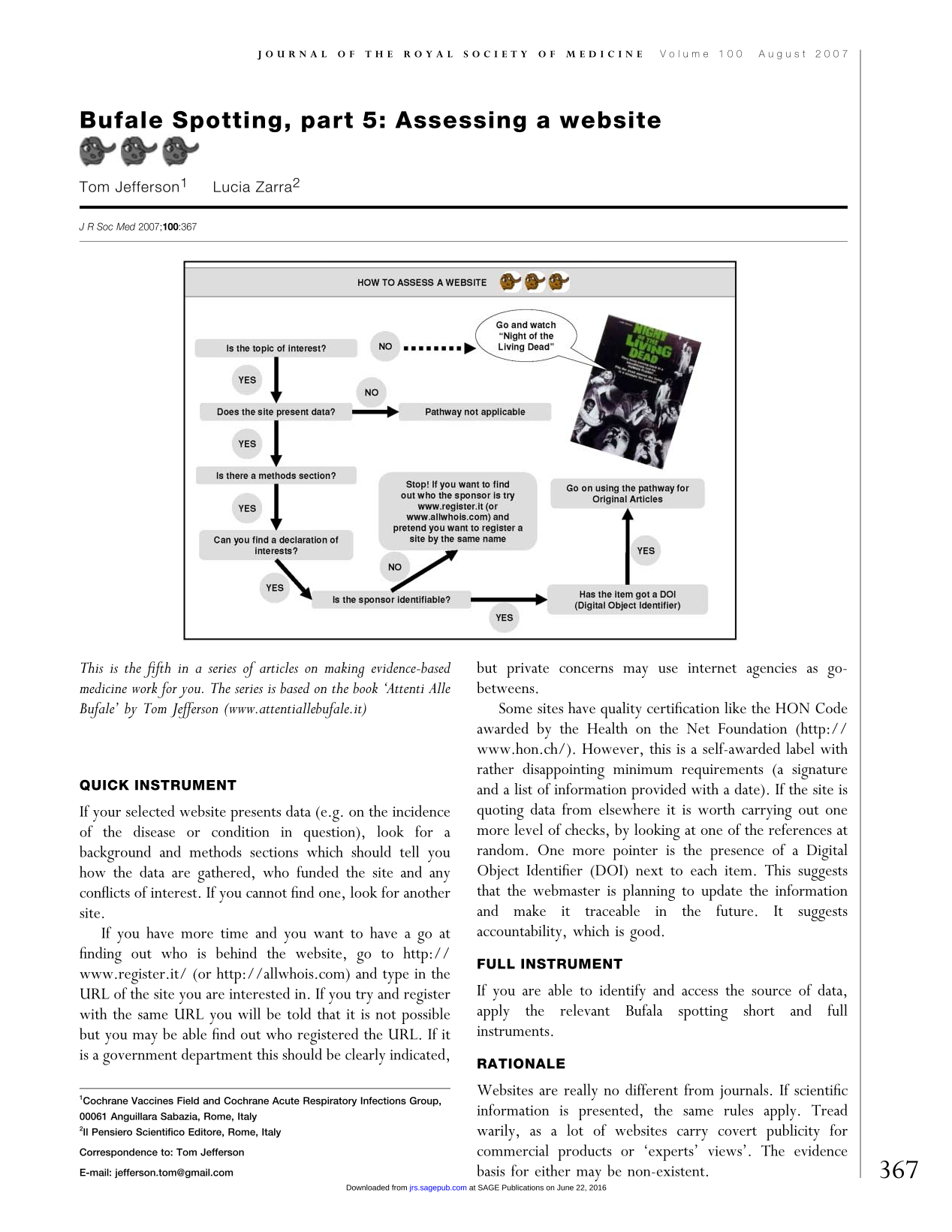
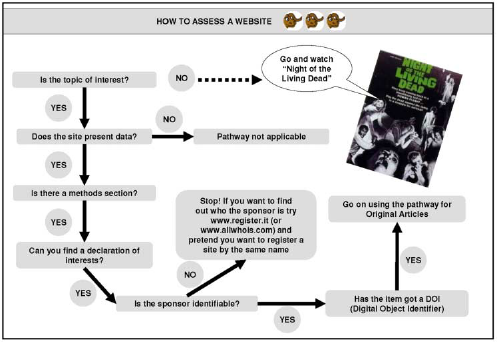
If your selected website presents data (e.g. on the incidence of the disease or condition in question), look for a background and methods sections which should tell you how the data are gathered, who funded the site and any conflicts of interest. If you cannot find one, look for another site.
If you have more time and you want to have a go at finding out who is behind the website, go to http://www.register.it/ (or http://allwhois.com) and type in the URL of the site you are interested in. If you try and register with the same URL you will be told that it is not possible but you may be able find out who registered the URL. If it is a government department this should be clearly indicated, but private concerns may use internet agencies as go-betweens.
Some sites have quality certification like the HON Code awarded by the Health on the Net Foundation (http://www.hon.ch/). However, this is a self-awarded label with rather disappointing minimum requirements (a signature and a list of information provided with a date). If the site is quoting data from elsewhere it is worth carrying out one more level of checks, by looking at one of the references at random. One more pointer is the presence of a Digital Object Identifier (DOI) next to each item. This suggests that the webmaster is planning to update the information and make it traceable in the future. It suggests accountability, which is good.
Full Instrument
If you are able to identify and access the source of data, apply the relevant Bufala spotting short and full instruments.
Rationale
Websites are really no different from journals. If scientific information is presented, the same rules apply. Tread warily, as a lot of websites carry covert publicity for commercial products or ‘experts’ views’. The evidence basis for either may be non-existent.