




Abstract
This paper examines the experiences of foreign nationals who moved to New Zealand through education-for-immigration pathways. Drawing on insights generated from an online questionnaire and semi-structured interviews, the study finds that the migration project of this group was largely successful. This finding is theorized using Bourdieu’s notion of “the affinities of habitus,” which provides an alternative framework for understanding migrant integration as the result of the interplay between the capital migrants bring and the “character” of the host country. The paper further identifies specific areas of improvement that would enhance the overall experience of educational migrants in New Zealand.
Keywords
Introduction
From the Colombo Plan that welcomed Southeast Asian students in the 1950s to the 1989 Education Act that liberalized its international education, New Zealand has regularly had foreign nationals at its educational institutions (Spoonley and Bedford, 2012: 198). Compared to the seven percent average across the Organisation for Economic Co-operation and Development [OECD] member countries, the percentage of tertiary students in New Zealand has ranged from 21 percent (pre-COVID) to 15 percent (post-COVID). Regardless of the post-COVID drop, international student enrollments in New Zealand have consistently remained above the OECD average across the years (OECD, 2025). While the deliberate marketing of New Zealand as a favorable destination for international study has contributed to this (Lewis, 2005), the liberalization of the study-migration pathway for foreign nationals has been one significant driver of this trend in the New Zealand education sector.
Numerous studies on the experiences of international students in New Zealand have been conducted over the past two decades (see, for example, Butcher and McGrath, 2004; Campbell and Li, 2008; Generosa et al., 2013; Kukatlapalli, 2016; Loveridge et al., 2018; Nguyen et al., 2023; Ward et al., 2004; Zhang and Brunton, 2007). However, studies examining the experiences of international students who choose to remain in the country after completing their studies have remained sparse. Snippets of the experiences of foreign nationals on post-study work visas in New Zealand are presented only but cursorily in reports prepared for government organizations aimed primarily at policy development and assessment of immigration schemes (see, Collins and Stringer, 2019; Wilkinson et al., 2010). With the exception of Joseph’s (2016) work that examined the role of social networks in the immigration transition of international students from India, and Anderson’s (2019) study that engaged international student workers in New Zealand, the experiences of individuals drawn into the country’s linking of export education with international labor and post-study residency have been insufficiently studied.
This paper takes the sparsity of scholarship in this area as its starting point to present some of the materials garnered for a doctoral project (see Ibeka, 2023) that examined educational migration to Denmark and New Zealand. Research data shows New Zealand’s educational migrants were satisfied with their study experience, did not feel socially or culturally awkward in educational and other social spaces, landed their first and preferred jobs within reasonable timeframes and expressed a significant sense of belonging to their host country. These findings are elucidated using Bourdieu’s notion of the affinities of habitus. The analysis shows that the positive accounts of the migration project of study participants emanated largely from the affinities of their habitus and that of most New Zealanders they encountered. The various capitals that they acquired before and after their arrival shaped their perception of themselves as not markedly different from members of the host society, which in turn fostered their “successful” integration.
In the sections that follow, I provide a purview of cross-border students’ education in New Zealand. Thereafter, I sketch out how the data for this research was generated and engage briefly with the theory that was used to make sense of it. Research materials are presented thematically with broad headings that focus on participants’ choice of New Zealand as their study and migration destination, their experience of New Zealand’s educational spaces, their engagement with the country’s labor market, the place-making practices they enacted and their perception of their host country. In presenting these materials, I show how habitus affinities, which include shared dispositions and social alignments, powerfully shaped participants’ experiences. While underscoring the positive experience of place that participants reported, I point to what can be done to enhance the experience of educational migrants in New Zealand as they contribute to the various nation-building projects.
Cross-border students in New Zealand
In varying degrees and often in alignment with specific political or economic projects, New Zealand has always welcomed international students on its shores (Lewis, 2011). Pre-1986, there were a handful of foreign nationals in New Zealand educational institutions, mainly from former British colonies, countries of the Pacific and those of the Southeast Asian region. However, the New Zealand Immigration Reform of 1986–87 and the subsequent identification of education as an export commodity that has the potential to build the nation’s economy saw the opening of New Zealand’s educational institutions to citizens of various countries (Alvey et al., 1999: 3–29; Bedford, 1987: 36–40). The neoliberal reform of New Zealand’s immigration and the tying of education more closely to the economic interests of the state amounted to a phenomenon that involved three distinct trends, namely immigration-for-education, educational immigration and education-for-immigration.
Immigration-for-education is the common form of international student mobility, whereby foreign nationals immigrate to New Zealand solely for education, intending to return to their home country at the completion of their study program. This primarily involves students in exchange programs, those on a short-term study visa to undertake English language courses, and individuals enrolled in full academic programs at the primary, intermediate, secondary or tertiary levels. It also includes those who arrive in New Zealand on educational partnership programs or specific scholarship schemes, such as the Commonwealth Scholarship or those offered by the New Zealand Ministry of Foreign Affairs and Trade, that require beneficiaries to return to their home countries at the end of their international study (Spoonley and Bedford, 2012: 198–199).
The second trend, educational immigration, as articulated by Belich (2001), is that intriguing phenomenon whereby immigrants arrive in New Zealand on a resident visa to bypass full-cost fees paid by full-fee-paying international students. Belich refers to individuals who migrate to New Zealand through various skilled migration regimes and usurp the fact of being residents to acquire English language skills (an internationally desirable commodity), with which they then move to a third destination. As residents, they acquire language and other skills available at different New Zealand educational institutions at rates already subsidized by the government. Such a trend is also evident in the case of young adults or children whose parents migrate to the country primarily to provide them with the “quality” education that New Zealand schools offer while paying domestic fees (Belich, 2001: 534–535; see also, Butcher, 2004).
The third of these trends, education-for-immigration, which is the particular focus of this paper, depicts the case of foreign nationals who arrive in New Zealand not only for international education but also with an underlying intent of establishing long-term residency in the country. This trend is predicated on the availability of residency pathways that allow students to remain in the country after their study program. Referring to the Australian case, Robertson (2013: 22) notes that the availability of such residency pathways led to the rise of internationally mobile students who pursue international education as a means to an immigration end. For these students, interest in their study or career aspirations usually takes a secondary position. The immigration outcome remains primary. New Zealand’s post-study residency pathways for foreign nationals drew significantly from the 2001 Howard’s government policy in Australia that allowed international students to apply for a residence visa without first returning to their home country. Established in July 2005, post-study work visas in New Zealand were issued in two categories, namely, the open visa and the employer-assisted visa. The open visa allowed international graduates to work for any employer in New Zealand and was issued for 12 months. The employer-assisted visa, in contrast, tied the holder to a particular employer (unless they applied for a variation of conditions); however, it allowed for another two to three years of stay if employment continued (Trevena, 2019: 34). In November 2018, a policy change made international graduates in New Zealand eligible to apply for an open post-study work visa that ranges from one to three years (depending on the type and level of qualification obtained). On completing these years (provided they were in paid employment), the individual became eligible for a New Zealand resident visa under the Skilled Migrant Category (see Immigration New Zealand, 2024).
While scholarship from other parts of the globe has begun to recognize the interconnected nature of international study and labor mobility for most internationally mobile individuals (see Robertson and Runganaikaloo, 2014; Valentin, 2012; Wilken and Dahlberg, 2017), works from New Zealand have concentrated mainly on the experiences of international students as consumers of New Zealand export produce (see, Collins, 2007; Hsu et al., 2009; Kukatlapalli, 2016; Zhang and Brunton, 2007). There is a paucity of literature that has examined the study and migration experience of foreign nationals who chose New Zealand for education and migration purposes as a bound-up phenomenon. This work recognizes this paucity and seeks to contribute to this body of literature by exploring the experiences of those who moved to New Zealand on these grounds between 2008 and 2017. 1
Methods and theory
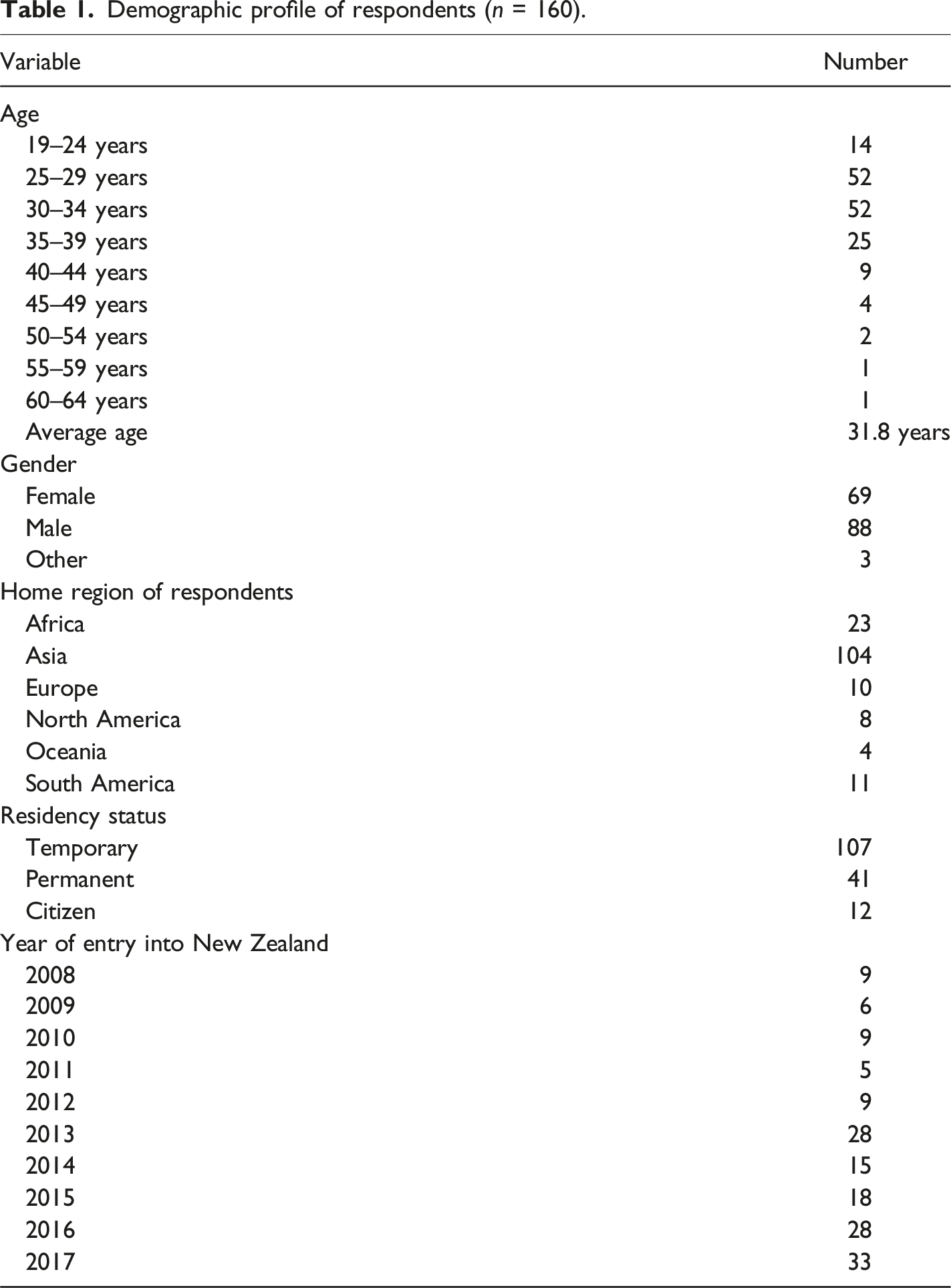
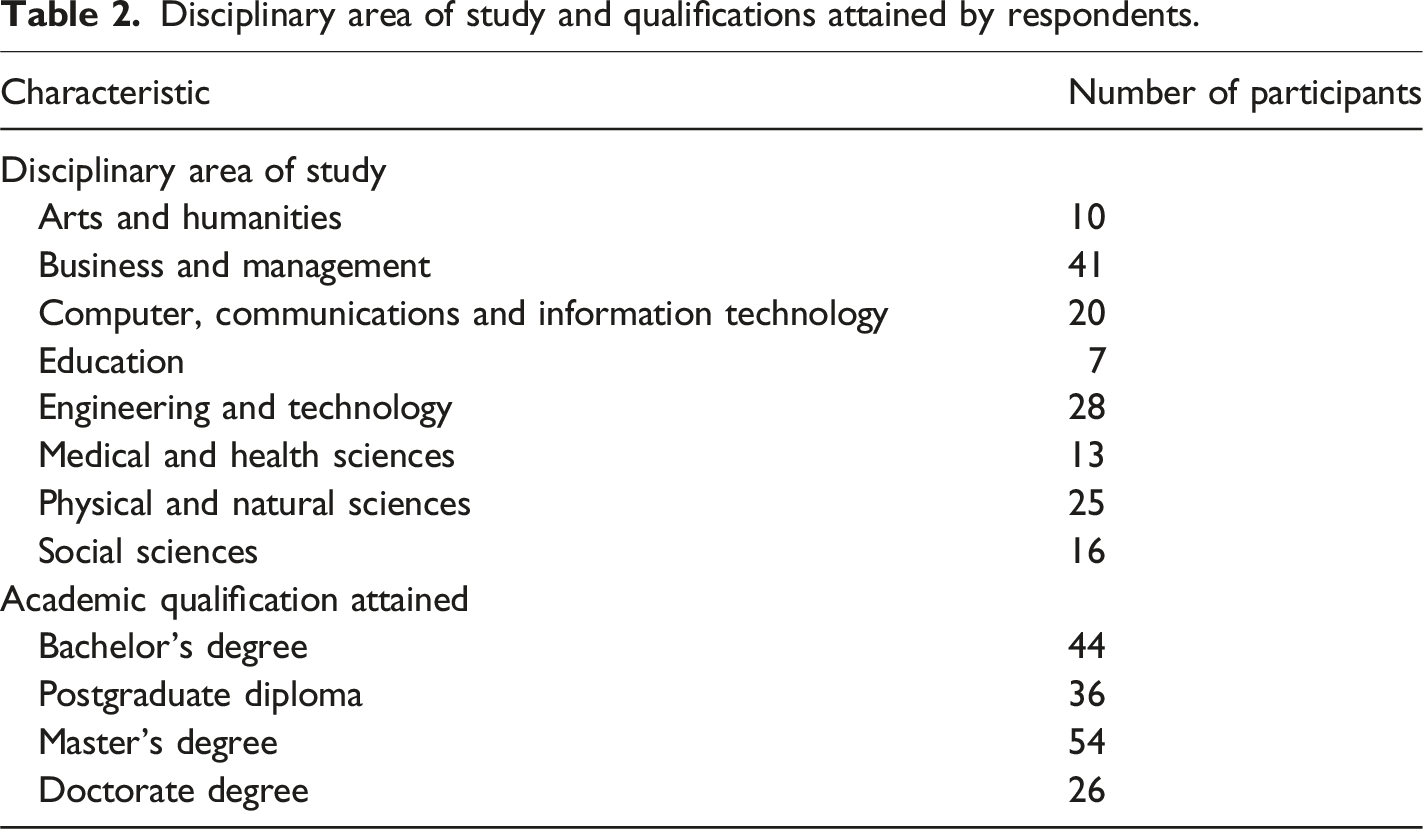
As noted previously, data for this paper were gathered as part of a doctoral project (Ibeka, 2023) that compared the experiences of individuals who moved from countries categorized as “low-income” or “developing” to Denmark or New Zealand through education-for-immigration pathways. Ethics approval was obtained from the researcher’s institution’s review board, and fieldwork took place between 2019 and 2022 across both sites. To capture participants’ collective experiences and identify individual practices, a multi-method approach was employed. An online questionnaire was administered, and semi-structured interviews were conducted. The anonymous online questionnaire was designed to elicit numerical and quantifiable responses from participants, which included the duration before they landed their first job, their current job status, yearly income, level of proficiency in the country’s official language and rating of the amicability of locals with migrants. The follow-up semi-structured interview (which was conducted either online or in-person) allowed for a deeper exploration of participants’ study and labor market experiences and their place-making practices.
Demographic profile of respondents (n = 160).
Disciplinary area of study and qualifications attained by respondents.
To make sense of the multilayered experiences of this migrant group, Bourdieu’s theory, which centers on the habitus (and his description of the affinities of the habitus) was utilized. For Bourdieu, the habitus is an accumulation of familial and personal experiences worked on over time through socialization that shape how individuals act and react in different social spaces (Bourdieu, 1990). It is a system of lasting and transposable dispositions that functions as a matrix of perceptions, appreciations and actions. It designates a way of being, a habitual state of the body and mind (Bourdieu and Wacquant, 1992: 18). While the habitus is conceived mainly as an individualized feature, Bourdieu also makes a case for “group habitus,” contending that individuals who are exposed to the same field configurations and occupy stable positions within it for an extended duration will adopt dispositions attributable to a particular social group. [A]gents who occupy neighboring positions in a space are placed in similar conditions and are therefore subject to similar conditioning factors; consequently, they have every chance of having similar dispositions and interests and thus of producing practices and representations of a similar kind. Those who occupy the same positions have every chance of having the same habitus, at least insofar as the trajectories which have brought them to these positions are themselves similar. (Bourdieu, 1987: 5)
The numerous capitals that study participants accumulated, mindful of their study and migration projects (in a clime that has witnessed the proliferation of Anglocentric cultural goods across various parts of the globe), were similar to those of local New Zealanders they encountered. Moreover, New Zealand’s identity as a classic immigration country meant that participants understood migration as a phenomenon ingrained in the nation’s fabric; thus, they did not consider themselves significantly different from other members of their host society, an awareness that enabled them to study, work and live in “regular and conventional ways” without enacting noticeable “migrantness” (see Hur, 2023). The absence of reports indicating socially discordant relationships with the locals and the mobilization of social networks in their capital conversion projects points towards an affinity of the habitus of both groups. For Bourdieu, perceived harmonious interactions among agents, the mutual sense of sympathy and reciprocal “existential certainty” that agents direct to one another are all products of habitus affinities.
In the following sections, I present some of the accounts of the experiences of this study’s participants and elicit from them pointers of dispositional features that highlight habitus affinities with those of their host society members.
Choosing New Zealand as a study-migration destination
International students who choose New Zealand do so for diverse reasons, expectations and long-term goals. One rationale shared by all participants was the desire to remain in their host country for an extended period beyond their study duration. Put differently, the availability of post-study residency pathways was one key reason for choosing New Zealand. Participants also noted values such as gender equality, work-life balance and the “openness” of the host society as significant considerations in their choice of New Zealand as a study and migration destination. Sara and Nitara, for instance, recounted: [My choice of] New Zealand was because of more equality here. Because I felt that I can be who I am here and work the way I like. I am a microbiologist, and sometimes I need to stay overnight in the lab. That was not possible for me back home. This is just a simple example. But there are lots of other reasons: The socioeconomic lifestyle and so on. In New Zealand, we do have a really good work and personal life balance here […] I think that was the kind of precursor for me that I wanted to have more personal and work-life balance and more opportunities that would be based on my merit, not if I’m a male or female. (Sara, Bangladesh, Female)
3
It was just that hope that the environment will be very welcoming – the safety and that feeling of welcome that makes you feel you belong here. I have two sons. So, for me, it was very important that I choose a country where I feel that the country will have a safe family type of environment that I can raise my kids. So that was a very big factor […] A place where I can bring up my children. After looking at different countries, we decided that it was the Pacific countries, I mean, either Australia or New Zealand, although we didn’t think too much about Australia. (Nitara, India, Female)
Another non-economic factor that was central to all our participants’ choice of New Zealand was the language. Migrants typically consider their linguistic capital and weigh how it will (dis)enable their integration into their host societies. Thus, migrants are more likely to consider only those destinations that speak a language that they have already acquired (see Jackson, 2016). For educational migrants whose migration projects are bound-up with their international education, factoring language entails seeking destinations where the language of academia is also the medium of social interactions. The responses of Sonia, Shu and Antonio clearly express the place of language in their choice of New Zealand. I always wanted to go abroad for my education in an English-speaking country, just because it is the language that I was more comfortable speaking. I knew university was going to be challenging. So, I didn’t want to do it in a country where [the] language will be a barrier for me because it will make it harder. So, yeah, that’s why I chose New Zealand. (Sonia, Hong Kong, Female) I was considering English-speaking countries, so I don’t have to learn another language. I thought about the US, but considering the safety issues in America, and also the tuition fees in America which is quite high if I wanted to study nursing, I didn’t choose it. Then I thought of Canada, but in Canada, I had to do four years of bachelor’s studies. But in Australia or New Zealand, I only have to do three years, finish my degree and get registration. That’s why I chose Australia and New Zealand. I first applied to Australia, but I got refused by immigration because they don’t think I’m a genuine student. So after I got rejected by the Australian immigration, then I started to think about New Zealand. (Shu, China, Female) I wanted to leave my country, and I had this idea ever since I was in high school. I speak Spanish, English and French; so, from countries that speak these languages, I chose New Zealand because it is the one that is the farthest away from Mexico. I couldn’t do the US as it is next to us. And so […] I made the decision and I’m here. (Antonio, Mexico, Male)
In choosing a destination that spoke a language they could speak, Sonia, Shu and Antonio were not just pragmatic but also strategic, as it implied seeking places where they could claim similar linguistic socialization with the locals and, in so doing, evade the peculiar migrant experience of feeling different due to significant dissimilarities of linguistic socialization. In effect, these participants sought macro-social spaces (nation-state) that afforded affinities between their own habitus and that of their host society members. Such strategic consideration in their choice of New Zealand and the material consequence of such a decision, exemplified in their interactions with locals, arguably nudged locals, in turn, to recognize that they share a related linguistic socialization with this migrant group and, by implication, an identical (linguistic) habitus. This shared recognition increased our participants’ chances of mobilizing their capital for profit, as seen in their accounts of getting into social networks in New Zealand, both at their educational institutions and in their labor market engagements.
Navigating New Zealand’s educational spaces
As international students are typically expected to demonstrate reasonable proficiency in the language of their international education, all of the participants met a proficiency threshold that allowed for easy communication with their local peers within educational spaces. The result of this is that they barely experienced the feeling of being different due to linguistic (in)competence. Recounting her experience as a foreign national who was new to New Zealand’s educational space, Jinjing noted: [Making friends in school] was not too hard, I think. Because I had good English, I guess […] so the communication part was not difficult. So, you just start to meet people in the lecture, you know, and the people are friendly. So, you’ll probably sit next to someone and start talking. And then yeah, I lived in the university student accommodation. So, it’s easy to meet people there as well, and they introduce you to their friends, and so you start to build up the social network. So as a student, it’s not difficult to meet people and meet friends, especially, you know, in a university environment. It is quite unique there in a way that people are more open, and also a lot of international students. (Jinjing, China, Female) The local friends that I had were all people that were living in the accommodations. So, I met them in this environment, and the same applies to them as well; they met me there. And in general, I find that students tend to be like this. So, it was easy to get to meet the locals living in the hostels. (Antonio, Mexico, Male)
Mobilizing cultural and social capital for the job market
Driven by their longer-term goal of acquiring post-study residency, most educational migrants who come to New Zealand enter their host country’s labor market shortly after arrival. The linguistic capital they arrived with makes them labor market-ready (especially if they possess the work-specific skills required for the roles they apply for). In New Zealand, international students are permitted to work up to 20 hours per week during academic terms and full-time during designated holiday periods.
4
Many of our research participants took on their first temporary jobs within the first three months of their arrival. On completing their study, most landed their preferred jobs within six months, with more than half of them in roles categorized as administration and management, as well as education and training (see Figure 1). Bar chart showing the distribution of respondents’ present jobs by sectors.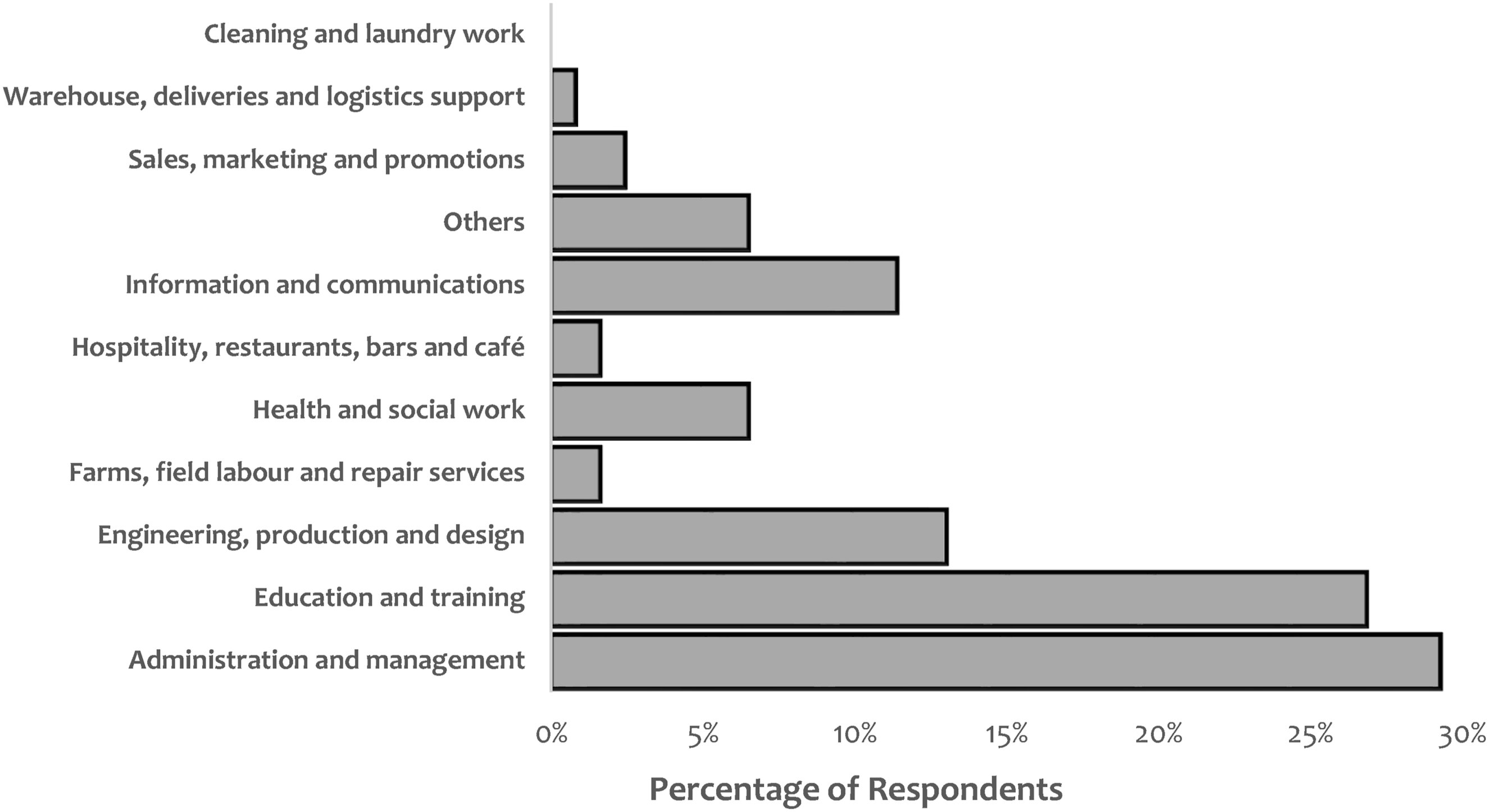
Participants noted the relative ease of finding part-time jobs in New Zealand. In major cities of New Zealand, there is a vibrant pool of alternative or contingent jobs characterized by short-term contractual agreements, which frequently entail compensation based on piecework arrangements (see Riggs et al., 2019). Whereas such labor arrangements engender precarity for most persons, they are, for educational migrants, opportunities to take on flexible working schedules, allowing for effective management of their employment commitments without having them interfere much with their academic engagements. Such was the case for Sonia. My first job was as a waitress. So, I put together this really simple CV (curriculum vitae) and I went to restaurants and got my first job in a restaurant. After that, I’ve worked under a researcher once when I was doing my Anthropology degree, but that was very temporary. And then I worked as a tutor associate. I did that for a year over two semesters and then I also worked for an immigration agency. I was there for eight months. And then now I am employed at a law firm as an administrative assistant. (Sonia, Hong Kong, Female) How I got my first job is that I had a classmate who was already working at a hotel in town. So, I asked him if they had job openings. And he said there was one available for room attendant. So, I gave him my CV, he gave it to the executive housekeeper. And the executive housekeeper called me like after a couple of days. And then I got the job. I’m still at the hotel, but not in the same job. I’m never going to be a room attendant for like, more than six months because it’s tiring. I’ve been promoted and I got relocated here in Queenstown, but I am still with the same hotel. (Cassandra, Philippines, Female) Well, I have had three jobs […] The first job I had was a teaching assistant for the university. The other job that I had was an internship and this was a software company. And this I found through a friend that was already working there and knew they were offering internships; so, he asked me if I would be interested, and I applied. I did [the] same for my current job. I got it through the university portal, and I’ve been working in this one for a while now, which is the one I currently hold, beside[s] the teaching assistant role. So, I am in the research and development section for a company that does software for civil engineers to plan and to take care of the maintenance of roads in New Zealand. (Antonio, Mexico, Male) LinkedIn alerted me that there is a job opening that they are looking for a geophysicist. And then I talked to my advisor here and he told me he doesn’t know the person, but he will ask around because it was at one of the universities. I applied for the job, but there was a lot done in the background. My advisor contacted his colleagues, and his colleagues contacted the employer because they know him. And then they told him we have an insider applying for the job. So […] it was done. I didn’t know about the job through my network, but I got the job through my network. (Moussa, Algeria, Male) So, the two jobs that I’ve had, the technician job […] that was because I literally was working with the people in the laboratory, so they knew me and they just, you know, people applied, and they hired me because they knew me. I’m not sure if I was the most qualified person for that role. Perhaps I wasn’t. And then in the other case, they had an idea of who I was, they knew me, and they hired me because of that. If I did not have that kind of network, I don’t think I would have gotten those jobs. (Pedro, Argentina, Male) [Networking] It’s the most important thing for you to work in New Zealand. You must be known. Your expertise is important, your qualifications is [are] important; but to be honest, you have to also develop relationships, very positive relationships with the people around you, so they can start [to] trust you and say oh this person can understand us and this person is open to understand us, to work with us and ready to adapt. (Azhaar, Palestine, Female)
Perception of the locals and the affinities of the habitus
Participants painted a rather positive picture in narrating their experiences engaging with locals. Sixty-four percent of survey respondents agreed that New Zealanders were friendly and helped further their settling-in projects; only 12 percent disagreed with the assertion, while 24 percent were neutral (see Figure 2). Such positive accounts about New Zealanders are also reflected in the qualitative materials obtained in the study. When you deal with people here, they are always welcoming. They are so tolerant, they are accepting. I have lived in different countries, and from a discrimination point of view, New Zealand is really tolerant. People here are really nice and they accept you in a good way. It’s a really good place for multicultural people to live in. (Azhaar, Palestine, Female) If people [New Zealanders] get to know you, they are very friendly and helpful most of the time. In fact, I feel more accepted here than back home. (Mukesh, India, Male) [The locals] are very friendly people, very accepting and open-minded. I found that although people are indeed very friendly here and open-minded, but like in every other country, they tend to be very friendly at a superficial level, like hospitality-wise or first introductions-wise […] Yeah, at least, you know, this happens in the city. I haven’t lived in the countryside. So, I can’t say that for other parts of New Zealand. (Antonio, Mexico, Male) I don’t really feel a big difference between an international and the local resident at work or any place. I think the only difference is like […] when I was an international student, I paid almost like four times of the tuition fee for local people. (Shu, China, Female) And you know, even though now, I haven’t got my residency yet, but still, I consider New Zealand as my own country. So, I feel accepted here in New Zealand that I am a part of this country. (Yash, India, Male) I would say, I’m lucky the places that I’ve worked for after graduation are all very nice and accepting. People who didn’t make me feel like I’m a foreigner. (Lin, China, Female) [M]y network is made up mostly of persons from other nationalities, persons who are also from other countries who are now living here. And I think it’s easy to connect because there are more shared experiences […] the experience of migration. (Chandice, Jamaica, Female) Column chart showing respondents’ assent to locals’ amicability or furtherance of settling-in.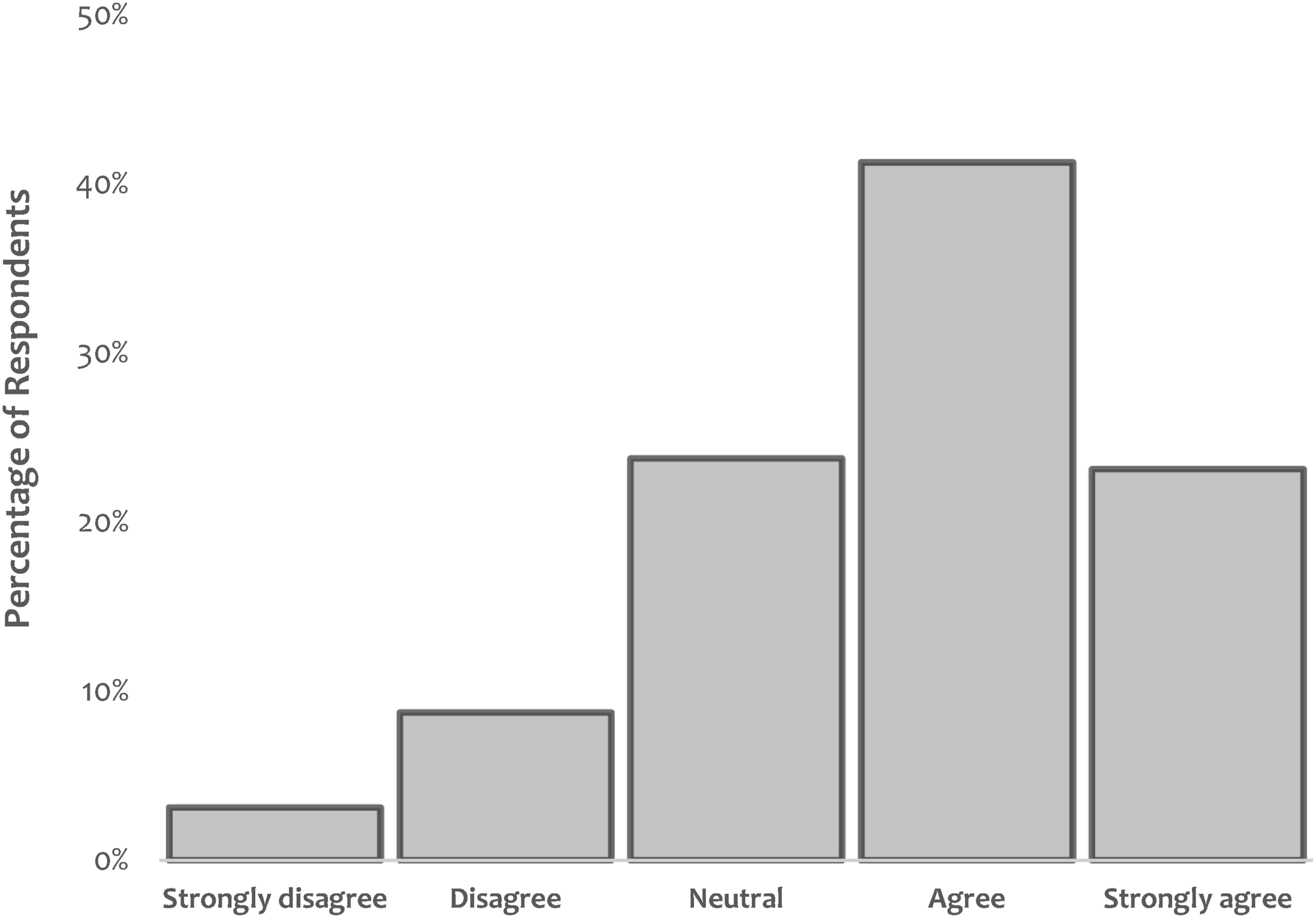
Concluding with notes for some interventions
In this paper, I have presented accounts of some of the experiences of a group of educational migrants in New Zealand who, in various aspects of social life, did not perceive themselves as markedly different from New Zealanders. This group of migrants was able to mobilize their cultural and social capital to advance their place-making projects. They reported feeling accepted in their host country and expressed a sense of belonging – empirical findings that are consistent with those of commissioned studies on the labor market integration of international graduates in New Zealand (see, for example, Generosa et al., 2013; Park, 2017). This paper, however, makes a distinctive contribution to these existing studies by articulating these findings as reflective of what Bourdieu considers as effects of the affinities of the habitus (of a migrant cohort and members of their host society).
Drawing on the affinities of the habitus to explain the experiences of New Zealand’s educational migrants allows for highlighting successful or rather, less fraught migrant integration processes as hinged to a reasonable extent on the degree of compatibility between the capitals that migrants bring (linguistic, educational, social) and the configuration of their host societies (see Hur, 2023; Yilmaz and Solano, 2024). Such framing invites us to attend to the dynamic and relational aspects of migrant incorporation. It also opens a space for further research that explores how the affinities (or dissonances) of the habitus shape integration trajectories across different migrant cohorts, institutional settings and geopolitical contexts.
Although study participants’ accounts of their experience of New Zealand were largely positive, one point not lost on most of them was the exorbitant tuition fees charged to international students. Nearly half of the respondents in the survey found the large fee differential a bit worrisome. Some participants also highlighted the emotional and financial burdens associated with navigating Immigration New Zealand’s bureaucratic processes. For these participants, the cost and difficulty of renewing study visas or obtaining other visa types; the targeted nature of medical examinations required for their visa applications (which makes them the subject of racial profiling); the often-intrusive personal information required by Immigration New Zealand for individuals they invite to visit them, compounded with the COVID-19 border restrictions that separated them from their family for an extended period, were dimensions of their migration experience they recall as unpleasant.
Significant tuition fee differentials may not directly engender habitus dissonance; however, they are powerful markers of otherness, and having international students pay exorbitant fees often leads to fanning the whispers that New Zealand educational migrants are effectively buying their way into residency in the country. Unpleasant encounters with state agencies such as Immigration New Zealand may not precipitate a complete transformation of habitus (see Montes, 2024; Nowicka, 2015); they nonetheless puncture migrants’ positive assessment of their host country.
Simplifying the requirements for visa renewals or transitioning, and eliminating practices that racialize human mobility, such as targeted medical requirements, will make educational migrants feel more welcomed in their host country and bolster their recognition that the various capitals (skills and competencies) they bring are valued by their host country, which in turn encourages their deeper investment in the national social space. Addressing the stark tuition fee disparity between domestic and international students would not merely lead to a socially just and sustainable export education (see Healey, 2023); it would, more importantly, serve a symbolic function of smothering the difference between both groups, which, as Shu noted, was the only difference she felt as an international in New Zealand.
Footnotes
Acknowledgments
Thanks to Andre Poyser, the anonymous reviewers and the editorial team at APMJ for their helpful comments and suggestions on earlier drafts of this paper.
Ethical considerations
The study received ethics approval from the University of Auckland Human Participants Ethics Committee on 24 May 2019 (Reference Number 023061).
Consent to participate
All respondents took part voluntarily. Written informed consent was obtained for interviewees.
Consent for publication
Participants gave their consent for the materials they provided to be used in publications resulting from the research.
Funding
The author received no financial support for the authorship and/or publication of this article. The research was supported by the University of Auckland Doctoral Scholarship.
Declaration of conflicting interests
The author declared no potential conflicts of interest with respect to the research, authorship, and/or publication of this article.
