




Abstract
Singapore has served as a strategic hub of immigration in Southeast Asia over the past two centuries since its founding as an entrepot in 1819. It is not only due to its geographic location at the crossroads between the East and West, but also to its vibrant social and business organizations that have provided effective institutional links both within Southeast Asia and between the region and China. This has, in turn, contributed to the making of Singapore as a key migration corridor among the Chinese diaspora. An overlooked institutional link in this corridor is qiaopi, the remittances-cum-letters sent home by Chinese immigrants from the 1820s to the 1980s, which was part of the intra-regional circulation of capital, goods, people and information. Qiaopi was officially selected into the United Nations Educational, Scientific and Cultural Organization’s (UNESCO’s) “Memory of the World” Register in 2013, thus demonstrating its heritage significance. This paper examines the role of the qiaopi trade in establishing and consolidating Singapore’s place as the most important migrant corridor in Southeast Asia. It also discusses qiaopi from a transnational perspective of diasporic heritage and its contemporary relevance to the heritage corridor.
Introduction
As one of the largest diasporas in the world, it is estimated that there were between 40 million to 45 million Chinese living outside of Mainland China, Taiwan, Hong Kong and Macau in the 2010s (Tan, 2013: 4; Song, 2019). 1 During the 1850s–1950s, approximately 90 percent of them were concentrated in Asia, especially Southeast Asia. The post-1950s era witnessed the localization of diaspora Chinese and identification with their respective nations of birth/residency. The launching of China’s reform and opening-up in the late 1970s led to the emergence of new emigration estimated at about 10.7 million (International Organization for Migration, 2019: 3).
There are various approaches to understanding these complex immigrant communities dispersing around the world. Wang Gungwu divides Chinese migration into four patterns: the trader pattern, the coolie pattern, the sojourner pattern and the descent or re-migration pattern. He considers the changing relationship between China and Southeast Asia as an important factor in shaping the migratory waves from China to the region and that the huashang (Chinese trader) pattern of migration was the dominant pattern from the early times in various parts of Southeast Asia (Wang, 1991). Reid (1996) shows the extraordinary range of Chinese interactions with Southeast Asian societies, while McKeown (1999) points out the necessity of examining “the development of a diasporic perspective that can direct the analysis of geographically dispersed institutions, identities, links, and flows.” Liu (2006) highlights the diversity of Chinese international migration to various parts of the world and argues for the incorporation of network and transnationalism into the analysis. Kuhn (2008) examines how Chinese migration was connected to domestic developments in China, seeing it as an extension of Chinese ecosystems. Recent collective studies from inter-disciplinary perspectives and multiple geographies (e.g., Tan, 2013; Zhou, 2017) have further enriched the scholarship of Chinese global migration and its diverse patterns of integration and identity formations. Scholars (e.g., Le, 2019) have also called for moving away from an essentialized China or Chinese-ness and for new methodological approaches in the studies of Chinese business culture and enterprises in Southeast Asia. However, with a few exceptions (e.g., Byrne, 2016; Wang, 2019), there is little study pertaining to the linkages between Chinese migration studies and diasporic heritage, which have been separate fields of study until recently, with different sets of analytical units and theoretical frameworks (Reed, 2015).
With the aim of bridging the divide and building a constructive dialogue between migration scholarship and diasporic heritage studies, this article examines the formation and transformation of Singapore as a key nexus of migration corridors through a close analysis of the qiaopi as a form of diasporic heritage. While migration corridors have been studied in contemporary global migration (e.g., Carling and Jolivet, 2016; Kaur, 2018; IOM, 2019), it has not been used as an explanatory framework to understand the historical evolution of Chinese international migration to Southeast Asia. We will focus on Singapore’s role as a strategic migration corridor in linking the region through qiaopi—which was a shared heritage among diasporic Chinese throughout the world. The qiaopi system also played an important role in shaping the migration corridor between China and Southeast Asia. In contemporary times, the concept of the migration corridor represents “an accumulation of migratory movements over time and provides a snapshot of how migration patterns have evolved into significant foreign-born populations in specific destination countries” (IOM, 2019: 72). We are more receptive to the notion of migration corridors as “open to different forms of asymmetries in movement” (Carling and Jolivet, 2016), which allows us look at Chinese migration at different spatial and temporal moments (Chan, 2015). The institutions and diaspora identity shaped through qiaopi helped lay the foundation of the corridors and played an indispensable part in establishing and sustaining the movements. We also connect migration corridor with heritage corridor and move away from the nation-bounded one-way movement of heritage studies to a transnational perspective of migration heritage with a focus on bi-directional flow of ideas and capital (cf. Byrne, 2016).
Qiaopi (侨批) or yinxin (silver letter, 银信) is the name given in Chinese to letters written home by Chinese immigrants to accompany remittances sent to their families in their hometowns during the period spanning the 1820s to the 1980s. Recipients of qiaopi acknowledged the money and letter by sending a huipi, which conveyed information about family and community matters. Throughout these 160 years, qiaopi had deeply affected the life of the Chinese immigrants and those they left behind at home. Nearly 160,000 qiaopi and huipi have been collected as of today, and they are archived and preserved, primarily in China. In June 2013, qiaopi was officially entered into the United Nation’s Educational Scientific and Cultural Organization’s (UNESCO’s) “Memory of the World” Register, which was set up in 1992 to give recognition to “a growing awareness of the parlous state of preservation of documentary heritage” in the world. The UNESCO official recognition demonstrated clearly the significant value of qiaopi in both migration and heritage studies, which describes qiaopi as follows: Letters, reports, account books and remittance receipts resulting from communications between Chinese emigrants and their families in China [sic]. They record first-hand the contemporary livelihood and activities of overseas Chinese in Asia, North America and Oceania, as well as the historical and cultural development of their residing countries in the 19th and 20th century. They constitute evidence of the Chinese international migration history and the cross-cultural contact and interaction between the East and the West.
2
This article focuses on Singapore to examine how the qiaopi trade helped cement its role as a key nexus of migration corridor that not only connected Chinese communities between Southeast Asia and the hometowns but also within Southeast Asia. It also discusses qiaopi from the perspective of diasporic heritage and its contemporary relevance. Put in a comparative angle, the Singapore case highlights the importance of unveiling the changing nature and characteristics of remittance not only as a social process and its contribution to development (cf. Hujo and Piper, 2007; Rahman, 2010), but as an evolving mechanism of migrant identity in the context of fluid region-making and nation-state formation.
This article is mainly based upon archival materials, including various qiaopi documents and oral history interviews with those involved in the qiaopi operations. The qiaopi documents are from two sources—published qiaopi collections, which include copies of original letters sent by immigrants or their family members and the personal collection of qiaopi documents. 3 We also made use of data from Singapore’s Oral History Project, 4 including lengthy interviews conducted in the 1980s with major qiaopi traders: Lim Soo Gan, who founded the influential Nanyang Exchange and Remittance Association, Loo Neng, who opened and managed his remittance shop in Singapore from 1946 to 1960, and Wee Soon King, whose great-grandfather started the qiaopi trade after he migrated from Hainan to Singapore in 1884.
In addition, the authors conducted an interview with Wang Chunxu on 27 April 2015 in Singapore. Wang grew up in a family with an extensive qiaopi trade background and is a collector of qiaopi documents. For the purpose of a comparative analysis in both geographical and historical dimensions, this article has also drawn upon the authors’ recent publications (together with Gregor Benton) pertaining to qiaopi and Chinese international migration, which were in turn derived from a much more substantial set of primary data collected in China, Southeast Asia and North America.
This article is organized into three parts. The first part briefly reviews the genealogy of qiaopi and argues for the importance of studying qiaopi through the interlinked contexts of migration corridors and diasporic heritage. It then looks at the evolution of Singapore as a nexus of maritime corridor for Chinese international migration and its emergence as the center of qiaopi trade in the region. The second part examines the formation and structure of the qiaopi system in Singapore from the colonial to the post-colonial periods by focusing on its key components, including qiaopiju [remittance firms] as a core of the qiaopi system. The third part analyzes the inner-workings and operation of the qiaopi system in the context of Southeast Asia through its dual linkages with both the homeland and neighboring countries in the region. Among these were business associations which organized common activities and market conventions that furthered the transnational flows of capital, people, goods and information. 5 The conclusion places our study in the interlinked contexts of migration scholarship and heritage studies and suggests future directions for research.
Chinese immigration to Singapore and the emergence of qiaopi trade
Qiaopi was a product of Chinese international migration starting from the early 19th century, which was characterized by the dominance of males who had to leave their families (wives, children and parents) behind in their ancestral hometowns. In his pioneering study, Emigrant Communities in South China (Chen, 1940), Chen Ta documents the effects of massive human mobility and remittance on the sending communities’ everyday life (livelihood, food, clothing, shelter, the family, education, health and habits, social organization and enterprise, religion and others). In the overseas communities, there emerged remittance brokers who consolidated remittances that would be sent to China, particularly from laborers and small merchants who had no other way of sending money. Once they had gathered considerable money and goods to be sold in China, the brokers would ship these to China. There, the monies were further distributed to individuals by the local head of the household, who was often the principal wife of the male titular head of household (Celarent, 2016). Some retail shops started to run their remittance business and these shops became the earliest remittance firms, or qiaopiju. Qiaopiju were business firms that emerged in the mid-19th century to specialize in transporting labor overseas, shipping goods throughout the diasporic network, handling private and business correspondence, and providing remittance and other banking services to Chinese immigrants (Harris, 2018; Liu and Benton, 2016). As we will demonstrate later, qiaopiju served as a major mechanism in sustaining the qiaopi system, which in turn became a foundation of the migration corridors in connecting the immigrants, financially and emotionally, with their families in the homelands and sometimes relatives in other countries in the region of Southeast Asia.
With the inclusion of qiaopi into the UNESCO Memory of the World Project in 2013, interest in qiaopi, both as an object of collection and a subject of research, has increased substantially. This is reflected in two main aspects: increase in numbers of publications on qiaopi (including collections of letters, monographs and conference proceedings), and development of institutions and projects devoted to qiaopi collections and studies. While these studies have enhanced our understanding of the dynamics, processes and impact of the qiaopi and the qiaopi trade (e.g., Cheong et al., 2013; Harris, 2015; Benton and Liu, 2018; Benton et al., 2018), the existing studies tend to focus on qiaopi’s main role in liaising the immigrants with their homeland in China. Other important issues, such as its place in cementing migration corridors through linking with a third country/region and its values as diasporic heritage, have not been explored. Due to its geographical, institutional and ethnic characteristics, Singapore has arguably been the most significant corridor in Chinese migration in the region. 6 The qiaopi system, in our view, was both a product of this strategic positioning and a key driver in the strengthening of Singapore’s role as a migration corridor.
Singapore has been studied from multiple perspectives, including as a migration and trading hub. Wong Lin Ken (1978) examines Singapore’s growth as an entrepot port from 1819 to 1941, focusing on its development into the premier British port in Southeast Asia and for the China trade. Takeshi Hamashita (2003) argues that Singapore was one of the main port cities linking maritime regions through long-distance trade. In contrast to the land, the maritime world encompassed coastal trade, cross-sea trade and chain-of-seas connections, which resulted in an open and multi-cultural realm that was diverse and well-integrated. Loïs Bastide (2011) analyzes Singapore’s economic development from its early phase as a node within the extensive network of trading routes to a major entrepot for trade in both the British Empire and Asia. He points out that Singapore has served as a logistical platform with a pivotal role in forming supply chains in the region, as a high-tech manufacturing platform and as a services and control center for transnational corporations’ operations dispersed throughout the region. In their study on the transformation of Singapore Chinese society, Liu and Wong (2004) also highlighted the role of Singapore as a regional hub of business networks in Southeast Asia.
After the British established Singapore as a free port in 1819, many people were attracted to come. One important group of Chinese immigrants was those who hailed from villages and towns in southern China, Fujian and Guangdong, which had long trading connections with Southeast Asia. Some were traders or were related to traders and eager to learn to become successful traders themselves. Singapore became a key destination for Chinese migration because of its geographic location connecting the Malaya and Indonesian archipelagos. Except for some small numbers of traders, most immigrants were coolies, who arrived in Singapore as unskilled labor preparing to work hard in the hope of earning enough to send money back, or to save enough money to eventually return (Wang, 1991). Immigrants from China to Singapore increased in number from 2,069 in 1838-1839, to 10,928 in 1849-1850. By 1890, the annual figure had risen to 95,400, and it passed the 100,000 mark in 1895, at 190,901 (Ee, 1961).
It was against the backdrop of growing Chinese immigration to Southeast Asia that qiaopi emerged, in response to the demands of immigrants to send money and letters back home. Just like other immigrant groups of the time, the first generation of Chinese immigrants maintained close connections with families in hometowns. Nevertheless, they rarely went home because of lack of financial resources. The letters and remittances thus served as a means of maintaining family ties and receiving news about the hometown.
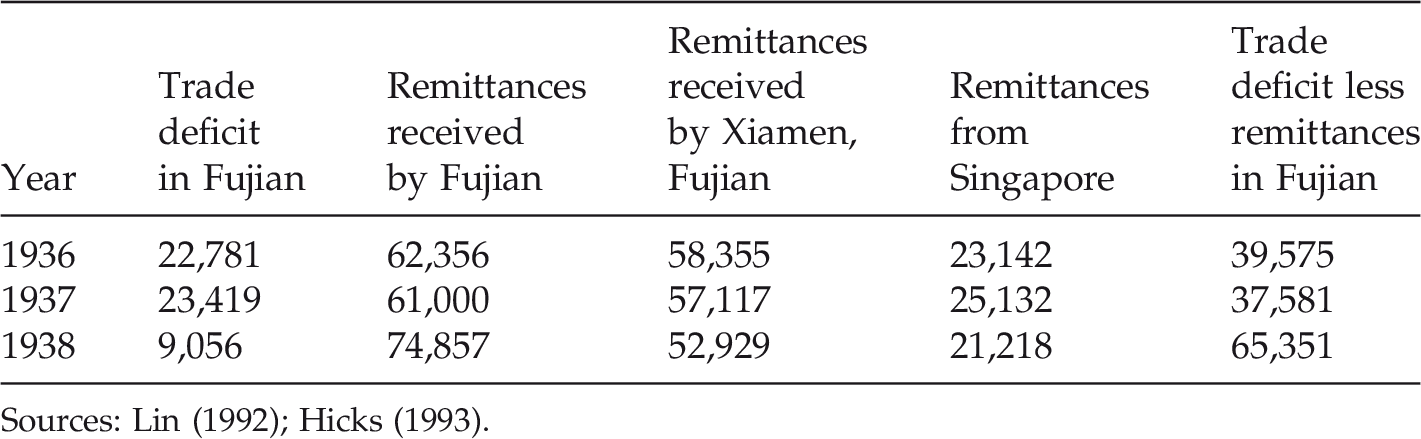
However, studies about Singapore and qiaopi have given little attention to the city-state’s role as a strategic migration corridor and how it was cemented by the burgeoning qiaopi system throughout most of the past two centuries. As a matter of fact, most qiaopi sent to Fujian and Guangdong—the hometowns of the great majority of Chinese diaspora throughout the last two centuries—originated from Southeast Asia, especially Singapore. For example, out of 32,317 original qiaopi letters preserved in the Museum of Chaoshan Qiaopi Archives, which is the earliest and largest archive in the world dedicated to the collection, preservation and studies of qiaopi and related artifacts, 37 percent were dispatched from Singapore. 7 Remittances sent from Singapore made up a big proportion of the total remittance received and contributed to cover the trade deficits of the homeland (Table 1). More importantly, there existed a complex qiaopi system, including remittance firms, the business associations which helped set up and enforce market rules, key stakeholders and transnational and intra-regional networks that underpinned the migration corridor.
Comparison of overseas remittances from Singapore and trade deficit in Fujian province, 1936–1938 (CNY million).
Sources: Lin (1992); Hicks (1993).
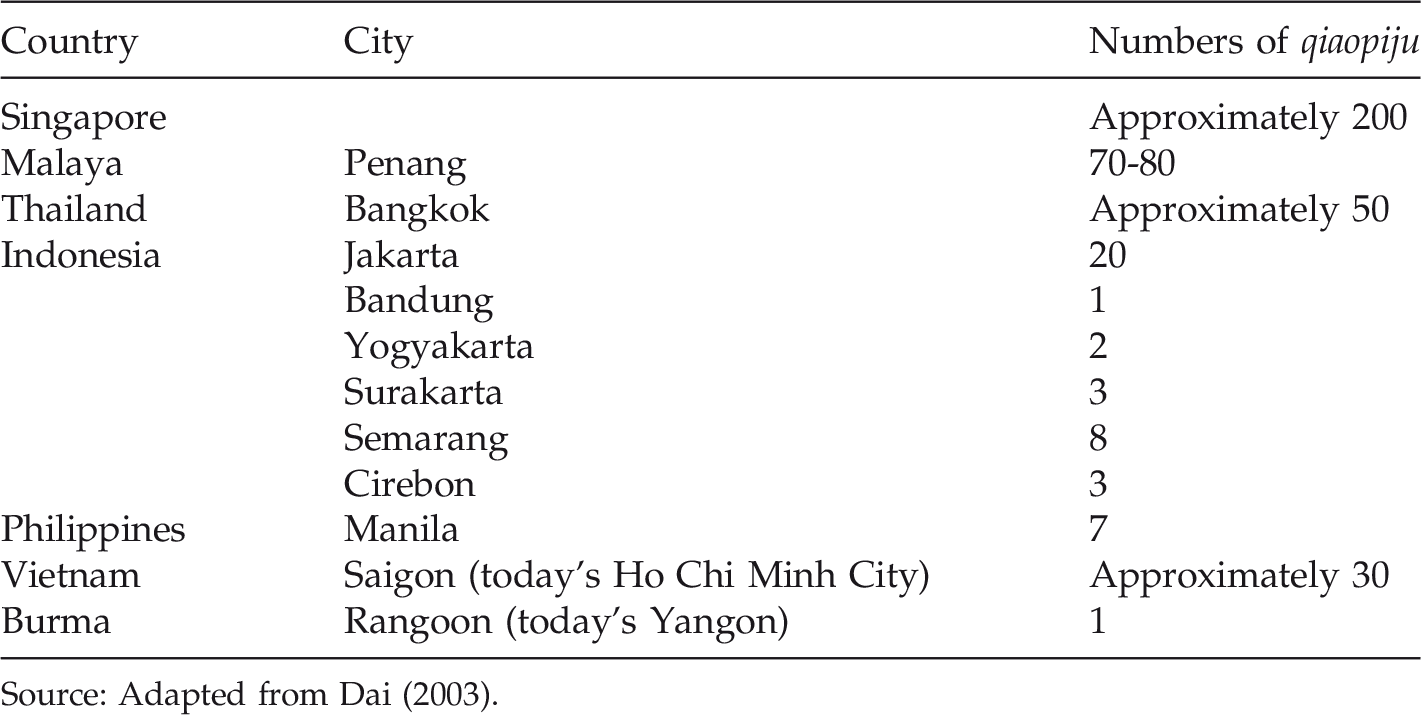
Therefore, given its strategic location and the population of Chinese immigrants, Singapore emerged as the center for qiaopi trade in Southeast Asia. According to official statistics in the early 20th century, Singapore had the largest numbers of qiaopiju in Southeast Asia (Table 2).
Numbers of qiaopiju in Southeast Asia (early 20th century).
Source: Adapted from Dai (2003).
In short, the making of Singapore as a maritime hub for China trade and Chinese migration was accompanied by the rising number of Chinese population and growing qiaopiju that helped sustain homeland linkages through transnational flows of capital, people, goods and information. In the meantime, as we will argue in the next sections, connecting the region of Southeast Asia through the qiaopi trade facilitated the transition of Singapore from a maritime hub to a key migration corridor in Chinese international migration, which also contributed to a transnational understanding of qiaopi in the context of a diasporic heritage corridor.
Formation of the qiaopi system in Singapore
From its establishment as a British trading post in the early 19th century to its growth into a global trans-shipment hub, the development of Singapore’s port has been synonymous with the modern history of the city-state. Singapore has also been a migrant society, in which the Chinese form the largest community. Among the Chinese community, there are five main sub-ethnic and dialect/locality communities, known as Hokkien, Teochew, Canton, Hakka and Hainan (Liu and Wong, 2004; Kwa and Kua, 2019). This pattern of sub-ethnic distribution was largely the same in other Southeast Asian countries, thus contributing significantly to Chinese social and business networking within the region as locality and dialect ties were the key elements underlying these networks.
After migrating to Singapore, the Chinese community still maintained close ties with their families and ancestral homeland, and one of the main forms of such connections was qiaopi. The qiaopi had numerous functions and dimensions, ranging from economic and social to cultural, education and political. The contents of qiaopi revealed Chinese immigrants’ lives in Singapore, their thoughts and reflections pertaining to family matters and ties with their hometowns (Benton et al., 2020). When the qiaopi business became an established trade in the late 19th century, those businessmen with good reputation and funds, especially owners of the stores in conjunction with the shuike (qiaopi courier), started to make it a regular business to take charge of such remittances. Their stores became the origin of qiaopiju. At that time, they also appointed the shuike as their employee. Most of the qiaopiju set up their branches or cooperated with their agents in Mainland China, Hong Kong and Southeast Asia. The operations of the qiaopiju were broader in geographic scope and function than those of the shuike, and were more reliable, reputable and trust-inspiring (Lee, 2016; Benton and Liu, 2018; Kua, 2019).
As mentioned, primordial ties, such as kinship and locality, served as the foundation of diaspora Chinese business and social activities during most of the past two centuries. In a similar vein, most of the qiaopiju were formed on such a basis. There were 49 qiaopiju in Singapore in 1887, among them 34 were run by the Teochew dialect group, 12 by Hokkien, two by Hakka and one by Cantonese. There were 180,000 packages of qiaopi sent in 1886, which increased to 280,000 three years later. The amount of remittance involved was one million Straits dollars (Singapore’s currency then) each year (Kua, 2019; Lee, 2016). In the following years, the Hainanese community also set up their own qiaopiju. At the time of Straits Settlements (1826–1946), the qiaopi trade in Singapore was demarcated by “dialect” and hometown connections and was further differentiated by sub-regional and sub-dialect levels. Members of any one particular community tended to send qiaopi through remittance houses operated by members of the same community (Lim, 1947). For example, the Hainanese usually used firms run by fellow Hainanese in Singapore (and elsewhere), whose businesses were all concentrated in the same part of town. 8 Moreover, all the employees hired by the firms were Hainanese. Thus, they had no communication problem with their clients and were able to help those who were illiterate or semiliterate to write letters in the Hainanese dialect. 9 Based on trust within the same community, the qiaopi firms sometimes provided advance remittance for the sender and let him pay back later when he got an income. 10
With the establishment of modern banks and post offices, some qiaopiju started to cooperate with these institutions, which made sending remittance or letters more convenient. Hence, a new cooperation and operation network of qiaopi trade was formed as qiaopiju—bank—qiaopiju or qiaopiju—post office—qiaopiju (Benton and Liu, 2018; Kua, 2019). In other words, the qiaopi system in Singapore went through three stages of transformations from the late 19th century to the 1950s—sending qiaopi through shuike or small stores, formation of qiaopiju, and cooperation between qiaopiju and banks or post offices.
The evolution of the qiaopi trade in Singapore reflects the changing characteristics of ethnic Chinese identity. Starting from the shuike, the qiaopi trade helped link the Chinese communities. Although Chinese immigrants were scattered in different places, the shuike would visit these places to collect qiaopi as well as share various pieces of information, which strengthened their collective identity as diaspora Chinese with a sense of sub-regional belonging. As qiaopi traders started to interact with people from different dialect groups, they established business relationships and undertook information exchange with each other, leading to the gradual formation of Singaporean Chinese identity that was beyond the primordial ties.
As McKeown (2004: 178) reminded us, in the process of global migration, the family served as “the fundamental arena of decision-making.” The qiaopi helped cement this role by strengthening and institutionalizing linkages between the family in the ancestral hometown and the overseas Chinese. This was an important emotional tie at a time when most of the immigrants began settling, gradually but permanently, in Singapore, as indicated by their move to become citizens of Singapore after the late 1950s. Although the first-generation immigrants still maintained close connections with the homeland through qiaopi across political borders, their new political identity as Singaporeans was also emerging. Over time, identification with Singapore increasingly became the primary and overarching allegiance for the subsequent generations who have no institutional linkages and little, if any, sentimental connection with China. Partly as a result of this broader transition, the number of qiaopiju declined from its peak of 200 in the late 1940s to about 60 in 1970 (Kua, 2019).
The weakening connection with the homeland as well as the emergence of powerful nation-states (along with their financial institutions such as banks) were major reasons for the demise of the qiaopi trade in the 1970s. It was also a time of rapid economic growth for Singapore, and as it became a globalizing nation-state, the island-state maintained its role as a migration corridor not only for new Chinese immigrants who left China after the end of the 1970s, but also for those from outside the region such as South Asians (Rahman, 2010; Bastide, 2011; Ren and Liu, 2015; Van Dongen and Liu, 2018).
Qiaopi system and the making of Singapore as a migration corridor
Singapore’s economic rise was, and has been, significantly facilitated by its strategic role in connecting trades between Europe, China and Southeast Asia. From 1828 to 1852, the main focus of regional trade shifted from Java to Singapore, and the growth of trade was facilitated by the rise of Chinese middlemen in Singapore. They purchased cotton goods from European merchants on credit, formed long-term relationships with Chinese traders through recurring transactions, while at the same time engaging in on-the-spot market transactions with local indigenous traders. It has been argued that the resulting multilateral trade relationships facilitated the distribution of European cotton goods throughout the region, thereby further stimulating Singapore’s intra-regional trade (Kobayashi, 2018). The very same process of intra-regional qiaopi trade also took place in the late 19th and most of the 20th centuries, which led to the strengthening of Singapore as an undisputed center of the maritime corridor.
We mentioned earlier about the functions of qiaopiju in collecting remittances and letters from Singapore, which were subsequently delivered to the hometowns in South China (sometimes by way of Hong Kong). In addition to this bilateral route, which has been well studied in the existing literature, Singapore also provided institutional (business and socio-economic) support and effective coordination for the qiaopi trade in the region of Southeast Asia (see Figure 1).
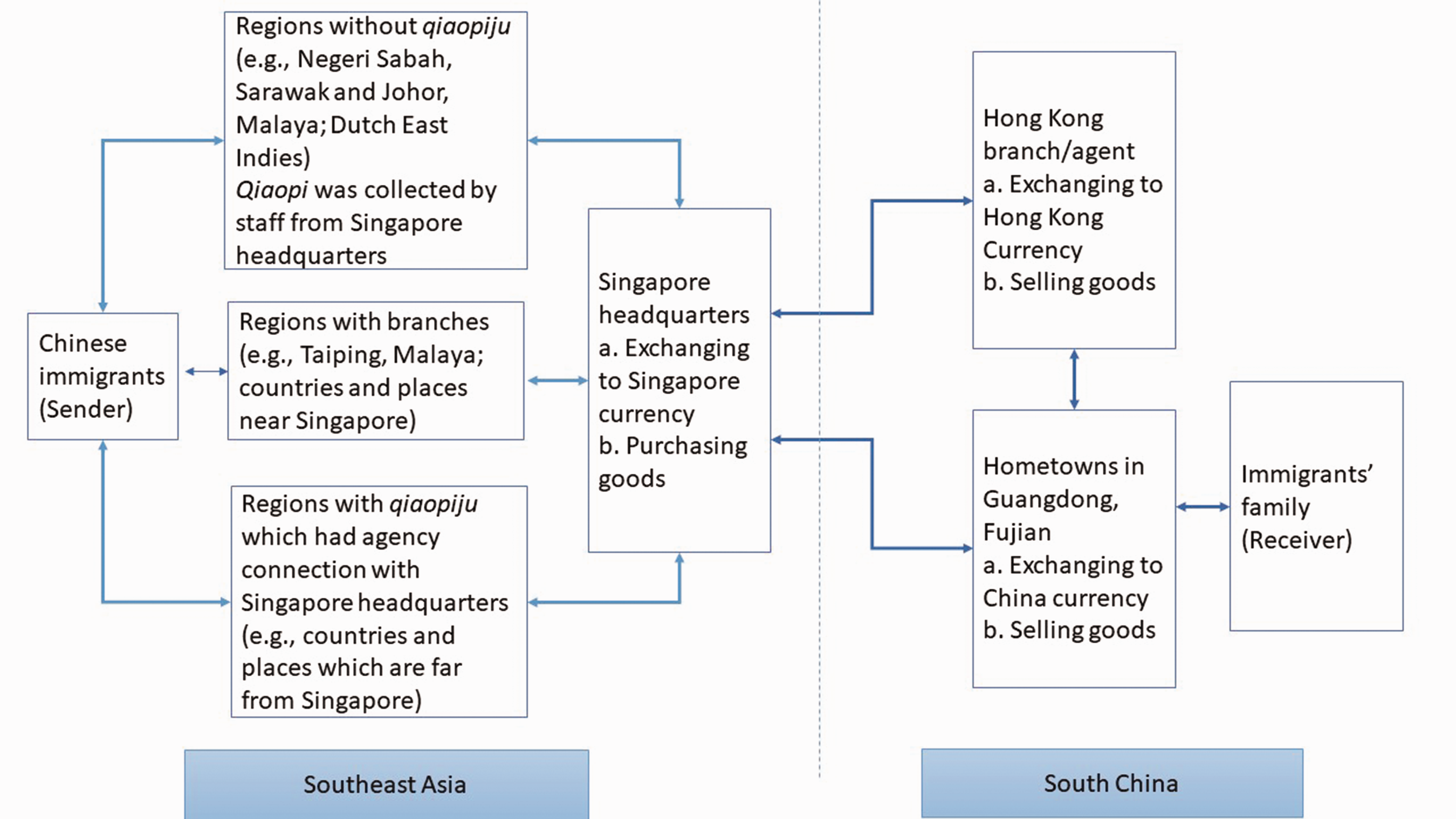
Singapore’s institutional coordination of the qiaopi trade in Southeast Asia.
This institutionalized business arrangement was supplemented by individual qiaopi traders who connected their business throughout China and Southeast Asia. Loo Neng (1915-?), who started his qiaopi trading in the 1940s, set up remittance firms in Hong Kong, Shanghai, Guangzhou and Hainan. The remittance collected from his Singapore stores was used to purchase goods and sent to his other stores. After the goods were sold, the money would be remitted to the immigrants’ family in South China. During this transaction process, the trader could subsequently obtain more profits than merely running a qiaopi business alone. 11 Similarly, Lim Soo Gan (1923–1993), founder of the Nanyang Exchange and Remittance Association, engaged in various businesses, including remittance, rubber, tea trading, groceries and soy sauce. His business was expanded beyond Singapore to China and other Southeast Asian countries, such as Indonesia, Thailand and Malaysia. 12
In other words, most of the qiaopi traders ran a transnational business operation which covered diverse areas, including collection of remittance, purchase and sale of goods, assisting the writing of letters (as most immigrants were illiterate), and distribution of remittance, and collecting huipi (returning letters from the family in the homeland). These multidimensional flows of capital, goods, information and people reinforced Singapore’s position as an indispensable nexus of the migration corridor. This position was strengthened and institutionalized by region-wide qiaopi associations for the purpose of business networking and setting up market conventions. As has been established, market conventions, transport, commodities were all important factors in the growth of “the trade that created the modern world” (Pomeranz and Topik, 2012).
These region-wide associations pertaining to the qiaopi trade were established in Singapore to articulate and protect the traders’ interests and served as a collective voice to exert pressure upon governments in Southeast Asia and China. In response to the British colonial government and the Chinese government’s restrictions on the qiaopi trade, the early 1900s saw the emergence of qiaopi federations in Southeast Asia, including the Teochew Qiaopi Federation, Hokkien Qiaopi Federation and Hainan Qiaopi Federation. While most of their activities were under the auspices of the Chinese Chamber of Commerce in their respective countries, Singapore played a leadership and coordinating role for the collective actions, partly due to its geographic centrality to much of the qiaopi trade as described above, and because it was (and remains) the most solidly ethnic-Chinese city outside Mainland China, Hong Kong and Taiwan. Furthermore, the robust nature of these associations, underlined by substantial financial resources and effective leaders of these associations who had broad personal and business connections throughout Asia, further enhanced Singapore’s centrality in the making of the migration corridor through the qiaopi trade (Liu, 1999; Liu and Wong, 2004).
In March 1946, a broad-based Nanyang Exchange and Remittance Association was formed under the leadership of Lim Soo Gan. As its name (Nanyang, or Southeast Asia) indicated, it had a larger membership and target clientele beyond Singapore. It was not only the leading association linking with the various dialect-based qiaopi federations in Singapore, but a regional hub for qiaopi federations located in other Southeast Asian countries. It served as a coordinator among qiaopi traders of all Southeast Asian countries as well as between them and various governments in China and Nanyang. There were numerous official letters pertaining to liaising with remittance associations across the region, with the British government in Singapore as well as Chinese central and local governments in the immigrants’ hometown for collective actions on issues such as the exchange rate and regulations on trade (Nanyang Exchange and Remittance Association, 1947).
After the end of the Second World War, the Chinese immigrants were eager to send remittances to their families in the hometowns, which were devastated by the Japanese occupation and subsequent civil war. This led to the so-called “golden era of the qiaopi trade” in the second half of the 1940s, with the amount of remittances reaching CNY150 million in just a week in November 1945, making remittance the most profitable business in Singapore at the time (Kua, 2019). It was necessary to have an institutional mechanism to settle various disputes, the exchange rates and other market conventions. The Nanyang Exchange and Remittance Association helped qiaopi traders and immigrants in Singapore as well as in other Southeast Asian countries to solve the problems of sending the remittances back home. For example, Indonesia did not have a channel to directly deliver qiaopi to China during that period, hence, all the qiaopi was sent to the homeland by way of Singapore. The Nanyang Exchange and Remittance Association coordinated various matters pertaining to remittances that were sent before the Second World War, which were lost when the war broke out. 13 The region-wide qiaopi traders associations’ institutional role was also extended to socio-economic areas. After the war, all the qiaopi traders were requested by the local governments to apply for a license to continue their remittance businesses. The Nanyang Exchange and Remittance Association served as the guarantor of qiaopi traders to apply for this license. Its guarantor role was not limited only to qiaopi traders in Singapore, but also included those in Malaya. 14
The qiaopi mobilization in Singapore can be seen as part of a national and transnational awakening of Chinese diaspora in Southeast Asia who were ready to project their interest vs. the nation-state. For example, the China government together with the Malay government wanted to control the setting of remittance exchange rates in the post-War years. In his capacity as Chairman of the Nanyang Exchange and Remittance Association and representative of the qiaopi traders, Lim Soo Gan negotiated with government officials and pleaded with the governments to allow the qiaopi traders themselves to decide remittance exchange rates in favor of the remittance senders (Nanyang Exchange and Remittance Association, 1947).
In short, Singapore has served as a key hub for economic and trading networks connecting Europe (later, North America) and China, as well as within the region of Southeast Asia for the past two centuries. This has become the broader context in which Singapore emerged as a strategic migration corridor for Chinese and other ethnic immigrants, such as the Indians. The vibrant qiaopi trade was centered in Singapore and supported by a complex web of institutional (business and socio-economic) mechanisms and individual firms engaged in the qiaopi trade. It not only strengthened Singapore’s migrant corridor but also provided key elements for its development through extensive flows of capital, goods, information and people in and outside Southeast Asia. While the late 1970s saw the qiaopi trade’s demise, Singapore continues to play a leading role as a regional and global financial hub, thanks in no small part to the historical legacy and institutional foundation as a migration corridor. In recent years, it has been ranked consistently as one of the top five global financial centers in the world, alongside New York and London (Reid, 2019). Its role as a Chinese migrant corridor has been revitalized after the launch of China’s reform and opening-up in 1978 and the Belt and Road Initiative (BRI) in 2013. Singapore is now a major hub for transnational Chinese migrants to and from the region, with Malaysia as the largest source of its foreign immigrant population (which collectively accounts for about one-third of the country’s total population), followed by Mainland China and Indonesia (UN Department of Economic and Social Affairs, 2019). In a related development, over the years, Singapore has attracted close to one-third of China’s outbound investment (to the 60-plus countries alongside the BRI), worth billions of dollars. Much of this has subsequently been rerouted to other Southeast Asian countries for various infrastructure and industrial projects (Liu, 2012; Liu et al., forthcoming, 2021).
Concluding remarks
This paper sets out to connect migration studies and heritage studies through a detailed analysis of the qiaopi trade in Singapore and beyond. Singapore’s emergence and continuance as a strategic migration corridor for Chinese diaspora has been a result of well-calibrated efforts by businesses (both local, regional and international) and various governments. While its geographic location has undoubtedly been conducive to its growth, an equally important factor has been the institutionalization of social and business networks established by the Chinese diaspora, who have effectively and skillfully connected the region with China, Europe and beyond. The qiaopi trade was an institution which existed and flourished throughout most of the past two centuries. It sustained the migration corridor through facilitating and mediating extensive transnational flows of capital, goods, people and information. The institutionalization of the qiaopi trade, through the region-wide business associations, further enhanced Singapore’s position as the most important migration corridor in the region and one of the most significant among the Chinese diaspora. The transition of Singapore from a colony to a nation-state over the past 55 years corresponded with the qiaopi trade’s decline. The importance of ethnic Chinese regional social and business networking, however, remains. In fact, the re-emergence of China as the largest economy in Asia has provided vast opportunities for Singapore to enhance its long-standing role as a migration and financial corridor. The influx of transnational Chinese and capital to Singapore contributes to its competitiveness in the global arena.
In view of qiaopi’s value as significant diasporic heritage, as demonstrated by its inclusion into the UNESCO Memory of the World Register and growing public and scholarly attention, this article also serves as a useful connecting node between migration studies and heritage studies, which have, until recently, been studied under different domains and theoretical frameworks, such as tourism studies (Reed, 2015). A number of recent studies on the Chinese diaspora have rightly highlighted the importance of linking diasporic heritage with qiaoxiang (Chinese ancestral hometowns), and they have called for a transnational perspective to migration heritage (Byrne, 2016; Candela, 2013; Wang, 2019; Cheng, 2019). Byrne has proposed the concept of “heritage corridor” to conceptualize the transnational connectivity between migrant heritage sites (in Australia) and overseas locales, as well as the bi-directional flow of ideas and capital encompassed by such a corridor. Our study has pointed to the need to go beyond the bi-directional focus of this new and inspiring scholarship and explore multi-directional movements of capital, goods, people and information which were behind the emergence of qiaopi and qiaopi trade from the 1820s to the 1980s. By linking concepts and empirical data pertaining to both migration corridors and heritage corridors, we will be able to decipher the complex patterns of migration and resultant diasporic heritage.
Seen from the interconnected perspective of migration and heritage corridors, there are two angles to approaching qiaopi. One is the institutional angle, examining the patterns and operations of the qiaopi trade which contributed to the formation and consolidation of Singapore as the central hub of Southeast Asian Chinese social, business and financial networks. We have established in the preceding discussion that the qiaopi trade constructed an economic and business network not only between the Chinese communities in Singapore and their hometowns but also extended to intra-regional engagements in Southeast Asia. The other angle is socio-cultural and psychological, examining the contents of qiaopi letters themselves, which will help reveal Chinese immigrants’ lives, sentiments, aspirations, feelings and thinking throughout the one-and-a-half century after the founding of modern Singapore in 1819. Furthermore, as an intangible diasporic heritage, qiaopi was a component of the modern history of Singapore. Not only did it connect immigrants with families separated by oceans and national boundaries, but it also contributed to Singapore’s emergence as the maritime corridor for Chinese immigration and its undisputed position as the financial center in Southeast Asia. It is hoped that future studies will be able to approach qiaopi from a socio-cultural and psychological angle within the inter-connected frameworks of migration studies and heritage studies, which will unveil a fuller picture of extensive transnational and intra-regional flows of capital, goods, people and information against the backdrops of colonialism, nationalism and globalization.
Footnotes
Acknowledgments
The authors are grateful for the constructive comments by the anonymous reviewers and the APMJ editors.
Declaration of conflicting interests
The authors declared no potential conflicts of interest with respect to the research, authorship, and/or publication of this paper.
Funding
The authors disclosed receipt of the following financial support for the research, authorship, and/or publication of this article: This work was supported by Nanyang Technological University (grant numbers M4081392 and M4081383).
1
The estimation of Chinese diaspora by Mainland Chinese scholars is nearly 60 million in 2017. See for example, statistical data in Center for China Globalization (2017).
2
For more details about the qiaopi official recognition, see UNESCO Memory of the World homepage (2013).
3
The collection is by Wang Chunxu and we are grateful for his permission to use the data and his oral history interview in this paper.
4
For details, see the National Archives of Singapore (NAS) website. Available at: https://www.nas.gov.sg/archivesonline/. For more information about Singapore’s oral history project, please refer to 
5
For the flow of people, the shuike [“water guest,” qiaopi courier] also helped to bring migrants to Singapore as well as arranged their accommodations, and helped find them work commensurate with their skills.
6
7
8
Interview with Wang Chunxu, Singapore, 27 April 2015.
12
Lim Soo Gan, oral history interviews, Access No. 000147. Available at: http://www.nas.gov.sg/archivesonline/oral_history_interviews/. On Lim’s business activities in the region and China, see Lim (2010) and Kua ().