



Abstract
The past decades have witnessed a burgeoning literature on guiqiao (Returned Overseas Chinese) in the People’s Republic of China. These works have advanced and broadened research in this field; however, there is a persistent male bias that tends to ignore the gendered nature of migration processes or simplistically frame the return migration of women through a monolithic masculine/patriotic lens. To fill this gap, this paper looks at gendered motivations behind the ‘return’ of Chinese women from Indonesia in the 1950s. Seeing gender as ‘a central organizing principle in migration flows and in the organization of migrants lives’ (Lutz 2010: 1651) and drawing upon interviews and archival studies, it suggests that the ‘return’ of Chinese women to Maoist China was closely associated with postcolonial feminist imagination, or more specifically, a longing for ‘emancipated womanhood,’ in a transnational context mediated by citizenship and ethnicity. In addition, the experiences of female guiqiao as voluntary migrants and successful careerists challenge the (mis)conception of Chinese women migrants as trailing dependents, adding a counter narrative to the overarching androcentric discourse about Chinese migration from a historical perspective.
Introduction
In the first three decades after the founding of the People’s Republic of China (PRC), partly due to the mounting overseas Chinese nationalism after the Second World War and partly because of anti-Chinese riots in Southeast Asia countries, about 1 million ethnic Chinese ‘returned’ to their ancestral homeland, with those from the Republic of Indonesia constituting the largest group (Lu and Quan, 2001: 284–285). The term ‘return’ is used here in a metaphorical sense. Particularly for the descendants of Chinese migrants who were born in Southeast Asia, ‘return’ refers to their migration to China, the ancestral homeland they had never been to before. 1 Largely speaking, there were three waves of ‘return migration’ from Southeast Asia to Maoist China (1949–1979). The first wave took place in the 1950s, which was marked by a large number of young ethnic Chinese who voluntarily ‘returned’ to China to continue their Chinese education and pursue a better future in the Socialist motherland (Godley, 1989; Godley and Coppel, 1990b). Among them, nearly half were women. 2 Many of these young returnees studied in universities and colleges and after completing their studies worked as teachers, engineers, doctors, artists or professionals in other fields in cities across China. Those who migrated to China in the 1960s had a different profile—they were mostly petty shopkeepers, traders and laborers who migrated with their families, fleeing anti-Chinese policies and riots in some Southeast Asian counties, especially Indonesia (Coppel, 1983; XJ Huang, 2005; Mackie, 1976). They were received by the Chinese government as ‘refugees’ and were assigned to huaqiao (Overseas Chinese) farms (华侨农场) in the rural areas of southern China, purposely built to accommodate the influx of refugees. Another cohort of returnees arrived in the 1970s, when a large number of ethnic Chinese fled the anti-Chinese violence in Vietnam. They were also accommodated in huaqiao farms.
Regardless of their time of arrival and whether the return was voluntary or involuntary, once they were ‘back’ in China, for policy purposes, the returnees/refugees were treated by the Chinese government as a particular group known as ‘guiqiao’ (归侨 Returned Overseas Chinese) to distinguish them from the domestic Chinese. The guiqiao were welcomed and recognized as Chinese citizens by the newly established communist regime. However, many of them were discriminated against or even persecuted during the Cultural Revolution (1966–1976) due to their connections with the capitalist world. It was only after the launch of ‘opening up and reform’ under Deng Xiaoping that the wrongdoings toward the guiqiao were gradually rectified (Wang, 2013). Some re-migrated to Hong Kong and Macau in the late 1970s and early 1980s when the Chinese government temporarily loosened its control over migration (Godley and Coppel, 1990a; Wang, 2006). The majority of the guiqiao settled permanently in China, got married and had children. Many of them are now retired and some have passed away (XJ Huang, 2005: 56, 60–61).
As one of the most important forms of international mobility in Maoist China, the guiqiao have attracted growing scholarly attention among both Chinese and Western scholars. Published research on this subject include surveys of the guiqiao history (XJ Huang, 2005; Peterson, 2012) and case studies of the guiqiao residing in cities (Godley, 1989; Godley and Coppel, 1990a, 1990b; J Huang, 1999, 2005, 2007; Wang, 2006) and rural areas especially in the state-run huaqiao farms (Han, 2013; Li, 2005; Naicang, 2010; Tan, 2010). These publications have undoubtedly widened and deepened scholarly research of the guiqiao. There is, however, a persistent male bias that tends to ignore the gendered nature of migration processes or simplistically frame female migration through a monolithic masculine lens. The guiqiao, men and women, were often homogeneously framed as ‘patriotic subjects’—they were depicted as ‘heroes’ whose return to Maoist China was motived by nationalist sentiments. Although nationalism was definitely a relevant and sometimes crucial element in studying the ‘return’ of the overseas Chinese in the aftermath of the Second World War, this perspective alone is unable to unveil the highly complex and fluid picture behind this unprecedented return migration in modern Chinese history. The existing literature has so far paid little attention to the experiences of women guiqiao and fails to answer the question of how gender functions as one of the ‘axes of power and difference’ (Donato et al., 2006: 6) affecting identifications and decision-making of women guiqiao about whom they wanted to be and where they wanted to go. As a result, the ways in which female overseas Chinese engaged with challenges and opportunities in one of the most critical moments in the history of both China and Indonesia were largely unexplored and untheorized.
To remedy the methodological and theoretical invisibility of women in guiqiao studies, we see gender as ‘a central organizing principle in migration flows and in the organization of migrants’ lives’ (Lutz, 2010: 1651) and explore the complex relations between migrants’ imagination of China and their migration intentions and experiences in a transnational context. In this paper, we consider, in particular, the motivations behind the ‘return’ of Indonesian Chinese women in the 1950s. As voluntary returnees who went to China in the 1950s as secondary-school graduates or students seeking educational and career opportunities, 3 the Indonesian Chinese women exhibited more agency in their decision-making processes compared to the refugees from Indonesia who arrived in China in the 1960s. Their life experiences thus provide us with valuable material for examining (gendered) motivations behind the return of the overseas Chinese. As the background and processes of the ‘return’ of the Indonesian Chinese in the 1960s were qualitatively different from those of the 1950s guiqiao, the experience of this group is discussed in a separate paper.
The participants in this study were recruited through the Beijing Association of the Returned Overseas Chinese from Indonesia, 4 an organization formed and run by the Indonesian guiqiao themselves; several were identified through snowballing. In total, we interviewed 20 Indonesian guiqiao in Guangzhou and Beijing in various years, 2003, 2004, 2005 and 2016. The profile of the 10 women, the focus of this study, is shown in Table 1. 5 The interviews were supplemented by information and insights from Chinese-language newspapers published in 1950s Indonesia as well as the life stories of the Indonesian guiqiao recently published in the PRC. 6 The findings from this qualitative research do not represent the motivations of all Indonesian women guiqiao. However, the rich and diverse experiences of the interviewees discussed here strongly illustrate the complex ways in which gender shaped and was shaped by the desire and imaginations of the homeland among the Indonesian Chinese women who ‘returned’ to 1950s China.
Profile of the interviewed guiqiao.
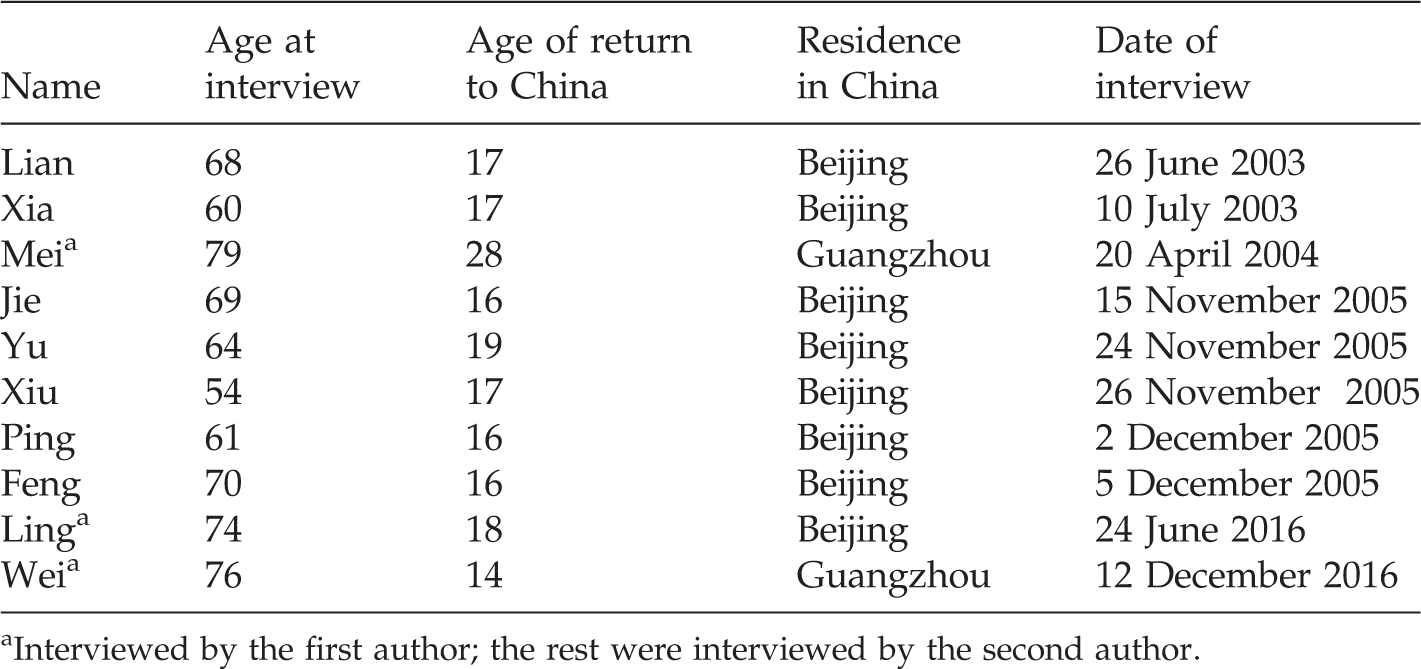
aInterviewed by the first author; the rest were interviewed by the second author.
The following section provides a brief review of the relationship between desire and migration as the analytical framework of this research. Next, the paper contextualizes this study in the rise of the women’s movement in postcolonial Indonesia and Maoist China, with an emphasis on the dilemma and orientations of the Indonesian Chinese women in their pursuit of modern womanhood. The main body of this article discusses the three different ways in which Maoist China was imagined by the young Indonesian Chinese women, and how the gendered imagination of China influenced their intention to return and informed their decision-making processes. The major findings and contributions of this paper are discussed in the conclusion.
Desire and return
Earlier literature on transnational migration studies tends to explain people’s motivations for emigration in terms of the ‘rational choice’ of individual migrants, based on careful evaluation of such factors as job market conditions, career prospects and income levels (Beaverstock, 1994; Findlay, 1990, 1995). Other scholars argue that the direction and dynamics of migration are shaped chiefly by structural factors, such as the new global redistribution of capital and investment driven by a ‘new international division of labour’ (Frobel et al., 1978: 123). Although these propositions help clarify many issues, they ignore the important role of non-economic and non-rational factors, such as emotion and desire, in migration motivations and processes. In addition, they often overlook the internal differences of highly diversified and fluid migration experiences structured around gender, ethnicity and class. Recently, more and more research has pointed out that migration decision-making is not necessarily rational, nor is it always the result of economic calculation. It is necessary to search for the ‘human face’ (Favell et al., 2006: 1) of migrants behind the aggregate data and structural logics in the decision-making process and to explore how the decision-making of migrants as racialized and gendered human beings is deeply shaped by the social, cultural and political environment in which emigration takes place. For instance, studies show the reasons for migration and destination choice are often informed by the knowledge and experiences people obtained from school, literary work and the media long before they embarked on emigration (Robinson and Carey, 2000; Tseng, 2011). In addition, experiences of repression in patriarchal societies often motivated young females to run away from their own countries to search for ‘personal freedom’ and ‘self-empowerment’ elsewhere (Ho, 2006; Thang et al., 2002; Yeoh and Willis, 1999). For educated young people, it is usually the drive of self-discovering and self-development, rather than the consideration of immediate economic gains, that played a decisive role in their decision-making process (Conradson and Latham, 2005; Ho, 2011; Kim, 2010).
Building on this body of literature, in this study, we focus on the motivations behind the return to China of Indonesian Chinese women in the 1950s. In particular, it aims at exploring the ways in which the decision-making of Indonesian Chinese women interlocked with their yearning for modern womanhood or more specifically, women’s emancipation, in a transnational context. This study contributes to the existing literature on guiqiao studies in two specific ways. Firstly, it suggests that it is necessary to move away from the highly abstract and generalized notion of ‘return’ as a patriotic action to a more nuanced vision that depicts returnees as embodied ‘desiring subjects’ (Rofel, 2007:2) who consciously make decisions about when and where to go through constantly negotiating their relationship with the external world. Although nationalism was indeed a major source of motivation behind the return of the guiqiao, a gendered imagination of China stimulated by the discourse of ‘women’s emancipation’ was also an important factor, although not necessarily the most important one. In other words, we are not saying that ‘women’s emancipation’ is more significant than or contradictory to ‘nationalism.’ Rather, we argue that ‘women’s emancipation’ intertwined with and complemented the discourse of nationalism in shaping quiqiao women’s longing about the homeland and nurturing their desire to ‘return.’ Secondly, this study points to the intersection and interaction between the return migration of people and the flow of things in the form of Chinese newspapers, magazines, films, operas, works of literature and letters home circulating between China and Indonesia in the 1950s. These material vehicles acted as important media through which an ‘emotional corridor,’ that is, the two-way circulation of ideas, aspiration and affect between Indonesia and China, came into being, providing the Indonesian Chinese women with a transnational space in which the gendered imagination of Maoist China was constructed and negotiated.
Negotiating women’s emancipation in a transnational context
The Indonesian Chinese women’s imagination of China was deeply embedded in the discourse of ‘emancipated womanhood’ that was on the rise in both postcolonial Indonesia and Maoist China. The inception of the women’s movement in Indonesia can be traced to the colonial era (Smith, 2008: 348–351). After gaining independence in 1945, the women’s movement entered a new phase. Kongres Wanita Indonesia or Kowani (Indonesian Women’s Congress) was established in 1945 as a nationwide women’s association of the new republic (Martyn, 2005). Apart from calling for protecting women’s rights in education, marriage and employment, Kowani made great efforts in mobilizing women from different backgrounds to participate in the anti-colonialism and anti-imperialism struggle of the new republic (Tjong, 2013: 28).
Indeed, no matter during the colonial era or in the postcolonial situation, Indonesia’s ‘women’s movement overlapped with the nationalist movement to a considerable extent’ (Smith, 2008: 350). Taking political and religious interests as the first priority on its agenda, Kowani had never fully developed into a gender-based unified organization. There was little evidence that the Indonesian Chinese women participated in the women’s movement in Indonesia (Martyn, 2005: 69–71). This separation was further deepened by the intensifying ethnic tension between the Chinese community and the local population in the aftermath of Indonesia’s independence. With the rise of indigenous nationalism in the late 1940s, the Chinese became the target of attacks due to the perceived economic dominance of Chinese in some fields and their privileged status given by the Dutch colonial authorities. After the implementation of the dual nationality agreement in June 1955, 7 various discriminatory legislations against the ethnic Chinese were introduced, accompanied by racial riots against the Chinese in some places (Coppel, 1983: 52–72; Mackie, 1976: 77–138). Under these circumstances, the Indonesian Chinese women were largely excluded from the women’s movement under the leadership of Kowani.
The estrangement of Indonesian Chinese women from the mainstream women’s movement was also noticed by Chinese communities in Indonesia. On 8 March 1951, International Women’s Day, the Jakarta-based Chinese newspaper Shenghuo Bao (《生活报》) published an editorial to call for collaboration between the Chinese and Indonesian women in safeguarding women’s rights: The Indonesian women and the Chinese women are ‘sisters’ among the women in Asian nations, and both of them have been the victims of imperialist and feudalist oppression … it is a great shame that the Chinese women have not formed close relationship with the Indonesian women so far. If the Chinese women could establish close friendship with the Indonesian women from all walks of life, it will not only enhance the mutual bonds between China and Indonesia, but also contribute to the development of peace-keeping force in Asia (YSBJCB, 2013:31, authors’ translation).
8
Although frustrated by not being able to participate in the women’s movement in the host society, the Indonesian Chinese women were thrilled by what was happening in their ancestral motherland on the other side of the South China Sea. In the first decade after the founding of the PRC, when it was still in the pre-socialist stage of ‘New Democracy,’ the Chinese Communist Party (CCP) employed moderate policies to mobilize various forces with diverse social, economic and ethnic affiliations, including the Overseas Chinese, to consolidate the new regime. Under this highly flexible state-building policy, China made impressive progress in economic growth and social development in a short period of time. The unprecedented socio-economic advancement in China stimulated a widespread nationalist sentiment among the Chinese in Indonesia and many other Southeast Asian countries. To the Indonesian Chinese women, what struck them most was the hugely improved status of women as a result of the ‘women’s emancipation movement’ under Mao. Soon after coming into power, the new communist regime wasted no time in setting up organizations and making laws to safeguard women’s rights in almost all aspects of life. The All-China Women’s Federation (中国妇联) was established in 1949 as the first country-wide women’s organization. The 1950 Marriage Law, the first civil law made in Maoist China, stipulated that men and women were equal in marriage. A woman had the right to choose her marriage partner and to divorce if she was not happy with the marriage. Arranged marriage was prohibited. The concubine and child bride customs that oppressed Chinese women from deprived family backgrounds for centuries were also abolished. The 1953 Election Law stipulated that men and women enjoyed the same right of suffrage and election. In 1954, the PRC published its first Constitution, according to which women enjoyed the same rights as men in political, economic, cultural, social and family life and men and women must have the same pay in work (Chen, 2011: 5). The Constitution and laws set up a legal foundation that never before existed in China to safeguard women’s rights.
A key feature of the women’s emancipation movement in Maoist China was the high percentage of women participating in the work force. Mao believed it was only by improving their economic status that women could enhance their status in the family and society and achieve real equality between men and women (Zuo, 2013: 98). In addition, China was then in urgent need of human resource for economic rehabilitation and construction, and women were encouraged to be educated and work alongside men. As a result, the percentage of women in employment increased rapidly in the first decade after the founding of the PRC. The number of women working in state-owned working units rose from 600,000 in 1949 to 3.28 million in 1957. It further reached over 10 million in 1958 (Gao, 2010). Women were found working in a variety of occupations, ranging from factory workers, nurses and doctors, teachers, engineers to governmental officers and so on.
The women’s emancipation movement in Maoist China quickly became the source of inspiration for the Indonesian Chinese women. Taking the Chinese community at Pontianak, Western Kalimantan as an example, less than four months after the founding of the PRC, the Chinese community established the Pontianak Chinese Women’s Association on 15 January 1950. On the first anniversary of the association, Bai Difen, the association chairwoman, published an article on the local Chinese newspaper Liming Bao (《黎明报》) to call the Indonesian Chinese women to follow the footsteps of their sisters in the motherland to ‘strive for a more proactive life:’ The women in our motherland are truly walking on the road to emancipation. They are undertaking various high-demanding jobs in the same way as men. They are striving for independence through actions … I hope that the sisters in Pontianak could follow in the footsteps of the women in the motherland, to have a clearer understanding of the objectives of our work, to pursue independent personhood and live a meaningful life (Bai, 1951).
What happened in Pontianak was echoed by the rise of the Chinese women’s movement in other places in Indonesia. Lin Liyv, who was born in Lubuk Pakam, northern Sumatra, and moved to China in 1954 as a teenager, recalled something similar: I was then a student at an evening school in Lubuk Pakam. The students paid close attention to the developments in China and kept abreast of the domestic situation. At one time, it was popular among the women in China to wear cargo pants. The girls at my school also dressed up in the same style and took a group photo to mark the occasion. In 1951, we organized the Chinese women in Lubuk Pakam to celebrate March 8, the International Women’s Day. The next year, the Lubuk Pakam Chinese Women’s Association was formally established (Lin, 2008: 224).
As discussed above, the Indonesian Chinese women’s yearning for emancipated womanhood was deeply embedded in the transnational context of the women’s movement in postcolonial Indonesia and Maoist China. Being excluded from the women’s movement in Indonesia, they became attracted to the women’s emancipation movement in Maoist China and the Indonesian Chinese women’s movement gradually became China oriented. Although they had never been to the ancestral motherland, the Indonesian Chinese women’s image of Maoist China as a desirable migration destination was deeply shaped by the knowledge they obtained from reading Chinese newspapers and magazines, watching films and operas and reading literary works that were imported from the PRC and widely circulated in Indonesia at that time. The correspondence between the Indonesian Chinese and their siblings and friends who were already in China also heavily influenced their perceptions of China. The exchanges of these texts and images between China and Indonesia contributed to the development of an ‘emotional corridor’ that played an important role in fostering the imagination of China as a paradise for women’s liberation.
The making of an ‘emotional corridor’ between Indonesia and China
The Republic of Indonesia and the PRC were both newborn countries in the aftermath of the Second World War. Sharing the common language of anti-colonialism and anti-imperialism struggle, Indonesia was one of the first non-socialist countries that established a formal diplomatic relationship with the PRC. The newly established Indonesian government adopted a laissez faire policy toward Chinese-language education in Indonesia. As a result, Indonesia in the 1950s witnessed the burgeoning of Chinese-language schools and the influx of a large number of Chinese newspapers, magazines, films, books and other cultural products from the PRC. With the wide circulation of these literature and images, the language of women’s emancipation, or ‘standing up’ (翻身) as termed by Hinton (1966), became a popular discourse well known among the Indonesian Chinese women. Indeed, from the early 1950s to the 1970s, slogans such as ‘Women hold up half the sky’ (妇女能顶半边天) and ‘Time has changed, and men and women are now equal’ (时代不同了, 男女都一样) frequently appeared on the front pages of major Chinese newspapers (Zuo, 2013: 98). These fresh and memorable headlines strongly signified a positive image of the Chinese women as independent subjects that, for the first time in history, started to enjoy equal rights with men in society.
The liberated image of women in Maoist China was further popularized and visualized by imported Chinese documentary and feature films. A retired civil servant who moved to China in 1964, told us vividly the influence of Chinese films on the Chinese community in 1950s Indonesia: There were three cinemas in Pontianak, and they screened films imported from China from time to time. I remember that a documentary film called The Ode to Motherland (《祖国颂》) was screened on China’s National Day in 1957. The film was so popular that the screening lasted for two consecutive weeks. I myself watched it three times. Another Chinese film that was very popular at that time was Five Golden Flowers《五朵金花》.
9
The theme song of the film was so pleasant and catchy that you could literally hear people humming the song every time while walking on the street (Interview with Youqi, male, 66 years old, 9 August 2017, Beijing).
10
In addition to films, operas played an equally significant role in spreading the new image of women among the Indonesian Chinese. A variety of operas, ranging from plays, Peking opera, Cantonese opera, Fujian opera to Huangmei opera, were put on stage. They showed how the Chinese women peasants were liberated from feudal and oppression by the CCP, as exemplified by The White-haired Girl (《白毛女》), and the active participation of women in building a New China under Mao, as in the case of Brother and Sister Opening up Wasteland (《兄妹开荒》) (Huang, 2000: 180–182). Many of the operas were performed by amateur actors and actresses made up of young Chinese school students. In 1954, the Bandung Huaqiao Middle School put on stage a one-act play called Women Representatives (《妇女代表》), depicting the involvement and contribution of women in the land reform in the northeastern part of China. The play sent out a strong message that ‘only by walking out of the domestic space of the family and obtaining political and economic independence could women achieve complete emancipation and live a new life of democracy and equality … the leading actress Zhang Guirong became a symbol of women emancipation among the Indonesian Chinese women at that time’ (Zhang, 2007: 751). In Singkawang and Pemangkat of Western Kalimantan, enthusiastic students even went to nearby towns and villages where many ethnic Chinese resided to perform operas that reflected China’s advancement and the new face of Chinese women (Yang, 2004: 162-163).
Thirdly, literary works written by left-wing Chinese writers such as Lu Xun, and revolutionary fictions and stories such as The Song of Youth (《青春之歌》) and Liu Hulan (《刘胡兰》) were all easily available from Chinese bookstores and school libraries across Indonesia (Sun, 2006). In addition, a large number of literary works produced by Soviet Russian writers, such as How the Steel was Tempered《钢铁是怎样炼成的》, The Story of Zoya and Shura (《卓娅和舒拉的故事》) and The Young Guard (《青年近卫军》), were translated into Chinese and became extremely popular among Chinese readers. The Chinese translations of these books were also introduced to Chinese students and young intellectuals in Southeast Asian countries including Indonesia. These Chinese and Soviet Russian novels left a deep and long-lasting impact on the imagination and pursuit of a new life among the Indonesian Chinese women (Chen, 2013).
In addition to Chinese newspapers, films, operas and books, private correspondence between the Indonesian Chinese and their siblings and friends who had already returned to China constituted a unique but equally important source of inspiration. In this correspondence, the guiqiao shared their excitement of living in socialist China and spoke highly of the socio-economic progress in the New China. These letters were not only read by family members and close friends, but also circulated widely in the local Chinese community (Liu, 1999: 110). According to Zheng Zhenmiao, a guiqiao from Indonesia residing in Tianjin, when China published its first Constitution in 1954, she translated it into Bahasa Indonesia and sent it to her father who distributed it among their relatives and friends (Zheng, 2007: 365). The positive first-hand experience of the guiqiao further convinced the Indonesian Chinese women that Maoist China was the right place to go. Mei, a retired middle-school teacher who went to China in 1953 at the age of 28, recalled: We listened to the radio to follow the developments in China and were excited about China’s great achievements. In the meantime, I received letters regularly from my first brother and my youngest uncle who were at that time studying in a senior middle school in Guangzhou. Their experiences of living in China further enhanced my faith in the motherland (Interview with Mei, 79 years old, 20 April 2004, Guangzhou).
Indeed, although overseas Chinese nationalism acted as an overarching discourse that affected the return of the Indonesian Chinese in the 1950s, when it comes to the motivations behind the return of the Indonesian Chinese women, it was the discourse of ‘women’s emancipation’ conveyed through the ‘emotional corridor’ between China and Indonesia that really mattered. It became the ‘seed of migration,’ referring to ‘historical linkages between the cultural-social milieu of a migrant and the formation over time of values conducive to migration’ (Findlay and Li, 1997: 38–39). The Indonesian Chinese students went to China in batches, usually together with schoolmates of the same cohort or friends of similar age, leaving their parents and other family members behind. Although some were fortunate enough to receive full financial support from their parents, some others did short-term work to save money to subsidize the trip. For the Indonesian Chinese women, as will be discussed below, their imagination of China was highly gendered, manifested in three distinctive but also overlapping realms. Together, they nurtured the motivation of return among the Indonesian Chinese women we have studied.
Gendered imaginations of China
By placing gender in the center of analysis, this study reveals that the Indonesian Chinese women’s negotiation of modern womanhood was played out in three coexisting and overlapping realms, namely, the realm of self-development, the realm of career aspiration and the realm of empowerment. Each realm is defined by and defines a particular set of geo-political and geo-economic relations between Indonesia and China, nurturing a specific subjective position of the Indonesian Chinese women in their imagination of China as a desirable migration destination. As shown in the discussion below, these positions are neither fixed nor mutually exclusive. Rather, they are overlapping in nurturing the migration intention of the young Indonesian Chinese women.
The homeland as the place for continuous education
Among the 10 women guiqiao we interviewed, nine were teenagers who were middle-school graduates or students at the time of their migration to China. For many, the chief motivation for their ‘return’ was the desire to continue their education. The 1950s witnessed a surge of new Chinese schools across Indonesia. According to one source of statistics, the number of Chinese schools increased from 816 in 1949 to 1,861 in 1957, and in the same period, the number of students enrolled in Chinese schools rose from 230,000 to 400,000 (Huang, 2000: 107). Many teachers or school masters hired by the new schools were pro-CCP intellectuals who recently arrived from China. Under their influence, the Chinese schools in 1950s Indonesia aimed at fostering nationalist sentiment among students. Consequently, in most schools, the development of the curriculum, the choice of textbooks and the content of teaching, especially in subjects such as Chinese literature, history and geography, became increasingly China oriented (Liang, 2013:7). One Indonesian Chinese woman who graduated from ‘Hua Chung Jakarta,’ a prominent Chinese middle school based in Jakarta, recalled: Mr. Zhang Guoji, the deputy school master and the teacher of my Chinese and history subjects, advised us to have high ideals and big ambitions, and to embrace new ideas and practices in the big family of motherland … He particularly told us female students that we should not be satisfied with being a good housewife after leaving school. Instead, we should think carefully about our future and choose the correct way of life. He told us that we should dare to break through all sorts of obstacles to chase our dreams, not letting our mothers’ tears weaken our determination (to go to China) and forfeit our bright future (Qiu, 1999: 69).
In addition to the influence of the pro-CCP teachers, the educational opportunities that opened up in China were also appealing to the young Chinese students in Indonesia. In the early years of the PRC, the overseas Chinese were seen by the CCP as a much-needed source of manpower and capital for restoring and building the war-torn national economy. The Chinese government actively encouraged the return of the overseas Chinese students and young professionals. It offered preferential treatment to the returned overseas Chinese students who received not only free secondary and tertiary education but also certain subsidies from the state during the period of education (Wang 2013: 73–74). Under these circumstances, it was not surprising that a large number of overseas Chinese students joined the returning tide to Maoist China. According to Suryadinata (1978: 150–153), prior to 1958, nearly half of the graduates from Chinese middle schools went to the PRC, a few went to Taiwan and Western countries, and the rest remained in Indonesia. Even after 1958 when migration to China started to decline due to domestic political turbulence and economic difficulties, majority of Chinese middle-school graduates still opted to continue their studies in China.
In Indonesia at the time, nearly half of the students who left for China were girls. Taking ‘Hua Chung Jakarta’ as an example, in 1957, a total of 322 students graduated from the senior department. Among them, 102 returned to China, including 53 men and 49 women (Shi and Jv, 2017: 240). Although both boys and girls were attracted by educational opportunities in China, our interviews revealed this factor was particularly important to girls in their decision-making processes. For the ordinary Chinese family in Indonesia at that time, sending every child to middle school, let alone university, was financially difficult. It was quite normal that boys were given the opportunity to study whereas girls stayed at home. Our interviewee, Jie, was born in Singkawang, western Kalimantan. Her story illustrates the difficult situation faced by girls to pursue education at the time. There were 10 children in her family of three boys and seven girls, and she was the eldest of the girls. She did not believe her father would support her to complete her middle school education as he had always paid more attention to sons than daughters. After graduating from junior middle school, she first worked as a teacher in a local primary school for half a year, and then used the money she saved to buy a boat ticket to China. She moved to China in 1952 at the age of 16, bringing with her nothing but some simple clothes. Her father did not give her any money. Her three younger sisters followed in her footsteps to go to China in 1954, 1956 and 1960, respectively (Interview with Jie, 69 years old, 15 November 2005, Beijing).
It was for the same reason that Yu decided to move to China after graduating from middle school. Born in Tegal, Java in 1941, she had 10 siblings. Her father ran a small business to support the entire family. There was no university in Tegal. If she wanted to receive higher education after middle school, she would have to go to a major city, such as Surabaya or Jakarta. The tuition, travel and accommodation cost would be an unsurmountable financial burden to her family. She said: When I was in grade 1 and 2 of the senior middle school, many of my schoolmates left for China. I thought I would follow them because at least I could attend school. To be frank, I knew nothing about socialism, neither did I understand the situation of China at that time. What I really cared about was to have the opportunity to receive higher education (Interview with Yu, 64 years old, 24 November 2005, Beijing).
The homeland as the place to fulfill career aspirations
The interviews reveal that the job opportunities available to Chinese youth in 1950s Indonesia were very limited. After graduating from middle school, boys usually joined small family businesses or private companies run by fellow Chinese. A small number of them worked in Chinese schools or newspaper offices as teachers or reporters. Girls could hardly find any proper jobs let alone pursue a career in society. Jie, who was born in Singkawang and moved to China in 1952 at the age of 16, told us: Girls had nothing to do after graduation. The only possible occupation was primary school teacher. There was only one school in the place where I lived, and the number of teachers they could accommodate was quite small. My father was doing a small business, and he had my two brothers to help him. That was enough for him (Interview with Jie, 69 years old, 15 November 2005, Beijing).
In contrast to the bleak future for the Indonesian Chinese women in Indonesia, women in Maoist China enjoyed unprecedented opportunities to work alongside men in society. The new images of Chinese women as happy and independent workers, as visualized in the film Five Golden Flowers, became a big inspiration and a model for the young Indonesian Chinese women who were keen to fulfill their career aspirations. One article published by a Chinese newspaper read: ‘we hope that educated young women would go back to the motherland to study or participate in economic construction’ (YSBJCB, 2013: 31). When asked about the motivations behind her return, Ping, a writer who returned to China in 1960 at the age of 16, told us: It was the women’s emancipation that attracted me to come back. I heard that China had female doctors, female pilots and female tractor drivers. That was what I was really looking for (Interview with Ping, 61 years old, 2 December 2005, Beijing).
Another woman guiqiao from Indonesia who was now a retired geologist told us a similar story. When she was a middle-school student in Indonesia, she watched a Chinese documentary film called Searching for Treasure in the Remote Mountains. The film documented and eulogized the work and life of a team of young geologists who devoted themselves wholeheartedly to the survey and evacuation of mineral deposits in China. Deeply influenced by the film, she was determined to become a geologist herself. She returned to China in the late 1950s and was admitted to Beijing Institute of Geology in 1961. After she enrolled, she found that there were more than 180 guiqiao students and 30 guiqiao teaching staff already in the institute (Chen, 2004: 51). Clearly, she was not the only guiqiao whose return was driven by dream of carving a career.
The homeland as an escape from patriarchal oppression
Whether in big cities or small towns, due to the limited working opportunities to young women as mentioned above, getting married was the only option for many young Indonesian Chinese women. To a certain extent, the future of a young Indonesian Chinese woman depended on whether she was able to marry a ‘good’ husband. Although getting married at a young age through a family arrangement might be normal in the eyes of their parents, it was unacceptable to the new generation of Chinese women who grew up under the influence of the women’s movement in both Indonesia and Maoist China. Indeed, running away from forced marriage was the reason behind the return of a number of interviewees. Ms. Xie Lifen is a retired senior engineer who was born in Bandung in 1931 and moved to China at the age of 22. When asked about the immediate reason for her return, she said: At that time in Indonesia, there were only two options for girls: either go to China or to stay and get married … I did not want to stay, being married to someone, and do the cooking and washing for the rest of life; I wanted to go to China (Xie, 2007: 293).
Similarly, it was also for the purpose of escaping from an arranged marriage that Yao Shuzhi, now a retired senior middle-school teacher, left for China in 1960: There were nine people in my family. I was the youngest sister, with four elder sisters, one elder brother and one younger brother. My parents thought girls did not need to be educated properly because sooner or later they would be married out, and the duty of a housewife was simply to follow the instruction of her husband, raise children and look after the entire family. Therefore, my first and second elder sisters only had primary school education, my third and fourth elder sisters stopped going to school after finishing junior middle school education. They all got married young, at the age of 18 or 19. I was not willing to follow suit. Due to my insistence, my parents finally agreed to send me to senior middle school. However, at the age of 17 (when I was in grade 3 of senior middle school), matchmakers visited my parents one after another. It really upset me. My wish of going to China became even stronger (Yao, 1999: 58–60).
Whereas for Ms. Xie and Ms. Yao, going to China was a choice between getting married and having freedom, for others it was a choice between life and death. Indeed, going to China was the only option for someone who physically and mentally suffered from patriarchal oppression. There was simply no other way out. The story told by Wei about her aunt Yujiao vividly exemplifies this situation: My aunt Yujiao was married by her parents to a man from an affluent Chinese family in Jakarta. At the time of marriage, her husband was already seriously ill. Yujiao was young and good looking, and according to the traditional belief in Chinese society, the misfortune of a sick man can be ‘washed away’ (冲喜) by marrying a pretty young woman. Soon after the marriage, the man died of illness. This traumatic experience hurt Yujiao deeply. She returned to her parents’ house as a young widow, depressed and isolated from the people around her. When my elder sister went to China to study in 1953, she asked aunt Yujiao if she would like to join her. She quickly agreed (Interview with Wei, 76 years old, 12 December 2016, Guangzhou).
It turned out to be a happy story in the end. After arriving in China, Yujiao worked as a kindergarten teacher in Guangzhou where she met a young People’s Liberation Army officer. They got married and had two beautiful children. Going to China was a life-changing choice for almost all the Indonesian Chinese women we interviewed. In the case of Yujiao, the ‘return’ to China gave her a second life.
Conclusion
The study of the ‘return’ of the Indonesian Chinese to Maoist China has been dominated by a masculine discourse. The guiqiao, men and women, were homogeneously depicted as ‘patriotic subjects’ whose migration to China was driven exclusively by nationalist sentiments. In this article, we argue that although nationalism was an important element in the study of guiqiao, this perspective alone masks the highly complex and fluid mobility of these transnational migrants. Focusing on the decision-making process of the Indonesian Chinese women who returned to 1950s China as daughters, sisters and young students, we argue for moving away from the previously highly abstract and generalized notion of ‘return’ to a more nuanced view that depicts guiqiao as embodied ‘desiring subjects’ (Rofel, 2007:2). As shown in this study, the decision-making of Indonesian Chinese women was consciously related to the longing for an ‘emancipated womanhood’ in the transnational context of China and Indonesia.
The Indonesian Chinese women’s imagination of China was highly gendered, playing out in three coexisting and overlapping realms, namely, the realm of self-development, the realm of career aspiration and the realm of empowerment. Each realm nurtures a specific subjective position in their perception of China as a desirable migration destination. Although nationalism acted as the overarching discourse that affected the decision-making of the Indonesian Chinese women who moved to China in the 1950s, as shown in this study, it was often through the discourse of ‘women’s emancipation’ that nationalism became relevant to the return of the Indonesian Chinese women rather than the other way around.
Secondly, this study brings to light the intersection and interaction between the migration of the Indonesian Chinese women and the circulation of Chinese newspapers, magazines, films, operas, works of literature and correspondence between China and Indonesia. An ‘emotional corridor’ came into being through the medium of these material objects that provided the Indonesian Chinese women with a transnational space in which gendered imaginations of Maoist China were constructed and negotiated. It demonstrates the value of adopting an intergrade approach in the study of transnational migrants in the Chinese context and beyond that pays critical attention to not only the movement of people but also, and more importantly, the interrelatedness between ‘things-in-motion’ (Appadurai, 1988: 5) and people on the move.
Thirdly, and more broadly, the experiences of these young Indonesian Chinese women, although not necessarily representative of all women guiqiao, suggest strongly that even before the rise of ‘transnational women elites’ (Yeoh and Willis, 2005) and mobile women academics (Fang, 2007) associated with the late 20th century globalization, the movement of Chinese women in Asia was not limited to that of the trailing wife or as dependents. This study thus contributes to a reconceptualization of transnational Chinese migrants from a historical perspective. However, based on the study of Chinese return migrants in 1950s China, the findings of this research, especially its gender focus and transnational perspective, may have implications for the study of return migration in present-day China.
Footnotes
Declaration of conflicting interests
The authors declared no potential conflicts of interest with respect to the research, authorship, and/or publication of this paper.
Funding
This research received no specific grant from any funding agency in the public, commercial, or not-for-profit sectors.
1
The term huiguo (回国, returning to China) appeared frequently in the Chinese newspapers published in Indonesia in the 1950s and it was the expression used by the interviewees themselves when they recalled their migration from Indonesia to Maoist China. It is in this sense that we use the term ‘return’ in this article.
2
According to a survey of the guiqiao from Indonesia in Beijing (Huang,  ), among the 359 respondents who came from eight different places in Indonesia, 50.4 percent were men and 49.6 percent were women. The majority of these respondents ‘returned’ to the PRC as students in the 1950s. After graduation, they took up jobs allocated by the state and, like most guiqiao, stayed permanently in China.
3
They were mostly self-financed because there were no scholarships set up by the Chinese government specifically for the returnees. However, because education in Maoist China, including higher education, was free, the guiqiao as Chinese citizens enjoyed free education. For more information about the Returned Overseas Chinese Students in Mao’s China, see Godley and Coppel (1990b), Wang (2013) and Chan ().
4
It was founded in 1989 under the name of ‘Beijing Alumni Association of the Returned Overseas Chinese from Indonesia.’ It was renamed in 2002 to the ‘Beijing Association of the Returned Overseas Chinese from Indonesia.’ As of 2003, there were 17 chapters in Beijing with a total of 1,500 registered members. It has acted as a key platform for bringing together guiqiao residing in Beijing who were originally from different parts of Indonesia and as a hub that facilitates the Beijing-based guiqiao to liaise with the guiqiao in other parts of China (see Huang, ).
5
Pseudonyms are used when citing interview dialogues to maintain confidentiality. When quoting published materials including the Chinese newspaper articles and the life stories of Indonesian guiqiao published in the PRC, real names are used.
6
From 2007 to 2012, the All-China Federation of Returned Overseas Chinese in the PRC has compiled and published a total 11 volumes on the oral history of the guiqiao. The Federation in Beijing, Guangdong and Fujian, have also organized similar publication projects. The individuals included in these publications are mostly model guiqiao and their stories follow the official view of guiqiao as patriotic subjects. Nevertheless, the stories collected in these publications provide some useful data for understanding the historical background of their ‘return’ and the personal experiences of the guiqiao.
7
In 1955, the Chinese government officially discarded dual citizenship firstly in Indonesia and then in all foreign countries, encouraging the overseas Chinese to settle down where they were and naturalize in the host societies. Concerning the dual nationality issue among the Chinese in Indonesia, see Willmott ().
8
All the Chinese language sources quoted in this paper were translated by the authors unless noted otherwise.
9
Five Golden Flowers was a Chinese romantic musical film released in 1959. It told the stories of five young women of Bai ethnicity, all named Jinhua—a steelworker, a tractor driver, a herder, a fertilizer maker and commune director—who happily participated in socialist construction and found true love in the workplace.
10
This is the only male interviewee whose transcript was cited in the article. The rest are all women.