




Abstract
Interprofessional education (IPE) is of central importance to health and social care students if they are to acquire the ability and willingness to collaborate across professional boundaries. There is disagreement about when such an educational intervention should be introduced. The aim of this study is to examine how students from different studies, or student groups at different stages in their study, describe their experiences with workshop and online IPE. This qualitative study consists of two sets of data. The dataset from the first year of study consists of data from 92 health students, and the dataset from the second year of study comprises 20 health and social care students. The intervention consists of a workshop and online IPE. Students’ discussions online and their assignments were the basis for text analysis. The findings show that students describe IPE somewhat differently. Students in their first year of study seem to have acquired knowledge of the roles of the professions involved. Students in their second year give more positive and conscious descriptions of IPE, compared with first-year students.
Introduction
In this study, we explore how students from different health and social studies, or student groups at different stages in their study, describe how they experienced workshop and online interprofessional education. Interprofessional education (IPE) is considered central to improving the ability and willingness of health and social care students to collaborate across professional boundaries. 1 It is defined as occasions when two or more professions learn with, from, and about each other to improve collaboration and quality of care. 1
Barr underlines that grouping together students across professions is one thing; enabling them to learn from, with, and about each other is something else.
2
If students from different professions are brought together, they have the opportunity to learn about each other and dispel negative stereotypes.3(p.23) Avoiding stereotypes, however, it is not enough to bring students together, as Allport has demonstrated.
4
He looked at the origins of intergroup prejudice and recommended that group members should have equal status in their contact with each other; that they should work towards common goals, have institutional support, and collaborate with each other. These conditions have since been refined and are collectively known as the contact hypothesis. This social psychological perspective recognizes that negative stereotypes are barriers to effective collaborative practice,5(p.25) and the basic tenet of this hypothesis is that contact reduces prejudice. However, as researchers stress, most prejudiced people avoid contact with people they do not like. Therefore, participants in interprofessional groups will usually be those they are prejudiced against.3(p.23) To have knowledge about the work and responsibility of other professionals might improve respect for each other. This knowledge, students might acquire during IPE as part of their studies. Gill and Ling suggest that IPE has at least the following components:
mutual experience and learning with different, relevant others; knowledge about the work, roles, and responsibilities of different, relevant others; knowledge focused on the skills and strategies for collaboration.
6
IPE implies learning, and learning requires reflection. Reflection on concrete interprofessional experience can be seen as a basic methodological approach to learning, where the purpose is to develop mono-professional and interprofessional knowledge.7,8 The reflective conversation is based on an actual experience, and the students share their perceptions of what had happened. Then, they reflect on what they learned and how they plan to use their knowledge in their future professional work. 9 Reflection has emerged as a key concept in educational theory and learning, especially in the health and social care professions. 7
In the IPE literature, reflection is often cited as a key ingredient in effective teamwork, education and practice.7,9,10 Ødegård and Willumsen underline also the need for reflection in an interprofessional context. 10 In the IPE field, collaborative and experiential learning – such as a group of students from different backgrounds working together on a clinical case – is the cornerstone of many methods of learning how to work in a team. In this context, learning is a process or a cycle, not a product or an outcome; the knowledge and skills acquired by the participants are the learning itself. 2
There is still a debate about when and how to introduce IPE into the curriculum. 11 One question is whether it should be included in the undergraduate or postgraduate degree. Should IPE be introduced from the first day or later in the course of study? There is no clear research on the ideal timing of IPE. 12 A few researchers11,13 suggest that IPE should start early and simply. Areskog 14 argues that IPE presented from the first day will influence students’ attitudes in a positive direction towards future collaborative practice and encourage the development of a conventional professional identity. Another finding supports the need to start IPE early in students’ training before professional doctrines have been built into their learning. 15 A study underlines the importance of the development of self-insight and understanding and states that students learn as much about themselves as about the other students from different backgrounds. 7 Interprofessional education can be constructed in innumerable ways. 16 According to other research 15 it is important to focus on students’ learning as a constructed process, and it is therefore necessary to try out various interactive approaches to learning.
A model of IPE
There is growing interest in the use of online IPE, often combined with physical encounter. 16 Much of the research on online IPE and workshop has a qualitative approach. 17 Cooper, Spencer-Dawe and McLean state that students who participated in IPE, where workshops and online learning were conducted, had a greater appreciation of the value of interprofessionalism. 15 Another study shows that both staff and students focus on the differences between the professions, 16 meaning that they were aware that professionals had various approaches to solving problems related to health care. A review of IPE shows that students who participated in workshop and online IPE learned about each other’s roles, solved problems together, and saw a need to improve collaborative practice. 18 Solomon et al.’s study underlines that technologies and other social networking tools should be integrated into IPE curricula to help students to learn how to communicate in both face-to-face and virtual learning environments. 17
The purpose of this study is to examine how students from different studies, and years of study, describe their experience with workshop and online IPE.
Methods
A case study was conducted to examine students’ expression of their experience with workshop and online IPE. According to Yin,19(p.15) a case study is a strategy of investigating an empirical topic by following a set of prespecified procedures. In a case study, the case itself is central. The focus on case study is typically on understanding why an individual or a group thinks, behaves, or develops in a particular manner rather than on what his/her/their status, progress, or actions are. 20
The workshop and online IPE
Health and social care students participated in a workshop. A video clip, illustrating a lack of collaborative practice, was shown to stimulate students to reflect on the various challenges connected to collaboration across professional boundaries. The action concerned a meeting in a laboratory at a doctor’s office. A biomedical laboratory scientist (BMLS), a nurse, a social educator, and a mentally-handicapped young man acted to illustrate the lack of collaborative practice. The young man (John) was afraid of phlebotomy, and had almost no support from the health and social professionals.
An overview of the student groups.

BMLSs: biomedical laboratory scientists.
The students discussed their future roles in health care, and lack of collaborative practice connected to the video clip. The students developed questions related to the action. During the following three weeks the students discussed online how to solve their task and worked with an assignment. From the first day, the students had access to four PowerPoint presentations online, as resource lectures. They were also given links to recommended readings. At the end of the third week, the students submitted their assignments online.
Data sources and text analysis
The data consisted of the written assignments of student groups and students’ online discussions. There are different approaches to analysing qualitative data. In this study we have chosen to apply text analysis. Text analysis is an analytical method that starts with identifying the written data as a whole. The text content analysis is defined as a systematic reduction of the text. 21 First, we read repeatedly the text to be analysed. The second step was to find out what the text was about and to code themes. We then condensed the coded area into categories. The final step was to look for any patterns, similarities and differences, according to the steps laid out by Forsberg and Wengstrøm. 22
Both being researchers and lectures on the course, we met in a face-to-face meeting to discuss and identify themes and categories that had been derived.
Results
An overview of the categories found in the data.
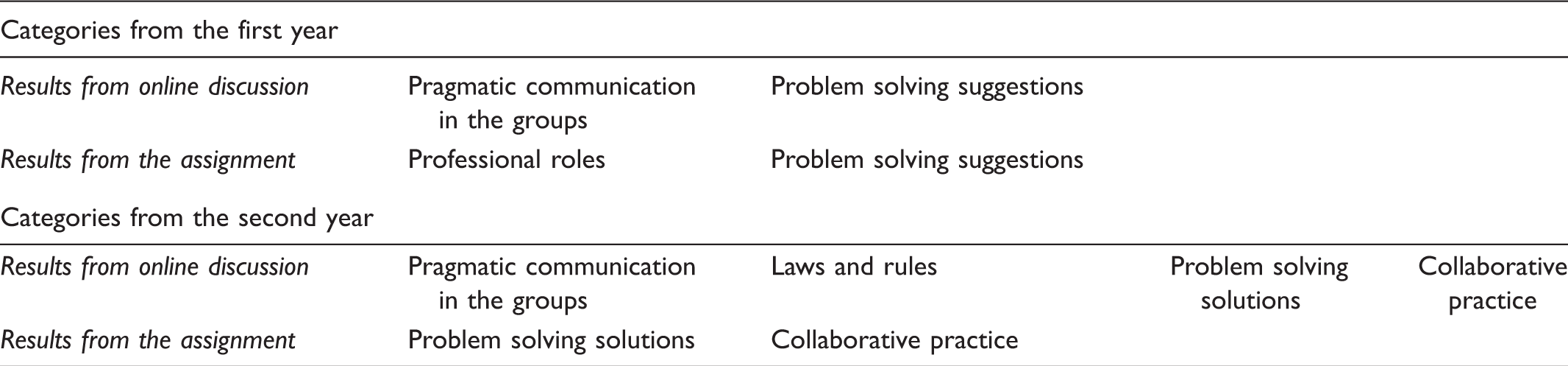
Themes from the first year of study
Results from online discussion
Pragmatic communication in the groups
Groups discussed how to divide the topics between members in the groups and asked ‘do we finish today?’ They stated that ‘We write 200 words each and put it together’. The result shows that some students were not always polite: ‘Those of you who don’t contribute anything do not get their names on the assignment’. Some students did not express themselves enthusiastic about the task: ‘I write only to show that I’ve been in here’. Others, however, were more positive: ‘It looks good, but we are missing 400 words’.
Problem solving suggestions
To improve collaborative practice, students proposed that ‘the BMLS in the video clip should have informed the difficult patient prior to phlebotomy’, and ‘she should ask what he thought of phlebotomy’. The students suggested that the situation would be enhanced if nurse and social educator were more involved.
Results from the assignment
Professional roles
The students wrote that, ‘A nurse is responsible for the patient’s care’. Furthermore, they interpreted that ‘the nurse seems to be unfamiliar with the patient’. About the social educator in the video clip, they expressed that, ‘The social educator works with the mentally retarded, drug and alcohol abusers, and those with mental illness’. They also found that, ‘It was finally the social educator who tried to calm John down’. In the assignment it appeared that ‘the BMLS works at a laboratory and does not have an interpersonal focus in her/his education’. As for the BMLS they underlined that, ‘She asks the nurse for the patient’s name and social security number’.
Problem solving suggestions
A suggestion to improve the collaborative practice was, ‘The nurse and the social educator should have communicated in advance’. Students also mentioned that, ‘The social educator should have informed the BMLS about the patient’s condition’. Mainly the participants concentrated upon general initiatives to improve John’s condition. ‘Can phlebotomy be taken at home?’ and, ‘A sedative could be used before phlebotomy’.
Themes from the second year of study
Results from online discussion
Pragmatic communication in the groups
Online, the second-year students discussed how to solve their assignment: ‘Maybe present the problem better in the introduction’, and ‘We have too many words, and we do not have the conclusion in place’. It seems that the students were polite to each other, for example: ‘Reacting to a little thing then. It would be fine if you reformulated the sentence’, and ‘A good contribution, I will see what I can do with this’. One student also wrote, ‘I think it has been fun, too. I’m super happy! Nice job guys! It has been a pleasure to work with you all’.
Laws and rules
The students in the second year were conscious of the importance of laws and rules connected to the situation: ‘Maybe we should refer more to the laws (the Law of Health Personnel, Interaction Reform, and Law of Patient Rights)?’, ‘Agree, we should get more laws and ethical guidelines into this document’. Two students said, ‘As health professionals, we have a duty to respect John’s point of view’. One student considered that, ‘This is a violation of both ethical standards and the Law of Health Personnel’.
Problem solving solutions
In the online discussion the students underlined that, ‘The information must be adapted to the individual conditions, such as age, maturity, experience, and culture’. The students argued that, ‘Confidence-building was not considered when John should be given a phlebotomy. This could have changed the whole situation’. Further, the students suggested that, ‘In order to provide the care we need to see the person as an individual’.
Collaborative practice
The students stated that ‘collaboration between the various health professions must be obvious’, and ‘Yes, the whole text must be about collaboration between us to provide security for John’. The students reflected further: ‘As professionals, it is important that we also consider the interaction perspective’. In terms of the communication in the case, they observed that, ‘Good nonverbal communication between John and the health personnel is necessary to create a positive experience for John, and he should feel that he is respected and equal’.
Results from the assignment
Problem solving solutions
In the assignment the students underlined that, ‘Everybody involved should sit down in a chair in this situation’. Another suggestion was: ‘John could take phlebotomy at home, and John could be shown around the laboratory prior to phlebotomy’.
Collaborative practice
The students mentioned that, ‘Unclear roles and communication in collaborative practice can lead to unclear, ambiguous goals’.
Discussion
The purpose of this study was to explore how students in different health and social studies describe their experience with workshop and online IPE. The data consisted of students' assignments and written online discussion.
Research on students' participation in online IPE has highlighted both its advantages and disadvantages. 16 The results of this study show that online discussion, from both first- and second-year students, emphasized a pragmatic approach to solving the problem connected to the assignment. Students in their second year of study seemed to be more polite and more receptive to the IPE intervention compared to the students in the first year. The second-year students’ online discussion clarified that they were courteous, and they wrote that it was pleasant to work with each other. In contrast to this, the first-year students expressed that students who did not contribute anything would be excluded from the assignment. It seems that the second-year students liked the task and had difficulties restricting themselves to the allowed word count. They had to reduce the number of words in their assignment to allow room to add their conclusions. The students from the first year indicated that they had too few words in their assignment. They wrote that it looked good, but that they still lacked 400 words.
A first-year students' proposed concrete actions, for example providing information to the difficult patient about the phlebotomy. The second-year students may have a more holistic view of humanity. They indicated that information must be adapted to the individual conditions, because patients are not heterogeneous. It might be that students in their second year focused more on strategies for collaboration compared with the first-year level, which had a more reductionist approach to health care. In the pragmatic communication of the first-year students, it seems that communication between the students was more negative, and that they did not like the task and/or the collaboration. For example, they indicated that they only contributed to the assignment to show that they had taken part in the task. Even though the pedagogical intervention was almost equal for both levels (similar PowerPoints, video clip and guidance from teachers/researchers), it seems that the second-year students were aware of the need for collaborative practice. In this way it might be that the first-year students did not reflect on the need for collaborative practice. Reflection is important in connection to interprofessional context. 10
Several researchers have highlighted the best time to introduce IPE.5,11–14 They indicate that there is no clear consensus on the ideal timing of IPE. When planning IPE it is important to differentiate the programme and the outcome of IPE depending on the stage of the students’ learning.3–5,11–14 Some researchers also indicate that IPE should be introduced early in students’ training before professional doctrines have been built into their learning. 15 It seems to be essential for students to have an insight into their own and other future professions. 7 In the assignment from the first-year students, the belief emerged that a nurse is responsible for the patient’s care, social educators work with mentally-retarded patients, drug addicted patients and patients with mental illness, and that BMLSs have the laboratory as their workplace. The students from the second year underlined the need for clarification of roles and clear communication in collaborative practice. As Engel underlines, communication underpins collaborative practice. 23 To have knowledge about each other’s work roles is centrally connected to IPE according to Gill and Ling. 6
It appears that the students in their first year of study reflected on the situation in the video clip, but not especially on how the interaction between professional groups could be improved.
The results show that students from both the first and second years understood the importance of communication during collaboration across professional boundaries. Reflection, according to Clark, is important for the interprofessional area. 7 This kind of reflection and learning are not very visible in the first year of study’s assignment.
In the assignment about problem solving solutions, both first- and second-year students highlighted the possibility of phlebotomy at home. In this way the situation for John could be improved.
The students from the first year underlined that the nurse and the social educator should have communicated in advance. In addition the groups of students from the second year were also aware of the importance of nonverbal communication. They expressed that nonverbal communication between John and the professionals might be important to create a more positive experience for John.
According to some researchers15,16 students in their second year of study mastered workshop and online IPE better than students in their first year. In our study we found a similar result. Students in their first year were more negative about the pedagogical intervention. The reason for this might be that the students in this period had heavy work-loads. The first-year students were in their first semester and it might be that they were eager to acquire knowledge about their own future profession instead of having insight into the responsibilities of other professions.
Students in their first year of study appeared to have knowledge about health professions that were included in this study. But we do not know if it was the BMLS students who wrote about their own future profession, and that can be a bias. Researchers point out that the same level of knowledge and skills related to interprofessional collaboration is an advantage. 16 The second-year students stated that collaboration between the various health professions must be obvious.
Ethics
Ethical approval for this study was obtained from the Norwegian Social Science Data Services. This was because no registry was created for the study, there was complete anonymity and the study did not concern any patient. Participants were given written and verbal information about the purpose of the project. The informants were told that the online discussion and assignment were anonymized and would be deleted after the study was completed. Voluntary informed consent was obtained for each participant.
Final remarks
This study shows through text analysis of written material that first year health programme students have the ability to acquire knowledge about other professions, roles and responsibilities through participating in workshops and online IPE. Students in their second year of study showed through their prior written material that they were more aware of the importance of collaboration processes and of promoting IPE. When planning IPE, the outcomes for different years of study need to be differentiated. This study may provide an indication that using the same IPE programme for first and second level studies can produce different responses and that interventions should be tailored more precisely to students’ stages of development. With differentiated outcomes from IPE it might work better, for example, that the outcome of IPE in the first year could be insight into competence in their own and other professions. The outcome for the second year could be the need for collaborative practice. Various case studies/video clips for first and second years could also be useful to try out.
Footnotes
Funding
This research received no specific grant from any funding agency in the public, commercial, or not-for-profit sectors.
Conflict of interest
The authors declare that there is no conflict of interest.