




Abstract
Two European qualification frameworks for higher education have been developed over the past decades. One of the goals of these are to promote common descriptions of learning outcomes at various levels within higher education. This article describes a) how national qualification frameworks have been perceived within bachelor nursing education, and b) the correspondence between learning outcomes and assessment methods. Evidently, a key factor for success is that the governing entities create a climate for good cooperation within and between the education institutions. However, our findings suggest that the communication between the experts and the educational institutions, who worked with the development and implementation of the national qualifications frameworks, has been far from good enough. Furthermore, there is a need to develop valid criteria for nursing competence, which in turn, could be integrated into the QFs and the NQFs. In this manner, on might secure that nursing education will uphold and meet the highest standards in all educational systems across Europe.
Introduction
Assessment in nursing is a complex process since it incorporates a combination of skills, knowledge, and attitudes. During the past decades, nursing education systems in Europe have undergone a number of reforms which aim to harmonize and synchronize different qualification frameworks within each country and across borders.
The Bologna Process introduced a common qualification framework for higher education already in 1999, The Framework of Qualifications for the European Higher Education Area (EHEA). 1 Shortly afterwards, another framework was developed through a broad European process, namely the European Framework for lifelong learning (EQF). 2 The EQF is closely related to the EHEA and these qualification frameworks (QFs) are compatible and the implementation of them has been closely coordinated. The QFs intended to provide a common language to describe and compare qualifications among students and employers all over Europe.1,2 Hence, a central goal of the QFs is to meet the needs of the labour market.
Historically, most countries have had formal descriptions for their educational qualifications systems. 3 In order to attain similarity across borders with regard to educational level and scope, 47 member states in Europe agreed to reorganize their higher education in line with the QFs. The basic premise of the Bologna Process was that the traditional methods of describing and assessing students’ learning were regarded as unsatisfactory.4–6 Hence, in the proposal for a common European framework for higher education, it was focused on certain defined learning outcomes in order to identify what students should know, understand and be able to perform after graduation. Consequently, there is now emphasis on describing the students’ learning outcomes in relation to what they have achieved, rather than merely focusing on the content of what they have been taught by the teachers.7,8 Formulating learning outcomes was described as a good way to take into account cultural and national differences.9,10 The learning outcomes should be formulated according to the knowledge, skills and general competence at each level of different educations. Focusing on learning outcomes is also regarded to match better the needs of the labour markets. 8
Member states have also agreed to replace teacher-centred learning with student-centred learning. The main point in student-centred learning is the shift going from teacher centeredness to student learning outcomes during and after studying. 11 In the following, we will describe the process with perception National Qualification Frameworks (NQF) in nursing education with regard to the transition to the correspondence between learning outcomes and assessment methods.
Learning can be understood as an ongoing process that arises out of the interaction between teacher and student. The assessment of learning can be performed by formal checks of learning outcomes at the end of a course or a programme. 12 Assessment could also pertain how far students are valued as participants in their own learning. This implies that students must be stimulated, via adequate feedback, to identify their own learning gaps and solve their own learning needs. 13
This review does not offer a detailed and comprehensive analysis of the perception of NQFs in nursing education in individual countries. Rather, it attempts to identify a) how national qualification frameworks have been perceived within bachelor nursing education and b) the correspondence between learning outcomes and assessment methods.
Literature search
A comprehensive literature search was conducted using ERIC, ORIA and OVID in order to present a review of the literature. The selection of relevant articles was limited to the English and any of the Nordic languages. Articles were included if they were peer-reviewed, described the perception and implementation of NQFs and were related to nursing education or higher education. In addition, they should describe European conditions related to the assessment of learning outcomes among nursing students
A combination of the following key words was used: ‘qualification framework’, ‘higher education’, ‘nursing students’, ‘learning outcomes’ and ‘assessment methods’. The filter function limited the articles and reports to those published after 2005 reflecting the period of interest wherein the NQFs have been implemented. The searches produced 302 references from the databases (ERIC; 28, ORIA; 161, OVID; 113) The last 22 references were found using manual searches. In order to narrow down which articles should be included, the following steps were used:
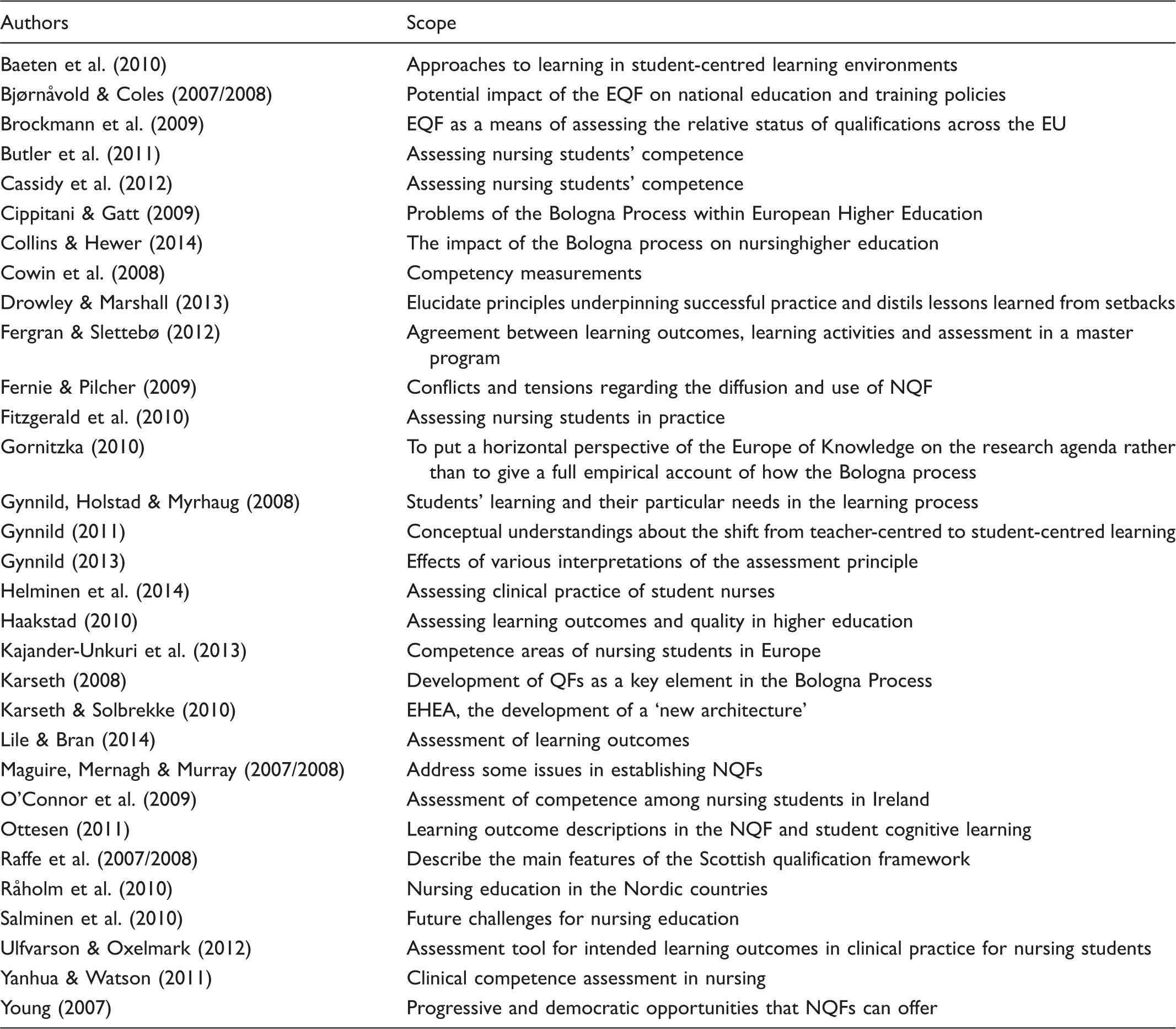
Step 1: Different databases and hand search were used to find articles (n = 324); ERIC (n = 28) and ORIA (n = 161). Additional records were identified through Google Scholar (n = 22). Step 2: After reading titles of all references, 78 articles remained for full evaluation of the abstracts, and 47 were excluded because they did not meet the inclusion criteria. Most articles were excluded because the studies were performed in countries outside Europe. Step 3: Finally, 31 articles met the criteria and were analysed.
Data analysis
Included articles.
Similarities and differences with regard to perceptions of NQFs
NQFs have been attempted implemented in the educational institutions in all the 47 participating countries. There has been varying levels of pedagogical discussions between different levels in the school systems. 15 Challenges arose when employees formulated and implemented learning outcomes in their own way without any type of cooperation between the different educational institutions. Obviously, it is challenging to find an optimal method for this work, as the new reforms might require some type of overall management and control16–18 and some level of trust between the educational institutions. 19 Strong institutional educational traditions may complicate the development of a common international platform in nursing education. It must also be taken into account that the NQFs are perceived very differently by those who develop them and those who use them. 20 This type of discrepancy in perception might affect the opportunities for improving the quality of higher education.17,20–22 Drowley and Marshall 15 found that it takes several years before all people involved feel a significant degree of ownership to the qualifications framework.
Scotland has had a long tradition with NQFs and is, in view of this, often used as an example of how QFs can be successfully implemented.17 Raffe, Gallacher and Toman
23
point out the following causes:
– The framework has maintained support of all institutional sectors of learning. – Similar knowledge and understanding about the framework have emerged among those who use it and those who develop it. – There have been common expectations about the NQF as an instrument of change rather than an agent of change.
Norway, the UK (sans Scotland), Austria, Demark, Sweden and Germany have tried to transfer much of Scotlands' experiences to their own process with NQFs.15,16,24 The process has in general progressed slowly in Europe, 25 and so far we do not know so much about their experiences. The reports so far only explain in which way they have managed to perform the QFs. Countries are quick to borrow models from others but without evaluate their lessons learned during implementation.15,17
Every member country has its own legislation, culture, healthcare needs, healthcare philosophies and structures, and economic situations which affect the system of higher education. 26 As may be observed in the Scandinavian countries, similar cultures and assessment systems might provide a good basis for mutual trust and cooperation across borders. 27 However, we see that even in these countries there are different ways of perceiving and implementing the NQFs, for example through different ECTS credits. 28 However, some criticism has been raised concerning the compatibility of qualifications from one educational system to another due to differences in context, that is, different legislations and academic cultures.20,27 Gynnild 18 also points out the importance of a common understanding of concepts, which so far does not exist.
Though some parts of Europe, especially German-speaking areas in Switzerland and post-communist countries, 29 prefer to educate nurses outside academic structures, most countries in Europe have nursing qualification programs within higher educational systems. Collins and Hewer 29 found big differences in how different nursing educations across Europe had implemented NQFs. Salminen et al. 26 suggest a need for the European Union to catch up with the changes in higher education by enacting legislation that sets out a clear framework for standardizing the learning outcomes across European countries.
Assessment of nursing students learning outcomes
Competence incorporates a combination of skills, knowledge, and attitudes30,31 and the assessment of nursing students in clinical practice aims to ensure that they act as safe and competent clinicians.32–34 This notion is supported by Karseth 24 and Ottesen 35 who pointed out that learning outcomes related to attitudes and physical skills are highly relevant in professions such as nursing. However, affective and psychomotor skills are examples of areas of learning that are visible in the EQF only in the domain ‘general competence’.24,35 Hence, the different directives and QFs do not define central competence areas of nursing education. 36
The assessment of learning outcomes must capture what students know, understand and are able to do when the learning process is finalized.17,24,35 Different assessment methods are also believed to be objective, in so far that they rely on objective criteria.27,35,37 Research shows that lack of student involvement, and lack of knowledge of students’ needs for learning, will reduce the quality associated with deeper understanding and learning for students. 38 Other studies show that it is challenging to assess students’ learning outcomes across institutions and countries because of great educational freedom.17,20,25 Teachers will analyse and assess the students’ learning process in their own way because assessment is socially embedded and open for individual interpretations by the teachers. 39
Ulfvarson and Oxelmark 34 showed that well-defined criteria help both teachers and facilitators to make consistent assessments during clinical studies for nursing students. Accordingly, a lack of criteria increases the risk of arbitrariness. 34 In addition, Fitzgerald et al. 33 and Ulfvarson and Oxelmark 34 found that good criteria descriptions facilitate nursing students who actively seek to understand and reach the learning outcomes.
Young 17 and Baeten et al. 37 argued that more specific learning outcome descriptions and specification of criteria might reduce the differences in assessment. It is also pointed out by Fegran and Slettebø, 40 that there should be correspondence between learning outcomes, learning activities and assessment methods.
Nurses who participate in the assessment of nursing students in practice have difficulties with understanding criteria related to performance, skills and attitudes. 31 Butler et al. 32 suggest that competence assessment among nursing students should be standardized. Currently, there is no common definition regarding what is required from students upon degree completion.36,41 However, defining and assessing this particular competence is difficult for the teachers and nurses using a variety of different methods, both at the Universities and in practice.36,42–44 In addition, the assessment documents are difficult to understand for those44 who use them; they are overly theoretical and are often written in an unfamiliar ‘academic’ language.17,31,32,43,44
Discussion
Most European countries have, initially, tried to work ‘bottom up’ in the implementation of their NQFs, reflection the intentions of the QFs. However, only a few countries have done this with some degree of success13,24,26 and the majority of countries have ended up with a ‘top down’ approach. This suggests that there should have been better communication between the experts who prepared the NQFs and the teachers, nurses and nursing students who were ordered to implement the NQF. For example, Drowley and Marshall 15 found that educators and students, who daily use the NQFs, only to a minimal degree, have participated in the implementation of the NQFs.
As emphasized by Raij, 45 engaging the students is crucial in all types of development oriented towards creating good contexts for learning. And as Gynnild et al. 38 found, the absence of student involvement in the process of implementation of NQFs has reduced our abilities understanding the process as a whole. Furthermore, Drowley and Marshall 15 argued that it might take years before those involved in this process will feel some sense of ownership to the NQFs. Characteristically, a lack of dialogue and weak participation will create resistance, and it is difficult to change cultures if participants do not want change. 3
The QFs serve as meta-framework for the NQFs, and without some sort of close collaboration between those responsible for drafting the frameworks and those who work with implementing the NQFs, there will be no possibility to secure the quality of each NQF. The QFs recommend that the learning outcomes descriptors are open and spacious due to differences between institutions and cultures.1,2 However, this might raise a number of pedagogical challenges. Different ways of perceiving NQF has obviously opened up for large disparities, both nationally and internationally, in terms of learning outcomes descriptions and various forms of assessment. Formulating students’ learning outcomes in a complex learning process may be fundamentally difficult. Løkholm 46 found that formulations of learning outcomes were often perceived as compromises that, again, could provide a wide scope for interpretations. Without sufficient cooperation between practitioners and educators, important knowledge about the labour markets` needs is missed.
Different pedagogical interpretations of the QFs complicate a common understanding related to assessment of nursing students’ learning outcomes. Hence, obtaining some sort of objective assessment method is a prerequisite both for acting in line with the QFs, to strengthen the quality of higher education in general, and in order to compare the quality of nursing education across Europe.8,47
As Karseth 24 and Ottesen 35 pointed out, learning outcomes related to attitudes and physical skills are highly relevant in nursing. When these important domains are lacking in the QFs, practitioners and educators are met with a number of challenges with regard to the assessment of learning outcomes. In addition, the QFs do not define the competence areas of nursing education. 36 These issues must be addressed in order to minimize the differences between educational institutions across Europe. However, as Fitzgerald et al. 33 and Ulfvarson and Oxelmark 34 have already pointed out, this is not as clear-cut as one might expect, since assessing criteria and tools, in and by themselves, do not guarantee a more accurate understanding of the correspondence between learning outcomes and assessment methods.
There are, in general, a number of shortcomings related to the implementations of the NQFs, in general: Clear criteria are lacking, each institution and the individual teachers are given a great manoeuvring room. This room for interpretation could be reduced by clearer guidelines and criteria with regards to formulations and assessment of learning outcomes. With regards to nursing education, standardized learning outcomes descriptions and a common understanding of how to assess nursing students should be developed. A basic issue in this aspect will be to secure that nurses are educated in line with the requirements of the labour market.
Limitations
Some limitations applied to this literature review. Firstly, because most European countries are still working with implementing of QFs in higher education, some important findings would probably be missed in this review, mainly due to the fact that studies in this area are yet to be performed and/or published. Secondly, the inclusion criteria pertaining to inclusion of articles written in English or the Scandinavian languages, may have led to the exclusion of relevant studies in European countries published in other languages.
Concluding remarks
More research is needed in order to capture, in greater detail, the situation in Europe with regards to how NQFs correspond with the QFs. Furthermore, there is a need to develop valid criteria for nursing competence, which in turn could be integrated into the QFs and the NQFs. In this manner, on might ensure that nursing education will uphold and meet the highest standards in all educational systems across Europe.
Footnotes
Funding
This research received no specific grant from any funding agency in the public, commercial, or not-for-profit sectors.
Conflict of interest
The authors declare that there is no conflict of interest.