




Abstract
This article is a report of a study on Russian nursing students’ willingness to take care of people living with HIV or AIDS (PLWHA). HIV and AIDS are continuing to spread in Russia. Nursing students’ willingness to care for people living with HIV or AIDS is one aspect that should also be taken in consideration on this transmission situation. In total, 102 nursing students participated in the study (the response rate was 95.3%). The data were collected using the Nurse Willingness Questionnaire (NWQ) and analysed using SPSS version 15 for Windows. The study showed that nursing students’ willingness to care for PLWHA was low when asked with one general question but quite high when asked more specifically related to some nursing activities. Nursing students were more willing to perform clean nursing activities than activities with infectious risk. There is a great need for improving understanding of and proficiency in safety work with HIV-infected patients.
Introduction
Acquired immunodeficiency syndrome (AIDS) and human immunodeficiency virus (HIV) have become one of the most serious global health problems. At the end of 2013, 35 million people were living with HIV. The HIV infection rate is rising fastest in Eastern Europe and Central Asia. 1 By the end of 2009, there were more than 500,000 officially registered Russians living with HIV, and the number of HIV-infected people is growing all the time. 2 In the whole of Russia, 75% of all HIV infections occurred among people between the ages of 15 and 30 years. In St. Petersburg alone, there were 4,548 new HIV infections in 2007. The majority of those infected with HIV are injecting drug users (IDU) and sex workers. 3
In 2010, UNAIDS 4 estimated that the number of people living with HIV in Russia was between 940,000 and 1,300,000. It is estimated that over two-thirds (69%) of the HIV-infected people of Eastern Europe and Central Asia are living in the Russian Federation. In Russia (as well as the Ukraine and Estonia), the estimated HIV prevalence exceeds 1% of the adult population. 5
HIV and AIDS are continuing to spread in Russia. In 2006, Russia proposed the issue of counteracting infectious diseases as one of their main priority issues, especially in regard to preventing the spread of HIV and AIDS. 6 The project has currently allocated more than 3 billion rubles (US$116 million) to combating the HIV and AIDS epidemic, and provides support for primary care, basic medical aid, and disease prevention including vaccination. Increasing access to health services and the scale-up of ARV (antiretroviral) coverage is another key component of the project.
The knowledge level of nurses and nursing students regarding HIV and AIDS-related issues, their attitudes towards HIV and AIDS and people living with HIV or AIDS (PLWHA), and their willingness to care for PLWHA are also central points, and have a direct impact on transmission rates. However, the nursing students’ willingness to care for PLWHA has not been previously studied in Russia. This is an important topic because although the collapse of the Soviet Union has significantly influenced Russia as a whole, insignificant changes have been seen in initial nursing education, which today takes three years to complete. 7 Nursing education has been closely associated with medicine. 8 There are two levels of nursing education in Russia. The basic level (vocational nursing school) consists of a 3-year course, resulting in the qualification of Qualified Nurse. The second level of nurse education is Higher Education in Nursing, and takes the form of a 5-year university correspondence course for qualified nurses (1 month per term).
HIV education is certainly a necessary intervention by which health care professionals can increase the efficacy of their work outcomes. Health care providers are part of society, and as such, their perceptions and attitudes toward PLWHA are expected to be influenced by the norms and attitudes of that society. 9 Internationally, there are challenges in upgrading nursing education to obtain an advanced degree in nursing,10 but in some countries (e.g. Haiti), there are national requirements for nursing students to demonstrate competency in their HIV/AIDS related knowledge, skills and attitudes with direct observation of the student performing authentic tasks. 11 Therefore, HIV/AIDS-related knowledge and skills can be highlighted in the initial stages of nursing education.
Background
Previous studies have found that students who had cared for patients with HIV or AIDS and who were willing to care for these patients’ showed more positive attitudes towards PLWHA and the disease. 12 Lohrmann et al. 13 indicated that students who had positive attitudes towards HIV or AIDS were more willing to care for PLWHA. Bektas and Kulakac 14 found that students who had either known or cared for PLWHA in the past, were shown more willing to care for this patient group, although they also found that nursing students had a fear of contagion. In Lithuania, students who had previously cared for PLWHA were also more willing to care for PLWHA in the future. However, data from Finland and Estonia showed that if students were generally unwilling to care for actual PLWHA, then they were unlikely to be willing to care for a hypothetical PLWHA in a survey-type situation. 15 Only having previously been asked to care for an actual PLWHA had a clear association with a students’ expressed willingness to care. 12
There are some other aspects which have been shown to have an impact on nursing students’ willingness to care for PLWHA, such as age and a longer work experience. 15 Students who are single have also been shown to report a higher willingness. 9 However, willingness has been reported to be associated to students’ knowledge and behaviour, and in cases where this has been shown to be lacking or negative, then the behaviour towards PLWHA was also seen to be negative. 16
Method
Aim, design and research questions
The aim of this descriptive correlational study was to describe nursing students’ willingness to care for PLWHA. The research questions were:
How willing are nursing students to carry out nursing activities for PLWHA? Which factors are associated with their willingness to care for PLWHA?
Sample
The sample was purposefully collected from three of 10 nursing schools in a major Russian city. The main specialty among educational programmes in the nursing schools was nursing, however other programmes such as midwifery, medical assistant, dental hygienist and dental prosthetist were also provided.
Data collection
The study team contacted the nursing schools’ administrators and invited them to participate in the study. All of them accepted the invitation. Questionnaires were offered to 107 of 125 graduating nursing students at three nursing schools. In all, 102 students registered their consent to participate (response rate 95.3%). The questionnaires were administered to the graduating students during their pre-practical training. Completing the questionnaires took about one hour and after completion, they were collected by the research assistant.
The data was collected from April to May 2010 using the Nurse Willingness Questionnaire (NWQ).17,18 The instrument described a fictional HIV patient named ‘Hannes’, whose health was deteriorating. Hannes had diarrhoea, was incontinent, vomiting, pyrexial and confused. Nursing students had to rate their willingness to perform a series of nursing tasks for the patient. These included feeding, taking vital signs, bathing, dressing, shaving and administering intravenous fluids. The instrument consisted of 13 items with a 5-point scale (1 = Strongly agree, 2 = Agree, 3 = Undecided, 4 = Disagree, 5 = Strongly disagree). The activities were phrased so that students expressed their degree of willingness to, for example, give Hannes a bed bath, their willingness to change Hannes’ dressing using gloves, their willingness to shave Hannes, their willingness to start intravenous fluids using gloves etc.
The NWQ instrument was originally developed in the USA, but has been modified for use in Europe by Finnish nursing scholars. The modified version (with a shorter vignette) has been used in Finland, the UK, Germany, Estonia and Lithuania.12,13,15,19 The instrument has been translated into Finnish, German, Estonian, Russian and Lithuanian 20 during previous phases of the research program by professional translators. 21
The NWQ has shown its usefulness in measuring an individuals’ willingness to care for PLWHA.12,13,15,19 Previous research has also shown the NWG to be a reliable and valid instrument for evaluating the willingness to care for PLWHA,17,18 with Cronbach’s alpha values between 0.88 to 0.95.12,13,15,19 In this study, the Cronbach’s alpha value was 0.91.
The independent variables included in this study were students’ gender, marital status, having children, knowing a family friend or close person with HIV infection or AIDS, having refused to care for PLWHA, having cared for PLWHA, and the general willingness to care for a PLWHA.
Ethical considerations
The topic is a valid field of research because there are no previous studies on this topic conducted in Russia, and the country is experiencing an exponential spread of HIV and AIDS. Nursing schools gave their formal permission for the study to be conducted, and the nursing students gave oral informed consent, prior to completing the questionnaire. All responses were deemed confidential and the anonymity of respondents was ensured at all times. No personal identifying data was requested. 22
Data analysis
The data was analysed using SPSS version 15 for Windows. For the further analysis, the responses 1 = Strongly agree and 2 = Agree were recoded as ‘Agree’, 3 = ‘Undecided’, and 4 = Disagree and 5 = Strongly disagree were recoded as ‘Disagree’.
The independent background variables were described using descriptive statistics. The dependent variable was the mean variable calculated from 13 items measuring the nursing students’ willingness to carry out concrete nursing activities for the fictitious HIV/AIDS patient. Associations between mean scores and background variables were tested with Multivariate Regression Analysis using the Stepwise method. The significance of the regression coefficient was tested using the t test. Only statistically significant results are reported in the results section (p < 0.05).
Results
Participants
Study participants.

Students’ willingness to care for PLWHA
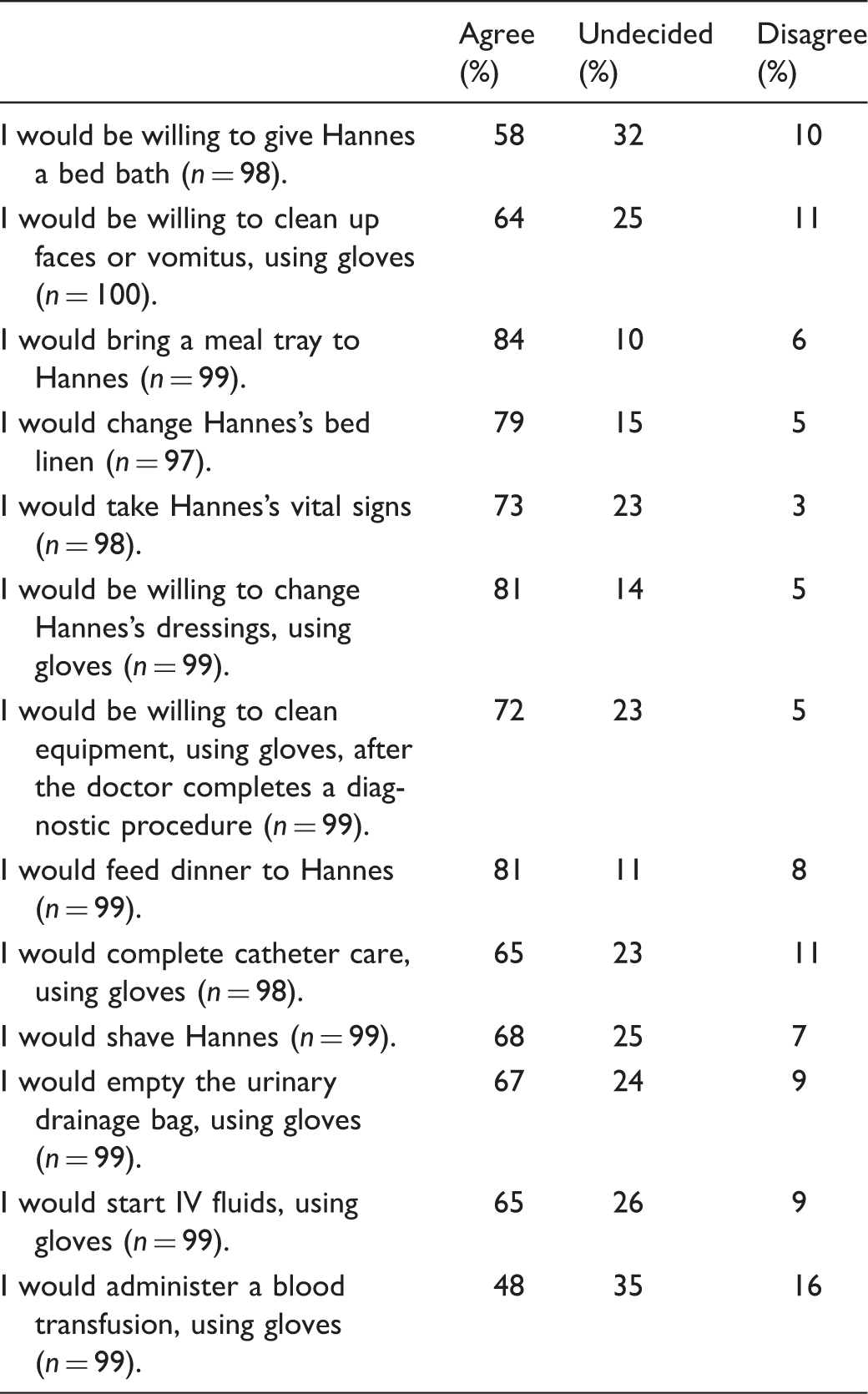
Nursing students’ willingness to provide care.
Factors associated with the students’ willingness to take care for PLWHA
If the student was generally willing to care for PLWHA (assessed by one background question), the student was subsequently more willing to care (assessed by 13 specific nursing activities) for the fictional PLWHA patient (p = 0.009, Beta = 0.477). If the student had cared for PLWHA, they were also more willing to care for PLWHA when measured by specific nursing activities (p = 0.019, Beta = 0.465). Students whose native language was not Russian (n = 12) were generally more willing to care for PLWHA (p = 0.024, Beta = − 0.143), as were those who were cohabiting (n = 15) (p = 0.047, Beta = −0.228). However, those whose first language was not Russian and who were cohabiting were few.
Discussion
The aim of this descriptive correlational study was to describe nursing students’ willingness to care for PLWHA. While in general in Russia, there is very little nursing research reported in the English language, nursing students’ willingness to care for PLWHA has not been previously studied in Russia. Given that the Russian HIV situation is alarming based on health statistics, the topic is especially important. 2 Our study showed that a majority of students are willing to carry out nursing activities for patients with HIV or AIDS. This finding is encouraging and calls attention to the ethical responsibilities among nurses in Russia. The findings also offer important feedback to nursing education in Russia, at a time when challenges in upgrading nursing education to meet international standards and in obtaining an advanced degree in nursing are being discussed. 10
Russian nursing students were more willing to perform clean nursing activities than those activities involving a risk of infection. For example, over 80% of the Russian students would bring a meal tray, change dressings using gloves and feed PLWHA. In Finland, nursing students have also shown a strong willingness to perform these activities. Most of the Finnish students were strongly willing to bring a meal to a patient, feed the patient, take vital signs and to change bed linen. Välimäki et al. 15 found that in Lithuania, about two-thirds of the students were willing to change dressing, clean up faces or vomitus, to start IV fluids and administer a blood transfusion, however in Russia, students were not so willing to do these kinds of nursing activities.
It was interesting that only a little over half of Russian students showed a willingness to give a bed bath to the PLWHA patient. The same issue has been observed in previous studies in Lithuania, Finland and Estonia. 12
If the student was generally willing to care for PLWHA, then the student was more willing to provide care for the fictional PLWHA. Previous studies have showed that if students were not generally willing to care for PLWHA, then they were not willing to perform certain nursing activities for the fictional patient. 15 Also in this study, if a Russian student had previously cared for PLWHA, then he or she was also more willing to provide care – an observation that has also been observed in for example Lithuania and Turkey.14,15
The study showed that nursing students’ willingness to care for PLWHA in Russia was quite high when measured by certain nursing activities. Safety issues are important and have an impact on their willingness to care for PLWHA. Similar findings have been presented in previous studies. 15 By contrast, when examining the willingness to care for PLWHA with one general question, students were less willing to provide care. If the degree of willingness was measured by 13 nursing interventions however, the students were more willing to perform the cleaner nursing tasks. Previous studies have also revealed the same phenomena amongst nurses and nursing students.12,13,15,19
This study has some limitations. Firstly, because of the relatively small sample size (102 nursing students), the results cannot be extrapolated to represent the views of all nursing students in Russia. Secondly, due to the limitations of the questionnaire-type survey, it was not possible to explain the deeper meaning of individual students’ answers. The questionnaire measured students’ willingness to care for a hypothetical adult male patient, thus we do not know how willing students would be in a real nursing situation or whether the male gender in the vignette of the questionnaire had an effect on students’ responses, given that the majority of respondents were female. Despite these limitations however, the study offers a general understanding of how ready nursing students are to care for patients with a specific transmitted disease.
Conclusion
This study highlights the need for improved understanding and proficiency in safely working with HIV-infected patients. Considering the existing myths and fears in society, there is therefore a need for debunking the prevalence of HIV myths, and increasing tolerance among nursing students and the general population.
Implications for practice and /or policy
HIV statistics from Russia are alarming and this should be considered in the fields of basic and continuing nursing education. It is important to investigate how willing nursing students and nurses are to take care of PLWHA patients in Russia, given the increasing incidence of infection. There is a need to improve the understanding of safely working with PLWHA patients, so as to debunk HIV myths and increase tolerance among nursing students.
Footnotes
Funding
This study has been funded by the Finnish Nurses’ Educational Foundation (Sairaanhoitajien koulutussäätiö).
Conflict of interest
The authors declare that there is no conflict of interest.