




Abstract
Aim
To describe mothers’ perceptions of what characterized mothers’ groups that continued over many years and to explore how the mothers benefitted from participating.
Background
Scarce knowledge about mothers’ groups in a long term perspective.
Methods
A qualitative research design was applied. Data were obtained by focus group discussions in three mothers’ groups that had lasted for 13, 16 and 21 years, respectively. Data was analysed using a phenomenographic approach.
Findings
The analysis revealed three descriptive categories and nine sub-categories. The categories were: Structure and contents over the years; Diverse backgrounds and views, with respect; and Revitalization, continuation and outcome of the groups. The underlying structure was found to be that the mothers’ groups had developed from baby-oriented to life-oriented forums and constituted a free space built upon confidentiality and trust, and with respect for differences.
Conclusion
The study concludes that mothers’ groups may result in social support and new coping strategies. Health professionals should encourage established groups to continue on their own. More research on the drop-outs from the groups is needed.
Introduction
Parent assistance programmes are offered in many countries. Such programmes may provide effective support for maternal depression, anxiety/stress, self-esteem and the mother’s relationship with her partner, but not regarding social support. 1 Long et al. 2 concluded that parenting support programmes (mainly including mothers) could reduce anxiety and depression among parents, just as Kane, Wood and Barlow 3 found that knowledge, skills, understanding and feelings of acceptance from others are essential for (mainly) mothers to regain control and be able to cope with the frustrations and challenges of parenthood.
In Finland, supportive interventions for families with young children (0–3 years) led by family workers are perceived as providing the families with emotional, cognitive and concrete network support and help to diminish anxiety and enhance self-knowledge. 4 Häggman-Laitila and Pietilä 5 examined parents’ perception of quality in support groups and found that a good support group was informative, allowed parents to contribute to discussion and encouraged activity, and had a reciprocal and mutual interaction, as well as successful group supervision. These groups were led by health workers, and the participants, mostly mothers, wanted to continue on a private basis by the end of the programme. 5 Scott et al. 6 studied ‘first time parent groups’ that developed into self-sustaining supportive social networks and found that they continued to flourish if they managed to change according to the time of the mothers’ paid employment. 6
In the Nordic countries, parents/families receive support from the health visitor after giving birth and at least during the first year of the child’s life. 7 During the last two decades, it has become more common for Danish health visitors to arrange groups for mothers with newborn children in addition to the individual contact. These groups meet in local areas and the mothers are invited to participate on a voluntary basis to share experiences and initiate contact with other mothers with newborn children. 7 The groups normally last until the mothers start working again, but for unknown reasons, some mothers’ groups continue to exist even after the children have become schoolchildren, teenagers or even young adults.
A Danish study 8 revealed that mothers’ groups in the primary health care system were very diverse, but that the most important benefit for all of them was the social relationship which formed between the participants and facilitated the acceptance and confirmation of their new situation as mothers. The composition of the group was important, and the most important single factor for a group to continue to exist was how the mothers related to each other on a personal level. 8
Materials and methods
Study design
A qualitative research design with a phenomenographic approach was applied in order to grasp the intertwined learning and health potential within the mothers’ groups. Phenomenography takes the standpoint that people experience the world in different ways. The results presented in categories therefore describe the qualitative variations in the data.9–11 Data were obtained by focus group discussions that aimed to capture as many different experiences and conceptions of the mothers’ groups, that is, ‘the what’ and ‘the how’ aspects. 12
Participants
The mothers’ groups who participated in the study.

The mothers’ group of the 13-year-olds consisted of eight mothers, of which seven were present during the focus group discussion and one was at work. At the start of the group, the mothers were 26–43 years old. Four mothers had their first, two had their second, and two had their third child when the group was formed. At present two mothers had one child, two had two children and four had three children. When the group initially began, there were four more participants: one stopped attending due to illness, and three stopped when the group continued on their own after the health visitor had left the group. The reason for this was unknown.
The mothers’ group of the 16-year-olds consisted of four mothers, all of whom were present for the focus group discussion. When the group was formed, the mothers were 24–34 years old. At that time, two mothers had their first, and two had their second child. At present they all have two children. When the group initially began, there was one more participant who moved too far away to be able to continue to participate.
The mothers’ group of the 21 years olds consisted of six mothers, of which five were present for the focus group discussion. At the start of the mothers’ group they were 23–30 years old. At that time, four mothers had their first and one had her second child. At present they all have two children. When the group initially began, there were two more mothers who continued to participate in the group for about 10 years before dropping out.
Data collection and analysis
Focus group discussions were conducted in August, September and November 2007. The focus group discussions lasted for about 90 minutes, and were conducted in the private home where the groups met at that time. After the introductory information, which included information about the women’s right to withdraw at any time, the mothers were encouraged to speak freely and inspire each other to remember how the groups had started and what had made them continue. The focus groups discussions were performed as a conversation in-between the mothers. The author asked some additional follow-up questions in order to explore the overall research questions:
What characterizes mothers’ groups that continue to exist longer than might be expected? How do the mothers and their children benefit from the long-lasting contact?
All focus group discussions were tape-recorded and transcribed verbatim by the author. Data were analysed using a phenomenographic approach to explore the women’s various perceptions of being members of a mothers’ group. The phenomenographic analysis included four steps:11–13 1) Becoming familiar with the data by reading and re-reading the transcribed text; 2) identifying differences and similarities among the mothers’ perception of being in the group; 3) developing descriptive categories; and 4) examining the underlying structure of the categories. Two independent co-examiners were assigned to test the inter-subjective agreement:
10
Categories, sub-categories and quotations were presented separately to the co-examiners, who were then asked to match them. The agreement between the co-examiners and the researcher was 80% for the categories and 75% for the quotations. Quotations from the focus group discussions are presented in the findings in order to facilitate the readers’ assessment of their trustworthiness. Due to scarce knowledge of mothers’ groups in a long-term perspective, a new literature search was performed in 2014 without adding any new hits.
Ethics
The participants were informed in writing and orally about the study and gave oral consent to participate. At the beginning of the focus group discussions, they were all informed that data would be handled with confidentiality and presented anonymously in writing just as it was emphasized that they could withdraw from the study at any time. Since the mothers’ groups introduced themselves as interested in participating in the study, no formal ethical assessment was approved.
Findings
The descriptive categories and sub-categories.
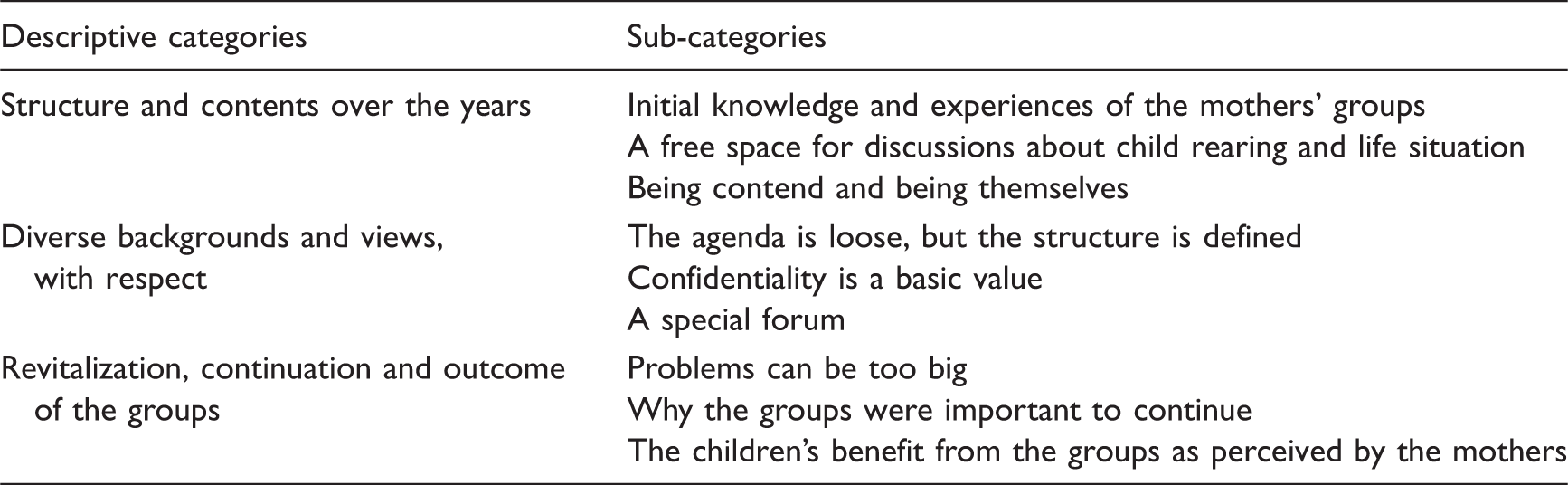
The underlying structure was found to be that the mothers’ groups had developed based upon shared histories and child- and life-centred discussions. The groups constituted a free space built upon confidentiality and trust, as well as respect for differences and a special, not too close relationship. After the scopes of the mothers’ groups were discussed due to continuation on private basis, some groups had developed to include the involvement of children and family.
Structure and contents over the years
This category includes the mothers’ experiences of attending a mothers’ group for mothers with newborn children years ago, and how they gradually changed the focus of the group. The mothers had different reasons for joining a mothers’ group; one needed other adults to talk with; others were curious about what a mothers’ group was and what such a group could provide them. One group was already established before the mothers gave birth, but was enhanced to include more mothers at the birth ward. The participants highlighted the possibility of sharing experiences with others in an inclusive atmosphere and dedicated discussions on child development and child rearing as main reasons for participation and for continuing in the groups, even though discussion themes changed as the children grew up. One group had maintained the primary discussion of their concerns about their children; another had extended discussions to include their own life situations; whereas one group had changed in the direction of more overall life-centred discussions.
Initial knowledge and experiences of the mothers’ groups
Some of the mothers had not known anything about the mothers’ groups initiated by health visitors before they gave birth. Others had established a group before birth due to expected caesareans or because they had heard about the groups from other mothers. Their first experiences of being in the groups were diverse, but what was common was that they wanted to give the group a try for different reasons such as being acquainted with mothers in the neighbourhood or finding a non-judgemental forum for second opinions. What I liked was that we all were very relaxed in the group … We did not have to play a certain role as better or more clever (mothers) than the others. (16-year-old group)
A free space for discussions about child rearing and life situation
It was essential for the mothers that they created a space in which they could discuss everything without necessarily involving their families. In one group, it was expressed that what they talked about was not especially secret from their husbands and fathers of the children, but that the themes were discussed in a different way in the group. The discussion developed over time according to the children’s age. It could be about the children’s school and leisure time, but also about issues they were uncertain about and benefitted from listening to each other’s views about, such as pocket money and what time to come home at night. There were different opinions within the groups and between the three groups, however, the mothers listened to each other without judgment. It is good to talk about these issues, not because you need confirmation, but just to be listened to and be reassured makes you more sure of what you do. (21-year-old group)
Being contend and being themselves
The mothers stated that sharing thoughts – although diverse – with people who were contend with their situation was what heightened the discussions. A characteristic of the groups was the mothers’ dedication to participate. In one group, a mother had moved to another town but continued to participate because she experienced the discussions and the company of the other members as stimulating. Another mother said that when she was invited to participate in a (new) mothers’ group in relation to the birth of her next child, she declined because she enjoyed being with the contended mothers in the initial group and could not manage to engage in a new one.
Diverse backgrounds and views with respect
The mothers expressed that they viewed many subjects very differently. They also had different family and professional backgrounds but this was seen as an asset and not a barrier to communication, listening to and learning from each other. For example, the participants worked in public services or private business, either as academics or skilled workers. The groups consisted of different members; one was very equal in level of profession and family situation, whereas another group was more diverse in educational level and included single mothers, stepfathers and stepchildren. But the respect for each other, despite differences in views due to different opportunities in life and lifestyles, was agreed to be a central point for all groups. … this respect for each other … respect for each other’s different lives and opinions … (13-year-old group)
The agenda is loose, but the structure is defined
The structure of the meetings was defined, but had changed over the years. It was important for the groups that a date for the next meeting was fixed. Some had fixed days and dates the year around while others decided the next appointment from meeting to meeting within a fixed schedule. How the individual meetings were arranged was very diverse, but it was common that they started with coffee or food and an introductory discussion. In all groups, it was essential for the women to point out that they did not spend time doing small talk. They spent some time updating each other on daily issues, but also shared serious concerns when these occurred. During the years, the women had among other issues experienced divorces and had lent valuable ears to each other without taking sides, something which had been crucial for the discussions. We have no agenda or plan for the discussion; [like] now it is you, and then you, and then you … We always listen to everybody, but not according to a schedule or a scheme, not at all. (16-year-old group)
Confidentiality is a basic value
An underlying value in all the groups was that what was discussed stayed between the mothers. If husbands and relatives asked what they talked about they would say that they talked about the health and development of family and children without going into details. They did not want to be seen as a ‘gossip club’. Maybe it was not expressed from the beginning of the groups, but when it came to sensitive questions such as divorces, the mothers reassured each other that the discussion was confidential. Other groups had stated confidentiality from the very first meeting and did not discuss the group in between the meetings, even if they met by coincidence in town. We have a free space where we can talk, knowing that confidentiality is respected. (13-year-old group)
A special forum
The mothers defined their groups as a special forum, not like a women’s club, or like a formal meeting, or like sisters. They were quite aware of the special forum the mothers’ groups provided with the freedom to talk and be quiet, to be listened to and to listen. For some it was the only forum to discuss sensitive matters, for others it was more like a second opinion. One group had extended meetings where the fathers participated; another had tried this without success and declared that the group was ‘their room’. One group always brought the children along while the others enjoyed being without children. After all it is interesting that we are here [in the mother group] where we in some sense have a refuge … Absolutely heaven … (16-year-old group)
Revitalization, continuation and outcome of the groups
It was difficult for the women to keep the groups going on their own when the officially-initiated mothers’ groups had come to an end. Problems occurred within the groups and some members had backed out. In a couple of groups, the reason was that one mother had taken all the time and that her concerns were too big for the others to cope with. In other groups, the content was not strong enough, or there was not enough power or vitality to continue although the mothers in some way wanted to continue.
Problems can be too big
One of the reasons for backing out could be if one mother had personal problems so big that the rest of the group could not or would not spend their time on it and therefore would not participate. In one group, they had reached consensus to ask a participant with personal problems that could not be solved within the group to stay away until she had solved them. The women wanted to discuss with others who in some way responded on the discussions, but did not want to be social workers. They were quite aware that they had established a private group of non-professionals that could not deal with larger problems. If a participant’s problems grew too big, for example dependence-related problems, professional assistance was needed.
Why the groups were important to continue
When group meetings were cancelled over and over again, the women discussed whether or not the group should continue and on which conditions. They tried different options such as extend the meetings to more cultural events such as going to the cinema, which did not work or make a journey with husbands and teenage children. Altogether, the mothers had realized that they, despite differences in education and interests, had gained a lot from the group meetings, and that it was the diversity of their views that made the groups valuable enough to continue. We actually know quite a lot about each other. This is the glue that connects us, keeps us together. We share experiences and history, concerns and worries. (13-year-old group)
The children’s benefit from the groups as perceived by the mothers
In some ways the mothers’ groups did not aim at having a spin off effect on the children, but on the other hand the mothers realized that their discussions could have an effect on how they handled a problem. This could be school-related problems or leisure time behaviours regarding alcohol, for example, but it could also be more like how to dress, what kind of clothes were acceptable or not. The discussions were naturally very different from group to group due to the children’s age. We have talked about drunkenness, are they [the children] allowed staying out at night; should they be allowed to participate in music festivals or not … I think we have been rather unanimous. (16-year-old group)
Discussion
The findings revealed that the three mothers’ groups had their own legitimacy. The three descriptive categories are equal in relation to each other and support the development of the groups from baby-oriented to life-oriented groups.
The first category presented the structure and contents of the mothers’ groups over the years and revealed that the content of the discussions had changed according to the women’s life situations. The groups’ importance was the social contact and support. This is supported by Scott et al. 6 who found that social support and peer support are more important than information from the nurse in nurse-led parents’ groups offered to all first time mothers in Melbourne, Australia. Some of those groups continued to function like ‘extended families’ 15–20 years after they were started. 6 This covers the views of the Danish groups and why they continued; that they were close, but not the nearest family nor a formal group. Long et al. 2 found that attending a parenting programme (mainly with mothers) itself is a coping strategy and that the benefits, among others, are the supportive and listening ears. 2 Social support is a central issue in the literature as well as in the Danish groups in this study.
The second category highlighted that the mothers had rather different views on many issues, but that the important issue was that they respected each other. Scott and colleagues 6 revealed that women participating in mothers’ groups hope to learn about child health and development and to share experiences and mutual support with other mothers; to form friendships and get out of their homes. 6 This is also consistent with the Danish groups. Häggman-Laitila and Pietilä 5 argue that groups have different quality criteria and are intertwined – in the Danish groups, this meant agreement on values and space for diversity. 5 Another important factor was the composition of the groups, where it was evident that the groups of mothers in the present study had actively chosen to continue being with each other after the more formal group session initiated by the health visitor ended, as also mentioned by Amlund. 8 Different views and respect for these were highlighted in the groups in this study in contrast to the literature.
The third category exposed the need to revitalize the groups in order to continue, despite concerns among the participants or due to lack of time or interest. According to Häggman-Laitila and Pietilä, 5 a functional group should be able to discuss experiences that rise negative emotions and even discuss the progress of the group. The Danish groups had to discuss the goals for their groups in order to survive as a group. The groups discussed problematic family crises and crises within the groups although there were limits for what kind of personal crisis. This strengthened the groups, 3 and built up resources. 5 What the ‘drop-out’ mothers perceived we do not know and can only speculate. But for those who continued to participate it was important to have reached this decision themselves.
The mothers’ perceptions of how their children might benefit from the groups were less articulated and not really the focus of the discussions. Häggman-Laitila and Pietilä 5 argue that small groups may enhance positive interactions between parents and children. This might also be the case in the groups included in the present study, although most argued that their children showed no interest in each other unless for one group, but at some occasions were aware of their mutual connectedness. According to Long et al., 2 parents participating in health visitors’ parenting programmes found it easier to accept their children and were better equipped to reflect on how to handle parenting situations that arose. This was similar to the way the mothers in the present study described discussions about different issues concerning their children.
Sharing problems about child rearing also provided the mothers the opportunity to test their own views and coping strategies. This is supported by Kane et al. 3 who found that parental programmes were helpful for mothers to gain confidence and increased coping ability. Further, they found that the programmes led to enlightenment when the parents were actively engaged. 3 More studies point out social support as the main benefit of parenting programmes and groups.1–3,8 Häggman-Laitila and Pietilä 5 argue that families gained and strengthened their resources in such groups, while Kane et al. 3 point out that there is little information about parenting programmes and especially what makes them meaningful to parents. In the present study, it was the diversity and social support and that it was their own decision that made it meaningful to continue the groups. The essence of health visitors’ works is health promotion and support to families to manage their lives with a baby and children. 7 Health promotion is defined as the process of enabling people to increase control over, and to improve, their health. 14 This may be true for the three mothers’ groups in this study, but maybe not for the excluded members of the groups.
Methodological considerations
A phenomenographic approach was chosen to study the different perceptions of mothers participating in three Danish mothers’ groups in order to grasp the intertwined learning and health potential within the groups. 9 Although this is a small study it does reveal some characteristics of long-lasting mothers’ groups and the benefits for the mothers. As in all qualitative studies, the results cannot be generalized to all mothers’ groups, but still may provide health professionals a glimpse of the construct and content. In order to establish trustworthiness, two independent co-examiners tested the inter-reliability of the findings to a degree which was acceptable within phenomenographic research. 10
Conclusion and implications
The present study has explored the potentials of mothers’ groups and has provided insight into why these may be perceived as meaningful, not least in revealing that they may result in social support and new coping strategies. Diversity in the groups was essential for the women to inspire to new ideas and to cope with life situations. Health visitors and other health professionals should be aware of the potentials of self-supporting mothers’ groups and encourage established groups to continue on their own. Therefore, this article may add information valuable to shed light on the health promotion work initiated by the health visitors and sustained by the mothers themselves.
More research on the drop-outs from the groups would be of importance in order to support more mothers/families in a fragile time of life.
Footnotes
Funding
This research received no specific grant from any funding agency in the public, commercial, or not-for-profit sectors.
Conflict of interest
The author declares that there is no conflict of interest.
Acknowledgements
The author would like to thank the mothers who invited me to attend their group session and provided me with valuable information. I also thank Associate Professor Lene Povlsen and Associate Professor Johan R Borup for testing the inter-subjectivity agreement of the findings.
The author thanks proofreader Marci Brown for thorough language revision.