




Abstract
Background
Recent changes to Introductory Psychology curricula emphasize the importance of building research skills, but instructors may need additional support.
Objective
This paper examines outcomes of the Ready Through Research (RTR) program in which research mentors from local universities guide Advanced Placement (AP) Psychology students to design, conduct, analyze, and present their research projects.
Method
Studies 1 (N = 72) and 2 (N = 124) compare changes in students’ research skills and science/psychology persistence self-efficacy and examine student perceptions of RTR outcomes across two program iterations.
Results
RTR students’ research skill self-efficacy grew significantly in both studies. Further, RTR students in both studies reported that the program made them more interested in pursuing research and psychology in the future. In Study 1, students’ science persistence self-efficacy did not change over time, but in Study 2, RTR students’ psychology persistence self-efficacy increased.
Conclusion
RTR programming benefits AP Psychology students’ research understanding, skills, and persistence, but students may not consider psychology a science discipline.
Teaching Implications
To meet new curriculum standards, teachers should engage students in psychological research and emphasize that psychology is a science.
Keywords
In 2022, the American Psychological Association's (APA) Introductory Psychology Initiative (APA, 2018) updated standards for Introductory Psychology courses at the high school and college level, positioning the scientific nature of psychological knowledge rooted in research as the foundation of the course. Likewise, the updated Advanced Placement (AP) Psychology curriculum lists research design evaluation and data interpretation as essential course skills (AP Psychology CED, 2024). Teachers are now required to provide their students opportunities to develop research knowledge and skills throughout all units of study (APA, 2021); however, not all high school teachers have the experience and training necessary to foster student research competence. To address this gap, our team co-developed the Ready Through Research (RTR) program, which involves a series of class-based workshops developed to position Introductory Psychology students as competent researchers within their school community. RTR aims to enhance students’ confidence in their research abilities and ability to persist in psychology and research. This paper examines student outcomes from the first two iterations of the RTR program, which was embedded in AP Psychology courses at two high schools in the Southeastern United States.
Ready Through Research
The RTR curriculum centers on two components: student-led research projects and mentorship (see Winter & Cerda-Smith, 2023 for programming details and materials). Before each school year, the AP Psychology teachers (second and third authors) and an advanced graduate student in psychology (first author) reached out to graduate and postgraduate students at local universities, inviting them to co-lead an RTR workshop and share their research projects to elicit high school students’ feedback on their ideas. RTR workshops occurred during regular class periods approximately once a month and for two consecutive weeks in May. First semester workshops involved activities led by the teacher and research mentors from local universities (e.g., postdoctoral scholars, graduate students), which encouraged students to apply course content to their lived experiences, create research questions (RQs), explore multiple methods/perspectives to address RQs, and reflect on research topics and methods of interest. Second-semester workshops, co-led by teachers and research mentors, guided small groups of 2–3 students in designing, conducting, analyzing (in collaboration with AP Statistics students), and presenting their research projects. RTR projects are a form of project-based learning (Kokotsaki et al., 2016) that aims to better understand or improve school conditions and student experiences within their school. School and district stakeholders, research mentors, and parents attended a Research Expo structured like a conference poster session. The Expo at each school allowed RTR students to share their findings with the larger community.
Although there is limited prior research regarding research experiences in high school psychology classes, insight from the higher education literature is more abundant. Previous research highlights the benefits of engaging undergraduate psychology students in research experiences, such as understanding statistical procedures better, valuing research more, and feeling less anxious about data analysis (Lutsky, 1986). Benefits may be long-lasting given a recent study involving psychology alums, which found that having research experience was associated with higher ratings of skills, greater perceived usefulness of their degree, and higher satisfaction with their undergraduate education even decades later (Budesheim et al., 2023). Regardless of their career path, alumni with research experience reported that their psychology experiences helped them understand and implement research methods and statistics, become a more effective writer and speaker, and improve their problem-solving skills more than those who had not (Budesheim et al., 2023). However, a nationwide survey of instructors finds that few Introductory Psychology courses at institutions of higher learning provide students with hands-on research or data presentation opportunities (Peterson & Sesma, 2017). This may also be the case for high school instructors who experience greater barriers to providing their students with research opportunities. For instance, most schools have one psychology teacher (Ragland, 1992) who may not have extensive training in teaching research methods. Thus, the RTR program provides a unique opportunity to examine the outcomes of engaging Introductory Psychology students with psychological research experience in high school.
Research and Science Persistence Self-Efficacy
We designed RTR to enhance students’ confidence in their ability to successfully perform research tasks (i.e., research skill self-efficacy) and their ability to persist in psychology and other science domains. According to the Social Cognitive Career Theory (Lent et al., 1994), self-efficacy is an essential factor that shapes people's performance, interests, and career decisions. Research self-efficacy is one of the best predictors of successfully engaging in research activities and is positively associated with research productivity, interest in research, intention/goals to pursue a career in research, attitudes towards research, and research identity (Livinţi et al., 2021). To the best of our knowledge, prior research has yet to examine research self-efficacy of high school youth, which is why the current study examines changes in students’ research self-efficacy concerning their RTR participation.
Other Research Outcomes
RTR programming was also designed to encourage participants to develop a science/research identity and a research-activist orientation (i.e., to view research as a tool for social justice and community improvement) and build connections with peers and research mentors. Prior research demonstrates that underrepresented students in STEM (i.e., girls, low-income students, and racially marginalized groups) are more likely to persist if they develop a science identity and a research-activist orientation (Chemers et al., 2011; Martin & Fisher-Ari, 2021; Merritt et al., 2021). Science identity involves incorporating science and one's performance and abilities in science into one's self-concept (Merritt et al., 2021). Exposure to in-group STEM experts can promote stronger STEM identities and efficacy (Gasman et al., 2017; Merritt et al., 2021; Stout et al., 2011). Racially minoritized adolescents often don’t see STEM as a tool to support their communities and goals for social justice (Martin & Fisher-Ari, 2021). Martin and Fisher-Ari (2021) encourage STEM educators to use problem-based approaches to position STEM as a tool for social justice. Therefore, this study examines whether RTR enhances students’ science/psychologist identity and research activist orientation.
Current Studies
The current studies examine RTR student outcomes with respect to factors that support successful STEM persistence, interest, and performance. Therefore, we were guided by the following RQs:
What are student perceptions of RTR outcomes (i.e., research knowledge and skills, psychology identity, research activist orientation, research/psychology interest, and connection to classmates and research mentors)? Do RTR students’ research skill self-efficacy and science/psychology persistence self-efficacy change from pre- to post-program?
Do these changes differ by school/RTR exposure?
Study 1
In its first iteration, we implemented RTR in four sections of AP Psychology taught at Cedar Valley High School (CVHS, pseudonym), a public school in the Southeastern United States during the 2022–2023 school year. Study 1 explored RTR student outcomes during the program's first iteration (RQ1). We also examined changes in students’ research skill self-efficacy and science persistence self-efficacy from pre- to post-program (RQ2).
Method
Procedure
We informed parents of this study and instructed them to opt their child out of participation 2 weeks before survey distribution. Since no parents opted their child out of participation, all students were invited to participate. Of the 120 enrolled students, 72 participated in pre- and post-RTR surveys. Participants completed the pre-RTR survey two weeks before the first workshop in October 2022 and the post-RTR survey 1–5 days after the Research Expo in May 2023. Each survey took students approximately 15 min to complete. See the RTR facilitator's guide (Winter & Cerda-Smith, 2023) for a timeline and complete description of program activities.
Participants
Participants (N = 72, Mage = 16.17, SD = 0.87) included 10th through 12th graders enrolled in AP Psychology at CVHS. Sample gender and racial makeup reflected the larger school community (see Table 1 for participant demographics).
Participant Demographics.
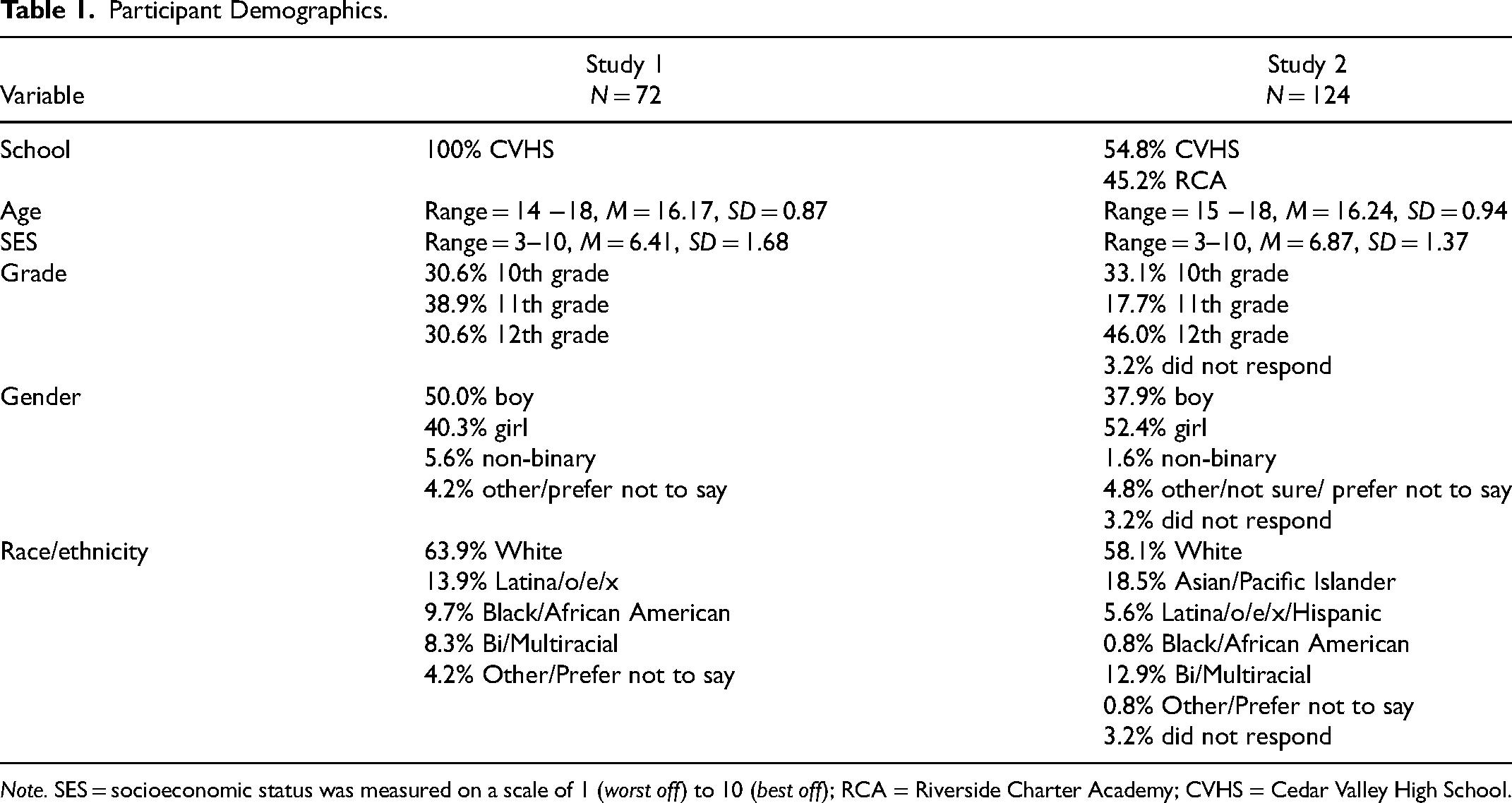
Note. SES = socioeconomic status was measured on a scale of 1 (worst off) to 10 (best off); RCA = Riverside Charter Academy; CVHS = Cedar Valley High School.
Measures
RTR Outcomes
To measure student perceptions of RTR outcomes, we asked students how much they agreed with 9 statements on a scale of 1 (strongly disagree) to 5 (strongly agree) on the post-RTR survey. Two statements aligned with research skills (“RTR helped me gain research skills” and “RTR helped me understand research methods”). Two other statements somewhat aligned with research/psychology persistence (“RTR made me more interested in doing research in the future” and “RTR made me more interested in pursuing psychology in the future”). Other outcomes included connecting with other students and research mentors, feeling like a psychologist, and seeing research as a tool for community improvement (see Table 2 for all items).
Ready Through Research (RTR) Outcome Descriptive Data.
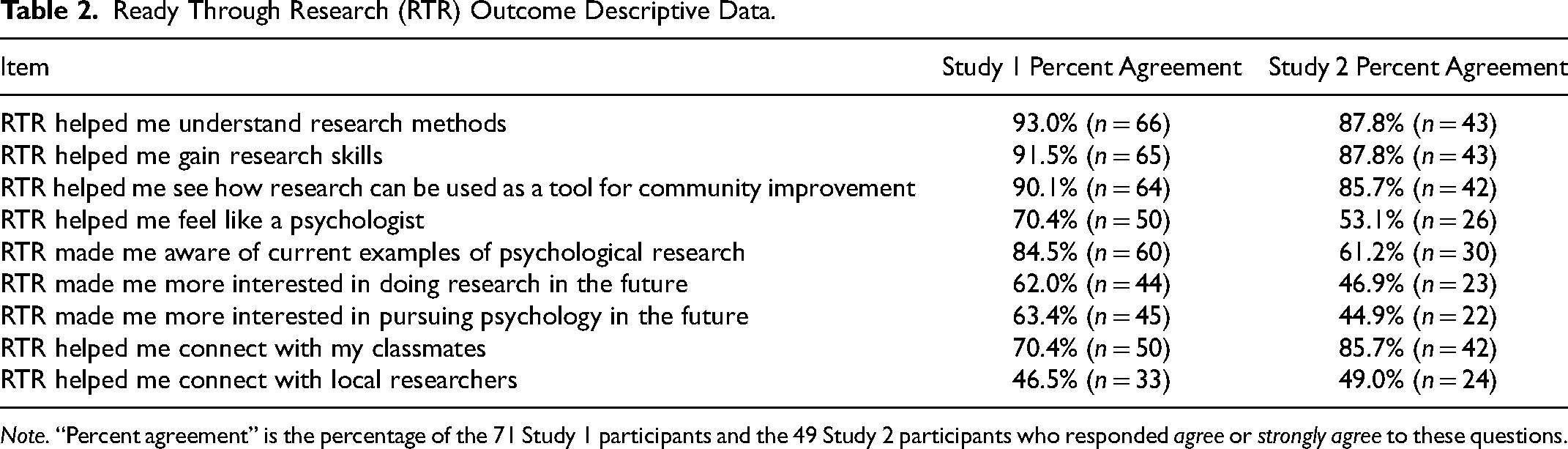
Note. “Percent agreement” is the percentage of the 71 Study 1 participants and the 49 Study 2 participants who responded agree or strongly agree to these questions.
Research Skill and Science Persistence Self-Efficacy
We measured students’ confidence in their research skills and ability to persist in science (adapted from Byars-Winston et al., 2016) on the pre-and post-RTR surveys. We asked participants to respond to the question stem “How much confidence do you have in your ability to …” on a scale of 1 (no confidence) to 5 (complete confidence). The research skill self-efficacy subscale averaged 11 items (α = .91–0.93), each listing specific skills (e.g., “collaborate with a research team”). The science persistence self-efficacy subscale averaged six items (α = 0.91–0.94), each listing ways to continue in science (e.g., “declare a science major in college”). Higher scores on these subscales indicate greater self-efficacy. See Cerda-Smith (2025) for all items.
Data Analysis Plan
To address our first RQ, we conducted descriptive statistics (see Table 2) to examine student perceptions of RTR outcomes. To address our second RQ, we used a two-tailed paired samples t-test to explore pre-/post-program changes in students’ research skill self-efficacy and science persistence self-efficacy. A post hoc power analysis using G*Power that included a moderate effect size (0.40), an alpha of 0.05, and a sample size of 72 resulted in adequate power (β = 0.92).
Study 2: Means and Standard Deviations by School and Time.

Note. The scale range is 1–5 for all study variables. CVHS = Cedar Valley High School (n = 64), RCA = Riverside Charter Academy (n = 52).
Results
First, we examined descriptive statistics to understand student perceptions of RTR outcomes (RQ1). Notably, the vast majority of participants agreed that RTR helped improve their research knowledge and skills and helped them see how research is a tool for community improvement (see Table 2 for percentages). Furthermore, most students agreed that RTR made them more interested in pursuing research and psychology in the future.
Next, we explored changes over time in research skill self-efficacy and science persistence self-efficacy (RQ2). Results of the paired samples t-test for research skill self-efficacy revealed that participants’ confidence in their research skills grew significantly from pre- (M = 3.64, SD = 0.66) to post-RTR (M = 4.08, SD = 0.61), t(70) = 5.82, p < .001, Cohen's d = 0.64. Results of the paired samples t-test for science persistence self-efficacy revealed that participants’ confidence in their ability to persist in science did not significantly differ from pre- (M = 3.22, SD = 0.98) to post-RTR (M = 3.38, SD = 1.01), t(70) = 1.51, p = .134, d = 0.86.
Discussion
Overall, results from Study 1 suggest that engaging in the RTR program helped AP Psychology students improve their understanding of and confidence in research skills and gain research skills. Furthermore, most students agreed that RTR made them more interested in pursuing research and psychology in the future. This somewhat contradicts our finding that students’ science persistence self-efficacy did not change over time. Perhaps AP Psychology students do not think of Psychology as a science discipline. This led to another iteration of RTR.
Study 2
Study 2 built upon Study 1 by expanding RTR to a new school context to begin to document generalizability. Specifically, Study 2 examines student outcomes during the second iteration of RTR, during which the program expanded to a new school. We implemented RTR in all Advanced Placement (AP) Psychology classes taught at CVHS (public school) as well as Riverside Charter Academy (RCA, pseudonym), a charter school in the Southeastern United States, during the 2023–2024 school year. There were five sections of AP Psychology at CVHS (total enrollment = 150) and four sections at RCA (total enrollment = 85). One teacher taught all sections of the course at each school. Shortly after the first workshop was implemented, the CVHS teacher left early in the school year, and RTR programming halted. CVHS students continued learning the AP Psychology curriculum through coursework (i.e., videos, slides, readings, projects, and practice AP test questions) provided by the teacher on leave. Still, RTR was suspended throughout the year at CVHS.
This created somewhat of a natural control group in which CVHS students experienced the AP Psychology curriculum without RTR programming. Conversely, RCA students experienced the entire RTR program embedded within the AP Psychology curriculum. While RTR programming remained consistent with the first iteration, we modified our survey measures to more broadly examine students’ confidence in their ability to pursue psychology rather than science.
Study 2 built upon the findings from Study 1 by continuing to examine student perceptions of RTR outcomes (RQ1) and changes in research skill self-efficacy over time (RQ2). Given that Study 1 participants may not have perceived psychology as a science discipline, we explored whether participants’ psychology persistence self-efficacy changed over time in Study 2 (RQ2). Study 2 further built upon Study 1 by examining whether changes in students’ research skill self-efficacy and psychology persistence self-efficacy differed between students who experienced the RTR program (RCA students) and those who did not (CVHS students, RQ2a).
Method
Procedure
We informed parents at both schools of this study and gave them instructions on how to opt their child out of participation one week before pre-RTR survey distribution. Since no parents opted their child out of participation, all students were invited to participate. Participants completed the pre-RTR survey during class the day before the first workshop in September 2023. RCA students completed the post-RTR survey within 2 weeks after the Research Expo in May 2024 during class. CVHS students also completed the post-RTR survey after the AP Psychology exam in May 2024. Each survey took students about 15 min to complete.
Participants
Participants included students who completed both pre- and post-RTR surveys (N = 124, Mage = 16.24, SD = 0.94), which involved AP Psychology students at CVHS (n = 68) and RCA (n = 56). See Table 1 for participant demographics. Notably, 10th through 12th graders can enroll in AP Psychology at CVHS, but only 12th graders can do so at RCA.
Measures
RTR Outcomes
RTR outcomes were measured using the same items included in Study 1 (see Table 2). Only RCA students responded to these items because they engaged in the RTR program; CVHS students did not.
Research Skills and Psychology Persistence Self-Efficacy
We measured students’ sense of confidence in their research skills and their ability to persist in psychology using the same items as Study 1 (adapted from Byars-Winston et al., 2016) with minor changes based on our findings from Study 1 that students may not consider psychology to be a science discipline. Therefore, we replaced mentions of “scientific” or “scientists” with “research” and “researchers,” respectively, on 3 of the 11 items included in the research skill self-efficacy averaged subscale (α = 0.89–0.91; see Cerda-Smith, 2025 for all items). We also replaced mentions of “science” with “psychology” for 5 of the 6 items included in the science persistence self-efficacy subscale, shifting this subscale to represent students’ average psychology persistence self-efficacy (αs = 0.84).
Data Analysis Plan
First, we conducted descriptive statistics to examine student perceptions of RTR outcomes (RQ1). Then, we used two 2 (school) x 2 (time) repeated-measures analyses of variance (ANOVAs) with Bonferroni post hoc analyses to examine whether there were significant changes in students’ research skill self-efficacy and psychology persistence self-efficacy from pre- to post-RTR (RQ2) and whether changes differed by school (RQ2a). We used G*Power to conduct a post hoc power analysis involving a low effect size (0.12), alpha of .05, and sample size of 124. This analysis revealed that we were slightly underpowered for this analysis (β = 0.76). We continued with our planned analyses but caution readers that there may be other significant differences that we could not detect. Future RTR iterations should consider ways to enhance participation rates on the pre- and post-program surveys to increase sample size and statistical power for these analyses.
Results
First, we examined descriptive statistics of RCA student responses to understand their perceptions of RTR outcomes (RQ1). The vast majority of participants agreed that the program helped improve their research knowledge and skills, see research as a tool for community improvement, and feel connected to their classmates (see Table 2 for percentages). Almost half of the participants agreed that RTR made them more interested in pursuing research and psychology in the future.
Next, we explored changes over time in research skill self-efficacy and psychology persistence self-efficacy (RQ2) and whether these changes differed by school (RQ2a). Results of the 2 × 2 ANOVA for research skill self-efficacy revealed significant main effects of time, F(1,114) = 14.81, p < .001, ηp2 = 0.12, and school, F(1,114) = 8.56, p = .004, ηp2 = 0.07, which were qualified by a significant time x school interaction, F(1,114) = 11.55, p < .001, ηp2 = 0.09. Bonferroni post hoc analyses revealed no significant differences between RCA and CVHS students’ research self-efficacy pre-RTR (p = .417) but RCA students reported greater research self-efficacy compared to CVHS students post-RTR (p < .001), see Table 3 for means and standard deviations. Furthermore, CVHS students did not demonstrate significant growth in research self-efficacy from pre- to post-RTR (p = .737), but RCA students did (p < .001, see Figure 1).
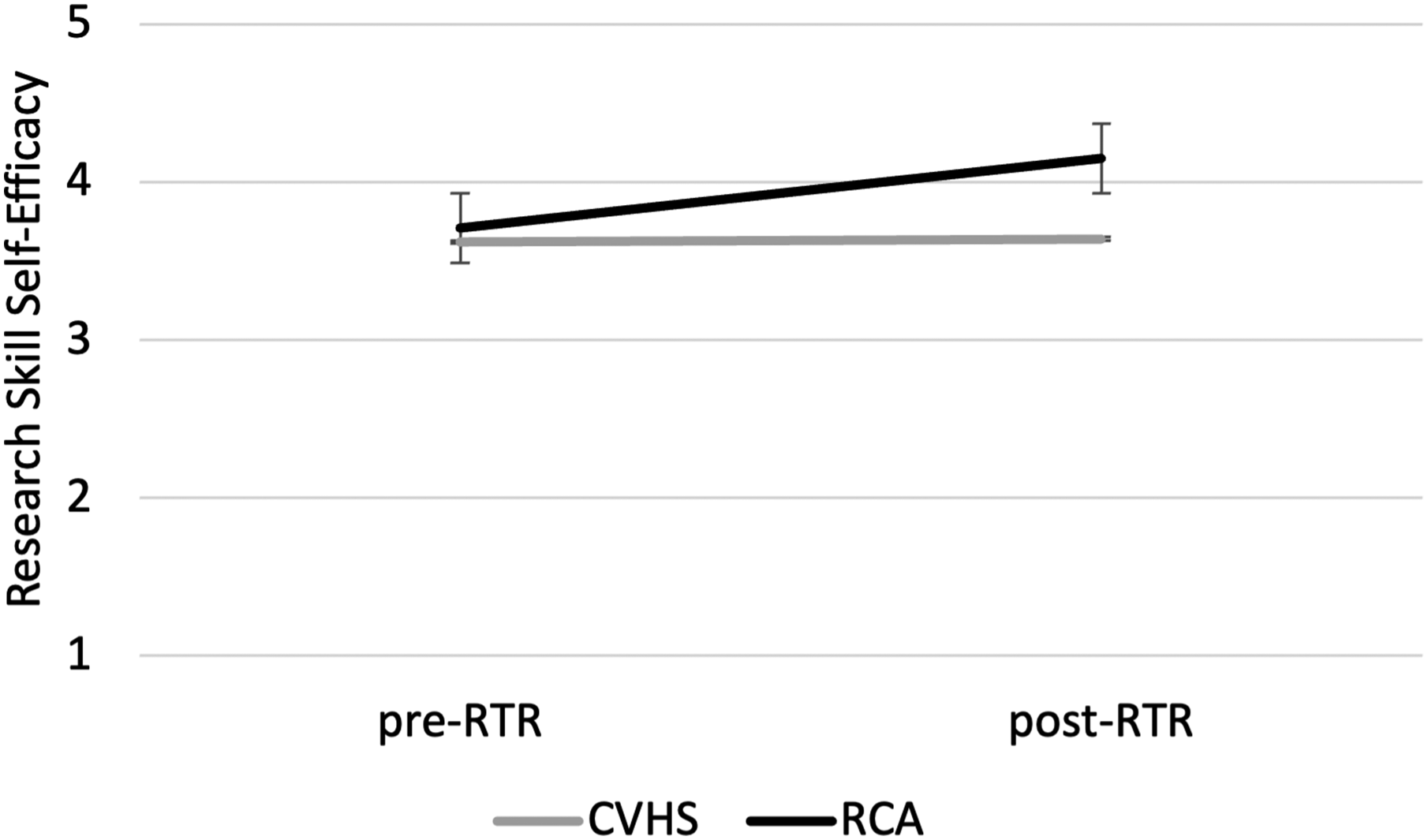
Study 2: Growth in RTR participants’ research skill self-efficacy. Note. RCA students received RTR programming. CVHS students did not. RTR = Ready Through Research; RCA = Riverside Charter Academy; CVHS = Cedar Valley High School.
Results of the 2 × 2 ANOVA for psychology persistence self-efficacy revealed significant main effects of time, F(1,114) = 11.55, p < .001, ηp2 = 0.09, and school, F(1,114) = 0.64, p = .425, ηp2 = 0.01, which were qualified by a significant time x school interaction, F(1,114) = 5.57, p = .020, ηp2 = 0.05. Bonferroni post hoc analyses revealed that RCA students demonstrated significant growth in psychology persistence self-efficacy (p < .001) from pre- to post-RTR. CVHS students did not (p = .439). However, students’ psychology persistence self-efficacy did not differ by school at pre- (p = .609) or post-RTR (p = .073, see Figure 2).
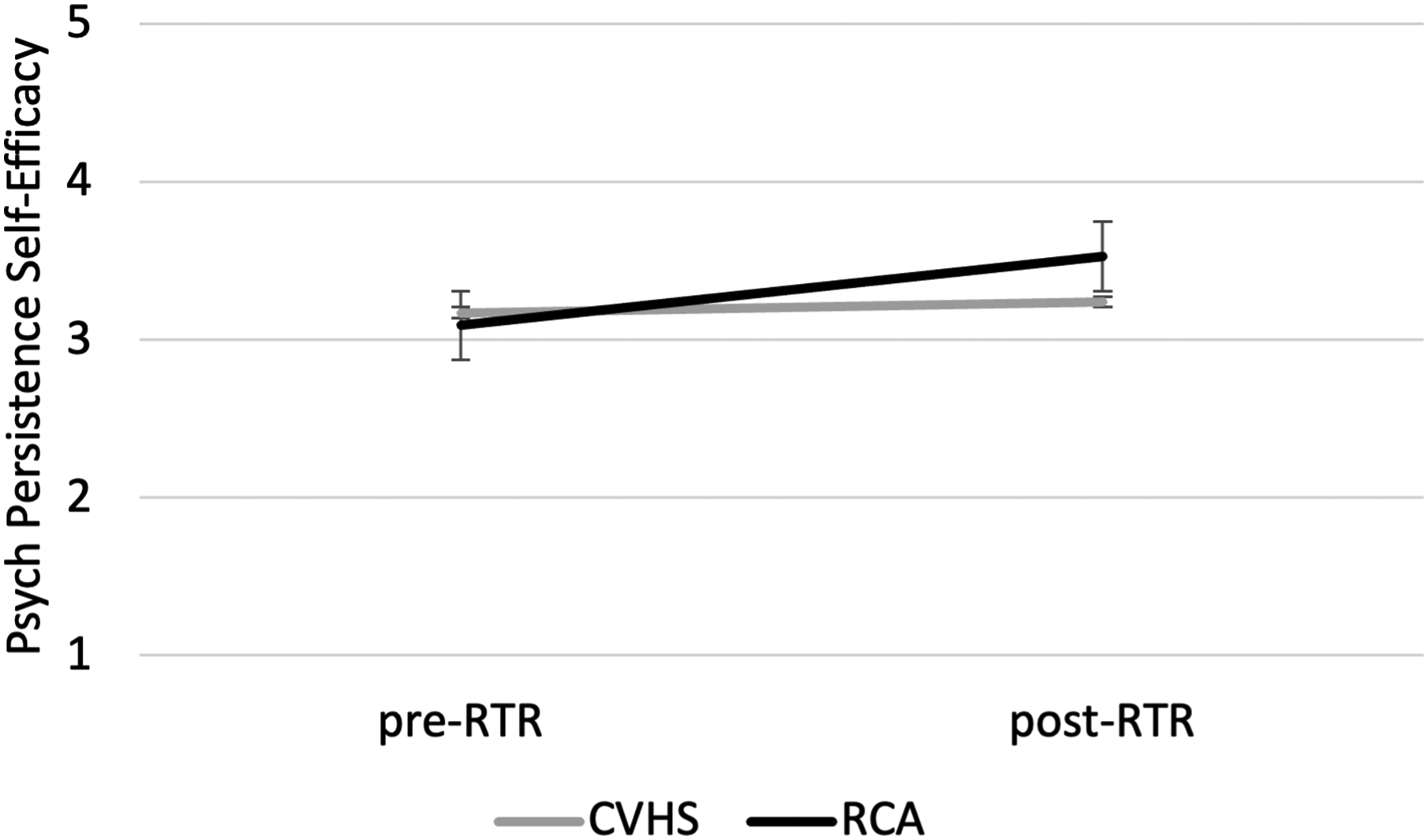
Study 2: Growth in RTR participants’ psychology persistence self-efficacy. Note. RCA students received RTR programming. CVHS students did not. RTR = Ready Through Research; RCA = Riverside Charter Academy; CVHS = Cedar Valley High School.
Discussion
Consistent with Study 1 findings, Study 2 found that RTR participants gained research skills and improved their understanding and confidence in research skills. By comparing changes over time between CVHS (control) and RCA (RTR) students, Study 2 demonstrates that experiencing RTR programming embedded in an AP Psychology course led to greater confidence in their research skills and their ability to persist in psychology more than students who received the standard AP Psychology curriculum. RCA students’ agreement that RTR helped them improve their research knowledge and skills and made them more interested in pursuing research and psychology in the future supports this finding.
General Discussion
Overall, results from Study 1 and Study 2 highlight the benefits of embedding RTR programming in AP Psychology courses. Notably, most students agreed that the RTR program enhanced their research skills and interest in pursuing psychology and research in the future. RTR students also demonstrated significant growth in their research skill self-efficacy and their psychology persistence self-efficacy. Importantly, these constructs did not significantly grow for students who did not participate in the RTR program. Together, these novel findings indicate that AP Psychology students benefit from designing, conducting, analyzing, and presenting their psychological research projects.
RTR Outcomes
Aligned with prior research documenting the benefits of undergraduate research experiences (Budesheim et al., 2023; Lutsky, 1986), student perceptions of RTR program outcomes demonstrate multiple benefits of providing high school students with research experience. This finding challenges the sentiments of most higher education Introductory Psychology instructors who felt that designing, conducting, and interpreting research was not especially important for introductory courses (Peterson & Sesma, 2017). Across Studies 1 and 2, over 80% of RTR participants mostly agreed that the program helped them understand research methods, gain research skills, and see how research can be used as a tool for community improvement. Most RTR participants also reported that the program helped them feel like a psychologist. Together, these findings suggest that RTR improves students’ research activist orientation, science identity, as well as their research knowledge and skills, which are predictors of science persistence and interest, especially for underrepresented groups in STEM (Chemers et al., 2011; Martin & Fisher-Ari, 2021; Merritt et al., 2021).
In both studies, over 70% of RTR participants reported that the program helped them connect with their peers; however, slightly less than half of RTR participants agreed that RTR helped them connect with local researchers. Feeling connected with peers in class encourages students’ sense of relatedness or belonging, which, in turn, encourages students’ intrinsic motivation (Ryan & Deci, 2000). Positive mentorships also encourage academic persistence and interest (Merritt et al., 2021), which is why future iterations of RTR might limit the number of research mentors to enable stronger connections between mentors and RTR students during workshops.
Interestingly, we also found that almost all of Study 1 (CVHS) participants agreed that RTR made them more interested in doing research and pursuing psychology in the future. In contrast, slightly less than half of Study 2 (RCA) participants agreed with these same statements. We wondered why this was the case when RTR programming remained essentially consistent between studies. Perhaps it is because RCA (Study 2) students are more interested in doing research than CVHS (Study 1) before engaging in the RTR program. Indeed, 44.6% of RCA students thought it was “very likely” that research would be part of their future career, compared to 31.1% of CVHS students, which indicates that RTR encourages high school students’ research interest, but high levels of pre-program interest may limit the appearance of post-program impacts.
Changes in Research Skill Self-Efficacy
Across studies 1 and 2, we found that RTR students’ research self-efficacy significantly increased from pre- to post-RTR. This aligns with prior research demonstrating the benefits of undergraduate research experiences (Budesheim et al., 2023; Lutsky, 1986) and research-self-efficacy (Byars-Winston et al., 2016; Livinţi et al., 2021) and extends this work to high school students. Consistent with work drawing on the Social Cognitive Career Theory (Lent et al., 1994) and previous research involving undergraduate and graduate students (Byars-Winston et al., 2016; Livinţi et al., 2021), these results suggest that by enhancing student's research self-efficacy, RTR programming also encourages success, persistence, and interest in psychology and research. Future research is needed to confirm these theorized associations for RTR participants.
Changes in Science/Psychology Persistence Self-Efficacy
In Study 1, RTR students’ science persistence self-efficacy did not change, but in Study 2, RTR students’ psychology persistence self-efficacy grew significantly. Together, these findings suggest that students may not perceive psychology as a science discipline despite being mentored by local research experts to employ the scientific method by designing, conducting, analyzing, and presenting their research projects. This is problematic if students have research experience and interest but do not perceive them as STEM-related. This may be especially important for minoritized high school students who are underrepresented in STEM, as prior research demonstrates that they are more likely to persist in STEM when they engage in authentic research experiences and mentorship (Beauchamp et al., 2022).
The APA Introductory Psychology Initiative (APA, 2018) and subsequent AP Psychology course changes (AP Psychology Course and Exam Description, 2024) attempt to correct this misconception by rooting psychological knowledge in scientific inquiry and research methods. These curricular changes emphasize psychology as a science, which aligns with the College Board's recent recommendation to offer AP Psychology as a science course in addition to its listing as a social science/studies course (College Board, 2024) and the APA's position that psychology is a STEM discipline despite being often excluded from the list of core disciplines responsible for scientific and technological progress (Bray, 2010). Perhaps as AP Psychology teachers adopt the new curriculum (AP Psychology Course and Exam Description, 2024), of which “science practices” are an essential course component, students will be more likely to see psychology as a science discipline. To further communicate that psychology is a science and, therefore, a STEM discipline, educators might explicitly state this in their course syllabus or align AP Psychology and AP Research curricula, which requires students to “…design, plan, and implement a yearlong investigation to address a research question…by learning research methodology, employing ethical research practices, accessing, analyzing, and synthesizing information.” (AP Research, 2023).
Differences by School/RTR Exposure
Study 2 results indicate that students who received RTR programming demonstrated significant growth in their research skills and psychology persistence self-efficacy, whereas students who did not participate in RTR did not. Further, although the two groups did not differ at baseline, RTR (RCA) students reported significantly greater research skill self-efficacy than non-RTR (CVHS) students after participating in the program. Although these findings may suggest that RTR programming enhanced AP Psychology students’ confidence in their research skills and ability to persist in psychology more than the standard AP Psychology curriculum, these findings should be interpreted cautiously. We acknowledge that CVHS was not an ideal control group in Study 2. Several confounding factors, such as having a long-term substitute, may have contributed to school differences other than RTR programming. For instance, class size, years of teacher experience, and student grade levels also differed somewhat between CVHS and RCA contexts. Future research should include a purposeful control group within the same school district to try to account for possible confounding factors. This is especially important given that new curricular changes emphasize scientific knowledge and practices more in the standard AP Psychology curriculum.
Limitations and Future Directions
Despite highlighting the promising benefits of RTR programming for AP Psychology students, this study has several limitations that educators should consider. First, these studies were conducted in a small sample of AP Psychology classrooms, which may not generalize to other settings. Not all teachers may be able to replicate RTR programming, as the intervention relies upon partnerships with local universities; however, they may be able to modify workshops to include virtual mentorship opportunities. Further, high attrition during Study 2, especially in the CVHS/control group, might have also influenced our understanding of RTR outcomes. Additionally, we chose to measure students’ research self-efficacy and perceptions of RTR programing rather than their actual content knowledge because prior research demonstrates that these cognitive factors shape individuals’ interest and persistence in STEM (Lent et al., 1994; Livinţi et al., 2021), especially for underrepresented groups (Byars-Winston et al., 2016). Future research wishing to explore changes in content knowledge over time in relation to RTR programming might consider using the Psychological Research Inventory of Concepts (Veilleux & Chapman, 2017). Future research approaches might also explore testing RTR in other high school psychology class settings beyond the AP classroom to assess whether the program is effective in different classes. Lastly, the current paper was limited in scope in examining RTR program outcomes for students, but preliminary data suggests that the program can also benefit AP psychology teachers and research mentors. Future research should examine program outcomes and experiences from these perspectives.
Conclusion
In summary, these studies demonstrate that the RTR program, which involves professional research mentors guiding high school students in designing and conducting their research projects, improves AP Psychology students’ (a) confidence and interest in pursuing psychology and (b) understanding of research methods and confidence in their research skills. In addition, over 90% of participants agreed that RTR helped them actually gain research skills, which helps prepare them for scientific college experiences and careers. However, findings from Study 1 suggest that participants may not consider psychology a science discipline. In light of the new changes to the AP Psychology curriculum, which emphasizes scientific practices, such as evaluating research design and data interpretation (AP Psychology CED, 2024), findings from our studies indicate that AP Psychology students should be given authentic opportunities to engage in the full scientific process by designing, conducting, analyzing, and presenting their research projects. Given that high school teachers may not have prior research expertise and may not feel efficacious in supporting their students throughout the research process, RTR programming highlights the benefits of partnering with local researchers to mentor AP Psychology students in their research endeavors.
Footnotes
Acknowledgments
The authors thank our Ready Through Research students for their enthusiastic interest and engagement. We also wish to thank our RTR research mentors Lauryn Miller, Zarria Tolbert, Luis Gonzalez, Maria Maza, Nathan Jorgensen, James Capella, Emily Herry, Angelina Joy, Patrece Joseph, Anna Buleza, Steve Jones, Courtney Medina, and Jennifer Persia for their guidance, time, and expertise.
Author Contribution Statement
Data Availability Statement
The deidentified data that support the findings of this study are available upon request from the first author (Dr. Jackie Cerda-Smith, jmcerda@ilstu.edu).
Declaration of Conflicting Interests
The authors declared no potential conflicts of interest with respect to the research, authorship, and/or publication of this article.
Funding
The authors received no financial support for the research, authorship, and/or publication of this article.
Ethical Approval
This study was approved by the IRB at North Carolina State University (protocol 25338).
