




Abstract
Introduction
Developing antiableist psychology curricula requires a system-wide approach that promotes inclusion and values knowledge at all levels. As a collective of autistic researchers, we explored how current curriculum structures impede inclusiveness.
Statement of the Problem
Both historically and currently within research, neurodivergent psychology is largely segregated under abnormal psychology. This segregation pervades into teaching, where educators position Western, Educated, Industrialized, Rich, Democratic, and Abled (WEIRDA) psychology as human psychology, implicitly excluding others from humanity.
Literature Review
Literature highlights that psychology centers on a medical model view of neurodivergence, a perspective at odds with the views of neurodivergent people. Understanding neurodivergence only regarding how these groups differ from WEIRDA norms reinforces stereotypes and understandings of neurodivergent people.
Teaching Implications
Consideration of neurodiversity within psychology curricula should be updated in line with neurodiversity-affirming research, with WEIRDA psychology named accurately. The voices of neurodivergent staff/students should be reflected in curriculum content. Neurotypical and neurodivergent psychology should be addressed together within topics.
Conclusion
Positioning WEIRDA psychology as human psychology directly opposes the aims of an antiableist psychology curriculum. We recommend actionable steps to reduce the exclusion and segregation of marginalized voices and, therefore, support meaningful change.
Despite recent efforts to diversify teaching materials and an increased focus on Equality/Equity, Diversity, and Inclusion (EDI) initiatives, education and curricula primarily platforms Western, Educated, Industrialized, Rich, Democratic (WEIRD; Henrich et al., 2010) knowledge (Acharya & Buzan, 2017; Hoffmann, 1977). Beyond these demographic characteristics, both psychology curricula and the academics who deliver psychology courses are unrepresentative of the broader population in other important ways. In the United Kingdom and the United States, around a quarter of the population is disabled (CDC, 2023; DWP, 2023), yet only 6% of the United Kingdom (HESA, 2023) and 2% of the United States academic staff (Andrews & Lund, 2015) report being disabled. We acknowledge that this low number likely reflects a lack of disclosure and true underrepresentation (see Jones, 2023). In recognition of these issues, there have been recent calls to expand the WEIRD acronym. Suggestions include Western, Educated, Industrialized, Rich, Democratic, and Abled (WEIRDA) (Bogart, 2024), where the A represents “Abled.”
The lack of diverse representation in psychology research largely reflects imperialist history (Bell, 2016). Research centers WEIRDA populations as the default group despite actually reflecting a global minority (Henrich et al., 2010; Puthillam, 2020; Puthillam et al., 2022; Rad et al., 2018). Western, Educated, Industrialized, Rich, Democratic, and Abled dominance becomes ingrained throughout academic research, which feeds into the curriculum. Marginalized groups are often excluded entirely (and so not represented) or referenced only in how they “deviate” from the WEIRDA norm (e.g., Hu et al., 2021) rather than integrated throughout research and curricula in a way that represents normal variation in human psychology. Research findings based on WEIRDA samples are presumed to generalize and to be about humans (and taught in a way that reflects this assumption) in general despite no evidence that they do and significant evidence that they do not (e.g., Henrich et al., 2010; Zinszer et al., 2023 for WEIRD; Hadad & Schwartz, 2019; Zisk, 2021 for neurotypicality). Research findings based on samples from marginalized groups may also encounter barriers to publication unless viewed through the lens of “deviation” due to assumptions that they will not generalize (Adetula et al., 2022; Forscher, 2022). As a result, such research is rarely incorporated into psychology curricula.
The treatment of WEIRDA populations as a “default” has wide-reaching consequences, specifically for curricula, where neurotypical and nondisabled are represented as the exemplar of human cognition, and neurodiversity and disability are positioned as deviant and abnormal. Where curricula position normality through this lens as good, natural, and comforting (Steinbock, 1995; Wysocki, 2020), deviation from normality is seen as aberrant, to be criminalized or pathologized (O’Connell, 2017). Ultimately, this leads to discrimination, suspicion, and scrutiny of people outside established WEIRDA norms. In some cases, marginalized groups are excluded not only as aberrant humans but also entirely from humanity, whether implicitly or explicitly (Gernsbacher, 2007). Where there is increased pathologizing, the rigid binary of normal versus abnormal is reinforced (O'Connell, 2017), and any gray area is eradicated.
One of the central components of “normality,” as constructed through psychology curricula and teaching environments, is to be neurotypical and nondisabled. In this article, we examine existing issues in psychology teaching and learning, focusing on systemic knowledge construction and implications for teaching, specifically, the designation of WEIRDA psychology as human psychology and the segregation of neurodivergent psychology under abnormal psychology. We focus on this issue because we believe that this exclusion and segregation represent a significant barrier to the development of inclusive academic environments and undermine the ability of existing initiatives to generate meaningful change.
Systems of Knowledge Production Based on Capitalist Interests
Higher education (HE) has become increasingly marketized, becoming a “for profit” system relying on students as consumers of a product (education) to buy access to their education (Molesworth et al., 2011). Marketization also affects how knowledge is constructed and distributed in HE via the curriculum, upholding corporate and government interests (Baskaran & Boden, 2006; Žarkov, 2015), and political agendas (Goggin et al., 2017). Academic institutions, places of research discovery and education, hold a position of power in knowledge construction and dissemination and play a central role in informing social perceptions and reinforcing dominant knowledge structures. As a result, individual academics have little autonomy in what and how they teach (Lawrence & Sharma, 2002; Olssen & Peters, 2005). This limits curriculum development and disadvantages students without accreditation (e.g., from the British Psychological Society) regarding employment and future study, which disincentivizes change.
Systems of knowledge production work to benefit the established norm, not by accident but by design. The processes and funding of knowledge generation are not neutral (Eriksson et al., 2014; Gani & Marshall, 2022). In line with these established norms, knowledge is primarily created and distributed by nondisabled, neurotypical academics. The implication is that community members directly affected by the knowledge created and disseminated are often not consulted or considered. Community knowledge is viewed as nonexpert regarding community members’ histories, experiences, and cultures compared to academic knowledge (Gani & Marshall, 2022).
This perpetuation of established norms and exclusion of disabled communities and researchers results in bias that permeates policy and research funding and ultimately, feeds into the psychology curriculum and pedagogical practice. This becomes ingrained into institutions, where systems are not actively challenged or changed (Caplan, 2003; Mills, 1970). Where the change is made, it is typically based on WEIRDA understandings and priorities serving market agenda (Tholen, 2022) or to aid specific performance metrics like the UK's Research Excellence Framework rather than change that reflects non-WEIRDA needs. This has implications not only for teaching and assessing the curriculum but also to what extent the curriculum is accessible and inclusive.
Positionality and Aim
Disability comes in many forms, most of which are not represented in the psychology curriculum (Rosa et al., 2015). To our knowledge, there is currently limited evidence of neurodivergent academics playing a role in shaping inclusive psychology curricula (e.g., with compassionate pedagogy; see Hamilton & Petty, 2023). Ultimately, understanding how neurodivergent academics may play roles in developing inclusive curricula is a goal that we strive for. Our consideration is positioned as a small collective of academics and researchers whose experience of HE and academia has been shaped by what it means to be disabled and autistic within these systems. We have different backgrounds and experiences and different disability profiles, but we are all autistic. The issues discussed here are certainly not unique to autism and will likely be more broadly applicable. However, we have chosen to focus on an area of disability where we have shared expertise that allows us to engage in self-relevant research (Devendorf et al., 2023).
We write as members of a Critical Participatory Action Research project exploring the experiences of autistic academics. Through this, we have had the rare opportunity to express and reflect on our experiences in various ways. It is through an autistic lens that we critically reflect on the current structure of psychology curricula and seek to address the often overlooked yet crucial role neurodivergent academics play in shaping a more inclusive and understanding educational framework reflected by antiableist research. Additionally, we supplement the literature review and academic analysis with examples and illustrations that represent our lived experiences as both students and teachers of the curriculum. With this comes the caveat that our positionality inevitably reflects the academic systems in which we work and study. All authors primarily have experience with Western Anglosphere psychology curricula and, therefore, can only speak to those. We do not intend to speak for others who remain systematically silenced under these knowledge systems.
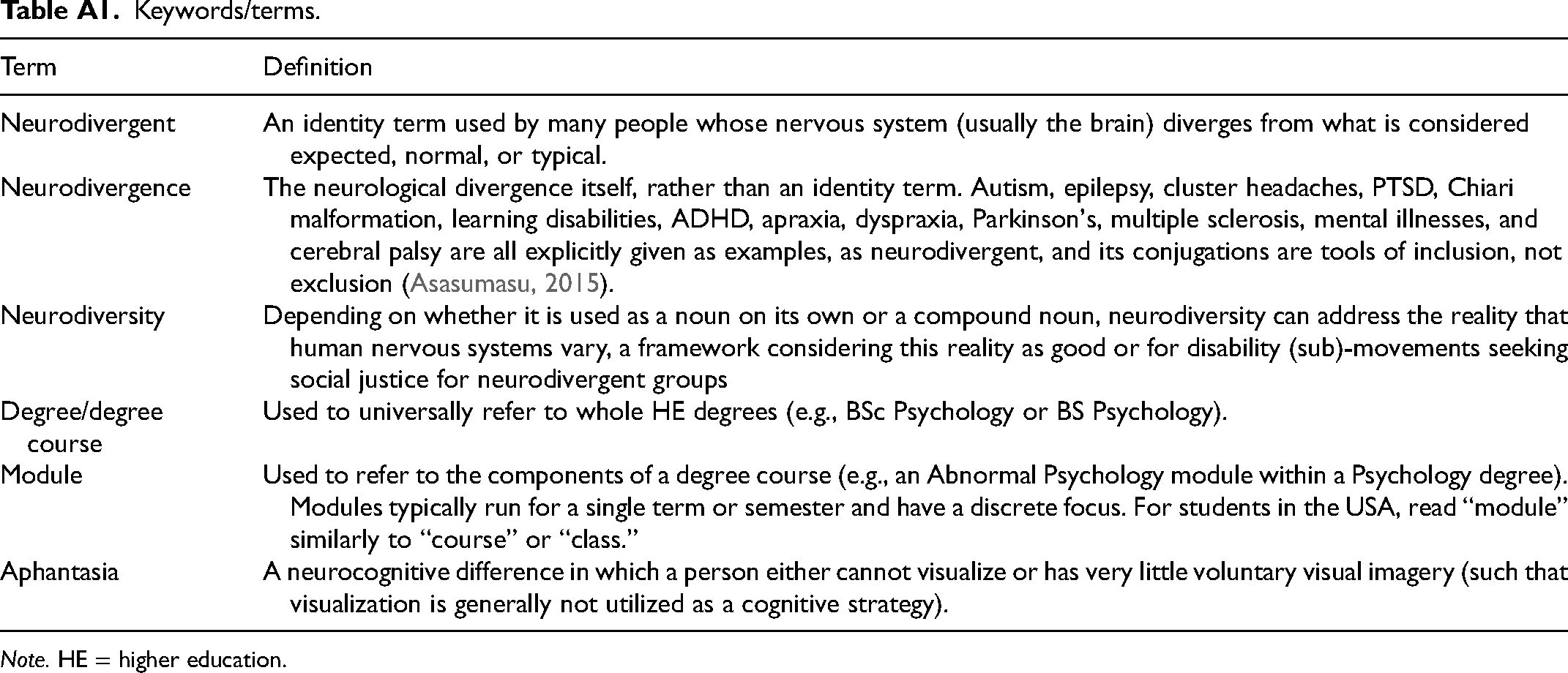
Here, we consider how ableism pervades and thrives in Western psychology research, how this influences knowledge and, ultimately, the development of psychology curricula, and how antiableist changes to curricula can, in turn, support antiableist changes in research. We discuss the impact embedded ableism within the research-to-psychology curricula pipeline has on autistic staff and students by reviewing the literature on neurodiversity in academia and drawing on our own teaching and learning experience. Finally, we suggest the requirements necessary to develop an antiableist psychology curriculum from an autistic viewpoint. To aid accessibility, key terms used in this manuscript are defined in Appendix A.
Autistic Academics: On Being the Curriculum
Social Understanding of Disability and the Implications
The medical model of disability conceptualizes disability as rooted in biology. Deviations from the societal view of “normal” are targets for eradication. This model is dominant in Western society and HE, perceiving a person to have an individual medical problem requiring a medical cure or resolution (Areheart, 2008). This model maintains abled supremacy (Dolmage, 2017; Singer & Bacon, 2020), intentionally singling out needs as “special” to paint a picture of “extraordinary needs” and “socially disruptive” needs (Dowse, 2017). This concept, therefore, is in direct opposition to the aims of the social model of disability, where disabled people are actively disabled, excluded, and restricted by external societal barriers (Disability Rights UK, 2022). Research utilizing the medical model creates a situation where the knowledge created about disabled people is potentially harmful and inaccurate, risking reinforcing stereotypes and perpetuating a narrow view of psychological health and development (Jaarsma & Welin, 2012). At the same time, knowledge relating to WEIRDA populations is presented as “human psychology” and is considered to be more generally representative of human cognition. Psychological researchers often fail to specify or justify their sampling, which often uses neurodivergent identities as exclusion criteria, yet continue to make population-based inferences (Simons et al., 2017) that are inaccurate, misleading, and self-perpetuating. Lack of critical engagement and reflection on the origins and motivations underlying these views about disability allow ableism to continue unchallenged. This is true for disability generally and autism research specifically.
Through the medical model, researchers view autism as a series of deficits in socializing, communication, and behavior that should be “prevented, eliminated or treated” (Natri et al., 2023) based on nonautistic observations of autistic features. As outlined above, knowledge is often constructed not by communities but by those who hold positions of power. This is particularly relevant here in relation to knowledge of autism, where historically, knowledge has been constructed by nonautistic people. This creates understandings of autism that do not reflect actual autistic experiences (e.g., Rosqvist et al., 2019) and fails to acknowledge autistic lived experiences and internal realities. Autistic people often build unique insights derived from the lived experience of being autistic. Yet, this insight is rarely utilized in project design, resulting in research and interventions not well-aligned with their needs and interests (McLaren, 2014). The problems with this approach are seen clearly when considering how autistic people view autism—recognizing that it is a disability, but in many cases treating disability itself as a neutral fact (Gillespie-Lynch et al., 2017).
Active inclusion of diverse knowledge and, in this case, autistic knowledge is key for gaining a true understanding of autistic academics’ lived experience within these systems and how to effectively construct and distribute knowledge in ways that are accurate and accessible. Autistic-led autism research has increased recently (Dawson & Fletcher-Watson, 2022; Milton et al., 2019; Nicolaidis et al., 2019; Pellicano & Stears, 2011; Pickard et al., 2021), yet this is unlikely to resolve current ableist curriculum where medical model knowledge still dominates research, and as a result what is taught across curricula. Moreover, the labor involved in pushing for better research, and teaching is often unacknowledged. Autistic autism researchers and participants are continuously forced into roles of “activists”, being exploited and tokenized for their expertise (Gillespie-Lynch et al., 2017) and willingness to contribute to their community knowledge (Botha, 2021). As a result, research centered on the medical model is used to inform curriculum and teaching, whereas community knowledge and antiableist psychology are rarely taught in university settings.
While academia continues to platform pathologizing research over community knowledge, it actively upholds this ableist system, directly affecting staff and students operating within the system. Contributing to the maintenance of this same system can alienate both practically and theoretically. Practically, the world is designed around WEIRDA norms because those with the most power in knowledge construction generally align with WEIRDA norms.
More theoretically, but with effects just as serious, if neurotypical psychology is framed as the default or universal “human” psychology, then by extension, those who fall outside this definition are implicitly positioned as less than fully human. This logic of devaluation and dehumanization is embedded in the very fabric and ideology of academic structures, impeding the creation of an inclusive, antiableist psychology curriculum. Gernsbacher (2007) highlights how academic discourse can erase or dehumanize entire groups that do not fit dominant theoretical frameworks (e.g., Benítez-Burraco et al., 2016). In this way, autistic people (and all other groups who fall outside of established norms) are frequently marginalized, their exclusion reflecting broader patterns of dehumanization. This dynamic extends into curricula and pedagogical practices, where knowledge of and openness toward disabled and neurodivergent individuals correlates with their continued dehumanization (Cage et al., 2019). Autistic experiences and perspectives are often overlooked or devalued, not just in curriculum content but also in how they are viewed and treated within academic settings. When autistic individuals are viewed as inherently “other” or less capable, it shapes both formal curricula and informal interactions, creating barriers to inclusion and equitable treatment. Those with multiple marginalized identities (falling outside of WEIRDA norms) face heightened dehumanization when their experiences do not align with the narrow concept of “human psychology” upheld by dominant academic paradigms, further hindering the development of an antiableist psychology curriculum and environment.
Representation Within the Curriculum
As a result of poor understanding of disabled and neurodivergent people due to ableist research, the representation of disability is poor across both the United States (Rosa et al., 2015) and UK psychology curricula. Most forms of disability (e.g., physical) are not taught at all in most psychology courses. The little representation of disabled people and other marginalized groups does receive is typically taught in segregated modules. For example, even where neurodivergent psychology is taught, this is often through modules segregated from “normal” cognition and development and instead related to “abnormal psychology,” “individual differences,” and “psychopathology” in undergraduate psychology modules. The concept of these modules is itself fundamentally problematic in pathologizing diversity and framing neurodivergence as abnormal.
The segregation of neurodivergent psychology and continued reliance on ableist terms perpetuate medical model views of difference as faulty/deficient with respect to its teaching of neurodivergence to psychology students. Neurodivergence is currently presented in psychology curricula with reference to how neurodivergent people are aberrant when represented at all. To even receive representation as neurodivergent people currently requires segregated and curated knowledge rather than being presented as “human psychology.” For autistic academics, we experience “othering,” with nonautistic processing positioned as the fundamental cognitive function shared by students and staff, while autistic processing is either positioned as a deviant exception present elsewhere, in clients or patients, or simply not addressed (Zisk, 2021).
This is compounded by the curriculum's problematic nature of framing divergence as inherently about “mental disorder” or “maladaptive behavior,” as “psychopathology” refers to in its definition (American Psychological Association, 2018). This framing is outdated, inaccurate, and inappropriate. It also promotes faulty and damaging views that people with these differences can and should be, “cured,” and that meaningful rehabilitation aligns with typical behavior and cognition. Where students are taught to view divergence through this lens, curricula then perpetuate the cycle of dehumanization and pathologization, encouraging future researchers and healthcare professionals to perceive any difference through the lens of diagnosis (Lundberg & Chen, 2024).
In addition, the knowledge presented in these modules typically fails to include neurodivergent people in its construction, often having limited validity and representation (Jones, 2022). Again, this happens by design. As disabled people are largely diverse communicators and often have intersectional identities, our knowledge is viewed as nonexpert, where we deviate from WEIRDA norms of nondisabled communication. As a result, perspectives presented in curricula rarely deviate from dominant knowledge structures. This means that at the most basic level, content often pathologizes, stereotypes, segregates, and alienates neurodivergent staff and students.
A considerable barrier to more meaningful change is the structural barrier. Even when disabled staff are given the option to contribute, institutions do not recognize the time commitment to family responsibilities, staff diversity (or lack of), or hierarchy between positions (Morris et al., 2021) of staff expected to implement policy changes in relation to inclusion (e.g., EDI policy). Kangataran (2023, The Game is Rigged Section) argues, “The game is rigged”: insufficient time limits what is achievable, leaving staff vulnerable to burnout. Initiatives are often implemented without meaningful engagement with staff, leaving their experiences and opinions unheard.
Often, autistic voices are explicitly and implicitly silenced, frequently being met with the claim that autistic people should not research autism or create content on autism because of their inability to be neutral (Devendorf et al., 2023). This claim works on the assumption that those in power are neutral. Autistic academics do not claim neutrality; “You can’t be neutral on a moving train” (Zinn, 1994, p. 8). However, despite claims to the contrary, those in power are not neutral either; “there are no bystanders, no witnesses and no positions of neutrality” (Fine & Weis, 2005, p. 93). Yet these spurious claims that autistic academics are uniquely biased are used to exclude our voices from the curriculum. At the same time, those in positions of power have the privilege of doing nothing in the face of inequality.
Where identity is concerned, there is often poor autistic representation across institutions, and lack of agency and authority means having limited opportunity to contribute to knowledge building or curriculum development. Autistic staff are not included or represented in constructing the psychology curriculum and rarely have meaningful opportunities to offer content that reflects community knowledge and experience or teach in environments that consider their needs as neurodivergent (and other minority group) staff. These points are echoed across other marginalized groups. For example, Black and other ethnic minority groups report exploitation, devaluing of their work/abilities, isolation, discrimination, disproportionate workloads, and fewer opportunities for career progression. All while being expected to perform tokenistic roles in teaching in areas related to race and ethnicity and being devalued while doing so (Equality Challenge Unit, 2009).
Being the Curriculum: Implications of What Can Be Understood About Neurodiversity Through Ableist Psychology Curricula
A consequence of upholding these ableist views through curricula can have implications on teaching and learning, assessment, accessibility and inclusion, and understandings of neurodiversity gained from teaching an ableist curriculum. The vast majority of what is known about the neural underpinnings of human cognition comes from studies limited to neurotypical samples from racially, ethnically, and socioeconomically homogeneous groups (Dotson & Duarte, 2020). The examples below highlight that extremely limited knowledge of neurodiversity can be gained due to current ableist curricula, which ultimately perpetuates cycles of ableist knowledge production and research.
In Table 1, we highlight three examples, drawn from personal experiences, of an ableist curriculum in the psychology teaching and learning environment.
Author Experiences of Ableist Curriculum.
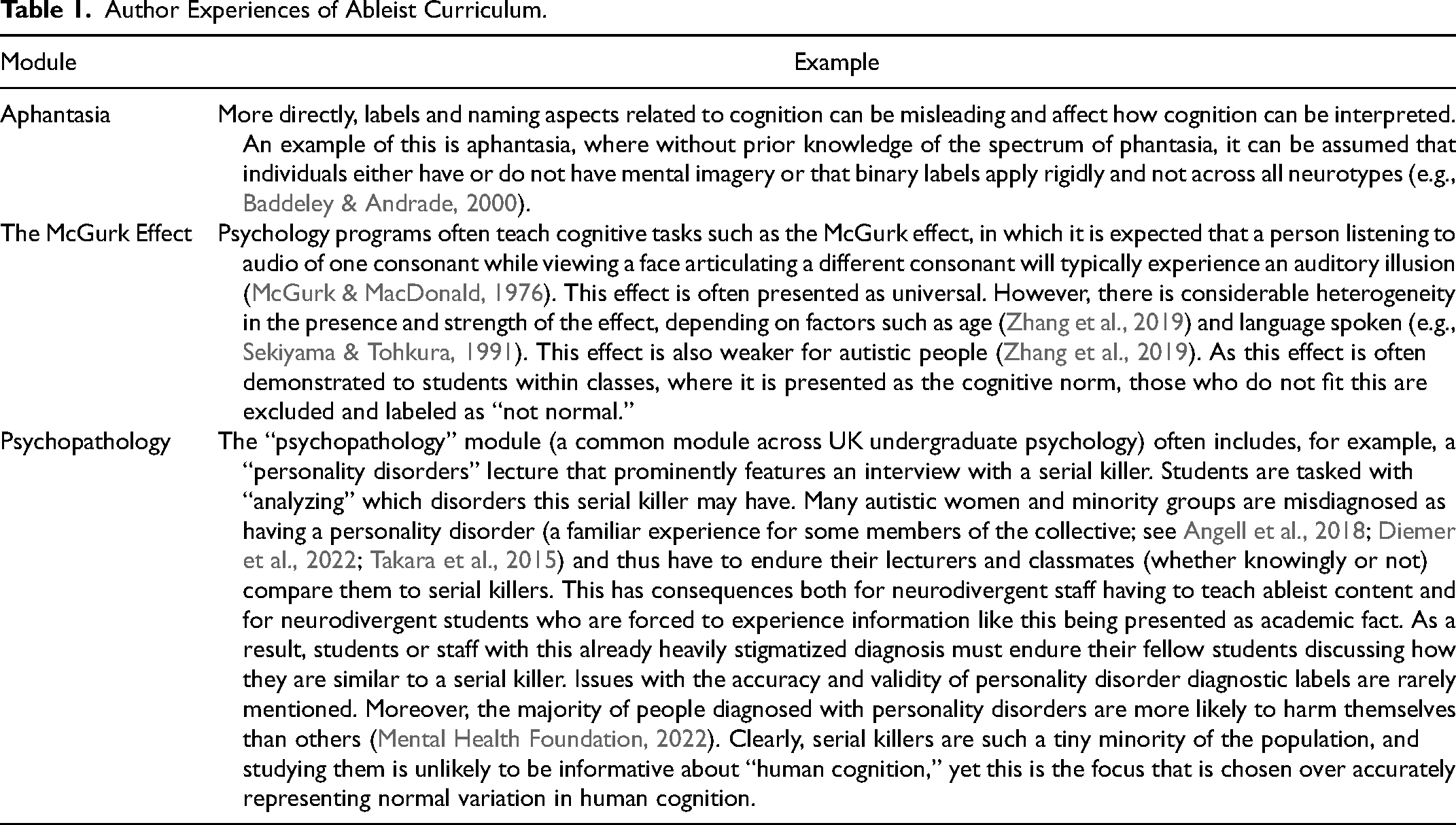
These examples highlight how neurodivergent people can be alienated when curricula (and the research the curricula are based on) do not consider neurodivergence within human psychology. Considered in isolation, this may seem innocuous, but these examples reflect a much larger lack of consideration for normal diversity in human cognition.
Lack of consideration of diversity through curricula that uphold ableist views harms neurodivergent staff and students in the knowledge and environments they foster around diversity. Ableism in academia reinforced through ableist curricula can have negative physical and mental health implications for autistic staff due to factors such as explicit ableism, lack of accommodation, isolation, stigmatization, exclusion, lack of safety, disclosure, and stereotyping, as well as negatively impacting career progression (Lindsay & Fuentes, 2022). Even efforts to move away from a deficit focus are problematic, where autistic “strengths” are positioned in a way that stereotypes “gifted autistics” (Brown & Fisher, 2023) while feeding into a narrative that neurodivergent people are only deserving of inclusion or support if they can offer giftedness or productivity under capitalist systems (Chapman, 2023). These assumptions of “strengths” and “giftedness” are harmful when staff are exploited for these strengths (typecasting; Milton, 2012) or forced largely into activist, advocacy, and mentoring roles (Botha, 2021). At the same time, universities refuse to accommodate autistic academics adequately to sustain or perform these roles, forcing them into burnout (Jones, 2023). This can result in expectations that staff will offer these (specific, stereotyped) strengths but no willingness to offer the accommodations and support needed to allow them to utilize and develop either the expected strengths or whatever strengths they might actually have.
These experiences can cause added labor, burnout, meltdown, exhaustion, and feelings of guilt for not performing to neurotypical standards, ultimately impacting careers and feelings toward the future (Jones, 2023). Autistic academics, as a result, will question whether their work is good enough or consider that there is no place for them in academia. This is an intense internal battle to contend with in a role that they have trained for with research areas integral to their identity.
For autistic students, institutional ableism (reinforced through ableist curricula) is associated with perceived institutional betrayal, poorer academic self-concept, increased grade dissatisfaction, and greater symptoms of anxiety and depression (Lett et al., 2020). This highlights the desperate need for antiableist curricula where current curricula contribute to the emotional and physical harm of disabled staff and students.
Recently, in attempts to address systemic ableism in academia, there has been increased discussion of “compassionate pedagogy” across a number of Western systems that incorporate perspectives from the neurodiversity movement into the educational environment (e.g., Dwyer et al., 2022; Hamilton & Petty, 2023). The neurodiversity movement emphasizes that these differences are natural variations and should be respected and valued. This movement asserts the importance of a social model, highlighting the poor fit between individual characteristics and their social context (den Houting, 2019). This encourages a shift away from pathologizing diversity and instead focuses on societal accommodation and acceptance. It also encourages research to address issues of key concern for the autistic community (den Houting, 2019).
However, while these aims are commendable, in practice, improvement remains limited. Where change is implemented, it often fails to tackle real issues where WEIRDA knowledge is deemed more trustworthy and superior to that of non-WEIRDA groups (Gani & Marshall, 2022). For example, diversifying curricula can sometimes lead to tokenistic inclusion, where adding diverse content does not equate to a deep understanding or integration of neurodivergent perspectives. Inclusive curricula go beyond merely throwing a few “diverse” examples into lecture slides. Token “improvements” to individual modules only result in slightly less offensive content in a system that fails to value disabled people (Holloway, 2001). This superficial approach can undermine efforts to create a truly inclusive educational environment (Brookfield, 2007) in the context of undoing historical harm.
Recommendations for an Antiableist Curriculum
To rectify the current ableist psychology curriculum, dominant knowledge structures must be abolished, and new perspectives must be considered in constructing inclusive knowledge systems. Here, we outline some brief recommendations as a starting guide based on the literature outlined throughout this article.
Acknowledge Where “Human Psychology” is Neurotypical Psychology
Knowledge that applies to neurotypical populations and cannot be generalized across neurodivergent populations should be clearly referred to as “neurotypical psychology.” The same applies if it is, in fact, WEIRDA psychology, not even generalizing across neurotypical populations. This suggestion resembles a teaching analog to the research and publication suggestion of constraints on generality (COG) statement (Simons et al., 2017). A COG for a research study describes which aspects of the participants, materials, and procedures are considered likely to be key to the finding and which aspects the authors reasonably expect to generalize—the authors note that replication with any group of participants meeting the description of the target population results is expected to generalize to, constitute a direct test of the effect. In teaching neurotypical and WEIRDA psychology, labeled explicitly as such, educators make a similar hedge to what Simons and colleagues encourage for authors, where outside the boundaries of the population tested, these results may not apply (Simons et al., 2017).
Teach Neurodivergent Psychology Alongside Neurotypical Psychology
Human psychology should recognize the diversity within which our brains work and embrace this by teaching neurodivergent psychology alongside neurotypical psychology. This would acknowledge both the neutrality of disability across the spectrum of natural human diversity and the need to accommodate diverse needs with diverse approaches. True inclusive education requires engagement and involves adapting teaching methods, curricula, and assessments to cater to a diverse range of learning needs. Note that teaching neurodivergent psychology as normal variation should never mean the failure to acknowledge neurodivergence as disability, and recognition as normal does not negate the need for recognition and accommodation.
Teach Accurate Information About Neurodivergence
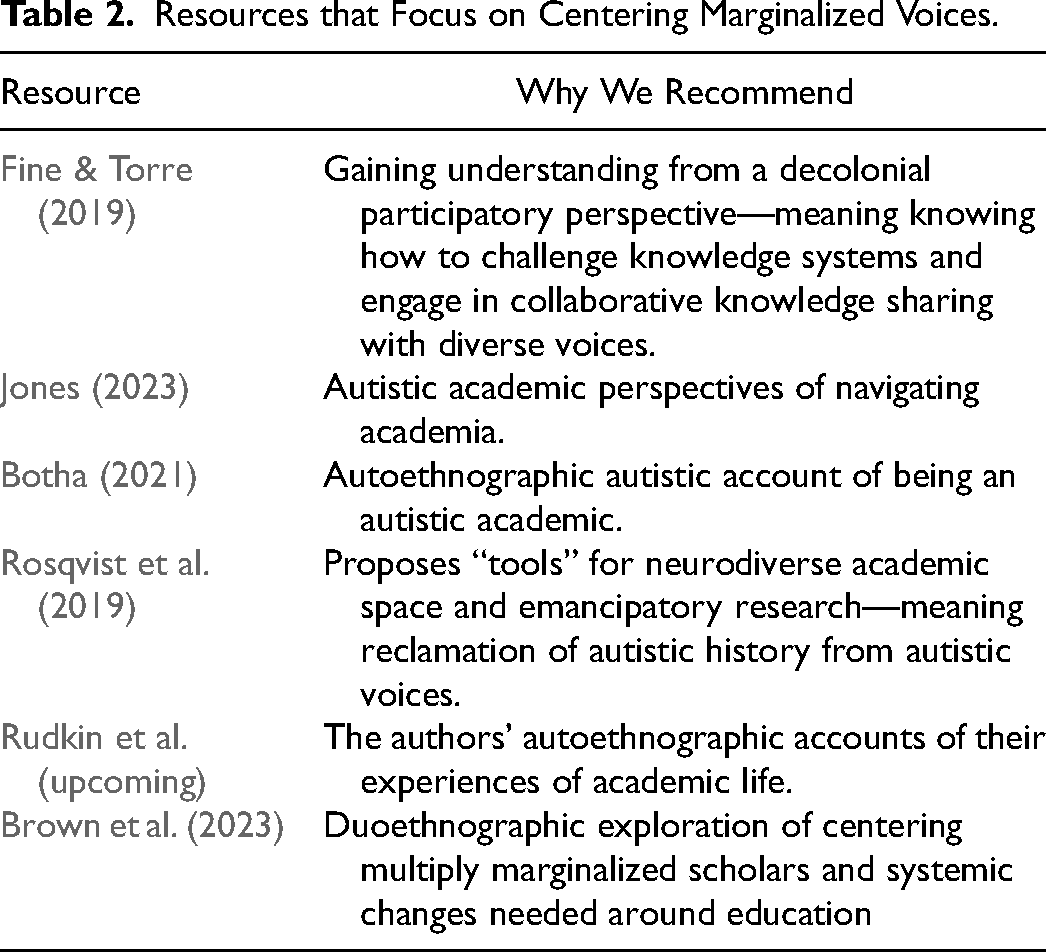
Psychology curricula should be updated to ensure accurate content about autism and other neurodivergence, including platforming antiableist autistic-led autism research. This relies on letting go of the medical model and instead prioritizing the voices of the communities being taught about. Here, we provide a few recommended starting points for educators who want to update their knowledge. Of course, this is far from extensive but is designed to provide a jumping-off point (Table 2).
Resources that Focus on Centering Marginalized Voices.
Overall, this will likely require updated training for staff to develop a greater understanding of social disability and inclusive education-framed teaching and perspectives. Staff with this training typically have more positive attitudes toward their disabled students, valuing them as individuals and prioritizing inclusive practice and equality (Morgado & Sánchez-Díaz, 2023).
Involve Autistic Staff and Students in Discussions on Ableism, But Don’t Rely on Their Labor
Inclusion does not just impact students, consequently, many autistic academics, including ourselves, are happy to discuss how curricula, teaching environments, and the culture that surrounds these can prioritize an antiableist agenda. However, this work is often done on top of an established workload and can be physically and emotionally taxing. It is important that colleagues feel they have a voice; however, their labor should not be relied on. Where staff do provide additional insight and input, it is important that appropriate mechanisms are in place to compensate for this additional effort. Acquiring funding is a notable barrier to compensating staff for these roles. However, charitable organizations (e.g., Teach Access, 2024) can often bridge some gaps here. Applying for funding is equally a barrier, so institutional support would go a long way in communicating that the institution values equal access enough to adequately compensate staff. Opportunities for contribution need to be accessible for diverse needs. Otherwise, voices are still being silenced.
Conclusion
Our review of the literature serves as a nonexhaustive reflection of aspects contributing to ableism within the curriculum, as told by autistic academics. We have offered suggestions based on this review; however, this is just a starting point for building antiableist praxis. The content addressing disabled and neurodivergent psychology will remain ableist unless and until it, too, is effectively addressed. However, we hold that these recommendations are necessary steps. As such, having a module about “abnormal psychology” and making token changes to improve classes or the module overall, while neurodiversity remains segregated from human psychology cannot fix the harm of the module (which is a curriculum-wide issue). Not even reworking the whole module to be from the neurodiversity paradigm will really fix it; segregated/separate is not equal (Brown vs. Board of Education, 1954).
Footnotes
Declaration of Conflicting Interests
The authors declared no potential conflicts of interest with respect to the research, authorship, and/or publication of this article.
Funding
The authors received no financial support for the research, authorship, and/or publication of this article.

Appendix A
Keywords/terms.
| Term | Definition |
|---|---|
| Neurodivergent | An identity term used by many people whose nervous system (usually the brain) diverges from what is considered expected, normal, or typical. |
| Neurodivergence | The neurological divergence itself, rather than an identity term. Autism, epilepsy, cluster headaches, PTSD, Chiari malformation, learning disabilities, ADHD, apraxia, dyspraxia, Parkinson's, multiple sclerosis, mental illnesses, and cerebral palsy are all explicitly given as examples, as neurodivergent, and its conjugations are tools of inclusion, not exclusion (Asasumasu, 2015). |
| Neurodiversity | Depending on whether it is used as a noun on its own or a compound noun, neurodiversity can address the reality that human nervous systems vary, a framework considering this reality as good or for disability (sub)-movements seeking social justice for neurodivergent groups |
| Degree/degree course | Used to universally refer to whole HE degrees (e.g., BSc Psychology or BS Psychology). |
| Module | Used to refer to the components of a degree course (e.g., an Abnormal Psychology module within a Psychology degree). Modules typically run for a single term or semester and have a discrete focus. For students in the USA, read “module” similarly to “course” or “class.” |
| Aphantasia | A neurocognitive difference in which a person either cannot visualize or has very little voluntary visual imagery (such that visualization is generally not utilized as a cognitive strategy). |
Note. HE = higher education.