



Abstract
Background
Citation practices are fundamental to teaching scholarly writing. With the emergence of generative Artificial Intelligence (AI) technologies, students need a structured way to cite when and how these technologies are used.
Objective
This paper introduces an instructor resource, an AI Contribution Statement, which provides students with an ethical and explicit framework for reporting on AI use during idea generation and writing in research methods.
Method
Students were guided to create an AI Contribution Statement that reports when an AI technology was used for a research paper, what prompts were given and text generated, and how the information was incorporated into a final written product.
Results
Sixty-four percent of students reported using AI assistive technologies. Of those, 33.12% reported using it more than twice, suggesting that, when allowed in a course, students’ use is relatively low.
Conclusion
Training students in best citation practices regarding ethical and transparent use of AI technologies is important, yet additional research is needed to understand how students are using it and how instructors can leverage this tool to foster equity.
Teaching Implications
An AI Contribution Statement is an important addition to research methods teaching to create equality in technology use and student success.
Keywords
Teaching students how to communicate effectively through writing is a core competency expected of undergraduate psychology majors (American Psychological Association [APA], 2023). A part of teaching students how to write includes a discussion of why and how scientists need to give credit to others; psychological scientists cite where ideas have come from and teach their students to do the same (Obeid & Hill, 2017). The purpose of the current paper is to introduce a teaching resource, an Artificial Intelligence (AI) Contribution Statement, for instructors to use that assists students with appropriating credit to a new source, AI technologies. Students include this statement with a research paper. It details, essentially cites, the various ways that students have used AI technologies in developing ideas and writing research papers in research methods courses. This paper highlights considerations that led to the genesis of the idea for an AI Contribution Statement, followed by a description of the Statement, the teaching contexts in which it has been tried, and descriptive statistics about the extent that students reported using AI technologies.
Giving Credit and Teaching Citation Practices
Students are taught in the process of scholarly writing that ideas are the currency of science, and thus appropriately citing where ideas come from is an ethical science practice. Some have argued that citations are perhaps akin to the monetary currency of science: the way in which scientists pay other scientists for using their ideas (Shi, 2011). Proper citation practices, or knowing when citations are needed, must be taught to novice scholarly writers; this knowledge is not necessarily intuitive (Park et al., 2011). Instructors spend a great deal of time discussing when an idea belongs to someone else, and the appropriate ways to keep track of whose idea is whose, via citations, to keep record of generated ideas and to help students avoid plagiarism. APA citation practices have a long history, and a specific and nuanced method to follow. Thus, from a pedagogical perspective, teaching students how to attribute ideas to others is not new.
What is new, however, is that there is now a technological “other”—generative AI large language models, like ChatGPT (OpenAI, 2023)—that can generate ideas and write about the ideas in language that mirrors what an individual might write. Generative AI technologies raise the question, whose idea is it when a student types in a prompt to ChatGPT, gets a response, and then incorporates the AI's response into a research paper? More than ever, instructors want to know where students’ written work is coming from—is it their own or was it adapted from a generative AI technology?
The APA-Style Blog (McAdoo, 2024) describes how the generated information from these large language models can be included in a reference list and offers direction for how the prompt and chat back should be included in an Appendix of a research paper. One of the primary problems, the article points out, however, is that the “chat” cannot be found by others in the same way that a cited research paper can; there is no way to reproduce the information provided by a specific prompt to a generative AI technology. Thus, what is missing as a resource is a way for students to keep track of their use of generative AI technologies. This was the primary impetus for the AI Contribution Statement: to give instructors a tool that would provide students with a systematic way of keeping track of how they were using AI technologies in the development of ideas for and writing of research papers in research methods courses. The AI Contribution Statement is a record or reference list for AI-generated information.
The AI Contribution Statement described herein was introduced specifically for research methods courses because of the courses’ placement in the writing curricula of many psychology programs. Students in research methods are often taught for the first time how to write scholarly papers, which includes learning proper citation practices and reference list generation (Chenneville & Gay, 2021). Research proposals that have students synthesize literature and develop methodologies to test theoretically grounded hypotheses are common in lower division psychology courses. In upper division lab courses, students often write full-length APA-style research papers, that require them to also analyze collected data, and write manuscripts to mirror publishable papers (e.g., Soysa et al., 2013). Thus, research methods courses tend to have a large writing component that mirrors the academic practices of scholars. In these courses, students refine their skills regarding how to give credit to scholars that have come before them.
Teaching AI Technologies and Documenting Its use
There are many technological tools (e.g., PsycINFO, Google Scholar, Endnote, Grammarly) that students use to support scholarly writing. Teaching students how to use these tools has long been a part of helping them learn how to produce research papers (e.g., Kortenkamp et al., 2023). Generative AI tool use is ethically complex (Satera, 2023). However, it can be viewed as just another tool in the process of writing that can be used by students. If generative AI technologies, like ChatGPT, are considered a tool, then instructors have a few pedagogical responses, like they do with any tool used in courses. They can choose to ignore the tool as if it does not exist, and assume that students will not use it. Another pedagogical choice is to forbid the use of generative AI technology, perhaps on ethical grounds. A third pedagogical choice is to teach generative AI technology. We chose to teach it: to teach students how to use generative AI technologies appropriately, ethically, and responsibly, like ChatGPT, and, most relevant here, to provide a way for students to document the AI tool use with an AI Contribution Statement.
We made the choice to allow AI tools for writing assistance because this technology is growing in use and the contexts of where it is being used are becoming more diverse. Generative AI technologies might also be useful for promoting student learning (e.g., Chan & Hu, 2023). For example, students can bounce ideas off ChatGPT in the same way that they might bounce around ideas during a peer study session. They can use ChatGPT to check whether their written work is correct similar to how going to a writing center might help them improve their writing. We also observed that knowledge about generative AI technologies, at least when we developed the AI Contribution Statement, was not equitable—some students seemed to know about ChatGPT, for example, and other students did not. This unequal distribution of knowledge could potentially create a “digital divide,” in the same way that other technologies have created inequalities among students (Fui-Hoon Nah et al., 2023). Thus, the best way to cross this divide was to make sure all students were aware of and knew how to use the technology. Thus, we taught it.
We feel supported in this endeavor because of the policies that APA has regarding the use of generative AI technologies in publications (McAdoo, 2024). The APA ChatGPT citation policy provides samples of how to properly use the technology, clearly states that scholars should not be lifting text verbatim generated by ChatGPT prompts, and that its use should be documented. This includes documenting when the AI technology was used, the exact prompt that was provided by the AI tool, and the AI response. We added all these components to the directions of the AI Contribution Statement. We included another component in the directions, not directly suggested in the APA blog, which required students to write a description of how they incorporated the AI-generated response into the final written product. It seemed important for responsible and ethical use to have students identify the process of how AI-generated information was used in a research paper. The choice to teach and have students specifically describe and document what they used generative AI technologies for in an AI Contribution Statement also felt familiar. This practice aligns with the increasingly common requirement of providing an author contribution statement that lists the specific contributions of authors as part of the journal submission process. We are not suggesting that ChatGPT, or other generative AI technologies are a possible author of a paper. Instead, there seems to be a parallel between the transparency involved with detailing how authors contribute to ideas and writing, and how AI tools might do the same.
Method
The AI Contribution Statement
The full AI Contribution Statement is in the Supplemental Material and directions summarized in Table 1 (Woods, 2024). The directions are explicit and clearly state that the AI Contribution Statement needs to provide a summary of how the student uses AI tools to assist with any aspect of a research paper, from the inception of ideas to editing of written work, and that the statement needs to be written in paragraph form. AI tool use could include a variety of technologies, such as ChatGPT, reading assistive technologies, like Explainpaper (computer software), and grammar checking programs. The directions also remind students that the use of AI for the writing of a research paper needs to adhere to the plagiarism policies of the course, and that it is a student's responsibility to use AI tools ethically and to document its specific use. Formatting directions for the AI Contribution Statement details the way that students should report on the use of AI tools as part of a research paper. Directions also provide an example contribution statement, along with directions for what students should report if they chose not to use AI tools. In this situation, students were asked to say that: “No AI tools were used in any way to help me develop the ideas for or writing of my Research Proposal.”
Directions and Example Statement from the AI Contribution Statement.
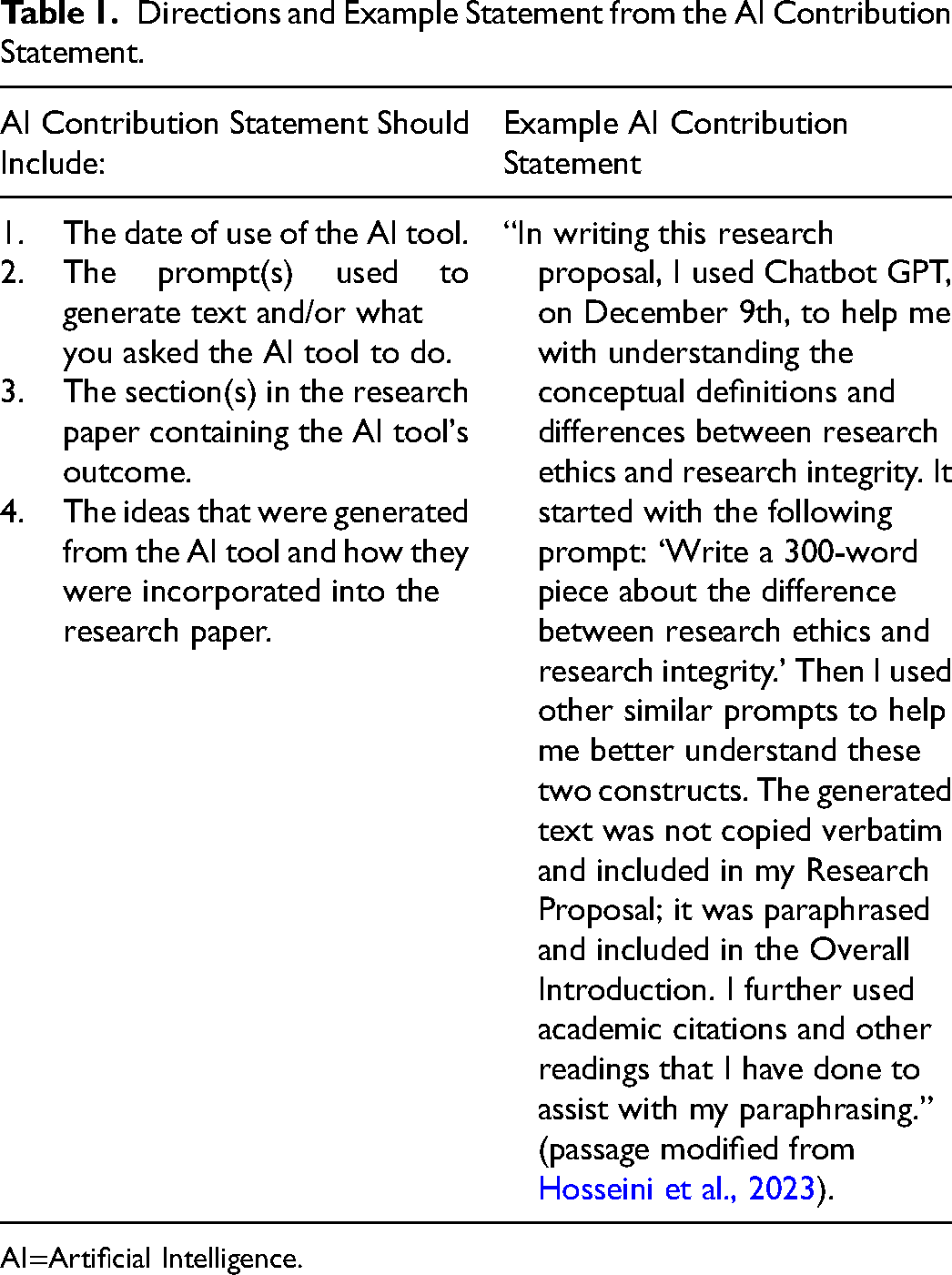
AI=Artificial Intelligence.
Teaching Context
The AI Contribution Statement was used in a 10-week quarter, in two different teaching contexts, with two different instructors at a large research university on the West coast of the USA. Both instructors have over 10 years of experience teaching research methods courses. One of the teaching contexts was a large (N = 204) pre-major, lower division research methods course, which includes both lecture and a lab. The final writing assignment was an individually submitted research proposal. The lab section included activities and assignments that scaffolded students towards writing a final research proposal. Five out of the nine lab sections had activities and assignments that included a discussion of how to use AI tools responsibly and ethically, and provided students with practice in using AI tools. As one example, in one activity teaching assistants showed students two text passages: one was the original text from a published paper and the other passage was AI-generated text from Explainpaper. Students then took the AI-generated text and paraphrase it in their own words, including citations from the original work. As other examples, students were asked to use ChatGPT to help them identify specific measurement scales for a construct, to generate possible paper titles, and to brainstorm ideas for a second factor to include in a factorial design. However, the AI Contribution Statement could include other AI tools not specifically introduced in the course, such as grammar and writing style checking programs. Thus, the AI Contribution Statement asked students to reference any type of AI tool use; it was broad and inclusive.
The other teaching context was a smaller (N = 42) upper division research methods lab course. There was a lecture and lab. The final assessment was a group research project that includes an individually written full-length APA-style paper. The instructor discussed the use of AI tools in assisting with the final paper in the first and last lectures, in the context of discussing proper citation procedures. The course placed less emphasis on introducing AI tool use as specific activities and assignments within the lab section. Thus, instructors used the AI Contribution Statement in different-sized courses, with students at different academic levels, with and without structured activities and assignments that discussed AI tools and their implementation. In both courses, the AI Contribution Statement was submitted along with students’ final research paper. The institutional review board approved both instructors to use the students’ course-related work for pedagogical research initiatives (protocol #s: 30-24-0024 and 15-24-0190).
AI Tool use Frequency Count
Three research assistants read and analyzed the AI Contribution Statements for the extent to which: (a) students reported using AI tools in the development and writing of their research paper and, if so, (b) to what extent were the tools being used. Extent of use was operationalized as single use, two uses, or three or more instances of use. The goal of this analysis was to assess how frequently students were using AI tools when writing their paper, not to provide a reliable way to content code AI Contribution Statements.
Results
The goal of the current paper is to provide teachers with the AI Contribution Statement as a resource to use in their courses. Thus, only descriptive statistics about the extent that students are reporting AI tool use, and example statements from students, are reported. As seen in Figure 1, just over half of the students (n = 157 out of 246 students) reported using AI tools in the development or writing of their research paper. This pattern mostly remained consistent across the two teaching contexts, with 65.20% of students (n = 133) reporting using AI tools when writing a research proposal (large lower division course), and 57.14% (n = 24) using AI tools when writing a full-length research paper (smaller upper division course). Overall, of students who reported using an AI tool, the rate of use was relatively low. Together, more than half (66.88%, n = 105) of students reported using AI tools only once (n = 73) or twice (n = 32). About a third of all students reported using AI tools more often, at least 3 or more times (n = 52). These patterns were very similar across both courses, so the data are presented as pooled data.
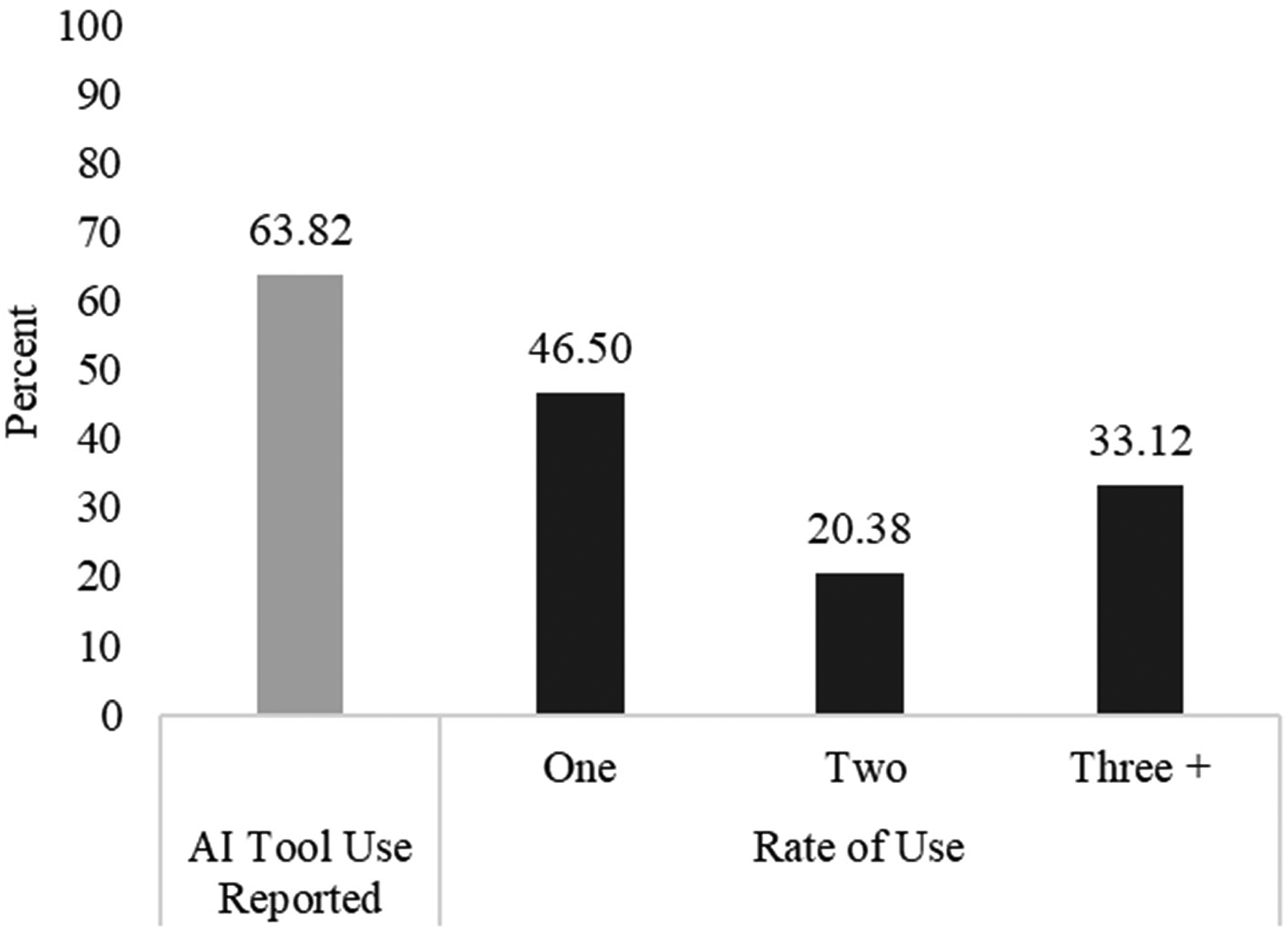
Percent of students reporting AI use in AI contribution statement.
Excerpts from students’ AI Contribution Statements are shown below, simply for illustration. As seen, the statements varied in terms of how frequently students were using generative AI technologies, like ChatGPT, to assist with generating research ideas, assisting with developing measures and analytic codes in R for statistical analyses, and writing assistance. It is also clear that ChatGPT, though perhaps most common, was not the only AI tool being used.
Student A wrote, The preparation of this research paper incorporated the use of AI to enhance its completion. Grammarly was used to proofread the assignment on 12/11/23, ensuring adherence to grammatical standards and proper citation. Additionally, ChatGPT was utilized for the identification and procurement of peer-reviewed articles to substantiate my claims. The remainder of the work is a product of my individual effort. In the writing process of this research paper, Chatbot GPT was utilized to check the format of the APA 7 citations. The prompt given to the Chatbot was ‘Correct mistakes in the following citations to make them follow APA 7 citation style’: The errors were then fixed and applied to the citation section in this paper…. In writing this research proposal, I used Chatbot GPT, to help me with grammatical punctuation. I asked Chatbot GPT to ‘fix the grammatical punctuation of this paragraph’ and then pasted the paragraph that needed to be grammatically checked. I then fixed my errors by adding/removing punctuation. I also used Chatbot GPT to find a R code for the median split values and asked it to find ‘alternate ways to find a median split.’
Discussion
The AI Contribution Statement we introduced as a teaching resource in the current paper was an easily implemented addition to students’ research paper submissions. Its application was broad, as it was used in two different research methods courses: a lower division introductory research methods course, and an upper division research methods lab class. One course had explicit training on how to use AI technologies ethically and responsibly, and the other framed AI tool use in the context of proper citation procedures. It was somewhat surprising that the reported use of generative AI technologies was not closer to ceiling given that we, the instructors, gave permission to use it. We thought explicit training for using AI technologies and the requirement of documentation with the AI Contribution Statement would promote the technology use among students. Most students did report using AI tools. However, in the AI Contribution Statement, approximately one-third of students reported that they did not use any AI tools in developing their research proposals and full-length research papers. Further, of those who did use AI technologies, about a third reported using it more than twice, suggesting most students’ use was either zero or low (i.e., 1 or 2 times).
The use response rates reported here, however, should not negate the importance of having students include an AI Contribution Statement when submitting research papers. There are several possibilities affecting student use rates that warrant future research. From the current project, there is no way to know whether the responses and reports in the AI Contribution Statement are genuine, or what students thought about using the AI Contribution Statement. Perhaps future iterations of AI detection software will enable instructors to compare the text in research papers to reports of AI use in a contribution statement to see not just whether AI tools are being used but how well they are being used. At this point, however, the detection technology does not seem to be accurate enough (Chaka, 2023). There might also be a stigma associated with using generative AI technologies, like ChatGPT, particularly if different instructors have different policies (e.g., ignore it, forbid it) across courses in a curriculum. Thus, students might underreport its use for fear of repercussion. Future research should explore the link between the possible stigma associated with using generative AI technologies and the extent that individuals report using, or not, these technologies in an AI Contribution Statement, like the one put forth here. Future discussions could involve creating a department or university policy regarding the use of generative AI technologies (Hasanein & Sobaih, 2023). Then, protocols like including an AI Contribution Statement may become mainstream in the writing submission process, and the stigmatization be reduced as normalization increases.
Students’ comfort levels with using generative AI technologies from an ethical standpoint are likely to vary based on their previous exposure or belief systems. Students who view AI negatively may simply refuse to use it on ethical grounds, and performance on course-related activities for which AI tools are allowed may suffer. This remains a question for future research. Regardless, the onus and challenge seem to currently be on instructors to find ways to better teach ethical generative AI technology use for scholarship and best citation practices. We hope that instructors see this AI Contribution Statement as one resource that can be valuable towards fulfilling that goal.
More fine-grained analyses of who is most likely to benefit from generative AI tool use and why is needed. If students can be taught to use this valuable, free, widely available tool in ways that can provide feedback to improve critical thinking about research and clarity of writing, it seems possible that generative AI technology use might be linked to student success and equitable student outcomes. Another future direction is to begin a thoughtful exploration into how students are using generative AI technology. Are they using it to find a theoretical framework to support their research question, to help better understand scholarly articles, or to check analytic codes? Knowing how students are using generative AI technologies and how those uses relate to assignment, assessment, and course grades is a fruitful direction; one that we intend to pursue.
Implementing the AI Contribution Statement in our courses taught us a few lessons that might prove useful for other instructors. It was relatively easy to incorporate activities and assignments into existing lectures and lab materials to teach students how to use AI tools ethically and responsibly. It did not add an undue amount of course material or take up an unnecessary amount of time. This is because many students were familiar with AI tools, especially ChatGPT, and were eager to have an instructor implement these tools in a course. Most students were comfortable attempting to use these technologies, although a few students were not (e.g., refusing to complete activities with an AI component, considering it unethical to use this tool). Students were also interested in how they could keep track of the ways in which they were using generative AI technologies to assist them with the development of research ideas and with clarification in writing. Additionally, there seemed to be a great deal of variability in both how much students knew about using these tools, as well as differences in comfort using these tools. While this is arguably true in many things that are taught in research methods courses, the lesson learned was to not assume any knowledge or comfort using the tool to start with and to carefully scaffold use. Students mostly seemed eager and excited about using the AI Contribution Statement and neither instructor received push back from students about submitting another statement as part of their final research paper in the course.
In conclusion, however, more work is needed to understand how to effectively teach students to use generative AI technologies to promote student success and to give instructors tools that they can use to help students give credit to these technologies. We hope the AI Contribution Statement is a resource that colleagues will find to be a useful first step. The collective goal is to find ways to positively impact students’ understanding of the process and product of scholarship as both consumers and producers of research, and to enhance the quality of their writing. Instructors have a responsibility to teach students how to cite the use of these new technologies, just as they have taught them to use other technologies. We suggest that, moving forward, an AI Contribution Statement might be as commonplace as a reference list that will be included in all student paper submissions.
Footnotes
Declaration of Conflicting Interests
The authors declared no potential conflicts of interest with respect to the research, authorship, and/or publication of this article.
Funding
The authors received no financial support for the research, authorship, and/or publication of this article.
