




Abstract
Background
The wellbeing of university students is deteriorating, highlighting a critical role for institutions to better support student wellbeing.
Objective
The goal of this work is to determine whether a final-year undergraduate wellbeing science module, inspired by recent theoretical developments, improved wellbeing during the COVID-19 pandemic.
Method
Participants (N = 128) completed a brief online questionnaire including the Warwick-Edinburgh Mental Well-being Scale across baseline and follow-up assessments. Analysis involved 2 group (intervention, control) × 2 time (baseline T1, follow-up T2) mixed-effects analysis of variance (ANOVA) and one-sample t-tests to compare the intervention group with population-based norms for adults aged 16–75+.
Results
A significant interaction effect was observed, reflecting an increase in wellbeing in the intervention group in T2 relative to T1. Comparisons with published norms, further highlighted the beneficial impact of the module.
Conclusion
Encouraging connection to self, others and nature has beneficial impacts on wellbeing, consistent with a modern science of wellbeing.
Teaching Implications
Students learn the latest wellbeing theory, spanning the individual to the planet, and engage with opportunities to improve wellbeing, broadly defined. Teaching materials are made freely available for instructors wishing to develop a similar module or adapt materials for other purposes.
University students are considered a high-risk population for mental ill-health (Eisenberg et al., 2013; Francis & Horn, 2017). The transition to university coincides with a critical developmental period for the brain, major exposure to stressors (leaving home, loneliness, academic pressures, gaining independence, developing new relationships, managing finances, social media) and lifestyle changes including exposure to alcohol and illicit recreational substances. Over and above traditional risk factors, the COVID pandemic brought a unique set of stressors including serious disruptions to education as courses were transitioned to online platforms, social isolation, and uncertainty about academic attainment and prospects (Liu et al., 2021). It is not surprising therefore that university students experienced significantly higher rates of anxiety (21.5% vs. 8.8%) and depression (38.6% vs. 15.8%) relative to the general population during the pandemic (Naser et al., 2020). These findings are contrasted by emerging research, highlighting a variety of factors to have protected wellbeing during the pandemic, including tragic optimism, gratitude, physical activity, social relationships, and connecting to nature (Kemp et al., 2022; Pouso et al., 2021; Wright et al., 2021; Wu et al., 2021; Mead et al., 2021b). Specifically related to students, physical health status, resilience and emotional support are positively associated with psychological wellbeing (Liu et al., 2021). Overall, these findings emphasize the adverse impacts associated with COVID-19, but also highlight capacity for building wellbeing despite hardship and suffering, consistent with recent developments in the field focused on accepting and transcending suffering for sustained wellbeing (Mead et al., 2022; Wong, 2019). In the present paper, we present evidence for the impact of a wellbeing science module on student wellbeing during the COVID pandemic using a group-based research design.
Several authors have demonstrated the beneficial impacts of positive psychology modules on university student wellbeing (Hood et al., 2021; Lambert et al., 2018; Young et al., 2020). These studies demonstrate how teaching of wellbeing-related concepts build declarative knowledge, while positive psychology interventions (PPIs) facilitate the development of procedural knowledge (see Kemp et al., 2022 for examples of PPI interventions). We have developed a module for final-year undergraduate students which included teaching recent theoretical advances in wellbeing science as well as the application of evidenced-based interventions guided by this work. The module was structured around our own theoretical model of wellbeing (Fisher et al., 2022; Kemp et al., 2017; Kemp & Fisher, 2022; Mead et al., 2019; Mead et al., 2021a), a transdisciplinary framework that ‘brings together’ other influential models across different disciplines and levels of scale, integrating heterogeneous ideas into a coherent whole. Our framework could be conceptualized as adding the theoretical glue that connects disparate transdisciplinary ideas, illustrating how these ideas reciprocally interact to realize wellbeing at multiple levels of scale, spanning the individual, community, and environment. Recent iterations of our model (Fisher et al., 2022; Kemp & Fisher, 2022; Mead et al., 2019; Mead et al., 2021a) present the key determinants of wellbeing within five categories; these include three categories denoting levels of scale relating to the individual, collective and planetary wellbeing in addition to socio-structural and cultural factors that influence wellbeing at each level of scale. While the capacity of individuals to promote their own wellbeing is greater than their capacity to promote collective and planetary wellbeing, there remains tremendous scope for individuals themselves to promote collective and planetary wellbeing alongside larger collaborative efforts through for example, volunteering and effective activism. The final category relating to the key determinants of wellbeing relates to positive behavior change.
What sets our module apart from other previously described modules (Hood et al., 2021; Lambert et al., 2018; Young et al., 2020) is a focus on broad theoretical underpinnings of wellbeing and theoretically-informed interventions that have been shown to support individual wellbeing whilst simultaneously promoting collective and planetary wellbeing. In the present paper, we address the following research question: Does our wellbeing science module improve student wellbeing during the COVID-19 pandemic? We predicted that participants who completed the module would display improved wellbeing on module completion.
Method
Participants
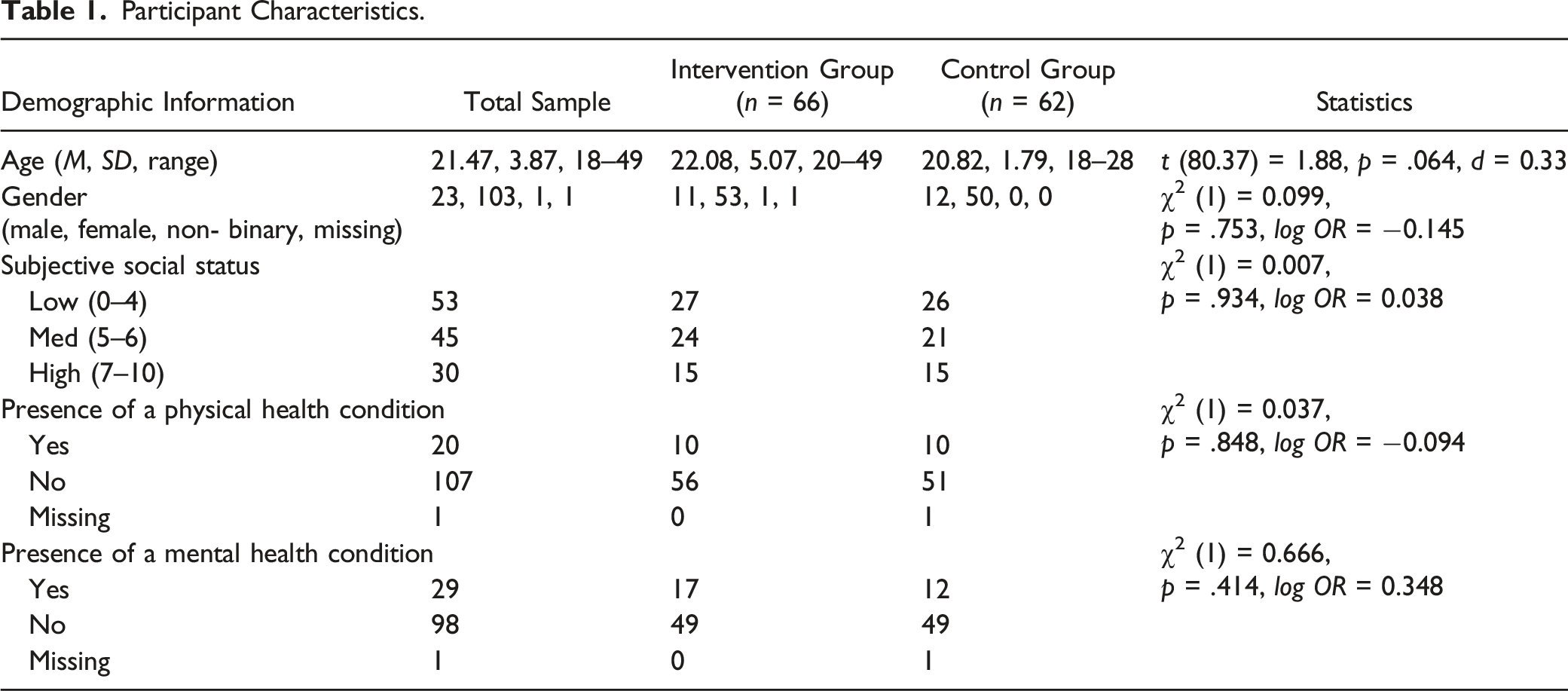
Participant Characteristics
Research Design
A non-randomized, mixed-effects design was adopted including a between-subjects factor of group (intervention, control), and a within-subject factor of time (baseline and follow-up assessments). For the intervention group, assessments occurred before and after the module, and for the control group, the assessments were separated by an equivalent amount of time elapsing for those in the intervention group. We also compared participant scores at baseline and follow-up with population-based norms from the Scottish Health Survey (Cheong et al., 2018).
Procedure
Swansea University student volunteers were recruited through social media, email, and the departmental participant pool. Those who elected to complete the optional, credit-bearing wellbeing science module were assigned to the intervention group (recruited n = 98, completed n = 66), while those that did not select to complete the module were assigned to the control group (recruited n = 83, completed n = 62). Assessments were conducted on the Qualtrics platform, facilitating the collection of basic demographic information and responses to the Warwick-Edinburgh Mental Well-being Scale (WEMWBS).
Materials
Demographic information included age, gender, number of self-reported physical and mental health conditions, and subjective social status (SSS) to assess a persons perceived standing in society. SSS was determined using the MacArthur Scale of Subjective Social Status (Adler et al., 2000). The WEMWBS provided a measure of wellbeing, characterized by sound psychometric properties (internal consistency, r = 0.89 for student sample and 0.91 for population sample; test-retest reliability, r = 0.83; minimal susceptibility to social desirability; Tennant et al., 2007). The WEMWBS taps into aspects of eudaimonia (flourishing; e.g., “I’ve been feeling useful”), hedonia (positive emotions; e.g., “I’ve been feeling cheerful”) and psychological functioning (e.g., “I’ve been thinking clearly”). All 14 items are positively phrased, and participants respond using a 5-point Likert scale ranging from 1 (none of the time) to 5 (all of the time). A total score is determined by summing the score for each of the 14 items.
Teaching Intervention
The intervention was a credit-bearing, stand-alone and optional module, offered to students in the third year of their candidature on a three-year BSc degree in psychology. The module took place over 5 weeks, including a focus on theory and background (week 1), connecting to self (week 2), others (week 3) and nature (week 4), as well as positive behavior change (week 5), while reflecting on sociostructural promoters and barriers to wellbeing alongside each week’s content. The module adopted a blended learning approach, encompassing 5 hours of online seminars over Zoom, 10 hours of asynchronous online learning modules, 40 hours of private study and activities, and 45 hours preparing for assessment. Control participants were enrolled on an alternative optional module with similar time commitments. On completion of the wellbeing science module, students were required to write up a research report on the impact the module had on their own wellbeing, encouraging active learning and a focus on how their own wellbeing might be improved. Repeatedly sampled data were analyzed and interpreted using statistical process control analysis, a rigorous approach to drawing objective conclusions in studies characterized by an N-of-1 research design. We have previously described student assessment for this module elsewhere (Kemp & Fisher, 2021), and have made supporting materials freely available to instructors on the Open Science Framework (Kemp et al., 2022). Content includes reading materials, student guidance, datasets on which analysis – reported in this paper – is based and additional resources.
Data Preparation and Analysis
Statistical analysis was conducted using JASP (version 0.16.1). The impact of the module on wellbeing was examined using a 2 group (intervention, control) × 2 timepoint (baseline, follow-up) mixed-effects ANOVA. One-sample t-tests were also conducted to compare wellbeing scores with those from a nationally representative dataset (Cheong et al., 2018; N = 4299, M (all adults) = 49.4, SD = 8.96, age range: 16–75+). Effect sizes (d) and Bayes factors are reported to illustrate the size of the effect and degree of support for findings. Effect sizes are described as either small (d = 0.2, r = 0.1), medium (d = 0.5, r = 0.3), or large (d = 0.8, r = 0.5) based on benchmarks suggested by Cohen (1988). A classification scheme for interpreting Bayes Factors (Jeffreys, 1961; Lee & Wagenmakers, 2013; Wagenmakers et al., 2018) was used such that values of 1–3 correspond with ‘anecdotal’ evidence, values of 3–10 as ‘moderate’ evidence, values of 10–30 as ‘strong’ evidence, values of 30–100 as ‘very strong’ evidence, while values exceeding 100 reflect ‘extreme’ evidence in support of the hypothesis (BF10).
Results
Analysis of Student Data
Descriptive Statistics and Pairwise Comparisons
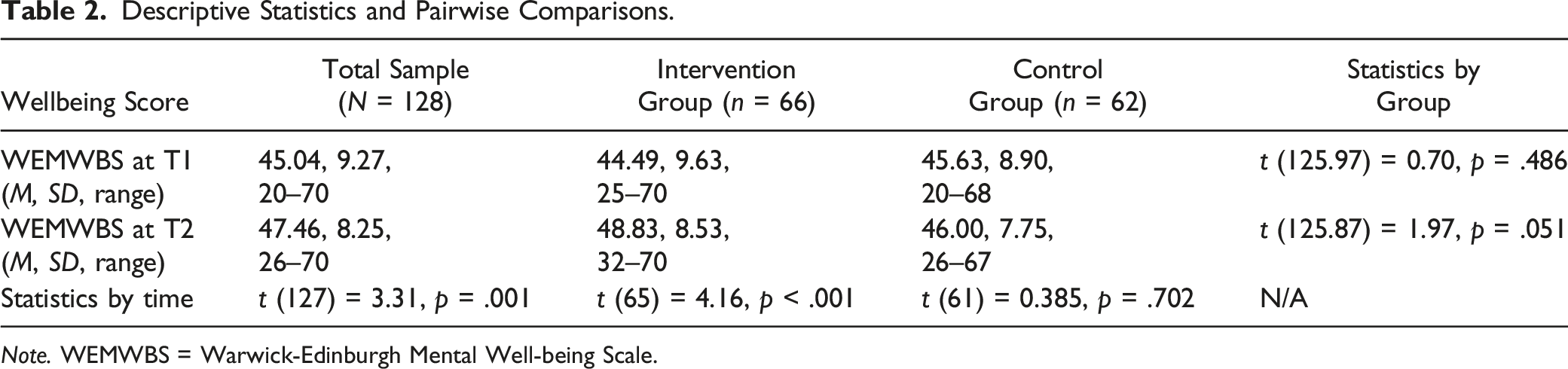
Note. WEMWBS = Warwick-Edinburgh Mental Well-being Scale.
Comparison with Population-Based Norms
Additional one-sample t-tests indicated that wellbeing for the intervention group at baseline (M = 44.49, SD = 9.63) was significantly less than published normative data (M = 49.4, SD = 8.96; t (65) = −4.15, p < .001, d = −0.51, BF10 = 211), and this difference was ameliorated on module completion, t (65) = −0.54, p = .591, d = −0.066, BF10 = 0.155. Associated JASP datafiles are provided on the Open Science Framework (Kemp et al., 2022).
Discussion
Here we present the first evidence for the impact of our wellbeing science module on student wellbeing during the COVID-19 pandemic. Findings indicate that the module improved wellbeing relative to those participants who did not complete the module. Findings also demonstrated beneficial impacts of the module relative to population-based norms. The unique contribution of this work is that it provides evidence on the impact of a wellbeing science module, built from a transdisciplinary perspective, encompassing individual, collective and planetary wellbeing.
Reported findings are notable for several reasons. First, students are at a high risk of developing mental health difficulties (Edwards et al., 2019; Sheldon et al., 2021) and as student demand for mental health typically exceeds support available in the general and student populations (Brown, 2018; Limone & Toto, 2022), there is an opportunity for instructors in psychology to contribute to institution-wide efforts to improve student wellbeing. Second, research has demonstrated (Santini et al., 2021) that for each point increase in mental wellbeing, healthcare costs and sickness benefit transfers decrease per person, a year later ($− 42.5 and $− 23.1, respectively), highlighting potential future downstream impacts of promoting wellbeing in student populations. Third, our study was conducted during the COVID-19 pandemic, a period associated with social isolation and generalized societal distress, highlighting the benefits of focusing on wellbeing despite suffering, providing support for an emerging existential positive psychology and science of wellbeing (Wong et al., 2021).
Our module was embedded into a third-year undergraduate degree program in psychology in the United Kingdom. A variety of teaching materials are provided (Kemp et al., 2022) for instructors who would like to develop a similar module at other institutions or adapt the module for different learning environments including class size, modality, student level and discipline. Historically, the module has been a popular one, attracting up to 150 students each year, and has been designed in such a way to allow students to progress independently, supported by weekly seminars, online learning modules and an online discussion board. For the upcoming academic year, it is expected that module contact time with students will increase from 1-hour-long weekly Zoom-based seminars, which included a presentation by the instructor and group-discussion, to 2-hour-long face-to-face workshops that will involve additional student group-work, focused on discussion of key reading materials (Kemp et al., 2022). Module delivery is flexible however and while it has been developed for the (online) classroom, it could be adapted for student life outside of the class environment without much difficulty. While our module was offered to students as an optional credit-bearing module in the final year of their degree, available materials could also be adapted for less advanced students as the module does not require prerequisite skills. Given considerations around flexible delivery, capacity for students to progress relatively independently, and no requirements relating to prerequisite learning, there is also capacity to embed available materials into programs run in other disciplines.
Our module was developed on strong theoretical foundations and developments in the field (Kemp & Fisher, 2022; Mead et al., 2021a), emphasizing that while human suffering is inevitable, there remains tremendous capacity to accept and transcend that suffering to realize sustained wellbeing (e.g., Wong 2019; Wong et al., 2021). The present study demonstrates that student wellbeing can be improved against the backdrop of COVID-19. Our related interventions for people living with acquired brain injury further demonstrate that wellbeing can be promoted despite considerable suffering (e.g., Gibbs et al., 2022; Wilkie et al., 2021). Recent work has reported high levels of climate-related distress in children and young people (Hickman et al., 2021), and such distress will inevitably lead institutions to question what they can do to support students in managing difficult emotions relating to the unfolding climate catastrophe. As our module places emphasis on individual, collective and planetary wellbeing (Kemp & Fisher, 2022; Mead et al., 2021a), we suggest that there is tremendous scope for supporting institution-wide responses to the climate emergency, and work has begun to measure the impact of our module in this regard.
While our study has several notable strengths including control group, sample size and research design, some limitations are worth noting. First, we restricted our dependent variable to the WEMWBS, a widely used measure of wellbeing. While this enabled us to determine the impact of our module on a reliable and valid measure, future research is needed to explore mediators and moderators of these findings. Second, it was not possible to randomly assign participants to group as the study was conducted within the context of an undergraduate degree curriculum. It is possible therefore that participants in the intervention group were more motivated to improve wellbeing – as they chose to study an optional module focused on wellbeing – than those in the control group. PPIs to improve wellbeing were also self-selected by students in the intervention group, consistent with calls for a more personalized approach to wellbeing promotion (Ciarrochi et al., 2022). While this may be considered a limitation, it is important to acknowledge that motivation is a key ingredient for the success of any psychological intervention (Ryan et al., 2011). Third, demand characteristics may have contributed to responses returned on the WEMWBS, although recent research suggests that informing participants about the purpose of an experiment has no detectable effect on observed treatment effects (Mummolo & Peterson, 2018), minimizing concerns relating to such characteristics. Fourth, our sample was comprised of individuals with pre-existing physical and mental health conditions. While no significant difference was observed in numbers of students with and without such conditions across intervention and control groups, future research is needed on larger samples to further explore impacts. Finally, we acknowledge that the intervention group included more older students (range: 20–49) than the control group (range: 18–28), which may have impacted on findings obtained, although no statistically significant differences on age was observed between groups.
In summary, we have described an innovative wellbeing science module that broadens the scope of taught content in positive psychology to encompass self, others, and nature. Our module introduces students to the latest theory and evidence in wellbeing science while encouraging active learning and evidence-based living through innovative assessment relating to change in the students’ own wellbeing in an N-of-1 research report, as we have described elsewhere (Kemp & Fisher, 2021). Findings presented here demonstrate that student wellbeing was significantly improved on completion of this module relative to a control group and population-based norms. It is our hope that by making our module resources freely available that other instructors will join our effort to promote a transdisciplinary approach to improving wellbeing at multiple levels of scale focused on individual, collective and planetary wellbeing.
Footnotes
Authors’ Note
This paper is an updated and refined version of a previously published preprint (Kemp et al., 2022), available here: https://doi.org/10.17605/OSF.IO/E7ZJF, and extends on related work described in another recently published paper of ours in the Teaching of Psychology journal (Kemp, 2021,  ).
).
Acknowledgments
We would like to acknowledge the support of Swansea University and the National Health Service in recognising and promoting our work through various awards including the University Research and Innovation Award for Outstanding Impact on Health and wellbeing (2018), the Swansea Bay University Health Board Chairman’s VIP Award for Commitment to Research and Learning (2018) and Swansea University Morgan Advanced Studies Institute (MASI) Summer of Hope Award (2021) to host a 2-day student-led wellbeing symposium. We also acknowledge the partial funding that we have received from our partner, Fieldbay (https://www.fieldbay.co.uk/), which has been used to co-fund a PhD studentship awarded to JM. We note however that this organisation did not contribute to the development of this module or the writing of this manuscript. Finally, we would like to express our heartfelt thanks for the support of our service users, with whom we have built and implemented our related novel and innovative positive psychotherapy intervention, based on our GENIAL theoretical framework ().
Declaration of Conflicting Interests
The authors declared no potential conflicts of interest with respect to the research, authorship, and/or publication of this article.
Funding
The authors received no financial support for the research, authorship, and/or publication of this article.