




Abstract
Background
Historically marginalized psychologists are underrepresented in history of psychology textbooks, which contributes to their poor recognition by psychology students. Open Educational Resources (OERs) offer a viable solution to inadequate pioneer representation.
Objective
This study sought to replicate and extend prior research by examining whether diverse and inclusive OERs related to students’ pioneer recognition and perceptions of course material identity representation (recognitive justice).
Method
Undergraduate students (N = 50) enrolled in a History of Psychology course completed a pioneer recognition test at the beginning and end of the semester. Students’ perceptions of recognitive justice and the OERs were also assessed.
Results
Initial pioneer recognition benefitted white pioneers and pioneering men. Follow-up recognition significantly improved for all pioneer groups. Students reported positive perceptions of OERs, and feelings of recognitive justice were associated with final grades.
Conclusion
Undergraduate psychology students need exposure to marginalized pioneers prior to taking a history of psychology course. A more inclusive history of psychology curriculum improves students’ marginalized pioneer recognition and may benefit their course performance.
Teaching Implications
Given the absence of women and pioneers of color in commercial textbooks, teachers of the history of psychology should consider using OERs to achieve more diverse pioneer representation in their curricula.
Keywords
Historically, the discipline of psychology was dominated by the work of white men. Significant barriers limited the contributions and participation of women and people of color. Women were routinely prohibited from entry into graduate programs and professional societies, funneled into “women’s subfields” (e.g., child psychology), or denied doctoral degrees despite meeting the necessary requirements (Furumoto & Scarborough, 1986). The contributions of some women went unrecognized, often due to collaboration with their spouses. The classic “doll study” conducted by Mamie Phipps Clark and her husband Kenneth Clark (Clark & Clark, 1947) is a prime example—most attribute this groundbreaking work to Kenneth rather than Mamie, despite Mamie’s role as the primary researcher (Aldridge & Christensen, 2013).
Historical barriers to educational access were more pronounced for psychologists of color (Guthrie, 2004; Leong & Okazaki, 2009). The first doctoral degrees awarded to racial and ethnic minority psychologists came several decades after G. Stanley Hall received the first American doctoral degree in psychology (Fancher & Rutherford, 2017). Further, the American Psychological Association (APA) adopted a Eurocentric perspective to psychology before the mid-20th century, and thus largely ignored the contributions of psychologists of color (Pickren, 2009). In a recent apology to people of color, the APA acknowledged its role in minimizing the work of psychologists of color and the centering of white male leadership, and how these actions contributed to the marginalization of people of color within the discipline (APA, 2021a).
The Absence of Women and People of Color in History of Psychology Textbooks
Further perpetuating these historical barriers, the contributions of women and psychologists of color are vastly underrepresented in the traditional history of psychology curriculum. This is problematic given textbooks often drive content coverage and normalize the knowledge that is important (Atchison, 2017). A recent content analysis of five history of psychology commercial textbooks (Cramblet Alvarez et al., 2020) revealed that pioneering white men are overwhelmingly mentioned (91.3%), compared to white women (6.9%), men of color (1.6%), and women of color (0.2%). Moreover, the only pioneers of color mentioned were African Americans (the Clarks), reflecting the historical exclusion pioneers from other racial and ethnic minority groups (i.e., Hispanic, Asian, and Native American pioneers) have received within the discipline. It is possible that this exclusion is driven, in part, by the gender bias in history of psychology textbook authorship and the potential for an author’s identities and racial worldview to shape who is included in the history of the field (Cramblet Alvarez et al., 2020). Indeed, most work highlighting the contributions of marginalized pioneers appears outside of history of psychology textbooks and was largely led or written by female historians and historians of color (Black et al., 2004; Bohan, 1990; Guthrie, 2004; MacArthur & Shields, 2014; Scarborough & Furumoto, 1987).
The lack of diverse representation in history of psychology textbooks may further explain upper-level psychology students’ poor recognition of marginalized pioneers. On an adapted version of Woody et al.’s (2002) name recognition test, Cramblet Alvarez et al. (2019) found that psychology majors from eight institutions across the U.S. recognized pioneering white men significantly more than pioneering white women, and men and women of color had the lowest recognition rates. Unfortunately, taking a history of psychology course did not yield significant recognition benefits for women or pioneers of color, as recognition among these students was better for white pioneers, particularly so for white men.
These findings suggest that women and people of color are most likely underrepresented in the typical history of psychology curriculum. Their absence comes at a high cost for undergraduate psychology students, as it perpetuates systemic inequities within the discipline and ignores our diverse roots. Further, with the growing diversity of psychology majors and the psychology workforce (Bailey, 2020), students deserve to see their identities reflected in the history of the discipline. Finally, since students tend to rely on textbooks as primary sources of information, the continued absence of marginalized pioneers ensures their identities and contributions will remain unrecognized (Cramblet Alvarez et al., 2020).
Using Open Educational Resources to Diversify Course Curriculum
Until greater pioneer representation is reflected in commercial history of psychology textbooks, it is up to instructors to do the work of making their course materials more diverse and inclusive. Waiting for commercial textbooks to be adequately revised is an impractical solution, as most go through a closed revision process and are subject to restrictive copyright licenses (Nusbaum, 2020). Alternatively, Open Educational Resources (OERs) offer a viable route toward diversifying the history of psychology curriculum. OERs are “teaching and learning research materials in any medium that reside in the public domain or that have been released under an open license that permits no-cost use, access, adaptation, and redistribution by others with no or limited restrictions” (UNESCO, 2012, p. 1). Examples of commonly used OERs include open-access textbooks, modules, lesson plans, videos, short readings, or podcasts (Butcher, 2015).
Due to their free availability and open licensing, OERs can be more easily diversified, as in the case of Nusbaum’s (2020) crowdsourced effort to add more inclusive content to sections of an open-access introductory psychology textbook (OpenStax College, 2014). Additionally, OERs can be combined in ways that increase diversity and inclusion within course curricula, such as selecting OERs that center the voices and visibility of marginalized communities (Bliss & Smith, 2017; Clinton-Lisell et al., 2021). This route to curriculum diversification was used in the current study, as selecting more diverse and inclusive OERs can make up for the lack of diverse representation in commercial history of psychology textbooks.
These diversification efforts further reflect how OERs can be used for social justice and embody the principle of recognitive justice. Lambert (2018) proposed this principle as part of a theoretical framework for examining the social justice impact of open educational practices. Recognitive justice is achieved through open educational practices that recognize and respect diverse views and experiences and highlight marginalized populations. For instance, selecting OER course materials that diversify course curricula, such as those that focus on centering marginalized psychology pioneers, would represent an act of recognitive justice. This principle was of interest to the current study, as we sought to examine the impact of using diverse and inclusive OER course materials in a History and Systems of Psychology course. Given the selected OER course materials focused on increasing students’ knowledge of and exposure to marginalized pioneers, the current study assessed perceptions of recognitive justice to measure the social justice impact of this open educational practice.
The Current Study
Altogether, the purpose of the current study was three-fold. First, we sought to replicate Cramblet Alvarez et al. (2019) to see whether upper-level undergraduate psychology students would again largely not recognize pioneering women and psychologists of color. Further, we sought to extend this prior research by determining whether more diverse and inclusive OER course materials would contribute to students’ pioneer recognition, particularly for women and pioneers of color. Finally, we sought to measure students’ perceptions of recognitive justice (i.e., the degree to which they felt their identities were reflected in the course materials), and whether these perceptions impacted course performance. To gather support for the use of diverse and inclusive OER course materials within the context of a history and systems of psychology course, students’ perceptions of the quality of the OER course materials were also assessed. Based on prior research, the following hypotheses were made: 1. As hypothesized by Cramblet Alvarez et al. (2019), students will show lower initial recognition rates for pioneering women than pioneering men. 2. As hypothesized by Cramblet Alvarez et al. (2019), students will show lower initial recognition rates for pioneers of color than for white pioneers. Further, initial recognition rates are expected to be highest for pioneering white men compared to other groups (i.e., white women, women of color, and men of color). 3. Given the recognition benefit for white pioneers and pioneering men in Cramblet Alvarez et al. (2019), it is expected that follow-up recognition rates will be higher for white pioneers than pioneers of color, as well as for pioneering men than women. However, students’ follow-up recognition rates for pioneers across all groups (including women and pioneers of color) are expected to improve. 4. Given researchers have yet to empirically examine the social justice principles in Lambert’s (2018) framework, it is unclear how the diverse and inclusive OER course materials will affect students’ feelings of recognitive justice, and whether feelings of recognitive justice will correlate with students’ course performance.
Method
Context
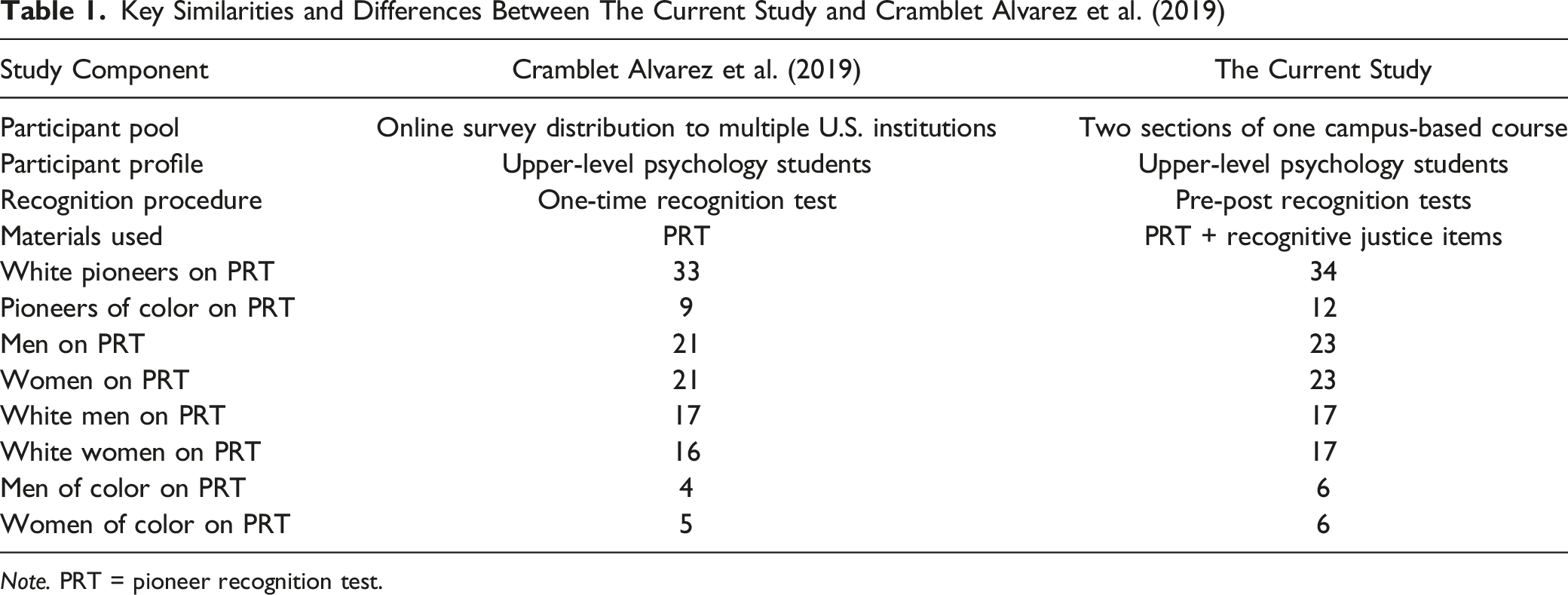
Key Similarities and Differences Between The Current Study and Cramblet Alvarez et al. (2019)
Note. PRT = pioneer recognition test.
The first author selected several OERs to improve pioneer diversity and inclusion within the course curriculum. A traditional textbook was not assigned and the OERs were used to supplement the video lectures for most lessons (all video lectures were prepared and recorded by the first author). Students were expected to interact with the OERs and answer questions about their content on lesson quizzes or assignments. Examples of the OERs included digital museum exhibits and “5 Minute History Lesson” videos from the Cummings Center for the History of Psychology’s educational resources, profiles from the Psychology’s Feminist Voices multimedia archive, journal articles, and podcasts. A list of all course lessons and the associated OERs, as well as links to access the OERs, is available in Appendix A on the OSF project page (Kelly et al., 2022).
Participants
All 75 students enrolled in both course sections were eligible to participate in the study. A total of 50 students completed both questionnaires and were included in the final sample. Of these 50 students, 5 (10%) identified as men and 45 (90%) identified as women. Students ranged in age from 20 - 48 years (M = 23.9, SD = 5.10), and 16 (32%) reported first-generation status. Forty (80%) students were white, nine (18%) reported either a biracial or multiracial identity, and one (2%) preferred not to respond. Prior to data collection, the authors obtained approval from the institutional review board and an exempt protocol was granted.
Materials
Initial Questionnaire
Two questionnaires were created by the first author for use in the study. The initial questionnaire included a revised version of the pioneer recognition test used by Cramblet Alvarez et al. (2019), which was adapted from Woody et al. (2002). The version used by Cramblet Alvarez et al. (2019) included 21 men and 21 women, with 33 white pioneers and 9 pioneers of color (five women and four men). The first author added more women and pioneers of color for the current study, so the recognition test included 23 men and 23 women, with 34 white pioneers and 12 pioneers of color (six women and six men).
Students rated how well they recognized each pioneer using a 4-point Likert-type scale (0 = never heard of this person, 1 = heard of the name, but cannot name one thing the person did, 2 = know of the person’s name and a minimal number of their contributions, and 3 = can recall the person and the majority of their accomplishments easily). Internal consistency for the measure was at good or acceptable levels for all items (
Follow-Up Questionnaire
The second questionnaire included the pioneer recognition test, demographic items, and six items assessing students’ feelings of recognitive justice. These items were created by the third author and are designed to measure Lambert’s (2018) principle of recognitive justice. Internal consistency for the items was at an acceptable level (
Procedure
At the beginning of the fall 2021 semester, students were invited to complete the initial questionnaire for bonus points. At the end of the semester, students were subsequently invited to complete the follow-up questionnaire for bonus points. Both questionnaires were completed in Qualtrics and the links to each were distributed on the course Learning Management System (Blackboard). An alternative assignment was available for students that opted not to complete either questionnaire.
Results
Like Cramblet Alvarez et al. (2019), exploratory data analyses revealed very low initial recognition for pioneers on the subscales for women, people of color, white women, women of color, and men of color. As a result, mean subscale values were highly positively skewed (i.e., values were greater than 1.0) and the assumption of normality was violated. Therefore, nonparametric statistical tests were used for these mean subscales. The raw and final datasets are available on the OSF project page (Kelly et al., 2022).
Initial Pioneer Recognition
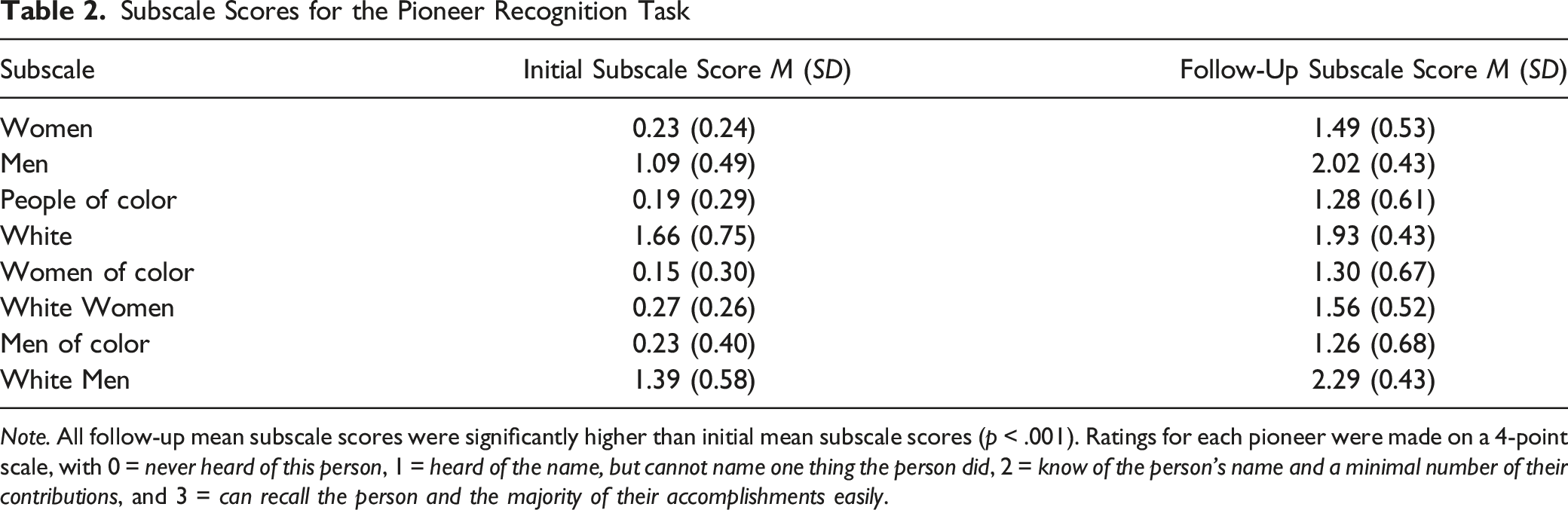
A Wilcoxon Signed-Rank t test compared initial recognition differences between men and women. Initial mean recognition scores were significantly lower for women (M = 0.23, SD = 0.24, Mdn = 0.00) than for men (M = 1.09, SD = 0.49; Mdn = 1.00; z = -6.126, p < .001, r = -.87). All effect sizes are reported as r values and follow Funder and Ozer’s (2019) proposed benchmarks (.10 = small, .20 = medium, .30 = large). These findings replicate Cramblet Alvarez et al. (2019) and support the hypothesis that initial recognition would be significantly higher for pioneering men than women.
Next, a Wilcoxon Signed-Rank t test compared initial recognition differences between white pioneers and pioneers of color. Mean recognition scores were significantly lower for pioneers of color (M = 0.19, SD = 0.29, Mdn = 0.00) than for white pioneers (M = 1.66, SD = 0.75, Mdn = 0.50; z = -6.154, p < .001, r = -.87). Following Cramblet Alvarez et al. (2019), since white pioneers outnumbered pioneers of color on the pioneer recognition test, a random matched sample was generated with 12 white pioneers (6 men and 6 women) to compare to the 12 pioneers of color. The 12 white pioneers in the random matched sample are included in Appendix B on the OSF project page. Another Wilcoxon Signed-Rank t test yielded similar results, with recognition of the random sample of white pioneers being significantly higher (M = 0.97, SD = 0.40) than for pioneers of color (M = 0.19, SD = 0.29; z = 6.096, p < .001, r = .86). Altogether, these findings replicate Cramblet Alvarez et al. (2019) and support the hypothesis that initial recognition of white pioneers would exceed that of pioneers of color.
Making further comparisons using the same random matched sample, additional Wilcoxon Signed-Rank t tests revealed that initial recognition was significantly higher for white men (M = 1.50, SD = 0.58) than white women (M = 0.45, SD = 0.36; z = 6.057, p < .001, r = .86), as well as for white men than men of color (M = 0.23, SD = 0.40; z = 6.101, p < .001, r = .86), and white women compared to women of color (M = 0.15, SD = 0.30; z = 5.126, p < .001, r = .73). However, there were no initial recognition differences between men and women of color (z = 1.668, p = .095, r = .24). Altogether, as expected, initial recognition benefitted white pioneers, particularly white men.
Follow-Up Pioneer Recognition
To compare follow-up recognition differences between men and women, and white pioneers and pioneers of color, Wilcoxon Signed-Rank t tests were once again conducted. As with initial recognition, follow-up mean recognition scores were significantly lower for women (M = 1.49, SD = 0.53, Mdn = 1.00) than for men (M = 2.02, SD = 0.43, Mdn = 2.00); z = -5.886, p <.001, r = -.83), as well as for pioneers of color (M = 1.28, SD = 0.61, Mdn = 1.00) than for white pioneers (M = 1.93, SD = 0.43, Mdn = 2.00); z = -5.970, p < .001, r = -.84).
These findings held for comparisons using the random matched sample of white pioneers, whose follow-up mean recognition score (M = 2.06, SD = 0.45) was significantly higher than for pioneers of color (M = 1.28, SD = 0.43; z = 5.907, p < .001, r = .84). Additional subscale comparisons found once again that recognition benefitted white men (M = 2.28, SD = 0.42) over white women (M = 1.83, SD = 0.58; z = 4.930, p < .001, r = .70), white women over women of color (M = 1.30, SD = 0.67; z = 5.347, p < .001, r = .77), white men over men of color (M = 1.26, SD = 0.68; z = 5.932, p < .001, r = .84), but no follow-up differences were found between men and women of color (z = -1.055, p = .291, r = -.15). Thus, follow-up recognition once again benefitted white pioneers, particularly white men. This was expected, however, given the overwhelming initial recognition of white men.
Changes in Pioneer Recognition
To determine whether pioneer recognition significantly improved by the end of the course, Wilcoxon Signed-Rank t tests compared initial and follow-up mean recognition for all pioneer groups. As hypothesized, follow-up recognition was significantly higher for all groups (white pioneers, z = -2.661, p = .008, r = .38; pioneers of color, z = -6.094, p < .001, r = -.86; men, z = -6.083, p < .001, r = -.86; women, z = -6.155, p < .001, r = -.87; white men, z = -6.040, p < .001, r = -.85; white women, z = -6.156, p < .001, r = -.87; women of color, z = -6.036, p < .001, r = -.85; and men of color, z = -5.963, p < .001, r = -.84). Using the random matched sample of white pioneers, similar results were obtained. Follow-up recognition rates were significantly higher for all 12 white pioneers (z = -6.157, p < .001, r = -.87), for the 6 white women (z = -6.162, p < .001, r = -.87), and the 6 white men (z = -5.864, p < .001, r = -.83).
Subscale Scores for the Pioneer Recognition Task
Note. All follow-up mean subscale scores were significantly higher than initial mean subscale scores (p < .001). Ratings for each pioneer were made on a 4-point scale, with 0 = never heard of this person, 1 = heard of the name, but cannot name one thing the person did, 2 = know of the person’s name and a minimal number of their contributions, and 3 = can recall the person and the majority of their accomplishments easily.
Feelings of Recognitive Justice
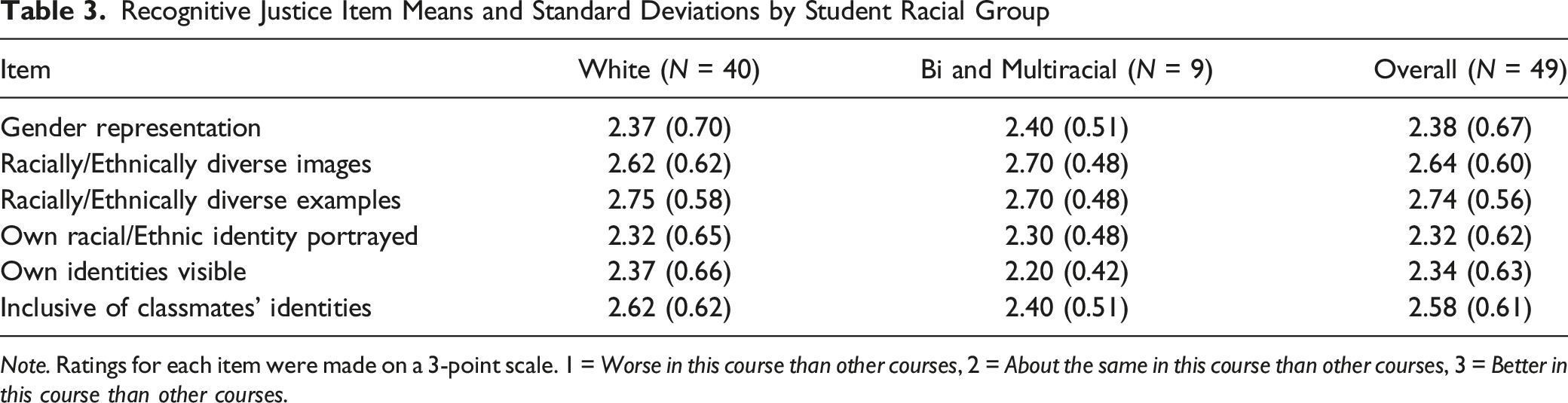
Recognitive Justice Item Means and Standard Deviations by Student Racial Group
Note. Ratings for each item were made on a 3-point scale. 1 = Worse in this course than other courses, 2 = About the same in this course than other courses, 3 = Better in this course than other courses.
To determine whether students’ perceptions of recognitive justice impacted their course performance, a Spearman’s rank-order correlation was conducted since the variables did not have a linear relationship. On average, students performed well on assignments, exams, and projects, leading to a skewed grade distribution. Final grades (M = 90.22%, SD = 8.02) were positively correlated with perceptions of recognitive justice r (49) = .255, p = .047, indicating that greater feelings of identity representation in course materials were associated with better performance in the course.
Perceptions of Open Educational Resources
Figure 1 includes the student response frequencies for each question designed to measure OER quality perceptions. Overall, students’ ratings of the quality of the OER course materials were favorable, both in terms of feeling that the OERs supported the work they did in the course (M = 4.44, SD = .90) and finding the OERs to be engaging and helpful (M = 4.34, SD = 1.04). Additionally, most students did not feel they would have been more successful in the course with a traditional textbook (M = 2.02, SD = 1.34). Students’ perceptions of the OER course materials. Note. “0” indicates a participant did not respond to the question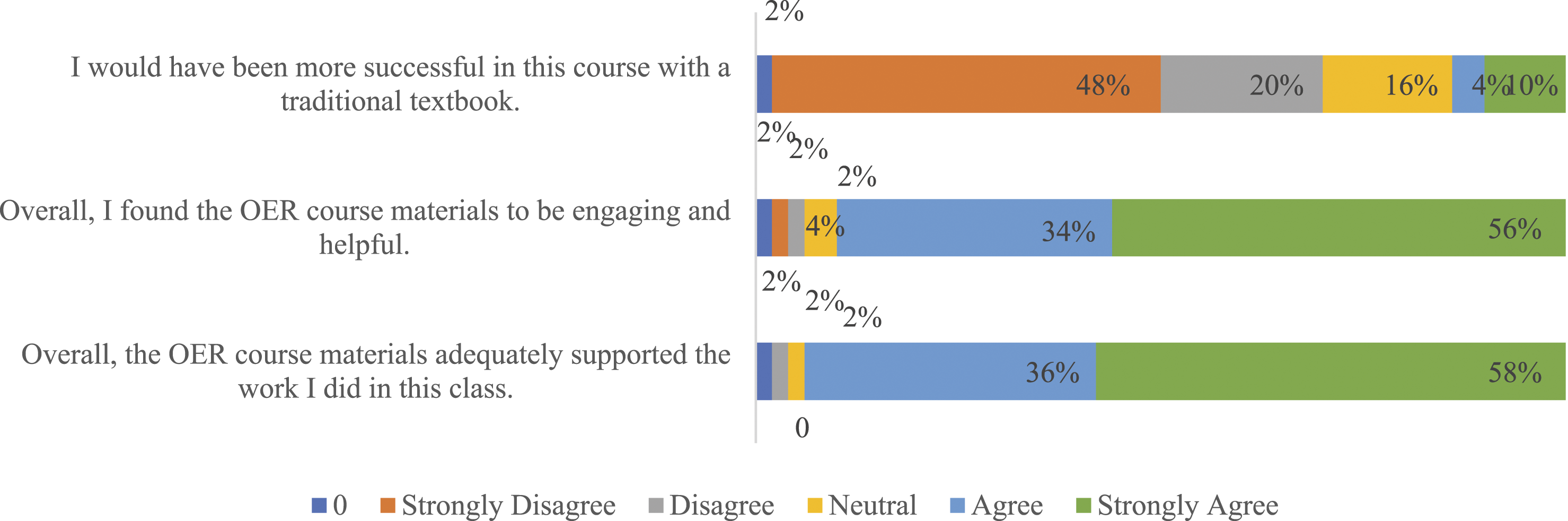
Discussion
The purpose of the current study was to replicate and extend prior research showing undergraduate psychology students’ low recognition of marginalized psychology pioneers
(Cramblet Alvarez et al., 2019). Once again, the current study found senior-level psychology majors were largely not aware of the contributions of pioneering women and psychologists of color compared to pioneering men and white pioneers. This suggests that students are primarily learning about the work of pioneering white men and underscores the need to expose psychology students to the work of marginalized pioneers much earlier. Ideally, this should happen during their introductory psychology course, given it is the front facing course of the discipline (Gurung & Hackathorn, 2018), and it exemplifies the Introductory Psychology Initiative’s key integrative theme of valuing diversity, equity, and inclusion (APA, n. d.; Altman et al., 2021). Until pioneer representation improves in lower-level courses, teachers of the history of psychology should move toward teaching a more diverse and inclusive history that highlights the achievements of women and pioneers of color. Doing so will ensure that our discipline’s diverse voices do not remain silenced, thus disrupting the status quo where white male voices have historically dominated the conversation (Cramblet Alvarez et al., 2019; Grahe et al., 2018).
Despite the initially low recognition of marginalized pioneers, recognition significantly improved for women and pioneers of color, and this was likely related to exposure to a more diverse and inclusive course curriculum. Our findings further support using OERs to meet curriculum diversification goals, particularly when current history of psychology textbooks cannot (Cramblet Alvarez et al., 2020). Students in the current study felt the OER course materials were helpful, engaging, and supported their course work, which is consistent with other research evaluating the quality of OERs (Cooney, 2016; Clinton, 2018; Cozart et al., 2021). Importantly, there is evidence that learning outcomes for students in psychology courses with OERs are comparable to those with commercial materials (Clinton, 2018; Jhangiani et al., 2018; Nusbaum et al., 2020); therefore, the flexibility of OER do not appear to have deleterious effects on students learning psychology content. Waiting for textbooks to be revised is an impractical solution to the problem of inadequate pioneer representation, as it is projected to take a substantial amount of time for textbooks to reflect inclusive scientist representation (Wood et al., 2020). Thus, we recommend teachers of the history of psychology strongly consider using OERs to meet curriculum diversification goals.
The current study further found that students’ perceptions of recognitive justice (i.e., perceptions of gender and racial/ethnic identity representation in course materials) were associated with final course grades. This suggests there may be performance benefits related to students being able to “see themselves” represented in course materials. While the correlation was small, it is consistent with research examining the impact of diverse representation in introductory biology course curricula. Students exposed to more diverse scientists experienced shifts in their ability to personally relate to scientists, and this shift correlated with their final course grades (Schinske et al., 2017; Aranda et al., 2021). Future research should continue to look at how students are impacted by diverse pioneer representation in course materials, particularly students with marginalized identities. Given psychology’s “diversity problem” and the need to recruit and retain more students of color in psychology programs, diverse pioneer representation within the curriculum may be an entry point for spurring these students’ interest in the field (APA, 2021a; Huff, 2021).
Conclusions
Limitations and Future Directions
The current study was limited by using a small, unrepresentative sample taken from a single course at a single institution. Conclusions regarding the potential impact of curriculum diversification on racial/ethnic minority students in the current study are made with caution. Even though the biracial and multiracial students reported feeling their identities were represented in the course materials, the correlation between perceptions of recognitive justice and final grades was largely driven by the overwhelming number of white women in the course. Future research should seek to replicate these findings in contexts where more students with racially/ethnically minoritized identities are represented. Relatedly, marginalized pioneer representation was limited on the pioneer recognition test, as pioneers from only two racial/ethnic minority groups were included (Black/African American and Latinx). Further modifications should be made to the pioneer recognition test if this line of research continues.
Additionally, the current study is limited by its quasi-experimental design, as the authors did not have access to a control condition. This prevents making causal conclusions about how diverse and inclusive OER course materials impacted students’ marginalized pioneer recognition. Comparing follow-up recognition with a course that did not include diverse and inclusive pioneer representation, as well as a course where a commercial textbook was used, would make a stronger case for the impact of curriculum diversification on students’ pioneer recognition. However, these limitations do not minimize the need for a more diverse and inclusive history of psychology, nor do they minimize the recognition benefits for marginalized pioneers that were found in the current study.
Altogether, the current study provides additional evidence that upper-level undergraduate psychology students are likely not being exposed to many pioneering women and psychologists of color in their undergraduate courses. The good news is that increasing pioneer representation within the course curriculum, particularly using OERs, offers a solution to this representation problem. Given the growing diversification of the undergraduate psychology student population (Bailey, 2020), and psychology’s long-standing role in perpetuating inequality for women and people of color (APA, 2021b), students deserve to see their identities represented in the discipline’s pioneers.
Footnotes
Acknowledgments
AK wishes to acknowledge the Open Education Group and the Hewlett Foundation for funding the OER research fellowship that supported this work. Special thanks to Virginia Clinton-Lisell for her fellowship mentoring and to Matthew Burton-Kelly for statistical support.
Author Contributions
AK conceived of and designed the study with help from VCL, collected and organized the data, and performed statistical analyses. AK wrote the first draft of the manuscript with results help from JL. VCL provided feedback on the initial version of the manuscript. All authors read and approved the submitted version.
Declaration of Conflicting Interests
The authors declared no potential conflicts of interest with respect to the research, authorship, and/or publication of this article.
Funding
The authors received no financial support for the research, authorship, and/or publication of this article.
