



Abstract
Background
Teachers’ perception of psychology is of importance because they get in contact with psychology as a scientific discipline and should apply (educational) psychological findings. This requires a generally positive attitude toward corresponding findings, which should be fostered during teacher education.
Objective
The goal of this study was to examine preservice teachers’ perception of findings from psychology in general and educational psychology in particular, thereby differentiating between confidence in and valuing of the same.
Method
Two subsamples of n = 937 German preservice teachers and n = 310 psychology majors participated in an online survey.
Results
Compared with natural science disciplines or another “harder” psychological subdiscipline, preservice teachers perceived psychology as less scientific, and judged findings from psychology and educational psychology to be less credible but more valuable. While both confidence in and valuing of findings from psychology were higher among psychology majors than among preservice teachers, the opposite was true for educational psychology. However, all differences were rather small.
Conclusion
We conclude that preservice teachers’ perception of (educational) psychology is not alarmingly poor.
Teaching Implications
The high valuing of scientific findings from (educational) psychology could be used to also foster a broader reliance on scientific findings (examples are discussed).
Keywords
Even though psychology is a well-established scientific field of study, psychological findings are often perceived as common sense and not scientifically sound (see Ferguson, 2015; Lilienfeld, 2012). However, there also is a high interest in psychology, which is indicated by a multitude of psychological articles in popular media and high numbers of applicants for psychology as a field of study (see Møgelvang Jacobsen & Diseth, 2020). A positive perception of findings from psychology in general and educational psychology in particular is especially important for teachers because they get in contact with corresponding research during their studies and are required to implement scientific methods and findings in their professional life (see European Commission, 2007; Kultusministerkonferenz, 2004). Furthermore, teachers’ general pedagogical knowledge and pedagogical-psychological knowledge have been found to be positively associated with indicators of instructional quality (e.g., König & Pflanzl, 2016; Lenske et al., 2016; Voss et al., 2011). Thus, it is important that teachers do not discard scientific findings from (educational) psychology. This implies having a positive perception of these findings, which should be mirrored both in a certain confidence in and valuing of the same (i.e., judging findings as eligible and worthwhile for one’s practice). Both aspects might be important for pre- and in-service teachers who can pursue different epistemic aims when dealing with research evidence, for example, gathering or applying knowledge (see Hendriks et al., 2021). Accordingly, both a positive view of the epistemic quality of research findings (mirrored in a high confidence, especially important when aiming for new knowledge), and their instrumental quality (mirrored in a high valuing, especially important when aiming for application) should be looked at.
While teachers seldom have direct access to research knowledge once they have left university (see van Schaik et al., 2018), preservice teachers regularly get in contact with scientific findings during their studies. Thus, teacher education sets the stage for teachers’ perception of scientific findings from (educational) psychology. Therefore, in this study, we focused on preservice teachers: We first globally investigated whether they perceived psychology as scientific. Second—for a closer and more nuanced evaluation of their perception of psychology and particularly educational psychology—we differentiated between preservice teachers’ confidence in and valuing of scientific findings (i.e., epistemic and instrumental quality). To classify their ratings, we compared preservice teachers’ perception of psychology or educational psychology with both their perception of another group of scientific disciplines or another psychological subdiscipline (i.e., psychology with biology and physics; educational psychology with biological/neuropsychology) and with the perception of another group of students (i.e., psychology majors).
The Perception of Psychology
Although psychology can be studied as a scientific discipline around the world, there are voices questioning the scientific status of psychology. These skeptical views are summarized and discussed in articles like Everybody Knows Psychology Is Not a Real Science (Ferguson, 2015) or Public Skepticism of Psychology (Lilienfeld, 2012). Furthermore, although psychology is an empirical science that uses observations and experiments—thus, shares key characteristics with classical “hard” natural sciences—psychology is usually considered to be a “soft” science (e.g., Biglan, 1973; Munro & Munro, 2015) and is downgraded stereotypically (see Krull & Silvera, 2013). In Germany, there also are distinctions at the structural level: Despite the focus of psychological syllabi on scientific methods, psychology is usually situated at faculties of the social or behavioral sciences, that is, apart from classical natural sciences like biology or physics. In contrast to these skeptical views about psychology as a science, many people are interested in psychological phenomena. There are countless numbers of (pseudo)scientific books as well as articles in newspapers, magazines, and the media that deal with psychological issues. These publications are very popular but can lead to inaccurate knowledge or beliefs about psychological issues (e.g., Taylor & Kowalski, 2004). Furthermore, there is a high interest in psychology as a field of study (see National Center for Education Statistics). In Germany, demand regarding university places often exceeds supply, leading to a very strict admission restriction for studying psychology.
Thus, there is a divergence between the confidence in psychology as a science and the valuing of its findings among the broader public. On the one hand, psychological findings sometimes are not perceived as scientific or credible. On the other hand, there is an enormous interest in psychological findings with many people believing that they are useful for their personal and professional life. However, while the perception of psychology among the broader public might be distorted because laypeople lack knowledge about the scientific discipline of psychology, preservice teachers get in contact with psychology during their studies and could therefore have a different view.
The Perception of (Educational) Psychology Among (Future) Teachers
Many teacher education programs in different countries include courses in psychology or educational psychology in particular, rendering them an important role in teacher education (see Fendler, 2012; Patrick et al., 2011). Furthermore, evidence-based thinking and acting are explicit aims of teacher education: Several researchers call for evidence-based practice in education (e.g., Slavin, 2002), and there are official guidelines asking teachers to use scientific findings and methods (e.g., Commission of the European Communities, 2007; Kultusministerkonferenz, 2004). It is clear that scientific evidence will only be one source of knowledge that teachers will refer to (see Buehl & Fives, 2009; Shulman, 1987), and that they will—and should—also take personal or vicarious experience into account in their professional life (see Bauer et al., 2015). However, such experiential knowledge can be assumed to be less reliable and generalizable than scientific findings and might therefore result in misconceptions (see Menz et al., 2021c). Furthermore, teachers should certainly not blindly accept scientific findings but rather be critical consumers of research (i.e., the idea of scientific literacy; OECD, 2013), for example, because the current state of research can be outdated at some point. Stark (2017) discusses further problems of evidence-based (or evidence-oriented) educational practice (e.g., regarding the applicability of scientific knowledge, also taking into account that scientific findings sometimes are inconsistent or conflicting). Nevertheless, to consider scientific knowledge as a possible relevant source, teachers should have a generally positive perception of psychological findings. While psychology might not experience the same trust as “hard” sciences like physics, evidence-based teaching implies at least a certain amount of confidence in and valuing of scientific evidence from (educational) psychology. If teachers do not generally perceive such findings as convincing, agree with or believe in them—or do not perceive them as interesting, useful and important—they should see no need to implement them in their teaching.
Regretfully, teachers have been found to not or only seldom use research findings to inform their practice (e.g., Dagenais et al., 2012; Lysenko et al., 2014). There is evidence that pre- and in-service teachers concentrate on experience-based knowledge or intuition instead of evidence-based research or theory-based sources of knowledge (e.g., Allen, 2009; Bråten & Ferguson, 2015). Several studies indicate that they rely on common practices, everyday theories or personal experience as well as common sense, and readily available sources rather than on scientific theories, and knowledge from systematic research (e.g., Costa et al., 2000; Gitlin et al., 1999; Parr & Timperley, 2008; Williams & Coles, 2007). There are studies about practitioners’ access to research findings, their skills to use research findings, and studies about other general factors surrounding the use of research results (for a summary, see Dagenais et al., 2012). However, the perception of the findings themselves lacks a sophisticated analysis. To what extent do (future) teachers consider them to be credible and valuable?
Previous studies on pre- and in-service teachers’ perception of scientific findings from (educational) psychology indicate a mixed view at best. Although Merk and colleagues (2017) found preservice teachers to report a higher practical value of general pedagogical knowledge when it originated from scientific sources than from practitioners, other studies found teachers to prefer experienced colleagues over professional journals or research findings because they considered the former to be more trustworthy and usable sources of information (Landrum et al., 2002, 2007). Merk and Rosman (2019) also found preservice teachers to perceive educational researchers as “smart but evil,” that is, to have more expertise but to be less benevolent and integer than practitioners. This critical view of educational researchers might be qualified by preservice teachers’ epistemic aims (see Hendriks et al., 2021) but in general, it could be one reason why scientific findings from educational psychology are mistrusted. Moreover, educational research is often perceived as unreliable and vague (see Berliner, 2002). In sum, these studies indicate a low confidence in findings from (educational) psychology among pre- and in-service teachers—and further studies also indicate a low valuing of the same. For example, Sjølie (2014) found that preservice teachers regarded (pedagogical) theory to be rather useless for the real world, and Gitlin and colleagues (1999) revealed that preservice teachers rated research as less important than experience from teachers to make decisions. Furthermore, practitioners often perceive a gap between educational theory and practice (see Broekkamp & Van Hout-Wolters, 2007; Vanderlinde & van Braak, 2010), and are sometimes assumed to devalue and disparage theory as comparatively irrelevant (e.g., Allen, 2009). However, there also is evidence for a positive motivational disposition toward (educational) psychology among preservice teachers as they have been found to show high interest in educational sciences at the beginning of their studies (e.g., Rösler et al., 2013). A positive attitude toward research knowledge is desirable because it has been found to be an important condition for transfer of findings into practice (e.g., Hemsley-Brown & Sharp, 2003; Lysenko et al., 2014; van Schaik et al., 2018). Hence, investigating both teachers’ confidence in and their valuing of findings from (educational) psychology is of importance when contemplating on possible reasons for the infrequent use of scientific findings among teachers. If teachers perceive the epistemic quality of scientific findings to be low (i.e., negating that one can rely on scientific findings as a source of true beliefs) and/or deny their instrumental quality (i.e., negating that one can use scientific findings for one’s practice), they will not consider their use.
In sum, there is ample evidence that teachers rarely use scientific theories and empirical findings but rather prefer informal sources of knowledge to inform their practice (e.g., Dagenais et al., 2012; Lysenko et al., 2014). However, the perception of the findings themselves lacks a sophisticated analysis—although a general positive perception of scientific findings constitutes a basic prerequisite for their use (e.g., Hemsley-Brown & Sharp, 2003; van Schaik et al., 2018). To our knowledge, there is no study that systematically differentiated between confidence in and valuing of scientific findings. Therefore, we wanted to disentangle the two facets to shed a more nuanced light on the perception of scientific findings from psychology and particularly educational psychology among preservice teachers. We investigated preservice teachers because they get in contact with scientific findings during their studies, and these experiences should set the stage for their future perception of scientific findings from (educational) psychology. Thus, our general research question was: How high is preservice teachers’ confidence in and valuing of scientific findings from psychology and educational psychology? For the question of valuing, we relied on expectancy-value-theory (Eccles et al., 1983). Expectancy-value-theory predicts that two motivational components, namely, expectancies (for success) and values (i.e., intrinsic value, utility value, attainment value [, and cost]), will drive behavior (see Eccles et al., 1983; Wigfield & Eccles, 2000). More precisely, the extent to which persons think they will perform is more important when explaining performance (e.g., Putwain et al., 2019), while values—that is, how interesting, useful and important a topic is for someone—rather predict choices (e.g., Musu-Gillette et al., 2015). Thus, if one is interested in a task or an activity—or a scientific finding from (educational) psychology—sees its utility and importance, they will probably also rather consider to use it. Hence, we focused on values according to expectancy-value-theory. We examined preservice teachers’ perceptions of both the entire discipline of psychology as well as their perception of more granular units, that is, of specific subdisciplines. To classify their ratings, we compared preservice teachers’ perception of psychology with their perception of other scientific disciplines and their perception of educational psychology with their perception of another psychological subdiscipline (within-person comparison), and we also compared preservice teachers’ perception with other students’ perception (between-person comparison).
Within-Person Comparison: Perception of Other Scientific (Sub)Disciplines
As stated above, research in psychology is characterized by qualities of natural sciences. Consequently, it is rational to compare the perception of psychology with the perception of natural sciences. In general, the findings descending from classical natural sciences receive high credit and prestige among the broader public. Already young children perceive natural science phenomena as being more difficult to understand than psychological phenomena (Keil et al., 2010). Further research indicates that classical “hard” sciences (such as physics or biology) are seen as more rigorous than psychology (see Ferguson, 2015), and that undergraduates perceive research in biology as more scientific than research in psychology (e.g., Rowley et al., 2008). In addition, psychology was rated as having less expertise and as having contributed less to society than biology and physics (Janda et al., 1998). Thus, in contrast to psychology, disciplines like biology or physics are viewed as scientific, and their findings are broadly accepted as facts (i.e., disciplinary differences in epistemological beliefs, Estes et al., 2003; Muis et al., 2016). However, interest in these “hard” sciences is often found to be rather low. For years, there has been a decline in the relative number of students choosing to study classical natural sciences at school and university in many countries (for summaries, see European Commission, 2004; OECD, 2006). This low interest in natural sciences is also apparent in the number of individuals applying to become a teacher for corresponding subjects: Germany has been and will be experiencing a shortage of teachers for natural sciences (see Kultusministerkonferenz, 2020). In sum, the perceived scientific nature of “hard” sciences does not coincide with a high interest in these disciplines.
Within the discipline of psychology, some subdisciplines are perceived as more scientific or rather belonging to “hard” sciences than others (see Lilienfeld, 2012; Munro & Munro, 2015). For example, biological/neuropsychology probably comes closest to the concept of a natural science for many people. Moreover, biological/neuropsychology is a field that is both prevalent in the media and of interest for preservice teachers. Weisberg (2008) reports that people in general are interested in neuroscientific studies (see Weisberg et al., 2008). Furthermore, people are not only interested in neurosciences but the confidence in neurosciences is high as well. The seductive allure of neuroscience explanations effect states that arguments for psychological topics are perceived as more credible, compelling, satisfying, and scientific when they contain irrelevant neuroscientific explanations (e.g., Fernandez-Duque et al., 2015; Weisberg et al., 2008). Furthermore, neuroscience evidence is judged to be qualitatively better and more relevant than behavioral science evidence (Munro & Munro, 2015). Thus, scientific findings from biological/neuropsychology can be expected to be both highly trusted and valued.
In sum, there is extensive literature suggesting that psychology faces a comparatively bad reputation as a science among different groups of society (e.g., Ferguson, 2015; Janda et al., 1998; Krull & Silvera, 2013; Lilienfeld, 2012; Rowley et al., 2008). Lilienfeld (2012) vividly summarizes common criticisms when he refers to sayings such as “psychology is merely common sense” or “psychology does not use scientific methods” (pp. 114–115). Thus, on a global level, we hypothesized the rather negative perception of psychology as a science among the general public to also be reflected in the view of preservice teachers: H1. Preservice teachers perceive psychology as less scientific than “hard” sciences.
Furthermore, while previous research generally indicates a high acceptance of scientific findings from natural sciences and biological/neuropsychology as a specific subdiscipline of psychology (e.g., Janda et al., 1998; Munro & Munro, 2015), it also hints to—at best—mixed findings about the confidence in scientific findings from (educational) psychology among preservice teachers (e.g., Landrum et al., 2002; 2007; Merk & Rosman, 2019; Merk et al., 2017). Thus, we hypothesized preservice teachers’ confidence in scientific findings from natural sciences or biological/neuropsychology to be higher than the confidence in scientific findings from psychology or educational psychology. Regarding valuing, previous studies indicate that interest in classical natural sciences is rather low (see OECD, 2006), while scientific findings from biological/neuropsychology are of interest for many people (see Weisberg, 2008). For preservice teachers, however, scientific findings from (educational) psychology should be perceived as more valuable than findings from “hard” sciences or biological/neuropsychology. This should be the case because findings from (educational) psychology can be transferred to their daily professional life more easily and because (educational) psychology also constitutes a central part of the studies and the profession they have chosen to pursue (see Fendler, 2012; Patrick et al., 2011). Thus, further and more specific hypotheses referred to a more nuanced view on the perception of findings from psychology in general and educational psychology in particular among preservice teachers, considering both confidence and valuing, that is, the perceived epistemic and instrumental quality, of scientific findings: H2a. Preservice teachers’ confidence in scientific findings from psychology is lower than their confidence in scientific findings from “hard” sciences. H2b. Preservice teachers’ valuing of scientific findings from psychology is higher than their valuing of scientific findings from “hard” sciences. H2c. Preservice teachers’ confidence in scientific findings from educational psychology is lower than their confidence in scientific findings from biological/neuropsychology. H2d. Preservice teachers’ valuing of scientific findings from educational psychology is higher than their valuing of scientific findings from biological/neuropsychology.
Between-Person Comparison: Perception of (Educational) Psychology Among Psychology Majors
As outlined above, there could be a difference in the perception of psychology among laypeople and people who get in contact with psychology as a scientific discipline. Thus, for this study, we chose to compare preservice teachers’ perception of (educational) psychology with the corresponding view of psychology majors, that is, a group who receives training in psychology and educational psychology as a specific subdiscipline and whose view is of interest in itself. Certainly, this is a high standard to compare preservice teachers’ perception with. Psychology majors have chosen an empirically working discipline as their field of study and should therefore—as well as due to an elaborated understanding of the discipline and socialization effects (see self-selection and socialization hypotheses; Trautwein & Lüdtke, 2007)—show a high confidence in scientific findings from psychology and its constituting subdisciplines. Correspondingly, psychology students have been found to view psychology as a science, even shortly after having started their courses (Provost et al., 2011). Because interest is a strong predictor of course enrollments and further educational choices (see Eccles et al., 1983; Musu-Gillette et al., 2015; Watt, 2006), and psychology majors have chosen psychology as their field of study, they should also highly value psychological findings. Thus, we hypothesized that psychology majors would show both a higher confidence in and a higher valuing of findings from psychology than preservice teachers. The high confidence among psychology majors should also transfer to its subdisciplines, while preservice teachers can be assumed to show a lower confidence in the findings from educational psychology. However, less is clear about psychology majors’ valuing of findings from educational psychology. On the one hand, educational psychology is a subdiscipline of their chosen field of study, but on the other hand, many psychology majors start their studies due to a high interest in clinical psychology (e.g., Glaesmer et al., 2010; Rief et al., 2007). Preservice teachers in contrast have not chosen to study psychology but (educational) psychology is part of their chosen study and also matches their future profession quite well. Thus, we posed the third group of hypotheses as follows: H3a. Preservice teachers’ confidence in scientific findings from psychology is lower than psychology majors’ confidence in scientific findings from psychology. H3b. Preservice teachers’ valuing of scientific findings from psychology is lower than psychology majors’ valuing of scientific findings from psychology. H3c. Preservice teachers’ confidence in scientific findings from educational psychology is lower than psychology majors’ confidence in scientific findings from educational psychology.
Differences between preservice teachers and psychology majors regarding valuing of scientific findings from educational psychology were analyzed in an explorative way.
Method
Data Collection
Between the beginning of November 2017 and the end of January 2018, participants for an online survey for the investigations of this and another study (Menz et al., 2021b) were recruited via mailing lists from and lectures at different universities in Germany, social media platforms, and personal contact. The online survey was conducted via SoSci Survey. The only requirement for participating was to be enrolled either for teacher education or psychology as a major at a German higher education institution. Completing the survey took approximately 15 minutes; participation was voluntary and could be ended at any time. All participants were offered a chance to enter a lottery for 20 drawings of 20€ each. Completion rate of all started surveys was 74.5%.
Participants
For this study, two groups of students were recruited: preservice teachers as the main sample and psychology majors as a comparison sample. These two groups form the total sample size of N = 1247 participants. After removing three participants due to their study location not being in Germany, the final sample of preservice teachers consisted of n = 937 participants (77.48% female; 21.99% male; 0.53% did not indicate their gender). Their mean age was 22.08 years (SD = 3.35) and at average, they were studying in their fourth semester (M = 4.11, SD = 3.27). They studied to become different types of teachers for a variety of teaching subjects. About 56% of this subsample had attended one or more than one course in educational psychology during their studies. The final sample of psychology majors consisted of n = 310 participants (83.23% female; 15.81% male; 0.97% did not indicate their gender) with a mean age of 21.66 years (SD = 4.23). At average, they were studying in their third semester (M = 2.90, SD = 2.93) and about 42% of them had attended one or more than one course of educational psychology during their studies.
Procedure
At the beginning of the questionnaire, participants were informed about the purpose of the study, the anonymous data collection, the possibility to abandon the survey at any time, and the chance to enter the lottery after finishing the questionnaire. After giving informed consent, participants provided demographic information and rated their confidence in and valuing of scientific findings from different scientific (sub-)disciplines and also made a judgment about how scientific they perceived different disciplines to be. Based on the literature summarized above, we chose biology and physics and biological/neuropsychology to compare the perception of psychology and educational psychology with. To establish shared knowledge about the scientific disciplines and subdisciplines, participants received a short description of each before rating them (for a similar approach, see Rowley et al., 2008; for our descriptions, see Seifried, 2021, October 21, Supplement A). Further, data on the prevalence and variability of specific misconceptions—especially from the field of educational psychology—were collected in the questionnaire; the corresponding findings are reported elsewhere (see Menz et al., 2021b).
Materials
Perception of Scientificity
The scientificity of biology, physics, and psychology was measured with one item. The item wording was: “How scientific do you consider the following disciplines to be?” Participants rated the scientific nature of each discipline on a 5-point Likert scale (1 = not at all to 5 = very much).
Confidence in and Valuing of Scientific Findings—Epistemic and Instrumental Quality
Confidence in and valuing of scientific findings from different disciplines (i.e., biology, physics, and psychology) and psychological subdisciplines (i.e., biological/neuropsychology and educational psychology) were assessed using a newly developed questionnaire, which was piloted in a previous study (see Seifried, 2021, October 21, Supplement B). The confidence-scale consisted of three items measuring agreement, conviction, and belief concerning scientific findings. Based on the value-component of expectancy-value-theory (Eccles et al., 1983), the valuing-scale consisted of three items measuring interest, utility, and importance concerning scientific findings. For the full list of items, see Seifried, 2021, October 21, Supplement C. Following the description of the discipline or subdiscipline, participants were asked to rate all aspects on a 5-point Likert scale (1 = not at all to 5 = very much).
Statistical Analyses
Statistical analyses were performed with Mplus (version 7.31) and IBM SPSS Statistics (version 26). As precursory analyses, we conducted confirmatory factor analyses to validate the factor structure of our newly developed questionnaire, examined internal consistencies of its scales, and analyzed correlations between the perceived scientificity of the disciplines and the confidence in their findings to investigate whether these were distinguishable. Then, we computed t-tests for paired samples for the within-person comparisons and a one-way multivariate analysis of variance (MANOVA) for the between-person comparisons.
Results
Descriptive Statistics of Perceived Scientificity of Different Disciplines as well as Confidence in and Valuing of Scientific Findings From Different (Sub)Disciplines.
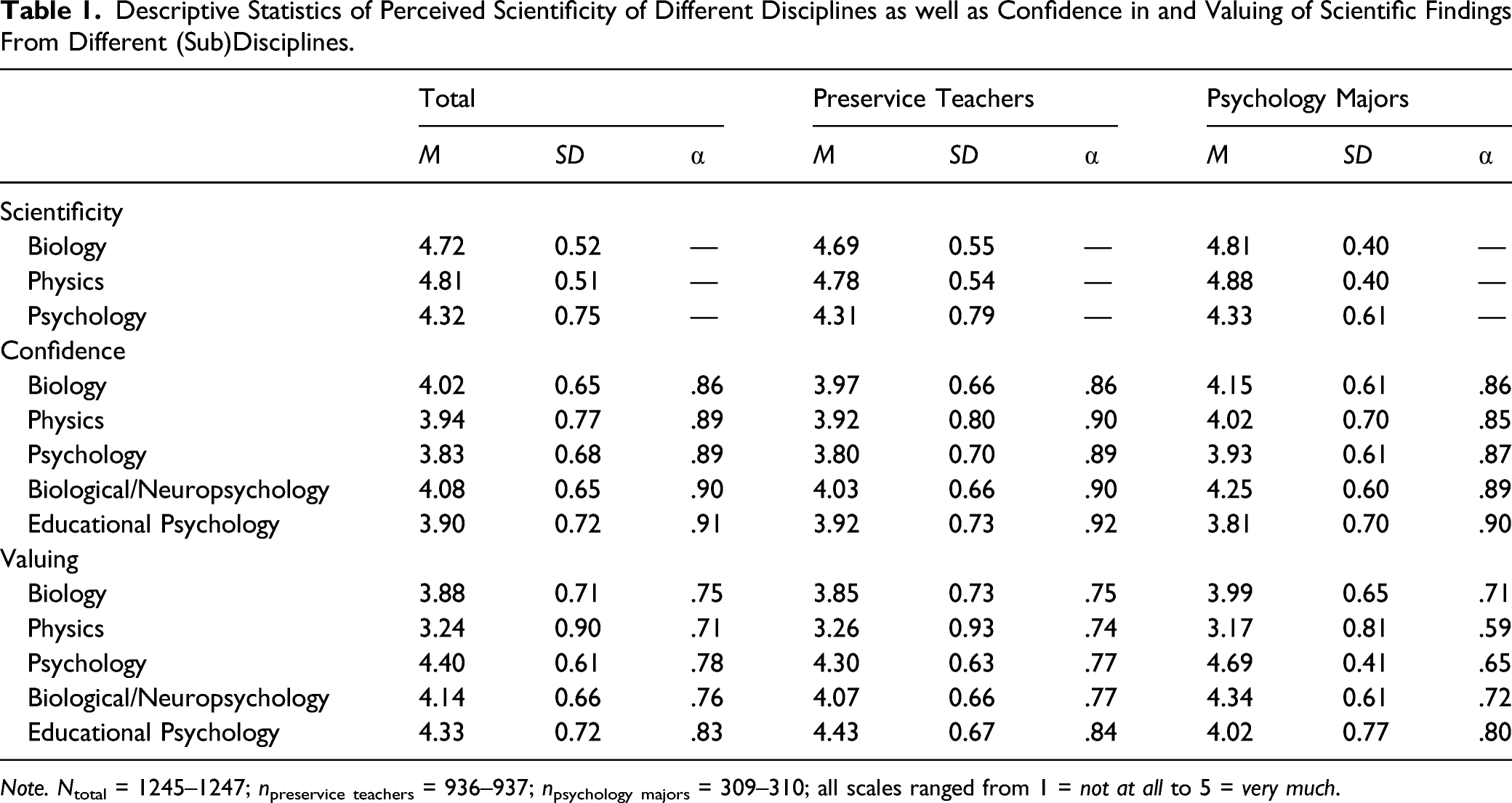
Note. Ntotal = 1245–1247; npreservice teachers = 936–937; npsychology majors = 309–310; all scales ranged from 1 = not at all to 5 = very much.
Precursory Analyses
To investigate whether the data fit the presumed two-factor structure of our questionnaire (confidence in vs. valuing of scientific findings), confirmatory factor analyses were conducted in Mplus (see Seifried, 2021, October 21, Supplement D). The model fit indices for a two-factor model for each of the three disciplines and for the two psychological subdisciplines were good to excellent and the latent standardized correlations between the two factors varied between r = .44 and r = .63, while the model fit indices for a one-factor model were not acceptable. Thus, the data confirmed the two-factor structure with good to excellent model fit indices. Internal consistencies for the scales of the newly developed questionnaire (see Table 1) could be classified as satisfying to excellent. However, when referring to the subsamples, it has to be acknowledged that the reliability scores of the valuing-scale for psychology majors regarding physics and psychology were not acceptable. Pearson correlations between the perceived scientificity of the three disciplines and confidence in their scientific findings were r = .27 for biology, r = .34 for physics, and r = .37 for psychology (all p < .001). These correlations indicate a substantial relation between the perceived scientificity of a discipline and the confidence in its findings but also that these aspects are separable.
Hypothesis 1: Perceived Scientificity
Using t-tests for paired samples, we found that preservice teachers perceived the scientific nature of psychology versus biology to differ significantly, t (936) = −14.37, p < .001, d = −0.55. The same was true for psychology versus physics, t (935) = −15.95, p < .001, d = −0.69. Effect sizes were slightly smaller when students studying one of the disciplines were excluded (i.e., d = −0.50 for biology, d = −0.63 for physics). Thus, while this exclusion led to less pronounced differences, the general picture that preservice teachers perceived psychology as less scientific than biology and physics remained the same.
Hypotheses 2a and 2b: Perception of Psychology Among Preservice Teachers
Using t-tests for paired samples, we found a significant difference between the confidence in scientific findings from psychology versus biology among preservice teachers, t (936) = −6.49, p < .001, d = −0.26. The same was true for psychology versus physics, t (936) = −3.80, p < .001, d = −0.16. Scientific findings from psychology were less agreed on and were perceived as less believable and convincing than scientific findings from the two investigated prototypical “hard” sciences among preservice teachers. Again, effect sizes were smaller when students studying one of the disciplines were excluded (i.e., d = −0.18 for biology, d = −0.10 for physics); thus, differences were less pronounced but still existed.
Corresponding t-tests for paired samples showed that there also was a significant difference between the valuing of scientific findings from psychology versus biology among preservice teachers, t (936) = 16.45, p < .001, d = 0.67—and again, the same was true for psychology versus physics, t (936) = 28.72, p < .001, d = 1.31. Scientific findings from psychology were more interesting, useful and important to preservice teachers than scientific findings from both biology and physics. Excluding people who studied the investigated disciplines led to even more pronounced differences (d = 0.79 for biology, d = 1.44 for physics).
Hypotheses 2c and 2d: Perception of Educational Psychology Among Preservice Teachers
A t-test for paired samples regarding the confidence in scientific findings from educational psychology versus biological/neuropsychology among preservice teachers showed a significant difference, t (936) = −4.25, p < .001, d = −0.15—as did the corresponding t-test regarding the valuing of scientific findings from these subdisciplines, t (936) = 13.95, p < .001, d = 0.53. Among preservice teachers, the confidence in scientific findings from educational psychology was lower than the confidence in scientific findings from biological/neuropsychology, while the reverse was true for valuing of findings from these psychological subdisciplines.
Hypotheses 3a–3c and Explorative Analysis: Preservice Teachers’ Versus Psychology Majors’ Perception of (Educational) Psychology
The one-way MANOVA to test whether preservice teachers and psychology majors differed concerning their perception of scientific findings from (educational) psychology yielded significance, Wilks-λ = 0.79, F (4, 1242) = 81.96, p < .001, part. η2 = .21. Results showed significant differences between preservice teachers’ and psychology majors’ confidence in scientific findings from psychology, F (1, 1245) = 8.30, p = .004, part. η2 = .01—and this was also true for valuing of the same, F (1, 1245) = 100.59, p < .001, part. η2 = .07. A significant difference was also found between the two groups’ confidence in findings from educational psychology, F (1, 1245) = 6.30, p = .012, part. η2 = .01—as well as their valuing of the same, F (1, 1245) = 79.32, p < .001, part. η2 = .06. Preservice teachers’ perception of scientific findings from psychology was less positive than psychology majors’ perception, while preservice teachers’ perception of scientific findings from educational psychology was more positive than psychology majors’ perception.
Discussion
Preservice teachers’ perception of (educational) psychology is of particular interest because they get in contact with corresponding research during their studies (see Fendler, 2012; Patrick et al., 2011) and because they will have to use scientific findings in their professional life (see Commission of the European Communities, 2007; Kultusministerkonferenz, 2004). With our study, we wanted to acquire a deeper understanding of preservice teachers’ view of (educational) psychology. We not only analyzed the perceived scientific nature of psychology but also explicitly differentiated between the confidence in and the valuing of scientific findings from psychology on the discipline level and educational psychology on the subdiscipline level—and found the latter aspects (i.e., perceived epistemic and instrumental quality) to be correlated but separable. Consequently, when making statements about how scientific findings are perceived, it is reasonable to consider these two aspects independently.
As hypothesized (H1), German preservice teachers perceived psychology to be less scientific than biology and physics. This result is in line with previous literature indicating a rather negative general view of psychology as a science (see Ferguson, 2015; Lilienfeld, 2012). However, evaluations of the scientificity of psychology still were well above four on a 5-point scale (see discussion of effect sizes and absolute values below). Furthermore, preservice teachers also indicated a lower confidence in findings from psychology than in findings from “hard” sciences and in educational psychology than biological/neuropsychology. Thus, in accordance with our hypotheses, we found a certain skepticism against findings from psychology (H2a) and educational psychology (H2c) when compared with other—“harder”—sciences (but again also see below for an absolute classification of the judgments). Our data also were in line with our hypotheses regarding preservice teachers’ valuing of scientific findings from psychology or educational psychology compared with classical natural sciences (H2b) or with another “harder” subdiscipline of psychology (H2d) in that preservice teachers indicated a rather positive motivational disposition toward both psychology and educational psychology. When compared with the perception of psychology majors, preservice teachers—as hypothesized—indicated both a lower confidence in (H3a) and valuing of (H3b) psychological findings (but once again also see below for an absolute classification). On the subdiscipline level, contrary to hypothesis H3c, preservice teachers’ confidence in scientific findings from educational psychology was higher than psychology majors’ confidence in these findings. This positive evaluation of educational psychology was also apparent for the ascribed values. Thus, among psychology majors, the positive perception of psychology as a scientific discipline did not transfer to educational psychology. Probably, also psychology majors make a distinction between different psychological subdisciplines, perceiving some of them as “harder” than others (see Lilienfeld, 2012; Munro & Munro, 2015). Their comparatively low valuing of educational psychology is in line with previous research indicating that German psychology majors often choose their field of study due to their high interest in clinical psychology (e.g., Glaesmer et al., 2010; Rief et al., 2007).
In sum, our results indicate that there is a difference between the confidence in and the valuing of scientific findings from (educational) psychology, that is, between the perceived epistemic and instrumental quality of the findings. Disentangling these aspects might be important because preservice teachers can pursue different aims (Hendriks et al., 2021). Interestingly, while confidence in scientific findings was lower and valuing of scientific findings was higher among preservice teachers on both the discipline level and the subdiscipline level when compared with other scientific (sub)disciplines, a different picture appeared when compared with psychology majors’ perception. In this case, confidence in and valuing of psychology were higher among psychology majors, but for educational psychology, preservice teachers indicated a more positive perception on both scales.
However, while all comparisons reached significance, both the effect sizes and absolute values of the judgments should be considered. While the effect sizes regarding the valuing of scientific findings were rather large, those for differences regarding the confidence in scientific findings were rather small. Likewise, the absolute ratings show that none of the disciplines or subdisciplines was rated as low on the confidence-scale (all M ≥ 3.80). The general high confidence in scientific findings might be due to the fact that our sample consisted of students who regularly get in contact with scientific findings. For the valuing of scientific findings, the absolute ratings were more diverse, with mean ratings among preservice teachers between three and four for biology and physics but above four for psychology and educational psychology (as well as biological/neuropsychology)—and these were only exceeded by psychology majors’ ratings for psychology (but not for educational psychology). Thus, in our view, preservice teachers’ perception of (educational) psychology is not alarmingly poor (cf. Allen, 2009; Sjølie, 2014). This is qualified by the fact that the differences between preservice teachers and psychology majors were small. In fact, when looking at our data—if anything—we might rather be worried about the perception of educational psychology among psychology majors. In general, as a side effect of our research, with the data on psychology majors’ perception of findings from (educational) psychology, we can add to the picture that (introductory) psychology students draw about psychology as a science (see Richardson & Lacroix, 2021).
Limitations
With this study, we aimed at a profound analysis of preservice teachers’ perception of scientific findings from psychology in general and educational psychology in particular. Therefore, we considered confidence and valuing as distinct concepts and used two standards of comparison, namely a comparison with other scientific (sub)disciplines and with other students. The latter comparison additionally permitted interesting insights into psychology majors’ views. However, there also are some limitations of our study design. First, on the discipline level, we compared the perception of psychology with two other sciences that can be considered classical natural sciences. Thus, we cannot make any statement about the perception of psychology when compared with other, for example, social sciences. The same is true for the subdiscipline level, where we decided to compare educational psychology with biological/neuropsychology because we wanted to use another psychological subdiscipline that preservice teachers possibly get in contact with and that is most comparable with the selected sciences on the discipline level. Second, we only used one item to measure the perceived scientificity of the disciplines, making it impossible to assess reliability and placing great emphasis on the item’s wording. We also only used a three item-scale to measure each confidence and valuing, though it might be desirable to shed a more differentiated light on these aspects. While in our pilot study, the newly developed scales were reliable (see Seifried, 2021, October 21, Supplement B), it has to be acknowledged that the reliability scores of the valuing-scale for psychology majors regarding physics and psychology in this study were not acceptable. Therefore, the corresponding findings need to be interpreted with caution. Third, based on our study, we cannot make any statement about the reasons for the different perception of the (sub)disciplines. However, our pattern of results is in line with previous studies indicating that practitioners perceive topics from educational psychology to be important but at the same time doubt their relevance, generalizability or applicability to their daily routines (e.g., Cain, 2016).
Practical Implications and Future Directions
Besides caring about Public Perceptions of Psychology (Ferguson, 2015), we think that we should also pay attention to how people who get in touch with psychology as a science perceive our discipline. Especially among preservice teachers, a positive attitude towards this (sub)discipline’s findings is very important because teachers are expected to apply corresponding findings to their classrooms and to pass evidence-based thinking and acting on to their students (see Commission of the European Communities, 2007; Slavin, 2002). To achieve this aim, our study indicates that it might be reasonable to look at both confidence in and valuing of scientific findings. Knowing whether one perceives the epistemic or the instrumental quality of scientific findings to be low can help to decide whether to focus on interventions that enhance the understanding of psychological methods to improve one’s understanding of the credibility of psychological research or on interventions that make the practical use of findings more salient.
While there are interventions to increase performance—especially in STEM-disciplines—by raising a discipline’s valuing through value interventions (e.g., Gaspard et al., 2015; Hulleman et al., 2010; see Harackiewicz & Priniski, 2018, for a review), the problem of (educational) psychology rather seems to be the confidence in their findings. Thus, when considering our results, in our view, there is a need to explore reasons for the—however, only rather—low confidence in (educational) psychology (among both preservice teachers and psychology majors). Cain (2016) already discussed different possible reasons for teachers’ non-acceptance of—or rather dissent with—research evidence. A specific reason for a low confidence in findings from (educational) psychology among pre- and in-service teachers might also ground in a perceived threat (see worldview backfire effect; Lewandowsky et al., 2012) and thus, in some kind of motivated cognition (see Lewandowsky & Oberauer, 2016). Another interesting aspect is whether students’ perception of (educational) psychology changes after attending a corresponding course. In addition, it is worthwhile to not only investigate the perception of scientific findings on a global level but also to have a closer look at specific topics, thereby shedding light on preservice teachers’ educational psychological misconceptions (see Menz et al., 2021a, 2021b, 2021c). These future directions have been addressed in further studies of our research project “Ask for Evidence – Imparting evidence-based thinking and acting in teacher education.” Further research on how other majors think about psychology and how to foster a positive perception of psychology as a scientific discipline could complement this research.
Furthermore, because several studies indicate that a positive attitude toward research is a strong predictor of the utilization of research-based information (e.g., Lysenko et al., 2014; van Schaik et al., 2018), the high valuing of findings from (educational) psychology by preservice teachers in our study is promising: If preservice teachers see the instrumental quality of scientific findings, this might help to engage them to further reflect on the epistemic quality of these findings. Probably, preservice teachers need to see the applications of research findings to their own practice (see Cain, 2016) or a deeper understanding of the methods and research processes to approve and then use corresponding results (see Cousins & Walker, 2000; Lysenko et al., 2014). To achieve this aim, teacher educators could make a good example of evidence-based practice but they also need support in doing so (see Diery et al., 2020). In addition, more cooperation between researchers and practitioners (for possible forms, see Ulvik et al., 2018; Vanderlinde & van Braak, 2010) are promising (see Joram et al., 2020). Along with this, however, it is important to also raise one’s awareness for the limits of research in (educational) psychology and its applications to not produce a blind acceptance of research findings, for example, by fostering an understanding that research results are always preliminary.
In sum, we think that—while paying attention to the general limits of research in educational contexts—psychology instructors could and should make use of the high valuing of findings from (educational) psychology to also foster a broader reliance on the same during teacher education. This in turn might influence the extent to which teachers apply such findings in their classrooms. We hope that the examples that we have discussed will prove beneficial in this regard.
Footnotes
Declaration of conflicting interests
The author(s) declared no potential conflicts of interest with respect to the research, authorship, and/or publication of this article.
Funding
The author(s) disclosed receipt of the following financial support for the research, authorship, and/or publication of this article: This research project was financially supported by the Ministerium für Wissenschaft, Forschung und Kunst Baden-Württemberg (Az: 33-7533.-30-10/25/63) and by the Excellence Initiative of the German Federal Government and the state governments – Funding line Institutional Strategy (Zukunftskonzept): DFG project number ZUK 49/Ü (“Heidelberg: Realising the Potential of a Comprehensive University").
