



Abstract
Background
Furnham and Hughes (2014) previously reported that a sample of adults was only able to recognize 37% of 249 myths based on those presented in Lilienfeld et al.’s (2009) Great Myths of Popular Psychology.
Objective
We sought to replicate these findings and to investigate predictors (e.g., education, cognitive ability, and personality) of beliefs in these myths in both lower- and upper-division courses.
Method
Over 150 psychology students completed a test of psychomythological beliefs, demographics, tests of cognitive ability, and measures of personality.
Results
Our sample identified a similar, but slightly higher percentage of the myths than those recognized by Furnham and Hughes’ sample. Myth acceptance was high among both introductory- and senior-level psychology students, but seniors believed significantly fewer myths, and the number of psychology courses taken was negatively related to false beliefs in the full sample. A larger general knowledge base and high intellectual openness predicted myth rejection; group membership did not moderate these effects.
Conclusion
Education and some individual differences variables likely play a role in psychomythological beliefs.
Teaching Implications
Psychology faculty should continue working to dispel psychological myths, and also redouble their efforts to enhance students’ core knowledge base, critical thinking, and intellectual curiosity.
For nearly 100 years, psychologists have attempted to document and explain college students’ superstitious beliefs (e.g., breaking a mirror causes bad luck) and other misconceptions (e.g., telepathy, ESP, and visual emissions) (see Dudycha, 1933; Nixon, 1925; Winer et al., 2002). However, despite psychology’s current popularity as a college major, misconceptions about core psychological topics still prevail, even among majors (Arntzen et al., 2010; Furnham & Hughes, 2014; Kuhle et al., 2009; Taylor & Kowalski, 2004). Myths such as “Children memorize much more easily than adults” and “In love and friendship, more often than not, opposites attract one another” are still commonly regarded as truth (Kuhle et al., 2009, p. 123). In fact, even after direct debunking of these myths, students often hold onto their beliefs (Gutman, 1979; Kowalski & Taylor, 2004; McCutcheon et al., 1992), and there is limited evidence that a psychology education greatly strengthens the ability to identify “psychomythology” (Arntzen et al., 2010; Higbee & Clay, 1998; Lamal, 1979).
Furnham and Hughes (2014) reported low rates of myth rejection (only 37%) among a large sample of students and community-dwelling adults who were presented with myths based on Lilienfeld et al.’s (2009) 50 Great Myths of Popular Psychology. And although psychology students had significantly lower belief in these myths, the size of this effect was “…negligible, accounting for around 2% of the variance” (p. 259). Accordingly, the literature on whether taking upper-level psychology coursework reduces psychomythological beliefs is mixed (e.g., Arntzen et al., 2010; Gardner & Dalsing, 1986; Higbee & Clay, 1998; Lamal, 1979; Standing & Huber, 2003), but the number of psychology courses students taken is negatively related to acceptance of psychological myths (Arntzen et al., 2010; Hughes et al., 2013; Standing & Huber, 2003). Simply put, the role of education on belief in psychomythology remains unclear and needs to be studied further.
The Current Study
In the current study, we sought to answer two primary questions.
Does Psychology Education Reduce Belief in Psychological Myths?
Furnham and Hughes (2014) reported that “psychological myths and misconceptions are numerous and widely held” (p. 256) based on a study in which they presented myths from Lillienfeld et al.’s (2009) 50 Great Myths of Popular Psychology to English undergraduate psychology students and the general population. They reported very small group differences, suggesting that the effect of a psychology education on dispelling myths might be minimal. However, they did not report the class rank of their psychology student participants. Therefore, it is unclear how much psychology coursework their student sample had completed, and whether this coursework helped reduce beliefs in psychology myths. By contrast, in this study, we compared psychomythological beliefs in Introduction to Psychology students to the same beliefs in seniors enrolled in a capstone course. We also used materials that were slightly different than those used by Furnham and Hughes to reduce potential response bias. In their study, all of the items presented were myths. Instead, we included some surprising truths from Lilienfeld et al. as well. In addition to using Likert scale belief ratings for each myth as done by Furnham and Hughes, we also collected true/false ratings on each myth to address the issue of question formatting (Higbee & Clay, 1998; Hughes et al., 2013).
Do Individual Differences in Measures of Cognitive Ability and Personality Predict Belief in Myths About Psychology?
Crystallized abilities (g c : is the ability to use acquired knowledge) also predicts the acquisition of new knowledge. For example, the acquisition of knowledge of new baseball knowledge (Hambrick, 2003), knowledge of current events (Hambrick et al., 2007, 2008), and the acquisition of political knowledge (Hambrick et al., 2010) are all predicted by g c . Therefore, g c might be expected to predict one’s knowledge of psychological myths.
Although fluid abilities (g f , the ability to solve novel problems and reason) were not direct predictors of knowledge acquisition in the aforementioned studies, there is reason to expect g f might predict myth identification. Correct myth identification requires knowledge of refutational knowledge and/or the ability to reason through the myth and determine it false. The latter could depend on g f . In fact, students with higher critical thinking skills are less likely to believe misconceptions about psychology, and higher performing students are more likely to change their beliefs when presented with correct information, and to simply hold fewer misconceptions (Gutman, 1979; Kowalski & Taylor, 2004; McCutcheon et al., 1992).
Similarly, because intellectual openness (IO—a personality facet that reflects general interest toward learning) correlates moderately with measures of fluid abilities such as reasoning, and with ACT scores, and also predicts acquisition of new knowledge through experience-seeking (e.g., Hambrick et al., 2008), we suspected it might also predict psychological myth identification.
In sum, in the current study, we will conduct a partial replication and extension of Furnham and Hughes (2014), with the goals of investigating the roles of psychology education, cognitive ability, and personality as predictors of students’ ability to identify myths about psychology.
Method
Participants
Sample Characteristics.
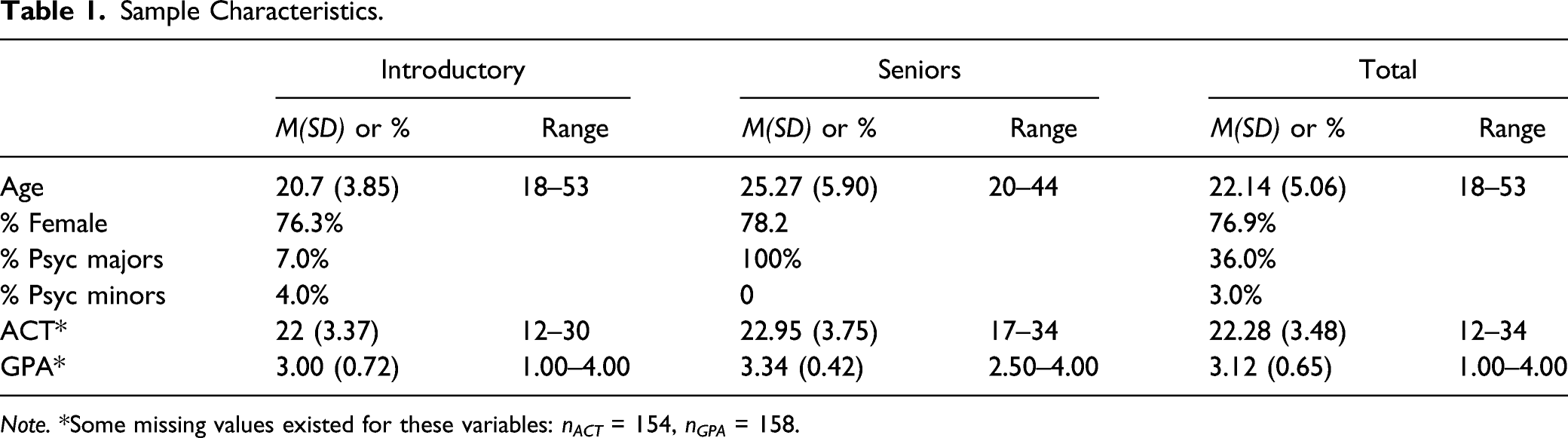
Note. *Some missing values existed for these variables: n ACT = 154, n GPA = 158.
Materials and Procedure
Participants completed a 75-min session in small groups (<10 participants each), completing each measure in a prescribed time after receiving instructions. The measures were administered by trained experimenters in the following order: consent, demographics, Belief in Psychological Myths Test, measures of fluid abilities (g f ) included Raven’s Progressive Matrices (Raven, 1962); Letter Sets (Ekstrom et al., 1976)), measures of crystallized abilities (g c ) included Reading Comprehension (Ekstrom et al., 1976); Synonym Vocabulary (Zachary, 1986)), and personality measures included the Big 5 (Goldberg, 1999); Intellectual Openness (IO; Cacioppo et al., 1984; Goldberg, 1999). We explain each below.
Belief in Psychological Myths Test
Psychomythology Items and Belief Rates for Introductory and Senior Students.
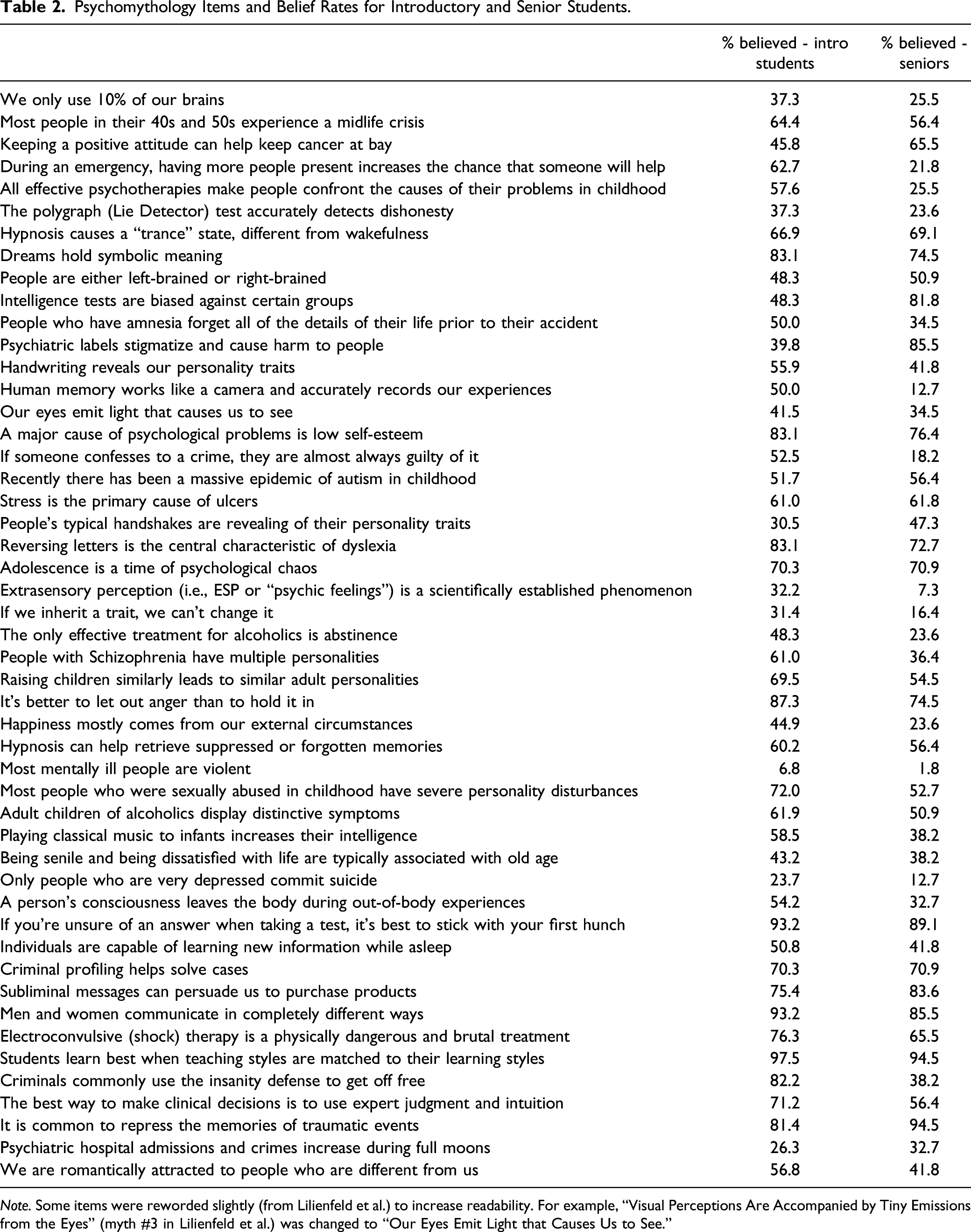
Note. Some items were reworded slightly (from Lilienfeld et al.) to increase readability. For example, “Visual Perceptions Are Accompanied by Tiny Emissions from the Eyes” (myth #3 in Lilienfeld et al.) was changed to “Our Eyes Emit Light that Causes Us to See.”
Descriptive Statistics.
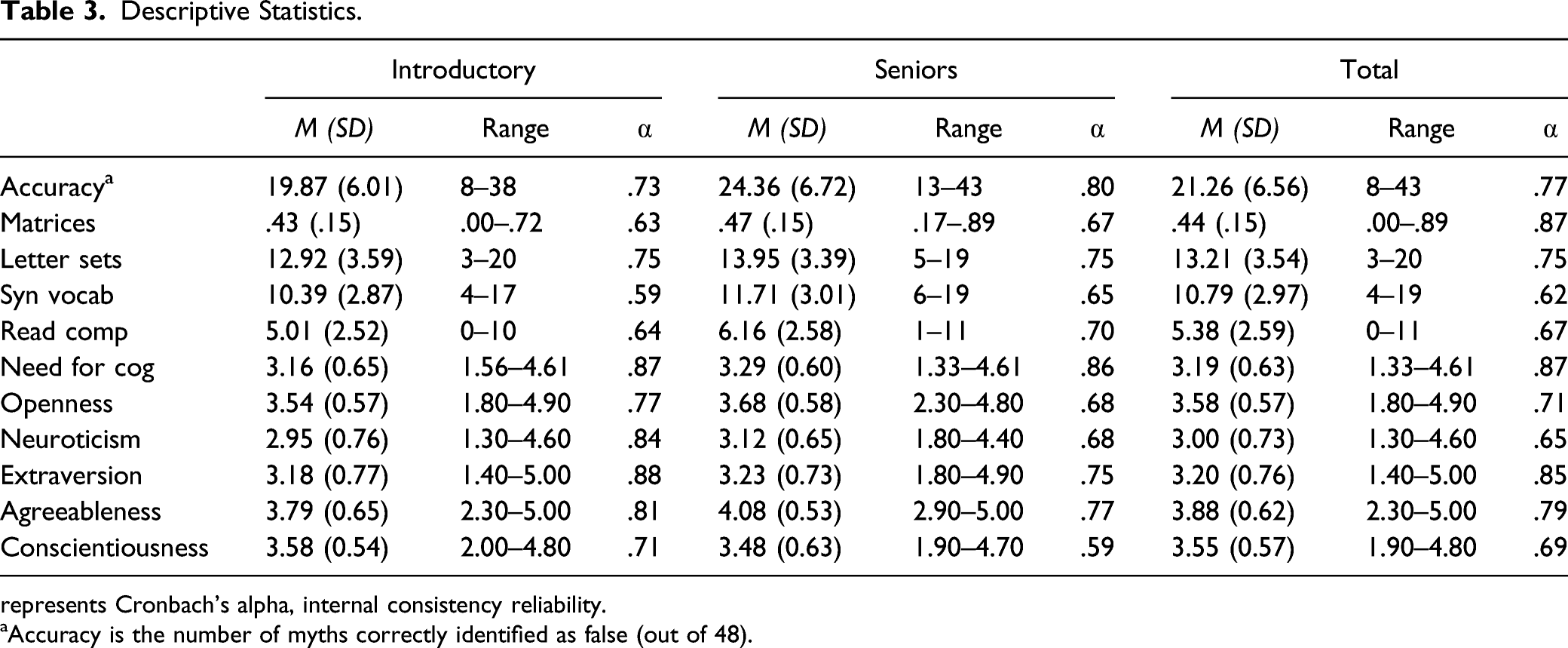
represents Cronbach’s alpha, internal consistency reliability.
aAccuracy is the number of myths correctly identified as false (out of 48).
Measures of gf
g f was measured using Raven’s Progressive Matrices (RPM; Raven, 1962) and Letter Sets (Ekstrom et al., 1976). In the 18-item RPM, each item consists of a 3 × 3 matrix, with 8 of 9 cells containing a pattern. Participants chose from 8 answer choices which best completed the blank cell. Letter Sets includes 20 items consisting of five groups of four letters. Participants identified which one of the five letter groups does not follow the same rule. For example, in the set NOPQ, DEFL, ABCD, HIJK, and UVWX, the correct answer is DEFL because it does not fit the same ordered pattern as the others. Ten min were allowed for each of the g f tasks. For both tasks, the proportions of items answered correctly were computed, with higher proportions indicating higher g f . The measures correlated positively (r = .34) even though the reliabilities were lower than anticipated (see Table 3). We created a z-score g f composite 2 to use in further analyses.
Measures of gc
g c was measured with a reading comprehension test (Berger et al., 1990) and a synonym vocabulary test (Zachary, 1986). In the former, participants answered 12 multiple-choice questions, each based on one of 12 unrelated paragraphs, in 9 minutes. For the vocabulary test, participants chose one of four options as a synonym for each of 21 target words in 5 minutes. For example, the options for the target SMIRCHED were STOLEN, POINTED, REMADE, and SOILED (correct answer is SOILED). For both tasks, we computed the proportions of items answered correctly, with higher proportions indicating higher g c . Again, despite lower reliability, the measures correlated positively (r = .53); therefore, we created a z-score g c composite.
Personality
Participants rated the extent to which each of 40 items described them on a 1 = very inaccurate of me to 5 = very accurate of me Likert-type scale. There were 10 items reflecting each personality trait: neuroticism, extroversion, agreeableness, and conscientiousness (Goldberg, 1999). Composite scores (averages) were created for each construct because of strong internal consistency reliabilities (see Table 3). We assessed IO with two measures, the 10 Openness items from Goldberg (1999), and the 18-item Need for Cognition (NFC; Cacioppo et al., 1984). NFC measures preference for intellectually-challenging activities. For this measure, participants rated how well each statement described them on a 1 (completely false of me) to five (completely true of me) scale. Reliabilities for both were moderate-strong (see Table 3), and they were correlated (rs > .41). Thus, we created an IO z-score composite.
Results
In order to prepare the data for analysis, we first screened for outliers (>3.5 SD from mean) on all predictors and the myth identification variable, and none were found. In addition, none had unusual skew or kurtosis (both values <0.7 in all cases).
We recorded the number of myths, out of 48, participants correctly identified as false; performance was below 50% (Mcorrect = 21.27 out of 48, SD = 6.56). Individual performances varied widely among the participants, with performance ranging from 8 (16.7%) to 43 (89.6%). Notably, Furnham and Hughes’ (2014) student participants correctly identified 40.1% of the myths as false. Their students (tested with a slightly different measure) performed significantly lower than our students, with a small-medium effect size (M = 44.30%, SD = 13.66), t (172) = 4.05, p < .001, d = 0.31 (Cohen, 1988).
Both our introductory and senior students frequently believed myths regarding IQ, such as “Students learn best when teaching styles are matched to their learning styles” (96.5% misidentified) and “If you are unsure of an answer when taking a test, it is best to stick with your first hunch” (91.9% misidentified). Combined, the two groups were most accurate at identifying myths about mental illness, such as “Only very depressed people commit suicide” (20.2% misidentified) and “Psychiatric hospital admissions and crimes increase during the full moon” (28.3% misidentified) (see Table 2 for a list of the myths and their identification rate among introductory and senior students).
Does Education in Psychology Reduce Belief in Psychological Myths?
We conducted an independent-samples t-test to determine whether seniors identified more psychological myths than introductory students. Despite the unequal sample sizes, Levene’s test for equality of variance was nonsignificant. Myth identification was higher for seniors (M = 50.53%, SD = 14.05%), than for introductory students (M = 41.13%, SD = 12.51%), t (171) = −4.30, p < .001, d = 0.69.
Do Individual Differences in Measures of Cognitive Ability and Personality Predict Belief in Myths About Psychology?
Before performing the regression analyses, we computed bivariate correlations among the dependent variable and the predictors. Of note, g c correlated significantly with accuracy of myth identification (r = .38, p < .001), but g f did not (r = .09). Of the personality variables, IO correlated significantly with accuracy (r = .29, p < .001), but neuroticism (r = .12), extraversion (r = −.08), agreeableness (r = −.02), and conscientiousness (r = −.09) did not. The number of psychology classes completed also correlated moderately, and significantly, with identification accuracy (r = .31, p < .001).
Our goal was to determine whether cognitive abilities predicted knowledge of psychological myths beyond the role of group membership (introductory vs. seniors), and then to examine the additional influence of IO. Thus, we conducted a hierarchical regression analysis with group (introductory/senior) entered in the first step, g f and g c entered in the second step, and IO entered in the third step (because IO’s correlation with performance was weaker than gc’s). We also investigated the interactions of group with each predictor in the fourth step to determine whether the roles of cognitive abilities and intellectual openness varied by group.
Group membership was a significant predictor of myth identification, F (1171) = 18.46, p < .01, R 2 = .10, R 2 Adj = .09. The positive effect (β = .31) reflects the superior myth identification of the seniors as compared to the introductory students as reported above. Cognitive ability’s significant incremental role, ΔF (2169) = 11.14, p < .01, ΔR 2 = .11, ΔR 2 Adj = .10, was attributable to a significant effect of crystallized (β = .36, p < .01) but not fluid abilities (β = −.09). Beyond both group and cognitive abilities, the role of IO was small, but still significant, ΔF (1168) = 7.23, p < .01, ΔR 2 = .03, ΔR 2 Adj = .03. None of the interactions with group were significant (βs < .15, ps > .15), suggesting that the predictors’ roles were similar in introductory and senior students.
Discussion
Lilienfeld et al.’s (2009) reiterated what psychologists have reported for over 50 years (see McKeachie, 1960); misconceptions about our field are pervasive. Furnham and Hughes (2014) found that, on average, psychology students correctly identified only 40% of Lilienfeld et al.’s 50 myths as false. Similarly, our participants correctly identified 44% as false. When comparing psychology students to the general public, Furnam and Hughes found a significant, but small, advantage attributed to psychology education. Likewise, we found a small, significant effect of psychology education when comparing introductory students to seniors.
Education’s Role in Reducing Beliefs in Psychomythology
Thus, psychology education does appear to explain belief in psychological myths when comparing seniors to introductory students. However, these effects are small. Although seniors are more educated about psychology overall, they may not be exposed to myth-refuting information in their courses. Furthermore, even if the myths were directly refuted in their courses, the refutation might have been insufficient to counter previous beliefs, or students simply may fail to retain refuting evidence. Second, although the groups in the current study were demographically similar (see Table 1), any group differences might have been accounted for by selection. That is, group differences in beliefs between seniors (who had successfully completed 3 years of college) and introductory students (who were primarily first-year students) could have reflected group differences in a quality other than education. For example, many students at an institution such as ours transfer in as Juniors (with Associate’s degrees) and thus take many of their 100- and 200-level psychology courses elsewhere. Last, there may simply be limits to the beneficial effects of education. Not only may individual differences factors play a role (as seen here), but students are exposed to many sources of information besides their college courses that may reinforce false beliefs.
Not only were there significant differences between introductory and senior-level students, but the number of psychology classes taken also correlated with correct identification of myths. However, approximately two-thirds of the sample were taking their first psychology class, and no significant correlation existed within the sample of seniors. We know that introductory students had taken no upper-level, psychology courses because Introductory Psychology is a prerequisite for all upper-level courses. However, beyond the required core of 200-level courses, seniors take a variety of different 300- and 400-level courses to fulfill their graduation requirements. This variation in the seniors’ completed coursework could contribute to the nonsignificant relationship between the number of courses taken and beliefs among seniors.
Individual Differences in Psychomythological Beliefs
Individual differences in psychomythological beliefs were large. In fact, accuracy on our test ranged from 8 correctly identified myths out of 48 (16.6% accuracy) to 43 correctly identified myths (89.6% accuracy). These individual differences were partially attributable to variation in general cognitive abilities, specifically g c . This finding is consistent with previous work implicating g c in the acquisition of new knowledge (e.g., Hambrick et al., 2007), and also consistent with the general literature suggesting a strong positive correlation between measures of general cognitive abilities and knowledge (see Horn & Noll, 1997, for a review). Given that g c is believed to represent one’s overall knowledge base, it is possible that a broad base of knowledge may help in the evaluation of myths. For instance, a better understanding of a variety of topics, acquired through reading and exposure, may serve as a foundation for evaluating the credibility of new information. Because g c also reflects vocabulary, students with high g c may have a stronger ability to understand the myths themselves. In fact, students with high g c (including word knowledge) may be more likely to read in general, which might lead them to encounter refutations of the myths in other sources.
g f was not a significant predictor of performance in this study. Although no research on this topic had utilized the measures of g f we employed, Kowalski and Taylor (2004) reported significant correlations between myth identification and a measure of critical thinking ability, and thus we expected g f would predict myth identification. However, the nonsignificant direct effect of g f is consistent with the aforementioned literature on knowledge acquisition. Perhaps, tests of critical thinking are simply more reflective of the type of reasoning required to correctly identify psychological myths.
Above and beyond the role of cognitive abilities, IO predicted performance. This personality trait may reflect a tendency to seek knowledge about psychology and thus learn about common myths. In fact, Hambrick et al. (2007) found that need for cognition predicted interest in current events topics, which predicted exposure to news (e.g., reading or watching news), and then knowledge about those topics.
Notably, no interactions of the predictors with education (introductory/senior) emerged. Thus, there is no evidence that, for instance, higher education is associated with a smaller role of abilities or personality in predicting myth identification. Although the measures in this study were administered in a fixed order, we do not suspect that measure order played a role in the results. Administering the psychomythological beliefs scale before the ability and personality measures should have shielded the primary dependent measure from any carryover effects, and using a fixed administration order is common in individual differences work.
Instructional Implications
Here we found that education may play a role in reducing misbeliefs, as seniors believed fewer myths than introductory students. Refutational techniques are effective at reducing belief in psychological myths (e.g., Kowalski & Taylor, 2017; Lassonde et al., 2017), and providing more (Ecker et al., 2019), and more detailed (Swire et al., 2017), information is key to sustaining corrected beliefs. Thus, faculty may need to allocate significant class time to refutation of these myths.
We also found that belief in myths was associated with lower crystallized ability and intellectual openness. Thus, interventions to enhance intellectual openness and increase core knowledge (i.e., crystallized ability) may help students critically evaluate myths’ veracity. However, efforts at modifying crystallized abilities (c.f., Alloway & Alloway, 2009; Redick et al., 2013) and intellectual openness (c.f., Jackson et al., 2012; Sander et al., 2017) have yielded mixed results. Similarly, enhancing critical thinking skills may help reduce belief in psychological myths (Basterfield et al., 2020). Thus, although efforts to directly refute myths may have some benefits, psychology faculty should continue focusing on some of the core goals of a college education (enhancing students’ critical thinking skills, knowledge base, and intellectual curiosity), which may have the added benefit of helping students evaluate psychological myths.
Conclusion
Limitations and Future Research
Here, we have identified those students most likely to believe in psychological myths: students with limited psychology coursework, and those low in IO and crystallized ability. Future researchers should seek to use this information to prevent or correct psychological misconceptions. For example, particular courses that lead students to reject psychological myths should be identified, possibly through longitudinal studies.
To further investigate the role of IO on belief in psychomythology, measures of interest in psychology and of study time and/or engagement in knowledge-rich activities (reading, attending talks, etc.) should be administered. In addition, although g c ’s role as a predictor of myth identification is interesting because it suggests that general cognitive ability plays a role, the specific role of core knowledge of psychology in myth identification should also be investigated.
In summary, even psychology majors fall prey to the allure of myths about psychology. Belief in the myths is lower with increased psychology education (d = 0.69). These beliefs are not harmless; Lilienfeld et al. (2009) suggested that belief in psychological myths can be harmful either directly (e.g., by believing that eyewitness testimony is always accurate, and thus convicting an innocent defendant) or indirectly (e.g., by utilizing treatments with no scientific basis instead of those based in science). But they also suggest that “the acceptance of psychological myths can impede our critical thinking in other areas” (p. 8–9). Psychology students must be stewards of current and accurate psychological science; it is our job as educators to make sure they are well-equipped for this job. As eloquently stated by Dudycha (1933):
The one inevitable conclusion which we must draw from these results is, although college instruction is such that it does convert some few students from their naive beliefs and superstitions, it certainly is not such as to convince all students of the falsity of such notions as those concerning good and ill fortune, fortune telling, and other such popular beliefs. The difficulty probably rests in the fact that we expect too much transfer. Too often, we teach general, scientific principles and then expect all students to translate them into their own lives and thought and to modify their beliefs accordingly. Are we sure that college students will necessarily do this? (p.464)
Our efforts to eradicate these beliefs need to be redoubled. In addition, we must continue our inquiries into the sources of psychological misconceptions so that we may better dispel them.
Footnotes
Declaration of Conflicting Interests
The author(s) declared no potential conflicts of interest with respect to the research, authorship, and/or publication of this article.
Funding
The author(s) received no financial support for the research, authorship, and/or publication of this article.