



Abstract
Even before the unprecedented social isolation brought on by the COVID-19 pandemic, many students felt isolated and alone. In 2017, 39% of US high school seniors reported they often felt lonely (Twenge et al., 2019b). Just before the pandemic, the American College Health Association (American College Health Association, 2020) found that 49% of college students were lonely. Loneliness is a normal human experience, of course, but research suggests that the prevalence of loneliness has increased significantly in recent years (Cacioppo et al., 2016; Cigna 2020; Twenge et al., 2019b). Indeed, health experts are sounding the alarm about a loneliness epidemic in the United States (Cacioppo & Cacioppo, 2018a; Murthy, 2017), where at least one-third of adults are lonely (Anderson & Thayer, 2018; Bruce et al., 2019; Cigna, 2018, 2020). Though loneliness affects people of all ages, some evidence suggests that young people are struggling the most (Barreto et al., 2021; Cigna, 2018).
Loneliness is more than an unpleasant feeling; it is associated with a variety of negative mental and physical health outcomes (Cacioppo et al., 2014). Loneliness also has important implications in academic settings. Students who feel lonely or disconnected from others are less motivated, earn lower grades, and are more likely to drop out of school than other students (Korpershoek et al., 2020; Rotenberg & Morrison, 1993; Suhlmann et al., 2018). Also, once loneliness sets in, it is difficult to overcome. This happens because loneliness increases the motivation for self-preservation, which manifests as an implicit hypervigilance toward social threats (Cacioppo & Cacioppo, 2018b; Cacioppo et al., 2016). In other words, lonely people, without realizing it, begin to mistrust others and become anxious in social situations. When lonely people see their social world as a threatening place, they tend to elicit behavior from others that confirms their negative expectations, fueling an incessant cycle of loneliness (Cacioppo & Patrick, 2008). Research shows that one of the keys to reducing loneliness is education, through which people can learn to recognize and correct the maladaptive thoughts and behaviors associated with loneliness (Masi et al., 2011).
Where will young people receive this education? Those who are struggling with feelings of loneliness may be reluctant to seek out information or ask for help due to the stigma associated with this condition (Kerr & Stanley, 2021). Also, because loneliness is not considered a mental illness, school counseling centers may not prioritize the distribution of resources related to loneliness. Fortunately, psychology teachers are in a position to help combat the growing epidemic of loneliness by educating students about the nature of loneliness and promoting social connection in their classrooms. The topic of loneliness is related to many domains within psychology, despite its apparent lack of coverage in most psychology textbooks. Teachers can incorporate lessons from the science of loneliness into their courses—from biological psychology to industrial-organizational psychology—to help students understand and defend against loneliness. Teachers can also support students’ social well-being through their teaching practices and activities. Below, I share a few highlights of the research on loneliness, discuss ways to incorporate the topic of loneliness into psychology courses, and explain how teachers can promote social connection in the classroom.
The Nature of Loneliness
Humans have a fundamental need for social connection (Baumeister & Leary, 1995). When this need is thwarted, people experience a variety of negative consequences, including loneliness. Loneliness refers to distress arising from the perception that one’s social relationships are inadequate in some way (Perlman & Peplau, 1981). Loneliness is synonymous with perceived social isolation, not actual social isolation. In other words, loneliness is the feeling of being alone or isolated, regardless of how many people are around.
Research shows that loneliness is a risk factor for an array of mental and physical health problems, including anxiety, depression, suicidal thoughts, fragmented sleep, increased vascular resistance and blood pressure, increased inflammation, and impaired immune functioning (see Cacioppo & Cacioppo, 2014, for a review). Loneliness also increases the risk of early mortality by 26%, which is equivalent to the risks associated with smoking 15 cigarettes a day (Holt-Lundstad et al., 2010). The fact that loneliness increases the odds of morbidity and mortality supports the hypothesis that social connection is a fundamental human motivation (Baumeister & Leary, 1995).
According to the evolutionary theory of loneliness (ETL; Cacioppo et al., 2014; Cacioppo & Cacioppo, 2018b), loneliness evolved as a biological warning signal to alert individuals to the potential dangers of being alone and to motivate them to reconnect with others. Just as the aversive state of hunger motivates people to locate food, the pain of loneliness prompts them to seek out opportunities for social connection. Because social isolation is potentially dangerous, loneliness also increases the motivation for self-preservation, which manifests as an implicit hypervigilance for and avoidance of social threats. Thus, loneliness creates two competing motives: an explicit drive to seek out companionship and an implicit desire to keep their distance from others who may harm them.
There is an abundance of empirical evidence in support of the ETL (see Cacioppo & Cacioppo, 2018b for a review). Research suggests that loneliness and other forms of social disconnection are associated with a heightened sensitivity to social cues and an increased desire for connection (Gardner et al., 2005; Inagaki et al., 2016; Maner et al., 2007). In fact, forced social isolation triggers neural ‘cravings’ that are similar to the ones evoked by hunger (Tomova et al., 2020). Research also shows that loneliness is related to increased implicit attention to social threats (Bangee et al., 2014; Cacioppo et al., 2009b; Cacioppo et al., 2016). For example, a brain imaging study found that lonely participants were quicker to differentiate between social threats (e.g., images depicting social rejection) and nonsocial threats (e.g., images of snakes) than nonlonely participants were (Cacioppo et al., 2016). Other work shows that loneliness is associated with a preference for larger (vs. smaller) interpersonal distance within one’s intimate personal space (Layden et al., 2018). These empirical results highlight the paradox of loneliness outlined in the ETL: perceived isolation stirs the desire for connection while arousing a conflicting motivation to withdraw from others in self-protection.
When primitive humans found themselves on the “social perimeter” (Cacioppo & Hawkley, 2009, p. 447), becoming more sensitive to social threats likely helped ensure their survival. However, this hypersensitivity to threat is not helpful in modern society. It distorts lonely people’s social cognition, which makes social connection even more elusive. Indeed, research shows that lonely people have difficulty navigating social situations (e.g., Knowles et al., 2015). Lonely people do not have deficient social skills (Gardner et al., 2005), but they expect to perform poorly in social situations and fear that others will negatively evaluate them (Cacioppo et al., 2006; Jones et al., 1982). As a result, lonely people tend to employ a cautious or avoidant interactive style (Lucas et al., 2010). Ultimately, lonely people’s anxious thoughts and overly cautious behaviors cause others to reject them, thereby perpetuating a cycle of loneliness in which they become increasingly more isolated (Cacioppo & Patrick, 2008).
Making matters worse, the hypervigilance created by loneliness is an implicit one, leaving lonely individuals unaware that they are sabotaging their efforts to find meaningful social connection. The antidote to loneliness, then, is not as simple as finding people to connect with. Indeed, a meta-analysis of interventions to reduce loneliness found that interventions targeting maladaptive social cognition were more effective than other common strategies, that is, improving social skills, enhancing social support, and increasing opportunities for social interaction (Masi et al., 2011). More recent research shows that mindfulness meditation also reduces loneliness, perhaps because it quiets the lonely brain’s alarm signal (Creswell et al., 2012; Lindsay et al., 2019).
Incorporating the Science of Loneliness and Social Well-Being into Psychology Courses
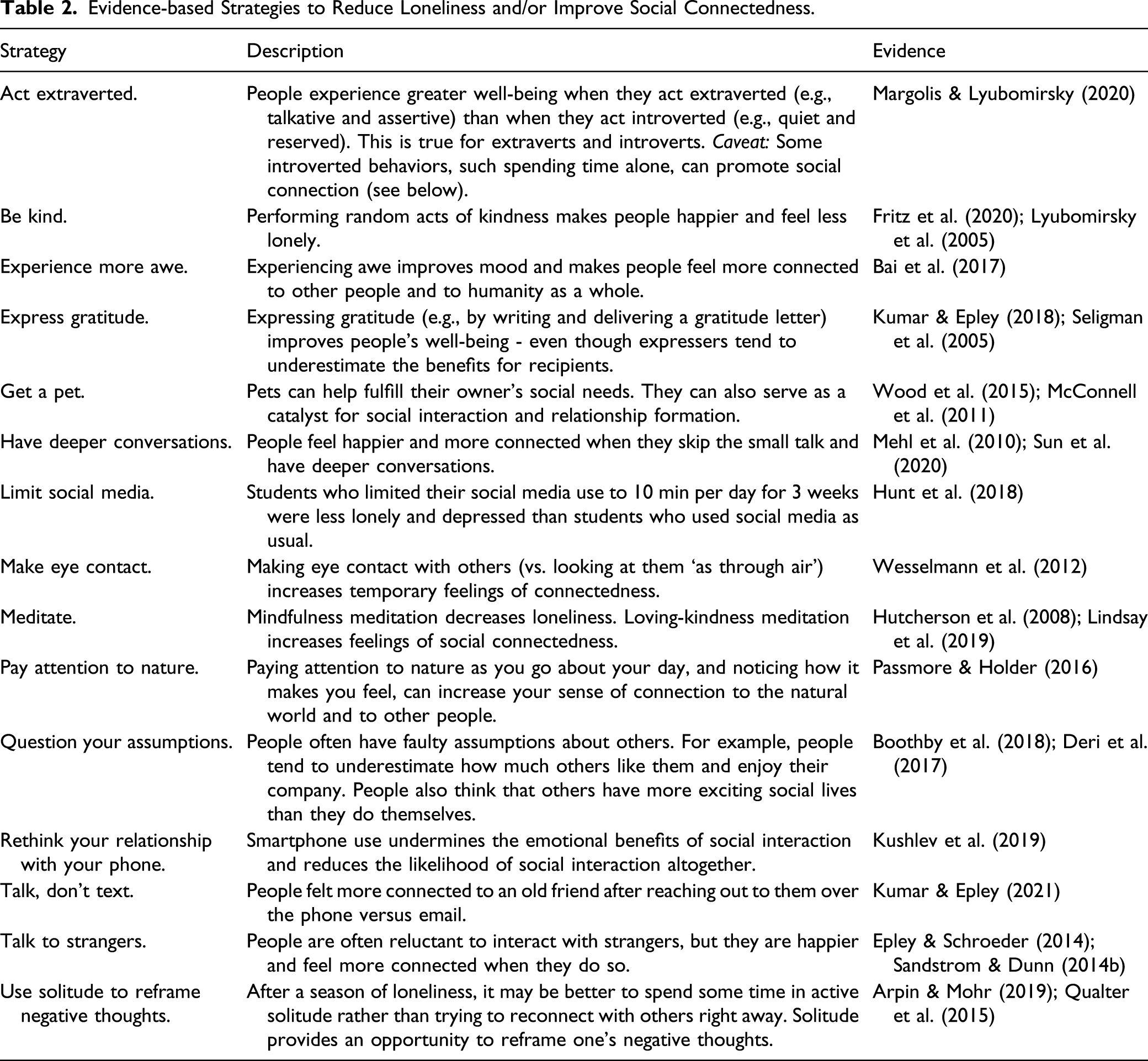
Loneliness has serious consequences for people’s health and well-being, and is a problem for many students, but the topic receives little coverage in most psychology textbooks. Psychology teachers can fill this gap by weaving lessons from the science of loneliness into their lectures, class discussions, and assignments. Teachers can also introduce students to research-based strategies for reducing loneliness and/or boosting social connectedness. Adding this material to the curriculum will help students learn about an important psychological topic—and it will help them understand how to overcome feelings of loneliness when they strike.
Select Research Findings on Loneliness and Social Connection, and Their Relevance to Other Psychological Topics.
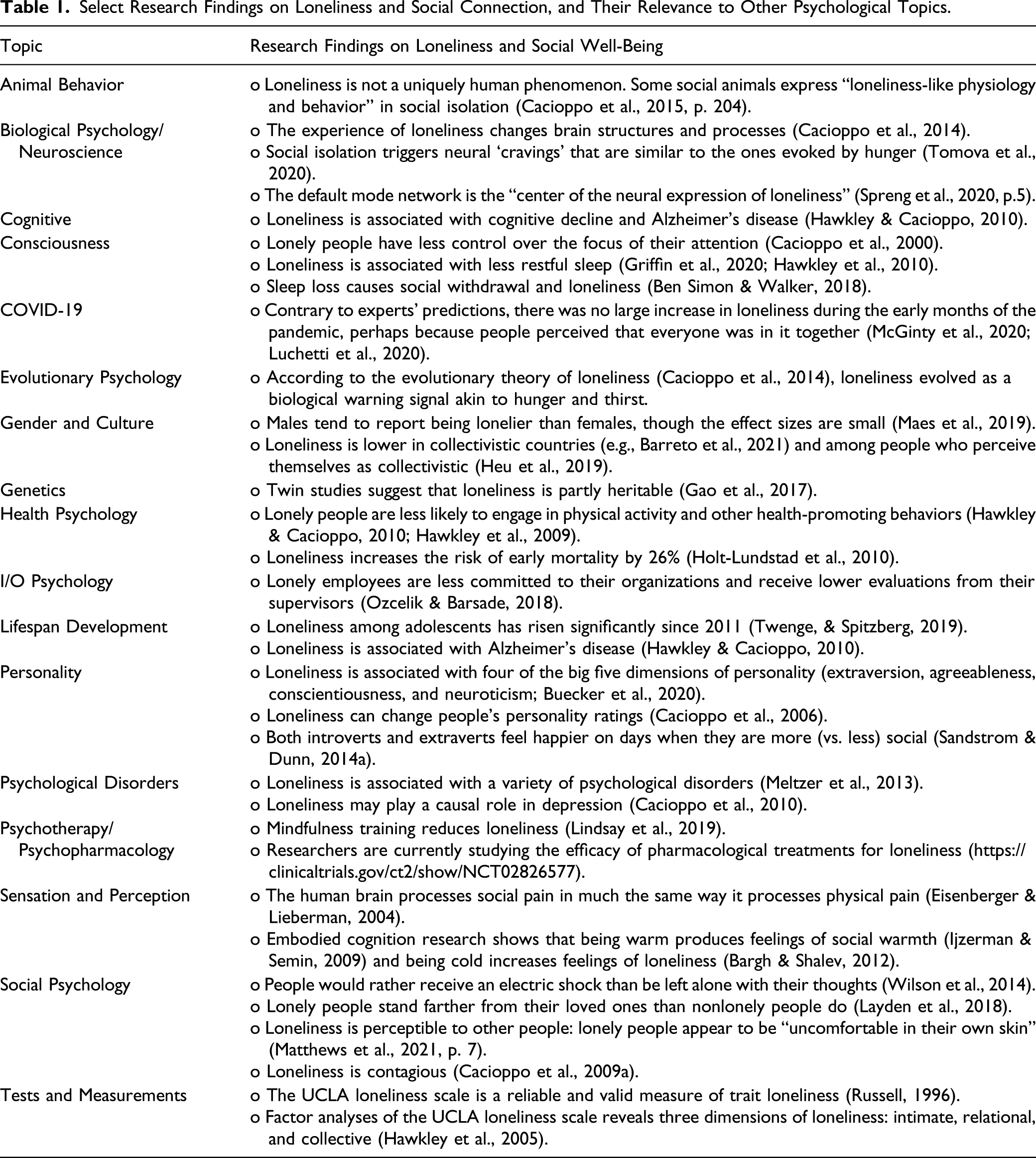
During the unit on neuroscience or sensation and perception, students can learn that the human brain processes social pain such as rejection in much the same way it responds to physical pain (Eisenberger & Lieberman, 2004). In fact, the pain reliever Tylenol reduces the pain of social exclusion (Dewall et al., 2010). When the topic is developmental psychology, students may enjoy discussing the increased prevalence of loneliness among young people in recent years (Twenge et al., 2019b). Today’s students have very different social lives than students of the past, given that traditional-age students are members of a generation that spend less time socializing in person and more time using digital media than earlier generations did (Twenge et al., 2019a; Twenge et al., 2019b). According to recent surveys, 45% of adolescents and 48% of young adults are online “almost constantly” (Anderson & Jiang, 2018; Perrin & Atske, 2021). Some scholars have argued that these modern habits—spending less time with people and more time online—increase feelings of loneliness and depression (Hunt et al., 2018; Nowland et al., 2018; Primack et al., 2021; Twenge, 2017; Twenge et al., 2019b). Students will probably have a lot to say about the potential causes of loneliness, especially with regard to the use of social media. This is also a good opportunity to reinforce the notion that correlation does not imply causation. Most research on the relationship between social media use and loneliness is correlational, but a recent experimental study found that limiting social media caused a decrease in loneliness and depression (Hunt et al., 2018).
In relation to physical and mental health, students can learn that loneliness is a major risk factor for adverse health outcomes. Students will probably be surprised to learn that loneliness increases the odds of an early death. Alternatively, one could talk about the positive link between social relationships and health: those with good social relationships are less susceptible to the common cold (Cohen et al., 1997) and have a 50% greater likelihood of survival (Holt-Lundstad et al., 2010). When covering personality or psychological disorders, teachers can review the experimental evidence that loneliness increases depressive symptomatology, anxiety, and social withdrawal (Cacioppo et al., 2006).
Evidence-based Strategies to Reduce Loneliness and/or Improve Social Connectedness.
Promoting Social Connection in the Classroom
Another way to help fight the loneliness epidemic is to promote social connection in the classroom. Students’ social interaction in the classroom is related to greater well-being and feelings of belonging (Sandstrom & Dunn, 2014a). Also, students’ sense of belonging (or sense of community) within a class predicts their enjoyment of the class (Sandstrom & Rawn, 2015) and performance on exams (McKinney et al., 2010). Experimental evidence in this domain is limited, but a few studies suggest that sense of connection causes these positive outcomes. For example, Walton and Cohen (2011) delivered a social-belonging intervention to a group of ethnic minority first-year students who lacked a strong sense of belonging at their university. The researchers helped students understand that uncertainty about belonging is common and short-lived. This simple intervention changed students’ mindset about social adversity and raised their grades over the next 3 years.
Clearly, it is important for students to feel like they belong at their school and within their classrooms. It is also helpful for students to interact during the learning process. As social creatures, humans are wired with a tendency to learn together (Lieberman, 2013, 2014). In fact, learning with a social motivation (e.g., to teach someone else) often leads to better outcomes than learning with an individual motivation (e.g., to pass a test). The learning-for-teaching strategy (Bargh & Schul, 1980; Fiorella & Mayer, 2013) is an inherent part of group-based instructional strategies such as interteaching (Boyce & Hineline, 2002), team-based learning (Michaelsen et al., 2004), and cooperative learning (Johnson & Johnson, 1999), and may help explain why these strategies often yield better student learning outcomes than the traditional lecture format.
Given the evidence that being social in the classroom is good for students’ well-being and learning, I encourage teachers to prioritize social connection in their own classrooms. There are a number of ways to do so. First, teachers might adopt a group-based instructional strategy that capitalizes on students’ social motivations to learn. Those who prefer a lecture format can blend collaborative learning activities into their class sessions (Saville et al., 2012). Keep in mind that putting students into groups does not ensure they will connect in a positive and meaningful way. Instructors may wish to devote time to helping students navigate through small talk into deeper, more authentic connection, especially at the beginning of the course. If using icebreakers, choose ones that allow students to form real bonds. In my general psychology courses, I have students meet in groups of 3 to discuss things they have in common. Their mission is to come up with uncommon things they in have in common (one group discovered that they all had ex-boyfriends who were incarcerated). This activity allows students to find similarities that may create a foundation for real relationships. In my upper-level courses, I ask students to engage in reciprocal self-disclosure using some of Aron et al.’s (1997) questions for increasing intimacy (e.g., For what in your life do you feel most grateful?). This exercise is particularly good for helping groups develop cohesion before working together on a collaborative project. Teachers may wish to establish ground rules for safe dialogue (e.g., Arao & Clemens, 2013) before asking students to share personal information or discuss sensitive topics.
The few minutes before class starts can also be a fruitful time for students to connect with each other. However, in my experience, students may need a little nudge to be social. For the first 15 years of my career, my students had animated conversations in the moments leading up to class. More recently, the classroom has been eerily quiet before class because students are more likely to interact with their phones than the people beside them. During the last class I taught, I gave students extra credit for signing a pledge that they would not use their phone during class or in the 5 min leading up to it (unless they had an urgent need to do so). All but one of my students signed the pledge and, once again, my classroom filled with chatter.
Another strategy is to embed activities that foster social connection. For example, mindfulness training has been shown to reduce loneliness and promote social connection (e.g., Lindsay et al., 2019). You might introduce students to a mindfulness-based practice (e.g., mindfulness meditation) and invite them to practice this technique at the start of class, during a break, or before an assessment. Mindfulness training has many other benefits for students, including reducing stress and anxiety (Bamber & Kraenzle Schneider, 2016) and improving cognitive performance (e.g., Calma-Birling & Gurung, 2017).
Finally, it is important to make sure that instructors’ needs for social connection are also being met. Teachers can enhance their social well-being by building authentic connections with their students, but feeling connected to and supported by one’s colleagues and institution is critical as well. I surveyed the teaching faculty at my university before the COVID-19 pandemic (Kerr & Meixner, 2020), and found that 20% of respondents did not feel a sense of belonging to the university. Over one-third reported sometimes or often feeling alone at the university. Importantly, workplace loneliness and sense of belonging were significant predictors of job satisfaction. Other research shows that employees who feel isolated at work are less committed to their organizations and receive lower evaluations from their supervisors (Ozcelik & Barsade, 2018). Thus, feelings of connection matter, for students and instructors.
A Note on Student Differences
In every classroom, students vary in terms of their personality, social aptitude, and preferences regarding social interaction. Some students love working in groups; others panic the moment they hear “turn to a neighbor.” Some students socialize with finesse; others, including those with social anxiety disorder or autism spectrum disorder, may struggle in the social arena. Teachers should respect students’ differences, but this does not mean they should limit opportunities for students to connect and collaborate. Communication is one of APA’s five learning goals for undergraduate psychology majors. Students who meet this learning goal will “interact effectively with others” (American Psychological Association, 2013, p. 31). To help students meet this learning goal, while being sensitive to students’ differences and preferences, teachers might include a variety of individual and collaborative activities in their courses. Additionally, teachers can allow time for students to gather their thoughts before joining a group discussion, which may be especially helpful for introverts. Teachers can also encourage students to adopt a growth mindset regarding their ability to connect with others: social connection is like a muscle that gets stronger with exercise (Cacioppo & Cacioppo, 2017).
Conclusion
Loneliness is an epidemic in the modern world, putting millions of people at risk of serious mental and physical health problems (Cacioppo & Cacioppo, 2018a). This important topic warrants coverage in psychology courses. Furthermore, psychology teachers are in a unique position to help fight the loneliness epidemic. Educating students about the nature of loneliness—and promoting social connection in the classroom—can help support students’ well-being and increase their potential in the classroom and beyond.
Footnotes
Acknowlegement
I would like to thank the following undergraduate research assistants for helping me understand students’ perspectives on loneliness and encouraging me to write this paper: Danielle Andreotta, Aileen Boylan, Emily Brayton, Katherine Fike, Kimberly Fisher, Catherine LeHanka, Camryn Lutz, Kayla Olivari, Jane Owen, Nicholas Trusty, and Emma Williams.
Declaration of conflicting interests
The author(s) declared no potential conflicts of interest with respect to the research, authorship, and/or publication of this article.
Funding
The author(s) received no financial support for the research, authorship, and/or publication of this article.