




Abstract
During the Second Sino-Japanese War, China’s “Northwest Highway” was a major conduit for Soviet equipment to support the war effort against Japan. This article investigates the building and operation of the portion of this new motor route in Gansu province. While the Northwest Highway was a remarkable achievement in long-distance motorized logistics—and later became a lever for Nationalist state-building in the region—it came at a heavy cost in energy and labor and negatively impacted state–society relations. This article uncovers the multiple layers of energy inputs involved in the construction and operation of the highway, from organic human and animal power to the colossal fossil fuel demands of truck transportation. Many of these costs were imposed on civilian society in Gansu through corvée labor and requisitioning. To compound these burdens, this article argues, the Northwest Highway brought few positive spillover effects because of restrictions on civilian road use and the limitations of Gansu’s wider transportation infrastructure.
The Second World War sparked remarkable achievements in long-distance supply and logistics. These included lend-lease routes to the Soviet Union, transoceanic air ferries, Atlantic shipping convoys, and the “Hump” air route between northeastern India and southwestern China (Plating, 2011; O’Brien, 2015a). Such logistical efforts brought an influx of personnel, material, and new technologies, often to parts of the world that were previously peripheral. But prior to any of these United States–led supply lines—and even before the celebrated Burma Road of 1938—from late 1937 a three-thousand-kilometer truck route ran across Central Asia and Northwest China. This new “Northwest Highway” 西北公路 from Soviet Kazakhstan to China brought tens of thousands of tons of Soviet equipment to support China in resisting Japanese invasion. Small amounts were siphoned off to Chinese Communist Party (CCP) troops, but the majority went to support Chinese Nationalist government forces under Chiang Kai-shek and the Soviet “volunteer” pilots fighting alongside them (AHA, 002-080200-00514-234; Minka, 1990 [1988]: 185).
At the time of its operation, this route was the most ambitious long-distance truck transportation scheme that had been attempted anywhere in the world, but it has never been closely examined by historians. Scholars exploring the diplomatic dimensions of Soviet support for Nationalist China have said little about the infrastructural work underpinning that relationship (Garver, 1988; Xue and Jin, 2009). Indeed, logistics and supply remain one of the most understudied areas of the Second World War, even in its military aspect, let alone its social and political effects (for recent exceptions, see Guyot-Réchard, 2018; Jackson, 2019; Charney, 2020; for China, see Yip, 2023). Similarly, in the rich scholarship on technology and infrastructure in modern China, the important emergence of motorized transportation still remains a prominent gap (for exceptions, see Flower, 2004; Mo, 2021: 132–66; Greene, 2022: 171–86).
This article both helps fill these gaps and uses the Gansu section of the Northwest Highway to explore the costs of the Nationalist war effort in Northwest China (it does not address the rather separate question of transportation in Xinjiang under informal Soviet control). Previous histories have rightly stressed strategic Nationalist successes in state strengthening and infrastructure building in the wartime northwest. Between the mid-1930s and mid-1940s, the Nationalist central government used a series of events—anti-CCP operations, warlord conflicts, and wartime mobilization against Japan—as levers for power projection and state building in western China (Lin, 2009; Rodriguez, 2011; Baumler, 2012). J. Megan Greene (2022) has recently shown how this was also a transnational process, with Sino-American networks supporting the development of state infrastructure and technology in the region.
The Northwest Highway was also part of this pattern, serving as the key artery for the extension of central government power into western Gansu (in summer 1942) and most of Xinjiang (1942–1944), at the expense of local power holders. But while recognizing this picture of Nationalist state building, this article shifts attention to its political, human, and resource costs. It argues that although overland supply from the Soviet Union was a remarkable logistical accomplishment, it was achieved only by intense mobilization of the limited resources of Northwest China. The establishment and operation of this mechanized fossil-fuel infrastructure was built on multiple layers of organic energy inputs—corvée labor for road construction and maintenance plus pack animals and human labor power to carry gasoline and other supplies—the demand for which was borne by the inhabitants of China’s impoverished northwest. Micah Muscolino (2014) has shown the struggles faced by the Nationalist state in the loss of li 力 (“energy” or “power”) in front-line areas. This article looks at Nationalist-held rear areas in western China to explore why inputs to front-line areas were so difficult, showing the vast energy inputs needed to shift even small amounts of material to the contested regions of Central China. The Northwest Highway from Soviet Kazakhstan illustrates this particularly starkly because of the sheer challenge of distance, but also points to a wider problem. After the costly retreat from coastal regions in late 1937, the inaccessibility of mountainous western China was a major asset for long-term Nationalist strategy. But given the limited existing infrastructure in the region, it was precisely this advantage that made the subsequent prosecution of the war so costly in financial, energy, and human terms.
After a brief background discussion of Soviet support for China, this article explores the heavy cost of road construction in the form of unpaid labor. It then turns to the animal and human power needed to keep the route in operation, showing how strategies for overcoming logistical difficulties imposed further burdens on an already impoverished region of China. It closes by arguing that, contrary to the official verdict, Northwest China’s new motorized transportation infrastructure brought few spillover benefits to local economies. Instead, the costs of the Nationalist war effort in Gansu led to rumbling discontent and even outright rebellion against the Chongqing authorities. In the short term, then, as a route for Soviet aid the Northwest Highway helped the Nationalist regime in the first desperate years of the Second Sino-Japanese War; as a lever for central government penetration in the wartime northwest, it also boosted long-term Chinese state building in the former Qing borderlands. But for the Nationalist state itself, this infrastructural penetration came with heavy political costs, and the CCP was the ultimate beneficiary of its frontier state-building efforts.
Routes of Soviet Support
Relations between the Soviet Union and Nationalist China began thawing after the resumption of diplomatic relations in 1932. This was aided by Chiang Kai-shek’s search for potential support against Japan and, in 1934–1935, the emergence of Comintern United Front policies (Xue and Jin, 2009: 58–80; Yang, 2020a; with more stress on Chinese initiative, see Jin, forthcoming). The full-scale Japanese invasion of China in July 1937 accelerated this rapprochement. Ideological and strategic tensions remained, but for both sides the pragmatic benefits of Soviet support for China outweighed mutual suspicions. The Soviet Union was keen to avoid a Chinese collapse or negotiated peace with Japan, its key rival in Northeast Asia; for its part, Nationalist China needed outside inputs, but with links to Germany on the wane and little sign of official support from the Western democracies, Moscow was its best short-term hope. Negotiations for military aid began soon after the Marco Polo Bridge Incident in July 1937, and the first set of purchases was approved in Moscow in September of that year. This support was formalized as a loan in March 1938, the first of three tranches of support worth a total of US$173 million. Interest rates were at a below-market 3 percent, to be repaid in Chinese products, including wool, tea, furs, and tungsten (Xue and Jin, 2009: 105–07). 1 Prior to the influx of US support after the Japanese attack on Pearl Harbor, around half of Nationalist China’s external credit came from the Soviet Union (estimated at 48.6% in Young, 1965: 345), as well as military advisors, pilots, and their support staff, totaling five thousand Soviet personnel at its 1939 peak. This aid played an important role in challenging Japanese air superiority, slowing the Japanese advance on Wuhan, boosting Chinese morale, and partly compensating for the heavy losses of modern equipment sustained in the loss of the Lower Yangtze region (Garver, 1988: 38–50; Xue and Jin, 2009: 107–22).
The Sino-Soviet relationship was far from seamless, however, and the flow of aid was made patchy by shifting priorities in Moscow’s Japan policy. Soviet supply also faced huge logistical challenges following the Japanese takeover of China’s eastern port cities in late 1937. The southern shipping route from Odessa via Hong Kong to Guangzhou was open longer, but was subject to Japanese blockades and bombing. Guangzhou fell to Japanese forces in October 1938; by then, the central government had pulled out of Wuhan in lowland Central China and relocated to Chongqing, in the mountainous Upper Yangtze region. “China has become an inland world,” reported the Inner Asia expert Owen Lattimore (1938: 476). Soviet shipping could only reach China from the port of Haiphong in French Indochina or through Yangon in British colonial Burma. The Haiphong route was preferable, with shorter road and rail connections to Yunnan and Guangxi provinces. But Japanese pressure on France meant that this route was never secure. Armaments were in theory not permitted to pass through Haiphong, although this was only sporadically enforced by the colonial authorities, and the route was subject to heavy Japanese bombing. Haiphong was permanently cut off within days of the fall of France in June 1940 (Bastid-Bruguière, 2014: 20–29). The completion of the Burma Road in late 1938 offered an alternative, but shipments were slow and limited by the poor condition of the road and a long rainy season. The abrupt British closure of the Burma Road between July and October 1940 meant that there was no route to Nationalist-held China from the south.
Japanese attacks and the vacillations of the European colonial powers meant that Nationalist China could not rely on maritime routes to receive Soviet equipment. The most secure international route between the Soviet Union and China was overland. The Turkestan–Siberia railway across eastern Kazakhstan had been completed in 1930 and passed just 230 kilometers from the Chinese border (Payne, 2001). Truck convoys could travel across Xinjiang and Gansu’s Hexi 河西 region before dropping down to the Yellow River at the provincial capital of Lanzhou. From there, trucks could continue to the core areas of Chinese resistance in Shaanxi and Sichuan provinces.
This overland route had definite advantages. It was not subject to the policies of a third party, which took on added significance during shutdowns on the Haiphong–Kunming railroad and the Burma Road. It was also largely beyond the reach of Japanese attack. This was more than just a matter of convenience: as Phillips Payson O’Brien (2015b) argues, sustained attacks on long-distance transportation routes could be fatal to a war effort—as shown by German and Japanese failures in the latter stages of the conflict. It is true that the logistical center of Lanzhou was periodically bombed, and other towns along the eastern stretches of the route faced occasional air attack, but when in early 1940 Japanese ground forces pushed west into Ningxia with a view to cutting off the road, they were beaten back by the combined troops of regional warlords Ma Hongbin 馬鴻賓 (1884–1960) and Ma Buqing 馬步青 (1901–1977) without getting close to their objective (AHA, 002-080200-00524-096). The remoteness of the route also made it suitable for the more sensitive aspects of Soviet supply, including warplanes, artillery, and Soviet personnel. And while the desert topography was not straightforward, the string of oasis towns across Xinjiang and Gansu made it preferable to the shorter but more inhospitable route via Ulaanbaatar. That alternative was briefly advocated in 1940 by Song Xishang 宋希尚 (1896–1982), head of China’s Northwest Highway Transportation Agency 西北公路運輸管理局, but was never adopted (AHA, 002-080200-00526-036). These towns also enabled the Soviet Union to establish a parallel air route from Kazakhstan, with intermediate landing grounds at Urumqi, Hami 哈密, Anxi 安西, Jiuquan 酒泉, and Wuwei 武威. This air link supported the presence of Soviet planes and pilots at the Lanzhou hub and forward bases in central China, but with its focus on fighter aircraft did not have sufficient carrying capacity to remove the need for overland transportation (see Xue and Jin, 2009: 116–21). In other words, there was no Soviet equivalent of the later US-operated “Hump” route between India and Yunnan; on the contrary, Soviet air operations in China were supported by long-distance overland transportation of aviation fuel and aircraft parts.
The most obvious drawbacks to the Northwest Highway were distance and operating cost. It was over three thousand kilometers from the railhead at Saryozek, Kazakhstan, to Lanzhou. The mountainous onward route through Shaanxi and Sichuan brought the total distance to the Nationalist capital at Chongqing to more than 4,900 kilometers. 2 F. Tillman Durdin, the New York Times correspondent in Chongqing, estimated in 1939 that the route via Haiphong and the Kunming railroad was four times cheaper (Durdin, 1939). Even the long, mountainous Burma Road route was less than half the distance (2,296 kilometers) from its railhead in Lashio, Burma (Myanmar), to Chongqing.
But there were also two other barriers to this trans-Eurasian connection. First, China’s central government did not directly control most of the route. Most of Gansu west of Lanzhou was under the military control of the regional warlord Ma Buqing, who was aligned with the Nationalist state but had autonomy in most local affairs. Xinjiang was under the strict rule of Sheng Shicai 盛世才 (1895–1970), who was politically close to the Soviet Union and estranged from Chiang Kai-shek. Second, at the outbreak of war there was no existing motor road linking Xinjiang, Gansu, and Shaanxi, despite the intense prewar interest in the strategic importance of the northwest region (Lin, 2007; Tighe, 2009). The previous decade had seen some road improvements, but only at the two ends of the route. In the east, the Lanzhou–Xi’an road had been upgraded in both 1929–1930 and 1935, on both occasions as a work-relief scheme, with the authorities mobilizing the labor of disaster victims in exchange for food aid. It was passable by trucks—more than a hundred were plying the route on the eve of the war—but was a notoriously poor road (A History of Road Transportation, 1987: 229–33). In the west, Soviet interests in Xinjiang had sparked a road-building program in the 1930s, but this was designed for the export of goods to the Soviet Union, not transportation to the rest of China (Kinzley, 2018: 93–95). Between Hami in eastern Xinjiang and a few miles short of Lanzhou, the only road was the old cart track improved by Zuo Zongtang for his successful reconquest of Xinjiang for the Qing dynasty in the 1870s. As the next section shows, major inputs in labor and raw materials were needed to make a viable truck route.
Human Power and Road Construction
Lattimore offered a cheerful reading of this overland route from Kazakhstan: “A wartime traffic in munitions and supplies through Chinese Central Asia has therefore one unique aspect: it demands no dislocation whatever of the normal activities of peace in either production, distribution or consumption” (Lattimore, 1940: 404). The experience of residents along the route shows that Lattimore’s reading was too optimistic—particularly given their recruitment as unpaid corvée labor in the construction of the gravel roadway. In an almost completely unmechanized environment, the burden of collecting, transporting, breaking, and laying stones brought disruption, exhaustion, and sometimes death along the route.
When the Northwest Highway was first conceived, neither the Chinese nor Soviet authorities had reliable information on how much road upgrading was required. Both sent teams out in autumn 1937 to investigate the proposed road. The Gansu authorities sent four hundred engineers and soldiers from Lanzhou under Cao Shideng 曹士澄, executive secretary of the provincial ministry of finance. The memoir of Cao’s deputy recounts how, after receiving permission from Ma Buqing, they proceeded west along the Hexi Corridor 河西走廊, trying to establish a route and set up temporary wooden bridges across watercourses (Qin, 1982: 110–20). Meanwhile, heading east, the smaller Soviet team found that their two trucks could pick their way along the mostly hard surface of the desert on the old cart route. They duly radioed for the first convoy under First Lieutenant Volnov to set off from Kazakhstan (Chen, 2017).
This initial Soviet survey was too optimistic, and the first full eastbound convoy became a grueling expedition. The Soviet driver Ivan Minka later recalled the journey in a glasnost-era journal, when the stories of Soviet soldiers in Nationalist China (and Republican Spain) began to reemerge. Minka was a driver and mechanic for the railway administration in Shakhty, southern Russia, when he was drafted into the army on a secret job. In October 1937 he arrived at dusty, windswept Saryozek and was entrusted with a ZIS-5 three-ton truck. After a tricky start on the gradients of western Xinjiang, it was a smooth run as far as Urumqi, where the drivers were treated to a slap-up banquet. But heading east toward the Gansu border, the going turned rough on what Minka remembered as a “long, unexplored and, indeed, God-forsaken path”: “Here was nothing, in fact, but some camels’ paths, all covered with endless knobs from half a metre to a metre and a half high.” Conditions were tough:
Endless dust storms, and the tracks vanished at once . . . it was dark even in the cab because of the dust . . . it was hard to breathe, and to drink, too . . . you had dust in your mouth and in your ears. We had a salt-marsh stretch to negotiate [location unclear: perhaps around the Shule 疏勒 River?], it took us about seven days to do it in first gear. We thought we would have our guts out and heads off. Our hands were bruised and shoulders swollen. (Minka, 1990 [1988]: 181–82)
Rather than the twenty-four days’ drive sometimes reported in this period (Xue and Jin, 2009: 122), it took Minka’s convoy more than two months to cover the three thousand kilometers to Lanzhou—and this in the cold, dry season, before the flood and mud risks of the spring thaw.
This “highway” needed major improvements to be made viable. The Military Affairs Commission in Chongqing asked its engineers to draw up plans, but the resulting proposals were priced at more than 20 million yuan and would take two and a half years to complete. The central authorities instead handed over 1.8 million yuan to Gansu governor He Yaozu 賀耀祖 (1889–1961) and urged him to make rapid improvements during the winter of 1937–1938. However, He felt that only Ma Buqing had the local political power to mobilize the resources of the Hexi Corridor and was unwilling to provoke confrontation at a time of national crisis by encroaching on the territory of the powerful Ma family. He Yaozu therefore passed the funds to Ma while withdrawing the provincial government’s work teams (Qin, 1982: 111). Government engineer Qin Chengzhi 秦誠至 (1910–?) was nonplussed to be recalled but was told that “Ma Buqing can improve the road quickly, and the faster the better for the war effort” (Qin, 1982: 120). Ma had already mobilized his own troops and local civilians for road construction in the winter of 1937–1938 (AHA, 002-090106-00012-113), and in February 1938 he was duly appointed superintendent 督辦 of the highway (Chen, 2017). This formally handed Ma control over construction and maintenance on the key 1,100-kilometer stretch between Hongchengzhen 紅城鎮 and the Xinjiang border at Xingxingxia 星星峽 (see Figure 1).
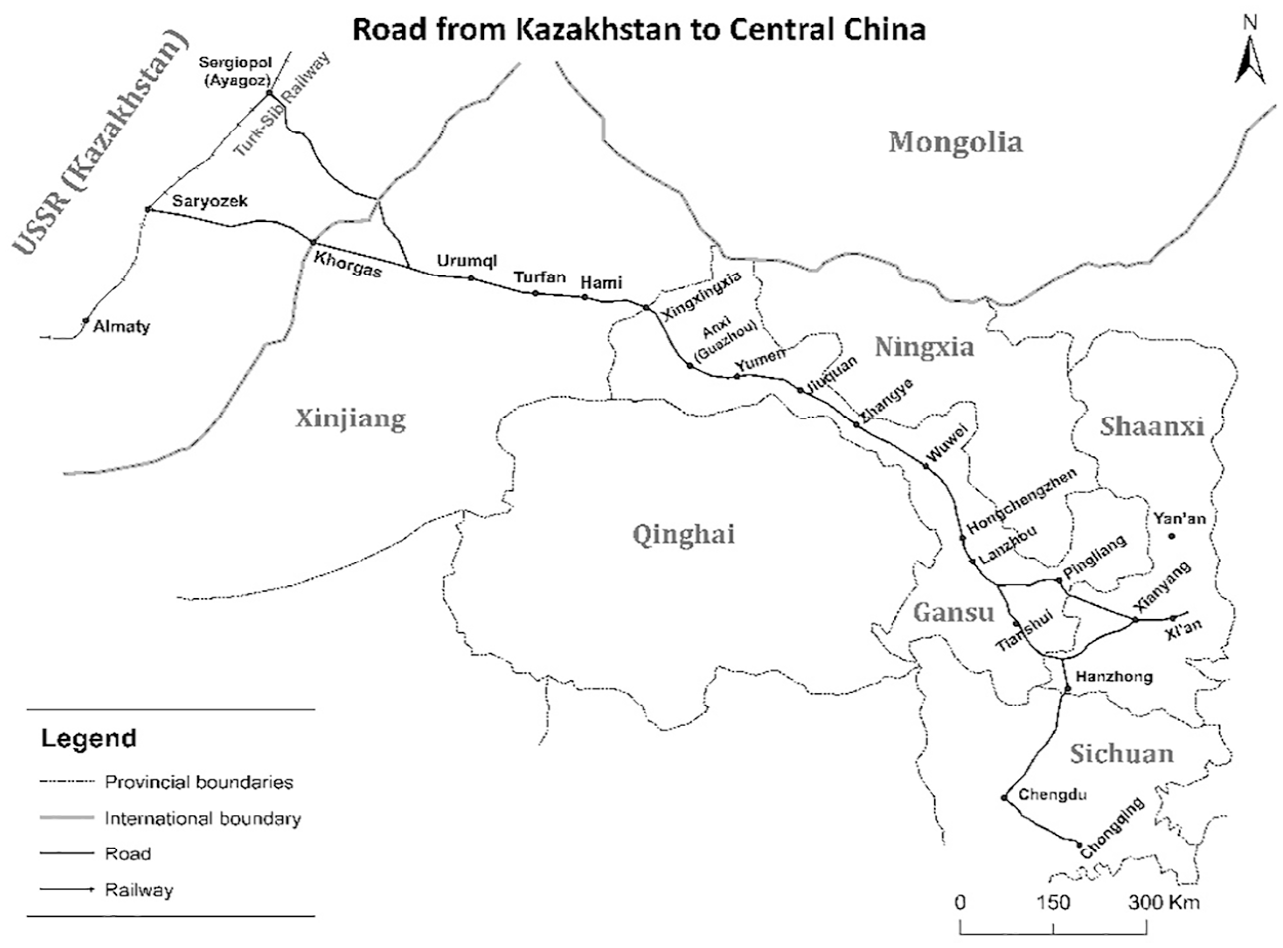
The Northwest Highway.
Rapid work on the road during the winter of 1937–1938 brought some improvements to Minka’s initial experience. In late February 1938, 130 trucks arrived in Lanzhou in a single week (AHA, 002-080200-00495-190). But the route soon deteriorated: “The road surface is not yet secure,” General Zhu Mingtao 竺鳴濤 (1896–1969) reported to Chiang Kai-shek in April, “[and] with the spring thaw the ice has melted and turned to mud, and parts are totally impassable” (AHA, 002-080200-00496-126). Spring snowmelt or summer rains on higher ground could also turn once fordable streams into formidable obstacles. Ma Buqing’s main task as highway superintendent in 1938 was to construct permanent bridges and turn these changeable earth sections into a metaled road, that is, one with a firm gravel surface. In some places this only involved widening and surfacing the existing cart track, but where the ground was soft, an entirely new road had to be laid out on higher ground. Funding was provided by the central government, and Ma Buqing recruited a team of engineers trained at Northeastern University 東北大學, then in exile at Xi’an from occupied Manchuria (Wang, 2015). But the trained, salaried engineers were only the tip of the iceberg of human labor. The main input for road improvements was the human energy of around 100,000 corvéed residents, mostly Han Chinese, of the Hexi region, working alongside some 20,000 of Ma Buqing’s infantry who had been redirected to road construction (for a contemporary estimate of these numbers, see Xiu, 1940).
Corvée labor for infrastructure projects was common practice in imperial China and continued under the warlord regimes of the early Republican period. This coerced and usually unpaid labor was reimposed by Chiang Kai-shek’s central government in December 1934, sparking widespread popular resistance (Bianco, 2009: 14–19). This corvée for wartime road construction was just the latest burden in more than a decade of extraction and upheaval in already impoverished Northwest China. As one anonymous visitor to Gansu’s Hexi region commented in 1939, the long regional wars of the late 1920s had brought a hefty rise in taxes and levies, exacerbated by the destruction wrought by the 1927 Gulang earthquake. The years afterward were marked by famine, agricultural depression, banditry, and continued high levies, sparking civilian flight from the region: “A great many households have fled from these counties, with the population much reduced in recent years, adding to labor shortages” (“Wuwei’s bad customs,” 1939). This increased the burden on those remaining, particularly in sparsely populated regions along the route: as the road engineer Qin Chengzhi pointed out, Anxi county in the west of the Hexi Corridor was the size of Zhejiang province, but home to only fifteen thousand residents (Qin, 1982: 110–11). This meant that many corvéed laborers from more densely populated counties were put to work far from home. In Zhangye 張掖 it was remembered that “lots of people were requisitioned to take their bullock and donkey carts to remote Xingxingxia to work on that section of the road. But they did not finish in the expected time, the carts broke down, the animals died, and quite a few of the civilian laborers died of cold and hunger” (Chen, 2017).
Labor service was also tough for those closer to home. Each county set up a construction office responsible for sending laborers and raw materials (mostly stone and wood) to the road site. In a letter home of December 1937, the American geologist Marvin Weller (1899–1976) described the road between Wuwei and Lanzhou as a hive of activity “by bare backs and hands with primitive picks and shovels. . . . Some of the men were pecking away at solid rock with their inadequate picks but the rock was giving way under the sheer weight of their numbers.” Stones were being carried in baskets by children as young as six (Weller, 1984: 283). Local historian Zhang Lei reports that due to labor shortages, corvéed workers were often deployed for several months at a time without being relieved (Zhang, 2012: 16). Near Zhangye, eight thousand people worked to lay a ten-kilometer stretch of new road away from a marshy zone, while in the hills around Xiuhuamiao 繡花廟, Shandan 山丹 county, three thousand people, including many women, used axes and improvised hand drills to break up stones (Chen, 2017). Yin Zuoquan 尹作權, a poet in the Hexi region, captured the horrors of both past and present:
In tragic Hexi . . . The strange birds and animals cry like demons and the hungry tigers attack the people, In ancient and modern times, all are crying with grief . . . Everyone’s home has young women constructing the Gansu–Xinjiang highway. (Chen, 2017)
In international-facing media, Hexi’s corvée laborers were praised as the “unsung heroes in Chinese communication history” (“Northwest Highway system,” 1940: 29)—but as well as being unsung they were unpaid and usually unfed. The appalling conditions along the Gansu section of the road were far from a secret in Nationalist-held China. One Chongqing journalist gave a detailed report in 1940: “Where the stationed troops and able-bodied men 壯丁 were insufficient, they mobilized women to help, and where there were insufficient adults they mobilized children. The children didn’t have enough to eat and were very tired, and many got sick and died.” At high-altitude Wushaoling 烏鞘嶺, laborers faced “high winds and snow, so cold that cracks appeared on hands and faces, leaving drops of blood on the surface of the road.” The journalist’s discussion closes with a laudatory observation: “This is not the kind of sacrifice that money can buy” (Geng, 1940). But it is hard to avoid a double-edged meaning here—that this sacrifice could only be bought with coercion.
This human suffering in construction looks particularly discordant when set against the suspicion that funds for Hexi road construction were simply pocketed by Ma Buqing and his associates. With a budget of 2.5 million yuan, the “sacrifice” of Hexi residents could have been bought—or, at least, they could have been provided with sufficient food for their subsistence. 3 Local historians in Gansu state Ma’s embezzlement as a bald fact, without providing documentary reference, but there are clues of it in surviving sources. In one estimate of 1940, the real costs of road construction were just a third of the allocated budget (Xiu, 1940). This is reinforced by a 1939 report to Chiang Kai-shek by General Zhu Shaoliang 朱紹良 (1891–1963), military commander in the northwest, who noted that the highway had come in well under budget, and argued that Ma was also inflating his demands for central government funds to maintain the route (AHA, 002-080200-00516-181). Already in summer 1938, the central government’s Control Yuan inspector 監察使 for the northwest had reported to Kong Xiangxi (H. H. Kung), head of the Executive Yuan, that “Ma Buqing is making excessive requisitioning and overtaxing in Hexi, more than the people can bear” and suggested that the provincial government in Lanzhou carry out a full takeover in the region (AHA, 002-080200-00500-077). Yet Ma remained in post, and the provincial authorities did not take over either civil administration or responsibility for the Gansu–Xinjiang highway. Instead, that November Kong Xiangxi formally commended Ma for the additional levies he had raised for the war effort. “In the Hexi area,” he noted, “the soil is weak and the people poor, and for sending such a large sum, this general is tremendously loyal to the state” (AHA, 002-090106-00013-322). Ultimately, Ma Buqing’s power to mobilize the resources of the Hexi region was simply too useful to the central government.
It is tempting to see it as ironic that this new route for Soviet aid resulted in coerced labor and the handover of wealth and power to conservative warlord elites. After all, this was an early linkage in the emerging global struggle against fascist powers callous in the use of forced labor for their war effort. On the other hand, though, Ma’s exploitation of Hexi’s residents was perhaps not so different—it was unpaid, but shorter in duration—from the uncompromising mobilization of civilians in the Soviet Union, the use of forced labor in wartime colonial Africa, or the heavy burden borne by African American engineers and local laborers on the Ledo Road between India and China (Anders, 1965; Johnson, 2000; Jennings, 2015; Goldman and Filtzer, 2021). Nor was Ma’s method at odds with corvée systems elsewhere in the Nationalist war effort (for a recent study, see Yip, 2023). On the route east of Lanzhou, residents of fourteen counties under central government control were called up to work on road improvement projects. The two investigators sent by the regional Control Yuan inspector were deeply critical of how corvée labor had been handled, reporting in summer 1938 that the burden was uneven and inefficient and that workers had not received the promised subsistence pay: “The people’s suffering is deep and their losses are large” (AHA, 002-080200-00497-153).
Infrastructure and Operations
With these inputs of forced labor and requisitioned materials, the major phase of construction on the Northwest Highway was complete by summer 1939, although Soviet trucks had already been using the route throughout the period of improvement. It was soon celebrated as the “most modernized road in the [unoccupied areas of the] nation” (Geng, 1940: 25), complete with supporting infrastructure of hostels, vehicle repair shops, and refueling points. This does not mean it was a good road by today’s standards, or even those of the celebrated Shanghai–Hangzhou highway that had set the benchmark for road construction in prewar China (Kirby, 2000: 145–46). Buses along the Hexi Corridor were timed at just twenty-one kilometers per hour (thirteen miles per hour), while loaded trucks were even slower, aiming to cover 163 kilometers in a ten-to-twelve-hour driving day (Northwest Highway Transportation Agency, 1940: 8–9). Even in August 1939, just as the road was declared finished, Soviet drivers arriving in Lanzhou complained of poor conditions, particularly in the sparsely populated stretches of western Gansu (AHA, 002-080200-00516-217). In later months and years, Ma Buqing’s low-budget maintenance squads came in for heavy criticism for their upkeep of the road surface. But despite these continued complaints, it was a major improvement on 1937 conditions: by 1940 the new surface and bridges had reduced the three-thousand-kilometer journey from Saryozek to Lanzhou to just eighteen days on a smooth run.
These road improvements were accompanied by strong transportation institutions. The part of the route under Soviet control (in Kazakhstan and Soviet-dominated Xinjiang under Sheng Shicai) was entirely a military operation, managed from Red Army headquarters in Almaty. Its twelve convoy companies were commanded by Nikolai Slavin, later the liaison officer managing US lend-lease in Moscow (Gradov, 1990: 130). East of Xinjiang, truck operations were run by China’s Northwest Highway Transportation Agency (hereinafter the NWHTA), a civil organ under the Ministry of Communications. This was the successor of the rather sleepy institution responsible for state-run transportation on the Lanzhou–Xi’an road: “When we entered the war situation,” remembered the agency head, “Soviet military items started flooding in, and our institution suddenly became a vital international cargo route” (He, 1944: 2). In addition to the Chinese side of truck operations, the NWHTA was responsible for petrol and accommodation along the whole 2,400-kilometer section from the Xinjiang–Gansu border to northern Sichuan, as well as road maintenance east of Hongchengzhen (Ma Buqing controlled road upkeep west of Hongchengzhen, see Figure 1). But in the first year of the route the NWHTA had very few trucks, and Soviet convoys continued east beyond Lanzhou to hand over equipment in Shaanxi. 4 It was only in October 1938 that Soviet representatives declared that their military drivers would not, in ordinary circumstances, proceed east of Lanzhou (AHA, 002-080200-00503-152). By early 1939, with the NWHTA operating a much larger fleet of eight hundred trucks, most handovers were taking place at Xingxingxia on the Xinjiang–Gansu border—to the relief of Nationalist officials, who had been anxious throughout 1938 about the difficulties of controlling Soviet truck movements and potential linkups with CCP forces (e.g., AHA, 020-021602-0017: 94-95).
The improved road and its supporting infrastructure enabled thousands of tons of equipment to be brought overland from the Soviet Union. Precise figures are hard to come by, but I estimate that more than 30,000 tons of Soviet aid were brought overland to China between October 1937 and the end of Soviet support in June 1941. Of this, I estimate that around half was transported all the way to Lanzhou overland, while the rest supported the Soviet air link from Xinjiang to Lanzhou, which itself relied on the infrastructure of the Northwest Highway to transport aviation fuel. The supply of Soviet aid was far from a steady flow, with periods of intense activity—early 1938, the winter of 1938–1939, the summers of 1939 and 1940, early 1941—interspersed with months when overland Soviet aid slowed to a trickle. 5 Soviet figures on aid to China do not break down according to what was transported by overland versus maritime routes (see, e.g., Myasnikov, 2006: 186), but a snapshot of truck consignments from 1939 gives a sense of what was being transported across Xinjiang and Gansu: 4,400 machine guns plus 100 million rounds of ammunition, 250 artillery pieces (with 140,000 shells), as well as 1,000 Soviet-built trucks handed over for Chinese use (Liu, 2017: 16).
The volume of aid looks small relative to that of the later “Hump” airlift, which eventually reached tens of thousands of tons per month. But even the “Hump” took almost a year to begin delivering 1,500 tons in a calendar month, and around 95–98 percent of its deliveries went to supply US units and the US-commanded Y-Force, rather than supplying Chinese forces: for example, Chinese commanders reported that during the first two years of “Hump” operations, just 60 artillery pieces and 30 million rounds of rifle ammunition were delivered to Nationalist troops under Chinese command (Plating, 2011: 163, 238; Taylor, 2009: 271). The impact of the Northwest Highway also bears comparison with the much shorter Burma Road route in operation at the same time. During 1939, only one thousand tons per month were flowing into Yunnan from Burma, even during the dry season (Young, 1963: 112–13). These volumes increased in the first half of 1940, but Britain closed the route for most of the second half of the year. It is true that with heavy usage after its reopening in October 1940, overall volume on the Burma Road exceeded three thousand tons per month (Warren, 2011: 27–28), but these figures include both fuel used on the journey and the weight of the trucks handed over for Chinese use, which are missing from the Northwest Highway figures above. Adding these components to the total for the Northwest Highway would raise the weight of Soviet overland aid entering China to more than 1,000 tons per month between December 1937 and June 1941—not far off the monthly average for the Burma Road prior to its July 1940 closure. All three routes into unoccupied China were remarkable logistical achievements in different ways. The “Hump” route broke new ground in bulk supply by air, albeit at enormous cost; the Burma Road is most notable for complexity of terrain and engineering; while, at three times the Burma Road’s length, the Northwest Highway stands out for the challenge of sheer distance.
Fuel Supply
This vast length of the Northwest Highway meant that colossal energy inputs were required for its operation. This is not to diminish other hurdles, including the political fragmentation between the Chinese central government and northwest warlords, as well as the shortages of tires and other components for the Soviet-built trucks, which at times kept the majority of Chinese-operated vehicles off the road (AHA, 002-090400-00007-197). But the major barrier was the reliable supply of fuel across such an immense distance. In early 1938, the Nationalist military still had plenty of fuel reserves, but civil organs such as the NWHTA were struggling to get hold of gasoline. Soviet drivers northwest of Lanzhou told the British explorer Violet Cressy-Marcks (1940: 286–87) that trucks were scattered along the roadside awaiting fuel. In the summer of 1940, around a hundred newly received Soviet ZIS-6 trucks were parked up by the Yellow River at Gongbogou 貢博溝 outside Lanzhou for want of fuel—and were washed away by the surging river (A History of Road Transportation, 1987: 468–69).
Given its strategic importance, for 1938 the NWHTA was able to secure fuel from military stores and the stock controlled by the National Economic Council (AHA, 002-080200-00495-055). But access to fuel dwindled as the Japanese invasion moved inland. The head of the NWHTA, Song Xishang, reported that in summer 1938 he had “bought tens of thousands of gallons of gasoline in Hong Kong, but just after it arrived in Hankou, the Long–Hai railway 隴海鐵路 [to Shaanxi] was cut off, and it had to be sent back.” Some fuel was coming in via Haiphong, but as Song pointed out “imports to the southwest are clogged up, and it’s expensive to bring things in by truck that way, with a large risk of leakage and loss en route” (Song, 1940: 652).
Fuel was also colossally expensive, with a single gallon costing more than eight times a driver’s daily food allowance by 1940. Fuel accounted for almost two-thirds of truck operating costs in the northwest (a total that includes expenses for truck purchase, tires, parts, and administration), compared with just 1 percent for drivers’ wages and food allowance (Northwest Highway Transportation Agency, 1940b: Table 4). These high prices incentivized theft, which in turn exacerbated shortages. In June 1938 the Control Yuan inspector in the northwest region reported that 20 percent of fuel was simply disappearing in Gansu’s Hexi region (AHA, 002-080200-00497-153). In late 1938 or early 1939, military driver Wang Jingcheng 王競成 was shot for theft of petrol, which one journalist felt had improved but not quite solved the problem (Zhao, 1939: 94c).
Local fuel production was also unable to meet demand. The Nationalist state was beginning to exploit the Yumen 玉門 oil field in western Gansu, and in March 1940 the NWHTA opened a workshop refining Yumen oil into petroleum at nearby Jiuquan (He, 1944: 3). But Yumen was unable to solve the fuel problem during the period of Soviet aid. Total production in 1940 ran at just 10,000 gallons of oil per month, insignificant relative to the 200,000 gallons required by the NWHTA alone (on output, see War Office, 1942; on demand for oil, see AHA, 002-080200-00495-055). Meanwhile, the NWHTA experimented with trucks using organic fuel sources, particularly charcoal and ethanol. They were celebrated for their running costs, which were just a quarter of their gasoline-powered counterparts. Yet quite apart from its environmental costs—particularly in the charcoal-producing hills of southern Shaanxi—such transportation had practical limits. In a snapshot of 1941 data, charcoal power accounted for 19 percent of the trucks operating around Lanzhou, but only 9 percent of total ton-kilometers. I have seen no evidence that they were used for the heavy, long-distance work of transporting Soviet equipment (A History of Road Transportation, 1987: 359–60).
Given these limits, Song Xishang was clear that overland supply of Soviet equipment depended on large inputs of Soviet fuel along the same route (Song, 1940: 652). But this approach was also fraught with difficulty. It was impossible for trucks carrying Soviet equipment to convey their own fuel. On the basis of Lattimore’s estimate of five miles (eight kilometers) per gallon, a truck making the 7,170-kilometer round trip from the railhead at Saryozek to Lanzhou would need 890 gallons of gasoline weighing 2.42 metric tons—accounting for almost all the carrying capacity of a Soviet three-ton truck (Lattimore, 1940: 400–401). But following the NWHTA’s own, more pessimistic fuel consumption targets for 1939, my own estimate is even higher—1,142 gallons with a weight of 3.1 tons (A History of Road Transportation, 1987: 343). This underlines the challenge of distance for motor transportation on the Northwest Highway. By way of comparison, with a shorter distance and more fuel-efficient US trucks, even by conservative estimates a round trip on the Burma Road between the Lashio railhead and Kunming could be completed with less than a ton of gasoline. Despite the extreme energy demands of air transportation, a C-46 cargo plane on the “Hump” route could also carry its own fuel for the return journey (see Table 1).
Distances and Fuel Efficiencies for International Routes to China, 1938–1942.
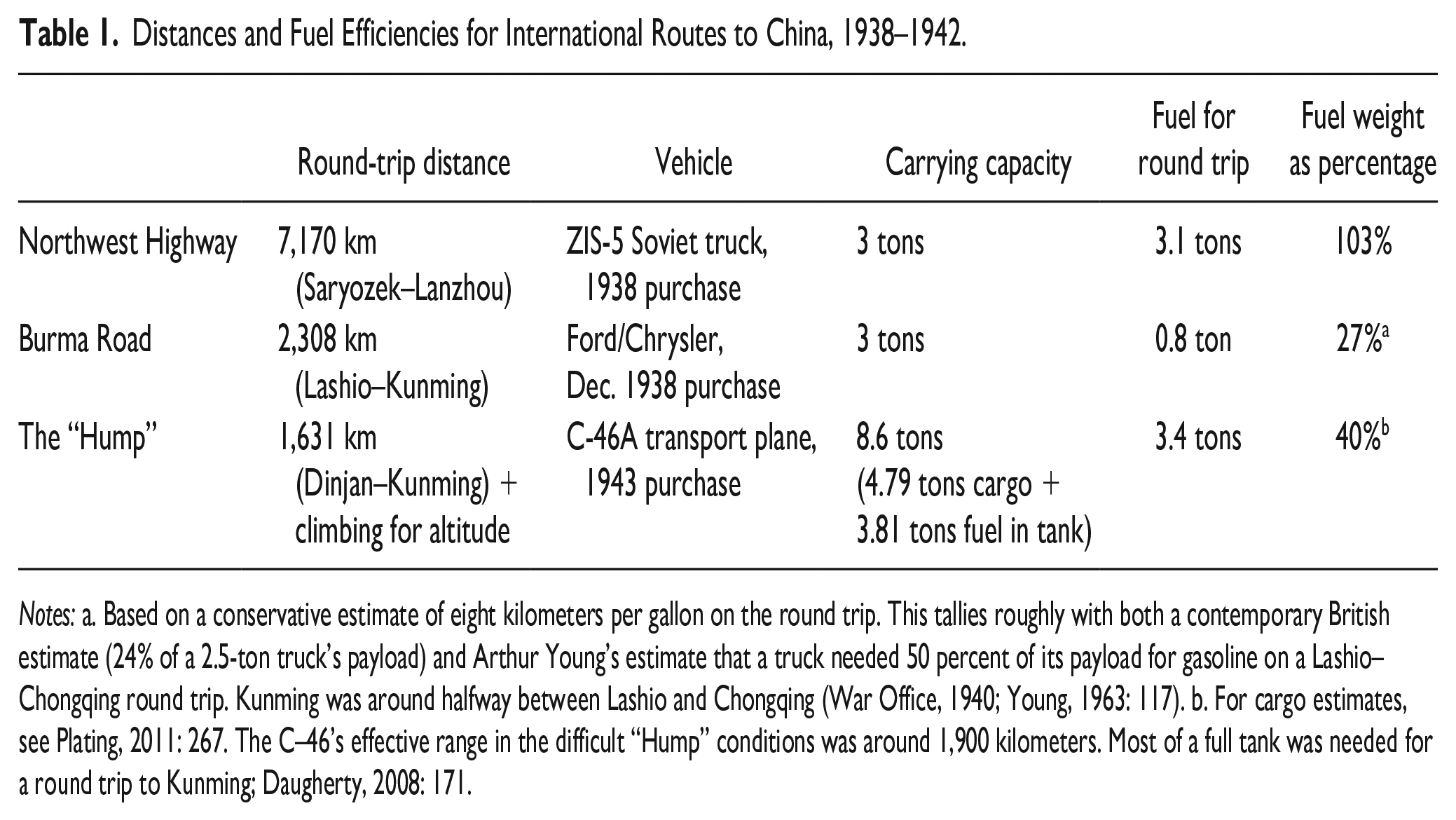
Notes: a. Based on a conservative estimate of eight kilometers per gallon on the round trip. This tallies roughly with both a contemporary British estimate (24% of a 2.5-ton truck’s payload) and Arthur Young’s estimate that a truck needed 50 percent of its payload for gasoline on a Lashio–Chongqing round trip. Kunming was around halfway between Lashio and Chongqing (War Office, 1940; Young, 1963: 117). b. For cargo estimates, see Plating, 2011: 267. The C–46’s effective range in the difficult “Hump” conditions was around 1,900 kilometers. Most of a full tank was needed for a round trip to Kunming; Daugherty, 2008: 171.
On the section of the route under Soviet control, in Kazakhstan and Xinjiang, most fuel was carried by trucks. This came at a heavy cost. According to Liu Zhi’s calculations based on Soviet data, on this half of the route alone over 1,200 trucks (32.5% of the total) in the Red Army’s China convoys were devoted solely to the auxiliary function of carrying fuel (Liu, 2017: 16). The Chinese authorities had similarly planned to use trucks to lay out and supply refueling stations along the eastern half of the route, but heavy costs and other shortages—of trucks, drivers, parts and, of course, fuel itself—rendered the scheme unfeasible (Lu and Ju, 2016: 38). The only energy input able to tackle the fuel supply problem was animal power.
Animal Power
Long-distance animal transportation across Gansu had an illustrious history as part of the celebrated Silk Routes and, as in many inland areas across the world, was still the mainstay of bulk haulage in the 1920s and 1930s. As the haulage expert Yao Baoxian 姚寶賢 pointed out in 1941, the absence of railways and a prewar motor network meant that the mule carts and camels of the northwest were well placed to meet the fuel-carrying needs of the wartime state (Yao, 1941: 29a). Indeed, animals had already provided logistical support for mechanized transportation, with the Sino-German Eurasian Aviation Corporation using camel caravans to deliver aviation spirit to refueling stops on its Urumqi route in the mid-1930s (Vasel, 1937: 94).
Animals were, of course, much slower than the motor trucks they were supporting, covering only thirty kilometers in a nine- or ten-hour stage compared with the 150–160-kilometer average of truck convoys. But they were not subject to mechanical breakdown and, apart from rubber for cart tires, were not dependent on the complex energy and industrial supply chains required by trucks. One 1947 study of the wartime northwest estimated that nine out of every ten animals were operating at any given time, compared with just three out of every ten trucks. This meant that while a three-ton truck in theory outperformed a mule cart ten times over (carrying twice the weight at five times the speed), motorized transportation was not vastly more efficient overall. In the long run, this study concluded, the ton-kilometrage of one truck was equal to that of just two mule carts (Gong, 1947: 236–37). 6
Animal haulage was also cheaper than motor transportation. This might not seem so surprising, but in the global competition over transportation costs in the twentieth century, motor power was usually much more economical over even shorter distances. In one multicountry study of the rural Global South in the 1990s, over the course of a year motorized trucks were found to be almost three times cheaper than animal carts for even small-scale haulage on poor roads (transporting an average of three tons per day for a distance of fifty kilometers) (Starkey et al., 2002: 59). In wartime Northwest China, this price-driven transition from organic to inorganic energy sources for long-distance transportation did not take place. The high cost of motor operations meant that the average cost per ton-kilometer of animal transportation was between a quarter and half that of a motor truck, depending on distance and fuel prices (A History of Road Transportation, 1987: 409). With their much lighter carrying loads (usually around 135–160 kilograms), camels were more expensive than rubber-tired mule carts—about 26 percent higher per ton-kilometer in a calculation from Gansu (A History of Road Transportation, 1987: 380–86)—but were a little faster, and a cameleer could lead up to six animals rather than the single vehicle of the mule carter (Liu, 1941: 83).
The division of labor between mule carts and camels along the Northwest Highway was driven by environmental factors. Mule-drawn carts tended to be used east of Lanzhou, where more vegetation and a denser human population provided the fodder and greater labor inputs required. Camels dominated west of Lanzhou and especially west of Wuwei, where sandy surfaces had to be negotiated. This meant that it was camels that were most closely connected to the Soviet trade and that captured the imagination of Chinese and foreign observers: “This new international road of national defense is full of their hoof marks,” celebrated one commentator (Yao, 1941: 30b), while in traveling to the northwest Joseph Needham (1944: 238) called the route and its camel trains “a romance in itself.”
Camel transportation might have looked romantic to Needham, but it was tough work for both the animals and humans involved. In 1939 and 1940, the Gansu Provincial Cart and Camel Agency 甘肅省車駝管理局 rostered 19,000 camels to travel twice per year between Xingxingxia and Lanzhou, a 110-day round trip, in convoys of 30 to 50 animals (A History of Road Transportation, 1987: 391). With the inclusion of camels contracted by the Lanzhou office of the Foreign Trade Commission 國際貿易局, the total number of camels on the route may have exceeded 30,000 or even 40,000 (“Northwest China trade,” 1939: 39–40; Li, 2017: 83). Gasoline was carried west to east, with each camel loaded with eight to ten five-gallon barrels. For example, in November 1939, camels laid out some 78,000 gallons of gasoline along the Hexi Corridor (Lu and Ju, 2016: 38). In what was probably a quiet month in the wake of the Soviet–Japanese clashes at Nomonhan, this met the monthly needs of the NWHTA, providing enough fuel for 210 three-ton trucks on a round trip between the Xinjiang–Gansu border and Lanzhou. But camels carried more than just fuel. When, in early 1941, the truck and petrol shortage produced a backlog of more than seven thousand tons of Soviet military equipment at Hami, it seems to have been animals that carried most of the load, including 4,300 tons of ammunition (AHA, 002-080200-00294-014). Traveling westward, camels helped carry the raw materials—furs, hides, tea, wool—being used to pay off the Soviet loans. Calculating from 1940 data, animal power was responsible for 84 percent of the ton-kilometrage on the transportation routes of Northwest China (A History of Road Transportation, 1987: 408).
How should we interpret this reliance on animal power? In one sense, it supports David Edgerton’s insight that the needs of new twentieth-century technologies preserved and existed alongside, rather than simply displaced, the old (Edgerton, 2006). This is a useful perspective on the adaptation of older organic technologies. In the Chinese context, there are some parallels with the repurposing of camels for short-distance urban haulage in Beijing after their earlier role was replaced by the railroad (Zhang, 2022: 917–19). Yet this technology-focused view does not quite cover the political tensions involved, and it would be a mistake to see this as a mobilization without social costs. The mobilization of civilian-owned animals was a major disruption and source of state–society tension. Already in fall 1937, the geologist Marvin Weller found that locals in western Gansu were hiding their animals: “They keep them as far away from soldiers and police as possible” (Weller, 1984: 211). In the first year of the route’s operation, the NWHTA seems mostly to have hired camels and carts from brokers in Lanzhou, but in 1939 the scale of haulage required forced a turn to compulsory requisitioning of animals by the new Gansu Provincial Cart and Camel Agency. The province was soon running short of animals. According to 1939 data, the Gansu Provincial Cart and Camel Agency only hit two-thirds of its target for requisitioned camels (Lu and Ju, 2016: 38; A History of Road Transportation, 1987: 391).
That same year, the Foreign Trade Commission in Lanzhou had to requisition a further six hundred carts from neighboring Shaanxi to transport aviation fuel for Soviet aircraft, much to the annoyance of its provincial government. When the first batch of hired Shaanxi carts arrived at Lanzhou, the carters refused to travel any further west and insisted they could not be forced to do so by the Gansu provincial government (Ministry of Finance, 2015 [1939]; Gansu Provincial Government, 2015 [1939]). “People are deeply suspicious of official organs using their carts,” noted Gu Gengye, who was responsible for animal transport on the Hexi route, “and initially they still plan to run away, not being willing to be requisitioned” (quoted in Li, 2017: 85). Despite offering state loans for new carters to purchase the expensive rubber-tired carts, haulage was still reliant on forced conscription of carts and animals for compulsory government work, as one commentator noted: “How to make people voluntarily support haulage 驛運 work . . . is a problem that must rapidly be addressed” (Liu, 1941: 85b). But the following year, more than 98 percent of carts and pack animals in the Shaanxi–Gansu haulage system were still conscripted (Li, 2017: 83–84).
It is true that unlike Gansu’s corvéed road workers, carters and cameleers received a fee for their work, but pay was low for civil government work, and even less for military haulage. According to the civil government pay schedules of September 1939 for requisitioned animals, cameleers received 237 yuan for transporting five loaded camels the 1,170 kilometers between Xingxingxia and Lanzhou (Gansu Provincial Cart and Camel Agency, 2015 [1939]). With time off for molting, pasturage, and camel recovery, this could be done only twice a year. Half of this income was needed just to feed a family of five at contemporary Lanzhou prices, let alone clothing, accommodation, and additional costs incurred in the care of camels. 7 Real profits therefore depended on having goods for the return leg, which later that year became a flashpoint when camel drivers demanded payment for a return journey without cargo (Lu and Ju, 2016: 39). “Often there are no goods for return journeys,” one commentator in Gansu noted, and “it is hard for the carters to avoid cold and hunger. Sometimes they meet with bad soldiers who commandeer the cart and beat them up, so their life is very difficult indeed” (Liu, 1941: 84a). Nor did payments for haulage keep pace with the rising cost of living in wartime China—particularly given that carters and cameleers only received their fees on completion of what was usually a months-long job (for a similar finding in the yiyun haulage system, see Yip, 2023: 640). By 1944, operating costs alone were 32 percent higher than incomes, and carters in Gansu were not only fleeing state service but selling their carts and animals to avoid conscription (A History of Road Transportation, 1987: 380).
“Inherently Local”? The Costs and Benefits of the Northwest Highway
This closing section offers a preliminary argument on the wider effects of the Northwest Highway, first from the perspective of the Nationalist state, then from that of civilians. From the state’s perspective, the military benefits were clear: although not decisive, Soviet advisors, equipment, and air support helped replace some losses of German equipment and expertise, assisting the Nationalist state in slowing the Japanese advance, organizing the retreat from Wuhan, and consolidating the Central China front, quite apart from the benefits to Chinese morale of outside support (Young, 1963: 51–55; Garver, 1988: 38–50; Yu, 2006: 12–16). These benefits came at immense financial cost. In 1939 the expense of moving 500 tons per month from Xingxingxia as far as Lanzhou was equivalent to around 1.5 percent of the Nationalist central government’s entire tax revenue for the year (calculating costs from Northwest Highway Transportation Agency, 1940b: Table 4; for tax revenue, see Young, 1965: 14). This was only just over a quarter of the full distance from the Saryozek railhead to Chongqing and gives a sense of the huge challenge of providing material support to the Nationalist war effort. But, crucially, almost all of these costs were not coming out of tax income but rather were covered by low-interest Soviet loans (Kalyagin, 1983: 9). As the United States went on to discover in the 1940s, even with intense, coerced labor inputs from Chinese citizens, those supporting China had also to support the heavy up-front energy costs of supplying a state trying to fight an industrial war from a position of geographical isolation and fiscal weakness.
The effects on Nationalist power in the northwest are more complex, but still point to long-term benefits for the central authorities. As we have seen, in the short run, the Northwest Highway handed money and authority to local warlord Ma Buqing. It also risked pulling Gansu, like Xinjiang, into the orbit of Soviet informal influence, with Soviet airstrips, liaison officers, and consumer goods increasingly prevalent across the province. By spring 1938, the Soviet trading firm in Xinjiang had extended its influence into Gansu, striking deals with tea merchants in Lanzhou, to the anger of the Military Affairs Commission, who insisted on controlling all purchases of China’s raw materials made by the Soviet Union in return for military aid (AHA, 020-021602-0017: 60–66). But in the longer term, the Northwest Highway became a tool for the extension and deepening of central state authority, with a stronger record of long-term use (under first Nationalist, then CCP rule) than most of the Burma Road and “Hump” infrastructures of the southwest. The NWHTA became the first permanent central government organ in Ma Buqing’s Hexi region, and during 1939 its growing logistical authority helped reduce the Soviet presence in the region by taking over deliveries from Xingxingxia on the Xinjiang–Gansu border. As discussed above, Chiang Kai-shek had balked at Kong Xiangqi’s 1938 suggestion of removing Ma Buqing from power, but four years later the central government was in a much stronger position in the northwest. In July 1942, Chiang ordered Ma to move his forces to the remote Tsaidam 柴達木 Basin and moved central government forces into the Hexi region. At the same time, Xinjiang governor Sheng Shicai turned away from his Soviet patrons and toward the Nationalist state, welcoming central government advisors and expertise into Xinjiang for the first time. Central government troops followed in spring 1944 (Lin, 2009: 203–205). Xinjiang and Gansu, linked by motor road in 1937–1938, were now politically connected for the first time since 1912—even if, as Justin Jacobs (2011: 385–88) shows, the Nationalist state struggled to follow up its rise to power in Xinjiang. The Northwest Highway was crucial to this Nationalist takeover. Between 1942 and 1944, the trucks of the NWHTA supported the key aspects of this expansion: takeover of civil administration, movement of troops to Xinjiang and western Gansu, resettlement of refugees, exploitation of the Yumen oil field, and the numerous surveying and prospecting expeditions to the region (He, 1944: 4–5).
What of the impact of the Northwest Highway on the civilian population? As John Flower (2004) reminds us, for all the importance of road building in the modern Chinese state’s visions of development, its effects and the reactions it engendered among local people were almost always complex and contested. On the Northwest Highway, wartime demands for speedy construction, a state near-monopoly on use, and the requisitioning of local resources increased the costs and reduced the benefits for local civilians. But new infrastructure in the region did seem to promise wider benefits. In May 1938 the celebrated road engineer Zhao Zukang 趙祖康 (1900–1995) visited Lanzhou and gave a speech at the NWHTA. Zhao urged staff members to work with local authorities to ensure that new infrastructure benefited the region. “Because a motor road is inherently local, it is very different from a railway . . . it is necessary to maintain a close liaison with the localities, and a helpful attitude, to be mutually supportive” (Zhao, 1938: 133b). At the end of the war, the official verdict was that Zhao’s ambition had been achieved and that the Northwest Highway to Xinjiang had benefited the development of the Hexi region (Gong, 1947: 117).
Some places and sectors did benefit from new infrastructure and the influx of Soviet material. Key towns such as Hami, Zhangye, Pingliang 平涼, and especially Lanzhou saw an increase in trade. Lanzhou’s prewar population had tripled by 1940 (Ding, 1940: 44; on Pingliang, see “On the Northwest Highway in Gansu,” 1941: 27b). Businesses such as cart dealers, hostels, and transportation brokers benefited from long-distance logistics, with a 70 percent jump in the number of cart brokers in Lanzhou between 1939 and summer 1941 (A History of Road Transportation, 1987: 392). But desirable transportation posts as drivers, mechanics, and Russian interpreters were dominated by those from outside Gansu, especially in the first years of the war. The first cohort of truck drivers was recruited en masse from Shandong, while skilled mechanics were brought in from the Ping–Han 平漢 and Long-Hai railways. Almost all Russian interpreters on the Gansu portion of the Northwest Highway were refugees from Northeast China, mostly former employees of the China Eastern Railway (AHA, 020-021602-0017: 49-51).
In rural areas, there is little sign that the road infrastructure itself helped civilians in the wartime period, despite Chiang Kai-shek’s assurances that new infrastructure projects should benefit those corvéed for their construction (Bianco, 2009: 15). Local production was dominated by government monopsony, buying up wool, tea, and hides to pay Soviet debts (Tan, 2012: 59–63). Very few civilian vehicles were permitted to use the roads built for delivering Soviet aid: as with most metaled motor roads in China (Strand, 2000: 127), livestock, rickshaws, iron- or wooden-wheeled carts, and even bicycles were all prohibited, although this does not mean the ban was always followed in practice (“Statutes,” 1940: 799–800). Private motor vehicles and rubber-tired carts were permitted for a fee and at the discretion of the road authorities, but almost all such vehicles had been commandeered for state use. Nor was this an empty decree. In 1942, a British military observer found that “except where it passes over the open desert the road is generally bordered by ditches of up to 3 feet in depth, which have been constructed for the purpose of preventing local Chinese carts and unauthorized vehicles gaining access to the road” (War Office, 1942). Presuming their labor was requisitioned for the task, local civilians must have dug ditches to deny themselves access to the new infrastructure. Local residents and traders were largely confined to the deteriorating cart tracks, either running alongside or at some distance from the main road. Even when the Lanzhou–Xi’an cart track underwent running repairs in 1939, it received a fraction (13%) of what had been spent on the parallel motor route—and, unlike the main road, this was funded by extra local levies rather than government spending (A History of Road Transportation, 1987: 284).
Rather than Zhao Zukang’s positive vision, in 1942 the journalist Hong Wenhan 洪文瀚 offered a more pessimistic view: “The existing construction of roads in Gansu has all been connected to military use. . . . The strength of the people 民力 and the state finances have both sustained major losses” (Hong, 1942: 123; quoted in Shi, 2008: 127). But Zhao’s thinking was in one sense correct: the disconnect between the new highway and local society was brought about by the characteristics that made it resemble a railway as much as a road system. Like a long-distance railway, the Northwest Highway was a thin arterial route rather than a “capillary” system providing a web of connections across space. In Gansu this was a single route originally built for the sole purpose of receiving Soviet aid, and it was not until 1945 that any branch motor roads were opened in the Hexi region (Wang, 1982: 137). The route operated like a railway, complete with stations, centralized systems for timetabling and dispatch, and the state’s near-monopoly on use. Even the convoy system, whether truck or animal, resembled trains more than the patterns of individual road usage familiar to us. This disconnected the new road from existing patterns of movement and exchange, reducing it to little more than part of the wartime burden on civilian society (on “arterial” and “capillary” infrastructures, see Kinzley, 2018: 11; Cooper, 1994: 1533). For all that the Nationalist regime became stronger in its frontier regions, this achievement was built on an extractive mode of rule—part of the wider failure of the Republican state to transition away from a mode of governance where, as far as most of its citizens were concerned, the state took away more than it gave in return, and was usually viewed by ordinary people as what John Keegan called a “belligerent institution” (quoted in Boecking, 2017: 13).
This means that infrastructure building became something of a double-edged sword in the wartime northwest. The burdens and extractions of the war effort produced simmering grassroots rebellion in Gansu, first in the region of Haiyuan 海原 and Guyuan 固原 (now in Ningxia) in 1939 and 1941 and then in southern Gansu in 1942–1943 (Liu, 2003: 141–43; Bianco, 2009: 183–89). “They claim that the worst enemy is our own state,” noted provincial governor Gu Zhenglun’s 谷正倫 (1890–1953) aggrieved report to Chiang Kai-shek on the 1941 uprising (AHA, 002-090300-00221-097). There is not a direct, monocausal connection between the burdens of new infrastructure and this unrest, but labor recruitment and additional fees were part of the bigger picture of excessive taxation, unfair conscription, and, in some cases, ethnic discrimination that fed into revolt: “There were numerous harsh levies and taxes,” remembered one rebel of 1942–1943, “such as levies for military construction projects, fees for military provisions, a fund for soldiers, a fund for horses, fees for road maintenance . . . the burdens of military conscription, grain and corvée labor were all thrown on the poorer households” (Ma, 1983: 153). It is also striking that the major 1942–1943 rebellion in southern Gansu began in Lintao 臨洮 and Yuzhong 榆中 counties, where new roads from Gansu to Sichuan and Shaanxi—first planned for Soviet aid—had recently been built with corvée labor at heavy human cost. The uprising spread, first to counties north of Lanzhou on the Xinjiang route, and then with rebels again harassing traffic on the Lanzhou–Xi’an road. Local military units were unable to cope, and the insurgency was only suppressed with Hu Zongnan’s central government troops, using, of course, the highways laid down by corvée labor to transport Soviet aid in the first years of the war (for military reports, see AHA, 002-090300-00208-148; AHA, 002-090300-00222-138).
Conclusion
The twelve years between the construction of the Northwest Highway in 1937–1938 and the CCP takeover of Xinjiang in 1949–1950 saw rapid changes in political alignment and territorial control in China. The Soviet–Nationalist collaboration in the first years of the period explored in this article was short-lived. After a last rush of military aid to China in early 1941, the Soviet Union and Japan signed a neutrality pact in April, relaxing tensions and allowing both sides to redeploy troops away from Northeast Asia. The delivery of preexisting purchases did continue, with Moscow’s representatives in Lanzhou assuring the Chinese authorities that goods already in transit would be delivered (AHA, 002-090400-00008-033). But in October 1941, four months after the initiation of Nazi Germany’s Operation Barbarossa and with Leningrad under siege, the Soviet Union announced an end to all aid to China, with only a few truck parts continuing to trickle east and some raw materials traveling west to repay China’s Soviet loans (He, 1944: 4).
The key phase of international logistics on the Northwest Highway was over, but the new geopolitical configuration of 1942 did come close to reviving the Xinjiang–Gansu logistics route. With the Burma Road cut off by Japanese invasion and the “Hump” airlift struggling to get off the ground, the US contemplated using the Northwest Highway to supply its growing presence in China and the Nationalist war effort. Foreign Minister Song Ziwen (T. V. Soong) proposed a long-distance operation either via the Trans-Persian route and Soviet railroads to Xinjiang or from Karachi via Kashgar to the Northwest Highway at Turfan. Discussions reached an advanced stage for what would have been a unique four-way logistical cooperation between the Allied powers—and, as Hsiao-Ting Lin (2008: 63–68) shows, even the surveys of these possible routes boosted the Nationalist presence in remote parts of Xinjiang (Noble and Perkins, 1956: 591–623). But quite apart from Sino-Soviet tension in Xinjiang and the limitations imposed by the Soviet–Japanese neutrality pact, delivery of the required several thousand tons per month on these proposed routes would have been a colossal challenge. Since the Soviet withdrawal, the number of available trucks was much reduced, and although it was an important lever for state power in the northwest, the condition of the Gansu–Xinjiang highway had deteriorated markedly by 1943 (War Office, 1943). The project was shelved, and delivery over the “Hump” proved more feasible—despite its own immense cost in energy and lives.
The belligerent states of the Second World War expended huge amounts of resources, energy, and labor on military logistics, particularly on the Allied side. One thinks of the vast inputs needed for the “Red Ball Express,” with trucks shifting an average of five thousand tons per day to supply US troops in northern France in 1944 (Patterson, 2014: 192), or the 71,000 tons flown across the “Hump” in July 1945 (Plating, 2011: 221). The amount of material shifted from Kazakhstan to China is small by comparison. Yet Nationalist China faced the most serious spatial and structural problems of all global belligerents, supplying and fighting a much longer war from the mountainous, impoverished, and largely unmechanized world of western China. That the Soviet Union and Nationalist China were able, at the very beginning of the global war, to transport tens of thousands of tons across thousands of kilometers overland is an impressive achievement, testament to multiple layers of technology and labor: from trucks, airplanes, and radio to human and animal inputs. But as this article has shown, it was an achievement bought with a great expenditure of scarce resources and at a heavy human cost. As part of the Nationalist state’s struggles to mobilize Chinese society during more than a decade of midcentury warfare, it also came at a political price. In fall 1949, almost exactly twelve years after Ivan Minka had battled his way to Lanzhou in the first Soviet aid convoy, some 90,000 troops under General Wang Zhen 王震 (1908–1993) traveled the wartime Northwest Highway to take control of Xinjiang for the CCP (Gao, 2007: 193).
Footnotes
Acknowledgements
Many thanks to the anonymous Modern China peer reviewers for their insightful feedback and suggestions. Special thanks to Gordon Barrett for giving detailed comments on an earlier version of this article and to Jogu Gopinath for preparing the map.
Declaration of Conflicting Interests
The author declared no potential conflicts of interest with respect to the research, authorship, and/or publication of this article.
Funding
The author disclosed receipt of the following financial support for the research, authorship, and/or publication of this article: This study was supported by a Career Development Fellowship research grant from Balliol College, University of Oxford.