




Abstract
Despite the Chinese state’s long-standing wariness of strong horizontal linkages among nongovernment organizations (NGOs) and a deteriorating political climate for civil society activism, cross-regional alliances among NGOs have become a persistent phenomenon in recent years. This article draws on the case of the Zero Waste Alliance—a nationwide coalition of environmental NGOs engaged in waste-related matters—to identify structural conditions that encouraged its emergence and illuminate how alliance builders have interpreted their environment. The article argues that developments internal to the environmental NGO sector (an increased need to pool scarce resources and professional knowledge, a stronger inclination to collaborate among a new generation of NGO leaders, and the formation of epistemic communities), combined with conditional state lenience, have propelled activists to embark on a strategy of alliance building. This case illustrates how the perceived boundary of the permissible shifts when structural conditions incentivize entrepreneurial activists to explore new strategies, and these attempts do not provoke repressive responses. It also highlights that the state has remained conditionally tolerant of boundary-pushing NGO behavior in a sector aligning with its interests, while strengthening political control over civil society.
China’s civil society has come under pressure in recent years. The Chinese leadership identified civil society as one of the seven perils posing a threat to the state in the 2013 Document No. 9 (ChinaFile Editors, 2013). The government subsequently cracked down on lawyers, labor activists, and feminists. It also promulgated new laws on national security and the management of foreign nongovernmental organizations (NGOs) (Fu and Distelhorst, 2018). However, scholars have also noted countertrends. Research on environmental and disaster relief NGOs has revealed that organizational professionalization and the capacity for policy advocacy have improved (Dai and Spires, 2018; Peng and Wu, 2018; Shieh and Deng, 2011; Teets, 2018; Zhan and Tang, 2013). Scholars have noted that networking and collaboration among NGOs have strengthened (Li, Lo, and Tang, 2016; Wu, 2013). The ongoing establishment and operation of relatively formalized, permanent, and cross-regional collaborative NGO networks with the objective of advancing a specific topical agenda (Hu, Guo, and Bies, 2016; Peng and Wu, 2018; Shieh and Deng, 2011; Wells-Dang, 2012)—a phenomenon we understand as an NGO alliance—also does not fit neatly into an image of civil society in retreat.
Collaboration and alliance building can increase the clout of individual NGOs and, collectively, strengthen civil society (Baldassarri and Diani, 2007; Putnam, Leonardi, and Nanetti, 1993; Sabatier and Weible, 2007). As a strong NGO sector both supports and relieves a democratic state, democracies often actively encourage nonprofit organizations to collaborate (Guo and Acar, 2005: 347). Hence, alliances between environmental nongovernmental organizations (ENGOs), as well as those linking environmental groups with government agencies or companies, have become a common feature in environmental governance (Milne, Iyer, and Gooding-Williams, 1996; Polonsky, Garma, and Chia, 2004). In authoritarian regimes, however, the state tends to be wary of strong linkages within civil society (Foley and Edwards, 1996; Heurlin, 2009). The augmented capacity of a densely interwoven civil society to participate in policy-making and implementation (Baldassarri and Diani, 2007; Putnam, Leonardi, and Nanetti, 1993; Sabatier and Weible, 2007) is not in contradiction with state objectives per se; what does clash with its interests is a cohesive civil society’s latent potential for “energizing resistance” against the regime (Foley and Edwards, 1996: 39; see also, Heurlin, 2009). Hence, China scholars have documented a long-standing state wariness of collaboration between NGOs (Hildebrandt, 2013: 78–79; Howell, 2003: 163; Peng and Wu, 2018: 163; Saich, 2000: 132).
Why then do we see indications of intensifying collaboration and recurrent examples of NGO alliance building? What are the structural forces that encourage activists to adopt a strategy of alliance formation? How do alliance builders interpret their environment and make their decisions? Where are the boundaries of state tolerance? Previous research has examined the operation of NGO alliances (Peng and Wu, 2018; Shieh and Deng, 2011; Wells-Dang, 2012) and the factors contributing to their termination (Hu, Guo, and Bies, 2016). However, insights into the forces driving their formation remain limited. In this article, we seek to contribute to this discussion by examining evidence from the Zero Waste Alliance 零废弃联盟—a nationwide coalition of over sixty ENGOs engaged in policy advocacy, capacity building, and grassroots mobilization in waste-related matters. Our evidence suggests that an increased need to pool scarce resources and professional knowledge, a stronger inclination to collaborate among a new generation of NGO leaders, the formation of epistemic communities (loose networks linking NGOs and other actors around specific policy agendas), and tacit tolerance by the authorities were critical factors behind the emergence of this alliance. In other words, we argue that a combination of developments internal to the environmental NGO sector combined with conditional state lenience help to explain the outcome at hand.
It is important to note that China’s environmental sector has peculiar characteristics. Although the environmental sector has not been spared the recent tightening of state control (Dui Hua Foundation, 2019), it has long enjoyed a comparatively broader political space (see, e.g., Hildebrandt, 2013; Saich, 2000: 137). The sector is also relatively professionalized and characterized by horizontal linkages between organizations (see e.g., Hsu and Hasmath, 2017; Ru and Ortolano, 2009; Sullivan and Xie, 2009; Wu, 2013). Hence, both external and internal conditions make it a particularly hospitable incubator for NGO alliances. Thus, it remains to be seen to what extent or if the driving forces we have identified play out in other alliances and NGO sectors. Nonetheless, within the environmental domain the Zero Waste Alliance (ZWA) can be treated as a “least likely case” (Gerring, 2007: 118). It has not stayed low-profile, it is highly formalized, and it is linked to activists who use contentious tactics. Based on insights from previous research (Hildebrandt, 2013: 78–79; Ho and Edmonds, 2007: 338; Mertha, 2008: 154; Wells-Dang, 2012: 12, 42, 176), these attributes would not have been conducive to the existence of such an alliance. This implies that, at least in this case, the Chinese state has remained tolerant of boundary-pushing behavioral strategies by NGOs whose goals align with its interests. At the same time, however, the authorities have doubled down on their efforts to rein in NGOs with objectives they deem threatening to regime stability. Such a simultaneous softening and hardening may help to make better sense of some contradictory developments in China’s state-NGO relations.
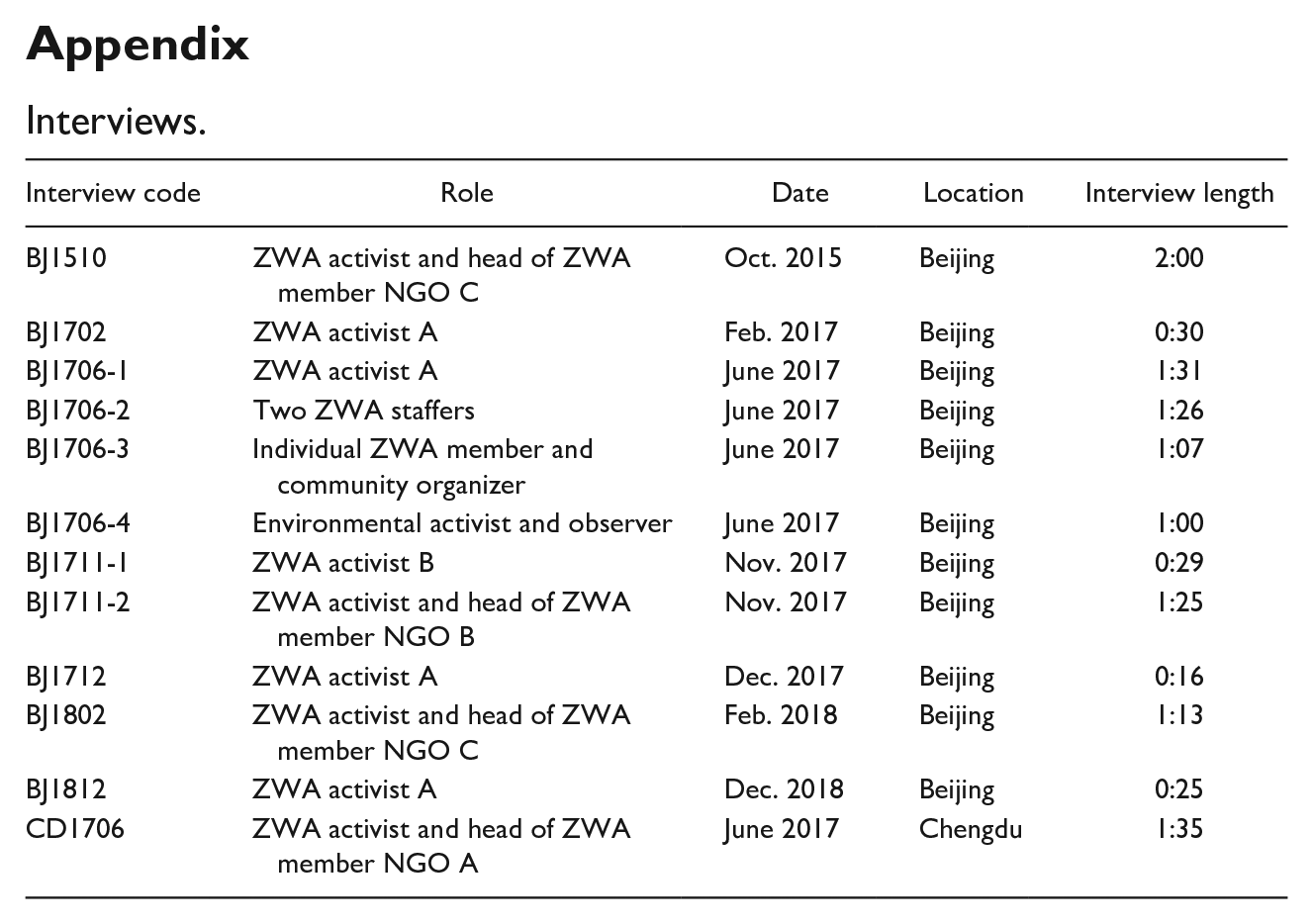
Our key evidence consists of twelve semi-structured interviews totaling almost thirteen hours with key alliance organizers and one environmental activist and observer, held in Beijing and Chengdu between October 2015 and December 2018 (see Appendix). Interviews were selected by snow-balling and were conducted face-to-face (with the exception of one by video conference) and audio recorded (again, with the exception of one). 1 We also draw on online materials, correspondence with and documents provided by activists, as well as observations from field visits to five local waste-sorting projects, an internal ZWA meeting, a ZWA volunteer meeting, and several public forums. We triangulate this evidence with existing insights into NGO behavior and alliance building.
The article is organized as follows: we begin with a review of the literature on horizontal relations in China’s civil society, during which we further define key terms and highlight that the picture emerging from existing research is not clear-cut. We subsequently introduce our case in greater detail. This is followed by an analytical narrative that identifies four forces driving alliance formation. We conclude with a discussion of the study’s broader implications and the potential avenues for future research.
Horizontal Relations in China’s Civil Society
Horizontal relations between NGOs can take different forms. Here, we understand an NGO network to be a horizontal relationship varying in type and permanence between more than two organizations. Collaboration is the act of mutual exchange and support between organizations. In our understanding of an alliance, the boundary between a collaborative network and an alliance is crossed when the former becomes relatively formal and enduring, extends regional boundaries, and explicitly adopts the goal of advancing a specific topical agenda. 2 An alliance is thus a more developed form of a collaborative network. In order to discern the conditions that have led to the emergence of such alliances, it is therefore necessary to understand the development of horizontal relations between Chinese NGOs more broadly.
In late imperial and Republican times, horizontal linkages between actors in the broadening “third realm” between the Chinese state and society were significant at the local level, but typically weak beyond local boundaries (Huang, 1993: 230–32). After 1949, the communist party-state almost totally absorbed organized social forces and intensified local division through its “segmented” administrative organization (Huang, 1993: 237). Since social organizations were once again tolerated in the 1980s, the Chinese state has remained wary of horizontal relations within and between NGOs (Saich, 2000: 132).
The Regulation on the Administration of the Registration of Social Organizations 社会团体登记管理条例 of 1998 and 2016 explicitly forbade NGOs to open regional branch offices. 3 Collaboration between organizations, however, has been situated in a fuzzier zone. Collaborative networks have not been formally outlawed, but at the same time no framework has been provided to legalize them (Wells-Dang, 2012: 176). While the 2016 Charity Law theoretically provides the possibility of registering NGO alliances as “professional organizations,” a precondition is successful registration of the alliance as a “social organization.” This registration failed in the present case (see below). Moreover, Anthony Spires (2020) argues that the law has not made any significant progress toward expanding China’s civil society and should be seen primarily as a tool of political control. Thus, a legal framework de facto remains absent.
Somewhat surprisingly, given the importance of NGO collaboration for civil society development and state-society relations, the question of how the state has constrained or tolerated collaboration between NGOs has received little systematic scholarly attention. The picture emerging from the literature is inconsistent. Timothy Hildebrandt’s study on NGOs in the environmental, health, and gay/lesbian sectors in 2007 and 2008 found an across-the-board preference for “staying atomized and avoiding linking up with other similar groups” because the authorities were deemed “fearful of more broad-based, threatening social organization solidarity” (Hildebrandt, 2013: 78). Hildebrandt and others also found that leaders were worried about guilt by association if one of their collaboration partners were to fall out of favor with the authorities (Hildebrandt, 2013: 79; see also Lu, 2007: 67; Wells-Dang, 2012: 174). Other scholars described collaboration among Chinese NGOs as “risky” (Howell, 2003: 163) and noted that the act of linking up across jurisdictions used to be a “taboo” (Peng and Wu, 2018: 464). Studying the dissolution of disaster relief NGO alliances, Ming Hu, Chao Guo, and Angela Bies identified political pressure as a key reason for the dismantling of alliances and noted that all their cases were, to different degrees, affected by it (Hu, Guo, and Bies, 2016: 2501–3). Andrew Wells-Dang, studying two Chinese NGO alliances in the health and environmental sectors in the late 2000s, noted that the formalization of collaborative networks was difficult due to the lack of a legal basis and the risk of making the network a target for political opponents. He also noted, however, that actual “government control of networks [was] weak” (Wells-Dang, 2012: 11).
Multiple studies have indicated that horizontal linkages among NGOs have intensified over the last two decades. The strongest evidence comes from the environmental sector. Scholars have traced networks with key ENGO founders as central nodes, as well as dense virtual networks between environmental organizations (Ru and Ortolano, 2009; Sullivan and Xie, 2009). Influential ENGOs also began to groom peer organizations in other parts of the country, with whom they subsequently collaborated (Schwartz, 2004: 39; Wu, 2013). In some regions, leading organizations and intellectuals have built strong, albeit informal, mutual support networks (Wu, 2013). An extensive literature has traced how ENGOs formed ad hoc coalitions with peer groups and other actors to stop or alter policy decisions on high-profile investment projects (Han, Swedlow, and Unger, 2014; Johnson, 2013; Li, Liu, and Li, 2012; Mertha, 2009; Steinhardt and Wu, 2016; Wong, 2016; Yang and Calhoun, 2007). Scholars have also revealed the emergence of loose, issue-specific networks linking ENGOs and other actors over recent years (Bondes and Alpermann, 2019; Bondes and Johnson, 2017; Hsu and Hasmath, 2017).
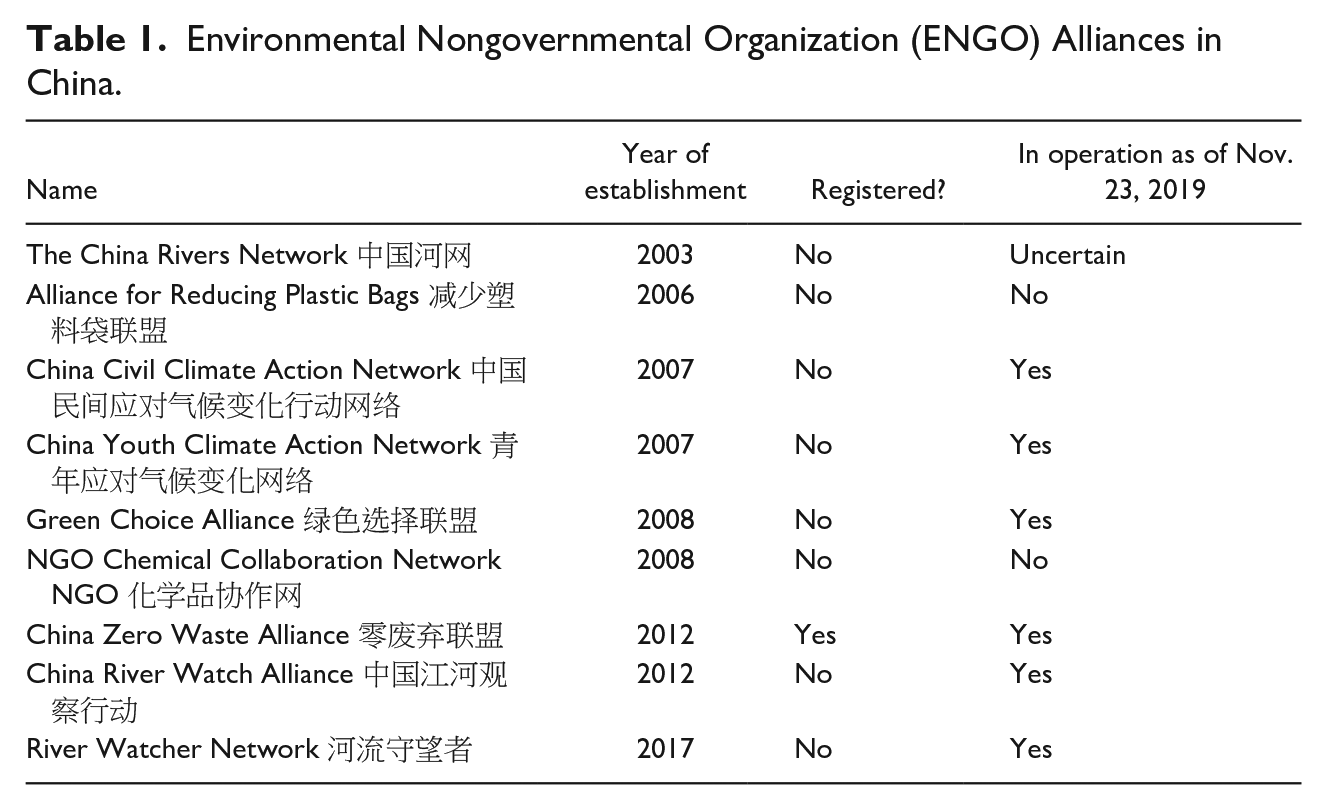
How prevalent, then, are ENGO alliances? Based on the scholarly literature and information from activists and scholars, supplemented by online research, we can discern nine operational or defunct alliances in the environmental field, founded between 2003 and 2017 (see Table 1). 4 The total population of alliances may be substantially larger. Beyond that, disaster relief is another issue area in which scholars have identified intensive collaboration and alliance formation (Peng and Wu, 2018; Hu, Guo, and Bies, 2016; Shieh and Deng, 2011). Hu, Guo, and Bies documented an impressive thirteen alliances that emerged in the aftermath of the 2008 Sichuan earthquake, which had subsequently ceased operating (Hu, Guo, and Bies, 2016). Lin Peng and Fengshi Wu described a further three currently operational and highly capable alliances engaged in this sector (Peng and Wu, 2018). Chao Zhang (2017) noted that alliances of NGOs that advocate for the rights of disabled persons are emerging in China. Other alliances exist in the health, gender, and cultural preservation domains. 5 We are not aware of any existing alliances in the fields of labor, religion, or education. Research suggests that in the face of tremendous political pressure, labor NGO actors tend to maintain contact with peer groups through covert social networks, but horizontal linkages remain fragile (Cheng, Ngok, and Zhuang, 2010; Fu 2018: 46 ff.).
Environmental Nongovernmental Organization (ENGO) Alliances in China.
Hence, despite the sensitive nature of collaboration between NGOs—and the additional difficulties of formalizing collaborative networks and linking across regions—NGO alliances have regularly emerged since the 2000s, and have continued to form and remain operational in more recent years. How can we make sense of this? Strong evidence suggests that the occurrence of the devastating Sichuan earthquake in May 2008 provided an extraordinary window of opportunity to form alliances for disaster relief (Peng and Wu, 2018; Hu, Guo, and Bies, 2016; Shieh and Deng, 2011). Moreover, Hu, Guo, and Bies (2016) identified four factors that contributed to the termination of alliances for disaster relief founded after the earthquake: political pressure, resource shortage, short-term orientation, and leadership failure. Evidently, alliance formation still bears substantial political risks and maintenance is difficult. Thus, what forces beyond the singular event of the earthquake and beyond the disaster relief sector have driven activists to test the boundaries and build alliances? How do alliance builders interpret their environment and perceive the risks and benefits of strategies? So far, these questions have not yet been systematically addressed. Before we begin to explore the forces driving the formation of a successful example from the environmental field, a brief introduction of the case is necessary.
The Case: The Formation, Structure, and Operation of the Chinese Zero Waste Alliance
The ZWA emerged in the context of an urbanization and consumption-driven increase in waste volumes and resulting landfill shortages. To resolve this problem, the Chinese central government promoted waste incineration on a large scale (Bondes and Alpermann, 2019). In early 2006, the Chinese National Development and Reform Commission issued two key policy documents that defined power generated from waste as biomass energy eligible for subsidies. 6 The construction of incinerators, however, became the subject of controversial debates and triggered protests. It also led to the formation of a loosely connected group of experts, lawyers, and ENGO activists who were critical of incineration and began to specialize in a wider range of problems related to household waste (Bondes and Alpermann, 2019; Bondes and Johnson, 2017).
In late 2011, a group of ENGO activists from this circle began to initiate the ZWA with project funding from the member ENGO Nature University 自然大学 as a “voluntary network” with limited contributions (Interviews BJ1702, BJ1706-1, BJ1706-02). In October 2011, they organized a meeting of peers from across China in Guangzhou. 7 Subsequently the group built a website, wrote up a charter, and formally adopted it in October 2012 (Zero Waste Alliance, 2012). By 2015, core activists began transforming the ZWA into a more active organization (Interviews BJ1706-1, BJ1802). Relying on seed funding from another member ENGO, Friends of Nature 自然之友, the ZWA hired four full-time staff (two in Beijing, one in Zhengzhou, and one in Shanghai) and used office space in the Friends of Nature headquarters (Interviews BJ1706-1, BJ1802). Initial efforts to officially register the alliance as an NGO failed. In September 2017, its registration as an enterprise succeeded in Guangzhou (Interview BJ1706-1). 8
As of December 2018, the ZWA consisted of twenty-three individuals and seventy organizational members (sixty-four ENGOs and six companies) from twenty provinces, municipalities, and regions. 9 In its charter, the ZWA defines itself as “a nonprofit action network and cooperation platform co-sponsored by China’s environmental organizations and environmentalists, which is dedicated to promoting communication and cooperation among governments, enterprises, scholars, the public and social organizations on the issue of waste management and the positive development of China’s waste management, circular economy and low carbon economy” (Zero Waste Alliance, 2012). In order to achieve these goals, the ZWA engages in three types of activities: disseminating information on waste sorting through environmental education and environmental communication, conducting policy advocacy about waste management, and assisting its members to enhance their organizational capacity (Interview BJ1706-2; Zero Waste Alliance, 2012).
The ZWA has built a simple but formal organizational structure. An annual member assembly discusses and votes on important issues (Zero Waste Alliance, 2012). An executive committee of seven organizations has been elected by member organizations (Interview CD1706). The ZWA also has a secretariat, which, at the time of writing, had eight full-time staff (a secretary general, a vice secretary general, a communications officer, two policy officers, a project specialist focusing on plastic waste issues, and two project specialists focusing on waste sorting) and one part-time financial staff person. 10 The secretariat staff are appointed and dismissed by the general assembly. Only with the consent of more than half of the general assembly can job candidates formally become members of the staff. As a main body of the ZWA, the secretariat is responsible for the implementation and coordination of day-to-day work, including managing membership records; maintaining archives of public statements, activities, minutes of the internal meetings, and research outputs; maintaining the website and social media accounts; coordinating actions among members; raising and distributing funds according to general assembly decisions; assisting member organizations with professional skill training, strategic guidance, and information sharing; and public outreach (Zero Waste Alliance, n.d.).
The internet, particularly social media, plays a very important role in the operation of the ZWA. The secretariat conducts its daily communication and coordination with members mainly through email and WeChat groups (Interview BJ1706-1). Moreover, social media are an important platform for the ZWA to achieve organizational goals. Public accounts on Sina Weibo and WeChat were established in early 2015. They are used to post information about the development of the ZWA (e.g., recruitment of volunteers and employees), activities organized by the alliance or its members (e.g., crowdfunding, training workshops for members), and the ZWA’s interpretation, and advocacy, of relevant policies (e.g., analyses of local, national, and international waste management policies and their implementation, policy recommendations).
Noteworthy is the ZWA’s relationship with protests against waste incinerators. ZWA members do not get involved in such cases under the label of the organization, but some do so independently (Interview BJ1706-1). A number of its activists are frequently approached by, and have provided assistance to, grassroots protest activists through, for example, applying for the disclosure of information on pollution from incineration plants, providing assistance to pollution victims, or providing other kinds of information (Interviews BJ1510, BJ1702; BJ1706-1). However, other activists and member organizations, possibly most, 11 steer clear of such contentious tactics.
To an extent, the ZWA emerged out of the anti-incineration movement as all core founders were involved in anti-incineration campaigns. One of them, for instance, began working for a member ENGO that “responded to public demands” on incineration-related matters while studying for a PhD degree. Hence, he explained, he “was studying and participating in the social movement [against incinerators] at the same time” (Interview BJ1706-1). The member ENGO Eco-Canton 宜居广州 grew out of an anti-incineration campaign in Guangzhou (Johnson, 2013; Steinhardt and Wu, 2016; Wong, 2016). Member organizations and the ZWA also promote scientific information about waste incineration and thereby provide discursive ammunition for resistance campaigns. 12 In 2016, a ZWA member created the WeChat public account “a world without incineration” 天下无焚, which focuses on disseminating information about anti-incineration activism, including protests, in China and abroad. Moreover, ZWA activists are aware that public attention to the “waste issue” 垃圾议题 is to a substantial extent driven by protests against incineration (Interviews BJ1706-1, BJ1706-2, BJ1802).
Thus, while the ZWA does not openly support or organize protest campaigns, it also does not keep a particularly clear distance from contentious behaviors. Research on NGO-state relations in China has shown that what counts as “antagonistic” or “confrontational” is up to interpretation by the state and that links to protests do not mechanically invite repression (Hildebrandt, 2013: 75; Steinhardt and Wu, 2016). However, it is similarly clear that even indirect links to protests increase the risk of drawing the ire of the authorities. Chinese NGOs thus typically avoid any such connections and do not collaborate with other NGOs whose actions could be interpreted as “antagonistic” (Hildebrandt, 2013: 78–79; Ho and Edmonds, 2007: 338; Mertha, 2008: 154). The ZWA thus noticeably departs from this pattern. This contributes to its “least likely” case (Gerring, 2007: 118) status and prompts us to reflect on potential implications for state-(E)NGO relations.
Driving Forces
Which forces contributed to the emergence and development of this alliance? In the following paragraphs, we draw on our evidence in conjunction with insights from the environmental NGO sector in China and beyond, and identify four critical driving forces.
A Growing Need to Pool Resources and Professional Knowledge
Theorists of social movements and nonprofit collaboration frequently start with the assumption that activism requires organizational, financial, and intellectual resources, and that these resources are scarce. Collaboration and alliance building are strategies for overcoming resource scarcity by way of pooling (Guo and Acar, 2005: 345–46; McCarthy and Zald, 1977). In China, resources available to (E)NGOs are particularly scarce.
As mentioned above, the Regulation on the Administration of the Registration of Social Organizations explicitly prohibits the opening of regional branch offices. The overwhelming majority of (E)NGOs are registered with local jurisdictions and therefore restricted in terms of their membership and scale of operation. Official regulations are one major reason for China’s predominantly localized, small, and resource-weak (E)NGOs (Hildebrandt, 2013: 35–37; Saich, 2000; Schwartz, 2004). Others are comparatively weak social support and restricted funding opportunities. Grants are predominantly earmarked and provide little to no overhead funding to maintain the organization itself (see, e.g., Deng, 2010; Hildebrandt, 2013: 95–137). Moreover, Chinese foundations are fairly conservative and are disinclined to support advocacy-focused (E)NGOs (Lai, Zhu, Lin, and Spires, 2015), such as the core organizations in the ZWA. It remains to be seen if the 2016 Charity Law decisively improves this situation. 13
According to a 2006 survey of over 2,700 ENGOs by an official environmental organization, 29 percent had no full-time staff and 47 percent had five or fewer full-time workers. Of the surveyed ENGOs, 76 percent had no fixed sources of funds, 23 percent worked largely unfunded, and 82 percent were able to raise no more than 50,000 RMB (currently around US$8,750) per year (All-China Environment Federation, 2006). The ENGO sector in China is relatively better resourced than others and conditions have been improving in recent years. There is no question, however, that the resources at the disposal of most organizations remain meager (Deng, 2010; Hsu and Hasmath, 2017; Zhan and Tang, 2013). It is therefore no coincidence that China’s oldest and most influential ENGO, Friends of Nature, currently employs just thirty full-time staff, while Greenpeace employs around a hundred full-time workers in its Beijing office alone. 14
Jonathan Schwartz has argued that resource scarcity, combined with the state-designated localization, incentivizes ENGOs to groom new peer organizations (Schwartz, 2004: 39). The case of the ZWA suggests that the same logic holds true for building alliances with peer organizations. Our interviews have consistently highlighted that activists perceive the key raison d’être of the ZWA to be a “platform” 平台 for sharing and mobilizing resources, sharing knowledge, coordinating activities across regions, mobilizing broad popular support, and building the capacity to compete with powerful opponents (Interviews BJ1706-1, BJ1706-2, BJ1706-3, BJ1711-1, BJ1802, CD1706). Hence, one interviewee explained, “We were clear about our individual missions, that is to work on waste. Since we had no resources, if we wanted to do that the only way was to do something organizational” (Interview BJ1706-1). Another core activist stressed that only through building a collaborative alliance could they efficiently obtain the resources needed to achieve their mission (Interview BJ1812).
However, the link between the resource-scarcity of an organization (or NGO sector) and the inclination to form alliances may not be linear. Absolutely resource-impoverished and unprofessional NGOs are not capable of initiating or leading an alliance (Wu, 2013: 101; Hu, Guo, and Bies, 2016: 2503–4). Thus, one of our interviewees commented on the scenario of allying with a very resource-poor organization: “If I play with you, but you don’t have any meat [to share with me] and [we] only drink soup [together], then I still have to [spend time and] discuss a lot of things every year. What’s the point?” (Interview BJ1706-4). Hence, widespread resource scarcity in an NGO sector, combined with the existence of a few better-resourced lead organizations, may provide the ideal conditions for incubating alliances. China’s ENGO sector is arguably precisely in such a stage of development (Hsu and Hasmath, 2017; Wu, 2013).
An additional trend among Chinese ENGOs that encourages alliance formation is a growing inclination to take up complex and “compound issues” (Wu, 2013: 96), which require substantial specialized knowledge. Waste, including its production, collection, and treatment, is such a cause. Thus, a leading activist explained: “It’s not only about funding, it’s also about expertise. Since [waste] is a chained issue, a single organization can only cover certain parts of it” (Interview BJ1802). The experience of a ZWA member organization illustrates the link between issue complexity and the inclination to join an alliance. This organization works in Chengdu and was officially registered in 2008. Initially it focused on environmental education. After adjusting its mission in 2010, it began to work on the issue of waste sorting. However, since its staff lacked training in environmental sciences and practical experience, as well as being the only NGO working on this issue in their city, the organization encountered numerous difficulties. Hence, they “felt lonely and realized [they] needed to learn a lot of things” (Interview CD1706). In 2011, activists heard about the plan to form the ZWA and joined soon after. This greatly changed the organization’s access to expertise. Our interviewee explained, “If we need to learn about incineration plants for policy advocacy, we’ll turn to [a member-NGO in Central China] for help because they’re good at it. If we want to learn about the treatment of wet waste, we’ll turn to [a member-NGO in East China]” (Interview CD1706).
The ZWA secretariat actively coordinates and promotes such sharing and exchange among members through email and WeChat. The secretariat is also responsible for providing timely direct support for the members on relevant issues (Zero Waste Alliance, n.d.). Thus, members in need can directly reach out to the secretariat for help. Moreover, the secretariat also helps ZWA members improve their professional capacity through organizing online or offline workshops (Interviews BJ1711-2, CD1706-1).
Lastly, Chinese ENGOs have displayed a growing ambition to influence environmental policy (Dai and Spires, 2018; Li, Lo, and Tang, 2016; Teets, 2018; Zhan and Tang, 2013; Wu, 2013; Interview BJ1510). The ZWA, with its organizational mission defined in its charter as “to promote the positive development of China’s waste management, circular economy, and low carbon economy,” is a case in point (Zero Waste Alliance, 2012). In trying to influence national policies, ENGOs often face very well-resourced and nationally organized business lobbyists (Deng and Kennedy, 2010). One of the ZWA’s key strategists recalled how the expansion of the lobby organization for the waste incineration industry in 2012 served as a key impetus to establish the ZWA: This force was huge, so we had to be able to act collectively. [. . .] If you want to get into the policy battle 博弈 in this field, you need capacity and strength. When you’re just a handful of NGOs, [while] there are projects of several hundred million RMB on the other side, people won’t even listen to you 人家根本不带你去玩. [. . .] You have to make some noise 发声, you have to have a platform, and you have to have a sustainable organization that can grow. [. . .] This was a major reason for us to push this thing [the ZWA]. (Interview BJ1802)
Hence, given the continuing resource scarcity in the environmental sector and the emergence of a few better-resourced lead organizations, combined with environmental groups’ increasing inclination to take on complex issues and engage in policy advocacy, the need for resource-pooling among ENGOs has grown. Alliance building is thus an attractive solution to a number of scarcity problems.
A New Generation of NGO Leaders
Another broad development favoring alliance building among NGOs is a growing inclination to collaborate at the level of organizational leadership. In the mid-2000s, Anthony Spires observed a dominant “autocratic” organizational culture among Chinese NGOs, characterized by top-down decision-making of authoritative figures with “little experience in cooperating as equals” (Spires, 2007: 242–331). Similarly, Guobin Yang noted a strong reliance on “charismatic leaders” (Yang, 2005: 61). However, Spires also described an “emerging democratic counter-hegemony” that began to break up these patterns (Spires, 2007: 242–331). The cultural shift within the NGO sector is closely related to a generational change of NGO leaders. Since the mid-2000s, a younger generation born after the launch of China’s reform policies in 1978 began to replace the old guard shaped during the Mao era. What distinguishes the generations is that the young tend to be less politically cautious, possess more knowledge of international NGOs and their strategies, use information technologies more frequently, and display a higher degree of social trust (Spires, 2011: 27; Wells-Dang, 2012: 174–75; Yang, 2005). Consequently, one might infer that the cultural shift toward more cooperation, flatter hierarchies, and the generational turnover of leaders contributed to a greater inclination to collaborate.
Our evidence supports this inference. The ZWA’s key activists were part of the new generation of NGO leaders who were in their late twenties and early thirties at the time they founded the alliance in 2012. All have significant experience with foreign NGOs and two have studied outside of mainland China. One, for instance, highlighted how participating in a Japanese waste-related ENGO alliance provided a blueprint for the ZWA’s charter (Interview BJ1706-1). Another noted the international anti-waste incineration network Global Alliance for Incinerator Alternatives (GAIA) as an organizational model (Interview BJ1802). 15 Leading activists also emphasized the strong “civic virtue” 公民性, cooperative spirit, and principle of shared ownership in the organization (Interviews BJ1706-1, BJ1802): “People in the administrative layer [of the ZWA] have civic virtue 公民美德. We all know that in order to sustain such a rare network [. . .] we have to convince people that this is a public organization. Then everyone’s behavior and treatment of the organization will be different” (Interview BJ1802). Our observations suggest that these are not empty words. When prompted in private, the key founders of the ZWA rejected the notion that they are the “founders” 发起人 and instead insisted that everyone present at the foundation meeting is a “founder.” Likewise, a junior ZWA staffer highlighted that a key motivation for working there was to avoid “complicated personal relations”—a Chinese way of describing office politics in hierarchical organizations. The interviewee also believed that the ZWA has “already overcome” dependence on individual leaders through its strategy of institutionalization (Interview BJ1706-2). When we attended ZWA meetings, we also got the impression of relatively flat hierarchies and a cooperative atmosphere among activists. 16
Hence, the case of the ZWA ties in with other observations of generational and cultural shifts in Chinese civil society. There is reason to assume that these shifts further increase the inclination toward alliance building in the environmental sector (and potentially beyond).
The Formation of Epistemic Communities
Jennifer Hsu and Reza Hasmath found that although epistemic communities are relatively underdeveloped in China’s civil society, they are most developed in the environmental sector. They also speculated that the formation of epistemic communities and alliances between NGOs are closely related phenomena (Hsu and Hasmath, 2017: 31). This would suggest that a necessary condition for NGO alliances to form is that a critical mass of specialized NGOs and activists with a shared agenda is in place.
In the domain of waste management, such a community began to form in the mid-2000s. When the Chinese government embarked upon its ambition to build incineration plants, conflicts with affected local communities were on the rise. Because of the uncertainty of the impact of incineration on the environment and public health, combined with the distrust of the information provided by local authorities, local resisters often sought outside support (Bondes and Alpermann, 2019; Bondes and Johnson, 2017; Johnson, 2013). Of particular importance was an anti-incinerator campaign in Beijing in 2006. It marked the beginning of a wave of similar cases and put key figures of the ZWA in touch with each other (Interview BJ1706-1). Core founding activists of the ZWA took up waste as the foci of their work between 2006 and 2009 and all were involved in at least one anti-incinerator campaign as activists or, what Maria Bondes and Thomas Johnson have termed, “intermediaries”—individuals connecting grassroots activists with outside allies (Bondes and Johnson, 2017; Interviews BJ1706-1, BJ1802).
Subsequently, anti-incineration activism underwent a significant transformation in issue framing, organizational specialization, and network consolidation. In response to public criticism of not-in-my-backyard (NIMBY) frames, anti-incineration protesters in Guangzhou, for instance, turned to justifying their actions by challenging China’s waste management policies (Johnson, 2013). Eventually, the ZWA member organization Eco-Canton emerged out of this campaign and specialized in waste governance. This exemplified a broader extension of the thematic scope in anti-incineration activism. Lead activists not only increasingly emphasized opposition to incineration plants, but also more explicitly linked this issue with advocacy for better waste governance. A number of ENGOs began to specialize in different areas related to the compound issue of waste—organizing community waste sorting, assisting incineration pollution victims, monitoring pollution from incineration plants, or advocating responsible waste management policies—and collaborated to achieve their goals. They gradually formed a loose collaborative network, developed a sense of community and trust, and began to gravitate around the idea of “zero waste” 零废弃. One of our interviewees emphasized the importance of this preexisting network of activists with similar goals and ideas for the emergence of the alliance: “Why does the ZWA exist, after all? From our perspective, it is us: this bunch of people. We are determined to work on waste and [. . .] we share a core desire 核心愿望, our undertaking was very thought through and we are very familiar with each other” (Interview BJ1706-1). Likewise, an environmental activist and observer argued that “having the concept of zero waste” was “very important” for the development of the alliance. “It is very difficult to have cohesion” in the absence of such a “visionary thing” (Interview BJ1706-4). The most difficult part, according to one of the founders, was not forming the organization, but instead, it was “more difficult to tie together an integrated agenda” (Interview BJ1706-1). Thus, by the time the ZWA was officially founded, a community of specialized actors and organizations was in place with a shared agenda. What the activists were lacking was a means to share resources and facilitate “joint action” (Interview BJ1711). Thus, one founder recalled, “we conceived the organization based on practical concerns, adjusted a little, [and wrote] a simple charter” (Interview BJ1706-1). An alliance, in the words of another founding activist, simply became a “real necessity” (Interview BJ1711-1), an almost unavoidable consequence of the previously established common mission. 17
Although some conditions for the epistemic community around waste are particular to the issue at hand, the growing prevalence of these communities in China’s environmental sector is not (Hsu and Hasmath, 2017). What contributes to it is the gradually rising professionalization of ENGOs (Hsu and Hasmath, 2017), and likely the availability of new information technologies that allow actors to gravitate around specific issues across distances.
Conditional Tolerance by the State
A critical determinant of NGO behavior in China is the structure of political opportunity (Hildebrandt, 2013: 3). To explore possible changes to it without direct evidence from the authorities, we opted to combine the perception of political risks by activists with anecdotal evidence of state agent behavior. 18 Moreover, due to the lack of systematic longitudinal data, we compared our recent evidence with previous research and queried interviewees about changes in their perception of risk.
Confirming the insights from existing research, our findings reveal that interviewees were aware of the political risks of alliance building (Interviews BJ1712, BJ1711-2). As one put it, “we are wandering on the edge” 走在边缘 (Interview BJ1712). However, they perceived the state to be conditionally lenient. State tolerance was thought to be contingent on two broad factors: that alliances pose no political threat and are helpful for governance.
Activists also drew their conclusions from the existence of other alliances and official tolerance of them. “It is not that [the government] doesn’t know [alliances exist],” said one interviewee. The informant also made an explicit reference to a disaster relief NGO alliance that was founded in 2011 (Interview BJ1706-1). Another recalled that the China Civil Climate Action Network (see Table 1), founded in 2007, was one of the models the ZWA drew upon at its foundation (Interview BJ1802). In other words, although ZWA activists understood the sensitivity of alliance building, the existence of other NGO alliances without repressive interventions from the authorities led them to believe that political space was present.
In order to lower political risk, ZWA activists have made use of precautionary measures. One is the tactic of “transparency” 透明. By “clearly explaining” their “position” 定位, “mission” 使命, and the relationship between their members, they try to convey to the authorities that the ZWA has nothing to hide and harbors no hostile intentions (Interview BJ1802). Sometimes, however, they use a strategy of ambiguity as well. As the ZWA has adopted a membership-based organizational structure and has been operating as a de facto NGO, the letter of the law would require to register it as “social organization” 社会团体. Since such a registration did not succeed, activists decided to instead register as a company to “avoid being politicized.” They thereby sought to “obfuscate the cooperation platform” by framing it as an organization that is contracting out “services” to member organizations (Interviews BJ1706-1, BJ1712).
Our interviews also suggest that the perception of political risk has changed over time. From the formation of the alliance in 2012 to 2018, activists have become more cautious. One involved in the initial formation denied there was any concern about sensitivity when the alliance was formed (Interview BJ1711-1). Initially, another lead activist agreed, the use of the term “alliance” 联盟 was “absolutely not” 完全没有 regarded as risky (Interview BJ1802). Yet after 2013, when the overall political atmosphere tightened after China’s leadership change, 19 the usage of the term was scrutinized. It was decided to continue using it and protect the organization by treading carefully (Interview BJ1802).
Compared with earlier periods, however, the perceived risk appears to have decreased. Hildebrandt’s interlocutors of the late 2000s attempted to minimize even informal horizontal collaboration because they were concerned about being held responsible if some of their associates fell out of favor with the authorities (Hildebrandt, 2013: 79). In contrast, the leader of a ZWA member NGO, who described her organization as having good relations with the local government because of its “very mild approach” (Interview CD1706-1), was apparently not deterred from joining the alliance because other members engaged in “confrontational work” 冲突性工作 (Interview BJ1706-1). 20 Moreover, as mentioned above, the ZWA also differed from previous collaborative networks in that it neither kept a low profile nor left the organization informal (Wells-Dang, 2012: 12, 42, 176). Notably, even local officials, whose job profile is to be extra sensitive about changes in the political atmosphere, were apparently not concerned about cooperating with the ZWA. Its 2015 and 2016 annual assemblies in Nanjing and Chengdu, respectively, were co-sponsored by city government agencies (Interviews BJ1706-1, CD1706; see also, Zero Waste Alliance, 2016).
What pattern emerges from these pieces of evidence? First, activists perceive that running an alliance has risks, but this perception is not strong enough to deter them from pursuing that path. They assume that the authorities are aware of their activities and deliberately tolerate them, and that they can lower risk by adopting protective strategies. Second, alliance builders are aware of the history of previous alliances and draw lessons from that. Third, alliance formation is less sensitive than in the late 2000s. However, our interviewees seem to have become more cautious again since 2013. Thus, the period after 2008 and before 2013 appears to have been something of a golden era for alliance formation. 21 The increased risk since then, however, has not persuaded activists to disband existing alliances—and new ones have formed since (see Table 1).
Three further developments have most likely offered additional space to maneuver for environmental NGOs in general and waste activists in particular. They help to clarify why activists continued to develop alliances in spite of a generally deteriorating climate for civil society under the Xi administration.
First, it has been widely noted that after Xi Jinping took the office, the central government has attached greater importance to environmental governance. Xi himself has stressed the significance of environmental protection on various occasions (Xinhuanet, 2018). Numerous important environmental laws or regulations regarding water, soil, air, and waste have been promulgated since 2013 (Kostka and Zhang, 2018). Most notable is the new Environmental Protection Law (in effect since January 1, 2015), which is regarded as “the strictest environmental protection law in history” (People’s Daily Online, 2014). In the same year, a central environmental protection inspection team, informally known as the “imperial envoy of environmental protection” 环保钦差, was set up (People’s Daily Online, 2016).
Second, in order to tackle environmental problems, the state has also enhanced the role of the public and NGOs in the environmental governance spelled out in official documents and discourse. The report of the Chinese Communist Party’s Nineteenth National Congress forwarded the idea of building an environmental governance system, in which the government takes the leading role, enterprises work as major players, and social organizations and the public participate (Chen, 2018). In other words, the state signaled its intention to absorb certain types of social organizations into the environmental governance system to improve its environmental protection record.
Third, the Xi administration has displayed an unprecedented determination to promote the development of waste sorting in China. At a conference of the Central Leading Group for Financial and Economic Affairs in December 2016, Xi himself demanded the construction of a waste sorting system across the country be speeded up (People’s Daily Online, 2019).
Hence, the “‘greening’ of the Chinese state” (Ho, 2011: 893) affords ENGOs with political space in spite of a deteriorating political environment for civil society activism. We are not aware of any indication that the state actively signaled that NGO alliances would be conditionally tolerated. Rather it appears as if pioneering alliance formations by entrepreneurial activists in the mid and late 2000s that did not provoke state interventions, in combination with “favorable policy lines” (Dai and Spires, 2018: 69) on environmental issues more recently, persuaded activists that there was space to maneuver. As a result, the perceived boundaries of the permissible shifted gradually. As one leading activist put it, “the reason the Communist Party’s rule is still somewhat legitimate is that it is not too ossified 僵化. If you do not threaten its status, and if you help with social governance, it will let you try something—it will not draw an overly clear line” (Interview BJ1706-1).
Discussion and Conclusion
The formation and development of the Zero Waste Alliance was driven by factors internal to the ENGO sector—an increased need to pool scarce resources, a stronger inclination to collaborate among a new generation of organizational leaders, and the formation of epistemic communities. In additional to these structural changes, the state’s lenience also played a significant role. It is important to note that the distinction between these factors is primarily analytical. Empirically, they interact with each other. For instance, a greater disposition toward collaboration among younger NGO leaders likely also increases the inclination to form epistemic communities and engage in compound issues, thus elevating the need to pool resources. Hence, while cause and effect between these factors is difficult to disentangle, in sum they create a hospitable environment for alliance formation.
Scholars have argued that when new avenues of societal activism in China become available and following them does not provoke state sanctions, a precedent is set and actors are emboldened to continue pushing in the same direction (Mertha, 2009: 1001; see also Steinhardt, 2016; Stern and O’Brien, 2012). Our evidence suggests that a similar dynamic was at play in the present case where the state has remained tolerant of behaviors that used to be off-limits. The alignment in policy goals between ENGOs and the state most likely contributes to this lenience. This softening on boundary-pushing behaviors by NGOs with goals that broadly align with state interests, combined with an overall hardening on other NGOs and sectors deemed to be a threat to regime stability, could help to account for some seemingly inconsistent developments in China’s state-NGO relations.
It is unlikely to be a coincidence that most of China’s NGO alliances seem to exist in the environmental, health, and disaster-relief sectors, while there are, as far as we know, none in the labor or religious domains. Environmental, health, and disaster-relief NGOs provide services that are broadly in line with state objectives and have therefore enjoyed more political space (Hildebrandt, 2013: 17; Kang and Han, 2008). In contrast, labor and religious affairs are, by definition, sensitive for a communist state. Diana Fu has shown how repressive conditions in the labor sector breed mutual distrust and disunity among NGO leaders (Fu, 2018: 46 ff.). The state has also repeatedly made a point of demonstrating—for instance in a crackdown in late 2015 (Cao, 2015)—that horizontal collaboration between labor NGOs will lead to punishment.
Sectorial differences in political opportunity alone, however, do not explain why collaboration and alliance formation appear to be by far most developed in the environmental sector, while we are not aware of a single NGO alliance in the education sector. Here, the latter sector’s comparative underdevelopment in organizational professionalization and the resulting immaturity of epistemic communities may be more telling (Hsu and Hasmath, 2017: 32). More research—and particularly cross-sectorial comparative work—is needed to understand the extent of collaboration and alliance building and the factors that account for sectorial differences. The mechanisms driving alliance formation that we have specified in this article can serve as points of reference for such studies.
Alliances that bring together environmental NGOs with companies and government agencies in China are another potentially fruitful avenue of future inquiry. Such bridging forms of alliances have been a major focus of research on environmental governance (Arts, 2002; Hartman, Hofman, and Stafford, 2002; Milne, Iyer, and Gooding-Williams, 1996; Polonsky, Garma, and Chia, 2004). The alliance investigated in this study includes six companies providing waste sorting, treatment services, and environmental equipment—businesses that have a stake in the alliance’s policy objectives. Our research, however, has not yet indicated that these for-profit members play a major role in the ZWA. In terms of collaborations between ENGOs and government agencies, we have noted that local government agencies have sponsored the ZWA’s annual meetings. Moreover, there is frequent exchange and at least loose collaboration between government agencies, member organizations, and the ZWA. Jessica Teets noted similar forms of collaboration between local authorities and selected NGOs (Teets, 2014: 141–42). ENGO-state collaboration in environmental governance appears to be on the rise and warrants more scholarly attention. 22
The experience of collaborating with peer organizations and the perception of having peers correlates not only with NGOs’ inclination to engage in policy advocacy (Li, Lo, and Tang, 2016; Wu, 2013) but also with NGO activists’ belief in civil society as a cohesive social force (Wu, 2017). The latter outcome is not in line with state interests and therefore has potential to prompt an end of tolerance for alliance building. Indeed, there are some indications that the authorities have begun to pay more attention to NGO alliances. 23 For a state interested in a third sector that supports its policy goals, but not in a strong civil society per se, collaboration and alliance building among NGOs remain a double-edged sword.
Footnotes
Appendix
Interviews.
| Interview code | Role | Date | Location | Interview length |
|---|---|---|---|---|
| BJ1510 | ZWA activist and head of ZWA member NGO C | Oct. 2015 | Beijing | 2:00 |
| BJ1702 | ZWA activist A | Feb. 2017 | Beijing | 0:30 |
| BJ1706-1 | ZWA activist A | June 2017 | Beijing | 1:31 |
| BJ1706-2 | Two ZWA staffers | June 2017 | Beijing | 1:26 |
| BJ1706-3 | Individual ZWA member and community organizer | June 2017 | Beijing | 1:07 |
| BJ1706-4 | Environmental activist and observer | June 2017 | Beijing | 1:00 |
| BJ1711-1 | ZWA activist B | Nov. 2017 | Beijing | 0:29 |
| BJ1711-2 | ZWA activist and head of ZWA member NGO B | Nov. 2017 | Beijing | 1:25 |
| BJ1712 | ZWA activist A | Dec. 2017 | Beijing | 0:16 |
| BJ1802 | ZWA activist and head of ZWA member NGO C | Feb. 2018 | Beijing | 1:13 |
| BJ1812 | ZWA activist A | Dec. 2018 | Beijing | 0:25 |
| CD1706 | ZWA activist and head of ZWA member NGO A | June 2017 | Chengdu | 1:35 |
Acknowledgements
We are grateful to our interviewees for their time and willingness to provide information for this research. We would like to thank the three referees as well as Christian Göbel, Yue Guan, Thomas Heberer, KuoRay Mao, Kevin O’Brien, Jiwei Qian, Yang Su, Dongtao Qi, Litao Zhao, and Yongnian Zheng for helpful comments on previous drafts of this article. We are also grateful to Fengshi Wu for helping us to contact Timothy Hildebrandt and Anthony Spires in order to track down relevant parts of their work.
Authors’ Note
Both authors contributed equally to this article.
Declaration of Conflicting Interests
The author(s) declared no potential conflicts of interest with respect to the research, authorship, and/or publication of this article.
Funding
The author(s) received no financial support for the research, authorship, and/or publication of this article.