




Abstract
The region sometimes known as Manchuria entered 1900 as a frontier of blurred boundaries. Inter-polity borders between the Qing and Russian empires, and between both empires and Korea, had been drawn in earlier centuries, but no power center exerted full control. Multiple populations—Manchu, Korean, Han Chinese, Russian, and also Japanese for a time—lived among one another. This changed by mid-century as borders hardened under new rationalist-Westphalian states, the PRC, USSR, and DPRK. Yet, as this article argues in a revisionist, multi-perspectival account, the Manchurian frontier had a long afterlife in the politics and culture of the PRC and its avowedly modern socialist neighbors. Historical and anthropological insights at the local level reveal how ubiquitous Manchurian frontier “bandits” were supplanted by Chinese, Russian, and Korean “partisans” during the 1920s–1940s revolutionary conflicts. As guerrilla fighters drew on romanticizations of noble, masculine bandit-heroes, the socialist causes—and ultimately states—they fought for became embedded in both the Manchurian wilderness and local imagination.
The region known to some now and in the past as Manchuria entered the twentieth century, in the words of historian Felix Patrikeeff, as “a hastily sewn patchwork of stake-claiming” by different political regimes (2002: 81). While interstate borders, notably those between the Manchu-Chinese Qing and Russian empires, and between both empires and Korea, had been drawn through the area in the eighteenth and nineteenth centuries, 1 these remained only selectively meaningful. Populations of Manchus, Koreans, Han Chinese, and Russians, although each concentrated in different sectors of the territory encompassed by Figure 1 and beyond, 2 were nevertheless scattered and distributed among one another. Moreover, with surrounding empires and states each beset by revolutions, invasions, and other political convulsions, no single polity was able to exert decisive control over the area, further blurring boundaries. Indeed, much the most coherent regime to govern any part of this area in the first half of the twentieth century was established by an outside power, Japan. Yet even the Tokyo-backed Manchukuo state’s (1932–1945) claims to be bringing rationalist technocratic governance to the frontier (Duara, 2003) often rang hollow, and so no center exerted rational bureaucratic and territorially “modern” sovereignty up to discrete state borders (Ersoy, Gòrny, and Kechriotis, 2010).
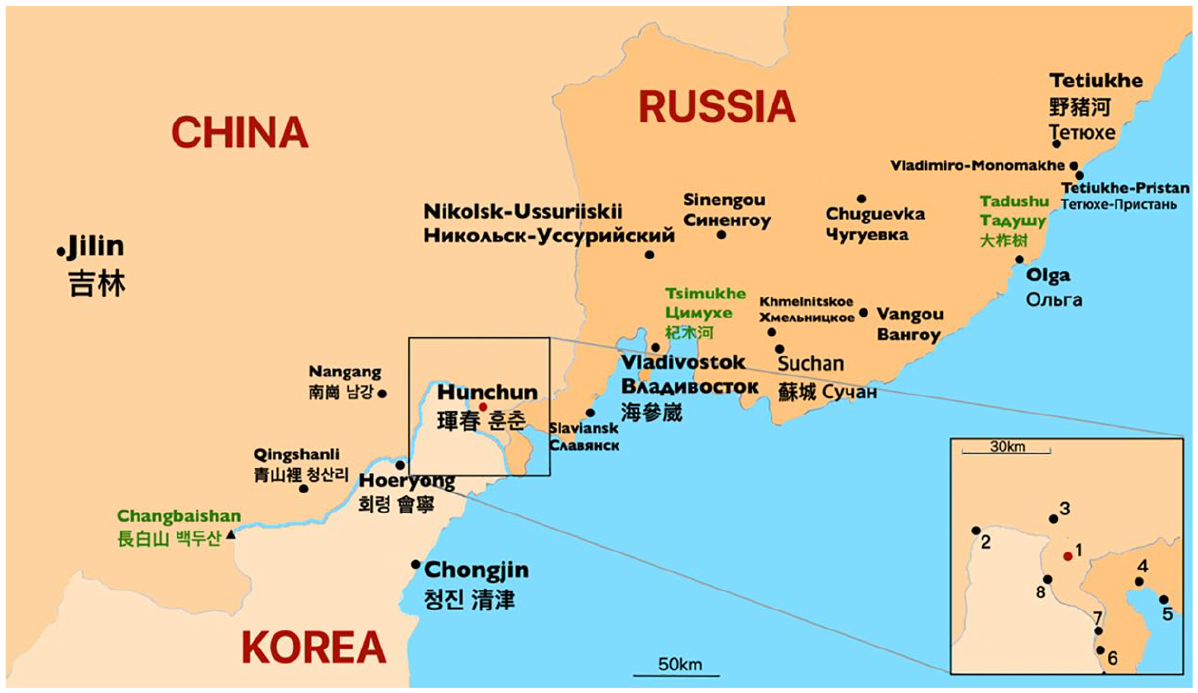
Hunchun frontier, 1900–1940s (map by author).
By 1949, however, three new regimes governed distinct sectors of the area under discussion here, and these soon came to assert firmer Manchurian boundaries, namely the Sino-Russian and Sino-Korean borders with which we are familiar today. As socialist countries, the People’s Republic of China, Soviet Union, and Democratic People’s Republic of Korea purported to be states of an entirely new type in this region. And yet, as this article will argue, the legacy of the not-long-gone era of overlapping Chinese, Manchu, Korean, and Russian frontiers was profoundly important to the subsequent histories of these polities, and remains so to the present. Such a claim is not wholly novel, for historians have discussed the importance of early twentieth-century Manchurian events to China (Levine, 1987), Soviet Russia (Stephan, 1996), and—most voluminously—the Koreas (Wada, 1992; Eckert, 2016). But this article offers a new analysis. As well as multi-perspectivally bringing Chinese, Russian, and Korean dimensions together, it argues for consideration not only of the larger-scale events discussed by the above authors, but also of the intimately local dimensions to the emergence of socialist statehood in Manchuria.
My focus here is rooted in Hunchun 琿春 (Figure 1), an erstwhile Qing dynasty (1644–1911) garrison town lying at the point where China, Russia, and Korea meet. Examining early twentieth-century events in this locale allows us to see how between 1900 and 1949 overlapping Manchurian interests distilled out into distinct sectors of bounded national territory. The primary and profoundly local actors in this multidimensional process, I will suggest, were figures termed “bandits” and “partisans.” If these appear obscure labels at this stage, their significance within historical and territorial processes during this crucial time will soon become clear. I begin, however, with a turn-of-the-century episode that had more organized and broadly geopolitical features than the more situational bandit and partisan activities which follow.
Overlapping Frontiers
One foggy dawn in mid-July 1900, a mounted Russian Cossack regiment advanced toward Hunchun from the east. 3 Spying the invaders on the old Novokievsk road, a route along which Chinese traders drove cattle to Russian markets, a Manchu horse herder raised the alarm. The 1880s German-made Krupp cannons of the town’s west battery spat a few shots through the mist, and a hurriedly marshaled defense troop managed to kill or wound several Cossacks. But the local Qing deputy lieutenant-general 副都統 and the artillerymen manning the east battery fled on learning of the Russian advance and, undermined by these displays of cowardice, Hunchun fell soon afterward.
The episode was novel for both sides, for it was both the Hunchun garrison’s first experience of open warfare since its early eighteenth-century foundation and a formational engagement for Russia’s newly formed Primorskii dragoons (Avilov, 2011: 125). The event also proved indicative of the increasing embroilment of Hunchun, and Manchuria at large, in turn-of-the-century global geopolitics and inter-imperial competition. The Russian advance was part of a larger Chinese Campaign of 1900 (Rus., Kitaiskii pokhod 1900 g.) by which Tsarist forces crossed the thitherto mostly peaceful 1858- and 1860-delineated Qing-Russian borders in several Manchurian locations. Their stated aim was to defend regional interests (notably the China Eastern Railway) against the anti-Christian and anti-colonial Righteous and Harmonious Fist 義和團 movement, popularly known in European languages as the Boxer Rebellion (Rus., Bokserskoe vosstanie). 4 Though particularly active in Manchuria, the Boxers were far from a merely local phenomenon, and across northern China they clashed with British, French, American, and other armies which made up an eight-way imperial intervention 八國聯軍. The Cossack advance was thus only one of a fractal of simultaneous regional conflicts.
These and other events across China proved harbingers of the end of the Qing dynasty, which arrived in 1911. The collapse only multiplied the many existing claims to stewardship over parts or all of Manchuria. From the Chinese Republican authorities who took power in 1912 to successive governments in St. Petersburg, Moscow, Pyongyang, Seoul, Tokyo, and ultimately Beijing’s new PRC government post-1949, regimes of all stripes sought to govern here over the ensuing decades. Yet while the Qing’s Manchu rulers had long seen Manchuria as a realm with a particular place in national history and myth (Elliott, 2000), for everyone else this was an edge space, and so became a region where multiple frontiers—Chinese, Korean, Russian, and Japanese—overlapped. In light of this, and with successive crises and revolutions unfolding at political centers, it was also a region subject to patchy and highly attenuated rule from any given metropole.
Before discussing this further, it is worth briefly outlining the pervasive incoherence of various governance efforts here during the first half of the twentieth century. From the Chinese side, the Republic of China (1912–1949) notionally represented a strong, modernizing polity following the enfeebled Qing, but its failure to live up to this image led to territorial disintegration and warlord rule. Much of Manchuria was the domain of Zhang Zuolin 張作霖 (r. 1916–1928), who had ascended from the below-discussed ranks of local bandits, yet remote areas around Hunchun lay even beyond his control, or that of his son and successor Zhang Xueliang 張學良 (r. 1928–1936). During the 1920s–1930s local Chinese and Korean Communist groups also sought to govern here, yet their ideas were often at odds with the policy lines favored by party central committees and were rarely fully successful (Coogan, 1994).
Russian actions in the region occasionally seemed more decisive, including during the above-mentioned 1900 invasion, which was followed by a five-year military occupation of Hunchun. Yet the country’s 1905 defeat in the Russo-Japanese War brought an end to this and exacerbated an empire-wide atmosphere of crisis and revolt mirroring China’s. Life on the Manchurian frontier was increasingly isolated from events further west, and news of Tsar Nicholas II’s February 1917 deposition in Petrograd, for example, only arrived in the region after several days because of one of many regular breaks in the telegraph line (Pak, 2013: 5). As remote frontier lives were increasingly uncoupled from the new histories being written in far off cities, projections of imperial power were reciprocally only partly successful: even after the 1922 establishment of the rational-modernist Soviet Union, Russian governance in Manchuria remained a “slovenly/disorderly” (Rus., bezalabernyi) confusion of half-achieved fragments (Patrikeeff, 2002: xiii).
Often underlying the incompleteness of Chinese warlord, guerilla, or Russian control over Hunchun and its surroundings was growing interest in the area from Japanese actors. As colonial occupant of Korea (1905–1945), Tokyo staked a growing claim to local Korean settlers as imperial subjects, a process that intensified after the 1931 invasion of Manchuria and establishment of the Tokyo-backed Manchukuo state (1932–1945). Manchukuo may have been the most coherent polity to occupy this area during this period, but even its technocratic and orderly official image concealed chaos and confusion amid feuding between Manchukuo authorities, the governor general of Korea, and the Kwantung Army, all stakeholders in its running (Park, 2005: 19–20).
Thus throughout the period under discussion here, this was a palimpsest-like space of overlapping frontiers, a canvas on which high-level schemes hatched at several imperial centers were incompletely projected. This had particular local political, demographic, and economic consequences to which I now turn. The roughly drawn Sino-Russian and Sino-Korean borders did broadly demarcate areas of dominant Slavic, Han Chinese, and Korean settlement, but these borders were neither strongly enforced nor did they represent definitive population limits. Russian outliers across Manchuria and northeastern Korea, thousands of Chinese laborers and fortune-seekers in the Russian Far East and Korea, and an aggregating mix of Korean farmers, waves of Japanese occupiers, and a scattering of Manchus on all sides, blurred firm distinctions. Populations were also in an ongoing situation of flux, for imperial breakdowns, revolution, and invasion saw mass migrations of Russians (actually often Ukrainians—known as malorossy), Chinese (mostly from Shandong province), and Koreans (mostly from Hamgyŏng province) arrive in the area between the 1880s and 1930s. 5
The biographies of all these multiethnic migrants exhibited remarkable temporal and circumstantial parallels. Whether Russian, Chinese, or Korean, most arrivals were poor peasants fleeing famine and overcrowded lives of indentured labor under landlords (Ukr., pan; Ch., 地主) across Eurasia. Settling around Hunchun they took up work as homesteaders, tenant farmers, ginseng/gold diggers, hunters, or—at the proletarian (and minority) end of the spectrum—miners, forestry workers, or railway laborers. Agricultural land on the Chinese side was dominated by Han landowners, and mines and ginseng plantations lay in the hands of Chinese, Russian, or Japanese industrialists. Small Chinese businesses generally predominated in the southern Primorskii region (informally “Primore”), Russia. Notwithstanding areas of denser settlement by one or other group, therefore, most frontier inhabitants were in comparable socioeconomic positions and lived alongside representatives of all other groups: frontier overlaps were a lived reality on the ground.
The hardship and legal, political, and moral opacity of frontier life induced many people around Hunchun—in varying numbers at different times—to engage in practices referred to using numerous terms in all languages (glossed below) as “banditry.” Such figures have appeared throughout China over time (see Antony, 1989), but in Manchuria during this period “bandits” of many stripes acquired a legendary status, and played a vital role in the historical processes that subsequently unfolded here. These terrestrially bound figures, and the similarly earthy Chinese, Russian, and Korean partisan fighters who succeeded them, were the change-producing protagonists of the era.
Bandits
Manchurian banditry, practiced by representatives of all ethnic groups, encompassed a range of economic, social, and sometimes political activities including theft or extortion of food, goods, money, clothing, and weaponry from peasants, merchants, officials, or travelers, often backed up by violence, or threats thereof. More will be said about how we might understand it as a phenomenon, including in reference to prominent social scientific literature on the subject by Eric Hobsbawm (1972) and Anton Blok (1972). But first, it is key to note that, as practiced and as suffered, banditry observed few boundaries and thus offered further testament to the area’s transborder frontier overlaps. As individuals seeking to survive amid a lack of sociopolitical order, bandits were a product of the palimpsest of competing but incomplete regimes. But their local specificity went beyond this to make them a quasi-ecological phenomenon. With top-down governance often tangled up in the frontier’s thick woodland terrain—Chinese, Korean, Russian, or Japanese rule rarely extended far into the wilderness around railways or mines—it was in wild spaces beyond the authorities’ reach that banditry was rooted. Particularly around Hunchun (where terrain remains wooded today), Manchuria was a kind of bandit Zomia, the non-state southeast Asian space most famously elaborated upon by James Scott (2009).
From the perspective of immiserated multiethnic migrants, bandits thus embodied an elision of the radical human and natural alterities confronted on the frontier to which many had been forced to flee. Emerging from thick woods to conduct raids, kidnappings, or worse before melting back into the taiga, they seemed a feature of an alien ecology. But if encounters with oft-terrifying Otherness, even if—as I shall show—different Othernesses carried different weights depending on the participants, were equally de rigueur for Han, Russians, and Koreans, so too were remarkably tenacious romanticizations of bandit lives and ways. Valorizing mythologies among all groups celebrated notionally Robin Hood-esque gangs united by fraternal bonds, embodying martial masculinity, and living deep in woods. It was this ethic that was later seized upon by local leftist and anti-Japanese partisans, to whom I turn after discussing bandit encounters in more detail.
Russians and “Ethnic” Chinese Banditry
The 1900–1905 Russian intervention in Hunchun with which I began offers a revealing entry point for considering Manchurian banditry as a multiethnic and culturally multivalent phenomenon. The Tsarist forces’ occupation was a destructive period, with key buildings including Hunchun’s local governor’s yamen 衙門, land reclamation office, telegraph bureau, and schoolhouse all burnt to the ground. Assets including the garrison archives and the aforementioned Krupp cannons were also spirited away to Russia (Jin and Huang, 1987: 99–100). This apparently disproportionate violence, as well as still severer contemporaneous actions in other border locations, notably the July 4–8 “Utopia” in Blagoveshchensk where thousands of Chinese locals were drowned in the river Amur (Dyatlov, 2003), must be understood in the context of banditry. Since the late nineteenth century, hysteria over the activities of Chinese “bandits” (Rus., khunkhuzy) had been growing in the Russian Far East, and the Boxer movement, which spread readily to Hunchun via continuing migrant flows from Shandong where it began, was seen in this light. 6
Across Manchuria, and especially around Hunchun, encounters with khunkhuzy were commonplace. Writing in 1914, explorer Vladimir Arsenev offered a concise taxonomy of these people in southern Primore, noting the presence of both small groups of down-and-outs (Rus., cheliad’) from local Chinese villages and mounted gangs (Rus., shaiki) arriving from Chinese Manchuria to kidnap or seize cattle before fleeing back over the border. Symptomatic of the lumbering nature of local governance, Russian authorities’ responses invariably came hopelessly late. Earlier, mounted Cossack brigades (reinforced in response to the khunkhuz threat—Avilov, 2011: 156) had pursued bandits westward over the permeable Chinese border, on occasion chasing stragglers a hundred versts (c. 107 km). But a summer 1879 incident when over-enthusiastic Cossacks mistakenly killed several Qing regular troops taking them for khunkhuzy had ended this practice. Thereafter, captives were handed over at Hunchun to any Chinese authorities who would take them, although most suspected that malefactors were simply released immediately (Avilov, 2011: 28–29).
Suggestions that they enjoyed the support of Chinese officialdom, as well as the tendency among Primore’s local khunkhuzy to disperse spectrally among the houses (Rus., fanzy) of peaceful Chinese residents (for whom many worked part-time as hired hands), meant that Russian settlers came to conflate khunkhuz and Chinese in telling ways. Such bandits were vanguards of a “yellow peril” (Rus., zheltaia opasnost’/ugroza), it was thought, a mass invasion threatening to “fall on the shoulders of all Europe,” in the words of one commentator from the time (Rudokopov, 1910: 923). Echoing parallel paranoias in Europe and America (see Larin, 1995), concerns that the khunkhuzy foreshadowed an impending effort to “reclaim” Primore for China were glossed as the Russian Far East’s “ethnic question” (Rus., etnicheskii vopros). 7 Any Chinese—or indeed Asian-looking—person perceived to be acting inimically, or merely unintelligibly, to Russians might be labeled a khunkhuz, and the threat was mainly seen to reside in their Chineseness, and thus their difference.
Yet ethnic difference formed only part of a range of Russian insecurities embodied by the Chinese Manchurian bandit. In atomized settlements surrounded by thick forest and populations of non-Slavic-speaking Korean, Chinese, and indigenous peoples, recent Russian arrivals confronted Othernesses both human and environmental. The khunkhuz menace represented a coalescence of these alterities since, emerging unannounced from the taiga (in many places impenetrable even now—see Figure 2), these strangers would attack before melting back into the woods or disappearing to an indistinctly bordered China. Moreover, as Arsenev observes, khunkhuzy did not usually discriminate, and Primore Chinese were only inclined to shelter these “robbers” (Rus., razboiniki) because they feared their brutal reputation for tying locals to trees, ripping out fingernails, breaking knuckles, cutting out tongues, and gouging eyes (Arsenev, 2004 [1914]: 195–206). Russians were thus not alone in feeling themselves thrust into an alien ecology by northeast Asian migration.
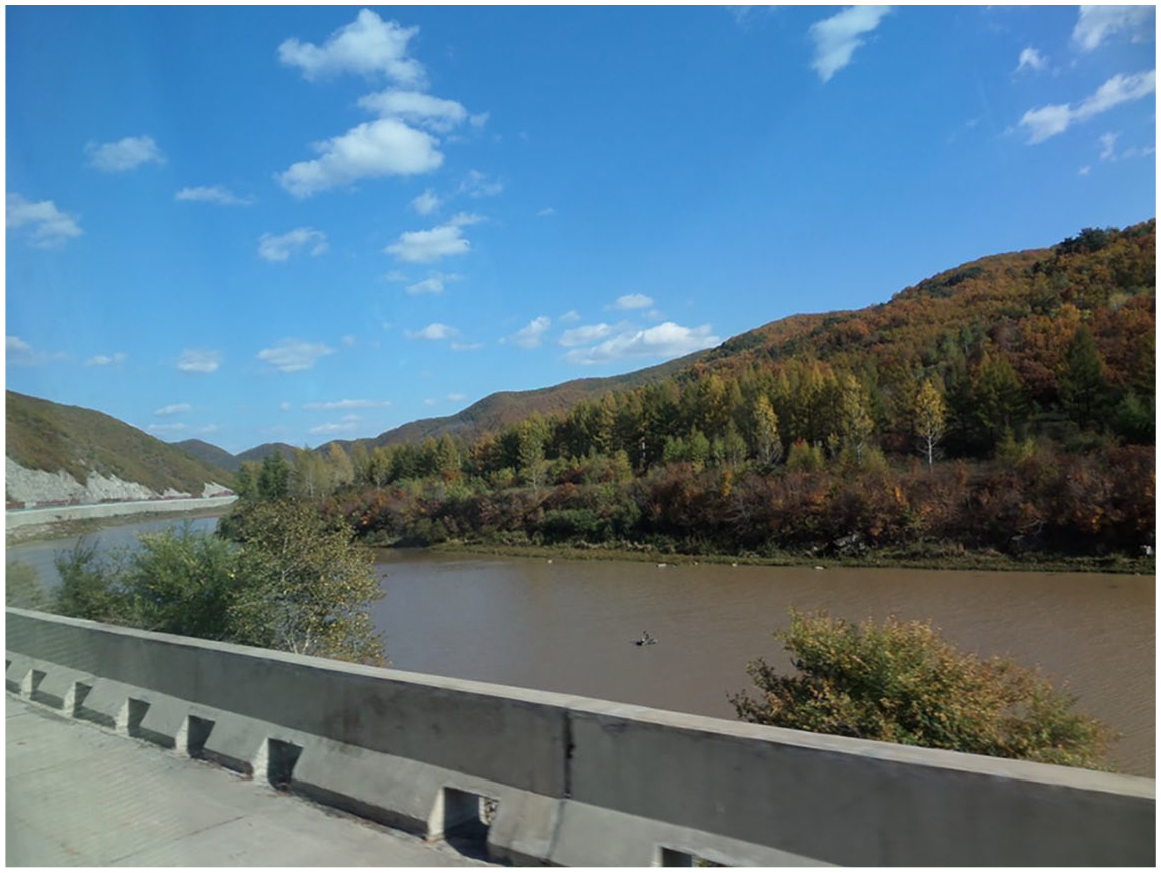
Woods along the Buerhatong River 布爾哈通河 west of Hunchun (photo by author).
Mirrored Alterities
However fear-induced, poor understandings of their neighbors thus obscured from many Russians the fact that their own circumstances mirrored those of their notional foes. For one thing, banditry was a practice with a local history long pre-dating the first Russian arrivals of the 1850s–1860s. With Manchuria having been kept off-limits to Han or Korean settlement under the Qing, those settling in this harsh region before the late nineteenth century were often already outlaws by definition, and engaged in hardy lifestyles as “ginseng-” or “sea cucumber-gathering bandits” 參賊 or “gold-mining bandits” 金匪. But as Korean and Han settlers fled Hamgyŏng and Shandong famines from the late nineteenth century, this relatively modest population was vastly outnumbered and new gangs of “red-beards” (honghuzi 紅鬍子, Kor., honghoja) proliferated. Though administrative fragmentation makes figures difficult to calculate, Billingsley (1988: 29–32) reports that Jilin had the largest Manchurian bandit population, with around eight thousand forming gangs several hundred strong by the 1920s, including around Hunchun. The origin province of Shandong was itself a bandit hotspot, and as famine, war, and the Japanese invasion of northern China in 1937 saw bandit numbers explode (Billingsley, 1988: 33), more migrants were driven northeastward (including to eastern Russia). Like the Boxer movement earlier, this in turn brought further bandit and secret society activities to Manchuria. 8 Even among those not officially labeled “bandits,” migrants were also increasingly engaged in “hinterland industries” such as gold mining or opium farming (Lee, 1983: 25).
In these circumstances, most peasant families owned guns and formed armed village protection groups to defend against honghuzi whom Chinese settlers, like their Russian counterparts, saw as a coalescence of human and natural Othernesses (though without yellow peril connotations). This is evident both in accounts from the time—Daur scholar Urgunge Onon describes, for example, “strange, wild-looking” opium-smoking Han bandits, “an outside, foreign scourge” in Caroline Humphrey’s interpretation (Humphrey, 1996: 41–43)—and in the very term honghuzi, or simply huzi 鬍子—”beard”—for short. Although having obscure origins, 9 this epithet reflects historical associations in China proper between the notionally wild and intimidating character of people(s) to the north (Zhao, 1978: 509) and their repulsive hairiness, a pervasive marker in Chinese constructions of ethnic difference (Dikötter, 2015: 29–30). Not necessarily bearded but distinctly alien, honghuzi would melt into and out of the wilds and, like many Primore Chinese described by Arsenev, were a mix of both full-time “professional” and “occasional” bandits 農匪. Many would “go bandit” 落草 when times were tough but then later return to farming, slipping into and out of banditry as necessary.
Connotations of menacing hairiness are also carried by the colloquialism maozi 毛子 (“hairies”), long used by northeastern Han to refer to Russians, 10 and indeed, at times Shandong migrants’ experience mirrored Russian khunkhuzy fears still more precisely. With Slavic settlers faced by comparable economic precarity, and with eastern Russia long having been a refuge for fugitives from Tsarist authority, gangs of Russian bandits (Rus., bandity, razboiniki, grabiteli) also roamed the taiga. Arsenev’s own indigenous Nanai guide Dersu Uzala was robbed and murdered by such people (see Pulford, 2017: 539), and Cossacks themselves—spearheads of Russian imperialism charged with combating khunkhuzy—were viewed ambivalently by Russians as half-bandits incapable of productive labor. From the Chinese point of view, these were Efei 俄匪 (“Russian bandits”), purveyors of an inverted ethnic banditry.
Bandit attacks were thus meted out indiscriminately by all on all. Class distinctions sometimes played a bigger role than ethnic difference on the frontier, as combating bandits motivated cross-border collaboration between authorities: in 1902 during the anti-Boxer intervention, a Chinese general sought permission from a Russian military commissar to use the China Eastern Railway to transport salary payments from Jilin City to his troops in Hunchun (Sokovnin, 1903: 217). In these circumstances, and with “frontier banditry” being considered so institutionalized as to comprise a dominant social form (Lattimore, 1932: 225), quite who was and was not a bandit could be hard to fathom. Even apparently more organized conflicts were fought by whole bandit armies who offered their raiding skills and local knowledge to competing adversaries in the Russo-Japanese War (1904–1905), the Russian Civil War (1917–1922), the Chinese Civil War (1927–1950), and the armies of Zhang Zuolin or Japanese occupants (Landis, 2008; Li, 2012), conflicts to which I turn below.
Where understanding Manchurian bandits theoretically is concerned, this willingness to serve power groups set them apart from the “social bandits” theorized by Marxist historian Eric Hobsbawm (1972). Hobsbawm’s ideal-type social bandit operates beyond the laws of superordinate groups and in harmony with the peasant masses, possessing “no ideas other than those of the peasantry” (Hobsbawm, 1972: 17) and defending rural justice. As Manchurian bandits sold their services to diverse paymasters with little sympathy for the Chinese, Korean, or Russian peasantry, they were often much more similar to the figures described in the most prominent contestation of Hobsbawm, that of anthropologist Anton Blok. Drawing on work in Sicily, Blok sees bandits seeking mainly their own benefit and “political protection,” collaborating with powerful groups and, rather than standing up for the peasantry, “quite often terroriz[ing] those from whose very ranks they managed to rise, and thus help[ing] to suppress them” (1972: 496). Local settlers at the time recognized this and, upholding a view that bandits were “strong-armed, recalcitrant, antisocial individuals engaged in a futile personal vendetta against all and sundry” (Billingsley 1988: 9), liberally deployed the “bandit” label as a means of discrediting enemies or rivals, regardless of nationality, level of organization, or agenda.
Yet although pejorative and homogenizing characterizations are understandable—people stealing, kidnapping, and gouging to serve any master invite little empathy—it is important that outlawry only makes conceptual sense if established codes offer a plausible way of existing within a society. As already discussed, the inchoate situation around Hunchun and beyond offered little such legal alternative, and Russian, Chinese, and Korean locals simply sought to survive an ambiguous age wherein political and social order, and a sense of where history was going, had all broken down in equal measure. Often being mere foot soldiers in a justice-free war of all against all, bandits should thus not be characterized so pejoratively, and indeed, even among those most threatened by them, negative views were not universal. Curiously, while living up to Blok’s characterization in reality, bandits in early twentieth-century Manchuria were in fact just as often idealized in a fashion more similar to Hobsbawm’s vision.
Romance and the Greenwood
The fact that bandits were, despite their fearsome strangeness, paradoxically also viewed positively—romantically even—is key to understanding the importance of their legacy to later events. Both the actual predations of ignoble Blokian figures and the idealized Hobsbawmian vision of honghuzi as noble, Robin Hood-esque bandit-heroes would be appropriated by Communist guerillas. Hobsbawm’s interest in the mythologization of banditry in many global cultures coalesces with his view that bandits’ closeness to the rural masses means that at “great apocalyptic moments [. . .] they become soldiers of the revolution” (1972: 29). But just as important as the revolutionary potential of Manchurian bandits (a subject discussed locally which will be revisited below), is the fact that myths around them were closely bound up with the quasi-ecological alterities they embodied.
Valorizing visions of bandits among Chinese, Russian, and Korean settlers (who shared some knowledge of Chinese legends) often drew on literary tropes. In the Chinese tradition, as scholar of northeastern literature Pang Zengyu observes, romanticization of bandit lifestyles owed much to Shi Naian’s 1592 novel Water Margin 水滸傳 and the “Peach Garden Oath” 桃園結義 episode in another classic, Romance of the Three Kingdoms 三國演義. Water Margin describes the “vigorous and brave feats of 108 of ancient China’s greenwood heroes” 綠林豪傑 (Pang, 1995: 120), encoding a cocktail of companionship, morality, righteousness, and a preference for death over seeing injustices perpetrated on one’s fellows. This is what Hobsbawm calls the “greenwood ethic,” and indeed Water Margin’s bandits hide out in wild “greenwood” 綠林 of Shandong’s Mount Liang, addressing one another with masculinizing labels as haohan 好漢 (“real man”) and dismissing rival, ignoble bandits as tufei 土匪 (“dirt robber”). Such visions pervaded China (Water Margin is set in Shandong and Romance of the Three Kingdoms on the Central Plains), but Manchurian bandit cosmology was especially rich. The northeastern “horse bandit” 馬賊, a Japanese-origin term pronounced bazoku and applied to all regional bandits mounted or not (Zhao, 1978: 509), mythologically rode vast distances, slept on horseback, and accurately fired arrows with both hands. As post-imperial successor to the rugged Manchu-Qing horseback archer, Manchuria’s former legendary residents, the horse bandit embodied, like his forebears, a martial 武 masculinity setting him apart as a rugged Other from archetypally scholarly 文 Han males.
Russian and Slavic folklore too had for centuries been populated by personages like the “fine young lad” (Rus., molodets) and Cossack bandit-heroes bearing many of the traits of the haohan. Literary examples from roughly the same period as Water Margin saw Tsar Ivan the Terrible figure in (generally fictional) encounters with the celebrated molodets in song cycles and poems (Perrie, 2002: 234–48). Elsewhere in the Slavic world there were Bulgarian and Ukrainian haiduks or haidamaks and stories of Russian razboiniki (a word commonly associated with Cossacks) engaged in martial heroics at the Russian Empire’s mountainous and restive Muslim/Christian fringes. The wild frontiers were key theaters for the emergence of the noble Cossack bandit-hero who, echoing the haohan-tufei distinction drawn above, was juxtaposed with dastardly “bandit-robbers,” generally representatives of the adversary Ottoman Turks, Circassians, or Chechens. 11 Indeed, just as most of the Hunchun frontier’s Chinese residents came from highly bandit-populated Shandong, its Russian Empire transplants originated from precisely the haidamak homelands of Ukraine and southeastern Europe. Such trans-Eurasian echoes were not lost on contemporary observers, and one China-based publicist wrote of the Boxers, “they are not robbers or madmen, but an uprising of armed patriots. They are like the renowned khunkhuzy who in turn are the same as the malorossy haidamaks or the Serb hadjuks of the past” (quoted in Datsyshen, 2001: 17).
Admiration for the greenwood ethic even extended to interethnic praise for bandit noblesse, at least in the Russian-to-Chinese direction. Chroniclers of the time, including N. Rudokopov, a coal prospector, wrote sympathetically of the khunkhuzy he encountered near his Manchurian mines who, fading in and out of the trees, were “just as mysterious as the magnificent and mighty Manchurian forest” (1910: 927). The importance of bandit-hero embeddedness in the natural setting, which permitted them to evade law enforcers and predate on recent settlers, was also common to all sides. The outlaw ethic of heroes like those in Water Margin was associated with life in the jianghu 江湖, a term literally meaning “rivers and lakes” which serves as an environmental metaphor for the murky but noble underworld that later became the backdrop for thousands of wuxia 武俠 (martial arts) novels. Other Chinese terminology speaking of bandit terroir includes shanlin 山林 (lit., “mountain and forest”), caokou 草寇 (“grass bandit”), and even the derogatory tufei. Chinese and Russian migration to the wooded Hunchun frontier thus furnished a richly evocative landscape for conjuring visions of justice-dispensing bandit-heroism.
Further evidence of this is provided by returning a final time to Russia’s 1900 intervention in Hunchun. Being an important garrison, Hunchun was one of few Chinese borderland places where the Russian advance met significant resistance, yet it was not a Boxer group that offered the stiffest opposition but a formation known as the Loyal and Righteous Army 忠義軍 led by Liu Yonghe 劉永和. Born into a Shandong migrant hunting family, Liu received the nickname Bullet 單子 early in life for his rifle skills and embodies much of the multivalent nature of bandit identity and labeling during the time. Later PRC accounts note that after suffering persecution from Qing officials, the young Liu hid in the greenwood around Hunchun before creeping into Russian territory in 1900 at the first signs of the Cossack invasion (Zhang, 2013; Li, 1985: 21–22; Jin and Huang, 1987). Near Vladivostok he assembled a fighting band from among local Chinese workers who then conducted sabotages on Russian military facilities and storehouses before reentering China. Thereafter, Liu’s burgeoning army extracted resources from local landlords and conducted anti-Russian activities from forest encampments. Outside official historiography, Liu’s anti-Russian activities are disputed (Zhao, 1978: 512–13), but for PRC History he features in the pantheon of unwitting anti-colonial proto-heroes of China’s Communist age. 12 Crucially, this rests on an image of him that foregrounds his purported “sense of justice” 正義感 and ornery desire for liberty and independence (rejecting both Boxer affiliation and Qing authority). He and his peasant, hunter, miner, and woodsman Loyal and Righteous Army are cast as quintessential Manchurian bandit-heroes. Improbably, but equally importantly given later territorial change, he is also said to have fought under the slogan “Defend against the Russian crown, restore our country’s land 國土!”
Liu’s case shows how romanticized visions of the Manchurian outlaw made vilification of one’s enemies as bandits a double-edged sword. As stressed here, real bandit careers rarely lived up to romantic dreams of swashbuckling masculine adventure. But later efforts by Communist movements to harness the myth demonstrated its power. As revolutionary cataclysms forced Hunchun frontierspeople to engage with bandit terrain and practices, partisans came more and more to draw on the bandit inheritance. Seeing how these in turn were elevated within national Histories allows us to reappraise state- and border-making in Manchuria, for the new states (USSR, PRC, DPRK) emerging here relied not on the pacification of violent unruliness or frontier masculinity, but on their nationalization.
Partisans
Hunchun and Manchuria’s overlapping frontiers became trifurcated into national spaces as bandit places and practices were recast as partisan ones, through both lived human experiences and their later narrativization. Because of frontier overlaps, Russia’s (1918–1922) and China’s (1927–1950) Civil Wars and Korean, Chinese, and Russian campaigns against foreign—especially Japanese—incursion here were all intertwined. The activities of local partisan and guerilla fighters (collectively termed “partisans” here) from all ethnic groups were in turn tightly enmeshed with the bandit world in both practical and conceptual ways: while actual partisan activity was lodged in the above-described “greenwood,” the “bandit” label was discursively deployed to discredit one’s enemies. Leftist debates also raged over where bandits fit into revolutionary struggle. Later glorified as heroes in the conflicts through which the USSR, PRC, and DPRK emerged from Manchuria’s opaque sociopolitical conditions, partisans resembled bandit-heroes in their embodiment of ethics of fraternal loyalty, commitment to justice, and, crucially, the elision of these practices with their surroundings. Given this last fact, elevation of partisans as vanguards of national Histories had unprecedented spatial consequences: as the overlapping frontier 邊疆 space was riven with military fronts 疆場, 13 slices of terrain around Hunchun now identified as arenas for nationalist partisan action were recast as bordered Soviet, PRC, and DPRK territory. Showing how this occurred, firstly in the Russian and then the Chinese and Korean cases, I rely on sources variously considered history, biography, or fiction, but in fact, as I show, difficult to separate along these lines. The below is not meant as a comprehensive history of the conflicts discussed, and such should be sought elsewhere. 14
Primore’s Palimpsest Partisanry
As the Red Army advanced slowly eastward from European Russia over the five years following the 1917 October Revolution, a host of small-scale, Russian leftist-led conflicts erupted to Hunchun’s east. Inspired by the Bolsheviks’ seizure of power and often responding to efforts by White Tsarist forces to recruit local villagers against the Reds, partisan activity began in earnest in summer–autumn 1918. Following a brief seizure of Vladivostok by leftist returnees from China, which was rapidly quashed by a Japanese and U.S.-led military intervention, fighters withdrew into the wilder terrain which dominated Primore. 15 Most were stolid members of the local migrant populace, and thus resembled figures described in Carl Schmitt’s (1963) Theorie des Partisanen, an expansion of his better-known Begriff des Politischen and the most comprehensive treatment of “partisanry” in Western social science. Schmitt’s main argument, resembling Hobsbawm’s about bandits, concerns what he terms the “telluric” land- and community-bound nature of partisans. In Primore these local roots had an importance perhaps even more literal than Schmitt intended, for the partisans’ woodland theater was richly evocative of the multiple frontier histories that were about to be overwritten here.
Local toponyms formed a palimpsestuous mélange of East Slavic and Sinitic, inscribing distinct migratory folk histories in a manner similar to many southwest American Apache places discussed by anthropologist Keith Basso (1996). Ukrainian transplants had named their settlements Novokievsk (“New Kiev”), Chuguevka (after Chuhuiv, eastern Ukraine), Khmelnitskaia (after Khmelnytskyi, western Ukraine), and Kievka, among other diminutive memorials to pasts at the opposite end of Russian imperial space. 16 By contrast, Primore’s natural features bore the nomenclature of the mostly Han Chinese taiga-exploring “ginseng bandits.” Early partisan resistance thus occurred in districts named both Khmelnitskaia and Tsimukhe (Ch., Qimuhe 杞木河, “willow river”). March 1919 recruitment in the Tadushu valley (Ch., Dazuoshu 大柞樹, “large oak”) by forces loyal to Admiral Kolchak, the strongest anti-Bolshevik bulwark in Siberia, saw residents of Tetiukhe (Yezhuhe 野豬河, “wild boar valley”) help locals seize the village of Olga. But having tellingly suffered a khunkhuz raid in 1916, Olga’s telegraph office workers were steeled against attack and managed to relay news of the uprising to Vladivostok. The following day White troops arrived by boat and retook the village, forcing the partisans to retreat into the woods and transfer their headquarters to Chufanka, a nearby Korean farmstead (Nazarova, 2013). By 1919 partisan activities were concentrated along the railway to the coal mining settlement of Suchan (Ch., Sucheng 蘇城). Led by Sergei Lazo (later a Bolshevik hero after being arrested by the Japanese in 1920 and killed by Cossacks who forced him into a running locomotive engine), the Olga partisans and others ambushed the mines’ Whites and interventionist guards at railway stations including Chinese-named Fanza and Sitsa (Borbat, 2015).
Also joining the Suchan raid were Korean partisans led by early twentieth-century Korean migrant Han Ch’angkŏl. Like the Chinese toponyms, this group, formed in February 1919 in Sinengou, a nearby village founded in 1868 by migrant Hamgyŏng peasants, further attested to the practical and conceptual entanglement of partisanry with banditry. Korean groups showed that, like bandits, partisans were highly heterogeneous: John Stephan (1996: 136) estimates that over fifty thousand “partisans” in two hundred groups roamed the Russian Far East by 1919, including those who considered the Bolsheviks “meddlesome outsiders” or merely “called themselves partisans [. . .] to confer a patina of legitimacy on plunder.” Even Primore’s Koreans, generally well-marshaled leftists, were divided, some backing Socialist Revolutionary forces and others variously prioritizing struggles against the Whites, the intervention, and the bigger target of Japan’s occupation of Korea (Naumov, 1992). Some were prepared to fight leaders with Japanese ties (e.g., Siberian White ataman Semenov), but not Kolchak (Stephan, 1996: 136), and disagreed over allegiance with Russian groups.
As well as resulting from divergent revolutionary goals, this diffusion stemmed from the above-mentioned fragmentation of local governance. Before and after the 1920 collapse of Kolchak’s Siberian regime and the establishment of the Far Eastern Republic (Rus., Dal’nevostochnaia Respublika) as a buffer between Soviet and Japanese interests, dozens of local governments of all stripes rose and fell. After periodic assaults from Russian, Korean, Chinese, and Magyar partisans (Borbat, 2015: 10–11), Vladivostok was finally taken by the Reds in October 1922, but Bolshevik newspapers candidly acknowledged that this was hardly the binary Red-over-White victory that Soviet historiography would later proclaim. As the Uralskii rabochii reported on October 28, 1922, the city had seen “changes of government almost every week [and] lacked the hallmarks of real ‘statehood’ [gosudarstvennost’]” (Pak, 2013: 299).
Partisanry was also difficult to disentangle from banditry because, somewhat ironically, both Reds and Whites employed local Chinese “illegal workers” (Rus., chernorabochie), “smugglers” (kontrabandisty), “down-and-outs” (liumpeny), and khunkhuzy. For the Bolsheviks, regionally atypical proletarian populations like the Shandong miners who made up over a thousand of the 1,633 workers at the Tetiukhe lead and silver pits (Kolesnikov, 2002) were targets for revolutionary agitation, while in 1921 the Russophone Chinese agitator Xin Diu was dispatched by them to Jilin to recruit among Zhang Zuolin’s former-khunkhuz soldiery. Partly because of language difficulties, however, neither side was very successful in attracting Chinese fighters (Zalesskaia, 2006: 74–75). 17
Under these circumstances, labeling adversaries “bandits” appeared natural. White commanders warned of “being torn apart by Red bandits,” Bolsheviks declaimed their foes as “White bandits,” and Han’s Koreans fought enemies comprising “Japanese, Americans, khunkhuzy and Kolchak forces” (Pak, 2013: 159, 234, 286–87). Bandit-labeling was also common elsewhere in the Russian Civil War where it was “a weapon in the arsenal of political rhetoricians” (Landis, 2008: 119), but the epithet resonated especially in Manchuria given local banditry’s legendary ubiquity. Here bandit-definition formed part of a process of forging a single moral-Historic storyline out of a situation in which there was no established order: as one Olga partisan memoir put it, this was a smutnoe vremia—“confused/foggy/troubled era” (Nazarova, 2013: 110).
As an insurgent force, the Bolsheviks were engaged in semiotic as well as kinetic warfare, and, like Bullet Liu’s Zhongyijun laying claim to yi 義 “righteousness” against fei 匪 scoundrels, applied the term “bandit” to those violating the projected rightful order of a hoped-for future. With the war on two fronts won, opponents of the new order would be “reduced to banditry,” Bolshevik newspapers declared (Pak, 2013: 299). Subsequent Soviet accounts portray the Red advance on Primore as an unstoppable, unified campaign against Whites who, like the poorly understood khunkhuzy before them, are dismissed as a single substitutable mass of errant counterrevolutionary bandits and ridiculous foreigners such as the interventionist “kind American uncles” (Shishkin, 1957: 75). Labeling these people “bandits” was half the task of forging this hilly, forested region into a realm of Soviet power, what Yael Navaro-Yashin (2012: 5) calls a “make-believe space” of the state. Next came a second stage involving both political “believing” and material “making,” as space historically inhabited by alien bandits was transformed into the territory of nationally conscious partisans.
Partisan warfare had indeed occurred in old bandit haunts using many bandit methods, sabotaging infrastructure, plying the littoral in hijacked vessels, using appropriated enemy weaponry, and relying on strong knowledge of locale (Rus., mestnost’) to outmaneuver clumsier—alien—enemies (Borbat, 2015: 45–46, 59–63). Through arduous periods of communion with the taiga, recent migrants developed Schmittian telluric bonds in ways impossible for urban White elites and blundering foreign interventionists. Partisan commander V. E. Serzhant described days of skulking in sodden woods before an August 1919 ambush on the Tetiukhe railway: “we ate nothing, got soaked and froze to our bones since we could not set an open flame.” After the attack Serzhant’s men were pursued deep into the taiga (Rus., v glukhuiu taigu) (45–47). Similarly, when Japanese soldiers attacked a hideout in Vladimiro-Monomakhe in Tetiukhe district, local partisans “returned through the taiga and along the coast to [their] native places [rodnye mesta]” (67). After their assault on Suchan, Lazo and his forces “scattered throughout the taiga and hills” (Shishkin, 1957).
Notwithstanding the conflict’s moral and military ambiguities, therefore, the trove of human material which it generated amidst “foggy times” and imperial collapse allowed for a new history of place to be written. Wartime experiences in Suchan, Olga, Tetiukhe, Tadushu, Tsimukhe, and Sinengou became the heroic Histories of Ukrainians, Russians, Chinese, and Koreans (later deported, see below) who would now be Soviet Far Easterners. The “valleys and hillocks” (Rus., doliny i vzgor’ia) extolled in Petr Pafenov’s 1922 song “March of the Far Eastern Partisans” (Dushenko, 2016), a frontier setting whose toponyms attested to layered Ukrainian/Chinese arrivals, entered a new national cosmology. Later rifts in the cosmos between the USSR and PRC would make the lodging of Soviet myth in Chinese-named places unacceptable, and prompt a still-deeper inscription of partisanry in the landscape. But before that, parallel processes would be wrought by Chinese and Korean fighters, to whom I now turn.
Sino-Korean Osmosis
To approach the guerilla campaigns of the Chinese Civil War (1927–1950), Second Sino-Japanese War (1937–1945), and Korean independence struggles (c. 1905–1945), which were intertwined around Hunchun, we follow the White Russians who fled Primore after the 1922 Bolshevik victory. Many escaped to China and Korea aided by Japanese forces who had occupied Novokievsk, Slaviansk, and Poset (see Figure 1), limping by sea to the Japanese-Korean port of Wonsan (Gattenberger, 1974) or overland to Hunchun where two thousand regrouped before moving further into China (Luchsheva, 2006: 25–26). The total of thirty thousand Russian refugees who entered China following the Civil War were as diffuse as Bolshevik mocking of their motley “banditness” implied, and many subsequently wandered Asia, often stateless, 18 expressive by their very existence of Patrikeeff’s frayed Manchurian “patchwork.”
The Hunchun where the White refugees gathered in 1922 was especially frayed. Despite modernizing schooling and trade here, late Qing empire-wide reforms had failed to prevent the collapse of the dynasty in 1911, although Hunchun’s unraveling had begun well before the shuddering end of Qing History. Japan’s subordination of Korea as a “protectorate” (1905) and then a colony (1910) made the two-thirds Korean population of Kando 間島 (Ch., Jiandao, as the area around Hunchun was then known) sources of particular interest to ethnically minded authorities in Tokyo and Seoul as potential Japanese citizens. The 1909 Qing-Japan Kando Convention affirmed the area as Chinese territory, but permitted the 1910 opening of a Japanese consulate in Hunchun and deepened what sociologist Hyun Ok Park (2005: 96) terms Japan’s “osmotic expansion” into local politics and markets.
New interests provided a pretext for measures to defend Japanese and Korean property, and suppressing “horse bandits” and defectors from Zhang Zuolin’s army served to justify increasingly martial interventions: by 1917 Japanese troops were permanently stationed in Hunchun (Park, 2005: 388–89). Yet those whom it became most expedient to label “bandits” were anti-Japanese Korean nationalists and partisans, a vast array of whom operated here with varying allegiances to the official Korean Independence Army (Kor., Taehan tongnip-gun), Northern Military Administration Office (Pungnogun jŏngsŏ-gun), and the Shanghai-based Provisional Government of the Republic of Korea (Taehanmin’guk Imsi Chŏngbu). 19
Around the 1919 conflagration in Korea and Kando of the anti-Japanese March First Movement (Kor., Sam-il undong), engagements with bandit armies at Pongodong and Chŏngsan-ri in countryside around Hunchun (Figure 1) saw Japanese forces suffer notable losses. Following these, the controversial October 1920 Hunchun Incident (Kor., Hunch’un sagŏn) saw bandits burn down Hunchun’s Japanese consulate, loot shops, and kill consular police, prompting the dispatch to Kando of twenty thousand Japanese troops who executed over six thousand Korean civilians. 20 Demonstrating ongoing trans-frontier resonances, this severe Japanese reaction, coinciding with the Primore crackdown which captured Bolshevik Sergei Lazo, has been attributed to paranoia following a March 1920 Russian partisan assault on the Japanese consulate at Nikolaevsk-on-Amur (Esselstrom, 2009: 74).
But as Soviet place-making accelerated east of Hunchun following the 1922 foundation of the USSR, threads knitting the frontier together were severed. Reassigned for military purposes, Vladivostok closed as a free port, impacting riverine and land-based commerce from Hunchun (Li, 1991: 348–49). Zhang Xueliang’s 1929 attempted seizure of the Soviet-controlled Chinese Eastern Railway also prompted greater border-marking by bolstered Soviet and Chinese patrols (404–7). Such developments, and the loose grip of Zhang and the Nanjing-based Republican authorities, facilitated further influxes of Japanese commerce, whose trade in everything from soybeans and radishes to tiger and bear pelts was by 1931 worth over forty times what Hunchun was exchanging with either Russia or other places in Jilin (348–49). Hunchun’s enfoldment within Japanese military, commercial, and diplomatic logics thus made Tokyo’s full September 18, 1931, invasion of Manchuria a quantitative rather than a qualitative change locally. But this and the 1932 establishment of the Manchukuo state, which also brought more Koreans to the area, proved definitional for ordinary Shandong and Hamgyŏng settlers. Amidst dynastic collapse, occupation, and weakened ties to the center, their experiences, like those of their Soviet contemporaries, would transform a bandit realm into territory of revolutionary partisan-heroes.
Blurred Lines
As earlier in Primore, the entanglement of the bandit and the partisan worlds was a matter of both practical action and narrative. The ubiquity of Chinese Manchurian bandits, whose estimated numbers trebled to 58,000 between 1924 and 1929, made them a key practical and ideological concern for all sides. For the Chinese Communist Party (CCP) and its Manchurian Provincial Committee, established in 1927, policy vacillated throughout the 1920s–1930s between assembling a movement of “workers, bandits [honghuzi], farmers and soldiers” and total discouragement of bandit cooperation (Lee, 1983: 24–26). Though Mao Zedong, a student of Water Margin, which he often carried with him, saw bandits’ revolutionary potential (Schram, 1971: 126), the Soviet-backed Comintern feared that Communist associations with the chaos sown by Manchurian banditry would provoke another Japanese intervention into the nascent USSR (Lee, 1983: 73–86). Consequently, CCP organization bore the usual regional hallmark of fog and confusion, a feature magnified by divisions among Han and Korean Communists (Lee, 1966). Amid rampant competitive bandit-labeling, Japanese forces feared “control of other bandit groups by the Communist bandits [Jpn., kyōsanhi]” (Lee, 1966: 245), and launched campaigns known as “wipe out bandits using bandits” (Kor., ibijŏngbi) (Kim, 1999: 7-1.131). 21
Literary sources, both contemporaneous and penned later, provide more detailed evidence of the elision of the haohan bandit-hero and the revolutionary partisan. In one PRC-era morality tale entitled Guerillas Seize Cattle in a Night Raid on the Pasture 游擊隊夜襲牧場奪黃牛 set in spring 1932, a band of Communist Youth League members appropriates several dozen cows from Han Shasan, a local “tyrant landlord” 惡霸地主 and “running dog” 走狗 of Japanese imperialism. Confronted by Han’s hired hands, the nimble, virtuous raiders politely inform them that the cows are “traitors’ property” 逆產 and must be taken (Li, 1985: 31–32). Like the above stories about Bullet Liu, these possibly entirely fictional accounts exaggerate their protagonists’ national consciousness and inflate CCP involvement. But read alongside more expansive texts from the time, they exemplify intricate guerilla-bandit entanglements.
Here I draw on two works, Han Chinese author Luo Binji’s 駱賓基 1936 Hunchun-based novel On the Borderline 邊垂線上 and later DPRK President Kim Il Sung’s swashbuckling auto-hagiography With the Century (Kor., Segiwa tŏburŏ). Although classified as generically different, both books lie somewhere between revolutionary fiction and autobiography, and thus serve as rich ethnographic sources if studied in the analytical manner that anthropologists Richard Handler and Daniel Segal approach Jane Austen’s work (1990), or historian Thomas Lahusen examines socialist realist fiction (1997). Neither Luo’s nor Kim’s text eschews hyperbole or schematic friend/enemy representations, but their (however fictionalized) accounts of revolutionary lives are revealing of “the (often conflicting) cultural principles that structure the negotiation of social life” (Handler and Segal, 1990: 155). Most importantly, since Luo is among a widely read and taught group of northeastern Chinese anti-Japanese wartime authors, and With the Century has been DPRK classroom gospel since the 1990s, each not only describes but partially constitutes the actually existing History of their later-formed respective states. They can therefore be understood to reflect both data and analysis in the making and believing of national space in Manchuria. Through guerilla warfare disparate Shandong and Hamgyŏng settlers forged new relationships to land and time, and entered bandit-hero-esque blood brotherhoods.
On the Borderline follows Liu Qiang, the son of Hunchun Han migrant-landowner Liu Lin, and perhaps the hero Luo Binji wishes he had become. 22 Like Luo’s own father, Liu Lin has arrived from Shandong and employs Korean tenant farmers in Hunchun’s wooded outskirts. As Hunchun wilts under Manchukuo colonial oppression and local merchants go bankrupt under Japanese market domination, Liu Qiang joins a guerilla force which, alongside bands of Korean Communist partisans (the “Korean Reds” 高麗紅黨), lurks in the woods near the Russian and Korean borders. Liu Lin is distressed by his son’s disappearance (intergenerational discord is a key theme, and Liu senior opposes anti-Japanese armed struggle) and, harassed by the occupying authorities who wish to seize his farmland for an airfield, is driven to an early grave. The narrative then shifts to follow his fellow Shandong migrants—sympathetically portrayed throughout as archetypally “stolid, patient and undemanding” (Gottschang and Lary, 2000: 10)—who, after laboring on a new Japanese railway into Korea, flee to the woods to join Liu Qiang. Led by Liu and a man named Pockmarked Wang Si, an experienced smuggler of Chinese opium to Vladivostok, 23 the group meanders through forests and along ridges pursued by the Japanese, dispersing to find food and conduct reconnaissance.
A run-in with a drunken Soviet border guard is followed by encounters with guerillas from the National Salvation Army 救國軍, among whom there is grim evidence of harsh revolutionary justice (an older Shandong man is executed for stealing some legwarmers), and of divisions between anti-Japanese groups (a Korean guerilla is imprisoned and abused). Appalled by this, Liu Qiang makes a powerful speech persuading his comrades of the righteousness of their cause and saying Han fighters should ally with oppressed Koreans. The closing stages of the novel are a period of tension and despair as the harried guerillas plaintively mourn their lost Shandong homes. With the Japanese closing in, Liu Qiang takes refuge with some comrades near the Soviet-Chinese-Korean triple border and suddenly, in the novel’s final scene, spies a red flag approaching over a hill: the much-desired link-up with the Koreans is on. “They’ve come!” he cries, and bounds off into combat.
Throughout the novel, the Shandong guerillas struggle to avoid succumbing to banditry, engaging in the same semiotic struggle pitching righteousness 義 against brigandry 匪 as in the Bolshevik case above. On one occasion Wang and another guerilla, named Kao Shan, debate raiding local farms for supplies: “Hopefully we’ll be sent legwarmers and coal soon. [. . .] We must not raid [搶] [. . .] We are not bandits [鬍子],” says Wang. “What if we are huzi? The huzi are also fighting the Japanese,” Kao replies, before Liu Qiang intervenes: “We are not huzi, we will do what we must to fight. [. . .] You’re cold? Everyone’s cold; you’re hungry? Everyone’s hungry.” (Luo, 1984 [1936]: 151–52)
Similar blurring pervades With the Century, where Kim observes Manchurian village defense forces “becoming bandits [t’obi]” amid hardship. Japanese propaganda about “communist bandits” (kongbi), he reports, also makes it hard “to distinguish righteous rebels [ŭijŏk] from bandits [majŏk]” (Kim, 1999: 3-2.156). The ŭi of ŭijŏk is the Koreanization of Chinese character yi 義. Recalling one day on March 1935, Kim reports entering a Han village north of Yanji (labeled with earlier appellation Nangang in Figure 1) only to have the entire population flee screaming about honghoja (red-beards). In a farfetched scene, he and his men resolve the situation by pitching camp in nearby woods and then, with Kim playing a foot organ, striking up a lusty rendition of the Chinese folk song Su Wu Tends Sheep in the local schoolyard. The villagers, Kim reports, thereby realize that “the Koryŏ Red Army [Koryŏ Honggun] is not a gang of bandits [pijŏk]” (4-2.188–91). 24 Echoing Liu Qiang, Kim must repeatedly deny intentions of plunder and explain, “I am Kim Il Sung, we are not bandits.” Confusion may be arising, he exasperatedly speculates, from the literal “red-beard” meaning of honghuzi and the association of red with Communism (4-2.198–99).
Guerillas, like the bandits with whom they are confused, are embedded in wild terrain. Luo’s novel opens with men emerging “dimly” 黑黝黝的 through the mist along the Russian border, their voices “harsh as frost, sharp as hailstones,” blending with landscape and climate (1984: 3). With the Century’s chapter titles evoke a “Snowstorm in the Tianqiaoling Mountains,” “Mount Paektu Secret Camp,” and “The Forest of Nanpaizi.” Yet while naturally impenetrable, this terrain remains politically permeable by agile partisans, and Kim crisscrosses the river Tumen to attack Manchukuo-Korea outposts. By the late 1930s, such raids provoked a Japanese military crackdown that sent guerillas fleeing into the USSR. But having passed eastward through Hunchun in 1940, Kim’s men are unsure whether they have crossed the border: “it was impossible to say where Manchurian territory [Manjuttang] ended and Soviet territory [Soryŏnttang] began,” Kim reports (1999: 4-2.232, 8-1.80). However, after discovering a sentry box containing a shoddily made Russian tea set (Kim misses few opportunities to criticize the Soviets to whom he owed his entire political career), he explains himself to a Soviet patrol by repeating his name and, tellingly, the word ppalch’isan (the Russian partizan borrowed into Korean) (1999: 8-1.82).
Luo also describes an opaque frontier whose transformation into bounded national territory is far from complete and, echoing his partisan forebear in Olga, one guerilla laments the “confused era” 混亂年頭 they are enduring. Sino-Korean relations are beset with alterity-reinforcing resentment and condescension: “who let them come and farm Chinese people’s land?” Wang wonders during the same taiga discussion (Luo, 1984 [1936]: 94). While communing with their frontier surroundings, Han guerillas nevertheless long for their “homes south of the sea” 海南家 near Laizhou 萊州, reflecting what Pang Zengyu (1995: 181) calls a Shandong-directed “cultural Oedipus complex” 文化戀母. Here in what much of China still considers a “wild” 野 place, the older generation’s identification with Hunchun is contingent. Deaths here express this poignantly, and at Liu Lin’s funeral his flimsy poplar wood coffin and red tasseled grave hat, which ridiculously makes him resemble a chicken, capture the cultural thinness of life here. To escape the Japanese, Wang plans to return to Vladivostok to resume opium smuggling, showing that Manchukuo and Soviet Primore remain a single frontier destination for Shandong migrants. But locally born Liu Qiang, who says he has “the lives of all Chinese people resting on [his] shoulders,” will continue to defend “Chinese hills and forests,” rejecting both banditry and exploitation of Koreans, predatory dimensions of frontier life (Luo, 1984 [1936]: 164). A new identification with place is emerging from the confusion.
New Time, New Inscriptions
The official Soviet, PRC, and DPRK partisan stories that would lodge in the Hunchun frontier’s old bandit haunts were more schematic and embellished than the ambivalent accounts of friendly fire deaths (Borbat, 2015: 90–95), Russian villagers’ White collaboration (Nazarova, 2013: 110), and dialogic intergenerational, or Han-Korean, struggle of On the Borderline. PRC history exaggerates the strength of the “righteous and courageous armies” 義勇軍 and the CCP’s role in their organization, while Soviet accounts eschew the partisans’ lack of strategic, never mind ideological, unity. Both marginalize Koreans. But the lived experiences of ordinary Ukraine or Shandong transplants in “confused times” (Rus., smutnoe vremia/Ch., 混亂念頭) was a broad slate on which to inscribe a new, unified national narrative. It was appropriate that the Russian intervention against the Boxers—named by the Qing after the Chinese cyclical year gengzi 庚子—where I began occurred only six months into the European twentieth century, for the new Histories written here would be lodged in new time. From “confused times” were wrought the “century” or “age” (segi) with which Kim Il Sung claimed to be walking in step, a “fateful” (rokovoi) or “great” 偉大 era as the period is respectively memorialized in Soviet/Russian and Chinese revolutionary accounts. The protagonists of this age, unlike the scholar-officials or generals of imperial times, possessed the agility, wit, commitment to justice and, most critically, the telluric rootedness of the mythic Manchurian bandit-hero.
Symbols of the new age became inscribed in text and territory. The Han Northeastern Writers Group 東北作家群, to which Luo belonged, explored the changes wrought on Manchurian lives under the dual onslaughts of Japanese occupation and modernity. These authors, like other northeastern intellectuals, promoted the notion that the anti-Japanese struggle in Manchuria was a Chinese concern, contributing to the development of modern Chinese nationalism countrywide (Mitter, 2000: 2–3). Later PRC critics, including Manchuologist Fan Qingchao (2011: 113), see Luo’s work as illuminating the “spirit of that great age” 偉大時代, while another literary scholar, Ma Junshan (1990), marrying temporal and spatial metaphors, notes that northeastern literature achieved a transition “from periphery to vanguard” 從邊緣道先鋒. Crucial then that this northeastern work is rooted in Manchurian spaces—Luo’s Borderlines, Xiao Hong’s Field of Life and Death 生死場 (1935), Duanmu Hongliang’s Egret Lake Melancholy 鴜鷺湖的憂鬱 (1936), and Xiao Jun’s Village in August 八月的鄉村 (1935). This instantiation of Chinese “regional culture” 地方文化, which, born of the northeast’s fertile loam, is known as Black Earth Culture 黑土地文化, rooted a migrant populace in these places and inscribed both into national history. The metaphorical “rivers and lakes” of the jianghu, and the wartime relationships forged in this semi-mythical realm were being re-concretized as state territory.
The socialist countries, whose verbose English-language acronyms—USSR, PRC, DPRK—reflected claims to abstract post-Enlightenment statehood, did act in starkly material ways to carve out distinct national sectors of the once-overlapping Manchurian frontier. New territorial and demographic regimes circumscribed land and populations, giving interstate borders, whose existence was also reaffirmed through military confrontations, new meaning. Preeminently a telluric process, Soviet collectivization sparked unrest and widespread anti-Korean and anti-Chinese violence during 1928–1932, forcing tens of thousands to leave Primore for China. Stalin’s 1937 deportation to Central Asia of over 170,000 Koreans then deprived the area of a previously aggregating frontier population, later written out of partisan history. Paranoia over Japanese/Manchukuo cross-border infiltration which had motivated the deportation combined with disputes over the location of Russo-Chinese boundary stones fixed in 1886 and burst into open conflict during the July–August 1938 Khasan/Zhanggufeng 張鼓峰 Incident southeast of Hunchun. 25 Poorly managed by competing Japanese political and military interests, the engagement was the world’s largest tank battle yet, a precursor to the better-known Nomonhan Incident, and a decisive Soviet victory. Confirming that new Histories were coterminous with new borders, Khasan/Zhanggufeng was also the USSR’s first combat engagement against a regular foreign army since its 1922 foundation (Karpov, 2013: 4).
Further national separation occurred as the Japanese were expelled from Chinese Manchuria in 1945 by a 1.5 million-strong Soviet army. Commanded by future Soviet defense minister Rodion Malinovskii, a Ukrainian who had reentered Russia through Vladivostok during the Civil War (Golubovich, 1988: 12), the Red Army was accompanied by Kim Il Sung and other Korean and Chinese guerillas who had crossed foggy borders in 1940. CCP guerilla operations in Manchuria during the latter phase of the Chinese Civil War (1945-1949) were known as the Northeastern Campaign to Suppress Bandits 東北剿匪. The “bandit” label now applied to the Guomindang and a baffling mix of “landlords’ militia, independent village self-defense corps, large, well-equipped remnant forces of the Manchukuo Army, Japanese Kwantung army stragglers, and various private armies” (Levine, 1987: 139–40). Communist guerillas still struggled to distinguish themselves from bandits, and one soldier named Chu Po 曲波 (Qu Bo)—in a typically evocatively titled memoir Tracks in the Snowy Forest 林海雪原—reports an incident mirroring Kim Il Sung’s 1930s song-singing episode. After Chu’s Chinese troops enter a Korean village, all the inhabitants hide for three days with their doors barred before being won over (Chu, 1978: 382–99). But eventually the CCP prevailed throughout Manchuria, which became the “Anvil of Victory” (Levine, 1987) for Communist supremacy across China.
The Hunchun frontier’s half-century of conflict finally ended following the 1950–1953 Korean War, and subsequently performed inscriptions of distinct Histories in territory itself remain legible today. The wooded hills of Yanbian Korean Autonomous Prefecture (founded 1952) are studded with hundreds of steles engraved in Chinese and Korean commemorating the “martyrs” (烈士/ryŏksa) of the Anti-Japanese, Civil, and Korean Wars (see Figure 3).
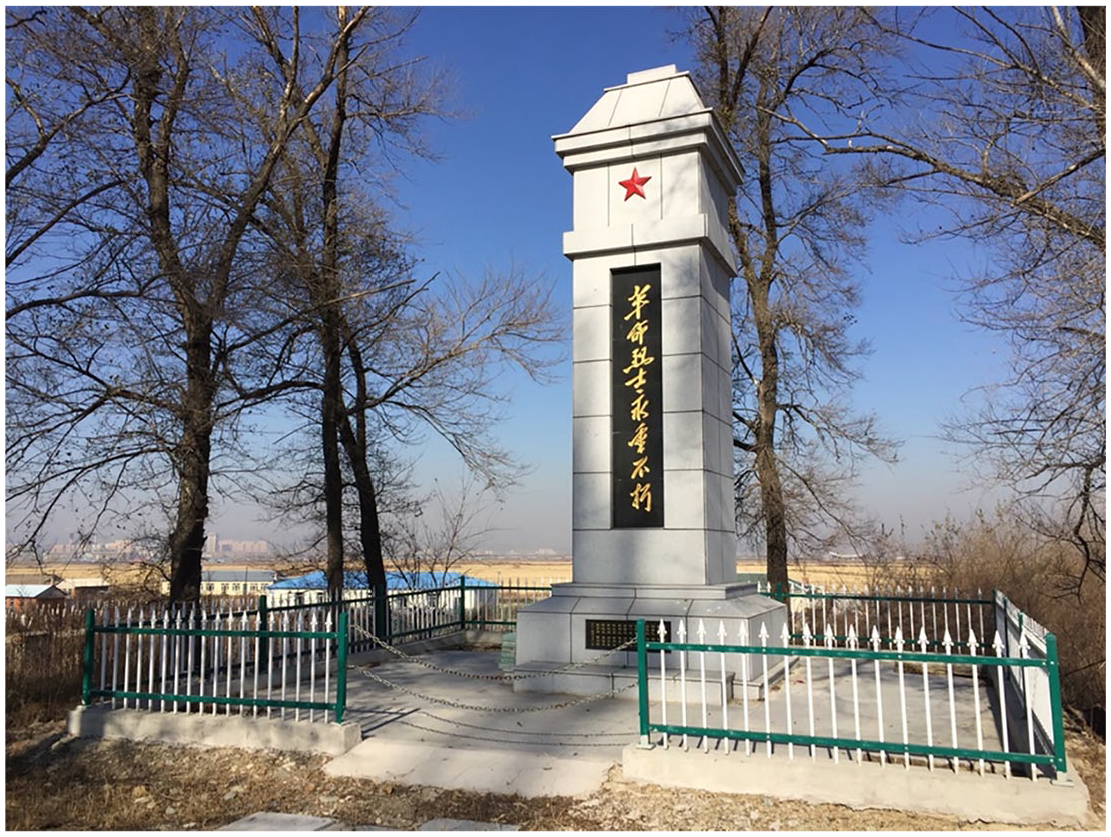
Martyrs stele at East Battery 東砲台, Hunchun (photo by author).
In the forests of DPRK’s Onsong county just over the Tumen, the Wangjaesan Grand Monument faces southward down the Korean peninsula, dramatic friezes at its base showing Kim’s guerillas stealing enemy weaponry, forging a new world out of old materials (see Figure 4).
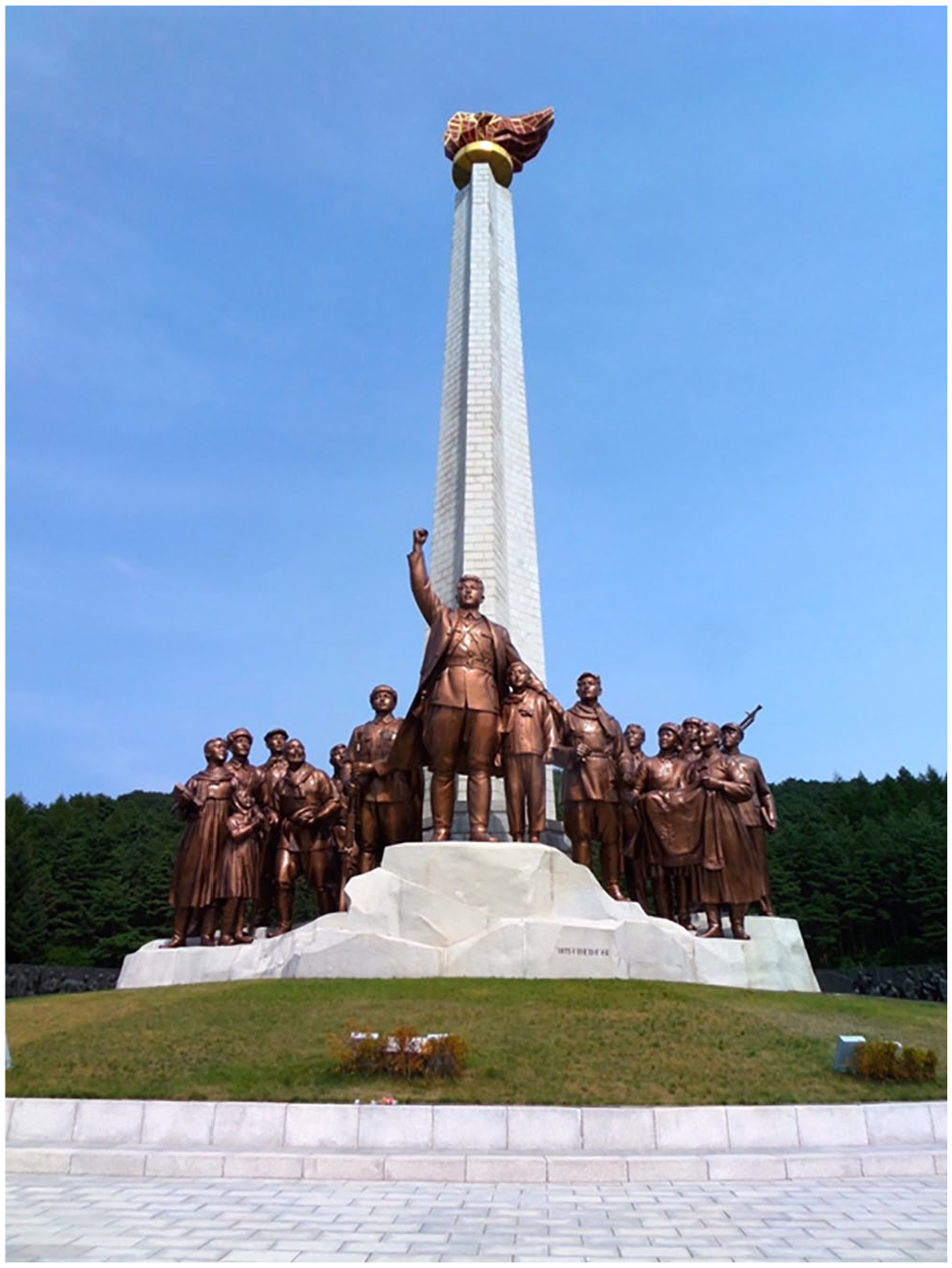
Wangjaesan Grand Monument, Onsong county, North Korea (photo by author).
Soviet memorials on the wild coastline once frequented by “sea cucumber bandits” commemorate the Great Patriotic War (World War II), but also uniquely mark the USSR’s first official conflict at Khasan, adding “1938” to the more typical dates “1941–1945.”
Finally, and among the most emblematic of all inscriptions in land around Hunchun, old “ginseng bandit” places were renamed. As Sino-Soviet relations soured during the 1960s (culminating in a 1969 border war), Sinitically inflected space became politically uninhabitable by Soviet people. In December 1972, fifty years after the Bolshevik victory in Vladivostok, Decree No. 753 of the RSFSR Council of Ministers allocated new toponyms to 239 places in Primore with Chinese-derived names (Sovmin RSFSR, 1972). Many changes evoked the heroics of a half-century earlier: Suchan became Partizansk (with outlying settlements Lazo and Avangard—”Vanguard”). Lazo gave his name to a river (Lazovka, previously Vangou), while the Tsimukhe River became Shkotovka, and the Tadushu Zerkalnaia. Other locations received functionally industrial/proletarian names: Tetiukhe became Dalnegorsk (“Far [East] mines”) and the nearby dock was renamed Rudnaia Pristan (“ore jetty”) from Tetiukhe-Pristan. 26
Conclusion
Today the figure of the righteous partisan is still celebrated at both local and national levels around Hunchun. The victory of agile Communist-organized guerillas over the Japanese remains a mainstay of school history teaching in the PRC (Duus, 2011: 107) and DPRK (Myers, 2010). Even if Russian history teaching has adopted a more nuanced approach to the Civil War in the post-Soviet era, partisanry remains a tenacious trope. In 2010, six youths from Kirovskii village near Ussuriisk calling themselves the Primore Partisans (Rus., Primorskie partizany) launched vigilante attacks on local police, receiving support from locals who lauded these acts of violence against corrupt authorities (Judah, 2013: 318). North Korea continues to celebrate its guerilla history, and some such as Koreologist Wada Haruki (1992) argue that a Kimist myth of guerilla spontaneity has transmuted into an entire national ethic of unpredictable behavior on the international stage. Russian president Vladimir Putin’s recent fondness for outwitting more deliberative foes echoes this. Perhaps China, for decades seeking to enter the existing global order, is today the least like a guerilla state.
The nationalization of the bandit-to-partisan inheritance on the Hunchun frontier is important to Russia, China, and North Korea since it was constitutive of the emergence of all three twentieth-century states at this strategic northeast Asian crossroads. My exploration of this subject has differed from common conceptualizations of modern state-making as concerned with top-down processes of imposing order (Scott, 1998). Borders, I have argued, were made significant here by the very micro-level anchoring, both geographical and narrative, of local events in specific terrains. My focus away from the drawing of borders has shown how lines notionally existing since the 1710s/1860s only gained human significance when the territories described by them (down to trees, hillsides, and rivulet gullies) were imbued with plausibly national experiences. Borders thus materialized as gaps between the terrestrial stories told by distinct Soviet, Chinese, and Korean states, products of deeply rooted local processes rather than impositions from above of territorial modernity or edge-reinforcing “border work” (Reeves, 2014). Manchuria was no longer an overlapping frontier, and Others increasingly came from over state borders rather than emerging from the forest.
Footnotes
Acknowledgements
I would like to thank David Wolff, who read this article before I submitted it and suggested several valuable modifications. Attendees at a June 2016 seminar at the Mongolia and Inner Asia Studies Unit, University of Cambridge, also offered valuable feedback, as did Modern China’s two referees.
Declaration of Conflicting Interests
The author declared no potential conflicts of interest with respect to the research, authorship, and/or publication of this article.
Funding
The author disclosed receipt of the following financial support for the research, authorship, and/or publication of this article: This work was supported by the Economic and Social Research Council (grant number ES/J500033/1).