




Abstract
The work of Chinese cartoonists who published their illustrations in the popular press in occupied China from 1937 to 1945 has largely escaped the attention of scholars of both the occupation itself and the broader field of cartoon history. This article seeks to fill this gap in the literature by analyzing how the very nature of the occupation, together with efforts undertaken by collaborationist governments such as that of Wang Jingwei, created a context in which a particular body of artists could continue to draw. In so doing, the article raises questions about the place of “collaborationist” cartoonists in the broader development of art and propaganda in China and about the very nature of collaboration in the Chinese context.
It is a fact that there is not one avowedly reactionary cartoonist [in China]. En masse, they are anti-imperialist, anti-feudalist. Their sympathies are all with the underdog. —Jack Chen, “China’s Militant Cartoonists”
The literature on cartoons and cartooning in twentieth-century China has stressed the importance of the Japanese invasion as a turning point in an art form which had first entered the country in the early decades of the twentieth century (e.g., Lent and Xu, 2008). The role of cartoons as a form of resistance to the Japanese dominates much of the literature—unsurprisingly, perhaps, given the radical repositioning of cartoons as a form of political communication during the Second Sino-Japanese war (1937–1945)—with the work of “salvationist” wartime artists being much lauded, both for its artistic merit and its political content. For scholars such as Chang-tai Hung (1994), for instance, the narrative is a relatively simple one, invoking the same themes first explored by Chalmers Johnson (1963): the Japanese invasion of 1937 led many illustrators to leave the urban centers of China’s coast and relocate to Communist base areas, Nationalist Chinese strongholds in the interior, or the Shanghai International Settlement. In such places, Chinese cartoonists developed their messages of resistance and patriotism—many of them infused with ideas originating in the May 4 Movement or the intellectual tumult of the 1930s—and tailored their work to the needs of the peasant masses, using their talents to mobilize ordinary people to take up arms against a foreign invader. Through bodies such as the National Salvation Cartoon Corps (Jiuwang manhua xuanchuandui) or, in Yan’an, the Lu Xun Academy of Art (Lu yi), such artists not only learned to modify and develop their ideas for a new audience but also played an important role in creating a unified national sense of crisis—one which would continue to serve the Communist Party, in particular, during its struggle for hegemony in the postwar years.
Far more rarely considered, however, is the work of the substantial number of cartoonists who did not flee westward in 1937, and who came, eventually, to work under the control of the Reorganized National Government (RNG) of Wang Jingwei. As I show in this article, the work of many celebrated wartime artists in western China, such as Hua Junwu and Feng Zikai, found a rival corpus of cartoons in such occupation manhua. The RNG fostered a community of cartoonists not only for overtly propagandistic purposes but also for the simple goal of filling newspapers and magazines with quotidian images—be these illustrations of female celebrities, advertisements, or amusing sketches of urban life. Cartoons, and other media derived from them (posters and handbills, for example), were as fundamental to the propaganda and media efforts of the Wang Jingwei government as they were to the work of the Nationalists in Chongqing and the Communists in Yan’an. Almost all of the major newspapers operating in the occupied areas employed at least a handful of illustrators, for example, while many of the same newspapers featured regular comic strips or cartoon supplements, and the Wang Jingwei government nurtured regional and national organizations for the mobilization of cartoonists.
It is the purpose of this article, then, to begin writing this story of “collaborationist cartoons” back into a history in which they have hitherto been denied a place. More importantly, however, I suggest that the very existence of this community forces us to revisit the standard narratives of cartooning in twentieth-century China, especially given that a number of occupation cartoonists continued not simply to produce art and other forms of propaganda in the post-1949 period, but were even praised as important contributors either to the patriotic cartooning of the 1950s People’s Republic or to the Nationalist kulturkampf against communism waged from Taipei.
At the same time, the story of collaborationist cartooning can tell us much about the experience of occupation more generally. As an emerging body of scholarship on cultural production in wartime China is now suggesting, the history of cartooning in wartime China should force us to rethink the very nature of life under occupation itself, as well as the ways in which Chinese intellectuals and artists responded to what John Hunter Boyle (1972: 350) once described as the “impossible dilemma of wartime collaboration.”
A Visual Invasion
As contemporary observers of the Japanese invasion of northern China noted following the Marco Polo Bridge Incident of July 1937, pictorial propaganda aimed at a domestic Chinese audience was a crucial element of early Japanese attempts to win “hearts and minds.” David Nelson Rowe, an American scholar resident in Beijing at the time of the invasion, remarked that “although numerous propaganda books and pamphlets were produced [by the Japanese and their collaborators], they were far exceeded in total volume by the more ephemeral posters, broadsides and handbills” (1939: 579). Such material contained both word and image, with the Japanese believing that visual propaganda, as well as other non-textual forms such as broadcasting, was far more persuasive than the written word when appealing to the Chinese masses. Making use of the propaganda apparatus that had been developed in Manchukuo since the mid-1930s, the Japanese army “carpeted” (Kushner, 2006: 122–23) North China with such materials from airplanes and the back of army trucks.
While the bulk of such propaganda remained authorless at the time, there is little doubt that it was Japanese artists who initially created such images. Indeed, prominent Japanese cartoonists were employed specifically to produce propaganda leaflets for use in the China theater, while others were also embedded within the Japanese army itself, usually within the Press Corps (Okamoto, 1997). Yet it is equally true that the sheer amount of such art in mass-produced propaganda also had a very tangible influence on the production of cartooning in the occupied zones of China. This was particularly the case following the establishment of early collaborationist regimes in northern and eastern China in 1938, namely the Provisional Government of the Republic of China (PGROC) in Beijing and the Reformed Government of the Republic of China (RGROC) in Nanjing. The Japanese themselves recognized that neither of these early collaborationist regimes was able to garner much genuine popular support (Brook, 2007)—a fact that may have contributed to the far more cautious ways in which the Wang Jingwei regime was formed some years later—yet their very existence did set something of a precedent for the production of visual propaganda by nominally Chinese regimes which sought to distinguish themselves from Chinese resistors, often by drawing on prewar Chinese tropes and imagery (Taylor, 1940: 66).
Moreover, and in keeping with their attempts to justify invasion, the Japanese sought to involve Chinese artists and journalists in the creation of pro-Japanese visual propaganda. They did this by funding and sustaining propaganda agencies within the puppet regimes as well as by allowing (with various conditions) locally based newspapers to continue to be published in occupied zones. Right across occupied China, newspapers were transformed, often within a matter of days or weeks, into mouthpieces for Japanese propaganda; at the local level, “new dailies” were produced to replace earlier newspapers, and were given a monopoly on news and information in all counties which came under Japanese control (Brook, 2005: 206). Despite suffering from poor sales in many areas (Fu, 1993: 114), such newspapers included visual content and fukan (supplements) which featured not only reproductions of Japanese and foreign cartoons but also, from the very outset, images provided by local Chinese illustrators (Weixin zhengfu chuzhou jiniance, 1939: 273–79).
Much of this early occupation cartooning was, without doubt, simple plagiarism: the illustrations of the cartoonist Huang Yao, who had invented the popular cartoon character Niu Bizi in the pages of Duli manhua (Oriental Puck) and other publications in the 1930s, but who had fled westward with the Nationalists, were copied directly in occupation newspapers such as Shibao in Beijing, for example (Wong, 2007: 27). Nevertheless, such practices in themselves began to create opportunities for Chinese artists who theretofore had not had the chance to have their work published in major newspapers or journals. As Timothy Brook notes in his recent study of the period, “occupation creates collaboration . . . by presenting certain elites with opportunities not available to them under normal political circumstances” (Brook, 2005: 12).
In other words, as well as controlling newsprint and publishing facilities, the Japanese sought to control those members of the intellectual and artistic class who had not fled westward in response to the invasion, and to use such individuals for their own purposes. In many ways, this represented a quite different approach to that adopted in Japan itself, where from the outset of the war in China, cartoonists themselves had tried to make the government more aware of the potential importance of their work in supporting the army’s efforts on the Asian mainland (Okamoto Inouye, 2009: 20–37).
Also noticeable, however, was that numerous cartoonists active in this early period were not always new to the field. In northern China, in particular, the speed of the Japanese invasion had left many established cartoonists stranded in cities such as Beijing and Tianjin. The more active among these founded the Black and White Cartoon Society (Hei bai manhua xiehui) as early as 1938, which included in its ranks figures, such as the woodblock artist Wang Qingfang, who had been involved in producing overtly anti-Japanese images in the years before 1937 (Shen, 2012). While the war thus afforded opportunities for new artists, it also led to a realignment of established cartoonists who continued to operate for much of the occupation.
Just as importantly, the Japanese sponsored the creation of new publications which encouraged the proliferation of cartoons. A typical example was Xin dongya (New East Asia), a Shanghai-based magazine which began publication in early 1939 and which was affiliated with the RGROC of Liang Hongzhi. 1 This polemical periodical provided space for photographers, essayists, and illustrators—both Chinese and Japanese—to explore their talents at lampooning the RGROC’s enemies (i.e., Chiang Kai-shek, the Soviets, and the British), as well as for extolling the virtues suggested in the magazine’s very title. In other instances, collaborationist authorities published collections of cartoons by various artists for distribution in occupied areas, so that “our people will be able to tell what they should believe in and what they should oppose” (British Museum, n.d.). These were often printed on an ad hoc basis and in response to specific events or trends, and appear to have been distributed en masse alongside other forms of propaganda, such as handbills and posters (Weixin zhengfu chuzhou jiniance, 1939: 39).
For many of the artists who provided content for such publications, the war appears to have represented one of their first opportunities to produce cartoons. And while little can be traced by way of biographical details about many such individuals, we do know that a number of cartoonists came new to the form both as a result of the early collaborationist governments and as a matter of timing. One of the Xin dongya stable of cartoonists, for instance, was a Ningbo-born artist called Chen Xiaozuo. Chen had graduated from the Shanghai School of Fine Arts (Shanghai meishu zhuanke xuexiao) just before the Japanese invasion, and had contributed briefly as both a photographer and cartoonist to a handful of periodicals in the immediate prewar years. In 1938, however, his father joined the administration of Liang Hongzhi’s RGROC, and it appears that through this family connection, Chen was able to find his way onto the pages of numerous occupation newspapers. 2 Under the pen name Ma Wu, Chen’s illustrations would appear in various publications, including Xin dongya, up until 1945. As we shall see below, Chen himself would also emerge as an important organizer in the world of occupation cartooning. For other cartoonists emerging in this period, the story was remarkably similar. The ironically named Huang Yebai also hailed from the Lower Yangzi Delta, being a native of Changshu. 3 Like Chen Xiaozuo, he had graduated from art college in Shanghai and started work as both a journalist and illustrator just as the war was beginning. From 1940 onward, however, he appears to have been closely aligned with the Zhou Fohai faction within the RNG—that is, that led by one of the regime’s main ideologues and most vocal adherents to cooperation with Japan (Boyle, 1972: 167–93). Indeed, Huang was formally employed by the newspaper Guomin xinwen, and provided copy for the daily broadsheet Pingbao; both papers were closely associated with Zhou (Chen, 2010), with the latter becoming something of a lightning rod for anti-RNG violence (its offices frequently attacked by anti-Japanese agents) (Fu, 1993: 115). 4
Thus, the exodus of intellectuals westward or into the Shanghai International Settlement in 1937–1938 created an opportunity for a younger generation of artists who were just coming of age in the late 1930s, or who, for reasons we shall perhaps never know, 5 chose to “keep calm and carry on” and continue their craft despite (or perhaps because of) the presence of the Japanese. In this way, Shanghai in particular became the setting for unusual parallel communities of cartoonists serving very different agendas: in the International Settlement existed the Salvationist Association of Shanghai Cartoonists (Shanghai manhuajie jiuwang xiehui), established by artists who had made their names in the 1930s but who, after 1937, were using their talents to fight the Japanese on paper; a few blocks away worked a new, smaller, and more informal body of artists in the employ of Japanese-censored newspapers. 6 The boundaries between these worlds appear to have been more porous than we might expect, as there were cases of individual artists who crossed them. 7 We can safely assume that both groups were aware of each other’s work.
While questions of motivations are not the focus of this article, that the Japanese and collaborationist governments encouraged the continued publication of newspapers and magazines, and the creation of new ones, meant that there was a very clear space for cartoonists in occupied China to ply their trade. It is important to remember, also, that this did not always equate to the production of propaganda. In 1937–1941 there was work to be had not simply for those who could draw denigrating images of Chiang Kai-shek or John Bull but also for those who were willing to design print advertisements for medicinal products—the sale of pharmaceuticals being one of the few boom sectors in the occupation economy (Cochran, 2004)—or simply to provide vacuous illustrations for a reading public that was not necessarily keen on political comment. 8 As several scholars have noted (e.g., Jiang, 2009), the Japanese invasion led to a surge in the popular culture industry in Shanghai and other cities: be it cartoons, popular music, cinema, or plain gossip, apparently apolitical leisure activities and diversions were the choice of both the Japanese occupiers and many sections of a war-weary public.
The work of the dozens of artists who chose to fill this gap has been erased from the standard histories of cartoons and cartooning in China. 9 To some extent, and in the post-1945 context, this is probably what many of these artists may have wanted. The propensity of ambiguous names for illustrators in the occupation press—names that disappear from the written record as soon as the Japanese surrender in 1945—suggests a deliberate attempt at obscuring a traceable legacy. The sheer number of such names that appeared alongside cartoons and illustrations of every sort with such regularity in the occupation press, however, suggests that the decision to work as a cartoonist under collaborationist tutelage was not particularly rare. Indeed, just as many writers continued to produce copious amounts of copy to fill the pages of the entertainment press in this period (Huang, 2005), cartooning continued apace in occupied China.
Mobilizing Cartoonists in RNG China
While the emergence of a community of cartoonists in the occupied zones of China had been encouraged by the Japanese and by the regional regimes they supported, the development of this group had been haphazard rather than the product of a single policy. Cartoons were certainly viewed as important, with a number of occupation newspapers dedicating substantial column space to them: the Zhonghua ribao (Central China Daily News) (a newspaper closely associated with Wang Jingwei himself, and one generally believed to offer greater levels of freedom for the Chinese in its employ) 10 included cartoons on its front page as well as space for cartoons in its weekly pictorial supplement. The frequent depictions of Chiang Kai-shek (often accompanied by a coquettish Madame Chiang in a cheongsam) that were provided by its artists were considered so useful they were syndicated in other regional newspapers throughout the Lower Yangzi Delta (see Figure 1). In the north of the country, broadsheets such as the Shibao played much the same role.
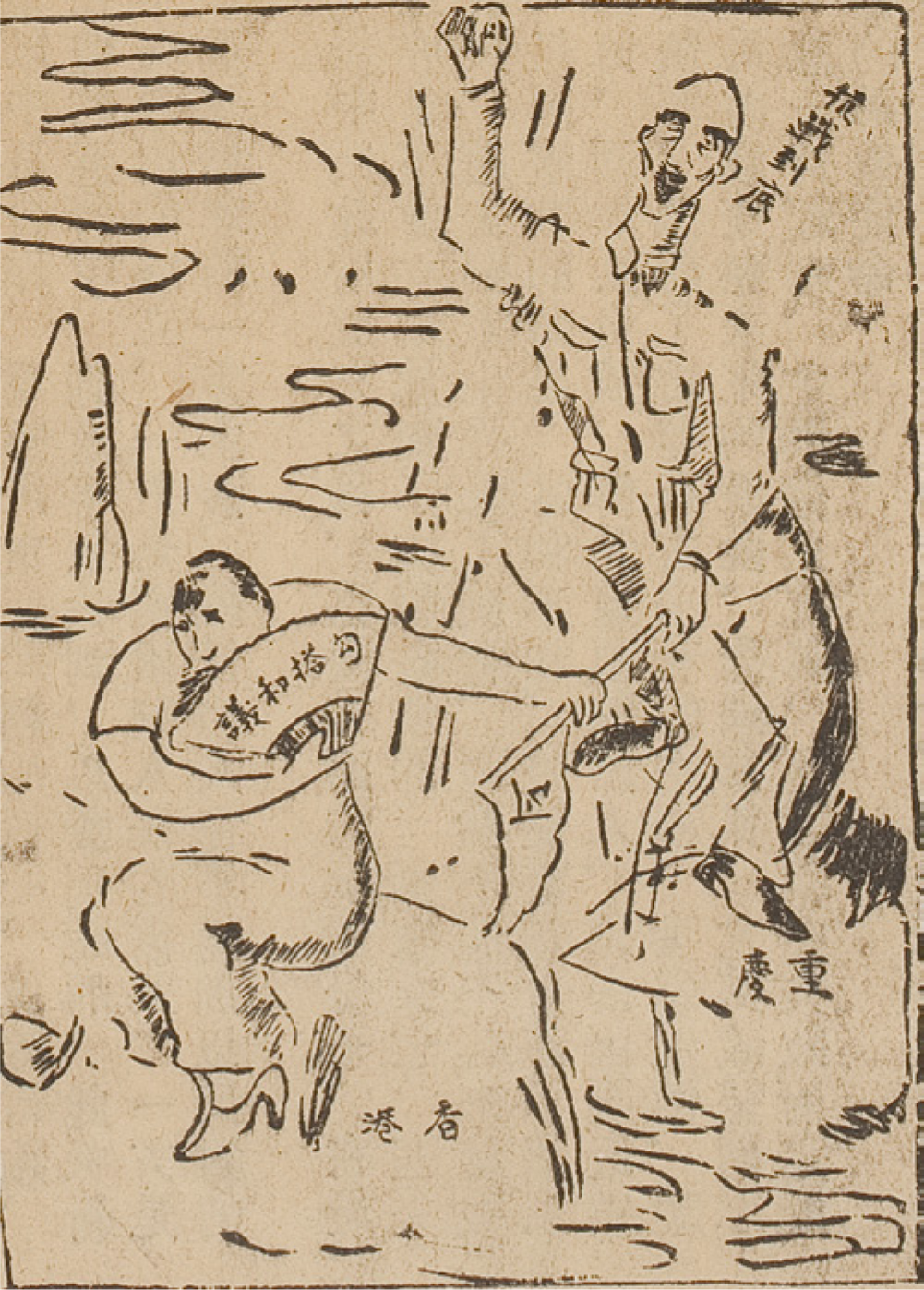
Untitled caricature of Chiang Kai-shek and Madame Chiang Kai-shek on the front page of Minzhong ribao, March 9, 1940. This image was reproduced in other newspapers in 1940. (Courtesy of the National Institute for Defense Studies, Tokyo).
However, there had been little attempt to rally artists within the occupied areas in the way that the Nationalist government and the Communist Party were doing in areas yet to be conquered by the Japanese: no pro-Japanese equivalent of the National Salvation Cartoon Corps or the Salvationist Association of Shanghai Cartoonists was formed in these early years. The explosion of well-organized artistic expression that was being channeled into the Resistance in 1938–1939 by bodies such as the Nationalists’ Political Department of the Military Affairs Commission (Junshi weiyuanhui zhengzhibu) (MacKinnon, 2008: 62–82), for example, found no parallel in the early collaborationist regimes.
As with much else in occupied China, however, this began to change in late 1939—precisely as Wang Jingwei’s RNG began to be constituted behind the scenes and just as Wang’s so-called Peace Movement was beginning to form itself into a recognizably alternative state to Chiang Kai-shek’s Nationalist regime in Chongqing. 11 The Wang regime focused a great deal on propaganda. Upon its formal induction, it established a Bureau of Propaganda under the former newspaper editor Lin Bosheng, and a “national” conference on propaganda, involving almost all newspaper editors and other media workers within the RNG realm, was held soon after Wang’s “return” to Nanjing. 12 Municipal and provincial authorities under Wang maintained their own propaganda offices (xuanchuan chu), and in a completely top-down fashion were instructed to produce and distribute propaganda based on directives from the capital. All of this was designed to enable the RNG to present itself as a genuinely Chinese alternative to the governments it had replaced and as the only legitimate “bearer of Chinese national identity” (Brook, 2007: 39).
Although all forms of propaganda proved important to the Wang regime, visual propaganda, both in public spaces and in formal and semi-official publications, was especially significant. Positive visual depictions of Wang began to appear in eastern China months before Wang officially established his new regime (Rubens, 1939: 336). It is no coincidence that a number of official publications produced to celebrate Wang’s triumphal “return” to Nanjing included cartoon images of Stalin and Chiang Kai-shek produced by one of the Xin dongya group of cartoonists who worked under the name of Wei Ru (see Figure 2). 13
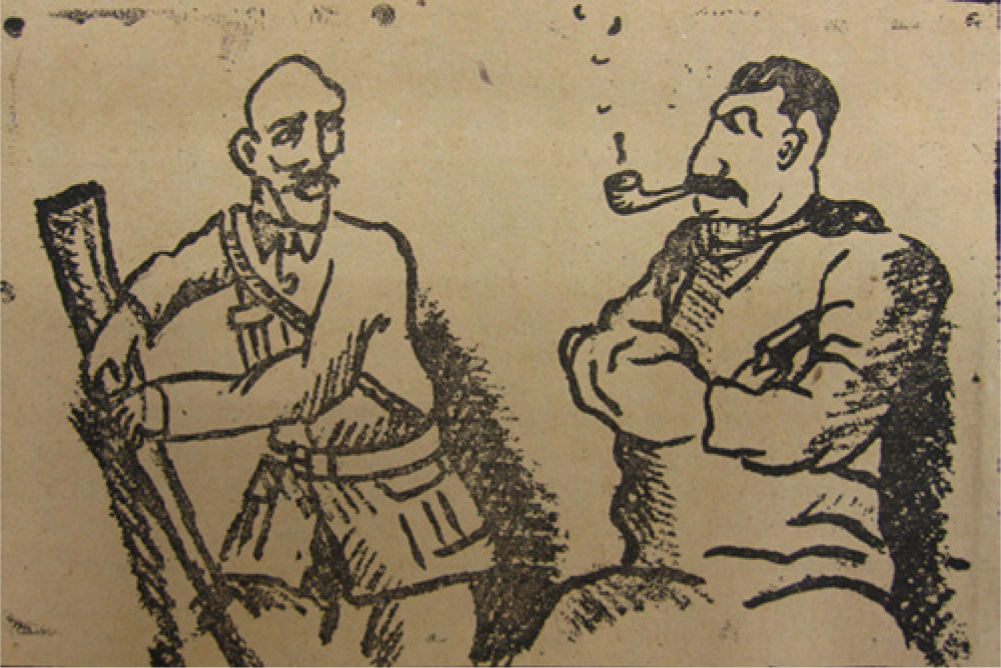
Wei Ru, “Yu zhengquan zhi molu” (The end of the road for the Sichuan regime). Published in Guofu huandu zhounian jinian tekan, 1941: 26. (Courtesy of the Institute of Modern History, Academia Sinica).
It was in the period between the Japanese attack on Pearl Harbor (December 1941) and the Wang regime’s declaration of war on the Allies (January 1943), however, that cartooning reached its apogee in RNG China. In the lead up to (and immediate aftermath of) the RNG’s direct involvement in the Greater East Asian War, the Wang regime began to pay far more attention to cartooning as a means of encouraging mass mobilization. Perhaps the clearest indication of this was the establishment of the Chinese Cartoon Association (Zhongguo manhua xiehui; CCA) in late 1942. In recognition of the central position of Shanghai in the Chinese tradition of modern cartooning, this body was established in Shanghai itself, operating out of offices on Peking Road (Beijing lu) in the heart of what had been the International Settlement. The CCA’s immediate predecessor appears to have been an organization referred to in Japanese as the Shanhai mangaka kurabu (Shanghai Cartoonists Club) (no date), a group which included among its ranks a number of China-resident Japanese cartoonists.
Shortly after its founding, the CCA began publication of its own house magazine, Zhongguo manhua (Chinese Cartoons)—cheekily taking its name directly from a publication which had existed in the mid-1930s. This magazine was, from the start, an outlet for overt propaganda, ranging from hagiographic portraits of Wang Jingwei to calls for the building of a “new China” under RNG guidance. In such depictions (often containing images of China’s “toiling masses” that looked strikingly similar to those emanating from Yan’an), CCA artists made visual references to the “light” that the Wang regime promised to bring to the country once the clouds of war and communism had been dispersed, with cartoon Chinese pagodas radiating brightness like the walls of Manchukuo had done in Japanese visual propaganda a decade earlier (see Figure 3).
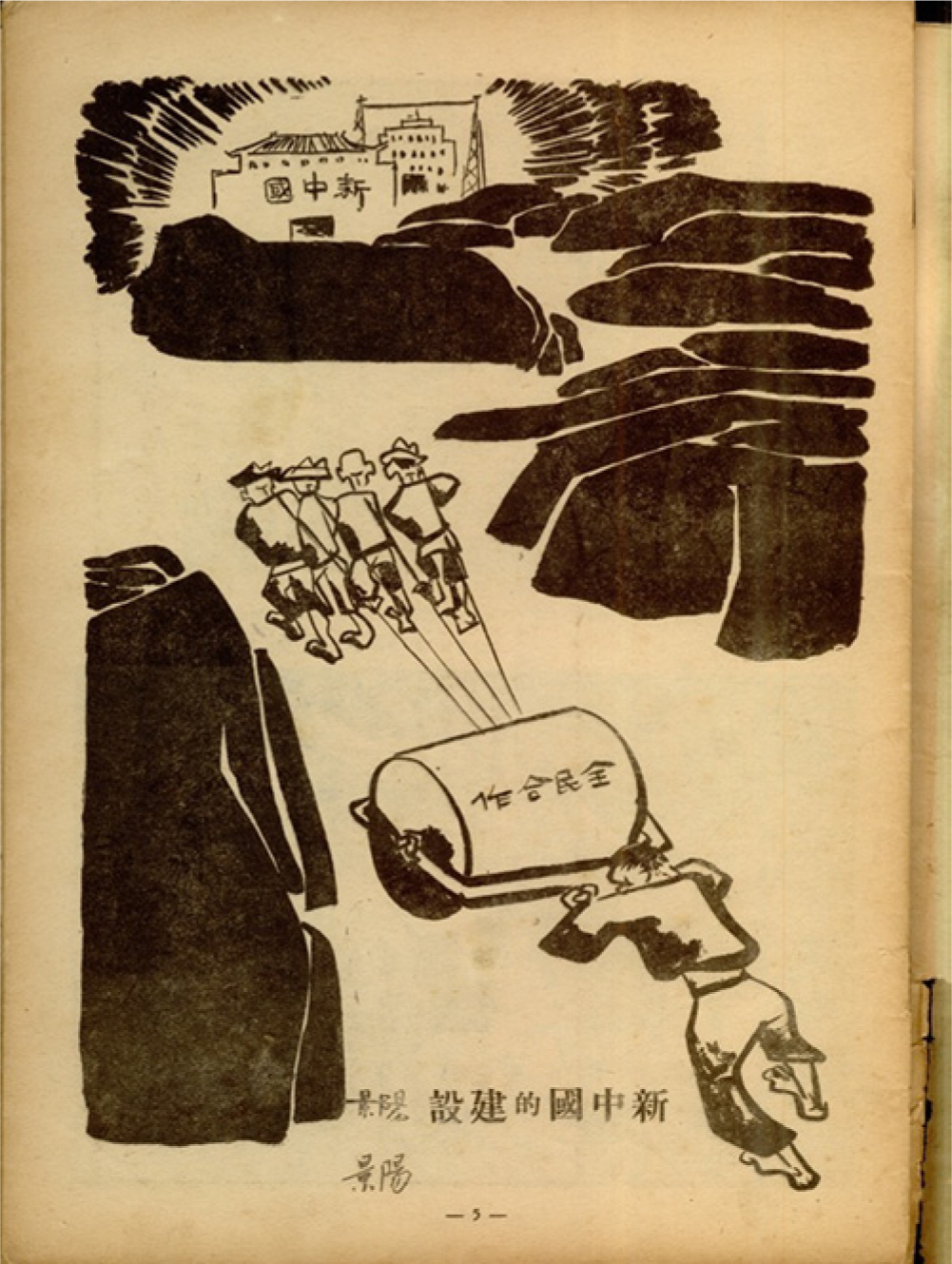
A propaganda cartoon calling on “all the people to cooperate” with one another under the Reorganized National Government. Yang Jing, “Xin Zhongguo de jianshe” (The building of new China), Zhongguo manhua 2 (Oct. 1942): 5. (Courtesy of the Shanghai Library).
Nonetheless, the bulk of the images it published depicted urban Chinese streetscapes (the Bund being particularly popular), attractive cheongsam- and suit-clad men and women, and advertisements of a decidedly middle-class nature (i.e., for restaurants, theaters, and photo studios). It included a substantial amount of copy—with major figures in the Wang regime, such as Lin Bosheng, penning inspirational texts about the merits of cartooning—much of it crossing into travelogues, reviews of recent films, and topical but often mundane essays. In keeping with the tendency in the RNG media to encourage news about entertainment and nightlife (Fu, 1993: 114–15), the magazine included commentary on happenings in the world of film and popular music, and comic, though sympathetic, images of attractive movie stars on its covers.
Zhongguo manhua was not without precedent, for the Shanghai-Nanjing cartoonists were clearly inspired by the activities of their northern peers. Illustrators in Beijing and Tianjin had also lobbied for, and been granted, official recognition and funding to establish their own organization, transforming the Black and White Cartoon Society into the Huabei manhua xiehui (North China Cartoon Association). The Propaganda Office of the Beijing city government funded this group to the value of 100 yuan a month, and called upon its members to produce overt propaganda for the war (Shizheng gongbao, 1943). Over and above such efforts, however, the group had been issuing its own magazine, Beijing manhua, since 1940. This periodical was published via the offices of the Wudebao (an occupation daily closely aligned to the collaborationist government) and would set something of a template for the Shanghai-based Zhongguo manhua, although the former devoted far more column space to discussions of the merit of cartoons as an art form and far less to the cause of the RNG.
The first issue of Zhongguo manhua was published just a few weeks ahead of national day (October 10) in 1942, and the CCA spent much of the issue justifying its work. What is most interesting about the publication, however, is the remarkable similarity in the reasoning behind the creation of Zhongguo manhua and the very ideas about using art to “bring culture to the masses” that Salvationist intellectuals were claiming to encourage in anti-Japanese cultural production in western China. “Among ordinary people in China, where illiteracy is rampant,” the editors argued in their first issue of Zhongguo manhua, “[cartoons] are the only type of reading material and propaganda tool that can be all pervasive.” Indeed, the magazine claimed that its main market was the uneducated masses and that it could help to inform such people about the “significance of the times.” “In the past,” its editors argued, “cartoons in China were simply a pastime for the few, things favored in postprandial moments by the leisured classes. But from now on, cartoons will occupy an extremely important position: they will be the reading material of the masses and a hobby for the ordinary man” (Zhongguo manhua, Oct. 1942: 3).
Like the Shanghai-Nanjing cartoonists, the northern artists justified their work on the grounds that in a post-1937 world their job was to bring cartoons down from their ivory towers and disseminate them to ordinary people (Beijing manhua, Mar. 1941). They also used Beijing manhua to lobby for greater space for cartoonists in the war effort. To be sure, CCA artists did lament that war had driven so many cartoonists to other fields and had displaced so many of their peers from the publishing centers in eastern China, 14 but this did not stop them from promoting the importance of this art form under the occupation
Such efforts appear to have been more than mere rhetoric. The first issue of the CCA’s journal was said to have sold out, with requests for new issues being turned down only due to a lack of facilities; the magazine also claimed readers in other occupied parts of Asia beyond China, with orders from Hong Kong and sections of the Chinese diaspora in Southeast Asia all being catered for (Zhongguo manhua, Oct. 1942: 56). True to their word, both organizations did also attempt to bring art to the masses, most noticeably through the organization of cartoon exhibitions. In the north, a Beijing Cartoon Exhibition (Beijing manhua zhanlanhui) had been held over the course of July 1941 (Sanliujiu huabao, 1941), with similar events being held in Shanghai in later years. The work of cartoonists in both centers was solicited for use in public parades and celebrations, such as anniversaries to mark the return of Wang Jingwei to Nanjing or festivities marking Japanese military victories in Southeast Asia. And cartoon seminars were held through the auspices of publications such as Zazhi (Miscellany) (1943) which, in its December 1943 issue, collated the work of as many cartoonists based in occupied China as it could.
In reality, however, both Zhongguo manhua and Beijing manhua focused primarily on middle-class readerships, and acted as fora through which greater levels of exchange between the world of Japanese cartooning—dominated in this period by the Shin Nippon mangaka kyōkai (New Japan Cartoonists Association) and its magazine Manga—and Chinese artists could be encouraged. Beijing manhua, for example, included tips on how best to draw facial features in political cartoons deriding enemies—although such tracts were taken directly from Japanese publications. For its part, Zhongguo manhua featured essays extolling the virtues of greater Sino-Japanese cooperation in art, and featured center spreads produced by Japanese artists from the New Japan Cartoonists Association.
Finding a Common Visual Vocabulary
What is arguably most significant about groups such as the CCA was the extent to which they represented a cross-section of cartoonists in occupied China. One of the founding figures behind the CCA and one of its most common contributors, for instance, was the above-mentioned Chen Xiaozuo (Ma Wu), who by the early 1940s was officially affiliated with the Press Corps of Wang Jingwei’s army (Zhongguo manhua, Nov. 1942: 56). Working with Chen, however, were more experienced artists, including a Japanese army cartoonist by the name of Miura Yoshio, who worked under the pen name of Miura Noa, and who had come to make a name for himself as a keen observer of Chinese street life in the CCA’s predecessor in Shanghai. A graduate of Keio University and a native of Tokyo, Miura emerged in this period as an important organizer of Sino-Japanese cooperation in cartooning (Shina hakengun hōdōbu, 1943). His work was published regularly on the pages of the CCA’s house magazine and in various other periodicals. 15
More significant, however, was that the CCA included among its ranks a handful of artists who had, up until Wang’s reclamation of the International Settlement in Shanghai, been involved in the Salvationist movement. Probably the two best examples of these are individuals whose names are familiar to students of Chinese art history, yet whose work during the war has been largely omitted from the official histories of Chinese cartooning: Jiang Dongliang and Dong Tianye.
Both Jiang and Dong could claim distinguished prewar careers as illustrators, the former in periodicals such as Dazhong manhua (Mass Cartoons), the latter working on all manner of publications. Indeed, and rather intriguingly given their cooperation with Chen Xiaozuo and Miura Yoshio, Jiang and Dong are often lauded today for their extensive work in the anti-Japanese cartooning movement during the early stages of the war (e.g., Bi and Huang 1986: 153), both being based within the International Settlement in Shanghai in this period. In late 1937, Dong had published his illustrations in Jiuguo manhua—the preeminent periodical for the dissemination of Salvationist cartooning—under unambiguous titles such as “Shajin hanjian” (eliminate traitors). Similarly, Jiang Dongliang had edited virulently anti-Japanese publications such as Manhua zhoukan (Cartoon Weekly).
Nonetheless, Dong and Jiang were prolific contributors to Zhongguo manhua and other occupation publications, and the CCA missed few opportunities to bask in its association with such genuine, Chinese cartoonists. Dong produced dozens of images for a range of publications operating under RNG control, from entertainment tabloids like Xin yingtan (New Movie Altar), to more generalist periodicals such as Zazhi (Miscellany) and Wanxiang yuekan (Phenomena Monthly). Much as he had done in his prewar work, Dong specialized in producing caricatures of movie actresses and other celebrities for the occupation press. Drawing on the photomontage techniques that had been adopted by many prewar Chinese cartoonists, Dong’s style was instantly recognizable both before and after his entry into the CCA: his illustrations were often composed of an almost photographic though oversized portrait of a female star set atop a caricatured representation of a female body dressed in the uniform of the Shanghai cabaret―the cheongsam. His cartoons of celebrated starlets drawn in this mode adorned the very cover of Zhongguo manhua on a number of occasions (see Figure 4). 16
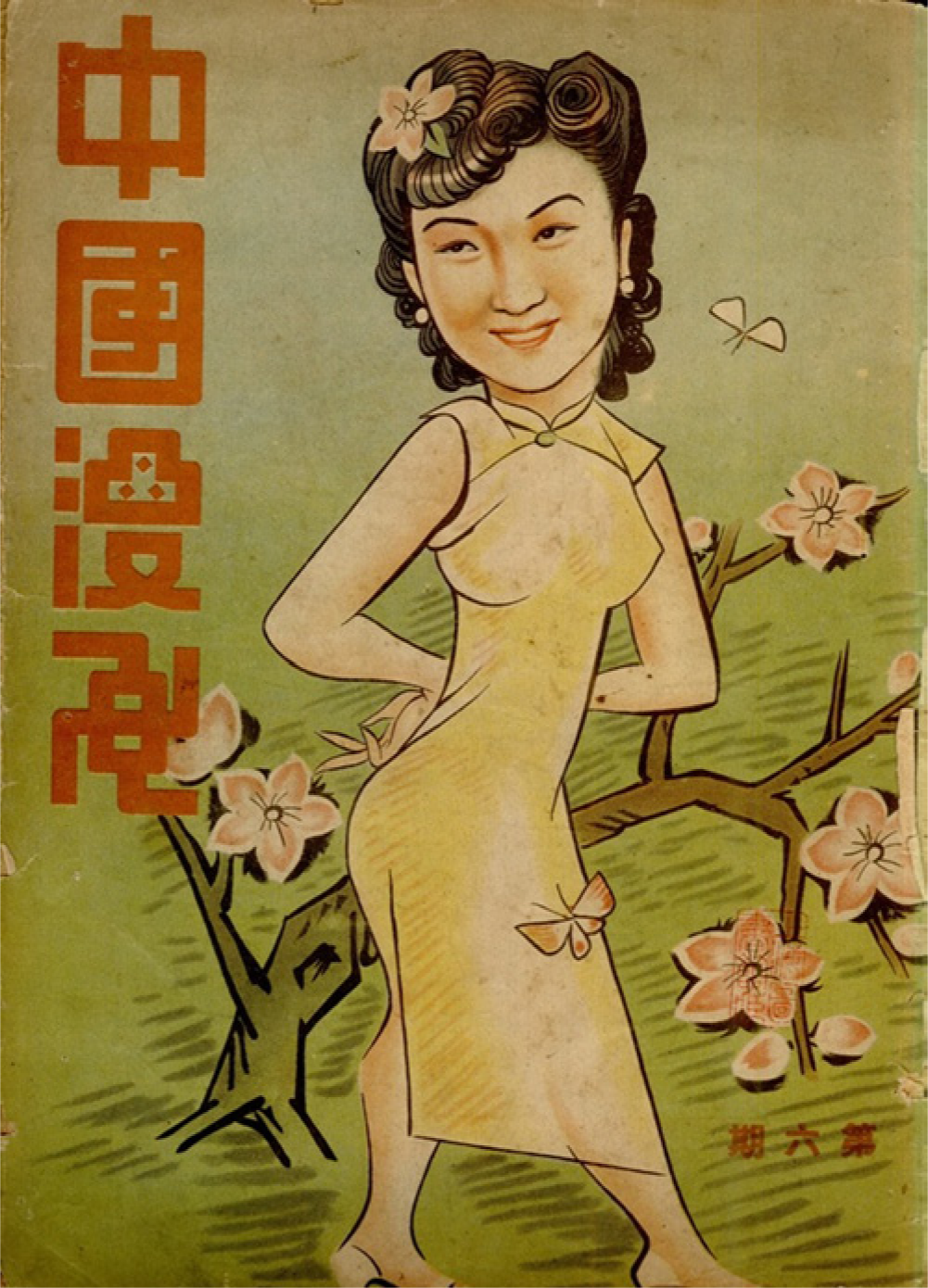
Actress Zhou Manhua, by Dong Tianye, on the cover of Zhongguo manhua 6 (May 1943). (Courtesy of the Shanghai Library).
In the postwar context, the work of Dong and Jiang is striking in its lack of shrill political content, and is vastly different from the more vitriolic hate mongering of the illustrations produced by those who had come new to cartooning under the RGROC and its peer regimes. In this regard, one can find clear parallels between the worlds of cartooning and other spheres of popular culture. Far from spelling an end to the cultural production that had thrived in Shanghai since the 1920s, the events of 1937, and indeed of 1941, led to a surge in production in popular films, music, publishing, and even various types of regional Chinese opera, precisely because such forms of cultural expression could be used not only to complete a facade of normalcy under occupation, but also because, once purged of their overtly Western content, they could be used to justify pan-Asianism.
What the example of occupation cartooning reminds us, however, is that occupation popular culture was indeed political in the innocuous and apparently apolitical nature of its very content. In particular, in the sheer preponderance of images of both female celebrities and archetypal Shanghai, Nanjing, and Beijing women, the work of occupation cartoonists such as Jiang and Dong hints at a shift toward more subtle uses of cartooning as propaganda under the RNG, but one which directly supported the gendered nature of pan-Asianist discourse in occupied China at the time, and which was expressed in parallel art forms. The boundaries between film, recording, journalism, and cartooning tended to be blurred in occupied Shanghai and Beijing.
As Christian Henriot and Wen-hsin Yeh (2004: 13) have suggested, there was nothing apolitical about depictions of women and domesticity in occupied Shanghai. They have stressed the sheer frequency with which women were represented in various forms of occupation media, arguing that “representations of women, along with the public consumption of these representations, became . . . an enterprise of tremendous political complexity.” Nowhere was the production of visual representations of Chinese women more prevalent during wartime than in the pages of the publications illustrated by the almost exclusively male CCA cartoonists. And nowhere was the political complexity of such images and their production seen better than in the diversity of meaning that was attached to such images by the very men who produced them. Indeed, while Zhongguo manhua sought to sell a unified message about the use of cartoons in RNG China, and although CCA artists shared with each other (and with songwriters, filmmakers, and writers in occupied China) a fascination with the female form, the images of modern Chinese women that emerged from such collaborationist cartooning were far from uniform.
In her exhaustive study of Chinese women writers during the occupation, Nicole Huang (2005) has shown how the Orientalized image of the shinü (graceful lady), usually pictured in traditional Chinese dress and in front of a recognizably Chinese landscape, emerged as a stock element of artwork featured in the popular press: such a figure fulfilled the criteria of being overtly Chinese (and hence supportive of the RNG agenda); at the same time, however, she represented a rejection of the treaty-port decadence, corruption, and Westernization supposedly concentrated in the equally ubiquitous “modern girl” celebrated in everything from poster art to Shanghai cinema.
Given the close connections between the female intellectuals of Huang’s study and the male cartoonists of the CCA—like Chen Xiaozuo, many of the female painters who adorned the covers of the very magazines that make up Huang’s study were graduates of the Shanghai School of Fine Arts (2005: 86–90); and writers such as Zhang Ailing were personally acquainted with the likes of Huang Yebai (Zhang, 1998: 142)—we might expect a shared commitment to the promotion of avowedly pan-Asianist imagery and a unified RNG message.
On the contrary, however, the “modern girl” remained one of the primary features of occupation cartooning, much as she had been in the pre-1937 period, and one to which all occupation cartoonists repeatedly returned. Indeed, and in a noticeable about-turn from the early collaborationist cartooning of Xin dongya, in which the Chinese modern girl was commonly associated with that most hated of Resistance figures, Madame Chiang Kai-shek, CCA artists embraced the cheongsam, high heels, and coiffed hair of urban Chinese women. What had changed was that a new context, in which a multitude of cartoonists from various backgrounds, all collaborating for a range of reasons after the reclamation of the International Settlement by the RNG, had enabled artists to attach to the clichéd caricature of the “Shanghai woman” all manner of new and often contrasting meanings.
For Jiang and Dong, such work suggested a continuity with prewar cultural production. Indeed, looking at images produced by both these artists before 1937 and after 1941, it is difficult to find substantial differences in either the subject matter or nature of their work, with images inspired by the cheongsam-clad female form a feature of both (see Figure 5). Like the collaborationist writers who form the basis of recent work on occupied Shanghai, Jiang and Dong appear to have found solace in nostalgia for a half-imagined, prewar Shanghai, believing that by engaging in anachronism they would somehow be able to continue to develop as artists while at the same time avoiding overt cooperation with their occupiers. Poshek Fu’s (1993: 110) analysis of Shanghai-based authors in this period could just as easily apply to the CCA illustrators: “Nostalgia, rather than any aspiration for a ‘New Order,’ became the dominant motif for collaborationist writings.”
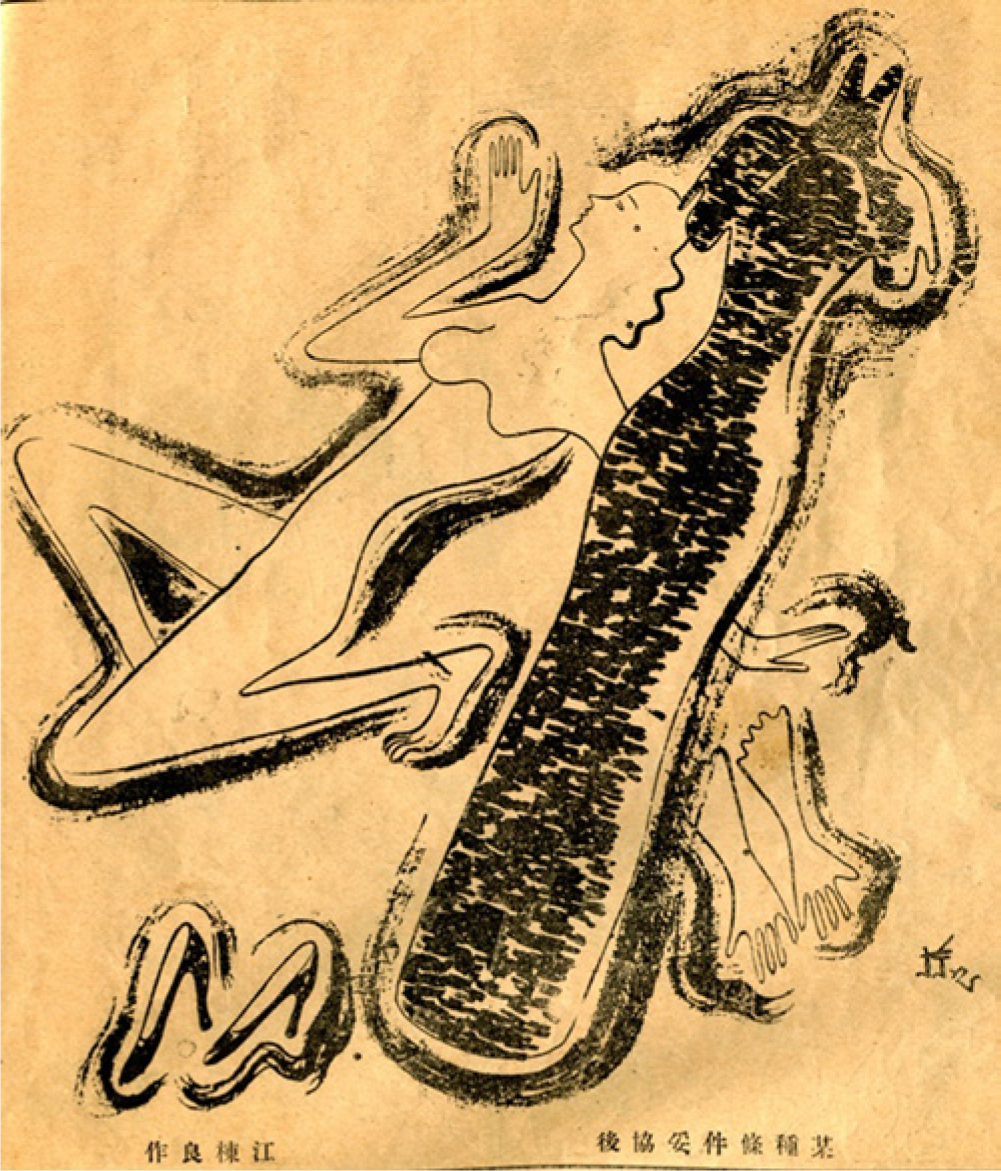
An example of Jiang Dongliang’s sketches of the female form from the prewar period. Jiang Dongliang, “Mou zhong tiaojian tuoxie hou” (After certain conditions have been compromised), Qunzhong manhua 2 (April 1935). (Courtesy of the East Asian Collections at Stanford University Library).
I would argue, however, that the context of occupation brought all manner of new significance to the images that such artists created, regardless of the original impetus behind such work. One might well read such illustrations as a conscious disengagement with the more overt political campaigns instigated by the CCA (such as the production of visual propaganda for rural pacification campaigns), or perhaps even a deliberate trivialization of an art form which was being mobilized for the important work of rebuilding RNG China. Equally, however, one can find in these cartoons the central role that such images played in convincing an occupied populace about the return to normalcy (or even glamour) under Wang Jingwei’s leadership. Like the return of attractive celebrities to occupied China’s theater screens, images of dushi nüxing (urban women) in Shanghai newspapers had a very political purpose (see Figure 6).
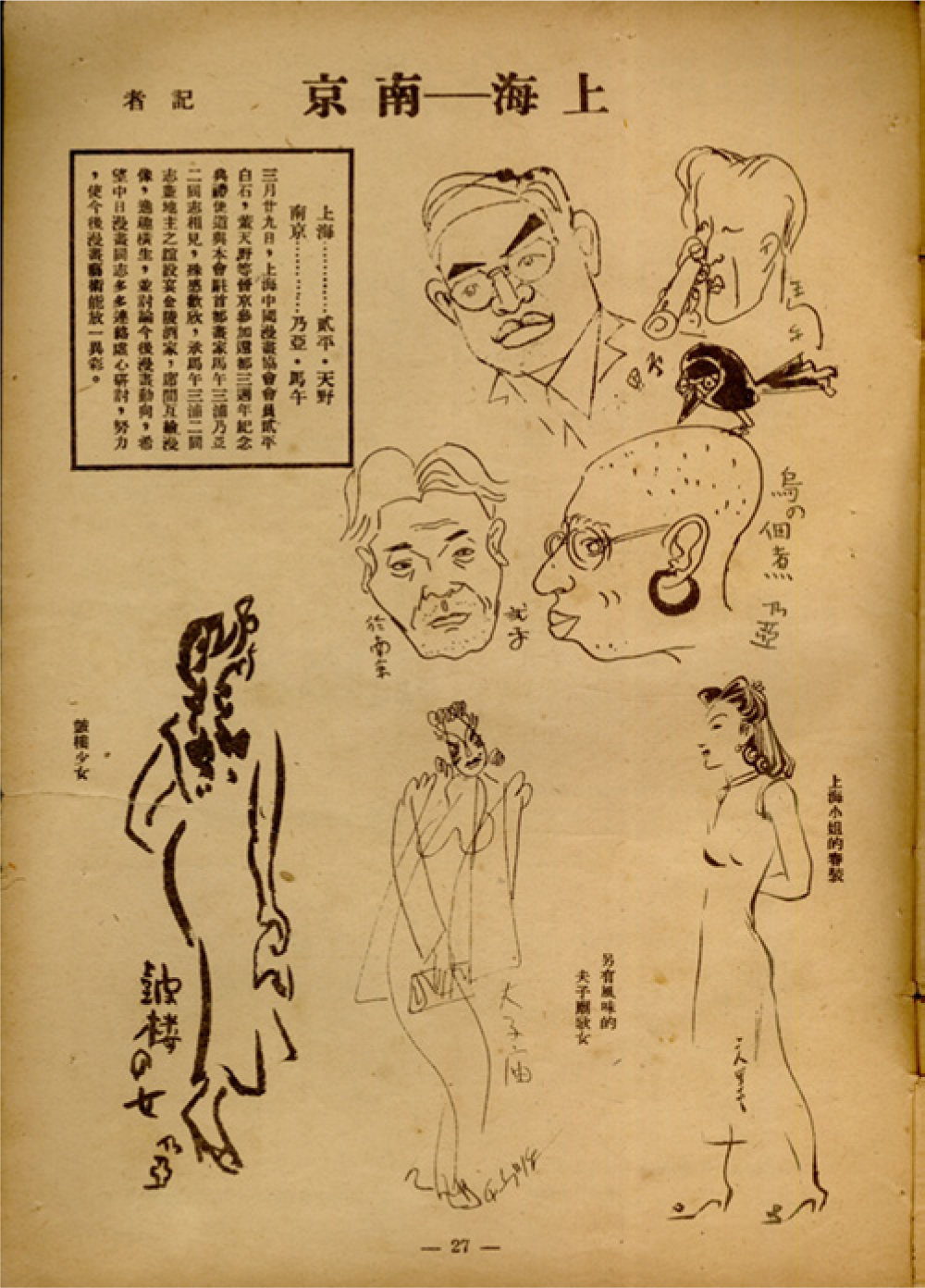
Sketches of Chinese women by Miura Noa (image on left), Ma Wu (Chen Xiaozuo) (image in center), and Dong Tianye (image on right). Zhongguo manhua 6 (May 1943): 27. (Courtesy of the Shanghai Library).
Take the work of Chen Xiaozuo (Ma Wu), for example. Chen’s female subjects were as frequent in the work he produced for Zazhi and Zhongguo manhua (he drew little else, in fact) as the movie stars of Jiang’s and Dong’s work. Under Chen’s pen, however, Chinese women were presented either as the victims of intrusive policemen on the streets of the International Settlement (thus echoing the wider anti-British sentiment that was being expressed vocally from within the RNG at the time) or simply as objects of male desire whose presence could be invoked to distract readers’ attention from the mundane realities of war. In some instances, and in contrast to Jiang and Dong, Chen even consciously derided the “modern girl” precisely because of her association with Western influence in China (Huang 2005: 86), this sometimes being reflected in Chen’s art: he had a tendency to grotesquely abstract limbs and other parts of the body when making a satirical or vaguely misogynist comment about the women he drew, embellishing his illustrations with wide and blotchy streaks of black ink. At other times, Chen drew his female muses with what can only be interpreted as voyeuristic interest in the female body: “When a typhoon comes along,” he wrote alongside a revealing sketch he had made of a woman struggling against the wind as her cheongsam is lifted to the height of her buttocks, “. . . people say there’s much to see! This modern girl (modeng nüzi) can’t move forward or backward.” 17
Miura Yoshio’s portraits of Chinese women were far less negative, and Miura left far fewer traces of his motivations for sketching them. His cartoons did, however, fit within a wartime tradition of inter-textual Japanese representations of Chinese women, and might be read as an expression of support for far hazier concepts of pan-Asianism. Miura became something of an expert on the representation of imagined Chinese “beauties,” producing, in significant number, line drawings which accentuated the female form, as well as fluent brush and ink drawings which represented attractive Chinese female archetypes with a minimum number of strokes. Some of these images―Miura even drew a kimono-clad Japanese woman sharing a joke with a Chinese “modern girl” for the magazine Changjiang huakan (Yangzi Pictorial) in 1942―were blatant in their message, but most of Miura’s images of Chinese women were far more subtle.
This is not to say that they were apolitical, however. In the cartoon images of the Chinese beauty produced by Miura, one can see evidence of the sentiments expressed through the occupation-era films of Ri Kōran (Yamaguchi Yoshiko), in which attractive Chinese women were invariably coupled with benevolent Japanese men in an attempt to win over ordinary Chinese audiences to the notion of Sino-Japanese cooperation (Stephenson, 1999), or perhaps even in the popular music that Shanghainese divas continued to record well after the International Settlement had been reclaimed by the RNG. In other words, in the work of Miura and other CCA-affiliated artists, the cheongsams and stilettos of the modern woman―satirized earlier in the war as the apparel of Western “lackeys” such as Madame Chiang Kai-shek―could be celebrated, provided they could be worked into appropriate RNG notions of peace and stability (see Figure 7).
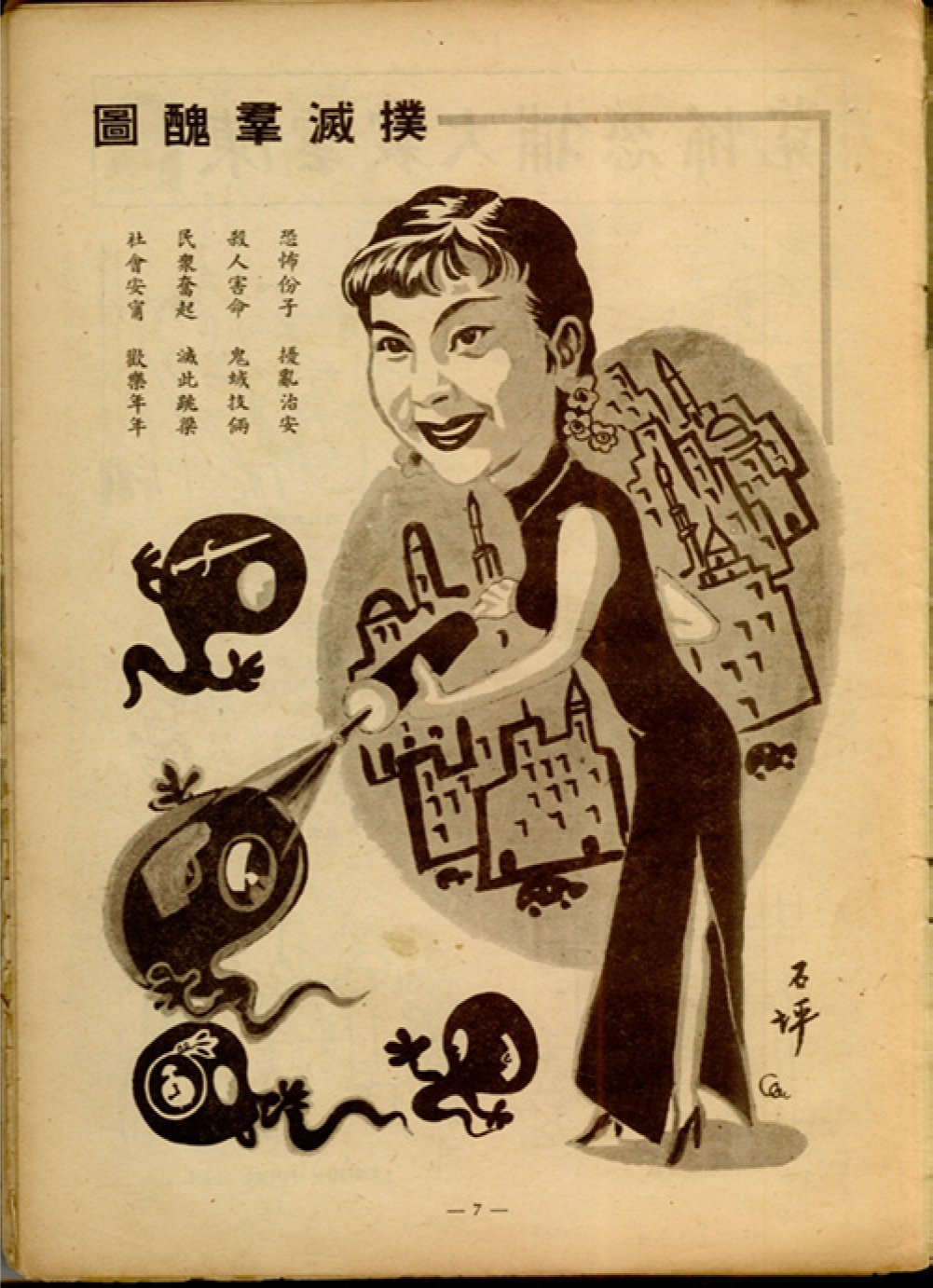
A “modern girl” helps rid Shanghai of (anti–Reorganized National Government) “terrorists.” Shi Ping, “Pumie qunchou” (Exterminate villains), Zhongguo manhua 1 (May 1943): 7. (Courtesy of the Shanghai Library).
This multiplicity of meanings in the cartoon depictions of the archetypal Chinese woman could even be used, occasionally, to express sentiments that were vaguely critical of the RNG or, at any rate, of life under Wang’s rule. A case in point is the work of the above-mentioned Huang Yebai. Huang cooperated with many of the most prominent of CCA artists, coauthoring film-related articles with Dong Tianye and contributing cartoons to many of the same publications as his peers in Shanghai and Nanjing. Huang’s oeuvre, however, represented the changing nature of cartooning in occupied China: in 1940, Huang was dismissing Chiang Kai-shek in the pages of Pingbao on the occasion of the Chinese Republic’s national day, drawing a series of cartoons that played on the standard trope of flight, showing Chiang as an isolated and unstable figure on an island called Chongqing. Within a year, however, the bulk of Huang’s cartoons focused on far more mundane matters. In an untitled column he wrote and drew for Pingbao, for instance, Huang concerned himself not with the war, but with humorous anecdotes about social inequalities in occupied Shanghai. Unlike much of the material being produced in the official press, however, this did not tend to blame such problems on Anglo-American influence—it laid very little blame at all. Lampooning the big-spending businessmen of Shanghai in “Song hanyi” (Giving her a winter coat), Huang (1941a) derided those who tried to win the favor of impressionable Shanghai women by outspending each other on fur coats, but were unwilling to donate a cheap garment for the use of but one of the thousands of refugees who had entered the city as a result of the war; his article was accompanied by an image of a voluptuous lady choosing from a range of well-dressed suitors. In other cases, Huang (1941b) ridiculed opportunistic citizens of Shanghai who attended the funerals of those they hardly knew in the hope of gaining money from the estate of the deceased. Another object of his satire was Shanghai’s “great landlords,” Huang’s fangdong drawn as a short, cigar-wielding figure in a double-breasted blazer embracing an apartment as if it were a trophy (Huang, 1941c).
Such topics were pursued by Huang in other publications also: in the cartoon pages of Zazhi (Miscellany), for example, Huang produced stark images of public mess halls (dazhong shitang) in urban China, or contrasted the luxury of the city’s middle classes with the plight of rural refugees who endured the proverbial harshness of the “westerlies” (xifeng). 18 In all of this work, the meanings attached to the cheongsam-clad women so common to Huang’s work took on an even more complicated twist, one in which the luxury of the stereotypical modern girl represented the inequities of life in 1940s Shanghai.
Huang’s work was not exceptional; instead, it was representative of cartooning in the mainstream press, and among groups such as the CCA, during the latter stages of the occupation. While cartoonists who did engage in overt propaganda for the RNG drew in their images a bright future in which Chiang Kai-shek was dead, Asia was cleansed of Western influence, communism was discredited, and a revitalized New China enjoyed peace and prosperity under benevolent Japanese guidance, their view of the present situation in occupied China was far more nuanced. In both their thinly veiled attacks on and celebrations of Chinese women, artists like Huang, Jiang, and Dong were effectively offering satirical comment on the realities of life under RNG rule, something that automatically put them at odds with the messages broadcast by the occupation state. Cartooning under occupation always had the potential to unsettle the very foundations of the RNG state, even as it could be (and was) employed to sell the idea of the return to normalcy to an urban readership.
Conclusion: The Legacy of Occupation Cartooning
As Timothy Brook has argued (2005: 13–19), research on the occupation has been hampered by the elusiveness of many of the individuals who worked in some capacity for puppet regimes in China. While those at the high end of command, or individuals accused publicly as “cultural traitors” (wenhua hanjian), were tried and sometimes even executed for their deeds, those who operated in less visible roles often simply disappeared from the written record come the Japanese surrender.
However, while the same is true for some of the most prolific of occupation cartoonists, it is also notable that many prominent individuals involved in this movement did not fade into obscurity after the Nationalist return to eastern China. To be sure, there were artists who suffered almost immediately for their association with the RNG. Chen Xiaozuo is said to have greeted the returning Nationalists to Nanjing in 1945 by contributing his work to celebratory events marking the Japanese surrender, only to be “found out” within days and thereafter banished from the ranks of respectable artists; he returned to illustration soon afterward, under a series of new pen names, but never achieved the same level of success as he had enjoyed through the CCA, and eventually was forced out of the art world (together with thousands of other “counter-revolutionaries”) in the Sufan movement of 1953.
Nonetheless—and perhaps surprisingly—the events of 1945 seem to have done little to slow the careers of Dong Tianye and Jiang Dongliang, who remained in Shanghai after the Japanese surrender, apparently unscathed by their association with the CCA. They continued to draw for major newspapers and journals, such as Xingqiliu (Saturday), their gift for producing comical images of starlets proving to be as sought after in 1948 as it had been in 1941. Perhaps more unexpectedly, both emerged as important figures in China’s emerging lianhuanhua movement in the early 1950s (Tan, 1999). It would take the purges of the 1950s to see both men banished (together with all manner of “class enemies”) from artistic production.
Arguably more surprising is the trajectory of Huang Yebai, for Huang’s career blossomed in the post-1945 era. Despite having started out writing for newspapers which denigrated Chiang Kai-shek on an almost daily basis, Huang launched his own short-lived pictorial, Shanghai shenghuo (Shanghai Life), in February 1948 while contributing, as an illustrator and a writer, to a wide variety of periodicals (Shanghai Municipal Archives, Q64-12-17-64). Perhaps more interestingly, he emerged again in post-1949 Hong Kong, where he reinvented himself as a film producer, worked as head of promotions (xuanchuan) for the immensely successful MP&GI (Dianmou) Film Studio (Zhang, 1998: 142), and eventually headed an anti-communist film industry body that was directly supported by the Nationalists in Taipei—the Free General Association (Ziyou zonghui). In an extraordinary change of fortune, a man who had once lampooned Chiang Kai-shek was, by the 1960s, being rewarded by Chiang’s government for his commitment to Chinese cinema and his staunch anti-communism. 19
In contrast, Miura Noa appears to have benefited little from the Japanese occupation of China. Miura lived in virtual poverty after 1945, earning a living by penning occasional articles in the popular press, illustrating children’s magazines and detective novels, and eventually becoming a graphic designer. He appears to have sunk into obscurity, and to have had little tangible or long-term impact beyond the war years.
None of this evidence is presented with the intention to expose individual cartoonists; neither am I indulging in schadenfreude by revealing the details of these artists’ postwar lives. Instead, what such evidence does suggest is the danger—inherent in many of the studies of Chinese cartooning with which I started this article—in confusing wartime allegiances with the quality of the work of a particular cartoonist. In much of the literature lauding the works of cartoonists who chose resistance rather than collaboration, there is an assumption that cartooning as a practice represented something artistically superior. Salvationist cartooning is said to have endured not because it found itself on the winning side after 1945, or because those who produced it came to inherit positions of artistic power in the People’s Republic, but because there was something sincere about such artistic resistance. The entire literature on cartooning in China (mirroring the standard history of the war in general as it is still expounded in the PRC) has long been presented as a story of radical intellectuals standing up to foreign invaders and internal oppression. As an early post-Liberation author put it, “The Chinese cartoonist has never slackened his efforts in the exposure of the imperialist deceit—whether it is the swastika magic box of Hitler, the fanciful lantern of the ‘Co-prosperity of East Asia’ or the foul dustbin of Chiang Kai-shek’s clique” (All China Association of Fine Arts Workers, 1951: i–ii).
If we take such a position—as has been the case in much of the literature on wartime cartooning in China—then we must dismiss the entire body of work undertaken by the CCA and its peers precisely because it was not motivated by resistance. The problem with such an approach, however, is that it leaves us with a gaping hiatus in the story of manhua (and many other forms of affiliated art, entertainment, and propaganda), especially when many of the same individuals feature both in the early story of Salvationist cartooning and in postwar cartooning. In other words, if we are willing to accept (as, ironically, the CCA itself did), that Jiang Dongliang, Dong Tianye, and others were reputable artists before 1941, then we cannot ignore the work they continued to produce in the final years of the war, and pick up again in 1949, when their lianhuanhua were being sold in PRC bookstores in support of a New China. 20 Equally, we cannot even hope to understand the role played by people like Huang Yebai, central as he was to ROC efforts to stifle pro-Communist expression in the Hong Kong film industry in the 1950s and 1960s, unless we acknowledge that he cut his teeth in newspapers run by Zhou Fohai.
Given the sensitivity and taboos that still haunt discussion of the RNG in China today, as well as the silence that many individuals maintained in the post-1945 period about their careers during the war, such revelations may seem novel. Taken in a broader context, however, they also remind us just how utterly normal it was for collaboration during wartime to help incubate and foster the careers of many cartoonists. In other parts of occupied Asia, from Malaya (Chen, 2009) to the Philippines (Chen Chue, 2005), it appears to have been anything but unusual for Japanese occupation to represent a point of entry into the world of publishing and art for a generation of illustrators just coming of age in the early 1940s. While the work of many individual cartoonists has only been discovered as a result of recent scholarship by cultural historians, the sheer number of similar stories, together with the parallels between such contexts and occupied China, suggest that the experience of working under the Japanese was centrally important to cartooning all over Asia. In fact, as Joel Vessels (2010: 85) has pointed out in his study of comics in wartime France, the collaborationist Vichy regime provided “the space for a reeling industry to right itself . . . and lay the seeds for the age d’or that was to come in the following decade.”
In this regard, the continuities—before, during, and after the war—inherent in the work of the occupation cartoonists should also prompt us to expand on the growing skepticism about the sanctity of terms like “Salvation” and “patriotism” present in the literature on the RNG and the occupation more generally, and to move beyond what Poshek Fu (1997) has described as the “binary reductionism” that has defined so much earlier scholarship on this period. The ease with which cartoonists crossed political boundaries throughout the 1930s, 1940s, and 1950s, the multiplicity of meanings that can be read into the work that many produced late in the occupation, and the diversity of careers that many went on to explore after 1945 suggests a far more complicated picture.
If there is one thing that Chinese cartoons of the occupation remind us, it is that cartooning in wartime China was never the monopoly of those who chose to resist the Japanese. Though much of the literature on cartooning in China (and on the occupation in general) would have us believe that the war marked a watershed, transforming the very art form of manhua from the expression of an urbane middle-class readership into the voice of the patriotic peasant masses, the story of collaborationist cartooning suggests a very different trajectory.
Footnotes
Acknowledgements
The author is indebted to staff at the British Museum, the Shanghai Municipal Archives, the Shanghai Library, the Hong Kong Film Archive, the Hoover Institution Archives, the Huang Yao Foundation, and the National Institute for Defense Studies in Tokyo for allowing access and providing much needed assistance in the course of conducting research for this article. I also thank the two reviewers of this article for their comments on an earlier draft.
Declaration of Conflicting Interests
The author(s) declared no potential conflicts of interest with respect to the research, authorship, and/or publication of this article.
Funding
The author(s) disclosed receipt of the following financial support for the research, authorship, and/or publication of this article: Research for this article was undertaken with the generous assistance of an Early Career Researcher Fellowship (AH/I026944/1) from the Arts and Humanities Research Council in the United Kingdom.
Notes
Author Biography
 ).
).