




Abstract
Two trends will dominate biosecurity over the next decade, shaping both opportunities and threats. The first is industrialization, as biotechnology becomes a globally important manufacturing base and economic force. The second is personalization, as an increasing number of individuals become able to harness the biological sciences to their own ends. The rules and regulations that emerge to govern the field will have an important impact. Safety will also be a major concern, because no laboratory is 100 percent accident free; to lower the risk to lab workers and the public, establishing protocols, using protective equipment, and raising the political profile of biosafety are essential. To meet the biosecurity challenge it will also be necessary to have health care systems that can rapidly respond to epidemics. Partnerships between nations will become even more important for learning early about potential threats, preventing them where possible, and acting quickly to limit their consequences.
Biosecurity risks are likely to evolve a great deal over the next 10 years, in large part as a result of two ongoing and escalating trends in the biological sciences. The first is that the field is becoming industrialized and incorporated into diverse and strategically important sectors. Petroleum, essential to the manufacture of scores of goods from plastics to paints, is being gradually replaced by biological products as the basis for myriad commodities. Biological manufacturing is now the focus of big corporations, and nations are interested in growing their bio-economies. The second trend is toward greater personalization and individual control. Ever more powerful biological techniques are increasingly accessible to individuals who use them as they see fit. As a result of both shifts, the biological sciences will become even more prevalent, and their practitioners capable of manipulating genes and organisms on a scale not possible 10 years ago.
Both of these trends have tremendous beneficial potential—for human health, the environment, and economies. But they will also shape future biosecurity risks. Anticipating how the challenges are likely to change over time, and taking action now to establish the right rules and to promote safety, cannot erase all dangers—but it could put us in a much better position in 10 years than we are in today.
The triage section of Kagadi Hospital in the Kibaale District of Uganda, during the 2012 Ebola outbreak in that nation. Photo credit: Centers for Disease Control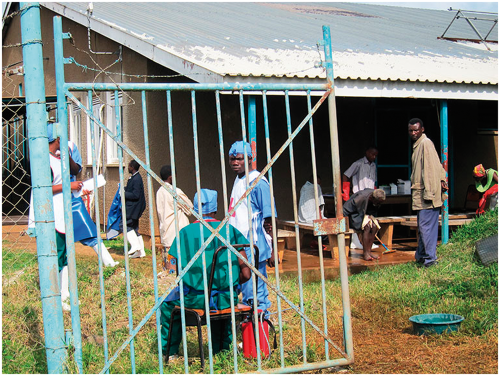
Get ready for big bio
When biotechnology makes the news headlines, it’s usually thanks to a major new discovery published in a scientific journal or perhaps the medically (and financially) important results of a clinical trial. These punctuated announcements don’t fully illuminate the increasing importance of biotechnology to national economies in strategically important sectors though, including manufacturing, fuel production, medicines, agriculture, and mining (Bergin, 2014). Multiple industries that never relied upon biology before are now taking it up, replacing traditional petroleum chemistry. Vanilla flavor compounds, saffron, adhesives, detergents, cosmetics, and tires can all now be made using synthetic biological production. The pharmaceutical industry is making more and more medicines based on biological processes. Currently, biofuels are hampered by the fact that they can’t compete financially with their main competitor, oil, but this may not always be the case, and new biofuel technologies are in development.
The potential for biotechnology to become the manufacturing base of the 21st century has not been lost on many nations of the world, which have developed plans specifically to grow their bio-economies. Some governments, including those of Great Britain, India, and China, have specific roadmaps for synthetic biology, a relatively new field that aims to make biology easier to engineer (OECD, 2014a). Given the international competition, and the funds being poured into these efforts (particularly by China), in 10 years the United States will likely not lead other nations by as much of a margin as it does now, and risks falling behind (MIT Committee to Evaluate the Innovation Deficit, 2015; National Institutes of Health, 2015; OECD, 2014b). This increased international competition poses direct risks to the economies and potentially the security of individual countries. It will also likely influence what sort of practical applications scientists focus on, and how those applications are regulated.
The rules of the road that emerge— laws, regulations, and standards of practice—will have as great an impact on our future as the technologies themselves. For example, the use of gene drive technology to rapidly spread a particular gene throughout a population of organisms has the potential to control malaria-carrying mosquitoes or invasive species, but will require careful oversight to manage safety risks beyond the intended target. The regulation of this and other applications that use new, powerful gene-editing techniques like CRISPR/Cas9 for large-scale open air trials, stem cell genetic manipulations, and new synthetic biology products will depend on who is pioneering the technologies. The players in the game will make the rules. Maintaining prominence in biotechnology should be a priority for the United States for many reasons, but the opportunity to shape the field’s governance should be one of them.
Backyard biology
The biological sciences aren’t just performed by large companies with multidisciplinary teams, or groups of highly trained scientists in academic labs. Powerful synthetic biology tools have become democratized, allowing for much greater participation by expert individuals and even relative amateurs. The best example of this phenomenon is the International Genetically Engineered Machines (iGEM) competition, in which undergraduate teams are given a kit of standard biological parts called BioBricks. Over a summer, the teams use the parts they are given and others they create to engineer biological systems and operate them within living cells. Team projects have been ambitious and sophisticated, even though many of the students are entirely new to bioscience. The competition has expanded to include other age groups, including high schoolers, and produced more than 6,000 alumni.
In a similar vein, “DIY Bio” is an amateur and educational movement that allows people to perform experiments in their kitchens or community laboratories set up in such places as Brooklyn and Baltimore. Many DIY (“do it yourself”) biologists have tackled real-world problems, for example by developing arsenic-sensing bacteria or a bacteria-produced blood substitute that can be stored for long periods. Other projects are purely whimsical and fun: bacteria that smell like bananas or wintergreen, or produce a rainbow of pigments. Some techniques are powerful and accessible enough for people to monitor their own health or answer questions relevant to their personal daily lives—such as whether the fish they purchased is the kind the store claimed.
Both trends in the biological sciences—industrialization and personalization—will result in many more people benefitting from and participating in the field in ways that were not possible before. Yet the democratization of biotechnology also increases the risk of misuse and the severity of potential consequences. To be sure, the risk of misuse has been present for a long time, and requires no new technological advances, but it is becoming harder to prevent and mitigate the problem.
Set priorities
In looking to the future, it is important to consider the possibility that a major biological accident will occur. Even in modern, well-run biological laboratories, mishaps take place. Of course, in a well-run laboratory the potential for accidents has already been thought through, with plans for many layers of containment. There is ample guidance on how laboratories should be run from the Centers for Disease Control and Prevention and the World Health Organization, including on how to assess the risks to best protect laboratory personnel. In many nations there are also regulations and laws that affect biosafety. For example, in US laboratories that work with the potentially risky pathogens known as “select agents” it is required that all accidents and mishaps be reported, and that the institution have a staff member whose sole full time job it is to be responsible for biosafety. The goal is to achieve a very low level of risk to laboratory workers and an extremely low level of risk to the public through adherence to protocol and use of protective equipment.
Unfortunately, however, biosafety is uneven throughout the world, and almost always underfunded. Paying to staff, train, retrain, and implement good practices is often considered less important than funding the research or other work going on in the laboratory. How often accidents occur worldwide, or result in direct harm to lab workers, is therefore almost completely unknown. As more and more institutions become able to perform work that requires biosafety controls, including handling transmissible pathogens that have the potential to spread beyond lab walls, the risk to the public grows.
There is nothing that can be done to prevent all accidents, but over the course of 10 years we should be able to raise the political importance of biosafety so that it gets the resources and attention it deserves, which will decrease the likelihood of mishaps and limit their consequences. Improved biosafety will require more than training individual laboratory workers, though that is important. It will also require national standards for budget and equipment maintenance, worker safety training, health monitoring, surveillance, and other activities aimed at keeping the public safe (Gronvall, 2014). New technical approaches to safety are also required. Recently, research funded by DARPA (the US Defense Department agency that develops emerging technologies) has produced organisms with built-in safety controls that prevent survival outside of a tightly controlled environment. The researchers have used synthetic biology techniques to add redundancy to the safety controls, so that failure is virtually impossible. More research along these lines is needed.
Be ready to react
While preventing biological dangers from occurring is an important goal, there are ultimately limits on what can be done to prevent accidents and misuse. Naturally occurring diseases will also continue to emerge regardless of the safety level at institutions. Therefore, becoming more effective at pouncing on biosecurity challenges to limit their consequences should be a priority; growing risks put a premium on managing events and limiting their consequences. The Ebola crisis in West Africa that began in 2013 and continues today is testament to the need to act early to prevent a significant loss of life.
A strong public health system response is one factor that can limit the scope of a hazardous biological event. Ebola spread rapidly because the health systems in Guinea, Liberia, and Sierra Leone were not prepared. Many nations beyond West Africa also have serious deficits in their public health infrastructure, inhibiting the ability to detect or respond to disease threats. To fill this gap, the Obama administration, in partnership with more than 25 other governments, the World Health Organization, and other international organizations, launched the Global Health Security Agenda (GHSA) in February 2014. The GHSA aims to organize efforts by donor countries to improve public health infrastructure, biosafety, and security in less-equipped nations around the world. The goal is to help countries regardless of the origin of their biological threats, since the same public health improvements are necessary to respond whether the sources are deliberate, accidental, or natural. The United States has pledged to help 30 countries meet GHSA objectives over the next five years. The process of building a global public health infrastructure will take longer than five years, however, so it will be important for future administrations to continue to support the GHSA and related programs within the Defense and State Departments.
Another factor that could limit the scope of a biosecurity event is effective medical treatment for victims. There is a great need to perform reliable research in the midst of ongoing epidemics, in order to test vaccines and other drugs. Being able to do so, however, has long been problematic; even though a variety of drug therapies were tried during outbreaks of SARS in 2003 and H1N1 influenza in 2009, the difficulty of setting up trials and performing research within the time frame when it would have been possible left major gaps in our understanding. It was again difficult to perform critical research when Ebola broke out in 2013, but a common protocol was eventually developed to accelerate the development of treatments; further development of protocols to be used in an emergency could limit such delays during the next disease crisis (Borio et al., 2015).
Joining forces
Over the next 10 years, partnerships between nations to improve biosecurity will become even more important for learning early about potential threats, preventing them where possible, and acting quickly to limit their consequences. The interactions, collaborations, and mutual trust built between scientists and officials of different countries—such as through biological engagement programs run by the US Defense and State Departments and the overseas laboratories run by Defense in collaboration with host countries—provide an opportunity to learn and expand cooperation. Neither the United States nor any other country can defeat biosecurity threats alone.
In the last 10 years, the field of biosecurity has seen new natural diseases (H1N1 and MERS), old diseases with new patterns of infection (Ebola and dengue), and persistent threats by rogue individuals and groups to deliberately use dangerous agents. There have been biosafety concerns about forgotten vials of smallpox and the shipment of pathogens. And concern has emerged that important life sciences research could inadvertently make a biological weapon easier to produce. The next 10 years promise to be just as eventful, and while no one can predict exactly what threats will emerge, understanding the trends and changes occurring in the biosciences today can give us an idea of future dangers. As much as possible, we must prepare for those dangers, because taking action now will leave us in a better position to overcome them.
Footnotes
Funding
This research received no specific grant from any funding agency in the public, commercial, or not-for-profit sectors.