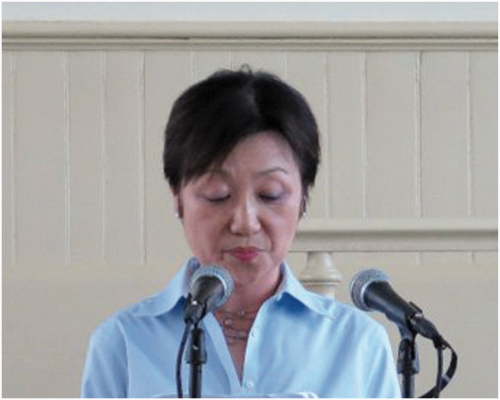
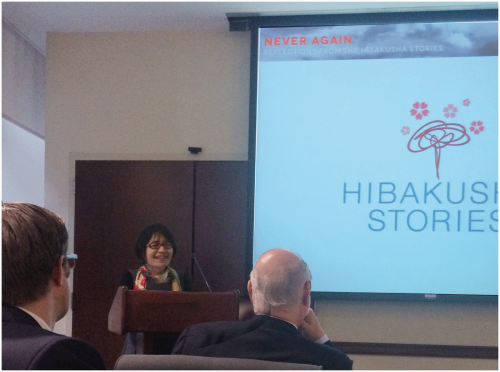
Mitchie Takeuchi’s mother and grandfather survived the atomic bombing of Hiroshima 70 years ago. Miyako Taguchi’s parents survived the bombing of Nagasaki three days later. Takeuchi and Taguchi both are part of the second generation (and in Takeuchi’s case also the third generation) of hibakusha—the Japanese term for people who were exposed directly to one of the two bombings or their radioactive fallout or who were exposed while still in their mothers’ wombs. Although many hibakusha have been reluctant or unwilling to discuss the bombings with their children, some have not only talked about their experiences with family members but also become active in groups such as Hibakusha Stories—which brings survivors into New York City schools to discuss their experiences with students. In this pair of interviews, Takeuchi and Taguchi talk about what it’s like to be the child of a survivor and why they feel a responsibility to share their family stories and to speak out about nuclear weapons.
Mitchie Takeuchi’s grandfather, Ken Takeuchi, was the president of the Hiroshima Red Cross Hospital at the time of the atomic bombing on August 6, 1945. When his daughter, Takako, went looking for him in the center of the city three days after the bombing she too was exposed to the radioactive fallout. Both became hibakusha, the Japanese term for atomic bomb survivors.
Miyako Taguchi’s parents, who had not yet met, lived in Nagasaki when the United States bombed the city on August 9, 1945. They too became hibakusha.
Hibakusha translates as “bomb-affected people.” Under Japanese law, it includes people who were exposed directly to an atomic bomb or its radioactive fallout as well as people who were exposed while still in their mothers’ wombs. But the bombs also affected people born years later, and not just because radiation can cause genetic mutations that can be passed on to the next generation. The children of hibakusha also inherit the memories of families scarred by atomic war, and some become the bearers of their parents’ hopes for a world without nuclear weapons.
Chance seemed to play a big role in determining who survived the Hiroshima and Nagasaki bombings. And it was only by chance that Mitchie Takeuchi and Miyako Taguchi became involved with Hibakusha Stories, a group that brings hibakusha into New York City schools to share their experiences with young people. A friend asked Takeuchi to help as an interpreter for the group and she remembers introducing herself at a meeting where she mentioned that she “happened to” come from a hibakusha family in Hiroshima. Taguchi, too, got involved with the group purely by accident; she ran into a friend who remembered her family history and invited her to a meeting. Now both women are active in disarmament education work.
Takeuchi is the founder of Arc Media, Inc. and has been working with Japanese companies as a new business development and marketing consultant for 25 years. She is also a regular contributor to Japan’s Nikkei Sangyo Shimbun newspaper, providing a business perspective from the United States, and was a producer of the US-Japan TV series Japan Today. As a teenager in Hiroshima, Takeuchi volunteered at the World Friendship Center, a peace community founded by the Quaker activist Barbara Reynolds; Takeuchi helped the American resident director, Leona Row from the Church of the Brethren, develop a translation program and publish the English version of the 1977 book Unforgettable Fire: Drawings by Atomic Bomb Survivors.
Taguchi likewise has a successful career in New York City. She is the founder of Miyako i Studio and an accomplished graphic designer who has made major contributions to diverse projects—from printing and packaging to display design—for numerous Fortune 500 companies for more than 20 years. She has a strong belief in the power of art. She received the title Nagasaki Peace Correspondent from Nagasaki City in 2014.
Contributing editor Dawn Stover spoke with both women recently. What follows are some excerpts from those conversations about second-generation hibakusha.
BAS: Your grandfather was in charge of the biggest medical center in Hiroshima. Was he at the hospital when the bomb was dropped?
Mitchie Takeuchi: Yes. Two days before the A-bomb was dropped, my grandfather called together the senior medical staff to tell them to start coming to work on time, at 8 a.m. It was hot and humid, and Hiroshima was one of the very few major cities that US bombers had not attacked yet, so Hiroshima people were very fearful. They often had air raid alerts in the middle of the night, so the staff members were really exhausted and they tended to come to work later than they were supposed to. Because my grandfather gave a pep talk about coming in early and getting a lot done while it was still cool, everybody was at work before 8:15 [when the bomb hit]. That saved a lot of lives. The hospital was devastated but its outer structure was not destroyed because it was a substantial concrete building.
BAS: Was your grandfather injured?
Takeuchi: Yes, a heavy door landed on him and he lost consciousness. When he came to, he realized that he had a lot of broken bones and shattered glass all over his body. After a few days he was able to supervise his medical staff who were working frantically. A lot of them were seriously injured too, and some died. It was complete chaos.
BAS: What was your mother’s experience?
Takeuchi: She lived in a northern suburb of Hiroshima called Ushita. She was almost 19 years old, living with her parents, and single. She worked in a military factory assisting the war effort. It was mandatory for young people at that time. When the A-bomb was dropped her supervisor urged her to go home immediately. She and some friends walked home, seeing flames in the distance. That night, my mother and grandmother evacuated farther out, to stay with friends. Two days later my mother—who was the only child and was very close to her father—decided to go into the center of the city to find her father. I cannot imagine what she must have seen on the way to the hospital. “Ah, poor people, that was really so sad,” she told me years later, but she wouldn’t say much more. Severely burned and injured people were streaming into the hospital because the city was flattened and people could see the Red Cross building still standing. My mother found her father in that hospital bed and stayed there with him a few weeks to take care of him.
BAS: Did your mother become sick?
Takeuchi: Because of her exposure to the radiation she had a certificate recognizing that she was a hibakusha. She wasn’t the most healthy person. She often got easily exhausted and had to rest. And now I can see that she must have been suffering from depression. She had mood swings and was rather easily overwhelmed. When there was a lot of stress she had a very hard time coping with it. She would shut down and did not want to deal with anything, including her children.
BAS: Did your family talk about the bombing while you were growing up?
Takeuchi: My grandfather had a significant position and therefore he was not allowed to talk about it openly in public. I think it must have had something to do with the press code exercised by the Allied occupation authority. He passed away when I was in high school, so we never really got to talk about it.
BAS: What about your mother?
Takeuchi: I was so unaware about the catastrophic experience that my mother went through. She was a very sensitive person. I can see why she could not talk about the devastating condition of suffering people. She really respected her father’s work; even during that catastrophic period, when he was badly injured, he was still helping people and working hard. That’s a positive story of our family. But whenever I would ask, “So, what did you see, though? That must have been terrible,” she would say, “I don’t want to talk about it.” She just could not handle remembering it or verbalizing it. I think a majority of people who experienced A-bombs were silent.
BAS: Was some of the reluctance because of the stigmatization that bomb survivors faced?
Takeuchi: Yes, I think that must have been a significant reason, along with the unthinkable difficulty they had to go through to rebuild their lives. Also, Japanese tend to be very stoic; they strive not to complain, regardless of what happens. I’m sure a lot of people didn’t want to voice their difficulties, because they survived while so many other people died.
BAS: Did members of your family experience any stigmatization as hibakusha?
Takeuchi: My assumption is that my mother preferred not to talk about it partly because of potential discrimination that could happen to her children. But if you lived in Hiroshima or Nagasaki, discrimination was not as apparent as if you lived in another city.
BAS: Was there some kind of turning point that made you realize the importance of sharing your family’s story?
Takeuchi: I got involved with Hibakusha Stories by pure accident. At the beginning I was a little overwhelmed; I had not dealt with the issue of nuclear weapons until then. But when I recalled my childhood I realized that I had been surrounded by prominent people in the antinuclear movement. In the past two or three years I’ve become more and more involved. Even though I feel that my family’s story is not my story, I realize that it is our story, meaning that it is the story of all people who have been affected by nuclear weapons. My family had this very horrific but very unique experience. It’s my responsibility to share that with the world.
BAS: You didn’t think of yourself as an activist when you were volunteering at the World Friendship Center as a teenager?
Takeuchi: I was supportive, but I had no self-identity as hibakusha. I was more interested in the anti-Vietnam War movement than in what was happening in my own backyard. Much later, through Hibakusha Stories, I met two powerful women, Setsuko Thurlow and Reiko Yamada, lifelong activists who went to my alma mater, Hiroshima Jogakuin. They both experienced the A-bomb. They both are so strong and so wonderful. I really connected with them; these women seemed like Japanese roots that I had lost.
BAS: Your grandfather was a painter as well as a surgeon. After his home was destroyed by the Hiroshima bombing and he recovered from his wounds, he painted a number of scenes of Nukushina village, where he and his family spent some peaceful time in a home provided by another family. Why do you think he focused on painting village life and nature?
Takeuchi: My grandfather made those drawings between 1946 and 1948, while he still had a position in the Red Cross Hospital during the rebuilding time. My mother recalled that whenever her father came home from the hospital he would pick up his paintbrush and some paint and walk alone into the forest or farmland, where he would paint feverishly. My mother said, “As a daughter, I felt my father must be going through really stressful times.” I think the painting was a type of healing.
BAS: When you tell your family’s story to young people who have grown up without experiencing nuclear war or even much threat of it, how do they respond?
Takeuchi: I recently spoke at the Lycée Français, the French school in New York City. I felt so inspired by how attentively they listened and the level of seriousness of the questions. The students immediately made a change to include the issue of disarmament in their debate class. In the United States, people don’t have much opportunity to find out what really happened, so disarmament education is hugely important because once people find out, they are very interested. Especially young people.
BAS: As a marketing consultant and also a newspaper contributor and TV producer, you are an expert at communicating information and messages. What are the media getting right or wrong about nuclear weapons?
Takeuchi: I attended the Peace & Planet march on April 26 in New York City. I was pushing the wheelchair of Setsuko Thurlow who was asked to be at the front of the march with three other hibakusha in wheelchairs. So I got to see the whole press scene. I didn’t see any major American networks except Al Jazeera, and I haven’t heard NPR covering NPT RevCon [the Nuclear Non-Proliferation Treaty Review Conference] that much. Or public television, which tends to do more in-depth coverage of important issues. Even the so-called liberal media don’t seem to be picking this up.
BAS: Maybe it’s because most hibakusha live in Japan?
Takeuchi: Maybe. And also probably because no United States president has apologized to Japan for dropping the A-bomb. If one of them had, it might have changed the faulty narrative that the A-bomb was necessary to end World War II. If more Americans understood that the Japanese were starving and about to surrender, and that there was a rush by the US military to use the A-bombs before that happened, then perhaps the cause of nuclear disarmament wouldn’t have the stigma it does in the United States. It’s an issue that nobody wants to talk about here, which is too bad because there are so many people who are dedicating their lives to working on nuclear weapons abolition.
***
BAS: What happened to your parents when Nagasaki was bombed?
Miyako Taguchi: My father was 18 years old. He had a problem with his leg on August 9, 1945, so he stayed home from work. He was sitting on the porch, two miles from where the bomb landed. He saw the bright light glowing and then everything began shaking and people were screaming and all the destruction happened. He and his sister and their parents went to an air raid shelter, walking through the debris. Later his family left the city because they were no longer able to live there. They went to his mother’s hometown to stay with relatives.
BAS: Did your father talk about his experiences when you were growing up?
Taguchi: He did but not in detail. Only when the children did bad things, like complained about the food, he would tell the story of how terrible and miserable it was after the atomic bombing. My siblings and I used to hate it, and I didn’t ask him much about his experience. I wish I had.
BAS: It happened before your father and mother met?
Taguchi: Yes, my mother was only 12 years old at that time. She lived in Nagasaki but much farther from the center of the city, by the sea. My mother told me that her younger brother was swimming at the time of the explosion. He came out of the water, realizing something was wrong, but then went back in because the air was too hot to stay. He lost a lot of hair and had a high fever after that. However, my mother doesn’t want to talk about her own experience at all.
BAS: Did she tell you why?
Taguchi: Because it is too painful to remember. My questions trigger many other bad memories that she likes to forget but she can’t escape from them, even though I’m just trying to understand what she went through, as her daughter. I think it is the same reason my aunt refuses to talk about what she and my father experienced at the time of the atomic bombing and afterward.
BAS: Did you grow up among reminders of the bombing?
Taguchi: Yes, I grew up very close to the epicenter. We were Christians so we used to go to Urakami Cathedral. It’s one of the biggest churches in Japan and it was totally destroyed; all the people inside were killed. And the [Nagasaki] Peace Park, not far from the cathedral, is the place I used to go play with my friends. We have a nuclear bomb museum [the Nagasaki Atomic Bomb Museum] there that has photos and materials they found after the bombing. Every year all students had to visit that museum. I remember seeing unspeakable evidence from my city’s past, such as a scrap of clothing with a piece of skin attached and blood stains. I felt sick whenever I visited that museum. Every August 9 we had to go back to school and pray together for peace, even though it was during our summer vacation. Peace activities to remind people not to forget the horrible past were part of my life since I was little.
BAS: You had an unhappy family life in some ways. Was that because of the scars of atomic war?
Taguchi: My parents had an arranged marriage. I wasn’t happy because my mother and father never showed affection and my father didn’t respect my mother—who did only housework and didn’t earn any income. At first I thought it was just old-style discrimination but I began to realize that my father had a very hard life. After the war he lost his father and had to support his whole family. Also, my mother enjoyed studying but had to give up going to high school after the atomic bombing because her father thought it was too dangerous to go to the city. When I began to listen to hibakusha testimonies at Hibakusha Stories, the survivors’ faces began to overlap with my parents, the 18-year-old boy and 12-year-old girl. I began to understand how the war changed my parents’ lives and characters and how hard they worked to survive and to be righteous in spite of their miseries and difficulties. I had not seen the deep scars from their youth until then. I wonder whether it may be the reason for my father’s exceeding dedication to Christianity and his complete denial of all nonsense and impractical matters.
BAS: In Japan the survivors of bombings were sometimes stigmatized. Did your parents experience that?
Taguchi: I don’t think so, because both of my parents and their families are survivors. But I remember that one of my co-workers had a boyfriend from another state and after she went to meet his parents they broke up. His parents didn’t want their son to have a girlfriend from Nagasaki who might have a deformed baby.
BAS: Did you worry about that yourself?
Taguchi: I was aware of the possibility but I didn’t worry that much. Fortunately, my sister had three healthy babies.
BAS: When you write that the survivors of the bombings and their families are still suffering today, 70 years after the bombings, are you referring to the health effects of radiation exposure? Are there other kinds of suffering still happening?
Taguchi: I think both. I think we need to know the risk of cancer. My father passed away when he was 63. He was always conscious about his healthy lifestyle. He didn’t smoke or drink and he exercised every day. Suddenly he found a cancer and the next year he passed away. My mother and my aunt were, both mentally and physically, holding the pain throughout life. Many survivors are living with fear because they have a higher risk of getting cancer or another fatal illness. And many survivors don’t want to reveal that because they fear discrimination and because of their health issues.
BAS: Does not talking about it make it easier or harder for them?
Taguchi: I think easier. I don’t think it gets them closer to a cure. I remember my aunt said, “I am happiest right now. So please don’t ask anymore.”
BAS: Does that make it the responsibility of the second generation to talk about these things?
Taguchi: I think it’s an individual choice. I had no clue five years ago. I didn’t plan to speak out, but I happened to listen to many hibakusha’s testimonies and to know them personally through Hibakusha Stories. I think that if there is a seed inside of you, and then you take a chance that is given to you, it might help that seed to sprout. That’s what happened in my case, I believe.
BAS: Do you see yourself as a nuclear abolitionist now?
Taguchi: I still don’t, because I would rather be an artist. I need to dig into myself very deeply to find my own voice and my own value in life. I cannot copy other people’s thinking; otherwise I would not be a creative person. This responsibility to act and speak for nuclear abolition is one of the most important things in my life and for humanity in general.
BAS: As an artist do you have any special insights into how art can convey the experience of war?
Taguchi: I can’t describe how powerful the hibakusha’s paintings are. I believe that a painter doesn’t need any drawing skill when he or she has a strong image in mind and the emotions to carry out a painting. The deformed body proportions and the unusual color combinations all work to give us an unforgettable message.
BAS: When you tell your family’s story, particularly to students, what kind of response do you get?
Taguchi: At first the students are very talkative and cheerful, but they begin to be quiet after we start our stories, and get a very serious face. By the end, we are hugging each other and we are sometimes crying. I think some students see an overlap between the hibakusha’s suffering and pain and their own experiences. Hibakusha are around 80 years old, so this is a big age gap between the speakers and the students. The students are a diverse group: Hispanic, African American, and Asian, as well as white Americans. But the big age gap and different ethnicities are nothing when we are sharing a powerful story that conveys emotions timelessly.
BAS: Do you have much in common with the children of people who have survived other horrific events, such as the Holocaust?
Taguchi: Definitely. Atomic bomb abolition is just one of many crucial issues. I am aware of many inhumanities that happened because of war, illness, disasters, and political or cultural reasons—and there are second-generation survivors of all these tragedies. I don’t think I can feel the exact pain my parents went through but as a second-generation hibakusha I think I always feel their pain. I try to feel the pain and make sure that I care for others who experience some sort of catastrophe, and for their offspring.
BAS: When you speak with people about the need to abolish nuclear arms, do you encounter any argument that weapons and war are a necessary evil or that world peace is a naïve goal?
Taguchi: I clearly remember that my colleague, who was pregnant at the time the United States invaded Iraq, said, “Oh, Miyako, a war is not as bad as you think because it also makes a good business.” I don’t think she remembered that I’m a child of atomic bomb survivors and her country dropped the fatal bomb on innocent people. She was pregnant and she supported a war because some corporations in the United States can make a good business out of the war. Unfortunately, many people separate what they’re saying from their own life. They think bad things will never happen to them, only to other people. They may be the real dreamers.