




Abstract
The Hanford Site in southeastern Washington state is widely considered to be the most contaminated place in the Western Hemisphere. From 1944 to 1989, Hanford’s primary mission was to produce plutonium for the United States’ nuclear weapons program. In May 1989, the signing of the Tri-Party Agreement between the US Energy Department, the US Environmental Protection Agency, and the Washington State Department of Ecology marked a shift in Hanford’s mission, from plutonium production to the environmental cleanup of massive amounts of radioactive and chemical wastes. The Tri-Party Agreement laid out a 30-year cleanup plan, but things have not gone according to that plan, and the Hanford cleanup is now expected to take at least 70 years to complete. The author describes progress made during the first quarter-century of the cleanup, work yet to be done, and risks posed by the remaining wastes at Hanford. He explains why the cleanup is taking so long, costing so much, and may be headed for further litigation between two of the three signatories to the 25-year-old Tri-Party Agreement. The lessons of Hanford are that such a complex cleanup is extremely and unavoidably expensive, and that extending the cleanup over many decades increases the risk of a catastrophic event.
Just four years into the cleanup of nuclear weapons production facilities around the nation, then-Oregon Senator Mark Hatfield began to realize that the magnitude of the problem had been greatly underestimated. “What I fear is that this $20 billion has not even begun to scratch the surface of cleaning up this nation’s atomic energy defense wastes,” he said in 1993. “I fear that we are staring into a toxic abyss of unimagined depth and unknown characteristics” (Oregon Department of Energy, 2009: 27).
Of most concern to Senator Hatfield was the Hanford Site, located in southeastern Washington state, about 35 miles from the Oregon border. The site included nine plutonium production reactors, research reactors and laboratories, and hundreds of waste sites stretched along about 50 miles of the Columbia River shoreline. The US Energy Department, which owns and operates the 586-square-mile Hanford Site, signed a 30-year cleanup agreement in May 1989. Called the Tri-Party Agreement (Washington State Department of Ecology et al., 1989), the cleanup plan includes the Energy Department, the US Environmental Protection Agency, and the Washington State Department of Ecology. Ecology and EPA split their regulatory responsibilities across the site, with each agency taking the lead on different projects.
The Tri-Party Agreement recently passed its 25th anniversary, but the 30-year cleanup will not end in five years. It is now expected to stretch to 70 years or more before it is complete (Energy Department, 2014a).
Paige Knight, president of the Portland-based public interest group Hanford Watch, admits the time frame is daunting: “I believe I knew from the start that I would not see ‘cleanup’ of the Hanford Site in my lifetime,” she said five years ago (Oregon Department of Energy, 2009: xi). Although there has been considerable progress in cleaning up Hanford, Knight’s group and other regional watchdogs are frustrated by the plodding pace and the major obstacles that remain. Dangerous wastes at Hanford continue to leak and migrate underground, and time is not on the side of those working to contain these wastes before they do further damage.
Hanford’s history of production and waste
During World War II, the federal government evicted about 1,500 residents who lived within the area now known as the Hanford Site and quickly broke ground for fuel fabrication facilities, three production reactors, and two chemical processing facilities. Workers also constructed temporary housing, eight mess halls, and recreational facilities for the 51,000 workers who quickly flooded the area. Less than 20 months later, workers in Hanford’s T Plant began separating out the plutonium later used in the world’s first atomic explosion—the Trinity test near Alamogordo, New Mexico. A number of expansions followed during the Cold War, and from 1944 through 1989, Hanford’s primary mission was to produce plutonium for the United States’ nuclear weapons program. In May 1989, Hanford’s mission shifted to environmental cleanup of the huge amounts of radioactive and chemical wastes generated during the plutonium production years.
The Energy Department and its contractors have identified more than 1,900 distinct waste sites at Hanford (Oregon Department of Energy, 2013), ranging from small areas of surface contamination to hundreds of solid waste burial grounds. When the cleanup began 25 years ago, there were about 500 contaminated buildings (including the nine reactors), five chemical processing buildings, and multiple laboratories and research facilities. Site workers dumped an estimated 444 billion gallons of contaminated liquid into the soil, causing extensive contamination of Hanford’s soil and groundwater. The most hazardous of the liquid waste was pumped to underground storage tanks. Figure 1 shows the locations of different geographical areas at the Hanford Site.
Cleanup footprint at the Hanford site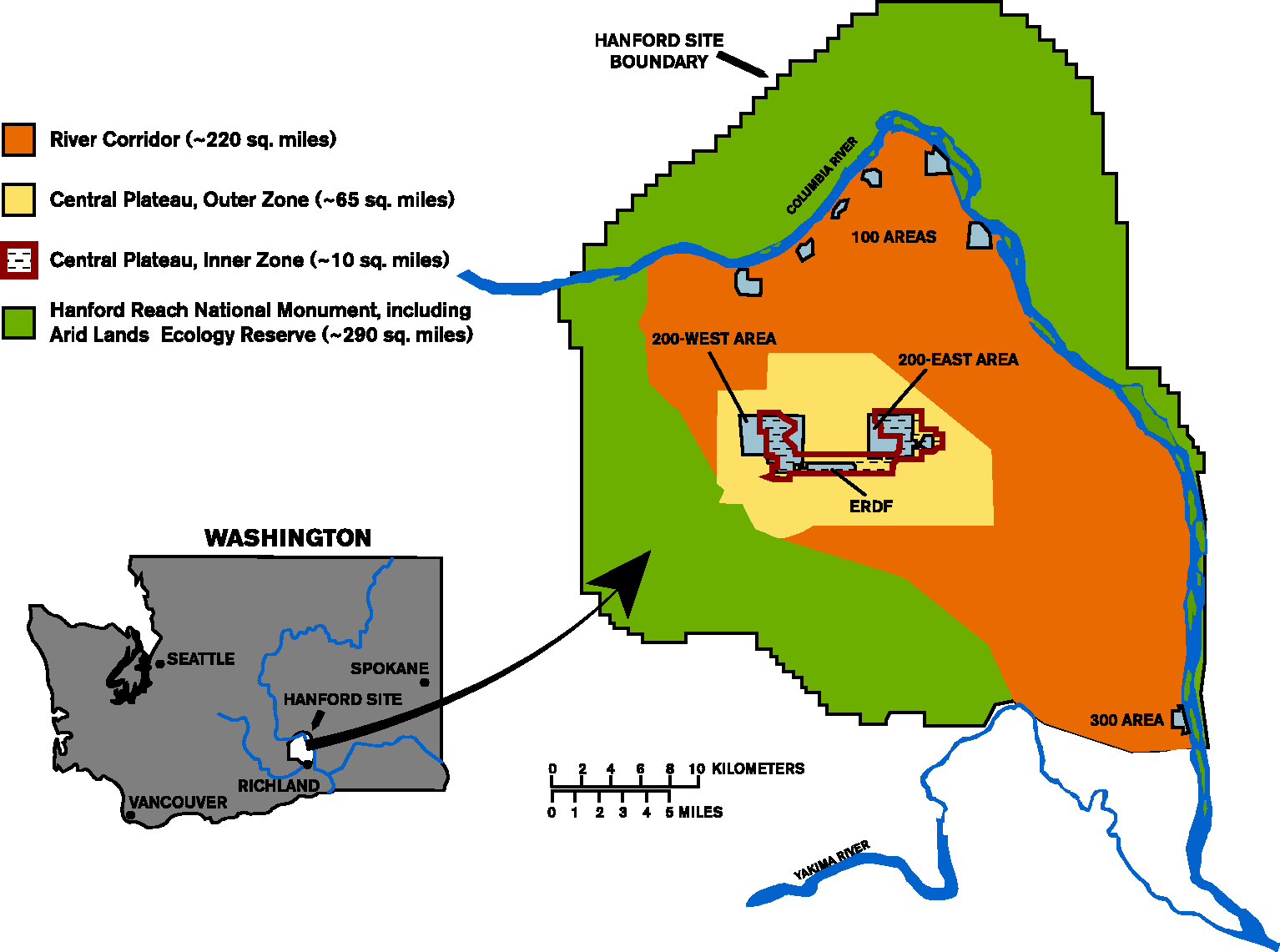
During Hanford’s operating years, disposal of waste into the soil was assumed to be permanent. However, the spread of contamination from liquid wastes, and the need to remove solid wastes near the Columbia River and elsewhere to prevent them from spreading and to free up the land for other uses, has necessitated that much of this waste be dug up, treated or repackaged, and moved.
The current risks
Since access to the site is restricted, the day-to-day risk to the public is low. Federal and state laws strictly regulate the radiation exposures and some chemical exposures that site workers can receive, but there have been a number of serious worker exposures during the cleanup—primarily to chemicals. This past spring, for example, at least 28 workers were exposed to potentially harmful chemical vapors from underground waste tanks; some sought medical attention (Frame, 2014).
Some of the near-term risks—though very unlikely to become reality—are of a potentially catastrophic nature. An earthquake or a fire, for example, could damage a waste storage facility and release radioactive materials.
Because of chemicals leaching into the Columbia River, there is also a near-term threat to species that use the river, such as salmon and steelhead (Energy Department, 2013b: 27). The Hanford area includes the Hanford Reach, a prime spawning area for salmon.
Many of the long-term risks are also related to the river. The Energy Department’s own calculations show that contaminants currently in the soil will move over time, potentially re-contaminating the groundwater for thousands of years to come (Energy Department, 2013a). Should those contaminants reach the river in quantities and concentrations much larger than seen today, they could potentially impact agricultural products that use river water for irrigation. What those future impacts will be, if any, will be determined by the cleanup decisions that have already been made and will continue to be made during the next several decades. Extensive monitoring conducted by the Energy Department and the State of Washington indicates that this risk is very small today.
When cleanup is complete, whenever that may be, at least 10 square miles in the center of the site will remain a waste management area in perpetuity. Other areas of the site will also have restrictions on how the land and groundwater can be used.
Cleanup progress
There has been considerable cleanup progress throughout Hanford, with the major exception of waste stored in underground tanks. The continuing, multiple problems with the tank waste treatment program often overshadow accomplishments elsewhere on-site. Hanford cleanup work is done by several large contractors and many subcontractors. About 8,400 people work at Hanford.
It was difficult to see much progress during the first decade or so of cleanup, but, in hindsight, a lot was done during that period. Much of the early focus was on resolving urgent risk issues, such as the potential for a fire or explosion in one of Hanford’s underground waste storage tanks, so that the rest of the cleanup could then move forward.
Environmental laws required identification of how much and what kind of contamination was present and the threat posed by the contamination. These laws also required identification of several cleanup alternatives; developing those alternatives to assess risks, effectiveness, and costs; providing regulators and the public with an opportunity to weigh in; and finally selecting and implementing the preferred alternative. In most cases, this was a multi-year process before actual cleanup could begin.
To support the cleanup, Hanford needed new treatment facilities for liquid effluent waste; facilities for handling and packaging waste; and a disposal facility for the more than 15 million tons of contaminated soil and building debris that would be generated during the cleanup. It took time for those facilities to be designed, sited, and constructed. Aging infrastructure needed replacement.
Hanford also needed stable, predictable funding, which Congress didn’t always provide. Former Louisiana Sen. J. Bennett Johnston Jr. described the difficult job faced by Assistant Secretary Thomas P. Grumbly, who headed the Energy Department’s cleanup program in the mid 1990s: “We have given him an impossible job. We have ordered him to meet standards he cannot attain, to use technologies that do not exist, to meet deadlines he cannot achieve, to employ workers he does not need, and to do it all with less money than that for which he has asked. If he fails, we have threatened to put him in jail” (Oregon Department of Energy, 2009: 41).
In some ways, the decade of the 1990s could be considered “getting ready for cleanup,” while the decade of the 2000s was when we began to see considerable progress. Significant additional progress was made in the early 2010s with the receipt of nearly $2 billion in extra funding as part of the American Recovery and Reinvestment Act.
The River Corridor
Early on, based on input from Native American tribes, the State of Oregon, and the general public, government regulators decided that the initial focus of the Hanford cleanup should be along the Columbia River shoreline, referred to as the River Corridor. This approximately 220-square-mile area includes the six reactor sites (some sites have more than one reactor), called the 100 Area; the fuel fabrication and laboratory facilities, called the 300 Area; and large connecting areas that were not part of the plutonium production operations (Energy Department, 2014a: 1-6). Throughout the 100 and 300 Areas, there was extensive soil contamination from liquid waste discharges; dozens of burial grounds—some of which contained pyrophoric materials, which can ignite when exposed to oxygen in the air; and heavily contaminated facilities. Much of the groundwater beneath these areas was laden with a mix of chemicals such as hexavalent chromium and nitrates, and radioactive materials such as uranium and strontium—all of which pose a potential health threat to humans and aquatic species.
Six of Hanford’s nine plutonium production reactors have been placed into what is called Interim Safe Storage, or “cocooning.” This involves removal of all surface contamination and surplus materials from throughout the reactor building; demolition of all support buildings (typically about two dozen at each reactor area); and the addition of a new high-strength corrosion-resistant galvanized steel roof. The intent is to isolate the reactor block and allow the radiation to naturally decay. Because the fuel was removed decades ago, active cooling of the reactor cores is not required. Current plans call for the reactors to be dismantled after 75 years and removed from the river shoreline.
One of the reactors yet to be cocooned currently stores highly radioactive sludge in a basin adjacent to the reactor. Until that sludge can be removed to the center of the site—a project that the Energy Department and its contractors have struggled with for years—cocooning of that reactor and a nearby reactor will not occur. The ninth reactor—actually Hanford’s first reactor, the B Reactor—has been preserved as a museum. The public is restricted to areas within the reactor that do not pose a hazard. Public tours of the reactor, though somewhat limited and strictly controlled by the Energy Department, have proved incredibly popular.
Hanford workers dug up millions of tons of contaminated soil from liquid waste disposal areas at each of the reactor sites and hauled it to a massive landfill in the center of the Hanford Site. Designed to be expanded as needed, this Environmental Restoration Disposal Facility (ERDF) comprises a series of cells or disposal areas. Liquids that move through the facility are captured beneath the disposal cells and routed to a treatment facility, preventing contaminants from reaching the groundwater.
Workers have also successfully cleaned up dozens of burial grounds associated with the 300 Area and each of the reactors, with much of that waste being disposed of in the ERDF as well. Some waste from the burial grounds is more radioactive than is allowed in the ERDF and is stored for eventual shipment to a deep geologic disposal site in New Mexico.
Work continues on one burial ground just north of the 300 Area that contains highly radioactive laboratory waste. Planning is under way for cleanup of yet another burial ground that is located adjacent to a commercial nuclear power plant located on the site. That proximity to the nuclear plant adds complexity to the already challenging job of digging up highly radioactive and sometime volatile wastes.
Among the other notable cleanup achievements so far:
About 2,300 tons of corroding irradiated nuclear fuel stored in two leak-prone storage basins just a quarter-mile from the Columbia River were packaged, dried, and moved to a much safer storage facility well away from the river. More than 13 tons of plutonium and plutonium-bearing materials were treated and stabilized for interim storage and then shipped off-site for disposal at a facility in South Carolina. These materials posed risks to Hanford workers, and the facility they were stored in—the Plutonium Finishing Plant—is still considered one of the highest-risk facilities on-site. With the plutonium stabilized and removed from Hanford, decommissioning and demolition are well under way on this facility. Multiple groundwater pump-and-treat systems have been installed along the river and in the center of the site. Most of the reactor areas have hexavalent chromium and other contaminants in the groundwater. The center of the site has a large plume of carbon tetrachloride and other contaminants as well. The pump-and-treat systems move groundwater to a treatment facility where these contaminants are removed. Hundreds of contaminated buildings have been torn down, with the debris taken to the ERDF. More than 640 truckloads of transuranic waste have been shipped off-site to a disposal facility in New Mexico, the Waste Isolation Pilot Plant. Transuranic waste is predominantly protective clothing and building debris that is contaminated with small amounts of plutonium. Because it will be hazardous for tens of thousands of years, it is buried deep underground to keep it away from people and the environment.
The Energy Department has been focused on completing surface cleanup in most places along the Columbia River by 2015. Work at one reactor area, at least one burial ground, and dealing with highly radioactive contamination beneath a building in the 300 Area will not be completed until 2020 or so. Groundwater treatment systems along the river and in the center of the site will operate well into the future. Cleanup efforts will then shift to Hanford’s Central Plateau, a 75-square-mile area located near the center of the site. The Central Plateau, which includes Hanford’s 200-East and 200-West Areas, is home to the waste storage tanks, the chemical processing facilities called “canyons,” hundreds of liquid waste disposal sites (Energy Department, 2014a: 4-1), and more than 40 linear miles of solid waste burial trenches (Hanford Advisory Board, 2011).
Hanford’s tank wastes
Hanford’s nine plutonium production reactors irradiated uranium fuel, which created a number of new elements, including small amounts of plutonium. The irradiated fuel, which was then highly radioactive, was transported in heavily shielded rail casks from the reactors to processing facilities on the Central Plateau. There the fuel was dissolved in acid as the first of many chemical steps taken to extract the plutonium.
Liquid waste was created at each step of the process. Some was directly disposed to the soil. The remainder was piped into underground tanks. To store the waste, 149 tanks, consisting of a single shell of carbon steel with a concrete liner and ranging in capacity from 55,000 gallons to one million gallons, were built from 1943 to 1964 (Energy Department, 2013a: S-2).
By the 1950s, leaks were detected or suspected in multiple tanks. When Hanford added additional underground storage tanks beginning in 1968, they were of a design that incorporated two carbon steel shells (Energy Department, 2013a: S-3). All 28 of the double-shell tanks have at least one million gallons of capacity.
As much as 525 million gallons of waste was piped into the underground tanks. More than 300 million gallons of liquid in this waste has evaporated (Gephart, 2003: 5.7). An estimated 120 million gallons was routed to the soil (Waite, 1991: 2). The Hanford tank waste volume now stands at 56 million gallons, with about 29 million gallons stored in the 149 single-shell tanks and 26 million gallons in the 28 double-shell tanks (Washington River Protection Solutions, 2014: 2). The tanks are grouped in 18 “tank farms,” all of which are located in Hanford’s 200 Areas.
The Energy Department confirms that one single-shell tank is actively leaking an estimated few hundred gallons of waste per year. The department previously listed 63 of the single-shell tanks as known or suspected of having leaked about one million gallons of waste to the soil (Energy Department, 2013a: S-51; Washington River Protection Solutions, 2014: 17–18).
In October 2012, the Energy Department announced that the inner shell of double-shell tank AY-102 was leaking waste into its annulus—the space between the two tank walls. It is the first of Hanford’s double-shell tanks to have a confirmed leak. This is cause for considerable concern, as the double-shell tanks are being counted on to safely contain waste for decades to come.
Since the Hanford cleanup agreement was reached in 1989, the intent has been to immobilize the tank waste using a technology called vitrification. With vitrification, the waste is blended with glass-forming materials under heat. The molten glass is then poured into stainless steel canisters to harden. The waste is still radioactive but is much easier to store and poses less threat to people and the environment (Energy Department, 2014b).
Several early attempts to design and construct Hanford vitrification facilities failed. Plans to begin construction in 1991 were initially delayed in 1990, and later cancelled altogether. The Energy Department initially cited tank safety issues as the primary reason for the delay. Other parts of the initial plan, such as using an existing Hanford canyon facility for pre-treatment of the waste and mixing the less radioactive part of the tank waste with grout and disposing it in huge vaults, both were scrapped.
In 1995, Energy Secretary Hazel O’Leary announced that her department would pursue privatization for tank waste treatment, with hopes of lowering costs. Under the plan, the Energy Department would offer a fixed-price contract and would only pay for treated waste that met Energy specifications. Although 14 companies initially expressed interest, only two firms submitted proposals. One of the two was later rejected, allowing only BNFL Inc. to proceed. The Energy Department sent a report to Congress in 1998 indicating its intention to move forward with BNFL and privatization at a cost of about $6.9 billion, with vitrification beginning in 2006 or 2007 (Oregon Department of Energy, 2009).
In April 2000, BNFL submitted its formal estimate of $15.2 billion, citing the cost of private financing as the primary reason for the higher-than-expected price tag. The Energy Department rejected the estimate and terminated its contract with BNFL.
Milestones missed
The Energy Department moved quickly to find a new contractor to finish the design and construct the facilities. Deputy Secretary T. J. Glauthier said that BNFL’s work thus far appeared sound, and that a new company could move forward with BNFL’s design. In December 2000, the department awarded a 10-year, $4 billion contract to a consortium led by Bechtel National, Inc., which had previously been a design partner with BNFL. Beginning in 2001, Bechtel began to construct a massive complex of waste treatment facilities at Hanford, collectively called the Waste Treatment Plant (WTP). Numerous design and construction issues have plagued the project. Construction on major portions of the WTP was slowed in late 2004 and stopped in 2005, when the Energy Department determined that seismic requirements for the design needed additional validation. Progress on two of the major facilities stopped for nearly two years until that issue was resolved.
By mid-2012, concerns about design issues—some raised by whistleblowers—again slowed or stopped major construction work on the same two major facilities. The issues raised include whether the WTP could operate safely and whether it could work as intended for the entire life of the plant. Resolution of these issues is likely at least a few years away.
In 2008, the State of Washington sued the Energy Department in federal court, alleging that major schedule milestones related to tank waste retrievals and operation of the Waste Treatment Plant were at risk. These milestones required operating the plant by 2011; retrieving all tank waste from the single-shell tanks by 2018; and completing vitrification of all tank waste by 2028.
Washington and Energy settled the lawsuit in 2010. Washington agreed to delays in the start of WTP operations, but added new “pacing” milestones to a consent decree, while integrating it with the Tri-Party Agreement. Under the new schedule, Waste Treatment Plant operations would begin by 2019; all single-shell tanks would be emptied no later than December 31, 2040; and all tank waste would be treated no later than December 31, 2047.
Within one year of the settlement, the Energy Department notified the states of Washington and Oregon that certain consent decree requirements were at risk, without specifying which ones. Further notices over the next two years indicated that most of the requirements would likely not be met. Despite repeated requests from Washington for more specifics, the Energy Department did not provide a new schedule (Attorney General of Washington, 2014: 1–2).
As designed, the WTP would receive the tank waste through underground piping and separate it into two waste streams. One waste stream would include the most highly radioactive elements (such as cesium) in an estimated 10 percent of the waste volume. The remaining 90 percent of the waste volume would contain only about 10 percent of the radioactivity.
These waste streams would go to separate vitrification facilities. The highly radioactive vitrified waste would be stored at Hanford until the federal government is able to open a high-level waste repository. Plans to open such a facility at Yucca Mountain in Nevada were canceled by the Obama administration. The lower-activity vitrified glass would be buried at Hanford. The low-activity vitrification facility being built may not have the capacity to treat all of Hanford’s large volume of low-activity waste, so an additional vitrification facility, or some other treatment technology, may be needed to treat the remainder of the waste.
Vitrification is a proven technology that is being used elsewhere in the United States and in Europe. There is an operating vitrification facility for high-level radioactive waste at the Energy Department’s Savannah River Site in South Carolina. Like Hanford, Savannah River had a plutonium-production mission, but it used only one chemical separation process, whereas Hanford used five different chemical processes over the years and dealt with a much larger quantity of waste.
In September 2013, the Energy Department released a draft conceptual document that laid out some broad ideas for beginning actual tank waste treatment. It suggested developing an interim pre-treatment system while initially bypassing the pre-treatment facility—which has the most serious design issues—and sending the waste directly to the low-activity vitrification facility. It also recommended seeking approval to treat waste in 11 tanks as transuranic and to send it for disposal to the Waste Isolation Pilot Plant in New Mexico (Energy Department, 2013b: 69). However, the plan included few details and no deadlines.
On March 31, 2014, the State of Washington and the Energy Department both submitted proposals to amend the existing consent decree. Washington’s proposal included a series of new milestones but the same final dates of single-shell tank retrievals completed by the end of 2040 and all tank waste vitrified by the end of 2047. Because of delays in operating the Waste Treatment Plant, Washington’s proposal required the addition of at least eight million gallons of new double-shell tank capacity by 2024 (Attorney General of Washington, 2014). The Energy Department’s proposal did not include dates for completing retrieval or vitrification and did not address new storage capacity (Energy Department, 2014c). On April 18, both parties rejected the respective proposals. If a negotiated agreement is not possible, they likely will end up back in federal court.
The State of Washington also took action earlier in March 2014 to force an accelerated pumping of the leaking double-shell tank, AY-102. Since the leak was discovered in October 2012, the Energy Department has greatly increased its monitoring of the tank and has conducted integrity exams of the other double-shell tanks. Because sludge in the bottom of the tank requires a certain amount of liquids on top to help cool the waste, the Energy Department has stated that none of the liquid should be pumped until the sludge is ready to also be pumped. For that, the department said, it would need about two years to acquire and install new equipment. The proposed plan would authorize the start of pumping no earlier than March 2016 (Energy Department, 2014d) but provides no schedule for removal of the waste. An administrative order from the State of Washington, however, requires the Energy Department to begin pumping liquid from the tank no later than September 1, 2014 and sets deadlines for sludge removal and subsequent inspection (Washington State Department of Ecology, 2014). The Energy Department has since appealed that administrative order.
The cost and time of cleanup
People often ask why the Hanford cleanup is taking so long and why it costs so much. The primary reasons are the unprecedented extent of environmental contamination and the difficulty of cleaning up these wastes. Workers often deal with high levels of radioactivity and chemical contamination that require them to use remote-handled equipment or robotics. Sometimes workers must wear protective suits and breathing apparatus for additional protection. Combining these restrictions with complicated procedures greatly adds to the time necessary to complete the work. In some cases, the wastes are unique to Hanford, and the methods and equipment necessary to deal with the wastes have to be created before cleanup can occur.
False starts, missteps, and bad decisions along the way have also hampered progress. For example, several earlier efforts to design and construct tank waste treatment facilities were later canceled, and the Energy Department has been struggling for nearly a decade with how to safely remove highly radioactive sludge from a basin near the Columbia River. The US Government Accountability Office has repeatedly hammered the Energy Department for its project management failures and its inability to successfully bring large projects to completion—both at Hanford and at other Energy Department sites.
The sheer volume of waste and the complexity of cleanup makes Hanford cleanup incredibly expensive. Dealing with hazardous and radioactive waste also greatly adds to the costs. To ensure worker safety and prevent the spread of contamination, relatively straightforward activities such as drilling wells and analyzing samples are tens or even hundreds of times more expensive than if those activities took place on an uncontaminated site.
The Hanford cleanup to date has cost about $40 billion. The site’s average budget is about $2 billion per year. The estimate to complete the remaining Hanford cleanup is at least $110 billion more (Energy Department, 2014a: ES-2).
Lessons learned
After being involved with the Hanford cleanup for nearly 25 years, I can make several observations about it. The first is that there are no shortcuts. There is no way to dramatically reduce the cost. Several times over the years, the $2 billion annual Hanford cleanup expenditure has caught the eye of a new president or energy secretary or head of the cleanup program. They assume there has to be a way to get this done cheaper and faster, so they suggest less cleanup. Or they launch a review of cleanup priorities. Or they invest tens or hundreds of millions of dollars in a technology that sounds promising but ultimately is not a viable solution. All of these things have happened multiple times.
The second big lesson: Cleanup is racing against the clock. The failure of the double-shell tank AY-102 is an urgent warning that the double-shell tanks might not remain viable for as long as they need to be. Other storage facilities are also aging and susceptible to an earthquake.
Former Washington Governor Christine Gregoire said it well when she talked with 60 Minutes in 2006: “We’ve got an area that is contaminated in the groundwater and is migrating towards the Columbia River. And if it gets there … we have an absolute disaster on our hands. … I can understand the frustration in Congress. Frankly, they are no more frustrated than me. But the last thing we need is to send a message to this country that it’s okay to walk away. It is not. The chances of a catastrophic event over there are real. Time is not on our side.”
Footnotes
Funding
This research received no specific grant from any funding agency in the public, commercial, or not-for-profit sectors.