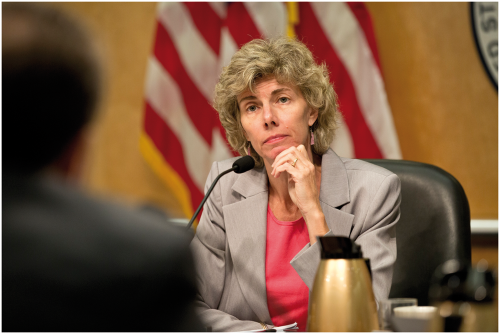
In this interview, Allison Macfarlane—the new chair for the US Nuclear Regulatory Commission and a former commissioner for the Blue Ribbon Commission on America’s Nuclear Future—talks to the Bulletin during her first weeks on the job. She brings her experience full circle by reviewing what the commission accomplished in terms of managing waste, and how it will be in the hands of Congress, not the NRC, to move forward and make something substantial of the commission’s efforts. The NRC, she notes, will then be tasked with regulating new developments, like centralized interim storage for nuclear waste. A geologist, Macfarlane talks about her optimism that a long-term nuclear waste repository will be sited—but she cautions that its placement should be based on sound and scientific analysis. She reviews what US nuclear safety means in a post-Fukushima world and mentions that earthquakes are not the primary safety risk to US nuclear power reactors; flooding, tornadoes, and hurricanes are the natural disasters, she says, that the NRC will be focusing on in upcoming months.
Sworn in as chair of the Nuclear Regulatory Commission in July of this year, Allison Macfarlane is an expert on nuclear waste and the first geologist to serve on the commission. Before beginning her one-year term as the NRC’s 15th chair, Macfarlane was an associate professor of environmental science and policy at George Mason University, as well as an affiliate of MIT’s Program in Science, Technology, and Society and Harvard University’s Belfer Center for Science and International Affairs.
Macfarlane’s research has focused on environmental policy and international security issues associated with nuclear energy. From 2010 to 2012 she was a member of the Blue Ribbon Commission on America’s Nuclear Future, a panel appointed by the Obama administration to conduct a comprehensive review of policies for dealing with high-level nuclear waste and to recommend a new strategy. She is co-editor of Uncertainty Underground: Yucca Mountain and the Nation’s High-Level Nuclear Waste, which explored technical issues at the proposed waste disposal facility in Nevada.
Macfarlane chaired the Bulletin’s Science and Security Board from 2008 until May of this year, when she was chosen to lead the NRC, and has authored numerous articles for the Bulletin over the years. After just a few weeks on the job, Macfarlane spoke with the Bulletin about her new work at the NRC.
BAS: It’s no secret that the NRC chair you replaced was often at odds with his four fellow NRC commissioners. How is your approach different?
Macfarlane: I’ve begun to establish a collegial and collaborative environment here, at least for my office and my interactions with the other commissioners. On my first day here, even before I was sworn in, I met with the four other commissioners for an hour each, and we had an excellent discussion. We’re continuing to meet on a regular basis, and my staff is working with their staff. I bring my academic approach to the job, which is to treat my colleagues as peers.
BAS: Some people were worried that, as an academic, you wouldn’t have the bureaucratic experience for the job.
Macfarlane: The way the commission operates, at this level, is like an academic department. You have a bunch of faculty and one of them is chair. You offer leadership in terms of policy directions, but your colleagues are equals in terms of their knowledge and capabilities. I don’t know what happened in the past, so I’m just approaching it in the only way I know how.
BAS: What are you most excited about accomplishing during your time at the commission?
Macfarlane: First and foremost, because of my role and my experience as a geologist, I’m interested in bringing a geological perspective to a number of these nuclear safety issues. I think that was driven home by the experiences at Fukushima and North Anna [Nuclear Generating Station in Virginia] last year. There’s a lot more that geologists and nuclear engineers can learn from each other.
BAS: What are you going to do about a long-term solution to the waste problem?
Macfarlane: It’s not for us to solve the waste problem. That’s Congress’s job. What the Blue Ribbon Commission did was develop a strategy for Congress to follow. But the Nuclear Regulatory Commission, we regulate. We license facilities, and we ensure that they operate safely.
BAS: The Blue Ribbon Commission recommendations were a great first step, but what happens next? Have people in Congress been talking to you about this?
Macfarlane: [New Mexico Sen.] Jeff Bingaman just submitted some legislation. I’m not sure that people expect it to go anywhere, but he did put some legislation forward. The Energy Department did a follow-on to the Blue Ribbon Commission report. It’s at the White House now for their consideration, and we’ll see what they say.
BAS: Between now and the time when we have one or more permanent waste repositories, do you see interim steps that need to be taken, beyond just storing spent fuel in pools at power plants around the country?
Macfarlane: Let me just put on my BRC hat for a second and say that one of the recommendations that came out of the Blue Ribbon Commission report was to have, at least initially, some small amount of centralized interim storage, especially for those reactors that had shut down and were decommissioned. That spent fuel could be consolidated in one place. Basically, it’s to save money and to make it more secure by putting it in one place instead of having it at nine sites, where it is now. But the NRC would have to license such a facility if it were ever to come into being. The NRC’s role right now is just to ensure that the spent fuel is managed safely at reactor sites around the country. As you know, it’s in spent fuel pools and dry casks.
BAS: Most people seem to agree that dry casks are a safer way to store spent fuel than in pools. Other than cost, is there any good reason not to move more spent fuel into dry cask storage?
Macfarlane: I think you’d have to ask the industry this question. This impression that dry casks are safer comes, in part, from recent experience with dry casks in earthquakes—both at Fukushima and at the North Anna site. They were rattled but they performed very well, and so that gives us some confidence in dry casks. One of the open research questions is how these things behave over the very long term—over multiple decades. Spent fuel pools are necessary. You can’t have a reactor without a spent fuel pool, because you need the pool to cool the spent fuel after discharge. There are no casks that are licensed and available that can hold spent fuel that’s aged less than five years after discharge. After five years, you can begin moving your spent fuel into the dry casks.
BAS: You’ve talked about the difficulty of deciphering the history of a rock and predicting what will happen in the geologic future. Are you optimistic that we’ll be able to find a safe place to bury nuclear waste?
Macfarlane: Yes, because the alternative is much worse. The alternative is just leave it where it is and let it rot and decay. We have to be realistic about what we can know and predict about a particular site and not go beyond our capabilities in evaluating a site.
BAS: In response to a court decision, the NRC recently suspended final approvals of licenses until you do a reassessment of waste storage and disposal risks. How are you going to go about that?
Macfarlane: Obviously it’s an active area of consideration, but I can’t say anything more about it. It’s an adjudicatory process.
BAS: What’s your position on Yucca Mountain?
Macfarlane: I don’t have a position on it right now. We don’t have any Yucca Mountain issues before us at the commission. As you know, the Circuit Court of Appeals said they were going to hold the issue in abeyance, and probably we won’t be seeing this issue on our plates until winter or spring. Right now there’s nothing on our plate, and we’re just going forward with all the other myriad and sundry issues that we face.
BAS: Scott Kemp recently wrote an article for the Bulletin in which he warned that a new uranium enrichment technology called SILEX could stimulate proliferation (2012). The NRC has since invited Kemp to give a briefing on SILEX. What does that say about the NRC decision not to do a proliferation assessment before issuing a license to the first commercial SILEX facility?
Macfarlane: It says that the NRC is dedicated to understanding the issues behind everything. Right now I can’t say very much about this issue because it is still being decided by the commission. There are actually two separate issues that we’re facing here: There’s the licensing of the SILEX facility, which is now with the Atomic Safety and Licensing Board. Once they make their decision, it will come up to the commission. And then there’s a separate petition that was put forward by the American Physical Society to ask that the NRC do a rulemaking to include a consideration of proliferation when licensing enrichment and reprocessing facilities, and that issue is coming up sometime this fall. So these are two active issues, and I don’t think I can say much more about them. Legally, I’m bound not to.
BAS: Has the NRC gone far enough in responding to the Fukushima disaster, or is there anything else you want to do?
Macfarlane: The NRC’s main mission is to ensure public health and safety, and we’re continuing to do that. We’ve enacted three orders on Fukushima. One has to do with ensuring that power plants can operate safely over the long term given a loss of offsite power. They’re required to have additional equipment to ensure that they can operate over a long period of time and to stage equipment offsite as well. Another order is to make sure that there are hardened vents at the GE boiling water Mark 1 and Mark 2 reactors, which are the reactors similar to those at Fukushima. A third order is to ensure that spent fuel pools have proper instrumentation so that we know what’s happening to them, and we don’t have to guess about water levels. We’ve also required our licensees to do what we call seismic and flooding walkdowns—to evaluate their facilities in terms of seismic and flooding resistance. On the seismic side, this is actually part of something that was already ongoing before Fukushima started. The US Geological Survey has issued new seismic hazard maps for the Eastern and Central United States. In response to that, the NRC has required its licensees to update their seismic hazard analyses. And so this has been folded into the Fukushima requirements. And then we have a whole suite of additional issues and activities that we are considering requiring of our licensees. After the Fukushima accident, the commission put together what they called the Near Term Task Force. Ninety days after the accident, they issued their report, which listed 12 recommendations for improving safety at reactors. The commission asked the staff to prioritize those 12 recommendations. The staff did, and the orders I’ve described to you already were the highest priority. Now we’re working down through the list of the rest of them. It’ll take a while to enact a number of these. To do some of this work, you have to wait for a plant shutdown to get into the reactor area safely and look at what you need to do and make adjustments. So there are time constraints that are imposed externally on what we’re doing.
BAS: You’re an expert on earthquakes. Are they the primary safety risk to reactors in the United States?
Macfarlane: No, flooding is actually also a risk, and as part of what we’re going to look at in terms of the Fukushima activities, we’re going to also consider preparation for dealing with other natural events like tornadoes and hurricanes.
BAS: We’ve been warned that climate change makes extreme weather events more likely. Will climate change be part of the post-Fukushima analysis?
Macfarlane: Not explicitly, but of course we have to understand the full range of possible future events, so maybe implicitly.
BAS: What do you think about the idea that smaller nuclear plants and new designs can enhance safety?
Macfarlane: Frankly, I haven’t learned enough about the details of small modular reactors. But I think they’re really interesting, and I think we’ll be hearing a lot more about them here at the NRC, and I plan on learning more about them. I try to do a pretty deep dive on the technology.
BAS: Nuclear power is often cited as the textbook example of “regulatory capture,” and Congress is not showing much interest in nuclear regulation these days. Do you agree that regulatory capture has been a problem at NRC, and do you have any thoughts about what can be done to avoid it?
Macfarlane: My impression of the agency is a strong staff that is very dedicated to ensuring public health and safety, and I mean that very honestly. I’ve been very impressed so far with the staff and their desire to make sure that these plants, and not just the reactors but the nuclear facilities as well, operate safely. They have demonstrated to me that they are prepared to stand up to industry and do what’s right to keep the public safe.