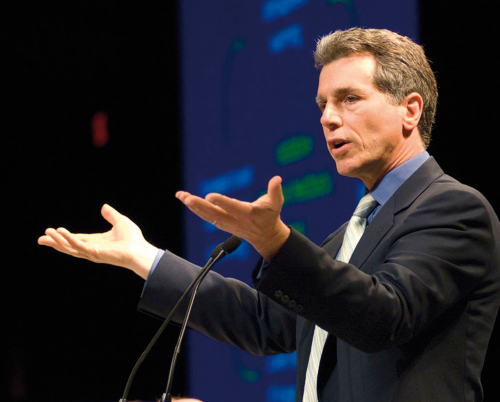
Canadian political scientist Thomas Homer-Dixon explains why human civilization must make a transition from fossil fuels to low-carbon energy sources—not just because of climate concerns but also because conventional oil is declining in production and becoming increasingly difficult to extract. He describes the political climate in Canada, where conversation about global warming—and especially about the oil sands in Alberta—is now widely viewed as unpatriotic and pointless. Homer-Dixon envisions a potential wake-up call to humanity in the form of a climate shock to global food-production systems, triggered by extreme weather events, and he sees increasing evidence for a connection between environmental stresses and civil conflicts. He calls for accelerated research on energy technologies, such as ultra-deep geothermal power, and for new research on how to restructure economies and social institutions. According to Homer-Dixon, the climate change problem might ultimately reside as much in our heads as in the external world. His latest work focuses on mapping the “mindscape,” a virtual space within which most of the world’s people are clustered in a few ideologically polarized groups. Vast, unexplored regions of the mindscape, he says, may offer new ways of thinking about problems such as climate change and new ways of living together successfully in the future.
Thomas Homer-Dixon is one of only a few social scientists who have studied climate change for more than two decades. His research on climate disruptions, energy scarcity, and economic instability investigates these major threats to global security and explores the connections between them. A political scientist by training, Homer-Dixon also ventures frequently into the fields of economics, environmental studies, geography, and social psychology.
Currently the Centre for International Governance Innovation chair of global systems at the Balsillie School of International Affairs in Waterloo, Canada, he is also the director of the Waterloo Institute for Complexity and Innovation at the University of Waterloo and a professor in the university’s political science department and its School of Environment, Enterprise, and Development.
In the 1990s, Homer-Dixon’s work focused on environmental stress and violence in poor countries. He led several research projects at the University of Toronto studying this connection, and his book, Environment, Scarcity, and Violence (Princeton University Press, 1999), won the Lynton Keith Caldwell Prize of the American Political Science Association. Homer-Dixon remains one of the world’s foremost authorities on environmental stress and conflict and has recently renewed his attention to this subject.
In the last few years, he has studied the connections between the climate crisis and peak oil, which he views not as separate issues, but rather as a single problem: the carbon problem. He edited a 2009 book, Carbon Shift: How the Twin Crises of Oil Depletion and Climate Change Will Define the Future (Random House Canada), in which he and other Canadian experts explored this junction.
Homer-Dixon has written or edited four other books, including the Canadian best seller The Upside of Down: Catastrophe, Creativity and the Renewal of Civilization (Alfred A. Knopf Canada, 2006), in which he suggested that some types of societal breakdowns may have a silver lining: an opportunity for bold reforms. This bad-news–good-news approach to complex problems pervades all of Homer-Dixon’s recent addresses and writings. He issues grave warnings about trouble ahead but also sees rich possibilities for transforming technologies, economies, political institutions, and societies in ways that not only reduce conflict, but also improve the quality of life.
Homer-Dixon writes regularly for Toronto’s The Globe and Mail and is working on a new book in which he will urge humankind to “grow up and slow down”—to reinvent our values, technologies, economies, and political systems before we destroy the planet. The book will look at the human mindscape, the mental landscape of possible worldviews, to identify beliefs and values that need to change in order to solve global problems. The Bulletin spoke with Homer-Dixon about this new research and his earlier work on climate change, energy, and security.
BAS: Your books have sounded a warning that human civilization is about to go through a major energy transition from an age of cheap, abundant energy to an age of energy scarcity. But at the moment, we seem to be entering an age of plenty in North America—with shale gas, new offshore drilling, and oil sands expansion. Has the age of scarcity been postponed?
Homer-Dixon: I think the folks who are saying that suddenly we don’t have an oil-supply problem and that North America will become energy independent are pretty dramatically overstating the case. There are two major facts that tend to get neglected. One is that there is a steady decline in global conventional oil production of just over four million barrels a day, every year. That adds up really fast. In five years, you’ve got a decrement of 20 million barrels a day; that’s roughly equivalent to two Saudi Arabias. You have to fill the decrement before you can even think about meeting increased demand. The second point that tends to get neglected is that the amount of energy we get back for every unit of energy we invest in oil exploration and production, is much lower than it used to be. You have to go farther, into more hostile natural environments, for smaller pools of often lower-quality oil, or you have to use much more complex and energy-intensive technology to extract energy from a source. Bitumen in Canada’s oil sands is, frankly, energy junk. The energy return-on-investment is about 4:1. Compare that with Texas in the 1930s, where the energy return on investment was around 100:1. Looking at shale gas, most people have focused on the possible contamination of groundwater supplies and on the enormous amount of waste produced. What gets the least attention is that these wells decline at about twice the rate of a standard natural gas well: somewhere in the neighborhood of an 80 to 90 percent decline rate in the first two years of production. The decline rate is so fast and so substantial that you have to keep poking holes in the ground. And that’s again an energy return-on-investment problem. I think that exactly the same is going to be true in the shale oil formations that are now being tapped.
BAS: What effect do you think the shift toward unconventional fossil fuels, such as shale gas, will have on global climate?
Homer-Dixon: It appears to have given a new lease on life to the conventional energy industries. There was excessive pessimism about natural gas in the middle of the last decade, and now there’s excessive optimism. When it comes to oil, the zeitgeist is that all these problems are behind us, but I think we’ll see that attitude changing. Despite the fact that the global economy has been staggering along, oil prices have remained near $100 a barrel for well over a year. That suggests that there’s a real tightness in the global oil supply. So anytime you get a shock of some kind—a terrorist attack on an oil rig in Nigeria, or a strike of oil workers, or bellicose talk about war with Iran—that triggers a significant price jump. Risk premium gets amplified in what is now a global oil market without much slack. What does this mean in terms of climate change? A consensus seems to have developed among North American elites that, because of this new supply, we don’t have to worry about any kind of energy transition in the immediate future. We don’t have to make the kind of major investments that people were talking about a few years ago, in developing a new energy infrastructure. That’s really unfortunate. It’s grounded in a pretty deep misunderstanding of the dynamics of the global energy—especially oil—situation. We do face a real supply-side problem, so we’re going to have to make a transition independently of climate change.
BAS: In the United States, a political war is raging over the Keystone XL Pipeline and the Canadian tar sands. How is this debate viewed in Canada?
Homer-Dixon: You make yourself a pariah in Canada if you use the “tar sands” terminology. The proper etiquette is “oil sands.” Which, as one wag in Canada said, is “a bit like calling a tomato plant a ketchup plant.” The evolution from tar sands to oil sands, which occurred over the last 10 years or so and has been promoted by oil-sands interests in Canada, is similar to how conservatives in the United States reconfigured the meaning of “liberal” for enormous political benefit. In Canada, increasingly the discourse has identified climate change conversations—and anybody who’s concerned about climate change—as unpatriotic, because the Canadian economy is now so closely tied to energy resource extraction that to raise the climate change issue is implicitly and sometimes explicitly a criticism of the oil sands, and the oil sands has become a Canadian third rail.
The oil-sands interests have a direct line into the Canadian federal cabinet, so we have deeply structurally embedded vested interests that have no interest in a climate change conversation. It’s like the issue has disappeared from the national media. We had an absolutely bizarre winter, and nobody talks about it. Among the cognoscenti, it’s pretty clear after Durban that nothing’s happening, and it’s completely rational to not talk about something if you can’t do anything about it. To bring it up in a conversation at a dinner party with friends, you’re just depressing people. That has had a big subliminal effect on people’s willingness to have a conversation about these issues, and the groups that are trying to promote climate skepticism are exploiting that psychological terrain: the uncertainty and the sense of hopelessness. In the United States, it’s a somewhat different set of issues. Part of it is that the economic crisis has sucked up a lot of the oxygen. But also, my sense is that the Obama administration took such a hammering on the health care issue, and then lost control of Congress, that they’ve recognized that there is nothing to be gained by moving forward on climate change—and an enormous amount to be lost, including quite possibly the White House. So they’ve just decided to bury the issue for the time being.
BAS: Would continued development of the Canadian oil sands be as disastrous as some climate scientists say?
Homer-Dixon: The most credible pit-to-tailpipe analysis shows that this energy source has around 17 percent greater carbon output per unit of energy produced than conventional oil. The defenders of the tar sands have a point when they say that opponents are exaggerating the difference. But we have to make a change here. We have to go to zero carbon. If we continue along our current trajectory, we’re going to have 700 or 800 parts per million of carbon in the atmosphere, and we’re going to be looking at a warming of 4 degrees or more Celsius. That will have catastrophic implications for human civilization. In terms of global oil supply, the tar sands aren’t going to make much difference. They produce about 1.5 million barrels of oil a day and, by 2030, will be able to produce 4.75 million barrels a day: only 5 percent of total global consumption. Canadians say we have 170 billion barrels of oil in the sands. That’s in the same ballpark as Saudi Arabia, which supposedly has 260 billion barrels of oil in reserve. But they’re not remotely comparable resources; they’re like apples and fish.
BAS: Do you foresee a crisis that might cause a major shift in attitudes and policies about climate change?
Homer-Dixon: Human history evolves through what I call “moments of contingency”—when there’s a crisis or shock that induces a certain flexibility in institutions, in politics, and in people’s psychology that allows for new pathways to be chosen. After those moments of contingency, you often get long periods of lock-in where things don’t change very much. Up to this point, almost all the climate changes we’ve seen have been what you might call “slow creep.” Whether we keep doubling down on carbon-based energy is going to depend, in part, on whether there is a shock that demonstrably affects a large part of the human population and can be attributed quite clearly to some kind of extreme weather. As far as I can see, there’s only one way that could happen, and that’s through the global food system, particularly through global grain production. We’ve been seeing a somewhat similar situation in the global food supply that we’ve been seeing in the global oil supply in the last few years, which is a declining elasticity of supply and a high volatility in prices. The price spike in 2010 was almost directly attributable to the heat wave that occurred in Russia. I think we’re quite likely, within the next 10 or 15 years, to see a couple of the major grain-producing regions suffer very serious, simultaneous climate impacts. That’s not great in the short term for large portions of the human population, but the zeitgeist could change quickly. Look at the change in attitudes toward, for instance, financial leaders between 2008 and now. The climate change issue could move front and center, and the folks who have been involved in blocking progress on this issue could have the same kind of reputation that bankers have right now. There’s one very important development in climate science that would help strengthen this kind of argument: Climate scientists are starting to produce some really nice tools for the attribution of extreme events; this has now become a high-priority research activity. I think the ability to say “the probability is virtually nil that extreme weather event X would have occurred in the absence of climate change” will greatly influence the debate.
BAS: The idea that climate change can cause the collapse of civilization, or even start wars, is controversial. What’s the best evidence for this idea?
Homer-Dixon: The cover story in Nature last August, by Solomon Hsiang and his colleagues, was a very nice piece of research because it used a natural fluctuation—the El Niño/Southern Oscillation phenomenon—to look at changes in precipitation and how that affected the incidence of violence, especially in poor societies. They got a strong signal, especially for the very poorest societies: The probability of new civil conflicts doubled in El Niño years. For these poor societies, the impact on food supply is critical. The story about potential impacts on the wealthy parts of the world, where people have a much more indirect relationship to the natural environment, is somewhat more complex. We may be able to buffer ourselves from the consequences of severe climate change in rich societies for a while, but ultimately we’ll pay an enormous price, too. And that’s independent of the fact that any major violence and social dislocation in the south could spill over into northern countries. The drought in Mexico, for example, is having extraordinary impacts on the northern part of that country right now. You can imagine it eventually driving very large migrations of people northward into the United States.
BAS: Last summer, there was talk that the UN Security Council might create a “green helmets” peacekeeping force devoted to environmental conflicts. What do you think of that proposal?
Homer-Dixon: Environmental stress, including climate stress, is not going to be a sufficient cause of violence or societal collapse by itself. What we found in our research is that all conflicts are always caused by a diverse set of factors, and those factors usually are interacting in some kind of multiplicative way. The problem with the “green helmets” idea is that it presumes that there are going to be conflicts that are specifically identifiable as environmental conflicts, but there won’t be any such thing. It might be climate change in the context of, for instance, chronic underinvestment in the food-production system in a region for a long time: limited extension services, irrigation systems, or grain-storage facilities. So when a climate shock comes along, it has enormous impacts on the local agricultural community. Is this climate change or bad food policy? Clearly it’s both. Large quantitative, statistical studies have a lot of trouble dealing with these interaction effects. But now that researchers are looking at clusters of variables in these large studies, they’re starting to find environmental factors as causes in a lot of these clusters. The reason that a lot of the statistical research previously has not shown a strong correlation between environmental stress and violence is because they were looking for a bi-variant relationship: higher in environmental stress, higher in violence. Nobody doing on-the-ground, case-study research ever suggested the relationship was as simplistic as that.
BAS: A couple of years ago, you said that solutions to climate change would reside largely at the level of culture. But more recently, you seem to be saying that what we really need is the rapid development of low-carbon technologies. Have you changed your thinking about the importance of technological change?
Homer-Dixon: We need significant progress on the technology side, especially in the development of new forms of high-power-density, easily disseminated, low-carbon energy. We need simultaneously to work on issues relating to values—our understanding of things like what “the good life” is. And we also need to pursue a lot of research on the issue of how we can structure our economies in ways that provide people with the goods and services they need—but with the absolute minimum of material and energy throughput. We can’t follow the growth trajectory that mainstream institutions like the World Bank suggest we’re on. The standard model is somewhere between 2 to 3 percent real growth in the world economy every year: That means the world economy will nearly quadruple in size in the next 50 years. Even with the best-case scenarios for increases in efficiency—about a 1.5 to 2 percent improvement in efficiency every year—we would double our load on the global environment. It’s not going to happen, because the consequences of that load will start to have major economic effects: climate shocks, resource scarcities, high oil prices—we’re starting to see them already. If we try to quadruple the size of the global economy and double its material and energy throughput, as these figures suggest we’re going to do, we’ll run off an environmental and economic cliff. The institutional challenge is: How do we design our economies to provide what we need, without increasing our throughput? We don’t have a clue. We need social science research on how to restructure our economies, both nationally and globally. We need an energy research program. These should be Manhattan Project-scale research programs, and we’re not doing it.
BAS: You seem to be pinning a lot of hopes on ultra-deep geothermal power. Do we really have time to research new technologies and work out all the kinks?
Homer-Dixon: My sense is that there are a relatively limited number of probably tractable technical problems with ultra-deep geothermal. The first is that you have to go deep, through really hard rock. Drillers are used to drilling through soft sedimentary rock or salt. With deep geothermal, you need to be able to go down 8 to 10 kilometers through igneous rock, which may be 100 to 1,000 times harder. So you likely have to use a radically different drilling technology, perhaps micro-explosives or lasers or high-frequency sound. These are engineering challenges, but probably not anything approximating the level of complexity you’d find in a nuclear power plant, for example. A lot of enhanced geothermal up to this point has been done in places where the heat is close to the surface, but these also happen to be tectonically active zones. You have to be able to drill much deeper, and then you can go to places where the risk of earthquake is lower. There are other critical issues that have to be resolved, but this energy source is one of the few that has all of the characteristics needed to power a highly developed, energy-intensive civilization with very low carbon output. It is essentially nuclear power. Instead of building a whole bunch of nuclear reactors on the surface of the planet, producing wastes that we don’t really know what to do with, we could tap the heat generated by radioactive decay deep underground. Two studies suggest that this is one of the best ways to go. One is the MIT geothermal study that came out about three or four years ago, which says this is going to be a really important energy source and we’re not investing anywhere near as much in it as we should be. The other one, which was released at the recent AAAS [American Association for the Advancement of Science] conference in Vancouver, is the Equinox Blueprint: Energy 2030 report from the Waterloo Global Science Initiative. Last summer, they brought together a couple dozen of the world’s top energy experts to survey the gamut of possible technologies for moving to a low-carbon energy future. After a week of very intense conversations, they put enhanced geothermal near the top of their list.
BAS: In your book The Ingenuity Gap, you wrote about a lack of good ideas to solve complex challenges, such as global climate change and antibiotic-resistant diseases. With seven billion people on the planet, how can there be a shortage of ingenuity?
Homer-Dixon: When I talk about ingenuity, I mean ideas that are actually implemented, not just ideas that are created. We have all the solutions we could possibly need for something like climate change. We don’t need unthought-of technologies and institutional designs. The problem is that there are blockages in the implementation pipeline, mostly related to the power of deeply embedded, structural vested interests—in energy industries, for example. They’ll do what they can to maintain the status quo, because that sustains their power and wealth and status. You need ingenuity not just to solve the specific problem, but also to reform the social and decision-making institutions—say, the democratic process—so that the specific solutions to climate change can be implemented. That’s a meta level of ingenuity.
BAS: You called the recent climate summit in Durban a “pathetic exercise in deceit,” saying that the negotiators lied to each other and to the world about the extent of climate change and its economic impacts. If scientists cannot move negotiators to action, who can?
Homer-Dixon: I don’t know. A lot of scientists now are afraid, really afraid to say anything. In Canada, I know scientists who work in the federal public services, and they say that it’s just impossible now. Anything that they want to say, including about their scientific papers, has to be approved politically. This full-frontal assault on reason muddies the water for the general public, and it undercuts the climate negotiators. The negotiators have no political backing for what they’re doing. They increasingly start to live in this kind of alternative world that is detached from the actual science, so they’re still talking about 2 degrees Celsius. We’re not going to keep this planet at 2 degrees unless something really bizarre happens. We’re looking at 3 or 4 degrees.
BAS: What do scientists need to do differently to get the climate message across, without becoming propagandists?
Homer-Dixon: Scientists need to be better at understanding how the public understands science, and they need to work with that understanding to make their communication of scientific information more effective. This is a critical, civilization-defining moment: Is science going to be part of our rational approach to the future, or are we simply going to jettison it because it’s telling us stuff we don’t like? We have to defend science, but there’s a fundamental flaw in our collective process of problem solving and decision making. We have large numbers of people who are actually quite concerned about these problems, but because they’re atomized they can’t communicate with each other, and they can’t effectively oppose the vested interests that want a bigger slice of the pie for themselves. It’s a problem of institutional design and political mobilization. It also relates to people’s beliefs and understandings of what’s possible. I call this “the mindscape problem.” All modern ideologies address a common set of questions. You can use those core questions to envision a multidimensional space, in which a particular ideology inhabits one part of that space—a place where people like to cluster because the ideas there make sense to them. What happens in our society is that we get locked into two or three of these clusters—local ideological equilibriums—so the debate becomes very simplistic: political right versus left, for example. There may be enormous amounts of ideological space that haven’t been explored. There may be other ways of thinking about our future, and other possible ways of living together, that we haven’t even thought about. So the questions we’re asking are: What is the structure of that space? Are there places in it that look interesting but haven’t been explored? And if so, how can we migrate from the current places to the new places? It strikes me increasingly that these are actually the central questions and that the climate problem resides as much in our heads as in the external world.