




Abstract
Proliferation concerns have generally been associated with the acquisition of the fissile material needed for nuclear weapons; however, the spread of the knowledge needed to build very light and powerful weapons that can be carried long distances by missiles is also a serious concern. Such knowledge could accelerate and destabilize regional arms races, and lead to the deployment of powerful weapons able to target the US and its allies. Classified weapons-related information has previously spread through the international effort to harness inertial confinement fusion. Success in achieving net fusion gain in the National Ignition Facility at the Lawrence Livermore National Laboratory could lead to greatly increased R&D in inertial confinement fusion worldwide, along with increased proliferation risks. The authors write that these issues have not yet been adequately addressed and require direct and transparent examination so that means to mitigate risks can be assessed and residual risks can be balanced against potential benefits.
Keywords
Proliferation concerns have generally been associated with the acquisition of fissile materials, primarily highly enriched uranium and plutonium, which are necessary ingredients for all nuclear weapons. In addition to the risk of nations acquiring materials for their first heavy, primitive nuclear weapons, however, is the risk of broad dissemination of scientific information that—coupled with modern computers—could help nations design very compact, light, and powerful nuclear weapons that can be delivered by low throw-weight, long-range missiles. In January 2011, US Secretary of Defense Robert Gates highlighted concerns that future North Korean nuclear-tipped missiles might be able to reach the West Coast of the United States (Bumiller and Sanger, 2011). Advanced weapons based in North Korea—or eventually in some other countries around the world—would not only put the United States and its allies directly at risk, but also have a highly destabilizing effect on regional arms races. As nations develop very powerful, lightweight weapons, deliverable by missiles, the risk of nuclear conflagration grows.
Currently, researchers at the National Ignition Facility (NIF) at the Lawrence Livermore National Laboratory are working with powerful lasers to generate x-rays in order to compress and heat a small target containing isotopes of hydrogen to achieve net fusion gain—more fusion energy produced than laser energy used. Oversimplified, the goal is a miniaturized version of the most powerful stage of a thermonuclear weapon. Success would mark a major milestone after more than three decades of research on inertial confinement fusion (ICF). It might also mark the beginning of an accelerated global effort to develop commercial fusion energy based on the science of inertial confinement, which overlaps with the science of nuclear weapons. Uncontrolled dissemination of knowledge gained from inertial confinement fusion research and development (R&D) may risk contributing to the proliferation of highly deliverable and very powerful advanced nuclear weapons.
The concept for the National Ignition Facility, developed in the early 1990s, was primarily to provide information on the physics of nuclear weapons in order to help the United States steward its stockpile of nuclear weapons without further underground testing; that is, the facility would allow access to the energy density of a nuclear weapons test (Figure 1) and allow detailed measurements on key scientific questions associated with nuclear weapons performance under weapons-relevant conditions
1
(Libby, 1994). These measurements were considered critical for the continued stewardship of the US stockpile of nuclear weapons, and such arguments were evidently sufficiently compelling to fuel the commitment to begin construction of the facility at the Lawrence Livermore National Laboratory in 1996. Even when the projected total cost escalated in 2000 from its original value of $2.1 billion to $3.9 billion (US Government Accountability Office, 2000), the US National Nuclear Security Administration continued to support the project, underscoring its value to the stewardship of the US nuclear weapons stockpile.
The National Ignition Facility is designed to reach energy densities similar to those of nuclear weapons tests, well beyond the capabilities of the previous Nova inertial confinement fusion research facility (Libby, 1994, with permission of Lawrence Livermore National Laboratory).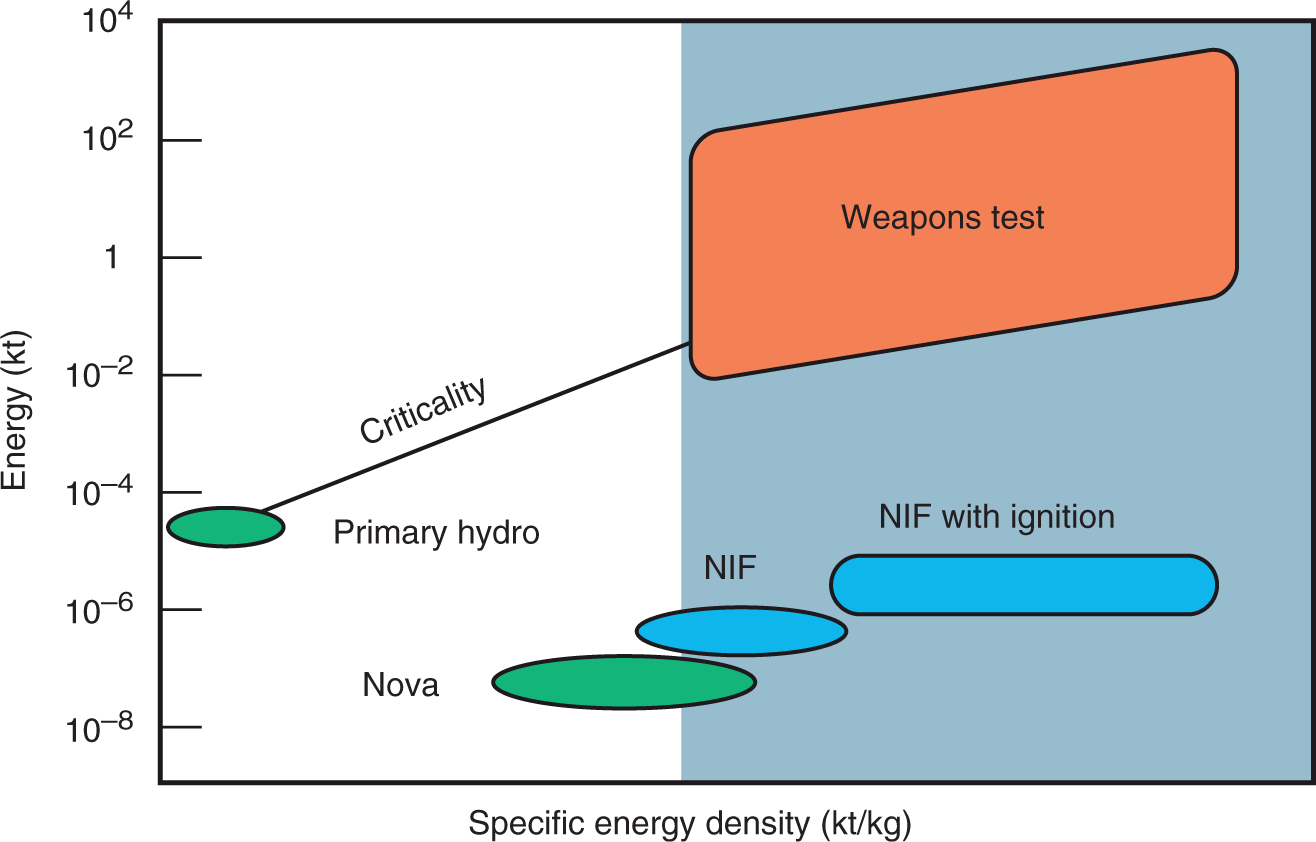
The US National Academy of Sciences National Research Council is now conducting a study to assess the prospects for commercial energy, rather than weapons science, from inertial confinement fusion. Fusion energy is attractive because the fuel is essentially unlimited, there is no risk of explosion due to an uncontrolled power excursion (Chernobyl) nor of meltdown due to decay heat (Three Mile Island and Fukushima), the radioactive waste is short-lived, and no weapons-relevant fissile material is required. Most of the world is pursuing fusion energy using steady magnetic fields (ITER, 2011) rather than miniature thermonuclear explosions, but inertial confinement fusion is an alternative approach.
While the National Research Council’s study has a classified sub-panel examining the physics of inertial confinement fusion mini-explosions, it has not been charged with examining the potential nuclear proliferation risks associated with inertial confinement fusion R&D. This question urgently requires direct and transparent examination so that means to mitigate risks can be assessed and the residual risks can be balanced against the potential benefits currently being evaluated. This concern is not new (Holdren, 1978), but its urgency is now greater than ever before.
The potential for accelerated regional arms races
The fissile materials needed for building nuclear weapons of any weight or power may soon become more widely available. A global nuclear renaissance may still be on the horizon in spite of the Fukushima accidents of March 2011. In addition to the 30 states currently operating nuclear power plants, 65 new states were “expressing interest in, considering, or actively planning for nuclear power” as of 2010 (International Atomic Energy Agency, 2010). Twenty-one are in the Asia–Pacific region, 21 are in Africa, 12 are in Europe (mostly Eastern Europe), and 11 are in Latin America (Figure 2). Some of the potential “newcomer” countries are in regions that are considered politically unstable today, and a number of these have expressed interest in developing uranium enrichment and plutonium reprocessing technologies, or emphasize their right to do so. Any of these nations, if strongly motivated, could engage in clandestine production of weapons materials, covert diversion of such materials from safeguarded facilities, or breakout from nonproliferation agreements followed by use of previously safeguarded facilities to produce weapons materials. It is concerning, therefore, that nuclear weapons materials may become available not only in South Asia and the vicinity of the Korean Peninsula, but also in Southeast Asia, the Middle East, Africa, and South America. The additional concern highlighted here is that data from inertial confinement fusion R&D might make it easier for these materials to be fashioned into very powerful and highly deliverable weapons, potentially accelerating arms races in these regions. Beyond the direct risk of an attack on the United States or its allies, nuclear arms races based on very powerful weapons deliverable by missiles on hair-trigger alert are especially unstable, and there is no guarantee that a regional nuclear war will stay contained. Furthermore the global climate effects of a regional nuclear war could be severe (Toon et al., 2007).
Existing nuclear energy states and states considering starting nuclear energy programs.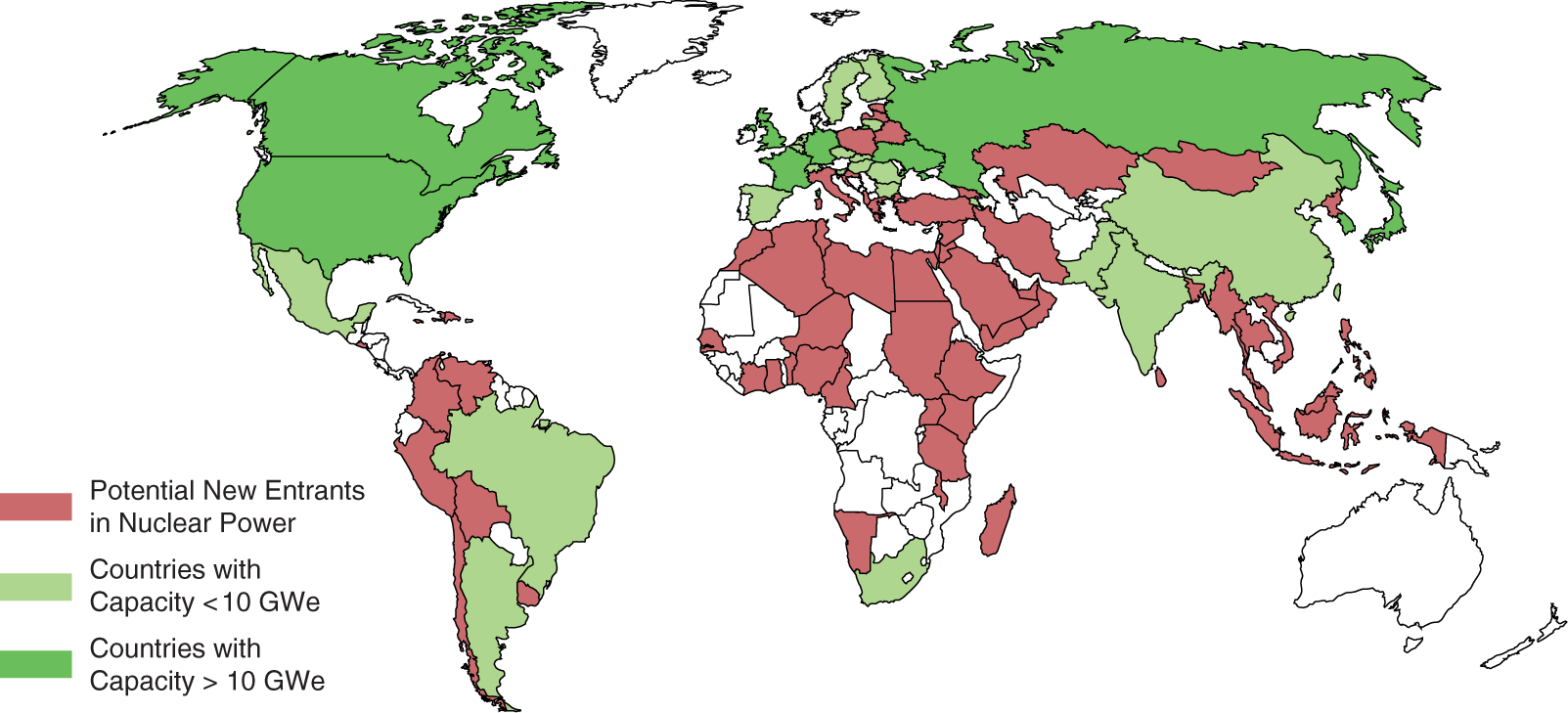
1995 Review of the proliferation risks of the National Ignition Facility
In 1995, the US Energy Department conducted a review of the proliferation risks associated with the National Ignition Facility. The unclassified report from this review (US Energy Department, 1995) described in simple terms the operation of a modern thermonuclear weapon and made clear the importance of the capabilities of the facility for understanding the operation of such a weapon. Furthermore, its analysis indicated that the facility can provide data on each of the three items that an advanced proliferator would require 2 in order to “pursue secondary designs, … improved capabilities in x-ray transport, equation of state, and thermonuclear reactions.” Nonetheless, this review concluded that, “[i]n general, without access to data from nuclear tests, ICF or unclassified NIF data would be of very limited utility to proliferators.”
Two points need to be recognized here:
Scientific data
It is important to observe that the conclusion of the 1995 Energy Department review left open the possibility that the full set of scientific data that could be produced by another country’s equivalent of the National Ignition Facility would significantly help a potential proliferating nation improve its weapons designs.
In 1993, a significant amount of information about inertial confinement fusion was declassified in order to facilitate research on energy applications, but much information available through inertial confinement fusion R&D remains classified.3 It is important to consider that, if there is a worldwide expansion of R&D on inertial confinement fusion energy, multiple nations will be positioned to develop their own data equivalent to the classified data that the United States will generate using Lawrence Livermore’s facility. Even if only a limited number of states have this capability, will they be willing and able to restrict the data that the United States considers sensitive?
The track record on this is poor. In 1955, France published detailed technical papers on plutonium-separation techniques during the first Atoms for Peace conference. Bertrand Goldschmidt, former Manhattan Project scientist who was instrumental in France’s nuclear program, later noted that the intention was to oblige “other nuclear powers to follow suit and likewise lift their secrecy for in fact they were using the same method” (Goldschmidt, 1982). At the time, France was frustrated with the United States for not sharing information on sensitive nuclear technologies that might have helped accelerate the French nuclear energy program. In 1955, the French strategy of defeating what it considered obsolete “political secrecy” worked, and efforts to suppress technical details about plutonium separation have essentially been pointless ever since.
Goldschmidt confirmed that France pursued the same strategy during the second Atoms for Peace conference in 1958. This time, the effort was aimed at making sensitive details of uranium enrichment public, but it ultimately failed. In fact, a few years later, the United States entered into discussions with the United Kingdom, Germany, and the Netherlands to reach a consensus that R&D on then-emerging centrifuge enrichment technology should be classified. By the time the European partners agreed, however, the United States had itself done most of the damage: Perhaps not being aware of the sensitivity of the data, it had published detailed experimental work by mechanical engineer Gernot Zippe that, until 1960, he performed at the University of Virginia. Efforts to contain the spread of centrifuge technology suffered another setback in the mid-1970s, when A. Q. Khan took with him from the Netherlands to Pakistan detailed blueprints of Urenco centrifuge technology and supplier lists facilitated by weaker security of a large multinational energy program as compared with the security of a national weapons program—a fact that continues to haunt nonproliferation efforts to this day.
Similarly, and directly relevant to the discussion of inertial confinement fusion R&D: Before 1979, the fact that thermonuclear weapons involve x-ray compression of a physically separate “secondary” component containing fusion fuel and reference to this technique in inertial confinement fusion were both classified in the United States. Nonetheless, during this time, inertial confinement fusion scientists worldwide, including those in non-nuclear weapons states, knew and talked about x-ray compression of inertial confinement fusion targets and its relevance to weapons ( Fusion Magazine, 1979; Kidder, 2005). The basic concept that “radiation from the conversion of the focused energy (e.g., laser or particle beam) can be contained and used to compress and ignite a physically separate component containing thermonuclear fuel” was declassified by the United States in 1979 (US Energy Department, 2002). However, during the 1980s and early 1990s, detailed results of international inertial confinement fusion research on x-ray compression were published (Murakami and Meyer-ter-Vehn, 1991) that revealed information considered classified at the time by the United States.
With a future large expansion of inertial confinement fusion R&D, the community of scientists engaged in this activity would also grow, and as noted in the 1995 NIF nonproliferation review, “[a]n ICF program could allow [an advanced] proliferator to maintain a knowledgeable cadre of individuals under the guise of a legitimate scientific activity.” These individuals would be well positioned to learn from the experimental, theoretical and numerical work performed by scientists of other nations.
Furthermore, it should be recognized that the cost of inertial confinement fusion R&D systems will diminish with a worldwide R&D program and, perhaps, ultimately with deployment of inertial confinement fusion energy systems. Thus, the capability to make measurements equivalent to those available at the National Ignition Facility will spread.
Underground testing
It is also important to observe that the 1995 review left open the possibility that inertial confinement fusion data could significantly help a proliferating nation that performs its own underground tests or has access to data from others’ tests. The US Energy Department’s 1995 National Ignition Facility nonproliferation review stated that, “Without nuclear testing, it is probable that a proliferator would not be able to develop a highly deliverable thermonuclear weapon…” Since this review, however, nuclear tests have been performed by India (1998), Pakistan (1998), and North Korea (2006, 2009).
We cannot exclude the possibility that a proliferating state will perform underground tests even if the Comprehensive Nuclear Test Ban Treaty ultimately enters into force, raising significantly the political cost of testing. The concern is that proliferating states may be able to achieve their goals with fewer tests, and therefore lower political cost, by inserting data equivalent to what can be acquired from the National Ignition Facility into programs run on inexpensive computer clusters 100,000 times more powerful than those available to US weapons scientists in 1970.
Moving forward
Today, the question is simple: Could access to the equivalent of classified data from Lawrence Livermore’s facility generated through worldwide inertial confinement fusion R&D—and perhaps, ultimately, deployment of inertial confinement fusion energy systems—accelerate the weapons program of a state attempting to develop very powerful, highly deliverable nuclear weapons? And if this is a significant risk, the next question is: Are there ways to limit this proliferation risk to an acceptable level? In one approach to limiting proliferation risks, the French Commissariat à l’Energie Atomique has stated that it will not pursue inertial confinement fusion energy in configurations that involve x-ray compression, which is used in the powerful second stage of thermonuclear weapons, but will only consider “direct drive” inertial fusion, where lasers or particle beams impinge directly on the surface of the fusion target (Massard, 2010). This restriction alone does not appear sufficient, most simply because lasers originally designed for direct drive can also be used on targets designed for x-ray compression.
We, the authors, cannot ourselves assess the magnitude or identify the specific features of the proliferation risks that could be associated with widespread inertial confinement fusion R&D, nor can we assess whether such risks can be adequately managed or limited by international restrictions or controls. But based on the 1995 National Ignition Facility nonproliferation review and the history of exposure of US classified information through international inertial confinement fusion R&D, it is clear that these issues have not yet been adequately addressed. In order to ensure public confidence, the possible approaches to these issues need to be analyzed before the achievement of net fusion gain has the potential to trigger a widespread international R&D effort; further, this should be done in as open and transparent a manner as possible. The 1995 nonproliferation review was a good step in this direction, but it applied to a much more limited question having to do with a single facility under US control. The present issue potentially has global ramifications.
The response should correlate with the wide-ranging scope of the issues involved. A review should be undertaken by a panel that includes not only weapons designers and nonproliferation experts from the nation’s weapons labs, but also members of the US intelligence community and the State Department, as well as scientists and nonproliferation experts from academia and nongovernmental organizations. It should have outside reviewers, as did the 1995 report, and should be commissioned in a manner that encourages the widest possible perspective. Such a review is beyond the scope of the present National Academies panel, but could be recommended by it.
By now, we scientists should have learned that nuclear technologies have risks that need to be considered carefully and openly—before these technologies are unleashed.
Footnotes
Acknowledgments
This work was supported in part under Contract Number DE-AC02-09CH11466 with the US Department of Energy.
Notes
Author biographies