




Abstract
The Chernobyl accident of 1986 released vast quantities of radioactive materials and significantly contaminated about 200,000 square kilometers of land. The Chernobyl Forum Report, an initiative of the International Atomic Energy Agency, suggested that the effects of radiation on wildlife were negligible relative to the impacts of human habitation, but this position was based on the very limited data available prior to this 2006 report. The wildlife of this region has been the subject of extensive study since 2005; since then, research has found that many birds, insects, spiders, and mammals show significant declines as a probable consequence of exposure to radionuclides. The best-studied group, birds, shows a 50 percent decrease in species richness and a 66 percent drop in abundance in the most contaminated areas compared to areas with normal background radiation in the same neighborhood. In addition, mutation rates and developmental abnormalities are dramatically higher, and survival rates and fertility are lower, in regions of moderate to high contamination. These findings challenge reports in the popular media and the conclusions of the Chernobyl Forum Report and are of relevance today, given recent interest in returning contaminated lands to agriculture use and the renaissance of the global nuclear power industry.
The Chernobyl disaster of 1986 provides unique opportunities to explore the impacts of chronic exposure to low-dose radioactive contaminants on human health and the environment. Fission products, mostly cesium 137 and strontium 90, and unspent nuclear fuel, in this case plutonium 239, were distributed across a vast geographic landscape (about 200,000 square kilometers, an area 2.5 times the size of South Carolina) that includes large parts of northern Ukraine, southeastern Belarus, and southeastern Russia, as well as less but still significantly contaminated areas of Scandinavia and Central Europe. At the regional scale, contamination levels are highly variable, with background radiation levels sometimes varying by two orders of magnitude in places just a few hundred meters apart. This “quilt work” of contamination levels, where high and low radiation readings can be observed relatively close to each other, but also at distances varying from one to hundreds of kilometers from the reactor site, allows for highly sensitive analyses of biological effects that can be replicated multiple times across a wide variety of ecological conditions. And, because areas of high and low contamination are distributed both within Ukraine’s fenced Chernobyl Exclusion Zone 1 —which is within roughly a 30 kilometer radius of the reactor site—and outside of it, there is the opportunity to investigate the effects of contaminants on plants and animals with and without human co-inhabitants. Serendipitously, this pattern of contaminant spatial distribution, ecological complexity, and diversity of land-use is optimal for addressing questions concerning the impact of exposure to low-dose radioactive contaminants on biological systems. There really is no other place on the planet that provides such potential to address fundamentally important questions at a spatial scale that is of relevance for scientists and policymakers wishing to understand the effects related to a nuclear disaster.
One question that has been posed repeatedly during the past few years is related to the alleged abundance and diversity of wildlife living inside the Chernobyl zone. The Chernobyl Forum Report (IAEA, 2006: 137) 2 concluded that, “… the populations of many plants and animals have expanded, and the present environmental conditions have had a positive impact on the biota in the Chernobyl Exclusion Zone.” This conclusion, however, was based on limited information from the Western peer-reviewed literature that was available to the authors of this influential report. 3 Despite this, the report made headlines—“Despite mutations, Chernobyl wildlife is thriving,” (Ravilious, 2006) or “Wildlife defies Chernobyl radiation” (Mulvey, 2006)—and the media coverage focused on the idea that the zone is a thriving ecosystem with large and vigorous populations of rare and locally exotic species that have returned to this site. It has even been suggested by the prominent environmentalist James Lovelock (Mulvey, 2006) that locating nuclear waste within environmentally sensitive areas could be a way to foster the conservation of threatened ecosystems because it would tend to deter other land uses, although this position is not widely supported.
For the past 11 years, we and our colleagues have systematically addressed questions related to plant and animal abundance and diversity in relation to contamination and human habitation in Ukraine, Belarus, Italy, Spain, and Denmark (our studies in countries outside of Ukraine and Belarus are regions that are relatively uncontaminated and thus provide controls for comparison). The motivation for these studies is an interest in the evolutionary responses of living organisms to rapid environmental change rather than any inherent interest in the impacts of radiation or nuclear accidents per se. A secondary interest has concerned the evolution of adaptations to mutagenic environments and the life history tradeoffs associated with investment in defensive mechanisms. A basic understanding of fundamental ecological and genetic responses to radionuclides in the environment might provide insights concerning variation among individuals in their sensitivity and responses to contaminants that could be transferrable, or at least relevant, for studies concerning impacts to human health.
Although there is extensive literature, primarily from Russia, concerning genetic damage and radionuclide movement in the environment (Geras’kin et al., 2008; Yablokov et al., 2009), there has been relatively little scientific study of the biology of the Chernobyl ecosystem by Western scientists. This point also underscores the fact that claims for the Chernobyl ecosystem’s biological health have been largely based on anecdotal observations (often by journalists or other non-scientists) rather than any systematic, population-based scientific study. Consequently, we have focused much of our effort on a series of ecological studies conducted over a 5 to 10-year period with the explicit objective of testing the hypothesis that a nuclear accident like Chernobyl could actually have a positive impact on wildlife, as suggested by many popular writers and a few scientists. 4 Although many uncertainties still exist concerning the broader impacts of these studies, the simple results are unambiguous: The areas of Ukraine and Belarus with higher radiation have fewer animals (both in terms of abundance and number of species); survival and reproduction of many species are reduced; sperm from many bird species are abnormal and have reduced swimming ability; developmental abnormalities, like birth defects, are commonplace; and DNA mutation rates are high.
The barn swallow as an indicator species
One of the first studies to examine “Chernobyl effects” used a popular avian model species, the barn swallow, Hirundo rustica (Ellegren et al., 1997). This bird has a near global distribution and has been the subject of many ornithological dissertations since 1976. 5 In other words, much is known about this bird’s biology, making it an excellent candidate for ecological research. Ellegren found that mutations that occurred in the germline were elevated in swallows from the Chernobyl region by a factor of 2 to 10, depending on the type of DNA that was examined. Germline mutations are of particular concern in that they occur in the sperm or egg and hence are transmitted from one generation to the next and may accumulate within a lineage, as opposed to somatic mutations (also known as “acquired” mutations) that occur in bodily tissues and are usually not transmitted to offspring. Since this report was published by Ellegren in 1997, many additional studies have revealed similar patterns of elevated mutation rates in a wide variety of plants and animals, including humans, living in the region (Møller and Mousseau, 2006; Yablokov et al., 2009).
Recent studies using the barn swallow have shown significant impacts on sperm, with direct observations of damage to DNA, and effects on sperm morphology and behavior—effects that could have direct implications for both male reproductive success and transmission of genetic mutations to offspring (Bonisoli-Alquati et al., in press; Møller et al., 2004, 2008). For example, it has been reported that sperm from male barn swallows collected in moderately contaminated areas of the Chernobyl zone can have upwards of 40 percent deformed sperm as compared to control areas in Ukraine and Spain, where less than 5 percent is typical. Also, there is a direct relationship between the level of background contamination and frequency of deformed sperm (Møller et al., 2004). Although not directly tested, it is likely that these observations concerning sperm may be related to reduced levels of egg viability and chick survival that have been reported in Chernobyl (Møller et al., 2005) since it is well-known from human fertility studies that defective sperm can be a cause of reduced fertility.
Barn swallows, like many birds and other animals, display a behavior known as “reproductive philopatry,” whereby adults will return to the same general place, often the same nest, to breed for as long as they are alive (usually one to three years). This allows the researcher to place a numbered band on the bird’s leg for identification to track the bird’s survival. In essence, birds that do not return to the nest site the following year can safely be presumed to have died during the interval. This feature of their life history permits very sensitive estimates of mortality and longevity, which, when combined with variation in environmental conditions, permits direct tests of the impacts of contaminants on individuals living in highly radioactive areas. Using this approach, we discovered that barn swallows living in moderately contaminated regions of Ukraine were more likely to die following exposure than birds living in relatively “clean” areas of Ukraine, Spain, or Denmark (Møller et al., 2005). Chernobyl barn swallows had a 28 percent chance of surviving until the following breeding season, while more than 40 percent of birds in clean parts of Ukraine and more than 45 percent of birds in uncontaminated Spain typically survive from one year to the next. It is important to note that this estimate of impact on swallow survival is likely to be very conservative in that this study only included populations where sufficient numbers of birds were living, a prerequisite for reliable statistical analyses. In many areas of the Chernobyl zone, especially areas of high contamination, barn swallows are so rare as to preclude their study or use in rigorous studies of population demographics.
In addition to our findings of genetic damage and reduced individual survival rates, these population studies of barn swallows demonstrated one additional pattern of effect that is likely of significance to the general question: barn swallows from contaminated areas are far more likely to display unusual developmental abnormalities not often found in “cleaner” areas (see Figure 1; Møller et al., 2007).
Photos of morphological abnormalities from barn swallows living near Chernobyl. a. normal male. b–d. albinistic feathers on head, throat, and beak. e. tumor on beak. f. deformed lips. g. deformed airbladder. h. extreme tail feather asymmetry. i. bent tail feather and high tail asymmetry. Source:
Møller et al., 2007; copyright TA Mousseau, 2007.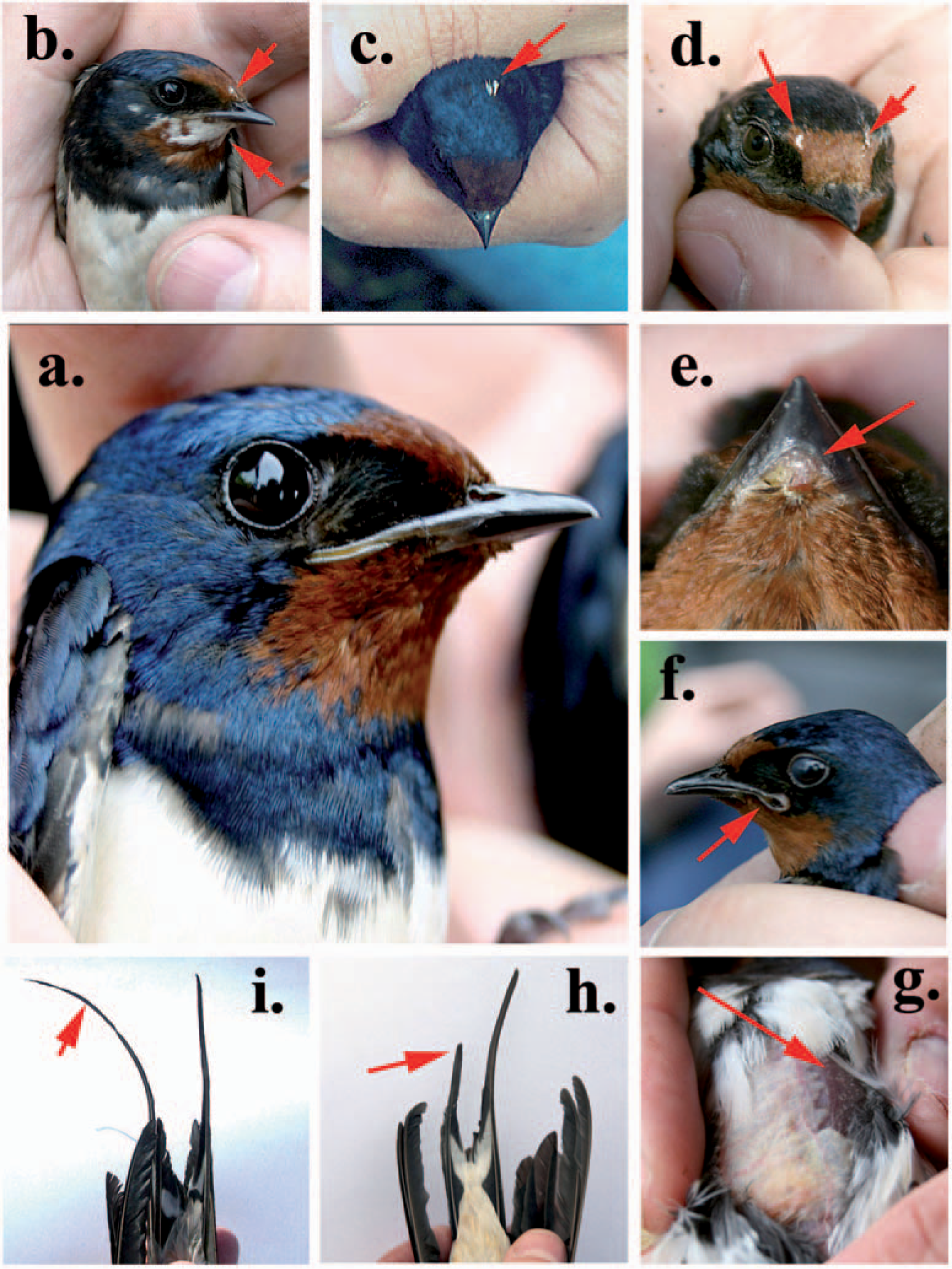
Birds in contaminated areas were much more likely to display patches of albinistic or deformed feathers and aberrant plumage patterns, in addition to a variety of other deformities including tumors on the feet, beak or head, and deformed toes, beaks, eyes, and feathers. If one superimposes the frequencies of abnormalities on a map of Europe showing levels of contamination on a continental scale, it is tempting to suggest a relationship whereby the high frequencies are found in Ukraine and Belarus (about 20 percent), intermediate frequencies are seen in Northern Italy and Denmark (4 to 5 percent), while the lowest numbers (less than 2 percent) are seen in a Spanish population where contaminants due to Chernobyl are not found.
How bird studies demonstrate variation in radiosensitivity
To address the possibility that swallows are somehow unique in their response to contaminants, in 2006 we initiated a series of ecological studies of the entire forest bird community in contaminated and control areas—in other words, all birds in specific patches of forest—in both Ukraine and Belarus that included sites both within and outside the fenced Chernobyl zone. The basic protocol was simple and involved walking a series of transects through these areas, stopping at regular intervals (usually 100 meters), recording an exact location (using GPS) and a localized background radiation level, and counting the numbers and species of birds at each spot during a period of five minutes. A total of 726 standardized point counts of breeding birds were taken over a four-year time frame (2006–2009). This is a standard protocol for ornithologists interested in ecological questions (i.e., distribution and abundance of species) and has been found by the authors and many others (Bibby et al., 2000) to be a highly repeatable and reliable method for bird population censuses.
The results of these surveys were unexpected and overwhelming: In contaminated areas, there were fewer than 50 percent of the expected number of species and the total abundance of birds was less than one-third of that expected (Møller and Mousseau, 2007a, 2007b). A more detailed analysis of individual species’ responses indicated that not all species were negatively affected, and in fact a few showed increased numbers in radioactive areas. It was found that species that engaged in long-distance migration (as is common in birds), species that were brightly colored (usually red or yellow), species that tended to feed on insects at the soil surface, and species with particularly large eggs were the most likely to be missing or in low numbers in contaminated areas. In addition, related surveys found that birds of prey were also found in lower numbers in highly radioactive areas, although our data indicate that populations of raptors are presently rising in “clean” areas both inside and outside the zone (Møller and Mousseau, 2008).
Overall, the data concerning bird biodiversity and abundances, the first of their kind from the Chernobyl region, were unequivocal in demonstrating large negative and dose-dependent effects of radioactive contaminants on bird populations and communities. Currently, one can only speculate as to the exact mechanisms underlying variation among species in radiosensitivity. However, it seems possible that the availability of antioxidants (or lack thereof) may play a role in determining the ability of an individual to manage the mutagenic effects from ingested radionuclides. It has been established that long-distance migrants may arrive on their breeding grounds depleted of antioxidant reserves (Ninni et al., 2004) and that brightly colored species often utilize antioxidants (i.e., carotenoids) to produce yellow and red feathers, and thus both groups may not have these antioxidants available for radioprotection. Birds with large eggs are known to allocate large amounts of carotenoids to the yolk, while birds feeding on soil invertebrates may be receiving particularly high doses of radionuclides as a result of dietary preferences—and both these factors may result in depletion of antioxidant defenses against oxidative stress related to radionuclides.
Mammals, bees, butterflies, and spiders
Of course it is possible that birds as a group represent a particularly vulnerable class of organisms, given their very high metabolic rate, frequent reliance on antioxidants for plumage coloration, large investment in egg production, and aerial life history. For this reason, in 2006 we initiated a series of ecological surveys designed to count common groups of insects, spiders, amphibians, reptiles, and mammals in a manner similar to that employed for the bird counts, except that mammal populations were surveyed during the winter by identifying and counting footprints on the ground following fresh snowfall (Møller and Mousseau, 2011). Insects, including bees, grasshoppers, butterflies, and dragonflies all show significant declines with increasing background radiation levels inside the zone (Møller and Mousseau, 2009). Although amphibians and reptiles also show signs of significant population declines in contaminated areas, the sampling method used for this study was not very effective at detecting them, and further research will be required to develop an understanding of how the contaminants affect these groups (Møller and Mousseau, 2011).
Perhaps the most provocative finding from this collection of studies relates to mammal abundances. Most of the media reports, such as those cited at the top of this article, were inspired by suggestions from journalists, tourists, and the occasional scientist that mammals, especially large mammals like moose, deer, wolves, and wild boar, are thriving in the heart of the Chernobyl zone. These reports are in opposition not only to the results from the bird, spider, and insect studies described here, but also to our many months of observations inside the zone, over a period of more than 10 years, that there is in fact a relative paucity of large animals despite the absence of post-disaster human impacts (e.g. hunting). This is a concern in that it is not unusual for visitors to national parks or wildlife refuges to be confronted by the consequences of unchecked population growth: Most organisms are capable of quickly overpopulating their habitats once predators (very often, humans) are removed from the ecosystem. Such is not the case for Chernobyl, where the sighting of a large mammal is in fact a very rare event. However, it is our opinion that disagreements of this sort are best addressed with scientifically designed experimental approaches that generate data that can be used to rigorously support or refute the underlying hypothesis. To this end, we conducted a survey of mammals that took advantage of the relative ease of species identification provided by examination of foot tracks in fresh snow (Bang et al., 2007). Using standard ecological methods (Becker et al., 1998), it was found that mammal abundance was significantly lower in contaminated areas of the Chernobyl zone and that variation in background radiation levels explained about 20 percent of the variance in mammal numbers, which in this field represents a very high level of predictability (Møller and Mousseau, 2011). At this time, it is not known with any precision if mammal abundances in clean areas within the zone are significantly higher than those outside the zone, but the data unequivocally demonstrate that abundances decline significantly in a dose-dependant manner with increasing background radiation levels.
Conclusion
With few exceptions, wildlife within the Chernobyl zone show a strong pattern of declining abundance and species richness in proportion to background radiation levels. This pattern is also observed in contaminated regions of Belarus, where human populations have returned and agriculture is practiced, thus precluding human influences as a source of the pattern of variation observed inside the fenced Zone of Alienation in Ukraine. The broader impacts stemming from these findings include the assessment of risks and hazards related to human repopulation of contaminated areas and the use of the land for agriculture, forestry, and tourism.
The genetic and ecological studies of natural populations presented here point to the possible perils of mutation accumulation accrued within populations and amplified across generations. That is to say, the long-term biological impacts of sub-lethal mutagenic environmental contaminants are insidious and are potentially considerably more destructive on an evolutionary scale than lethal exposures because the carriers of the mutations may transmit them to their offspring, potentially lowering the mean fitness of the entire population. For the moment, such ideas are purely theoretical and lack strong empirical evidence, but they warrant further investigation in the one ecosystem that provides opportunities to test them: the Chernobyl Zone of Alienation.
Footnotes
1
This area is also sometimes referred to as the “Zone of Alienation.”
2

3
4
Our research started in 2000, but continues today.
5
For example, a search on ISI’s Web of Science shows 864 papers published since 1976 that include Hirundo rustica as a keyword.
Author biographies