



Abstract
This article analyzes how the rapid urban and suburban development of Oakland, from 1900 through 1930, occurred through the expansion of racially restrictive subdivisions in the Oakland hills and Berkeley. By analyzing urban and suburban environments, it becomes clear how real estate corporations developed the use of racial covenants as part of their city planning enterprise, a project which occurred between 1900 and 1930 while also influencing the rise of restrictive covenants in Los Angeles. The article intervenes in urban and suburban history by considering how racially restrictive covenants offered a flexible form of racial and class segregation in California, where the state’s multiracial population—with a significant Chinese, Japanese, and Black population—sought new housing in a discriminatory and antagonistic market.
In the aftermath of the 1906 earthquake and fires, which destroyed much of San Francisco, political and business leaders across the bay began planning for “Greater Oakland,” a metropolis which they hoped would outstrip and eventually subsume its rival. 1 Mayor Frank Mott explained that Oakland was the terminus of the transcontinental railroad, and, beyond that, it also possessed “the most superb harbor in America.” This harbor meant that “[t]he Orient is at the very door of Oakland, and by the opening of the Panama Canal, the great Pacific is yoked with the Atlantic to bear the burdens of a world commerce.” 2 Such grandiose language expressed Mott’s ambitions for profiting off of such trade, and at the same time differentiated Chinese people from the presumably white people set to turn Oakland into a metropolis.
This article analyzes how the rapid urban and suburban development of Oakland, from 1900 through 1930, generated racial and spatial inequalities connected to the unequal acquisition of land, wealth, and housing in the Oakland hills. Streetcar suburbs with racially exclusionary covenants written into the deeds of subdivisions were built, marketed, and sold to middle-class white people at the exclusion of non-white individuals. 3 The story of Oakland and the growth of its immediate suburbs suggest how racial segregation became so entrenched on an urban and suburban scale in California before the rise of redlining, and before the post-World War II period. Critically, it also suggests that an Oakland to Los Angeles axis among realtors existed that has not been fully recognized in scholarship. Oakland-based realtors exported the use of racially restricted subdivisions to the biggest market for real estate during the 1920s—Los Angeles—and thus Los Angeles–based realtors learned from the racial segregation practiced and innovated upon in Northern California. 4 This is a finding that builds upon The Shifting Grounds of Race, where Scott Kurashige argues that in Los Angeles “new and massive subdivisions proved to be the greatest progenitors of residential segregation.” 5 Through the work of real estate developer Walter Leimert, among others, Southern California subdivisions were themselves modeled after and in some ways inspired by the subdivision in Oakland and in Northern California.
While this article engages directly with scholarship on Oakland real estate and race, and more indirectly with scholarship on Los Angeles, future work must continue to emphasize how racially restrictive covenants influenced the nascent real estate industry, probing the connections between exclusionary local, state, and national politics. I see my work on Leimert’s role in promoting exclusionary subdivisions in both Oakland and Los Angeles as evidence of a broader trend in real estate. Among existing scholarship connecting the Bay Area to Los Angeles, Charlotte Brooks’s Alien Neighbors, Foreign Friends analyzes restrictive covenants across the state between the late nineteenth century and the 1950s, arguing that the experiences of Asian Americans in California seeking housing illustrate that racial confrontations transcended “black/white struggles.” Instead, these confrontations resulted in Chinese and Japanese people eventually winning access to suburban neighborhoods in San Francisco and Los Angeles that were previously restricted to white people, a consequence in part of a Cold War political climate which made incorporating Chinese and Japanese people into the United States more politically and culturally desirable. 6
To date, the most comprehensive study of Oakland’s urban and suburban development remains Robert Self’s American Babylon, from 2003. 7 Self focuses on the post–World War II period, analyzing how the racial geography of the East Bay developed, with largely white suburbs and an African American core, in West Oakland. Similarly, Marilynn Johnson emphasizes World War II as a turning point in Oakland’s development, whereby federal wartime investment built up Oakland’s economy through industry and the ports. 8
More recently, Donna Murch’s Living for the City argues that Oakland should be understood through the prism of race and social movements. Murch centers on higher education, and on how public colleges in Oakland and Berkeley influenced the rise of radical politics in the form of Black Power and the Black Panther Party. Grassroots movements led by Black Oakland residents are informed by socioeconomic conditions created by unequal economic development and racial segregation. Although it is also focused on the postwar period, Living for the City demonstrates how racial and class inequalities shaped Oakland’s development and inspired new forms of resistance. 9
A key concern of scholarship during the 2010s and early 2020s has been analyzing how racial segregation and economic inequality emerged and intensified before World War II. Ocean Howell found in his work on San Francisco that “neighborhood-based planning” has a long history, and that the improvement clubs of the Progressive Era and the Community Development Corporations of the 1970s should be understood as moments of the same lineage, not as unrelated movements. Howell identified racial covenants in San Francisco subdivisions during the 1920s that barred African Americans, Chinese, and Japanese people from renting or owning property, while some of the same subdivisions viewed Latino people as having white racial identity, and thus accepted them as tenants. 10
Focusing on Baltimore, Paige Glotzer intervenes in new suburban history by showing how exclusionary policies designed to intensify housing segregation did not always correspond to local diversity. Baltimore’s Black/white racial binary, exacerbated by local segregation ordinances, diverged from how Baltimoreans understood more complex racial hierarchies. In San Francisco, meanwhile, Glotzer notes that the presence of a large Chinese population resulted in the creation of separate schools for Chinese students, among the many ways in which California’s more multinational and multiracial demographics resulted in differing racial hierarchies as compared with some Southern or Eastern cities—a demographic diversity which Oakland shared as well. 11
Also emphasizing developments before World War II, David Freund’s Colored Property focuses on metropolitan Detroit, and argues that white people’s rationales for housing exclusion transformed between the 1920s, when justifications for segregation invoked mythical racial hierarchies, to the post-World War II period, when white people invoked nonracial rationales, such as protecting housing markets, property ownership rights, and citizenship rights. In other words, rationales rooted in homeownership and the law were used by white people to defend and uphold racial segregation, a new form of racism couched in color-blind appeals. 12
The voluminous scholarship on redlining and urban history has been advanced most recently by the work of Todd Michney and LaDale Winling. Michney and Winling find in several articles that redlining thought to have been propelled by the federal Home Owners’ Loan Corporation (HOLC) during the 1930s was actually not as linear or simplistic a process as it was previously imagined to have been by older scholarship. HOLC’s infamous mapping project of low- and high-risk real estate did not begin until after refinancing loans had been issued to homeowners. HOLC’s racial logic allowed for more extensive loans to Black applicants than previously thought, although the agency still reinforced racial segregation through endeavoring to replenish capital for white-owned buildings. 13
Rebecca Marchiel’s After Redlining shifts the scholarly conversation by considering how grassroots financial regulators at local banks in Chicago worked together with urban community groups to center urban reinvestment and new community–bank partnerships during the 1970s through the 1980s. Marchiel identifies the reinvestment movement’s key organization—National People’s Action (NPA)—which increased urban residents’ access to banking capital, mortgages, and loans. After Redlining intervenes in the scholarship on racial segregation and urban history by considering how the U.S. financial system forged and was forged by community organizing, highlighting examples of cross-racial organizing inspired by the Black freedom struggle and by labor movements. 14
This article examines the history of racialized housing in Oakland and its suburbs at the level of the municipality and the street because the political actors involved came not from federal but from local sources: the real estate broker, the streetcar capitalist, and the homeowner. By narrowing in on case studies of three suburban environments—in Berkeley, Rockridge, and Lakeshore Highlands—it becomes clear how transit and real estate operated in tandem to entrench racial segregation. In large part, housing corporations were also transit corporations, and these corporations used racially restrictive covenants in the deeds of new developments to prevent Chinese, Japanese, and Black people, among others, from renting or buying property.
Before proceeding further, it is important to define what is meant by the term restrictive covenant. Scholarship has long differentiated racially restrictive covenants from deed restrictions, a distinction that is often lost in popular accounts. Clement Vose noted that in “deed restrictions, racial restrictions are written directly into title deeds. In covenants, they are in a separate document referenced by the deed. ‘Restrictive covenant’ has become the generic name that can refer to both.” Restrictive covenants were made unenforceable, but not unconstitutional, by Shelley v. Kraemer in 1948. The implications of restrictive covenants and deed restrictions have been analyzed by Beryl Satter’s work on Chicago and by Jeffrey Gonda’s scholarship on the Shelley v. Kraemer case. 15
As in the case of Brown v. Board of Education, enforcement of Shelley v. Kraemer came piecemeal across the country, and racially restrictive covenants remained on the books of homeowners’ associations (HOAs) and real estate bylaws for decades. 16 As one book on covenants explains, “[w]hen Shelley was decided in 1948, the NAACP and others had high hopes that the denial of racial covenants’ legal enforceability would usher in an era of residential integration. This did not occur.” 17 Instead, as Brooks and Rose discuss in Saving the Neighborhood, racial covenants could continue to be advertised until the Fair Housing Act of 1968. Even today, homeowners are finding restrictive covenants in the deeds of their properties, and some are working to strike them out.
Oakland became the California center for restrictive covenants in real estate—an industry of speculation, racial exclusion, and profit—in the late nineteenth and early twentieth century, before it moved to Los Angeles, in part because there was much more available land for development in the East Bay as compared with San Francisco, which was confined to a relatively small forty-nine-square mile peninsula. Structural factors, then, played an important role in making Oakland seem like a strong investment and in turning it into a locus of economic development by the early 1900s, a shift that had been started in motion several decades earlier by the transcontinental railroad depositing passengers in Oakland upon its completion in 1869.
A major focus of white businesspeople in the post-1906 earthquake era was to develop and subdivide the pastoral hills of the East Bay, what would become the suburbs of Berkeley, Rockridge, Claremont, and Piedmont. 18 Today, these areas of the Oakland hills remain some of the most expensive and exclusive neighborhoods in the East Bay, with a median home sale price of $1.5 million in Rockridge as of 2024. 19 Many homes sell for millions more. They offer some of the most dramatic vistas of the San Francisco Bay and of the San Francisco skyline, and are located just minutes from downtown Oakland and San Francisco. They are also increasingly threatened by wildfires made more intense by climate change, the danger of humans building homes in the wildland–urban interface. In Oakland, these homes are close to abundant dry fuel in the form of highly-flammable eucalyptus trees, an invasive species planted by early real estate developers to make barren hilltops more forested.
In the early twentieth century, Rockridge and nearby foothills were fields for grazing and agriculture, and a rural escape for San Francisco residents looking for time in restorative nature away from the bustle of the city. Following the 1906 earthquake and fires, however, Oakland experienced its first housing construction boom, and bungalows began replacing hayfields. 20 Those white residents who could afford to buy or lease property in these suburbs began a generational move away from downtown Oakland during the postearthquake period. 21
The 1906 earthquake also saw a stream of refugees—Chinese and white, largely—move from San Francisco to Oakland. According to Mae Ngai, the Southern Pacific Railroad moved some 225,000 people out of San Francisco to Oakland in the weeks following the disaster, many of whom had been rendered homeless. 22 The neighborhood of Chinatown in San Francisco had been devastated by the disaster, with virtually all of its buildings, homes, and businesses severely damaged or destroyed. Oakland offered a new start for many Chinese immigrants seeking housing and jobs, or at the very least shelter away from the epicenter of the destruction. As Joanna Dyl discusses in Seismic City, earthquake disaster aid from the state and from private individuals was mobilized along lines of race, gender, and class, with many Chinese survivors unable to secure “earthquake shacks” in San Francisco due to their race. 23 Real estate companies in Oakland, meanwhile, saw a new and desperate labor supply who needed homes, and great profit to be made. 24
Conventionally, covenants focused on building and land use: square footage of a home; required setback from the street; building styles; prohibitions on commercial uses, and so forth—restrictions that concerned the aesthetics and uses of a property. One of the first planned communities in the United States, Roland Park in Baltimore, included covenants related to landscaping and its park-like setting. Restrictive covenants in California—such as at Claremont Park in Berkeley beginning in 1905—included an additional category of restrictions based upon people’s race.
The Claremont Park Restrictions
Berkeley had been one of the first planned communities of the East Bay due in part to the University of California opening its doors there in 1869. Some of the first realtors and businessmen of the East Bay attended UC Berkeley, including Duncan McDuffie, who graduated in 1899. McDuffie had been born in Iowa and grew up in Santa Barbara. 25 He was a salesman who started his career selling fine linens and silks to upper class Oakland residents at the Taft & Pennoyer department store. While there, McDuffie met Joseph Mason, a businessman and real estate executive who helped to insure the store. The elder Mason and the younger McDuffie joined forces in 1905, and Mason’s real estate business changed its name from Joseph J. Mason Real Estate to the Mason-McDuffie Company. 26
At Claremont Park, located just south of the UC Berkeley campus, McDuffie added a racially exclusionary covenant to the subdivision, one of the first instances of this taking place at any residential development in California. The covenant stipulated that “[o]nly persons of the Caucasian race . . . except servants” could live there. 27 At the time, there was a small population of Black and Chinese people in Berkeley and Oakland. McDuffie created this racially exclusionary restriction to ensure an all-white neighborhood in the future, or at the very least an all-white class of homeowners or renters, as the covenant admitted that many people depended upon the labor of non-white domestic workers. These workers—whether Chinese, African American, or part of the white working class—needed to access Claremont Park by streetcar for the everyday labor a new subdivision required: gardening, cleaning, cooking, and all manner of domestic work. Restrictive covenants aimed to enact an all-white racial policy which proved harder to enforce given the multiracial and cross-class labor that new subdivisions required.
Within a few years of McDuffie, other real estate developers included similar restrictions in their covenants, across Oakland, San Francisco, and Los Angeles. McDuffie became a prominent member of California’s realtor class, and the Mason-McDuffie company became the largest real estate company in Northern California. 28 It continues to operate today. For his efforts, he was praised by Berkeley’s mayor, awarded an honorary doctorate by UC Berkeley, and chaired Berkeley’s first city planning board. Racist covenants in real estate proved good business for McDuffie and for his reputation as a whole.
So how did McDuffie and other realtors sell the restrictive covenant as something necessary to prospective owners of property, and to the broader community in Oakland? In 1916, McDuffie lectured to Berkeley residents from his position as prominent businessman. 29 In the address, he argued that Berkeley had to protect “against the disastrous effects of uncontrolled development” with new and discriminatory zoning laws, working at the level of municipal law as well as at the level of restrictive subdivisions. Uncontrolled development meant any Chinese or Black businesses or tenants seeking housing or leased space near subdivisions. In particular, McDuffie lauded Los Angeles politicians in their “fight against the Chinese wash-house,” as they had passed districting ordinances preventing Chinese laundries from moving into new areas of the city. 30 It was these exclusionary ordinances that Oakland politicians could learn from and adopt, McDuffie argued. He used the latent fear and racism of white residents that Chinese people would gradually take over white neighborhoods and displace them, securing choice property in the process, to appeal for new kinds of discriminatory zoning laws and regulations.
Restrictive covenants emerged first in Berkeley because of its affluence as a college town without previous norms of exclusion, and because it was close to Chinese communities in downtown Oakland and San Francisco. As Brooks and Rose explain, “covenants were most widely used in white neighborhoods where the neighbors were reasonably well off but did not necessarily have particularly strong internal norms among themselves.” 31 In Berkeley, the newness of the community created a need for formal racial covenants, as most white people there had just recently moved to the neighborhood and did not have a long tradition of exclusion toward non-white others. The covenant created a norm of exclusion where no norms had previously existed. This norm and this practice did not just apply to the first generation of homeowners; a covenant also restricted future generations of residents, and, in fact, many covenants remained on the books in California into the twenty-first century. 32
In state and federal courts, meanwhile, the racial covenant in housing had a more complicated and contested history. As a form of a private contract between a buyer and seller, racial covenants were largely seen as legally enforceable by courts. However, some courts were more wary than others. Traditional property law made some courts hesitant about private arrangements that attempted to control the uses of land over long periods of time. 33 In 1892, a federal court ruled in Gandolfo v. Hartman, using the Fourteenth Amendment, that a covenant against selling to Chinese people could not be enforced. In practice, though, real estate corporations ignored the ruling, and it was not enforced. In 1917 in Buchanan v. Warley, the United State Supreme Court made racial zoning unconstitutional, focusing greater attention on the role of covenants. The racially restrictive covenant was the main legal method remaining to enforce segregation in cities. 34 In the 1920s, Corrigan v. Buckley found that covenants against Black people were enforceable, arguing that this did not represent discrimination according to civil rights clauses of the Constitution. By then, McDuffie and other realtors recognized that racial covenants could do the work of zoning laws without the same risk of being challenged in court.
Even without a strong history of Jim Crow, California real estate developers found a generally amiable social climate that supported discriminatory measures, such as in immigration and agricultural law. This was the era of Chinese Exclusion, which began in 1882 and would last through 1943, and it was an era of discrimination for other non-white immigrants, such as Japanese people, as well. The California Alien Land Law of 1913, and a secondary Alien Land Law of 1920, prohibited Japanese people and companies from purchasing agricultural land and restricted the land they could lease. 35 Nevertheless, Japanese farmers actually increased their holdings of agricultural land between 1913 and 1920, primarily from World War I expanding United States agriculture as a whole. 36 The 1920 Alien Land Law, then, attempted to expel Japanese farmers from California agriculture and fix the loopholes of the 1913 law. 37 To that point, Japanese farmers labored on farms near Fresno and Lodi. After the laws had passed, Japanese people considered migrating out of California, to Georgia or Florida, or, perhaps, to Mexico. 38
Oakland realtors embraced the Alien Land Laws as evidence that state courts would similarly support or at least refuse to intervene in or overturn racist covenants in real estate. In a 1931 publication of the Oakland Realtor, the corporate lawyer H. L. Breed noted that in his conversations with realtors they had referenced the Alien Land Law as aiding covenants by restricting “residential areas to certain classes of individuals.” 39 Breed clarified that the Alien Land Law did not “directly legislate against the ownership or use of lands . . . by any particular race or class of individuals.” 40 He explained that the Alien Land Law applied to agricultural land, not residential property. What could realtors do without explicit protection from these laws? Breed suggested that covenants could continue to work to restrict “the character of a neighborhood . . . for the purpose of effecting a segregation of the races.” 41 Breed understood that racial zoning was unconstitutional, according to Buchanan v. Warley. Covenants, though, offered flexibility, and had become the “general practice” for new subdivisions. 42 The case of Village of Euclid v. Ambler Realty, from 1926, may have also given Breed a certain confidence about using covenants as opposed to zoning to affect and produce racial segregation. The Supreme Court ruled in this case that cities and towns could use the police power of zoning to restrict some real estate development based upon the uses of the property. Covenants remained a powerful and exclusionary tool for developers and for the lawyers defending them.
Along with Japanese people, Chinese refugees from San Francisco fleeing the 1906 earthquake and fires faced a discriminatory housing market. While many white business and political leaders wanted to profit off of trade with China, at the same time, they also campaigned to exclude Chinese people from Oakland. Much like San Francisco city leaders attempted to remove Chinese people in the aftermath of the earthquake, Oakland politicians feared the growth of a Chinese population which included some refugees from the 1906 disaster. In a June 1906 article in the Oakland Herald, the South Improvement Club—a group of white property owners—expressed its racism toward the “encroachments of the oriental population . . . ever since . . . the earthquake and fire . . . had the effect of sending to this city a great bulk of the Chinese from the destroyed Chinatown.” 43 The Club worried that Chinese residents were renting property near downtown Oakland, “too close for comfort to the business section on the one side and to the choice residence section on the other.” 44 The blatant racism of these white property owners paralleled the feelings of white people in San Francisco worried about Chinatown’s location close to downtown.
Oakland politicians slighted the essential role of Chinese people in constructing infrastructure in the East Bay region. In the aftermath of their labor on the transcontinental railroad, Chinese people in Oakland built dams that formed Lake Chabot and Lake Temescal, dredged the canal that turned Alameda into an island, and worked in the booming fishing industry—all for wages much less than white laborers. Around 8th and Webster, they formed a robust business district with laundries, restaurants, herb shops, and gaming rooms. 45
In Oakland, the South Improvement Club went so far as to petition the City Council for the removal of Chinatown. The petition documented “the threatened invasion of Chinese” and aimed to restrict where they could live to a more industrial part of the city closer to the docks and farther away from downtown. The request was presented to the Council by Louis Schaffer, former chief of police. 46 Again, the parallels to San Francisco are clear. There, police chiefs also led the anti-Chinese movement, advocating for the destruction of Chinatown. Schaffer’s petition also referenced the threat of Chinese people to “public health and good morals.”
This appeal to public health has been most thoroughly investigated by Nayan Shah. In Contagious Divides, Shah argues that, in San Francisco, calls to quarantine Chinese people and restrict Chinese-owned laundries, among other businesses, reflected a shifting racialization of disease between the late nineteenth century and the 1940s. At first, Chinatown and Chinese residents symbolized expected sites of disease, and many white people led campaigns for their forced containment. But, by the 1930s and 1940s, Chinese residents became incorporated into city politics, if they abided by sanitary standards, a shift which revealed how racial politics had changed from considering Chinese people as singularly threatening the city toward considering that Chinese people could be reconciled with societal norms. 47
California real estate developers helped innovate the concept and practice of the covenant, exporting this form of racial exclusion across the Western United States and throughout the country. Individuals such as Duncan McDuffie understood that they could profit from racial exclusion: one of the selling points of his subdivisions was the fact that non-white people were excluded from owning property. In lieu of Jim Crow, California realtors created new kinds of racially exclusionary practices through covenants, a more nimble and less obviously unconstitutional practice because they did not need to be passed through a state legislature and could be adopted at a more local and intimate level—the level of the subdivision and not the state. Oakland politicians and realtors adapted to California’s multiracial population—with significant numbers of Chinese and Japanese people—by attempting to draw racial boundaries more firmly and to close ranks around whiteness. To understand how well they succeeded, we must more closely examine three case studies of subdivisions and how they operated.
The North Cragmont Example
The Realty Syndicate, a real estate and transit corporation, was founded in 1895 by Francis Marion “Borax” Smith, pictured above, and Frank Havens. Borax Smith—so named because he earned his fortune from the mining of borax in Nevada—was also responsible for founding the Key System of electric streetcars in Oakland, a main competitor with the Southern Pacific Railroad. 48 As a senior executive of the Syndicate later testified, the relationship of the Key System and the Realty Syndicate was “very similar to the relation between two pockets in the same man’s trousers.” 49 One of the Syndicate’s many subsidiary companies was Wickham Havens, Inc., which operated in conjunction with the Key system, building out a network of subdivisions serviced by streetcar lines that linked residences to the rest of Oakland and to ferries to San Francisco. Some of these streetcar lines are pictured below, with the Key route labeled in red. 50
What Havens brought to the Syndicate and Borax Smith was property. Havens owned some thirteen thousand acres of hilltop land in the East Bay. 51 This was a period, before the rise of car culture, where one’s closeness to a streetcar station determined one’s mobility, to a great extent. The most valuable property was usually located close to streetcar stops, and stops in turn made adjacent property more valuable. Wickham Havens was the son of Frank C. Havens, and the Havens family helped develop some of the earliest subdivisions in the East Bay. In 1908, they advertised a subdivision called North Cragmont, in the northeastern section of Berkeley, which promised “a beautiful view, rapid transportation, high class residences of a uniform character” and, importantly, easy access to transit. 52
Buying into North Cragmont was feasible for white men and women of the middle class: lots were sold at 10 percent down of the full price, meaning that for a $1,000 lot, someone could put down $100 and then pay $10 a month. There was no interest or taxes for one year from the date of purchase. Havens explained that anyone with a “moderate income” could buy a lot, and, he assured buyers, that these lots were investment properties, sure to increase in value. 53
The subdivision noted that the Key Route streetcars and the Southern Pacific railways started construction on streetcar lines that would pick up and deposit people at North Cragmont. 54 Here was a blatant example of the collaboration between the transit arm of the Realty Syndicate—the Key system streetcars—and its subdivision arm, Wickham Havens. Streetcars helped sell the subdivision, and the subdivision’s dwellers provided a supply of paying customers for the streetcar. 55
North Cragmont was more subtle than other subdivisions in enforcing racial exclusion. In its declaration of restrictions, the subdivision did not explicitly target Chinese, Black, or Japanese people; instead, the declaration explained that there would be “no saloons” allowed and residences would be of “high character” and “high class.” 56 Such language enforced class distinctions, ensuring that working-class people could not own property in the subdivision. Here, class did the work of race. Poorer individuals, who could have been white but were also more likely to be non-white, were told in the advertising materials of the subdivision that they were not welcome, that they did not have the moral values needed to buy into the property. As Paul Boyer finds, saloons, in particular, were viewed in an early twentieth-century context of the Progressive Era as damaging the souls and moral character of men and women. 57 Through the temperance movement, many white women, ministers, and middle-class reformers targeted alcohol as the source of the nation’s problems, resulting in crime, unemployment, laziness, and vagrancy.
For Borax Smith and Havens, the streetcar lines themselves never made much profit on their own. Most profit came from how the streetcar line helped sell the subdivision. The peak of subdivision profit came from around 1900 through 1920. After this time, the Syndicate had over-built streetcar lines, and, when subdivision sales declined, the corporation suffered. The Key System also struggled with competition from the Southern Pacific Railroad, which could slash its fares more easily than Key streetcars due to its greater capital reserves. 58 Between 1914 and 1923, the Syndicate had run its course, and representatives of other creditors took control of the corporation, renaming it the San Francisco-Oakland Terminal Railways. 59 While the Syndicate had a relatively brief tenure as a corporate form, it nevertheless played an essential role in developing exclusionary real estate and streetcar networks.
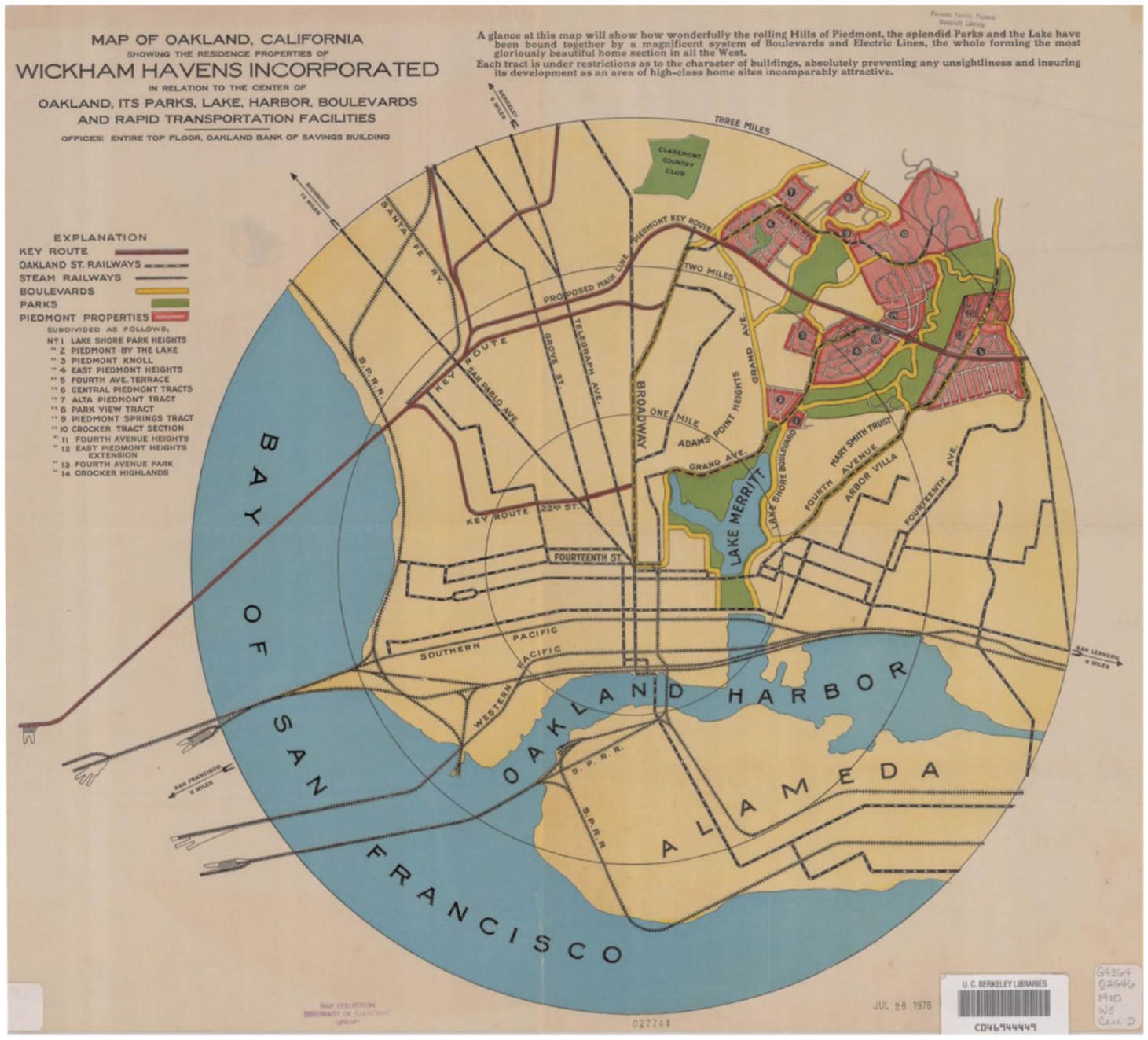
This map of Oakland depicts the residence properties of the Wickham Havens real estate corporation (in the top right) in relation to parks, the Oakland harbor, and the rapid transportation networks of the early 20th century. Map of Oakland, California, Wickham Havens, G4364.O2G46 1910.W5, Bancroft Library, University of California, Berkeley.
Explicit Restrictions
Just a few miles southeast of North Cragmont was the subdivision of Lakeshore Highlands, so named because it was near Lake Merritt, which had been dredged during the late 1860s so that property could be sold nearby. Unlike other Realty Syndicate subdivisions which included implicit references to race, Lakeshore Highlands included a more explicit “Declaration of Restrictions” with clauses specifying who and what was allowed or not allowed on the property. Clause fourteen of the Declaration warned that [n]o person of African, Japanese, Chinese, or of any Mongolian descent, shall be allowed to purchase, own or lease said property or any part thereof or to live upon said property or any part thereof except in the capacity of domestic servants.
60
Black, Chinese, and Japanese people were thus explicitly excluded from owning or renting property with Wickham Havens. 61 They could only enter the subdivision as domestic servants, proving their essential labor but denying their permanent standing in the community.
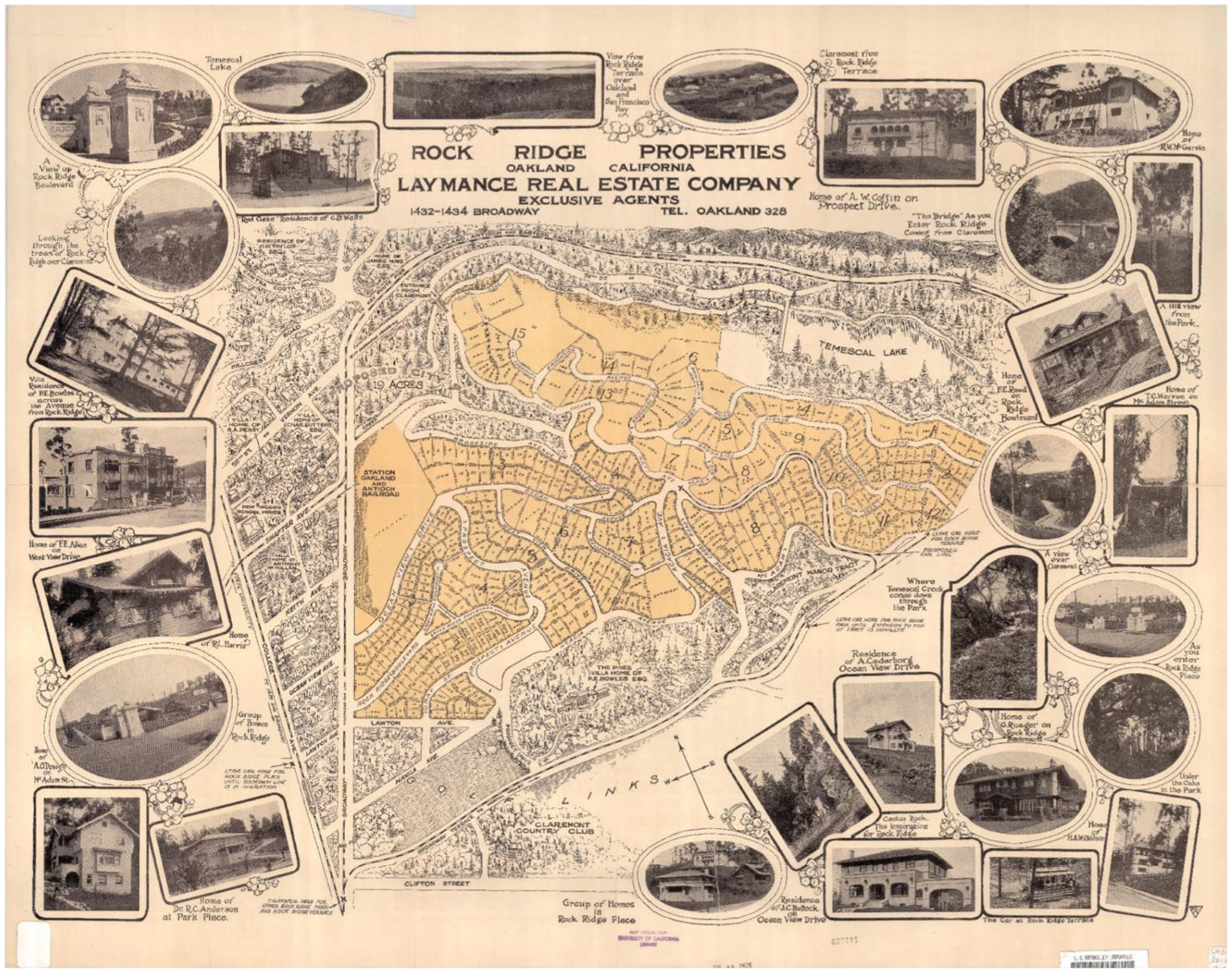
The Laymance Real Estate Company included this map of the Rockridge subdivision, with images of houses, grading, and decorative landscaping, to help advertise and sell its property. Rock Ridge Properties, Bancroft Library, G4364 O2 2R62 1910 L3., University of California, Berkeley.
These policies of racial exclusion become all the more significant when we consider how much real estate the Realty Syndicate controlled. The Syndicate successfully bought and sold property across the East Bay and its hills, and it was one of the largest and wealthiest real estate companies. In its publications from the 1920s, the Syndicate argued that its land holdings were helping unite the East Bay area into a “Greater Oakland” metropolitan region to rival San Francisco. An article by George C. Clarken of the Syndicate explained in the 1920s that [e]ast and west, north and south, The Realty Syndicate’s holdings cover Alameda County like a blanket, extending from the heart of Oakland’s business center to the densely wooded, and in some places, impenetrable sections on the outskirts of the county.
62
Clarken added that “the operations of The Realty Syndicate are bringing the scattering nooks of the county into one compact GREATER OAKLAND.” 63
The grandiose vision of the Syndicate mattered when we consider who was included and excluded from Greater Oakland. The more territory and property that the Syndicate controlled, the more they could exclude Black, Chinese, and Japanese people from the housing market, forcing them into smaller sections of the region. Greater Oakland was not just a vision for monopoly control of the real estate market; it was also a manifesto for a whites-only city and region—one which must inform our understanding of the racial segregation of Oakland and the Bay Area today. Oakland and its suburbs developed in what Simon has referred to as a “spatially uneven” process “where both space and nature were continually produced by and for estate-based capital accumulation. Indeed, the settlement of hillside landscapes by wealthy, white communities was no accident.” 64 The capital gains and the profits from Oakland’s subdivision flowed to the owners of real estate corporations, and to a lesser extent the homeowners in these subdivisions, with the rest of the region’s population left to find a home somewhere else.
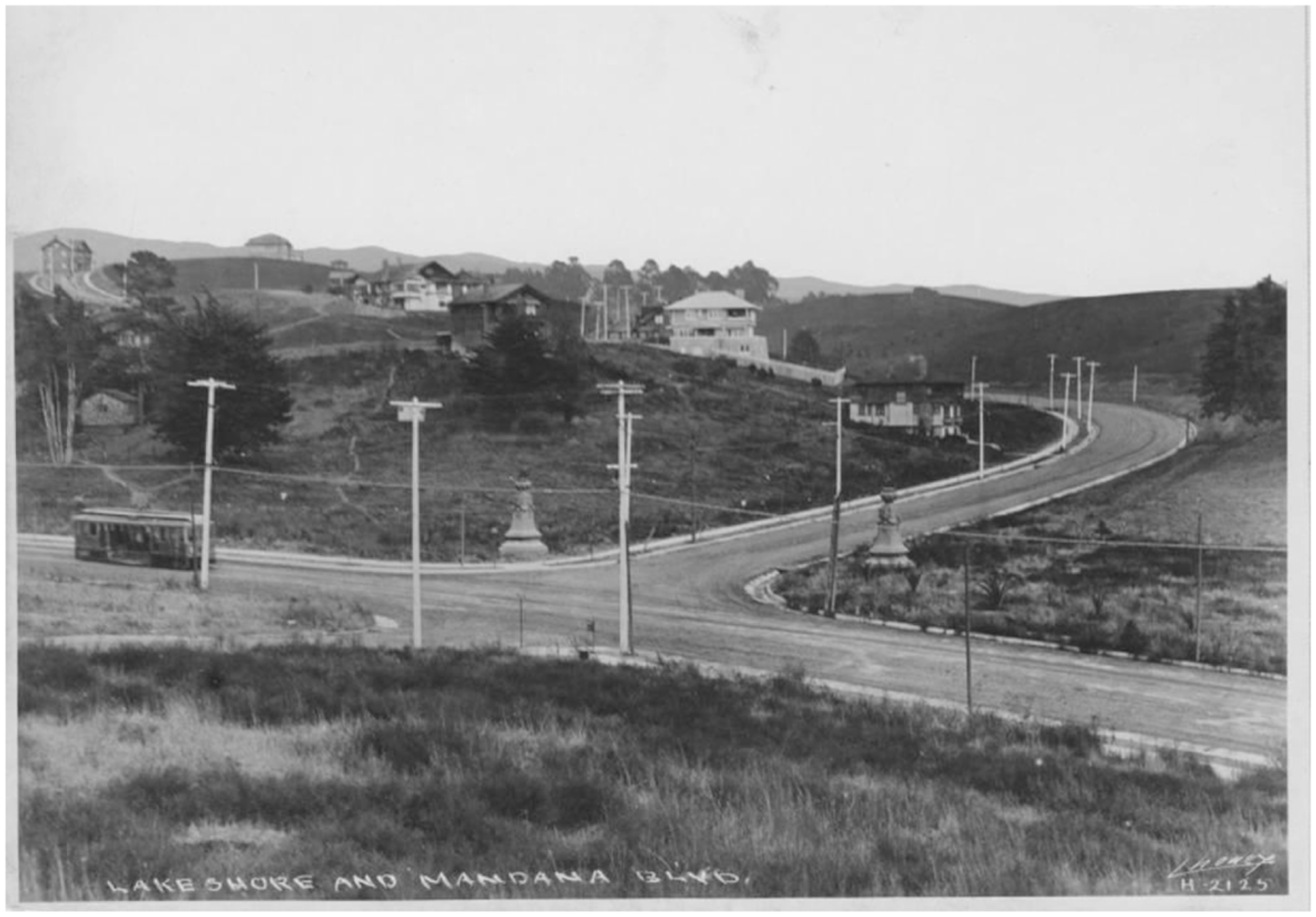
The image above shows a streetcar on the left, newly constructed power lines, and stately homes near Lakeshore Highlands subdivision, at the intersection of Lakeshore and Mandana Boulevard in Oakland. Digital Public Library of America, Views of real estate subdivisions, Wickham Havens Inc., Oakland, https://dp.la/item/2d33e69cba15b48f0496dd30653bab67. 76
It was another neighborhood close to UC Berkeley—Rockridge—where we can better understand how restrictive subdivisions were sold to the public, and also see an example of a Los Angeles–Oakland axis in selling subdivisions along exclusionary class and racial lines. Southeast of the UC Berkeley campus sits the Rockridge neighborhood, today filled with mid-century homes along tree-lined streets, each worth between some one to four million dollars. In Rockridge, the Laymance Real Estate Company developed new tracts of homes with racially exclusionary covenants, and initiated a spatial and racial process of unequal development that has lasted into the present day. Beginning around 1910, Laymance advertised a new development in the Rockridge area of the Oakland hills—an area of Oakland that had been largely undeveloped prior to the 1906 disaster, and had been a source of redwood lumber for San Francisco. In 1906, the assessed value of the region was $250 per acre. In 1911, the same area saw a twelvefold increase in its assessed value, up to around $3,000 per acre. 65 Real estate was an increasingly lucrative form of capital accumulation.
In Rockridge, the Laymance corporation relied upon Fred Reed to help sell the property. Reed’s involvement in selling the subdivision serves as a potent symbol of the power of the real estate corporation during this period, and of its role in drawing racial boundaries across the topography of the East Bay. Reed was a young realtor who had started his career developing property in Southern California, and his life demonstrates one facet of the Oakland–Los Angeles axis in the real estate industry. 66 He would become one of the most influential real estate brokers in California during the early twentieth century, serving as the first chairman of the Oakland Planning Commission, the founder and first president of the California Real Estate Association (CREA), and the president of the Oakland Real Estate Board. 67 He also ran for mayor of Oakland in 1923, on a platform that prioritized business over labor and lower taxes. 68 His mayoral aspirations were unsuccessful, but he remained an influential figure in Oakland real estate.
Reed’s role with the Syndicate was to advertise subdivisions for an upper class and white clientele. In 1912, Reed advertised the Rockridge subdivision for a San Francisco businessman, presumed to be white. He explained in the San Francisco Call that “the San Francisco businessman, tired of the atmosphere and environment of his day’s work, will turn eagerly to those gently sloping hills, with all their allurements, and there he will make his home.” 69 The Rockridge subdivision included a gated entrance, large white stone pillars, and Date Palm trees planted along the boulevards. The land that was part of this development is pictured below, from 1910, with telephone poles recently constructed, grading of land in progress, and eucalyptus trees in the background. Such architectural details were supposed to spatially separate the urban masses from a more genteel suburban oasis: pillars, gates, and palm trees visually separating the urban working class from middle- and upper-class suburbia.
Advertising in Oakland and San Francisco newspapers in October of 1906 included the stipulation: “no one of African or Mongolian descent will ever be allowed to own a lot in Rockridge or even rent any house that may be built there.” 70 Note the stipulation that no Black and Chinese people could “even rent” property in the subdivision. More than a binary of inclusion and exclusion, this stipulation tells us something about property ownership as opposed to leasing property. White-only ownership of property was accepted by real estate developers as necessarily exclusionary. However, there may have been an alternative method for some Black or Chinese people to access subdivisions if they rented property from an owner, perhaps through a sublease of some kind.
The developers of Rockridge seemingly understood that renting offered non-white people a more economical and “backdoor” avenue toward accessing the subdivision. If these developers were so concerned about Black and Chinese people renting subdivisions from white property owners, there is reason to believe that some non-white people did successfully accomplish exactly that. Property ownership was the ultimate goal for those seeking housing in Oakland and its suburbs, at least in the imagination of real estate developers and many in the region. By owning property, you became a stakeholder in the land itself. You gained a permanency that you belonged in this region, that you belonged in Oakland and in California. Moreover, as property values increased, which they did across California during this period, your investment in the property increased in value likewise, and your wealth and capital increased. Restrictive covenants sought to ensure this kind of stratified belonging—and this kind of profit—for white people, and to deny it for African American, Chinese, and Japanese people, among others.
Renting is by its nature a less permanent and less lucrative financial arrangement, according to the tenets of real estate capitalism. Renters move more often than property owners, or at least have less of a financial incentive to remain tied to a single property. Renters are not enjoying any profits from the property value of a subdivision increasing: indeed, they more often than not see their rent increased as this occurs.
If Black and Chinese people rented property from real estate companies, this would have been seen as somewhat less of an affront toward the machinations of racial capitalism, at least in the eyes of white real estate developers, because the profits would not be directly flowing into their bank accounts. Thus, by including the “or even rent” stipulation, these developers warned Black and Chinese people against seeking housing of any kind, whether to own or to lease, but simultaneously depicted their own anxieties that some non-white people were getting a foothold in the community through renting. For some time, for instance, Chinese people in San Francisco had rented property in Chinatown from white property owners. Oakland real estate developers feared that the same would happen in their growing city.
Rockridge ad brochures included spatial as well as racial propositions. On its last page, one brochure included the phrase “Rockridge–a part of the city below yet apart from it.” 71 In their advertising, real estate capitalists divided themselves and their potential buyers from the city of Oakland, located just a few miles to the southwest from the Rockridge development. The city, in this thinking, represented industry and some degree of danger due to its multiracial character and working-class associations; the subdivision was close enough to access workplaces but far away enough to protect home buyers from such dangers. Suburban subdivisions thus demonstrated a kind of tenuous belonging to a metropolitan region, and, simultaneously, their separation from disreputable and non-white people living in the city. The owners of subdivisions belonged much more closely to their subdivision and to their fellow property owners than they did to the larger city.
Real estate development drew upon cultural and environmental ideas in architecture and planning such as the blending of residential forms with one’s garden, which can be seen in the Lake District, between Oakland and Piedmont. Here, the Walter H. Leimert Corporation worked to subdivide homes near Lake Merritt and what it described as the “exclusive” Lake District. The district was formerly known as Trestle Glen, with soaring oak trees, cowpaths, and hiking trails. 72 The Leimert Corporation turned the area into a residential subdivision but preserved a garden-like atmosphere, relying upon landscape designers and architects who included the sons of Frederick Law Olmsted. The blending of residential and natural forms included streets that followed the curved topography of the Oakland hills, numerous trees and much vegetation, and enough open space to prevent crowding. Leimert, like other real estate developers, was an advocate of the urban garden movement, which held that neighborhoods featuring attractive single-family homes with well-maintained green spaces and gardens should coexist with industrial factories, all part of the same urban and suburban ecosystem. 73
Walter Leimert, real estate developer, was a close friend and associate of Wickham Havens and part of the developer class in Oakland. Born in 1877, Leimert was the son of German immigrants to Oakland. Leimert’s father, Louis, arrived in California in 1862 from Germany, where he had been a candy maker. In California, real estate was more lucrative than candy, and Louis tried selling real estate instead of confections. 74 Walter followed in his father’s footsteps by also becoming a real estate developer. He formed the Leimert company in 1902, and set out subdividing and developing land into streetcar-serviced suburbs. He would be responsible for developing over one thousand properties on two hundred acres of land. According to Mitchell Schwarzer, Leimert developed properties for an “aspiring class of managers and professionals . . . and a community of all-white neighbors.” 75
Leimert advertised its subdivisions without explicit racial covenants. Instead, he used references to “restrictions,” a cue to readers that non-white buyers would not be accepted. For example, in a 1923 advertisement for Lakeshore Highlands, Leimert explained that “[o]nly beautiful homes have been or can be constructed . . . because perpetual restrictions prevent the intrusion of unsightly structures or undesirable neighbors.” 77 The reference to undesirable neighbors meant anyone who was not white and middle-upper class. In Bourgeois Nightmares, Robert Fogelson explains that Leimert had been urged by associates “to include East Indians in his racial covenants–and to add the phrase ‘or any other races in the discretion of the Lakeshore Homes Association.’” 78 It is not clear whether later declarations included racial restrictions, but the original Declaration of Restrictions from 1921 did not include explicit exclusions, and, thus, the neighborhood association likely feared non-white intrusion. 79
In a 1925 article, Walter Leimert explained his goal for the Lakeshore subdivision. In an Oakland Tribune article, Leimert said that “[w]e will protect the property owner. We will make his home more valuable. We will maintain the proper home environment. We will provide building restrictions commensurate with the natural beauty of Lakeshore Highlands.” 80 References to “restrictions” and the “proper home environment” were, again, euphemisms for maintaining a neighborhood of white and middle to upper class residents. The goal of Leimert—as for all real estate corporations—was to make money by increasing the property values of their subdivisions. Leimert linked capital accumulation with whiteness and, thus, conceived of increasing the value of a property by ensuring its whiteness.
The Lakeshore Homes Association policed who could buy or rent property, ensuring the maintenance of racially discriminatory covenants. The Association became a model for the development of similar HOAs in Los Angeles and across the country. For instance, a 1927 article in the Oakland Tribune boasted that the Lakeshore Homes Association has taken its place as one of the most successful organizations of its kind in the country. Its plan of organization has been widely copied and scarcely a week passes but some realtor in some section of the country requests a copy of the plan from the Leimert offices.
81
What made these kinds of associations so attractive to real estate developers was that they essentially did the exclusionary work of a real estate corporation or board by themselves.
HOAs privatized policy decisions at the local level, making governmental regulation less necessary and less powerful. The developer J. C. Nichols demonstrated the importance of HOAs with deed restrictions for one of the first times during his tenure in Kansas City in the early twentieth century. Nichols and his real estate company created a comprehensive building plan that used “self-perpetuating” building restrictions and HOAs to govern what became known as the Country Club District in suburban Kansas City, long one of the most sought-after places to live for middle-upper class residents. 82
As Janet Bollinger argues from a legal studies framework, “[t]he privatization within HOAs arguably redistributes authority from the government to private developers and homeowners’ boards, neither of which are subject to constitutional restraints.” 83 HOAs functioned, then and now, to privatize governmental services and privatize decision-making to nonelected members, turning subdivisions into fiefdoms governed by property owners. 84 At the federal level, Bollinger notes that the United States “Congress has shown little concern . . . for limiting the power of HOAs to regulate property.” 85
This is not to say that the local government in Oakland or the federal government would have allowed for less discriminatory covenants from the 1900s through the 1930s. As noted, Oakland city government generally agreed with the need to exclude Black and Chinese people from new subdivisions, particularly in the hillsides near Berkeley and in the area near Lake Merritt. But, HOAs did make the process of racial exclusion more localized and targeted, a policy that operated at the level of the neighborhood for tens or hundreds of homes. In his study of Detroit, the urban historian Thomas Sugrue notes that neighborhood improvement associations originated to enforce racial covenants. By the 1940s, Sugrue argues, their “raison d’etre” was to resist neighborhood entry from non-white people. 86 In California, this happened even earlier, in the 1900s.
If HOAs operated by policing the boundaries of race at the local level, professional organizations did similar work at the state and national level. The real estate industry took on national structure with the formation, in 1891, of the National Real Estate Association (NREA), an organization of predominantly Southern and Midwestern real estate brokers. 87 The NREA was a short-lived but important organization, giving way to the National Association of Real Estate Boards (NAREB), in 1908. 88 As Paige Glotzer argues, NREA realtors “charted an imperialist trajectory framed as evolutionary and progressive. This trajectory incorporated and made sense of the subjugation of Native peoples in the U.S. West, the disenfranchisement of African Americans in the South, and American overseas ambitions.” 89 NREA members identified the real estate project as fitting in with Progressive Era ideas regarding an assumed male and white superiority, framed through beliefs in Anglo-Saxon supremacy and imperialism.
NREA was, at the time of its founding, more of an Eastern than a Western institution, with no committee members from California or anywhere west of the Great Plains, and just two members from California attending the 1891 convention. 90 The concerns of these Eastern and Southern realtors had more to do with the Jim Crow South and to a racial environment which was forged out of the rise and fall of Reconstruction. By contrast, in the early 1900s, Western realtors recognized that they needed to form state and local real estate organizations to advocate for racial exclusion in the more multiracial environment of California. Real estate boards such as the Los Angeles Real Estate Board (LARB) and the CREA licensed who could become a realtor and controlled who could become a member, and they ensured that their bodies were entirely white. 91 CREA recognized that city planning should be directly influenced by realtors through the subdivision of land. They embraced this goal in 1914, when the Pasadena-based chair of CREA’s Subdividers and Homebuilders Division explained that “[t]he subdivider is the practical city planner. The actual working out of a city plan lies largely in the hands of the subdivider. He is creating the city of the future on the outskirts of the city of today.” 92
The NAREB, started in 1908, revealed the growing influence of Western realtors, the ideological continuities with NREA, and the whiteness of the realtor profession. 93 At their national conventions during the 1910s, the NAREB demonstrated their politics of anti-Black racism through a recreational program. Realtors at the 1914 convention in Pittsburgh sang racist songs such as: “Massa’s in De Cold Cold Ground,” “My Old Kentucky Home,” and “I Want to Be in Dixie.” 94 These songs embraced the Confederacy and slavery, and were performed alongside patriotic classics such as “The Star Spangled Banner.” To be a realtor in this period was to embrace whiteness and anti-Black racism. Like the NREA, the unit of organization of NAREB was the real estate board, a local institution that was segregated by race and gender–meaning real estate boards were made up of almost exclusively white men. 95 The NAREB included more representatives from the West as compared with the NREA, although both organizations had a strong Midwestern contingent.
Real estate boards in NAR, LARB, and CREA helped establish HOAs across the country, such as the Lakeshore Homes Association in Oakland, which in turn enforced segregation at the local level, an outcome protected through policy tools such as subdivision regulations. 96 This happened in seen and unseen ways, formal and informal. On an informal and perhaps more subversive level, realtors had the ability to advertise properties to their clients, and could thus deny Black or Chinese people from viewing available developments. Piedmont, Rockridge, and Lakeshore developments were designed to be all-white neighborhoods, and realtors understood who would be seen as a respectable property owner. Many white realtors would not take an appointment with a non-white client in 1900s Oakland to see property in these exclusive neighborhoods. Instead, they either denied them outright or showed them properties in the areas close to downtown with existing Chinese or Black populations.
These discriminatory practices in the real estate industry lasted decades. In 1961, UC Berkeley law students conducted a study to identify and assess how Berkeley real estate agencies—and in particular the Mason-McDuffie corporation—perpetuated racial segregation. Black and white students worked in teams to reach out to realtors and have them show them properties in Berkeley. The students found that individual real estate agents had been scripted to dissuade and deceive buyers interested in listings from the “wrong” neighborhood. Realtors repeatedly warned white buyers that “investment in a negro or transitional area was risky” and that they would not want their children attending schools “overrun with negro children.”
97
Even though racial restrictions had by then been deemed unenforceable by Shelley v. Kraemer, the practice of racism proved harder to change than the law.
The revised 1948 Declaration of Restrictions for Mason-McDuffie included new language to replace the “Caucasians Only” rhetoric of previous declarations. Instead of this explicit restriction, Mason-McDuffie explained that It is the purpose of Declarant by provisions hereof . . . to restrict the use and occupancy of said property to persons of a cultural status conducive to the creation and estimation of congenial friendship and fraternization between and among the occupants of said property.
98
Here “cultural status” did the work of “Caucasians Only,” with the expectation that this euphemism would be understood by Mason McDuffie property owners and realtors to mean one thing—white people only. 99
It was not just homeowner’s associations but also important Oakland agencies that enforced racial covenants and patrolled the boundaries of racial and class desirability. The Oakland Chamber of Commerce included on its “City Planning” committee one of the leading real estate developers in the city—Fred Reed, of the Realty Syndicate. Along with Mayor Frank Mott, also on the committee, Reed helped ensure that subdivisions remained exclusive and exclusionary endeavors. 100 George Pardee, chairman of the “Laws and Legislation” committee, was another key ally of Mott and Reed, and a former governor of California. It was no accident that some of the most important politicians in California occupied positions on the committees of the Chamber of Commerce; these committees lobbied city and state governments to enforce racial and class exclusion at the level of the subdivision.
The Oakland to Los Angeles Axis
By the mid-1920s, Walter Leimert took his talents to Southern California. In Los Angeles, Leimert saw the opportunity for greater wealth, as an agricultural revolution and railroad development turned arid land into a bountiful metropolis. There, he bought property west of downtown Los Angeles and helped sell a new subdivision, Leimert Park, using similar tactics as in Northern California. In one of its advertisements to prospective buyers, Leimert again mentioned “excellent protective restrictions.” In an open letter published in 1927 in the Los Angeles Times, Leimert described that these “restrictions” included the following: I am bringing to Los Angeles the Community Association Plan of protective restrictions – new here, but well established throughout the Lakeshore Highlands property in Oakland and Piedmont where, largely due to the fine restrictions, values have increased 400% to 500% over original prices. . . they can and do maintain the beautiful appearance of the property, both from an architectural and a landscaping point of view.
101
Such restrictions defended racially segregated neighborhoods in Los Angeles, and linked the Oakland example to Southern California real estate.
It must be emphasized that real estate corporations were the private manifestation of public ideals and civic life. The Realty Syndicate, Laymance, and Leimert would not have been so successful at racially segregating Oakland if there had not been public support for these policies. The captains of the real estate industry were viewed as civic leaders. In a similar vein, Gene Slater argues that the two leading realtors who created the first racially restricted developments, Duncan McDuffie of Berkeley and J. C. Nichols of Kansas City, were nationally lionized champions of city planning. . . . Organized segregation began not in the name of individual freedom but in the name of civic progress and the good of the community.
102
The subdivision of Oakland land had immediate and long-term implications for the spatial and racial organization of the East Bay. Subdivisions fueled racial segregation, promoted streetcar development and an expanding Key System, and housed many thousands of migrants to the region. These subdivisions are often lauded for their architectural details, stately streets, and park-like environments. Surely, they benefited from a handsome design and contributed to Oakland’s reputation as a city of single-family homes with gardens. However, the attractiveness of Leimert, Laymance, and Syndicate subdivisions should not distract us from the racial exclusion that they encouraged. Subdivisions did the work of racial capitalism and of real estate magnates bent on extracting as much profit from the land as they could. They accelerated a kind of residential segregation that remains persistent in Oakland, Berkeley, and the East Bay, exacerbating economic and wealth inequality between racial and ethnic groups across the region. To properly address these historical injustices requires fighting at the level of the subdivision and the home, as well as at the level of state and federal policy.
Footnotes
Declaration of Conflicting Interests
The author declared no potential conflicts of interest with respect to the research, authorship, and/or publication of this article.
Funding
The author received no financial support for the research, authorship, and/or publication of this article.
