



Abstract
By the 1920s, apartments were among the prototypical living arrangements for urban tenants in cities like Chicago. These tenants found their domestic lives constrained by the spatial realities of apartments and the landlord-tenant relationship. Through an examination of complaints filed with one landlord across multiple apartment buildings in Chicago, this article explores how tenants wrestled with constrained domesticity and the responsibilities of landlords. In doing so, tenants took up a long-running debate about the obligations of landlords, including to regulate the social world of buildings. Through complaints, tenants leveraged the property rights of their landlord to their own ends. They pushed for their landlord to police their neighbors as a means of enforcing gender and sexual norms, while upholding racial categories and segregation. This article argues that tenants worked to shape, contain, and harness the power of their landlord in ways that offer new perspectives on tenant activism and urban domesticity.
In January 1938, Lillian Solomon received a letter from her landlord regarding a delicate matter. 1 Solomon lived in the Lakeview neighborhood of Chicago with her mother, nephew, and two lodgers in a building owned by the local real estate company, Waller & Beckwith Realty. 2 One of Solomon’s neighbors had accused her of “running [a] sporting house”—in other words hosting unsavory gatherings at the very least, and engaging in sex work at the worst. 3 Solomon’s neighbors continued to complain in the years that followed about late-night commotions after the family returned from running a hot dog stand across the street, “playing radio until all hours,” as well as drinking. 4 Finally in the summer of 1942, the neighbors “propos[ed] a petition” to force Solomon and her family out, and “failing in this to move out in a body,” they informed their landlord. 5 The company took the threat seriously. “Several tenants are threatening to move out,” read a letter to Solomon from early September 1942. “Under the circumstances we feel that it would be to the best interests of all concerned, including yourself, if you make arrangements to find another apartment.” 6
The complaints about Lillian Solomon were among hundreds that Waller & Beckwith received from residential tenants living in roughly two dozen buildings across Chicago between the 1920s and the early 1940s. 7 Like Lillian Solomon, tenants in these buildings were overwhelmingly white. The Solomon saga typified these complaints. Tenants wrote to voice their frustrations about their neighbors’ disruptive domestic practices, which included everything from chopping wood inside apartments to children roller skating to dogs barking incessantly and late-night gatherings. Disputes traced back to the spatial arrangements of multi-unit buildings, the dominant form of housing in Chicago by the time neighbors complained about the Solomon family in the 1930s and 1940s. Yet, at issue in these complaints was more than pets and parties. As this article demonstrates, these were conflicts over the social order of cities. Rental housing served as critical terrain for confronting transformations to racial, gender, and sexual norms underway in the first decades of the twentieth century.
Furthermore, complaints to Waller & Beckwith reveal tenants’ capacity to shape the rental relationship and the responsibilities of landlords. Tenants who complained invoked the property rights of their landlord to their own ends. Complaints typically sprung from domestic behaviors that shaped the sensory environment of buildings. Residents frequently produced sounds, smells, and sights that impeded their neighbors’ sense of peace, quiet, and privacy at home. Racial, gender, class, and sexual politics were all articulated through these disputes over the domestic and social lives of tenants in these buildings. When they grouched about their neighbors, tenants imbricated their landlord in the process of negotiating social and cultural changes remaking urban life. In short, this article argues that those who complained imposed a responsibility on their landlord to use their power as property owner to police tenants in ways that enforced gender and sexual norms, while regulating racial categories and segregation.
By conscripting their landlord into the social policing of their neighbors, these tenants weighed in on a question underlying urban reform for decades: to what degree were landlords responsible for what happened inside buildings? The long-standing principles of renting held that landlords had limited obligations once they granted a tenant possession of the property. Yet these principles were ill-suited to the realities of housing in industrial cities. 8 Public health reformers looked to hold property owners accountable for decrepit living conditions that bred disease through successive building codes and tenement laws enacted beginning in mid-nineteenth century. 9 These regulations provided the basis for court rulings in the early twentieth century that expanded a landlord’s duty of care for tenants. 10 Anti-vice reformers in the Progressive Era reshaped the obligations of landlords and pushed for them to intervene in the goings-on among their tenants. Social activists, often acting under the auspices of investigative committees, labored alongside lawmakers to reinscribe morality and the existing social order they argued was under siege from vice. They fretted that the ideology of separate spheres, sexual propriety, and racial purity were crumbling. 11 Landlords were key figures in their war on vice. As legal and social historians have explored, reformers innovated new legal techniques that circumscribed the rights of property owners who allowed their buildings to be used for vice. Most notably, states, including Illinois, passed a slew of injunction and abatement laws in the 1910s. 12 Waller & Beckwith were among the landlords threatened with injunction after vice investigators found evidence of prostitution and other forms of “lewdness” in the company’s buildings. 13
Yet as the scores of complaints from Waller & Beckwith tenants illustrate, the debate over the responsibilities of landlords was not confined to the realm of law. Instead, through complaints, tenants continued to debate behind closed doors over their landlord’s obligation to police the social worlds of buildings in the interwar period, after a wave of regulation crested. 14 The interwar period brought new urgency to this debate as a growing number of urban Americans experienced the tensions of apartment living. The 1920s in particular saw the proliferation of apartments across the urban United States, including in Chicago. By the end of that decade, the percentage of families nationwide living in multi-unit housing had increased to roughly 54 percent. Not only did tenants dominate Chicago in the interwar period, but the majority of the city’s tenants also lived in apartments in the 1920s. 15 The predominance of multi-unit housing would endure during the Depression and World War II when construction dropped precipitously. The disputes among neighbors documented in complaints therefore unfolded during a period when the landlord-tenant relationship still structured the domestic lives of many urban Americans, before the onset of mass homeownership following World War II.
Although the balance of power in the landlord-tenant relationship was undeniably weighted toward the landlord, this article argues that tenants were not merely recipients of the power of their landlord but also worked to shape, contain, and harness that power in ways that offer new perspectives on tenant activism and domesticity. First, those efforts to mold and enforce the responsibilities of landlords were the engine of the tenant movement, both in the interwar period and across the twentieth century. However, complaints to Waller & Beckwith do not fit seamlessly into the existing scholarly framework of tenant activism. Historians have by and large examined tenant activism that followed in the mold of the labor movement. Tenants in these histories typically launch rent strikes, form advocacy organizations, lobby for legislation, and lodge complaints with public authorities. They worked to constrain the power of landlords over rent and eviction, and enforce a greater responsibility for maintenance and vital services like heating. 16 To be sure, successive generations of tenant activists in this mold secured crucial protections, especially for working-class and poor residents, and forged a place for themselves within the political culture of cities. Yet, complaints to Waller & Beckwith, and this article that draws on them, indicate that a wider framework is necessary to capture the breadth of tenant activity aimed at shaping the power of landlords. A narrow focus on traditional political activism overlooks the more quotidian ways tenants could also wrestle with the power of their landlords behind closed doors. Given that complaints were rooted in the spatial arrangements of apartments that existed outside of Waller & Beckwith buildings and outside of Chicago, it stands to reason that many other tenants were likely at work attempting to reshape the power of their landlord. In other words, a wide range of tenants could be invested in debates over the responsibilities of landlords even if they did not engage in a rent strike or join an advocacy organization. Moreover, the substance of these complaints, which deal primarily with domestic disputes rather than rent, maintenance, or eviction, underscores the ideological complexity among tenants. Those who complained to Waller & Beckwith about their neighbors often appeared to align less with the politics that animated many of those individuals and organizations at the center of histories of the tenant movement. Roberta Gold for instance argues that many tenants championed inclusive community rights, distinct from the exclusive property rights typical among homeowners. 17 However, complaints from Waller & Beckwith tenants echoed more the politics of homeowners’ associations, who were likewise concerned with policing uses of property and upholding social norms. 18
Through its focus on the landlord-tenant relationship, this article furthermore offers a new lens on one of the core dilemmas of modern urban life: how to reconcile domestic ideals, chief among them privacy, with the realities of multi-unit living. Historians have thoroughly explored the ways in which multi-unit housing, including tenements, boardinghouses, and apartments, existed in tension with domestic ideology. However, these works dedicate less attention to the underlying property relations themselves, and the specific responsibilities, rights, and powers that emanate from rental property ownership. 19 Indeed, tenure is part of the social architecture of housing and domestic life. The landlord-tenant relationship, and the social dynamics it engendered, compromised domesticity for tenants and complicated the work of realizing domestic ideals in an apartment. 20 By creating a contract and financial relation between tenant and landlord, the lease brought the market into the domestic realm, in contradiction to the ideology of separate spheres. Moreover, leases made landlords and neighbors parties to any one tenant’s domestic life. The landlord could set the terms for how tenants lived in their homes, and neighbors had to negotiate competing conceptions of freedom at home. In the interwar decades when tenants lodged their complaints, the landlord-tenant relationship was a widely accessible vehicle for negotiating domesticity and social norms in cities.
In spite of the geographic and temporal constraints of these records dating from two decades in the history of Waller & Beckwith and confined to a single city, the complaints enable a granular analysis of negotiations over the mutual obligations between parties to the lease. They shed light on what historian Elizabeth Blackmar terms the “social power of landlords.” 21 These negotiations played out against the backdrop of the transformation of gender, sexual, and racial norms in the nation’s second largest city. Not only did these debates over the responsibilities of landlords and their social power extend beyond Waller & Beckwith buildings, but they would also echo into the late twentieth century. Indeed, legal authorities would later implicate landlords in formal policing. The increasing liability of landlords for any illegal activity in their buildings helped to create stricter and more discriminatory tenant screening.
Reformers and the Responsibilities of Landlords in the Changing Urban Landscape
Lillian Solomon’s neighbors were not alone in insinuating that there was illicit activity in their building. Their complaints mirrored notices Waller & Beckwith received from Chicago’s Committee of Fifteen. Modeled after similar organizations in New York, Chicago’s Committee consisted of social activists and influential philanthropists, including Sears Roebuck president Julius Rosenwald. 22 In 1922, the Committee’s assistant superintendent wrote to Waller that one of his buildings on Halstead Street, “has been used recently by occupants in violation of law.” 23 Investigators had visited the cabaret on the first floor of the building multiple times in the previous two years. In addition to prostitution, investigators “reported indecent dancing; several young girls and men intoxicated; many young girls smoking cigarettes; couples loving and kissing each other in open view to others.” 24 The letter reminded Waller that he was responsible for what went on inside the Halstead Street cabaret. Moreover, he was obliged to “institute correctional measures,” presumably by exercising his right as the landlord to evict. 25
Waller received this letter from the Committee only two years after he had taken over his family’s real estate business. The company traced its roots back to the aftermath of the Chicago Fire of 1871. James Waller founded a real estate company and developed a section of the city’s North Side into the Buena Park neighborhood, named for the family’s Buena mansion. The elder Waller’s grandson, James B. Waller, took over the business in 1920 following the death of his father, and joined forces with James Beckwith. 26 By that time, the company operated buildings across Chicago, though their tenants were mostly clustered on the North Side.
The Committee of Fifteen’s correspondence with Waller was one piece of the group’s larger effort to involve landlords in the campaign against vice, which required reassessing the responsibilities of landlords. Through lobbying of individual property owners as well as legislators, the Committee intervened in debates about the duties of property owners that had preoccupied a previous generation of reformers. New questions about the responsibilities of landlords to their tenants emerged alongside the development of new housing typologies in the nineteenth century. The foundational principles of the landlord-tenant relationship originated in the English agrarian land tenure system, in which the core of renting was the exchange of rent for possession. Once a tenant took possession, the landlord had minimal obligations. The tenant was thought to be self-sufficient and responsible for the property during the duration of the lease, including maintenance. 27
The changing housing market over the course of the nineteenth century puts pressure on these principles. The new urban wage earners made their homes in tenements. Initially subdivided existing structures and later purpose-built multi-unit housing, tenements stood in opposition to Victorian domestic ideals, rooted in the concept of separate spheres. The ideal home was thought to contain separate zones for labor, public socializing, and most importantly private family life, specifically a single family. The private family home was difficult to come by in tenements, with multiple families and lodgers crammed into units, and the units themselves close together. 28 In a 1901 report on tenement conditions in Chicago, Robert Hunter, social reformer and chair of the City Homes Association that had commissioned the report, stressed “that the mass of people in tenements have not what people commonly call a home.” 29 Among the effects of these living conditions were “individual and social degeneration,” Hunter argued. 30 Beyond the ideological concerns, haphazard construction, lack of sanitation, and overcrowding allowed contagious diseases to flourish in tenements.
Who ought to be responsible for rectifying the conditions of tenements that threatened the health and morality of cities? The growing population of cities and tenants spurred campaigns to pass new regulations that would expand the responsibilities of landlords. 31 One strain of regulation focused on the built environment. In their efforts to improve sanitation and create proper family homes in tenements, housing and public health advocates pushed to establish construction standards that ensured access to light and air, in addition to limiting the number of occupants in a unit. New York provided the model, enacting a series of tenement laws from the 1860s through the 1920s that spread elsewhere, including to Chicago. Successive city and state laws governing Chicago passed from the 1870s through 1920 set standards for sanitation and building materials, while also allowing for inspections. However, these new regulations were both poorly enforced and failed to address the underlying economic conditions of housing and labor markets. Moreover, new regulations crucially did not impose any meaningful obligation on landlords for maintenance and more broadly for the goings-on inside buildings. Illinois’s Tenement and Factory Ordinance, passed in 1881, for instance continued the tradition of placing the onus for maintenance on tenants. After a flurry of new regulations up to the 1920s, the codes in Chicago would remain in place until a renewed pushed for revisions came after World War II. 32
Regulations to the built environment of housing also provided the basis for a change to the liability of landlords. In 1922, a New York court ruled that landlords were responsible for injuries to tenants in their buildings. The case, Altz v. Leiberson, interpreted building codes to create a “duty of care” among landlords to their tenants. As legal historian Richard Chused argues, the emergence of the duty of care was one of the handful of shifts in landlord-tenant law itself amidst the trend of housing reform at the turn of the twentieth century. 33
Whereas building codes and the duty of care dealt with the landlord’s obligation to maintain the physical structure of buildings, a parallel strain of reform worked to more vigorously hold landlords accountable for the morality of tenants. If regulations to the built environment proved inert in many ways, vice reformers in the Progressive Era created a powerful tool in injunction and abatement laws. This generation of vice reformers at the turn of the twentieth century responded to sweeping changes to cities like Chicago. 34 The city’s population exploded with the arrival of migrants from Europe and the American South in particular. The influx of tens of thousands of new Black Chicagoans in the early twentieth century prompted city officials and property owners to implement more rigid forms of segregation. 35 Growing numbers of women, especially young women, moved into new areas of employment outside of households and lived independently of their families. 36
The demographic, household structure, and employment patterns within Waller & Beckwith buildings reflected these urban trends. Occupations varied both within and among buildings. While many men were middle-class professionals working in white collar industries as clerks, salesmen, and managers, others were employed in factories, building trades, or service industries. Female tenants additionally joined the growing ranks of working women in the first decades of the twentieth century. These women found employment as teachers, stenographers, bookkeepers, and salespeople at department stores among others. Moreover, women scattered throughout the buildings were listed as heads of their households. In contrast, the racial makeup of Waller & Beckwith buildings was more uniform. The overwhelming majority of tenants were listed in the U.S. census as white. Although Waller & Beckwith rented occasionally to tenants with roots in Mexico or China, there were no Black residents in the buildings and only the occasional Black domestic servant. 37 The absence of Black tenants was far from accidental. In the late 1920s and early 1930s, Waller adopted restrictive covenants, in which he agreed that his properties would not be “sold, given, conveyed, or leased to any negro or negroes.” He furthermore assisted in persuading other property owners to sign covenants. 38
A new culture of commercial leisure replacing homosocial and family-oriented pastimes accompanied these changes to urban populations and labor. Dance halls (and later cabarets and nightclubs) were at once exotic and erotic, allowing men and women to dance, drink, and mingle across racial and class lines. By facilitating interracial socializing and potentially sex, the new culture of leisure threatened racial purity and with it, standards of respectability. 39 This new culture in turn inspired a moral panic. For critics, commercial leisure marked a weakening of the social order, loosening of morality, and an embrace of new cultural values of pleasure, consumption, and sexual expression. Moreover, the physical proximity of commercial leisure sites to red light districts meant that dance halls, cabarets, and the like were closely associated with commercial sex. 40 Efforts to tamp down on prostitution at the turn of the twentieth century were at their core efforts to uphold an eroding social order. “It behooves us to raise social life to the highest possible standards of righteousness—to teach the youth of our land loyalty and honor to womanhood,” the Chicago Vice Commission wrote in its 1911 report on prostitution, The Social Evil in Chicago. 41
The Vice Commission’s report underscored the role of landlords in the proliferation of the “social evil” of prostitution. “Practically no effort has been made during the past three years to prosecute owners and real estate agents who are leasing and renting property for immoral purposes,” the Commission argued. This was in part because of the “indifference of the public,” and in part because landlords reaped the financial benefits of these profitable endeavors. 42 The Commission highlighted a disconcerting state of affairs: Chicago landlords were implicated in the illicit activity of their tenants but not accountable for them.
As the successor to the Vice Commission, the Committee of Fifteen sought to remedy this contradiction. The Committee sponsored investigations into individual buildings that were associated with prostitution and generally what its members deemed to be immoral. From the outset, the Committee’s work consisted of pursuing criminal charges and publicizing property owners who permitted vice to take place in their buildings. Investigations led to familiar criminal charges, including “keeping a disorderly house.” Earlier generations of reformers targeting prostitution had also used this charge that was rooted in the concept of public nuisance, a use of property that harmed the entire community. 43 The Committee additionally publicly shamed landlords by tying them to criminal charges against their tenants. For instance, one case against a man for “contributing to the delinquency” of a teenage girl noted that “they were living at 709 N. Clark St as man and wife. The room was rented to them by a Mrs. Hocff about 6 weeks ago.” 44 More than criminal charges, “publicity” was “the chief weapon used in this warfare” against vice, the Committee’s superintendent Samuel Thrasher stressed. 45 By 1919, the Committee had published the name of over 700 of property owners in whose buildings they had found evidence of vice. 46
Property owners, including landlords, were linchpins in the war on vice. Part of the “great value of the Committee’s work,” in Thrasher’s estimation was “naming the places with the names of the owners,” as well as “co-operating with owners who really desired to clean up their property and in forcing unwilling owners to take action.” 47 Annual reports regularly evidenced support from property owners. One landlord took care to thank the Committee for “helping [him] discover some undesirable tenants.” The landlord went on to evict thirty-three tenants according to a report. “I think he would have ejected some of them, anyway, but not all,” Thrasher concluded. 48 Through a mix of cooperation and shaming, the Committee of Fifteen pushed landlords to assume responsibility for the goings-on in their buildings by exercising their right to evict.
Toward this end, Chicago’s Committee of Fifteen, and the Progressive Era anti-vice movement writ large, introduced a new legal tool to hold landlords accountable for the immoral activities of their tenants. In 1915, Illinois passed its Injunction and Abatement Law, part of a national trend of similar legislation in the 1910s. Building on the same nuisance principles as disorderly house charges, the Injunction and Abatement Law held that “all buildings and apartments. . .used for purposes of lewdness, assignation, or prostitution,” were de facto public nuisances and “the owners, agents, and occupants of any such building, or apartment, or any such place shall be deemed guilty of maintaining a public nuisance.” 49 Crucially, the law allowed for property seizure and summary proceedings that did away with the need for a trial. 50 By creating stricter means for punishment, injunction and abatement laws brought landlords more directly into the project of regulating morality among urban residents, and implicating them in the social worlds of tenants.
After the Illinois law went into effect in 1915, the Committee of Fifteen made swift use of the threat of injunction. In instances when investigators turned up evidence of vice, the Committee would send an informal notice to the property owner, followed by a formal notice, before finally pursuing an injunction if the owner did not respond. 51 By 1919, five years after the law went into effect, the Committee had sent 645 first notices, 130 formal notices, and pursued fifteen injunctions. 52
Injunctions represented a notable infringement on property rights, one that the Committee and its supporters sought to justify in defense of the new law. Following the first injunction under the law in 1916, the Chicago Herald conceded that “the punishment of the owners may seem severe to those holding the traditional views of the ‘rights of property.’” Yet the property owners in question had earned such severe punishment, the Herald contended. “They did what they would with ‘their own,’ regardless of morals and decency. They are justly deprived for the time of property whose ownership they persistently abused.” 53 In its communications to property owners and real estate agents, the Committee of Fifteen also encouraged closer monitoring of tenants that would save landlords from “undue publicity and expense.” 54 Furthermore, enforcement of the Injunction and Abatement Law itself would protect the property values of responsible owners, the Committee maintained. These arguments reframed injunction as not a potentially anti-American punishment but rather as a necessary corrective in the best interests of responsible owners. 55
By the time Waller took the reins of his family’s company and the records of complaints from tenants begin, the wave of regulation that looked to expand the responsibilities of landlords dating back to the mid-nineteenth century had crested. The postwar period would bring renewed regulation of the built environment, and as a result renewed focus on the obligations of landlords. 56 Waller & Beckwith tenants took up the debate over the responsibilities of landlords, transferring issues of law and regulation to the domestic sphere. Tenants also pushed for their landlord to be more involved in the goings-on inside buildings, by policing their neighbors to preserve the social order. They did so by routinely contacting their landlord to complain about the activities of neighbors that deviated from their own values.
Tenant Complaints and the Policing of the Social Worlds of Apartment Buildings
In the early 1940s, Mary McMahon wrote to Waller & Beckwith chronicling her own investigation into her neighbors. She sought to find the source of the noise in the building, which she described as “something terrible.” McMahon ultimately identified children in one apartment and a man chopping wood in another as the culprits, and reported them to the landlord. 57 When they surveilled and reported on their neighbors, complaining tenants like McMahon engaged in their own informal policing that often paralleled the work of anti-vice reformers.
The records of complaints that have been preserved date from the early 1920s through the early 1940s. While initially corresponding directly with Waller himself, overtime tenants conferred with employees of Waller & Beckwith. These employees (who largely remain nameless as they are only identified by initials within the correspondence) handled the majority of complaints. 58 This shift in correspondence illustrates not only the sheer number of tenants in these buildings that required staff but more broadly the largess of a company that was no mom-and-pop landlord.
The complaints themselves are markedly consistent over roughly two decades. Disputes from the early 1940s mirrored those from twenty years earlier. The language tenants, Waller, and company employees summoned in their correspondence echoed across decades. The topics tenants grappled with did not neatly correspond to pivotal national and global events that unfolded in these decades. Complaints about drinking were not confined to the period of Prohibition, when tenants drinking would have carried a different valence. 59 Direct references to the effects of the Depression and World War II were scarce. While the language and disputes at the center of complaints may not have evolved meaningfully in this period, the complaints nevertheless evidence contestation over broader social and cultural transformations playing out inside apartment buildings.
In the most immediate sense, complaints arose from the spatial arrangements and particular intimacy of apartment buildings. Beginning in the second half of the nineteenth century, designers and developers sought to create a form of purpose-built multi-unit housing for middle-class urbanites. However, apartments were initially vexed by many of the same problems as their lower-class cousin, the tenement. Commentators charged that multiple households living under the same roof, even in separate units, did not allow for appropriate familial privacy and therefore was not a respectable option. As the typology developed, architects sought to reconcile through design the constraints of multi-unit living with domestic ideals by creating more spacious apartments and dividing public and private spaces within units more purposefully. 60 In particular, designers and developers gravitated toward the courtyard apartment. This building style balanced the density of residents with some elements of single-family housing, including a landscaped lawn and semi-private entrances. In Chicago, the Pattington, which Waller & Beckwith eventually came to own, epitomized this trend (Figures 1–2). When it was constructed in 1902, the Pattington was the city’s largest courtyard building. Early advertisements underscored that its layout was not only healthy—as “all rooms have outside light and good ventilation”—but private. 61 The “luxurious and elegantly appointed building” featured thick concrete under the floors which offered “protection from fire and freedom from noise.” 62 These advertisements then distilled the promise of apartments at the turn of the twentieth century, offering a modern home that ensured peace, quiet, and privacy. 63
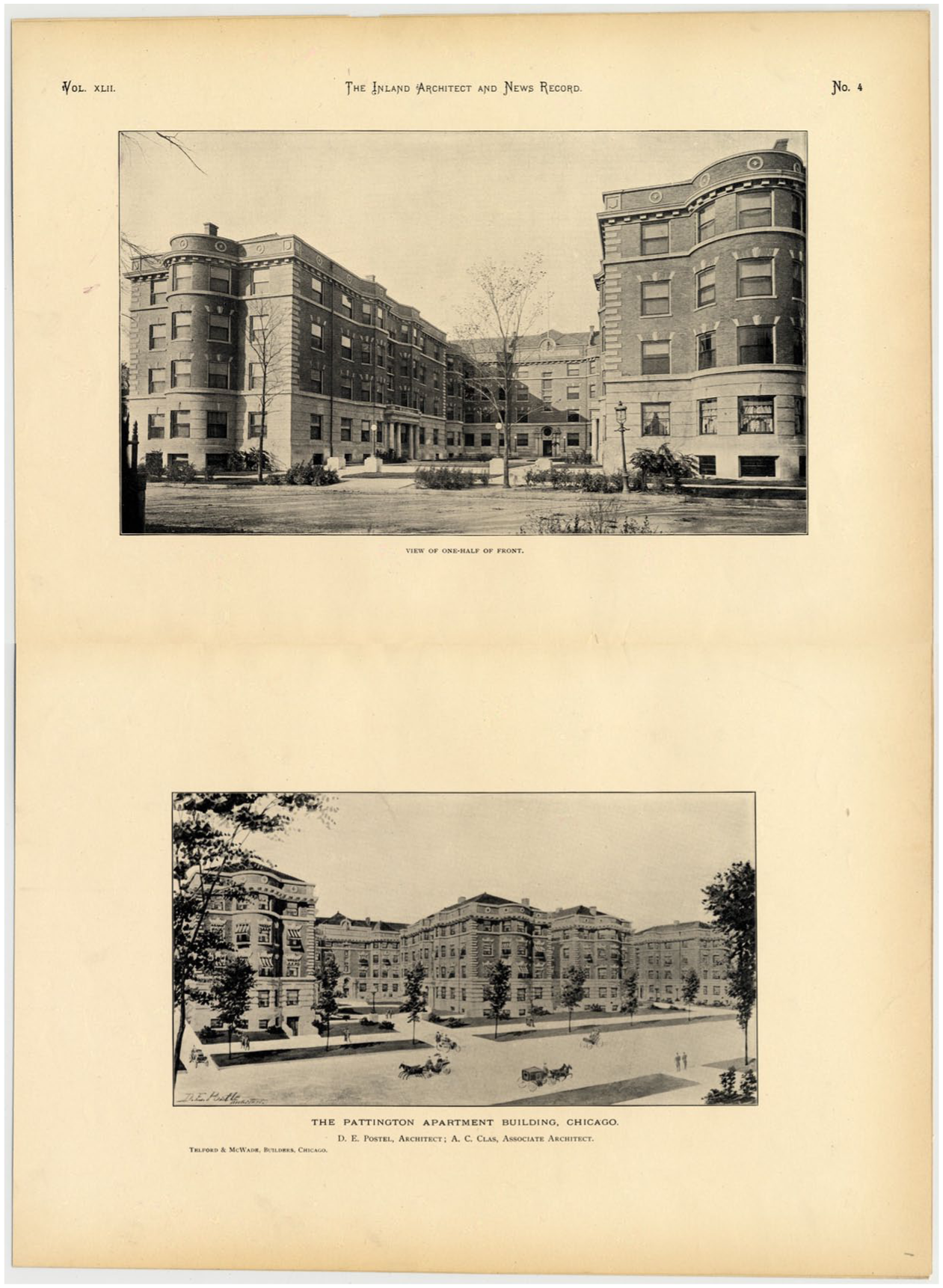
Pattington apartment building, Chicago, Illinois. David E. Postel, architect. Inland Architect, vol. 42, no. 4, Ryerson and Burnham Art and Architecture Archives, The Art Institute of Chicago, Digital File #IA4204_3825-3826. The Pattington was a prime example of the new courtyard style apartment at the turn of the twentieth century. This style aimed to accommodate more density while also adhering to domestic ideals. Notably, the Pattington’s seventy-two units were organized around two large courtyards that incorporated some features of single-family housing. In addition to mimicking lawns, the Pattington’s courtyards offered multiple points of entry that decreased crowding in the building’s communal spaces. Courtyard apartments like the Pattington were designed to offer residents more illusions of privacy in apartment living.
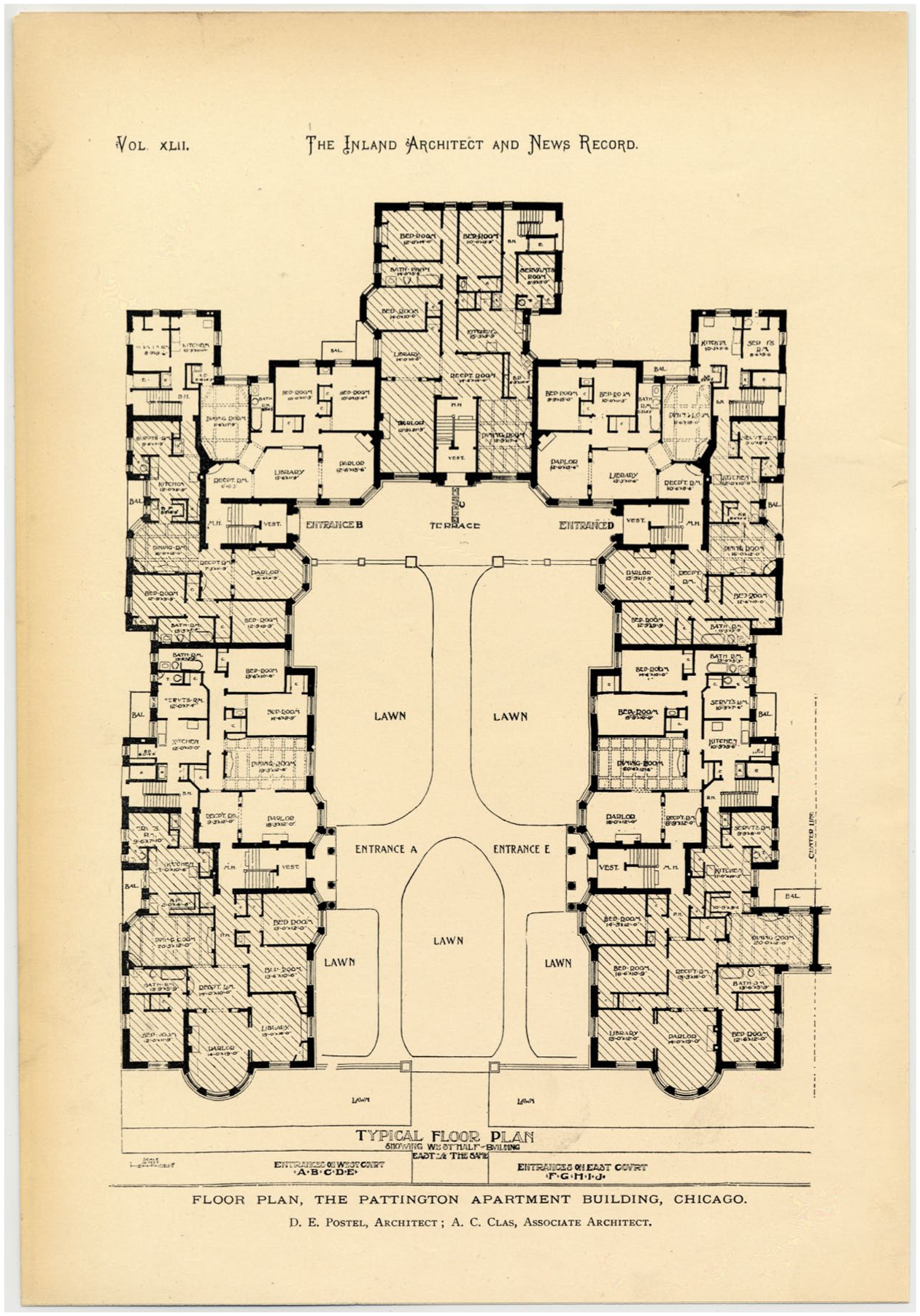
Pattington apartment building, Chicago, Illinois. David E. Postle, architect. Inland Architect, vol. 42, no. 4, Ryerson and Burnham Art and Architecture Archives, The Art Institute of Chicago. Digital File #IA42XX_3827. The floor plan of the Pattington also replicated domestic ideals typically associated with single-family houses. Among the most important of these ideals was a clear separation between public and private space in the home. The front rooms of Pattington apartments included more public spaces designed for socializing, including a reception room, a parlor, and a dining room. The private family spaces, primarily bedrooms, were set apart in the layout from the public spaces.
Apartment construction boomed in cities across the United States in the following decades. Between 1921 and 1928, the percentage of families living in multi-unit housing grew from approximately 24 percent to over 50 percent. In those same years, the percentage of families living in single-family housing decreased from roughly 58 percent to 35 percent. The growth of apartments “was felt in an appreciable degree in cities in all sections of the country,” one study from 1931 found. 64 This included Chicago, where the majority of building permits issued in the 1920s were for apartment construction. More than half the city’s housing units were for three or more families by 1940. 65 Moreover, tenancy in Chicago increasingly connotated apartment living. The same study from 1931 found that the majority of tenants in Chicago lived in apartments. 66 Construction would grind to a halt during the Depression and World War II, leaving the city’s housing stock mostly stagnant until the postwar era. While apartments became a mainstay of the urban housing market, apartment dwellers had to reckon with the fact that the peace, quiet, and privacy promised in advertisements were more of illusions than reality. Tenants in Waller & Beckwith buildings shared walls, hallways, and porches. As a result, they lived in regular earshot and sight of their neighbors. These porous boundaries between apartments generated friction among tenants, and ultimately a paper trail of complaints.
Domestic habits, especially those that produced sensory disruptions, were typically the origins of a complaint. The sounds, smells, and other traces of pets were a common source of tension, including dogs who barked and dirtied the hallways, as well as the pungent odors of cats. 67 Augusta Dart, a fifty-six year old single woman who lived with her mother in a South Side building, reported that her neighbor’s dog had made “a mess” by defecating on her back porch. 68 Even though she confronted the neighbor who owned the offending dog, Dart wrote in a letter that “the nuisance has not abated in the least. It is worse if anything. With this hot weather the flies are gathering,—something we have been rarely troubled with in your building,—and the odor is getting bad.” 69 “Nuisance” was both a polite euphemism and invocation of a relevant legal principle. By calling on the language of nuisance, Dart claimed injury. 70
The injury, it seemed, was to Dart and other tenants’ domestic aspirations. Indeed, at issue in the complaints about the keeping of pets and other disruptive practices were ideals of domesticity. The sounds and smells of pets flouted boundaries between one tenant’s home and their neighbor’s, undermining any pretense of a peaceful, private, and therefore respectable home. Notions of class distinctions inflected these complaints. As sensory historians argue, sensory distinctions made manifest social distinctions, including class. Middle class urbanites had come to define themselves in part by their refined senses, including a lack of offensive smells and sounds. Through complaints, tenants like Dart engaged in a form of what historian Adam Mack calls “sensory politics,” in this case at home. 71 Complaining tenants pushed for their landlord to uphold a particular classed vision of domesticity by regulating their neighbors’ domestic lives.
Parties and the sounds of socializing inside apartments likewise irritated neighbors and blurred the boundaries between public and private space in cities. Letters from Emma Walton detailed multiple parties in the Pattington where she lived with her mother. 72 One letter concerned Basil Church, a thirty-one-year-old salesman at a publishing house who lived with his wife, young daughter, and a domestic servant across the courtyard from Watson. 73 She recounted that Church “plays the piano until all hours, frequently, often accompanied by shouts and cries and singing of friends.” 74 Walton was also tormented by other tenants who hosted the “most terrible party,” according to a separate letter. “From before ten until one, they yelled, shouted, sang, played the radio full tilt, pounded the piano and played other musical (?) instruments as loud as was possible . . . It was simply outrageous.” 75 Walton’s neighbors appeared to revel in being as loud as possible. They played music with the windows open so “that we might hear more plainly,” she wrote. 76
Complaints about the sounds of socializing, especially those emanating from radios, engaged in a form of racial as well as sensory politics. In addition to Walton, other Waller & Beckwith tenants reported their neighbors who were known to “dance & play radio at all hours of night” as one complaint put it. 77 Alongside the surge in radio ownership, local broadcasts boomed in Chicago beginning in the 1920s. 78 Not only did radio foster racial and class cohesion, it also “remapped symbolic geography” historian Derek Vaillant has argued. Vaillant notes that local stations frequently programmed Black musical genres, notably jazz, and regularly broadcast live from nightclubs and dancehalls on the South Side that featured Black performers. 79 It is not possible to say for certain what tenants in Waller & Beckwith buildings were listening to when they blared radios in their apartments. But many may well have been listening to jazz or broadcasts from South Side venues. In doing so, radios would have disrupted segregation by bringing the sounds and voices of Black musicians and South Side nightlife behind the walls of Waller & Beckwith buildings. Complaints about radios and the sounds of parties more broadly would have in effect asked landlords to enforce the boundaries of segregation.
Furthermore, radios and parties marked the incursion of public nightlife culture into the private world of apartment buildings. Complaints highlighted the drinking, dancing, and open sexuality that often accompanied parties and flouted the standards of respectability and domesticity. 80 The dancing, singing, and casual drinking of parties represented a shift in cultural values, namely from restraint toward pleasure. 81 In a letter complaining about the late-night gatherings of his upstairs neighbor, William Case stressed that he was not opposed to leisure per say. Case was a septuagenarian lawyer who lived with his wife and adult daughter in the affluent Gold Coast neighborhood. 82 Case did “not like to begrudge people their innocent amusements,” but he argued that those amusements did not belong in an apartment building. “If anyone wants to have midnight parties they should hire a house for that purpose,” he concluded. 83 Tenants like Case sought to insulate their apartments from their neighbors’ late-night leisure, and by extension the stigma of immorality and impropriety. Moreover, their requests that Waller & Beckwith intervene and put an end to parties among other disruptions had the effect of policing the social lives of their neighbors.
Complaints about parties, drinking, and late-night socializing furthermore entangled shifting gender norms, in particular norms of femininity. Part of what made nighttime leisure spaces disreputable was that they welcomed women. Complaints documented women in Waller & Beckwith buildings who drank, danced, and partied, in some instances alongside their husbands. Neighbors claimed for example that Mr. and Mrs. Zeman were known for “drinking & carousing every evening & into the night” 84 Perhaps even more concerning were women like Rita Ogilvie who hosted parties in their apartments with no mention of their husbands. “We have been repeatedly awakened at all hours of the night by loud talking, arguments and fights, and in addition to this, have had inebriated persons knocking at our front door,” Leslie Cook, one of Ogilvie’s neighbors, reported. 85 The twenty-nine-year old Cook worked as the vice president of an insurance firm, while his wife Helen was employed at a department store. 86 “It is necessary that I make frequent business trips out of the city,” Cook continued, “and I do not wish to leave Mrs. Cook in the Apartment under such conditions.” 87 “Such conditions” seemingly put his wife at physical risk and in close proximity to sexual taboos. Single women who drank and socialized with men were imagined to be at the very least part of a more permissive sexual culture, if not involved in prostitution. Another tenant, Louis Meckstroth, a doctor who lived with his wife and a Swedish domestic servant, similarly complained when “his wife came home one night & found a fellow & girl” from the basement apartment. 88 While Meckstroth left the details to the imagination, he conjured an erotic scene of a man and a woman late at night. Both men positioned their wives as victims of the loose morals of their neighbors, drawing a stark contrast between the respectable Cook and Meckstroth households and those of their neighbors. By complaining about women who engaged in disreputable pastimes of drinking, dancing, and partying, neighbors asked the landlord to set a standard for what was and was not acceptable behavior for women.
Further at issue in complaints that shone a light on the social and often sexual activities of female tenants was additionally normative racial behaviors. Anti-vice campaigners framed prostitution and other forms of open sexuality as a threat not only to morality but also to white racial purity. 89 One complaint to Waller & Beckwith tied concerns about parties and female sexuality to racial segregation. Mrs. Fischer reported that her neighbor, Rita Umsted, hosted rowdy parties where her guests “sing dance and raise the roof.” In addition to her frustration with the “drunks [who] ring her bell and knock on her back door by mistake,” Fischer made sure to note that “colored people go up there also.” 90 Beyond the more common issues with noise and parties, the presence Black visitors in these segregated buildings was a concern unto itself. “Colored people” in a presumably white woman’s apartment evoked the possibility of interracial sex. Here the policing of gender and racial norms overlapped.
The behavior of children likewise created opportunities for tenants to both publicize and scrutinize women who deviated from feminine and maternal expectations. Reports about children setting fires, breaking windows, clogging toilets, punching holes in walls, and peeling off the plaster, among other forms of destruction, functioned as indictments of parents, and especially mothers. 91 Complaints directly connected children’s troubling behavior to the failures of their mothers. Two neighboring tenants complained that the “Larson children make considerable noise in hall. Pound on old piano standing in hall.” The record of the complaint additionally included the aside, “Mrs Larson drinking heavily.” 92 Reports on children referenced whether the mothers worked and the household structure. Tenants in a building on Clark Street repeatedly complained about Minnie Snyder’s children, including an incident where her son hit another child with a baseball bat. The notes from Waller & Beckwith staff included commentary about Mrs. Snyder herself, specifically that “she works all day and is separated from her husband.” 93 Alice Robinson, a divorced mother of three, faced similar complaints. Robinson’s neighbor, Rose Ashbury reported that Robinson worked outside the home, leaving “no one to look after these children except a young girl who also does housework.” The Robinsons housed two other men in their apartment according to the complaint. Ashbury herself lived with two lodgers, but the presence of her husband likely mitigated any stigma. 94 Reports about both Snyder and Larson came during the Depression. The judgment of these women who worked and took in boarders reflected the bind that women found themselves in during the Depression. They sought to balance urgent financial needs that pushed them to work with cultural demands to maintain a household structure that centered a male breadwinner. 95
The inclusion of these details suggests that these women’s family lives were not only common knowledge within buildings, but that their neighbors who complained understood this to be relevant information for the landlord. The fact that these women worked and housed boarders contributed to their children’s behavior, the complaints insinuated. While mothers ought to be responsible for their children, landlords too had a responsibility to intervene, some tenants argued. One tenant, Mrs. Harbeck, complained about children who had left the building’s entryway in a “deplorable condition.” The widowed Harbeck worked as a secretary in a law office and lived with a lodger. 96 Harbeck insisted that “I don’t blame the children, as they don’t know any better, but you should take the proper steps with the parents of the children and let them know that it will have to be stopped,” she wrote to Waller & Beckwith. 97
When she listed the neighbors in question, Harbeck included both their apartment numbers and identifying racial information: “Mexicans with four small children . . . Jews with two small children . . . Irish with two small children.” Like the majority of Waller & Beckwith tenants, Harbeck was herself white. Harbeck’s and a small group of other complaints that included similar details notably identified neighbors whose claims to whiteness were ambiguous and shifting. The turn of the century racial regime (characterized by a hierarchical taxonomy of white races) was undergoing a renovation at the moment Harbeck and others complained. Reforms to immigration in the 1920s catalyzed an on-going process of making European ancestry a threshold for whiteness and distinguishing people with Mexican ancestry as not white. 98 Those complaints that named the racial origins of other tenants were part and parcel of a broader negotiation over the borders of racial categories in the early twentieth century. By referencing the Mexican, Jewish, and Irish ancestry of their neighbors, tenants who complained positioned these neighbors as racially distinct from themselves. In doing so, complaints further racialized these offending tenants and their domestic practices, attributing their failure to adequately control the behavior of their children for instance to race.
More broadly, underlying these disputes among neighbors documented in complaints were perceptions of character, morality, and respectability. “Undesirable” was a common descriptor to characterize troublesome neighbors. 99 “Undesirable” succinctly conveyed that tenants who hosted parties, let their children and pets run amuck, and generally violated the privacy of their neighbors were not respectable and lacking in character. Moreover, complaints served to draw a contrast between undesirable and desirable tenants. One anonymous letter writer speaking on behalf of a “tenant of good name and respect,” while labeling the neighbors who sang and drank until the early morning” as “awful un-Decent.” 100 Complaints provided a vehicle to police those neighbors who were not “of good name and respect.” Those who complained attempted to uphold gender, sexual, and racial norms, all of which were under pressure in the first decades of the twentieth century from changing demographics as well as patterns of work and leisure in cities. Through complaints, tenants additionally conscripted the landlord into this process.
Tenant Complaints and the Responsibilities of Landlords
After chronicling the late-night exploits of her neighbor in the Pattington, Emma Walton concluded her letter addressed to James Waller with a question: “Can you help us?” 101 Walton and others who complained appealed directly to the authority of their landlord. Waller & Beckwith employees and tenants also referenced state entities in their correspondence, namely police who were called to the buildings or health inspectors. 102 Complaints evidence that tenants, like the anti-vice campaigners, appeared to grasp the distinct authority of landlords. Mrs. Barnard for example threatened to move if her neighbor’s son, who had been sent to a juvenile home after stealing from Barnard, returned to the building. In this case, the police, courts, and penal system had already intervened. Yet the decision to write to Waller & Beckwith suggests that Mrs. Barnard understood that it was her landlord who was empowered to force out the neighbor’s son. 103 After all, a tenant’s contractual relationship was with the landlord. In the interwar period—when apartments had become mainstream, many white middle-class urbanites like those living in Waller & Beckwith buildings were tenants, and before federal housing programs would make ownership available to them (and notably not others)—the landlord-tenant relationship was a prime vehicle to reconcile domestic aspirations with the realities of multi-unit living. Complaining tenants looked to use the property rights of the landlord to their own ends. They called on the landlord to exercise the rights of property owners to police domestic practices as well as gender, sexual, and racial norms. In particular, tenants pointed to the landlord’s power to select and evict tenants, as well as the terms of occupancy stipulated in the lease.
Tenants living in Waller & Beckwith buildings as well as others in Chicago signed leases that outlined the kinds of activities that were allowed within their apartments. Form leases drafted by the Chicago Real Estate Board and used by Waller & Beckwith in the 1920s and 1930s prohibited tenants from using their units “for any purpose whatsoever. . .that will disturb the tenants of said building or inhabitants of the neighborhood.” Accompanying these clauses were “rules and regulations” that touched on everything from children’s play spaces, to pets, decorating, and laundry schedules. Moreover, these form leases included explicitly moralizing language. Leases banned the use of apartments for “unlawful and immoral practice” or more broadly any use that would “injure the reputation of the premises or the building.” 104
Those who complained pushed for Waller & Beckwith to enforce these lease clauses as well as the rules and regulations. In the process, they lobbied for the company to assume a role in the social policing of their neighbors. One tenant took care to underscore the landlord’s responsibility to uphold the rules of buildings. He signed off his letter “assuring you always of my desire to cooperate with the rules you have set forth in your building,” presumably unlike his noisy neighbors. 105 The final line served as a reminder not only of the existence of the rules but additionally a call for the landlord to enforce them. After Paul Messereau was unable to stop the children living above him from running around at night, he placed the onus on Waller & Beckwith to intervene. “We can stand this sort of thing no longer and trust you can do something about it,” he wrote to Waller. 106 Messereau did not ask whether Waller was able to do something but rather insisted that Waller could do something. Others would be forthright in their demands, including those tenants who complained about the residents of a basement apartment at the Pattington. The neighbords conceded that “‘they are not noisy,’ read a staff report, ‘but go in & out of the court in terrible bathing outfits.’” The complaining tenants wanted Waller & Beckwith to “notify them to use the back way when dressed for bathing.” 107 The tenants who wrote to the company saw it as incumbent on the landlord to dictate how their neighbors could move throughout the buildings. And yet the crux of this complaint, the “terrible bathing outfits,” was an issue of propriety. By complaining about their neighbors’ bathing suits, these tenants asked their landlord to set a standard of propriety in the buildings.
Beyond enforcing the rules of buildings, tenants stressed that Waller & Beckwith ought to be more discerning in selecting tenants. One resident of the Pattington reminded the company that “you require references for your building, and that the Paddington [sic] has such an enviable reputation,” echoing the language in leases that prohibited tenants from damaging the reputation of buildings. 108 In William Case’s estimation, the problems he experienced in his building stemmed from the failure of the company to properly select tenants. “Your office seems to have done some rather bad guessing about tenants during the last year or two,” he wrote to Waller. 109 For these tenants and others who complained, the landlord’s responsibility for policing tenants began with tenant selection.
Complaints could moreover gesture to the responsibilities of landlords that exceeded leases, including protecting racial segregation. As cultural historian Adrienne Brown contends, emergent real estate practices in the early twentieth century, including restrictive covenants, positioned whiteness as a residential “amenity.” 110 When the Central Uptown Association wrote to Waller in 1928 urging him to sign on to the restrictive covenant they had drafted for the neighborhood, the group argued that protecting this residential amenity was a responsibility of property ownership. Because Waller owned a substantial amount of property in the area, “you hold the key to this situation,” the Association’s letter read, “If it is a failure you are directly responsible for it.” 111 Complaints could reinforce this responsibility as articulated by the Central Uptown Association to protect and maintain the residential amenity of whiteness. When tenants complained about neighbors whose social activities contributed to a leisure culture that eroded segregation, these tenants implicitly asked that their landlords help to uphold segregation by eliminating these kinds of social activities in buildings. The report about Rita Umsted’s “colored” visitors noted above made this connection between policing tenants’ social lives and buttressing segregation more explicit. The complaint from Umsted’s neighbor Mrs. Fischer suggests that enforcing segregation in residential buildings could encompass not only discrimination against prospective Black tenants as outlined in restrictive covenants, but also the regulation of the social lives of white tenants.
In the event that Waller & Beckwith failed to uphold their responsibilities as the landlord, tenants who complained regularly threatened to move. The company’s staff reported that a tenant who was unable to sleep as a result of their neighbor’s barking dog “will break lease if action is not taken at once.” 112 Helen Doyle, a housewife who lived in the same building as frequent source of complaints Rita Ogilvie, informed staff that with her lease set to expire soon, “as far as she is concerned she don’t like the bldg anymore.” 113 Yet Doyle told the staff that she and her husband had not made a final decision, one that might change if Ogilvie’s parties ceased. By threatening to break or not renew leases and therefore deny the company income, tenants leveraged their limited power in the rental relationship—that is the power to end the relationship all together—as a means of pushing their landlord to take an active role in policing their neighbors. To be sure, not every tenant would have had the capacity to leverage this power. Those who threatened to move likely did so out of confidence that they could secure satisfactory housing elsewhere. These threats then underscored the degree to which the race and class of tenants shaped their relationships with their landlords.
In response to hundreds of complaints over two decades, Waller and his staff proved willing to assume responsibility for regulating the social worlds of buildings. The company regularly acquiesced to complaints and wrote to disruptive tenants. In some cases, the letters presented this sort of intervention as an anomalous break with the usual stance. “While it is our policy at all times not to interfere with our tenants in the use and enjoyment of their premises,” one letter read, “we do want to satisfy everyone concerned.” 114 Interfering was precisely what the complaining tenants had requested and precisely the effect of the letter. In correspondence with tenants, Waller and his staff articulated the company’s role as a neutral arbiter, balancing the demands of those who complained against the rights of other tenants. “We realize that as one paying rent you have a right to live in your apartment,” Waller acknowledged in one letter, “But we must ask you to do so in a way that does not unnecessarily annoy our other tenants.” 115
Although the tone of the correspondence tended to be deferential, the company nevertheless frequently threatened to exercise the rights of the property owner, including removing tenants who did not comply with requests. Waller informed Helen Baltes that the company did not want to “risk losing several tenants” due to “noise complaints” about the people subletting her apartment. “Unless some action on your part is taken at once, we shall be forced to protect ourselves in accordance with the terms of your lease.” 116 If the threat to evict Baltes was veiled, the company was more blunt in its correspondence to Emitt Isbell, whose children were the source of multiple complaints. “We do not intend to permit this practice continue and unless something is done about it at once, we shall be compelled to ask you to vacate.” 117 The company followed through on threats in some cases. Waller notified Maxim Olefsky that he was the subject of repeated complaints “from various parties.” His neighbors reported “loud and boisterous talking after 10:00 o’clock at night” and “the continual moving of heavy objects over the floor.” Waller warned that “any recurrence of just complaints will be followed by drastic action on my part.” 118 Within a week, Olefsky’s lease was marked as “cancelled.” 119
While the records of complaints document Waller & Beckwith’s willingness to participate in the social policing of tenants, some of those tenants who were the subject of complaints resisted these incursions into their lives. In addition to outright rejecting the accusations, tenants on the receiving end of complaints frequently reframed the disputes in their responses. 120 “Complaints regarding my children are absolutely false,” Carl Anderson announced in a letter. “There is nothing I can do to please your complaining tenants.” 121 Anderson and others argued that the problem lay with their neighbors who took it upon themselves to complain. In short, the tenants who complained were intruding on the privacy of their neighbors. These responses boiled down to “mind your own business.” When Waller informed Mildred Ubel that she could no longer keep her dog in the apartment as a result of complaints (as well as a notice from the Department of Health), Ubel countered that her neighbors had “nothing to complain” about. “I don’t bother no tenants. I mind my own business,” she continued, unlike the “old cranky fellow” who lived below her. 122 Another tenant likewise asserted that complaints stemmed from the grievances of busybodies, especially “one who is always making trouble in the building, too busy minding other people’s business & because they can never find out our business it gets under their skin.” 123
Some responses from the subjects of complaints suggested that the disputes between neighbors were rooted not in failings of individuals but in the spatial arrangements of apartments. Barney Wolk, a wholesale retailer, received reports that his two young children were too loud. 124 In his response, Wolk was quick to “readily admit, that our children and ourselves walk across the floors in the normal course of our daily lives.” He went so far as to ask the neighbor who complained “to be good enough to suggest a remedy.” “But we realize, that in the average building, where there are no sound proof floors this cannot be helped,” he continued. 125 Wolk reasoned that sounds were bound to travel from one apartment to another. He echoed the sentiments of another tenant who, fifteen years earlier, concluded, “people who have to live in flat buildings have to put up with a lot of things that are unpleasant, and I have not the least patience for chronic kickers.” 126 Tenants could not expect apartments to neatly conform to domestic ideals of a quiet, peaceful, and private home. Apartment building necessitated tolerance rather than interference.
Conclusion
In spite of these responses from a small subset of tenants rejecting interventions from their neighbors and landlord into their domestic lives, it was the complaints themselves that spoke the loudest and created the more substantial paper trail. Complaints spoke to the capacity of tenants to shape the responsibilities of landlords, in this case a responsibility to intervene in disputes among neighbors. In doing so, tenants living in Waller & Beckwith buildings stressed that their landlord ought to be accountable for upholding domestic ideals, as well as the norms of gender, sexuality, and race within their buildings. In short, landlords had an obligation to police the behavior of tenants.
By revealing the capacity of tenants to shape the responsibilities of landlords, the records of complaints from Waller & Beckwith tenants serve as a reminder that those responsibilities were subject to change and thus have a history. Complaints from tenants were part of a longer history of enforcing this and other responsibilities of landlords that continued on after the interwar period. The questions that underlay injunction and abatement laws as well as tenant complaints—namely whether and how to hold landlords accountable for the activities of tenants—reoccurred later in the twentieth century.
Both questions had additional implications for the development of tenant screening methods in the twentieth century. If a landlord was going to be responsible for the activities of tenants, it behooved them to scrutinize prospective tenants more closely. Over the course of the twentieth century, landlords adopted increasingly rigorous and systematic screening procedures. Legal authorities would also continue to take up the problem of the landlord’s responsibility for what happened behind the walls of their buildings, and ultimately impose a greater obligation that helped to reshape screening. In 1970, a federal district court ruled that landlords were liable for the activities of third parties as well as tenants. Criminal background checks became a part of the tenant screening repertoire as a result. Background check imbricated landlords not only in the informal policing of the social worlds of tenants but additionally in the formal policing of the carceral state. 127
Through screening, the landlord’s responsibility for the activities of tenants took on a more clearly discriminatory dimension. Given the impact of incarceration on African Americans, criminal background checks also function as a form of racial discrimination. 128 The more rigorous and systematic screening practices landlords adopted in the late twentieth century helped to exclude prospective tenants who might generate complaints and who they generally deemed “undesirable.” At stake in the process of sorting out a landlord’s responsibility to police their tenants then was also sorting out who was desirable and should have access to the basic necessity of housing.
Footnotes
Acknowledgements
Thank you to readers who offered feedback on drafts of this article over the years: colleagues in the Collaborative Humanities Postdoctoral Program at Vanderbilt University, the Mansueto Urban Doctoral Fellows program at the University of Chicago, as well as Jon Levy, Tara Zahra, and members of their Globalization seminar at the University of Chicago. I am grateful to Adam Green for his support of these ideas and Evelyn Kessler for her incisive critique. I also wish to thank the anonymous JUH readers for their insightful and helpful comments.
Declaration of Conflicting Interests
The author declared no potential conflicts of interest with respect to the research, authorship, and/or publication of this article.
Funding
The author disclosed receipt of the following financial support for the research, authorship, and/or publication of this article: The author workshopped this article as a part of a fellowship funded by the Mansueto Institute for Urban Innovation at the University of Chicago. Research funding from Vanderbilt University also supported supplemental archival research.
Ethical Considerations
Not applicable.
Consent to Participate
Not applicable.
Consent for Publication
Not applicable.

Data Availability
Not applicable.