




Abstract
After the Mexican Revolution, statesmen and educators envisioned a new urban complex for the National Autonomous University of Mexico to expand public higher education and support the consolidation of the postrevolutionary state. Although construction of Ciudad Universitaria (CU), or University City, would not begin until 1950 due to political upheaval and university-state conflicts, this article examines unbuilt plans and sketches of the project that circulated in the interim decades to trace the urban planning models that shaped it, including other Ibero-American ciudades universitarias, Beaux-Arts architecture, and the Garden City Movement. Despite state rhetoric insisting that the project reflect a Mexican national character, this article shows that early plans drafted between 1928 and 1942 primarily reflected international models because the aesthetics of Mexican revolutionary nationalism were still in development. Although the early plans were never realized, they served as crucial antecedents against which planners eventually imagined a Ciudad Universitaria imbued with Mexicanidad.
Keywords
On December 28, 1929, in an ornate stone building in downtown Mexico City, officials in the congressional chamber clamored to be heard about an issue of national importance. Just nine years after a bloody revolution had killed more than one million Mexicans, these men were routinely grappling with pressing questions about the future of Mexico and the consolidation of a postrevolutionary state. On this day, however, they were not debating economics or foreign policy, but whether the government should build new facilities for the national university in Mexico City, a project known as Ciudad Universitaria (CU), or University City. “Ciudad Universitaria must be understood . . . [as a way] to make students useful to the social fabric, so they study all our problems in this country . . .” argued Deputy O. Mendoza González in support of the project, “It should be a true laboratory of all Mexican ideas . . . to promote our industry, commerce, and natural resources.” 1 This enthusiastic argument for the national goals imbued in Ciudad Universitaria reinforced what his colleague had argued the day before, defending against a common critique of the project: “Ciudad Universitaria has a high ideal that is not simply imitative,” Ramón Santoyo declared, “it is not only because great centers exist in European nations . . . that the University wants to establish one in Mexico.” 2 Mendoza and Santoyo articulated two central mandates of the Ciudad Universitaria project: that it support the government’s economic and political goals and that it be Mexican at its root, not a reproduction of universities elsewhere.
Over the next two decades, politicians, students, university administrators, architects, and urban planners articulated multiple visions for this new site for the National Autonomous University of Mexico (UNAM). These early visions would never be built, but they show the ways in which Ciudad Universitaria provided a blank slate for imagining the future of the university and a screen onto which different groups projected their aspirations for modern Mexico. In Spanish, the word anteproyecto is best translated as a proposal or a draft; the word’s components mean “before the project.” Together, these early anteproyectos form a rich archive of spatial representations that reveal the goals and influences of their creators. 3 This article examines drafts of CU that circulated between 1928 and 1942 to illuminate how ideas about urban planning and architecture changed—both in Mexico and around the world—from the moment when the project was first imagined to the moment when the plans were finalized in the late 1940s. In contrast to the plans that were ultimately built, starting in 1950, the unbuilt drafts reveal a long intellectual lineage of international influences and planners whose work bridged the periods before and after the revolution. 4 While conflicts over the university’s political allegiances and funding stymied the project throughout this period, there were two parallel processes underway that also shaped it. First, the new Ibero-American genre of university planning, the ciudad universitaria, was developing with an emphasis on the needs of Latin American public universities. Second, a new, locally rooted Mexican modernist architectural style was emerging in the capital. This national aesthetic linked to the Mexican Revolution sought to break with the past and would shape the new building projects of the postrevolutionary state.
Throughout this period, the unofficial sketches and plans of CU reveal a heavy reliance on international urban planning models that was at odds with the rhetorical mandate from leaders like Santoyo that the project not be “imitative” and reflect a sense of Mexicanidad, a Mexican national identity or character. 5 The unbuilt drafts bear witness to a gap between that rhetoric and the plans, which mostly emulated global trends in modern urban planning such as Beaux Arts, the Garden City movement, Bauhaus, and U.S. campus influences. 6 This article argues that early plans for Ciudad Universitaria that circulated between 1928 and 1942 reflected global urban planning models because they were not subject to the Mexican modernist aesthetics of revolutionary nationalism that were still developing in this period. However, these plans served as crucial antecedents against which planners eventually crafted the plan that became a reality, imbued with Mexicanidad and the plastic integration that characterized Mexican modernism. 7 Beginning with historical background on the Mexican Revolution and the postrevolutionary period, this article will show that Ciudad Universitaria was imagined during a tumultuous period of consolidation of the postrevolutionary state and nation, amidst debates over the university’s role in that process. It then situates Mexico’s CU within the history of the Ibero-American ciudad universitaria movement, which was developing in Madrid and Bogotá when Mexico began imagining its own version. Finally, the article analyzes the unbuilt sketches and plans for Ciudad Universitaria that circulated from 1928 to 1942 and traces the influences of global urbanism in their designs.
The Ciudad Universitaria that the federal government began building in 1950 was designed by Mexican creators and permeated with Mexicanidad in concept, material, and aesthetic. 8 But the project’s renowned Mexican modernist form was not inevitable. Had Mexico built its Ciudad Universitaria when the Chamber of Deputies first discussed it in the 1920s, it would likely have adhered more closely to international models despite the mandate to avoid mimetic design. As Mexican historian Fernando González Gortázar writes, “architecture has been a faithful mirror of our passions, contradictions and searches . . . one of the richest and most fascinating manifestations of national culture.” 9 Tracing the search for Mexico’s CU shows that it could have taken any number of different forms. Although it was ultimately a product of the moment in which it was built, the unbuilt visions that preceded it played an important part in imagining Ciudad Universitaria.
Background: The Mexican Revolution and Post-Revolution
In the tumultuous years following the Mexican Revolution (1910-1920), university leaders and political actors debated three major changes to the national university, one of the main public institutions that could aid in consolidating postrevolutionary rule: expanded access, autonomy from the state, and new facilities. Just a few years earlier, the revolution, a conflict between multiple regional factions, had ended the thirty-five-year dictatorship of Porfirio Díaz and ushered in a constitutional republic. In addition to fighting for fair elections and the removal of Díaz, some revolutionary factions fought for economic justice and democracy for the majority of Mexicans living in oppressive poverty, many of whom were Indigenous or of Indigenous descent. 10 After the revolution, the triumphant constitutionalist faction began to consolidate power into a postrevolutionary government, resting its political legitimacy on promises made during the revolution.
Access to basic education was one revolutionary promise granted as a right in Article 3 of the Constitution of 1917, which mandated free, compulsory, and secular public primary education for all Mexicans. In contrast to primary education, however, higher education had exclusively been available in urban centers and was mostly the realm of elite men. Since primary, secondary, and higher education were all led by the newly established Ministry of Public Education, any funding allocated for the university was necessarily seen as decreasing funding for rural primary schools. Nonetheless, politicians such as Mendoza and Santoyo saw Ciudad Universitaria as an opportunity to expand access to higher education for all Mexicans and, through the professionalization of a broader political class, a tool to consolidate the power of the burgeoning postrevolutionary state.
The relationship between Mexico’s primary institution of higher learning and its government had long been reflected in the university’s facilities, which sat in close proximity to the halls of power. University buildings had been situated in the center of the capital since the founding of the Royal and Pontifical University of Mexico in 1551 under Spanish colonial rule. Indeed, the first university building sat on a corner between the viceregal palace and the cathedral, its location a signal of its deep connections to the two central institutions of colonial power: the Spanish crown and the Catholic church. The university’s history mirrored the ups and downs of Mexico’s national history: it began as a colonial institution, became national after independence in 1821, underwent secularization and fragmentation during the liberal reform period in the 1860s, and re-consolidated as a single university under Díaz’s efforts to “modernize” and Europeanize state institutions just before the revolution. 11 Despite these major disruptions and institutional changes, the physical spaces of the university in the central Barrio Universitario remained unchanged. By the twentieth century, the old university buildings were overcrowded, undermaintained, ill-equipped for modern science, and woefully inadequate for the university’s needs.
Discussions about a new Ciudad Universitaria intertwined with ongoing debates about the university’s autonomy, a designation of self-governance that was particularly significant given that higher education had long been tightly controlled by the church and, more recently, the state. In 1929, the university gained official autonomy and was designated the National Autonomous University of Mexico, following the model of university autonomy granted at large public universities in Uruguay and Argentina in 1908 and 1918, respectively. In Mexico, however, this initial version of autonomy only included limited faculty and student participation in university governance. In 1933, following major protests, the federal government granted full autonomy to the university, allowing unprecedented faculty and student participation in university governance but drastically cutting federal funding for the institution. 12 The autonomy laws indicated that federal funding came with obligations to maintain intellectual allegiance to the postrevolutionary state in teaching, research, and political activities at the university. The two university projects of this period—autonomy and Ciudad Universitaria—were inextricably linked. As students and faculty struggled over the university’s status, many imagined CU as a physical and spatial manifestation of autonomy, a coherent, self-contained complex that could materialize their intellectual and political independence. 13 Much like an Ivory Tower, this site for the university would remove it from the political entanglements, urban congestion, and anxieties around crime and vice that characterized the epicenter of Mexico’s capital. For state actors, CU would also conveniently remove students and their frequent protests from the center of power where they had often been a nuisance to government officials.
The intellectual foundations for Mexico’s Ciudad Universitaria were laid in the years when the postrevolutionary state was consolidating power, a time when political leaders sought to distinguish themselves from the Díaz regime while also preventing the full realization of the redistributive promises of the revolution. 14 However, many continuities from the Díaz era remained, including influential urban planners and architectural styles. In the context of a burgeoning Ibero-American style of urban university planning described in the following section, those imagining Mexico’s Ciudad Universitaria first turned to global forms and styles of the previous era. However, as the postrevolutionary state institutionalized its single-party rule, it also consolidated ideas and aesthetics of revolutionary nationalism characterized by indigenous imagery, local building materials, integration with the landscape, rejection of colonial forms, and solidarity with their Latin American neighbors.
La Ciudad Universitaria: An Ibero-American University Model
When Mexican leaders began imagining a new home for the national university, they joined a developing constellation of Ibero-American universities planning projects called ciudades universitarias based on the first one built in Madrid in the late 1920s. 15 This new genre of urban university development had a strong regional identity and a political and ideological charge: its creators sought to spatially manifest the autonomy and self-sufficiency of universities that had long been controlled by the church and state by creating independent university complexes that were integrated into the local landscapes and built specifically for Ibero-American contexts. Planners integrated influences from European and U.S. modern architecture and city planning, including from the Beaux Arts, Garden City and City Beautiful movements, Bauhaus, and, later, ideas from the International Congresses of Modern Architecture (CIAM) and international functionalism. However, there was also a uniquely Ibero-American character to these projects that linked aesthetics and national politics at a time when many Latin American states were investing in modernization and developmentalism. 16
Built for large, public, federally funded universities, ciudades universitarias were sites where the interests of architects and statesmen met in envisioning the future of Latin American capitals. 17 In these national contexts, championing local architects and planners became a key feature of this new university planning genre, and political upheavals shaped the projects both spatially and ideologically. Although Colombia began building the first Ciudad Universitaria in Latin America in 1937, for example, Mexico had been deeply engaged in discussions about its own project since 1928. However, Mexico experienced several false starts due to political upheaval and university-state conflict over autonomy, protest, and funding, and they did not begin construction until 1950. This section traces the development of the ciudad universitaria as a university planning style through the first two examples that pre-dated Mexico’s own project: Madrid in the late 1920s and Colombia in the 1930s and 1940s. This analysis illuminates the visions and planning currents that shaped Mexico’s parallel process of imagining its own Ciudad Universitaria. Through regional discussions about the ciudad universitaria, the planners of Latin American capitals integrated and hybridized global influences with national needs to develop a new genre of university planning.
Built in Madrid beginning in 1927, the first Ciudad Universitaria set the standard for a city university complex with spatial autonomy, though its grand scale presented challenges for internal circulation and connection to the rest of the capital. It was a model for later ciudades universitarias not only spatially, but also ideologically, as it was conceived as a “pan-Hispanic,” modernizing, Ibero-American project by King Alfonso XIII. 18 With support from the Rockefeller Foundation, Spanish planners conducted studies of other international universities, taking inspiration from the German research model, British colleges, and U.S. campuses. They envisioned a “micro-city” that was also a “university-park,” with autonomy and distance from the city center, exclusively for the use of the university community. The planners considered their project as not exclusively Spanish but broadly Ibero-American, in part because they hoped to bring more students from Latin America and the Caribbean to study in Madrid. In so doing, they forged a new genre of urban university complex and branded the ciudad universitaria as a particularly Ibero-American style. They followed trends in modern architecture from the Bauhaus school as well as older, nineteenth-century Beaux Arts architectural styles, and their site was spatially vast, extending across almost 360 hectares. 19 This distinguished it from contemporaneous U.S. campuses and created problems with very long traveling distances both within the university and beyond it to access essential services. The scale of the design created, instead of one singular campus, a “spine of nuclei” along three kilometers of shared road. 20 This issue of balancing scale, transportation, and accessibility would recur in planning for later ciudades universitarias, but Madrid set the standard for the look and feel of this modern, hybrid genre.
Although plans for ciudades universitarias circulated throughout Latin America in the late 1920s, the first one to be built in the Americas was for the Universidad Nacional de Colombia in Bogotá between 1937 and 1946. The government articulated Colombia’s need for a modernizing, developmentalist university project and wrestled with the implications of employing German architects for such a national project. The fact that political upheaval ultimately disrupted the project’s completion as planned illustrates how important political consensus was to fully carry out the complex, long-term, urban planning needed to build a ciudad universitaria. At the start of the project, Colombia faced similar challenges to Mexico: the project arose from a need to unite old, fragmented university buildings in the city center and to reform the university by physically manifesting its autonomy granted in 1935. As Minister of Education Jorge Zalamea asked in an address before Congress, “Will we dismiss the possibility of creating a CU, as is appropriate for the needs of the new culture and the new type of professional that we need only because no CU exists in Paris or Bologna or London?” 21 Zalamea stressed that Colombia had particular cultural and professionalization needs during this reform period that required a ciudad universitaria, national needs (not shared by European counterparts) that necessitated a national answer. Given this national specificity of the project, some lamented a lack of local participation in the initial planning efforts. The Society of Architects later complained, in a “nationalist spirit,” about local architects losing work to foreign visitors. 22
Following the pan-Hispanic ideal of ciudades universitarias, López Pumarejo’s government did consider a proposal by two Latin American experts, not from Colombia, but from Mexico. In early 1937, Mexican architects Luis Prieto Souza and Manuel Parra proposed a design for Ciudad Universitaria in Bogotá to the Colombian government. Their design, which was, as architectural historian Silvia Arango writes, “academic and conventional,” was ultimately discarded, but it demonstrates that Mexican architects and planners were in conversation with planners throughout the Americas about the developing ciudad niversitaria style. 23 After consulting with experts from Spain and Germany, López Pumarejo hired German architects and planners Leopoldo Rother and Fritz Karsens, who had recently completed housing projects for the Weimar Republic and were in dialogue with Bauhaus and modernist colleagues.
Reflecting ideas about collective urban space, zoning, and social inclusion from the Garden City Movement and the latest rationalist architectural ideas from Bauhaus, the planners selected a site on the outskirts of the capital and designed an ovoidal shape around a common open space with ample space for athletics. 24 They designed the complex as a coherent, integral whole using the modernist block system, with pedestrian walkways throughout the interior and peripheral ring roads around the site for cars and buses. When construction began in 1937, President Alfonso López Pumarejo promoted Ciudad Universitaria as a key modernization project within his Liberal economic and social reform program known as “the revolution on the march.” 25 The creators hoped the project would reflect the newly democratic governance of the university, open higher education to a broader base of Colombian students, provide unprecedented space for sport and recreation for students and the public, and drive economic development.
Over the next few years, however, López Pumarejo’s initial efforts to achieve this secular, “liberal dream” were blocked by conservative opposition and political upheaval, and construction progress stalled between his two presidential terms. 26 The coherence of the initial plans eroded over years of conservative opposition, starts and stops in the project, and the necessary sale of university land. Ciudad Blanca, as the project was known, was not completed as originally planned. Nonetheless, this first Latin American ciudad universitaria became an important model, visited by many official delegations, at a time when many countries were considering building their own version. As university rector Gerardo Molina said upon leaving office in 1948, “in the international landscape, one can observe a just appreciation for what Colombia has accomplished . . . several countries are about to begin their Ciudades Universitarias following the example and stimulus we have given them . . .” 27 Mexico was one of these countries. Notwithstanding the German architects who led the project, Colombia’s Ciudad Universitaria became an emblem of Latin American modern architecture that provided both a model and lessons learned for projects in Mexico, Venezuela, Cuba, and other countries in the region. 28 The debates over the national origins of planners encouraged later countries to prioritize local leadership, and the effects of political instability on the Colombian project highlighted the importance of both economic and political commitments to fulfill the integral designs of these university complexes.
Despite many shared aspirations and features, ciudades universitarias have often been framed in contrast to the U.S. concept of the campus. As historian Mauricio Tenorio writes, the campus is, “the United States institution par excellence . . . the campus is as United States as the polis is Ancient Greece.” 29 Although urban campuses also existed in the United States, the prototypical U.S. campus to which Tenorio refers is a protected, bucolic site outside the city that offered a particular middle class student experience. Derived from the Latin word for field, the word “campus” traces its origins to late eighteenth-century Princeton University, then the College of New Jersey. The term referred to the open green space between the main college building, Nassau Hall, and the town of Princeton. Although planners of the first ciudades universitarias certainly observed and drew inspiration from U.S. campuses and receives support from the Rockefeller Foundation, the impulse to distinguish this Ibero-American design from U.S. campus models can be understood in the context of U.S. neocolonialism in the region during the twentieth century. The older Ciudad Universitaria de Madrid was never labeled as a campus due to its veteran status as a satellite city, though subsequent Spanish and Latin American universities have been called campuses since. 30 During the planning process, UNAM students expressed disdain for U.S. models in their protests against university leadership, accusing them of creating, “only copies the systems of American Universities, considering the University of Mexico as a personal business venture.” 31 Yet, while many in Mexico balked at the idea of importing a U.S. model, some internal university actors embraced the association. An annual report at the graduate school, for example, advocated for “a university city constructed, in large part, according to the ideas that govern the campus of North American universities.” 32 Internal discussions within the university may have acknowledged that the U.S. campus was one model among many, but presenting the project to officials of the revolutionary government required emphasizing the influence of other Ibero-American ciudades universitarias, despite the fact that these also shared common influences with their U.S. counterparts, such as from the Beaux-Arts and Garden City Movements. 33 To understand how the creators of the following drafts imagined Mexico’s Ciudad Universitaria, it is essential to contextualize them in the constellation of the Ibero-American projects, both architecturally and politically, as they focused on spatializing university autonomy, modernizing capitals during this period, and collectively defining this new, hybrid urban complex known as a ciudad universitaria.
Drafting Mexico’s Ciudad Universitaria
Early imaginings of Mexico’s Ciudad Universitaria shared several goals with other ciudades universitarias such as spatial autonomy, urbanization, and influences from global modern architecture. In the late 1920s, as construction began in Madrid, many different actors—including students, politicians, university administrators, architects, and planners—articulated visions for Mexico’s own Ciudad Universitaria. For example, former university rector and presidential candidate José Vasconcelos argued that CU would spatially unite the institution and unite Mexico itself through the collaboration and collective effort the project would require across a fractured postrevolutionary nation. 34 By tracing different visions for CU from 1928 to 1942, this section analyzes three early unbuilt plans for Ciudad Universitaria and one group of student plans to illustrate the diverse planning ideas and global influences that circulated around this project before the consolidation of a revolutionary nationalist aesthetic in Mexican modern architecture. None of these plans came close to being built, but together they demonstrate the centrality of international models and the gap between the plans and the state’s rhetorical mandate of an as-yet-unrealized Mexicanidad. In the twenty-year national debate about the CU project, these early drafts would elicit the Mexican modernist response that was eventually built.
The first draft of Mexico’s Ciudad Universitaria was a student project. In 1928, two UNAM architecture students designed a new space for their alma mater for their thesis project defined by the Beaux-Arts style that had predominated in the architecture school since before the revolution (see Figure 1). Mauricio de María y Campos and Marcial Gutiérrez Camarena conceived of a campus in the small neighborhood of Huipulco in Tlalpan, twenty kilometers south of the city center. This first plan—often cited and celebrated in university histories for its student authorship—emphasized the unification of academic units with attention to sunlight, sanitation, and garden spaces that were typical of urban planning in the 1920s. The students situated university buildings along two wide intersecting axes running north-south and east-west, routes intended primarily for automobiles. With the exception of a small plaza at the intersection of the two major axes, there was no large central space for congregating, nor were there significant spaces exclusively for pedestrians. Medians, small squares, and gardens around the university’s periphery separated it visually from the surrounding city, though connections to avenues and trains gave its inhabitants easy access. 35 Sports fields and a stadium appeared prominently.
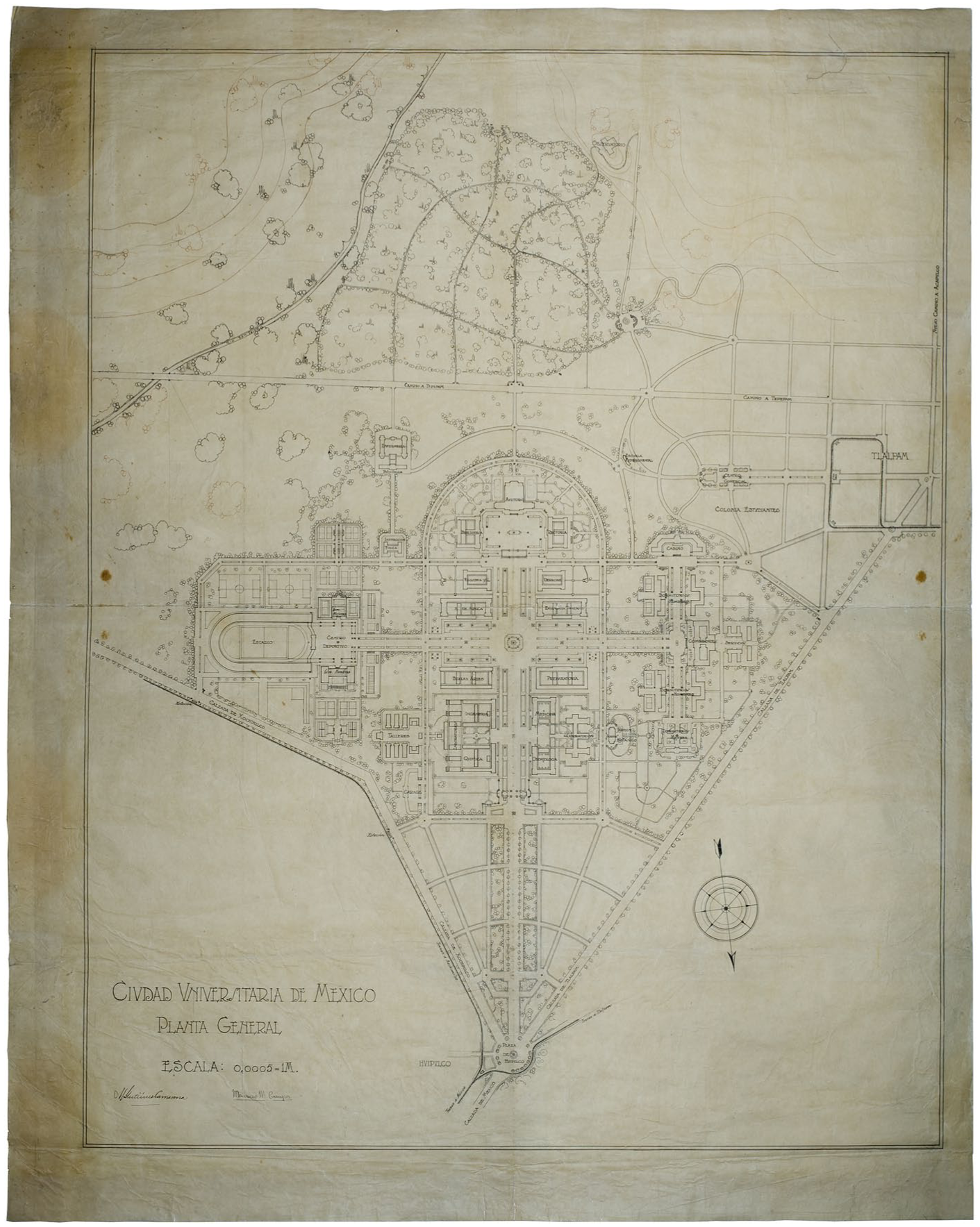
Mauricio M. Campos y Marcial Gutiérrez Camarena, “Planta del plano general de Ciudad Universitaria” (1928).
An early example of the incipient Mexican urbanism and city planning that took shape within the university’s own architecture school, Campos and Gutiérrez Camarena’s work emulated the Beaux Arts model that shaped so many Latin American and global capitals and universities during this period, and they integrated influences from Haussmann, Cerdá, Howard, and Garnier. The boulevards and monumentality of the design reflected other prominent Haussmann influences built in Mexico’s capital before the revolution when his styles were acclaimed by the Mexican elite as international signals of being modern. 36 Lined with trees and planters along the medians, the streets resembled the city’s central avenue, Paseo de la Reforma, often called “the first Parisian boulevard in the New World.” The plan’s car-centric approach to urban planning was typical of this moment in modernist planning, but misaligned with demographics in Mexico City where very few inhabitants owned cars in the 1930s. 37 Overall, this first student project reflected the urban planning that was taught in the architecture school during this period, defined by Beaux-Arts boulevards and structured green spaces.
The students’ plan presaged a change in Mexican planning that was already underway; it diverged from architectural styles that predominated in Mexico’s immediate postrevolutionary years when public buildings and state-sanctioned projects mostly continued to adhere to a neocolonial style. Despite the apparent contradictions, this approach traced its roots to Spanish colonial buildings emulating haciendas, or landed estates, with interior patios and grand baroque entranceways and facades. New educational buildings and libraries built in the city in the 1920s emulated the university’s original colonial buildings, which had been designed with an interior quadrangle to encourage cloistered, monastic learning as at Oxford, Cambridge, and other early European universities. 38 Vasconcelos encouraged the neocolonial style: “the mess of the past contains healthy threads where we can put down the roots of growth . . . our national inheritance such as the architecture of colonial times . . .” 39 By the 1930s, however, the state began fomenting more functional, less ornate, architectural models to address the social priorities of health, education and housing. As the ruling party shifted to the left under President Lázaro Cárdenas (1934-1940), who sought to fulfill more of the social promises of the revolution, prominent architects reached a consensus that Mexican architecture should be defined by the more modern style, mostly leaving behind the more traditional, colonial forms. This would be an architecture in service of the majority, meant to fulfill those revolutionary promises, inspired by international modernisms from urbanists like Le Corbusier and the famed modern architecture node the CIAM, but rooted in a true sense of Mexican revolutionary nationalism. 40
Following the autonomy laws, university fundraising efforts made it possible to acquire land for Ciudad Universitaria in Lomas de Tecamachalco in the hills northwest of the city center near the large park Bosque de Chapultepec. The site was adjacent to Lomas de Chapultepec (Chapultepec Heights), an upscale suburban residential complex developed by planner and urbanist José Luis Cuevas Pietrasanta in 1922. 41 One of the first subdivision housing complexes in Mexico, Cuevas Pietrasanta built it in a California colonial style arranged around the automobile, inspired by Ebenezer Howard’s Garden City movement. Cuevas lectured about Howard’s ideas in the university’s first urbanism class, signaling a shift from neocolonial to more modern forms in both university classrooms and public planning. 42 Unlike Howard’s initial concept of social welfare through an urban planned community, however, Cuevas applied the model to an upscale residential development. Chapultepec Heights became an emblem of the growing influence of Hollywood and U.S. aesthetics on the Mexican elite, architects, and planners. 43 Over the next few decades, planners of Latin American capitals would gradually transition from the influence of European, “Old World” urbanism to adopting more North American influences. 44
In 1929, architect and urban planner Carlos Contreras drafted a design for Ciudad Universitaria—an anteproyecto—that was circulated for fundraising purposes in the first issue of a journal published by the newly autonomous university the following year (see Figure 2). Contreras has been widely credited with bringing global ideas about urban planning to Mexico. 45 He created this design several years before publishing his influential Master Plan for Mexico City in 1933, but his ideas about car-based cities, alignment with the Chapultepec Heights housing development, and influences from both Howard’s Garden City movement and New York’s 1929 Regional Plan were already evident in his design. 46 Trained at Columbia University, where he received a Bachelor’s in Architecture in 1921, Contreras brought ideas from Howard, Jean-Claude Nicolas Forestier, and Frederick Law Olmsted to Mexico City, emphasizing zoning with open green spaces and a move away from colonial grids. The concept of a self-contained zone, campus, or small city reflected Howard’s Garden City concept of a cooperative “model community.” 47 Olmsted’s ideas had been taken up by many U.S. land grant universities, which integrated a park-like atmosphere for the benefit of students with less formality and rigidity than the traditional elite colleges. Planning the university near a suburb like Lomas de Chapultepec—not in the middle of the city, but also not far outside it—was typical of Olmsted’s approach to integrate nature, home, and community in campus designs through picturesque, meandering walking paths and dormitories. 48
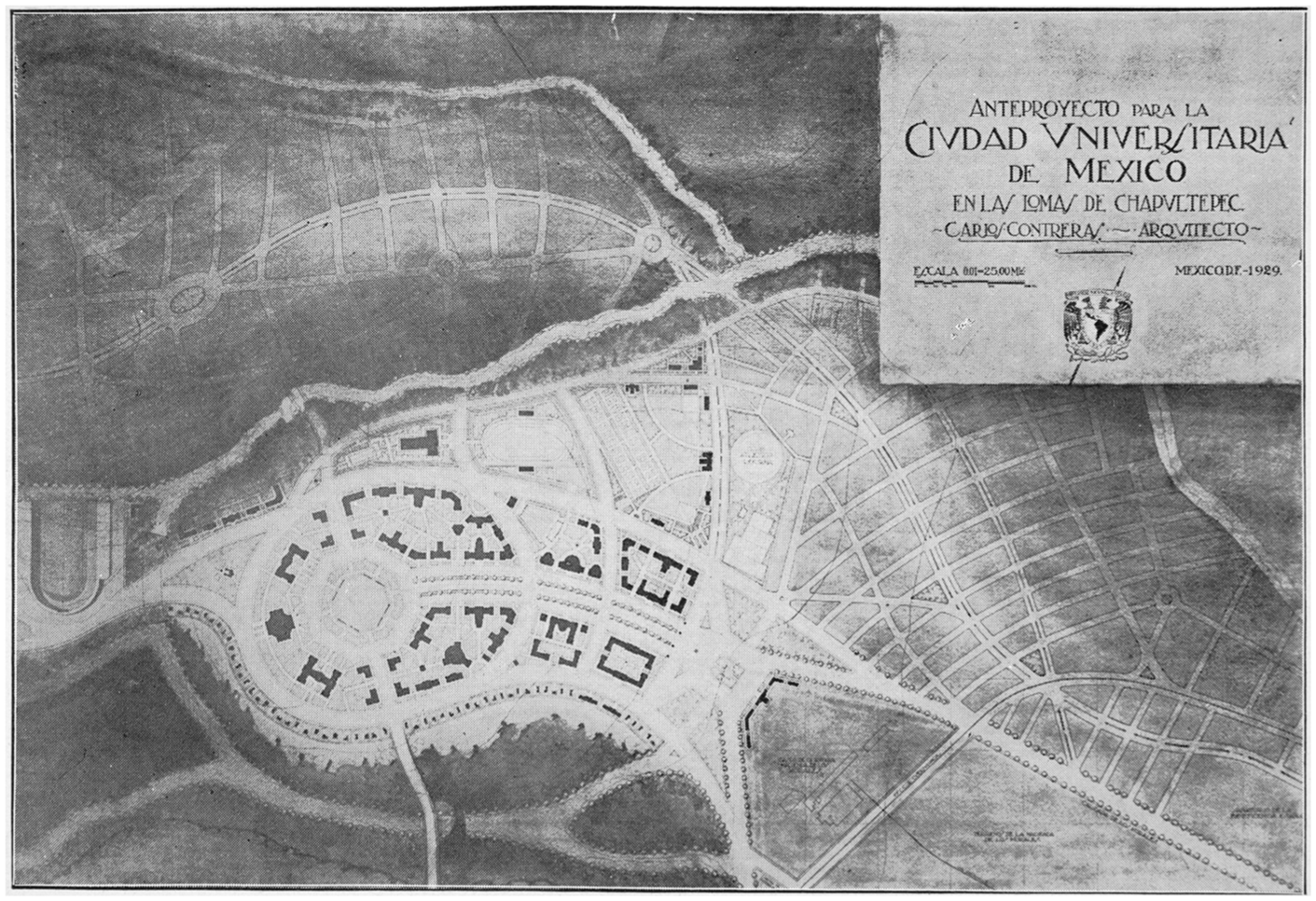
“Anteproyecto para la Ciudad Universitaria de México,” by Carlos Contreras (1929).
At the center of Contreras’s design was a grand undulating axis or esplanade with a tree-lined median connected to a system of secondary axial streets, common features of the Garden City and City Beautiful planning movements. 49 These streets reflected an automobile-centric style of planning, though there was also space for pedestrians. A central plaza contained a monument or obelisk that echoed the Haussmann style utilized on the Paseo de la Reforma. The draft includeed space for athletic fields and facilities as well as ample green space and notable inclusion of trees, bushes, and plants. Among the many buildings was a central one, likely the library, designed with a Greek-cross architectural plan like Low Library at Columbia. Other buildings emulated the Beaux Arts style that had been popular in Mexico during the time of Díaz and continued to be relevant in the work of architects like Contreras, who brought aesthetic continuity since he worked for both Díaz and the postrevolutionary government. Several buildings in this draft featured enclosed quadrangles, a feature of early monastic universities that reemerged in U.S. campuses like the University of Pennsylvania in the early twentieth century. A peripheral ring road designed for car traffic encircled the university, separating it from the nearby suburbs and demarcating it as a space apart.
Since this draft was primarily a sketch for fundraising purposes in a university publication, no legend or building labels were provided, which makes it difficult to identify specific features or architectural styles with precision. Nonetheless, the sketch shows what it would have communicated to alumni and other potential donors at that time: Mexico’s Ciudad Universitaria would be built in a wealthy suburban area in the City Beautiful or Garden City Movement style with ample space for gardens, athletics, and car traffic. Some of the alumni targeted in the fundraising campaign likely lived in Chapultepec Heights and would have appreciated the global resonances of this design. It emulated the modern features of urban planning complexes of that moment throughout the world.
In the pages surrounding the Contreras draft in the first issue of the Revista de la Universidad de México, students, faculty, and administrators made a case to alumni and other readers to contribute funds for new facilities for the newly autonomous university. This new institution, what Rector Ignacio García Téllez called “the supreme laboratory of national culture,” needed a new environment, they wrote: “[It is] impossible to begin a new era in the progress of our country with the accession of university autonomy . . . within old places built to fill educational aspirations of remote times . . .” 50 After establishing the linkage between autonomy and CU, the issue laid out the goals of the project. First, they alluded to removing the university from the city center for the spiritual good of students, providing “a moral environment uncontaminated by surrounding vice . . .” This idea echoed the viewpoints of campus planners like Olmsted, who sought to provide a picturesque, natural environment for students outside of the city and argued it would bestow moral and spiritual benefits. 51 The second goal aimed to improve spirits by expanding space, providing “spacious and modern buildings that are favorable for meditation, for healthy and free spirits . . .” The modernizing impulse extended to facilities for scientific research, “current centers of science where a researcher’s aptitudes can develop.” An accompanying list of proposed new buildings for CU reflected these goals, including an observatory, a biology institute with a garden, and a student social center. Finally, the journal linked spatial expansion to expanded access to the university for “social classes most in need of knowledge.” 52
Students, too, argued that building University City would democratize public higher education for all Mexicans and reverse the university’s reputation as being only for the privileged. As a message from the student committee argued, “The construction of University City will allow that, far from the University being an intellectual refuge of privileged classes, the doors of elevated thought will be wide open to the working class, laborers, and peasants . . .” 53 Access to education would allow these groups to hone their agricultural and industrial skills, the students contended, identify their needs and free them from prejudices through real experience, not theory or abstraction.
In their efforts to raise funds using the Contreras draft design, the authors referenced other global university campuses funded by the state, generous philanthropists, and contributions from the general public. Spain, France, the United States, Germany, and England, they wrote, had demonstrated the “pedagogical advantages” of building such “temples of knowledge . . . on the edge of the great cities . . . ” Alongside these reference models, however, the authors emphasized that the project would have “very deep roots in the needs and aspirations of the working class of the country . . . it will not raise its gaze to the heavens of pure truth and stop treading firmly on native ground.” 54 In these early discussions, university actors recognized international models but quickly emphasized that Mexicanidad was central to the project; it must remain rooted in national soil, though the Contreras draft did not indicate how.
In the architectural and planning landscape of early twentieth-century Mexico, there was a tense interplay between the adoption and interpretation of international forms and the development of a national architectural identity. This did not stop continuous international influences on Mexican architecture after the revolution, but it did politicize such projects in a new way. Contreras was not the only Mexican planner with international influences rooted in the Garden City Movement; Cuevas Pietrasanta and Miguel Angel de Quevedo, influential urban planners who developed many public green spaces in Mexico City during this period, also shared these models. 55 Because their work began under Díaz and continued after the revolution, these planners toed the line between an emerging architectural nationalism and city planning that adhered to international influences, tailored to elite Mexican investors and international observers. 56 All three were ardent followers of Howard, whose ideas about city planning for social welfare, sanitation, and reform had resonated in Latin America, and Contreras took care in his master plan to adapt such concepts to local conditions and national aesthetics. 57 In 1929, however, the ciudad universitaria plan reflected the Garden City movement precisely and showed little clues of the local or national elements Contreras would integrate in his later projects.
Turning to the university’s own students again for inspiration, in 1931, a commission of architecture professors launched a contest for students to submit designs for Ciudad Universitaria in Tecamachalco (see Figure 3). All four winning student designs, which were publicly exhibited to raise funds for the project, reflected the Garden City Movement and resembled Contreras’s draft with wide boulevards, undulating axial streets, and ample park-like green space. 58 Commentary published alongside the designs in the Revista de la Universidad de México emphasized the importance of public access, participation of students and faculty in the plans, and ample outdoor space for sport and recreation, which U.S. campuses had increasingly adopted as a pillar of university communities since the late nineteenth century. 59 The similarity of all four student projects, and their resemblance to Contreras’s plan just two years earlier, demonstrates that these were the dominant urban planning paradigms at the architecture school during this period. The fact that students were iterating on CU plans as part of their architectural studies illustrates how, even before it existed, Ciudad Universitaria was a key space for student participation and collective imagining.
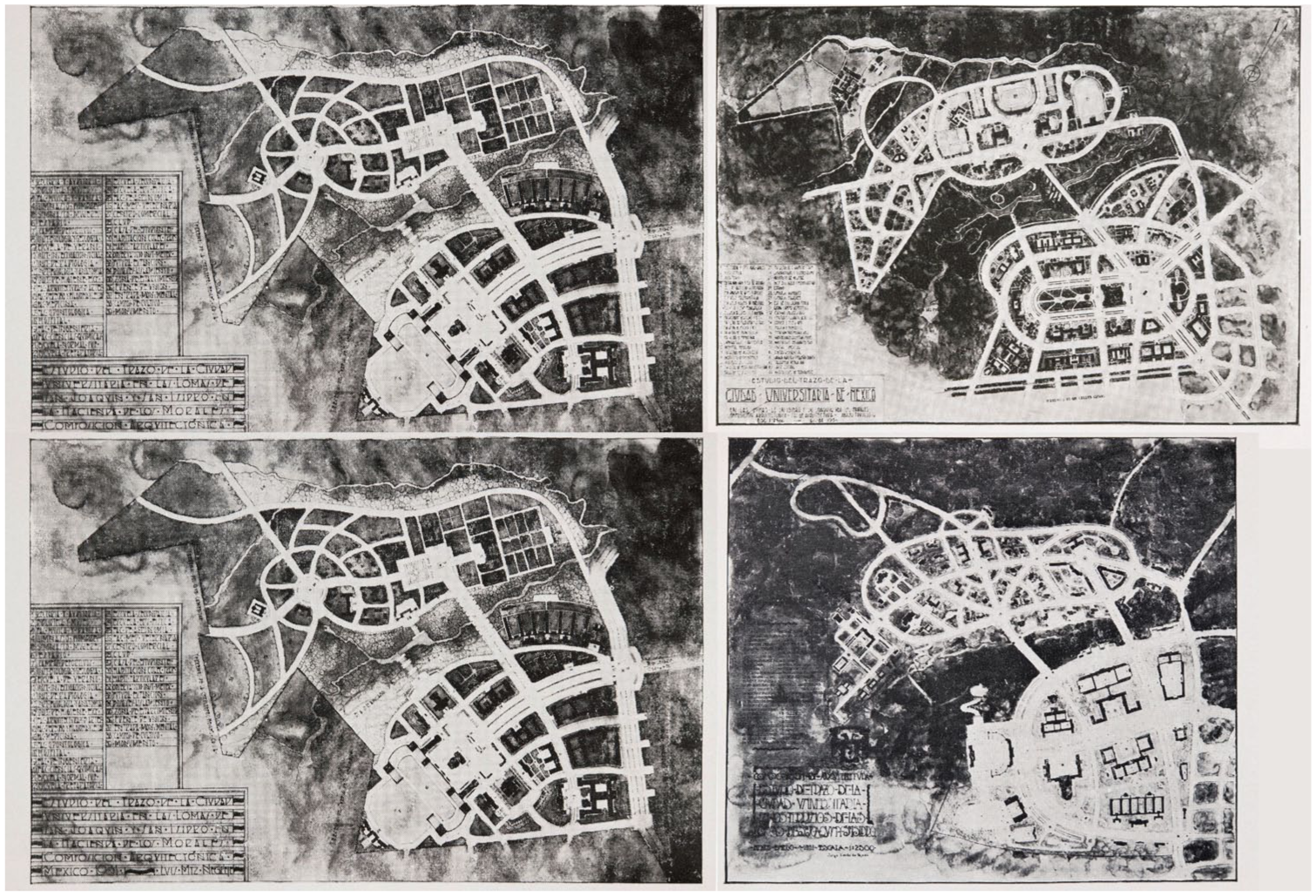
These four student designs for Ciudad Universitaria by José Lerdo de Tejada, Luis Martínez Negrete, Luis Quintanar, and Adolfo Trujillo won a competition at the architecture school in April 1931.
Despite the fundraising efforts of the Pro-Ciudad Universitaria Committee, Ciudad Universitaria would not come to fruition at the Tecamachalco site. When it came time for Congress to approve a large budget to build the campus, debates about educational priorities and the university’s usefulness to the revolutionary state resurfaced. As one deputy described the investments in education, “we have wanted to start with the roof and have neglected the base, the foundations.” 60 He advocated to devote the CU funds to primary education, school supplies, books, and teacher’s salaries, and many of his colleagues agreed. The university had no choice but to sell the Tecamachalco property in 1937, the same year that President Lázaro Cárdenas founded a technical, vocational institution, an alternative in public higher education called the National Polytechnic Institute (IPN) and began to construct its campus on a former hacienda known as the Casco de San Tomás.
IPN was a contrast to UNAM from the start: it emphasized professional education for students in engineering, the sciences, and technology, did not offer education in the humanities or law, and aimed to aid in the government’s developmentalist economic policy. Members of the Chamber of Deputies called IPN “the pride of revolutionary Mexico,” casting it as a revolutionary alternative to the national university that many saw as increasingly reactionary and opposed to the ruling National Revolutionary Party. 61 The timing of IPN’s founding and the construction of its campus indicate a decision on the part of the government to invest in a technical alternative to UNAM at a moment of deep ambivalence about the uses of the national university. The rapid construction of facilities for IPN, led by co-founder Juan de Dios Bátiz Paredes, revealed what was possible with political will, state funding, and executive support, highlighting the political nature of the delays in the CU project. IPN’s site shared many attributes with the Ciudad Universitaria drafts, including a central, broad, tree-lined esplanade, park-like pedestrian walkways, and ample athletic facilities (see Figure 4). However, as a technical institute, the IPN design integrated more spare, rationalist architectural concepts, reflecting a focus on practicality. The campus embodied the new institution’s motto: “Technical Knowledge in the Service of the Fatherland.”
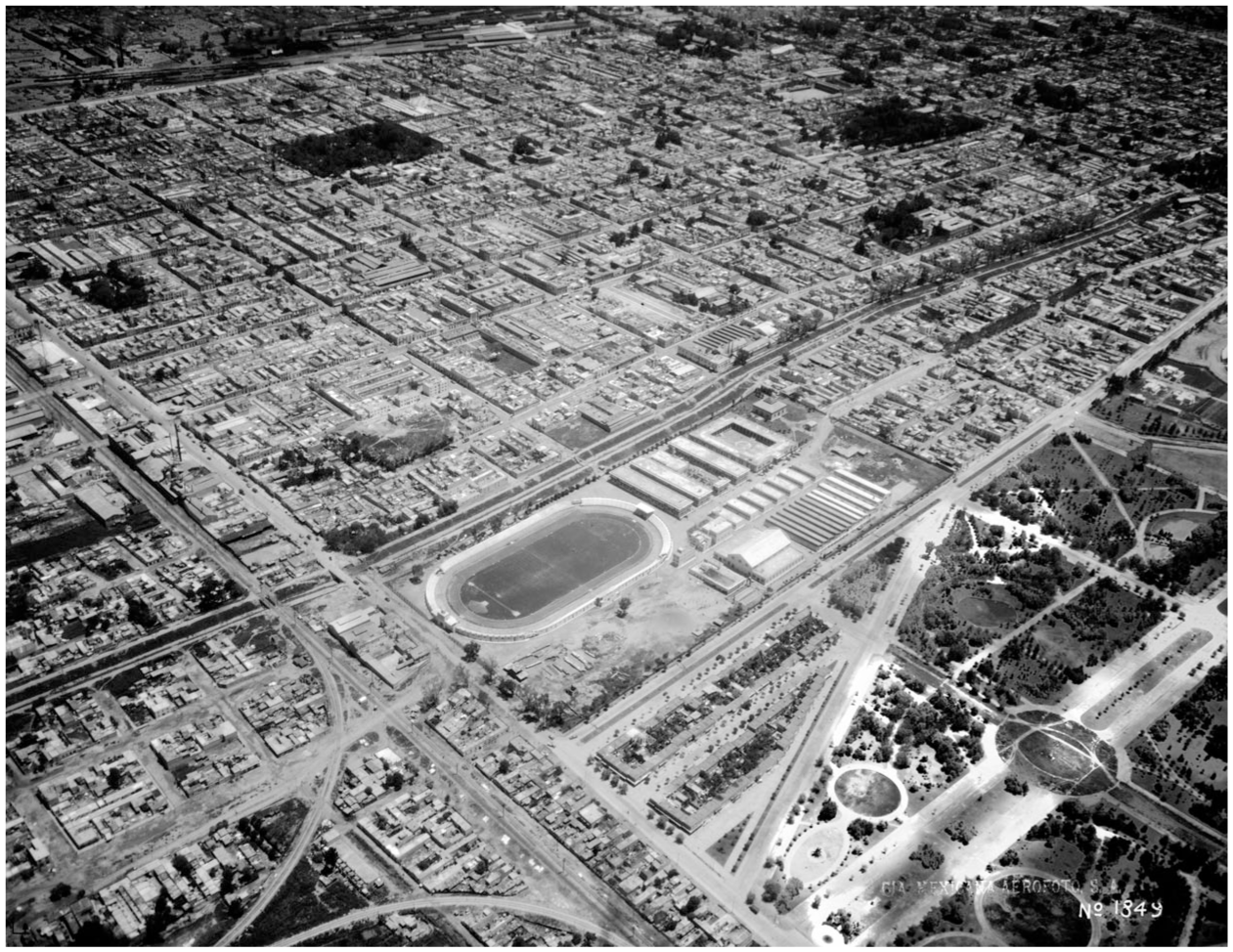
Aerial photograph of the National Polytechnic Institute (IPN) on the site of a former hacienda at the Casco de San Tomás (1940).
Over the next five years, there was little movement on the Ciudad Universitaria project for UNAM, and the university verged on bankruptcy. The idea did not reemerge until 1942, when newly elected rector Rodulfo Brito Foucher created a commission to reopen the proposal with Contreras and other major urbanists and architects. Brito Foucher was an UNAM-trained lawyer and an outspoken conservative and opponent of Mexico’s revolutionary government, especially the left-leaning, secularizing government of Cárdenas. He had only recently returned from conducting “studies of National Socialism” in Germany and had expressed sympathies for Adolf Hitler and Francisco Franco. 62 He shocked many when he publicly declared that Mexico should have continued under Spanish rule and that the heroes of Independence were simply “the initiators of a lie.” 63 Nominated for rector by a student federation of Catholic activists, his election signaled a significant shift to the right in university leadership that mirrored a parallel rightward turn in Mexico’s federal government under President Manuel Ávila Camacho (1940-46). During this rightward shift, tensions between the party’s increasing urbanizing goals and its rhetoric about agrarian concerns—by then mostly rhetoric—were put on display when, in 1946, the state expropriated 733 hectares of ejido land in Pedregal to build the university, leveraging its own incipient agrarian reform system to acquire the land at low cost. 64
While topography students measured the site, Brito Foucher’s commission drew up plans and proposals to present to Ávila Camacho. One of these, drawn up in 1942, bore striking resemblance to the campus where Brito Foucher and Contreras spent the late 1920s, Columbia University. In this draft proposal, buildings of monumental scale line a primary esplanade with axial streets dotted with rotundas containing obelisks in the Beaux-Arts style (see Figure 5). The dome and Greek-cross ground plan on the largest central building, as in Contreras’ earlier design, closely resembled the Greek revival style of Columbia’s Low Library built in 1895. 65 Surrounding buildings feature neoclassical colonnades in the style of newer buildings at Columbia such as Butler Library, built in 1934 not long before these plans were made. An athletic complex with a prominent baseball diamond, Greek-style amphitheater, a field, and a track is featured prominently. 66 The grand central esplanade and rotunda reflected the older influences of the University of Virginia’s innovative campus design. The observatory, surrounded by a garden, fulfilled the promise of modern scientific instruments mentioned by students in the Revista de la Universidad de México back in 1929. Despite the urban grid, the plan also integrated the natural landscape in its design, with the volcanic rock landscape of the selected site in Pedregal visible around the edges. 67 By this period, modernist architects such as Juan O’Gorman, Mario Pani, and Luis Barragán had begun utilizing such rock and other local materials in construction, striking a balance between Corbusian modernism, arts and crafts style, and a material connection to Mexicanidad. Given Brito Foucher’s conservative ideology, fascist sympathies, and preference for European forms, it is not surprising that the imagined Ciudad Universitaria under his leadership returned to earlier, neoclassical U.S. models and ignored the Mexican modernist style and Ibero-American ciudad universitaria model that some architects were already adopting. This was a conservative response against the consolidation of architectural Mexicanidad.
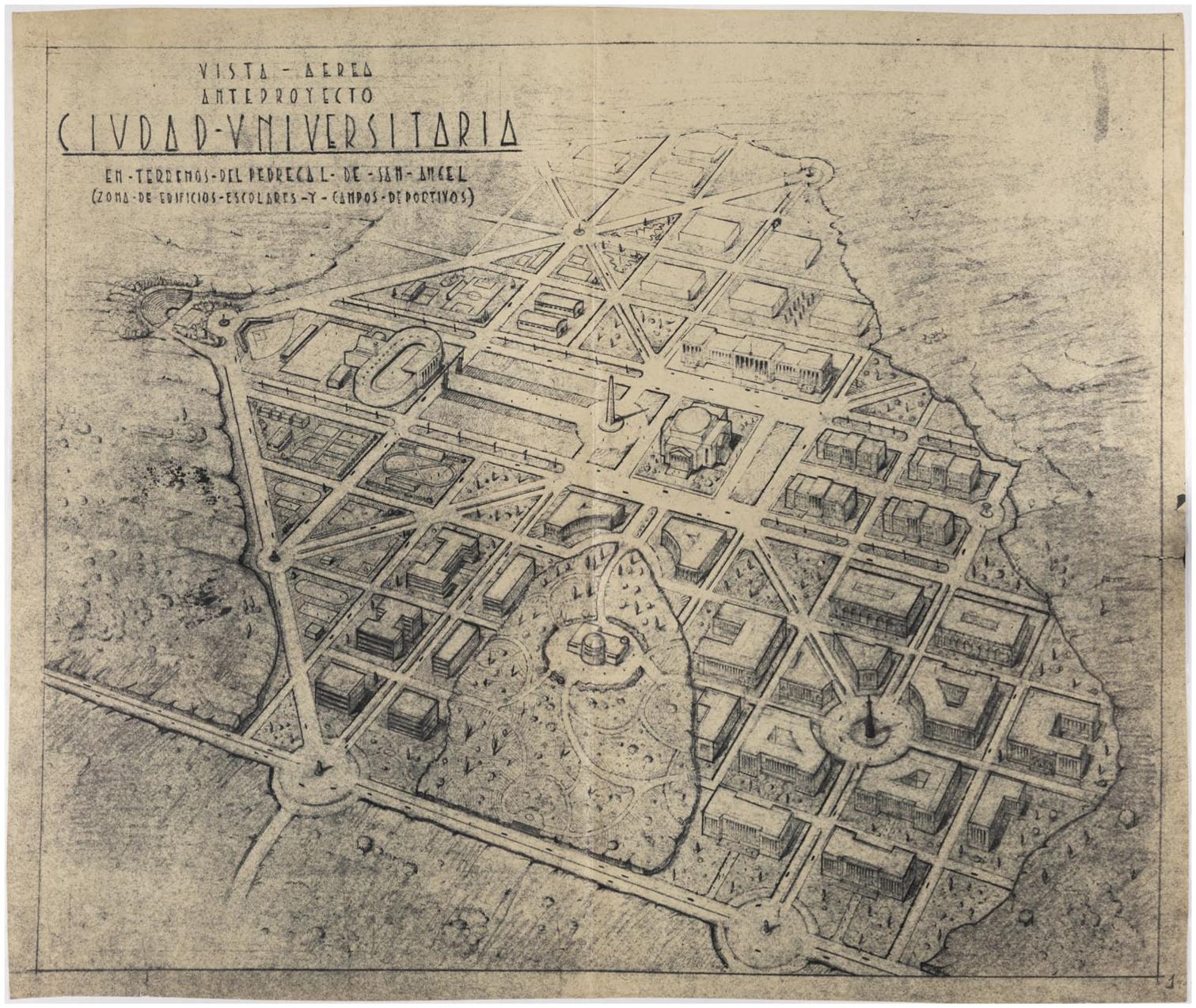
“Aerial view of proposal for Ciudad Universitaria on the Pedregal de San Ángel lands” (1942).
The archive of unbuilt plans for Ciudad Universitaria from 1928 to 1942 traces an arc of changing urban planning models, continuities from before the revolution, and the training of a new cohort of planners at the university itself. Although several of the plans reference Beaux-Arts styles, the urbanism landscape changed so much in both Mexico and across the globe during these years that, by the 1940s, the same style carried a much more classical, old-fashioned valance. During this period, UNAM planners and students experimented with plans based on various global movements, sharing the goals of other ciudades universitarias but more often drawing upon European and U.S. planning paradigms, at odds with the postrevolutionary state’s rhetorical mandate to eschew mimetic design. By imagining Ciudad Universitaria in these formats, these varied authors created a body of work against which Mexican modernists could formulate a response once the project received the necessary funding and state commitment to move forward.
Conclusion
“There will be a Ciudad Universitaria!” exclaimed headlines in December 1943 when the federal government approved UNAM’s proposal to expropriate the Pedregal land. 68 The time had come to select a final draft of the Ciudad Universitaria plans, this time through a national architectural competition that would award the project to Mexican modernists Enrique del Moral and Mario Pani as head architects. With collaboration from architectural teams made up of hundreds of colleagues, students, and former students—including Campos, one of the student co-authors of the first proposal in 1928—del Moral and Pani materialized a vision for UNAM’s campus from within the university itself. Integrating high modernist styles with functionalism and plastic integration, they built upon the influences of ciudades universitarias, campuses, and the urban planning trends of the previous decades.
Imagining Ciudad Universitaria took place over crucial years of consolidation of both the postrevolutionary state and a national cultural identity defined by Mexicanidad. By the time the state was ready to move forward on the Ciudad Universitaria project, both university and state had undergone deep transformations. The postrevolutionary state had institutionalized its one-party rule in the Institutional Revolutionary Party (PRI) and, after a new Organic Law passed in 1945, the university became more united with the party than ever before and benefited from unprecedented federal funding. State and university interests had aligned around a monumental building project that would buttress developmentalist economic policy and place the national university at the center of national public life. Following World War II, Mexico benefited from an export boom as a supplier of raw materials, which funded public infrastructure and contributed to the economic boom known as the Mexican Miracle, building up the country’s middle classes but doing little to address vast economic inequalities. For the ruling party’s growing middle class political base, sending their children to study at Ciudad Universitaria was the fulfillment of long held promise of the postrevolutionary government.
Since its construction, Ciudad Universitaria has been hyper visible in international architectural magazines as an emblem of modern Mexico, a model of Latin American ciudades universitarias, and, since 2007, a UNESCO World Heritage Site. Analyzing the project’s long incubation period and situating it in a lineage of other ciudades universitarias reminds us of the limits of planning and shows how political disruptions have shaped the built environments of Latin American capital cities. This open moment in Mexican urban planning and architecture—when the remnants of influences and planners from before the revolution remained and a new revolutionary nationalist aesthetic of Mexicanidad had yet to amalgamate—illuminates the continuities from before to after the revolution and the search for new styles in the postrevolutionary period. It reveals the global models and hybrid ideas that the planners of CU were responding to and shows how delays from one historical moment to another can be unexpectedly generative of new urbanist forms. The unbuilt drafts of Ciudad Universitaria, so different from the modernist complex that was eventually built, reveal an archive of influences, ideas, and responses that remain mostly hidden from view at the site today.
Footnotes
Acknowledgements
The author would like to thank Ernesto Capello, Josh Savala, and the other authors in this special section for their editorial feedback and generative discussions about Latin American capital cities. She is grateful to Debbie Sharnak, Stephen Hague, Emily Blanck, and Jennifer Rich for their detailed comments on earlier drafts of this article. She especially wishes to thank Anna Bierbrauer and Julia Dauer for their intellectual engagement and support.
Declaration of Conflicting Interests
The author declared no potential conflicts of interest with respect to the research, authorship, and/or publication of this article.
Funding
The author disclosed receipt of the following financial support for the research, authorship, and/or publication of this article: The research presented in this article was supported by funding from the Department of History and Program in Latin American Studies at Princeton University, the Roy Rosenzweig Center for History and New Media and the Department of History and Art History at George Mason University, and the Ric Edelman College of Communication, Humanities, and Social Sciences at Rowan University.
