



Abstract
Marketplaces known as “swap meets” boomed in Greater Los Angeles during the 1980s and 1990s, serving as early sites for the production and distribution of a variant of West Coast hip-hop known as “gangsta rap.” This article examines relationships between Asian American swap meet entrepreneurs and the genre’s emerging musical and visual artists. Case studies at the Roadium, Compton, and Slauson swap meets show how Asian American vendors collaborated with underground DJs and rappers including Dr. Dre, Tony A., Hi-C, and DJ Quik at early stages in their careers. Then, it demonstrates the central role of Korean-operated swap meet businesses in defining hip-hop fashions. By analyzing these semi-formal commercial spaces in a globalizing metropolis, this article reveals a hidden history of West Coast hip-hop’s polyphonous social and racial roots.
In December of 2014, hundreds of longtime vendors at the Compton Fashion Center (known locally as the Compton Swap Meet) were notified that their workplace had been sold to Walmart and that they would need to vacate their booths within thirty days. “Close Out Sale” banners unceremoniously appeared on the building’s façade as hundreds of Asian and Latinx vendors scrambled to sell their inventories at cut rate prices. One vendor lamented that she was instructed to clean and vacate her space with “not even a thank you” after over two decades in business. 1
The closure reverberated across Los Angeles’s Asian, Latinx, and Black communities because it marked the demise of one of the region’s first—and largest—indoor swap meets. The multitenant marketplace, which Korean investors opened inside a repurposed Sears department store in 1985, incorporated aspects of Korean textile markets and Latin American mercados. It housed roughly 500 vendors in ten-foot by ten-foot booths, and its lucrative formula of high retail rents per square foot helped popularize the conversion of over 100 supermarkets, department stores, and warehouses across Greater Los Angeles into indoor swap meets by 1991 (Figure 1). 2 Nearly all were located in low-income, predominantly African American, Asian, and Latinx neighborhoods, and most were under Korean ownership, with sociologist Pyong Gap Min estimating in 1993 that 80 percent of swap meet vendors were Korean. 3 As one of the first such markets in this Korean economic niche, the Compton Fashion Center was a significant site for Asian-American immigrants because it offered them an affordable pathway to small business ownership.
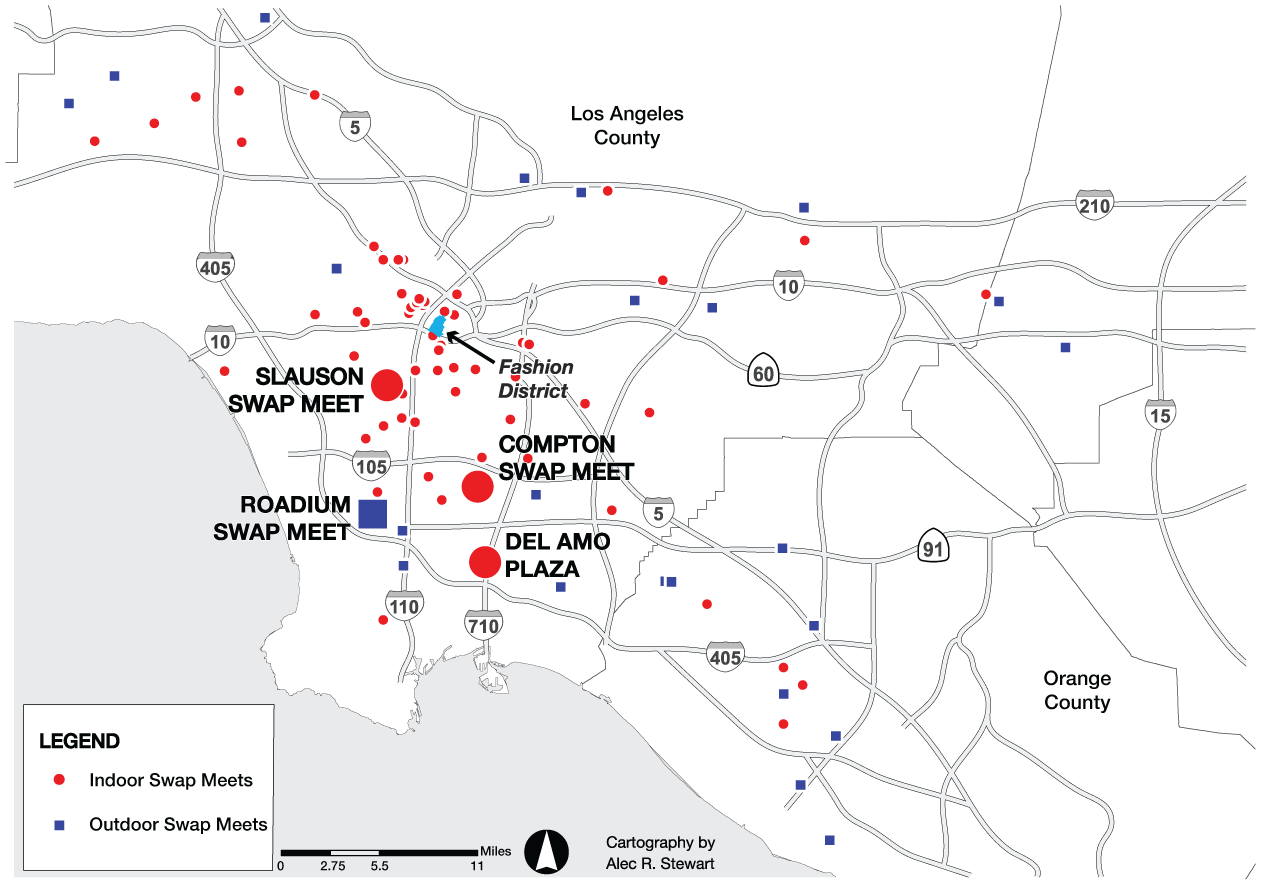
Map of indoor and outdoor swap meets in Greater Los Angeles, c. 1990.
At the same time, the swap meet’s closure marked the erasure of a Black and Brown social arena. In 2014, one shopper called it “the holy grail of the hood,” as well as “the former stomping ground for some of your favorite rappers… and current stomping ground for some of your future favorites. 4 Another noted that it “literally has everything you need/want in life: clothes, shoes, underwear, food, makeup, hair salon[s], jewelry, grillz [gold dental prosthetics], etc. and everything is so cheap.” 5 For shoppers in a city with few retail chains, the Compton Swap Meet was an affordable oasis in a retail desert and a gathering place that helped define the neighborhood’s material culture.
In addition to its vast inventory and diverse vendors, the market’s social status was affirmed by a rich folklore within the hip-hop movement. In 2015, for example, acclaimed rap artist Kendrick Lamar referenced the marketplace twice on his studio album, To Pimp a Butterfly. In a critique of the US government’s centuries-long exploitation of Black Americans, he rapped that he would “put the Compton Swap Meet by the White House.” 6 And in “King Kunta,” the album’s third track and its second-most-watched music video on YouTube, he rapped about his hometown roots and songwriting prowess while dancing on the Compton Swap Meet’s roof and in its parking lot. 7 The market’s starring role in Lamar’s music reflected its centrality to his life and career. He mentioned swap meets in fourteen earlier songs because, as he remarked in 2012, “I’ve been going to the swap meet my whole life . . .. As a kid, that’s where I used to get all my cassettes, all my CDs. My pops, too—he’d buy music. I’d get my Nikes there.” 8
These representations of a shuttered marketplace may seem merely aesthetic or incidental, but they point to a much deeper and intertwined relationship between swap meets and West Coast hip-hop’s genesis. A survey of the song lyrics database, Genius.com, reveals that 337 rappers have referenced swap meets in the lyrics to 463 songs and music videos between 1985 and 2024, with the number continuing to grow each year (Figure 2). Although indoor swap meets opened in other cities including Atlanta, Chicago, Dallas, Las Vegas, New York, and Seattle, Los Angeles had the largest number of the markets because of its garment industry, which was (and still is) the nation’s largest. 9 This meant that of the swap meets called out by name, the Compton Swap Meet was the most frequently invoked (on thirty-three recordings), followed by other notable marketplaces across South Los Angeles’s neighborhoods and municipalities such as the Roadium, Slauson, Inglewood, and Del Amo swap meets. 10
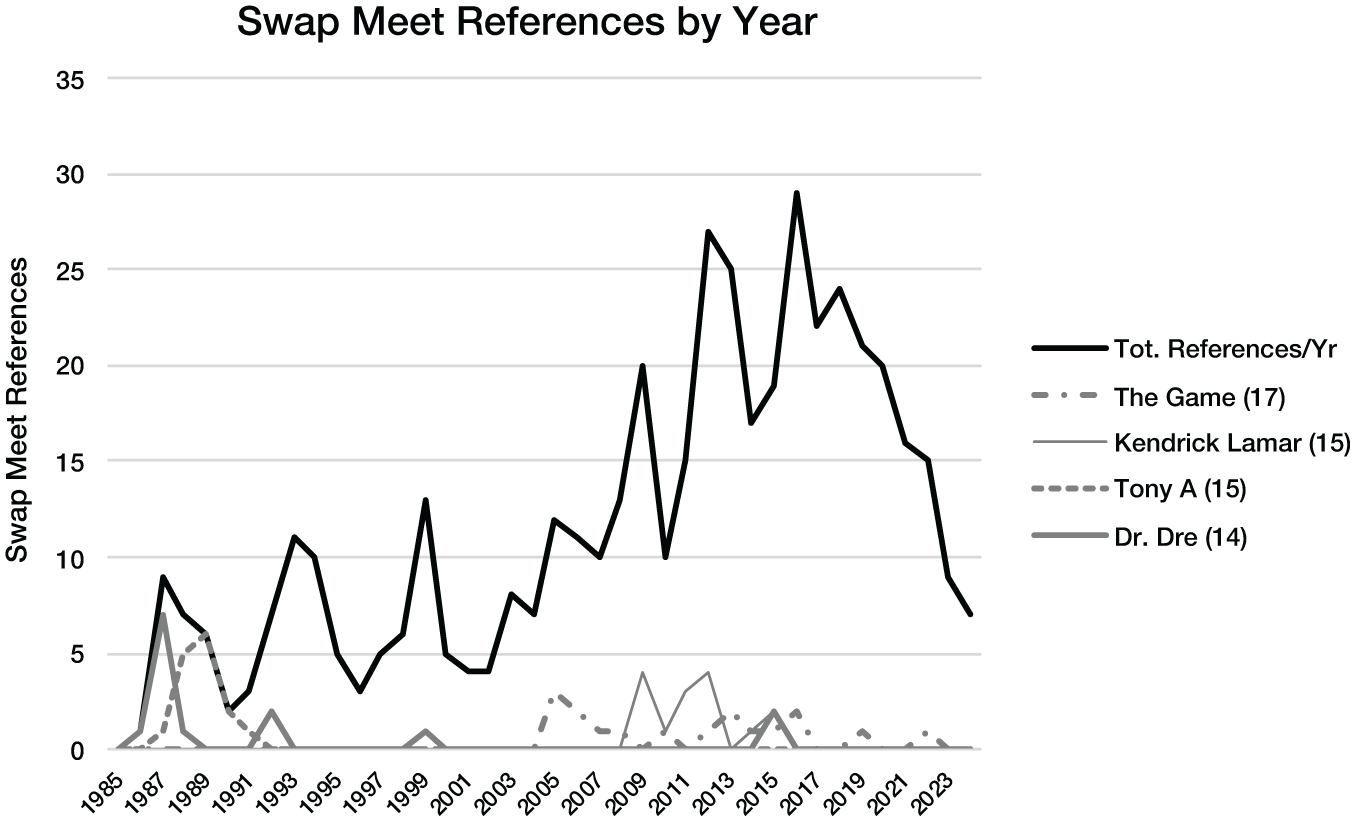
Swap meet references within rap lyrics, 1985-2024. N = 463. Table by author.
As an eight-year-old, Lamar watched hip-hop legends Tupac Shakur and Dr. Dre film a music video at the swap meet, remembering on a 2009 mixtape that “Pac was on Rosecrans” Avenue and “I was right there.” 11 The 1996 video Lamar referenced—a remixed version of Dr. Dre and Tupac Shakur’s hit single, “California Love”—broadcasted the market’s significance as an iconic hip-hop site. It began with a phone conversation between the two rappers about where to meet before a party. Speaking from his luxurious bedroom, Tupac instructed Dre to “meet me at the Compton Swap meet, [because] I’ve gotta get some gear.” Dre protested, but Tupac insisted that he “just meet me at the swap meet.” 12 Depictions of the duo walking through the market’s parking lot and cruising the streets of South Los Angeles in a Mercedes convertible informed viewers that the market was a social hub for all members of the hip-hop community, regardless of their social class.
By discursively and visually claiming the Compton Swap Meet in their raps and videos, Lamar, Tupac, and Dre associated themselves with the origins of West Coast hip-hop and its hyper-realist variant of “gangsta rap,” both of which emerged in Los Angeles in the 1980s. Addressing the literal and structural violence of racialized policing, disinvestment, and racial inequities through its vivid representations of street hustlers and gangsters, the latter articulated a vision of street justice from the perspective of disenfranchised young Black and Brown men. 13 Dre and several of his friends were key figures in the development and distribution of this new genre at South Los Angeles swap meets during the mid-1980s. Like hundreds of other rappers, their lyrics and videos highlight the markets’ importance in this origin story, as well as their influence on West Coast hip-hop’s aesthetics more broadly. By reifying the marketplaces as iconic hip-hop sites, rappers have placed them on equal footing with another urban space associated with hip-hop’s rise: the Bronx apartment towers where Jamaican DJ Kool Herc, Grandmaster Flash, and Afrika Bambaataa developed the foundational DJ’ing techniques of sampling, mixing, cutting, looping, and scratching audio fragments into hip-hop tracks during the 1970s. 14 Just as historians have sanctified the first floor recreation room at 1520 Sedgwick Avenue as “the birthplace of hip-hop,” swap meets are regarded by fans and music writers as birthplaces of West Coast hip-hop and gangsta rap. 15
This folklore of the swap meet, a folklore that centers the experiences and perspectives of hip-hop artists and fans, overlaps with broader histories of Asian American entrepreneurship. This article examines these overlaps, specifically in the unlikely exchanges between Asian American swap meet vendors and the first West Coast gangsta rap artists. Despite hip-hop and gangsta rap’s association with Black communities, the art form emerged out of and has been continually sustained by a multitude of marginalized groups. Anthropologist Maurice Rafael Magaña, for example, has observed that hip-hop lyrics, music videos, and murals reveal a rich mutuality between Black and Latinx youth that challenged Black/white racial binaries. 16 I contend that Asian American swap meet vendors further complicated these binaries by acting as distributors, producers, and mentors for emerging rappers and DJs within the intimate spaces of their booths. In doing so, Asian American swap meet vendors brokered the formation of West Coast hip-hop music and fashion by circumventing the racism and social conservatism of mainstream society during the 1980s and 1990s. These solidarities unfolded within an urban landscape shaped by acts of grassroots city building. While Asian swap meet vendors left their mark on the city through the real estate they managed and the merchandise they sold, hip-hop artists and fans claimed the markets through spatial occupations and lyrical appropriations. These claims to space were made in an environment that denied many Black and Brown youth access to the rights and financial security of full citizenship. Gaye Theresa Johnson has detailed how—during the 1950s—similarly disenfranchised groups asserted their social citizenship through “spatial entitlements,” appropriations of urban spaces through musical performances and R&B lyrics. In doing so, Johnson contends, R&B performers and fans created new arenas for congregation and interracial discourse, which African Americans and Latinos used to articulate their visions of a more egalitarian city. 17 Hip-hop artists employed swap meets for similar purposes, using their physical and social infrastructures to launch their careers while invoking the markets to demand respect for the dignity of those residing in ghettoized neighborhoods. Meanwhile, the markets’ material culture announced hip-hop’s presence in the city, “marking” it with graphic t-shirts, grills, musical recordings, car sound systems, and other merchandise sold from Asian-owned booths. By fostering both the production and dissemination of material and musical cultures, Asian Americans participated in the nascent hip-hop movement via “moments of cultural exchange” with Latinx and Black vendors and shoppers. 18
In the first half of the article, two case studies—at the Roadium (outdoor) swap meet and the Compton (indoor) swap meet, illustrate how two Asian American-operated record stores built physical and social infrastructures that supported the production and distribution of early West Coast gangsta rap recordings. In the article’s second half, I examine how Korean American–operated swap meet clothing and jewelry businesses at the Slauson Swap Meet articulated both the lower and upper echelons of hip-hop fashions. While these musical and material partnerships were not without conflict, they reveal how immigration and economic restructuring shaped early West Coast hip-hop music and fashion, while some rap lyrics and fashions critiqued those same globalizing forces.
As a shopper and participant observer, I spent many hours browsing swap meet aisles between 2014 and 2019, visiting 47 of Greater Los Angeles’s 70 then-extant indoor swap meets and 15 of 26 extant outdoor swap meets. Conversations with vendors about their merchandise familiarized me with the material world of these two types of markets, while semi-structured interviews gave me a richer sense of their vendors’ experiences. A review of Los Angeles telephone books was particularly useful in constructing a chronology of swap meet openings and closures between 1983 and the mid-1990s, as were business review websites like Yelp and Google Maps. Above all, keyword searches in the lyrics database, Genius.com, helped me construct an archive of rap lyrics referencing the swap meet economy. Following Kelly Lytle Hernández, I treat these lyrics as a “rebel archive” that reveals how a business type both shaped and reflected the rise of West Coast Hip-hop. 19
Swap meets—and the retail built environment more broadly—were far more than backdrops for the development of a purportedly “Black” musical genre. As geographer Ed Soja has observed, they also convened people of vastly different backgrounds and class positions, acting as “conflictual edges . . . where different cultural worlds frequently collide in struggles to maintain cultural identity and cohesion.” 20 By facilitating meetings between Black, Latinx, and Asian vendors and shoppers, swap meets were generative spaces that fostered critical negotiations and solidarities across racial lines.
Conflict and Solidarity within Multiethnic Retail Landscapes
These negotiations and solidarities unfolded amid a rapid reordering of Greater Los Angeles’s demographic and commercial landscapes. Cold War conflicts and the passage of the Hart-Cellar Immigration and Nationality Act of 1965 contributed to mass immigration from Latin America and Asia. The region’s Korean-born population, which doubled between 1980 and 1990, supported a growing agglomeration of Korean-serving banks and businesses near the intersection of Wilshire Boulevard and Western Avenue, where Korean real estate investors, bankers, and journalists promoted a new Koreatown. 21 As historian Shelley Sang-Hee Lee has shown, these “place entrepreneurs” envisioned the neighborhood as a social anchor for the region’s Korean communities. 22 At the same time, Korean community leaders also developed an economic ecosystem of garment factories and wholesalers in the Fashion District south of Downtown, as well as a constellation of grocery stores, liquor stores, gas stations, swap meets and other retail businesses in the predominantly Black and Latinx neighborhoods of South Los Angeles. Lee observes that while “Koreans sought to prove their worthiness, distinguish themselves, and build political capital” by developing Koreatown “into a monoethnic bastion of commerce and tourism,” they viewed South Los Angeles as “simply a place to work, make money, and invest minimally.” 23
The business opportunities Korean entrepreneurs encountered in South Los Angeles emerged out of an urban landscape ravaged by the early effects of globalization and economic restructuring. Between the 1965 Watts Rebellion and the early 1990s, over 300 manufacturing plants as well as numerous department stores and large floorplate retailers closed in Los Angeles’s inner suburbs. 24 It was during this period that South Los Angeles’s Black, Japanese, and Jewish merchants began to sell their small businesses to Koreans. 25 By 1992, the Hankook Ilbo, a Korean language newspaper published in Los Angeles, estimated that 80 percent of South Los Angeles businesses were Korean-owned, including at least twenty swap meets and hundreds of gas stations, grocery stores, dry cleaners, and beauty supply shops. 26
In a neighborhood reeling from the loss of unionized manufacturing and retail jobs, this overrepresentation of Korean merchants set the stage for a series of conflicts between Black shoppers and Korean proprietors. Allegations of rude and discriminatory customer service in Korean-owned stores circulated in the pages of the Black-owned Los Angeles Sentinel, culminating in the boycotts of a series of swap meets and grocery/liquor stores in the late-1980s. Meanwhile, frequent robberies and assaults, combined with the murders of nineteen Korean merchants between 1988 and 1991, fueled resentment and fear amongst Korean store owners and employees toward Black customers. 27 In March of 1991, the Korean owner of the Empire Liquor Market murdered Latasha Harlins in a conflict over a bottle of orange juice, sparking further protest and outrage. 28 These tensions boiled over on April 29, 1992, when the acquittal of the four white police officers who were videotaped brutally beating Rodney King sparked five days of urban unrest. In the Los Angeles Rebellion, 63 people were killed and 2,280 Korean-owned businesses were damaged or destroyed, including businesses at thirty indoor swap meets, the most impacted retail category. 29
A considerable literature has identified several contributing factors to the unrest: cultural differences between shoppers and merchants, sensationalized media portrayals of ethnic tensions, the inability of political institutions to mitigate those tensions, and racial inequities. 30 Sociologist Pyong Gap Min, for example, posited that Korean business owners were placed in a “middleman” position that forced them to negotiate between the demands of their “minority” customers and their (white-controlled) suppliers. 31 More recently, anthropologist Kyeyoung Park has adapted Claire Kim’s theory of “racial triangulation” to argue that a “multitiered racial cartography” of inequality affected how Koreans, African Americans, and Latinos interacted with one another before and after the uprising. 32
Alongside these conflictual narratives have been many instances of peaceful coexistence. Historian Mark Wild has shown, for example, that between 1900 and 1940, Los Angeles had many diverse neighborhoods where inter-ethnic relationships were the norm. Despite contemporaneous portrayals of the city as a segregated patchwork of racially homogenous neighborhoods, he documents considerable diversity within them, as well as interethnic solidarities between their working-class communities. 33 Following World War II, historian Luis Alvarez has similarly demonstrated that African Americans, Asian Americans, and Latinos seized on the production of jazz music, Civil Rights era art and poetry, and hip-hop music as opportunities to fight for the collective dignity of minoritized groups in the face of hegemonic power. 34 More recently, in her interviews with African American shoppers in Harlem and West Philadelphia, sociologist Jennifer Lee has found that counter to media narratives focusing on interracial conflicts, most interactions between Asian merchants and their Black customers were civil. 35 Within commercial, residential, and public spaces across various geographic contexts, Black and Brown city residents have repeatedly found ways to fashion new social spaces that subvert and reimagine dominant racial hierarchies. 36
Swap Meets as Hubs of Exchange and Reciprocity
In 1980s Los Angeles, one of these social spaces was the swap meet record store. Because hip-hop DJ’s assembled fragments of existing recordings into original tracks, they prized record stores that carried affordable selections of hip-hop, and hip-hop-adjacent records. 37 Underground and unsigned electrofunk, disco, and East Coast hip-hop recordings, were difficult, if not impossible to find in chain retailers because of their aversion to hip-hop’s subversive lyrics and self-produced recordings. Black-owned record stores like Long Beach’s VIP Records carried some of these in-demand recordings, but they were few in number. 38 For the latest sounds, DJ’s scoured the swap meets in Los Angeles’s low-income neighborhoods. The convenience of their booths made them social hubs where hip-hop fans hunted for records, rubbed elbows with up-and-coming artists, and watched DJ’s perform on turntables. By functioning as “loose spaces,” or sites appropriated for unintended uses, swap meet record stores were far more than mere consumption sites. 39 They were also contact zones that facilitated unlikely meetings and collaborations that strengthened the vitality and reach of the emerging West Coast hip-hop and “gangsta rap” genres.
The Roadium Mixtapes
Arguably the most influential record store in West Coast gangsta rap’s rise was operated by a Japanese American couple at the Roadium, an outdoor swap meet (or flea market) operating at a drive-in movie theater in the South Los Angeles suburb of Torrance (Figure 3). While college students, Steve and Susan Yano began selling records at outdoor swap meets for extra money, and swiftly realized the business was lucrative enough to be a full-time job. Catering to the swap meet’s predominantly Black and Latinx clientele, the Yanos specialized in the hip-hop and electrofunk genres that mainstream record stores were ignoring and refusing to stock. As Yano remembered in 2002, “there started to be this new type of talk—R&B, Grandmaster Flash, Kurtis Blow, Run-DMC . . .. Kids [were] talking about it,” but mainstream record retailers had “never heard of it.” 40
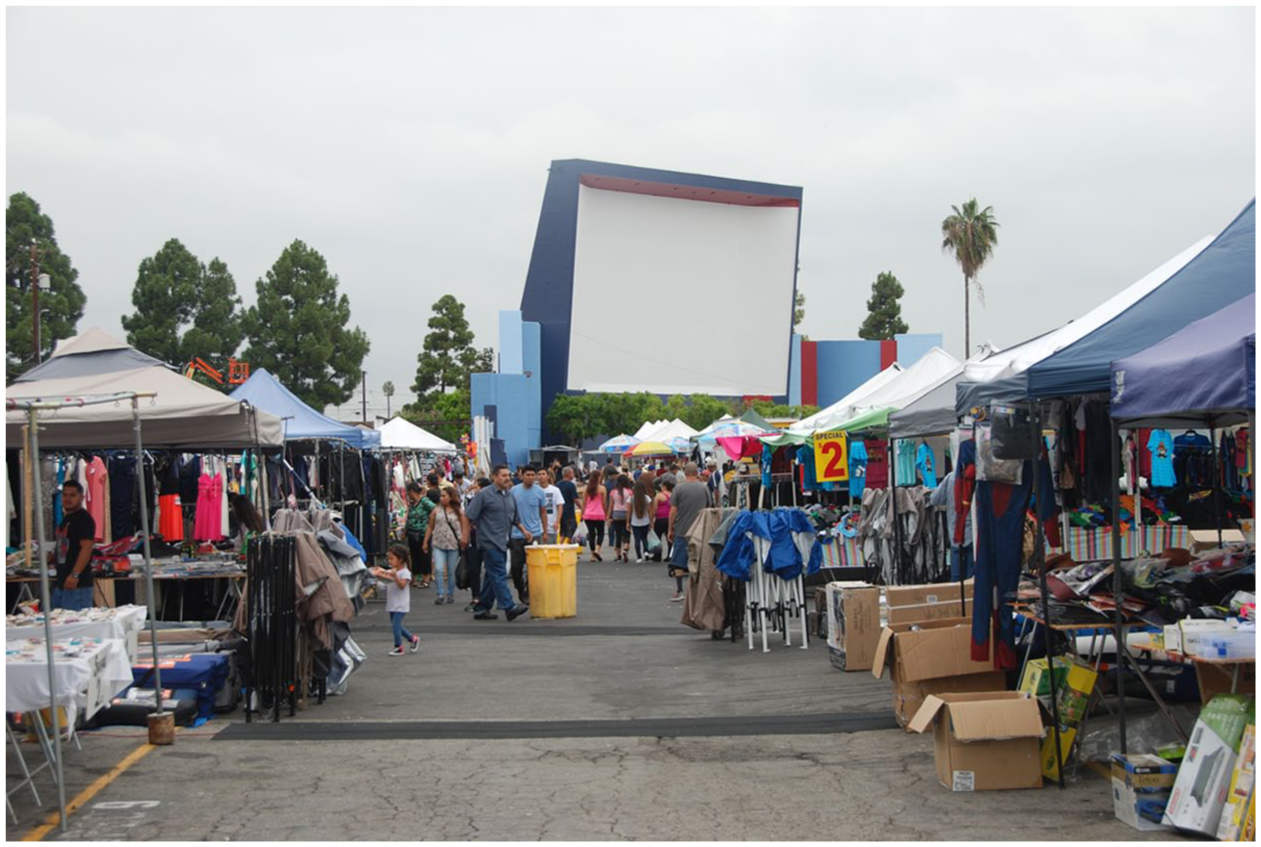
The Roadium Swap Meet in Torrance, California.
The Yanos’ record booth became a nerve center for the movement as they built a network of underground hip-hop artists and distributors who supplied them with hard-to-find titles. Like other outdoor swap meet booths, their store was defined by little more than a tent, tables, and pegboard walls upon which they displayed prominent titles (Figure 4). By playing selections from their stock on a sound system, the Yanos expanded the sonic dimensions of their booth, which enabled them to instantly gauge the popularity of new releases. When new records arrived, Steve Yano recalled that they “could tell the first weekend if something is going to sell just by how the kids react[ed].” For a while, Yano remembers, “I become [sic] a very important guy. I’m buying 500 copies of a title. The first place anybody called in L.A. was me. ‘Play this. Whattya think?’ All these label guys are starting to bring me their new records.” 41
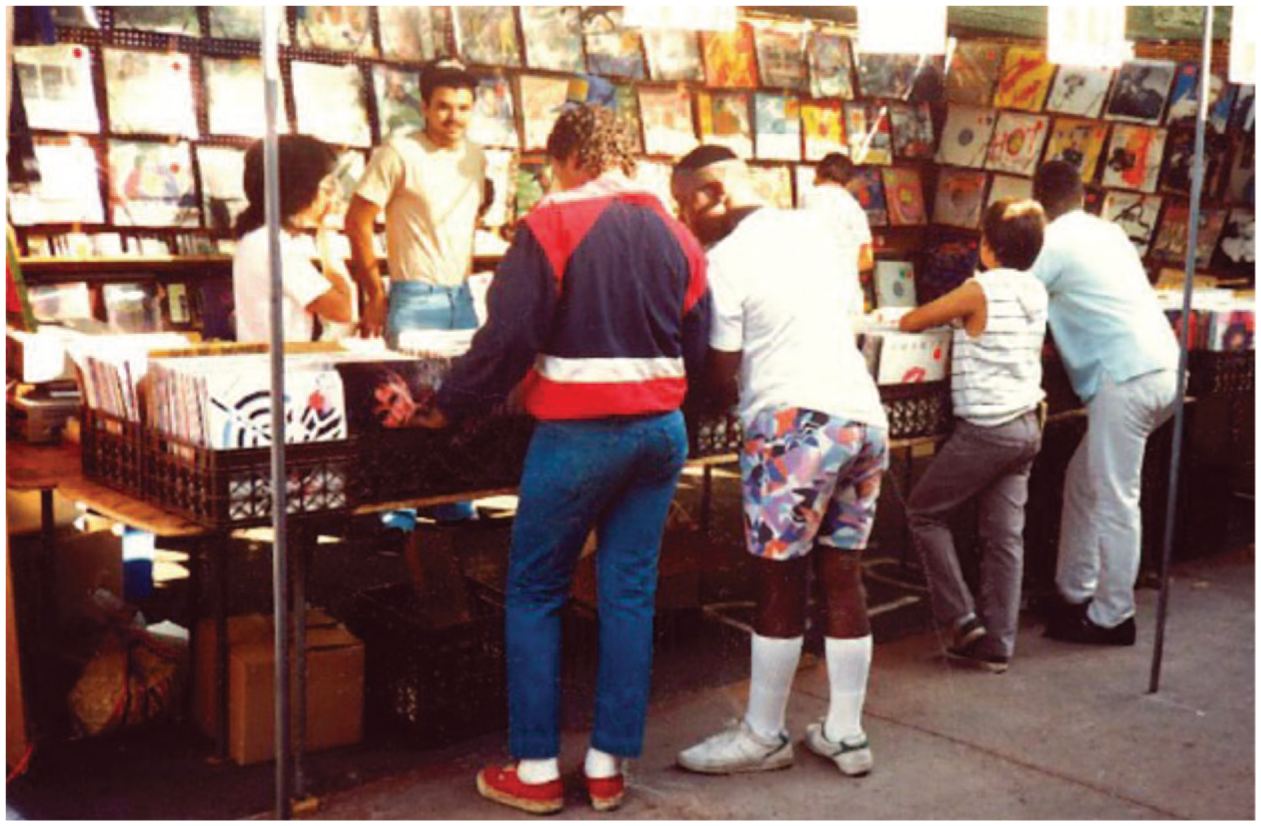
Yano’s Roadium Swap Meet booth.
Meanwhile, the Yanos provided a stage for emerging hip-hop talent by inviting DJs to perform on their turntables. “At the end of the day,” Yano recalled before his death, “I’d put the pegboard [on the ground,] over to the shiny side . . .. [A] DJ scratches, and then these kids would come out and they’d start break dancing.” 43 Complementing the turntables and break dancers were airbrush artists, who Yano invited to make custom t-shirts at the rear of his booth. Among these artists were Artie T. and Mark Machado—now known as Mr. Cartoon—who is famous for his Chicano-themed representations of the afterlife. 44 By convening musical, performance, and visual artists at his booth, the Yanos created a dynamic public space that united the “four elements of hip-hop”—DJing, rapping, break dancing, and graffiti writing. In addition to convening the Afro-diasporic and Chicano vernaculars that made West Coast hip-hop distinct from its East Coast counterpart, they also established a space that allowed artists and record producers to sharpen their voices through conversations with their listeners.
In 1985, while visiting the club of his hip-hop producer friend Lonzo Williams, Yano met DJ’s Dr. Dre and DJ Yella while they were producing a mix for Los Angeles’s first all-hip-hop radio station. 45 Impressed by their abilities on the drum machine, turntables, and mixer, Yano asked them to record custom mixtapes for sale at his Roadium record booth. Between 1984 and 1987, Dre, Yella, and Yano collaborated on bootleg mixes that featured popular hip-hop hits united by the duo’s original scratching and beats.
A “mega mix” on the first few minutes of each tape also featured original rapping by Dre and Yella, who made highly specific references to their everyday surroundings. Their rapped introductions called out important sites and people in the hip-hop community, including the Roadium Swap Meet and figures like Steve Yano and Artie T. On a mixtape titled ’86 in the Mix, Yella begins Side B by asking, “Hey, yo Steve, you got a level? Artie, you ready to go off? Well, check it out. Right about now, Dr. Dre is on the wheels and I’m about to cold tear shit up.” 46 Similar introductions established a pattern of reporting on the quotidian realities of the hood, a pattern for which Yella and Dre would become famous in their later studio recordings. Rapper Chuck D. later compared this style of hyper local street reporting to “a CNN that Black kids never had.” 47
By distributing Dr. Dre and DJ Yella’s first hip-hop recordings, Steve Yano served as their de facto record label and promoter. By 1987, Dre and Yano had co-produced at least 40 mixtapes, on which Dre, Yella, and his friends developed new mixing, cutting, and rapping techniques. 48 Although the mixtapes were produced and sold by Yano, they traveled widely due to their pocket-sized dimensions (4 inch by 2.5 inches) and the zeal with which fans copied and re-sold them. One mixtape fan recalls that “basically people were dubbing the original Rodium [sic] tapes . . . and passing them off at other swap meets but with different (and lame) artwork.” 49 Thanks to an informal (and unauthorized) network of swap meets spanning the United States, Dr. Dre, DJ Yella, and their successors Artie T. and Tony A. swiftly enjoyed national visibility thanks to Yano’s mixtapes. 50
This visibility drew the attention of Eric Wright, a 22-year-old hip-hop enthusiast and aspiring record store owner who repeatedly asked Yano for a re-introduction to his former high school classmate. When Yano eventually relented, the duo asked for his help in starting a record label named Ruthless Records. 51 In 1987, the label released a single titled “Boyz-n-tha-Hood” under Wright’s stage name Eazy-E. Yano even helped market test Eazy’s three first songs at his booth before they were pressed onto a record. As DJ Tony A. recalled, Dre, Eazy, and Yella “asked him, ‘play [the recordings] and let us know what the crowd—the swap meet, you know, the underground—has to say.’” 52
The rest of the story is well-documented: “Boyz-n-tha-Hood” became a hit and Eazy-E, Dr. Dre, DJ Yella, MC Ren, and Ice Cube founded N.W.A. (Niggaz Wit Attitudes) later in 1987. The group’s platinum-certified second album, Straight Outta Compton (1988), focused international attention on the systemic racism and police brutality endemic to American cities. Its second track, “Fuck tha Police,” prompted the FBI to write a letter accusing N.W.A. of “encourag[ing] violence against and disrespect for the law enforcement officer.” 53 Widely credited for supercharging N.W.A.’s album sales, this letter inspired Dr. Dre to opine, “we’re like news reporters. We tell exactly what’s going on the streets. You know? That’s all it is. Street knowledge.” 54
And yet, many popular accounts of this origin story ignore the swap meet’s social complexity. The 2015 blockbuster film, Straight Outta Compton, which dramatizes the rise of N.W.A. and West Coast rappers Eazy-E, Dr. Dre, Ice Cube, and DJ Yella, completely edits out Dre and Eazy’s collaborative relationship with Yano. Instead, the film perpetuates a white-Black conflict narrative by focusing on N.W.A.’s contentious relationship with the Jewish co-founder of Ruthless Records, Jerry Heller. Also omitted from the film’s narrative is Chicano DJ Tony Alvarez, who under his stage name, Tony A., produced at least 30 additional mixtapes with Yano after Dr. Dre devoted his full energies to N.W.A. 55 In 1991, Tony A. and Yano were asked by the Walt Disney Company’s Hollywood Records to transform their mixtape recording of the underground rapper Hi-C into a studio album titled Skanless. Released by Yano’s record label Skanless Records later that year, the album was Hollywood Records’s first-ever hip-hop release. 56
The notion that a Japanese American swap meet vendor might possess a better sense of “the underground” than Eazy-E or Dr. Dre, even when that “underground” consisted of swap meet customers, unsettles histories that frame hip-hop’s emergence as a purely Afro-diasporic phenomenon. Hip-hop historians including Tricia Rose, Jeff Chang, and Murray Forman agree that hip-hop owes enormous debts to Jamaican reggae, but they rarely mention that reggae itself was shaped by Chinese-Jamaican merchants. 57 As Tao Leigh Goffe has argued, “Chiney shops,” Chinese-owned shops that sold the audio equipment on which reggae was initially developed in Jamaica, provided a social and economic “infrastructure” that facilitated the music’s development and distribution. 58 Partly because Chinese-Jamaican reggae pioneers were racialized as Jamaican, this Asian “infrastructure” has remained invisible. When histories of West Coast hip-hop leave the contributions of swap meets and their vendors on the sidelines, they similarly obscure South Los Angeles’s demographic complexity and the swap meet’s role in fostering moments of ethnoracial hybridization.
The Compton Swap Meet: Hub City’s Hip-Hop Hub
While Yano and Dre collaborated at the Roadium, the Compton Fashion Center helped initiate an indoor swap meet boom that eventually introduced semi-formal shopping emporiums to nearly every low-income community of color in Greater Los Angeles. 59 As the Compton Swap Meet’s Korean investors sought to lease its 500 booths in 1985, they recruited vendors at the Roadium, where they met Korean immigrants and hair accessory vendors Wan Joon and Boo Ja Kim. 60 The Kims had noticed the crowds at the Yanos’ record booth, and they envisioned running a similar business within the confines of an indoor marketplace that offered monthly rather than daily leases, sun protection, air conditioning, lockable storefronts, and 24 hour security. They secured a highly visible booth at the market’s main entrance for $500 per month, where they established Cycadelic Music Corner when the market opened later that year (Figure 5). 61 With the help of their English-speaking children, Kirk and Jinna, the Kims built a reputation for sourcing mixtapes and albums directly from emerging hip-hop artists. Kirk recalled in 2012 that “you [could] come, you [could] give my dad five, ten cassettes or vinyls, and he would put it up on the wall and try to sell it. And if it sold, then he would re-order. If not, you [could] come and get your product back eventually.” 62
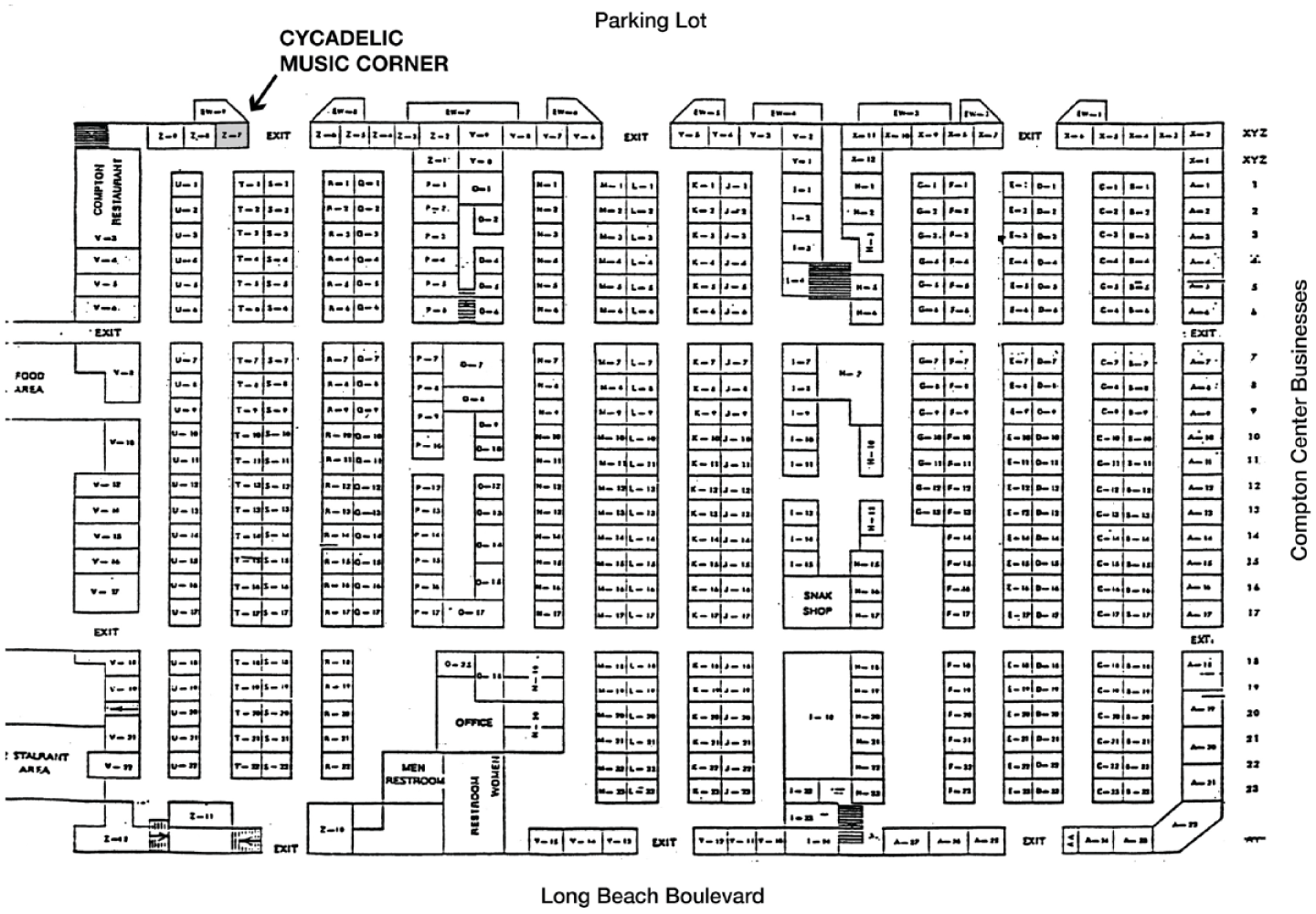
In the upper left-hand corner, note the Cycadelic Music Corner booth within the Compton Fashion Center, circa 1986. Source: Compton Fashion Center Korean Sellers’ Association Et. Al. vs. BJS Development Corporation. 63
Whereas Steve Yano helped establish mixtapes as the primary vehicle for early West Coast gangsta rap recordings, the Kims amplified the genre’s reach by actively promoting emerging artists. Arlandis Hinton, who rapped as BG Knocc Out, remembered that DJs and MCs in the 1980s “didn’t know nothing about signing to a record label, so they made music for their own neighborhood . . . [and] took it, to the Compton Swap Meet. [Wan Joon Kim] was like their first distributor.” 64 While many rappers failed to achieve significant notoriety, some sold thousands of self-produced albums from the Kims store. Rapper Bobby Wilson, for example, was rebuffed by fifteen record retailers because of his prison record until the Kims stocked his album and sold 15,000 cassettes in just one year. 65
By offering consignment sales of mixtapes alongside albums released by major labels, Cycadelic Music Corner attracted hip-hop fans, emerging artists, and stars who credited the business with their early successes. Customers would drive from all over the region to browse Cycadelic’s up-to-date inventory while hoping for a chance to meet West Coast hip-hop’s leading artists and producers. Meanwhile, hip-hop artists ranging from lesser-known artists to household names like Eazy-E, Ice Cube, and DJ Quik all entrusted the Kims with distributing their first mixtapes and recordings. 66 More than a merely transactional site, the booth was also an intimate place of reciprocity where hip-hop moguls, celebrities, and fans exchanged news and advice. 67 Rapper Kendrick Lamar recalled that during the swap meet’s heyday, “you might see [rap producer and Death Row Records CEO] Suge Knight, other folks from Compton” congregating at Kim’s booth. 68 Until the Compton Swap Meet closed in 2015, the Kims actively promoted local artists like Chicano rapper King Lil G, whose Blue Devil 2 mixtape they “sold . . . to every single swap meet in Southern California.” 69
Even artists who eschewed the Kim’s store in favor of direct sales from the Compton Swap Meet’s parking lot enhanced Cycadelic Music Corner’s gravitational pull. Rapper OG Daddy V, for example, sold three albums from a van parked outside of the closest entrance to the Kim’s booth (Figure 5). Although outside of the swap meet’s physical confines, his strategic location near the record store ensured his proximity to potential customers while simultaneously increasing the visibility of the record store. By claiming the parking lot as an extension of the Compton Fashion Center, he—and other artists who sold their tapes from the parking lot—enhanced the swap meet’s cultural power. Kendrick Lamar memorialized the swap meet’s contributions to West Coast hip-hop music, rapping that “Back when Dogg Food dropped in the Compton Swap Meet parking lot, Daddy V had three, sold one to my pops.” 70
Hip-hop artists and fans who fondly remember Cycadelic Music Corner complicate narratives of conflict between Korean swap meet merchants and Black customers. These tensions were embodied in boycotts of the Crenshaw, Slauson, and Inglewood indoor swap meets between 1987 and 1990. 71 The protests highlighted concerns about the quality of swap meet products, perceptions of rude customer service, and a sense that Korean vendors refused to hire Black workers while they “make all the money here and take all the money away” to “Downtown and Koreatown.” 72 However, the Kim family made itself part of Compton’s hip-hop community through years of respectful exchange with their customers. As Wan Joon Kim recalled, although “most of my customers were the gang-bangers and drug dealers . . . I built a friendship with them . . .. They were good to me as I was good to them.” 73 Former clients expressed a similar regard for Kim, with rapper Brian Wilson remarking that “I think he understood my struggle, more than anything . . . [because] he’s in the heart of Compton.” 74
In the past decade, Kirk Kim leveraged the cultural power of his family’s business by starting a record label under the Cycadelic name. Between 2012 and 2016, Kirk Kim’s Cycadelic Records produced albums for local rappers, including BG Knock Out’s first album after his 2006 release from prison. 75 Following the Compton Swap Meet’s closure in 2015, the younger Kim began promoting Compton rap artists in China and Korea while supporting Korean-American and Latinx hip-hop artists in the United States. In 2017, he further strengthened transpacific hip-hop ties by opening a hip-hop venue in Seoul’s Itaewon neighborhood called “Club Compton.” 76 Kirk Kim’s transnational career—which took him back and forth between his parents’ Korea and his LA—is one example of how a new, transnational generation of Korean Americans exported their own versions of Southern California’s multiethnic milieu back to Korea.
Representing Hip-Hop at the Swap Meet
As manifestations of a new global era, indoor swap meets introduced thousands of imported goods to Southern California’s lower-income communities. Just as hip-hop DJs combined audio fragments from diverse origins into entirely new pieces of music, Asian American swap meet vendors curated the clothes, accessories, and jewelry that defined hip-hop fashions. When vendors purchased their wares from wholesale and design firms (known as “jobbers”) in the Los Angeles Fashion District, they connected their customers to a rapidly changing global economy while sharing valuable feedback on emerging streetwear fashions with garment producers.
Between 1970 and 2000, economic restructuring reoriented Los Angeles’s regional economy toward international trade and low-wage manufacturing. 77 Improved port, rail, and highway facilities made the region the United States’s leading port of entry in 1994, opening the spigot to a stream of goods that flowed from Pacific Rim nations to thousands of jobbers in the Los Angeles Fashion District. 78 These firms orchestrated global flows of merchandise by designing and then ordering the next season’s fashions from factories in Asia and Latin America. 79 They could only hope that their designs would be on-trend, and the speculative nature of their work required jobbers to shoulder considerable risks, which they partially mitigated by relying heavily on non-unionized “garment contractors” to complete the cutting, assembly, laundering, and finishing of their apparel. As sociologist Edna Bonacich has observed, nearly all of the “literally thousands of garment contractors in Los Angeles” were owned by Asian immigrants, with Koreans owning “some of the largest shops,” and employing half of the region’s garment workers by 2000. 80
Nearly all indoor swap meet apparel vendors acquired their merchandise from Fashion District wholesalers in person, which allowed jobbers and vendors to swiftly respond to emerging trends within the neighborhoods where hip-hop was the most popular. 81 The face-to-face nature of these transactions, along with the shared Korean identities of many jobbers and vendors, meant that market research occurred with each transaction. This tight coordination is one reason why swap meet fashions as simple as unadorned t-shirts were considered cutting-edge fashion staples within the hip-hop community.
Meanwhile, the reasonable monthly rents for a small booth made swap meets havens for artisans, such as jewelers, tailors, and screen printers, who were even better equipped to respond to the emerging styles and preferences of swap meet customers. Fashion designers and jewelers occasionally used swap meet space as a development platform for emerging styles, such as the ostentatious custom jewelry known as “bling.” Together, mass produced as well as custom clothes and jewelry defined a spectrum of hip-hop fashions ranging from affordable to high end.
Swap Meet T-Shirts as Hip-Hop Fashion
By the 1980s, white t-shirts, black hoodies, loose khaki pants, and black baseball caps were among the most popular and widely available swap meet goods. In 1988, following the release of their Straight Outta Compton album, the members of N.W.A. introduced the world to these goods during a visit to the Compton Swap Meet on the iconic show, Yo! MTV Raps. The show, which is credited with popularizing hip-hop music globally, depicted a raucous scene at a clothing booth, where the group joked about “the meaning of the swap meet” while perusing t-shirts and underwear. 82 In a repeat visit to the swap meet in a 1989 episode, N.W.A. appeared in its parking lot adorned in black pants, solid black and white t-shirts, gold chains, and black baseball caps emblazoned with LA Raiders logos. When host Fab 5 Freddy asked Eazy-E to tell the audience “all about” the marketplace, he replied that “the Compton Swap Meet is something like a flea market, you know? We come here and get the Locs [sunglasses popular with Chicanx and Black gangsters] and shirts, and Levi’s, and the whole hookup, you know?” 83 In these portrayals of the swap meet to an international TV audience, N.W.A. advertised unadorned t-shirts, sunglasses, and pants as the epitome of West Coast hip-hop fashion.
Swap meet vendors capitalized on the growing popularity of these articles by adjusting them to the tastes of their customers. During the 1990s, for example, several Korean entrepreneurs launched the Pro Club, Pro-5, and Shaka t-shirt brands, which they marketed to swap meet customers. Constructed out of heavyweight cotton and sold for between $3 and $7, the shirts inspired a dedicated following. A 30-something Korean American swap meet vendor explained to me in 2015 that “some guys wear Pro Club t-shirts like I would wear an Armani shirt. Some of my customers drive all the way from Vegas to purchase Pro Club shirts because they are status symbols.” 84 As Los Angeles rapper Wes Michaels further explained in 2018, “no matter what social class you identify with you can still look fresh asf with a ‘Fresh White Tee.’” 85
Pro Club, the oldest and most famous of these brands, was the brainchild of former swap meet vendor, Young Geun Lee. After leaving behind a white collar job at IBM in his native South Korea, he migrated to Los Angeles in the early-1980s, where he made a living buying t-shirts from wholesalers and selling them to swap meet vendors. Drawing on this experience, he founded his own wholesale clothing company in 1986. When the North American Free Trade Agreement (NAFTA) disrupted his business model, he established the Pro Club brand in 1995 to focus on selling t-shirts. 86 From a booth in the Slauson Swap Meet—a popular indoor marketplace in a majority-Black section of South Los Angeles—Lee used the feedback from his customers to tweak the shirts’ construction and coloring dyes. By using the swap meet as both a selling space as well as a market research arena, Kim crafted a product that achieved cult fashion status. 87
Since 1993, when Hi-C rapped on his breakout studio single, “take me to the swap meet, it’s time to get dressed, I want a t-shirt and some khakis, can’t freak with the Guess,” at least twenty artists have invoked swap meet t-shirts to express their class positions and claim their places within a South Los Angeles hip-hop lineage.
88
In an annotation to his song, “Fresh White Tee” on Genius.com, Wes Michaels remembered “buying Pro-Clubs from the Inglewood Swapmeet back in ‘99 as a little ghetto skater kid . . .. I’d cop those daily it seemed, throwaways ya know.”
89
Kendrick Lamar also celebrated the t-shirt’s affordability and quality in his 2010 song, “For the Homies,” rapping that: we used to run in the swap meet for the Rollie chains, Pro Club t-shirts, whiter than Anglo-Saxons, Make it a 1X-Tall, crispy with the cotton fashion, That’s fashion if you come where I’m from, Compton California. . ..
90
Summing up the appeal of the “crispy” cotton t-shirt, Lamar foreshadowed a 2021 Los Angeles Times story that characterized Pro Clubs as “one of the few garments truly emblematic of West Coast aesthetics.” 91
After West Coast hip-hop became a global movement in the 1990s, graphic t-shirts and hoodies emblazoned with local place names and images of popular hip-hop artists helped mark swap meet interiors as hip-hop spaces. References to the cities of Compton, Pomona, and Lynwood could be purchased on a t-shirt, as could the likenesses of Dr. Dre, Eazy-E, Ice Cube, Tupac, and Nipsey Hussle (Figures 6-8). Throughout the region, one could find references to N.W.A.’s hit single, “Straight Outta Compton,” on t-shirts that read “Straight Outta Pomona” or, in a nod to hip-hop’s Asian American and Pacific Islander fans, “Straight Outta Samoa” (Figure 9). When were worn outside of the swap meet, t-shirts became emblems that announced hip-hop’s presence in the urban landscape.
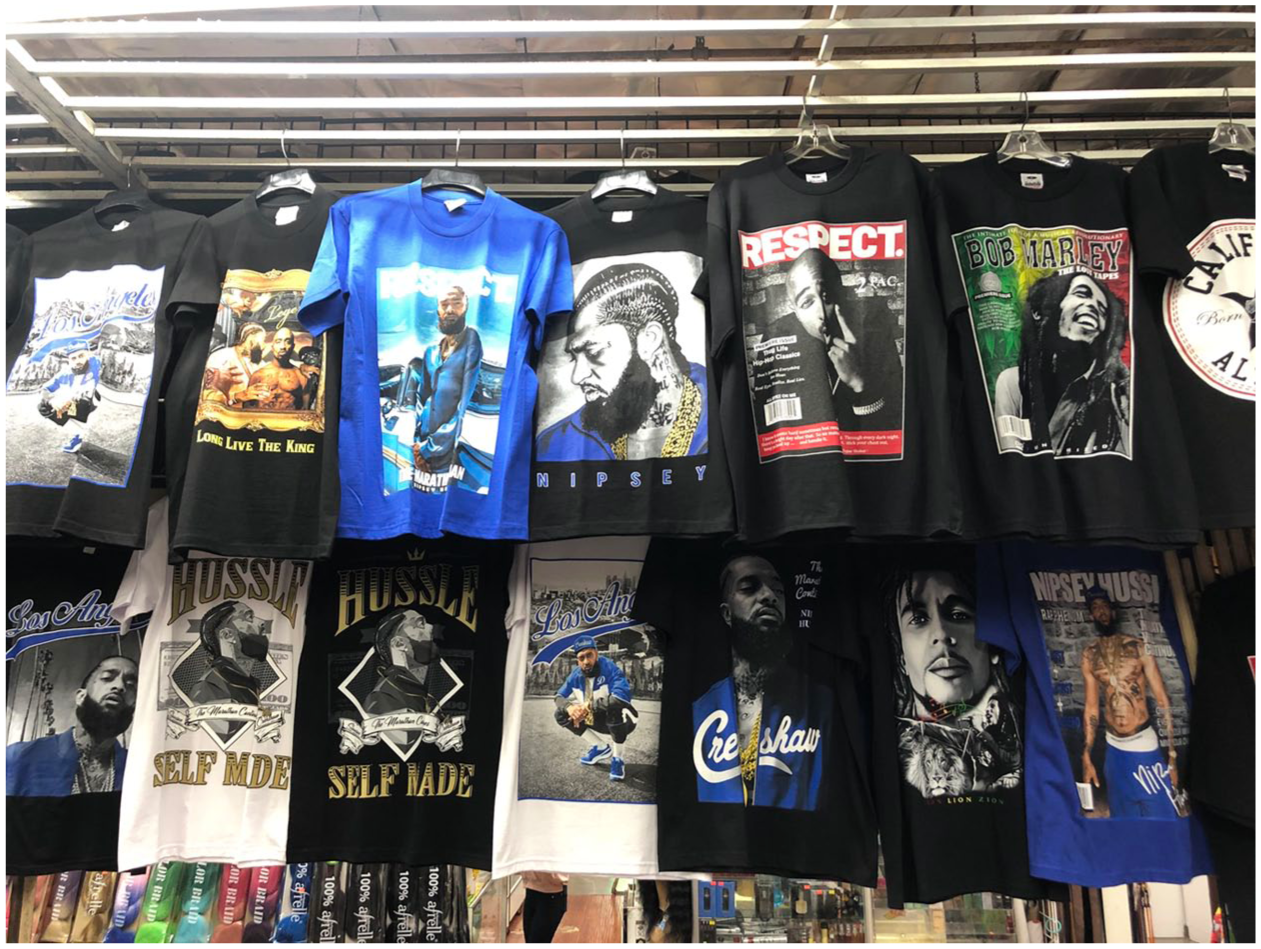
T-shirts commemorating murdered rappers Tupac and Nipsey Hussle on display at the Slauson Swap Meet in Los Angeles.
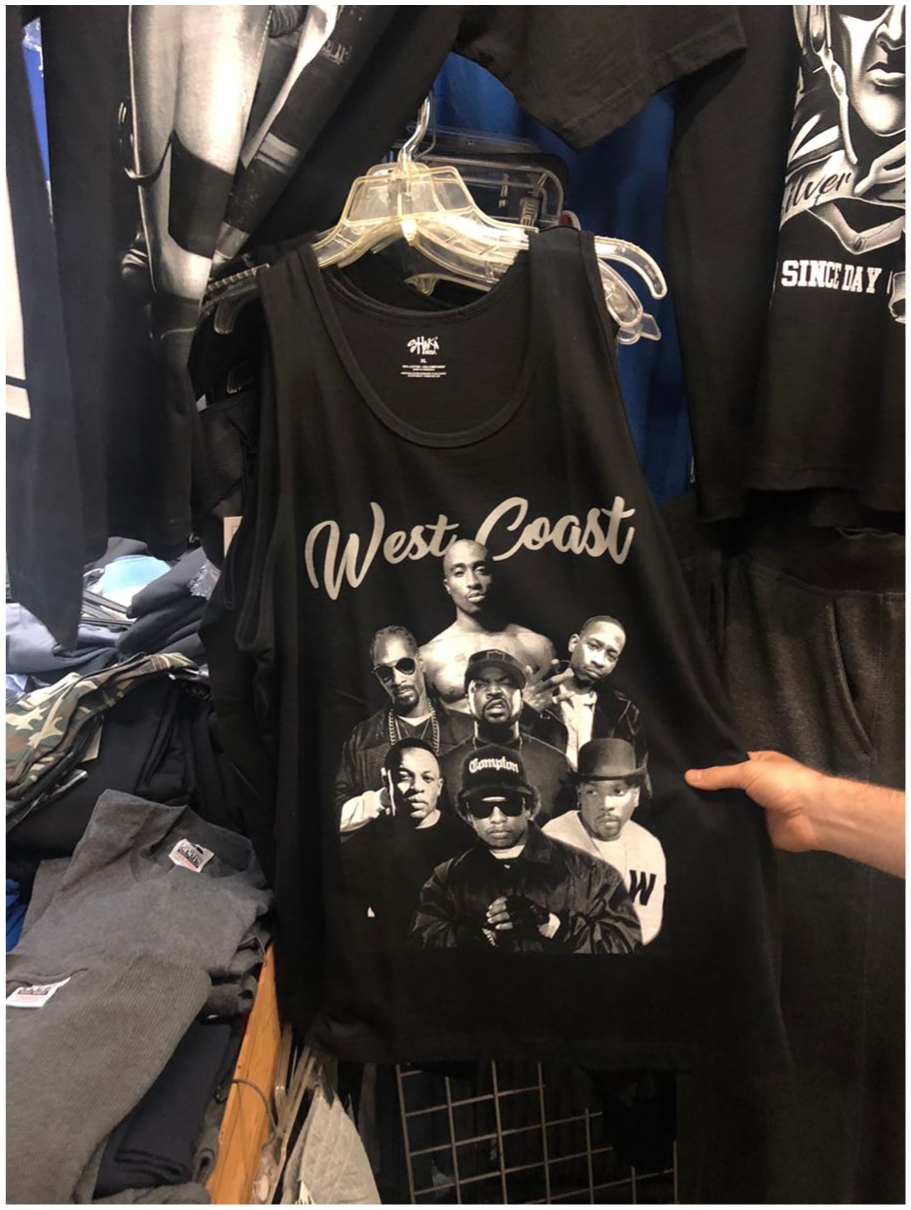
Prominent West Coast gangsta rap artists (including Tupac, Snoop Dogg, Eazy-E, Dr. Dre, and Ice Cube) represented on a Shaka branded tank top at the Union Swap Meet in Los Angeles.
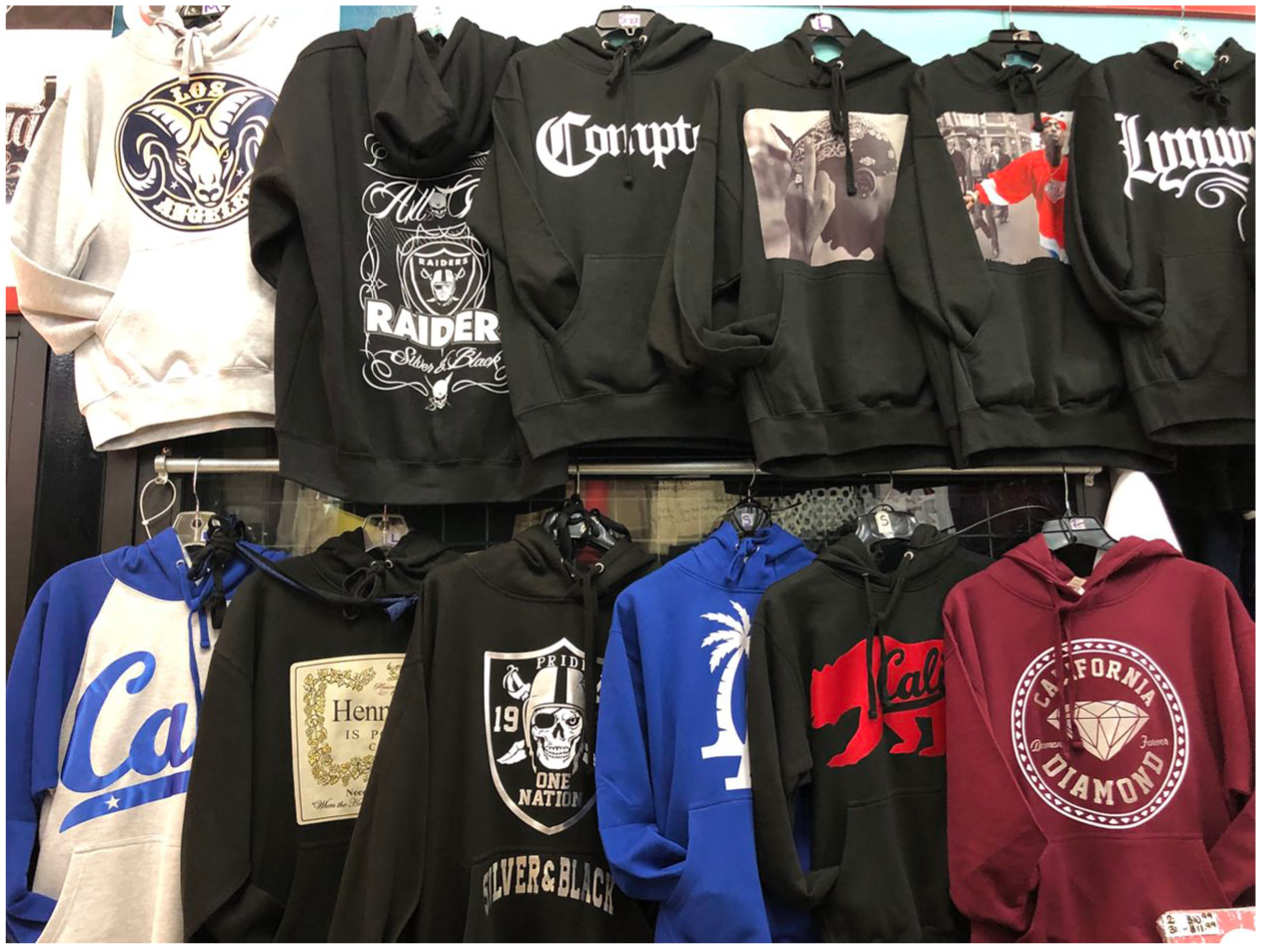
T-shirts representing sports franchises (the Los Angeles/Oakland/Las Vegas Raiders and the Los Angeles Rams) and places (Compton, Lynwood, and “Cali”) that were important to West Coast Hip-hop artists and fans are displayed at a Slauson Swap Meet vendor booth.
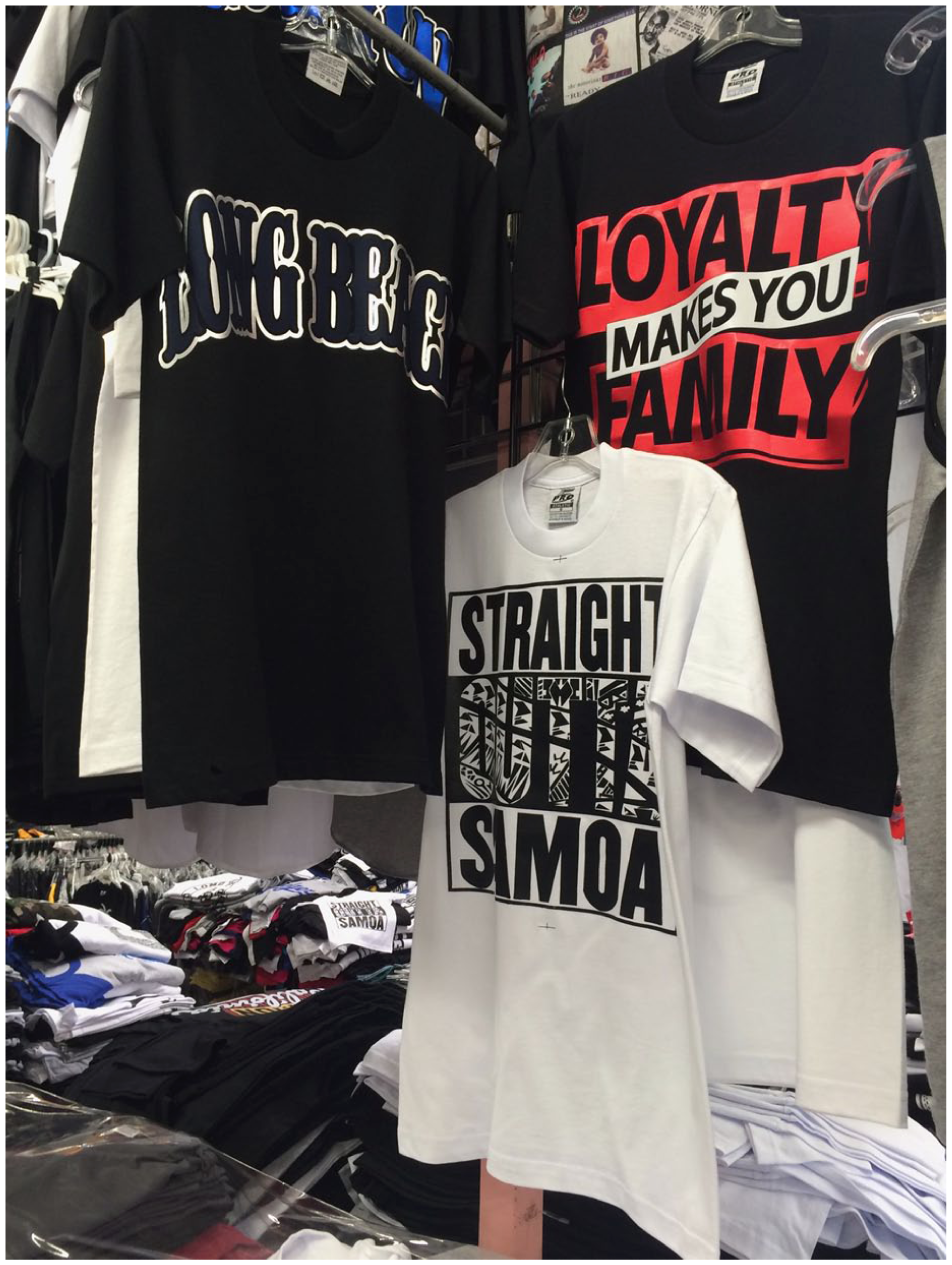
Straight Outta Samoa t-shirt, for sale at Del Amo Plaza in Compton.
By the 1990s, hip-hop artists were vocal “advertisers” of swap meet fashions because of the markets’ significance as egalitarian spaces. Humble $3 t-shirts—which were status symbols for some hip-hop fans—could also be worn by multi-millionaire recording artists to signal their working-class roots. Stories of vendors “making it,” whether as t-shirt manufacturers or local fashion designers, further aligned with the pro-capitalist narratives of many gangsta rappers.
Expressing Individuality through Custom Fashions
Although t-shirts and most other swap meet merchandise were usually mass-produced, the compact size and affordability of vendor booths made the markets havens of craft production. Scattered along the aisles of any swap meet were skilled tailors, embroiderers, screen printers, and airbrush artists who could alter and embellish garments with one-of-a-kind designs that were popular with swap meet patrons. In consultation with their Black and Brown customers, Asian and Latinx craftspeople were central to the proliferation of these custom swap meet fashions.
These fashions were perhaps most pronounced in the swap meet jewelry businesses. Due to unusually large profit margins that enabled them to weather economic ups and downs, jewelry stores were usually the oldest businesses at most swap meets. Just as apparel vendors maintained close relationships with garment district wholesalers, swap meet jewelers sourced their chains, bracelets, earrings, and rings from wholesalers in the downtown Jewelry District. In 2010, the Los Angeles rapper Jay Rock linked swap meet apparel and jewelry with masculine toughness: “Headin’ to the swap meet,” he “cop[ped] a thousand white tees, Cortez Nikes, chains all icy, Niggas know better, it ain’t no point to try to fight me.” 92
Swap meet jewelers responded to these attitudes by selling chains, bracelets, charms, and pendants at a range of price points. During my visits to Susan Tiffany Jewelry at the Slauson Swap Meet, for example, I observed diamond encrusted pendants in shapes of marijuana leaves and AK-47’s interspersed between more quotidian designs. These symbols seemed to echo the mission statement for Streetwise Clothing, a fellow Slauson Swap Meet retailer, whose Latino founders viewed their brand as “dedicated to those who come from the struggle and are determined to succeed by any means necessary.” 93
This scrappiness is most dramatically evident in the work of a handful of Asian American jewelers who specialized in removable gold dental caps known as “grills.” In the 1990s, after Surinamese jeweler Eddie Plein developed them in New York and Vietnamese immigrant Johnny Dang popularized them at a Houston swap meet, grills were introduced on the West Coast by Korean jeweler Jason Shin (Figure 10). 94 After opening his first grills shop in Oakland in 1999, Shin helped one of his brothers open Mr. Bling Gold Teeth in the Slauson Swap Meet in 2002 (Figure 11). A few years later, when St. Louis rapper Nelly released a song called “Grillz,” soaring demand for the prosthetics prompted the Shin brothers to briefly open storefronts at Compton’s Del Amo Plaza swap meet, the Riverside Discount Mall, and in Denver. 95 Although the Shin family’s other outposts closed, their Slauson Swap Meet store endured because of an American-born nephew who began apprenticing at the business while in college. As he learned how to make jeweled and “diamond cut” “6-sets,” he dropped out of school because he “saw room to grow the business.” 96 Although his college-educated friends were incredulous that he worked at a swap meet, he told me in 2016 that he enjoyed the challenge of learning a trade while interfacing with clients that included celebrity boxer Oscar de la Hoya and model Jasmine Sanders. Transgressing professional norms ascribed to Asian American men, Jae—who took over the business in 2023—was part of a small but significant cadre of second-generation Korean entrepreneurs who elected to work in the hip-hop industry.
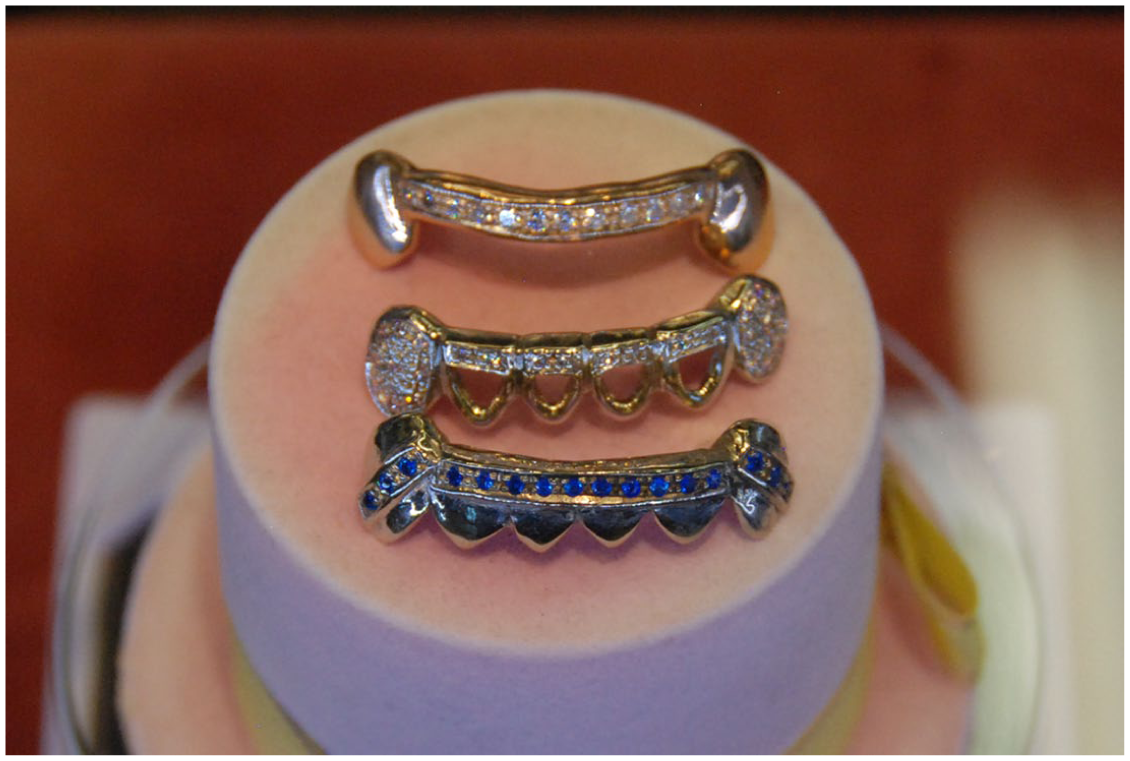
Grillz for sale at Mr. Bling’s Gold Teeth booth at the Slauson Swap Meet.
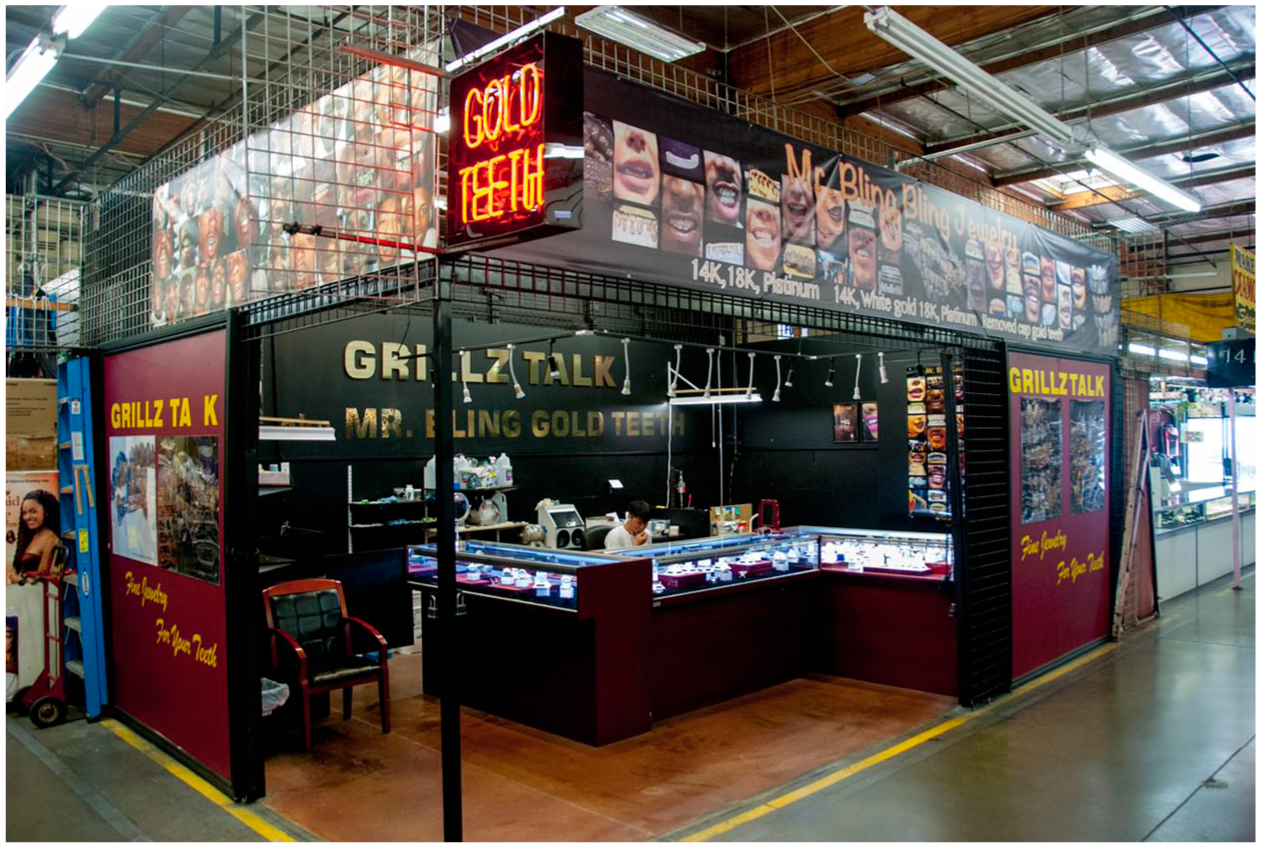
Mr. Bling’s “Grillz Talk” Location at Del Amo Plaza in Compton.
Whereas Mr. Bling continues to serve a range of social classes from its swap meet booth, other swap meet jewelers transitioned to exclusively high-end clients. Icee Fresh & Co (now IF & Co) opened in the Slauson Swap Meet in 2004, but today serves “the Hip Hop community and young Hollywood” from a showroom in Beverly Hills (Figure 12). 97 Run by Korean American cousins “Slauson” Steve Her and Ben “Baller” Yang, the pair learned their trade at the Slauson Swap Meet’s Susan Tiffany Jewelry store, which was run by Her’s father. While “Slauson Steve” developed diamond-encrusted pieces that sold for over $25,000, “Ben Baller” cultivated the firm’s celebrity client list—which included Paris Hilton, Tom Cruise, and Drake—through contacts made while working as a producer for Dr. Dre. 98 Like Dr. Dre and other successful hip-hop artists, some Asian American swap meet-turned hip-hop entrepreneurs parlayed their South Los Angeles origins into lavish lifestyles.
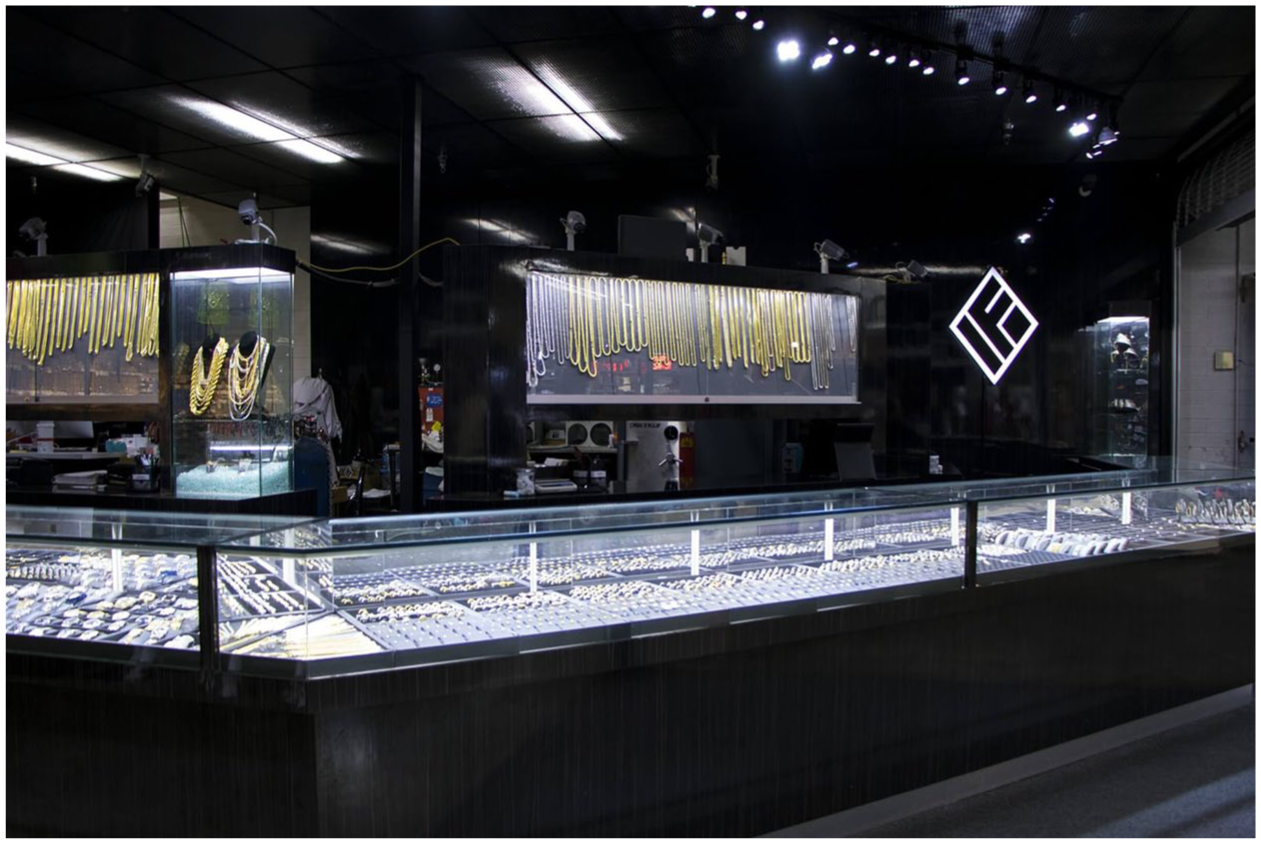
IF & Co counter in Booth J-01 at the Slauson Swap Meet. Its modern and austere aesthetics contrast with the more chaotic designs of other self-built swap meet jewelry booths.
Conclusion
Critics have variously dismissed swap meets—and loosely regulated marketplaces more broadly—as sites of informal (and illicit) commercial activity. 99 Sir Mix-a-Lot’s 1992 music video, “Swap Meet Louie,” highlighted these dismissals in a xenophobic critique of the swap meet economy. In the video, a woman named “Mary Pong” stood in for the thousands of Asian swap meet vendors whom, Mix-a-Lot alleged, sourced counterfeit goods from Korean sweatshops, spoke broken English, and insulted their customers. In airing these grievances, he echoed the frustrations of the shoppers and community activists who perceived the markets as instruments of economic exploitation in a globalizing and increasingly unequal city. The conclusion of the video, which portrays Mix-a-Lot looting Mary Pong’s store, even foreshadowed the actual looting of Korean-owned businesses during the Los Angeles Rebellion just two months later. By rendering swap meet vendors as a transgressive presence to be rooted out and punished, Mix-a-Lot echoed and amplified a strain of anti-Asian and anti-globalist rhetoric that had circulated within the media and some hip-hop circles over the previous decade. 100
But these social and economic complaints mostly disappeared from rap lyrics after the uprising, as rappers appropriated swap meets as symbols of West Coast hip-hop’s roots in “the hood.” Representations of the Compton and Slauson swap meet in the music videos of Tupac, Dr. Dre, and Kendrick Lamar exemplify a broader acknowledgment of the markets’ central role in the distribution and promotion of West Coast hip-hop music. At the same time, the lyrics of hundreds of hip-hop tracks emphasize the importance of the markets’ polyphonous material cultures, tacitly acknowledging the influences of global migration and the garment industry’s sprawling supply chains on the urban landscape. They paint a far richer portrait of West Coast gangsta rap’s origins than the neat narrative of a Hollywood film, a portrait that hints at the conflicts and solidarities between hip-hop artists and Asian swap meet vendors.
These complex social and racial histories further reveal how material culture and music are sometimes integral to the practice of urban citizenship. 101 Whereas Korean American swap meet vendors pursued a vision of the American Dream through their entrepreneurship and their (partial) control of real estate, early West Coast hip-hop artists used the tools at their disposal to make discursive claims to ghettoized sections of the metropolis. Through their lyrics, rappers asserted their right to the city, demanding respect for their hometowns and class positions alongside the right to define their identities as rebels through their clothes and jewelry. 102 In making these claims, hip-hop artists and vendors imbued swap meets with meaning.
My purpose in this article has not been to argue that moments of inter-cultural exchange are always harmonious or civil. Far from it. Instead, I have suggested that a contested commercial landscape played a central role in West Coast hip-hop’s ascendence, and that complex realities lurk behind seemingly simple narratives. At the same moment that militarized policing, ballooning incarceration, and structural disinvestment worsened everyday life in Los Angeles’s minoritized inner suburbs, the advent of West Coast hip-hop can be read as a “countermobilization” in which multiple social groups participated. 103 By examining the origins of the genre at area swap meets, we can interpret the “local knowledges” of hip hop artists, swap meet vendors, and swap meet goods themselves. These knowledges highlight the importance of interstitial spaces like swap meets as sites of agency, spatial claiming, and as crucibles of new cultural forms.
Footnotes
Acknowledgements
The author wishes to thank the anonymous reviewers as well as Trude Renwick, Noah Allison, Stathis Yeros, Eric Peterson, and Eliana Abu Hamdi for their thoughtful feedback on this manuscript.
Declaration of Conflicting Interests
The authors declared no potential conflicts of interest with respect to the research, authorship, and/or publication of this article.
Funding
The authors received no financial support for the research, authorship, and/or publication of this article.
