




Abstract
The notion of “sundown town” broadly encompasses the various methods employed by American towns and counties to exclude specific racial or ethnic groups from their borders. This paper mobilizes the sundown town notion to explore the dynamics of exclusion present within Canadian company towns by first establishing a sundown exclusion scale that categorizes cases of sundown towns in the United States. Using this framework, it then specifically examines the case of Thompson, Manitoba, a Canadian mining community established in 1956 by the International Nickel Company (INCO). Findings reveal that there appeared to be a voluntary absence of consideration by the parent company of the issues relating to employment and housing discrimination faced by the town’s First Nations and Métis population during the town’s first years of existence. The paper further discusses the lasting effects of these dynamics of exclusion and marginalization on the city’s residents of Indigenous identity.
Introduction
There has been a significant interest in recent years in the lasting effects of racial and ethnic discrimination in Canada. Recent literature has mostly focused on the social repercussions of systemic racism, 1 the inequities in terms of access to healthcare services faced by racial minorities 2 in addition to the economic 3 and psychological 4 effects of discrimination on racially marginalized minority groups. Federal reports have been published examining the extent of systemic racism in various Canadian institutions and defining recommendations and action plans to address these issues. 5 The relation between territorial planning and racial discrimination has nevertheless received limited attention, although some researchers have made valuable contributions relating to social policies and racial inequality in a Canadian context. 6 There have been some recent vital studies pertaining to environmental justice, uncovering the environmental racism faced by marginalized groups, 7 with some studies focusing more specifically on Indigenous, 8 and Afro-descendant communities in Canada. 9 These studies raise further questions as to the role of racial discrimination on residential planning as a whole in Canada. Although it remains to be defined clearly, some researchers who have examined Canadian municipal laws have claimed planning to be a racial project that can reinforce dynamics of discrimination and exclusion, 10 mirroring findings of U.S. studies.
The notion of sundown towns as brought forth by U.S. Sociologist, James W. Loewen, serves as a way to define jurisdictions in the United States that took active steps in excluding specific racial or ethnic minorities from their borders. 11 As of yet, no scientific research has been undertaken on this topic in a Canadian context. It remains further undefined as to what knowledge this notion can bring forth in relation to the analysis of Canadian planned communities. Although we observed a noteworthy correlation between the sundown phenomenon and planned communities in the United States, a finding that we will present as part of our framework, researchers have yet to study it in a Canadian context. This could be due to in part to the fact that, despite their significant contribution to the country’s industrialization, Canadian planned communities remain, as Morisset puts it, “on the periphery of the research conducted on such settlements around the world.” 12 In this research, we aim to study Canadian planned communities through the sundown town lens. We further seek to question the role of parent companies in addressing racial and ethnic tensions within these planned communities. To extend our understanding of this notion, we more specifically examined the dynamics of exclusion present within the planned mining community of Thompson, Manitoba, using multiple types of sources. Analyzing racial segregation on a large scale, we first dissected the notion of sundown town by creating a scale of exclusion based on the research conducted by Loewen and supplemented through other research studies pertaining to specific cases of racial or ethnic exclusion in the United States. This serves as a relative measure from which we can further examine our case study while providing us with a comprehensive overview of the dynamics at play in this case.
Sundown Towns
Sundown Towns, sometimes referred to as sunset towns, is a term which Loewen brought significant attention to and which broadly refers to “an organized jurisdiction that for decades kept African-Americans or other groups from living in it and was thus “all-white” on purpose.” 13 This also includes jurisdictions which heavily restricted members of a specific race or ethnic group from being within their border after a specific time or at all times in more restrictive cases. This phenomenon, although specific to the United States, varies in scale, ranging from unincorporated areas to whole counties. Loewen establishes the peak of this phenomenon from 1890 to 1940, a period which corresponds to a notable decline in race relations across the United States, leading to rising tensions and an increase in racially motivated violence. This in turn precipitated the expulsion of racial minorities from numerous towns and counties across the nation. Analysis conducted by Loewen’s research team using census data, oral history, and archival newspapers initially focused on the Midwest, leading to the overwhelming representation of this region, with states like Illinois, Indiana, Wisconsin, and Ohio encompassing the highest number of confirmed or suspected sundown towns and counties. 14 There has been an increase in studies relating to racial tension and its effects in the Heartland of the United States as of late. 15 Such data challenges the popular belief that would typically localize racial violence within the traditional south.
Studying sundown towns reveals that ethnic and racial exclusion primarily focused on African-Americans, through a historical phenomenon that Loewen defined as a Great Retreat. This refers to the forced expulsion of African-Americans from small towns and rural areas across the North of the United States and their subsequent seclusion in segregated neighborhoods of large urban cities. 16 He further revealed that this phenomenon also frequently targeted other groups, namely Asian-Americans, Mexican-Americans, Native Americans, and people of Jewish descent. 17 Specific historical cases illustrate how a single event can serve as a catalyst leading to the expulsion of most members of a targeted group from an area, hence creating its sundown status. 18 Several case studies have demonstrated that restrictions were mostly imposed and subsequently reinforced through violence (Figure 1). Examples of such means of exclusion include the expulsion of African-Americans in Pierce City, Missouri, in 1901, 19 Harrison, Arkansas, in 1909, 20 and Corbin, Kentucky, in 1919. 21
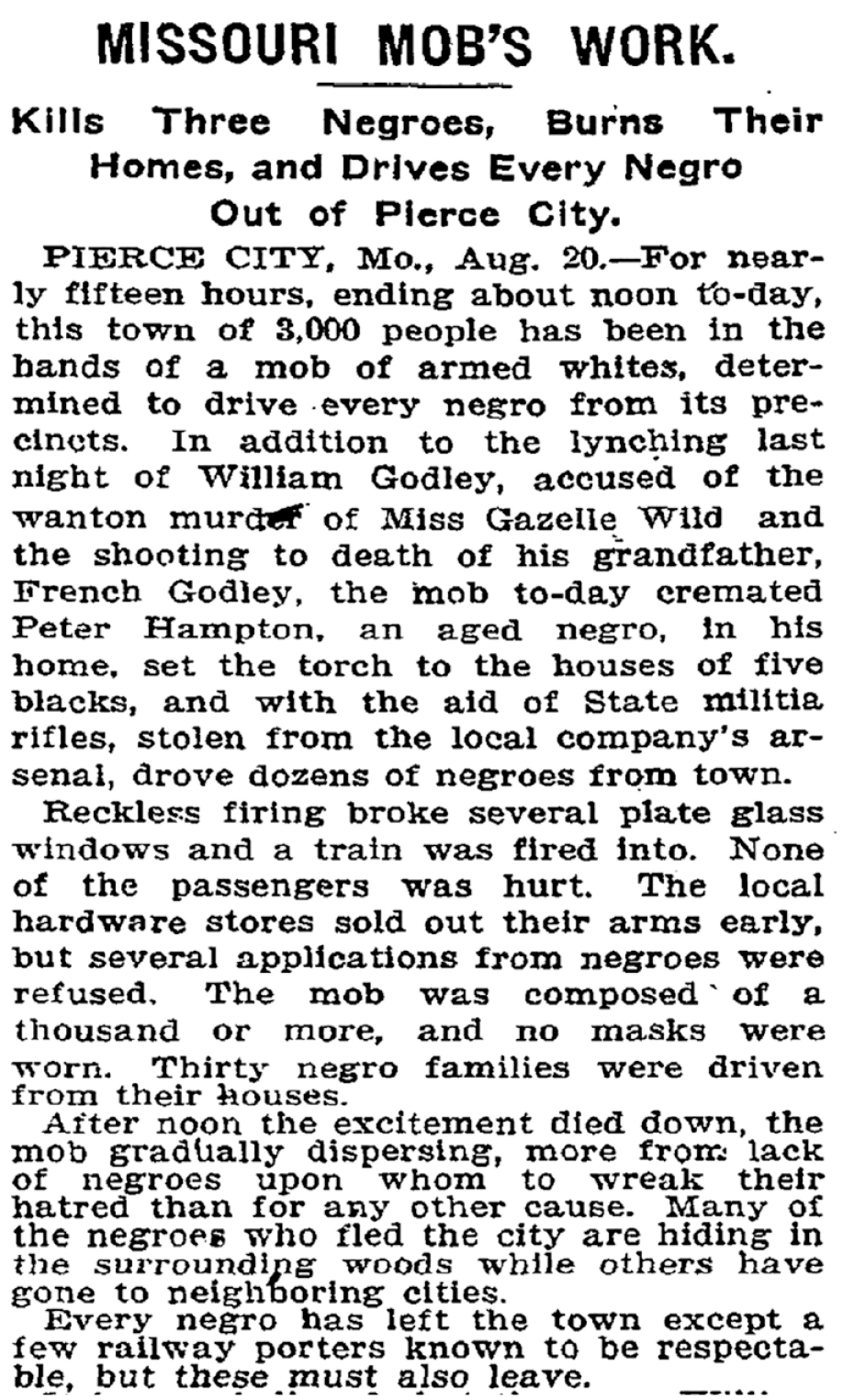
Expulsion of African-Americans in Pierce City, Missouri, as reported in the New York Times in August 1901. 22
Research further unveils a variety of additional exclusionary practices meant to reinforce a locality’s sundown status, ranging from social and economic ostracism to formal and informal ordinances and proverbial signs warning targeted groups to leave town before sundown. 23 Studies highlight the sharp decline in sundown practices starting from the 1970s. 24 Sundown towns is a phenomenon which is generally situated within a specific time period, with practices of exclusion typically lessening over time depending on the jurisdiction. Researchers have nevertheless noted the pervasive effects of the sundown phenomenon over time, ranging from lasting economic disparity between whites and non-whites to the gradual transition from overt to systemic racism, hence substantiating the need to further the understanding of this phenomenon through additional research. 25
Exploring previous research pertaining to the phenomenon of sundown towns and, more generally to residential exclusion based on race and ethnicity within this specific time period in the United States, we were able to establish ten levels of exclusion as depicted in Figure 2. These range from an absence of organized means of exclusion to the total exclusion of a targeted ethnic or racial group. The term exclusion is to be understood here in spatial terms, meaning that it considers the physical removal of individuals and is mediated by a temporal dimension. Evidence pointing to a more total form of removal of a particular group from a specific locality would lead to it scoring higher on the scale. It is also of importance to define the meaning of the term organized in the present case. This refers to coordinated attempts by formal groups such as municipal police forces, companies, and homeowners’ associations at excluding a specific minority group or to a harder to define general agreement among the town’s population, and further denotes quasi-legal enactments. We detailed each level of exclusion and analyzed specific cases exemplifying each of the ten levels (see Appendix A).
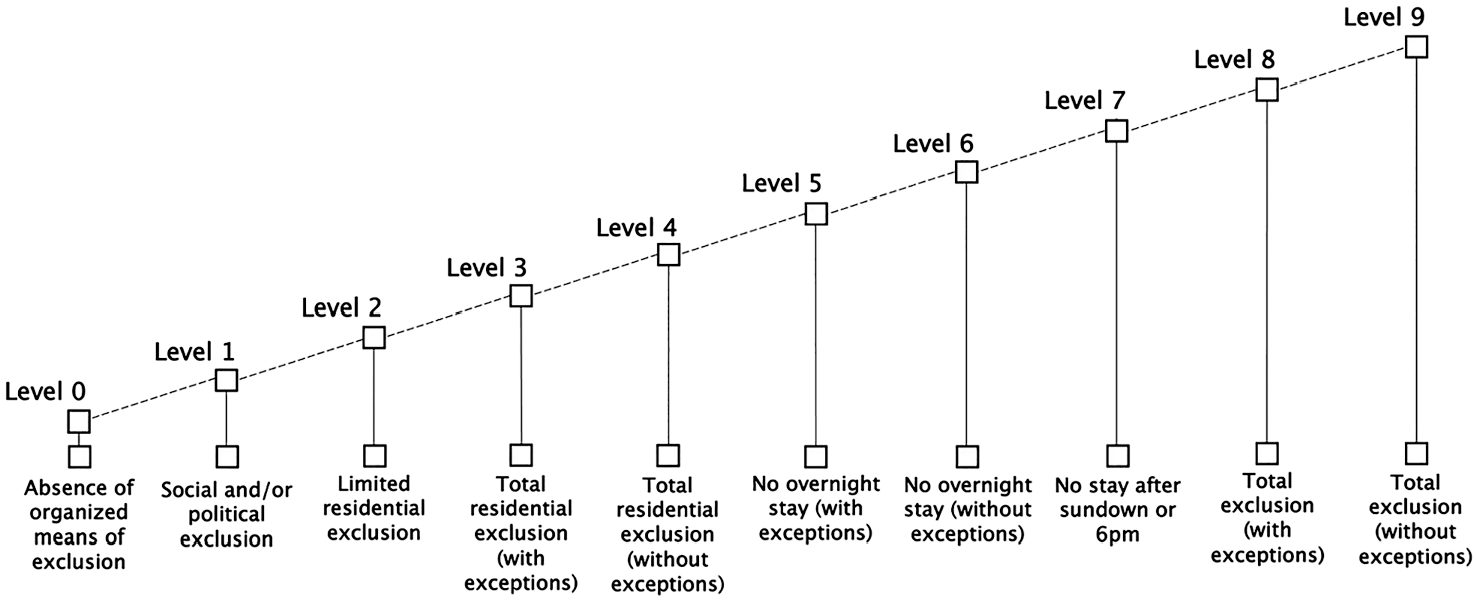
Sundown scale of exclusion.
This categorization serves as a way to facilitate further investigation into potential sundown towns by establishing a measure that allows for a comparison of different cases. Previous case studies have mobilized a binary approach in order to determine whether a locality qualifies as a sundown town. The proposed scale allows for a more nuanced understanding of this phenomenon by taking into account the severity of these dynamics of exclusion. In doing so, it also allows us to provide insight into the role of formal groups, companies, and planners in the case of planned communities in reducing or perpetuating racial and ethnic discrimination. This is significant as by conducting a comparative analysis of the sundown town database compiled by Loewen and his research team 26 to a database of company towns created by the Canada Research Chair in Urban Heritage, we found that out of 460 documented company towns in the United States, 44 appeared to have sundown characteristics (see Appendix B).
Evidence of Racial Discrimination in Canadian Company Towns
The term Company towns, otherwise referred to as planned single-industry towns or single-enterprise communities, refers to “built ensembles established by companies to house the employees of industrial sites.” 27 Researchers have identified over 1,000 such company towns in Canada, with 243 still being in existence. 28 Company towns in both the United States and Canada are generally defined by the overarching role of a sole private company in overseeing the town’s development and subsequent management. Canada’s later industrialization, when compared to the United States, can be defined by its own set of characteristics. The more complex machinery utilized in addition to its reliance on hydroelectricity has led to the creation of more permanent settlements. Often intertwined with the country’s territorialization, Canadian company towns were frequently located far from urban centers. This meant that they were generally characterized by a more thorough planning process, which served as a way to attract and retain its workforce, especially in the face of the town’s remoteness. 29 It is not to say that various forms of exploitation were not present. Indeed, previous studies on Canadian company towns have described a generally more inclusive model when compared to the model of territorial planning found in the United States. 30 The significant contribution of their large immigrant and minority workforce has defined company towns in both Canada and the U.S. Canadian planned industrial communities like the mining town of Arvida, Quebec, favored a more integrative approach. 31
This approach did not in fact apply to the majority of Canadian company towns. Research shows that specific industrial sectors were more likely to be defined by exclusionary practices. The canning, fishing, railway, and logging industries were notable in this aspect.
32
Examples include the range of discriminatory practices experienced by South Asian workers in logging communities of Western Canada such as Fraser Mills and Youbou in which lower wages and housing segregation had become common practices.
33
A study undertaken by the British Columbia Underwriters of the province’s canneries in 1923 reports a clear racial segregation of their workforce, a situation upon which Muszyńska reports on in her foundational research on the Canadian canning industry:
While the white employees enjoyed private bungalows on many sites, Chinese men and Japanese men were each put up in bunkhouses reminiscent of the overcrowded conditions found in Nazi concentration camps. Aboriginal peoples camped according to their village groupings, either supplying their own accommodation or being put up in company housing.
34
This mirrors a common phenomenon in company towns across the United States where towns tended to be segregated by ethnicity.
35
Green comments on Lowell, Massachusetts, considered to be the United States first company town:
Neighborhoods tended to be segregated by nationality, and each established its own separate institutions, including churches. And as would be common elsewhere, the companies pitted one group against another, using the desperate newcomers to undermine efforts to limit the working day legislatively and to serve as strike-breakers.
36
While generally less segregated, discriminatory practices also characterized the mining industry. Across Canada, studies have noted the added difficulties faced by ethnic and racial minorities. Notable examples include the discrimination experienced by Afro-descendant workers in the mining region of Cape Breton, Nova-Scotia, 37 as well as the extensive legal and social difficulties faced by Chinese miners in British-Colombia, 38 once again mirroring the experience of the U.S. where the harsh conditions faced by ethnic and racial minorities in the mining industry have been extensively studied. 39 It remains unclear as to the degree of racial exclusion in these cases as defined in to the proposed scale, with an in-depth analysis of each of these case studies needed in order to establish a comparison.
Research Method
Building upon the work undertaken by Loewen we attempt to mobilize the sundown town framework in order to examine the residential planning of the mining community of Thompson, Manitoba. We seek first to determine the level of exclusionary practices according to the scale established previously. We further seek to assess the role of the private company and governmental institutions in charge of the town’s development in addressing racially motivated residential and social discrimination. Incorporating multiple sources of information, we attempt to document the town’s history in relation to its Indigenous workforce. In doing so, we studied archival newspapers, extensively analyzing Thompson’s two local newspapers; The Nickel Belt News and The Thompson Citizen founded in 1961 and 1960, respectively. In addition to these sources, we also consulted various archival fonds and collections. 40 Finally, we supplemented these accounts with census data, provincial and federal reports, and technical papers. In researching this phenomenon, we encountered the most common difficulty in documenting sundown towns as defined by Loewen, the lack of official sources addressing a locality’s evidence of racial exclusion. 41 In this specific case, the main issue is that official company records relating to both the residential planning and hiring processes in Thompson have not been made public. Loewen nevertheless informs on the pertinence of local histories and newspapers in uncovering evidence of organized racial exclusion. 42
Thompson, Manitoba
Starting in 1946, the International Nickel Company (INCO) would conduct mining prospecting operations in Northern Manitoba which would first lead to the inconclusive attempt at establishing a commercial mining operation in Moak Lake in 1952. The discovery of nickel deposits twenty-five kilometers at Cook Lake soon after led to the creation of the planned community of Thompson in 1956. Named after INCO’s chair, it was further conceived as a northern service center. 43 Owing to its relatively late development, provincial and federal authorities vastly influenced the City of Thompson, contrasting earlier resource communities that private companies mostly planned and operated. 44 An agreement was signed by INCO and the Province of Manitoba in 1956, specifying these shared responsibilities. It further specified that an elected municipal council could not be established without the consent of the company, essentially omitting municipal authority during the town’s first years. 45 The agreement specified that INCO would assume both the conception and construction of the townsite, but that it would have to produce a town plan that provincial authorities would approve. 46
From its foundation, the role of the Indigenous population has been substantial and complex. Located in traditional First Nations territory, more precisely the Nisichawayasihk Cree Nation, the establishment of Thompson resulted in substantial displacement in addition to significantly impacting trapping, fishing, and hunting activities. 47 Thompson’s development period also fits within a change of paradigm in terms of Canada’s relationship with the First Nations. Following the Second World War, the Canadian Government consulted First Nations communities for the first time in order to revoke some of the most restrictive measures of its Indian Act. 48 This Act, which the Federal government first introduced in 1876, included a series of colonial laws aimed at restricting the freedom and movements of First Nations. 49 Among those was the pass system, an unconstitutional process developed in the late 19th century that remained in enforcement in certain localities until the 1940s. This system mostly took the form of a travel document which had to be signed by an Indian agent and served to restrict the movement of Indigenous people in Western Canada. This document dictated the duration for which an Indigenous person could leave their reserve in addition to specifying where they were allowed to go. 50 The revised Indian Act of 1951, if successful at reducing the effects of some of the most oppressive measures of the initial legislation, reaffirmed the government’s desire of assimilating Indigenous nations into white settler society. Research on government programs of the time further reveals the governments’ objective of limiting this integration to the Canadian working class, offering in actuality few options for social mobility. 51 Thompson would reflect these dynamics.
Thompson would be characterized by the sustained participation of its Indigenous population in its initial development and subsequent daily operations. Sources reveal that First Nations and Métis were first hired as survey crews in order to clear forest land needed for the construction of the mine and townsite’s infrastructure. Out of the 150 men hired to assist in the construction of the mine and townsite, between 30 and 40 were First Nations or Métis. 52 Regardless of this initial contribution, the seemingly total absence from local historical newspapers of this foundational role has been commented upon. 53 It is also of interest to note that the 1956 agreement mentioned previously made no mention of the Indigenous population. However, the contribution of Indigenous workers would appear elsewhere in Canada, with an article written in a Quebec newspaper in 1957 reporting that INCO deemed satisfactory the work performed by First Nations laborers. 54
Following negotiations between government authorities and INCO, Thompson would be settled as an Open Town, hence diminishing company control and essentially allowing for private residential ownership, which is another contrast to planned communities of previous decades. 55 Although a resident administrator who had been appointed by the Province and approved by INCO would have full control over the sale of residential lots, it was specifically stated that some non-company personnel would be allowed to live in Thompson, as long as they had valid reason to do so. 56 This specificity contributed to a rapid influx of residents. This, in addition to delays caused by internal disagreements and weather-related difficulties, resulted in a housing shortage, greatly impacting the town’s composition and racial makeup. 57 Recently, researchers have noted the limited research pertaining to the impact of the development of housing in Thompson on Indigenous Peoples. 58 Our findings show that if indeed faced by the population as a whole, this housing shortage would impact First Nations and Métis residents from nearby reserve communities at a more significant rate.
Issues of employment discrimination also quickly arose, with discriminatory hiring policies by the company being denounced, an allegation which INCO vehemently denied. 59 INCO nevertheless operated on a referral program where employees were offered a bonus upon recommending a friend or a relative, a feature which has been linked, in part, to the particularly low number of Indigenous employees. 60 Both INCO and government officials had put the town’s diversity forward as a selling point, with indeed the workforce largely consisting of recent immigrants in the town’s first few years of existence. 61 This narrative parallels the changes in Canada’s construction of its national identity which were occurring in the early 1960s. In response to what the federal government defined as being a crisis of national unity, and in an effort to move away from a British-based identity, Canada shifted its efforts to the promotion of a collective identity based on multiculturalism and the idea of unity through diversity. 62
The town’s Indigenous population did not, however, benefit from this same level of exposition and valorization, despite having taken part in the town’s initial development in addition to having several of Thompson’s first roads being named after them.
63
Despite INCO signing an agreement in 1961 with the local Union of Mine, Mill, and Smelter workers stating that there shall be no discrimination in employment on the basis of race, national origin, color, or religion,
64
First Nations and Métis people were only officially allowed to work in the mine in late 1962,
65
following protests and official demands by First Nation bands over the previous years and ongoing support by the workers’ union.
66
However, this issue had come to the attention of provincial authorities earlier that same year, following picketing by eighty Indigenous men at the INCO plant (Figure 3).
67
Company officials declared that, regardless of INCO’s role in the town’s development, the company was not to blame in regard to the current situation, a viewpoint which the editor of The Thompson Citizen agreed upon:
It seems logical to us that our Canadian Indians are not regularly competent miners and mine employees. If they were well suited to Canadian Mining they would be working in fairly impressive numbers at such centres as Lynn Lake, Flin Flon, Snow Lake, Uranium City, Yellowknife, Trail, Bralorne, Valdor, Timmins or Sudbury. To our information, they have not worked at any of these properties in any great number.
68
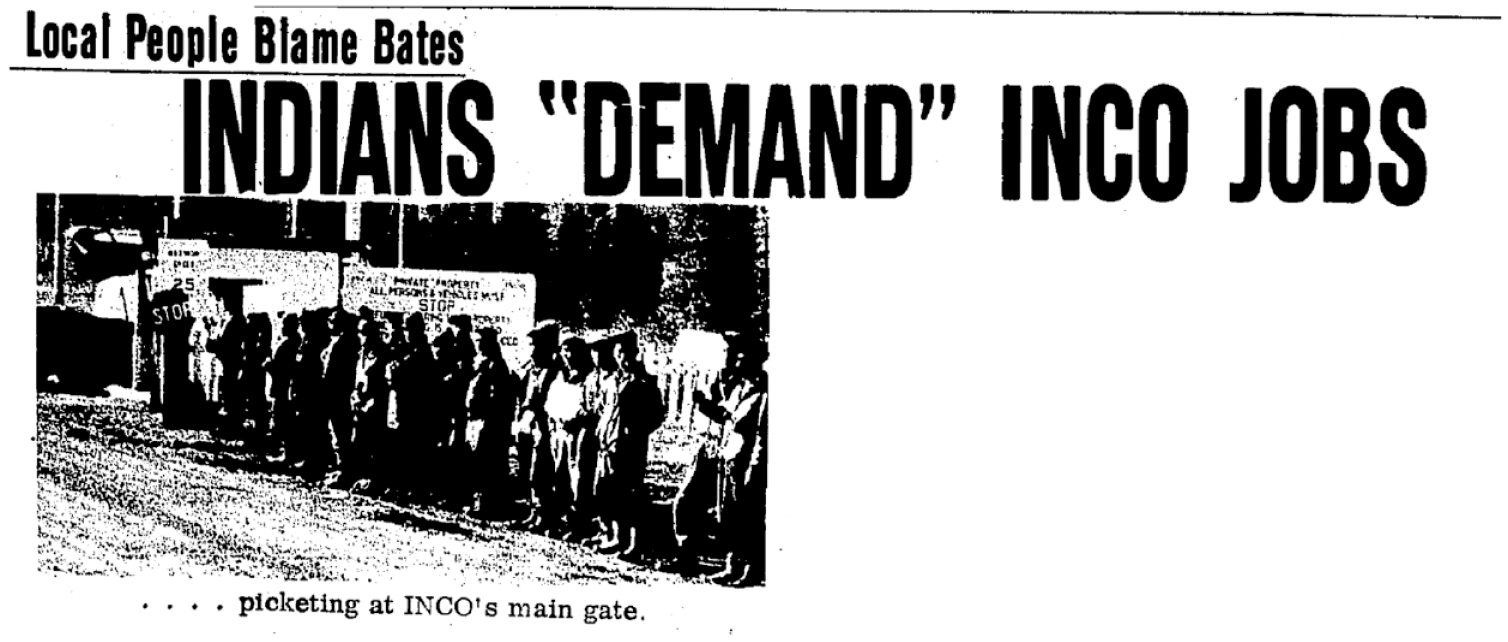
Picketing of the INCO plant by Indigenous jobseekers as reported in The Thompson Citizen in September 1962. 70
This attitude would further the substantial difficulties faced by First Nations and Métis when trying to settle in Thompson. The editor of The Thompson Citizen would comment further:
We suggest that it would be a greater mistake to transplant an entire Indian family from a home in Nelson House or Split Lake to Thompson. We would only be confronted eventually with the same problems as are so evident in Churchill, The Pas and Winnipeg.
69
These instances of personal prejudice not only reflected the viewpoints of the company but also served as a way to minimize the responsibility of the company in regard to the integration of the Indigenous population.
In the face of the Indigenous population’s precarious housing situation, provincial authorities would declare that they were in favor of the integration of First Nations and Métis citizens from neighboring Indian reserves in Thompson but stated that this could not be accomplished without establishing community acceptance, acknowledging the existing tensions at Thompson. 71 Sources of the time fail to describe the role, if any, the company itself held in regards to this integration, with INCO representatives declaring in early 1963, at a meeting in Ottawa, that they would not take on the full responsibility relating to the rapid influx of prospective Indigenous workers in Thompson. 72 Further protest over the following months would aggravate the existing tensions and lead the provincial authorities to come up with a temporary solution in the face of the slow progress being made in regard to the integration of Indigenous workers. 73 They would quickly initiate the construction of a winter road leading into the city as well as a weather landing strip, projects which would employ Indigenous labor. 74 INCO’s vice-president would finally affirm in January 1963, following a meeting with provincial representatives, that the company would vow to match training programs for peoples of Native ancestry initiated by other companies in Thompson despite being the town’s primary employer, 75 a news which was welcomed positively by the town’s Chamber of commerce. 76 Negotiations went on for the following months with a council electing members in order to draw up long-range plans aimed at defining an integration plan. 77
The relocation initiative, although conceived by the Federal Government 78 would, however, over the course of the following years, end up under the oversight of organizations such as the Manitoba Metis Federation through what we could define as a grassroots approach. 79 A 1971 report by the provincial government on employment in Northern Manitoba would warn that training programs in the region more often than not replicated the urban southern framework, which created legitimate barriers to the employment of Indigenous workers. 80 Ongoing difficulties over the following years regarding the employment of Indigenous workers at INCO would lead to the suggestion in 1980 of creating an advisory committee composed of local and regional Native resources to oversee this issue. Private correspondence between INCO’s employment division, the Keewatin tribal council, and Ma-Mow-We-Tak Friendship Center, a local nonprofit organization, reveals that INCO refused this proposition. 81
One of the factors that further contributed to this situation was the initial failure of the town’s residential plan to accommodate the realities of its Indigenous population. The majority of the housing units built during the first years of the town’s existence were single-family homes that could not accommodate larger multigenerational households,
82
a fundamental feature of culturally appropriate housing.
83
This was due in part to the fact that the loans for the purchase of these homes were guaranteed by INCO and were then mortgaged through the Central Mortgage and Housing Corporation which was created by the Canadian Government in 1946. Consequently, single-family homes were also the reference model for the Central Mortgage and Housing Corporation, hence reinforcing the prevalence of this type of residence in Thompson (Figure 4).
84
Federal authorities acknowledged this lack of housing opportunities through a report by the Department of Indian Affairs and Northern Development confirming this problematic situation. It is of interest, however, to note the negative connotations relating to the lifestyle of Indigenous employees in this official discourse:
A further examination of the circumstances revealed that little accommodation was available where an Indian employee could house his family. Accommodation was at a high premium and mostly single men were employed and housed in apartments. Few Indians had the down payment to purchase a home, and if he did, he was plagued with friends from the reserve who were in Thompson for the day and stranded.
85
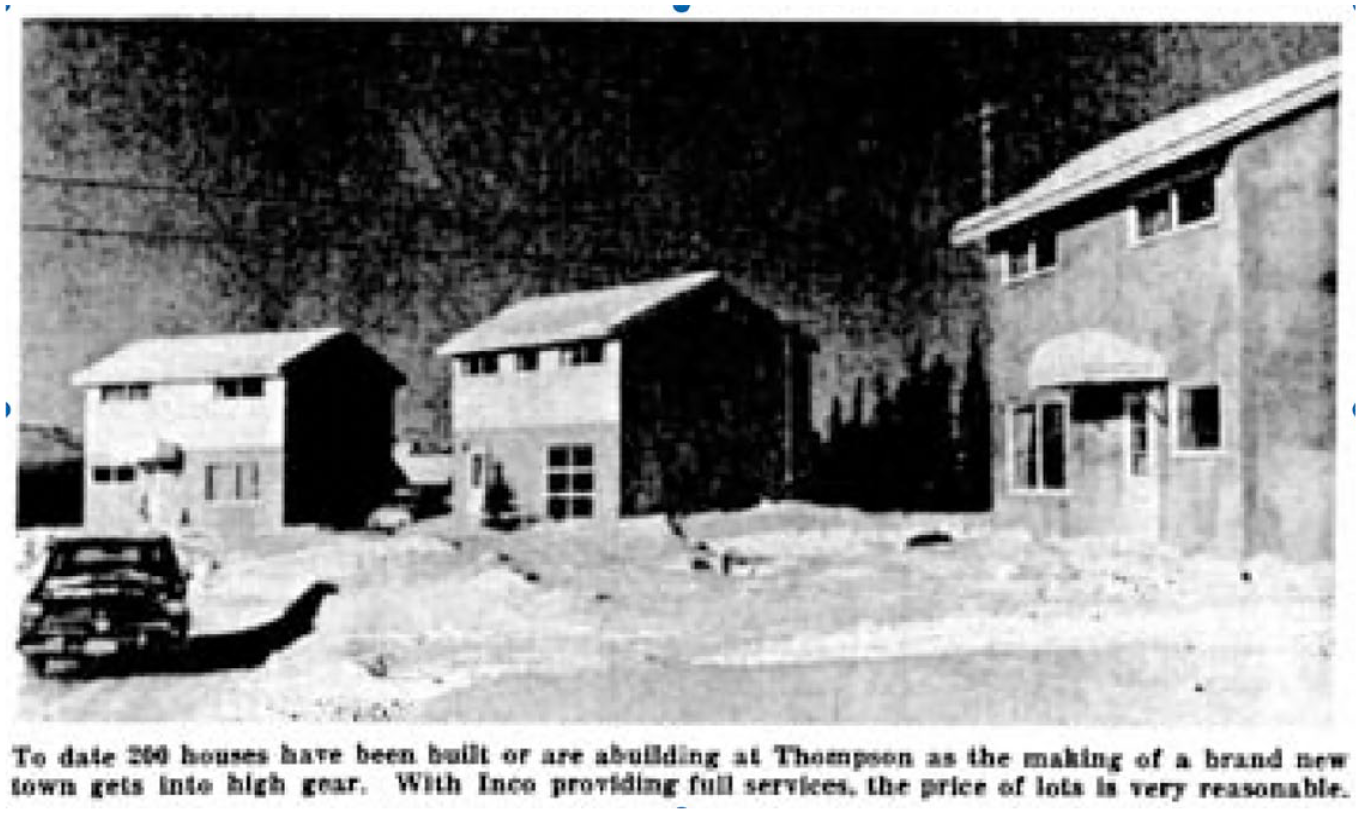
Photography of some of Thompson’s first houses, published in February 1959 in INCO’s official newspaper; The INCO Triangle. 86
This shows that the stereotyping of the Indigenous population was not only perpetrated by individuals within Thompson but also by government authorities.
In addition to discrimination relating to housing and employment, sources attest to the social discrimination impacting this population during these first years.
87
The first social club of Thompson was created in 1960 under the name of Thompson Community Club.
88
It was quickly followed by a series of societies and associations targeting a wide range of the community’s needs.
89
Although it remains unclear whether First Nations and Métis residents could not expressly take part in the activities offered by these various clubs, the town’s official monography implies it. It is said:
So far, the societies, clubs and associations mentioned in connection with the new town were all based on western culture, that is not to say that they forbade the membership of the native Indian, but that a native person probably would not feel comfortable in the type of atmosphere created by a group whose philosophy of life was so radically different from his.
90
Such a statement reflects a certain degree of normalization of the dynamics of exclusion present within Thompson.
Social issues faced by this community led to the creation of the Keewatin Club in 1963, whose mission was to provide assistance to First Nations and Métis residents and to serve as a bridge between Indigenous communities and other communities. 91 Following this first initiative, ongoing issues faced by the Indigenous population led to the creation over the following years of further associations and clubs whose main missions were to defend the rights of First Nations and Métis residents and provide the structures needed for an active social life. 92 These initiatives would contribute to easing the integration of First Nations and Métis in Thompson but would not succeed in eliminating the tensions which had been present starting from the town’s infancy in regard to the role played by Indigenous Peoples. 93
Despite advances seemingly being made in relation to employment and community life, the ongoing housing shortage in Thompson would persist in disproportionately impacting the Indigenous population.
94
The issues brought forth by the limited type of housing being built in Thompson were commented upon even after Thompson’s 1967 incorporation, which also saw the appointment of the town’s first council.
95
In speaking of mining in North Manitoba at a Public Hearing on Housing in Thompson in October 1968, the councilor for the City of Flin-Flon, another company town, would state:
The true Natives of the North—The Indian and Metis are being encouraged to take up employment in the mining communities. This is good and must be increased. However, it is unrealistic to have these people move in a community that cannot provide homes for them.
96
The town’s chamber of commerce also commented the following month on the residential integration of the Indigenous population during a meeting of the Federal Task Force on Housing. They would go further when addressing the issue by stating that INCO’s complete collaboration was necessary for such an undertaking and that a comprehensive residential plan would have to emerge in order to prevent the confinement of this population to a single area, as had been observed in the neighboring town of Churchill. 97
Such measures did not, however, end up being implemented. 98 News of the time emphasized how problematic the housing situation had become for the town’s Métis population. Although employed in Thompson, it was reported that a significant number of them would unwillingly congregate around the town’s railroad switch (see Figure 6) in an area known as The Wye, 99 in what was described at the time as rundown shacks. 100 In late 1967, a journalist from Toronto would decry the situation, which he defined as being caused by INCO’s failure to respect their engagement in facilitating the employment of First Nations and Métis workers. In doing so, he related how the company had effectively “quietly abandoned” the relocation program.” 101 Despite these criticisms, INCO did not consider the situation at the Wye an area of concern. The situation was, however, denounced by a prominent resident of Métis origin and brought to the attention of the provincial government. 102 It was announced, subsequently to a meeting in Winnipeg in 1968, that the provincial authorities would once again intervene in this highly mediatized crisis, following some reticence from Thompson’s mayor (Figure 5). 103 The provincial Ministry of Health would build and manage sixteen mobile homes in the Burntwood trailer court (see Figure 6) in order to house the Métis population in February 1969, 104 with the city’s lack of involvement once again being criticized. 105
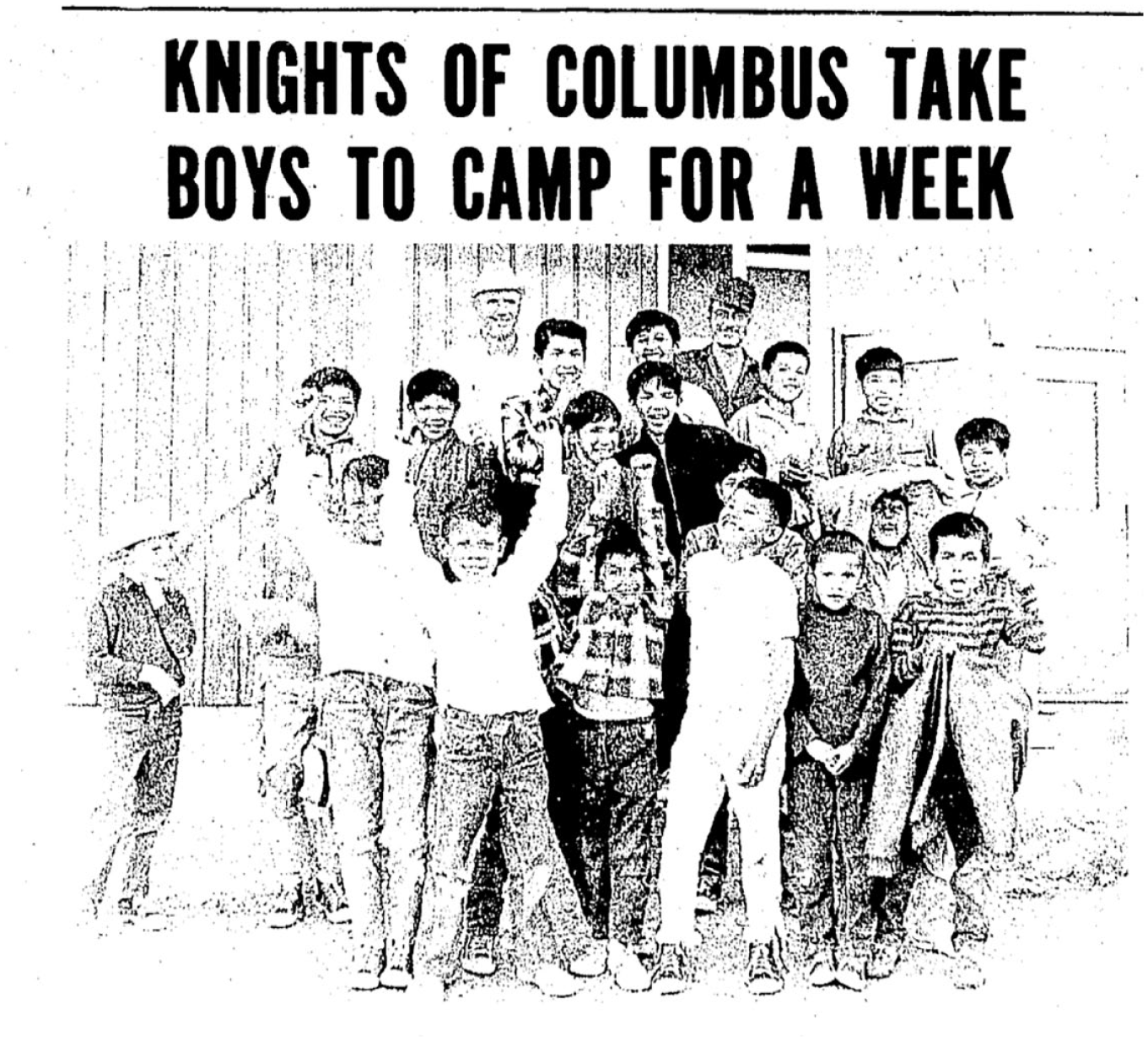
Photography of some of the boys living in the newly constructed mobile homes at Boy Scout camp, as reported in The Thompson Citizen. 106
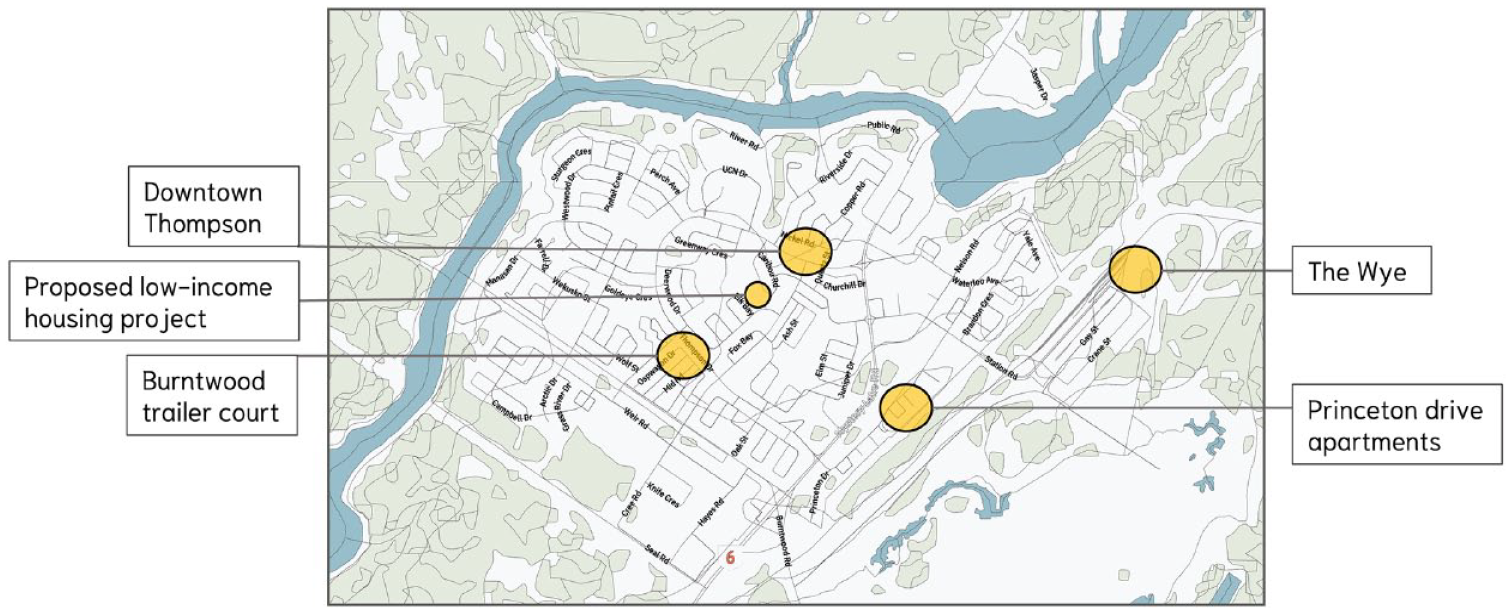
Map of Thompson depicting key areas discussed in the present article. 107
This, in addition to the construction later that same year, of a low rental housing development primarily aimed at single men located on Princeton Drive (see Figure 6), within the new neighborhood of Eastwood, 108 reinforced the existing residential patterns of Thompson for the following decades. Located on the eastern side of the city, in close proximity to the train station and furthest from the town’s amenities, it still remains the area with the highest portion of low-income housing and the area with the highest percentage of First Nations residents. 109 Information provided in local newspapers suggests that although the area was initially planned by INCO, it would once again be built by the provincial government, this time under the Manitoba Housing and Renewal Corporation. 110 It would prove difficult over the years for residents of Indigenous ancestry to attempt to relocate within Thompson owing, in parts, to housing discrimination. A committee would be created in 1969 under the name of “Native Civil Rights Action Committee,” whose mission was to bring to the attention of the different levels of government the various complaints of injustice filed by Native residents. Among those would be “Discrimination when attempting to secure housing.” 111 This would prove to be an issue that would persist for decades to come. 112 In a survey conducted in 2003, 67 percent of a sample of 100 residents of Aboriginal identity interviewed reported having experienced housing discrimination in the last five years. 113 The two most common effects of housing discrimination reported by these residents would take the forms of feeling like they had fewer choices among available vacancies and fewer choices among the city’s locations or neighborhoods. 114 This specific issue would still be denounced in focus groups conducted with Thompson residents of Indigenous ancestry in 2020. 115
Thompson was incorporated as a city in 1970, the same year it reached an estimated population of 20,000, a number which the official census would not reflect, with around 4,000 people working in the mining sector. 116 The sharp drop in the price of nickel, which occurred in 1971, along with the notable labor strikes that occurred in Thompson in 1964, 1974, and 1981, would precipitate the decline of the community. 117 This would, in turn, accelerate the population decline in Thompson, with the most recent population being 13,035, according to the 2021 census. 118 It has been qualified, as of 2021, as one of Canada’s fastest-declining small communities. 119 Despite this noted decline, it remains a northern service center for nearby communities. It further remains a city with significant Indigenous culture, as over 43 percent of the town’s population identified as having Aboriginal identity in 2016. 120 The city has taken active steps toward reconciliation with the Indigenous population in the last few years. Although not explicitly acknowledging the town’s past issues of discrimination, the establishment of the Thompson Urban Aboriginal Strategy (TUAS), a community-based strategic planning committee that focuses on improving social and economic opportunities for Indigenous residents in Thompson, led to the joint signature in 2009 of the Thompson Aboriginal Accord by the City of Thompson and local Indigenous leaders. 121 Part of the accord reads, “The City of Thompson acknowledges the significant contributions Aboriginal people and organizations have made to this community.” 122
In 2010, Vale, which acquired Inco in 2006, substantially reduced the scope of its operations by announcing that it would be closing both its smelter and refinery by 2015, generating vast uncertainty regarding the town’s future, with an estimated loss of 500 direct jobs. 123 Reports confirmed that the surface operations would be the most affected by these closures. Consequently, it is in these lower-paying sectors that the few women and Indigenous employees tend to work. 124 The smelter and refinery ultimately ended up closing in 2018, a year after it had been announced that Vale would additionally be suspending operations of one of its smaller mines in the area. 125 There have been concrete attempts at diversifying the town’s economy following this announcement with initiatives like the Thompson Economic Diversification Working Group (TEDWG), chaired by the City of Thompson, comprised of representatives of both the federal and provincial governments, tribal councils of northern Manitoba in addition to local commercial organizations, which launched in 2011. 126
In the face of the changes in the mining sector and Thompson’s overall economic prospect, it is unsurprising therefore that social and economic difficulties faced by Thompson’s First Nations and Métis residents remain considerable. Housing remains one of the most pressing issues in Thompson, with aging housing stock, high costs for both the private and public sectors, as well as overcrowding being some of the most frequently noted concerns. 127 A survey conducted by TEDWG revealed that housing remained, as of 2012, the city’s weakest characteristics, according to Indigenous respondents. 128 Demographic mapping conducted by TEDWG also depicted that areas within the city that housed the highest percentages of First Nations and Métis residents, namely the neighborhoods of Eastwood and Burntwood Trailer Court, also correlated to the areas having the highest population density, the lowest average household income, the highest percentage of households spending more than 30 percent of their income on rent as well as the highest percentage of population with no high school diploma attained. 129 In the case of Eastwood, a neighborhood that houses one of the highest percentages of First Nations residents, the City has targeted it as an area of focus due to its notable safety and security issues. 130 Attempts at addressing these residential patterns have mostly failed. A notable example is the project conceived in 2009 by provincial authorities aimed at building low-income townhouses and row houses outside of previously determined areas, which was abandoned following strong neighborhood opposition (see Figure 6). 131
In addition, studies note that the city remains defined by its short-term, often circular migrations, with patterns of migrations between nearby reserve communities and Thompson is a frequent occurrence, 132 a phenomenon which replicates tendencies observed in numerous rural reserve communities across Canada. Researchers note that these forms of migration are motivated by a search for better housing, social, educational, and economic opportunities. The disintegration of social relationships, the urban center’s lack of services along with a shortage of affordable and culturally relevant housing often leads to an increase in vulnerability and precipitates incidences of homelessness. 133 The designation of Thompson by the Government of Canada in 2012 as one of the countries sixty-six urban communities facing significant issues with homelessness along with the subsequent implementation of the Homeless Partnering Strategy demonstrate this specific pattern. 134 Figures such as these attest to the lasting effects of the dynamics of exclusion and marginalization which have been present since the town’s creation.
Discussion
The planned community of Thompson, Manitoba, mirrors various Canadian company towns as it is defined by the significant contribution of its racial and ethnic minority workforce. From the onset, the importance of the First Nations and Métis population cannot be understated. Having first taken part in the initial construction of both the town and mine site, they have played a vital role in shaping the community. The role of the Indigenous population remains significant with Thompson still being a vital northern service center.
Literature has supported this idea that we can define Canadian company towns as a whole by their more comprehensive and elaborate forms of town planning. This has led to a sense of community in several company towns across Canada which Thompson exemplifies. It has further contributed to the longevity of several planned industrial communities. Cases such as Thompson conversely support this notion that this sense of community depicted by the parent company would not systematically apply to the entirety of the town’s population, with the active reinforcement by the parent company of this idea of a desirable and undesirable class. Our research reveals that the conception of Thompson as an open town would correlate to social issues being left to the responsibility of the federal and provincial governments rather than to the company itself. This was mostly reflected in residential planning and employment opportunities.
Our research highlighted the difficulties faced by Indigenous workers who had first been hired as survey crews when attempting to secure both housing and employment in Thompson. Coordinated actions by the company such as discriminatory hiring practices, a voluntary lack of involvement in integration initiatives, coupled with the preferential housing opportunities offered to INCO employees, and the presence of an INCO-approved resident administrator having full control over the sale of residential lots would significantly impact the integration of the Indigenous population and circumvent property ownership by Indigenous workers.
However, we previously defined the term exclusion as being in reference to both a coordinated attempt by formal groups as well as a general agreement among the town’s population aimed at excluding a specific minority group. Our research indeed revealed that the dynamics of exclusion that existed and still persist in Thompson resulted from factors going beyond the company’s actions. We identified various examples of personal prejudice and stereotyping, which validated coordinated actions by formal groups and led to the normalization of the exclusion of Thompson’s Indigenous population. Although later responsible for addressing some of the crises that occurred in Thompson, provincial authorities initially worked alongside company officials to elaborate the agreement that led to the creation of Thompson. It is crucial to remember that this agreement did not make any mention of the Indigenous population despite the site for both the mine and the city being located in traditional First Nations territory. Furthermore, we revealed that although they recognized the existence of issues regarding the integration of the Indigenous population in Thompson, they failed to sanction or even criticize INCO’s hiring policies, deeming them to be in accordance with the law. The federal government also contributed to these dynamics, first through the application of an exclusionary housing model, and second by not following through with its relocation program. Lastly, we noted the late involvement of city officials in addressing prejudice with formal steps toward reconciliation, which have only been taken in the last few years.
It is also of interest to acknowledge the various groups that challenged these dynamics of exclusion. These predictably include the various associations and clubs aimed at defending the rights of the First Nations and Métis population such as the Keewatin Club and the Native Civil Rights Action Committee. These further include the local miners’ union, which actively negotiated to prevent employment discrimination and supported First Nations-led protests, as well as local engaged residents who went against collective prejudice and denounced the injustices which took place in Thompson. These examples attest to the fact that there has been attempts at challenging racial discrimination since Thompson’s creation.
Regarding the scale of exclusion established previously, we identified both direct and indirect means of exclusion going beyond personal prejudice, relating to a level 3 on this sundown scale during the town’s infancy period. This progressively decreased to what we could define as a level 2. Considering the emphasis on residential exclusion which we find in the notion’s original definition, we can argue that it is at this level of the scale that we can begin to consider a locality as being a sundown town. Characteristics of a level 3 include being actively barred from taking part in some social activities, as was shown when discussing Thompson’s social life in its first years of existence. It further means that members of the targeted community were generally prevented from renting or owning property, with exceptions. Our research shows that these measures, as was the case in many sundown towns in the United States, would lessen over time without, however, completely disappearing. Government intervention starting in the early sixties would reduce the level of exclusion faced by this population to what would amount to level 2, meaning that targeted groups were prevented from residing within a specific section of town or were compelled to live within previously designated neighborhoods. Our research detailed how these interventions would also lead to the construction of the mobile homes in the Burntwood trailer court and the apartment complexes in the Eastwood neighborhoods. These areas, as we stated previously, remain the areas with the highest percentages of First Nations and Métis residents in addition to being among Thompson’s most disadvantaged areas. It could hence be argued that the city remains at a level 2, with housing discrimination persisting to this day and attempts at building social housing outside of previously determined areas facing strong opposition.
On a more general scale, the specific case study of Thompson gives us insight as to the potential forms of application of the sundown town notion in both a Canadian context and in the context of company towns. It suggests some disparities to the U.S. experience, by focusing here on the substantial effects of colonization and cultural loss on its Indigenous population. Localized dynamics of exclusion as the one depicted in this case find themselves amplified through Canada’s arduous and complex relationship with Indigenous Peoples. Canada’s later period of industrialization, when compared to its southern neighbor, also serves as a determinant in the specific ways in which this phenomenon manifests itself in this specific case. We noticed here how discriminatory ordinances were not as prevalent although more indirect means of enforcement of exclusionary practices were still present, contrasting both previously mentioned cases in the United States as well as earlier Canadian settlements whose creation preceded changes in Canada’s desired collective identity.
This research serves to contribute to the recognition of the role of the Town’s First Nations and Métis workforce and population in the town’s industrialization. It contributes to the restoration of the town’s memory, serving as a way to reclaim the marginalized group’s identity by addressing the gap in the town’s official historical narrative as to the role played by several instances in regard to the discrimination faced by the Indigenous population. Efforts to recognize the city’s past, an aspect we’ve observed in some former sundown towns in the United States, such as Glendale, California, Bluffton, Indiana, and Goshen, Indiana, have proven beneficial in supporting reconciliation and restorative justice processes. These examples have supported the idea that the acknowledgment of a town’s discriminative past can assist in the creation of more inclusive policies and encourage the participation of marginalized communities in the definition of these policies. The city of Bluffton, Indiana, was one of the first to recognize its past as a sundown town. In 2006, the city joined the National League of Cities’ Partnership for Working Toward Inclusive Communities which aimed at initiating an ongoing dialogue on acceptance and diversity. The city further supported this initiative through the use of signs placed within city limits stating the city’s goals of inclusivity. 135 In 2015, the council members of the city of Goshen, Indiana, voted to pass a resolution in which it acknowledged having been a sundown town for two-thirds of the twentieth century in addition to formally recognizing the pain and suffering caused by this practice and defining the steps taken by the city in promoting racial equality. 136 Finally, under the initiative of The Coalition for an Anti-Racist Glendale, a coalition aimed at conceiving and promoting racial justice plans and strategies, the city of Glendale, California, passed a resolution in 2020 in which they apologized for its history as a sundown town. It has since further launched a series of educational programs as part of its pledge to define a more just, safe, and inclusive community. 137
In 2013, the City of Thompson defined inclusivity as one of Thompson’s key goals for the next ten years, an objective that they specified could only be attained by implementing structural changes within both the private and public sectors. 138 There have been notable steps toward reconciliation and recognition of the Indigenous population’s contribution to the city’s development in these last few years, which stemmed from the signature of the Thompson Aboriginal Accord in 2009. These range from localized interventions such as territorial acknowledgments of the Nisichawayasihk Cree Nation on entrance signs and the implementation of Rocky Cree street signs to concrete partnerships with the City itself and the Chamber of Commerce aimed at encouraging Indigenous investment and community inclusion. 139 Vale, which co-signed the accord, has put forth some initiatives aimed at strengthening relationships with Indigenous communities. 140 Such actions undoubtedly represent a step in the right direction.
Nonetheless, the U.S. examples suggest the added potential when addressing inequality and supporting reconciliation of recognizing the role played by both private and public actors if not in shaping, at least contributing in some measure to the issues that persist today. This happened recently in the Canadian city of Portage la Prairie, located in the southern part of Manitoba, where city officials formally apologized to the Dakota Plains First Nation during a historic reconciliation ceremony for a motion that city council passed in 1911 that led to the forced removal of the Dakota People from city limits. Mayor Sharilyn Knox stated:
For me, Truth and Reconciliation means acknowledging the full history of our city, not just the parts that are comfortable or convenient. It means listening to and amplifying the voices of those who have been marginalized and wronged. Reconciliation is important because it’s the foundation upon which we can build a more just and equitable society.
141
It has been evoked that although recognition of the lasting damages of this historical injustice constitutes a significant step toward reconciliation, this needs to keep being furthered through coordinated actions by various formal groups including Indigenous communities, business leaders, federal and provincial authorities, and city councils. 142
Conclusion
Building upon foundational work on the notion of sundown towns and mobilizing specific historical cases, we established a scale of the various forms of racial exclusion which existed in sundown towns in the United States. This scale served as an analytical tool which allowed us to examine the extent of this specific notion in a Canadian company town. It also represented a departure from the traditional binary approach used when assessing potential sundown town cases. The scale therefore constitutes an innovative tool which may be useful for scholars wishing to further the study of the sundown town notion. Investigating the case of the planned community of Thompson, Manitoba, we determined that dynamics at play related to levels 2 and 3 on our previously established scale. This in turn enabled us to establish a connection between the town’s past and contemporary inequalities and dynamics of exclusion. It further defined the role of acknowledgment as an integral part in valorizing the heritage of marginalized communities and in this specific case, their significant role in the town’s industrialization. This stands out as particularly significant in communities affected by the phenomenon of deindustrialization such as Thompson in which tensions and dynamics of ruination are heightened. One implication of these findings is its contribution to the recognition of the town’s past through the renewed visibility of those who have historically been left behind. It serves as an essential component to the definition of strategies aimed at addressing racialized inequality and preventing further racial division, an effect which often accompanies industrial decline. 143
Sundown towns are a phenomenon for which we have seen an increase in interest in the last few years from both the scientific community and politicians. Knowledge gaps remain as to the general applicability of this notion in a Canadian context, a question which the proposed scale could assist in answering. Further research needs to be undertaken on Canadian company towns in general owing to the fact that this specific type of settlement remains understudied in scholarly literature despite their significant role in Canada’s industrial development. The role of the parent companies in addressing racial and ethnic tensions within these communities remains further understudied. Additional research on this specific topic could prove substantial in establishing trends and henceforth analyzing the extent of the sundown town phenomenon within Canadian planned communities. We note here the potential, in further assessing this question, of comparative studies, first between this specific case and the closely located town of The Pas (Manitoba), whose development has been strongly impacted by the pass system and where evidence of deliberate and collective forms of exclusion against the town’s Cree and Métis population has been reported. 144 It would also be beneficial to compare this case to other Canadian company towns with a substantial minority workforce such as Glace Bay (Nova Scotia), in addition to a U.S. case defined by the exclusion of its First Nations population. Examples of such include, as outlined in Appendix A, the neighboring towns of Minden and Gardnerville (Nevada).
This specific study further attests to the potential of oral history as a complementary resource in the study of such phenomena. The approach mobilized here, if useful in assessing the situation, does not provide a complete overview of the situation. Researchers have informed the public of the difficulties associated with the study of such topics, pointing to issues ranging from denial within the local population to the conscious suppression of compromising archival material, with the result being the underrepresentation of such history. 145 The notion of sundown town, especially in the context of planned communities and even more so in a Canadian context remains vastly understudied. In order to further our approach, it would prove valuable to conduct interviews with former INCO workers of First Nations and Métis ancestry. Oral history offers, as specified by High, gives us “insight into everyday lives and a more embodied sense of the past.” 146 It would hence assist in filling in the gap that arises when relying entirely on more traditional research material. Supplementing this study through oral history and firsthand accounts could further reveal the intricacies at play and provide a more thorough comprehension of this phenomenon.
Footnotes
Appendix A
Appendix B
Declaration of Conflicting Interests
The author(s) declared no potential conflicts of interest with respect to the research, authorship, and/or publication of this article.
Funding
The author(s) received no financial support for the research, authorship, and/or publication of this article.
