



Abstract
The paper delves into the role of communist ideology in urban planning during the late Soviet era (1960s-1980s). It claims that the implementation of new urban plans, which aimed at the radical reconstruction of pre-war populated areas, was deeply rooted in socialist ideological stances. However, chronic housing shortages made the associated demolitions problematic and undesirable. By addressing this conflicting situation, the concept of “banal socialism” was introduced. The concept asserts that the decreasing prominence of overt ideology in the reconstruction of historic cities does not imply a weakening of its influence or the rationalization of the planning system. Instead, it suggests that Soviet ideology underwent a process of banalization, a transformation that involved the ideology adopting routinized, mundane, almost invisible form. By examining the case of Vilnius, the paper argues that this process not only significantly influenced late Soviet era urban planning but also played an important role in shaping a distinctive socialist landscape.
Introduction
During the Soviet era, urban development within the communist framework was driven not solely by utilitarian considerations but also by ideological imperatives. This led to the naturalization of the idea of the radical reconstruction of historic cities, which were ideologically seen as vestiges of the bourgeois legacy. A practical factor in urban planning related to the chronic housing shortage and various economic and material deficiencies within the Soviet Union, including Vilnius, which introduced a reluctance toward demolishing habitable dwellings, despite their low valuation by communist ideology. For instance, the 1967 general plan of Vilnius sought extensive westward expansion as a means to avoid the demolition of existing residential housing, prioritizing the growth of housing units. However, these selected peripheral areas earmarked for new construction were not devoid of settlement. They encompassed historic villages and settlements of varying sizes, leading to a paradoxical situation where, despite pragmatic intentions to spare demolitions, they continued in practice. An exemplary case in point is the Viršuliškės district, where planning was initiated in 1971, entailing the comprehensive redevelopment of the settlement, which comprised 369 dwellings. This scenario compels us to reevaluate the role of ideology in the context of socialist urban planning.
To fulfill this objective, Vilnius, the capital of one of the former Soviet Union republics, was selected as the focal point for the case study. In addition, this case study will include examples of urban planning decisions in Moscow, as it served as must-follow model for other Soviet Union cities. The historical capital of Lithuania was first documented in written sources in 1323. Before the Second World War, the city had a population of approximately 194,661 inhabitants, with a significant portion being Poles (128,400) and Jews (53,500). 1 A decade after the second Soviet occupation in 1944, the city entered a period of intense Sovietization though still not yet fully restored from the damages of the war, and the majority of its inhabitants were either killed or displaced. 2 In the subsequent years, due to the repressive policies of the Soviet regime and forced modernization, Vilnius, like the capitals of other Soviet republics, experienced rapid population growth and territorial expansion, far exceeding the urbanization rates of Western countries. 3
The analysis of arguments regarding the demolition of pre-war urban areas during the urban reconstruction of the 1950s to 1980s is firmly grounded in archival materials obtained from local government bodies and various urban planning and construction sector institutions. These materials encompass a range of documents, including urban planning records such as general plans and detailed territorial planning projects, along with associated documentation related to their creation and execution. Additionally, this compilation includes resolutions, decrees issued by local authorities, minutes of meetings, and interdepartmental correspondence. The selection of these materials is guided by the acknowledgment, as highlighted by Alexey Yurchak, that “during late socialism, the newly normalized Soviet ideological discourse no longer functioned at the level of meaning in the usual sense of the word.” 4 Hence, to evaluate the impact of ideology on urban planning, the research adopted a focus on mid-level bureaucrats. Unlike higher ranking officials, the roles and responsibilities of these individuals did not necessitate overt ideological engagement. However, it also eliminated the possibility of questioning or challenging the prevailing ideology. By concentrating on the archival material of key actors within the bureaucratic apparatus, including urban planners and members of the city’s central committee, who served as carriers of socialist ideology regardless of their personal beliefs, the research reveals the presence of ideology in a more substantial form. In accordance with historian Hannah Arendt, 5 we can observe ideology not merely as a set of abstract beliefs or principles but as a dialectical logic embodied in concrete actions and implementations. This approach allows for a deeper understanding of how ideology operated in the field of urban planning during the late Soviet period.
In the historiography related to the topic, the architectural studies devoted to the Soviet period stand out thematically. Within Lithuanian historiography, the examination of demolitions during the Soviet era has primarily revolved around issues related to the reconstruction of old towns. 6 When it comes to urbanization beyond the old town, the predominant emphasis has been on new development. 7 In a broader context, Katherine Zubovich’s monograph, “Moscow Monumental: Soviet Skyscrapers and Urban Life in Stalin’s Capital,” stands out as a dedicated research effort focused on demolitions during a period of intense ideological fervor. 8 Meanwhile, Steven E. Harris addressed this issue by interpreting demolitions related to reconstruction during the late Soviet era as manifestations of socialist gentrification. 9 From a theoretical perspective, the most influential work in this research has been the historiography of the post-revisionist trend, with Alexei Yurchak’s influential monograph, “Everything Was Forever, Until It Was No More,” standing out. 10 Lithuanian historian Tomas Vaiseta’s work, “Society of Boredom: Everyday and Ideology in the Late Soviet Period (1964-1984),” has also been a particular focus of the research. Vaiseta’s work makes a compelling case for the prevalence of ideology in the late Soviet regime, presenting the idea of ideology as a disciplining and mobilizing component of socialization that eventually transitioned into the stage of decommunization. 11
At the end of this introduction, it is essential to provide brief clarifications for the terms used in the article. Within the article, the greatest attention is dedicated to the historical period, including Nikita Khrushchev’s construction reform of the mid-1950s, and symbolically concludes with the onset of perestroika in 1985. A historic city is defined in the text as a complex urban formation that evolved over time, performing all the functions of a city. The article defines the territory urbanized before 1944 as the historic city of Vilnius, emphasizing the new phase of the city’s development that began after the second Soviet occupation. It is important to stress that the article concentrates on the reconstruction of areas considered to be of low value during the Soviet period, that is, the reconstruction of districts outside the boundaries of the old town. This choice is due to the different treatment of the architectural/historical value of these parts of the city during the period under study, the differences in their ideological roles, and the inherent disparities in regulations. Finally, the notions of hot and banal ideology are borrowed from Michael Billig’s theory of banal nationalism. Here, the first one refers to outbreaks of hot, openly ideological fervor, and, conversely, the second one refers to the state of ideology when, in moments of conditional political stability, it takes on an everyday, inconspicuous form.
Banalization of Ideology
If we adhere to the theoretical premise that during the late Soviet period, the communist regime was still ideocratic, 12 it implies that in socialist urban planning, the fulfillment of pragmatic needs was never an end in itself but rather a means to achieving ideological objectives. Consequently, the process of urban development, as a distinct form of communist construction, is considered in the article as an integral part of the process of Sovietization. By considering Sovietization as an attempt to disseminate communist ideology among the masses, we can effectively apply the research approach used for nationalism to study it. Therefore, the analysis of the role of ideology in Soviet urban reconstruction is based on the theory of banal nationalism by social psychologist M. Billig. Billig’s analysis of Western societies led him to conclude that nationalism is not an intermittent mood in established nations but rather an endemic condition. 13 This led to a revision of the definition of nationalism to include forms of ideological power that were rendered invisible by their familiarity.
Distinguishing them from outbreaks of “hot” nationalist passion, which arise in times of social disruption, the researcher coined the term “banal nationalism”: “Banal nationalism is an ideology that allows states to exist, but which, in periods when no obvious political challenges are encountered, takes on a banal, routinized, almost invisible form.” 14 Considering that ideology, first of all, is what this word literally describes: the logic of ideas, 15 we can conclude that banal nationalism does not signify a weakening of the role of ideology but rather its formal transformation. Under the conditions of state socialism, the distinction between “hot” ideological fervor and its banalization could be reinterpreted by introducing a new concept: banal socialism. In this case, banal socialism is understood as an ideology that preserved the fundamental principles of communism and its influence on state formation but, in the changed reality of the late Soviet era, became seemingly inconspicuous.
One potential explanation for understanding the nature of formal ideological changes could be found by delving further into H. Arendt’s ideas. According to her, the smaller the movement and the greater the external pressure, the more energy and attention will be devoted to propaganda. Conversely, the greater the strength of the movement or the more isolated and secure the totalitarian government is from outside interference, the more active the indoctrination will be. 16 Thus, from an institutional perspective, during the era of banal socialism, it was more crucial for authorities not to propagate ideology through forced persuasion of actors but to create and implement noncoercive methods to ensure that they acted in accordance with ideological principles.
On the other hand, based on the research findings, it can be argued that banal socialism, which lends ideology an everyday, inconspicuous character, played a role in resolving or mitigating conflicts between authorities and society, as well as between the center and periphery when addressing problematic issues. This suggests that the process wherein ideology assumes a mundane, hardly recognizable form not only reflects a period of relative state stability, as suggested by M. Billig, but also serves as a means to maintain such a situation. Additionally, considering the inherent ambiguity in communist understandings of architectural heritage 17 and the challenges the new regime faced when trying to realize utopian goals, banal socialism, exercising its power in the form of dialectical logic, 18 served as a tool for addressing latent ideological contradictions. Therefore, the extent to which we can consider the banalization of ideology in autocratic regimes a natural phenomenon and how much it becomes an integral part of the policies implemented by the authorities requires further investigation.
Ideologically Informed Urban Reconstruction
From an ethical standpoint, the pursuit of communism with the goal of achieving a classless society can be seen as utopian. Janusz Słodczyk suggests that utopias in different time periods emerge as a negation of the existing socioeconomic reality.
19
Another notable characteristic of utopias is that their creators envision the urban environment as a visual extension of social theory.
20
Therefore, the complex relationship between communism and the historical environment is a result of both a critical reevaluation of the past and utopian visions of the future. The first of these aspects becomes quite evident in the matter of architectural heritage. Despite Lenin and his comrades’ early recognition of the value of tradition in state construction, the new regime’s policies related to this question exhibited notable fluctuations.
21
Meanwhile, the housing question serves as a focal point for the interaction between the former physical space and the future society. When discussing early Soviet housing policies, Steven E. Harris argued that the Bolshevik government was not providing a cynical justification for ending private property and using housing to control people for its own sake:
Rather than being “weak” Bolshevik ideology on housing would be better described as revolutionary, infinitely expansive, and ultimately tied to the broader project of creating a new society.
22
So during the period of overt ideological manifestation, the premise that historic cities were incompatible with the needs of a socialist society manifested itself in unmitigated destructiveness.
For example, in 1930, when “the fever of the First Five-Year Plan was upon everyone,” orthodox communist A. Miliutin, then Commissar of Finance of the Russian Soviet Federative Socialist Republic (RSFSR), in his book The Problem of Building Socialist Cities (Russian: Проблема строительства социалистических городов), strongly asserted that the cities of that era, products of a society based on trade relations, would die along with it. 23 However, despite the authoritarian nature of socialist modernization, the communist authorities had to take into account the specific economic and material conditions of that period. Sociologist B. Moore, as early as the fifth decade of the twentieth century, drew attention to the ways in which the Stalinist regime sought to reconcile utopian communism with a recalcitrant reality. This involved the abandonment of certain ultimate socialist goals, their relocation to an indefinite future, or their ritualization—symbolic or formalized enactment of ideological goals rather than their practical realization. 24
These aspects were also reflected in the early emerging socialist urban planning system. In a decree issued on July 10, 1935, by the Council of People’s Commissars of the USSR and the Central Committee of the All-Union Communist Party (Bolsheviks) outlining the Moscow reconstruction plan, the competing proposals promoting the complete destruction of the existing city and its preservation as a city museum were deemed unrealistic. 25 However, in the document, which later became the basis for all other Soviet city plans, historical Moscow continued to be critically evaluated by emphasizing its barbaric Russian capitalist character, necessitating a radical and systematic reorganization. 26 This standpoint, regarding historic cities, although losing its former rage, essentially dominated the subsequent decades of urban reconstruction and development projects. C. Kelly’s research on the communist regime’s relationship with the “bourgeois heritage” supports this, stating that throughout the Soviet era, urban development prioritized modernization and new construction. Therefore, objects from previous periods, even if they avoided direct destruction, often remained condemned to slow decay. 27 Moreover, the ideologized perception of architectural heritage was based not on a general respect for the cultural and material legacy of previous eras but on its instrumentalization. 28 Buildings and objects that could not serve the Soviet historical narrative, despite their architectural value, were often considered insignificant and remained outside the boundaries of the state heritage system.
Socialist Reconstruction of Vilnius City
From Hot to Banal Socialism
The urban plans of Vilnius city prepared during the first Soviet occupation and annexation (1940-1941) were not implemented at that time. Thus, this period did not primarily affect the urban fabric of the city, but rather the attitude toward it held by local politicians and architecture professionals. In 1941, a team of specialists sent from Moscow to provide practical assistance in organizing the reconstruction and management of Vilnius assessed the existing city as extremely poor and considered it unfavorable for the development of socialism.
29
At the same time, it rejected the previous development plans as based on incorrect provisions and faulty design methods.
30
After the Soviet Union reoccupied Lithuania in 1944, work on the socialist capital continued. A couple of months after the end of active hostilities in the city, the Secretary of the Central Committee of the Communist Party of Lithuania (b), N. Gridinas, stated at a meeting of the Vilnius city activists,
Urban recovery and construction cannot be separated from planning and architecture. The extent to which Vilnius has failed to meet today’s basic planning and architectural requirements is well known to our friends.
31
Thus, in the postwar period, the ideologized and devalued position of the existing city continued to be followed, but it was no longer formulated as a conclusion limited to Muscovite specialists but as a generally known truth.
The resolution “Regarding the Measures to Rebuild the City of Vilnius,” published by the Soviet Council of Ministers on April 1, 1948, marked a pivotal moment in the reconstruction of Vilnius. Presented to the public as Stalin’s personal concern for the reconstruction of the capital, 32 it not only secured greater financial and material investment for the city but also put more pressure on the local authorities to intensify their reconstruction efforts. 33 In terms of architecture, the primary objective of this period was to establish the new capital of Soviet Lithuania with key representative structures. This involved the formation of a new city center, the reconstruction of two main transportation avenues, a pedestrian boulevard, and an academic quarter and squares containing monuments to Lenin, Stalin, and General Ivan Chernyakhovsky. 34 However, the government’s desire to create a socialist landscape affected not only the city center and the old town but also the more remote areas. One of them was the Red Army (now Savanorių) Avenue, a historic street that connected the city center with the southwestern industrial district and was one of the main access routes into the city. It was important both for the general infrastructure of the city and for the representation of the capital. Thus, as early as 1950, the first-order construction and reconstruction blueprint of Vilnius city already showed plans to demolish all the buildings that bordered the avenue. 35 The demolition of the existing buildings was therefore planned before the detailed project for the reconstruction of the avenue was drawn up. 36 This suggests that the necessity for demolitions, in this case, was one of the initial provisions of the project rather than its outcome (Image 1).

Southern development of the Red Army Avenue, 1955. Vilnius regional state archives.
However, quite radical proposals for the redevelopment of the city seen in the plans for the Red Army Avenue as well as other plans drawn up during this period, in reality, did not fundamentally alter the planned structure of the historic areas and did not cause large-scale demolitions. 37 With the slow progress of the new construction of the city, only a small part of the monumental Stalinist Red Army Avenue was realized. In late 50s, following the launch of domestic reform aiming to move the country out of the housing crisis, a new period of accelerated urban construction and radical modernization of Soviet cities commenced. Referring to the drastic remodeling of entire areas, Nikita Khrushchev’s building reform was evaluated as a return to “heritage iconoclasm.” 38 However, as official policy turned toward the industrialization of construction and the saving of resources, the processes of standardization and bureaucratization of the architectural and planning field intensified. The year 1955 saw the first adoption of the directive urban, architectural, and construction norms—SNIP (the Russian acronym for “stroitelnye normy i pravila”—Construction Rules and Regulations), which left even less room for individualized decision-making in an already rigidly hierarchized urban planning system.
In 1957, at the Urban Construction Design Institute, architect B. Palukaitytė-Kasperavičienė began to work on a project for Block No. 10, which occupied the southern side of Red Army Avenue. It was one of the first urban design projects of this kind in Lithuania, intended for the development of the area with multistory large-panel residential and public buildings, mostly constructed from prefabricated elements. The optimal option for the redevelopment of the area was the demolition of all the existing inferior buildings and the construction of new ones. 39 Meanwhile, the part of the blocks adjacent to the avenue was to be highlighted by buildings of a high architectural level, using high-rise accents. 40 The development of the northern side of the avenue started a couple of years later. The architect Laimutė Bergaitė-Burneikienė was responsible for its layout and development. The new development of the whole of the Red Army District was the largest reconstruction project in the city. In the 1964 All-Union competition of the best-built buildings, the layout and development of Block No. 10 was recognized as the best, and its authors were awarded state prizes.
However, the comprehensive development of neighborhoods with prefabricated houses on nonvacant plots, which required extensive and simultaneous demolitions, proved challenging to implement. The chronic housing shortage that plagued the Soviet Union, and by extension Vilnius, throughout its history, 41 first meant that the amount of habitable dwellings which could be demolished during the reconstruction was strictly regulated. 42 Second, the city’s executive committees were incapable of creating and maintaining an adequate maneuverable housing fund, which was supposed to accommodate evicted inhabitants until the end of new constructions. 43 Thus, the construction of Subdivisions 7 to 9 and Block No. 10 was planned to be carried out in two sequences, in accordance with the current procedure. The first phase of construction was planned to take place in those parts of the blocks with a relatively small number of relocations. In those territories, it was deemed necessary to demolish all objects that obstructed the construction of new buildings and engineering communications. Meanwhile, the demolition of the rest of the old buildings needed to fully improve the site was postponed until a second construction stage. 44
In both cases, the implementation of the second line of construction was immediately considered unrealistic due to the high demolition costs. 45 This meant that, contrary to the architectural vision, in reality not only the individual unreconstructed blocks but also some of the old buildings that had stood in the newly built-up areas remained standing indefinitely (Image 2). Thus, while the modernist solution, like the Stalinist plan, was intended to emphasize the representational character of the avenue, the order of demolition in the development process was dictated first and foremost by pragmatic considerations. However, the hybrid development of the avenue that resulted from this construction practice was not a sign of the diminishing influence of ideology and the increasing level of rationalization of decisions, but a search for constant compromises in the implementation of the ideological goals of communism.
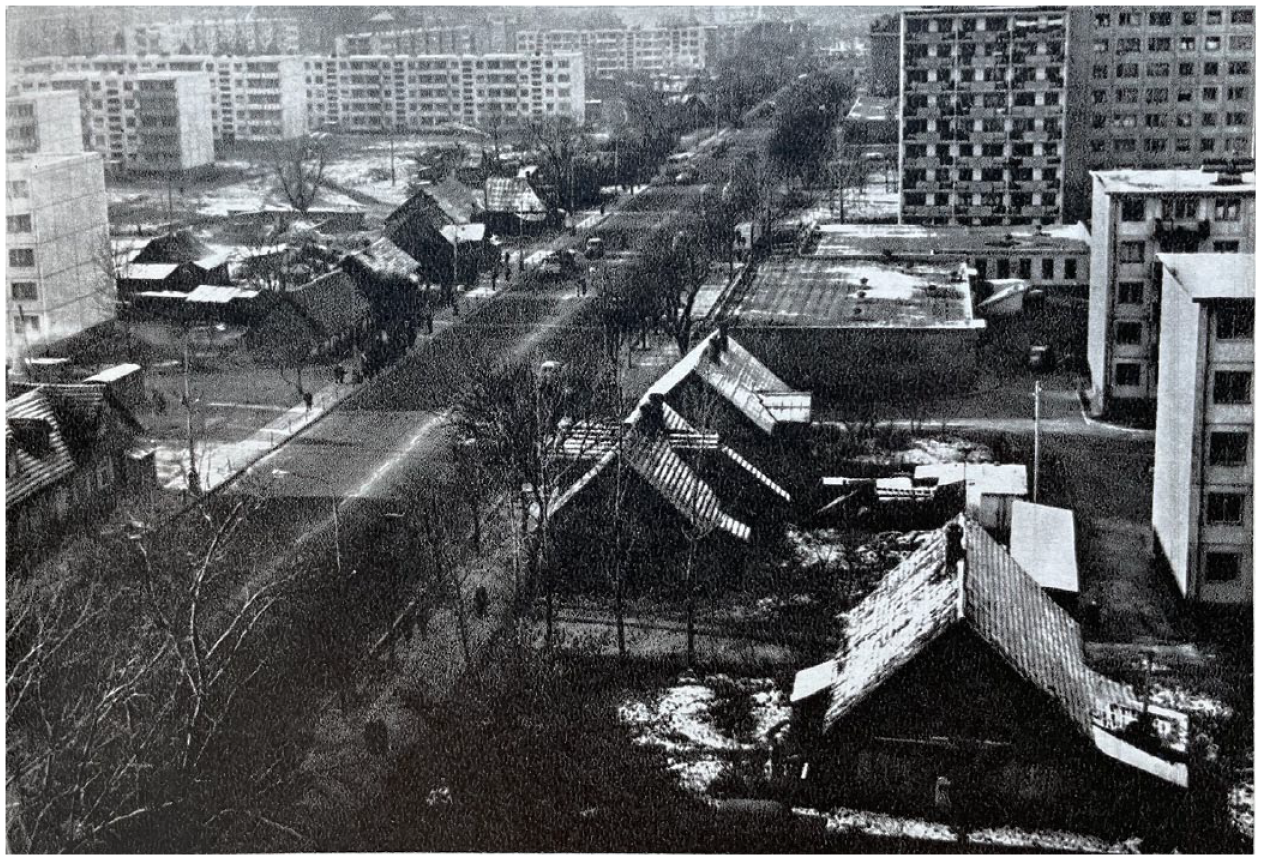
Red Army Avenue. Vilniaus Miesto Istorija: Nuo Spalio Revoliucijos Iki Dabartinių Dienų (Vilnius: Mintis, 1972).
In 1960, the revision of the Vilnius general plan, prepared by the Institute of Urban and Rural Design of the Ministry of Construction of the Lithuanian SSR, divided the historical development of the capital into several urban periods. The most valuable of these was the old town of Vilnius, from the fourteenth to the eighteenth century. The least valuable was the “period of Tsarist Russia and bourgeois Poland,” which lasted from 1795 to 1940. The document pointed out that this period was not characterized by any value in terms of either building or planning and that no special precautions needed to be taken when drawing up a forward-looking general plan for the city. 46 The text specifically pointed out that “in drawing up the general plan, a great responsibility rests with the planners to complete these districts in a manner befitting the period.” 47 Thus, in the assessment of the city of the late Soviet era, which directly affected the nature and extent of the planned transformations, the main criterion continued to be not the architectural value of individual objects and areas but the ideological attitude toward the period in which these objects were built.
As the group of districts to be reconstructed formed a significant part of the urban fabric of the city, the implementation of the general plan as well as the individual projects of the districts was complicated by the issue of residential buildings demolition. In the first-line development blueprint of Vilnius, drawn up in 1961 under the supervision of the architect Kazimieras Bučas, the layout of the new residential buildings was planned on the basis of cost-effectiveness calculations carried out by the same institute. According to the authors of the project, a comparison of the development of Red Army Avenue and the new Burbiškės district planned in the free territory showed that adopting a new area would require considerably more resources due to the high cost of creating new infrastructure than construction involving the demolition of the existing residential area. However, the cost-effectiveness of built-up areas was better only in the first phase of construction. The higher number of demolitions required for the second phase of construction made it economically unviable. 48 Thus, already in the same year, at a meeting of the Construction and Architecture Commission of the Vilnius City Council of Workers’ Deputies, the chief architect of the city Vladislovas Mikučianis, commenting on the prospective twenty-year master plan of Vilnius, said, “It is planned to expand the construction of new districts so as to minimize the demolition of the old houses.” 49
Hot Banal Socialism
In the late 1950s, a generation of local modernist architects, who had graduated in the postwar period, began to dominate Lithuanian architectural life. 50 In 1962, V. Mikučianis, who had been sent from Moscow as the city’s chief architect, was replaced by Gediminas Valiuškis, a graduate of the Vilnius Art Institute. It was no coincidence that in this period, the idea of the growth of Vilnius in a northwesterly direction would begin to be seen not only as a pragmatic motive but also as an architectural ambition. At one of the meetings of the Permanent Construction and Architecture Commission of the Council of Deputies, architect Juozas Vaškečius, from the Design Institute, described the future development of Vilnius, envisioning the new part of the city as a new contemporary city with a population of one hundred thousand inhabitants. 51 However, the areas chosen for urban development, which were described as vacant, were not entirely free from buildings. One of the most densely populated areas for new development was the historic Viršuliškės village. When the plans for the new district started to be drawn up in 1971, there were 369 residential buildings from different periods with 34,428.0 m2 of living space, as well as a number of institutions and enterprises. 52 However, on the instructions of the chief architect of Vilnius, only two objects had to be taken into account when drawing up the detailed layout plan: the feather factory Žuvėdra and the Sudervės cemetery.53,54
This resolute decision did not go unchallenged. In 1972, an official letter was handed to the director of the design institute stating that the executive committee of the Vilnius City Council, after inspecting the existing development of the village of Viršuliškės, had decided that when designing the II and III subdistricts of new residential area, it was necessary to preserve all postwar houses. The same document explained that, due to the fact that the area of the I subdistrict was the densest village at that time, its design had been postponed until a later time. The planners were also reminded that, in the case of new transport routes, it was necessary to look for options and choose the one that would allow the least number of dwellings to be demolished. Only if necessary, the executive committee considered it possible to envisage the demolition of twelve (exact addresses were provided) prewar houses. 55
The architects did not welcome the local authorities’ efforts to minimize demolitions to economize on the project. According to the authors of the project, the decision to plan the development only for the southern part of the Viršuliškės district made the design more difficult because it did not take into account the strong relationships between the street layout, zoning, and architectural compositional design.
56
The architects also expressed their disapproval of this solution and diplomatically described it as “unusual” in their calculations of the living area and population.
57
However, it can be assumed that the main reason for this dissatisfaction was not the difficulty of preserving the existing built-up area by implementing mandatory planning norms but the inconsistency with the socialist vision of the city. In 1973, the members of the Vilnius City Building and Architecture Council, most of whom were architects, raised concerns that the existing individual houses, which were being left in the foreground of Kosmonautų Avenue, would look unusual without significant additions and refinements, and continued:
Therefore, only after a major reconstruction of these houses with a significant addition and refinement of their form, they will be able to have a tolerable appearance along the city-wide highway—Kosmonautų Avenue. Each house will need to be individually measured and individually designed. . . It would probably have been much more correct to demolish these houses.
58
So, in a hearing chaired by the city’s chief architect, it was shown that, unlike on Red Army Avenue, the demolition of the existing development was the most rational solution at the time 59 (Image 3). However, this decision, which was later implemented, required a common ideological attitude that the existing buildings could not remain in their original form in a socialist city. Thus, this openly undeclared ideology shaped the city not only through top–down decisions but also involved the activities of professionals in the architectural field.
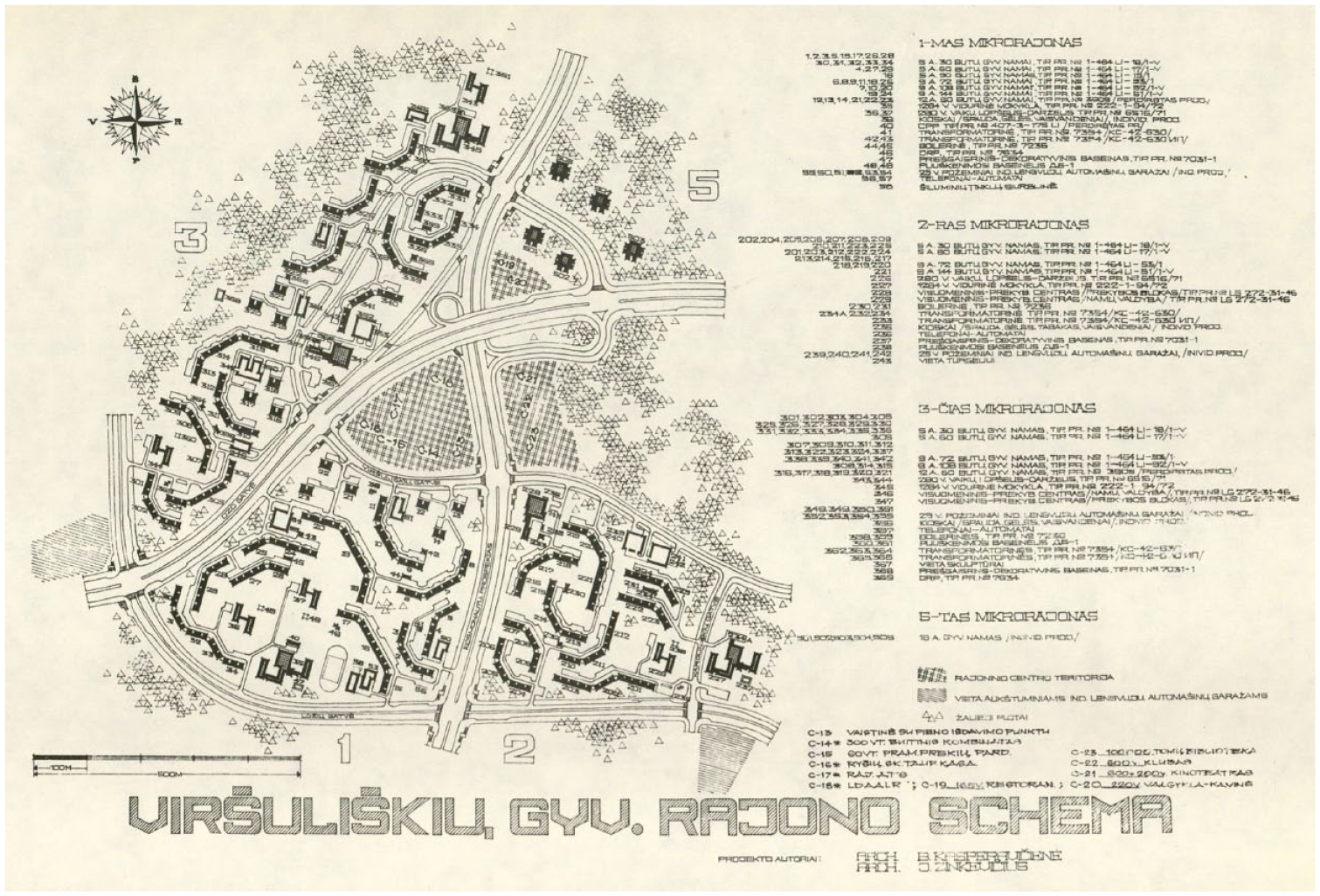
Viršuliškės residential district plan, 1974. Vilnius regional state archives.
Thus, in the late Soviet period, the cost of demolishing old buildings and the associated constraints on the reconstruction of historic districts encouraged priority to be given to the construction of new socialist neighborhoods. 60 The development of new districts also offered greater opportunities for architects and engineers to realize their professional ambitions, which, combined with national aspirations, played an important role in the Lithuanian field of architecture at that time. 61 However, the uneven development of the city did not go unnoticed by contemporaries. In 1973, Jurgis Vanagas, one of the most influential urban theorists in Lithuania at that time, in his review of the technoeconomic foundations of the Vilnius general plan for 2000, stated that the extensive development of the city, as a massive program of residential construction, was in fact being carried out at the expense of the reconstruction of individual districts of the city. Although the architect invited his colleagues to bear in mind that this was not only a technical urban issue but also a social one, 62 it was nevertheless interpreted exclusively as a problem caused by the calculation methods used in the planning field, which were based on the generalized averages of housing stock data. 63
Thomas M. Poulsen, one of the members of the U.S.–USSR Agreement on Cooperation in the Field of Housing and Other Construction Working Group, in the 1980 report stated that the shortcomings of urban planning and plan implementation in the Soviet Union did not mean that Soviet cities lacked common characteristics. According to the researcher, the situation was the opposite:
Thus, outside of the showpiece centers of Moscow, Leningrad, and Kiev, Soviet cities appear to have concave rather than convex cross-sectional profiles. Their cores remain relatively unchanged nineteenth-century squat wooden towns while the new construction has occurred mainly in peripheral rings, beginning with the five- and six-story walk-ups of the Khrushchev period followed by the multi-floor high-rises of the Brezhnev era.
64
In this respect, Vilnius became a typical case of socialist reconstruction of historical cities, which suggests that banal socialism was not a local but a general phenomenon of the Soviet Union.
Aftermath of Banal Socialism
The data reviewed suggest that socialist urban planning and development procedures during the late Soviet era in Vilnius were deeply rooted in an ideologically charged negative stance toward what was perceived as the “bourgeois” legacy of the years 1795 to 1940. This ideological perspective not only became widely accepted as an unquestionable truth but also seamlessly integrated itself into various bureaucratic processes. In banal socialism, such ideological stance manifested itself mostly in the form of dialectical reasoning, consequently causing the entire urban planning system to assume an appearance of rationality. Thus, in the late Soviet era, the primary focus shifted from justifying the ideological necessity of demolishing prewar constructions to the more practical concern of determining which demolitions could be executed immediately and which needed to be postponed until favorable economic and housing conditions arose. From a contemporary perspective, it becomes evident that this banalization of ideology played a pivotal role in preserving it even after the dissolution of the Soviet Union.
For instance, in Lithuania, it took nearly two decades of independence from the Soviet Union for the wooden architecture of cities to shed its label of “inferiority” and be recognized as a unique cultural heritage. The Strategy for the Protection of Wooden Architecture Heritage was approved in Vilnius municipality in 2006. 65 It was not until 2018 that the historically significant Žvėrynas district, once considered for demolition during the Soviet era, was officially acknowledged by the Department of Cultural Heritage under the Ministry of Culture and added to the cultural heritage register due to its architectural, landscape, and urban value. 66 This gradual shift in architectural valuation also prompted critical reflections on the “naturalness” of the demolition process itself, leading to discussions about the destruction of heritage and its implications for the historical legitimacy of specific ethnic and religious groups. 67 These examples remind us of Billig’s warning that it would be wrong to assume that “banal nationalism” is “benign” because it seems to possess reassuring normality: “As Hannah Arendt stressed, banality is not synonymous with harmlessness.” 68 Therefore, the critical evaluation of ideology’s influence on urban planning and its long-lasting effects remain pertinent issues in today’s urban studies of former USSR republics, warranting further investigation and research.
Conclusion
The unique role of the physical environment in communism meant that urban development during the Soviet era had to fulfill not only utilitarian needs but also ideological requirements. Consequently, in urban reconstruction, the demolition of historic districts, especially outside the old towns, was often seen as a fundamental requirement for socialist cities development. However, the chronic housing shortage and other economic and material deficiencies in the Soviet Union led to hesitancy in demolishing habitable dwellings. Analyzing how this contradictory situation was addressed in the case of Vilnius city suggests that ideology continued to play a crucial role in urban planning during the late Soviet period. Yet, unlike earlier times, hot ideological engagement was replaced here by banal socialism. During a period of relative stability, when the fundamental principles of communism were not questioned, ideology took on an everyday, almost invisible character. Nevertheless, banal socialism did not limit itself to mere changes in ideological discourse; it gradually became evident in the landscapes of reconstructed historic cities. The specificity of urban space under State Socialism was primarily shaped not by the rationalization of the planning system but by bureaucratic pragmatism. Rooted in the dialectical logic of communist ideology, it constantly sought compromises between its utopian goals and the actual possibilities of their implementation.
Footnotes
Acknowledgements
The author thank her colleagues at the Department of History, Vilnius University. Their professionalism in confronting the complexity of Soviet historical sources has been an invaluable lesson. Special thanks to the editor, Dr. David Goldfield, and the reviewers for their thoughtful comments, which provoked new questions and greatly contributed to improving this paper.
Declaration of Conflicting Interests
The author(s) declared no potential conflicts of interest with respect to the research, authorship, and/or publication of this article.
Funding
The author(s) received no financial support for the research, authorship, and/or publication of this article.
Notes
Author Biography
 .
.