




Abstract
In the Soviet era, a long-lasting idea of collective housing was implemented in various forms, most notably, constructivist “house-communes” (doma-kommuny) of the 1920s. This article considers less-known realization of collective housing in late-Soviet Russia, by focusing on the project of “Youth Residential Complex” (MZhK). Starting in 1968, this project was declared as an experiment, in which residents had to participate in the process of design, organization, and management of their housing complexes. Future residents also had to work on the construction site for several years, building housing with their labor and earning, in such a way, the right to live in it. Based on this case, this article re-emphasizes the agency of residents’ collectives and grassroot organization as an essential but neglected part of late-Soviet urban development. In contrast to the common narrative of the top-down provision of apartments by the state, it demonstrates that bottom-up collective practices were behind a major housing project, with ample consequences for both people concerned and urban development. While the history of self-help housing construction is firmly embedded within the context of crises and austerity, in the Soviet context, participation in self-help project was regarded as a privilege, leading to a single-family apartment ownership and exclusive urban services, otherwise unavailable in residential districts.
Keywords
Introduction
Once on a spring Sunday, groundwater damaged the power cable. It was unclear what exactly happened but in the evening, it became obvious that no one would fix it. So tomorrow, on Monday, the kindergarten would not be able to operate—this is an emergency. What to do? At 11pm, Evgenii Korolev, chairman of the MZhK [residents committee], briefly asked: “Can we fix it?” And until four o’clock in the morning, more than seventy men from a 213-apartment building were digging up a damaged cable in the rain. In terms of maintenance service, just a trifle remained—connecting the cable’s broken ends. The work week began as usual.
1
A story of the residents of a large housing estate digging a hole in their own backyard to carry out major infrastructural repairs is a strange one. Nothing seems to be typical in it. Why did no one fix the cable? Why did the residents have to do it themselves? Is it about the failure of communal services during the country’s stagnation? This piece was published in a book by Galina Karelova, who was the chairman of the residence committee of this district, where this event took place. She provides this story to make a different argument though. This story was published in a book about an urban district in Sverdlovsk (now Ekaterinburg), called Youth Residential Complex (Molodezhnyi Zhiloi Kompleks or MZhK) constructed in 1977-1986. This housing district had a peculiar design: Housing blocks were supplemented with extensive collective services and public facilities. Sanctioned and aided by the government, MZhK complex in Ekaterinburg was built with self-help methods—resident’s participation in construction. Assisted with a limited number of professionals, most administrative and construction work was done by the residents themselves: “multi-storey buildings, a clinic, a cultural center, a children’s art station, and other premises. Everything—from the foundation of the first house to the playgrounds in the courtyards—was built by the hands of the residents of the MZhK themselves.” 2 In her book, Karelova argues that the whole project was an experiment in cooperation and grassroots organization, which strengthened bonding between families and helped building a collective with meaningful relations, as she continues: “our collective is devoted, by its existence, to prove the possibility, or rather, the need for joint activities to solve the complex educational social and everyday problems.” Major infrastructural repair of the power cable, in her story, is an ultimate example of such “joint activity” enabled by this collectivist drive. 3
The MZhK project emerged during dire economic shortages of the late Soviet Union. Due to labor shortages, the growing ineffectiveness of the central administrative system, and chronic shortage of labor, housing delivery was going behind schedule. 4 Family living was cramped, and a single apartment was a great privilege in the late Soviet Union. In this context, the movement of the Youth Residential Complex started as an experiment in self-management and cooperation of residents in 1968. The first housing complex was constructed in Korolev (Moscow region) in 1974, and the project continued with other housing complexes. Peaking during perestroika, it grew into a mass movement, with more than 700 self-built complexes constructed across Soviet Belarus, Ukraine, and Kazakhstan. 5 While in many aspects MZhK complexes differed from one another, each one involved some form of resident participation in the construction process. The design of MZhK complexes differed from the general standard Soviet residential typologies: Not limited to residential towers, they often included adjoining collective service blocks. In both Korolev and Ekaterinburg districts, extensive collective facilities were constructed: childcare institutions, recreational facilities, and clubs. After the construction, residents took on obligations to run many of these facilities, organizing festivals, children and sport events, and various clubs.
Stories about self-help construction and self-administered collective services in Ekaterinburg stand in sharp contrast with the mostly conservative view on the delivery of “alienating” districts of mass housing in the recent scholarship. 6 Self-help construction is a collective process as such, where skills are produced and new relations among participants are formed. 7 Late-Soviet years are discussed in terms of “privatization” of every-day life, vanishing of socialist values of collectivity, and growing pragmatism and individuality. Provision of housing is often seen as a state-led production and distribution of private apartments, which seem to strengthen such individualism. In this context, Soviet citizens are seen as rather pragmatic individuals, pursuing individual interests whenever possible and passively expecting welfare handouts from the state while avoiding participation in collectivist projects. 8 Historians have shown that on a lower level, collective experiences were part and parcel of late-Soviet everyday life, and Soviet citizens had to actively cooperate to achieve basic daily goals. 9 Late-Soviet years represented a productive time for various types of self-organization. However, literature discusses these practices normally on a limited scope and concerned free time, focusing on hobbies and everyday activities. 10 The case of MZhK advances this literature, demonstrating that self-help practices were behind a major housing project, with ample consequences for both people concerned and urban development. This article shows that such scale of the project required development of a complex model of cooperative economy for mediating responsible dependencies among members and vesting residents’ collectives with significant rights over urban development.
The study of residents-led construction allows us to expand the existing historiography on self-help housing construction. Cooperative housing with the principles of self-help and mutual aid first became widespread in Western Europe in the mid-nineteenth century and spread to the Union of Soviet Socialist Republics (USSR) and other countries not long after. 11 The history of self-help practices is firmly embedded within the context of crises and austerity and centered around a single-family, detached house, or a low-rise dwelling. While, the years of the MZhK project were also a time of severe economic shortages, self-help practices, arguable, were not limited to austerity measures. Participants were mainly middle-class professionals; participation was highly competitive, and candidates had to “earn” their right to be part of the project by entering “socialist competition.” Observers contemporary to the project also clearly saw participation in the project as a privilege, as they condemned it for compromising the general queue of housing provision, putting young people in a privileged position, and creating a questionable shortcut for obtaining accommodation. 12 Moreover, while in most cases of self-help construction, participants “pool their skills and labor” to build small, single-family, detached house or a low-rise building, MZhK represents an unusual case of self-help construction of a large housing estate with panel tower block. This article demonstrates that the project originated within the economic crises of the final decade of the Soviet era, resulting in a distinctive blend of a robust house-building industry and a severe scarcity of labor. The case of MZhK allows us to discuss the meaning of collectivism in late-Soviet years in the context of privileges, socialist ethics of collectivism and scarcity. It may help to re-emphasize residents’ agency in the late-Soviet time and to point out grassroot as an essential but neglected part of late-Soviet urban development. MZhK highlights some of the paradoxes of wealth in the late Soviet Union. Owning a single-family apartment was a tremendous privilege. The MZhK project was favoring MZhK participants; yet, this privilege was achieved by an exacting labor at construction sites, sleepless night and mastering professions, which few will later use.
Finally, this article contributes to the literature on socialist collective housing. This body of literature has a strong focus on the post-revolution years. 13 In the 1920s, collectivism was seen to dramatically shape society according to revolutionary principles. It influenced architecture, most notably inspiring a vision of “house-communes” (doma-komunny). Immense scholarly attention was paid to the house-communes, to the extent that they became one of the major brands of revolutionary avant-garde. However, despite the centrality of the rhetoric of the global restructuring of everyday life in the 1920s, most of these housing projects remained an idealistic vision, rather than actually functioning housing. Few buildings with experimental housekeeping were implemented in Soviet Russia, and none of them functioned in accordance with the initial project. This article argues that the visions of collective housing of the 1920s have not just vanished, being substituted by the Stalinist discourse of individualization. 14 It shows that less-known re-articulations of collective housing in the mid-1960s formed a productive base for the late-Soviet residents-run housing in the late-Soviet time. In contrast to the housing communes of the 1920s, the ideology of communist living played a less significant role in the MZhK project, and these late-Soviet articulations of house-communes produced more than a romantic architectural vision of collective housing. The MZhK project involved extensive development of the supporting socio-economic base of cooperative housing, producing an economically viable model of collective housing which saw its way into mass implementation, and in the last Soviet decade, it turned MZhK into a mass movement on the level of the whole country.
This article analyzes the story of Soviet collective housing movement, first, looking at official articulations of the project, development of the corresponding socio-economic and legislative base and, second, looking at actual construction and running of MZhK district in Ekaterinburg. The first part shows that the MZhK emerged at the intersection of two concepts—an architectural model of a cooperative housing commune, developed in the 1960s, and Komsomol practices of self-help construction. The second part discusses the actual implementation of collective housing principles, looking at MZhK complex, constructed in Ekaterinburg in 1977-1986. Based on this case study, it looks how participants re-articulated some high-mined principles of socialist collectivism and self-management. Looking at lived experience of collectivism, it analyzes how housing was used to mobilize active participation in socialist construction, as well as privileges, inequalities, and challenges it created.
The movement of MZhK was discussed in multiple of publications, as participants and researchers contemporary to the project created a large body of literature on the project’s main features while the project was ongoing. However, there are few recent critical studies of MZhKs. 15 This article relies on these published sources, Soviet popular and professional press, complementing them with archival materials and the recollections of former practitioners—both in verbal and textual. During my fieldwork in Ekaterinburg in 2019, I have conducted eleven semi-structured interviews with the former participants of the MZhK project: members of the project’s board, architects, foremen and construction workers, and people in charge of running collective services. While my respondents benefited from the project and tend to describe it in favorable terms, I also introduce a needed critical correction to these interviews, complementing them with social science literature and archival sources.
Part 1. Developing a Model of Residents-Managed Housing
While individual apartments were at the center of the Soviet housing program, Khrushchev’s Thaw re-energized the drive to the “socialist democracy” through the transformation of everyday life and collectivism. 16 Collectivist discourses became increasingly influential during the Thaw Khrushchev’s reforms of de-Stalinization aimed at repudiating coercion and establishing a social policy based on collectivism. 17 Such historic context provided room for “remembering the avant-garde” architecture, in the terms of Stephen Bittner. 18 According to architecture historian Vigdaria Khazanova, the discussion about collective housing started with “almost a similar vigor,” as in the 1920s. 19 One project that responded to these trends was the House of the New Way of Life (Dom Novogo Byta or DNB) (Figure 1). 20 This residential project, realized in 1964-1971 in Moscow, projected new forms of social and private life and means of socialization for residents. Apartments in the DNB were tiny, with no kitchens and only hotplates for “episodic cooking.” The reduction of private spaces was balanced by collective facilities, such as halls for communal dining and childrearing. The building also provided other benefits, such as a cinema, club halls, and storage rooms with communal vacuum cleaners, which were even featured in Soviet films 21 (Figure 2). With such design, the project responded to the discussion of house-communes and, in the words of Richard Anderson, represented a “revised version of the housing commune” due to its similarities with avant-garde housing. 22
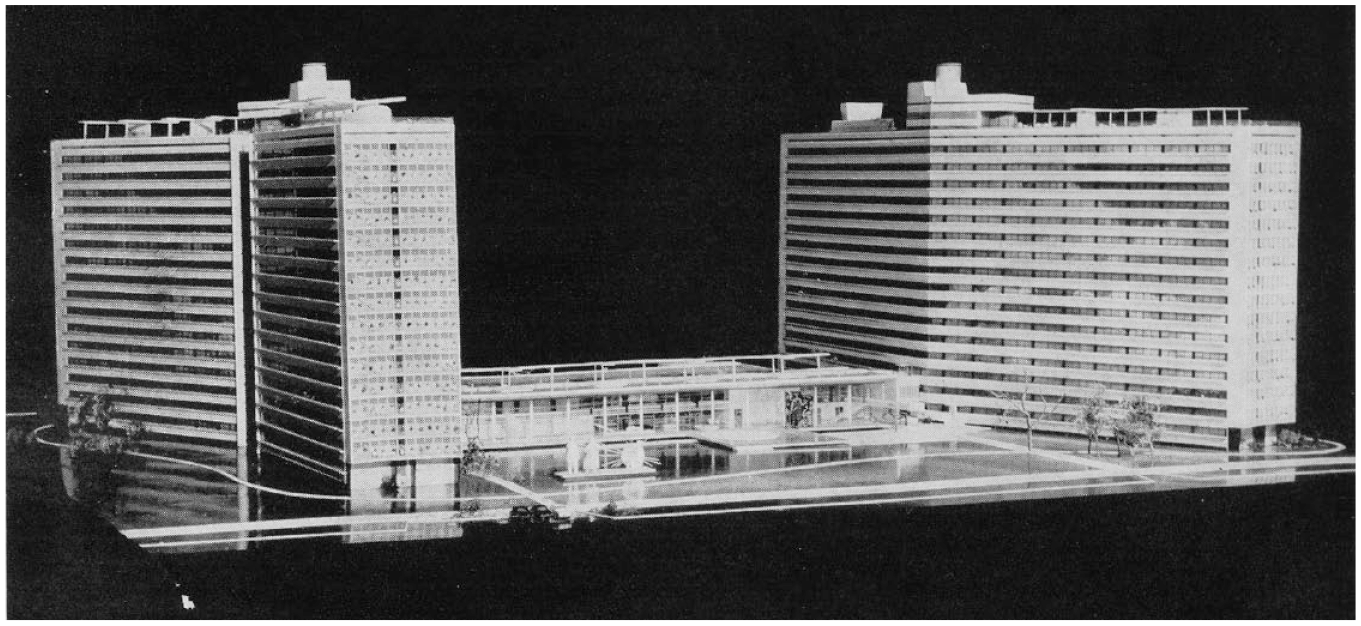
Architectural model of the House of the New Way of Life.
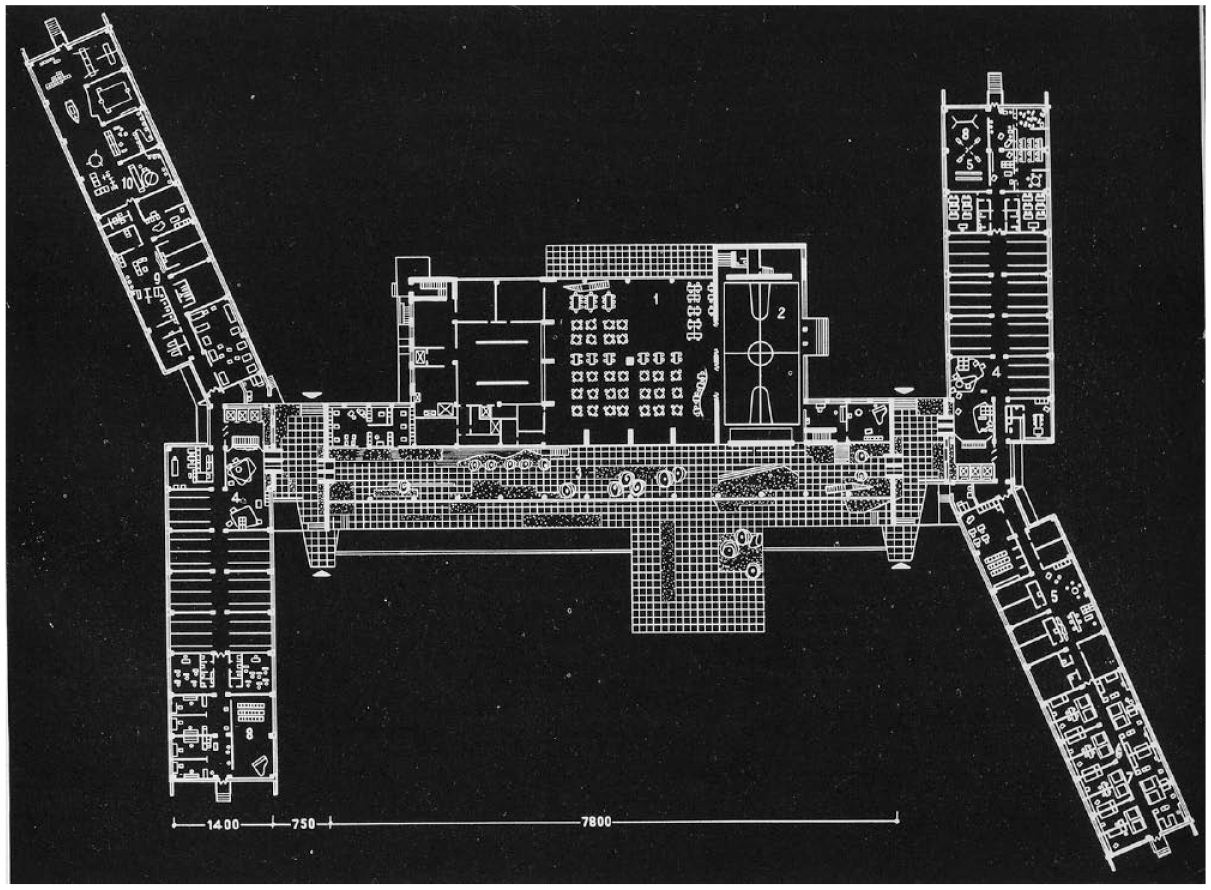
Plan of the ground floor of the House of the New Way of Life complex, with a dining hall, universal hall, winter garden, housekeeping department, two clubs, children’s room and a medical center.
Even the name of the project—House of the New Way of Life—implies a reference to the post-revolutionary avant-garde housing. The discussion of the “new way of life” (novyi byt) was central for house-communes of the 1920s. 23 In house-communes, architecture was explicitly seen as a vehicle to inculcate a new mode of life into the residents—to “organize people to perform socialism according to local ambitions and requirements.” 24 The vision of house-communes was firmly based on collectivist discourses. According to Moisei Ginzburg, collective housing had to, most importantly, facilitate “new relations falling under the notion of community.” 25 For example, Narkomfin’s Communal House with fully communalized kitchens, dining rooms, baths, and a children’s creche was to facilitate interactions between residents, which will eventually assist creating a collective with meaningful relations. 26 A specific type of “co-habitation collectives” (bytovye kollektivy) were conceptualized as the application of the Soviet concept of collective into housing. 27 As we will see, the discussion around collective housing in the mid-1960s revitalized not only avant-garde architectural forms but also these collectivist concepts.
In the DNB project, socio-economic questions of a collective housing complex were put at the center of the discussion. In the context of the severe housing shortage of the 1960s, a residential complex with gardens, gym, and canteens could hardly be understood as anything other than a fantastic luxury. Architects, instead, insisted that the aim of the project was not to create an act of favoritism but a viable model of social and economic organization that could be replicated elsewhere. Multiple benefits of the housing complex were based on cooperation of residents. All bonuses of the collective services could be provided only under particular conditions and with certain extra responsibilities. Residents would not only live in flats with highly reduced private space, they would have to run most services with their own labor, to make the complex less dependent upon paid staff. The discourse of cooperation was key in presenting these housing complexes not as a singular privileged development but as a model for society as such. The housing complex was envisaged as an environment designed for families “interested in creating a co-habitational collective (bytovogo kollektiva), based on self-sufficiency and self-governance.” 28 Framed in this way, the central aim of the project was to develop an economically viable model of self-sufficient residents-run housing.
The centrality of the cooperative economy in housing complexes raised many questions: How to legally define an economy based on relations of responsible dependency between residents? How to make sure that residents invest sufficient time in running facilities? How to measure the rate of participation and cooperation between them? What to do with the spoilsports? In answering these questions, the project produced a large interdisciplinary body of research. 29 The social program of collective housing was developed in collaboration with the Institute of Philosophy of the Academy of Sciences of the USSR. 30 The prognostic investigation into the future of daily life involved fifteen research institutes, six chairs of higher educational institutes, and seven branches of the boards of the Moscow State Committee 31 —“in all more than 150 persons.” 32
In multiple publications, authors described to the DNB as a “social experiment.”
33
Social experimentation was used by Soviet social scientists as a method of investigating the reaction of a social group to certain internal or external factors.
34
The concept of social experimentation was intertwined with the concept of a collective. Social experiments, in the theory of the 1960s, were conducted on particular collectives under the supervision of experts. Collectives implemented this experimental program upon themselves, creating new subjectivity and new types of social relations: An experimental program is implemented by a collective; this collective under scrutiny is the object of research. While the experimental program is being implemented, this collective continues to perform its main functions, which may or may not coincide with this program.
35
Specific social experiments were conducted in pedagogy and at enterprises, where they had socio-economic aims. The project of DNB redirected this method to the sphere of housing, as it had to provide a setting for such a collective undergoing such a social experiment. One of the authors, Kanaeva, referred to the DNB as a “social-spatial formative experiment”—a “laboratory” which had to develop a viable model of cooperative housing. 36 The concept of a collective was seen as a base to build a cooperative economy in the project. Discussing the project, architect Platonov considered that managing “disorganized people” in a housing complex would represent an impossible task. He suggested instead that tenants should be assigned to a number of “household collectives” with an overall number of no more than 2,500 people and housed in a separate residential complex, so that such household collectives “could be controlled.” 37 Another author of the project, Irina Kanaeva, argued that the selection of residents would not only be based on their housing needs but also on their willingness to participate in the establishment of a “co-habitational collective,” directly referring to the terminology used in the context of house-communes. Residents would have to run most services with their own labor, to make the complex less dependent upon paid staff. Theoretically, more than two thirds of all the operators of building services would be volunteers from among the residents. Authors suggested that coaching staff and workers in the cultural sector would all be volunteers, and elderly residents with medical backgrounds could volunteer as nurses. 38 In this framework, the multiple privileges of housing with services were seen as an economically justifiable benefit, unleashed by a collective in a specially designed environment (Figure 3).
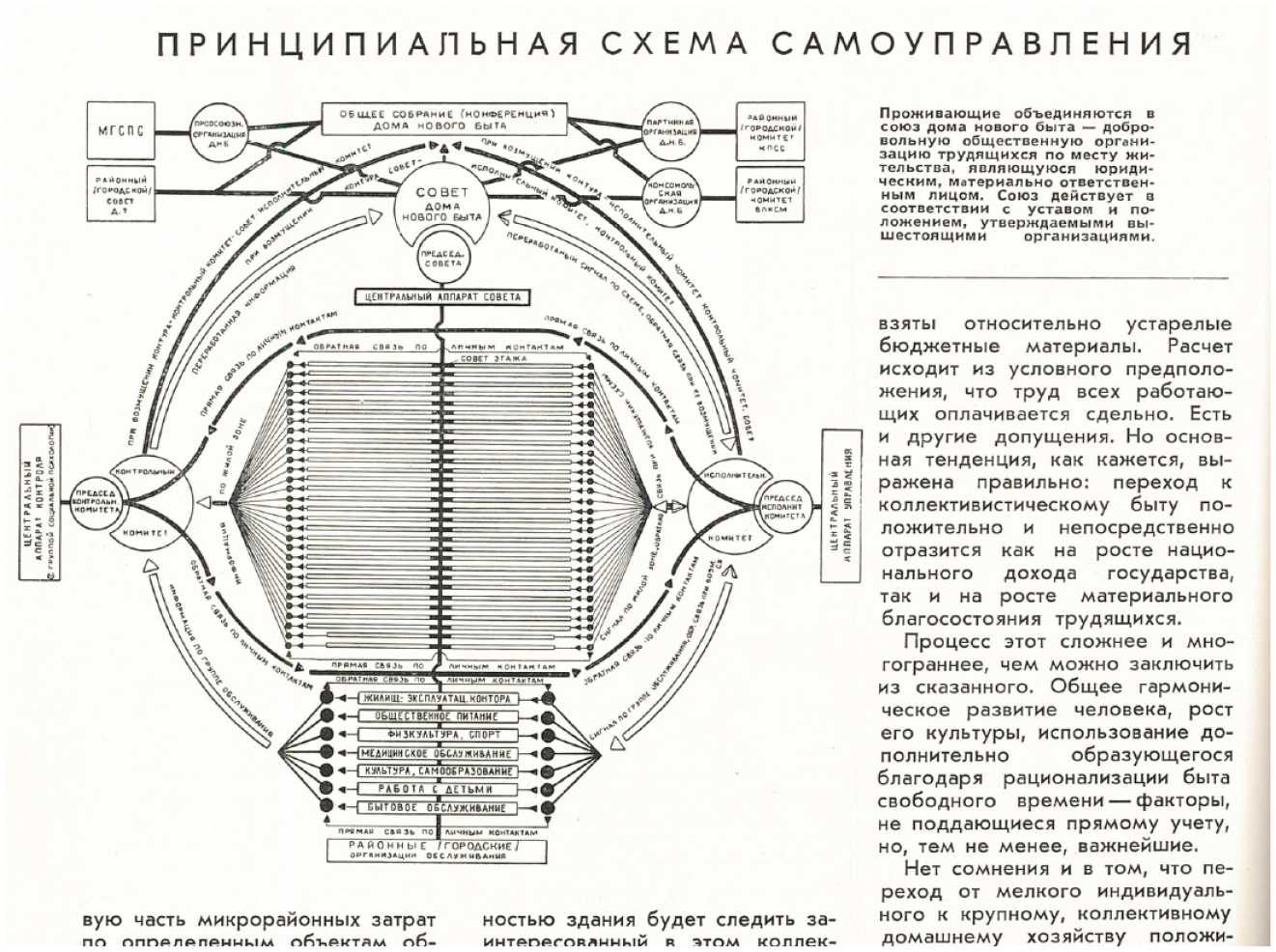
The conceptual scheme of self-government in the House of the New Way of Life project.
However, the major obstacle for the project was that there was no existing legislation appropriate for “social experiments” in housing construction. 39 While architects cooperated with economists and lawyers to develop a legal support structure for their experiment, the project soon faced difficulties in implementation. 40 Above all, it was not clear who should reside in the complex, and how to ensure cooperation of residents. A housing economy based on relations of responsible dependency between residents was difficult to define legally. The “social experiment” required an authority to manage its dynamics—an organization which will select and house residents and supervise their behavior. These functions were beyond the capacities of an architectural institute. In 1969, the DNB was almost complete, and it turned out that there was no organization interested in taking responsibility for the project’s real implementation. 41 The completed building was transferred to Moscow State University and mostly used to house students, while the initial ambitions of the project were left behind. 42 Apart from the difficulties in social organization, the reasons for the failure of the DNB project were also ideological. The project started amid the peak of Khrushchev’s Thaw, a period marked by the reinvigoration of ideology, a return to Marx’s writings, and a strong resurgence of utopian thinking. The DNB project shared multiple similarities with avant-garde house-communes: Both ideas centered around organization of a new way of life and seen a collective as a vehicle for such cooperation. However, “remembering avant-garde” was no longer relevant in the 1970s, and a project with communal catering was not relevant with the individualistic ideology, centered on the family. 43 The project of collective communist housing was no longer a priority for the government.
Even if the DNB design resembled avant-garde housing, it brought a project to a whole new level. Supplemented by an extensive socio-economic program, it advances the discussion of residential communes further. The project triggered the development of a supporting theoretical, institutional, and legal base of a self-manageable housing complex run by residents. This research formed a basis for the next iteration of the project, which was designed to mitigate lack of community-building mechanisms. There was an organization in the USSR that practiced community building on a large scale: the Komsomol. The Komsomol (VLKSM) was the Soviet mass organization dedicated to instilling communist attitudes in young people. From the 1930s onwards, it undertook, and directly supervised, large construction projects around the country—from Magnitogorsk blast furnaces to the Baikal–Amur Mainline with the half-million-strong population of Komsomol workers. In these projects, Komsomol was responsible for the organization of labor and the political activities of participating workers. As Christopher Ward has shown, collectivist discourses were central for strengthening of labor discipline and the fostering of workers’ morality in Komsomol projects. 44 Komsomol also had extensive experience in accommodating workers arriving to construction sites. Molodezhnie zhilie kompleksy (MZhKs) emerged as a term from Komsomol vocabulary, however, with a different meaning—it referred to the Komsomol-sponsored dormitories, in which Komsomolers (usually single) could reside. MZhKs were constructed around construction sites, often by residents themselves. 45
Based on Komsomol experience of self-help housing construction, as well as documents and research of DNB, the municipal Komsomol branch in Korolev made a separate attempt to create a cooperative housing complex with collective service blocks. In the hands of Komsomol, the DNB project was renamed into MZhK and amended. Above all, the Komsomol offered answers about how to form a collective of residents—that has to be done through a “socialist competition”—a Soviet practice of fostering productivity, in which participants compete by outproducing each other. Construction of housing would serve as such “socialist competition.” In that way, the housing would not be provided to the residents ready to use, rather residents had to construct it with their own labor. The very process of such construction would serve as a filter for the formation of the collective.
Hence, the MZhK emerged at the intersection of two concepts—an architectural model of a self-manageable housing complex and Komsomol practices of self-help housing construction. The project was still articulated in terms of a social experiment with “ideological novelty and value for society.” 46 Discourse of experimentation was key to represent a project as not just a bypass of the general queue of housing distribution in favor of the members of Komsomol but also as an attempt to create an innovative living environment. The discourse surrounding the project demonstrates authors’ material thinking and their belief that specially designed space could trigger new forms of social relations. Yet the emphasis shifted from the finished architectural form to a practical process of construction. The members no longer had to adhere to a particular design but, in the process of construction, would have to discover one, tailored for their particular needs and local conditions. The purpose of the MZhK experiment, as defined, was to create collectives of friends, like-minded people, and good neighbors. These collectives would further increase the labor and social activity of their members and would “conduct a wide range of activities to strengthen their political, educational, cultural, and sporting activities.” 47 The sociologist Vishnevskii defined this project as a special type of social experiment aimed to form a collective. In his term, this “do-it-yourself (samodeiatel’nyi) experiment” has the practical function of the formation of collective: “The process of continual self-creation is at the basis of a do-it-yourself experiment. The subject and the object of the experiment are the same—participants are testing ideas on themselves. The collective is formed during the experiment, and not prior to it.” 48
The first MZhK was constructed in Korolev in the Moscow region in 1974-1978. The leader of the project, Stanislav Sinitsa, explains that the secretary of Komsomol, Boris Pastukhov, facilitated the policy transfer, as in 1968, he introduced him to the DNB documents and proposed to implement the project in their town. 49 The same year, Sinitsa formed an “initiative group” in Komsomol for the development of the project. It took three years for organizational activity, securing permissions, funding, land, and capacities of construction organization. The construction started in 1971, the first bloc was delivered in 1974, and construction of the whole complex finished in 197850 (Figure 4).
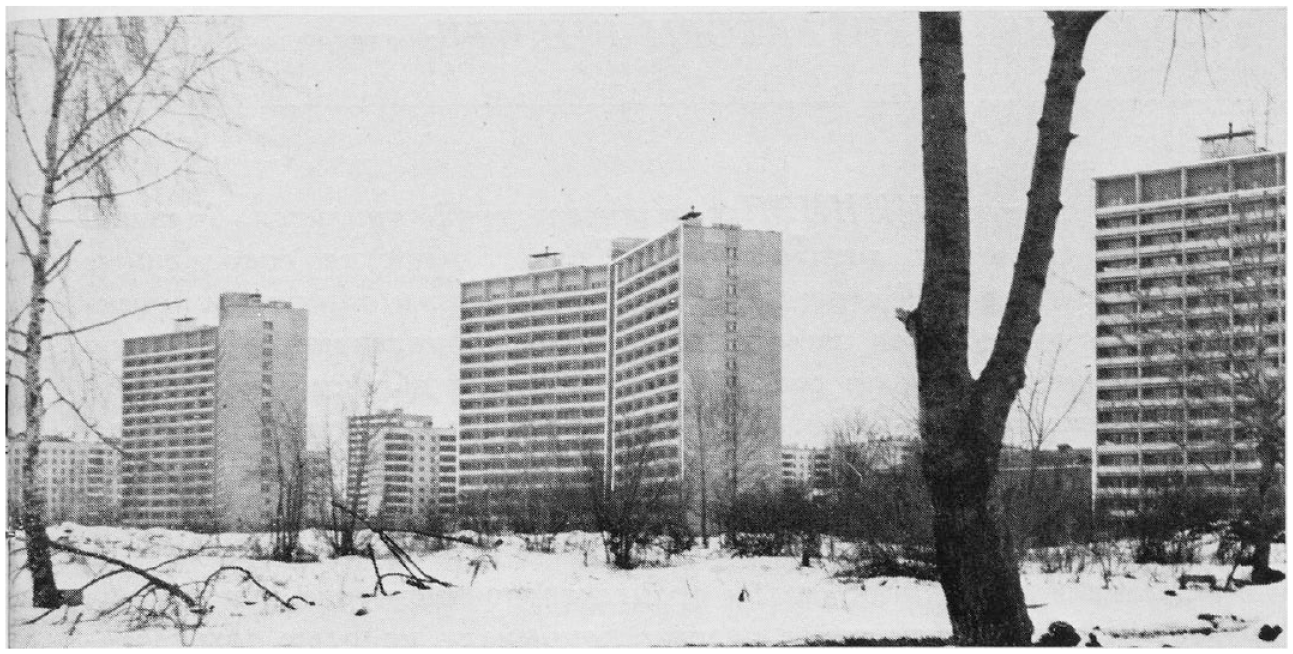
View of the Molodezhnyi Zhiloi Kompleks in Korolev, 1968-1974.
The 1978 documentary “Experiment on Ourselves” (Eksperiment na Sebe) shows young employees of Korolev scientific research institutes working at a construction site of a large-panel housing estate. 51 Their housing complex differed from the general standard residential blocks: It consisted of two residential towers, joined together via a block with collective services. Furthermore, the documentary shows residents making good use of this block, organizing music events, pumping iron in the gym, and running libraries and childcare centers with their own labor (Figures 5 and 6). “In the housing complex we have constructed, we are conducting an experiment on ourselves,” claimed the leader of the project, Stanislav Sinitsa. Other participants argued that their housing complex was not only the solution to the housing crisis but also an experiment in cooperation and grassroots organization. Collectivism was the aim of this experiment: “When we started, we had a dream: to have a whole new life, to communicate with comrades, to be friends with neighbors,” added another resident, Kosanin. 52 In the film, residents of Korolev housing complex re-articulate some high-minded principles of the socialist collectivism discourse, which informed both the DNB and MZhK projects. In the late-Soviet times, official discourse often served as a camouflage, seemingly confronting state ideological projects, but in fact covering more pragmatic motivations. 53 The second section explores what collectivism actually meant for the participates, exploring in more details the MZhK project in Ekaterinburg.
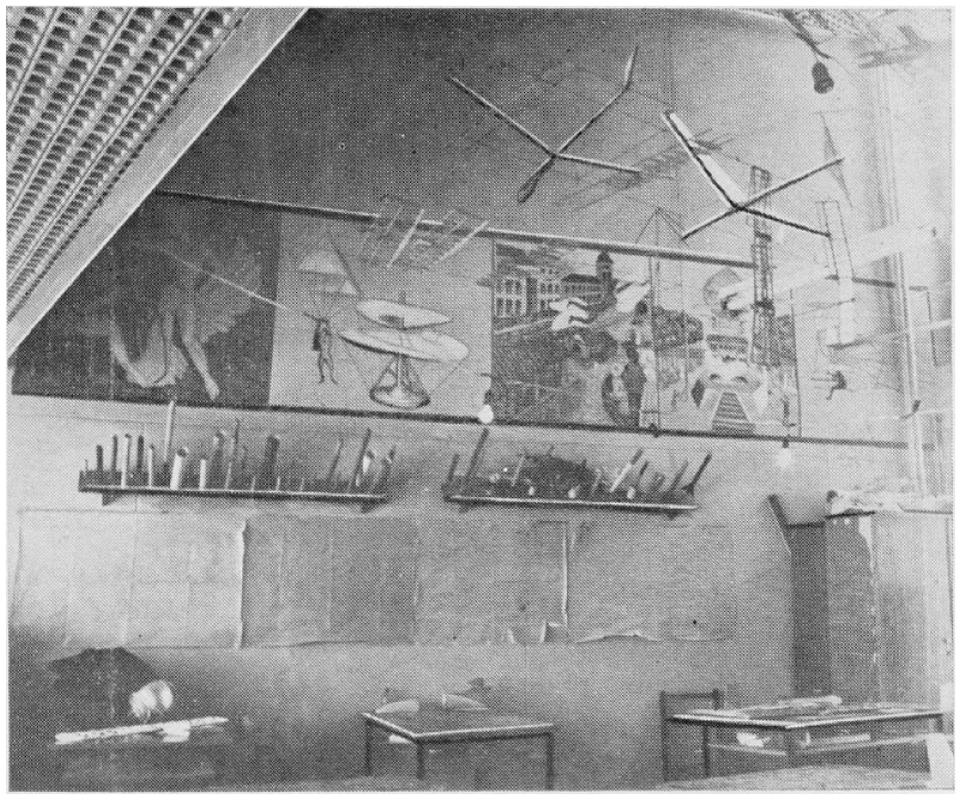
Resident’s club premises in Korolev Molodezhnyi Zhiloi Kompleks, 1968-1974.
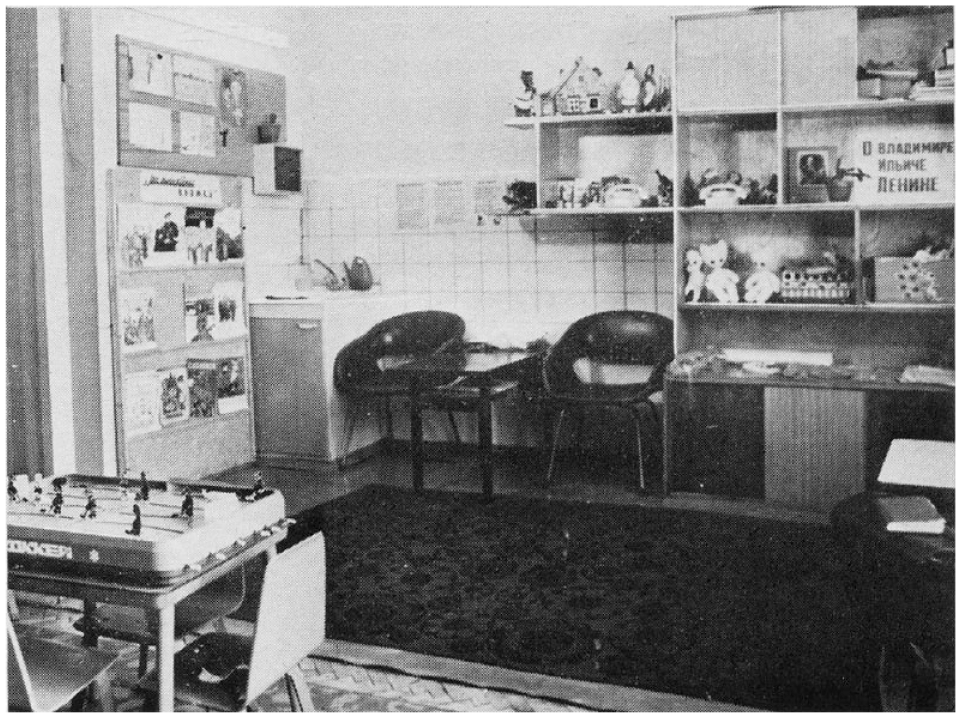
Evening kindergarten (room for a child’s short-term stay) in Korolev Molodezhnyi Zhiloi Kompleks.
Part 2. MZhK in Ekaterinburg
In Ekaterinburg, Ekaterina Bukharova, who moved to the MZhK district as a kid with her parents, showed me around the district and introduced me to her neighbors, other former participants of the project—Vladimir Pakhomov, a foremen of 12th construction brigade, and Vladimir Popov and his wife Ludmila, both former members of the MZhK governing body. Now in their sixties, they are middle-class handy Ekaterinburgers. They recall their time in various Komsomol initiatives, from construction projects to hikes. With visible resentment, they recall post-Soviet years, when some members of the governing body used their power to privatize communal facilities for their own benefit. Pakhomov relied on the skills acquired during the MZhK project to independently carry out construction projects in Russia and Ukraine to support his family during the crisis of the last years of the USSR and the economic shock of the post-Soviet decade. “After MZhK, we became unsinkable,” he recalls. 54
The MZhK housing estate in Ekaterinburg constructed in 1977-1986 was the second and probably the most visible of all MZhK housing complexes. The policy transfer from the first project in Korolev was facilitated through Komsomol organizations on the municipal level and through direct contacts between collectives of Korolev and Ekaterinburg. Founding documents of the Korolev project, as well as DNB project, laid the base for the second iteration of the MZhK. 55 The project was organized jointly by the trade unions of several Ekaterinburg scientific research institutes and construction enterprises and Komsomol. 56 Future residents of the project had to be both specialists and workers in these enterprises and members of Komsomol. 57 In 1977, they formed an “initiative group” in municipal Komsomol branch, which became a governing body of the project.
The second MZhK project was larger than the first housing complex. It included four 16-story tower block housing with apartments for a total of 3,180 residents, as well as a full complement of public buildings in the micro-region, including six services blocks, kindergartens, and nurseries 58 (Figure 7). The whole complex was constructed, supervised, and managed with residents’ participation. Participation in the project started with an internal “socialist competition” held at their workplaces in each of the three participating institutions. 59 Participants competed by outproducing each other or engaging in “voluntary” activity. Their level of participation was measured in symbolic units (points), and only those who earned the most points were allowed to receive the part- or full-time leave from their jobs necessary to join the construction brigades and work full time at the construction site, or participate in administration of the project. 60 All work, managerial or physical, in the MZhK project was also evaluated with “points.” A certain number of points were required to secure an apartment in the complex. The points system of evaluation was a typical practice of socialist competitions; yet, in the MZhK project, it turned into a crucial currency, which upon the construction of the complex could be converted into a tangible material result—apartments of various sizes and comfort levels.
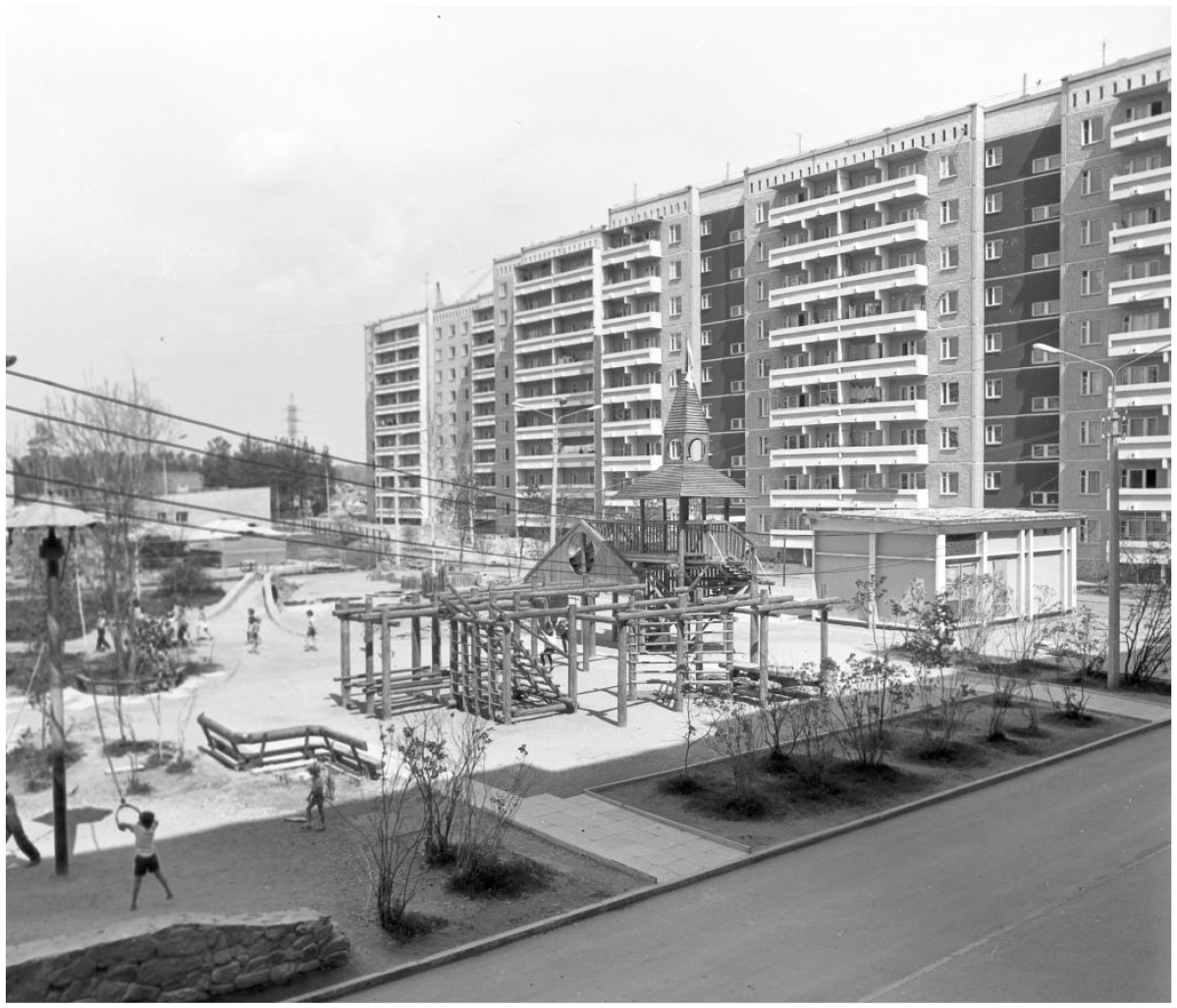
Children’s playground in the courtyard of a Molodezhnyi Zhiloi Kompleks district in Ekaterinburg.
Collectivist discourses shaped a particular organizational model of the project. The project was coordinated by the MZhK collective formed by future residents. The head of the collective formed a governing union (aktiv soveta MZhK, henceforth “MZhK union”), responsible for administration and management of the project. After construction, the union became responsible for running and maintaining the complex and took the leading role in organizing collective services in the whole micro-region. 61 The project was defined as an “interdepartmental experiment,” in which the Ekaterinburg city hall vested the MZhK collective with “the right to centrally manage all current and economic activities of socio-cultural institutions located on the territory of the MZhK.” 62 De facto, the city hall delegated to the union the authority of coordinating public services for the whole 3,000-people residential district.
The MZhK union undertook organizational work for the first two years of the project prior to the beginning of construction, which included managerial and legal development, securing state funds, and land and production facilities for the project. The union contracted professionals, including architectural design institute to produce blueprints. Some professionals worked on the basis of a barter relationship, in exchange for an apartment, similarly to other participants. Ten percent of apartments in the housing complex were reserved as payment for contracting specialists, among them, architects. A group of eleven architects was formed in the state design institute to design the project. 63 While standardized housing typologies were used for residential blocks, architects designed individual structures for all the public buildings of the project: clubs and sport and children’s playgrounds. 64
As in the DNB project, participation in the project was seen as collaboration of collectives with specific tasks. There were several collectives, the members could join, to earn points in a “socialist competition.” The union’s function was to sort out multiple questions regarding provision of land, funds for construction and construction materials, labor, and other things. Once the construction started, members were assigned to construction brigades to directly participate in the construction process. Such brigades were formed of about thirty people, with certain specializations—from major infrastructural work to the finishing of apartments. Each brigade contained future residents and professional construction specialists or members with previous experience at Komsomol construction sites, who helped others to master their new jobs. 65 Participation in construction brigades was not the only way to earn points. Separate brigades were formed at the local house-building factory to help with production of prefabricate panels for housing construction. 66 Novices received three months of training to develop skills in various construction trades. 67 The principles of the division of work were articulated in collective discourse—each member had responsibilities within his collective, while the whole collective was responsible for delivering their assignments; otherwise, they threatened the whole project. 68
The level of participation of each brigade and each member within the project, both managerial and physical, was evaluated through the awarding of points. Points were crucial for all members to succeed in their final goal of receiving an apartment. The amount of points determined the fate of all members. Those who got the most points advanced in the housing distribution queue. Those who were left behind risked being left with no apartments. Depending on the amount of points required, the level of involvement of various members differed. Some members temporarily left their jobs to focus on a project full time. They received limited salaries, apart from points. Some participants continued working at their former jobs, participating in the MZhK at second shifts. While the main purpose was to earn points, officially, the work took various forms: from full-time jobs to individual activities declared as voluntary work campaigns.
Participants do not conceal that participation in the project was primarily driven by the practical individual goal of receiving an apartment. 69 However, the building process in construction brigades was itself a collective endeavor. Each brigade not only worked together but also shared meals and rested together. Participants remember that construction was not an easy process. Construction process involved a great deal of overtime work, which was officially defined as subbotniki (unpaid voluntary work campaigns, normally held on Saturdays). In the MZhK, subbotniki were held not only on Saturdays but also on most other days and sometimes late at night. The initial condition of the project was to deliver the first residential block by the end of 1980. According to one of the participants, this happened at the expense of many sleepless nights at the construction site. 70 The points system required constant overcommitment and left many participants behind in the competition. According to Vladimir Pakhomov, participants had to work twice as hard as regular workers, often spending more than twelve hours at the construction site: “In order to succeed, we had not only to work well, but to always be in the first ranks.” 71
Participants remember a constant feeling of uncertainty over the outcome of the project. They never knew whether they would get an apartment or whether their efforts would all be in vain. A point-based economy also left much room for cheating. Since points were assigned internally at the level of enterprises, the process was not transparent. 72 The system of points was explicitly gendered to benefit male workers. Not only were more points assigned for physical work, but the knowledge about assignments that provided a sufficient amount of points also circulated predominantly in the networks of male workers. Good relations with foremen were crucial. 73 As Marina Beduleva explains, women were not always welcome to participate in subbotniki. Female participants were able to secure points running collective services and through organizing events, which was by contrast a predominantly female sphere. 74 Hence, not everyone was welcome to participate in this collective drive.
Such uncertainty, alongside the difficulties in construction and the exhaustive pace, decimated the number of participants. Some assignments were considered just too difficult. The micro-region was located in a rocky terrain, and the construction of basements and provision of infrastructure required particularly difficult rock extraction. Stuck on one such task, as much as a third of the members of a construction brigade ended up leaving the project. 75 In total, 37 percent of the participants of Ekaterinburg MZhK dropped out, even if they had no alternative housing available. 76 While the experiment was a collective endeavor for some, it left many others behind in the competition. For this latter group, it represented nothing but frustration and time lost on “voluntary” and unpaid subbotniki.
The first building was delivered in 1981. In the few next years, two other blocs were delivered, along with a nursery, two kindergartens, a school and a sports complex, a house of culture, administrative buildings, clubs, playgrounds, and an open theater, which residents called “Forum” (Figure 8). After the construction and housing, residents’ union took charge in organizing social activities in the district: self-organized festivals, or music concerts, were held in a self-made open theater. Apart from state-run facilities, some services, such as sports clubs, were run by residents themselves. For example, Ludmila Popova was in charge of the cinema club and, later, a local television. She also remembers that the residents were especially proud of their cooperative children’s room, also run cooperatively by mothers from the district. Do-it-yourself practices were widespread among the last Soviet generation. Self-made gyms, clubs, and various types of studios proliferated semi-officially in the Soviet urban fabric. 77 The MZhK movement thus enabled and facilitated grassroots organization in the local district (Figure 9).
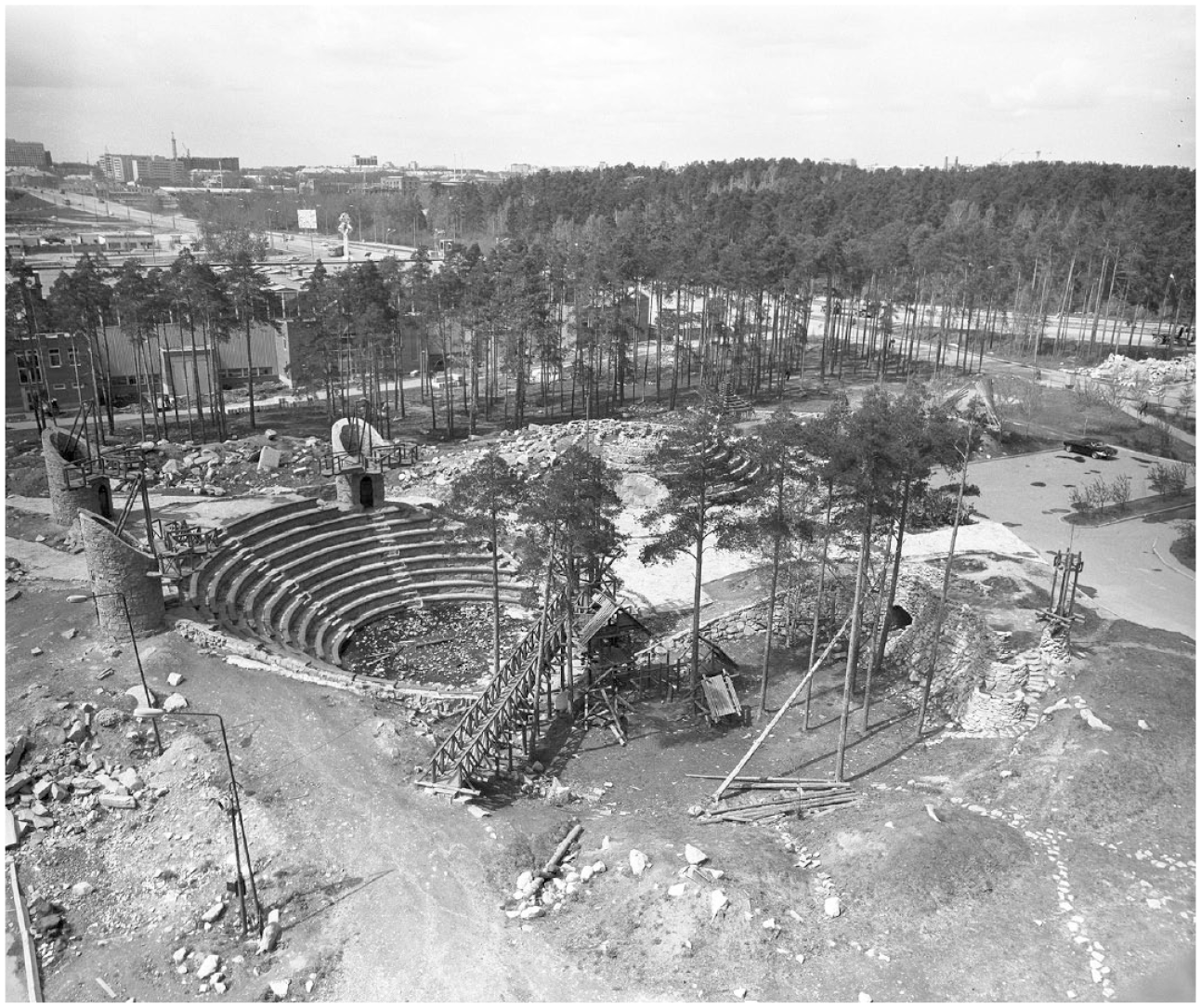
Construction the open theater (forum) in the Molodezhnyi Zhiloi Kompleks district in Ekaterinburg.
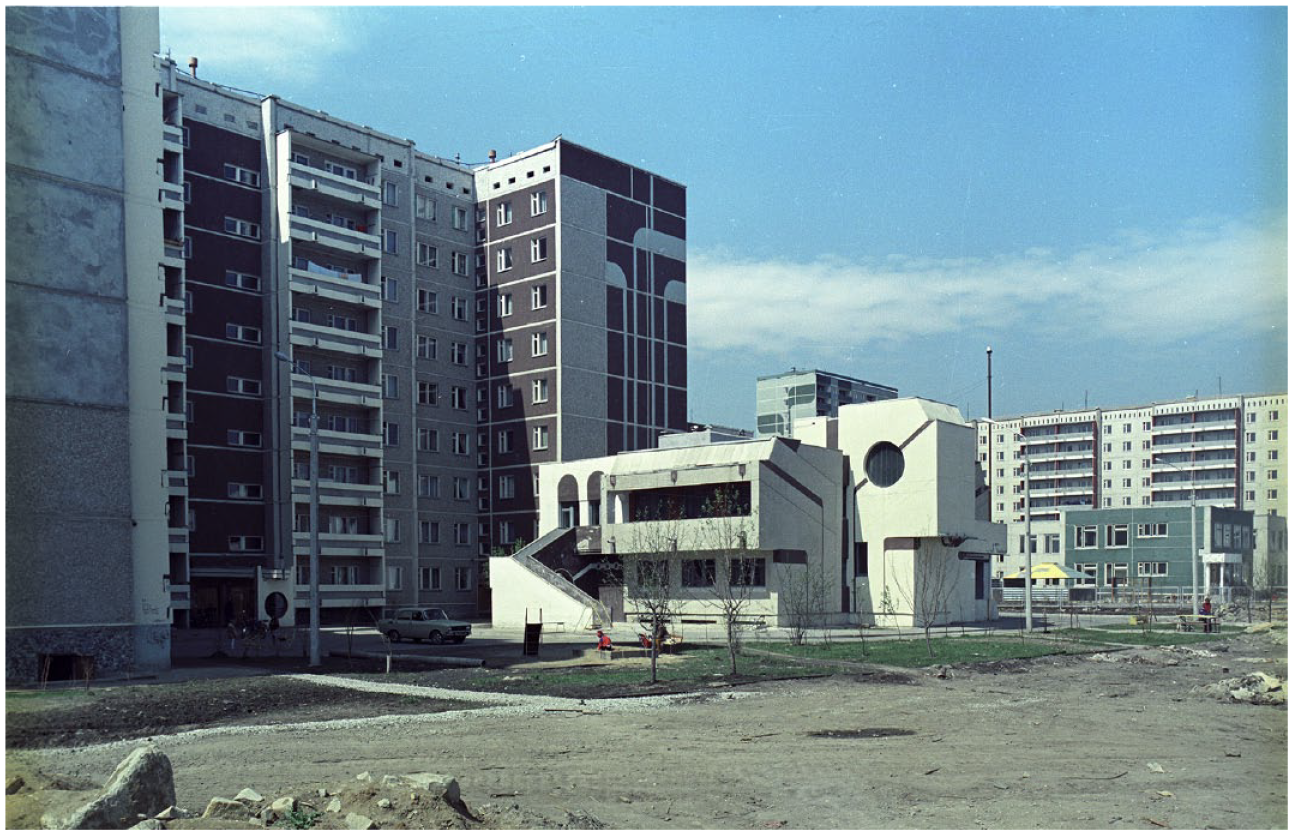
View of the house of culture in Molodezhnyi Zhiloi Kompleks district in Ekaterinburg.
Engaged in self-organized activities, participants in MZhKs produced a peculiar culture, including a flow of amateur poetry and prose and pictures and drawings. It was typical for my respondents to show me self-made albums, newspapers, and publications, which depicted various collective activities held in their district, from concerts and festivals to joint camping trips. For many members, the MZhK represented primarily a shortcut to securing an apartment, yet, even for those participants, it was difficult to avoid participation in collective events. The memories of one of my respondents are marked by an aversion to the communal ethos of the project and its predominantly male culture, which included collective visits to the baths, playing guitar, and singing folk songs (Figure 8).
While collectivism was emphasized by both participants and observers of the project, its changing notions in the 1980s is evident. Initially while collectivism was theorized as a practical way of organizing everyday life and leisure time, in Ekaterinburg, the community-building ethos shifted to the collective ability to coordinate more basic maintenance tasks. MZhK residents had to deal with a variety of urban problems on their own. As one of my respondents recalls, “we soon realized that in our district, we had to do everything ourselves.” 78 The example of self-help repairs of degrading urban infrastructure outlined in the beginning of this article is one such telling example.
For many respondents the project was, first of all, a practical solution to overcoming the housing shortage impasse during the severe shortages of the late Soviet economy. In the words of the foreman of a construction brigade, Vladimir Popov, the project was primarily a solution for the failures of the city administration to deliver apartments. The city was accountable for the housing delivery plan, and participants wanted their apartments as well. 79 In the context of housing shortage, the MZhK was not the only such project of housing construction. The self-help construction with residents’ participation was intended to mitigate the lack of workforce, which represented one of the major problems at the Ekaterinburg housing sector. Enterprises in charge of housing delivery in Ekaterinburg had difficulty fulfilling plans for housing delivery due to lack of labor force. Difficult rocky soils in the region required large expenses for the installation of foundations and utility networks. To overcome these constraints, construction companies made use of “volunteers,” soldiers, and prisoners’ labor. 80 Tellingly, even large state enterprises, such as Sverdlovsk’s housebuilding factory, had to hire shabashniki (moonlighting brigades who undertook illegal or semi-legal contracts) to unofficially cover gaps in construction. 81 The use of semi-legal workforces by large state companies testifies to the deep and chronic dependence of the late Soviet industry on the informal economy.
In comparison to cadre builders, an MZhK gave rise to a different attitude to work. According to Karelova, at construction site “no one would smoke or play dominoes if there was no concrete, brick, or equipment—they would find building materials at all costs.” 82 Each construction brigade was responsible for delivering their assignments; otherwise, they threatened the whole project. 83 The MZhK district was located on a rocky terrain, and the city hall had previously been unable to find contractors willing to carry out construction in this area. 84 Pakhomov remembers tremendous difficulties in handling this rocky terrain, which was solely the job of Komsomol construction brigades. 85 Due to the fact that a large percentage of the members had higher education and experience working at industrial enterprises, technical issues were resolved promptly.
The knowledge of how to get materials “at all costs,” which recall my interviewees, could refer to a broader late Soviet trend: access to the “second economy.” 86 In the late Soviet era, grassroots management became especially efficient, as it facilitated access to the unofficial sphere—alongside an increase of the shortage economy. Construction of the MZhK district involved a variety of informal practices, irregular transactions, and the use of personal networks for getting things done. 87 According to Pakhomov, MZhK union had at least forty subcontractors, each of whom provided construction materials, equipment, or services. 88 One of the members of the MZhK union, Sergei Khoroshilov, was directly responsible for establishing “informal” relations with subcontractors involving various forms of such quid pro quo agreements. 89 Professional construction workers even sometimes earned points for “borrowing” equipment or directly stealing building materials from their official places of work. 90 Serving as mediators for official enterprises, MZhK members facilitated their access to the informal sector.
According to architecture historian Yuri Volchek, the MZhK represented a school for learning “how to get things done” efficiently during times of dire shortage. 91 The “graduates” of this school developed an important set of skills, which included finding required materials and securing permissions and funding. The team was in charge of the whole process of construction, from the groundwork to the finishing of apartments. Later, some construction brigades turned into collectives of skilled work gangs, able to carry out construction and maintenance tasks on their own, who found further employment in unofficial or semi-official spheres of the Soviet economy. 92 Practices of mutual help and the use of practical knowledge in obtaining goods and services in short supply proved crucial in the conditions of scarcity and delays of the construction sector. In the case of the MZhK project, the informal economy ambiguously supported the state-defined socialist goals of housing construction. 93
Not limited to the construction process, MZhK members seek to convert their skills and collectivity into political force. The union of the MZhK developed into a municipal political force, able to promote its interests. In 1984, when authorities tried to allocate some of the apartments in the MZhK district to some high-status managers who had not actually participated in the process of construction, residents strongly objected, campaigning and signing petition letters to Boris Yeltsin, who at that time served as a head of Sverdlovsk regional committee of the Communist party. 94 By the end of perestroika, their influence grew even further, since it started to represent a political force, and they were able to participate in demonstrations in favor of or against local politicians. Tellingly, an MZhK member, engineer Alexander Mikh, was able to organize private cable television in the district—reportedly, the first such project in the USSR. Among other shows filmed in the local studio, the team also started airing political analyses. 95 What was designed as a controlled community-building project for strengthening interpersonal relations for the assistance of young families, soon turned into an almost autonomous grassroots movement, which strengthened communities to endure the failures of the late Soviet economy (Figure 10)
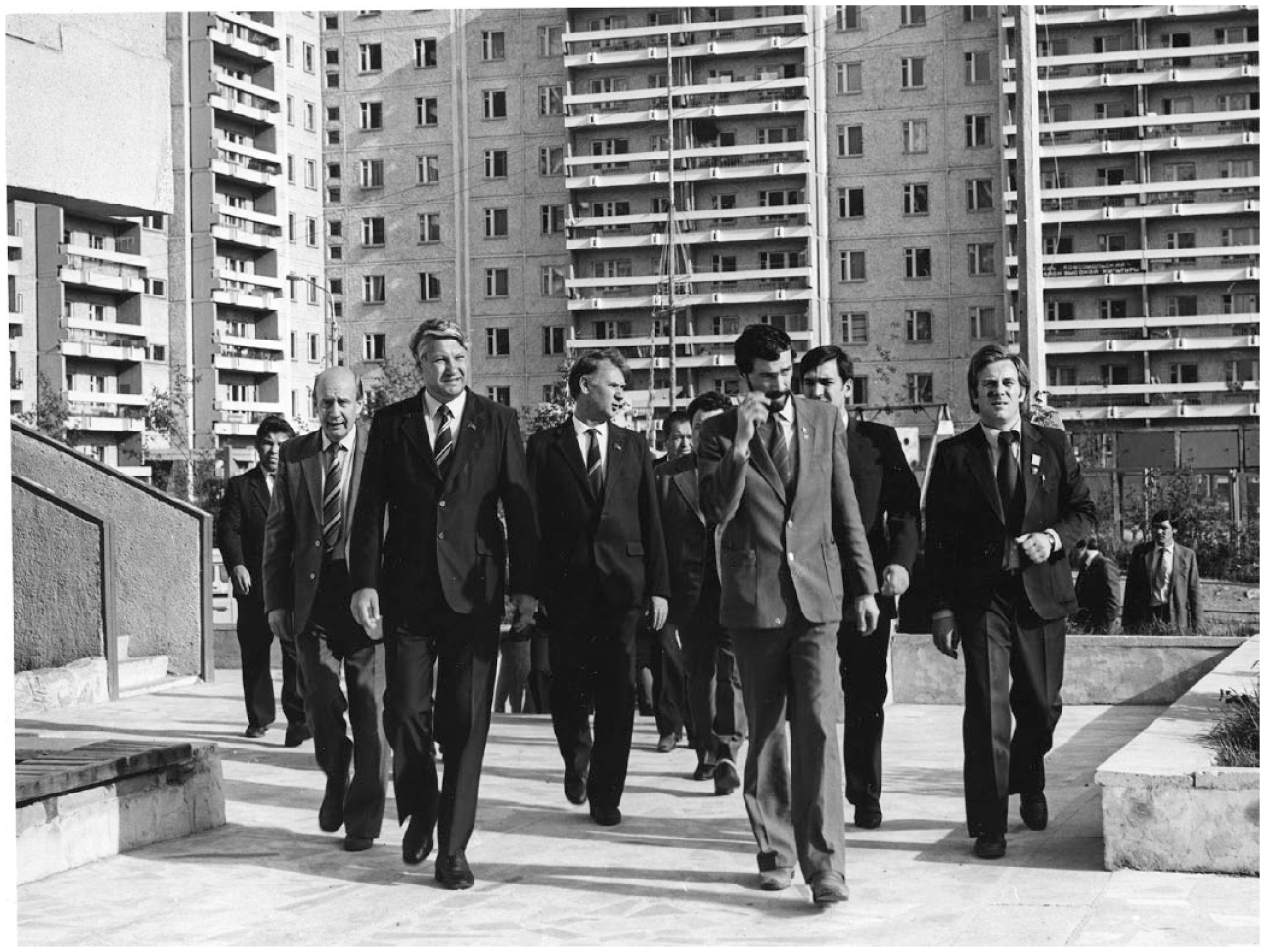
First secretary of the Sverdlovsk regional committee of the Communist party B.N. Yeltsin inspects the Molodezhnyi Zhiloi Kompleks district in Ekaterinburg (August 13, 1983).
From two early complexes in Korolov and Ekaterinburg, the MZhK turned into a mass movement during Perestroika. 96 The project MZhK was supported by the 27th Congress of the Communist Party in 1986. It underwent the process of standardization to allow for replication: The legislative base of the project was developed, and an official charter of the MZhK was released. 97 Recommendations for the architecture, construction, and running of MZhKs, 98 for social, cultural, and pedagogical work in the serviced blocks, were developed. 99 With this package of documents, the project became a mass movement, which rapidly spread throughout the country.
The MZhK movement thus reveals how the project of self-managing cooperatives began in the 1960s and was introduced into mass construction in the 1980s. The first model of self-managed housing, the DNB, was seen as a model for society as a whole. In the 1970s, it mutated into a model for Komsomol members, who passed various types of filters. Instead of following the original goal of a universal and egalitarian concept of kollektiv, the projects turned to serve particular communities. In the 1980s, there was a growing pragmatism in the movement. The members still had to pay for their housing by working at construction sites, but sometimes this could involve merely working in the construction industry, rather than working directly on their own housing project.
100
Instead, the MZhK movement started to be seen primarily as a shortcut for solving the housing problems of young families, who otherwise had to wait in the queue for years or even decades. In 1990, even an official reference book refers to the MZhK as an alternative to despair and a solution to gridlock.
101
The MZhK became seen as a solution for younger people, enabling them to invest their labor in addressing their housing needs. In 1991, Bestujev-Lada, a prominent Soviet sociologist, even proposed extrapolating the practice globally: it would be reasonable for all young people of both sexes after graduation or military service to work for some time at construction sites, and on their wedding day, they would receive the keys to their honestly earned apartment right in the registry office.
102
Conclusion
In 1961, the Third Party Program declared the ethics of collectivism and “social self-management,” as a method by which Soviet society would outgrow the socialist state, into true communism. MZhK project responded to this discourse. However, despite being a collective endeavor, the MZhK project achieved anything but equality. What emerges for the actual construction of MZhK complex in Ekaterinburg is a story of a highly competitive project, where participants struggled to secure material goods. The project benefited participants on specific criteria: Most successful participants were young, married middle-class scientists, affiliated with local research institutes, members of Komsomol. The project, in fact, led to gendered and unobvious mechanism to housing distribution and created a “loser leaves the tournament” competition, where less than a third of all participants received their apartments. But even despite all these problems, the MZhK represents an interesting attempt of constructing and managing a large housing estate on the bottom-up collectivist principles. Vested with rights to manage their district, cooperation of the relatives enabled large-scale urban development and organization of major activities, such as the MZhK festival on grassroots basis.
The case of MZhK helps uncovering less-known aspects of the Soviet welfare system, which was not necessarily characterized by passivity and paternalism, but also required the construction of active citizenship. Collective ethics especially facilitate the access to informal economy, as participants combated shortages, acquiring building materials, and other things thorough irregular transactions. More broadly, the MZhK project demonstrates the centrality of self-help and mutual aid to a late-Soviet shortage-ridden economy that, it has often been noted, would have stalled in its endemic shortages and stockpiles had people not kept cooperating through irregular, unplannable, activities.
Footnotes
Acknowledgements
The author would like to thank Anna Ivanona for her feedback on the draft of this article and Dmitry Pushmin for his help in obtaining illustrations.
Declaration of Conflicting Interests
The author(s) declared no potential conflicts of interest with respect to the research, authorship, and/or publication of this article.
Funding
The author(s) disclosed receipt of the following financial support for the research, authorship, and/or publication of this article: The author would like to acknowledge that the work has been made possible due to the generous support by the Humboldt Research Fellowship.
