




Abstract
Strasbourg, this article argues, played a seminal role in the development of urban planning. The city’s transformation in the late nineteenth century was one of the earliest, largest, and most expensive planned urban extensions in modern Germany. In the process, Strasbourg also came to play a central role in the development of urban planning into an established area of technical expertise, an academic discipline, and an area of professional practice. Initially conceived under the aegis of the empire’s military command, the transformation of Strasbourg quickly involved local politicians, landowners, and independent experts, accelerating the development of urban planning into a practice dominated by what Camillo Sitte described as “technicians and specialists.” The reception of Strasbourg impacted the salient debates in urban planning from the 1870s to the early twentieth century.
Planning seems as old as the city. Attempts to theorize, design, structure, and control urban space have existed long before the modern age. But only relatively recently has planning become institutionalized as a body of theory, an academic subject, a professional discipline, and, crucially, a policy field. It took until the second half of the nineteenth century for planning treatises and planning laws to proliferate and for state-led planning to reach beyond the remit of capital cities. 1 By the turn of the twentieth century, almost every European state had its own, ambitious urban transformation projects, 2 avid readerships of professional journals followed the latest innovations in planning theory and practice, state parliaments took charge of planning law as local authorities did of building codes, and planning competitions were widely broadcast in the press.
The development of modern urban planning was particularly striking in Germany, whose urbanization, in contrast with Britain and France, was late but rapid. In 1830, there were only two German cities with more than hundred thousand inhabitants. By 1914, their number had exploded to fifty. 3 Only 36 percent of Germans lived in cities in 1871, but by 1914, this figure had almost doubled to 60 percent. While there were 15 million urbanites in Germany in 1871, this number had almost tripled by 1914. As a result, in the long nineteenth century, German cities saw some of the world’s fastest growth rates.
It was due, in part, to these challenges that after its foundation in 1871, the German empire obtained “world leader” status in the field of urban planning. 4 It was Germany where planning was first systematically anchored in academic, legal, and administrative practice. 5 German planners not only published some of the first textbooks, treatises, and pamphlets in the history of modern planning. They also produced the first specialist journals and lecture courses, the first professorships, university departments, and the first national conferences of planning. 6 By the eve of the First World War, British planners, in particular, looked upon the achievements of their German colleagues with a mixture of admiration and envy. If modern urban planning was born in Haussmann’s Paris, its “chosen country,” according to the French urban historian Georges Duby, was Germany. 7
One of Germany’s most ambitious planning projects took place in Strasbourg. Set on the Upper Rhine, this formerly French city was a late addition to unified Germany. Annexed in 1871 as a result of the Franco-German War, Strasbourg became the youngest regional capital of the newly founded German empire. Its development became the object of special attention for the empire’s leadership, involving such high-ranking decision-makers as German Chancellor Otto von Bismarck (1815-1898) and the chief of the Prussian general staff, General Field Marshal Helmuth von Moltke (1800-1891). Conceived by Moltke himself, the transformation of Strasbourg tripled the city’s size. The city’s relative growth thus dwarfed similar projects in Mainz, Cologne, Düsseldorf, and Frankfurt, cities that have so far commanded much greater interest among historians of urban planning and urban form. 8
Strasbourg, this article shows, played a vital role in the development of German modern urban planning. Its transformation was not only one of the earliest, largest, and costliest urban planning projects of the young German empire. It also had a lasting effect on the specific kind of urban planning that became the norm in fin-de-siècle Germany. The transformation of Strasbourg, initially conceived top-down under the aegis of the empire’s military leadership, quickly shifted to include the kinds of groups that would characterize modern urban planning by the eve of the First World War: municipal politicians, technical experts, and bourgeois citizens. 9 Even in Strasbourg, which remained politically subordinate to central government like no other German city, these groups were able to assume an active role in urban planning from the 1870s.
The events in Strasbourg shed light, especially, on the institutions that accompanied the rise of urban planning and that enabled the practice to mature into a field of knowledge with technical standards, scientific methods, and independent experts. In 1878, Strasbourg became host to one of the first planning competitions in global history. 10 This competition marked the first time that a general urban plan was discussed in the young empire’s professional press. It brought together a group of technical experts around the engineer Reinhard Baumeister (1833-1917), the man often credited as the originator or “father” of the discipline of modern urban planning. 11 Baumeister’s involvement in Strasbourg helped spur the development of an intellectual and practical school of urban planning that adhered to liberal principles and scientific methods, as will be shown in the final section of this article. Strasbourg, in other words, became instrumental in helping an emergent generation of expert planners establish their intellectual and practical leadership in the field.
Military Planning
The first strides in Strasbourg’s transformation, however, were made by military planners. In 1871, the young empire’s military leadership took charge of rebuilding war-torn Strasbourg, a process that developed into an ambitious urban extension. Initiated by Moltke, the chief of the Prussian general staff, the project was welcomed by Strasbourg’s leading citizens. But as time went by, citizens increasingly objected to the uncoordinated manner in which the military leadership managed the planned extension. In the absence of democratic participation, leading citizens used petitioning to leverage their economic power. It was citizens, rather than imperial policy makers, who drove the city’s transformation from the mid-1870s. This development forms the subject of the following section.
The development of Strasbourg had long been shaped by military considerations. Set at the confluence of the rivers Rhine and Ill, the city developed out of a Celtic village that became a Roman garrison town, which was called Argentoratum. It was seized by the Franks in the fifth century and was subsequently renamed Strateburgum. In the middle ages, it became a free city of the Holy Roman Empire, a position that it maintained until 1681, when it was captured by King Louis XIV of France (1638-1715). Under the guidance of Louis’s famed military planner, Sébastien de Vauban (1633-1707), Strasbourg was subsequently developed into a modern fortress. The city formally became part of the Kingdom of France in the Treaty of Rijswijk (1697), but it retained many of its privileges, including generous religious freedoms for the city’s Protestants. Its university, once a cradle of the Reformation, continued to attract German students such as the poet Johann Wolfgang von Goethe (1749-1832) and Klemens von Metternich (1773-1859), later Austrian chancellor, who fled the city after the outbreak of the French Revolution in 1789. The revolution strengthened Strasbourg’s political and cultural links to Paris, while railway construction in the mid-nineteenth century integrated the city economically with France. 12
Set in the borderland of Alsace, in 1870 Strasbourg became a site of the Franco-German War. By this point, Strasbourg was among the most heavily fortified cities on the continent. Strasbourg’s obstinate refusal to surrender led to a month-long siege, which culminated in its bombardment in September 1870. German artillery destroyed large parts of the city and inflicted heavy damage on its fortifications. Sections of the cathedral, including the roof and central crossing, the city’s Protestant church, its precious library, and hundreds of homes in the northern section of the city, were reduced to rubble. Vauban’s city walls did not withstand modern artillery power. 13
The conquest ushered in an era of central government administration in Strasbourg. Between 1870 and 1871, Alsace-Lorraine was under military administration by General Governor Friedrich Alexander von Bismarck-Bohlen (1818-1894), a cousin of the chancellor. 14 The influence of the military remained strong throughout the 1870s, while the civilian administration of Alsace-Lorraine was, in effect, run by a special department in Bismarck’s imperial chancellery. In 1879, a newly founded regional government took office in the city, headed by Field Marshal Edwin von Manteuffel (1809-1885), who was also the commander of the German 15th Army Corps in Strasbourg. 15
Military authorities took control of urban development. The bombardment of a notionally German city by German troops had been a source of some embarrassment to the Prussian leadership. 16 On September 29, 1870, the day after the city’s surrender, Bismarck ordered military commander Bismarck-Bohlen to create an inventory of damages to the city, coupled with the instruction to explore the possibilities of compensation and reconstruction. 17 More important still, for the military leadership, was restoring Strasbourg’s defensive capacities. Days after the annexation was formally confirmed in the Peace of Frankfurt on May 10, 1871, Helmuth von Moltke, the Prussian head of general staff and architect of the German victory in the Franco-German War, visited Strasbourg to take stock. Moltke envisaged a thorough transformation of the city’s civic and military infrastructure, in which the defunct seventeenth-century fortifications would yield a new, larger ring of walls, buffered by an extended glacis surrounded by satellite forts, a model already in place in the Prussian city of Breslau/Wrocław. 18 The planned reconfiguration of the city walls would free up space for a significant urban extension.
The transformation of Strasbourg became a priority for the Prussian general staff. Military officials around Georg von Kameke (1817-1893), the inspector-general of fortresses, shared a conviction that the planned transformation of Strasbourg would also aid in its “Germanisation.”
19
In a report from June 2, 1871, Moltke and Kameke told the emperor that the institution of numerous administrative authorities in Strasbourg, the city’s already woeful housing shortage, the need for an improved train station [. . .] and the creation of a canal linking Strasbourg to Mannheim along the Rhine, speak in favor of a considerable expansion of the city.
20
Together with Kameke, who would be promoted to Prussian minister of war in 1873, Moltke lost no time in creating faits accomplis. A year after the annexation, building works were under way on the new ring of fortifications. 21
Citizens welcomed the new administration’s plans in the hope that it would allow them to put their fallow building land outside the old city walls to lucrative use. 22 Strasbourg’s mayors had, since the 1840s, unsuccessfully lobbied for an extension to the old city. 23 Moltke’s visit in May 1871 presented a unique opportunity to realize the long-desired urban extension. The city council convened specially, twice, to discuss Moltke’s proposal, signaling its general approval and its willingness to contribute to the cost. 24 The project would no less than triple the surface of the city, making Strasbourg, in terms of physical area, the largest city in the German empire. Crucially, the extension would finally enable Strasbourg’s bourgeois landowners to capitalize on their land holdings outside the old city precincts. 25
In practice, cooperation between the citizens and the military proved more difficult. Moltke set about planning Strasbourg in an almost absolutist manner. 26 The only people who knew his plans were visitors who happened to steal a glance at the large-scale drawings which would swallow up one of the field marshal’s two writing desks for years after the annexation. 27 Moltke made no further effort to involve local stakeholders and never published an official plan. The general staff’s unwillingness to communicate its plans led to a deterioration of the relationship between the municipality and the military, so much so that Strasbourg’s mayor, Ernest Lauth (1828-1902), together with his entire administration, demonstratively abstained from the celebrations to mark the official commencement of the works in September 1872. 28 Lauth’s refusal to attend the event added fuel to his already strained relationship with the military, who lobbied to have the recalcitrant mayor removed. Pressed by the military leadership, Bismarck assented. Following controversial remarks that Lauth made in conversation with a Prussian official, Bismarck dismissed the mayor and suspended the city council in April 1873. In place of Lauth, he appointed the Prussian civil servant Otto Back (1834-1917), the head of Strasbourg’s police department, as acting mayor.
Tensions intensified further. The dismissal of the democratically elected mayor and the suspension of the city council increased local discontent. Three years after Moltke’s initial visit, citizens still knew nothing about the details of the planned urban extension. Those who awaited the lifting of building restrictions on the glacis, the former firing-field that was to be turned into new city districts, grew increasingly impatient. “I would much like to be able to execute my long-planned building works,” one landowner, a widow, told Mayor Back. 29 “For years I have been waiting for the freedom to build,” another wrote, “but until today nothing has happened. To whom should one turn to be heard?” 30 While investors were rushing to put their money into property amid the construction frenzy that engulfed the young German empire in the early 1870s, Strasbourg’s citizens lacked comparable investment opportunities. In May 1874, a group of bourgeois citizens addressed Bismarck in an open letter, which was published in the local press, expressing their discontent with the urban extension project. 31 “Many landowners in the old military zone are only waiting for a sign to begin significant construction projects,” the petition explained. “There is only one way to exit the current predicament: an urban extension, without any further loss of precious time.” 32
The petition successfully leveraged the socioeconomic power of Strasbourg’s bourgeois citizenry. The signatories constituted the city’s circle of “notables,” a term that originated in the French Second Empire to denote local economic, intellectual, or political elites. Among the signatories, there were six members of the suspended city council, five members of the regional council, and four former or present members of the chamber of commerce, including its current and previous president. Of the sixty-three signatories, nineteen described themselves as “merchants,” eight as “entrepreneurs,” and six as “rentiers” or “proprietors” respectively. The professions were equally well-represented, including six judges, three university professors, three architects, two notaries, two lawyers, two managing directors, one physician, four bankers, and the editor of a major regional newspaper. “Time is money,” the signatories warned, “as capital lies barren in Strasbourg for lack of productive use. Does the government have any interest in losing that capital to speculation?” 33 By this point, the urban extension had turned into one of the most pressing political demands in Strasbourg.
Municipal Enterprise
The transformation of Strasbourg did not remain under military control for very long. The military’s apparent disinterest in civic aspects of urban development created a vacuum that was quickly filled by local economic elites and municipal politicians. Mounting tensions between the military leadership and the city’s notables led Bismarck to devolve critical responsibilities to the local level. These new responsibilities radically changed the role of the municipality in the urban extension. They ushered in an era in which municipal politicians took far greater stakes in urban planning than they were accustomed to—politically as well as economically.
Faced with continued local discontent in 1874, the imperial government changed its strategy on Strasbourg. In October that year, Bismarck invited Mayor Back to Berlin to meet with the representatives of the Prussian general staff and the ministry of war. The meeting took place in early December. Bismarck proposed to devolve key responsibilities to the municipality. When the outlines of the new fortifications were agreed, Mayor Back’s municipal administration was put in charge of the plan development and implementation of the urban extension. This way, the municipality became the primary developer and the principal bearer of financial risk. The final agreement between the imperial government, the military, and the municipality stipulated that the municipality would buy the old fortifications, raze the ramparts, re-partition the building land, and sell the individual building plots to private investors. The deal was translated into an imperial law, which was ratified in February 1875. The corresponding contract between the empire and the municipality was signed in December 1875. 34
The devolutionary deal marked a turning point in the city’s development. It shifted planning practice in Strasbourg away from the custom of the French Second Empire, where planning had been a competency of central government, executed via the departmental administrations. Instead, Strasbourg became more closely aligned with the legal and administrative practice of Germany, where communes and municipalities were put in charge of developing and implementing general plans in the decades after of 1848. Individual laws to that effect were passed in the Grand Duchy of Baden in 1868 and in the Kingdom of Prussia in 1874 and 1875. 35 The prominent role of the municipality had important precedents, too. Urban extensions in Vienna, Antwerp, Mainz, and Magdeburg had seen comparable arrangements, in which governments sold fortification land to municipalities or local planning bodies. 36 Similar deals had been also been reached in Frankfurt am Main and Cologne, as Cologne’s city councillor Wilhelm Kaesen told Strasbourg’s mayor in 1886. 37 Strasbourg, in other words, became part of a wider development in which municipalities across central Europe were developing an increasingly active role in urban planning.
However, devolution also posed some challenges to the municipal administration. While Bismarck’s deal liberated the local administration from the whims of the military, it also subjected the municipality to entrepreneurial risk on an unprecedented scale. The agreed price for the fortification terrain, 17 million mark for 200 hectares, stirred some controversy in the Reichstag. 38 Many in Strasbourg, among them many petitioners who had pressed for greater speed in the urban extension, felt extremely uneasy. One example was Jules Klein, sometime mayor of Strasbourg and a man who had very openly cooperated with the imperial administration. In a series of critical articles in the local newspaper Elsässer Journal, Klein expressed his concerns, noting that the city had no history as a developer and pointing out that none of the local administration had entrepreneurial expertise required for work on this scale. 39 Klein reported the nervousness among the circles of the suspended city council, calling the project “speculation.” 40 ‘Had it been possible to entice the empire, by payment of a few millions, to take responsibility of the execution, one would have—even the leaders of the protest party assured me—readily made that sacrifice,’ Mayor Back recalled later. 41 In truth, Back himself was doubtful whether the municipality would be able to service its payment obligations under the agreed deal. 42
Some degree of nervousness about municipal enterprise was not uncommon in the late nineteenth century. Across central Europe, many of the communes and municipalities that had been given greater responsibilities after 1848 were hesitant, in practice, to take on the kind of entrepreneurial risk that these responsibilities entailed, as Pieter Judson has shown. 43 In some cases, conservative city councillors and mayors objected to debt-financed infrastructural projects altogether. 44 In Strasbourg, however, the concerns of fiscal conservatives further compounded an already unstable political situation.
Faced with such new challenges, the mayor intensified his efforts to secure political backing locally. As the city council remained suspended, Back sought to generate support among the circle of notables who had traditionally dominated local politics, many of whom signatories of the 1874 petition to Bismarck. Back designed the planning process to give notables as many opportunities to involve themselves as possible. As a first step, he organized a public exhibition of plans, which opened in the town hall in May 1878. Over a period of six weeks, citizens were invited to inspect the individual plans and to submit their comments. As expected, the Strasbourgeois did not hold back from sharing their thoughts. Back collected letters from members of the regional health council and the university, from industrialists and representatives of the Rhine shipping industry, and from property owners, concerned residents, and pleading pensioners. 45
The exhibition was only the first step in a process intended to create accountability and display all due diligence. The planning process was designed specifically to enfranchise bourgeois citizens. Throughout the process, Back delegated important decision-making powers to bourgeois stakeholders. In summer 1878, following the exhibition, Back assembled an independent judging panel for the urban extension project. The panel included representatives of the shipping industry, of the chamber of commerce, the professions, the military, and the district health council. Several panel members had been signatories of the 1874 petition, among them being the architect-developer Eugène Petiti, the president of the chamber of commerce Jules Sengenwald, and Alfred Herrenschmidt, Strasbourg’s largest employer. Herrenschmidt reacted with surprise at the thought of joining a judging panel for an urban plan. In his letter to Mayor Back, he professed “complete ignorance in municipal affairs.” 46 Back wanted him not for his political experience or expertise in urban planning: he knew he had none. His aim was to broker a consensus that enjoyed the backing of as many key stakeholders as possible.
Another important element of the planning process was publicity. No earlier planning process in the German empire commanded comparable attention in print media. The public plan exhibition sparked a series of articles in Deutsche Bauzeitung, the national organ of Germany’s associations of architects and engineers, the first time that an urban plan was rigorously discussed in that journal. 47 Professional readerships were thus acquainted with the most important entries and with the different opinions of jury members even prior to the adjudication. In response to the articles in Deutsche Bauzeitung, August Orth, one of the plan designers, published another article in the same journal. 48 To garner further support, Orth also presented his design before the Berlin association of architects and had his design, together with an explanatory text, published as a book of which he sent copies to dozens of people in powerful positions. 49 When the judging panel met in September 1878, Mayor Back did not involve himself in details of the discussion. Instead, he chaired the meetings and ensured that minutes were meticulously kept. The minutes were then typeset and printed by the publisher Gustave Fischbach, another signatory of the 1874 petition, and distributed to local and national stakeholders, from the local association of architects to individual council members, to the military leadership and the Chancellor Bismarck. 50 Imperial leaders and local stakeholders, Back hoped, would be less able to object to plans that had been negotiated under the auspices of a wider public.
The planning process behind Strasbourg’s urban expansion entailed several important innovations, as we have seen. From the planning competition to the public exhibition of plans, from press coverage to public minute keeping, the planning process unfolded in an increasingly public setting. The divisive potential of an urban extension, paired with the considerable economic power of the bourgeois citizenry, prompted politicians to give greater weight to the interests of bourgeois stakeholders. Despite the powers wielded by military leaders and central government, Strasbourg became a pioneering case in the development of a planning practice that was increasingly dominated by municipal politicians and local landowners.
Design
The devolution of the planning process had important effects on urban form, too. The involvement of local interest groups privileged a specific kind of general plan design, a design more in line with the interests of local stakeholders than with the ambitions of decision-makers in Berlin. Rather than adhere to military considerations, the agreed general plan followed the principles of economy and infrastructural development, the guiding motives of the city’s bourgeois entrepreneurs and landowners. The echo that this process created would unfold a wider effect on the development of urban planning in Germany.
In September 1878, the judging panel convened in Strasbourg for a week. Panel members were presented with several plan proposals, some of which were already known from the public exhibition and from the coverage in Deutsche Bauzeitung. Others, such as the designs of Hermann Eggert, of Eduard Kreyßig, and of the local entrepreneurs Deuter and Ulrich, had been unsolicited. The two most sophisticated entries, however, were the results of commissions from Back. They formed the focal points of the discussion as the jury’s discussion unfolded.
The two leading entries embodied distinctive design approaches. The first proposal was boldly interventionist. Its author, the architect August Orth (1828-1901), was among the most accomplished architects in the imperial capital. A prize-winning graduate of the prestigious Berlin Building Academy (Bauakademie), the incubator of public service architects in Prussia, Orth was accustomed to designing for ambitious clients, generous budgets, and representative purposes. His plan proposal for Strasbourg reflected these tendencies. Orth’s idea was to merge the existing city and the urban extension into a coherent whole. Not unlike Haussmann’s Paris, he planned to cut new thoroughfares into the existing inner city, connecting them to the main arteries of the urban extension (Figure 1). For instance, Place Broglie, the cultural center of the inner city, would lead seamlessly into the new Kaiserplatz, the center of the urban extension, which, in turn, connected to the main axis toward the planned university at a thirty-degree angle. The result was a highly intricate and carefully balanced, if complex, design. It paid attention to lines of sight, key landmarks, and featured a veritable profusion of squares and green spaces. In ironing out the ruptures in Strasbourg’s development, in recasting the old and new city into a seamless whole, Orth’s plan catered to the Germanizing ambitions that many in Berlin entertained with regard to Strasbourg.
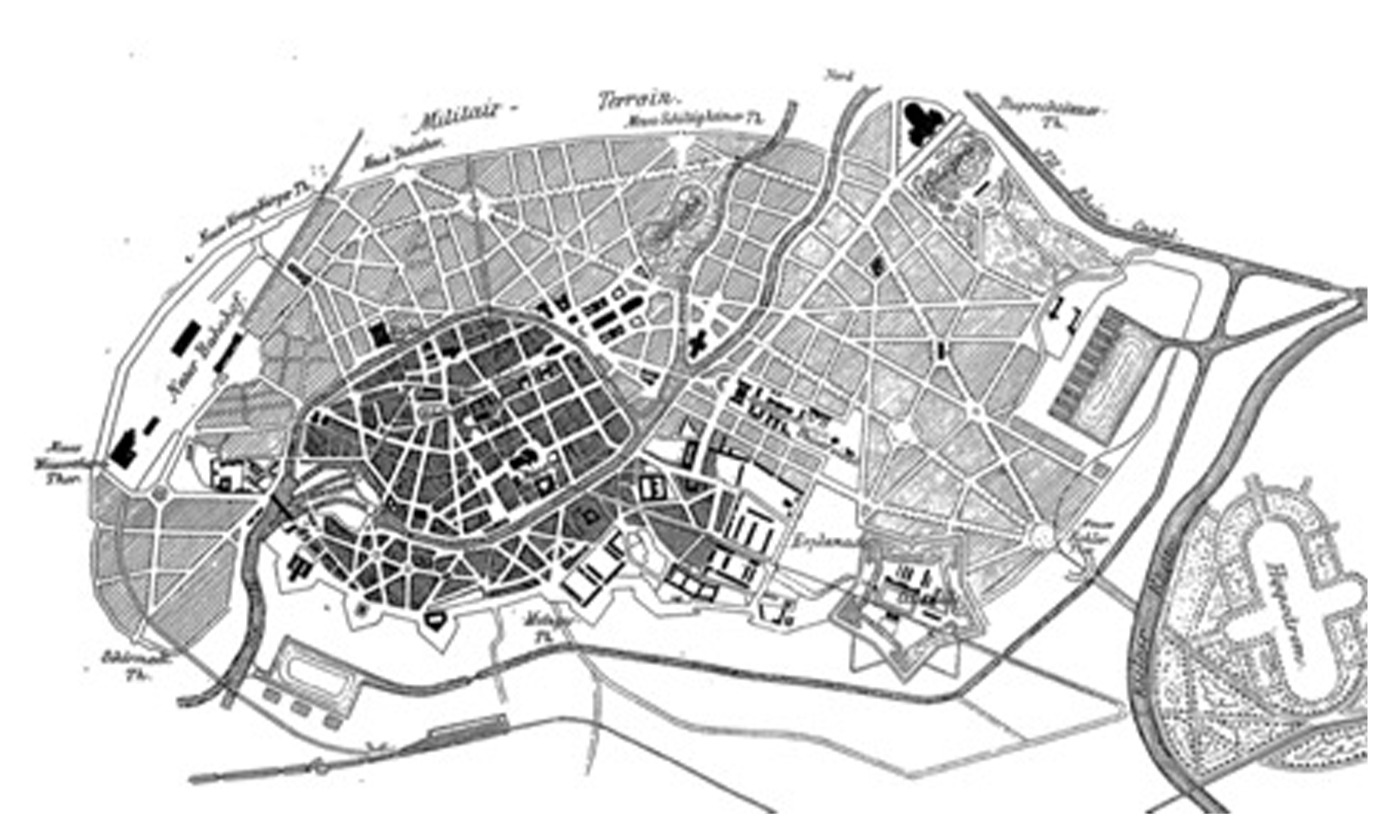
Orth’s highly bespoke plan for Strasbourg, with the old city area marked in dark gray.
The second design applied a considerably lighter touch. It was the work of Strasbourg’s city-architect Jean-Geoffrey Conrath (1824-1892). Conrath, a first-class graduate of the Parisian École des Beaux-Arts, had been in the service of the municipality of Strasbourg since 1849. 51 Due to this experience, Conrath knew how controversial any changes to existing ownership structures would prove. His design therefore left the city center untouched, embedding it in a giant rectangular grid, not unlike Idelfons Cerdà’s design for Barcelona (Figure 2). Conrath’s gridiron plan divided the extension land into large, rectangular blocks. It included fewer public spaces, fewer parks, squares, and star-shaped nodes, and considerably fewer grand public buildings than the elaborate design of his competitor. Of the two designs, Conrath’s was less Haussmannian. Allusions to the grand travaux of Second Empire Paris, quipped Jean-Louis Cohen, were ‘paradoxically more literal in Orth’s project’ than in that of his French competitor. 52
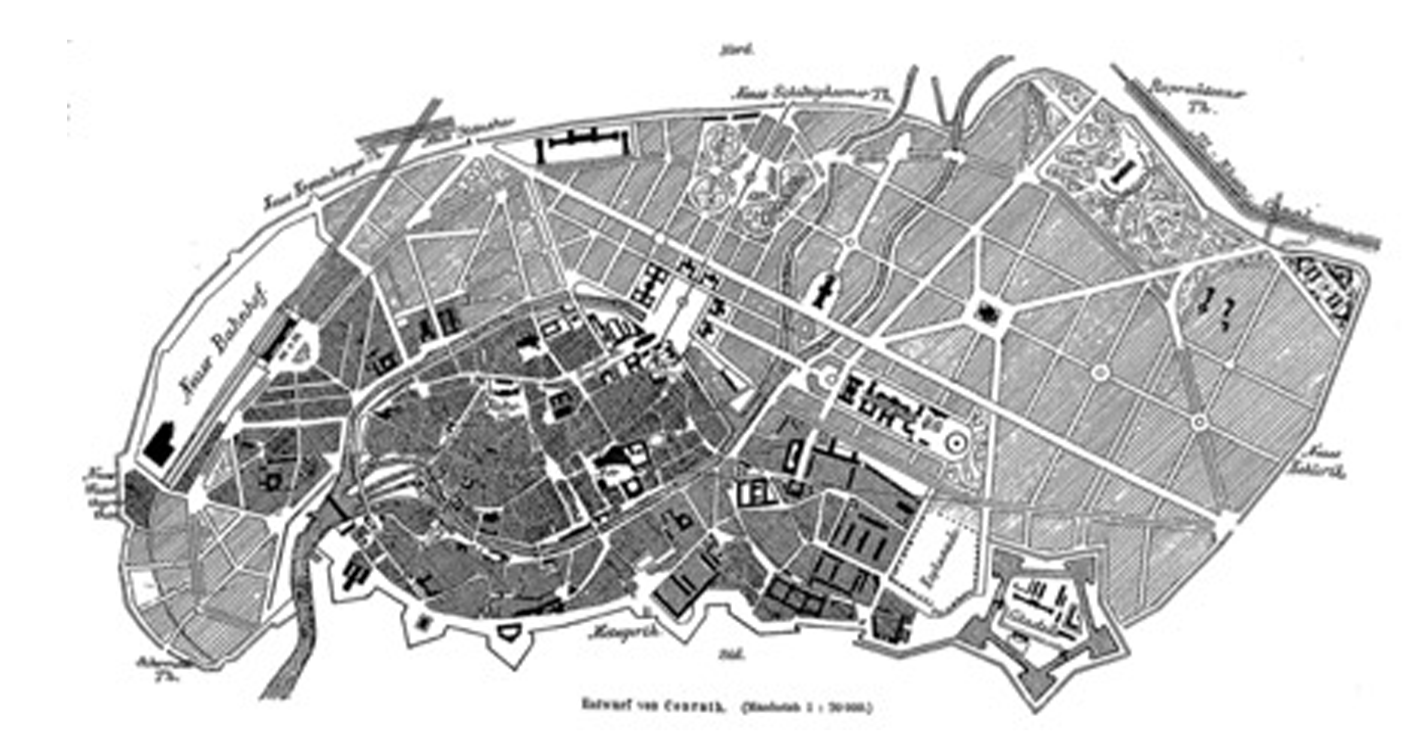
Conrath’s plan embedded the old city in a giant rectangular grid.
Both designs carried important contributions to the development of urban planning. They marked early steps in a transformation that saw architects in Europe increasingly devoting themselves to planning, a process that begun in the 1870s and that culminated in the first international conferences, professional associations, university courses, and expert journals on urban planning in the years before the First World War. For most of the nineteenth century, planning had held little allure for architects. General plans of that era were often the work of engineers, police officials, or civil servants. In Berlin, for instance, the city’s most recent general plan had been authored by James Hobrecht (1825-1902), a relatively junior engineering graduate specializing in waterways and sewage infrastructure. Far more prestigious and lucrative among architects were public buildings and private commissions, especially amid the economic boom of the post-revolutionary decades. But from the 1870s, architects increasingly turned to urban planning. A pivotal role in this development was the European economic crisis of 1873, which was followed by the so-called Long Depression (1873-1896). The crisis ruined many fortunes, brought construction projects across Europe to a halt, and left many building professionals without commissions, 53 prompting architects to rethink their business model.
Orth and Conrath played active roles in recalibrating the position of architects after 1873. Orth, in particular, had been hit hard by the crisis. The bankruptcy of his main client, the railway magnate Bethel Henry Strousberg (1823-1884), lent a new urgency to an interest which was not, however, new in itself. 54 In 1871, Orth had first appeared before Berlin’s association of architects with a presentation on urban planning, entitled Berlin und seine Zukunft (“Berlin and Its Future”). In 1874, the year after the collapse, Orth contributed to an important resolution to improve standards in urban planning. This resolution was put to the National Association of Architects and Engineers at its annual conference in Berlin, the first such document passed by a national professional association. 55 In 1875, Orth had his talk, Berlin und seine Zukunft, published. Its coverage in Deutsche Bauzeitung, the nationwide journal of the professional association, affirmed his reputation as an astute and independently minded planning critic. 56 The general plan for Strasbourg was the first time that Orth was able to put his thinking on urban planning into practice. Here, too, he published his design in book form, sent copies to politicians in Berlin, and presented his work to the Berlin association of architects. 57
Orth’s competitor in Strasbourg, Jean-Geoffrey Conrath, may have been a provincial from the vantage point of Berlin, but intellectually he was at the helm of innovations in a quickly internationalizing field. Drawing inspiration from recent extension plans for Vienna and Lille, Conrath’s design was not only the first general plan in his long career as city-architect. It was also one of the first modern general plans in the history of France. As Jean-Louis Cohen has pointed out, it was “without doubt the first modern [urban] plan to have been conceived by a student of the École des Beaux-Arts of Paris, where the question of planning was not treated until the final years of the century.” 58
Of the two plans, Conrath’s was favored in Strasbourg. Bourgeois citizens, in particular, preferred Conrath’s rational grid over Orth’s Haussmannian web of streets and squares. Less complex and less interventionist, Conrath’s plan, they hoped, would enable landowners to maximize marketable building surface and waste less on avenues and representative public spaces. Moreover, while Orth’s radial thoroughfares produced inconveniently shaped individual plots, Conrath’s rectilinear grid would make for easily marketable, regular plots (Figure 3). As the local landowner Charles Lobstein told Mayor Back, “the greatest merit in Mr Conrath’s project lies in its respect for the right angle throughout his streets network. We should not forget the importance of this disposition for the utilisation of the building land. Mr Orth’s project,” Lobstein continued, “has infinitely more sharp angles” so that its adaption would result in “much lower value from the re-sale of the plots.” 59 Friedrich Sengenwald, the director of the Chamber of Commerce, assented. Although he enjoyed aesthetic aspects of Orth’s design, he feared the costs of its implementation. Strasbourg’s bourgeois landowners were showed much more concern about the economics of the plan than about its aesthetic implications. As the largest landowner in the extension project, the municipality shared these priorities. Mayor Back’s ability to break even on the project would depend on keeping costs low and on maximizing marketable building land. It was thus that the interests of municipality and citizens aligned.
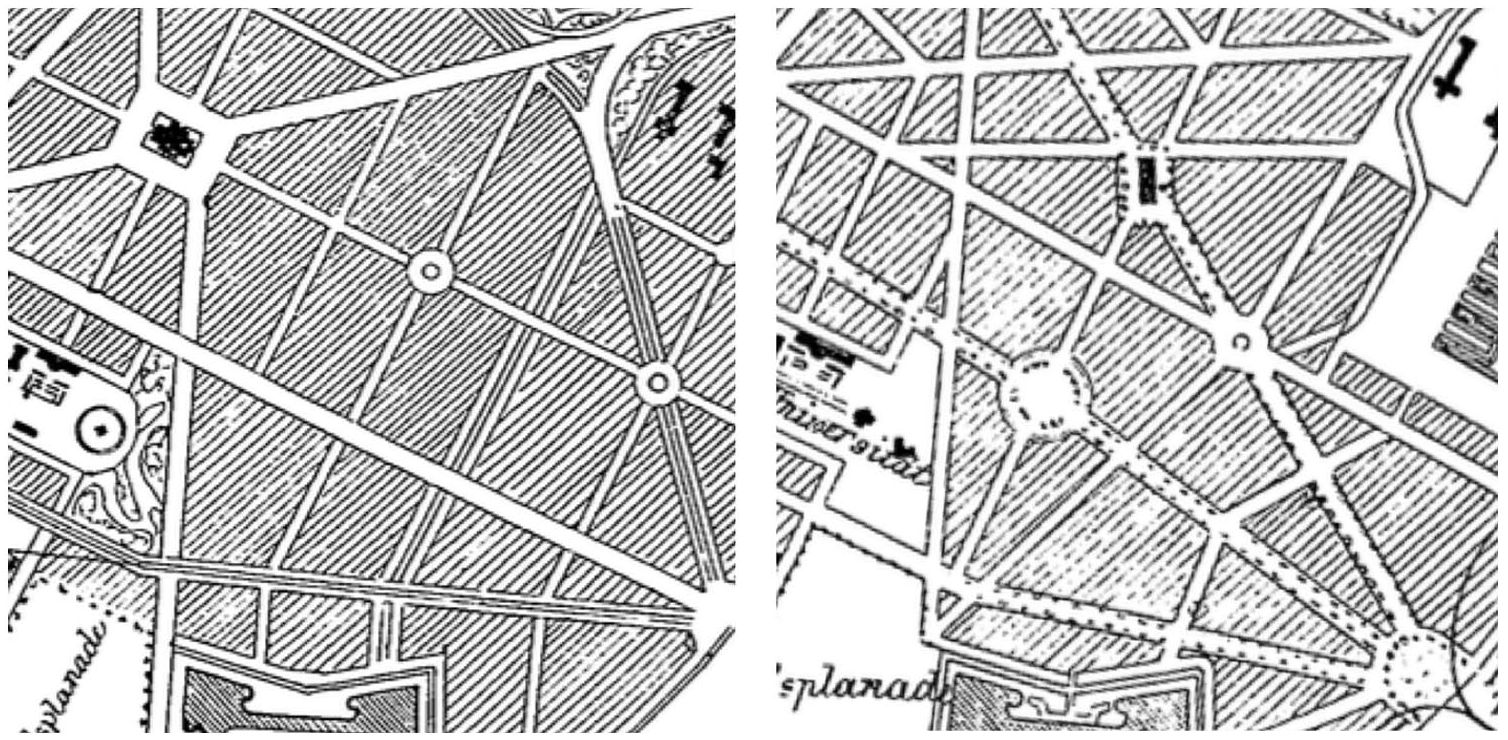
Property owners and liberals preferred Conrath’s cost-saving grid (left) to Orth’s boldly interventionist design (right), which was favored by Bismarck’s imperial government.
Technical Expertise
To legitimize his management of the process, Mayor Back involved a number of technical experts whose priorities, he knew, would align with the interests of municipal and private landowners. In addition to local stakeholders, Back had invited a number of independent technical experts on the judging panel. Among them were city-architects, such as Eduard Kreyßig (1830-1897) and Andreas Meyer (1837-1901), who were overseeing similar projects in their own cities. Kreyßig was the designer of an 1860s extension plan for the city of Mainz, one of Germany’s most ambitious urban extension projects before Strasbourg, which was implemented from 1872. 60 Meyer, Chief Engineer of Hamburg, was managing his city’s transformation into the logistical hub of the newly founded German empire. 61 The panel also included academics, such as Friedrich von Leins (1814-1892), president of Stuttgart Polytechnic and senior architect in the service of the King of Württemberg, and the up-and-coming Reinhard Baumeister. The Strasbourg panel was one of the first, thus, to bring together Germany’s most accomplished practitioners and theorists in urban planning.
Baumeister, in particular, was one of the most influential figures in nineteenth-century urban planning. 62 He is often credited as the originator of the academic discipline of urban planning. 63 At the time, he was a recent convert to the subject. An engineer by training, and not unlike Orth, Baumeister had spent the first two decades of his career in the booming railway sector. The economic crisis of 1873, which put railway construction to a halt, prompted him, too, to focus instead on urban issues. In 1874, he appeared before the annual conference of the National Association of Architects and Engineers in Berlin as the main proponent of the aforementioned resolution on urban planning. In the following year, he developed the resolution into a full guidebook, which appeared in 1876 under the title Stadt-Erweiterungen in technischer, baupolizeilicher und wirthschaftlicher Beziehung (“Urban Extensions under Technical, Legal, and Economic Considerations”). This work is typically credited as the first book on urban planning in the German language and among the earliest internationally. It established his reputation as Germany’s most prolific planning theorist.
Baumeister’s thinking on urban planning was shaped by his liberal background. Born into a family of eminent professionals in Hamburg, Baumeister was a child of the 1848 Revolution. His father, a lawyer, became the first president of Hamburg’s democratic citizens’ assembly in 1848; his uncle the chief engineer of the city’s port. Baumeister’s education unfolded in Germany’s polytechnics, institutions of higher education modeled on the École Polytechnique of the French Revolution, and centers of Germany’s transformation into a modern, industrial economy. 64 In 1849, Baumeister began his engineering studies at the polytechnic of Hanover, a favored destination among the Hanseatic bourgeoisie. Two years later, in 1851, he switched to Karlsruhe, the capital of the Grand Duchy of Baden, a renowned bastion of liberalism and the only German state to have been governed, albeit briefly, by a democratic government in 1849. 65
In his thinking on urban planning, Baumeister was a child of the post-revolutionary decades. His chief concern was to balance the interests of property owners with necessary public interventions in urban development. Baumeister’s goal was to carve out a niche for himself as an independent advisor and university teacher. His success, in other words, depended not on central government commissions, but on his ability to establish a reputation in professional circles, to secure university professorships and advisory appointments such as in Strasbourg. It is not without reason that Baumeister made his career in the Grand Duchy of Baden, whose liberal, devolutionist reforms were among the first to empower democratically governed municipalities to pass and implement their own urban plans. As planning was, in an increasing number of cases, a matter of local government, Baumeister understood that he had to tailor his expertise to the needs of local administrations. Strasbourg project was one of the first instances that Baumeister was able to put his knowledge into practice.
In Strasbourg, Baumeister lent intellectual legitimacy to the material interests of landowners. In his recently published Stadt-Erweiterungen (1876), he had argued that urban plans should prioritize material prosperity over representative purposes. In Baumeister’s opinion, economy, health, and traffic should at all times outweigh purely representative considerations. Interventions in private property rights, Baumeister argued, should be kept to an absolute minimum and were only acceptable for technical reasons. Orth’s highly irregular design appeared to him an attack on the principle of economy and an affront against all due commensurabilities. “The first priority of a street network,” wrote Baumeister, “is to provide convenient building plots. Rectangular street crossings are therefore preferable, and it is certainly wrong to make sharp angles into a design principle.” 66 His colleague Andreas Meyer, like Baumeister, a son of the Hamburg bourgeoisie and graduate of the Hanover Polytechnic, joined the attack. In the judging panel, he argued that Orth’s plans “destroy and devalue [. . .] the entire new, exquisitely situated, building terrain,” calling the manner in which Orth “forced” his streets and squares into symmetry “perverted” and unnecessarily expensive. 67
Technical experts around Baumeister, much like bourgeois citizens, favored Conrath’s gridiron plan. Conrath’s rectilinear grid was widely recognized as the most efficient way of laying out a new city. 68 It was, in the words of one of the jury members, “exceptionally clear, exceptionally systematic.” 69 The grid produced blocks of invariant shape and dimension, with minimal traffic areas for maximum development surface. Rectangular plots could be marketed and sold more easily than irregular ones. Baumeister’s own extension plans, for Heilbronn (1873) and Mannheim (1872), had also made extensive use of this system. Kreyßig’s extension plan for Mainz (1866), too, was grid-based. The rational grid, as in Conrath’s plan, protected the city from the whims of planners and government alike. It prescribed no particular aesthetic vision, but left the urban form to its inherent economic forces.
Orth, by contrast, declared himself an “enemy of the Mannheim checkerboard plan.” 70 He made it his mission to contest Baumeister’s preference for the grid, maintaining that artistic considerations should take precedent over the immediate maximization of profits. He argued that the value gained from beautiful streets and squares would more than make up for the potential loss in marketable building surface. In his presentation, Orth invoked aesthetic principles, insisting on “appropriate artistic design” above practical or economic priorities. 71 A renowned competition designer and purveyor of representative architecture, Orth was used to generous budgets and ambitious clients, but not accustomed to economy of means.
Economic and political default lines underlay the jury’s debates, and in particular, the controversy between Orth and Baumeister. The two experts found no common ground in Strasbourg. They also thought and spoke about planning in different terms. Where Baumeister excelled in technical questions and reveled in details of canalization, sewage, street profiles, policing, and fire regulations—in which his expertise was unrivaled—Orth lacked the suitable terminology to engage in a meaningful conversation. Where Orth stressed the finer qualities of his plan, emphasizing the “organic” development of its streets and squares, or invoking “artistic considerations,” Baumeister refused to engage in such a debate.
When Orth and Baumeister did use the same terms during the jury’s sessions, they often meant different things. A key term in the debate was the notion of the “organic” city, popularized most recently by the Viennese architect Heinrich von Ferstel (1828-1883). 72 Orth, too, made extensive reference to organicism during the jury’s meetings. His insistence on “organic” urban development implied that planners should be in complete control of all aspects of its harmonious expansion. As we have seen, his design for Strasbourg worked hard to weave together the old and the new city into a continuous whole. Baumeister, too, had written of “organic” urban development in his recent book. 73 But for him, “organic” development rested on the freedom of economic actors to invest and build freely and safe from the whims of the political executive. The planner’s task was not to control urban form through design, but to put in place reliable mechanisms to unleash the city’s inherent growth.
Most notably, Baumeister supported a very different view of aesthetics from his Berlin colleague. “Architectural beauty,” he opined in 1876, could only “develop through the way of freedom.” 74 “Competition and necessity,” he continued, would lead “more safely toward beauty than public control.” 75 His laissez-faire attitude toward aesthetics was more than a matter of mere personal disposition: it was programmatic; Baumeister was not a philistine. His first book, Architektonische Formenlehre für Ingenieure (1866), had sought to bridge the gap between engineering and fine art. In it, the budding academic attempted to enlighten engineers on architectural form, demonstrating his mastery of some of the most pertinent aesthetic questions of the age. However, not once in the course of the week-long adjudication for Strasbourg did he make reference to art or aesthetics.
Baumeister’s career would depend on his ability to establish planning as a widely acknowledged discipline. Technicization was his best option. It is for these reasons that he developed a specialist, scientific vocabulary of planning, with its concomitant concepts and methods that located planning in its “technical, legal, and economic” context. 76 This vocabulary would aid the emancipation of an independent, specialist planning discipline. 77
It was a matter of professional pride for Orth to resist Baumeister’s specialist language games. Nothing was further from him than acknowledging an independent discipline of planning, let alone a technical or even scientific one. Planning, in his opinion, belonged to the echelons of high art. The Berlin Building Academy, Orth’s alma mater, trained its students as universalists, as one contemporary put it, “representatives of the state organism” dedicated to “the accomplishment of the ideals of the true, good, and beautiful.” 78 It was one of few institutions of higher education in Germany that still made no distinction between architecture and engineering. At the time of the Strasbourg competition, it was fighting off government attempts to turn it into a “Latin-less” technical university. Fiercely determined to resist technical specialization, the school insisted on producing not technicians but so-called Master Builders (Baumeister) in the tradition of Prussian court architecture.
The resistance to technical specialization was more than a matter of personal pride to Building Academy graduates like Orth. It was a matter of material interests. After the crash of 1873, when opportunities in the private economy became sparse and civil service position was far and few between, academicians faced severe competition from ever-increasing numbers of technically educated professionals. Orth became a leading voice of academic conservatives. A prominent member of the Berlin Association of Architects, in 1879 he found rival group to support the interest of academically trained architects who saw themselves threatened by increasing competition from those with inferior formal education.
Orth and Baumeister supported different claims to planning: Baumeister as a technician, Orth as an artist. Orth, like many fellow academicians, was not only an architect but also a trained painter (he had studied at art colleges in Brunswick, Berlin, and Munich alongside his architectural education) and he understood himself as a visual artist above anything else. 79 The fact that Baumeister stubbornly referred to him as a “technician” (Techniker) in a lengthy article in Deutsche Bauzeitung suggests that the question of professional authority played a fundamental role in the Strasbourg competition.
In the event, Orth did not get off to a promising start. The first meeting of the jury opened with a debate on the question of a new port. This was a strategic issue for many of the present industrialists and entrepreneurs. If Strasbourg was to strengthen its trade links with the rest of Germany, the Rhine would play a key role in connecting it to the empire’s industrial heartlands downstream. Orth was first up, forced to defend his design of an inner-city port against an alternative proposal from the coal merchants Deuter and Ulrich. 80 His competitor Conrath had, on Back’s explicit request, refrained from including a detailed port design in his plans. 81 A final decision was adjourned to the following morning. 82
Conrath commenced the next meeting with his presentation on a potential port development near the railway lines in the city’s south. Baumeister strongly supported the idea, and Meyer sided with him, before Back concluded the discussion. A vote among the jury ruled “almost unanimously” in favor of Conrath’s plans. 83 Rather than move on to wider aesthetic questions, the jury turned to yet another technical subject in the afternoon. Conrath presented his proposal for the inner-city waterways. His design of an embankment along the river Ill contrasted with Orth’s more costly version of a promenade on either side; the concluding vote again went in favor of Conrath. 84
Bit by bit the commission discussed, then voted on, separate aspects of the extension, while Back abstained from active participation. Over the course of six days, every element of the plan was systematically covered. Orth’s plan, which relied on a delicate balance of parts, did not lend itself easily to piecemeal alterations. His competitor had deliberately delivered a blueprint. Orth, by contrast, conceived of his plan as a fine-tuned, coherent artistic product. He was growing noticeably less agreeable by the day. When the discussion finally reached Orth’s real strong points—the aesthetic arrangement of public spaces, streets, and greenery—the essence of his original design had been compromised almost beyond recognition.
As the days progressed, Orth was increasingly unable, or unwilling, or both to partake in a discussion on Baumeister’s terms. As a result, Baumeister managed to dominate the jury not only with his technical language, but also with his particular methodology. 85 It had been his idea to tackle the technical aspects of the extension upfront. In his Deutsche Bauzeitung article, which appeared a few weeks before the jury’s convention, Baumeister had suggested that the questions of port, canalization, river regulation, and sanitation were the pivotal issues of the new Strasbourg, on whose resolution all further specifics of an extension depended. 86 In designing the agenda for the judging panel, Back had almost directly adopted these priorities.
The aim of the public competition was much less to appoint a winner than to agree an indisputable compromise. Back had tailored the proceedings carefully to such a compromise: jury votes were never framed as a head-to-head between two rival designs, but instead treated as decisions on specific technical problems. Neither of the entrants were awarded a prize. The consolidated, final plan was elaborated by the municipal building department, taking into account the comments from the jury. This plan, a local power-grab in disguise, bore much closer resemblance to Conrath’s design than that of his competitor from Berlin. Orth not only had an entirely unsatisfactory week in Strasbourg, but he also returned to the capital curiously unable to voice his frustration. He could scarcely protest against the detailed work of a commission in which he himself had played a key role. Orth’s only remaining strategy to save face was to claim success. Years later, he still maintained that the final plan for Strasbourg bore his own handwriting. 87 It has occasionally been referred to as “Orth-Conrath” although it was arguably the much more of the latter. 88
Back’s strategy proved a success. When the outcome of the competition was communicated to Berlin, the project had progressed too far under the eyes of a scrutinizing public than to allow for major changes. While the ministry of war held manifold objections to the plan, it proved unable to effect substantial alterations. Conrath negotiated directly with the planners of the ministry to resolve its lengthy catalog of complaints. By this point, the municipal architect had the legitimacy of the public consultation process, the competition, and the debate in the professional association behind him. The plan that was eventually agreed showed only minor departures from Conrath’s initial submission. Baumeister had been right in 1876 when he understood the plan as a binding contract between all stakeholders in the city, noting that “drawn law should be as sacrosanct as written law.” 89
Reception
Strasbourg occupied a seminal role in the history of modern urban planning. The urban extension was one of the earliest and, in relative terms, the largest urban extensions in the German empire. More importantly still, its effects on the development of planning were profound. Through the emergent networks of planning specialists, through publicity and press coverage, the project influenced the further development of urban planning, as will be shown in this section.
The planning competition of 1878 made Strasbourg into one of the most well-known examples of urban planning in the German empire. Not only was this one of the first planning competitions in global history. 90 It was also, as we have seen, the first instance that an urban planning project featured in the official organ of Germany’s associations of architects and engineers. The impact in professional circles was immense. Their involvement in Strasbourg helped experts like Baumeister establish their reputation as authorities in urban planning. Jury members went on to export the takeaways from Strasbourg to all corners of the empire. Andreas Meyer, for instance, became responsible for the design of Hamburg’s new port district, from 1881, and for its first general plan, which was passed in 1896. 91 In Mainz, Kreyßig oversaw the finalization of the city’s urban extension. Most notable were Baumeister’s plan designs. He would go on to develop extension plans for Rostock (1887), Heidelberg (1894), and Rastatt (1894).
Strasbourg, we have seen, was the first instance that Baumeister was able to put his recent theories from Stadt-Erweiterungen (1876) into practice. Baumeister’s coverage of the competition in Deutsche Bauzeitung and the ensuing public controversy with Orth helped him spell out his vision of a scientific, evidence-based practice of urban planning before a nationwide audience of architectural and engineering professionals. Strasbourg thus proved an important boost to Baumeister’s career. In 1887, eventually, he was able to launch the first university course on urban planning, a lecture series at Karlsruhe. 92 In 1890, he was appointed to the empire’s first chair of urban planning there. 93 And in 1895, he became the first rector of what had, by then, become the Technical University of Karlsruhe. 94 In 1891, the first English edition of his 1876 book appeared in New York. 95 In 1910, his plan designs for Mannheim and Altona featured at the General Exposition of Cities (Allgemeine Städteausstellung) in Berlin, the forerunner of the first Town Planning Conference in London later that year. 96
In political circles, too, Strasbourg became an important precedent. The planning competition, one of the earliest in a whole string of similar competitions that soon engulfed Germany, Austria-Hungary, Italy, and the Netherlands, had made the city into one of the best-known examples of urban extension planning. Mayor Back made sure that minutes of the jury were sent to his colleagues in Cologne, Mainz, Düsseldorf, Frankfurt am Main, Eberfeld, Barmen, Koblenz, and Munich. 97 His publicity created a culture in which decision-makers from across Germany frequently shared their knowledge and experiences. Decision-makers in Strasbourg, we have already seen, relied on the advice from municipal politicians in cities like Cologne, which were undergoing similar transformations. 98 In the decades that followed, politicians from these cities, in turn, attempted to adapt the best practice from Strasbourg. One particularly prominent example was Johannes Widenmayer (1838-1893), the prolific mayor of Munich from 1888 to 1893, who consulted Back on the legal processes underlying urban extension planning in 1890. 99
Nineteenth-century planning experts regarded the case of Strasbourg as exemplary. Its plan design, in particular, became widely respected through key works of urban planning, most notably Der Städtebau (1890) by Joseph Stübben (1845-1936), which further developed Baumeister’s scientific approach. Stübben was one of the many technical experts who were sent minutes of the planning competition in 1878. 100 The resultant plan was, in his opinion, one of the most important contributions to the development of urban planning. In Stübben’s Der Städtebau, the new general plan for Strasbourg was featured alongside general plans of Paris, New York, Moscow, Tokyo, Turin, Vienna, Mainz, and Cologne and alongside Baumeister’s extension plans for Mannheim and Rostock. Moreover, Stübben awarded Strasbourg a full double-page spread, as one of only four general plans in the entire book. 101 Further images and references to Strasbourg abounded throughout the text. 102 The city thus occupied a key position in the work that would replace Baumeister’s Stadt-Erweiterungen as the established practical manual in German urban planning until the First World War. In 1894, professionals descended once more on Strasbourg, the host city of the annual conference of the National Association of Architects and Engineers, an event that enabled professionals from across the empire to gain a clearer picture of the ongoing urban extension.
The reception of Strasbourg extended into the twentieth century. The city’s general plan played a role, in particular, in the unfolding controversy between the established, technical approach to urban planning and the movement for “artistic planning,” championed by the Viennese planning critic Camillo Sitte (1843-1903), who rejected the established, technical approach of Baumeister and Stübben. In Sitte’s best-selling book Der Städtebau nach seinen künstlerischen Grundsätzen (“Urban Planning According to Artistic Principles”), which was first published in 1889 and went through three further editions until 1909, Strasbourg also played a part. Sitte repeatedly referenced Strasbourg (from its 1901 edition, the book contained a full-page illustration of the cathedral), whose inner city he admired for its picturesque arrangement of streets and squares, while attacking the kind of urban planning evident in the urban extension. 103 He objected, in particular, to the regular arrangement of straight streets that had been so dear to planning experts and local landowners in the 1870s. Eventually translated into English as The Art of Building Cities in 1945, Sitte’s book was influential, too, in the development of urban planning in the United States and in Britain, whose first garden city, Letchworth, emphatically employed Sittean design principles.
The reaction against nineteenth-century planning also impacted Strasbourg. From the turn of the century, several amendments to the general plan introduced Sittean “artistic principles” to the city. In 1897, municipal planner Johann Carl Ott revised the general plan for the eastern part of the urban extension, the Île Sainte-Hélène, abandoning the agreed pattern of rectangular streets in favor of a network of curved streets that took cues from existing paths, in line with Sitte’s theory of artistic planning. 104 When asked to justify his changes, Ott referred explicitly to Sitte. 105 In 1905, Mayor Back asked the city council to alter the general plan for the suburb of Neudorf in line with the principles of artistic planning, although the existing plan was less than ten years old. In his explanation, he unmistakably borrowed from Sitte’s arguments. “The comparison of the old, picturesque, and habitable cities with the bland, boring looks of modern urban extensions has led to the general conviction that [ . . .] the exaggerated regularity of straight streets and squares bears the blame,” Back told the city council. “For this reason, in more recent general plans, straight streets have yielded to gently curved ones.” 106 A generation after the planning competition of 1878, the city of Strasbourg became part of a reaction against a kind of urban planning that it had helped to establish in the first place.
No matter which side of the debate one occupied, Strasbourg’s importance was an undisputed fact among adherents as well as critics of nineteenth-century urban planning. In Britain, in particular, experts looked with admiration upon the transformation of Strasbourg. By the eve of the First World War, British planners were familiar with the case of Strasbourg through books like Stübben’s and Sitte’s, but also, even more importantly, through exhibits such as the Royal Institute of British Architects’ (RIBA) Town Planning Conference in London in 1910, the world’s first international conference on urban planning. The conference was preceded by a string of national conferences and exhibitions on similar subjects. One particularly important source of inspiration was the Berlin Urban Planning Exhibition (Städtebau-Ausstellung), which was held earlier that year. The exhibition featured, for instance, Baumeister’s urban extension plans for Mannheim and Rostock. It did not, however, include any exhibits from Strasbourg, whose absence was noted by the British planner Raymond Unwin, the organizer of the RIBA Town Planning Conference, who visited the exhibition to scout out potential contributors for the London show. 107 The RIBA’s secretary Ian MacAlister regarded “the important role that the city of Strasbourg has played in this history [of urban planning]” as “such an exceptional one” that he and Unwin started repeated attempts to ensure the city’s contribution to the RIBA’s Town Planning Conference. 108 “At present, the history and principles of the discipline of urban planning are being studied with great earnestness in England,” explained MacAlister, asking the mayor for “photographs or drawings” of the transformation of Strasbourg. 109 Unwin wrote again. The municipality finally agreed to submit a “plan of the development of the city of Strasbourg,” which Unwin had mounted and displayed with an accompanying text that explained the recent urban extension, at the RIBA’s Town Planning Conference in London. 110 Strasbourg thus became one of several German cities that took center stage in the exhibition that would have a sustained impact on the development of twentieth-century urban planning.
Conclusion
Strasbourg, this article has shown, warrants a significant position in the history of urban planning. Despite its peripheral location within the German empire, the city played a central role in the development of German urban planning, a development that, in turn, had lasting effects on the history of Western urban planning more generally. In absolute terms, Strasbourg was already a pioneering achievement. The city’s reconstruction after the Franco-German War (1870-1871) commenced a process that merged into one of the earliest, largest, and most expensive planned urban extensions in the German empire. More importantly though, Strasbourg also played a seminal role in the development of urban planning into an established area of technical expertise, an academic discipline, and an area of professional practice. Strasbourg became a catalyst in the development of urban planning into a well-established field dominated by what Camillo Sitte described as “technicians and specialists.” 111 Bringing together individual planning specialists from across Germany, Strasbourg helped foster a tight-knit community of technical experts that would dominate urban planning in the final decades of the nineteenth century. Moreover, the events at Strasbourg highlight the importance of institutions such as competitions, professional associations, and expert journals in the development of urban planning. As one of the most prominent examples of nineteenth-century urban extension planning, Strasbourg also came to occupy a central role in the international debates around the future of urban planning that unfolded after the turn of the century. Strasbourg was more than just a typical example of nineteenth-century urban planning in Germany. The city deserves new attention as an active part in the wider development of urban planning.
Footnotes
Acknowledgements
First of all, I would like to thank Christopher Clark for his helpful and generous advice on previous versions of this article. The article has been further improved in the light of the insightful comments of two anonymous reviewers of this journal, to whom I owe a debt of gratitude. I am grateful to those, too, who have shared suggestions on this piece at several conferences and workshops, at the Institute for Historical Research and at the German Historical Institute, London, and at the Leibniz Institute for Contemporary History (IfZ), Munich, especially John Arnold, Caroline Goodson, Christina von Hodenberg, Constantin Kilcher, Matthias Mößlang, Martina Steber, and Florian Wittmann. I also thank Benoît Jordan of the Archives de la Ville et de l’Eurométropole de Strasbourg (AVES) and Marie Collin of the Archives départementales du Bas-Rhin (AdBR) in Strasbourg.
Declaration of Conflicting Interests
The author(s) declared no potential conflicts of interest with respect to the research, authorship, and/or publication of this article.
Funding
The author disclosed receipt of the following financial support for the research, authorship, and/or publication of this article: The author recieved financial support from the Cambridge Trust, from the Faculty of History, University of Cambridge, and from King’s College, Cambridge, for the research of this article.
