



Abstract
Israel’s civil defense apparatus relies upon a technologically advanced alarm system. Once a rocket is detected, a cellphone app alerts the residents of the targeted area, and only the sirens located close by start wailing. The ability to isolate hundreds of such “alert zones” from one another during conflagrations with the Gaza Strip has been celebrated as the key to Israel’s civil and economic resilience. Yet, when the history of this technology is examined, a different picture also emerges. Civil society in Israel has often contested the fragmentation of the country into distinct alert zones and surfaced the social and political inequalities it enhances. By following these claims, this article shows how Israel designed the alert zone system to crumble the traditional notion of emergency and turn it from a collective into an individual experience. The article argues that Israel has shifted the meaning of war, for its citizens, from a political crisis into a series of random events, thus naturalizing the perpetual conflict with the Palestinians, stifling any effective demand for resolving it, and cementing an individualized form of state sovereignty.
The introduction of air bombing and missiles in the twentieth century confronted states worldwide with a dilemma: which comes first, human lives or economic and industrial resilience? While states could not allow their citizens to be exposed to bombing, the price of over-protection that would interrupt industry and economy could often be strategically higher than the toll of actual air strikes. To solve this problem, modern states gradually adopted sirens to warn their public of impending raids and missile attacks. Air raid sirens worked in two parallel and complementary ways. In their more known role, sirens enabled states to capture the attention of their public far and wide in areas that came under threat. Sirens of civil defense thus started their historical role in principal cities, the primary target of air raids since World War II (WWII). Yet, into the years of the Cold War, with the growing presence of long-range missiles and radars, rural areas were integrated into nationwide alert systems. 1 Sirens now became a vital device for differentiating between spaces that should be alarmed and those that should not. In other words, siren systems were not only about the effective reach of the alarm but also about who should be alarmed and when. The reach of sirens and their differential activation marked a spatial and temporal distinction between emergency and routine. A distinction that became necessary for achieving both efficient protection and civil resilience.
The world after the Cold War largely left nationwide air raid siren systems behind it. With the exception of the recent Russian invasion of Ukraine, which is beyond the scope of this article, in most European countries, air raid sirens now bear mainly a ceremonial role. In public spheres across the globe, sirens are much more recognized today with warning against natural hazards than military threats.
The recent history of Israel, however, has seen an opposite trajectory. While air raid sirens largely diminished as a central state infrastructure elsewhere, in Israel, it received a renewed meaning and almost potent presence in recent years. 2 Israel’s use of the air raid siren in the twenty-first century resembles the patterns described above. It has become a tool for differentiating spaces of emergency and routine. Yet, by adding significant technological improvements, linking advanced rockets-detection ability with remote control of multiple siren horns, Israel has taken the goal of spatial differentiation and fragmentation to an unprecedented level. This article argues that by so doing, Israel has come close to individualizing the state of emergency, making each fall of a rocket a personal affair. By focusing its alerts on areas as small as a few hundred square meters, the Israeli siren system enabled turning emergency from a collective to a private experience, thus significantly maximizing the maintenance of civil routine during conflagrations.
The first part of this article lays out the short history of Israel’s “alert zones system.” It shows how the system developed as a complementary measure to the blockade of the Gaza Strip, and in response to the advancing capabilities of the Palestinian resistance against it. The second part discusses the civil responses to the system within Israel, exposing the agitation against the isolation and individualization of emergency. The main quarrels discussed here revolve around the civil demand to hear the sirens wherever they are and the right to be alerted by threats across the entire country. Finally, the closing part of the article examines some of the broad political implications of this short history. It argues that the consequences of Israel’s efficiency in establishing civil and economic “resilience” through this system had been significant: it had shattered the sense of civil solidarity and de-politicized the state of emergency. From the state’s perspective, these prices were worth paying nevertheless, because the individualization of the state of emergency had become a powerful instrument for maintaining state sovereignty and achieving legitimization for prolonging Israel’s armed conflict with the Palestinians. Israel’s treatment of the Palestinians in Gaza, on the one hand, and its own citizens, on the other, was shaped as a mirror picture of one another. While turning the entire Gaza Strip into one unified “zone” that is put collectively under military blockade, Israel designed the protection of its own citizens as a project of spatial fragmentation of the country into increasingly smaller, more isolated, and more individualized “zones.”
Israel’s Alert Zones System: A Short History of Spatial Fragmentation
While no major threat necessitated a nationwide alarm system in Israel since the 1973 War, this requirement emerged abruptly with the first major conflict of the post-Cold War era, the 1991 Gulf War. Over a month of conflict, the Iraqi army shot 45 Scud missiles toward Israel; 40 hit the country’s territory, mainly causing damage, 20 of them fell in the Tel-Aviv metropolitan area. Israel’s civil defense of the time relied on a system that alarmed the entire population of the country to go into shelters and wear gas masks when a launch was detected. Once the threat was over, another “all clear” alarm was sounded. The entire country, thus, made a single “alert zone”: never mind where exactly the missile was heading, sirens went off countrywide. 3
The first version of differentiated alert zones was introduced several days into the conflict. The Israeli Defense Force (IDF) detected that most of the missiles aim at central Tel Aviv and the Haifa Bay and therefore announced an improvement whereby the country was divided into six zones. After a hit was approved in one zone, the IDF spokesman gradually “released” all other zones from shelters with an “all clear” sound, thus allowing most of the population back to routine faster than before. 4 Preparing for another round of Iraqi attacks following the American deceleration of the non-flying zone over southern Iraq in September 1992, Israel divided the country further into ten alert zones. 5
This initial trial with differentiating zones of emergency paused with the demise of the threat from Iraq. During the 1990s, Hizballah occasionally fired rockets from southern Lebanon into Israel. These mainly were low-range projectiles that only reached Israeli towns along the northern border. Protection against these rockets relied on hand-operated sirens across Israel’s northern region. However, a significant shift started to take place in the year 2000. After the IDF withdrew from the occupied “security zone” in southern Lebanon, fire into Israel mostly ceased. At the same time, Hizballah started acquiring new long-range rockets, mostly 122 mm Grad type, with a range of 40 km. With the IDF gone, firing positions also advanced significantly closer to the border, thus enabling Hizballah to shoot farther into Israel. 6 Almost concurrently, the Second Intifada that started in 2000 brought Hamas organization in the Gaza Strip to develop rocket-launching skills too. While using mortars before, in 2001, Hamas fired its first locally produced Qasam rocket outside the boundaries of the Strip and hit the town of Sderot. Following the footsteps of Hizballah, Hamas too gradually increased the range of its rockets within several years to reach 40 km. 7
While monitoring the advancing abilities of Hizballah and Hamas in real-time, Israel came to acknowledge their actual effect for the first time only in 2006. During the Second Lebanon War in the summer of that year, Hizballah shot some 3900 Grad rockets into Israel and experimented with 200 mm Fajr rockets, covering the territory of the northern border to the Haifa Bay area. 8 Despite a relatively low number of civil casualties in Israel (41 out of the total of 161) and some damage, the month-long war demonstrated how ill-prepared Israel was for a reality of constant fire. Shelters in many towns were in a state of disrepair, and municipalities did not have functioning emergency services, volunteers, or supplies in hand. Worse yet, the siren system, partially hand-operated, suffered from the lack of personnel and maintenance, causing many people to remain unnecessarily in shelters for many hours, sometimes days. 9 Given the poor conditions, 200,000 to 300,000 people fled the northern regions of Israel southwards. 10 In several towns of the upper Galilee area, municipal services virtually collapsed due to the flight of civil servants and the residents’ anxiety about leaving shelters. 11
The year 2006 was also the year that Hamas first fired Grad rockets from the Gaza Strip. In March, only six months after Israel’s withdrawal from the Strip (“The Disengagement”), Hamas launched its first Grad rocket to the Israeli city of Ashkelon, thus significantly advancing its threat on Israel’s home front to reach over 20 km. In July, these rockets directly hit the city for the first time. 12 After Hamas took power in Gaza in 2007, Israel tightened its already-strict control over the boundaries of the Strip to become a full-flanged military siege that harshly restricted the movement of people, materials, goods, and even food supply in and out of the Strip, aiming to collapse the Hamas government. During a series of conflagrations throughout the following years, Hamas expanded its fire to include all major cities within the range of 40 km from the Strip, including Ashdod and Beersheba. The heaviest demonstration of these abilities was during the Gaza conflict of December-January 2008 to 2009, 13 when under a massive Israeli offensive, Hamas fired 247 rockets (forty-one a day) and 277 mortar shells that fell within Israel’s territory. 14
The lessons learned from the Second Lebanon War and the ongoing reality around the Gaza Strip since 2006 faced Israel with a challenge. The threat of rocket fire, became a matter of daily life. As Israel saw the blockade of the Strip as a pillar of its security policy against Hamas, it had been clear that the rockets “drip” from Gaza (so it was discussed in popular media) would go on. Again, the problem was not very much the fear of massive casualties, which remained small even in times of heavy fire, but the ongoing disruption of everyday routine and the eroding civil resilience. While the need for supplying more shelters and improving emergency services was evident, civilians could not shelter themselves nonstop. The main innovation that this period brought about was a reassessment of the quality of the warning that the state supplied civilians against rockets. In 2009, Yair Golan, then major general of the IDF Home Front Command (HFC), the military unit in charge of civil preparedness and defense in Israel, repositioned the country’s alarm system to be “the most central component of Israel’s ability to face rockets threat.” The chosen solution was to focus the alerts by dividing the country into more discrete zones. 15
This idea was not conceived in a total vacuum. By that point, a certain form of division of space into zones was already in the making. It started a few years back as a direct response to the expansion of Hamas’ rocket range. Unlike low-range mortars that fall shortly after launching, rockets that went farther in space flew longer times and thus “enabled” targeted populations more time to run for shelter. And thus, when cross-border conflagration with the Gaza Strip aggravated in 2006, the HFC started distributing a rocket-range “rings” diagram that showed the different Israeli towns and cities within rocket range from Gaza [Figure 1]. This visualization enabled imagining the Israeli space around the Gaza Strip as a uniquely defined region, characterized by rocket threat and known colloquially as the “Gaza-enveloping region” (Hebrew: ‘Otef ‘Aza). 16
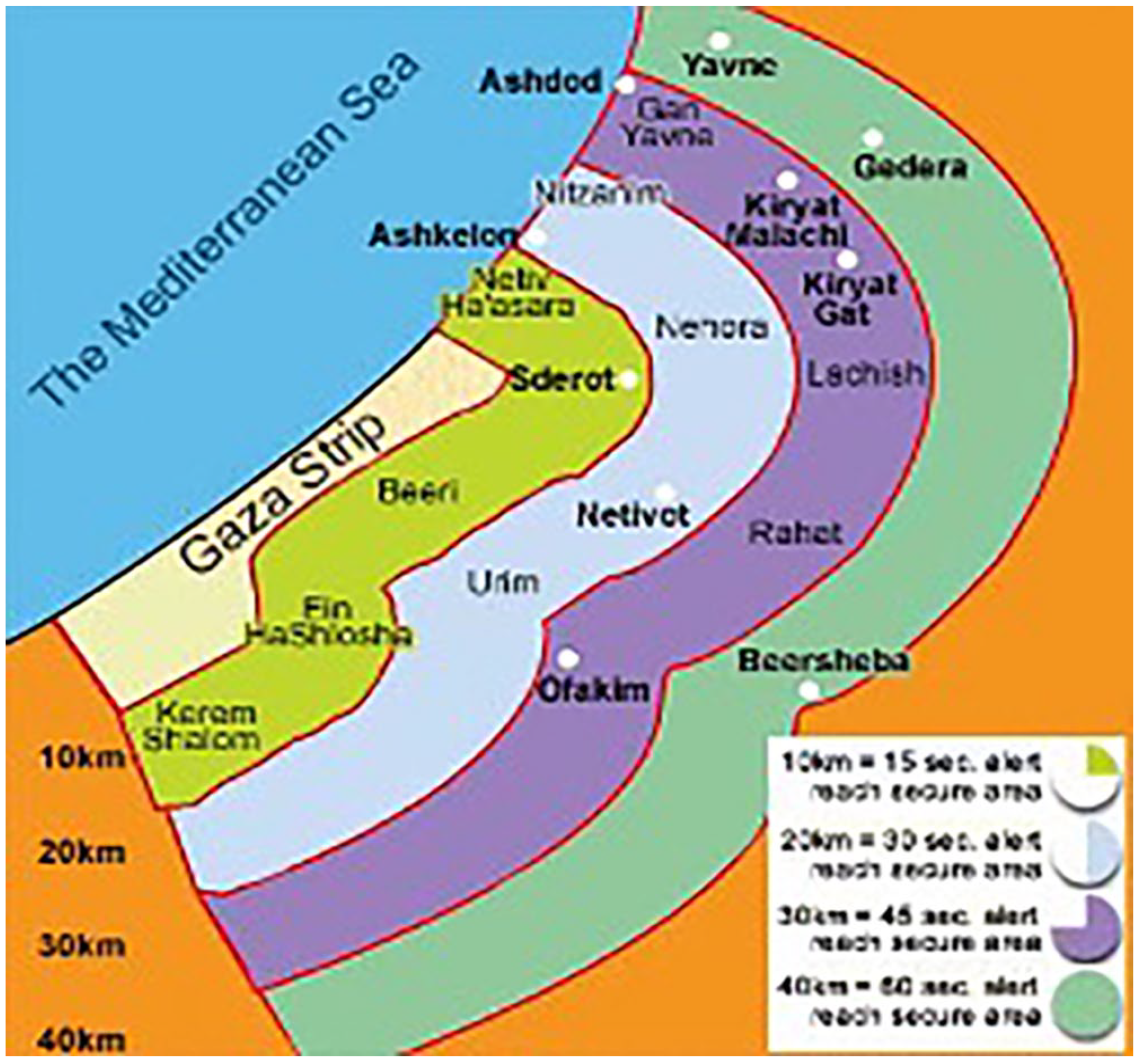
The rocket-range rings diagram.
Following the 2008 Gaza conflict, this logic of civil protection was first expanded to include the entire country and become national in scope. Then, in April 2009, the HFC distributed the first map that divided the whole country into areas representing how fast the population must run for shelter upon alarm: from no time in the Gaza-surrounding area to three minutes in Israel’s center [Figure 2]. 17
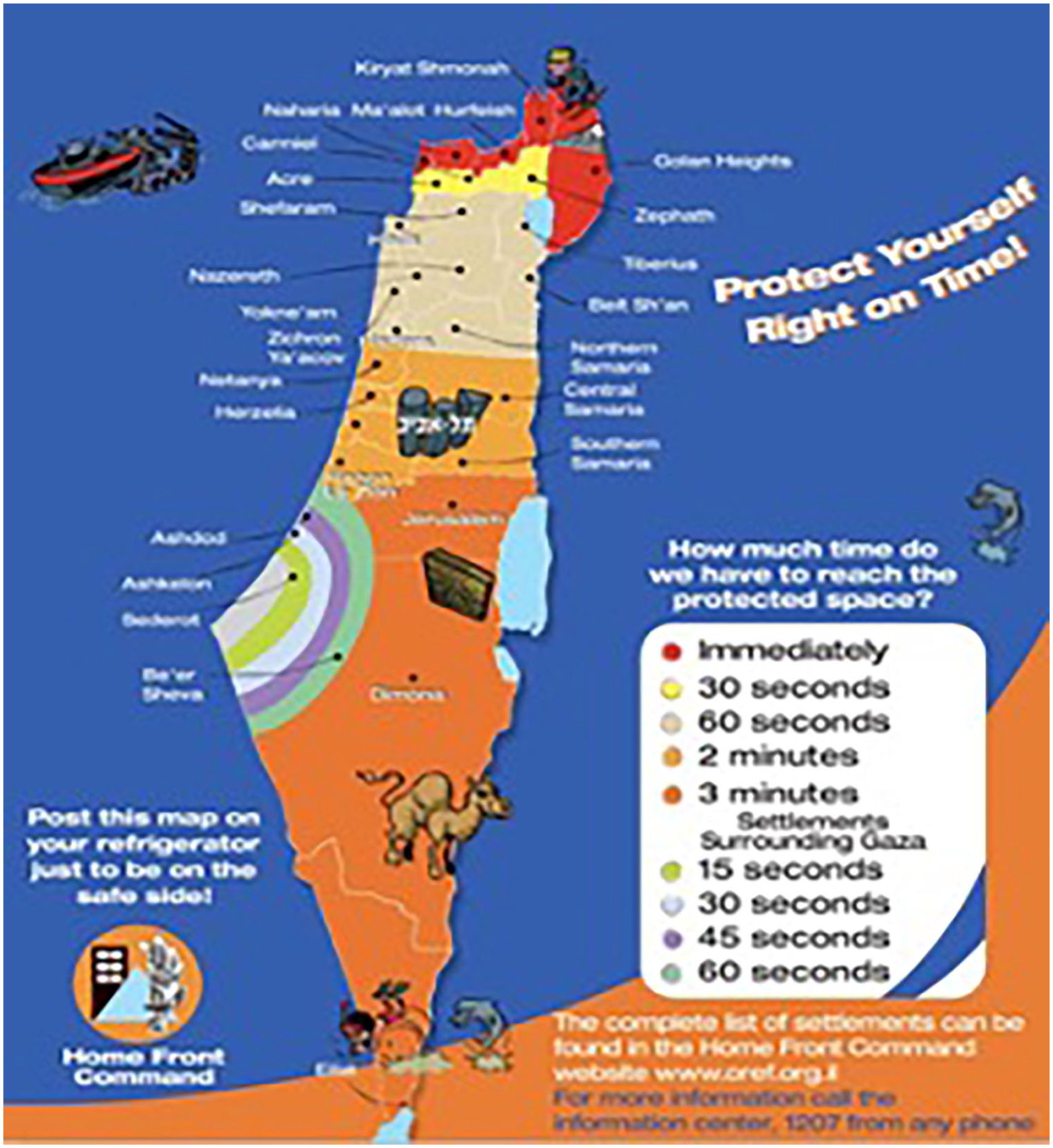
The first alert zones map of 2009.
But applying the timing system to a countrywide scale also enabled another layer of protection: an internal division of the colored areas into smaller polygons, each with a name, 27 in total. This was the first version of the alert zones system introduced by the HFC major general in 2009: isolating the targeted areas that must be alarmed from those that are not. 18 As he described it himself: “we wish to reach a situation where civilians would receive an alarm in the smaller radius possible, while civilians in non-threatened areas will not, and be able to continue their daily routine.” 19 The new method relied on a recent technological development enabling to detect rocket launches and their approximated point of fall with great precision and synchronize this information with the siren system spread across each of the 27 alert zones.
From this moment on, any improvement in rocket detection enabled to increase the exactness of the alarm and thus made alert zones smaller and more multiple. In 2011, the HFC installed some 3,000 modern, remotely controlled, siren horns across the country, sometimes replacing manually operated devices that dated back to WWII. 20 However, the technology to operate these horns usefully, in a differentiated manner, was still lacking. The breakthrough came when Israel fully operationalized the Iron Dome system in 2012.
Conceived already in 2007, the Iron Dome is a network of batteries firing missiles to intercept short and medium-range rockets, the ones fired from the Gaza Strip and occasionally from southern Lebanon. To hit rockets in the air, the Iron Dome batteries rely on an intricate network of “Multi-Mission” radars developed by Israeli ELTA. The unique advantage of the Iron Dome system, however, was its ability to cherry-pick the rockets it wanted to intercept. Given the high cost of each interceptor missile, the Iron Dome fires only when the rocket would most certainly fall in a populated or strategic area. To achieve this information, the approximated falling point supplied by the radar is situated upon a map of multiple polygons categorized according to the different levels of civil vulnerability, location of infrastructures, industry, and so on. Battery operators decide in real-time whether to intercept a rocket or not. 21
The Iron Dome was first tested on a large scale during the November 2012 Gaza conflict. 22 Then, the alert system still operated through 30 alert zones, differentiated primarily by the time to find shelter in each. 23 Yet shortly after this conflict, the Iron Dome and the national alarm system were wired together to enable the rapid expansion of isolated zones with a much more focused alarm in each one. From 30 in 2012, the number of zones grew to 146 by the beginning of 2013 and 235 by the summer of 2014. 24 When presented to the public, the naming of the system changed gradually during this period from “protection zones,” recognized chiefly with the time to find shelter, to “alert zones” (ezorei hatra‘ah) pertaining to the fact that sirens are sounded in one zone and not in the other.
By the next conflict with Gaza in 2014, 25 the alert zones system had already operated fully according to 204 alert zones, and its mission and meaning were widely distributed in popular Israeli media. 26 This seven week–long Israeli offensive on Gaza was unprecedented in its violence. Some 3,000 Palestinians were killed, more than 11,000 were injured, and the Strip suffered massive destruction. Hamas also used the heaviest fire to that moment, shooting some 4,600 rockets and mortars, including toward Tel-Aviv and Jerusalem, resulting in several hundred civilian casualties and one death in Israel. The Iron Dome system intercepted many of the rockets that targeted populated areas. And yet, the ongoing fire shattered everyday civilian life in Israel. 27
The 2014 conflict proved beyond doubt that, given Israel’s new protection technologies, the greatest threat posed by Hamas front is disruption of the country’s economic routine. 28 Following the 2014 conflict, the Bank of Israel examined the financial cost of the periodical wars with Gaza on the Israeli market for the first time. The forced work-stop during the 2014 conflict cost Israel some 3.5 billion dollars, which made 0.3 percent of the country’s national product, a loss similar to that of the Second Lebanon War and much higher than any other conflict with Gaza before. 29 The Iron Dome and the alarm system supplied good protection against casualties. Still, the current division of the country into more than 200 zones was proven insufficient to maintain business as usual. “When I switch on the siren in Jerusalem, I send million people to shelters,” contemporary HFC major general Eyal Eizenberg explained, “I shut down the government, factories, transportation, services. I harm the continual functioning of the state severely[. . .], and eventually, the rocket falls in [the sparsely populated] mount Hebron.” In Eizenberg’s vision, future alerts were to operate in a radius no bigger than 1 square km. 30 The number of differentiated alert zones was, thus, conceived as potentially as big as 3000, the number of siren horns countrywide. 31
The years following the devastating 2014 Gaza conflict remained relatively calm around the Gaza front from an Israeli perspective. The state maintained its strict military blockade on the Strip, while international efforts to recover Gaza from the destruction of the last war hardly challenged it. Rocket fire diminished to 15-30 a year between 2015 to 2017, resulting in one death in Israel and 74 in Gaza from Israeli retaliations. 32 The new reality of relative “quiet” on the Israeli side somewhat relaxed the urgency to improve the system further. Only several alert zones were added during these years. According to one source, existing technology could already support a more precise alert system by that point. Yet, the HFC had not come up yet with the proper method of delivering the protection practice to the public. 33 Developments on the ground, however, did not leave too much time for these deliberations. Violence ensued in earnest in 2018 after Israel reacted harshly against the Palestinian “Great March of Return” along the borders of the Gaza Strip. Since May 2018, ongoing conflagrations renewed rocket and mortar launching to hundreds every month, culminating in May 2019 with 690 rockets within only several days. 34 This year-long period of almost constant Hamas rocket fire and Israeli air strikes between May 2018 and May 2019 pushed Israel to perform the greatest leap thus far in the alert zones system. In June 2019, the HFC announced the jump from 255 zones to 1,700 zones, each much smaller than previously. To quickly identify one’s alert zone, the HFC made every unit of civilian settlement (towns, villages, municipal authorities), as well as facilities outside residential areas (industrial zones, military bases, hospitals, airports), into a stand-alone zone. 35 The ten big cities of Israel, spreading over several square km each, were also divided internally into four or five zones, some indeed as small as 1 square km. The intra-urban division, the HFC stressed, is of utmost importance since, given the vast population in cities, a focused alarm will decrease the number of unnecessary sheltering from millions of people to thousands. 36 Indeed, by the subsequent major conflicts in Gaza in May 2021 37 and August 2022, 38 the differentiated intra-city zones were fully operational, and further cities were split too. 39
Could the alert zones system be even more efficient than this? For the HFC, the answer is clearly yes. In 2021, the HFC launched its new online portal and app, intended to make civilians’ personal devices into private alarms. The signal sent to street sirens, HFC media explained, reaches cellphones and computers faster, per their IP and GPS location. The app and portal had formally become the cornerstone of Israel’s emergency alarm system. According to the HFC, street sirens are still there for people who are outdoors (or outdated). Yet, in principle, sirens had been relegated to being only a complementary measure until the personalized alarm on personal devices would become a part of everyday life. 40 The following section takes a closer look into the question of alarm personalization and the responses of the “persons” that unwantedly became its subjects.
Civilian Contestation and the Right to Hear Sirens
Since 2009, the IDF has time and again introduced the alert zones system to the Israeli public as a story of technological progress and ingenuity. The steadily growing number of alert zones since The Gulf War in 1991 gives this narrative a clear linear telos. The more efficient the system becomes, it is told, the more resilient the Israeli society and national economy get. 41 While true in many senses from a bird’s eye view, this neat narrative simultaneously conceals chapters of civil protests against the system’s dictates, social inequalities that the system was based upon and reaffirmed, and most importantly, its political context and consequences.
The Problem of Sonic Spillover—Urban Responses
The socio-political aspects of the alert zones system are revealed if one considers its embedded paradox: The system relies on a combination of an existing hard-wire infrastructure—the siren-horn network that produces sound—and an imagined, map-based, spatial division of the national space into differentiated zones. The system’s efficiency is achieved when the siren is activated and remains within the boundaries of the imagery alert zone. To isolate targeted areas from those that are not, in other words, it is essential to prevent sonic spillover from one alert zone to the other. However, since sound travel throughout space cannot be curbed, these two spatial dimensions can never perfectly match. The best the HFC can do is not to have one siren horn sharing two neighboring alert zones. The more alert zones there are, the more siren horns are required [Figure 3]. Counterintuitively, then, adding more sirens is not meant to enlarge its audibility but to diminish it. This means that as the system progresses, the siren sound overall becomes less audible rather than the contrary.
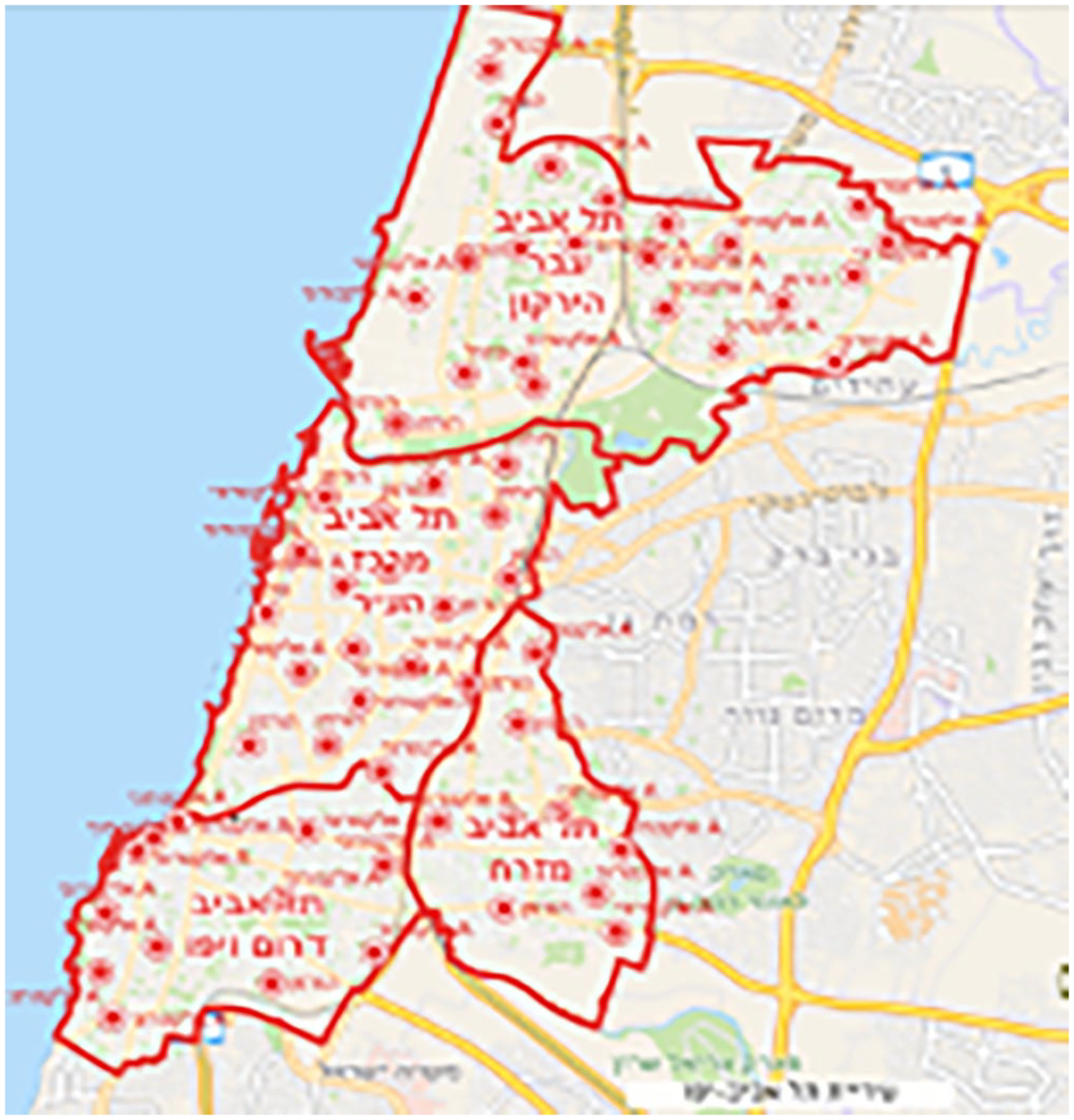
Distribution of sirens and alert zones division in Tel Aviv 2022. The city’s 52 km2 has 61 sirens, a horn for every 850 m2 on average.
Indeed, the first significant advance to over 200 zones during 2014 started pointing to the limits of sound-curbing. When people in Israel first heard sirens coming from adjacent alert zones, they mistook them as theirs. Confused, they complained that the siren was not loud enough or that their own sirens were not working. 42 Instead of being alarmed by the sirens, people were alarmed by not hearing them. The new system made them think that they had been left behind. For instance, residents of the southern city of Ashdod, who came under frequent targeting during the 2014 conflict, complained that they heard no sirens despite the sounds of bombs falling in the city. The municipal website had to announce that the horn system in the city works fine and that the rockets targeted areas outside the residential boundaries of the city. 43 Residents of various cities around the country had similar complaints of the sirens being too quiet and demanded that the municipality add more horns in their neighborhoods. 44
Popular media was also confused at first by the new reality. One newspaper suggested that the horns were dysfunctional or purposefully silent but did not provide an excuse. 45 Ynet online, arguably Israel’s most popular news outlet, had to explain the new system to the public in an article amply titled “why you do not hear the alarm?” 46 Other outlets gradually followed suit to clarify that if a siren is not heard, there is no reason for panic. But the system remained unintuitive for the public. Aside from the “quiet sirens” phenomena, the division of the country into more than 200 zones made the spatial dimension abstract. Zones were now too small to be represented on a map, so the visuals featured in HFC media featured an old division where only 32 zones were shown [Figure 4]. The names given to each zone also reflected a sub-division of the former system and thus consisted of a title (unit) and a number (sub-unit) that were hardly memorable. News outlets advised the public not to rely on one’s senses but to verify which zone is targeted on television and radio. 47 However, the uncontested hero of the hour that emerged from this situation was the rocket-alert cellphone app.
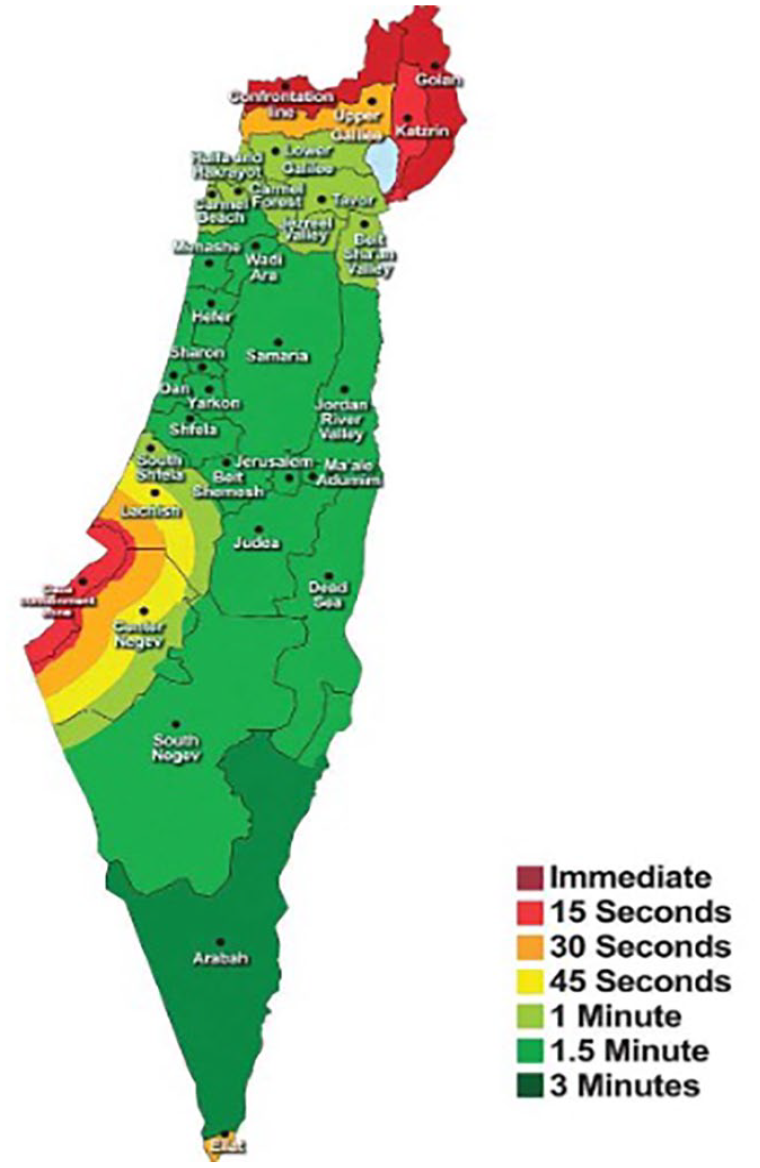
The map distributed in Home Front Command media releases in 2014. featuring only 32 zones.
Cellularizing Emergency—Rural Responses
Noticing the confusion created by the multiplicity of alert zones, private software developers started as early as 2012 to work on smartphone apps to inform users of current alarms across the country. 48 The 2014 conflict, when much of the country came under rocket fire and as the number of alert zones grew, made the apps almost a staple of civil protection, especially among residents in the areas surrounding the Gaza Strip. 49 The “Red Alert” app, developed by the startup tooleapp in one night during the 2014 conflict, was downloaded by thousands within two days and was ranked 4.8/5 among apple apps. 50 This and other apps simply followed media reports and transmited the information to their users. Later, they started relying directly on the open-access HFC database, which also nourished the HFC website. 51
Creating an app of this kind was, in fact, one of the HFC goals from the first conception of the alert zones system. 52 The HFC was too aware of the catch embedded in their system: As missile detection becomes more precise, alert zones are becoming smaller, requiring more sirens that each must be quieter. Sound spillover, as mentioned, undermined the effort to maintain a routine, while if sirens were too silent, then what was the point in so many of them anyway? Real sirens, in other words, had become the problem rather than a solution. It was an antiquated, and yet irreplaceable technology of war. While necessary, sirens could never achieve a complete personalization of the alert without losing the reliability of the system among the public. Relegating the siren from the streets to any person’s private cell phone was the perfect solution. A person’s cellular location is theoretically the ultimate alert zone, one that is not preordained but variable according to where a rocket is heading and the circle of damage that this rocket’s specific warhead may cause.
Indeed, as early as 2014, the HFC examined the use of “push” notifications that would target phone holders according to their location but refrained eventually from implementing it, due to juridical complications. Instead, the effort went into developing an official HFC app. 53 It would not be too far-fetched to assume that the appearance of private apps of the same function hastened this decision.
The HFC launched the first version of its app, i-Oref (Hebrew for home front), in the summer of 2016. 54 Upon installation, the app asked users to choose up to three alert zones for which they wish to receive alarms, in addition to the phone’s self-location. True to the overall goal of the HFC alert zone system, this limit was explicitly designed to prevent troubling the users about alerts that are supposedly not of their immediate concern. 55 In other words, the app replicated the silent-siren phenomena in the virtual world.
Yet, the public did not find this limitation attractive. The private alert apps, which had already gained wide popularity and esteem, supplied their users with alerts for any part of the country. And thus, the HFC app received little traction. 56 The competition did not seem crucial as long as relative quiet was maintained around the Gaza front. Yet when conflagrations resumed in May 2018, and information on alerts was of the essence again, the HFC changed its approach. In January 2019, it blocked its open-access database, thus shutting off all competing private apps, including the most popular, Red Alert, with some half a million users (5.5% of the country’s population). 57
Indeed, with the country’s division into 1,700 alert zones already in sight (it was already announced in the press in January 2019), the private apps made a clear obstacle for the HFC effort to decrease public exposure to alarms and isolate alert zones from one another. According to the HFC logic, as alert zones became smaller, the utility of limiting the number of zones grew. Justifying the insistence on the three zones limit, the HFC head of the alerts department argued that “we can put the entire state in shelters because of one missile, but that would also stop civil life and the operational continuity of the economy.” The goal, he declared, was to allow most of the country to run “business as usual.” 58
The news was shocking for civilians, especially in the region surrounding the Gaza Strip. Discussions in social media accused the IDF of purposefully concealing information from the public and acting out of considerations of ego rather than the public good. The HFC argued that private apps made frequent false and delayed alarms. Yet, for users, it was clear that the issue was the limit of alert zones allowed for each device. It was agreed widely that the private apps were accurate, intuitive, and helpful, while that of the HFC was convoluted and slow. 59 “If you wish to know about your family [in an alert zone other than the chosen three], you better not,” one participant replied. “They don’t want us to hear the alarms, so they could continue whitewashing [their failures to alert],” wrote another. 60 A popular meme on social media mocked the move stating that “to prevent residents from receiving false alerts, the HFC decided that they should not receive alerts at all.” 61
Contrary to the HFC logic, the residents of the surrounding Gaza region demanded access to the broadest possible picture of threats and were not satisfied with only three alert zones. A residence of Kibbutz Zikim, north of the Gaza Strip border, explained that “when rockets start, no matter where, I want to know about it. I live this reality, and I become more alert if I know they are shooting somewhere.” Another argued that the people of the region prefer to have more alerts, even if some are false, then only some of them.
62
Heads of the two sizable regional councils of Eshkol and Sha‘ar Hanegev in southern Israel explained that the limit of three alert zones makes no geographic sense for residents of vast rural areas as the Gaza-surrounding region, where people traverse large distances daily to reach their workplace, schools, family members, and other facilities.
63
A petition signed by 2000 of the region’s residents as well as city council members of the region called upon the HFC to re-enable the private apps’ operation.
64
For Israeli civilians, hearing sirens and knowing about them had been considered a civil right, egalitarian access to a state service.
65
Trying to voice this public sentiment, Haaretz reporter Almog Ben Zikri, himself a resident of the region, wrote:
66
[T]he IDF toiles to portray a media picture that is brighter than reality [in periods of conflict]. [Civilians] even sometimes feel that it seeks to lower the height of the flames on their expanse. Feeling helpless, or at least that information is concealed from them, they resort to private apps, the informal ones, so these would give them an accurate picture of what is going on around them.
HFC’s attempt to monopolize the alert app market also fell short of addressing political inequalities across space. When the private apps stopped working, dozens of Arab Bedouin communities in Israel’s south, home to some 70,000 to 80,000 people, lost all forms of alert against rockets. Most of this population resides in makeshift villages that have been unrecognized by state authorities and off-gird of formal infrastructures for decades. While private apps allowed residents of these places to receive alerts for their map location, or the broader area name, the HFC demanded registration with an official municipal name that features in Israeli registers. That detail linked users to their respective alert zone. 67 These Bedouin villages did not have an official place name for supplying and never came to be part of any alert zone. That is not only because they were not recognized by the state but also because of the technological developments that enabled this system in the first place. As mentioned earlier, the precision of the alert zone system relies upon the Iron Dome geographic categorization, aiming to prevent spoiling expensive interceptor missiles for rockets that would fall aloof from populated areas. Being unrecognized by the state, many of these Bedouin villages were indeed not categorized by the Iron Dome system as populated areas but as “open spaces.” 68
During the 2014 Gaza conflict, residents of these villages suffered casualties after the Iron Dome batteries of the same district did not even try to intercept rockets that fell there. Disconnected from state infrastructures, many of these villages neither had an ordinary siren system to warn them of the impending threat nor public shelters to run to. 69 An appeal of the Association for Civil Rights in Israel to Israel’s Supreme Court to rule against this clear discrimination and force the state to supply sheltered hideouts in these villages was overruled. Supreme Court saw “no justification to intervene” in the HFC decision-making process. 70 Being left unprotected by all measures, these villages’ last resort became the private Red Alert apps, which were shut down in January 2019.
The civil protest against the HFC’s monopolization of the alert apps bore fruits to a limited extent. In April 2019, three months after blocking the competing apps, HFC updated its app to enable choosing ten alert zones rather than three. 71 Two months later, as mentioned in the previous section, the entire system changed to consist of 1,700 different alert zones. This change, in effect, made choosing more zones for the personal alert to be, on average, not necessarily bigger in actual geographical size than the previous choice of having only three zones. At the same time, however, the considerable number of alert zones made the app necessary since it resurfaced the problem of sonic spillover in earnest. During the rocket attacks of 2020 and 2021, civilians that did not catch up with the new spatial division once again complained that they could not hear the siren, that it was too quiet, or that it was misfunctioning. Rather than feeling more secure, they felt forgotten. 72 A popular meme on Facebook became “we cannot hear the alarm in [placename]” 73 In response, municipal websites such as that of the city of Rosh Ha‘ayin, in the center of Israel, had to explain to its residents that “the siren sound waves do not stop at the boundary of our town.” The ongoing problem now had only one solution: “To be sure that the alarm is in your location,” the municipality suggested, “define your location on the HFC app.” 74 And yet, the same complaints kept rising, creating a space for private apps to reemerge during 2020, with the HFC turning a blind eye, knowing that otherwise, the advanced system would create more confusion than utility.
The Political Consequences of Fragmented Emergency
Israel’s alert zone system relies upon a new political logic of emergency and its spatial distribution. War in the era of alert zones is no longer a political crisis demanding a political solution but a sporadic collection of isolated events which can be quantified as data and then solved one by one on an individual basis. Emergency as a political situation vanishes since there is no actual crisis on a public level, and sirens, the modern marker of emergency, can thus be diminished too.
This development marks a shift in the history of the siren. As mentioned earlier, sirens became a global phenomenon during the years leading to the Second World War and in the war itself. 75 Because cities were the primary target of air raids, states experimented widely during the late 1930s and into the 1940s with establishing sonic coverage across urban spaces. But that was not an easy task since the built environment created sound barriers that “locked” sound between streets and neighborhoods. Establishing efficient alarms thus required not only making sirens loud but also spreading horns everywhere. 76 To operate synchronically through remote control, siren horns were wired to municipal telephone and electricity lines, integrated into building roofs, and hung on street poles. 77 Sirens, in other words, became a public infrastructure that was meant, even if primarily ideologically, to turn the alarm sound into a collective experience marking wartime and emergency. 78
Despite the great chronological leap, for most Israelis, and especially for the national majority of Israeli Jews, sirens were still taken to be a public sound marking a collective experience of national emergency well into the twenty-first century. But paradoxically, in a period that Israel came under constant attacks, and despite the unprecedented infrustructurization of the siren system, the collective quality of the emergency experience seemed to be vanishing. Instead, emergency fragmented. This, in turn, made social and political inequalities surface.
Social Inequality and State-Indorsed Ignorance
To operate countrywide, the alert zone system assumes societal uniformity across the populated spaces. A rocket attack is taken not as a problem of the political or social area it hits but as affecting only the targeted space in isolation of a wider context. “Every missile creates its own polygon,” one of the system’s integration managers explained in media. 79
Yet, the civil sentiment discussed above exposes that the system could not bypass the reality of unequal power relations within society. The justification for the alert zone system is to prevent unnecessary routine-stop for as many people as possible. This cause became significant when rocket range started to include Israel’s large cities, and it is no wonder that HFC media often mark urban populations as examples of civil resilience.
Yet what applies to urban settings is not necessarily valid for rural areas. In cities, even a focused alarm in one alert zone is heard by thousands of people at the least. Along the introduction of the system, as shown above, urbanites were mainly concerned that they could not hear their own alarms. But as long as they could hear it, they felt secure. In rural areas, however, focused alarm aimed at a limited group of people meant being left alone on the front line. So it is no wonder that residents of the surrounding-Gaza area wanted to know if and when zones around them are alarmed too. The HFC’s limit on this information immediately caused people to assume that the state does not care about them or that things are much worse than what they know.
Moreover, residents of rural areas were also concerned that this dynamic might work in the opposite direction. Since central cities like Tel Aviv or Jerusalem were now isolated from places that are targeted much more often, the country’s “center” received legitimation for losing interest in the bombarded periphery because of the limit on alert information and the overall mindset becoming, with little exaggeration, that the siren must be in one’s own alert zone, to be worth carrying about.
This logic entails that the process of social fragmentation should not necessarily stop there. Not only can central Tel-Aviv citizens ignore the reality in Israel’s south, but they can now also do so for rockets falling a few streets away. If the alert zone system diminished the shared emergency experience overall, it simultaneously expanded the legitimate space for social ignorance, thus harming civil solidarity. It is by this process, whereby society is segmented, that the mirage of business being “as usual” is maintained, and a state of a recurring war becomes tolerable.
Legitimizing the Perpetual Conflict
Israel’s alert zone system enhances an explicit political policy of managing the conflict with the Palestinians rather than attempting to resolve it. The shift in the official Israeli mindset from “conflict resolution” to “conflict management” coincides with the historical evolvement of the alert zone system. Israel’s withdrawal from Gaza in 2005, Hamas’ rise to power in Gaza in 2007, and the Israeli blockade on the Strip since then virtually terminated the prolonged Oslo “peace process” era. 80 With the Palestinian political collective split between Gaza and the West Bank, Israel had turned away from searching for peaceful solutions with the Palestinians and moved to rely on ongoing series of ad-hoc cease-fire agreements on the Gaza front and security collaboration with the Palestinian Authority in the West Bank. Both arrangements consider that the eruption of violence every so often is only a matter of time.
The alert zone system, alongside the Iron Dome, to which it is technologically and politically attached, has created a circular situation whereby the Israeli society become tolerant to occasional rocket attacks, at the same time that this very tolerance (or “resilience”) is what enables this reality of periodical mini-wars to persist while depressing any horizon of leading a political solution. The state’s responsibility for preventing conflict is replaced by the citizens’ obligation to face its taken-for-granted consequences.
Analyses of the ongoing conflict in the Gaza front have proven the direct causation between Israel’s “success” in protecting its citizens, its adoption of a conflict management approach, and the prolonging of the conflict. 81 They have also shown that the choice to manage the conflict made it more violent, destructive, and costly over time. 82 The primary victims of this choice are, of course, the Palestinians, in the Gaza Strip in particular, who suffer under Israel’s inhumane blockade and horrendous air strikes. Israelis, on the other hand, pay a minimal price for prolonging this policy. Most are individually protected by the system and encouraged to ignore the fact that their neighbors and fellow citizens come under the same threat, let alone those marginalized groups that are not protected at all. Needless to mention, under the effective protection of the alert zone system and the Iron Dome, Israelis can barely empathize with Palestinian suffering of being left defenseless under military attacks.
Alert Zone Sovereignty
Carl Schmidt’s conception of sovereignty is the one most clearly aligned with the establishment of a national emergency or the state of exception. To him, only by determining the state of emergency, when no liberal hindrances stand in the way of the state, the modern sovereign fulfills its authority to an uncontested extent. He stresses that the emergency he envisions must be comprehensively unbound by constitutional law. 83 Not coincidently, this idea works nicely with the historical introduction of air-raid sirens in European cities during the interwar period. As mentioned above, the spread of siren infrastructures in cities to mark emergency conditions was designed to cover the entire built landscape and reach every person. Serving as an ideological instrument, sirens were conceived to be the state’s “protective spell” over the national collective. 84 By WWII, siren systems enabled the modern state to establish mastery over the soundscape of its public spaces. In many states, the widespread use of sirens and other noise-making devices in factories, celebrations, and transportation, was outlawed to make the state the ultimate sound-making authority and the siren—the marker of emergency. 85
But national territories consisted of more than cities. In rural areas during WWII, European governments limited the spread of state sirens, believing it was unnecessary everywhere. In Britain, for instance, rural communities resisted this differentiation and established their own siren systems that “picked up” on sirens sounded by the state in other areas. 86 Britain enforced wartime noise abetment to fight piratic sirens or wired the rural siren systems to the existing state-controlled networks. 87 Thus, states have become sonic sovereigns in their national territories not by being able to produce the loudest or the most widespread type of sound but rather by being the ultimate authority to decide who hears it and when. The state’s ability to rule certain spaces for siren sounds and others for silence in an interchangeable, unexpected, or unintuitive manner made the state of emergency fragmented in time and space rather than a total experience encompassing the entire territory and national community.
The Israeli alert zone system did not invent this ability but brought it to a level of art. The evidence above testify that aside from supplying necessary protection, the alert zone system in Israel simultaneously keeps civilians on their toes (or ears) to ensure that they remain a part of the national solidarity group. As shown in the case of the Bedouin population, the system enables the state to constantly redraw the boundaries of the citizenry and national group by depriving certain groups of the right to hear the siren, the right to be part of the state of emergency, or the right to be protected from wartime threats.
These situations suggest a different relationship between emergency and sovereignty than the one suggested by Schmitt. If the state of emergency is not a totality, but a temporally inconsistent and spatially malleable situation, then the way that state sovereignty is projected is by having the subject internalize the need to be constantly alert to its being part of the national collective. The individualization of the emergency, taken by Israel, attests to a much more Foucauldian model of sovereignty whereby subjects are not a-priori part of the protected collective but must discipline themselves to remain attuned to whether the emergency includes them or not. But while doing so, they are not practicing their role as one particle in a bigger social structure under emergency. The alert zone system makes their situation unique indeed: a rocket is heading toward them. This very notion makes the system reliable.
This form of sovereignty thus operates not on the body politic but on the individual corporal body. The HFC’s stubborn insistence that the public should rely primarily on the app for receiving alerts crystalizes this logic: the human body is the ultimate alert zone, the smallest unit to be alarmed while routine is maintained everywhere else. This vision considers the emergency a situation that should be experienced individually, in isolation from social, political, or spatial meaning. In other words, this vision strips humans from their humanity (being part of a social group), leaving them as bodies defined only by their innate instinct of self-protection and survival. This idea leads us toward a conception of alert zone sovereignty in line with Gorgio Agamben’s understanding of sovereignty. “The sovereign exception,” he writes, “is the fundamental localization which does not limit itself to distinguishing what is inside from what is outside but instead traces a threshold[. . .] on the basis of which outside and inside, the normal situation and chaos, enter into those complex topological relations.” 88 In the moment of alarm, the more the alert zone is secluded, the more the alerted subject turns bare flesh and blood. Deprived of wider societal and political reference groups, it emerges as the ultimate site for state sovereignty.
Footnotes
Acknowledgements
Many thanks to James Sunderland, Ori Schwartz, Assaf Mond, Inbal Ofer, Yoav Hamdani, the members of the Polonsky Academy Seminar 2021-2022 at the Van Leer Jerusalem Institute, and the “Colonial Landscapes in Israel/Palestine” Research Group for their important insights and assistance.
Declaration of Conflicting Interests
The author(s) declared no potential conflicts of interest with respect to the research, authorship, and/or publication of this article.
Funding
The author(s) received no financial support for the research, authorship, and/or publication of this article.