




Abstract
This article contributes to the debate on the stigmatization of street vendors and market traders by illuminating the moralizing and disciplinary state interventions that city officials used in Amsterdam to direct the social and spatial behaviors of this group in the period of the “civilizing offensive” at the beginning of the twentieth century. By using archive materials, this article empirically demonstrates that these interventions were justified by stigmatizing narratives that represented street vendors as “ill-adapted” and “undisciplined,” and considered their behaviors as an inevitable outcome of their marginalized socioeconomic position. Whereas in recent studies neoliberalism is often mentioned as the driving force behind narratives that stigmatize street vendors and market traders, the case of Amsterdam demonstrates that the stigmatization and regulation of such marginalized communities could better be considered as consistent and historical processes in which the state, particularly the local state, offers its assistance.
Introduction
Policy attempts to manage, regulate, and control contemporary practices of street vending and market trading have received great research attention. 1 Much has been written about institutional efforts that either aim to fully erase street vendors from public space 2 or try to move and contain them elsewhere, for example, by turning street vendors into market traders, thereby immobilizing them in spatially designated markets. 3 It has been argued that these policies are often motivated by visions that consider street vendors (and to a somewhat lesser degree also market traders) as “out of place” actors who do not fit visions of modern urban development, particularly in the Global South, 4 but also in cities in the Global North. 5
Within this robust scholarship, neoliberalism is often mentioned as the driving force behind narratives that stigmatize street vendors and market traders to justify policies of spatial exclusion and/or formalization. For example, Sara González and Paul Waley have forcefully argued that municipal regulations that aim to modernize markets (such as tenancy agreements including clauses on improving “poor” displays and general improvement of the stalls) should not be understood as offhand or benign interventions, but instead as being part of broader agendas for the recent neoliberalization of public services and urban policy. In this context, markets tend to be seen as unruly and old-fashioned secondary services and obstacles for more profitable urban development projects. 6 Other critics have similarly argued that such urban variants of competitive, neoliberal governance are responsible for the oppression of street vendors and market traders around the world. 7
Moreover, social status, ethnicity, and race play an important role in making some street vendors and market traders less welcome than others. 8 A recent ethnographic study of a relatively low-income, multicultural market in Amsterdam has shown how class and racially coded ideas about “good” markets and desirable traders have been taken up by various institutional actors involved in the governance of markets. Whereas policy reports of the national traders’ association applauded the economic success of markets located in the touristic and gentrified areas of the city, the market in the predominantly immigrant neighborhood was represented as having “no quality.” In everyday conversations, market managers, policy makers, and visitors tended to transpose the identified problems of the market (such as a homogeneous offer of products, lack of entrepreneurial creativity, and strife in the traders community) onto the presumed sociocultural attributes of immigrant traders, thereby essentializing the need to partially close the market. 9
Research on street vending practices in Chicago has similarly shown how various types of street vending are differently valued and regulated by the local state. While the businesses of Latino immigrant street vendors faced restrictiveness and were stigmatized by the city council as “backward economic practices from the developing world that pose a health risk to the public” (p. 1879), the upcoming gourmet food entrepreneurs were welcomed as “trained professionals,” contributing to Chicago’s competitive status as a world-class food destination. 10
These studies highlight how neoliberal discourses about a city’s desired future go hand in hand with the construction of symbolic—and often racialized or culturalized—divisions between “worthy” and “unworthy” retail actors; divisions that are used, in turn, to legitimize contemporary policies that exclude, restrict, or formalize “traditional” 11 street vending and market trading practices. Reading through the extensive body of literature, it is easy to see that the dominant understanding of these representations and regulations hinges on a relatively recent time frame. In this article, we take inspiration from this scholarship, but direct the attention, in contrast, to the kind of discourses and imaginaries city officials employed in the past to regulate practices of street vending and market trading in the city. The article focusses on Amsterdam, the Netherlands, in the period between 1900 and 1940 when street vending regulations in the city accelerated significantly. The archive materials reveal how many markets in the city have historically emerged through strategies of (state-sanctioned) stigma production and formalization, targeting street vendors in particular.
While in recent years several new studies on street vendors in the nineteenth and twentieth centuries have emerged, 12 it is striking that scholarship on contemporary street vending and market trading practices hardly engages with these studies. 13 This article is an attempt to empirically demonstrate how the stigmatization of street vendors and market traders is not just an intrinsic feature of neoliberal urban governance, but also that it is part of much older political-economic struggles over who are considered legible retail actors in the city. As such, we ask the question, “How and why, from the early twentieth century, were street vendors and market traders perceived negatively by many urban residents and city officials?”
In the remainder of this article, we will first discuss the relationship between stigma production and urban redevelopment, linking this to literature on urban imaginaries and street vending. Second, we will situate this debate in a historical context, specifically the period of the “civilizing offensive,” when the urban elites used biopolitical strategies to control the behaviors of the lower classes in the city, such as street vendors. Third, we will present our archive materials and explore dominant imaginaries in the beginning of the twentieth century that conferred street and market vending with notions of “blight” and “uncivility” to justify moralizing and disciplinary state interventions that would safeguard the well-being of the “public good.” Finally, we will draw some conclusions about the importance of attending to past urban imaginaries that stigmatized marginalized communities, both analytically and politically.
Stigma, Urban Redevelopment, and Street Vending
Cities are not simply material spaces in which people live—they are also spaces of representations and imaginations. These representations and imaginations have effects. 14 City officials, policy makers, urban designers, and planners have ideas about the function, appearance, and use of urban spaces, and these are translated into policy plans, redevelopment projects, and eventually the socio-spatial environment. 15 This idea that the symbolic and discursive meanings of spaces are constitutive was central to Edward Said’s work, who used the term “imaginative geography” to refer to the powers of representations of space in devising, informing, and legitimating colonial practices. Here, the essentialization and reification of the spatial distance between the “Self” and the “Other” is an integral part of imaginative geographies. 16 But imaginative geographies not only involve demarcating symbolic partitions between “our space” and “their space,” but they also refer to ensuing practices of materially appropriating “their space” as “our space.” Although Said employed the term to explain the underlying logic of Orientalism, he insisted that the production of imaginative geographies is a generalized practice used by individuals and institutions in all societies. 17
The relationship between imaginative geographies and urban redevelopment is a well-established research topic in sociology and geography. 18 City officials spend considerable time on place promotion, launching new cultural projects, and focusing on selling the city in terms of new lifestyles and experiences. As part of this emphasis on reimaging the city, a range of new policing strategies have been introduced so that new users of the city can explore and work while remaining sheltered from those whose very presence might disrupt this manufactured imaginary. 19 In a compelling article, Kallin and Slater argue that the stigmatization and defamation of city districts and neighborhoods that do not fit this constructed imaginary are closely linked to practices that aim to regenerate these places, the former laying the groundwork for the latter. Similarly, Wacquant, Slater, and Pereira demonstrated how blemish of place and its residents is used, fueled, and harnessed by both private concerns (such as real estate investors) and public officials (such as policy makers and city officials) to promote their own ideas, “such that spatial disgrace operates as a symbolic lynchpin between inequality and marginality in the metropolis” (p. 1276, original emphasis). 20
One group of urban actors who have often borne the brunt of such forms of stigmatization in many parts of the world are street vendors and market traders. Studying the livelihoods of street vendors working in the central districts of the cities of Quito and Guayaquil in Ecuador, Kate Swanson has shown how policy plans to renew these areas were projected against an image of the perceived “backward,” “ugly,” and “dirty” street vendor who presumably contaminates the aesthetic of the “modern” city. 21 Yet the idea that street vending is inimical to the modernist ideals of a clean and economically viable city is not only emblematic of contemporary neoliberal urbanism. 22 The stigmatization of street vendors has much older roots, emanating from quite different political-economic contexts. 23 Indeed, as argued by Gray and Mooney, many ideas to justify contemporary redevelopment programs can be seen as a return not only to some of the harsh “underclass” narratives of the 1980s and 1990s, but also a revitalization of ideological categories that have long been historically embedded in accounts of poverty, modernization, and progress. 24
Seen in this light, Swanson indeed observed that the contemporary representation of street vendors is a continuation of late nineteenth-/early twentieth-century rhetoric, which emphasized a semantic division between the presumably uncivilized, unhygienic, and ignorant vendors and traders whose presence posed a threat to social order and the image of the honorable and respectable laboring classes (p. 716). 25 The origins of stigmatization, what would become oppressive policies targeting street vendors and traders, extend back to the last decades of the nineteenth century and unfolded across the first half of the twentieth century in a series of ideas and exchanges that Samuel Zipp has called an “ethic of city rebuilding” in Journal of Urban History. 26
Founded in the cities of Europe and North America at the end of the nineteenth century, advocates of the ethic of city rebuilding sought to transform the urban environment. They offered a specific social and political response to the chaos of cities characterized by an age of poverty, industrial instability, mass migration, and population explosion. They looked to restore urban order through fundamental reconstructions of both the built and social environment. The immediate source of the ethic of city rebuilding was housing reform, including slum clearance and the construction of modern housing. 27 The need for physical interventions was firmly linked to the idea that pernicious urban environments would lead to urban “ills,” such as moral failings and aberrant behaviors. The crusades by urban elites against these urban ills were carried out with an understanding that poverty was a result of character defects, and thus focused on the perceived characteristics of the poor themselves rather than root causes of poverty. 28
In the Netherlands, a sense of moral duty and fear informed the actions of the elites who tried to educate and discipline the “lower classes” with a proper living environment, house visits, language courses, and education in democracy. 29 Their ideas and practices of poor relief have been considered as part of a national approach called the “civilizing offensive” (in Dutch: beschavingsoffensief) launched toward the working class in the nineteenth century. The concept of the civilizing offensive was first introduced by historians Piet de Rooy and Bernard Kruithof in 1979, 30 and further elaborated upon by sociologist Ali de Regt in her 1984 book, Labor Families and Civilizing Work: Developments in the Netherlands 1870-1940. 31 These scholars took a historical approach to empirically study developments and changes in Dutch welfare arrangements, working-class family life, and the regulation of family relations. Welfare arrangements were analyzed with regard to their disciplinary effects, taking inspiration from Michel Foucault’s work on governmentality and biopolitics. 32
Foucault used the concept of government in a comprehensive sense, bringing the link between power relations and subjectification together. In addition to administrative and management powers of government, Foucault stressed that government, or more precisely “governmentality,” also encompass rationalities and techniques of controlling families, households, and even individuals’ bodily autonomy (hence “biopolitics”). For this reason, Foucault defined governmentality as the “conduct of conduct,”
33
encompassing all “techniques and procedures for directing human behavior.”
34
Using Foucault’s lexicon to explain how certain local governments try to contain the (spatial) behaviors of street vendors, Huang, Xue, and Wang have argued that attempts of immobilizing street vendors into spatially designated places should be understood as a method or technique of governmentality. The authors draw from Foucault’s work Discipline and Punish
35
to argue that not only social, but also spatial forms of interventions should be understood as “part of the state’s perpetual efforts to make society legible and controllable through the means of settling populations” (p. 456).
36
Similarly, Van Houtum and Van Naerssen have argued that formalization by means of spatial immobilization reflects the intention of the state to confine ungovernable practices in ways that conform to the logic of boundaries: It is implicitly argued that the territorial demarcation of differences that borders provide assures a geographical ordering of presumably governable spatial unites. The resulting categorization and classification of places in space allows mappable comparison of differences in spatial institutionalization, naming, identifying and performance. (p. 128)
37
It is in this historical context and theoretical debate that we aim to deconstruct the stigmatization and regulation of street vendors and market traders in Amsterdam. To explore how this civilizing offensive has shaped the imaginative and actual presence of street vendors and market traders in the city, an analysis of archive materials and academic resources was conducted. 38 The archive materials were derived from an online archive collection of the Department of Market Affairs (1855-1956) of the City Archive of the Municipality of Amsterdam (CAMA; access number 745). 39 The collection covers 1,542 archived files in total, consisting mainly of newspaper articles, civic registers, and policy documents. Most of the materials in the archive collection date from 1920 to 1940, the period during which public and governmental problematizations of street vending intensified and regulations were implemented. Starting with the digitalized part of the collection, the keyword search engine was used to select relevant sources based on themes such as “street trade,” “vendors,” and “markets.” Relevant files that could not directly be accessed online were reserved and consulted in CAMA’s study center a few days later.
The Emergence of the “Formal” Market Structure in Amsterdam
Selma Leydesdorff gives in her book, We Lived with Dignity, an overview of Amsterdam’s political-economic structure between 1900 and 1940. 40 Her work serves as an important starting point to contextualize the problematization of street vendors in the city and the concomitant attempts of the ruling elites to contain their mobility practices from which today’s structure of outdoor markets has emerged. Twentieth-century Amsterdam was, as Leydesdorff describes, a city of small- and medium-sized enterprises. 41 Industrial activities were centered around the port, where imported products such as diamond and tobacco were distributed throughout the city. In the first years of the twentieth century, almost 40 percent of Amsterdam’s workforce was active in the trade and retail sector, 42 which included small shop owners, market traders, and street vendors.
The retailing of goods was most prominent along the main axes to the weekly, “official” markets (such as the Noordermarkt, Westermarkt, Nieuwmarkt, and Botermarkt) where market traders offered a broad assortment of goods from locally fixed market stalls. 43 The street vendors, in contrast, were physically mobile. They wandered through the streets that surrounded the weekly markets and sold their products from pushcarts (Image 1). The street vending economy especially attracted marginalized, low-income groups from inside and outside the city, partly due to the legacy of the early modern guild system that was officially abolished in 1798. The guilds, in which shop owners and market vendors were largely organized, only allowed a limited number of street vendors to become members. These street vendors were often poor as they did not have the financial means to hire stalls on weekly markets, forcing them to vend their products in the streets. 44 There are two reasons why guilds favored shop owners and market traders over street vendors.
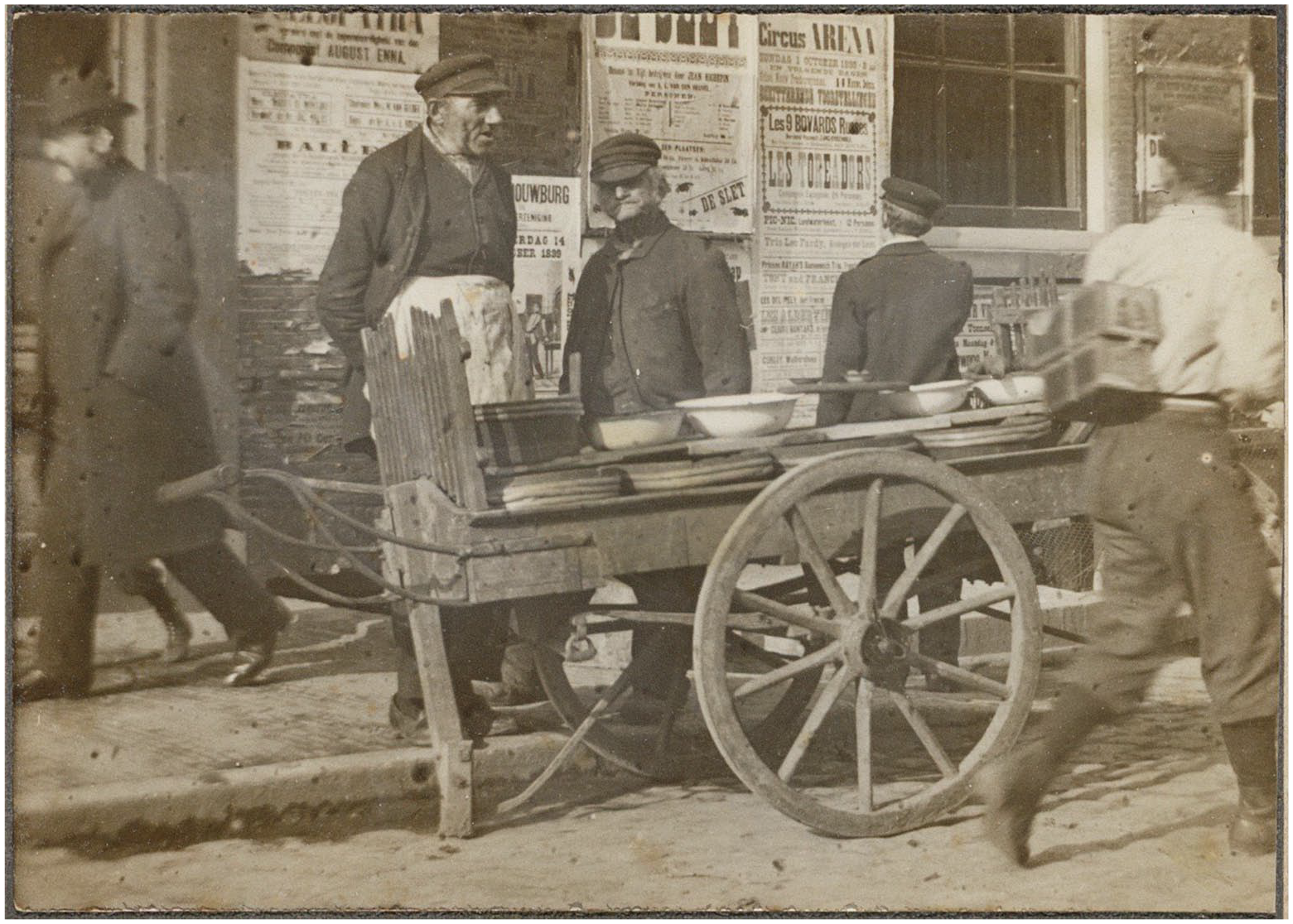
A street vendor selling pickled vegetables in front of a wall covered with advertising brochures and posters in 1900.
First, guilds considered vending as a lower-class economic activity, constituting “undesired wandering behavior” and “unfair competition” in relation to the established and fixed businesses of shop owners and market traders. 45 The explanation in the literature for this stigmatization is often economic, namely, the change from a feudal to a market-oriented capitalist system, or from territorially bounded to free labor. 46 People who preferred or saw themselves forced to engage in the latter, for example, as self-employed street vendors, were increasingly met with suspicion and stigmatized as “vagabonds.” The guilds felt threatened by the growing numbers of “landless” women and men, and associated them with being uprooted and disorderly. They were understood as “placeless” people who lived outside the web of obligations and duties. 47
Second, guilds operated on the basis of group-specific traits, as they only accepted citizens and “generally favored men over women, guild members’ offspring over others, and Protestants over people from other religious denominations, especially Jews” (p. 373). 48 Class position was thus not the only determining factor for guild membership; as important were definitions of identity based on relations of religion, gender, and ethnicity, excluding minority groups from the possibility to become institutionally recognized actors in the city’s retail economy. Both factors resulted in constrained selling opportunities for the most marginalized groups in the city, which therefore often resorted to the then informal vending sector. 49
That many marginalized street vendors were still present in the first decades of the twentieth century is evidenced by newspaper articles and a document entitled “Ordering Street Trade in the Netherlands,” published by the National Vendors’ Association (AVB) around 1934.
50
In 1930, one year after the Stock Market Crash of 1929, the national newspaper, De Telegraaf, published an article about street vendors in Amsterdam beneath the headline, “The last resort: Most vendors on the brink of pauperism.”
51
The AVB highlighted the high number of street vendors in Amsterdam, which had increased by 500 percent between 1914 and 1934, from 1,500 to 9,000 people. The reasons for this dramatic expansion, as the AVB explained, were mainly economic: Periods of unemployment, even before the current crisis, have ejected workers out of the labor industry. Many of them have, either willingly or unwillingly, resorted to the vending economy to make a living. The current crisis has shockingly exacerbated the precarious position of street vendors. Many municipal administrations got rid of support personnel as an austerity measure, providing them with only a meager amount of trade money to start a business in the vending economy. That’s what has been happing for a couple of years now, and institutions still do not seem to care about the fate of these people. Do the Poor Relief Institutions [Maatschappelijk Hulpbetoon] not know that street vendors suffer from hunger? Do they not notice the increasing requests for help? Thrift deceives wisdom, and that especially holds truth in this case. That vendors damn their work for its disgraceful nature does not need any further explanation. The street vending economy has, after all, never yielded any human dignity.
52
The impact of the First World War on retail, market, and vending activities was indeed significant in the first decades of the twentieth century. The absence of heavy industry in combination with fluctuating trade activities rendered the city’s economy susceptible to international conjuncture, resulting in a relatively weak economic position. 53 Both high demand for cheap food and products in the aftermath of the war, as well as the low operating costs of vending, drew many people to this sector.
Veronica Huberts showed in her dissertation entitled The Amsterdam vendors, a sociographic monograph that approximately 35 percent of the vendors were Jewish in the 1930s. 54 This relatively high percentage was the effect of the discriminatory logic of the former guild system as aforementioned, as well as the broader and deep-entrenched anti-Semitic sentiments that excluded Jewish immigrants from many jobs in the city’s labor market. When the Great Depression caused the collapse of Amsterdam’s diamond industry in which Jewish residents had originally carved out a niche (with unemployment rates going up to 85 percent in the 1932), 55 many of them took recourse to street vending to get ahead. The accelerating number and deconcentrated sprawl of vendors was, however, a thorn in the side of the ruling elites.
Against this backdrop, the municipality implemented the city’s first vending bans for the most busy and congested streets. 56 Accordingly, the municipality established so-called “free markets” as a compromise for these bans where street vendors, under the supervision of police officers yet exempt from market rents, could sell their products on allocated market spots. 57 The deputy mayor for food provisions argued that this measure had to pertain to all street vending practices outside the already established “official” markets—a necessity to prevent that the whole city would turn into one big “disorderly market.” 58 The free markets were added to the already established official markets of the city and laid the foundation of Amsterdam’s prewar market structure as it still, for a large part, exists today. 59
It is here that we can observe the emergence of the first strategies to formalize street vendors by immobilizing them in designated and spatially bounded places.
60
Yet the free markets expanded so rapidly that they no longer achieved their objective of spatially containing and institutionalizing the sprawling mobility trajectories of street vendors. Mercurius, the union of market traders that was established in 1898, described the popularity of the free markets as follows: The free markets expanded rapidly. The police had their hands full. People took market spots randomly, which often resulted in conflicts. Both vendors and visitors arrived in large numbers. Many vendors therefore occupied market spots overnight, or even hired night watchmen for nickel-and-dime amounts, to be ensured of a selling place on Sunday mornings.
61
The City Council deemed it unreasonable to uphold free markets in the face of licensed market traders who had to pay rents on official markets. In 1922, the decision was made to place the free markets under the administration of a centralized municipal institution, for which the Department for Market Affairs (Dienst Marktwezen) was established. From then on, occupants of the free markets also had to pay rents, and those who were able to meet the required payments became “official” market traders. 62 Thousands of street vendors, however, were unable to pay these market rents and remained selling on the streets. As a response, a comprehensive police force developed that further enhanced the capacity to supervise and cleanse the city’s public spaces. This police force is the object of analysis that follows.
The Vendors’ Question: Biopolitics and the Civilizing Offensive
In the mid-1920s and 1930s, the protracted presence of vendors in the streets resulted in the establishment of a Committee that had to examine the “problems” that street vendors caused to the functioning of the city economy. This Committee addressed the so-called “Vendors’ Question” (Ventvraagstuk) and provided the City Council with plans to further regulate and formalize street vending practices. The Committee consisted of twelve members (including the director of the Department of Market Affairs and the chairmen of AVB and Mercurius) and was led by Salomon Rodrigues de Miranda, the deputy mayor for food supply and a prominent member of the Social Democratic Labor Party (SDAP). 63
The social democratic ideals of the party were firmly imprinted on the social and spatial institutions of the city, even in the years when SDAP did not deliver city councillors directly. 64 In the “Socialist Guide,” SDAP city councillors deliberated and theorized about adequate governmental interventions to regulate the free market. 65 Their policy proposals could be described broadly as social and interventionist or expansionary and progressive, including increased government expenditure, improved social security benefits, and progressive education, housing, and health reforms in line with the ethic of city rebuilding. 66
The rise of the SDAP was based on the idea that the capitalist economy is only self-regulating within certain limits, that it results—as described in the previous section—in overcrowding, unemployment, urban misery, and so on. The invention of social government was closely related to a broader set of concerns that Michel Foucault has theorized as “governmentality” or “biopolitics” that both refer to the governing of populations. 67 In particular, social government relied on the biopolitical idea of forming and guiding the actions and behaviors of populations by remaking their physical environment, or the milieu, which appeared for Foucault as a “field of intervention in which . . . one tries to affect, precisely, a population” (p. 21). 68 From this perspective, the SDAP published a “Socialization Report” in 1920 as part of a national campaign to roll back private ownership of businesses. This report formed together with the city program of Amsterdam (that more specifically addressed issues such as health care, housing, and minimum wage) a blueprint for the socialization of industries and, in particular, to social-spatial ordering of the retail and street trade sector.
Yet the political program of the SDAP was not only motivated by manipulating the milieu of the trade sector, but it was also based on a strong belief in the efficacy of direct social control and malleability. The labor leaders were convinced that they could teach street vendors, who were problematized as “ill-adapted” and “undisciplined,” how to live according to a more “socially respected life style.” This was rooted in the belief that the class struggle was not only confined to improving the position of the working class, but also about uplifting their life styles and moral positions. These moral improvements came down to the civilizing offensive as aforementioned, based on the values of neatness, industriousness, and devotion to duty.
69
Both elements, that of indirectly and directly shaping the conduct of street vendors, were put forward in the first report of the Committee in 1923: The Street Vendors’ Question has had our continuous attention in recent years [. . .] Street and market trade will significantly improve through the establishment of a centralized market hall and the partial transfer of trade to this enclosed terrain where buyers and sellers have to adhere to strict admission rules [. . .] Although we might assume that the creation of this new market—with its better organized conditions—will have an impact on street trade in vegetables, fruits and potatoes, we would like to stress that this measure is insufficient to realize real improvements. Provided that we want to achieve improvements, we argue that direct interventions in street trade are necessary. We would like to summarize the reasons for more direct regulation [. . .] Street trade has a negative impact on the quality of products that are distributed throughout the city [. . .] The high number of vendors causes sale reductions of real traders, leading to a relative increase in their operating expenses [. . .] Attempts to drive down costs result in the distribution of cheaper products that negatively impacts the public good. (Emphasis added)
70
Spatial Formalization: The Establishment of the Central Market Hall
One of the first large-scale interventions to regulate the vending’s economy, as mentioned in the Committee report, was to establish a central meeting point for wholesale and street trade by constructing a covered Central Market Hall (Centrale Markthal) at the waterfront in the western part of the city. The market complex was strictly regulated and organized in so-called corners where only specific types of products were allowed to be sold. The western part of the harbor complex, for example, was intended solely for the sale of potatoes, whereas the eastern part of the complex was reserved for the trade of vegetables. The entrance building was located outside the market square, where the offices of the Department for Market Affairs were relocated. The Central Market Hall formed an enclosed ensemble to fend off “undesired elements and activities.” This enclosure, as noted in a report about the physical design and management of the Central Market Hall, did not yet exist somewhere else in the country and constituted an important tool to foster “well-organized and controlled trade.” 71
Moreover, the market complex had to gain a prestigious character, expressed in the spatial layout, the architecture of the buildings, and the design of its surrounding public space (Image 2). In 1926, the City Council accepted a revised version of its construction plan and financing budget as initiated by Salomon Rodrigues de Miranda and another prominent deputy mayor of the SDAP, Floor Wibaut (responsible for finance). The building of the market hall started in 1932 and formed the first modern institution for the management of retail trade. The market complex encapsulated, among others, ten new excavated docks, modern office buildings, an upscale restaurant and a large cold store. 72 By relying on notions of formalization and regulation, city authorities were actively working to sanitize the streets and markets of those vendors who did not fit the modern aesthetics of the city. Hence, formalization under spatial conditions represents a mode of governmentality that seeks to better control vendors for the sake of securing a given urban spatial order. 73
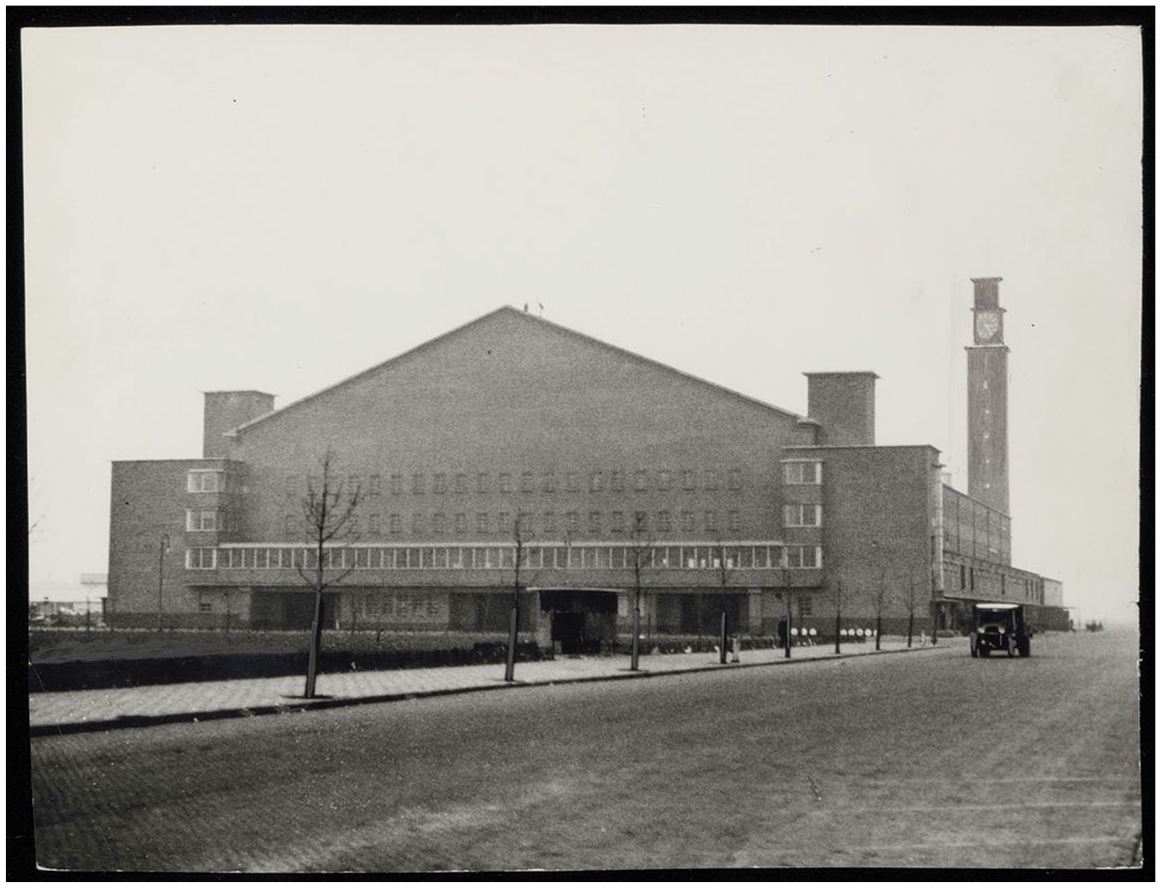
The Central Market Hall in 1935.
Disciplinary Practices of Direct Social Control: Stigmatization and Registration
Despite the predominately spatial goal of the Central Market Hall that was founded on the logic of formalization, the Committee argued that the Vendors’ Question could not ignore sociopolitical concerns about the well-being of the “public good.” Street vendors were blamed for unfair competition and the resulting distribution of low-quality (food) products throughout the city. By deploying this narrative, the Committee sought to justify more disciplinary state interventions to prevent conditions injurious to the public health, safety, morals, and welfare. In the preparations for more regulations that followed, eliminating the comprised use value of street vending was perceived as a moral duty, blurring the boundaries between public and private responsibility. 74
Reviewing the regulation of street vending practices in different European cities, such as in London, Paris, Brussels, and Berlin,
75
the Committee proposed to implement and enforce a strict license system. The archive accounts show how discursive strategies of categorization and stigmatization functioned as the primary justifications for the implementation of this registration system. The Committee did not only emphasize the perceived low quality of the products offered by street vendors, but also highlighted their deceitful nature and unhygienic sanitary conditions: The fraudulent practices, which are intrinsically linked to street trade, are countless. Think of tampering with the weight of fish [. . .] smoking spoiled fish, storing fish in improper storage rooms, displaying fish on dirty push carts, etc. [. . .] Similar fraudulent practices are identifiable in the street trade of venison and poultry. Birds that died of illness are placed in limewater, and sometimes even burned with denatured alcohol, to get rid of the bad smell [. . .] Other types of deceit include for example the sale of wood pigeons for partridges, etc.
76
These perceived fraudulent practices of street vendors also became the central topic of drawings and newspaper articles. At the beginning of the twentieth century, graphic artist André Vlaanderen drew the street vending scene of Amsterdam, accompanied with comments on the moral and hygienic standards of vendors. Image 3 shows one of his drawings. The text next to the ice cream vendor states that the ice cream truck was the “favorite gathering place for lallygagging youth, squandering their pocket money on unhygienically prepared ice cream.” The text next to the fruit vendor further emphasized the immoral standards and behaviors of street vendors, by stating satirically, “In the absence of product knowledge, the vendor quickly takes a bite of the apples to distinguish the sour from the sweet ones. No one will know!”
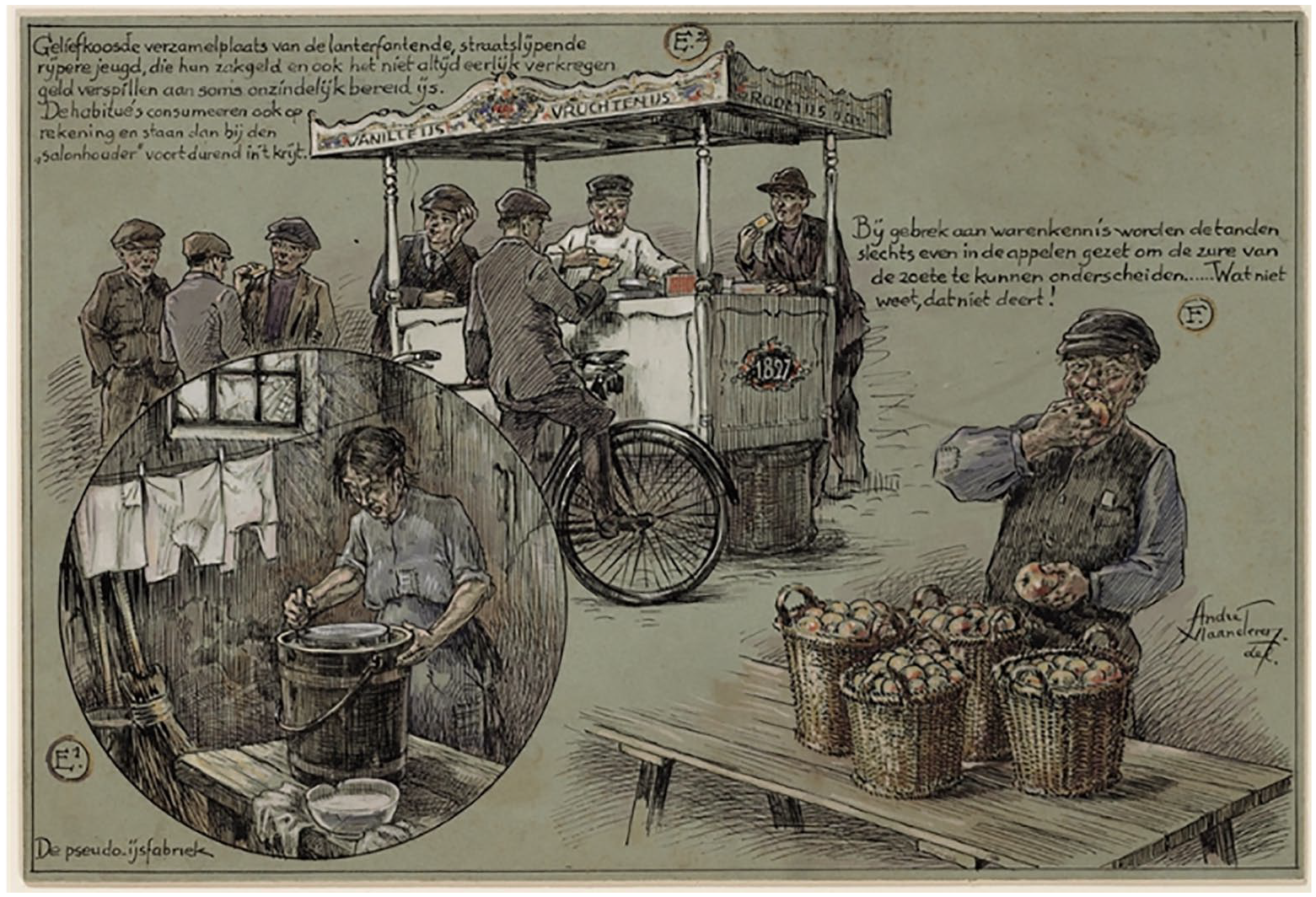
A cartoon from the beginning of the twentieth century, deriding street vendors’ immoral and unhygienic practices.
Time and again, the social behaviors of street vendors were framed as deceitful or dishonest and presented as an inevitable outcome of their marginalized socioeconomic position. What was wrong was for the most part identified in relation to poverty and marginality, while what could improve was primarily identified in change of behavior. As such, the explanation for the miserable conditions of vendors was sought in the signification of negatively evaluated personal characteristics that were, in turn, rendered amenable to governmental intervention.
In March 1933, the City Council heeded to the call to implement a license system, as put forward by the Committee, which would enable the city government to directly affect the conduct of vendors by restricting their access to the street vending economy. 77 Accordingly, the City Council presented a draft version of the so-called “Vending Decree” (Ventverordening) that soon would be implemented. The draft version of the Vending Decree stipulated (among others) that street vendors (1) had to carry their names and addresses on sales vehicles, (2) were not allowed to extend their displays or leave objects outside the sales vehicles, (3) were not allowed to either place their vehicles widthwise next to each other or to place them on public roads, and (4) were required to follow the instructions of police officers regarding the nature, time, and place of their vending practices. 78
Interestingly, the Amsterdam union of street vendors, “Our Interest” (Ons Belang), did not oppose but rather publicly support the Vending Decree. The perceived problems of the street vending economy were so deeply entrenched in the dominant discourse that its essentialist representation became readily and uncritically accepted, thus making it highly infectious and easily communicable, even among representative bodies of street vendors themselves. In one of the issues of the union’s magazine “The Free Vendor,” the secretary of Our Interest addressed the importance of “sanitation” and “organization,” accompanied with disciplinary admonitions, such as “Street vendors, retain the trust of the public. Give fair weight, provide good products and neat service” and “Give this magazine after you have read it to [a vendor] who is not or wrongly organized and discuss with him the content.” Moreover, commenting on the proposed plans of the Vending Decree, the secretary of Our Interest wrote, There are people who do not understand why “Our Interest” supports measures of sanitation [sanering]. We would like to tell them that we have never opposed measures that can improve our sector [. . .] As soon as the Vending Decree is implemented, street vendors will be able to earn more money as it brings an end to the unbridled expansion of new vendors [. . .] We have to take a stand against those who engage in unfair competition and financially kill other vendors. We should establish healthy financial relations between street and wholesale trade to wipe out the hustlers [beroepszwendelaars]. Comrades, let me get this straight, unity brings a lot, and let us therefore convince unorganized street vendors of the importance of our trade union. Because effective organization is the only means to improve work and life conditions. Therefore, organize yourself, in “Our Interest.”
79
On September 1, 1934, the City Council officially implemented the Vending Decree. Only those vendors who possessed a license issued before September 1933 could be issued a new one, and, from that date on, licenses had to be paid for. Moreover, vendors carrying licenses were prohibited from selling in neighborhoods that were not allocated to them, and they were not allowed to stop and ply their products in a radius of 50 meters around official markets and stores. 80 The director of the Department of Market Affairs announced to crack down on rule violations. 81 The Vending Decree took its toll. Between January 1935 and March 1941, the number of street vendors decreased by almost 60 percent, from 7,184 to 2,877. 82 At the same time, as desired by the city government, a significant part of the vendors had become market traders in the period between 1935 and 1940, when their share increased from 1,600 to 2,000. 83
Despite the fact that street vendors slightly grew in stature through their conversion into “official” market traders on spatially confined markets, they still suffered the wrath of the populace that considered market traders as illegitimate and irrational economic actors in the city’s retail sector. In the first comprehensive inquiry into the national state of market affairs conducted around 1941 by the Ministry for Economic Affairs, the director general of Trade and Industry wrote, The complaints, which are frequently addressed, specifically refer to the superfluous and disloyal competition of markets, and boil down to the following: One cannot say, from a social-economic perspective, that markets fulfil an independent task; established shopkeepers could easily take over and perform this task accordingly. The competition is disloyal due to the low prices, which are the result of the provision of low-quality trade.
84
To conclude, we observe how street vending and market trading already were highly contested retail activities in Amsterdam at the beginning of the twentieth century. We hit upon a set of narratives that stigmatized street vendors and market traders and, subsequently, justified policies of spatial exclusion and incorporation. These practices did not occur in isolation but were part of an approach that was rooted in biopolitics and which manifested itself as a concerted attempt to control and morally uplift lower social classes.
The historical continuation of stigma—first directed at street vendors and later also at market traders—shows that stigmatization has been in existence prior to the neoliberal era, reflected against the imaginary of the “modernizing” city. The specific forms of stigmatization, in which categories of social class, ethnicity, religion, and race played—just like now—an important role, tell us that the history of the stigmatization of street vendors and market traders is longer than often acknowledged in existing studies.
Conclusion
This article speaks to studies that have explored the relations between stigmatization and redevelopment, which seem to typify contemporary forms of neoliberal urban governance targeting street vendors and market traders around the world. A broad view of this work reveals stigma and institutional attempts to exclude or formalize traditional types of street vending and market trading to be two sides of the same coin, the former paving the way for the latter. 85 Contributing to this debate, we have made use of a historical perspective in the case of Amsterdam to show that this relationship is much older and can be traced back to, at least, the beginning of the twentieth century. The archive materials have revealed that the stigmatization and regulation of street vendors and market traders are consistent and historical processes in which the state, particularly the local state, offers its assistance.
The added value of a historical perspective is that it does not only illuminate the politics of street vending and market trading prior to the advent of neoliberal urban governance, but it can also help us better understand the present. 86 The case of Amsterdam has shown that today’s market structure has largely been created by past city governments in balancing the need to contain the sprawling mobility patterns of street vendors in spatially designated markets with the need to safeguard the well-being of the “public good.”
This process, which we conceptualized as part of the “civilizing offensive,” was based on two principles. First, it relied on the biopolitical idea of forming and guiding the actions of street vendors by remaking their physical environment, resulting in the emergence of “official” outdoor markets and the covered Central Market Hall. The spatial rationality undergirding this principle imagines the dependence of social control on the ordering of space. Second, it was based on a strong belief in the efficacy of direct social control, resulting in the establishment of the Vending Decree that directly affected the conduct of vendors by restricting their access to the street vending economy.
To justify the implementation of both interventions, street vendors—and later on also market traders—were problematized and stigmatized as “ill-adapted” and “undisciplined,” while their behaviors were framed as deceitful and presented as an inevitable outcome of their marginalized socioeconomic position. This historical process of stigmatization provides insights into the articulation of new urban governance. Recent studies on street vending and market trading have made the argument that the increasing invisibility of street vendors and redevelopment of markets should be understood “in the context of a pervasive neoliberal discourse on urban renewal and modernization that promotes the notion of a hygienic city” in which certain street vendors and market traders “have become the new undesirables of the urban landscape” (p. 311, emphasis added). 87 While we do not contest the pervasive effects of neoliberal governance, we would argue, however, that its accompanying imaginary that stigmatizes street vendors and market traders as “out of place actors” or “undesirables” is not something “new.” In other words, stigma production is a feature of neoliberalism, but the era of neoliberalism is not its genesis. 88
The historical origin of stigmatization described in this article could therefore be considered as what Butler-Warke has called “foundational stigma,” that is, stigma production that occurred prior to neoliberal practices of stigmatizing people and places for more profitable urban investments, “implying that the story of stigma can be seen as a consequence of the industrializing and modernizing city rather than solely as a feature of the post-industrial society” (p. 150). 89 This finding underscores not only the analytical, but also the political stakes in attending to interconnected historical geographies of stigma production and forms of exclusion and forced incorporation.
Susan Parnell and Jennifer Robinson argue that it may not be helpful for political resistance to symbolic violence, exclusion, and exploitation in urban processes in general, and directed against street vendors and market traders in particular, “to be [solely] effected under the sign of anti-neoliberalism” (p. 602). 90 By acknowledging that these processes have a longer history, we can better identify the warning signs of stigmatization against marginalized communities and, accordingly, as Butler-Warke concludes, “actively work to combat it by challenging dominant voices” (p. 150). 91 Understandings of space and place as both presently and historically produced could, therefore, be a key resource to combat forms of stigmatization and exclusion that currently define many public space governance regimes around the world.
Footnotes
Acknowledgements
The authors would like to express their sincere gratitude to all members of the Gender & Diversity group at Radboud University—notably Gijs Hablous—for their suggestions and inspirations. The authors would also like to thank Rianne van Melik (Radboud University) and Sophie Watson (The Open University) for their critical engagement with the manuscript. Final thanks must go to the anonymous reviewer(s) who provided encouraging and constructive feedback.
Declaration of Conflicting Interests
The author(s) declared no potential conflicts of interest with respect to the research, authorship, and/or publication of this article.
Funding
The author(s) disclosed receipt of the following financial support for the research, authorship, and/or publication of this article: The research of this article is financially supported by the Humanities in the European Research Area (HERA) Joint Research Program ( ) which is co-funded by Dutch Research Council (NWO) and the European Commission through Horizon 2020 (grant number: Hera.2.015).
Notes
Author Biographies
.