




Abstract
Throughout urban Europe, the introduction and presence of vehicles in the city caused tensions of safety and scarcity of space. This article discusses the vehicle culture of early modern Amsterdam, where vehicles and their users had no undisputed right to the streets. The current view in the historiography is that regulations that tried to curb wheeled horse-drawn vehicles were ineffective and that the streets rapidly became a vehicular space from the seventeenth century onward. This narrative is reconsidered by differentiating by vehicle type and location within the city. Specific parts of the city formed distinct vehicular spaces, and draft horses carrying sleighs formed an underestimated but important part of early modern street life. This difference between wheeled and non-wheeled vehicles is explored through new empirical observations from notarial attestations, and additional attention is paid to the role of vehicle speed and the gendered nature of early modern vehicle culture.
When the German traveler-scientist Georg Forster visited Amsterdam in 1790, he gave a vivid description of how loud everyday competition over urban space in the city could be: In small cities, crowdedness is more noticeable than here [in Amsterdam] where there is room to move out of each other’s way. But also in Amsterdam there are neighborhoods where one can only painstakingly move through the swarming in narrow small streets. The whole day long, a continuous thunderous roaring dominates. The manifold carriages of mayors, councilors, state officials, directors of the East India Company, physicians and the lavishly rich, the unremitting transport of goods and the resulting rising of drawbridges obstruct the way of passage and cause a constant yelling and rumbling. From the early morning to the late evening, men and women loudly cry to sell all sorts of goods on all of the streets. The church towers have carillons and in the evening, organ grinders and singing women pass through the streets.
1
Forster’s short description of street life shows the diversity of Amsterdam’s urban space. Areas of relative spaciousness—most likely allusions to the newer expansions—are contrasted with an obstructive crowdedness, probably references to the medieval center and the densely populated Jordaan district. Wheeled vehicle traffic and pedestrians loudly vied for the space needed to pass through the city. As the streets were filled with economic and with leisure activities alike, the street was used both as a transitory space and a destination in itself for various pursuits. Here, the “manifold carriages” described by Forster are especially striking: a year earlier, in 1789, the English author Samuel Ireland had written that carriages with wheels, except for the use of the nobility and gentry, were not suffered here for many years after its establishment. A sleigh, as the Dutch term it (the French a traineau or pot de chambre) is now much in use: it is the body of a coach, without wheels, drawn on a sledge with one horse and goes at the rate of three miles an hour. The driver walks close to the door, holding a rope, as a rein to guide the horse, and a pipe, as he says, to purify the air. The following sketch (Figure 1) will explain the nature of this carriage, a mode of conveyance better suited to the gravity of the Hollander than the sons of the whip in our country. The vehicle will hold four persons, but not very commodiously. The fare is reasonable, being only eight stivers to any part of the city till ten at night, twelve stivers till midnight, and sixteen from thence till day break: if kept in waiting, the price is eight stivers per hour.
2
Ireland makes an important distinction between types of vehicles that had seemingly been ignored by Forster: there were a large number of vehicles without wheels. Sleighs were wheel-less vehicles that were dragged over the street pavement, for which an oily cloth (a smeerlap) was used to smoothen the passage. 3 Whereas Forster described carriages as an important part of street life, for Ireland they were more the exception than the rule. Perhaps, Forster simply included sleighs 4 under the phrase “manifold carriages,” since the closed type of sleigh used to transport people was sometimes called a “coach sleigh” (koetsslee). Yet especially since the introduction of wheeled coaches within city walls had initially been seen as an undesirable and dangerous innovation, the quotes cited above highlight the importance of distinguishing different types of vehicles when studying the city street and the impact of vehicles on it, bound together in what I will here in this article call “vehicle culture.”
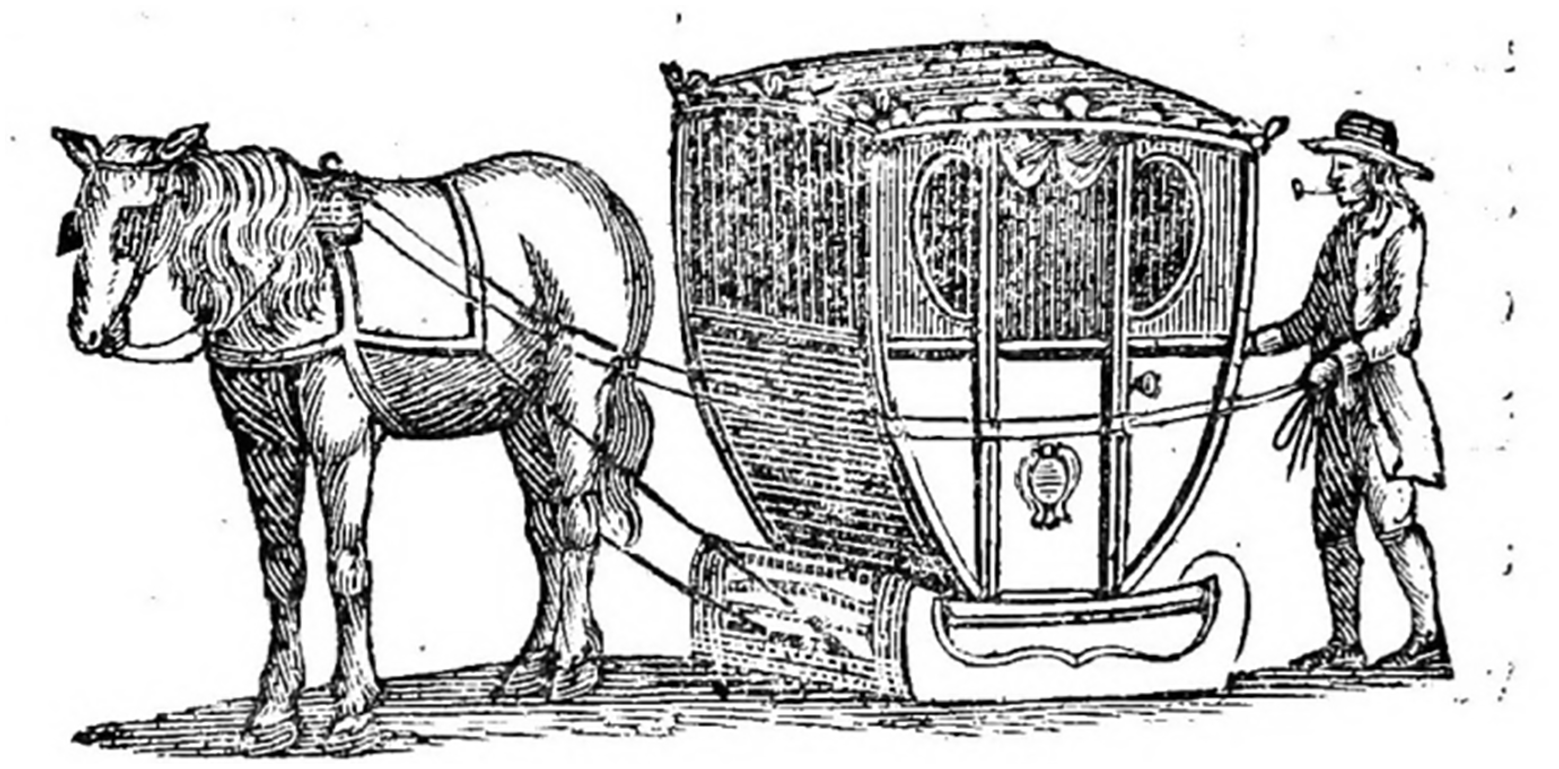
The Amsterdam closed sleigh or coach sleigh pulled by one horse and steered by a walking driver. Samuel Ireland. A picturesque tour through Holland, 128.
The place of vehicles in the city is a matter of spatial politics in which social differences among people in the form of gender and status play an important role. Vehicles require access to urban space that is inherently scarce, and they demand transformations of that space. At the same time, access to vehicles was marked by barriers of its own. The question of who gets to drive or to be driven is relevant to the organization of societies at large. Research into modern automobiles has considered how “categories of masculinity and femininity penetrated, applied to and organized the dawning car culture,” 5 but in contrast early modern vehicles have received, from a gender-analysis perspective, only limited attention. 6 Yet we should note that studies not engaging explicitly in gender analysis nevertheless depict early modern vehicle culture as a man’s world, as is apparent from historical descriptions such as Georg Forster’s above, or contemporary book titles, such as Driving. The Horse, The Man and the Carriage from 1700 up to Present Day. 7 Gendered analysis has occupied a more evident place in the strand of scholarship that has given horses a place in cultural history and where the human–animal relation between human and horse has been studied as a matter of embodiment, identity and status. 8 Some of the authors working in this vein have discussed masculinity as an important factor in the identity of groups such as German equine tradesmen and colonial Boers in what is now South Africa. 9 Simultaneously, historians are increasingly recognizing and exploring the profound influence of the horse (and other animals) on urban life. 10 In one such study—one of the few studies combining gender, urban space, and early modern driving culture—Thomas Almeroth-Williams has described the layered gendered context of the eighteenth-century English elite’s riding through London’s Hyde Park: equestrian ability was seen as a matter of masculinity, even as the “delicate” Londoners who drove parading themselves through urban parks were critiqued as “example[s] of London’s frivolous and effeminate ways.” 11
In this article, I will discuss the rise of vehicular speed in the city, and the unequal relations of access to it. I will try to answer the question to what extent wheeled vehicles were able to claim space in Amsterdam during the seventeenth and eighteenth centuries, and what the consequences were for access to the streets for different people. The early modern city was still a walking city and continued to be so until deep into the modern period, but new modes of transportation were emerging that competed with walking, left a mark on everyday urban experience, and posed new challenges. 12 As we will see, Amsterdam’s distinct vehicle culture possessed unique features, but studying its development helps us to grasp a wider European vehicle culture and the tense relationship between urban space and vehicles in general. Insights into early modern vehicle traffic in Amsterdam’s streets have previously been deduced from ordinances and regulations, traveler’s accounts like Forster’s, general demographic data and accounts of the city government’s efforts to intervene in the urban fabric, 13 but in short: “we do not have any quantitative data on traffic.” 14
In this article, I reconsider the ordinances and regulations and complement them with traffic data in the form of observations of practices of vehicles on the street. To find such observations, I turn to notarial depositions drawn up for the chief officer of Amsterdam and the diary-chronicle kept by Jacob Bicker Raije from 1731 to 1772. To find more about vehicle ownership, I turn to the Personele Quotisatie tax record from 1742. 15 These data are scattered and incomplete, but nonetheless, this is the first time we possess any sort of compiled empirical data on traffic for early modern Amsterdam to compare to the ordinances and regulations. While one cannot distill a complete overview of flows of traffic from these documents, they do offer insights into the experience of the movement of vehicles and into the changes in their use that took place during the period under scrutiny. The tax register contains useful information on vehicle ownership, and the diary-chronicle and the depositions provide observations of remarkable scenes, such as traffic accidents or conflicts on the street. Bicker Raije wrote down what he found notable and interesting for decades. The depositions drawn up through the office of the personal secretary of the chief officer in Amsterdam are particularly revealing because they often contain descriptions of people and their conflicts in and around the city, frequently on and around the street. The result is a set of depositions that can be seen as “court-like records,” a term introduced to broaden the scope of court records to include documents that, though not used in the courtroom, nonetheless supported the legal system in one way or another. 16 This way, such depositions can be used in a way akin to how (church) court records have provided elaborate insights into everyday life. 17
Exploration of vehicle culture of early modern Amsterdam will be divided in three parts. First, I will introduce the theoretical and historiographical context. Then the following empirical part looks at different vehicles and their distribution throughout the city as part of a broader citywide spatial analysis. This discussion will give us an idea of the shared structure of the city that affected both those with access to vehicles and those lacking such access. The final part considers the questions of who got to drive and how vehicle culture interacted with early modern social categorization as social class and gender.
Traffic in the Early Modern City: Historiographical Context
An important context for debates on traffic is the contrast between the premodern and the modern city. Accounts of the modernization of streets have typically contrasted a disordered premodern street, whose administration was the personal responsibility of its inhabitants, to a “rationally” ordered modern street, where the norm of public responsibility and the professionalization of the street’s supervision had turned it into a depersonalized place, used mainly for transit: What urban historians generally describe is an effective civilizing process of street life in the transition period from pre-modern to modern times. The rowdiness of the eighteenth century is contrasted by the demand for order and obsession with manners in the nineteenth century.
18
Such accounts locate most of the radical change in the nineteenth century, a time when “[t]he authorities took increasingly effective action to pave, drain, light, and police [the street].”
19
Some of the premodern multi-functionality remained in the nineteenth century, as “encounters with individuals, street furniture, animals, and vehicles would require [the pedestrian] to make constant changes of course, precluding relaxation. The street would be a scene of conflict.”
20
Such ongoing potential for conflict persisted until a process of “canalization of movements” in the form of sidewalks made for a “more relaxed pedestrian.”
21
Ogborn already saw such a process in eighteenth-century London, where the “politics of paving” spawned streets that were “brighter and safer” and “ordered and straightened” and as such became spaces of modernity.
22
In such a narrative characterizing the transition from premodern to modern cities, streets became sites of passing, unsuitable for social contact. London gentlemen’s magazines from the late eighteenth century advised their readers to keep moving and to avoid looking at others.
23
Similarly, but with a different emphasis, Lewis Mumford saw such a canalization of movement as an issue of social differentiation that had already been happening in the early modern city. He argued that the wider avenues of the “baroque city” gave material form to social differentiation: the dissociation of the upper and the lower classes achieves form in the city itself. The rich drive; the poor walk. The rich roll along the axis of the grand avenue; the poor are off-center, in the gutter; and eventually a special strip is provided for the ordinary pedestrian, the sidewalk.
24
Amsterdam does not fit the general periodization sketched above. As an important regional center within what has been dubbed “the first modern economy,” Amsterdam experienced growth that fueled the need for a series of urban expansions, of which the latest was finished at second half of the seventeenth century. 25 With those expansions, an urban structure and morphology was laid down that remained roughly the same until far into the nineteenth century. In that sense, it modernized too early for a modernization narrative of radical nineteenth-century change and already had features traditionally associated with different periods, such as a strip for pedestrians and streetlights in the seventeenth century. “Multiple modernities” existed alongside each other in practice. 26
Those multiple modernities were visible in the morphology of the city, as Amsterdam consisted of distinct districts with different spatial characteristics (see Figure 4 for different expansions). The largest contrasts were found between the narrow, curved and shorter streets of the medieval center and the straight, long and broad elite-occupied canal belt streets of the seventeenth-century expansions. But not all of the expansion was planned out as broad and accessible streets: Prior to urban expansion, the Jordaan had been a suburban collection of ditches and pathways, and its morphology was retained when this area was urbanized. The result was that the bridges into this socially mixed district did not directly connect to streets that ran through the district, resulting in sharp turns and badly connected streets. Clé Lesger, studying the so-called to-movement potential of Amsterdam’s street network, found that “[a]s far as connections and accessibility were concerned, the street network in the Jordaan was nothing short of a disaster.” 27 It was not only difficult to access from the city center, but “crossing the Jordaan itself was a problem.” 28
Although Amsterdam’s economy was not exactly industrialized at that time in the way that its later, nineteenth-century mechanized industry is understood to be, parts of the early modern economy were characterized by strong specialization and spatial centralization in the form of places, such as ship’s wharves, windmills, the Exchange, and textile processing factories. Furthermore, the city had introduced environmental regulations that put restrictions on stench, smoke and noise in the city center and canal belt that led to the development of industrial areas away from the city center and elite-occupied expansions. 29 This differentiated urban landscape, consisting of residential, mixed-use, and industrial areas in and around the city, made Amsterdam, in Jaap Evert Abrahamse’s view, “probably one of the best-planned cities of Europe.” 30 Environmental considerations were constantly weighed. Leaving waste on the street or in canals was prohibited, and it was to be collected in special waste barges and could be left in waste bins, although the constant reissuing and specification of these ordinances because they are “violated daily to the great disembellishment of the city” shows that rules and practices could differ. 31 Finally, another relevant large-scale urban environmental operation concerned the thousands of trees that the city government planted on the streets, safe for the most narrow and congested streets where there was no place for them. 32
In most of the seventeenth century, Amsterdam underwent a period of rapid and explosive growth in which it was—but did not remain—the dominant economic center of Europe. 33 In the demographically more stable long eighteenth century, its population first continued to increase, albeit with a slower pace of growth than before, and then declined, rising and falling in a range between 200,000 and 230,000 inhabitants. The population growth was the result of large-scale immigration, Amsterdam being a famously diverse city that was relatively open to minority groups from across Europe and beyond. 34 But even among those who shared a common background or religion, great differences existed: some rose to riches, others were plunged into poverty. 35 Amsterdam was, especially in early modern terms and compared to other Dutch towns, a proper metropolis that was dwarfed only by London and Paris. 36 Yet, in contrast to those monarchical capitals, it was a burgher’s city, its socio-political life dominated by strong civic institutions. 37
For cities throughout Europe, and not just Amsterdam, a teleological narrative that posits disorderly premodern streets ultimately transformed into ordered modern streets simplifies both the premodern and the modern situations. Abrahamse has showed that in the seventeenth century, a number of narrow alleys in the old city center of Amsterdam were broadened so as to smoothen passage through them. 38 Likewise, Jenner argues that “conveniency of passage” and the prevention of obstruction in the streets also represented a regulatory issue in seventeenth-century London, where the smooth circulation of traffic was deemed important. 39 Traffic rules and pavement regulations ordered street life throughout the early modern period and thus were not a modern invention. Furthermore, the narrative of “rationalization” presupposes a neutral best outcome for all urban street users, whereas in practice different interests compete with one another and have always done so. The matter of who got to use the street and in what capacity has its winners and losers, where some are able to claim more space than others. Especially, since the question of who gets to drive is dependent on a person’s gender and social class, the way vehicles successfully lay claim on the street is important with regard not just to early modern Amsterdam but also to cities throughout the world.
Finally, the narrative that casts early modern disorder as eventually yielding to modern order omits a particular type of disorder that was in fact a feature of what one might call modernization: the increasing rate of street users moving at different speeds. The introduction and social integration of high-speed interurban traffic, though it has been held up to critical scrutiny within the context of twentieth-century cities, has received far less consideration as an early modern phenomenon. 40 Yet the privileging of speed and its distribution is a topic that can be applied to early modern cities as well as more recent iterations of the urban landscape. Acknowledging this helps us further understand the logic of early modern streets on its own terms. As we will see below, high-speed vehicles had no obvious place within a city’s walls. Only gradually were such vehicles accepted into the city during the early modern period. There was neither an outright invasion nor a smooth transition to the new status quo. In the same sense that we can see the process that Koslofsky has called “nocturnalization”—in which “the elites of the court and the city colonized the urban night” 41 —as both a colonization process and a civilizing process, I would argue that the “vehicularization” of the early modern city was, too, at once a civilizing and a colonizing project.
Speed and Vehicular Space in the City
In Amsterdam in 1528, a new bylaw stipulated that the drivers of sleighs and wagons were no longer allowed to sit upon their vehicle and instead would have to walk beside it, because the “driving caused great disorder, often mixed with malice, as people, specifically women and children, are at great danger of being driven over.” 42 As commercial and economic activity grew and claimed more space in the street, the city authorities sought ways of regulating the flows of people, goods, and vehicles. The above example hints at a gendered competition over street space and offers an image of male sleigh drivers competing specifically with women and children for space. We know from London that “[c]hildren were especially vulnerable to traffic.” 43 Balancing the demands of economic activity with the everyday safety of urban inhabitants, the bylaw from Amsterdam, revealing that it was deemed appropriate for women and children to take up space in the streets, shows an effort to protect their capacity to do so. Heavy sleighs brought economic advantage; to counter their danger, their drivers were brought back to walking speed.
We see here that the sixteenth-century urban street was not an unproblematic “vehicular space.” The regulations were aimed at the drivers of vehicles: it was they, and not pedestrians, who had to adjust the way that they moved. The danger of vehicles on the city’s streets had to be mitigated as much as possible. This view came under increasing pressure in the seventeenth and eighteenth centuries. Amsterdam’s seventeenth-century expansions were increasingly planned with vehicles in mind and by the eighteenth century, wheeled vehicles had certainly achieved an accepted place in street life. This is not to say that the whole of urban space had been unproblematically reconceptualized and transformed into vehicular space. Heavily regulated in particular to ward off disorder and danger were those parts of the city that had never been designed for vehicles. Furthermore, among land vehicles pulled by horses, an important distinction was put in place separating vehicles with wheels, on one hand, and sleighs without wheels, on the other.
So at least since the sixteenth century, sleighs had been an important part of street life in Amsterdam long before coaches and chaises (fast and lighter two-wheeled wagons, pulled by a single horse) came into fashion in the seventeenth century. 44 While most goods came into the city by water, a part of the subsequent inter-city transport was done by draymen or sleigh-men (sleepers) who used a single draught horse connected to a simple sleigh to bring goods to locations within the city. Such sleighs or sledges, not unique to Amsterdam, could be seen in other cities in the Dutch Republic and in England, at least in Bristol. 45 Sleigh-men’s movements clearly had an economic purpose which, as long as they controlled their horses properly and drove slowly, gave them a legitimate claim on urban space. City ordinances and guild structures, such as the 1528 bylaw and certain other regulations (which will be considered later in this article) show how sleigh-men’s claims on the streets were never simply accepted; but they would be accepted if their movements were regulated so that they were safer. Similarly, carts and wheelbarrows were accepted, if regulated. Coaches and other vehicles that could also be used recreationally had much less of a legitimate claim on urban space: When, from the second quarter of the seventeenth century onward, coaches rapidly became more popular, they damaged streets and bridges and were deemed too dangerous to share the streets with others. 46 The collective damage caused by these vehicles was much greater than whatever individual gains they might provide. So, in 1634, the city authorities banned the use of all coaches within the city walls. Even a widow’s plea to be excused from these rules so that she could use a one-person vehicle was brushed aside, Abrahamse has shown. 47
Besides the damage and danger that wheeled vehicles in the city posed and indeed caused, such conveyances were also seen as a threat to the moral order. Coach owners flashed their wealth in the streets; commentators were especially distressed about the nouveaux riches now shaking up the status quo and its hierarchy. There was a clear difference between vehicles used for economic activity, employed so that people could make a living, and coaches called into service for leisurely drives and showing off. In his 1614 emblem book Sinnepoppen, the Amsterdam emblematist Roemer Visscher included an emblem of a coach with a quote from Virgil, “uid domini facient audent cum talia fures” (“What would the lords do if thieves/servants dared such things?”) and a text in Dutch that complained of the conspicuous splendor and arrogance of those who had earned their fortunes unjustly and who now took to showing off with horses, carriages, clothes, and banquets. 48 The coach was an illustration of these luxury-indulging people who “did not leave prominence to the noble sovereign.” 49 Danielle Bobker has found a very similar discourse in England, where the poet John Taylor wrote in his 1623 The World Runnes on Wheeles: “The aristocracy merit this luxury [to be coached] but why should common traders raise themselves thus above the crowd?” 50 Coaches, significantly, were limited at first to royal and aristocratic households. In the eyes of moralists, such as Roemer and Taylor, the widespread adoption of coaches across Europe was a “transgression of the coach’s ceremonial origins.” 51 Yet there was a crucial difference in the case of Amsterdam, which was a city-state within a civic republic with an urban bourgeois social structure: it had neither a court nor an influential aristocracy. However, this association of coaches with nobility might have been a stronger reason why such wheeled vehicles were distrusted. The suspicion directed toward them fits the logic of sumptuary laws throughout the Low Countries, where limitations on the “livery of noblemen” were not a matter of an aristocracy protecting their privileges but rather a means whereby urban authorities engaged in “limiting the display of noble power and influence within city walls.” 52 In that sense, the 1634 ban on wheeled horse-drawn vehicles within the city can be seen as a combination of a safety law and a sumptuary law.
In contrast, Paris and London in the seventeenth century were each “overrun by coaches and carriages of all sorts.” 53 This development had been rapid: From the sixteenth century onward, it slowly became socially acceptable for noblemen to be seen in coaches. Still, court cultures had not always introduced vehicles in a smooth fashion. The French king Charles IX (reigned 1560-1574) had not allowed his nobles to use carriages, which he saw as a foreign and effeminate. 54 But from the late sixteenth and early seventeenth centuries onward, “coaches quickly spread through the aristocracy and gentry.” 55 Their design and comfort improved, especially from the seventeenth century onward. 56 In the capital and court cities of Paris and London, they quickly became a common sight on the street. Karen Newman observes: “The coach’s popularity needs to be understood in part as a means of reestablishing the social distinctions put in jeopardy by the ‘promiscuous sociability’ of the newly congested, burgeoning urban environment of the streets.” 57 In Paris and London, coaches were a new way for the upper gentry and nobility to differentiate themselves from the common people in the face of metropolitan sociability. Coaches provided both a metaphorical as a literal ascension above common pedestrians. Yet, in Amsterdam, especially given the lack of an aristocracy, this was problematized and the use of coaches was rather seen as part of this “promiscuous sociability.” The coach sleigh, even literally lower because of its lack of wheels, became a viable alternative.
How successful was the ban on wheeled horse-drawn vehicles in Amsterdam? It is hard to say. One historian suggests that visual material shows that “the driving prohibition was well-complied with.” 58 Recent work on the subject, by contrast, suggests the idea that the ban was not practically achievable, even that it was, in the words of Abrahamse, “too far removed from reality to be enforced.” 59 Lesger, following this view, writes that “the ban was ignored by many, and pleasure carriages contributed to the huge crowds, especially in the old center of the city.” 60 Abrahamse finds support for the idea that the ban was not enforceable in a 1656 regulation that declared that vehicles could no longer enter the city walls after 21:00 when the gate clock started ringing, from which one can infer that they could enter the city before that time and that wheeled traffic drove through the city. 61 Finally, newer regulations in 1663, 1669, 1679, and 1681 allowed wheeled traffic as long as it only went directly (via recta) from a place of residence or accommodation to a city gate. This repetition, interpreted as evidence for the difficulty of upholding the total ban on vehicles, has been presented as a concession that paved the way for the later acceptance of wheeled vehicle traffic. 62
In my view, the ban on wheeled vehicles may have been more successful than has recently been argued, but I would add here that some spatial specification was in place. While it is likely true that the prohibition was not enforceable across the entire city, it was probably enforced in the vehicle-unfriendly parts, which for the most part was the medieval center. Certain arguments support this idea. First, the 1656 regulation mentioned by Abrahamse can be interpreted in another way: many of the squares around city gates were wagon squares—the locations where vehicles could be parked or where coaches could be hired—precisely because they were not supposed to venture further into the city. Here, we find a liminal space of transition between the (wheeled) vehicular space outside the city walls and the non-(wheeled) vehicular space within them.
Second, if the 1634 prohibition was in fact massively ignored, then the rise of the closed sleigh is rather mysterious. A sleigh of the sorts used for the transport of people was sometimes called a toeslee (closed sleigh) or koetsslee (coach sleigh) to distinguish these conveyances from the simpler sleighs employed in the transporting of goods (such as the one seen in Figure 2). These coach sleighs were a feature unique to Amsterdam that provided a useful alternative to coaches. Because they took up less space and went at a slower speed, they were a more widely accepted method of interurban transport. These sleighs could be used in the narrow streets of the older parts of the city as can be seen in Figure 3. They were still in use by the nineteenth century. They likely came into use (or at least became much more popular) due to the ban on wheeled coaches: The first regulations that explicitly mentions “coach sleighs” can be found in an update of the guild regulations for draymen dating from 1671. These were available for hire as cabs for rides throughout the city. Rich citizens also had their own private coaches, as a legal alternative to the more dangerous and banned wheeled coaches. The rich seemingly made sure that their private coach sleighs stood out from the ones that were publicly rented out as cabs: According to the 1671 regulation, coach sleighs that were for hire could no longer be “carved, gilded, silver-plated or varnished.” 63 In addition, maximum prices were set. Here the authorities were probably trying to keep these sleighs accessible to all: a regulation that set a fine for refusing customers was implemented as well. Sleigh renters were creative in evading these laws: In 1683, a stipulation was added that forbade the decoration of a coach sleigh with painted pictures or flowers. 64 Either way, closed sleighs became an important alternative to coaches and an important means of respectable travel within the city.
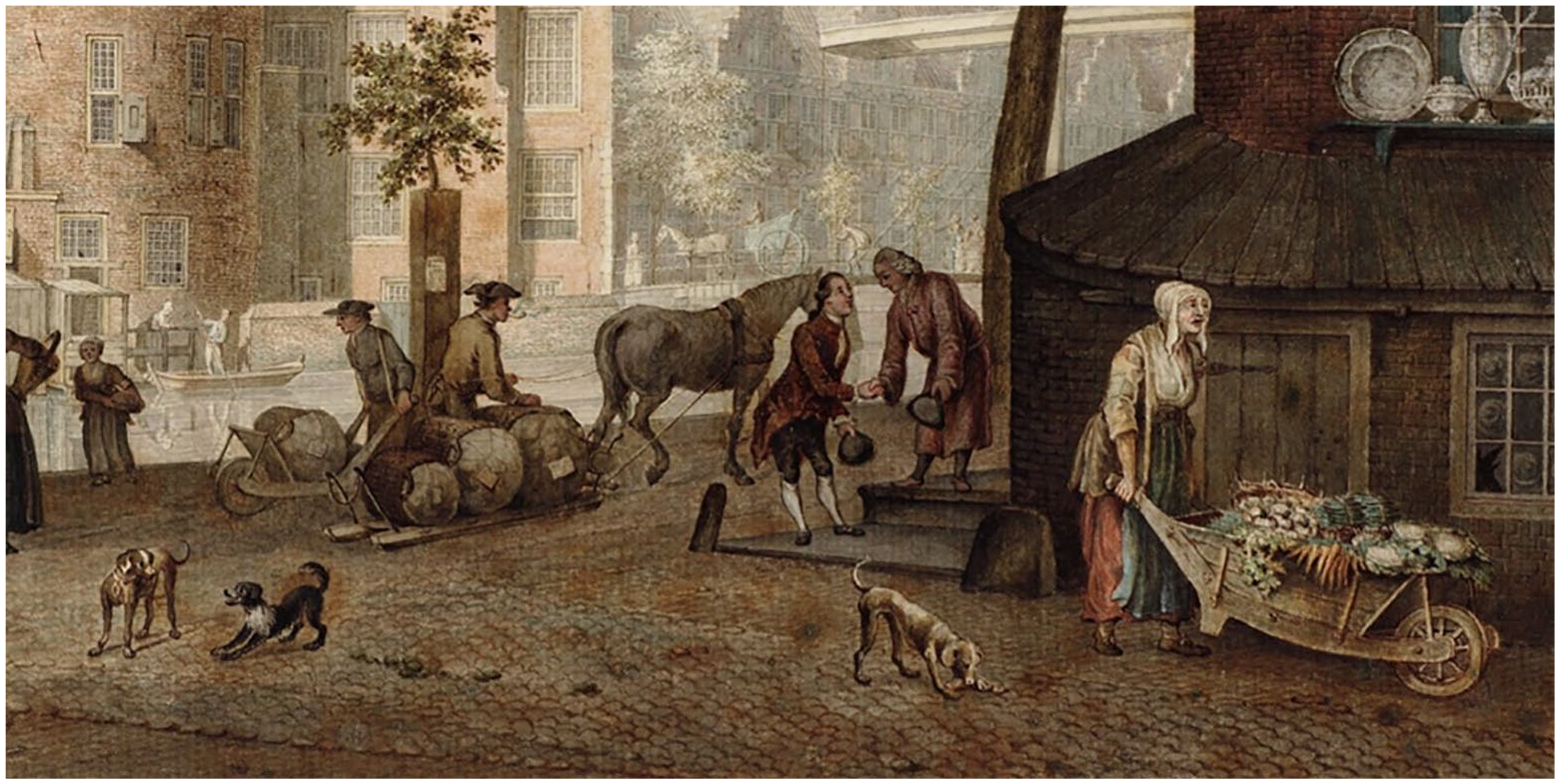
A sleigh and two wheelbarrows on the street. A chaise can be seen in the background. Cutout from a drawing by H. P. Schouten, 1779. NL-AsdSAA, Splitgerber (10001).
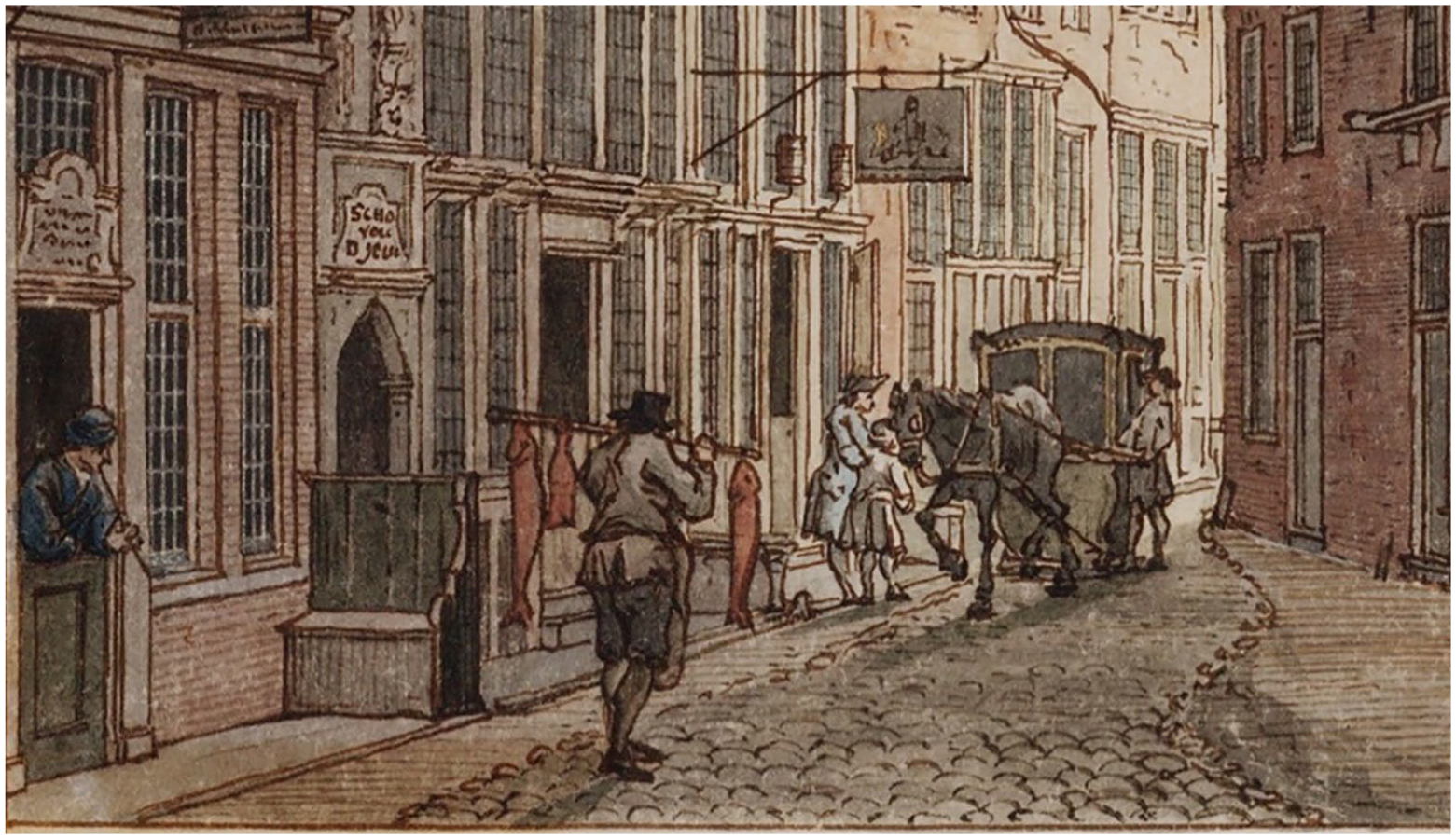
The closed sleigh or coach sleigh in the narrow Enge Kerksteeg (literally called “the narrow church alley”). Cutout from a drawing by R. Vinkeles, 1768. NL-AsdSAA, Collectie Stadsarchief Amsterdam: tekeningen en prenten (10097).
A third reason why the coach ban may have been more effective than previously argued: The new regulations that appeared from 1663 onward, in which coaches were allowed as long as they went straight to and from home, yielded only specific parts of the city to coaches. They were not so much a concession to already existing wheeled vehicle traffic, as adjustments made to match the new situation arising due to the fourth expansion, which was being built in that period (see Figure 4 for these expansions). The infrastructure of the fourth expansion facilitated vehicle traffic much more effectively than what one found in the old city center and earlier expansions, and it contained broad streets as well as many stables and coach houses. 65 The newest parts of the city were clearly vehicular spaces, some streets having even been designed explicitly with the width of wagons in mind. 66 But with the new regulations, many of the people who used a coach to get from their house to outside the city walls could still not legally drive it into the old city center unless they lived there themselves. Owners of coaches mostly lived in the expansions, as the Herengracht and Keizersgracht were prime residential areas for those who could afford coaches, as we shall also see ahead and in Figure 4.
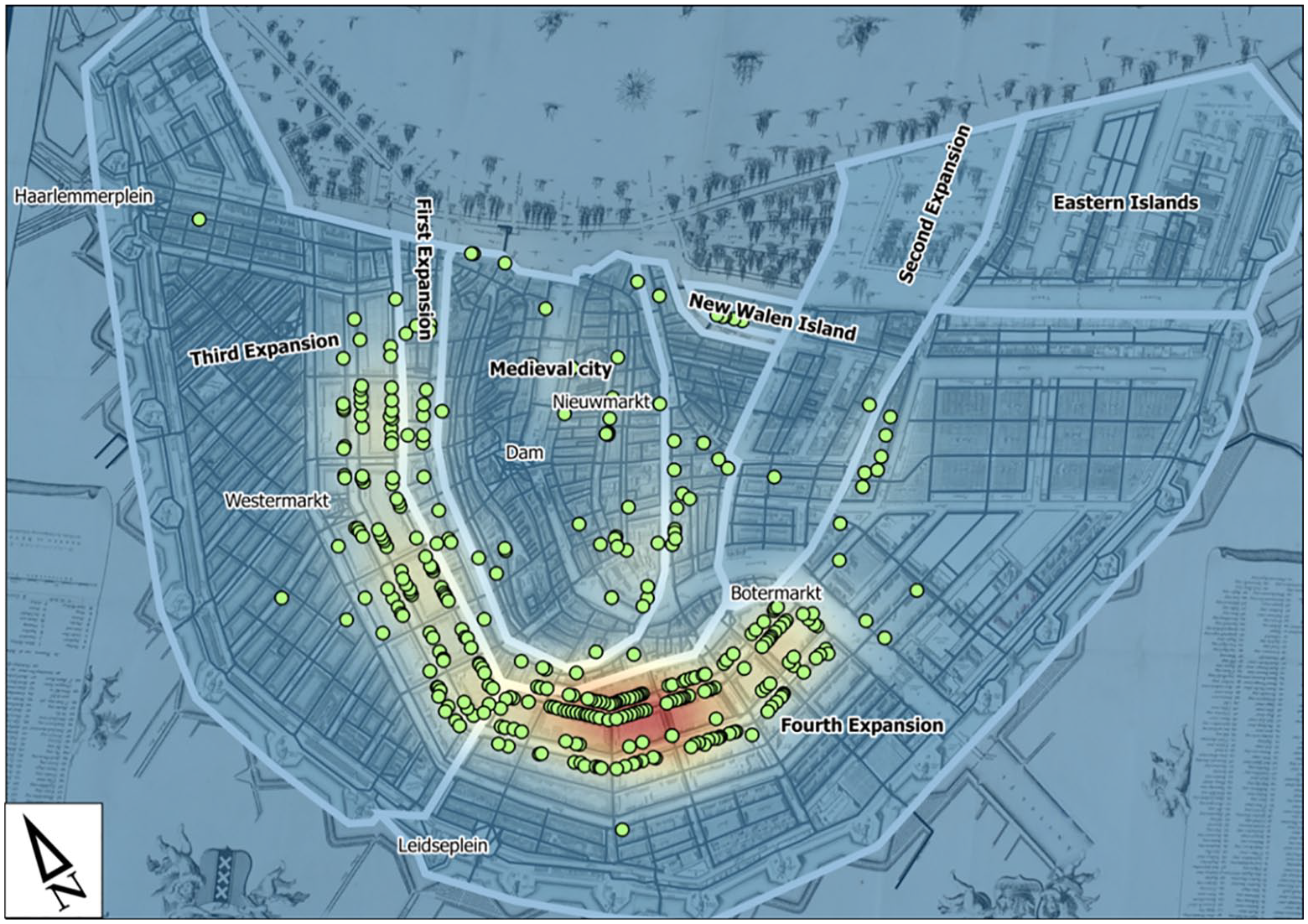
Locations of residence of people who owned coaches and fourgons in the Personele Quotisatie of 1742, with the expansions of the city, projected on the map of Amsterdam by Gerrit de Broen.
The timeline of regulations on wheeled vehicles and the language used in them offer further insight into the process of vehicularization. The 1634 prohibition on wheeled vehicles was upheld for twenty-nine years. The new 1663 bylaw then stipulated that wheeled traffic was allowed only if the vehicle drove from a location of residence or accommodation to a city gate and avoided narrow streets. 67 Coach owners in violation of this new rule were to be fined 100 guilders. Declaring that the number of coaches had grown considerably, the new bylaw stated that the streets were too narrow, had often been damaged and that there had been accidents. Six years later, in 1669, the bylaw was renewed because it was “every now and then contravened.” 68 A new addition stated that a coach owner was always liable for the fine, even if they had borrowed or rented the coach out to someone else, which suggests a way in which drivers had been evading the fine. Then, in 1679, another bylaw was passed that specified that all types of coaches fell under the above-cited bylaws, not excluding coaches with a single horse or low wheels. Again, this measure was taken because these rules were “every now and then contravened.” The timing of these bylaws in the second half of the seventeenth century was not accidental. A wave of technological experimentation and advances in suspension, such as twin-strap suspension systems and steel springs, had led to the introduction of new wheeled vehicles across Europe. 69 It seems likely that this is also the period when the lighter and faster one-horse chaises became more widely adopted, and regulations followed accordingly.
Two years later, the bylaw was repeated, as it had been once again “in many parts contravened.” This time, an important addition about speed was included, perhaps because of the increased use of chaises. With the sole exceptions of post wagons, vehicles were to only go at a walking pace (stapvoets). After that bylaw, no new bylaws on the matter were passed for fifty-five years. This latest update allowed wheeled vehicles as long as an annual tax of fifty guilders was paid (which would be about fifty days of work for an unskilled laborer, who of course was not driving around with a coach). The text of this 1736 bylaw stated that the previous bylaws from the seventeenth century had “been out of use since a long time, despite the renovation of 1681.” 70 In this newest concession to wheeled vehicles, the damage that coaches caused to the streets was cited as the main justification for a tax to be implemented. The earlier considerations of danger to pedestrians were not reiterated, nor were moral considerations. One practical matter was given in a 1733 advisement that led to the 1736 bylaw; the idea of allowing coaches while taxing them was a way to “meet the wishes of the upper middle class, who cannot miss the use of coaches because of the large size of the city.” 71 Interestingly, the size of the city had not changed since the 1660s, but of course, it took longer for certain parts of the last expansion to come into complete use. In any case, Amsterdam after the fourth expansion was now considered too large to travel within without there being vehicular transport for the wealthy. We are reminded of Mumford’s baroque city, where the rich drove and the poor walked. 72
Even if the bylaws were not fully enforced, they shaped the street and its use over the seventeenth and eighteenth centuries. If they were not adhered to at all, it would not make sense to tack on new additions intended to catch exceptions and to make sure that everyone understood that the laws applied to them. But, as we have seen, every successive updated version of the bylaws explicitly states that the previous laws had been evaded to either a small or a large extent.
73
It seems that at least in the second half of the seventeenth century, conscious efforts were made to make the laws clear and to enforce them. Somewhere between 1681 and 1736, the laws clearly became obsolete. But the phrasing “out of use since a long time” from the 1736 bylaw is very ambiguous. The period in which a bylaw can be considered “out of use for a long time” was probably at least a few decades. But perhaps most importantly here, we can see that the bylaw was not entirely ignored. The 1681 addition stipulating that vehicles were only to drive at a walking pace was still enforced. We find evidence of surveillance of vehicle speed in the depositions: In 1696, Jan de Bruijn was stopped by the servants of the substitute sheriff because he or his servant had driven his chaise too fast.
74
More importantly, there was still an enforced speed limit after the 1736 bylaw had allowed vehicles: In a 1744 deposition for the chief officer, we find a case where a coachman was fined for causing a dangerous situation on the Herengracht when he drove at high speed past another coach that was driving at a walking pace.
75
We see here that wheeled vehicles, though they were now accepted on the street, were still expected to proceed at the speed at which pedestrians moved. Coaches and chaises were effectively supposed to behave like sleighs as long as they were within the city walls, and they could be fined when they did otherwise. Another hint at this practice comes from something that was either a decoration or a piece of graffiti reportedly written on a wagon and collected by Hieronymus Sweerts, published between 1683 and 1690. The rhyme reads, Die hard rijd wint wel tijt Who drives fast make a quick start Maar raakt licht Paard en Wagen quijt. But easily loses their horse and cart Voorzichtig en verstan- Careful and sen- Dig is een goed Voerman Sible is a good carriage man.
76
After coaches had been accepted in the city, they still followed the spatial patterns laid out in the seventeenth century. Figure 4 shows a map with the home addresses of all owners of coaches and fourgons (another type of horse-drawn wagon) as reported in the Personele Quotisatie tax record of 1742. 77 It pictures the canal belts as a shell full of coach ownership around the old city, with the Kloveniersburgwal and the Singel as its branches. Of course, the location on the map is not necessarily the location of the stable and the coach. Some people had coach houses at or behind their houses, but many others stabled their horses and coaches elsewhere and had them driven to their door as necessary. Many such locations were situated even further away from the city center. A good example comes up in a notarial deposition in which a coachman had moved the coach from the residence of his employer in the canal belt on the Herengracht to the Jordaan, as he had parked the coach in the third stable of the first cross-street of the Laurierstraat. 78 So it could be argued that rather than opening up the whole city to vehicles with wheels, the liminal zone between the wheeled vehicular space outside of the city, in its periphery and the wheeled non-vehicular space at its center was broadened and extended into the newest parts of the city. Interestingly, this does not follow the same pattern of the environmental regulations against pollution, noise and smells that banned new industrial activity: in those regulations, the city center and the canal belt were both covered, but in the vehicular logic, these areas stood opposed. 79 Of course, both benefited the elites who could afford wheeled vehicles and who took up residence in the elite canal belt. The old city remained largely unfriendly to wheeled vehicles while vehicular zones had come into existence around it. While the medieval city center and especially Dam Square were in theory accessible to wheeled vehicles, these vehicles were used much more often in other parts of the city. Instead, sleighs were used in favor of wheeled vehicles. There was no use for speed in the crowded and narrow medieval center.
To further my hypothesis that the medieval city center was accessed with less frequency by wheeled vehicles than by sleighs, I collected thirty observations of coaches and chaises and thirty observations of sleighs from eighteenth-century notarial depositions and mapped them. 80 Most of these observations come from a period when wheeled vehicles were officially allowed to drive through the entire city without restrictions. Still, as the map in Figure 5 shows, the number of wheeled vehicles in the medieval city center was very limited and the number of sleighs was much larger. Only three of the thirty observations of coaches and chaises were in the medieval city center, while eight to ten of the thirty sleighs were found there. 81 In contrast, coaches and chaises were evident in great numbers in the area of the fourth expansion, including the Plantage green space district. And the third expansion shows an interesting mix of both types of vehicles as a sort of intermediate form that had emerged between the city’s two types of vehicle culture. It is clear that sleighs had much more of a place within the medieval city center, while coaches and chaises were much more likely to be found in the newest part of the city. Even after the formal restrictions had been lifted, the added benefit of taking a wheeled vehicle into the medieval city center was negligible. Sleighs formed a viable alternative to coaches as the morphology of the city center and its crowdedness made the more maneuverable sleighs more desirable. Especially since vehicles could not get up to a high speed, the possession of wheels levied no distinct advantage.
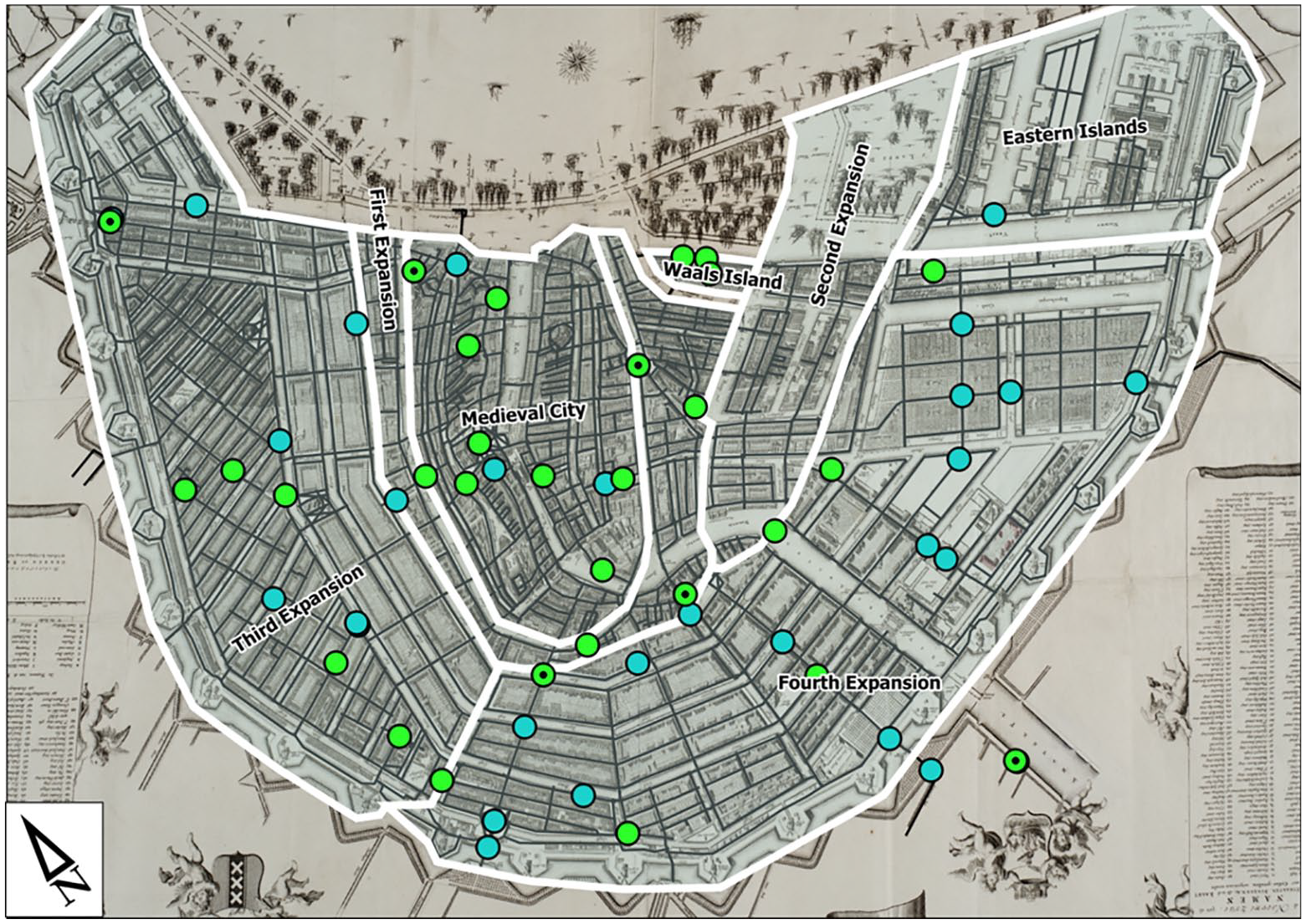
Vehicles from eighteenth-century notarial depositions. Sleighs in green, coaches, and chaises in blue. Closed sleighs and coach sleighs are marked with a black dot.
To add to these findings, I looked for all references to the use of wheeled vehicles and horse driving in the chronicle kept by Jacob Bicker Raije between 1731 and 1772. Of the twenty-six incidents reported by Bicker Raije involving wheeled vehicles or riding horses, only three took place within the old city center, and all occurred on or near Dam Square. Three were in areas created during the first early modern expansion: two on the Singel (the city boundary until the first expansion) and one on the Boomsloot. In both cases on the Singel, coaches fatally ran over women who were walking there, in one case a sixteen-year-old girl and in the other a mother with her two young children. 82 In the case on the Boomsloot, two horses that were pulling a “Phaeton wagon” (a type of open carriage) fell into the canal and drowned. 83 All other twenty incidents taking place within the city walls transpired in one of the newer expansions; ten cases were outside the city. 84
While wheeled vehicles frequented the newest city expansions to a far greater extent than the medieval city center, the latter area was not entirely unvisited by coaches and chaises. Perhaps Dam Square was the most notable exception where wheeled vehicles could still be found in the city center, with the Nieuwendijk and Kalverstraat forming important access streets. Originally dikes, these streets were thus among the sparse number of broader and relatively straight streets in the old city center where there was some space for vehicles, but they provided only north-south access. 85 East–west access was much more problematic and required a considerable detour. A funeral procession in 1781 that went from the Oudezijds Voorburgwal to the Nieuwe Kerk first had to go to the Kloveniersburgwal, then proceed to the Munt Tower and enter the Kalverstraat to get to Dam Square. 86
The Singel and the Kloveniersburgwal were broader streets where wheeled vehicles could drive around the city center in the first expansions. These observations are also confirmed by the many illustrations made of the eighteenth-century streetscape; when a coach or a chaise was depicted in the city center, it was almost always on or around Dam Square, sometimes in the Kalverstraat and the Rokin, and a single instance on the Grimburgwal. Sleighs, in contrast, were to be found everywhere, especially in narrow streets and around ferries. 87 Most other accessways were narrow, as shown by regulations on one-way traffic for sleighs and proposals for the broadening of certain alleys. Deviating from the main roads with a coach was very problematic. In 1771, Bicker Raije wrote that a heavy fog had hit the city and that “several coaches that wanted to drive from the city hall into the Kalverstraat ended up in the Kromelleboogsteeg.” 88 The Kromelleboogsteeg was a narrow and curved alley that would have been very difficult if not impossible to drive through. As the site of the city hall, Dam Square was a location where officials had themselves brought in coaches. In one of the accidents described by Bicker Raije, the panicked horses of the coach of schepen Willem Bakker bolted and went crashing through the fish market. A woman with a wheelbarrow selling ribbons was badly hurt, but “there was no other accident than that the fishwives were startled and had to drink and piss.” 89 Dam Square being one of the city’s busiest places, it was dangerous to have wheeled vehicles frequenting this locale: In another case, a clerk of the Haarlemmerboom (an entry point in the IJ bay for ships) was run over and killed by a coach with four horses. 90 Finally, it was also along the route of the post wagon, as we know from Bicker Raije that a seven- or eight-year-old boy was killed there by a post wagon in 1733. 91
Joseph Amato, working with Mumford’s idea of an archetypical “baroque city,” writes, “At the meeting points of [the] old lanes and the era’s new avenues, medieval Europe, still on foot, gave way to mounted authorities and the riding, parading, and promenading upper classes of modern Europe.” 92 In Amsterdam, instead of one giving way to the other, these modes existed alongside each other. As separate spaces within the city possessing their own vehicular logics, they complicate the view that a straightforward modernization was undertaken in Amsterdam. While wheeled vehicles could not be banned, the infrastructure was designed with the idea that they were supposed only to be passing by while taking the route with the shortest distance to get beyond the city walls, and they were to proceed at a walking pace. Another development that supports this idea is the construction of a driving lane outside the city walls, so that wheeled vehicles could leave the city and re-enter it elsewhere. 93 This followed the same logic of pushing undesirable activities out of the city walls that also saw a sawmill park, the pest house and the black powder mills located outside of the city. 94 Coaches and especially chaises were meant to be driven outside the city walls. Using only a single horse, chaises were also cheaper and more accessible to a broader group of people, and they made the hinterlands of the city more accessible. In a typical scene of chaise use coming down to us from a 1713 notarial deposition, four men reported that they had rented chaises at 5:00 a.m. at the Reguliersdwarsstraat at the Botermarkt. They went out riding outside of city and were back by noon. 95 Such was the purpose of chaises: for leisurely driving outside the city or to other cities. From the Botermarkt, one could drive in a straight line to a city gate and leave the vehicle-unfriendly city behind.
The Botermarkt (current-day Rembrandtplein) deserves further attention, as it was a space to be found at the edge of the city when the first expansion was finished but later became a central location between the old city and the newest (fourth) expansion. The streets and alleys around it were important locations for stables and (rental) vehicles. For some parts of the city, militia maps show the number of stables. Figure 6 shows the results from all such maps available through the Amsterdam City Archive. 96 High concentrations of stables are visible around the Botermarkt and near city gates, compared to a low number of stables in the city center. The comparison between the old city center and the newer expansions is very telling, as it shows how a vehicular city outside the old city center was taking shape, with the Botermarkt serving as a central zone of transition between the two areas.
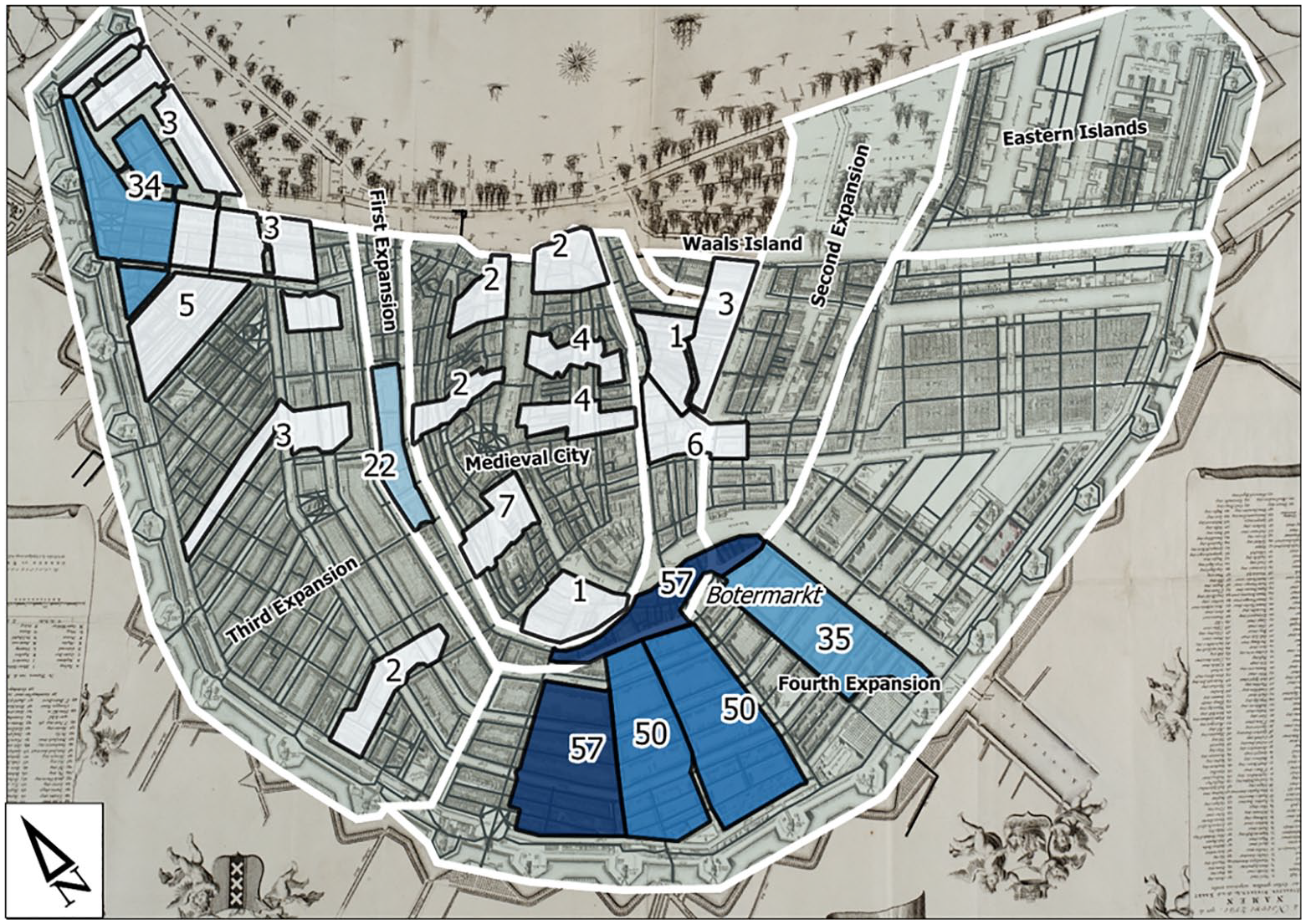
Number of stables as reported on available militia maps.
Interestingly, the Botermarkt itself was designed as a vehicular space graced with a non-vehicular center. Figures 7 and 8 show how a palisade (called staketsel in one of the depositions) separated the market area from the area where people were able to drive. Yet the separation of static activity and transitory activity did not always run smoothly. In 1742, a crowd of people was “watching the quacksalver between the houses and the palisade” when an open wagon with one horse and four or five men on it was driving at a trot (faster than walking speed, that is, but the horses were not at full gallop) and almost plunged into the crowd. 97 We can infer that the crowd was probably too large to be contained within the designated area and was standing in the driving lane. Someone who almost got the wheel of the wagon on his foot had grabbed onto the horse to stop the wagon. The wagon then drove around the Botermarkt and, when it again came again upon the spot where the crowd was gathered, drove into it at a higher speed. 98 A fight among the driver, his passengers and the crowd ensued. The driver and passengers had to flee the scene on foot, and the wagon was confiscated in the name of the chief officer. Although people were standing on the driving lane, it was clearly forbidden to claim the right of way if that would endanger them. 99
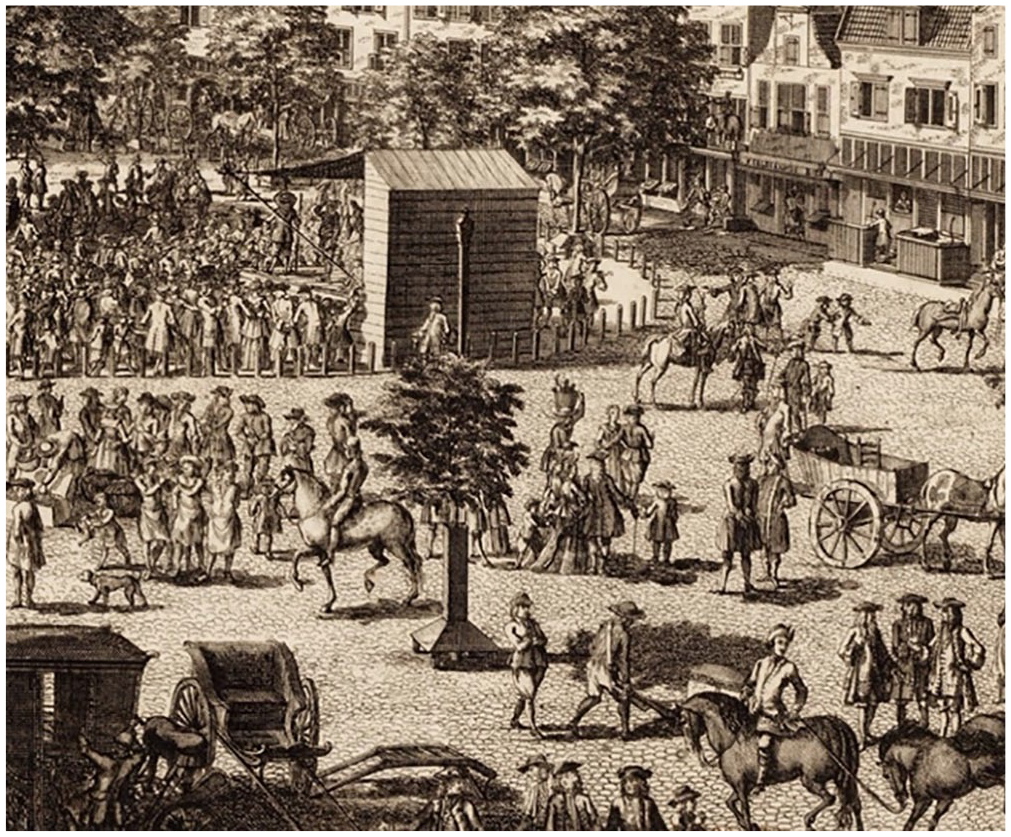
A cutout of a drawing of the Botermarkt where the palisade is visible. Petrus Schenk, circa 1740. NL-AsdSAA, Collectie Stadsarchief Amsterdam: tekeningen en prenten (10097).
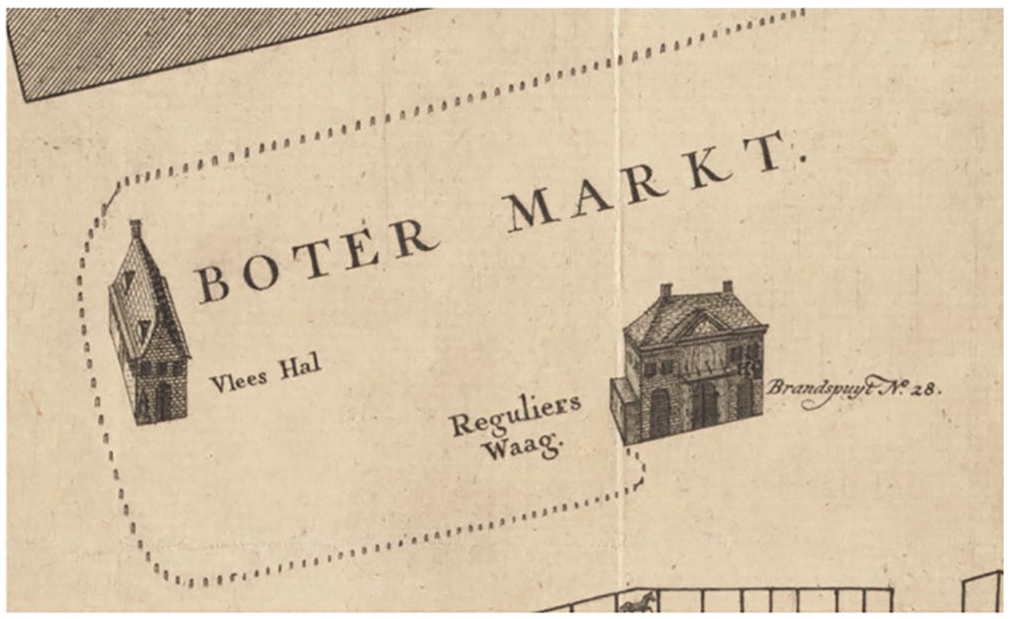
The Botermarkt with the palisade as depicted on the militia map Burgerwijk 28. Anonymous, 1737. NL-AsdSAA, Kok (10095), inv. nr. 544.
The principle that the street should be partitioned to protect pedestrians from vehicles was applied elsewhere as well. On the Hogesluis, the large bridge over the Amstel River, a row of bollards separated the driving lane from the walking lane (Figure 9). As on the Botermarkt, this measure mostly kept vehicles out of a pedestrian lane, but not the other way around. Throughout the city, driving lanes in the middle of the streets were paved differently—using larger stones—than the lanes next to the houses, which were paved with small stones (kleine stenen), which can be seen in Figure 10. This practice was originally probably a matter of cost, as pavement was very expensive and the city sought to save on paving costs. 100 Yet the concept of small and large stones was not just an economical and practical concern but also shows up in notarial depositions. Stone size became a way of designating the proper place for different types of transportation. Similarly, in post-Great Fire London, pavements and traffic posts separated vehicles from pedestrians. 101 In contrast, streets in Paris were notoriously muddy and sidewalks came only into use in the late eighteenth century as a measure imported from England. 102
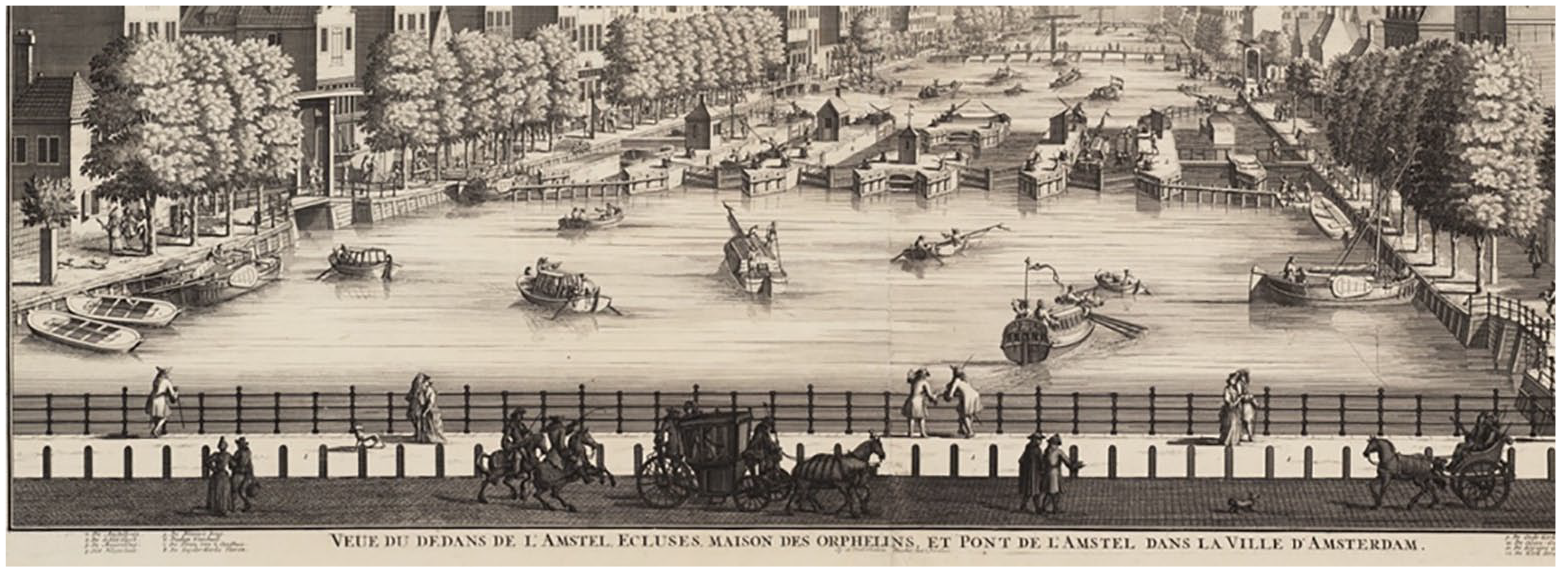
The view of the Hogesluis, cutout from the view onto the Binnen Amstel. A coach can be seen in the middle, a chaise to the right. Daniël Stoopendaal 1702-1713. NL-AsdSAA, Splitgerber (10001).
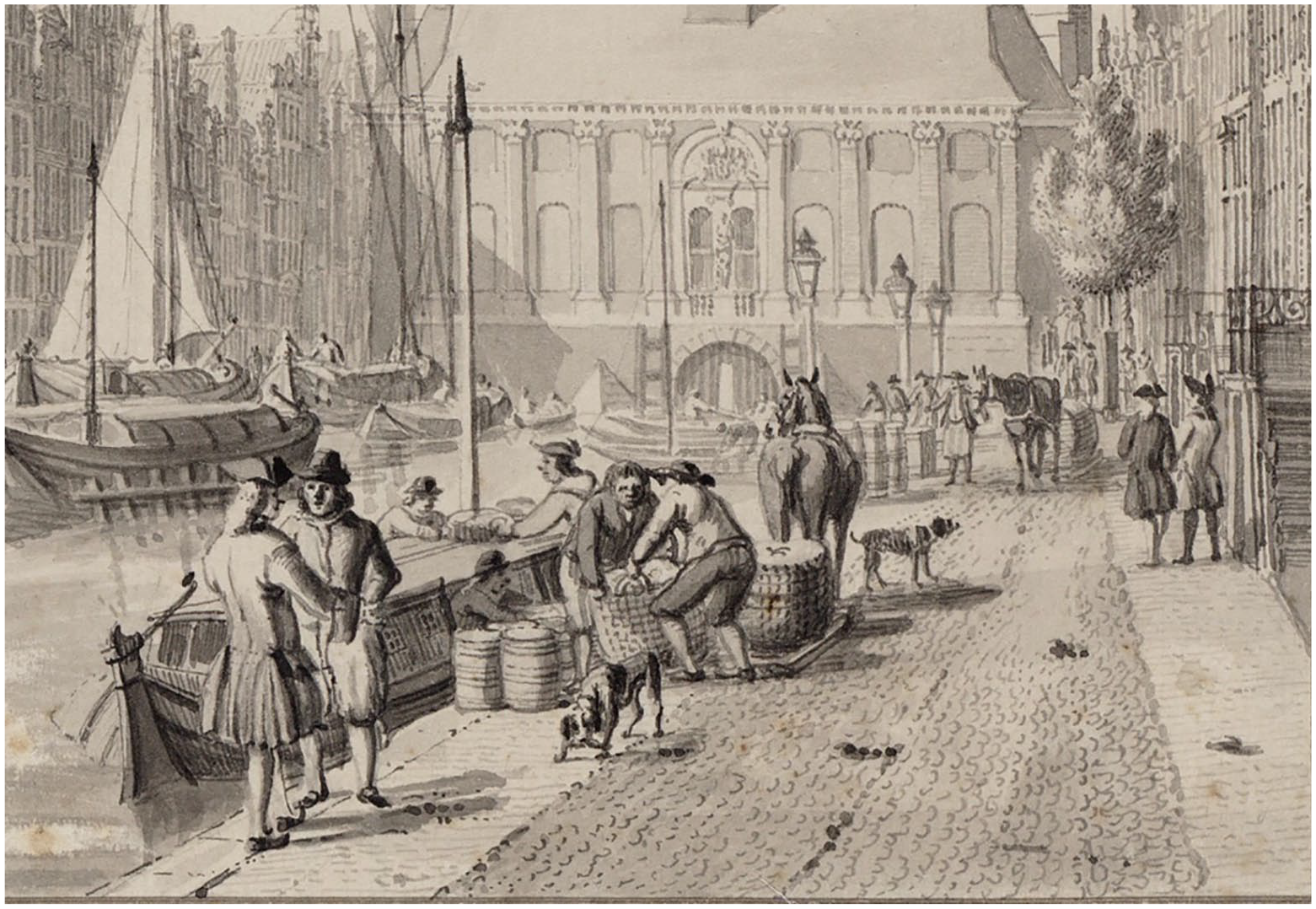
Sleighs at the Utrecht ferry at the Rokin behind the Exchange. The difference between the small stones and large stones can be seen very well. Jan de Beijer, ca 1764. NL-AsdSAA, Splitgerber (10001).
In Amsterdam, people on foot easily crossed between the types of pavement, but it was problematic when vehicles did so. When a deposition recorded an accident that had happened on the street, it was often noted whether the accident had occurred on the larger stones or the small stones. When a sleigh driver who transported cargo in 1791 led his horse onto a small-stone area, he almost drove into a magistrate. The magistrate and two other witnesses reported that the driver, angered that the magistrate had not stepped out of the way, proceeded to punch the magistrate in the chest, which they regarded as an “improper treatment.” 103 A deposition from the same year shows the reverse situation: An angry innkeeper struck a sleigh-man’s servant whose sleigh was blocking the street by the dock for the ferry to Gouda. The servant’s boss and two other witnesses reported “that it had been busy, but that the small stones at the side of the houses were free to pass.” 104 Apparently, not everyone making their way on foot accepted the rule that they were to yield the middle of the street to vehicles. Wheelbarrows were also supposed to stay on the larger stones. In a 1742 deposition, a printer’s laborer tried to pass a stable in the Elandstraat but found two closed sleds on the street blocking his passage “so that he had no occasion to pass the street without leaving the large stones.” When the laborer attempted to pass the sleds anyway, the sleigh-man who owned them angrily ran out, afraid that the wheelbarrow might break them. 105 Such cases show how conduct in the street was not just a matter of regulations or the street’s design and materiality but also a result of everyday negotiations over space. This case shows how, in practice, sleigh-men could claim parts of the street. Material entities such as the “small stones” or the “large stones” were conceptualized in practice as the proper place for different street users.
Access to Vehicles, Status, and Gender
As parts of urban space came to be reconceptualized as vehicular space from the seventeenth century onward, and definitely in the eighteenth century, there were different outcomes for people of differing social status, gender and age. Not just for those who would now raise themselves above the street’s crowds to drive, but also for those who stayed below them making their way on foot, changes were brought to the experience of urban life. Furthermore, the introduction of both coaches and coach sleighs meant that a new urban experience of being closed-off while still in the street became accessible for a select group of people. Previously, to proceed on foot was the implicit status quo so that now while the “pedestrian” still remained the presumed standard, it had become a distinct category of street user, possessing certain responsibilities in traffic. In the politics of who got to drive or who got to be driven, to be wealthy, male and adult were the triumphal categories standing in opposition to the rubrics of the more numerous female, young and poor urban inhabitants. Yet, as we will see, women, and especially those of higher social standing, were not entirely excluded from vehicle culture. In this section, I will explore the politics of access to vehicles in further detail.
In the century after the vehicle ban of 1634, something had definitely changed. In the depositions where coaches and chaises are mentioned, their presence in the street itself was not problematized. What witnesses exposed at the notary of the chief officer was the negligence of traffic rules when the drivers of these vehicles speeded or entered the pedestrian area of the smaller stones close to houses. Sometime between second half of the seventeenth century and the first half of the eighteenth century, wheeled vehicles had appropriated their place in the street and began taking up larger parts of scarce street space. Pedestrians now shared space with vehicles and had a new responsibility to protect themselves against these dangerous fellow users of the street. To demonstrate what was going on, the language used in Bicker’s chronicle is very telling: In 1734, exactly a century after the vehicle ban, he wrote of a coachman who “had the misfortune of driving over a poor woman who died shortly thereafter.” 106 Here, rather than the “women and children first” rhetoric that we have seen in the sixteenth-century regulations on the sleigh-men in the previous section, the coachman was also presented as a victim, and the right of the coach’s presence on the streets remained undisputed. Similarly, in 1746, Bicker Raije wrote of a nine- or ten-year-old boy who was “negligently watching around him” moments before he was killed by a sleigh horse. 107
Being able to drive and being a proper driver had also become a matter of respectability and, to a certain extent, adulthood and masculinity.
108
When commercialized, this development could put pressure on social hierarchies. In the spectatorial publication De Vaderlander in 1776, the contribution “The Disadvantages of Horses” complained of the lack of humbleness of the owners of horses and carriages, and also that “No carriage man, no stable servant, is ashamed to let himself be called ‘Sir’ (Mijn Heer),” and this “pride infected the common people.”
109
Phelps and Jenner discuss the tensions in London where hackney coachmen were seen as servants by their customers, even as they fancied themselves to be proud self-employed entrepreneurs.
110
Maintaining a vehicle, on one hand, brought a position of responsibility and power toward others and the animals one controlled while simultaneously it made drivers dependent on their customers. Driving a vehicle offered a type of power and control, which was often seen as requiring responsibility and modesty. A vehicle rental business on the Botermarkt advertised itself via this ideal of the capable, respectable driver: Hier verhuurt men Karossen, Chiézen, Paar- Here coaches, chaises, horses den en Karren, and wagons are for rent, Voor fatsoenlijke luiden, to decent people, maar niet voor gui- but not to rogues, ten, zotten en narren. Fools and clowns.
111
Furthermore, piloting a horse-drawn vehicle represented a type of bodily movement structurally denied to women. Although I have found no evidence of formal exclusion in the form of laws forbidding women to drive carts or coaches, the norm was rooted firmly in practice. City and guild regulations do not explicitly exclude women, but rather they portray men as the appropriate drivers. A 1762 addition to the sleigh-men’s, millers,’ butchers’, and beer-sellers’ 1602 guild regulations, for example, explicitly named manspersonen (male persons) of at least twenty-one years of age to be the only individuals permitted to drive a sleigh or a cart with goods.
112
The regulation’s aim of course was to add a minimum age, but it reveals that it was taken for granted that the appropriate drivers were male. The specification of an age minimum also shows that access to vehicles in the city’s streets was not undisputed for men. Because “many boys below the required age, incompetent of controlling horses, drive with sleighs [. . .] had caused many accidents,” the rules became more strict. In the original Dutch text “controlling horses” was Paarden te regeeren, where regeeren can also be translated as “governing,” which resonates with the patriarchal logic casting adult men as the authorities who controlled those underneath them in the hierarchy, as well as enforcing differences among men, anointing some more capable than others. Masculinity, rather than a static entity that we can securely assign to all men, was instead a more volatile entity, something that men were anxious to continually prove, dispute and (re)assess.
113
Differences between capable and incapable men were deemed important for the social order to function. It is no accident that controlling a horse was also a familiar metaphor for sexual domination (over women).
114
This strong connection between masculinity and control over horses is further demonstrated by the death of a stable hand which had caught Bicker Raije’s attention in 1743 because at the undressing, it was found that the stable hand was a woman. Nobody had ever noticed this and to the great surprise of everyone she had known how to deal with every horse. Those horses that others could not control (regeeren), she knew how to coerce and tame in the stables and elsewhere. She knew no equal, even under men.
115
Bicker Raije’s surprise of course reveals how much it was taken for granted that controlling horses was deemed the domain of capable men.
The differentiation between capable and incapable men is further highlighted by discourses on early modern disability. In a late eighteenth-century print showing street figures (Figure 11), a man in a wheelchair is depicted with the accompanying text “many people drive for their leisure; but I am being pulled forwards, fraught with pain, for a reason that nobody has to guess.” The analogy between the leisurely driving of the rich and the necessary driving of the poor highlighted the inequality of the culture of wheels. In another instance, the spectatorial publication De Overweeger from 1771 features a story about a person with dwarfism who went driving upon a chaise. 116 The particular chaise was an older model with a high backside, and thus, pedestrians could only see his hat and not the entirety of his person sitting on the chaise. Some boys on the street would then pull the prank of yelling “there is a chaise running wild with a hat on it,” as if there were no driver. 117 Of course, the joke capitalized on pedestrian’s weariness toward horses running wild and, more generally, toward incapable and dangerous driving. In this way, the person with dwarfism was deprived of his role as capable conductor of the chaise, and the challenging of this capability stood at an intersection of status and masculinity. The story continues with a scene where the masculinity of the person with dwarfism was further challenged when he was humiliated in a brothel.
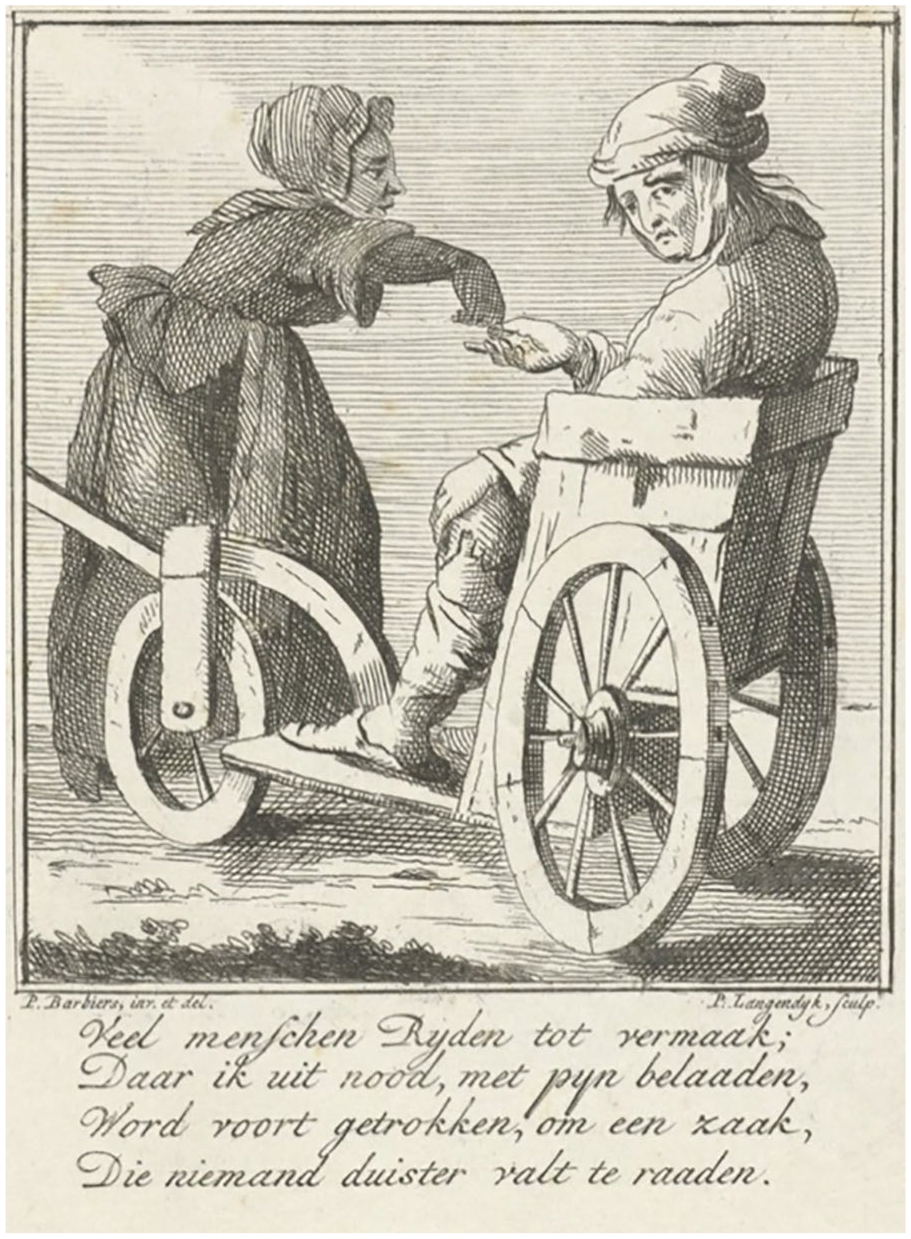
A man in a wheelchair from a series of street figures in Amsterdam. By Pieter Langendijk (after Pieter Barbiers), around 1770. Rijksmuseum, RP-P-OB-46.569.
As research on gender and work has shown, the formal transport sector was clearly male-dominated. 118 While commercial and economic activity also took women and children into the streets with hand-carts and wheelbarrows, control over larger vehicles, such as sleighs and coaches was kept firmly in male hands. Horse-drawn vehicles were exclusively piloted by men. In a database of work activities that I made for another investigation into work on the streets, as well as in all the supplemental depositions used for this article, no women were found piloting a horse-drawn vehicle. 119 The formal transport guilds were exclusively male, albeit with the usual exception of widows. In the case of the sleigh-men, the guild membership that was required to keep a horse and a sleigh locked the reins tightly in male hands. 120 The guilds of sleigh-men and porters were, in that sense, one of the most evident organizations showing men uniting as a regulated occupation group claiming space in the streets. All the 130 weighing-house porters recorded in the Personele Quotisatie of 1742 were men, although three of the seventeen people listed as sleigh-man or sleigh-boss were widowed women. Their presence follows the usual exception of widowhood, through which women could access guild-protected jobs usually inaccessible to them. While the weighing-house porters had salaried jobs that were not taken over by their widows, the sleigh-men operated as small businesses which the widow could take over; most likely, these women had played an active role in these enterprises before their husband’s death. Oldewelt suggests, comparing the numbers with those of an earlier guild membership list from 1688, that there would have been around 285 more sleigh-men in 1742. 121 Many of those probably relied on women’s labor to keep their business running. 122 Yet, to be considered the sleigh-boss in charge, a woman would have needed to have inherited her dead husband’s authority.
Although they were not found driving vehicles, women were not excluded from the ownership, management and use of them. If their economic status would permit it, they had access to vehicles for social visits, pleasure rides, and travels to country houses.
123
Women owned sleighs, coaches, and horses, and they were being driven around in them. Coach drives outside the city or in the Plantage were a popular recreative pastime for men and women alike. On July 20, 1751, Jacob Bicker Raije wrote in his chronicle: The eldest Miss van Tijjen has passed away, even though in the afternoon she had first eaten healthily and vividly; and then after eating had been out riding with her coach until seven o’ clock [. . .] This Miss was a very good friend of my mother, who often went out riding with her.
124
In such cases, however, we can presume that both the men and women had themselves driven in their coaches. With chaises, the person going on the ride would also be the driver, but then we do not see women taking those excursions by themselves or conducting the vehicle. In one case, however, we do find a woman going out horse riding: Bicker Raije also mentions the death of the housewife of a magistrate in 1750. She died after an accident during horse-riding, which, he reported, was her beloved hobby. 125
We can also see in the account of horse ownership and of vehicle ownership reported in the Personele Quotisatie of 1742 that elite women had access to vehicles and horses (see Table 1). The women who reported owning sleighs, coaches, wagons, and even chaises probably represent the tip of the iceberg regarding access to vehicles. They were mostly widows because of the logic of tax collection per head of household. Accordingly, I want to stress that the Personele Quotisatie data show formal ownership of vehicles and horses rather than actual access to vehicles. Through many of the male owners of vehicles, access to vehicles was available to wives, daughters and other women. So while these data fail in indicating a clear-cut male/female division of access to vehicles, there is still an useful trend visible where women mostly had coaches (in absolute numbers) and sleighs (in relative numbers) rather than the faster, often more open chaises. The sleighs reported here were probably the closed sleighs or coach sleighs used for the transport of persons rather than the sleighs employed for the transport of goods. In a 1749 notice regulating the tax rate of horses and vehicles in Holland, an explicit exemption was made for those who for who it was “inescapably necessary to use horses to conduct one’s trade or occupation,” strictly distinguishing work and leisure vehicles. 126
Chaise, Sley, and Coach Ownership from the Personele Quotisatie in 1742 by Gender.
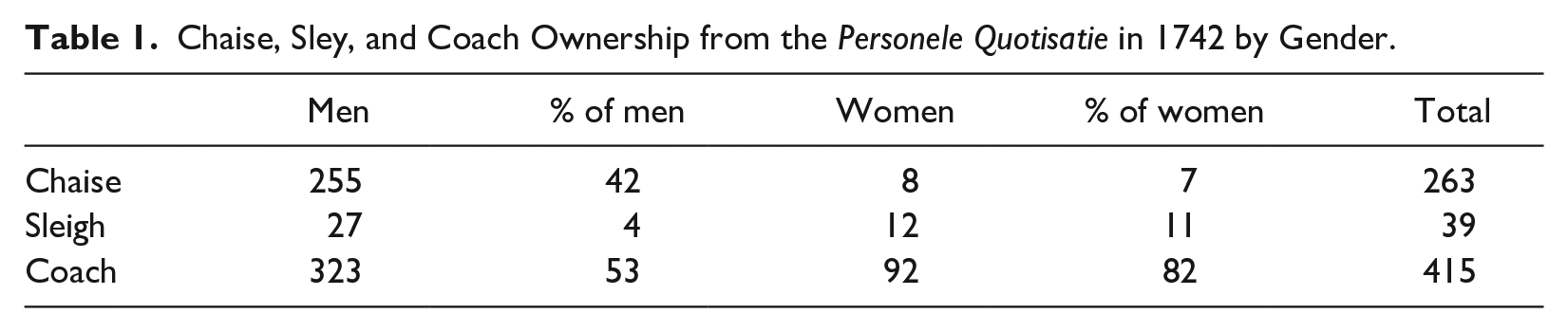
The data on the ownership of vehicles are interesting in light of the earlier observations on sleighs in this article. In the Personele Quotisatie, the sleigh seems to take up only a fraction of the street compared to chaises and coaches. Yet we have to bear in mind that many coach sleighs were probably also not subject to taxation, since they were rental sleighs that one could haul for a ride in the city as a cab, and were thus used for the occupation of a sleigh-boss. And as such, they would not be included in the Personele Quotisatie. Furthermore, it was probably the case that one sleigh-boss with a stable had several sleighs. This conclusion is suggested by the case in the Elandstraat mentioned above on in the previous section, in which one sleigh-man owned two closed sleighs parked in the street. The sleigh-men who transported goods would probably also be hired to transport people in coach sleighs. Such usage is further suggested by the guild regulations: regulations for the transport of people and goods were mixed. 127 So, there were probably a multitude of sleighs owned and used by the 285 sleigh-men surmised by Oldewelt. Thus, for men and women alike of a certain social and economic standing, either owning a coach sleigh or hauling them as a cab service for trips throughout the city were options available to them. While the conducting of coach sleighs was restricted to men, the use of coach sleighs was not limited by gender but was more a matter of economic and social status. Hauling a coach sleigh for a trip was much more affordable than the maintenance of a coach. The coach sleigh’s fare of eight stuivers (from the quote by Samuel Ireland at the beginning of this article) would be almost half a day’s wage for an unskilled laborer, a fare most likely not casually spent but certainly accessible to members of the middle and upper middle classes. 128
There were even more uses for sleighs, many of which were broadly accessible. Some uses were explicitly ceremonial and processional, such as the coach sleighs that could be rented for wedding processions or funeral sleighs used especially for the funeral processions of deceased children in Amsterdam (and sometimes Haarlem), as seen in Figure 12. 129 In other cases, the use of a coach sleigh was not meant to generate attention or instigate a ceremony in the streets but to avoid the further attention of bystanders. A part of this trend may simply have been convenience, but there may also have been concerns about shielding the transported persons from disrepute. One of Bicker’s observations confirms an instance when sleigh transport spared its passenger the scrutiny of the crowd’s gazes and sidestepped potential commotion, as he writes that a stealing maidservant “was brought to jail with sleigh, silently without any turmoil.” 130 Bicker also writes of a case where a maidservant who denied being pregnant and who was suspected of infanticide was brought on a sleigh to the Spinhuis (a disciplinary institution for women). 131 In this way, closed sleighs provided an accessible new form of public secrecy; publicity could be avoided while people were nonetheless being transported through the streets.
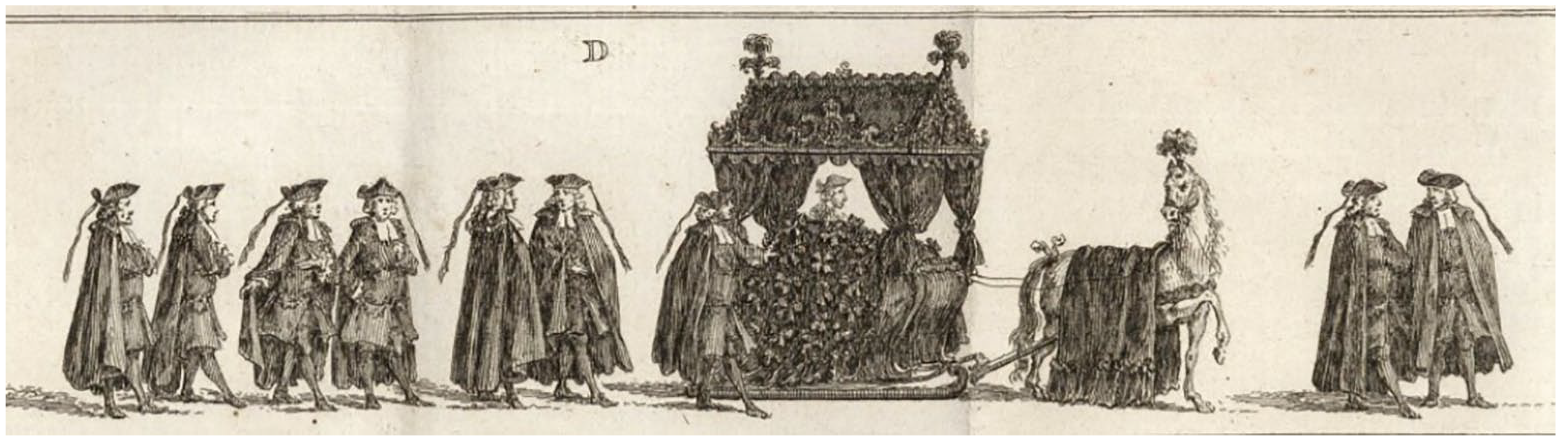
Children’s funeral in Amsterdam. J J. le Francq van Berkhey. Natuurlijke Historie van Holland. Deel 3. Vol. 3. Amsterdam: Yntema en Tieboel, 1772, 1958. Vol. 3. Amsterdam: Yntema en Tieboel, 1772, 1958.
With the use of both coaches and coach sleighs in the city, a mobile interior space was introduced and integrated into the streetscape (Figure 13). In being a closed-off but movable space, the coach and the coach sleigh were similar to each other and differed from both the ordinary sleigh for goods and the chaise. Both coach and coach sleigh allowed the transported person to be shielded from being viewed the street. This new way of experiencing urban space, where some people could close themselves off from the street, spawned a new politics of gatekeeping in which gender and status played an important role. The combination of mobility and privacy provoked sexual suspicion. Cohen writes that Roman courtesans were forbidden to ride in closed carriages, “perhaps also intended to preclude courtesans being mistaken for ladies.”
132
Bobker writes, Erotic associations targeted the public privacy of the coach that was novel for non-elite men as well. [Poet John] Taylor [in his 1623 The World Runnes on Wheeles] worries about what people hiding inside a coach might do, stressing the difference between the coach and its less secretive, lowbrow cousin, [the cart].
133
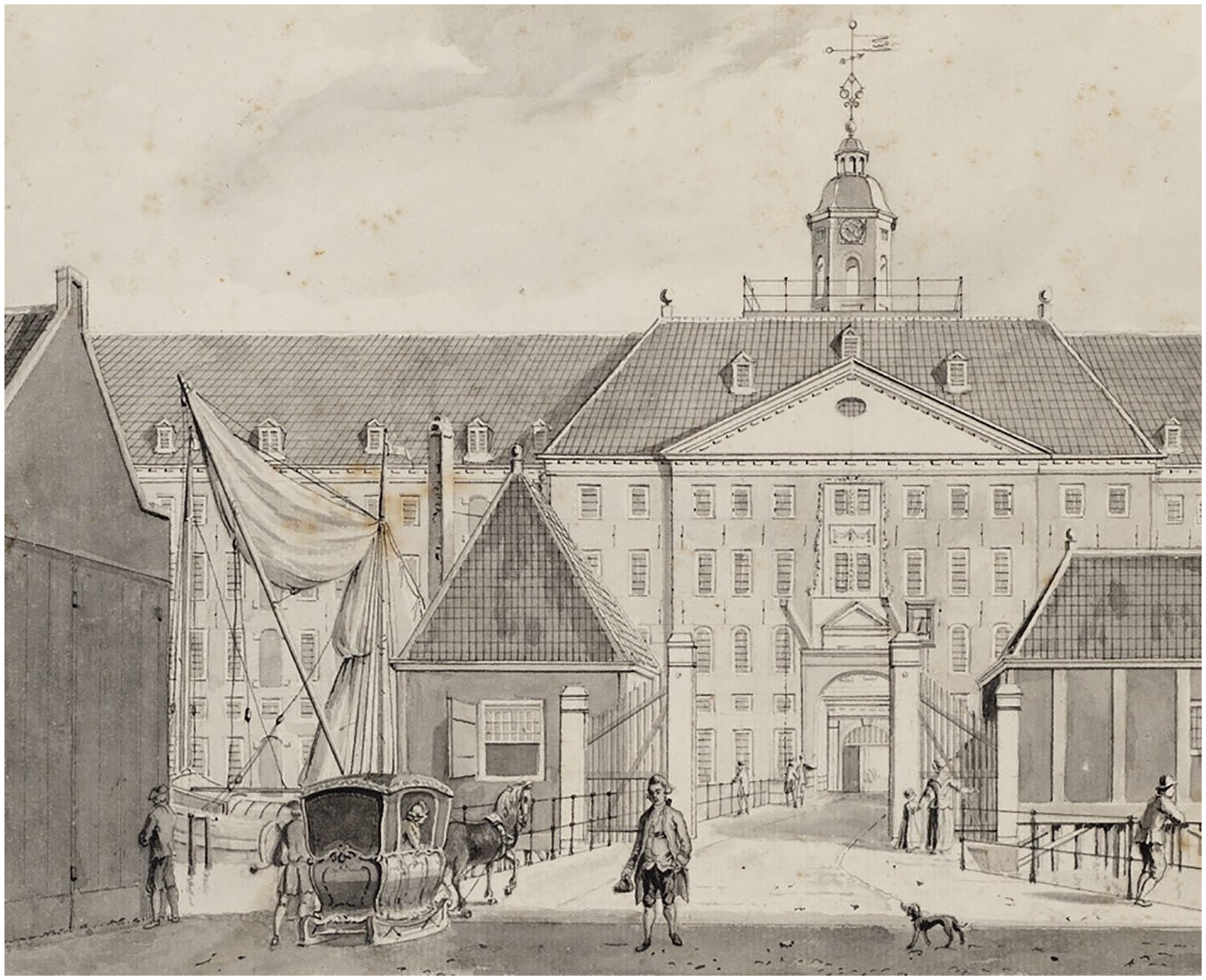
A United East India Company governor has himself transported in a coach sleigh to the Sea Warehouse. Cutout by H. P. Schouten, ca. 1770. NL-AsdSAA, Splitgerber (10001).
Elite men and women had control over access to the vehicles they owned, but coaches for hire were more often shared spaces. In England, [s]ingle and non-elite women who relied on hired coaches for travel, including girls going into service or for some other reason divorced from their families, were especially targeted, tapping into an ongoing connection between women’s mobility and their sexual availability.
134
The hired and thus shared coach was not a place in which women had a strong power of gatekeeping, which led to depictions of it being a “risky social space [where] men and women stay together in an enclosed place for a long time, creating the likelihood of breaches of public decorum.” 135 Of course, in the English context, more people used hired coaches for travel between cities, while in the Dutch Republic, people more often relied on barges for such journeys. 136 Yet, there was the similar situation where women traveling alone had no control over who their travel companions would be.
One case from the notarial depositions shows that the coach sleighs that transported people within the city were ambiguous spaces as well. On one hand, they were not for long-distance travel and were not normally shared with strangers. But apparently, the same mechanism we have seen at play in the English hired coaches applied here as well; single and non-elite women who used coach sleighs were considered sexually available, at least by some men. This perception is clearly visible in the one case where in the closed-off space of a sleigh cab, a man found the opportunity to harass two women: In 1763, Catharina Daams and Jannetje van Link returned to the city from the country estate of their employer a little after 18.00 and asked around on the Haarlemmerdijk for a coach sleigh to be driven home in, because they had some goods with them. A man “dressed like a gentleman” (Heer) offered to get them a sleigh, then insisted on paying for the journey and joining them. After a little while, the man had the sleigh stopped and told the sleigh-man to get a bottle of wine from a tavern. When the women refused to drink, the man threw wine on them and assaulted them by groping their skirts. They managed to escape into a nearby cellar but had taken a heavy beating. 137 The case also shows the intersections of social status, gender and vehicle culture, as the man had used a pretext of respectability to put the women in a vulnerable position.
Finally, it was not just the secrecy of coaches and coach sleighs that carried sexual connotations. A second dimension was mobility itself. As I have argued elsewhere, mobility could free someone from the prying eyes of family, friends, and acquaintances. 138 Wheeled vehicles made it possible for people to leave the city altogether to engage in sexual escapades. In the interrogations of arrested people (Confessieboeken), Maria van der Val, a woman suspected of prostitution, was asked about suspicious chaise trips. She was asked if she “denied having sexual intercourse with Jan Frederik Hermans” and, having been driven to Sloten via a chaise, it was demanded that she reveal where the pair had allegedly slept together in a bed in an inn. 139 The moralistic warnings against spending too much money on vehicles were easily combined with warnings against prostitution, and Lotte van de Pol has shown that East India sailors were depicted as prostitution-seeking squanderers, who went “with a whore on a wagon” or would have “wasted their inheritance with driving with chaise, horses, wagons and coaches, drinking [. . .] whoring night and day.” 140 In such depictions, masculinity, conspicuous consumption, and the protection of the boundaries of social class came together in vehicle culture.
Vehicle culture was—like early modern society as a whole—inherently unequal. Vehicles were not accessible to everyone, and as they became more widely accessible, the possibilities they possessed for the transgression of social status placed them under suspicion. The English situation, where “social mobility became interconnected with a new form of geographic mobility”, 141 certainly applied to Amsterdam as well. Freedom through mobility for some came at the cost of heavy suspicion toward others, especially for women. The connotation of mobility as related to sexual availability that came with the rise of vehicle culture fueled the distrust of non-elite and single women’s movements.
Conclusion
The vehicle culture of early modern Amsterdam furthers our understanding of a wider European vehicularization. While Amsterdam was unique in having integrated the logic of walking-speed sleighs with coaches in the form of the coach sleigh, the basic principle of walking speed in city streets being preferable over fast driving applies all over Europe. The coach sleigh reminds us that the choice of integrating fast-moving vehicles into urban space was not an inevitable one, and that alternative pathways of modernization have existed.
The vehicularization of Amsterdam was not a process of homogenization but was rather something that created very distinct types of spaces for different types of vehicles, and resulted in a high diversity of different zones. For quite some time, wheeled vehicles were strangers in the city; they were admitted but were surveilled closely. Instead, non-wheeled vehicles, such as the sleigh and coach sleigh were the important factors in the urban landscape that provided a safer and better-fitting alternative. The influence of wheeled vehicles on the city itself was largely resisted in the oldest parts, but in newer parts, urban space was designed to facilitate them. Even after the ban on wheeled vehicles was lifted, this spatial difference distinguishing vehicle types remained in practice, and wheeled vehicles were primarily employed for extra-urban movement. In that sense, wheeled vehicles exerted an influence on bridging the gap between urban space and space outside of the city for those who could afford it. In the area around the city center, a liminal zone between the city where wheeled vehicles were out of place and the area outside of the city where wheeled vehicles were well-accepted was created, effectively a compromise between different urban spatial logics. The elite canal belt was situated at the heart of this compromise, providing elites with both proximity to the center of the city and accessibility to the urban peripheries and hinterlands.
The two main arguments advanced in this article apply all over urban Europe and beyond. First, vehicle culture was never unproblematically integrated into urban life; second, access to vehicles was determined by social status and gender, and social mobility and physical mobility intersected with each other. As we have seen explicitly and implicitly, these two main arguments overlap, interact and intersect. An integration of these two arguments comes in the form of access to vehicles being an important factor in access to the city at large. Some people had access to this distinct urban experience of vehicular mobility while simultaneously their presence in vehicles changed others’ experience of the street. Usually, they were men who had access to horses, coaches, chaises, and sleighs. Yet, gender was not the only factor, but intersected with social class, as the women who did have access to the vehicle culture were mostly upper class wealthy women.
As we have seen in the first part of this article, it was understood that vehicles in the city impeded pedestrians’ access to the city street, which resulted in regulations and the surveillance of vehicles, determining where they would drive and at what speed. In Amsterdam, this framework resulted in a unique sleigh culture. It also placed wheeled vehicles in an ambiguous position: on one hand, they were built and maintained for rapid travel outside of the urban context, but, on the other hand, some part of urban space were amended to account for their presence. A larger city became a city with a greater partitioning of space, where people were both physically and socially differentiated through their access to vehicles.
Admittance of vehicles was a matter of access to the city and competition over urban space marked by scarcity. Disproportionally, women and children’s access to the street was directly impeded by a stronger degree of vehicularization of the city street. The physician Johannes le Francq van Berkhey directly made this link when describing the poor health of children in Amsterdam at the end of the eighteenth century: A large part of the reason is the narrow inhabitance of the ordinary people [in Amsterdam]. [. . .] They have only little space, a room, or a cellar, and have little opportunity to let their children walk, other than on the street, where is not rarely dangerous, because of the bustle of people, horses and sleighs.
142
The history of urban vehicles then, is a history of access to the city, mediated through materialities of street and vehicles, but also norms of gender and social class. This access through vehicles had a distribution that was deeply rooted in early modern hierarchies, as vehicles were mostly for men and mostly for people of a certain social standing.
Footnotes
Acknowledgements
This publication has benefited greatly from being presented at the research seminar of the Amsterdam Center for Urban History and at the PhD Conference of the Huizinga Institute (The Netherlands Research School for Cultural History). At the latter conference, Jaap Evert Abrahamse was so kind to act as referent and provide him with very useful comments, for which he would like to express his thanks. He further wants to thank Antonia Weiss, Bram Mellink, Danielle van den Heuvel, Geert Janssen, Geertje Mak, Marie Yasunaga, Nathanje Dijkstra, and Örjan Kardell for their keen reading and helpful suggestions.
Declaration of Conflicting Interests
The author(s) declared no potential conflicts of interest with respect to the research, authorship, and/or publication of this article.
Funding
The author(s) disclosed receipt of the following financial support for the research, authorship, and/or publication of this article: This publication is part of the project “The Freedom of the Streets. Gender and Urban Space in Europe and Asia (1600-1850)” with project number 276-69-007 of the research program Vidi that is financed by the Dutch Research Council (NWO).
