



Abstract
This text explores the photographic documentary work on the city of Glasgow by Thomas Annan in the mid- to late nineteenth century. I focus on Annan’s most well-known project—The Closes and Streets of Old Glasgow, 1868-1871, which remains the most significant urban focus in his work. I will begin by briefly outlining Annan’s position in the history of photography and the relation of his photographic work to the city of Glasgow. Subsequently, I will engage directly with the volume of interest and outline the character of the photographs. Finally, I will provide an analysis of Annan’s photographic work and the manner in which he contributed to a classed construction of the city of Glasgow through documentary photography. In particular, I will explore the images themselves through the lens of critical visual theory and relate them to the urban space of Glasgow itself.
Keywords
Thomas Annan, the Photographer
. . . and yet a paradise compared with the wynds of Glasgow, where there was little more than a chink of daylight to show the hatred in women’s faces.
1
Thomas Annan’s work has been belatedly acknowledged as significant in the history of photography due to its pioneering status in the domain of documentary photography, the history of the city of Glasgow, and the development of photographic practice in Scotland as a whole. 2 For the most part, his work has been largely neglected in scholarship on the origin of documentary photography or the city. Some historians, such as the influential Beaumont Newhall, 3 have not even mentioned him as a significant figure. 4 When cited, Annan is commonly referred to as a pioneer, but explorations of his work tend to limit him to a rather narrow context of national discourses of history and photography, whereas other photographers’ work tends to be extrapolated to international discourses, for example of surrealism or modernism, while still remaining tied to their national milieu (e.g., Eugène Atget, Jacob Riis, Charles Marville, and others). What Annan is mostly known for is that he was a state-commissioned photographer who documented poor working-class areas in the center of Glasgow. 5
Annan’s work brought into focus the living conditions of Glasgow’s poorest in the years 1860-1890 in the city’s old closes and lanes. At the time, these areas were notorious for their squalor and the Glasgow City Improvement Trust was interested in dislocating the inhabitants of the area in order to demolish and reconstruct the neighborhoods in a more acceptable form. The poor living conditions in Glasgow are a direct aftermath of the terrible effects of industrialization and large-scale urbanization. Glasgow, at the time, was commonly referred to as “the second city of empire.”
6
Boman points to the “metamorphosis in the structure and texture of middle-class life in Britain, [. . .] to an increasingly public lifestyle in the latter period.”
7
Osman and Englander further shed light on the “The Age of the Great Cities” and “the ubiquitous back-to-back, [. . .] the perilous backlands of urban Scotland”
8
that followed the exponential population growth of major industrial cities in Britain since the 1820s, which characterized the working-class experience of central Glasgow. However, Annan documented these areas of the city in a way that did not seemingly focus on the immigrant working-class inhabitants and cannot be said, according to Stevenson,
9
to be sympathetic. Unlike John Thomson’s photographs of London in the 1870s,
10
which feature portraits of London’s destitute and deprived, Annan’s oeuvre features portraits only of the local gentry and academics. Maddox and Stevenson point to the complexity of Annan’s work, and its openness to interpretation, as sentimental records of sites on the verge of disappearance, as social documents representing the plight of the working class, and as harbingers of progress achieved by the efforts of the Improvement Trust.
11
Gossman describes Annan as “quick to adopt the latest technical innovations in photography.” 12 Namely, Annan would take advantage of Scotland’s position as outside the boundaries of English patents and purchase rights for various methods, going so far as to arrange for his son to learn the photogravure 13 process in Austria in 1883 14 as well as purchasing Joseph Wilson Swann’s carbon printing process. 15 Annan practiced several kinds of photography—copies of paintings, portraiture both in carte-de-visite and cabinet format, landscapes, buildings and public works, as well as “the modern triumphs of industry and engineering.” 16 A key example of the latter is Annan’s commissioned documentation of the Loch Katrine Waterworks; notably, on the event of their opening in 1859 Annan photographed Queen Victoria herself. 17 Annan’s work as a professional photographer was rich and varied in its subject matter. However, Lionel Gossman, in the most extensive work on the photographer so far, notes that the “photographs of buildings and public works, usually commissioned by well-to-do property owners or local authorities [are] the field of activity for which Annan is best remembered.” 18
Glasgow and the City Improvement Trust
In 1866, Glasgow City Council passed an Act through Parliament “to purchase and clear slums at the heart of the old town.” 19 This led to the formation of the Glasgow City Improvement Trust. 20 Annan began work to document the slums of the old town before and during their demolition, about two years after the passing of the Act. It has been assumed that the Trust has commissioned Annan, 21 as well as argued that Annan was hired by the city architect directly, rather than the Trust itself. 22 However, Stevenson, 23 in a recent account on the issue, has rejected both on the basis of limited evidence. 24 The only evidence is the payment for printing of photographs, but not for the photographic work itself. 25 Regardless of the details of its origin, it is his work with the City Improvement Trust for which Annan is most known, 26 commonly known as the Old Closes and Streets in Glasgow, 1868-1871. As a document, in fact a folio volume of 32 photographs, it was presented to the Trust in 1871 without any text to accompany it. Annan is primarily known as the photographer of the City Improvement Trust, despite his long history of working as a professional photographer and as a pioneer of photographic processes in Scotland.
The City Improvement Trust’s urban restructuring process had to go through several barriers to its implementation. First, the project needed an extension, for which the Trust had to appeal to Parliament—and for which the first official use of the volume of photographs occurred. 27 Second, the process was halted by the crash of the City of Glasgow Bank in 1878. 28 As a result, or perhaps despite these issues, the photographs of Glasgow’s old closes and streets in parallel to Annan’s photographs of the Loch Katherine Waterworks were exhibited in the City Museum as evidence of the city’s pride of achievement. 29 Stevenson 30 notes that the audience would have been primarily working class. An interesting dimension, considering the high cost of the production of the albums, is that the volume was produced in a very limited print of 250 copies—distributed primarily to Trustees, thus unavailable to those photographed. 31
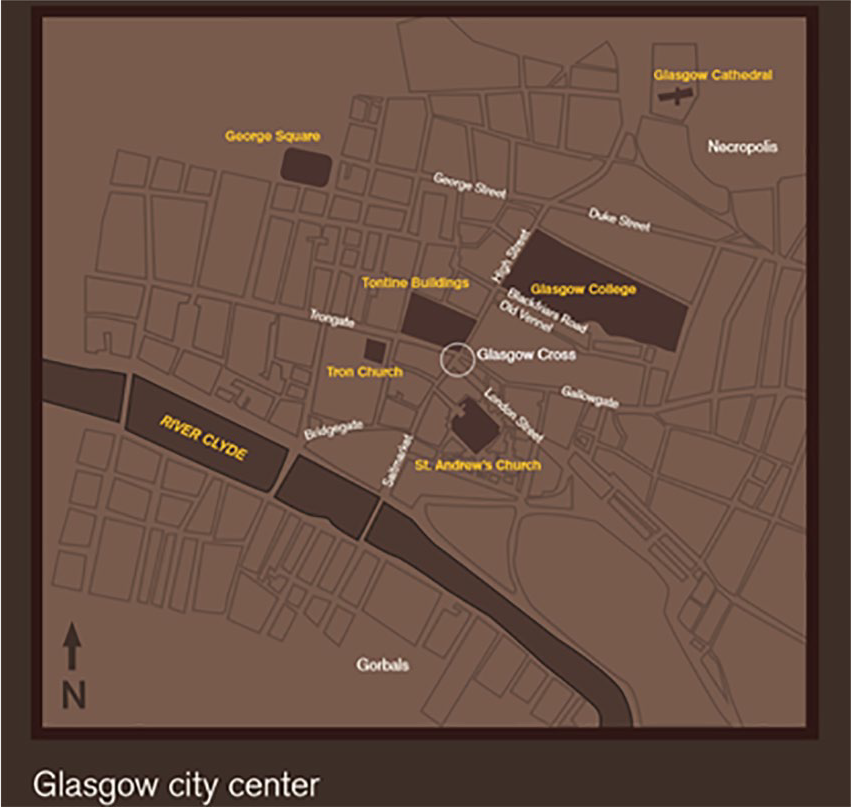
The geographical focus of the project, both in terms of Annan’s photographic record and the City Improvement Trust’s demolition and renewal plans, was the Glasgow Cross—a major intersection of the key thoroughfares of Saltmarket, High Street, Trongate, and Gallowgate. 32 In terms of territory, Annan’s documentation spanned the densely populated immigrant working-class neighborhoods that “radiat[ed] two to five hundred yards east, west, and north” from the aforementioned Glasgow Cross. 33 Due to the sequence and ordering of the photographs in the folio volume, it can be argued that order itself is intended to introduce the viewer to the spatial relationships. Losch has pointed to this in reference to Annan’s photographs of the Tontine buildings and the Tolbooth as intended to “situate his viewers . . . at a focal point particularly familiar to a civic administrator.” 34
Opening Up Glasgow to Light
The main volume of interest explored is the one for which Annan is most famous—The Old Closes and Streets of Glasgow, 1868-1871. 35 While originally the album presented to the City Improvement Trust in Glasgow was printed in 1871 and consisted of 31 albumen prints, the volume examined was one from 1900 that consists of 50 photogravure prints and a lithograph of Trongate in 1774 (the same one mentioned above but in slightly larger format). This volume was issued after Thomas Annan’s death and was thus printed by the authority of James Craig Annan, Thomas’s son. The individual prints examined from The Old Closes and Streets of Glasgow, 1868-1871 pertain exclusively to the main focus of this paper—the urban image. The analysis followed the organizing principle of the volume and has been divided into two subcategories of “closes” and “streets.”
Glasgow’s Closes, Wynds, Lones, and Vennels
A close is a small street in Glasgow, also common throughout Scotland and Northern England, enclosed by buildings on both sides, where there is not much light, and visibility is poor. Despite the title of the volume, it also includes wynds, lones, vennels, and other types of passageways between the gables of two buildings. As such, closes, lones, wynds, and vennels are minor streets that are primarily encountered in urban spaces. Because of the lack of light, the images are often with very high levels of contrast, scarcely populated, and dense with visual information (see Figure 1). Considering the images of this category occurred more frequently, an argument can be made that the old closes were of higher interest to Annan’s documentary project, which would make sense considering their intended demolition by the City Improvement Trust as part of its plan for urban renewal. In fact, when mapped out on an ordnance survey map from the 1850s, Annan’s photographs seemed to follow exclusively the areas defined as due for urban redevelopment by John Carrick, the city architect responsible for the implementation of the City Improvement Trust’s plans.
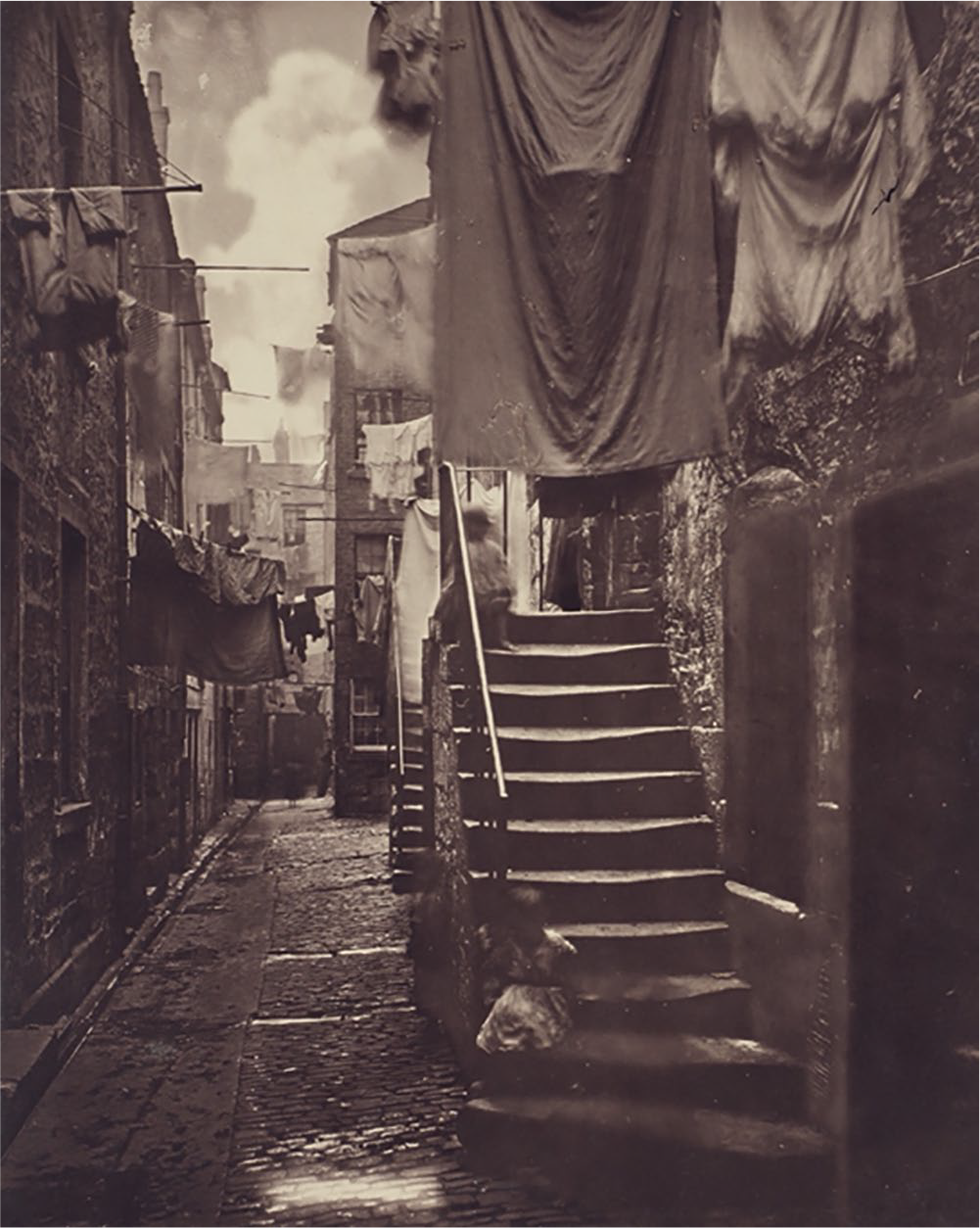
Thomas Annan, Close No.193 High Street (The Old Closes & Streets of Glasgow), negative date:1868; print 1900. Photograph, photogravure.
Considering the urban environment and its social and class dynamics at play in the 1860s and 1870s, it is unlikely that a significant majority of Glasgow’s population would know these closes, despite their central locations. For one, the gentry of Glasgow tended to live outside the city, effectively resulting in a poor, immigrant, and working-class population to reside in the central area of the closes. Although social mobility was common in Victorian industrial cities, Glasgow followed the trend of the vacated, already overcrowded flat quickly being filled with new tenants due to the high rate of urbanization. 36 The influx of seasonal workers from the rest of Scotland 37 and immigrants from Ireland, which in 1861 made up nearly 16 percent of the city’s population, 38 also contributed.
The Streets of Glasgow
In contrast to Annan’s images of closes and lanes, the images of streets depict much larger spaces, light is present in much higher degree, and more often than not they are populated with people (see Figure 2).
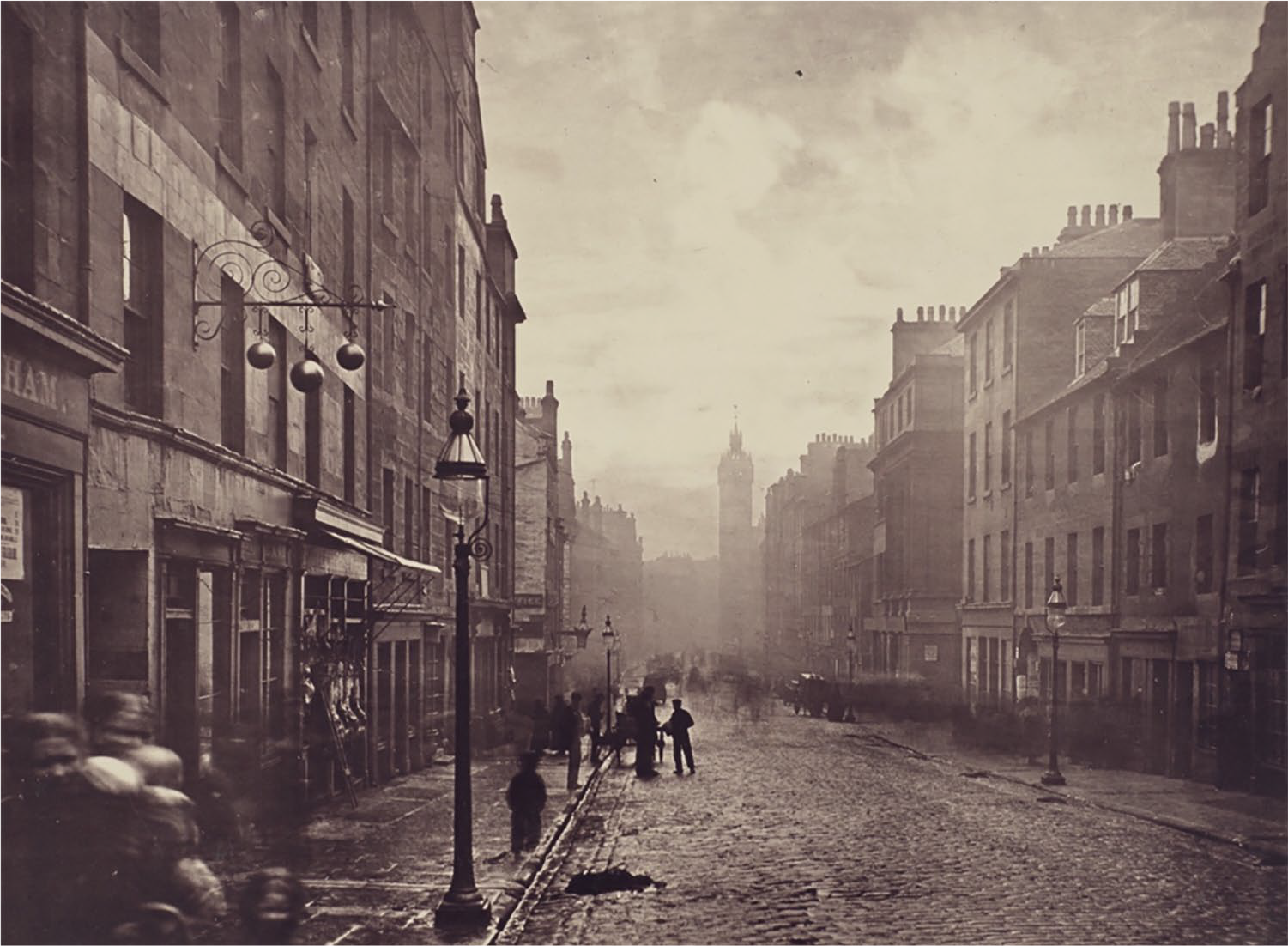
Thomas Annan, High Street, from College Open (The Old Closes & Streets of Glasgow), negative 1868-1871; print 1877. Photograph, photogravure.
As a significant distinction, the two subcategories differ greatly in their use of formats. While 90 percent of instances in “closes” are in format “portrait,” 75 percent of instances in “streets” are format “landscape.” This contrast further adds to the visual difference between the two categories in-frame. All photographs in this category show long and wide thoroughfares that are populated, well-lit, involve commerce, or depict movement. However, the photographs of the closes are high in contrast due to lack of light. Due to the lack of light, the people present in those photographs tend to pose and look directly into the camera (something that is rare in Annan’s images of larger streets). In addition, while the photographs of closes involve people that are blurred by motion, there is also evidence of personal possessions such as laundry or handcarts, thus highlighting the contrast of the public space of the street with the more private space of the close.
Accounts of the central Glasgow Cross area’s disrepair and poor condition are numerous,
39
a famous example of which is by the writer Nathaniel Hawthorne, then the U.S. Consul in Liverpool: The Trongate and the Salt-Market [. . .] were formerly the principal business streets, and, together with High Street, the abode of the rich merchants and other great people of the town. High Street, and, still more, the Salt-Market now swarm with the lower orders to a degree which I have never witnessed elsewhere; so that it is difficult to make one’s way among the sullen and unclean crowd, and not at all pleasant to breathe in the noisomeness of the atmosphere. The children seem to have been unwashed from birth.
40
Although the closes seem to have been the focus of the City Improvement Trust’s work, as well as Annan’s work judging by the number of photographs, their poor conditions seem to have been connected with those of the larger thoroughfares. It is likely that the two categories were not only intended to work as contrasting types of the spaces—the ideal of the street and despicableness of the close—but to also demonstrate a relationship between the two of interdependence. Considering the bourgeois ideals of modernity at the time, this would have been a rather controversial idea. Namely, the photographs taken by Annan showed areas of the city, that is, the closes of which the city’s middle classes would have had no knowledge. Understood this way, the matter of Annan’s omission of taking photographs of the interior of the dwellings of the people living in the closes is not that significant. It is the environment and its complete novelty for the bourgeois citizen that is of interest. As Engels described the phenomenon in Manchester: those are areas that conceal from the eyes of the wealthy men and women of strong stomachs and weak nerves the misery and grime which form the complement of their wealth.
41
The very act of unveiling this environment is a political one, because it forces the bourgeois viewer to confront the so-called “complement of their wealth.”
Navigating the Urban Space Photographically
The detailing of the space provided by Young in the introduction to the volume of Annan’s photographs includes frequent references to past street names or directions of an imaginary gaze or traversing urban space. As such, the account can be understood as positioning the reader as more than a simple dweller in Glasgow, but a possessor of embodied knowledge of its geography. The introductory text appears to be providing a “phenomenological hermeneutic” 42 of the space, without actually making references to the photographs themselves. Despite this, the photographs further reinforce the phenomenological-geographical aspect—the apparent implication is for a reflective engagement with the photographs, where the viewer imaginatively positions oneself in the urban space of Glasgow as depicted in Annan’s images.
To illustrate this, in addition to the photogravure prints, number 18 is a lithograph bearing the inscription “Trongate in the Olden Time” (see Figure 3). It depicts central Glasgow as a lively and commercial open-air space. As such, it is an idealized representation of the city’s public center—different types of labor and social classes are clearly identifiable, all framed by recognizable architecture of the Glasgow city center. Interestingly, the image is directly preceded by a photogravure print of “Trongate from the Tron Steeple” and is succeeded by “Tontine Building Trongate” (see Figure 3, in sequence). In other words, the documentary function of Annan’s photographs has to do with both documenting the types of urban space (closes and streets) and their relationship as shown through the lived experience of the city. In keeping with Nesbit’s claim about documentary photographs, 43 Annan’s photographs have an intended viewer—that of the social engineer or the bourgeois member of the City Improvement Trust.
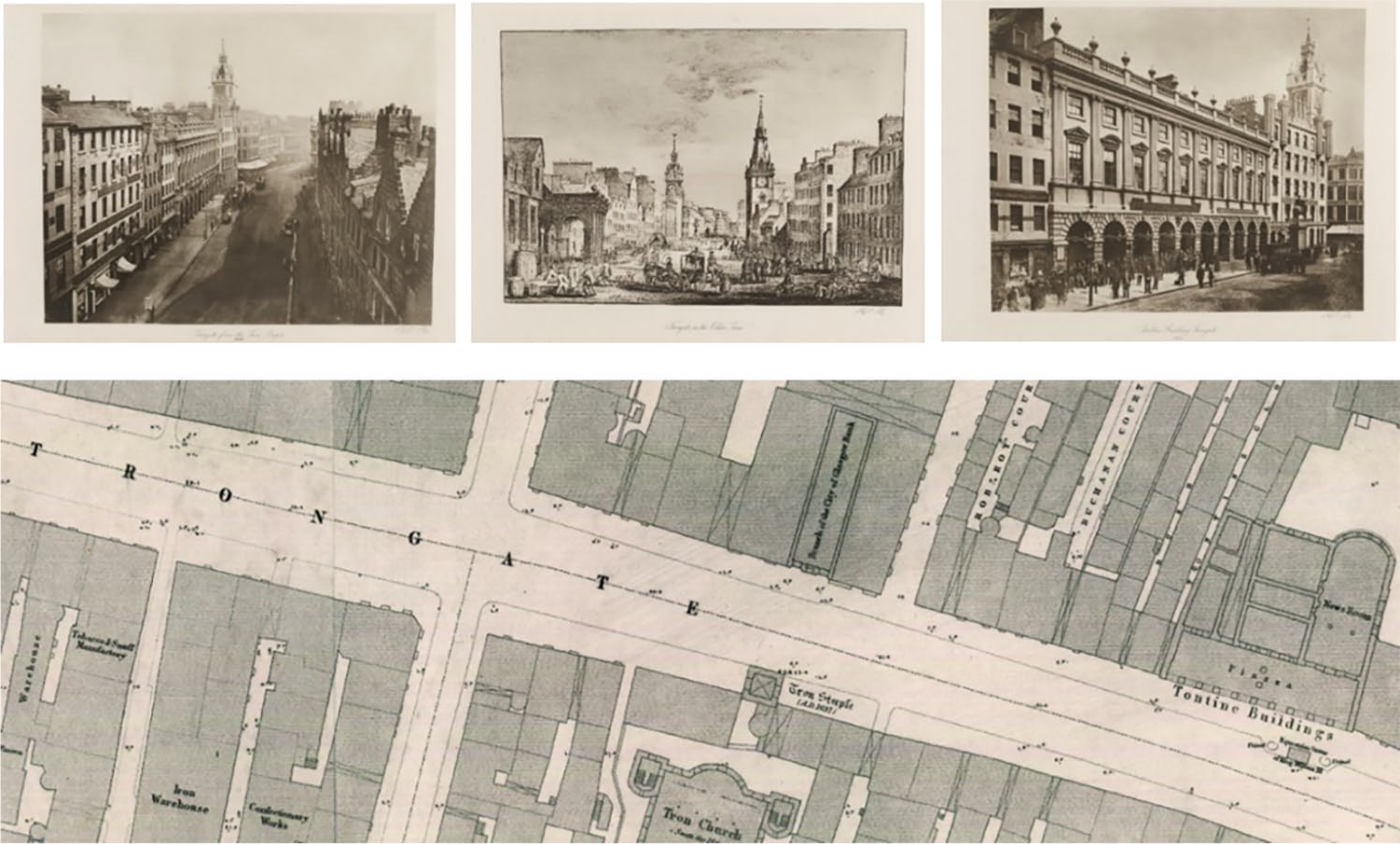
(Top left) Thomas Annan, Trongate from Tron Steeple (The Old Closes & Streets of Glasgow), negative 1868; print 1900. Photograph, photogravure. (Top centre) Thomas Annan, Trongate in the Olden Time (The Old Closes & Streets of Glasgow), negative 1868; print 1900. (Top right) Thomas Annan, Tontine Building, Trongate (The Old Closes & Streets of Glasgow), negative 1868-1871; print 1877. Photograph, photogravure.
All three images can be positioned in a clear line of sight on the 1850s ordnance survey map of the city. The Tron Steeple is the square (with a cross inside it) on the bottom part of the street (Figure 3, center of map), the steeple itself is visible in the lithograph, and the Tontine Buildings can be seen at the end of Trongate (on the lower right of the map). This way, the volume further builds on the established geographical and embodied knowledge of the city described by Young in the introduction to the volume. Furthermore, the sequence of images can be understood as the perspectivizing effect of the Trongate Boulevard. 44 This way, the volume constructs the space of the boulevard as a linear axis of vision that is transparent and legible.
The Layout
The use of text and the page layout of the volume is also significant. As mentioned above, none of the text was written by Annan. However, the majority of the text is intended to either situate historically the volume in the development of the city or provide an almost street-level orientation to the reader of the city and its surroundings. In some cases, such as the Country Houses of the Glasgow Gentry folio volume with photographs by Annan, the text predominantly relies on Glasgow’s gentry as ostensibly well-known reference points. As a whole, most volumes by Annan, but The Old Closes and Streets of Glasgow, 1868-1871 more so than others, rely on a documentation of environments that have either been demolished, or are in the process of being so, in relation to images that are seen as emblematic of Glasgow city life. However, The Old Closes and Streets . . . volume is the only one without text in its original, first edition. As Gossman describes this, The photographs in the first two albums of The Old Closes and Streets (1871 and 1878) are unaccompanied by any text at all, other than simple identifying captions. The 1878 album was to have contained “an introductory and descriptive letterpress,” but, in the event, it was put together without the planned text, which, in any case, would again not have been by Annan himself, but by the City Architect, John Carrick, an influential and energetic figure with strong ideas of his own. A volume published posthumously in a limited edition by Annan’s son, James Craig Annan, did contain an introductory text by the local antiquarian and artist William Young, but it dealt mostly with the history of Glasgow and its various quarters and streets and had nothing to say about the photographs themselves [. . .] Annan’s silence, whether deliberate or fortuitous, places the burden of interpretation entirely on the viewer.
45
Gossman further points to the unique position of Annan’s work at the time. Both Jacob Riis’s 46 photographs of New York in the 1880s and John Thomson’s 47 photographs of London in the 1870s relied to a great extent on text to situate their photographs—they either did so through description or evocative appeals. Annan’s photographs are unique due to their significance to the city of Glasgow, their seeming disengagement with the inhabitants of the deprived areas, and the silence of the photographer. It is important to note that Gossman’s point that “the burden of interpretation [is placed] entirely on the viewer” 48 omits both the phenomenological hermeneutic identified by this article and the considerable institutional framing of the photographs and volumes—either by their possessing libraries, or the City Improvement Trust as their producer.
Walking the Street
Considering that the general visual analysis of Annan’s The Old Closes and Streets of Glasgow, 1868-1871 has been introduced and the framing of the volume has been outlined, in this section I will engage in a brief semiotic exercise on the basis of a single photograph in order to provide an analysis of Annan’s photographs in relation to the construction of urban spaces as malleable. The photograph that serves as starting point to the discussion (Figure 4) is “Saltmarket from Bridgegate,” taken in 1868, and it shows the main thoroughfare of Saltmarket looking north toward the Tollbooth Steeple at the center of the Glasgow Cross (visible as a partial outline in the background of the image).
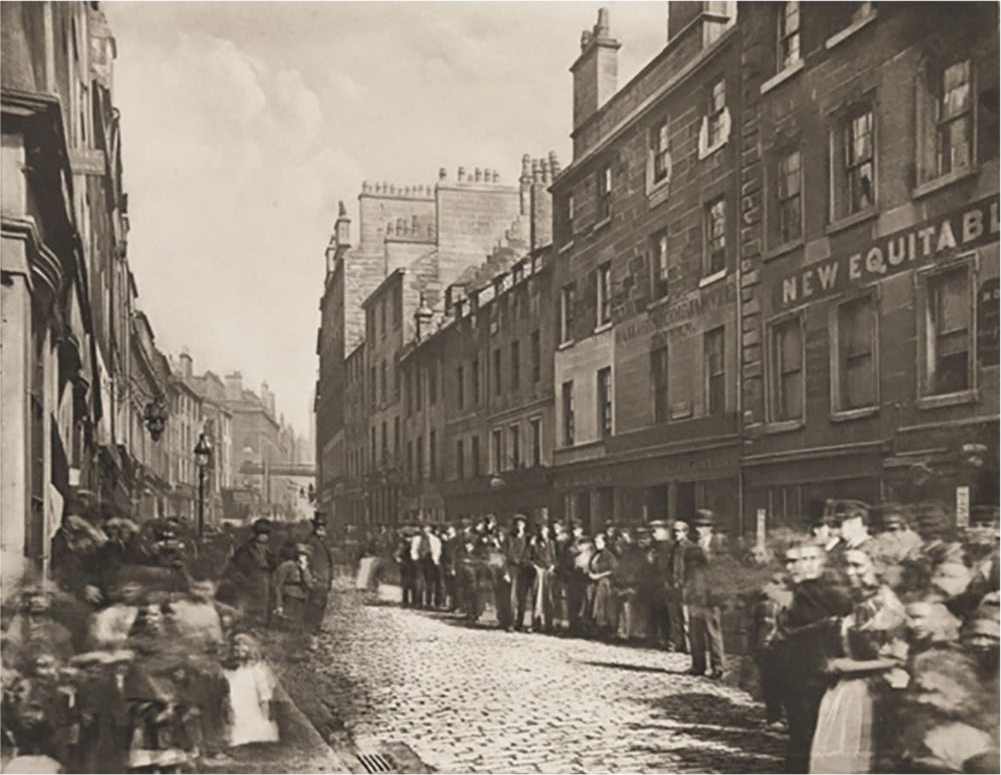
Plate 19: Thomas Annan, Saltmarket from Bridgegate, 1868. National Library of Scotland, 2016.
The first thing one tends to notice in the photograph are the ghost-like figures and silhouetted shadows of people on the streets and closes. There are a large number of people on Annan’s photographs of streets—so much so that they appear as a singular blur. According to Baudelaire, 49 the urban crowd in the mid-nineteenth century offered new and ambiguous promises of attraction and danger. 50 In fact, according to Gunning, “the crowd” was at the center of “the changing relation between the modern metropolis and the practice of urban spectatorship.” 51 In Annan’s photographs, people appear in two ways—either as blurry silhouettes or as a posing group. The former appears incidental and unplanned, while the latter implies a collaboration with the photographer and thus a deliberate intention. Furthermore, the former tends to emphasize the public character of the street, while the latter tends to highlight the private environment of the close.
Clearly, building on our understanding of the differences in the spaces, both types of crowds bear different meaning, precisely because of the spaces they occupy. The crowd of the street is inevitably blurry, even when posing, since the street is the epitome of movement (see Figure 4). In contrast, people in closes appear as ghosts and private hauntings; in the case they do pose, the photographs’ material environment tends to suggest an intimate and private collaboration (see Figures 1 and 8). In the case that closes do appear devoid of people, Benjamin’s description of Atget’s photos as those of crime scenes appears apt in Annan’s case as well. Namely, modern urban spaces, which to a large extent can be characterized by the crowd, 52 once devoid of it, appear lacking. On one hand, this points to the extent that the crowd is characteristic of urban space. On the other hand, this could support Scott’s argument regarding “state simplifications,” 53 since the rendering of space as uninhabited allows for the state to act upon it much more freely. Moreover, the rendering of space as empty or “ruined” 54 is an abstraction of space from its lived context. Understood this way, the role of the lived experience of the street in Annan’s photography comes to the front—even when Annan deprives the city from its inhabitants it appears significant, since it is the presence of people on a mass scale that makes the metropolis such a novel experience for its time. 55 By stripping the crowd from spaces or rendering it as a single blur, the photographs appear not to leave space for people in the city’s streets. This way, Annan’s photograph of Saltmarket from Bridgegate becomes an image made up of abstract details of the material structure of the city, of its buildings and streets. Annan’s photographing of Glasgow’s slums is central to opening them up for the strategic gaze of the bourgeois Glasgow City Council, and thus it is essential to the conceptualization of space as malleable.
The ordering of the images in the volume further supports the opening up of the city for the strategic gaze of the social engineers. Particularly, the order of the photographs in the volume is further oriented around the Glasgow Cross (see Figure 5). In fact, the first photograph is High Street from the Cross followed by 15 images of closes off of High Street or the street itself. Following this is the sequence of three images (including a lithograph) of the Tron Steeple, then an image of Gallowgate which is Trongate’s continuation past the Cross, and then a series of closes or streets off of Saltmarket which is the continuation of High Street past the Cross. Images from 39 to 50 in the 1900 version of the volume, however, vary—potentially indicating that as late additions they were not made to fit into the overall logic of the project. It could be speculated that due to the pattern being present in the first 30 images only, which were taken by Annan himself (and the other 20 were not all by him), that the pattern was envisioned by Annan, or at the very least implemented by him; since the only change from the first to the 1900 edition was Annan’s death, but the publisher remained the same. Moreover, it could be argued that the original layout, if not due to Annan’s direct involvement or in addition to it, is based on the involvement of the City Improvement Trust as it was in the process of urban change in Glasgow. As such, it is highly likely that the nature of the volume being an outward - facing document is significant.
Screenshot by author of Annan exhibition guide, J. Paul Getty Trust (2016: 3).
With this in mind, the Glasgow Cross can be understood as an organizing principle for the volume, and as a key for a phenomenological hermeneutic of the urban space—effectively performing a walk through the spaces of interest. In a more theoretical sense, Annan’s photographs appear to be engaging closely with the material arrangement of space in the city of Glasgow. In other words, the documentary function of Annan’s photographs appears to be rooted in a strict representation of the formal spatial order of the map on street level. Moreover, Annan’s photographs document more than the presence of photographic principles in the city of Glasgow, but rather document their effect to the experience of being on the streets.
Understood this way, the perspective effect of the boulevard is counterpoised with that of the close, both of which are simultaneously pertaining to the documentary function of the photograph and its aesthetics. This results in an aesthetics of counterposition, where the street appears to be a manifestation of the desired order and the close is the deviation from it. Moreover, although photography is frequently understood as a depiction of time—in the sense that a photograph is “confronting us with the passage of time and the stillness of that which has gone,” 56 it can be inferred that Annan’s photographs are documents of more than the Zeitgeist, but of Glasgow’s Raumgeist as well. 57 The places one encounters by looking at the photographs, and one does so primarily through the volume in sequence, take the viewer on a walk. This walk is inscribed with opportunities for pedagogical encounters with the environment that has been documented. For example, the viewer can learn to identify the Tron Steeple, the Glasgow Cross, and so on and thus engage in a phenomenological hermeneutic that speaks to the lived experience of the spaces. This pedagogical aspect of the gaze further empowers its proclivity to exercise strategic control and determine the meaning of space. By representing the experience of walking through the city, Annan appears to have documented more than the material environment by capturing both elements of the experience of the space.
This reading can be further extended by a “material hermeneutic” 58 of the built environment that the photographs document. Namely, the spatial relationships between the photographs operate on a logic of material ornamentation—that of suture of ostensibly disparate parts. This can be shown with the material relations in two photographs. On Figure 6, a scaled-up section of the map of Glasgow’s Princes Street can be seen with three blue squares. The blue square on the very left and at the end of Princes Street is Plate 14 titled Princes Street from King Street, 1868 (Figure 7, left); the blue square in the middle is Plate 13 and is titled Laigh Kirk Close 1868 (Figure 7, right).
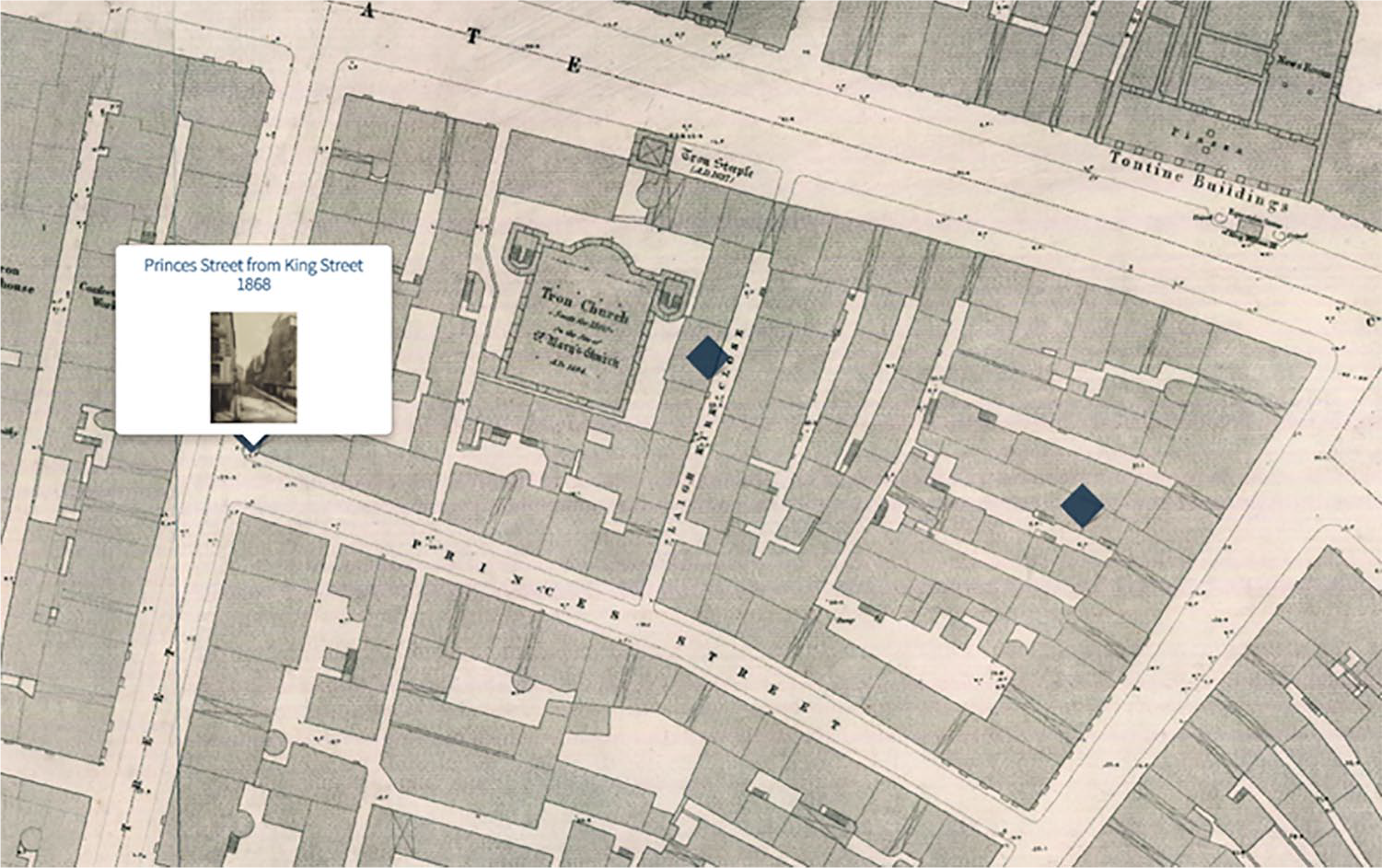
Partial screenshot of “plate locations,” National Library of Scotland, 2016, https://digital.nls.uk/learning/thomas-annan-glasgow/historical-maps/.
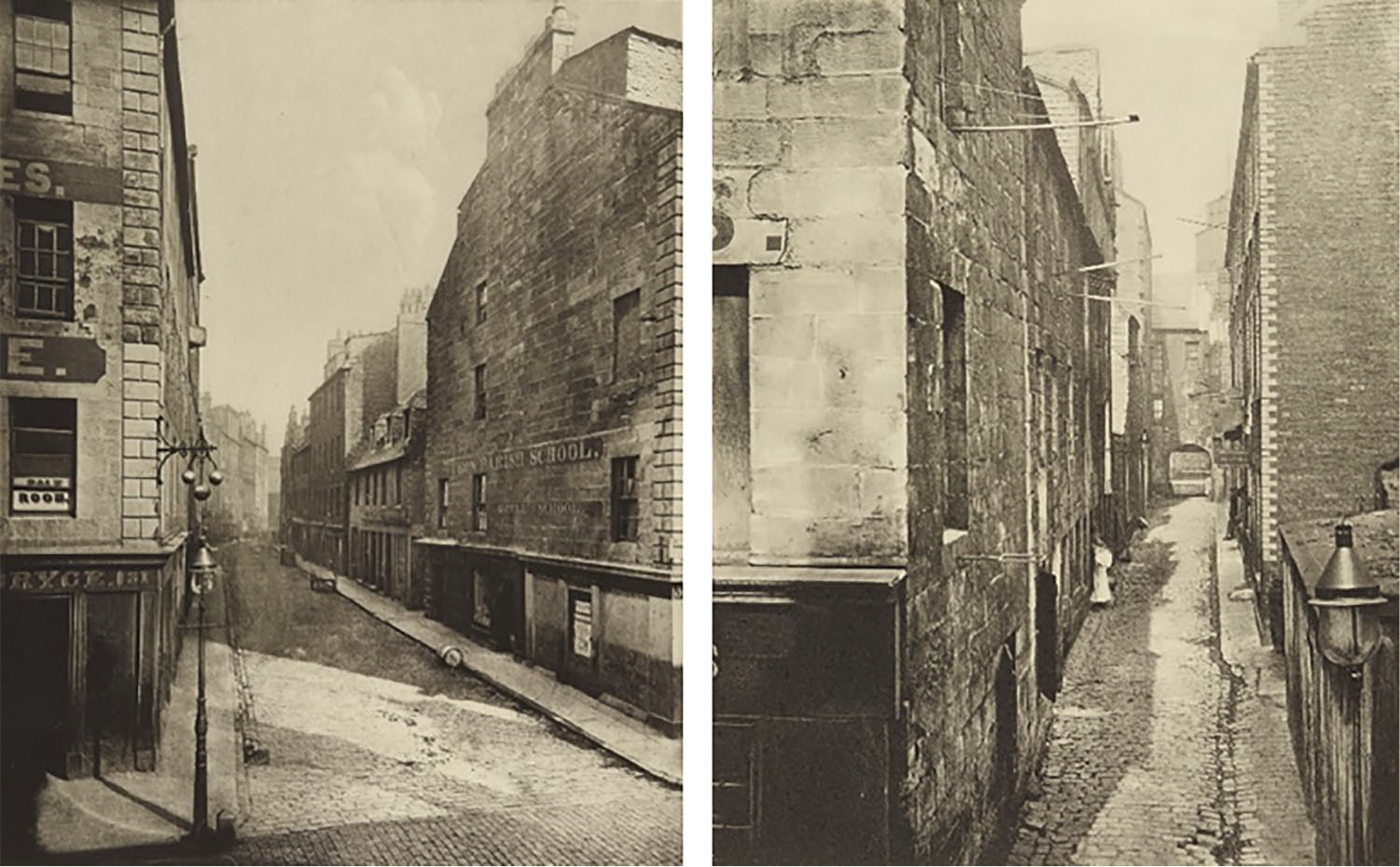
(Left) Plate 14: Princes street from king street, 1868 by Thomas Annan, National Library of Scotland, 2016; (right) Plate 13: Laigh Kirk Close, 1868 by Thomas Annan, National Library of Scotland, 2016.
The interactive map provided by the National Gallery of Scotland allows the viewer to place the two photographs in relation to each other cartographically. However, there are limitations to this. On a general level, the map only locates the first 20 plates from The Old Closes and Streets of Glasgow, 1868-1871 59 ; as such, it does not include the 10 others that have either been part of the original 1868 volume, or the 30 additional ones in the later 1900 edition. On a particular level, the blue square for Laigh Kirk Close is positioned at the middle of the close itself. The examination of the two photographs next to each other, and in relation to the map, reveals this to be incorrect and merely an approximation. First of all, the map reveals that the close is accessible through a passage from Trongate (the main thoroughfare at the top of the map), which is visible in the photograph on the other end of the close. Second, on the bottom right corner of the photograph of the close, there is a lamppost, which is identical to the one on the bottom left corner on the photograph of the photograph of Princes Street. Lighting in the closes was a big element of rendering the areas as problems and, going by the photographs provided by Annan alone, it can be determined that there were different types of lamps in closes and streets. For example, in Figure 8 the difference between a lamp on a main street (on the left) and in a close (on the right) can clearly be seen; one is attached to a wall due to the narrowness of the close, the other one is on a post. On the basis of this, it can be asserted that Plate 13 is not actually taken from the middle of the close as the map on Figure 6 shows; rather, the photograph has been taken from a position on Princes Street itself. This interpretation can further be strengthened by acknowledging the lack of commerce in the closes; this means that the building façade visible in the lower left corner of the Laigh Kirk Close photograph is, in fact, a street.
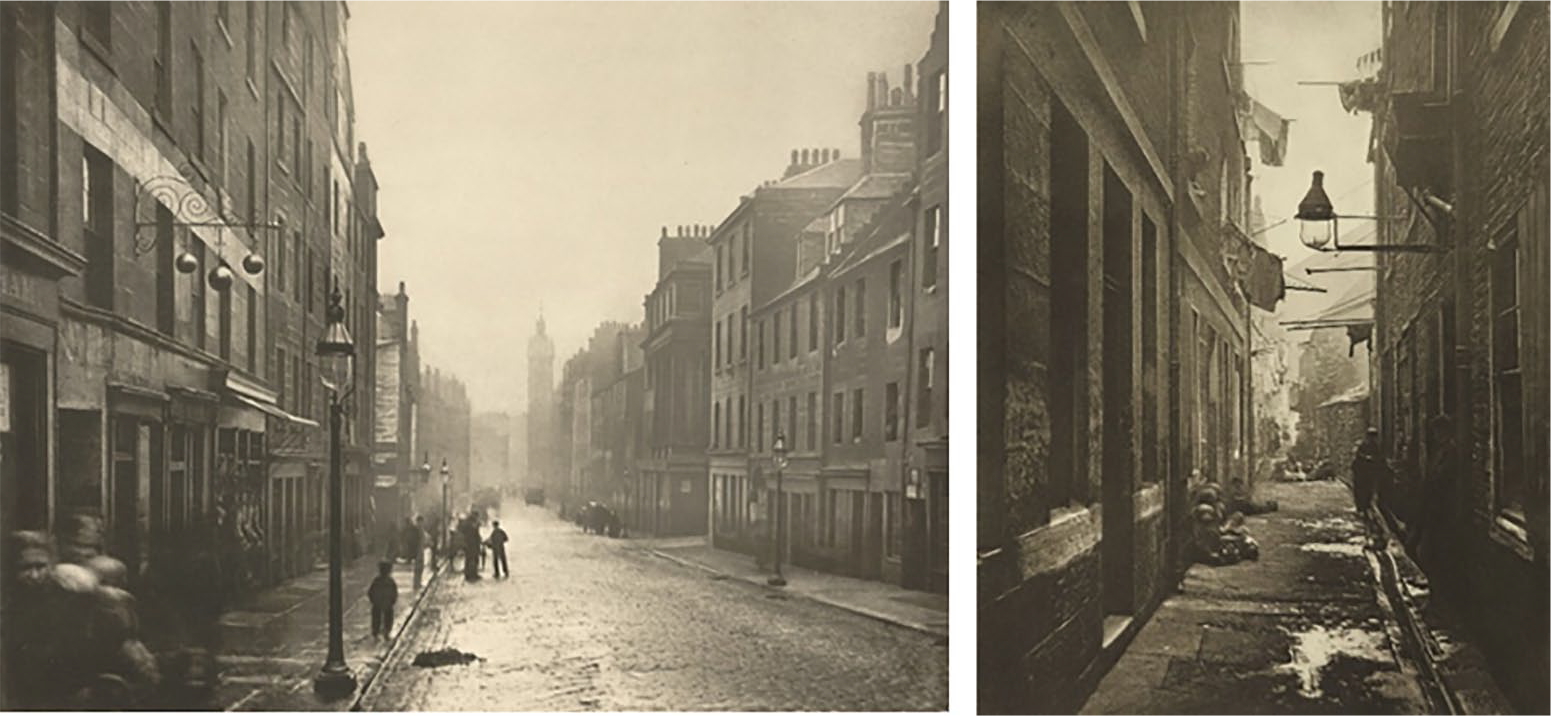
(Left) Plate 3: High street from college open, 1868 by Thomas Annan, national library of Scotland, 2016; (right) Plate 8: Close no 80 high street, 1868 by Thomas Annan, National Library of Scotland, 2016.
Further Remarks
Furthermore, the close/street divide is starker than the lack or presence of commerce. About 60 percent of the photographs are of closes, and thus places that would not be familiar or even known at all neither to the civic engineers responsible for the urban project nor the bourgeois gentry class of the city that would fund it. 60 Because of this, the photographs need to be rooted in something familiar and identifiable, and it appears that the Tollbooth Steeple at the center of Glasgow Cross and Tron Steeple (now known as the Tollbooth Tower) are the clearest points of reference (also seen in Figure 8, left), on the basis of which a knowing observer can read the images and navigate through their virtual space. This, in turn, creates a form of space that speaks to both the material environment of the city and the abstract formal order of it seen on the map, as well as the lived experience of navigating the streets. However, this constructed transparency is not reciprocal, and it favors the privileged observer of the photographs, that is, the social engineer of the City Improvement Trust. Understood this way, Annan’s photographs demonstrate the transparency of space in its clear strategic aspect of having achieved access to a place that would otherwise be unknown. To put it in abstract terms, Annan’s photographs should be understood as a complement to the slum clearance, rather than simple representation of its stages of progress.
On another level, the photographs themselves are the “opening up” here. In the similar case of Paris, the urban changes were what allowed for space to “open up” through Haussmann’s carvings and disembowelling 61 and subsequently for photographers such as Atget to document the new spaces. For Atget, the photographs could only be taken after the process of modernization. In Annan’s case, much like Marville’s in Paris, the photographs themselves are what allows the panoptic principle to be applied to the urban plan of the city of Glasgow.
For Benjamin, the principle according to which reality was stripped from its aura in photography was through the incisions that the camera inflicts on the world. In his essay The Work of Art in the Age of Mechanical Reproduction, Benjamin 62 compares a camera operator to a surgeon, who, in order to operate, must break apart a person’s body, penetrate into it, and, ultimately, does not address the one operated on otherwise than through the very operation. 63 The already established comparison between the human body and the modern Western city is thus revealed as even deeper. 64 Benjamin is describing the operation as a medium of knowing, both of accessing and enacting knowledge. Understood this way, the City Improvement Trust must cut into Glasgow’s slums in order to gain knowledge of them—and photography was a medium used in doing so.
It is also important to note that in 1866, the year in which the City Improvement Act passed in its first form, Parliament also passed the Glasgow Police Act, which has widely been articulated as an extension of the police’s repressive powers. This was done in congruence with the introduction of a ticketing system, which included the fixing of a metal plate on the door of a given house with the intent of making readily apparent the number of people who are lawfully inhabiting it. 65 Knox further points to the ubiquity of nocturnal raids by police and sanitary inspectors to determine transgressions in numbers of occupancy, which, in turn, were frequent. Moreover, the Glasgow Police Act of 1866 was largely focused on criminalizing sex work and allowed the police greater powers (e.g., the sworn testimony of a single individual was enough to petition a magistrate for a warrant) to enter a brothel as well as targeting women sex workers on the streets (for which the testimony of a constable was sufficient). 66 Overall, the changes in urban space, photographic documentation, and other forms of “state simplifications” (such as tickets, warrants, etc.) should not be seen in isolation, but understood to be a solidification of this very process of the state exercising control over its spaces and their inhabitants. In addition, the implied links between the closes and crime are not to be overlooked.
A supplementary aspect of the 1866 Glasgow Police Act was that its institution was influenced by the slum surveys carried out by the city architect John Carrick; the Act included the power to exert control over construction, and as such, was also a tool utilized by the architect. 67 Carrick’s powers extended to monitoring and advising upon the construction of any new buildings in place of the cleared areas. Interestingly, the impetus behind the project is reported to be influenced to some extent by Haussmann’s work in Paris, 68 with an expedition led by Carrick having visited the city (and Amsterdam and Brussels) in June 1866 (mere days before the City Improvement’s Act obtainment). The stipulations of the Police Act with regard to new constructions is said to have also been informed by the characteristic to Paris “airy, internal quadrangles” 69 as well as the “. . . great care taken to preserve numerous open spaces at intervals in the midst of the masses of building.” 70
Congruently to the Police Act and the City Improvement Act, photography as procuring knowledge is best understood as a way to exercise control; as such, it demonstrates the political dimension of documentary photography and its reification of social relations and class. Namely, Annan’s work quite clearly fits into Rosler’s description of documentary photography’s discourse of being: a fiery pencil that with flash and flare inscribed into the historical and journalistic record as well as into the consciences of the “comfortable” classes, the image of the previously unphotographed poor (emphasis added).
71
The photographs of closes are exactly “images of the previously unphotographed poor” that are meant as both evidence and justification for the urban modernization undertaken by the “comfortable classes.” Furthermore, this can also be related to documentary photography’s basis on access 72 —the more difficult it is to see a space, the more valuable it is for photography. This, however, more often than not results in the photographic gaze constructing the people and environments documented as other. The photographer, the viewer of the photograph, and the institution are the ones in power. They are the ones who gaze upon the object in the “bounded arena of shared expectations as to meaning” that is discourse. 73 As Sekula observes, “the archival perspective is closer to that of the capitalist, the professional positivist, the bureaucrat and the engineer—not to mention the connoisseur—than it is to that of the working class,” 74 let alone that of the colonial other. 75 Ultimately, this results in what Sekula describes as an aesthetics of compassion with a distant Other. Thus, once again evoking Rosler’s description of documentary photography as a practice that carries “(old) information about a group of powerless people to another group addressed as socially powerful” 76 ; in fact, documentary photography appears to be this very address. If, as it has been argued so far, documentary photography is about transparency and making a certain issue visible, then Annan’s photographs reveal the strategic use of documentary photography to simultaneously produce a differential order and reproduce existing inequalities. Even more so, the arrangement of this order in spatial terms is articulated as discriminatory and strategic, on the part of the state and the city authorities.
In terms of the larger context, the direct parallels to Annan’s work (and its use) are few, both in terms of the specific period (i.e., shortly after the middle of the nineteenth century) and in terms of the predominantly urban focus (rather than architectural). Notable examples are the work of Charles Marville in Paris, who worked as a photographer commissioned by Haussmann himself to visualize the demolition and reconstruction of Old Paris, 77 and Georg Koppmann’s documentation of the redevelopment of the Speicherstadt in 1880s Hamburg 78 ; multiple other projects on European cities include examples such as Andreas Groll’s photographs of Vienna, 79 Louis-Émile Durandelle’s documentation of the construction (1875-1914) of Sacré-Coeur de Montmartre in Paris, 80 Louis Ghémar’s commission 81 to document the covering of the river Senne in the 1860s (and the boulevards that followed) in Brussels as well as Edmond Sacré’s work (around 1900) for the Ghent Monument Commision. 82 Outside of Europe, notable examples remain the documentation of Cairo in the late nineteenth century by Beniamino Facchinelli 83 and the work of Linnaeus Tripe as official photographer of the Madras Presidency. 84 Later photographic projects of documenting cities such as Jan Bułhak’s early twentieth- century photographs of Vilnius 85 and Arthur Goss’s synchronous documentation of Toronto 86 allow for potential comparative analyses. An important aspect of all examples noted above is the matter of the state’s, or an institution thereof, involvement. The dynamics observed in this paper between Glasgow and its City Improvement Trust bear strong similarities to Bassnett’s work on Montreal and the Province of Quebec’s Association of Architects’ Civic Improvement Committee 87 as well as Toronto’s urban plans developed by the Ontario Association of Architects 88 in the beginning of the twentieth century. With reference to the latter, significant parallels can be made to the role of photographer Arthur Goss and that of Thomas Annan. 89
In conclusion, my aim has been to demonstrate the role of Thomas Annan’s documentary photography as more than simple documentation of the processes of urban change. Putting aside speculations on Annan’s motives, the analysis showed here points to Annan’s photographs being closely aligned with the strategic interests of the City Improvement Trust. With the exception of the approximately cotemporaneous documentation of Paris mid-Haussmannization by Marville and the visualization of the refashioning of the Speicherstadt by Koppmann, and the early twentieth-century documentation by Arthur Goss of Toronto’s urban plans as developed by the Ontario Association of Architects, the examples listed above do not show an overlap of photographic documentation and state strategic interests to the same extent. The phenomenological effect of the photographs—the performance of a walk through the central Glasgow Cross—is indicative of the photographs’ operationalization as a tool for the civic engineer or the bourgeois member of the City Improvement Trust. Moreover, it has been stressed that Annan’s work should be understood in its proximity to the solidification of state control, at the expense of the working class, in the mid- to later nineteenth century.
Footnotes
Declaration of Conflicting Interests
The author(s) declared no potential conflicts of interest with respect to the research, authorship, and/or publication of this article.
Funding
The author(s) received no financial support for the research, authorship, and/or publication of this article.
