




Abstract
Two opposed conceptualizations of Granada, shared across poetry, painting (and photography) and music, combined to create a contrasting transmedia soundscape of the city throughout the twentieth century. Granada “the Beautiful” responded to the romantic myth of the city and was rooted mainly in the Alhambra, an Arab palace among the mountains, filled with gardens and water fountains. This idealized image could be heard in Manuel de Falla’s literary and pictorial dream: Noches en los Jardines de España [Nights in the Garden of Spain] (1916), and also appeared in Federico García Lorca’s musical conception of his city (1933). Fifty years later, the democratic transformation of Spain generally led to a punk, poetic deconstruction of the city in Rimado de ciudad [Rhyming from the City] (1983), singing about the margins of the city: Granada “the Wounded”, emerging from the suburbia and from the dark streets of the Arab quarter: the Albaicín.
Introduction: Creating the City: Urban Transmedia Soundscapes
Arts create the city. That is to say, the conjunction of literature, music and painting around a topic related to the city may convey powerful urban soundscapes, which are shared across all media, without boundaries. As a consequence, this paper investigates how meaning is generated both by transmedia constellations and by cross-media references, 1 considering the “transmedia” phenomena as the “appearance of a certain motif or style across a variety of different media.” 2 “Transmediality” can then be conceived as an intermedial phenomena which is non-specific to individual media (motifs, thematic variation) and which appears across a variety of different media. 3 Moreover, according to Wolf, transmedia narratology is defined as the study of narrativity in works of art outside the literary text, such as painting, sculpture, and instrumental music. 4 Transmediality is used here only in the context of sharing an idea across different strands of “the arts”, observing certain archetypal subject matters and “themes” in verbal texts, the visual arts, and music. These content phenomena can be marked as transmedia, since they do not originate specifically from a certain medium, or that no such origin plays a role in the gestation of the work which it is proposed to study. 5 In the transmedia narration, the story or content appears over and over again in different formats, storage medium and platforms, expanding and transforming on each new occasion, having the consumers a determining role in the exercise of this dispersion. Although the concept is thought to study collaborative work in digital networks, its own theorists are expanding it to various previous historical cases such as Wagner’s total work of art, thereby running the risk of hypertrophying the category. 6
At the same time, this essay uses sound studies as an interdisciplinary field, considering both the social and cultural context of sound production 7 and the ways that sound contributed to the production of space. 8 Drawing upon Schafer’s definition of a soundscape as a sonic environment, Emily Thompson defined soundscape as aural landscape. By this she means both a physical environment and a way of perceiving that environment, a world and a culture. At the same time, she limits the cultural aspects to the scientific and cultural ways of listening, to the listeners’ relationship to their environment, and to the social implications. 9 Notwithstanding, Schafer’s definition offered a second meaning which has been generally neglected in sound studies: “The term may refer to actual environments, or to abstract constructions such as musical compositions and tape montages, particularly when considered as an environment.” 10 Although Schafer referred mainly to sonic descriptions and imitations through music, it is particularly stimulating to explore the possibilities which it offers: to describe imagined environments, strongly transmedia, flowing between disciplines. As the term “transmedia landscape” has been widely used for transtexts (a text which is shared between different ways of expression, different arts, visual, aural, and so on) and storytelling across multiplatform systems, 11 the term “transmedia soundscape” is used here to reinforce the notion of “acoustic turn,” as a much-needed supplement to the visual turn of modern and postmodern culture. 12 Music and sound pass through walls and, along with poetry and pictures, provide us two opposite, inspiring transmedia soundscapes from the city of Falla and Lorca.
Granada the Beautiful: Falla and Lorca
In a collection of articles published with the title Granada la Bella [Granada the Beautiful] (1896), the journalist, writer, and diplomatic Ángel Ganivet dreamed of a town which looks like a recumbent woman resting her head on the red pillow of the Alhambra. Ganivet wrote initially his archetypal mythical book as a series of articles published in El Defensor de Granada, a local newspaper for its bourgeois inhabitants, articles which were only published as a collection in a private edition later, because he had not wanted it to be publicly available. 13 He was then the Consul of Spain in Helsinforgs (now Helsinki) and wanted to write about his idealized native city he had visited the year before. Actually, Ganivet had been seeking the “soul of the city,” a supposed spiritual essence, lying somewhere between aesthetics and sociology, as a sort of chronotope. 14 His aim was to refer to an idea which was independent of a specific time and independent of a specific location in space, an idea which would then free his imagination, opening it to the more timeless ideas of a Granada of a space without time, or at least an unreal time: “My Granada is not the one you see today: it is [a Granada] which could be or which perhaps should be, yet one which I am uncertain will ever come to be.” 15 A town-woman, with its/her curves and folds, enclosed in herself, threatened by the danger of the straight line. 16 The struggle for functionality and the straight line seems to go hand in hand with the struggle for progress, and with the struggle for modern expression in every sense. The modern city, with its great avenues and broad streets, is a woman without curves. Therefore, the exteriority of the straight line contrasts with what Ganivet calls the richness of the “internal house,” the soul of the South rooted in the narrowness of streets and in the rhythm of the line formed by walls and eaves. Ganivet did not conceive of the Alhambra as an Eden, or as a sheer fortress living in a never-ending party. On the contrary, he feels the deep sadness which issues from a desert palace, abandoned by its inhabitants (Figure 1), “imprisoned by the invisible thread, woven by the spirit of destruction, this invisible spider, whose legs are dreams.” 17
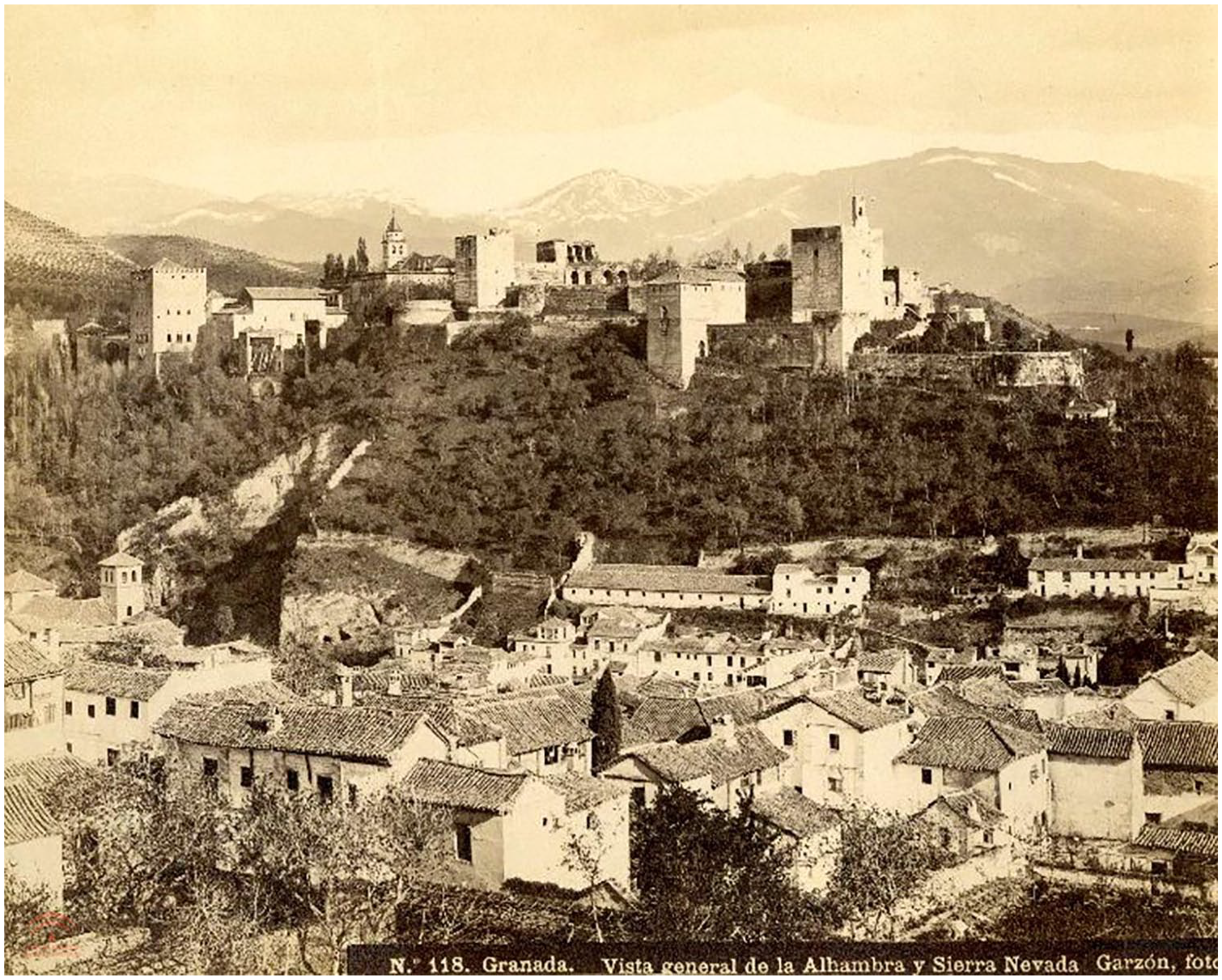
Granada. General view of the Alhambra and Sierra Nevada, ca. 1890 18
The musician’s literary and pictorial dream: Manuel de Falla (1916)
This beautiful city is dreamed of by Manuel de Falla in 1916, when he premiered his work Noches en los jardines de España [Nights in the Garden of Spain] for piano and orchestra in Madrid, a score he had been working on since 1909. The work had three movements, each with suggestive titles: “In the Generalife” (I), “Far dance” (II), and “In the gardens of the Córdoba mountains” (III). The first movement is related to the villa, with its gardens next to the Alhambra, conceived of since the thirteenth century as a place of rest for the Arab kings of the city. Before settling in Granada in 1921, Falla’s inspiration for his representation of the Generalife and the Alhambra gardens came from two works, one literary and the other pictorial, both of which greatly inspired him.
Literature
Granada: An Emotional Guide is an evocative book of city views, sounds, and perfumes, in which the garden acquired a spiritual dimension: Who has never compared life to a garden? Who has never said that the soul is a vegetable garden? Who has never cut roses from the rosebush of his own spirit’s? Who has never listened, in the murmur of a fountain, to the restless and lively voice of his own desires? [ . . . ] All of this, garden, roses, the murmuring of fountains, lively water flowing, is found in this Wonder of the World which the classifiers of beauty forgot to include in their list: “The Generalife from Granada.”
19
María Lejárraga, the wife of Gregorio Martinez Sierra and co-author of this guide (if not author), describes how Falla bought this Emotional Guide in Paris, during an unproductive period in terms of his compositions; an unproductive period which promptly ended when the musician read it. 20
Painting
Jardins d’Espanya is a luxurious publication, which includes forty pictures by Santiago Rusiñol, a Catalan painter whose work borders upon Impressionism. Seventeen of these pictures are dedicated to gardens in Granada, displaying the fences, hedges, and fountains which María Lejárraga described. 21 Previously, The Garden from Spain exhibition in October 1899 in L’Art Noveau Gallery in Paris meant an international acknowledgment for Rusiñol, with a new vision of Spain, totally away from clichés, along with the Spanish intelligentsia of the time, which claimed for a political and cultural regeneration after the colonial past. 22 Some years later, when Falla studied in Paris, he wrote to his family in 1909 asking them to send him the Jardins, wherein four pictures portrayed gardens from the Alhambra and the Generalife. These pictures must have made a strong impression on Falla, who had already expressed his longing for Granada in his first opera—La vida breve—in 1904. In fact, Jardins d’Espanya seems to be the most direct inspiration for Falla to compose his Noches. 23 There is a clear affinity between the atmospheres which Rusiñol painted in his Jardines and the impressionist soundscapes which Falla included in Noches, a visual and resonant connection between painting and music.
Starting in 1887, Rusiñol had visited Granada several times, and specifically the Alhambra, where he had once lived for a month and a half, narrating his impressions of the Generalife: What mystery is hidden by that unexplored palace? I do not know, but I think, just as there have been artists who have made poetry, music or work of art from love, there were those who made gardens, and it was an artist in love who created the Generalife. That garden is a garden written in verse; the framework of a King’s love, the nest of a happy race under those cypresses one day, and banished from their homeland the next, the green dormitory of their white illusions, waiting for the garden to rise to the sky of the Prophet, or rather: It is the cloister of love, today abandoned by Kings and Sultanas, but inhabited by memory, which fills it with poetry.
24
The transmedia dimension of Rusiñol’s painting and thinking—he was also a writer, and met many poets—transformed his gardens into models for the relationship between poetry and painting, even poetry as painting, as in some poems dedicated to his paintings by Ruben Darío 25 (Rovira, 2015). Manuel de Falla’s notes in a work by Darío, Tierras Solares (1904), 26 provide even more insight. He selected several extracts related to the topic of gardens, and to the wider topic of Granada, even to Rusiñol: “Nothing compares to the serious melancholy of its garden, these gardens masterfully portrayed in melodies of colour by the exceptional and profound talent of Santiago Rusiñol.” 27
Rusiñol’s representations of Nature “in its mysterious hours” is framed within an aesthetic of the fin-de-siècle garden, tending to decadence and symbolism, described as melancholic gardens. 28 Thus, Rusiñol approached Granada’s gardens on the hunt for their Arab past, although most part of the gardens he portrayed were not strictly of Arab origin. Nevertheless, his gardens became the paradigm of the Spanish lost garden, with the Spanish-Muslim element, as a result of an uninterrupted Spanish tradition. 29 In this representation of Nature in its mysterious hours, it can be seen that both the distance from realism and the search for expression are common bonds between Falla’s music and the paintings Granada al vespre [Granada in the Evening] o Jardí cap al tard [Garden at Nightfall]. Each of them is an evocation in music and painting which awakens our senses and which excites our imagination. Even more, a spiritual affinity to Falla’s musical impression is found in those of Rusiñol’s paintings which represent Arab gardens at nightfall. Arquitectura verde [Green Architecture] portrayed the whimsical figures of the darkened cypresses, and the fountains in the hearts of the trees. Brolladors del Generalife [The Fountains of the Generalife] (Figure 2) captured the water in movement, in a play of light and shadow. One last remark: Falla’s volume of Rusiñol’s Jardines contained only a few color prints, and the black-and-white copies gave even more darkness and mystery to these paintings.
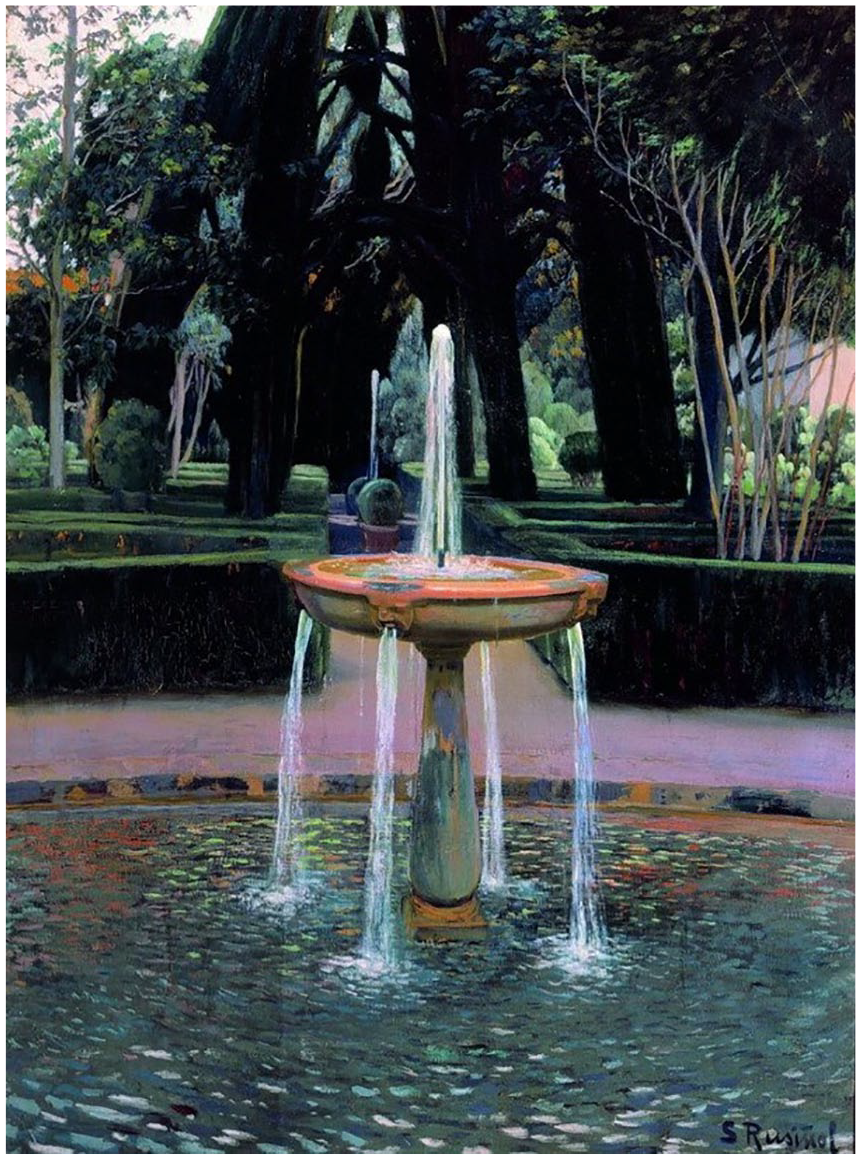
Santiago Rusiñol, Brolladors del Generalife [The Fountains of the Generalife].
Music
Falla subtitled his Nights in the Gardens of Spain as “symphonic impressions” for piano and orchestra, indicating a possible aesthetic ascription for his work. In fact, Falla had exposed his innovative thinking in a conference about “the new music” the year before he composed his Nights in the Ateneo in Madrid, an artistic and cultural private reference institution in the city center existing until nowadays. This was when he returned from Paris, highlighting Debussy’s Impressionism as the pathway to the renovation of Spanish music. In the concert program for the premiere, Falla wrote, The author of these symphonic impressions for piano and orchestra thinks that, if he has been successful, merely the enunciation of its tittles might be sufficient guide to hear it. Although in this work—as it might be the case with all works which rightly aim to be musical—the author has followed a plan determined by the tonal, rhythmic and thematic perspective, a detailed analysis of the pure musical structure could perhaps divert [the listener] from the purposes for which they were composed: none other than to evoke places, sensations and sentiments. [ . . . ] The thematic part of this work, this is the case in most of the (rest of the) author’s work (La vida breve, El amor brujo, etc.), is based on the rhythms, modalities, cadences and ornaments characteristic of Andalusian popular singing, which is applied in its authentic form very few times; and the same instrumental work often stylizes certain particular effects from the people’s instruments. Bear in mind that in these nocturnes music does not aim to be descriptive, but simply expressive, and that these sound evocations have been inspired by something more than the rumours of parties and dances, in which sorrow and mystery have also their part.
30
These lines included terms such as “sentiments,” “expression,” and “sorrow,” related to a Romantic aesthetic. Falla himself recognized this presence of “what Romanticism reveals of evocative force and lyric expansion (provided that it has been expressed in a simple and natural way, without vain pretentiousness).” 31 However, Falla also employed other terms, such as “evocations,” “mystery,” “impressions,” “rumors,” and “sensations,” pointing out the significance of senses, a symbolism and impressionism influence already included in the subtitle of the work.
In his approach to the popular, in his comments for the premiere, Falla related the stylization of the sound effects of the people’s instruments. Thus, the composer himself admitted his aim, at the beginning of “En el Generalife” (Falla, 1996), 32 to imitate the rondallas bandurrias and guitar sonorities through the strumming of the harp and the tremolos of the violas. Simultaneously, with the undulating melody in the lower pitched stringed instruments (cello, double bass), Falla seems to capture the mysterious hours from Rusiñol’s pictures. Moreover, the initial appearance of the piano, emerging from the mystery of the night with waving arpeggios and glissandi, translates into sounds the babbling of the water fountains of the Generalife. Beyond Rusiñol’s paintings, Falla had visited Granada for the first time the year before finishing the score, and he was really captivated by the Alhambra and its garden. 33
The Poet’s musical build: Federico García Lorca (1917-1933)
In 1917, Federico García Lorca published a “Symbolic fantasy” wherein he offered an intensely musical portrait of the city: “caressed by the music of its romantic rivers ( . . . ) and the wind turned Granada into an organ, its narrow streets serving as tubes . . . the Albaicín has blurred and impassionate sounds.” This sparked a dialogue between Ganivet and the spirit of the city, with a transmedia ending: “Granada was a dream of sounds and colors.”
34
Only a year later, he published Impresiones y paisajes [Impressions and Landscapes] the fourth chapter of which, entitled “Sonidos” [Sounds], constitutes a true transmedia soundscape of the city as heard from the Alhambra: And the panorama, although being so splendid and unfamiliar, and having that strong voice of romanticism, that is not what fascinates us. The sound is what fascinates us. It could be said that everything sounds . . . that light sounds, that color sounds, that shapes sounds ( . . . ) Each hour of the day has a different sound. Sweet sounds symphonies are what are heard . . . And by the contrary to the rest of soundscapes I have listened to, this landscape of the romantic city modulates unceasingly ( . . . ) It has minor tones and major tones. It has impassionate melodies and solemn chords of cold solemnity . . . Sound changes with color; therefore, there is room for saying it sings.
35
Thus did Lorca portray the sounds of Dauro river, “the landscape harmony,” the symphonies of the bells, and how the colors changed the sounds in the Albaicín, in the Alhambra, and in the Generalife, as the day went by.
Moreover, this soundfilled city became musical in 1926, when Lorca described the autumn in Granada in a letter to his friend Fernández Almagro: “Granada definitely is not pictorial, not even for an impressionist. It is not pictorial like a river is not architectural. Everything runs, plays and escapes. Poetic and musical.”
36
Not pictorial, but poetic and musical. Some years later, in 1933, he would go further still, ordering these two expressions of his city hierarchically in a lecture entitled “How a city sings from November to November,” illustrated by the poet singing and playing the piano. At that point, Lorca even wrote that Granada is made for music, because it is an enclosed city, a city among mountains where melody is returned and contained by walls and rocks. The inland cities have the music. In Sevilla and Málaga and Cádiz it escapes through their seaports, but Granada has no way out other than through its high natural port of stars. It is cozy, suitable for rhythm and echo, which are the heart of the music.
37
Lorca pointed out that the musical, not the poetic, is the highest expression of his city. Granada attained this with the orchestra of water fountains in the Generalife, with the vihuela player Narváez, and with Falla and Debussy. These are the beginnings of the interrelations between painting, music, poetry, and the city in twentieth century Granada, most of them revolving around Lorca’s figure and works, and which will go on to appeal many others—Leonard Cohen, Enrique Morente, Joe Strummer, Michael Nyman—overwhelmed by fascinating urban transmedia soundscapes.
Granada “the Wounded”: Rimado de ciudad [Rhyming from the City] (1983)
An intensely contrasting transmedia soundscape emerged in Granada in the early democratic period of the 1980s. During this time, the end of over forty years of reactionary conservatism under the Francoist regime inaugurated a great period of political, social, and economic change in contemporary Spain. This was associated almost exclusively with the Madrilenian movida—a contracultural wave of disrespect and youth influenced by the British Punk Rock—but was also present within other, unheard voices, whose contribution to a change in cultural attitudes was equally relevant—perhaps even more so 38 . After Franco’s death generated an initial, profound hope for a better future, there was a general disenchantment with political discourse among young people, a disenchantment which crystallized in cultural movements. 39
As a consequence, music focused the wider disillusion of youth of that time: “young people were massively disgruntled, they did not believe the reality announced by the news, they did not fall for the myth that everything looked wonderful.”
40
In fact, young people soon realized that their problems and interests were not even registering on the agendas of the new leaders, and did not figure in their policies. The reactions of younger people were described as a disenchantment which was also contemporary with the punk explosion in the United Kingdom and New York.
41
Jesús Arias, guitar and voice of
In this context, one of the most outstanding urban transmedia soundscapes, interrelating poetry, music, design, and photograph, resulted in Rimado de ciudad [Rhyming from the City] (1983). It is a music-poetic experience consisting of two poems by the contemporary Granadan poet Luis García Montero, set to music by two Granadan punk-rock bands: To turn the mythical “Granada the beautiful,” of Ángel Ganivet, into the “Granada the wounded,” of the 1980’s. Not to portray the Alhambra postcard beauty, not to light up the Albaicín’s fond corners, not to sketch those city portraits made by English and French romantic painters in the 19th century. Nothing of that: it was a question of showing the other side of Granada, its grittiest side, its darkest side, its suburbs.
42
As a consequence, no idealized or picturesque image appeared in this soundscape. In fact, the LP case was covered with photos and designs, becoming a true subversive artistic manifesto. The sleeve showed a man sitting on the street surrounded by bottles of alcohol, and the photos included in the LP case reinforced this street vision, with sidewalks, street dogs, and old urban furniture. The underground groups were portrayed rehearsing in stinking holes. Even more, all the people participating in this adventure were portrayed sitting on the stairs of the Cathedral, a photo which was used to promote the concert at which the music was premiered, in Granada on 30 May 1983 (see figure 3).
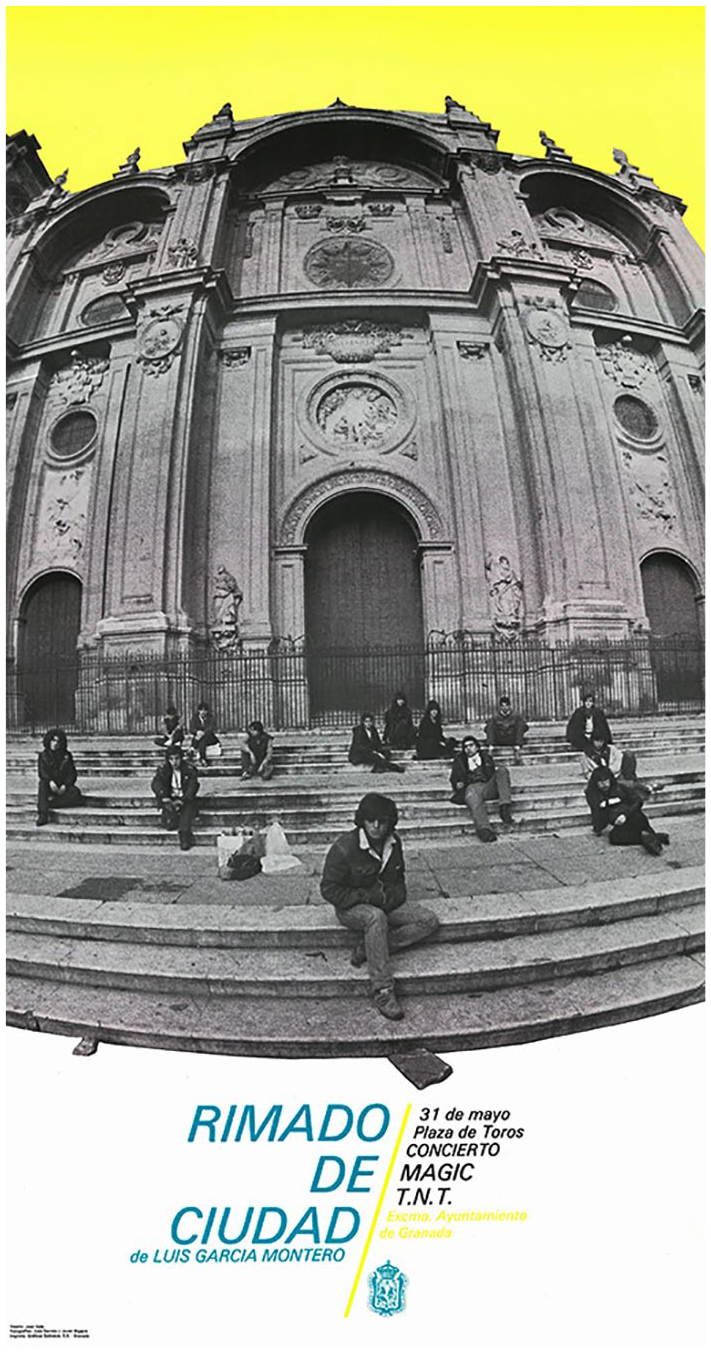
Billboard of the “Rimado de Ciudad” premiere concert. Granada, Ayuntamiento, 1983.
In contrast with this (apparently) imaginary scene, classical literary forms used by Jorge Manrique and Luis de Góngora (early Renaissance and baroque Spanish Poets, respectively) were adopted by the poet. For example, the poem Coplas to His Father’s Death by Jorge Manrique was deconstructed in Coplas to His Mate’s Death by Luis García Montero. This was dedicated to a punk hero of the street, who stained the streets of Granada with his blood: a typical character of the movida in the urban culture of the more radical Spanish cities in the eighties.
The song was composed by Jesús Arias, from
García Montero, Luis, “Coplas a la muerte de su colega” [Coplas to His Mate’s Death], Poesía Completa, 911.
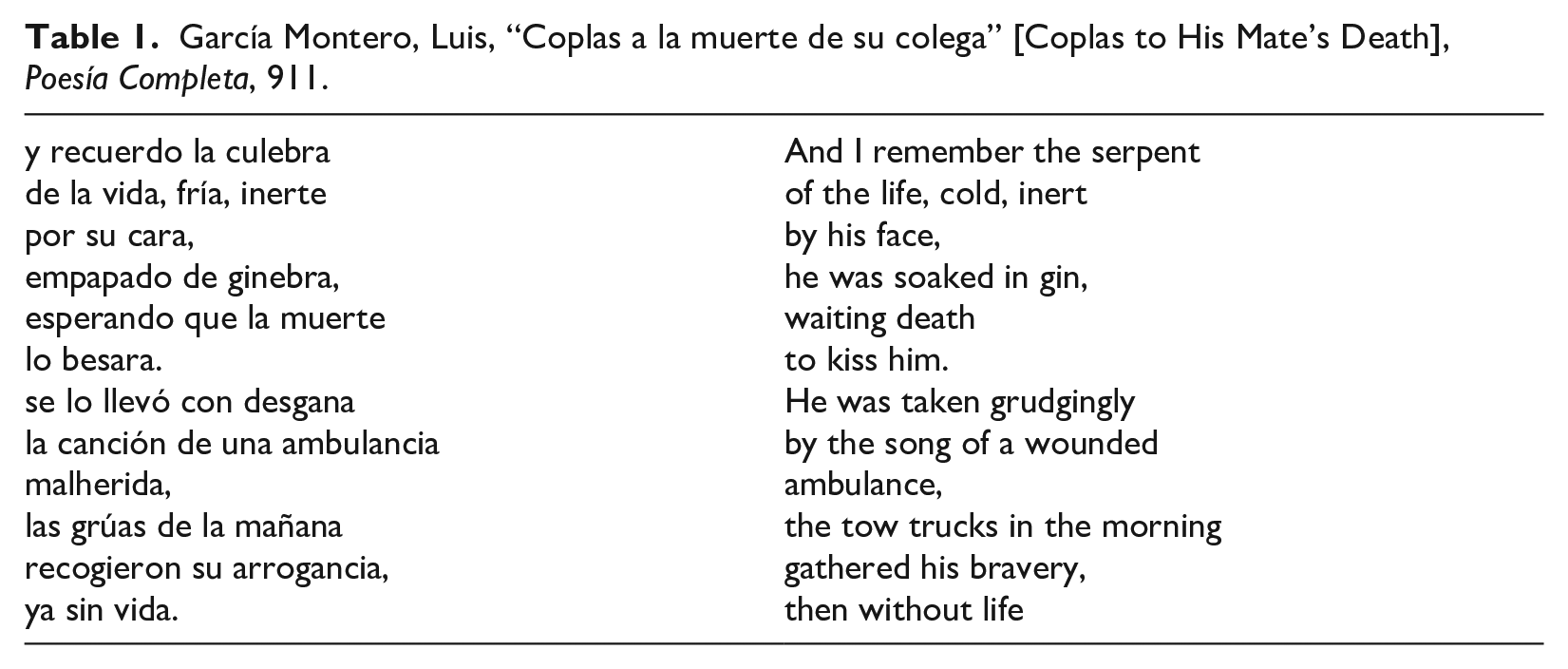
The music is intensely related to the text, including the narrative sounds of a street organ, an out of tune piano, sirens, and a shot, which led to the suggestion that
But was “the Beautiful” Granada ever really killed? Undoubtedly, Ganivet’s tag was successful and it persisted as a lament against the growing urbanization, even until today. 47 During Franco’s regime, the reconstruction of the Spanish identity signs is done through works based on the popular music of Andalusia—Albéniz or Falla—with Granada and the Alhambra as a reference. 48 At the same time, it has been widely used as a promotional strategy for tourism (closely associated with the Alhambra), has also been applied in the cultural field (to film a performance of Falla’s work 49 ), and has provided an enduring backdrop each year for the Granada International Music and Dance Festival. 50
In the years of Spain’s transition to democracy (1975-1978), a countercultural agitprop developed in Spanish cities, as the incipient cultural policies promoted by Spanish institutions failed to satisfy the citizens’ desire for freedom and for experimental culture. Experiments in music, literature, and painting began to be welcome in Granadan nights, and found their place in Planta Baja, a bar founded in 1983 (and still operating today), whose name referred to a building lower floor in a narrow, dark street in Granada.
51
Planta Baja soon became the contracultural reference point, promoting the musical avant-garde in Granada (
Footnotes
Declaration of Conflicting Interests
The author(s) declared no potential conflicts of interest with respect to the research, authorship, and/or publication of this article.
Funding
The author(s) disclosed receipt of the following financial support for the research, authorship, and/or publication of this article: The research for this essay formed part of the R+D projects ‘Microhistory of Spanish Contemporary Music: International Peripheries in dialogue [MICIN, PGC2018-098986-B-C31] and Poesía, Música y Ciudad: Cartografía Poético-Musical de la Granada Contemporánea (1898-1998) (POETICAURBE) FEDER (A-HUM-260-UGR18).
