




Abstract
The article presents the reasons for which the issue of providing housing to low-income citizens has been a real challenge in Addis Ababa during the recent years and will continue to be, given that its population is growing extremely fast. It examines the tensions between the universal aspirations and the local realities in the case of some of Ethiopia’s most ambitious mass pro-poor housing schemes, such as the “Addis Ababa Grand Housing Program” (AAGHP), which was launched in 2004 and was integrated in the “Integrated Housing Development Program” (IHDP) in 2006. The article argues that the quotidian practices of communities and their socio-economic and cultural characteristics are related to the spatial attributes of co-housing practices. Drawing upon the idea that there is a mutual correspondence between social and spatial structures, it places particular emphasis on the analysis of the IHDP and aims to show that to shape strategies that take into account the social and cultural aspects of daily life of the poor citizens of Addis Ababa, it is pivotal to invite them to take part in the decision-making processes regarding their resettlement. Departing from the fact that a large percentage of the housing supply in Addis Ababa consists of informal unplanned housing, the article also compares the commoning practices in kebele houses and condominium units. The former refers to the legal informal housing units owned by the government and rented to their dwellers, whereas the latter concerns the housing blocks built in the framework of the IHDP for the resettlement of the kebele dwellers. The article analyzes these processes of resettlement, shedding light of the fact that kebele houses were located at the inner city, whereas the condominiums are located in the suburbs. Despite the fact that the living conditions in the condominium units are of a much higher quality than those in the kebele houses, their design underestimated or even neglected the role of the commoning practices. The article highlights the advantages of commoning practices in architecture and urban planning, and how the implementation of participation-oriented solutions can respond to the difficulties of providing housing. It argues that understanding the significance of the endeavors that take into account the opinions of dwellers during the phase of decision-making goes hand in hand with considering commoning practices as a source of architecture and urban planning frameworks for low-cost housing in this specific context. The key argument of the article is that urban planning and architecture solutions in Addis Ababa should be based on the principles of the so-called “negotiated planning” approach, which implies a close analysis of the interconnections between planning, infrastructure, and land.
Keywords
Introduction
The theme of precarity of housing is central to this article given that one of the most pressing problems in Addis Ababa nowadays is the fact that, despite the galloping growth of its population, due mainly to migration from rural to urban areas, there are no sufficient housing units to accommodate low-income people. The existing housing stock of Addis Ababa has been characterized by poor condition. As Sascha Delz has remarked, in a paper delivered in the framework of the “No Cost Housing Conference” held at ETH Zürich in 2016, “almost 60% of the units within the city center were identified as dilapidated, and thus in need of substantial upgrading or total replacement.” 1 To grasp the intensity of the problem of housing shortage in Addis Ababa, it suffices to note that, as Felix Heisel notes, “Addis Ababa was burdened by a housing shortage of an estimated 700,000 units” in 2017. 2 During the last few years, the flows of internal migration from rural areas to urban ones, especially to Addis Ababa, have been increasing. Therefore, the question of providing housing is becoming even more pressing.
A large percentage of the housing supply in Addis Ababa consists of informal unplanned housing. To show the prevalence of informal housing in Addis Ababa and the urgency caused by the housing deficit, I could refer to the fact that between 1996 and 2003, 34.1 percent of the total housing supply was informal housing. 3 The enormous number of slum residents was a core issue during the COVID-19 pandemic breakout, during which many of the slum dwellers were forced to leave their housing.
Kebele Houses: Informality and the State Ownership of Urban Land
To grasp the specificity of the tenancy patterns of low-income housing in Addis Ababa, one should bear in mind that the land in Addis Ababa is owned by the government that also owns the majority of low-cost rental housing. In Addis Ababa, there are both legal and illegal types of informal housing. As Mintesnot G. Woldeamanuel notes, many of these slums, despite their precariousness, are legal and owned by the state. 4 This especially applies to the inner-city slums, which are legal, in contrast to the slums located on the outskirts, which are mostly illegal. The kebele houses—a term which refers to the legal informal housing units owned by the government and rented to their dwellers—are part of the legal forms of informal housing in Ethiopia. 5 To give some numbers regarding kebele houses, I could refer to the fact that as of 2018, “more than 40% of the population of Addis Ababa [lived] . . . in older kebele housing on land covering approximately 11% of the total area of the city encompassing 54,000 hectares” 6 (Figures 1 and 2). To understand the importance of the issue of precarious housing in Addis Ababa, one should be aware of the fact that approximately 80 percent of the housing units in Addis Ababa are informal housing. Among these informal housing units, 70 percent—the kebele houses—are owned by the government. This means that 70 percent of the slums are legal. 7
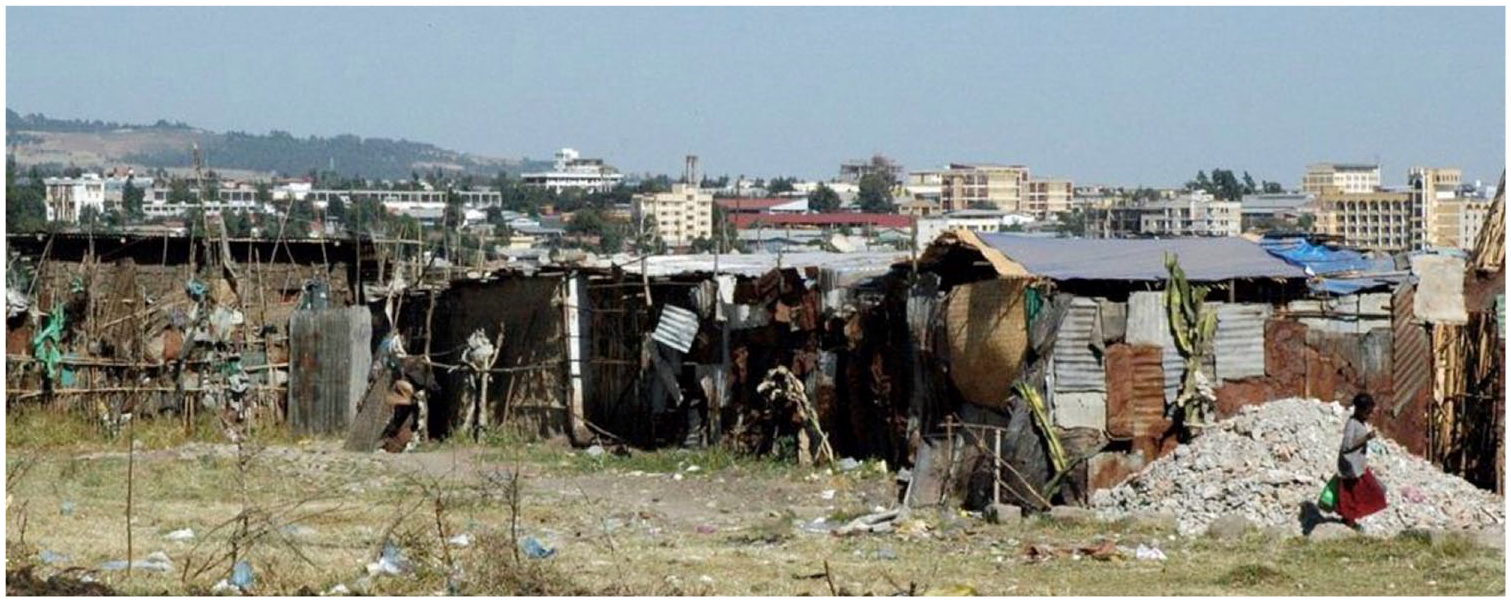
Informal housing in Addis Ababa, Ethiopia.
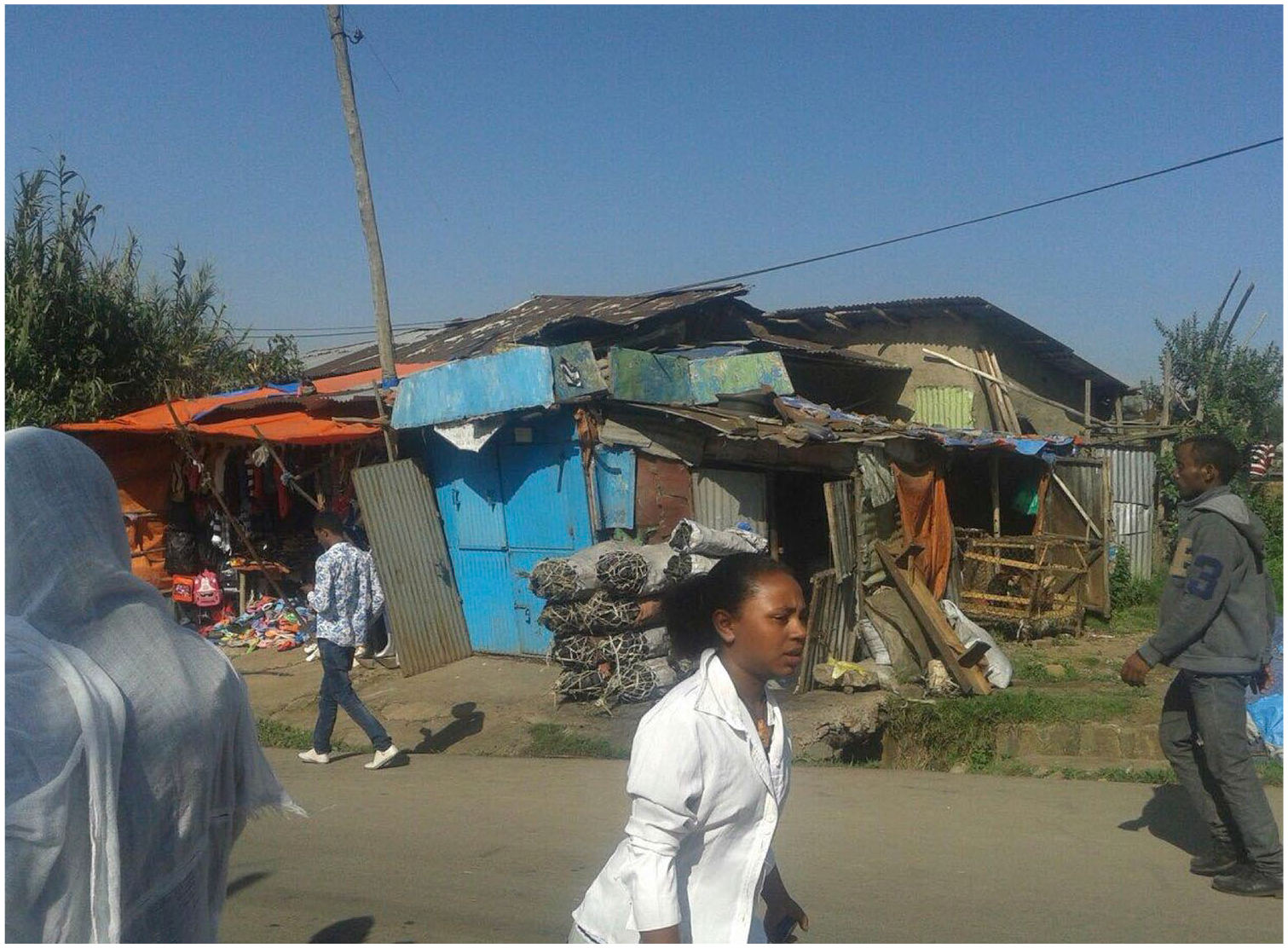
Informal housing in Addis Ababa, Ethiopia.
To render clear how the kebeles function, Jonathan Baker underscores that they “have strictly defined rights and duties and, in theory, are self-governing, democratically elected bodies.” 8 During the “Derg” regime, which was a Marxist–Leninist junta that lasted from 1974 to 1991, the land was owned by the nation, and the citizens of Addis Ababa did not have any right to buy land and build on it. Of great importance for understanding the status of precarious housing in Addis Ababa is the way the “Urban Dwellers’ Associations” (UDA) functioned. These associations, which were previously named “co-operative societies,” “were organised at three levels: at the local or kebele, the higher and central levels.” 9
According to a report of UN-Habitat published in 2011, “[t]he majority of low-income Ethiopians reside in rented kebele housing.” 10 As Felix Heisel mentions, “[k]ebeles fulfil a variety of administrative functions in today’s Addis Ababa,” such as “registering and identifying inhabitants and providing food assistance, referrals to health care and schools or access to state-distributed resources, kebele officials run community courts, local prisons and in some places even local militia.” 11 The most relevant function of the kebeles for this article is the fact that apart from the functions mentioned above, they also “manage and rent land and low-cost housing.” 12
Important for understanding how precarious are the living conditions in the kebele houses and in the informal housing in Addis Ababa, in general, is the fact that a quarter of the existing housing units do not have toilets. In addition to this, the supply of water and electricity is far from sufficient. Another characteristic of the informal housing in Addis Ababa is the high density of the housing units. According to Keith Griffin, in 1992, “[i]n Addis Ababa, in one-third of the city, density . . . [was] 400 people per hectare.” 13 Despite the fact that the very high density contributes to the precariousness of the living conditions, it has also certain advantages, such as the sharing of natural resources, which are very limited in the case of Addis Ababa, and the enhancement of close social interactions, which are very important within the context of low-income communities, which constitute a large part of the population of Addis Ababa.
The Transformation of Addis Ababa and the Migration from Rural to Urban Areas: The Land Reforms of the “Derg” Regime
Another characteristic of Addis Ababa and of Ethiopia, in general, that is of great significance is the fact that the internal migration from the rural to the urban areas is a relatively recent phenomenon. This internal migration will increase significantly during the years to come due to the fact that Addis Ababa is not only a financial center, but also a diplomatic capital. The inner city of Addis Ababa “has gained international significance as the headquarter of the African Union (AU), UN Economic Commission for Africa (UN-ECA) and a regional office for a number of international organizations including UNDP, UNESCO and the European Economic Commission (EEC).”
14
To understand the significance of the transition from a rural status to an urban one in Ethiopia, one should take into consideration that, in 1984, 88.7 percent of its population was classified as rural.
15
Christopher Clapham explains, in Transformation and Continuity in Revolutionary Ethiopia, how [t]he land reform of April 1975 made all rural land the collective property of the Ethiopian people [, and] . . . abolished all existing forms of tenure, together with all dues on land and all litigation relating to it.
16
He also examines how this land reform “restricted the size of family holdings to a maximum of ten hectares . . . and prohibited the employment of hired labour on land.” 17
The fact that, during the “Derg” regime, home ownership was restricted to one house per household is pivotal for understanding why living conditions in the kebele houses tare deteriorated. Jonathan Baker, in “The Growth and Functions of Small Urban Centres in Ethiopia,” sheds light on the fact that the “Derg” regime “quickly introduced one of the most radical urban and rural land reforms ever attempted in Africa.” 18 He explains how two proclamations passed by the “Derg” regime, in 1975 and 1976, respectively, significantly transformed the ownership of urban land and housing, nationalizing it. These two proclamations are Proclamation No. 47 (1975) and Proclamation No. 104 (1976). Baker also remarks that “[a]ll land within the boundary of a municipality or town is covered by this legislation and the centrepiece of urban is the Urban Dwellers’ Association (UDA) or kebele.” 19
To grasp the situation regarding the nation-owned land during the “Derg” regime, one should take into account the implications of the 1975 proclamation according to which all urban land passed to state ownership. The proclamation known as “Public Ownership of Rural Lands Proclamation No. 31/1975,” was divided into six chapters: Introduction; Public Ownership of Rural Lands; Establishment of Associations for the Implementation of the Proclamation; Powers and Functions of the Minister of Land Reform and Administration; Communal and Nomadic Lands; General Provisions.
20
Due to this proclamation, the rents of the kebele houses became much lower. As has been highlighted by Felix Heisel, following the nationalization of land by the “Derg” regime, dwellings that used to collect more than 100 birr in rent were given over to the management of the Agency for the Administration of Rented Houses, while all units worth less than 100 birr per month were given to the kebeles.
21
The Integrated Housing Development Program (IHDP) and the Promotion of Individual Homeownership
The Ethiopian government and the German Technical Cooperation (GTZ) 22 collaborated to establish a mass housing program in Addis Ababa. This collaboration included the “Low Cost Housing” (LCH) program, which was launched in 1999 with a bilateral agreement between the GTZ and the Ministry of Federal Affairs of Ethiopia. 23 The main objective of the LCH program was the implementation of solutions based on the use of “simple technology to promote housing construction.” 24 The GTZ’s operation in Ethiopia was nothing new, as it had already existed “for many decades, primarily in providing technical support and building capacity in building construction.” 25
In 2005, the City Administration of Addis Ababa initiated a large-scale housing development project to address urban poverty and improve the living conditions of low- and middle-income residents. This project was named IHDP. Its main objective was to promote home ownership for low-income households. The project was based on the idea that the “[s]uccessful applicants [would] pay only for the construction costs of their unit and the government [would provide] . . . the land.” 26 It intended to “enable low-income residents to become house owners and thereby ensure fair distribution of income, and create [a] conducive environment for development.” 27 To do so, it offered the possibility to the “successful applicants[, who are selected according to a lottery,] to pay only for the construction costs of their unit and the government provides the land.” 28 According to an annual report of the Ministry of Urban Development and Construction of Ethiopia published in January 2009, “150,000 housing units have been built in 54 towns under the IHDP . . . of which 60,000 housing units are built in Addis Ababa.” 29 According to UN-Habitat, the IHDP’s main goal “was to construct 400,000 condominium units, create 200,000 jobs, promote the development of 10,000 micro—and small—enterprises, enhance the capacity of the construction sector, regenerate inner-city slum areas, and promote homeownership for low-income households.” 30
Another program that is worth mentioning is the so-called “Addis Ababa Grand Housing Program” (AAGHP), which was launched in 2004 and was integrated in the IHDP in 2006. This program aimed “to reduce the overwhelming housing backlog, estimated at about 300,000 housing units, and to replace 50 percent of the 136,330” 31 kebele houses. In parallel, the AAGHP intended to help condominium dwellers to get used to the new living conditions after their resettlement. For this purpose, it published two guides that aimed to help condominium dwellers to adapt their mindsets to the new modes of inhabitation. 32
As can be read in a report concerning the IHDP published by UN-Habitat in 2011, “the promotion of individual home-ownership in low-income countries for poverty alleviation is nothing new.” 33 In other words, the IHDP was conceived as an urban renewal program that would promote the demolition of the kebele houses and the use of the land in which they were previously located for the construction of new condominium units by investors and international companies. It was based on the idea that the first 20 percent initial payment would be paid at the moment of entry to the condominium unit, whereas the rest is facilitated from the bank for twenty years payment back (20/80 scheme). The Pilot Project of the IHDP was a group of condominium units built in the site named Bole gerji. One of the largest housing projects within the context of sub-Saharan Africa is the condominium units that were built in the site of Koye Feche, also within the framework of the IHDP (Figure 3). Thousands of condominium units were built in this site under the government’s so-called 20/80 scheme (Figure 4). To grasp the scale of the IHDP, I could mention that condominiums were built in approximately one hundred different sites throughout the city of Addis Ababa, changing once and for all its urban character (Figures 5 and 6). To understand the transformation of Addis Ababa’s periphery due to the construction of condominium units, it is useful to think that between 2006 and 2016 the area of condominium housing increased to occupy 11 percent of the area of the city. 34 In addition, the condominium units built until April 2019, in the framework of the IHDP, correspond to “approximately 175,000 units.” 35
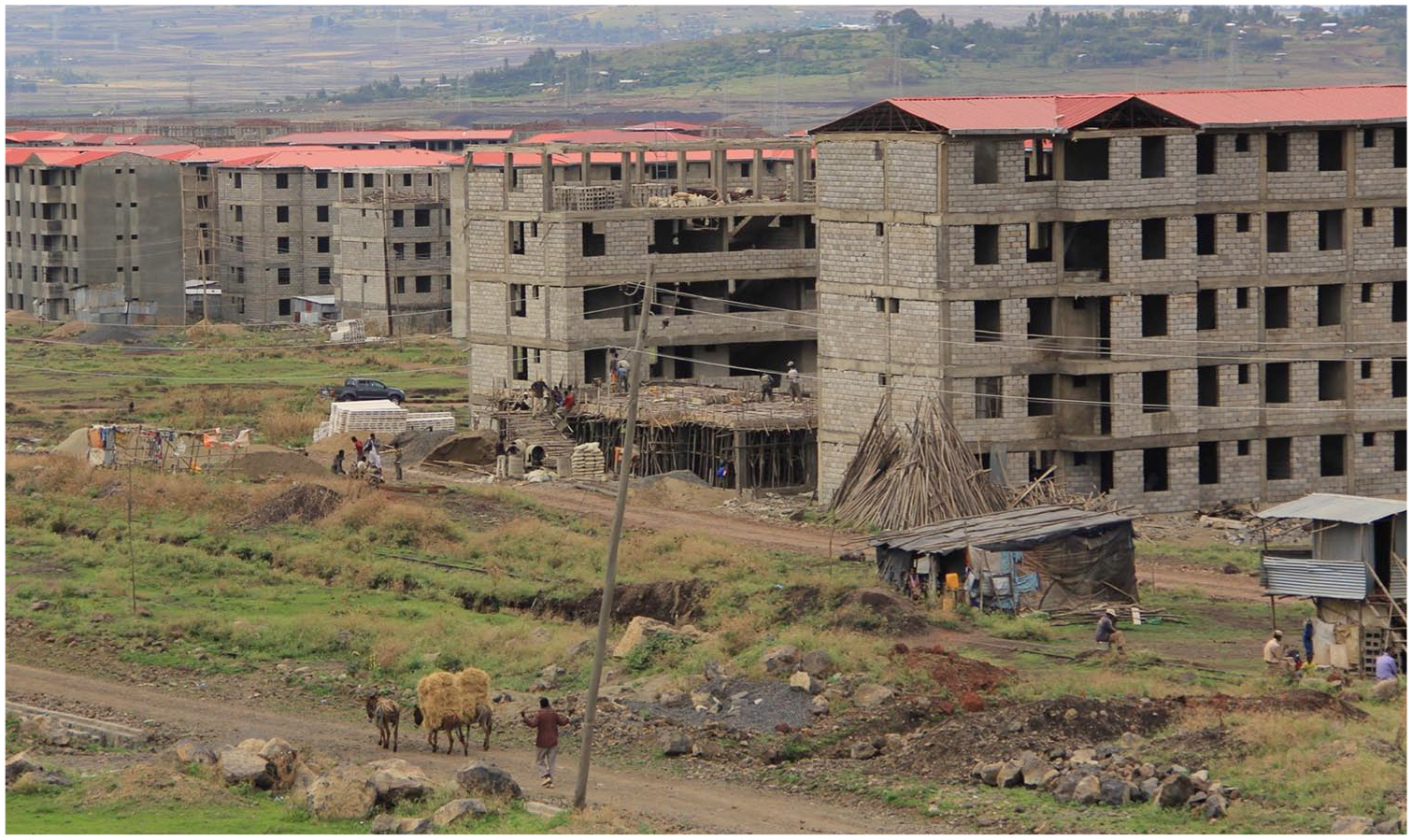
Condominiums built in the framework of the IHDP, Addis Ababa, Ethiopia.
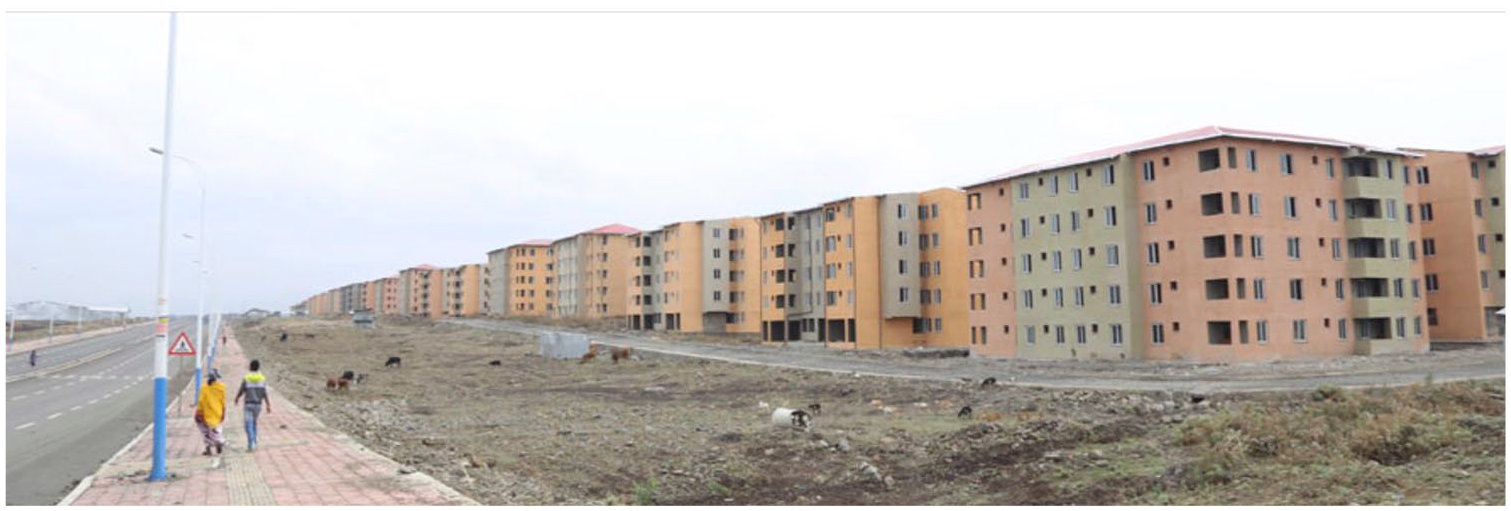
Condominiums built in Koye Feche in the framework of the IHDP, Addis Ababa, Ethiopia.
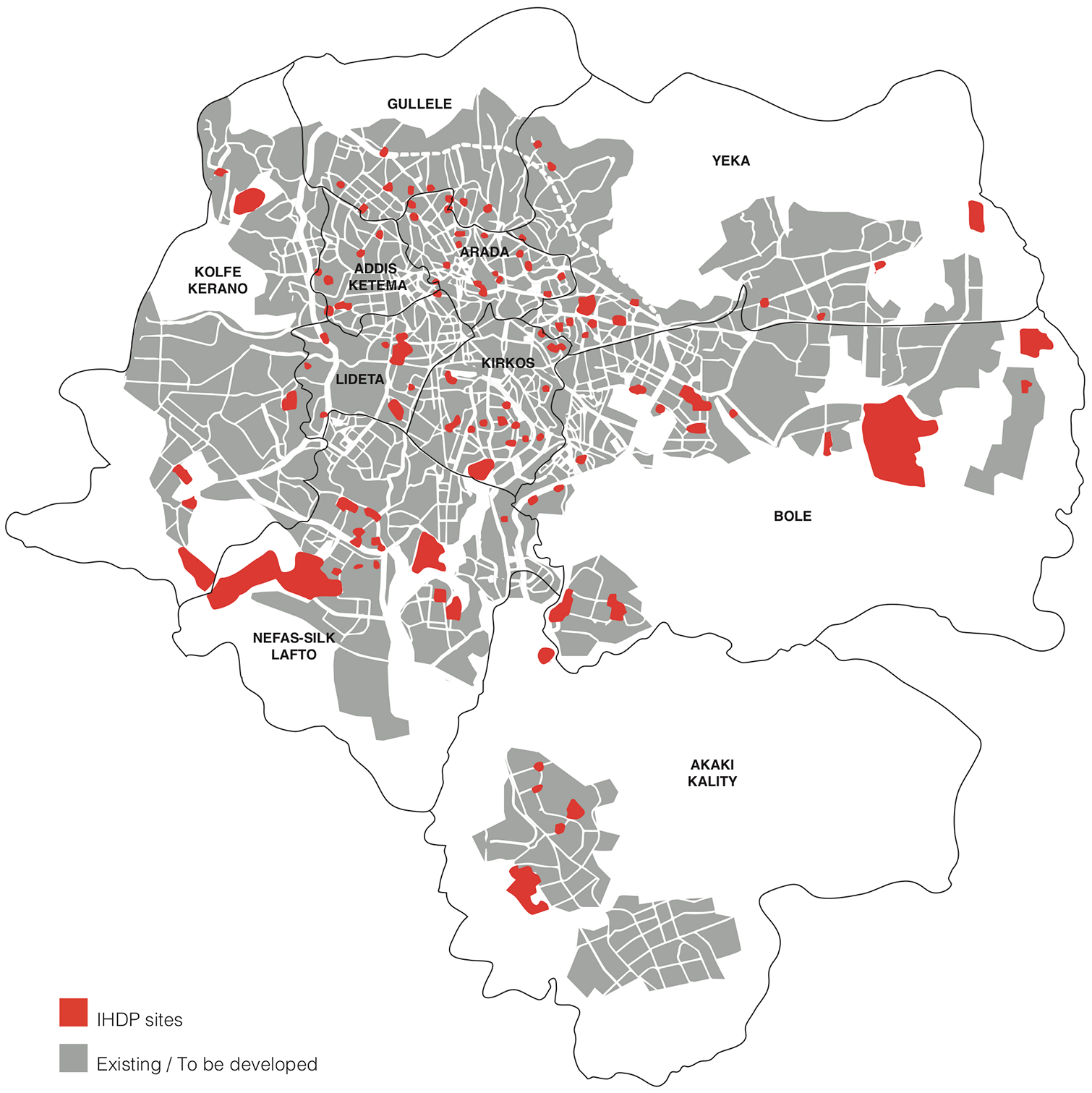
Plan: EiABC master plan evaluation—housing component (2010) (color adjusted by Sascha Delz).
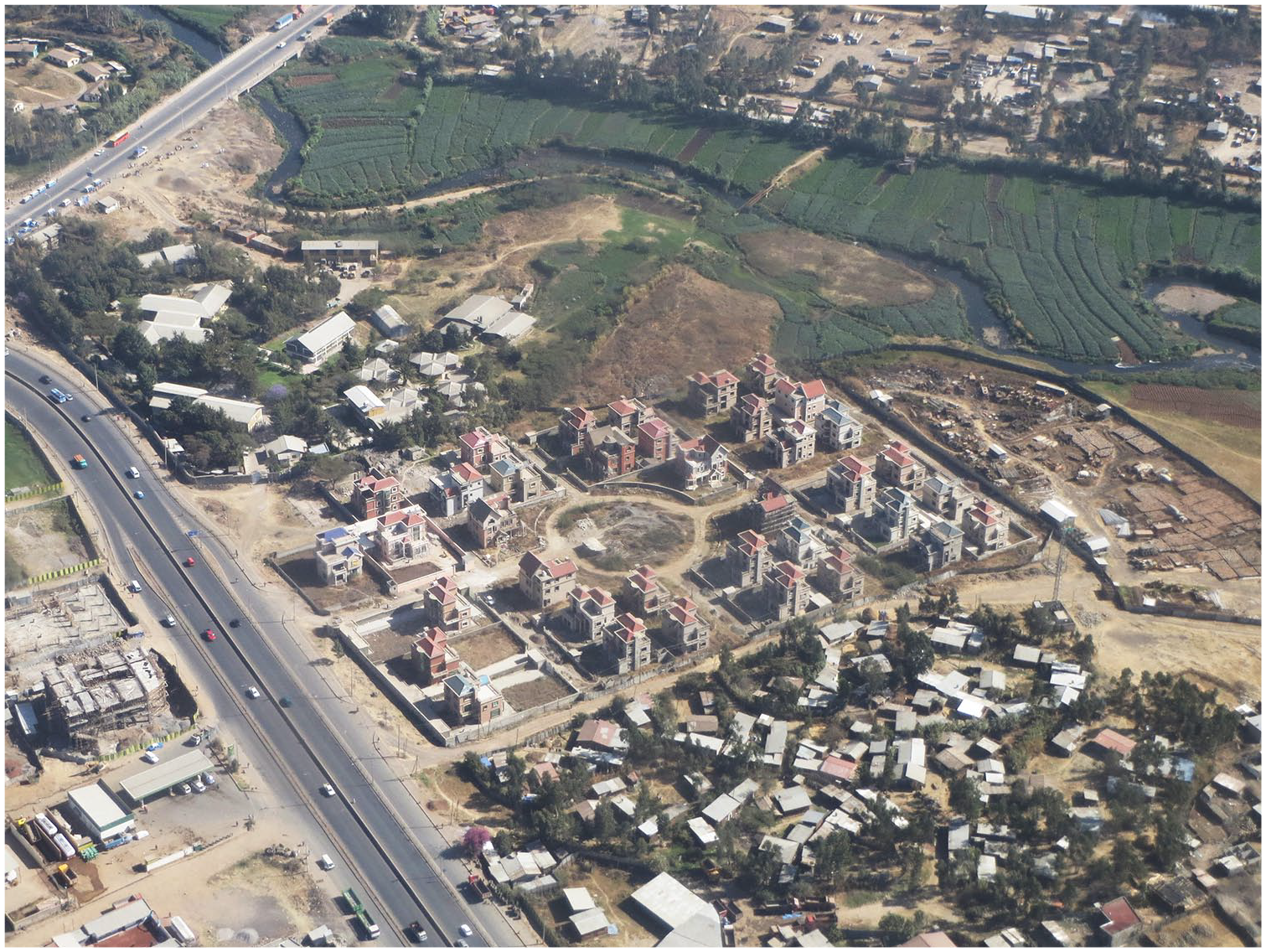
Urban and landscape transformations, Addis Ababa, Ethiopia, 2016.
From Kebele Houses to Condominiums: The Myth of Social Mobility
Despite the fact that the living conditions in condominiums are of much higher quality than those in kebele houses, in many cases, the role of the commoning practices and the public or shared spaces that facilitate these practices were underestimated or even neglected. The fact that only former legal kebele renters have the right to take part in a lottery process, which provides to a group of low-income citizens the possibility to become the owners of condominium units, is pivotal for understanding how the process of migration from kebele houses to condominium units work. What should be underscored is the fact that many dwellers of the kebele houses that were selected through the lottery process are not able to afford the down payment. This explains why, despite the fact that they had the possibility to move to alternative kebele houses, in many cases, they chose to borrow money to pay the down payment of the condominium unit they have been offered. This creates many financial difficulties and forces them to rent their condominium unit to higher income classes and continue living in a kind of informal housing elsewhere.
Both kebele houses and condominiums constitute co-housing practices. However, they are characterized by certain differences as far as their access to commoning practices is concerned. The approach adopted by the IHDP is top-down and has been criticized for not taking into account the social capital and habits of former kebele dwellers. An issue that should be highlighted is the fact that the daily life in the condominium houses is very distant from the lifestyle and the habits of the inhabitants of the kebele houses. As a result, moving to the condominiums, the former inhabitants of the kebele houses are forced to live in a way that does not take into account or extend their social and cultural habits in the kebele houses. In this sense, the condominium units fail to accommodate not only their spatial practices, but most importantly their social habits. A significant challenge to which the government of Addis Ababa should try to respond is the establishment of strategies able to offer the possibility to promote home ownership without, however, neglecting the sense of collectivity characterizing the quotidian life in the kebele houses.
Despite the efforts of the UN-Habitat to support a narrative claiming that the condominium houses offer the possibility for social mobility, in reality, this is not always the case. In many cases, the condominiums are, in the end, inhabited by middle-income citizens instead of low-income ones. Even if the IHDP was originally conceived as a pro-poverty housing program, very often, the low-income owners of the condominium units are forced to rent their apartments to middle-income residents. This shows that the social classes of the condominiums are in a state of becoming. In certain cases, the resettlement in the condominium units offers, to a certain extent, social emancipation due to its break with the previous mechanisms of inhabitancy and dependency. However, a close examination of what really happens can reveal that often this is not the case. The expenses related to the down payments and the construction works of the unfinished living units, and the necessity to travel back and forth to the inner city of Addis Ababa, where their previous sources of income are located, make the living conditions in the condominiums precarious. For the aforementioned reasons, the former dwellers of the kebele houses are forced to sublet the living units to which they gained access through the system of lottery. As Delz remarks, “the program has failed to provide wide-spread affordable housing to the targeted low-income groups.” 36 The particularity of the urban redevelopment strategies in Addis Ababa lies in the fact that, in contrast with the majority of the “new city” approaches, it incorporated and permitted the construction of low-income housing. The IHDP contributed significantly to the acceleration of the production of social housing in Ethiopia. However, despite the fact that the IHDP “has allowed to build respectable quantities unseen in Ethiopian history, it has simultaneously caused fairly questionable social and spatial outcomes.” 37
From the “Derg” Regime to the Neoliberal Agenda
The “Derg” regime was overthrown in 1991 by the Ethiopian People’s Revolutionary Democratic Front (EPRDF), which is considered neoliberal, as Sabine Planel and Marie Bridonneau remark. 38 The neoliberal character of the EPRDF should be taken into consideration when one tries to decipher the political and financial agenda of the IHDP. According Planel, Bridonneau, and Fassil Demissie, the neoliberal political project of the EPRDF, which is based on the privatization of the economy, has been ineffective in addressing the problems characterizing the living conditions of slum dwellers. 39
The transition from the “Derg” regime to the EPRDF is related to the mutation of the land tenure practices. Planel and Bridonneau draw a distinction between social capital and financial capital to refer to what has been neglected in the case of condominiums. 40 To grasp the urgency of the issue of displacement for the dwellers of kebele houses, it would be useful to refer to the fact that, during the last years after the implementation of IHDP in 2005, “some people move house every year and each time they are driven further out of the most central neighbourhoods.” 41
The quotidian life in kebele houses was characterized by the pervasive presence of common spaces and facilities. This means that the shift from inhabitation in kebele houses to condominiums is related to the transition from a mode of life characterized by an intense presence of the commoning practices to a lifestyle and a mindset in which the role of commoning practices becomes much less primordial. For instance, an important aspect of daily life in kebele houses related to the key role of commoning practices in daily life, which was neglected in the design of condominiums, is the intense presence of coffee ceremonies. The significance of these ceremonies lies in the fact that they play an important role for the creation of close social bonds among the citizens. Mintesnot G. Woldeamanuel has shed light on the importance of coffee ceremonies for the social life of the Ethiopians, remarking that coffee was discovered in Ethiopia, in a place called “Kaffa.” Woldeamanuel also notes that “[h]istory tells us that slum removal has never been a successful strategy in itself.” 42
The strategy of relocating the inhabitants to low-cost housing units situated in the urban periphery is not a phenomenon encountered only in Addis Ababa, but is a rather global phenomenon. The roots of this strategy are found in modernism. A particular characteristic of Addis Ababa, which is at risk of being lost in years to come, because of the displacement of the kebele houses dwellers, is its urban social mixture. In other words, the co-habitation of rich and poor in the inner city of Addis Ababa was a characteristic that has given to this city its heterogeneous character.
Pivotal for understanding the dynamic transformation of the urban fabric of Addis Ababa is the dynamic tension between formal and informal tenancy patterns. One of the reasons that the political agenda of the IHDP should be problematized and even criticized is the fact that it promotes the demolition of several kebele houses located in the inner city of Addis Ababa. This raises serious problems given that “[t]he inner-city kebele neighbourhoods in Addis Ababa are characterised by a high degree of socio-economic interdependence among their inhabitants.” 43 To grasp the status of the kebele houses, one should take into consideration that it is a kind of “state-owned informal housing, and today comprises much of Addis Ababa’s inner city.” 44
The Lack of Sufficient Natural Resources and the Expansion of the City
Another matter that characterizes the living conditions in Addis Ababa is the fact that its citizens have to face in their everyday life the problems that emerge due to the lack of sufficient natural resources. Conflicts over natural resources do not only characterize the Ethiopian context, but the so-called Global South in general. 45 The lack of sufficient natural resources in Addis Ababa is among its most pressing issues. For instance, there is a significant lack of drinking water. The problem of water shortage becomes extremely pressing during the dry season. As Katrina Stoll remarks, in “Water Harvesting,” “[i]n Addis Ababa, well over one-third of the city’s demand for potable water is not currently met.” 46 Despite the fact that the aforementioned text by Stoll was published in 2016, the situation has not improved much since then. The expansion of the city and the construction of several condominium complexes in its periphery makes the problem of the lack of sufficient potable water far more difficult to resolve. Moreover, the government does not appear to have taken satisfactory measures to solve the problem of water shortage, as is evidenced by the fact that “between 1998 and 2004, 30 percent of water supplied by the city was lost as a result of leakage, which the city did not take action to correct.” 47 Three different aspects are related to the problem of water shortage in Addis Ababa: first, its cleanliness; second, its accessibility; and, third, its management. All these aspects are closely connected to the lack of sufficient infrastructure and should be taken into account when one addresses the issue of pro-poverty housing programs in Addis Ababa.
In regions with limited natural resources, high density is helpful. Hany Abo-El-Wafa, Kumelachew Yeshitela, and Stephan Pauleit note that “[h]igh-density settlements would help to preserve natural resources, maintain food supply by land and increase the potential to service smaller areas with infrastructure.” 48 Similarly, Peter Newman and Jeffrey Kenworthy, in Sustainability and Cities: Overcoming Automobile Dependence, relate the question of density to the issue of energy consumption, maintaining that “land use and urban form of cities are . . . fundamentally shaped by priorities in transportation.” 49 Apart from the benefits concerning the decrease of energy consumption, density also helps in the enhancement of social interactions, which constitute a significant aspect of the social capital within contexts where poverty is very present, as in the case of Addis Ababa.
Urban Renewal Policies and the Decrease of Density and Public Spaces in the Inner City of Addis Ababa
The urban renewal strategies that were implemented in the framework of the IHDP have changed once and for all the special character of the inner city of Addis Ababa. Despite the fact that their main intention is to make the city center more welcoming the foreigners who visit the city, given that Addis Ababa is a diplomatic center, these renewal strategies have resulted in the transformation of areas such as Lideta and Kasaches, which were important neighborhoods of the inner city of Addis Ababa and played a significant role in its vividness and the sharing of urban commons. These urban renewal strategies are accompanied by changes in the regulations concerning the buildings’ heights in the city center, offering the possibility erect buildings far taller than previously. An important instance for the implementation of the urban renewal policies was the founding of the Master Plan Revision Office in 2012. All the measures that have been taken by this office have contributed not only to the decrease in density of the inner city of Addis Ababa but also to the decrease of the public spaces, which were indispensable for the social interactions of the citizens. It thus becomes evident that the search for alternative more bottom-up and more participation-oriented strategies of planning is indispensable in the case of Addis Ababa. Another parameter that further explains why the existing urban renewal strategies do not contribute to the improvement of the citizens’ living conditions on a satisfactory level is the fact that kebele dwellers are informed very shortly before their displacement about their obligation to move.
Given that Addis Ababa has to face many difficulties related not only to the city’s limited resources but also to its underdeveloped transport infrastructure, the solution of building new condominium complexes at the outskirts of the city does not constitute the most efficient solution, or, at least, this solution should be conceived in conjunction with other projects regarding transport infrastructure and the creation of public space. The fast population growth of Addis Ababa makes the issue of restrained natural resources even more pressing. The question of limited natural resources should be understood in conjunction with the problem of social instability. The same is also valid for the question of limited transport infrastructure, since “infrastructural systems are not exclusively technical but also social in nature, or ‘socio-technical’ constructions.” 50
Another type of problems that should also be addressed are those related to the professional activities of the citizens of the condominiums and the economy of Addis Ababa in general. It is worth mentioning that the income of the majority of the kebele houses dwellers depended on small-scale trading activities that took place within the neighborhoods of the kebele houses. As Heisel remarks, “[m]any inhabitants of the condominium blocks have been displaced or moved from their former life style where they depended on micro-enterprises.” 51 With their displacement to the condominiums, the former kebele houses dwellers are forced either to leave behind these activities or to spend a large part of their limited income on their transportation back and forth to the inner city. The former kebele dwellers, once they move to condominiums, lose their main source of income because they are forced to quit their professional activities that were closely related to their quotidian life in the inner city, such as the selling of injera, a typical bread of the region, or other kinds of commercial activities based on their placement in the city center.
Apart from the issue of the distance of the condominiums from the city center, another problem linked to the displacement of the poor citizens of Addis Ababa from the kebele houses to the condominiums is related to the very architecture of the housing blocks. The dwellers of kebele houses based their income-generating professions on activities that take place on the ground floor and in connection with their life in the kebele houses, as, for example, in the case of the baking and selling of the injera. Another problem, which is also related to the very architecture of the condominium complexes, is the lack of integration of the building blocks to their urban environment. The way the condominium blocks are designed does not create any sense of neighborhood and the living conditions in them are not characterized by the inhabitation of common outdoor spaces.
Around the Notion of “Urban Commons”: Commons or Commoning?
The notion of commons is useful for shedding light on the shared codes and conventions characterizing the production of co-housing practices in Addis Ababa. Useful for understanding the notion of commons is David Harvey’s critique, in “The Future of Commons”, 52 against Garrett Hardin’s approval of privatization in “The Tragedy of the Commons.” 53 Harvey also refers to Elinor Ostrom’s Governing the Commons, highlighting that the latter focused her reflection mainly on natural resources. 54 He remarks that all resources are socially defined in the sense that they are always related to technology, economy, and culture. Starting off with Harvey’s aforementioned view of the commons beyond their reduction to natural resources, it would be useful to understand the “urban commons” as a network of technological, economic, and cultural parameters. John Bingham-Hall’s remark, in “Future of Cities: Commoning and Collective Approaches to Urban Space,” that the notion of the common “suggests a community of commoners that actively utilise and upkeep whatever it is that is being commoned” 55 can help us better grasp how commoning practices promote the sense of community. Mintesnot G. Woldeamanuel’s endeavor to shed light on the social benefits of slums is useful for understanding how the commoning practices they enhance are related to the social capital they provide. 56
A tension that is useful for better grasping the notion of commons is the interrogation regarding the understanding of commons as community or as public space. Understanding the commons as community implies that community is conceived as a homogeneous group of people, whereas comprehending the commons as public space is based on the intention to take into consideration the relation between heterogeneous communities. A question that emerges is whether, in the case of Addis Ababa and the social capital of its poor citizens, it would be more compatible to understand the commons as public space or as community. Useful for responding to this question is Jeremy Németh’s definition of the commons, in “Controlling the Commons: How Public is Public Space?” as “any collectively owned resource held in joint use or possession to which anyone has access without obtaining permission of anyone else.” 57 Given that the inner city of Addis Ababa is characterized by a great social mixture, it seems that the model of interpretation of the commons that based on an understanding of them as public space is more suitable.
Another aspect that is useful for responding to the question whether understanding commons in Addis Ababa as public space or community is more convenient is the replacement of the notion of commons by that of commoning, which has been examined by Patrick Bresnihan, in “The More-than-human Commons: From Commons to Commoning.” Bresnihan underscores that “[t]he noun ‘commons’ has been expanded into the continuous verb ‘commoning,’ to denote the continuous making and remaking of the commons through shared practice.” 58 Another remark that could help us better grasp the impact of commoning practices on the relations between citizens is Stavros Stavrides’s claim that “[c]ommoning practices importantly produce new relations between people.” 59
What is worth mentioning regarding the role of commons within the context of capitalism is the following remark by Michael Hardt and Antonio Nergi, in Commonwealth, regarding the expansion of commons: “Contemporary forms of capitalist production and accumulation in fact, despite their continuing drive to privatize resources and wealth, paradoxically make possible and even require expansions of the common.” 60 Hardt and Negri employ the notion of the common to refer not only to the natural resources such as “the earth we share but also the languages we create, the social practices we establish, the modes of sociality that define our relationships, and so forth.” 61
Michael Hardt and Antonio Nergi’s intention to think the notion of the common(s) in conjunction with the concept of urbanity is evidenced by their claim that “the metropolis . . . [is] a factory for the production of the common.” 62 Beginning with an understanding of the inner city of Addis Ababa as a factory for the production of the urban commons, and taking into account that more than 40 percent of the population of Addis Ababa lives in kebele houses, it is thought-provoking to reflect upon the ways in which the commoning practices characterizing daily life in the kebele houses contribute to the production of urbanity. Conceiving space as commons goes hand in hand with shaping strategies of urban planning that go beyond the distinction between public and private space.
Karl Marx, in his Critique of Hegel’s Philosophy of Right, notes that “at its highest point the political constitution is the constitution of private property.” 63 Hardt and Negri, starting out from Marx’s understanding of property, remark that “[p]rivate property in its capitalist form . . . produces a relation of exploitation in its fullest sense.” They also underline that the relations of exploitation in capitalism are based on “the production of the human as commodity,” on one hand, and the exclusion “from view the materiality of human needs and poverty,” 64 on the other hand. Hardt and Negri, in Commonwealth, redefine the poor as follows: “The poor . . . refers not to those who have nothing but to the wide multiplicity of all those who are inserted in the mechanisms of social production regardless of social order or property.” 65 They highlight that “the multitude of the poor is a real and effective menace for the republic of property.” 66 They also mention that among the practical maneuvers aiming to divide the poor and to deprive “them of the means of action and expression, and so forth” are the “efforts to tame, undermine, and nullify . . . [their] power.” 67
Toward the Participation of Local Communities in the Processes of Decision-Making
Since December 2001, the World Bank—The International Bank for Reconstruction and Development (IBRD), which is a global development cooperative owned by 189 member countries—has adopted a revised Operational Policy concerning involuntary resettlement based on three core objectives: first, “to avoid or minimize adverse impacts and to conceive and execute resettlement activities as sustainable development programs”; second, “[t]o give displaced persons opportunities to participate in the design and implementation of resettlement programs”; and, third, “[t]o assist displaced persons in their efforts to improve their livelihoods and standards of living, or at least to restore these to pre-project levels.” 68 To understand whether the methods implemented in the framework of the IHDP are efficient in their endeavor to respond to the problem of the housing deficit in Addis Ababa, it is important to shed light on the political and ideological implications of the transition from the centralized model of governing of the “Derg” regime toward a more decentralized model of governing characterizing the political agenda of the EPRDF. Decentralization, in various cases, has been conceived as a way to shape pro-poor strategies. 69 However, decentralization, despite its capacity to contribute, to a certain extent, to the reduction of poverty, entails many risks, which are closely connected to threats to the commoning practices characterizing the daily life of citizens, especially those concerning their co-housing practices.
To shape strategies of urban resettlement that respect the social capital of the citizens, it is important to enhance the participation of local communities in the processes of decision-making. 70 Within such a context, participation can and should be understood as an anti-poverty mechanism. A main issue that characterizes the existing situation during the decision-making processes concerning the condominium units built in the framework of the IHDP is the absence of socioeconomic surveys preceding not only the selection of the sites in which the condominiums are built but also their design and the design of the outdoor spaces that surround them. The Land Administration Authority should further elaborate its strategies to respond to these needs.
The Local Development Agency of Addis Ababa aspired to implement Local Development Plans (LDPs) to respond to the citizens’ needs. In the LDP Manual published in September 2006, one can read that among the key principles of the LDPs were participatory planning and sustainability. The aforementioned manual places particular emphasis on the core role of public participation, arguing that the participation of the different stakeholders would enhance the “sense of ownership among key stakeholders and [would provide] . . . opportunities to capture the interest of the community at large.” 71 The role of the LDPs has been menaced recently, given that the Addis Ababa City Caretaker Administration has issued a directive that enables land leasing and construction without the prerequisite to respect the LDPs. The reflections that are developed in this article regarding the particularities of kebele houses and the IHDP aim to show that the participation-oriented strategies to be established should draw upon a threefold understanding of sustainability aiming to take into consideration social, technological, and environmental aspects and interactions between them. 72
The use of local materials and building methods for the construction of new housing complexes for the low-income citizens is one of the main aspects on which these strategies should be focused. The materials that were used for the construction of the kebele houses are “mud, corrugated, HCB or Asbestos,” whereas “[t]he most used material . . . is mud.” 73 The local name that is used for the material that results from the mixture of mud and straw is chika. 74 To understand the prevalence of the use of chika as the main building material for the construction of housing in Addis Ababa, it suffices to think that as of 2017, 70.8 percent of the housing units were made of chika. 75
In the case of the construction of condominiums in the framework of the IHDP, the most used materials are “reinforced concrete for structural element, hollow block and fired brick for wall, corrugated iron sheet for roof, and masonry for trench foundation are very usual,” 76 whereas recently compressed stabilized earth block and/or Hydraform have started being used for the construction of their walls. In parallel, other materials that are used in the construction of the condominiums are corrugated mica, clay, and metal sheets for the roofs. Katrina Stoll, in “Cement Dreams,” sheds lights on the difficulties of acquiring cement in Ethiopia, noting that “the demand for cement will continue to rise 15-20 percent each year.” 77 To realize how predominant is the demand for cement in Ethiopia, one should call to mind that more than one-third of the cement needed in Ethiopia is imported from the Middle East. More specifically, almost half of the total supply of cement is imported from Yemen and Pakistan. The problem of the production of cement in Ethiopia is closely related to the production of electricity given that cement manufacturers and factories are among the most important high-energy consumers in the country. The government of Ethiopia has set the goal of increasing the production of cement in the country by 300 percent and, as a result of this, twenty-four new cement factories were established throughout the country.
Another aspect that is pivotal for the establishment of urban resettlement strategies that intend to respect the social capital of the inhabitancy patterns of the citizens is the respect for the relationships between their social and cultural habits and the most predominant housing typologies. This aspect was also neglected during decision-making regarding the typologies that one encounters in the condominium units that were built in the framework of the IHDP. A text that is of great significance for realizing is the importance of respect not only for local modes of construction but also for the dominant typologies in Addis Ababa is Felix Heisel’s “Housing Typologies: A Case Study in Addis Ababa,” where the author argues that “[i]n an indigenous city that grew mostly unplanned since its foundation, architects can learn not only a great deal about city planning, but even more about social networks, interaction of space and cultural habits.” 78 As Yonas Alemayehu Soressa and Imam Mahmoud Hassen point out, in “Inner-City Dwellers and Their Places in the Context of Addis Ababa’s Urban Renewal,” “there is a need for urban development to shift its focus and priorities from individual households to compounds and neighborhoods if the goal is to aid the poorest urban residents.” 79
Two aspects that should be taken into account when urban resettlement strategies for the poor citizens are established in cities of the Global South such as Addis Ababa are, first, the concept of the “critical zone” elaborated by Henri Lefebvre in The Urban Revolution,
80
originally published in French in 1970, to refer to the phase that comes after the industrial revolution, and, second, the theory arguing “that poorer countries have the potential to grow faster richer ones.”
81
Telling regarding the complexity of the interaction between spatial politics and social relationships is Lefebvre’s following claim regarding the “critical zone”: The industrial city . . . a shapeless town, a barely urban agglomeration, a conglomerate . . . serves as a prelude to a critical zone. At this moment the effects of implosion-explosion are most fully felt . . . During this period of generalization, the effect of the process—namely the urban reality—becomes both cause and reason . . . Urban reality modifies the rations of production without being sufficient to transform them. It becomes a productive force . . . Space and the politics of spaces “express” social relationships but react against them.
82
Conclusions or toward a “Negotiated Planning” Approach and “Co-Production”
To conclude, it is important to highlight that to shape strategies that take into account the social and cultural aspects of the daily life of poor people in Addis Ababa, it is pivotal to invite them to take part in the decision-making processes regarding their resettlement. In parallel, it is indispensable to be aware that to provide solutions that are sustainable, it is necessary to take into account the use of local materials, construction techniques, and housing typologies. This should also be accompanied by an intention to create public urban spaces, including outdoor, and semi-outdoor spaces between the housing units and/or complexes. Such spaces would be able to accommodate the daily activities of the citizens and to cultivate their tendency to enhance commoning practices, contributing to their sense of sharing the urban commons.
The main argument of the article is that the situation in Addis Ababa and the fact that its citizens have learnt to live without the obsession of acquiring a property should be seen as a challenge, in the sense that it can be treated as the very basis for establishing methods of thinking architecture and urban design beyond the notion of property and the way it threatens the very experience of the urban commons. This does not mean, however, that their living conditions should not be improved through the implementation of architecture and urban planning solutions. What I aimed to demonstrate through my analysis was that the specific character of commoning practices on which the lifestyle of the citizens of Addis Ababa is based should be seriously taken into account during the decision-making processes.
A distinction that is helpful for realizing the implication of the implementation of participation-oriented strategies is that between the so-called “collaborative approaches” and the concept of “co-production.” The commonalities and differences of these approaches are examined by Vanessa Watson in “Co-production and Collaboration in Planning: The Difference,” where she remarks that “co-production” and “collaborative or communicative planning,” despite their shared concern “with how state and society can engage in order to improve the quality of life of populations . . . with an emphasis on the poor and marginalized,” differ in the sense that co-production “works outside (and sometimes against) established rules and procedures of governance in terms of engagement with the state, while this is much less usual (although not impossible) in collaborative and communicative planning processes.” 83
Useful for understanding the significance of closely examining the actual practices while making decisions related to spatial planning is the concept of the so-called “negotiated planning,” which “focuses less on normative expressions of how planning should be (i.e., informed by evidence and participation) and more on the actual practices evident in cities.” 84 As Vanessa Watson has highlighted, “negotiated planning” strategies should be based on a close analysis of “the difficulties of . . . [the] processes as well as to the range of contexts and conditions within which participation takes place,” 85 which would save them (the “negotiated planning” strategies) from the traps of an idealized image of collaborative planning based on the “Habermasian” model. 86 The shift from “collaborative” toward “negotiated planning” is related to the intensification of the interest not only in the commoning practices, but, most importantly, in the actual “actors and power dynamics . . . involved,” as well as in “the ‘virtuous cycle’ of planning, infrastructure, and land.” 87
A characteristic of “negotiated planning” that is of great significance for the case of Addis Ababa, given its complexity as far as the land and home ownership policies and its political and diplomatic particularities are concerned, is the attention it pays to the actual “power-laden compromises, contests . . . among various arms of the state, civil society, and the local and international private sector.” 88 More specifically, “negotiated planning” approaches place particular emphasis on “the actions and agendas of a whole range of stakeholders who together work to configure a fragile system which is constituted through and co-constitutive of each urban context.” The implementation of “negotiated planning” strategies in Addis Ababa would imply that the architecture and urban planning strategies concerning the design of pro-poor housing should be shaped in close dialogue with the actual commoning practices. Within such a perspective, architecture and urban planning should act as actors connecting planning, infrastructure, and land.
Footnotes
Acknowledgements
I am grateful to the anonymous reviewers and Prof. David Goldfield for their helpful comments. Many thanks also go to Lukas Kueng for giving me permission to publish figure 1, to Nigist Goytom for giving me permission to publish figure 2 and figure 3, to (Addis) Fortune for giving me permission to publish figure 4, and to Sascha Delz for giving me permission to publish figure 5 and figure 6.
Declaration of Conflicting Interests
The author(s) declared no potential conflicts of interest with respect to the research, authorship, and/or publication of this article.
Funding
The author(s) received no financial support for the research, authorship, and/or publication of this article.
Notes
Author Biography
 ) at ETH Zurich (2021). She is also postdoctoral research associate at the National Technical University of Athens. Before joining ETH Zürich as a lecturer, she taught in various schools in Europe—especially in Paris and Greece. In 2020, her essay “Simultaneously Space and Event: Bernard Tschumi’s Conception of Architecture” was awarded an honorable mention by Bruno Zevi Foundation. She is a licensed architect engineer since 2010 and the founder and principal of THINK THROUGH DESIGN architectural and urban design studio. In September 2018, she was awarded a Doctoral Degree all’unanimità from the National Technical University of Athens. In her PhD dissertation “The Relationship between Interpretation and Elaboration of Architectural Form: Investigating the Mutations of Architecture’s Scope” which she is currently editing into two books, she examined the mutations of the modes of representation in contemporary architecture in relation to the transformation of the status of the addressee of architecture. She also holds a Master in Architectural Engineering at the Aristotle University of Thessaloniki (2010), a Master in Science in Sustainable Environmental Design from the Architectural Association in London (2011), and an MPhil in History and Theory of Architecture from the School of Architecture of the National Technical University of Athens (2013). She was a visiting research scholar at Columbia University’s Graduate School of Architecture, Planning and Preservation (invited by Prof. Bernard Tschumi, 2016-2017 & 2017-2018) and the Institute of Fine Arts of New York University (invited by Prof. Jean-Louis Cohen, 2014-2015 & 2016-2017), the École française de Rome (2016-2017 and 2017-2018), and resident at the Canadian Centre for Architecture (CCA) for her project “The modes of representation of Peter Eisenman, John Hejduk, Aldo Rossi and Bernard Tschumi: the ‘observer’ vis-à-vis the strategies of de-codification” (Doctoral Students Grant Program 2018). She has presented her research at many international conferences (more than 55) and has published numerous articles in scientific peer-reviewed journals and edited volumes focused on history and theory of architecture and urban design.