




Abstract
In this article, we examine how in the 1960s the political leadership in Anjou, a suburban community in the Greater Montreal region, cultivated the stereotypical ideal of a bourgeois residential suburb in contrast with its actual dynamics of development in the metropolitan region. Our analysis focuses on three dimensions of the suburban ideal: residential monofunctionalism, political autonomy, and an exclusive and apolitical community. For each of these dimensions, we show how Anjou’s political leadership grappled with a complex reality and adapted the suburban ideal to ensure that their community, dependent as it was on metropolitan infrastructure and a host to heavy industry, could still be considered an ideal suburb. Our contribution speaks to the material and political impacts of such representation in a more complex set of processes of suburban and metropolitan development.
The Myth of the Bourgeois Residential Suburb
Since the 1990s, numerous researchers have challenged the stereotypical concept of suburbia in terms of its uniform and monofunctional nature,
1
desirable, idealized appeal,
2
and apolitical character.
3
At the same time, a series of new terms or concepts such as “technoburb”
4
and “edge city”
5
emerged to describe the peripheries of major urban centers. The principal argument of the proponents of this new vocabulary is that the classic distinction between city and suburb no longer applies because the suburban development that has taken place since the end of World War II has assumed many of the characteristics traditionally associated with major urban centers, especially the development of large-scale economic and commercial activities. In this regard, Fishman notes, To me the massive rebuilding that began in 1945 represents not the culmination of the 200-year history of suburbia but rather its end. Indeed, this massive change is not suburbanization at all but the creation of a new kind of city, with principles that are directly opposed to the true suburb.
6
However, a lot of suburban scholars have expressed doubts over the demise of the stereotypical bourgeois suburb model as characterized by Fishman, with its emphasis on private homes; an exclusive, inward-looking focus; and nonpartisan, consensus-based politics, combined with a strong sense of civic engagement. As for the “bedroom community” role of suburbs, Claire Poitras has shown that this model of land use has survived in the case of Montreal, 7 along with a certain continuity in the strategies and advertising slogans adopted by the municipalities and real estate companies concerned, 8 despite a shift toward a form of polycentrism. 9 In the United States, Sara Stevens has underscored how extensively this vision of suburbia has been reflected in the design of the suburban homes promoted by real estate developers. 10 Similarly, the authors of The New Suburban History feel that an unbridled focus on bourgeois and middle-class suburbia has obscured recognition of suburban diversity and a wide range of suburban interactions in the metropolitan environment. 11 Still, these authors do not consider bourgeois residential suburbia to be a completely outdated model. In line with much other research that highlights a variety of suburb types, 12 The New Suburban History shows that the diversification of activities and the establishment of regional sub-hubs on the periphery of large cities do not prevent the continuation of residential developments based on late-nineteenth-century ideas, most importantly the stereotypical idea that suburbia constitutes residential space that is superior to the urban core in terms of space and social relations.
The suburban ideal continues to be operative at a political level as well. In fact, the appeal of political autonomy and a separate political culture in early-twentieth-century suburbs, 13 which valued sound management and consensus-based civic engagement as opposed to big-city politicking and partisanship, appears to be very evident in the self-promoting efforts of post-1945 suburbs. Despite this apparent ideological continuity, experience has shown that suburbs claiming this kind of autonomy and distinctiveness as residential havens nonetheless inserted themselves into the metropolitan dynamics of regional communities competing to develop infrastructure and attract capital investment so as to maintain and negotiate their particular style of socioeconomic development and political autonomy. 14
The disconnect between reality and the representation of suburbia is a persistent problem in the historical literature whose main goal has usually been to show that reality is more complex than it seems. Popular books by Fischman and Garreau have argued that the clear-cut distinction between city and suburb did not correspond to reality anymore. 15 In parallel, suburban scholarship has evolved toward a more complex understanding than a clear-cut spatial or temporal distinction between city and suburban development. Historians have shown that the distinction has always been a fluid one with suburbia being more diverse in practice than its stereotypical representations. 16 Still, these representations are not disappearing. Despite its heuristic potential, the thesis of diverse forms of (sub)urban development can be misleading, if it focuses only on the material dimensions of urban and suburban development without acknowledging the influence of persistent and more homogeneous normative ideals about the good place to live. Recognizing the importance of the work on post-suburbia and the diverse types and trajectories of suburban development, 17 our objective here is different: we focus on how normative representations of the stereotypical suburb were still operational in this context of diverse forms of actual suburban development. There is a growing interest in the origins, persistence and performativity of planning ideas, and stereotypical representation of suburbs. 18 Take, for example, one of the most famous suburbs in Canada, Don Mills. Richard White showed that the promoters and planners who designed Don Mills in the 1950s envisaged a form of autarchy at a time when this idea was “entirely obsolete, with mobility increasing and labor markets expanding.” 19 For White, it is important to understand the origins of this representation of suburbia as an autonomous community (which he situates in the British garden-city planning tradition) because even if this vision did not correspond to the reality of urban expansion, it did have an important impact on the way Don Mills was designed. Indeed, in accordance with this ideal of autonomy, Don Mills was conceived as a multifunctional town with some industrial land and was planned to host a wide range of social classes in different types of developments.
Building on White’s insights, this article will study the spatial and political effects of the stereotypical representation of autonomous suburbia in the postwar period by focusing on the example of Ville d’Anjou, Quebec. In the 1950s and 1960s, Ville d’Anjou was one the fastest growing suburbs in the Montreal region and rapidly became an important economic sub-hub. As part of a large municipal merger, the provincial government amalgamated Ville d’Anjou with Montreal in 2002 with the result that the former is now considered an urban sub-hub in the polycentric Greater Montreal region. However, as with Don Mills, the original planners and political leaders did not design it to be an integrated part of Montreal. Drawing on the tradition of the autonomous suburbs, they wanted to develop a complete town in its own right and, in their campaign to attract residents, they made good use of the image of the ideal bourgeois residential suburb. Ville d’Anjou has indeed attempted to embody the suburban ideal from its very beginnings by applying disciplined planning to its territory and articulating political messaging that touted modernity, sound management, and administrative autonomy, while also endeavoring to become a diversified hub that would attract industries and businesses for the entire eastern portion of Greater Montreal.
In this article, we will show that the Anjou political leadership tried to integrate the presence of heavy industry, the municipality’s appeal as a regional commercial hub and an idealized version of the typical residential bourgeois suburb into an overall vision of Anjou as a model suburb. This case study highlights the persistence of images and representations of the ideal suburban lifestyle, despite the transformation and mass scale of suburbia since 1945 and the often-paradoxical ways in which the people involved have cultivated and adapted the standard vision of the ideal suburb.
In response to criticism of the bourgeois suburbia model, historian Mary Corbin Sies points out that recognizing suburban diversity does not negate the importance that the ideology of bourgeois suburbia has had—and can still have. 20 This ideology can find concrete expression in different physical forms, and, in her opinion, it is precisely this dynamic that needs to be further studied. Sies emphasizes the importance of understanding suburbs and their urban forms in terms of the relationships among their material and cultural manifestations, with particular attention to local contexts. How, for example, is the initial development presented, what representations and motifs are associated with the built environment and its uses, and what discourses used by developers, residents, and local politicians are associated with it?
With respect to the current context, Roger Keil has described the importance of a certain vision of conservative and homogeneous suburbia (in terms of its social composition and dominant residential functions) in the reconfiguration of suburbs that, despite its disconnect with reality, operates through a political reproduction of the stereotype to make certain voices and development options more influential. 21 A certain snobbery tends to veil the focus of intellectuals and researchers from aspects of suburban development that offer potentially favorable ecological alternatives compared with the compact density of most cities 22 —a hypothesis that was actually explored for Ville d’Anjou. 23 Similarly, despite being a strong advocate for recognition of suburban diversity, Richard Harris recently argued that stereotypes are inevitable, thereby pointing up the need to analyze who supports and perpetuates suburban stereotypes, and what their interests are in doing so. 24 In keeping with this wish to present a more complex understanding of the role of images and representations in the development of suburban forms, this article attempts to document and understand how the Anjou political leadership tried to both portray and go beyond the suburban ideal jointly forged by popular conceptions and the scientific literature. The aim is to analyze how the Anjou leadership adapted the suburban ideal and how cultivation of this stereotype impacted the municipality’s economic, material, and political development.
Our study focuses on three dimensions of the suburbia stereotype that have been challenged in recent suburban history literature: residential monofunctionalism, political autonomy, and an exclusive and apolitical bourgeois community. In terms of residential monofunctionalism, a narrow focus on the residential dimension of suburbia for many years masked the presence of industries that played an important role in the economic development of many suburbs and other metropolitan areas. 25 We therefore examine how the Anjou leadership balanced the existence of heavy industry on their territory with their wish to preserve Ville d’Anjou’s status as an ideal residential suburb. Other authors have subsequently argued that a bourgeois suburb’s desire for political autonomy, self-government, and exclusiveness must be placed in the context of the overall metropolitan region in which it participates and the tensions that its desires engender. 26 We therefore examine the arguments the Anjou elites used to uphold the municipality’s special character and political autonomy in their efforts to become a regional hub. Drawing on recent research that has presented a more nuanced interpretation of suburbia’s relationship to politics, 27 we also examine how those elites handled political opposition and citizen participation.
Albeit highly different, these reflections on the impact of ideas and depictions can be considered complementary to research on how certain suburbs evolved into “growth machines.” 28 As we shall see, the political regime that oversaw the post-1945 development of Anjou corresponds to a growth machine in many respects. And yet our aim is not to understand how a series of sociopolitical actors (mayor, real estate developers, petroleum industry officials, and the provincial government) were able, at a particular point in time, to form a coalition of interests that propelled Anjou’s growth. Rather, we would like to study the urbanist ideas and political representations that underpinned what these actors did. Building on certain criticisms of growth machine theory, 29 we argue that even though political–economic relations and the dynamics of common interest definitely played a very important role, these factors alone cannot account for the specific form of suburban development that emerged in Anjou. Ideas and representations, and how these were reflected in the forms of physical homes, also played an important role.
The Canadian context is, of course, very different from the United States and the United Kingdom where the ideal of bourgeois suburbia was born, 30 even though similar trends are apparent in Canada as well. One primary difference is that the same racial segregation issues are not found in Canada as in the other two societies. On the contrary, the various ideas that have underpinned post–1945 suburban development share many similarities, particularly because of the importation of British and American expertise into Canada during this period. 31 Recent urbanization in Canada has been less dispersed: downtown Montreal, for instance, has maintained a more important role than its urban counterparts in American metropolitan areas. 32 Similar job decentralization dynamics are, however, apparent, even though they lead to more polycentric and less dispersed and metropolitan forms. 33 The distinctive American characteristic of an absence of mandatory urban planning at the federal level and thus the crucial importance of local zoning 34 also differentiate Canada from several European countries, although to a lesser extent in Canada due to constitutional dispositions that give Canadian provincial jurisdictions primacy over municipal affairs and planning issues. Compared with the United States, the legal autonomy that cities in Canada enjoy is more circumscribed because provincial governments can unilaterally proceed with municipal amalgamations or implement policies to protect agricultural land. Many elements in the discourse of Anjou’s political leadership were therefore appeals to Quebec’s provincial government to respect municipal autonomy. 35
While we have attempted to situate our research in a long temporal horizon, thereby enabling us to grasp how certain parameters evolved over time, this article focuses on the first seventeen years (1956-1973) of Ville d’Anjou’s most intense period of growth. To grasp the Anjou political leadership’s messaging during this period, we analyzed press files, technical documents, and correspondence, and also carefully perused the issues of Le Progrès de Ville d’Anjou, the municipal government’s newspaper, from 1962 to 1967. This newspaper was published in reaction to another one, Cité nouvelle, published by a group in opposition to Mayor Ernest Crépault’s team, but which we were unable to find in the archives. Le Progrès de Ville d’Anjou expresses the vision of the elites who founded and led the city. Although we have addressed this bias by cross-referencing this source of information with press releases from national newspapers (such as La Presse, the Montreal Gazette, and the Montreal Star) collected in the Montreal City Archives as well as with other in-house documents and correspondence, it is important to understand that our aim is exactly that to study the discourse of the leading figures who oversaw Anjou’s development. We have therefore made a special effort to highlight how the municipality and its various functions are described in these documents, what material changes are reported, how intermunicipal and intergovernmental relations are described, and how political debates are framed.
The Founding of a Municipality as Both Urban Center and Model Suburb
Ville d’Anjou is located in the east end of the Island of Montreal, an industrial, working-class, and mostly Francophone area characterized by substantial petrochemical industry facilities that are anchor tenants of its industrial park. While many Anglophone bourgeois and middle-class residential suburbs existed in the Montreal region in 1945 and thereafter, Anjou was one of the first Francophone suburbs that aimed to embody the bourgeois ideal way of life. It must be said that the period of Anjou’s most intense economic growth coincided with what was called the Quiet Revolution, a contested historical concept that reflects the rise of French Canadian nationalism in Quebec in opposition to the Anglophone minority’s hold over the economy. 36 Many housing experiments were launched during this period, particularly the establishment of a housing cooperative in the neighboring suburb of Saint-Léonard. 37 It is also important to note that Montreal had a much lower rate of home ownership than Toronto at that time. In 1951, Montreal’s urban area had 24.4 percent owner-occupied units compared with 70.7 percent in Toronto. 38 In reaction, a large social movement of Catholic associations and planners opposed to residential towers rallied around the slogan “To every family its home” (“À chaque famille, sa maison”) and promoted a suburban lifestyle to the Francophone working class 39 (Image 1).
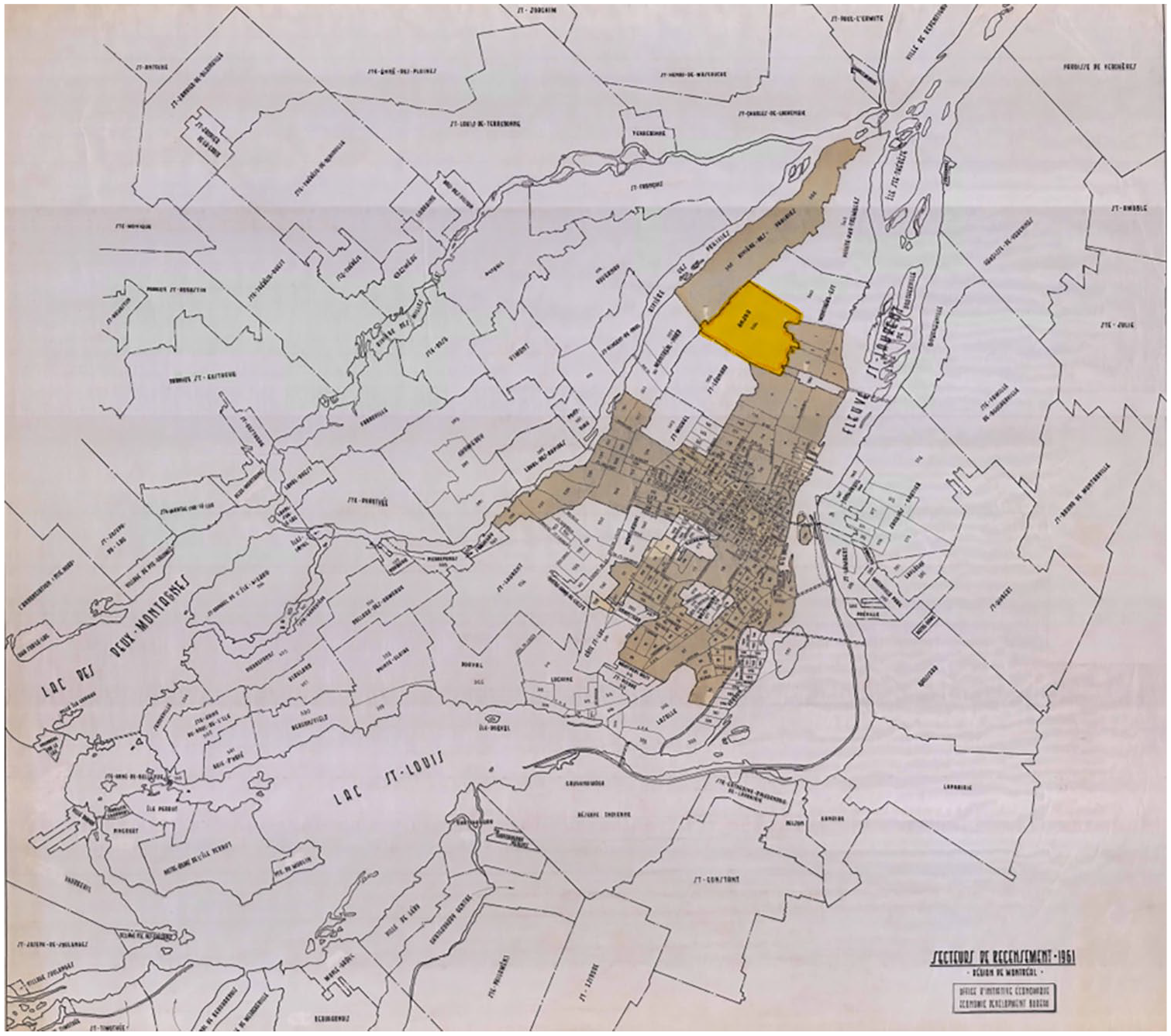
Map of the Island of Montreal and its surroundings divided by census tract, 1961. Anjou is colored in yellow. The different neighborhoods that made up the city of Montreal in 1961 are colored in gray-brown. Archives de la Ville de Montréal.
Ville d’Anjou was founded in 1956, following the adoption of the Act to incorporate the town of Anjou by the Legislative Assembly of Quebec. The parish municipality of Saint-Léonard-de-Port-Maurice then became a town municipality, that is, a town in the sense of Quebec’s Cities and Towns Act, and acquired expanded powers, which included the ability to borrow money to accelerate its development. However, it is very likely that this incorporation was more due to the ambitions of certain politicians than to the circumstances of a still largely agrarian area with relatively few inhabitants. Three days before the new town was incorporated, Ernest Crépeault, a member of the Union Nationale, the political party then in power in Quebec, became Mayor of Saint-Léonard-de-Port-Maurice and remained Mayor of Ville d’Anjou until 1973. 40 Soon after the municipality was incorporated, multinational oil company British Petroleum (BP) prepared plans to set up a major refinery in Anjou on condition that it received special tax benefits—benefits that were subsequently ratified by a private bill passed in the Legislative Assembly of Quebec in 1958. 41 The creation of Ville d’Anjou was in keeping with the economic policy of Union Nationale leader Maurice Duplessis, who was in power from 1936 to 1939 and then from 1944 to 1959. This policy was characterized by the use of generous fiscal incentives 42 to attract major multinational natural resource extraction companies to Quebec. In short, the connections between an ambitious mayor and a powerful provincial premier, coupled with the possibility of attracting a major, world-class industry to Quebec, explain how and why Ville d’Anjou was born.
Ernest Crépeault combined several roles—mayor, industrial commissioner, Anjou school board chair, and private real estate broker. He benefited from this situation by receiving commissions on land sales and even arbitrarily changing zoning regulations in exchange for money. 43 This led to his imprisonment and Anjou’s being placed in trusteeship. As a result, management of the city was supervised by Municipal Commission of Quebec public servants from 1969 to 1976.
Throughout his “reign,” Crépeault was aided by engineer Charles-Édouard Campeau. Campeau had previously been hired by the Saint-Léonard-de-Port-Maurice municipal council in 1954 as director of urban planning. Campeau’s ideas at the time corresponded to the vision of the ideal town imagined by local elites: that of a functional town based on the urban planning theories formulated in the early decades of the twentieth century. Furthermore, Campeau’s presence gave Anjou a certain reputation because he was one of the first French Canadian experts to pursue a career in municipal urban planning. In particular, he was director of urban planning with the City of Montreal from 1955 to 1958, supervising the widening of Dorchester Boulevard in the burgeoning downtown district, a flagship urban redevelopment project at the time.
Inspired by several ideas about modern urbanism with a particular debt to Walter Gropius, Campeau advocated for the construction of highways in the 1940s. He argued that urban development is conditioned by its ability to adequately handle automobile traffic, a principle that subsequently guided the planning of Ville d’Anjou. 44 As a federal Member of Parliament for the Progressive Conservative Party from 1958 to 1962, he also campaigned for state intervention in the economy, especially more funding for urban renewal. 45 As we shall see, the mostly undeveloped territory of Anjou in the late 1950s provided Campeau, then at the peak of his career, with an opportunity to apply the functional urbanism principles that he was having difficulty to implement in Montreal’s central neighborhoods.
Following the arrival of Crépeault and Campeau, Ville d’Anjou entered a period of intensive growth on several fronts. It launched a large-scale advertising campaign to showcase itself as a residential suburb for French Canadians. Taking advantage of the rapid modernization of the Greater Montreal region’s highway system (especially the completion of Highway 40 and the construction of both the Louis-Hippolyte Lafontaine Bridge-Tunnel and Highway 25, conveniently located in the vicinity of Anjou), the town quickly attracted many well-off commuters. As a result, by the late 1950s, several leading Montreal newspapers were enthusiastically reporting Anjou’s real estate boom and describing the municipality as a model suburb. 46 The town’s population accordingly increased from 2,140 inhabitants in 1956 to 33,395 some 15 years later. In addition, according to the 1961 Canadian census, most Anjou residents were French Canadian (6,548), followed by those of British extraction (1,921) and Italians (177). The average annual salary of Anjou men was Can$4,807, higher than both that in Francophone neighboring municipalities like Montréal-East (Can$3,867) and the Canadian average of Can$3,679, but much lower than that in anglophone bourgeois suburbs like Ville Mont-Royal (Can$9,020) to which Anjou was compared. According to the 1961 census, 44 percent of Anjou’s male workers were manual laborers and 56 percent were employed in white-collar work. In comparison, 66 percent of Montreal-East’s men were in manual labor and 34 percent in white-collar occupations; in the more upper-class Town of Mount-Royal, only 10 percent of male workers were in manual work and 90 percent in white-collar jobs. 47 Anjou was thus not a bourgeois suburb like those of the first half of the twentieth century but rather a middle-class suburb for upwardly mobile Francophone working- and middle-class families aspiring to more comfortable lifestyles than the ones they left behind in overcrowded central districts. Nevertheless, in the media and in the discourses of local elites, stereotypical images of bourgeois suburbs were largely used to make sense of what was going on and to promote the development of Ville d’Anjou—the specific social phenomenon we are interested in (Image 2).
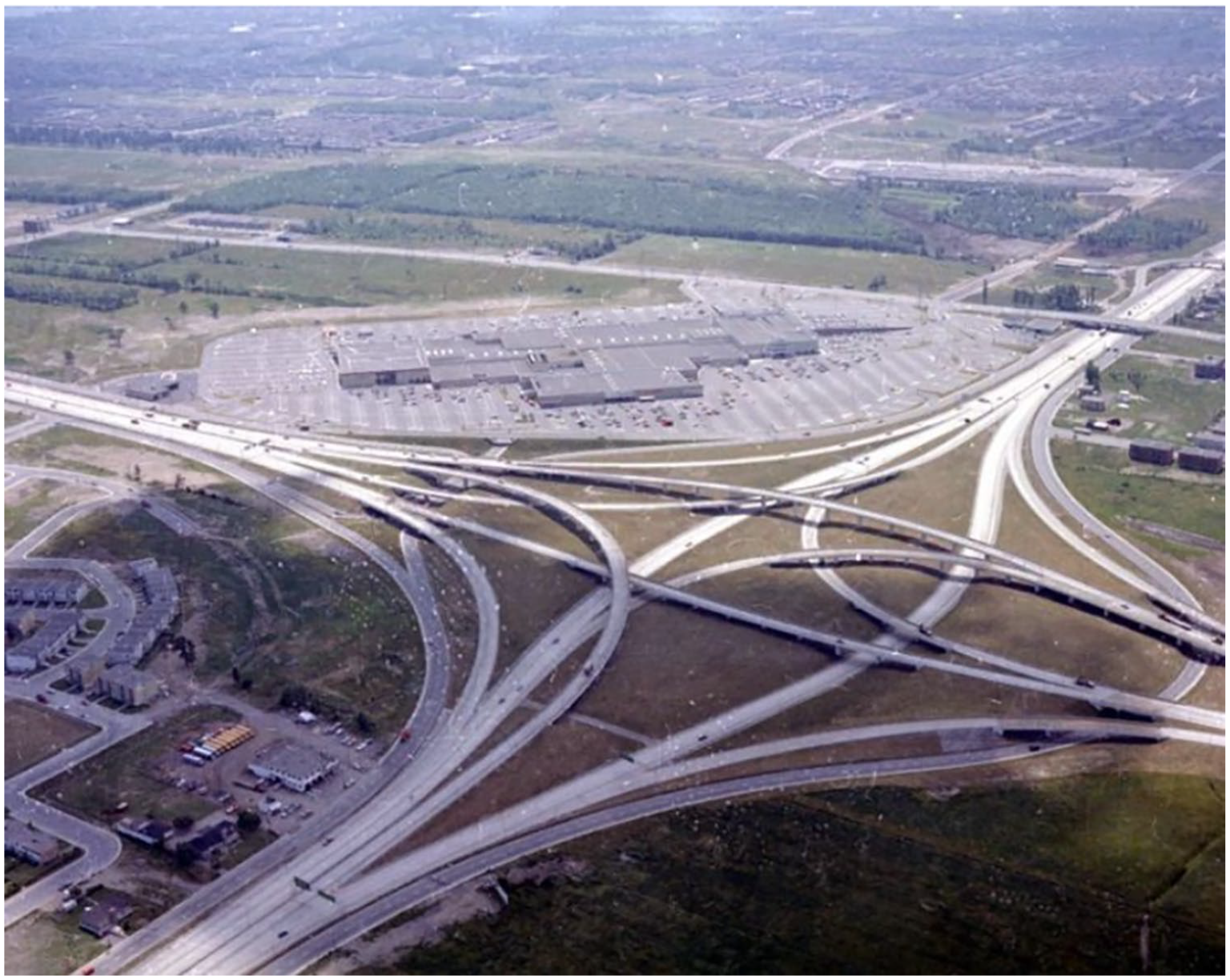
Interchange between highway 25 and highway 40 near the Galeries d’Anjou mall. Henri Rémillard, 1970. Bibliothèque et Archives nationales du Québec.
What we will present here is the tenacity and the effects of this bourgeois ideal in the age of the middle-class massification of postwar suburbs. We do recognize that large-scale economic and material processes were at play during the period considered and shaped the terrain upon which Anjou developed: we can think of motorization, highway construction, industry leaving urban centers for peripheries, and containerization. Adapting to these large-scale material processes, Anjou elites exploited a certain suburban ideal to appeal to promoters and aspiring suburbanites. We now turn to this mobilization of the bourgeois suburban ideal in Ville d’Anjou and the interesting relations between this stereotypical representation and the actual material and sociopolitical relations marking its development, considered from three standpoints: residential monofunctionalism, political autonomy, and an exclusive and apolitical bourgeois community (Image 3).
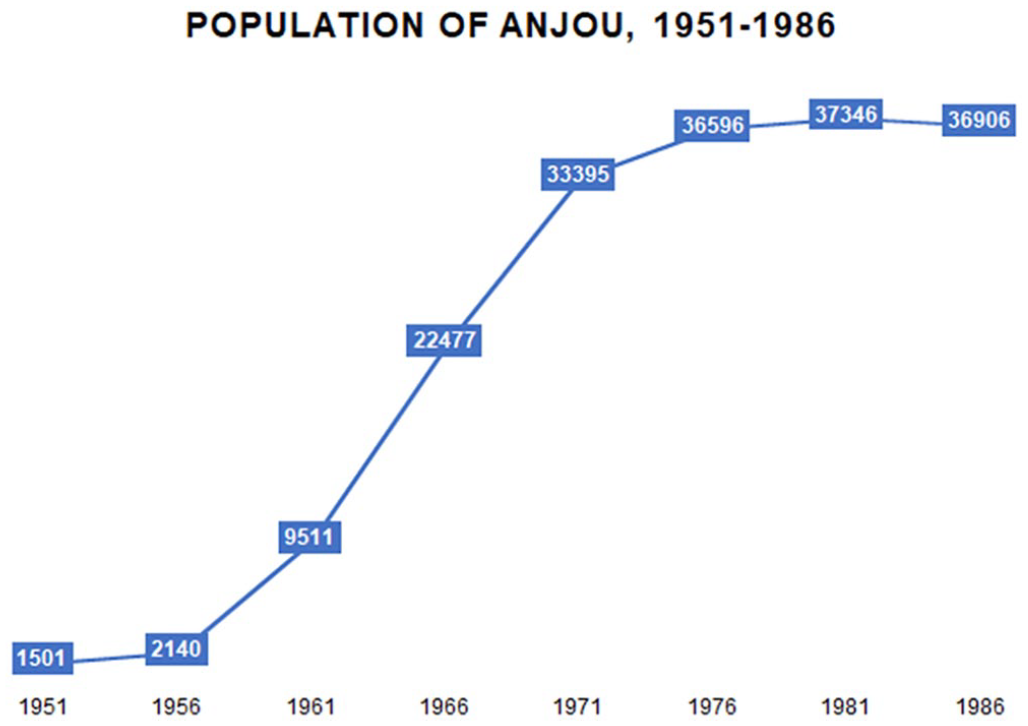
Evolution of the total population of Ville d’Anjou between 1951 and 1986.
Hyperfunctionalism and the Role of Industry in the Development of Anjou
The idea that the primary function of suburbs is residential is one that has persisted. In this stereotypical concept, suburbia is essentially a collection of homes where suburbanites come to spend the night after working weekdays elsewhere in major urban centers. 48 A closer look at the history of suburbs in the twentieth century, however, reveals a wide variety of suburban forms. 49 For example, many suburban municipalities also embrace industrial and commercial functions to diversify their community’s activities and revenue streams; these functions are much more than cosmetic insofar as they play a decisive role in these municipalities’ development, which was very much Ville d’Anjou’s case. We mentioned the case of Don Mills earlier on; other examples include Maisonneuve and Dearborn. 50 However, functional diversity does not necessarily mean spatial diversity. Anjou offers an example of hyperfunctionalism involving strict spatial segregation of the municipality’s residential, commercial, and industrial functions. This aspect is also interesting because it sheds light on suburban municipalities’ complicated post-1945 relations with industry.
In 1960, some twenty years before the Quebec government made urban planning mandatory for the province’s municipalities, Anjou was one of the first municipalities in Quebec to have its own urban land-use plan. This master plan, prepared by Charles Edouard Campeau and Roger Gagnon, reflected then-fashionable functionalist ideas by imposing a strict division of functions. 51 Starting from the natural boundary of the metropolitan highway then under construction, the plan divided Anjou into two sections: the northwest side of the highway was reserved for both light and heavy industry with a thin strip designated for the construction of a few homes to be surrounded by light industry; the southeast side was designated for primarily residential use. Most of the zoning prescribed the construction of single-family or semi-detached houses, while some areas, especially near major thoroughfares, were designated for higher residential density. The quadrant-shaped plan included the building of a large shopping center at the intersection of the two main highways.
In addition to preparing Anjou’s master plan, Campeau recommended the urban redevelopment of southeast Anjou, an area that had already been partly developed before the municipality was created in 1956 and which consisted of wooden owner-built dwellings typical of households that had left the downtown Montreal core to escape high taxes and onerous building regulations. In a letter to the mayor, Campeau criticized the disorganized state of this part of Anjou, especially its “mixed land-use” and the lack of a standard urban plan. 52 Undoubtedly benefiting from the contacts within the federal public service he had developed during his time as an MP, Campeau obtained funding from what was then called the Central Mortgage and Housing Corporation (CMHC—now the Canadian Mortgage and Housing Corporation) during the 1960s to redevelop this area. 53 In the spirit of modernistic urbanism, this undertaking involved the complete demolition of all the existing homes (Image 4).
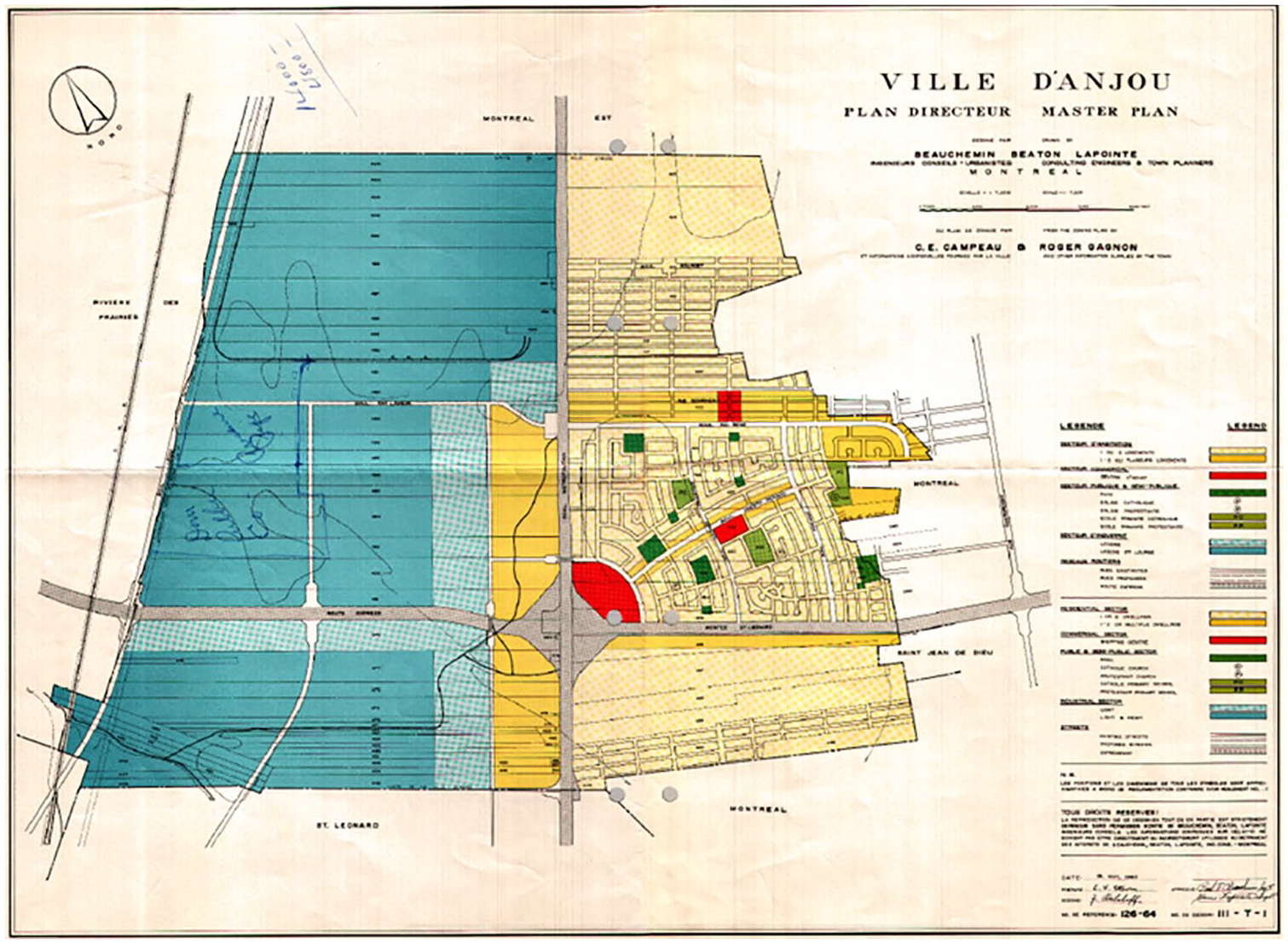
Ville d’Anjou master plan, 1960. Archives de Ville d’Anjou.
In Ville d’Anjou then, the suburban ideal was reflected in the adoption of urban planning policies and the implementation of a strict form of functional segregation. This involved zoning that, as historian Sonia Hirt has shown, 54 has been a historically important tool to stabilize property values by controlling land-use changes in municipalities. In fact, Anjou’s urban plan was therefore heavily promoted in the municipality’s advertising. For example, an ad that appeared in La Presse in 1959 trumpeted: “Ville d’Anjou . . . where urban planning protects your investment.” 55 Despite the sophistication of this marketing, leaders of Anjou did not actually create anything new. The use of urban planning to promote and upgrade land value was indeed hardly new in Montreal. This practice can be traced back to the end of the nineteenth century, as Linteau showed in his study of Maisonneuve. 56 Still, our study shows that Anjou’s political leaders had the ambition to be up-to-date and rigorous in their application of modern urban planning principles.
In response to a complaint from a resident named J. Andrew against a neighbor who was using their basement and garage as a commercial workshop, Mayor Crépeault expressed the functionalist ideal in these words: “You can be assured that the applicable sections of the zoning regulations will be carried out to the letter because it is those regulations that have earned our city its enviable reputation as a nice place to live.” 57 The residential district that developed in south Anjou, with its wide lots on curved streets, its main thoroughfares offering easy access by car, and its modernist church designed by architect André Blouin, was clearly intended to be at the leading edge of suburban development in the region. 58 Indeed, Anjou was extremely proud that many members of the French Canadian cultural and sporting elites came to live there. 59
And yet, a totally different scene emerged on the other side of the metropolitan highway. From its very beginnings, Ville d’Anjou was closely tied to industry, especially heavy industry. A La Presse journalist even stated that Anjou was founded by Mayor Crépeault, with the support of his friend, Premier Maurice Duplessis, for the primary purpose of attracting a British Petroleum (BP) oil refinery to Quebec. 60 An article in Le Progrès de Ville d’Anjou also claimed that BP “was the foundation of Anjou’s success.” 61 While these statements may appear exaggerated, it is still true that the development of Anjou was highly dependent on its industrial sector. Accordingly, in 1958, the Legislative Assembly of Quebec passed Private Bill No. 229—An Act respecting the town of Anjou and BP Canada Limited and others. In consideration of the positive economic impact from a multinational company setting up a large refinery in a Quebec municipality, the bill granted BP a special tax status for 15 years in the form of a fixed annual municipal tax of Can$65,000 and a property assessment value of Can$1,000,000. 62 This kind of arrangement was standard practice for Canadian municipalities since the nineteenth century, 63 and was particularly widespread in Quebec during the Duplessis regime, which was eager to attract multinational companies to the province (Image 5).
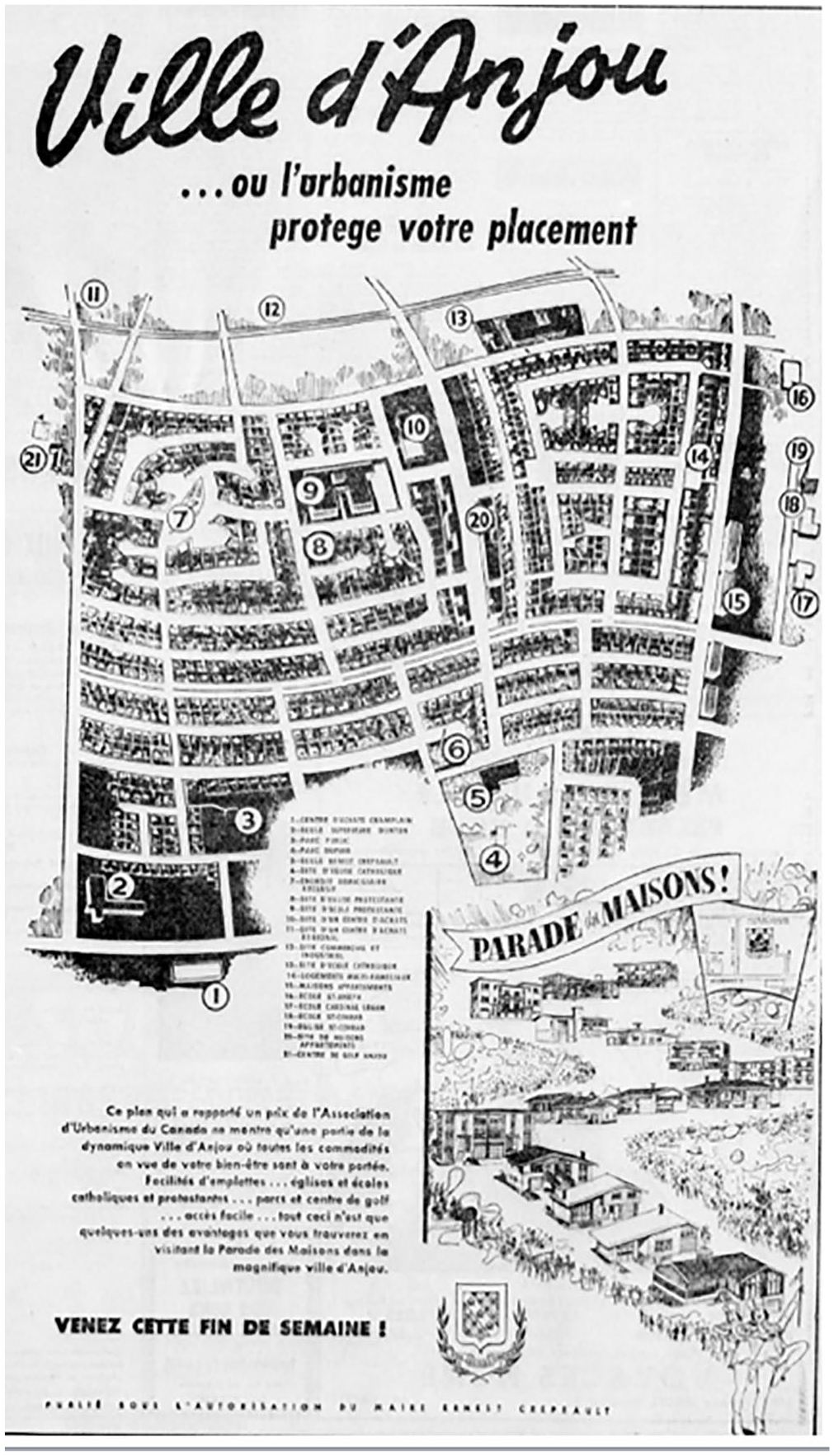
Advertisement by Ville d’Anjou published in La Presse, March 14, 1959, p. 13. Cited in Bérubé, 2017, p. 14.
The importance of attracting industries to suburban municipalities like Anjou is obvious from Mayor Crépeault’s statements and what was written in Le Progrès dAnjou. The installation of the BP refinery in Anjou was clearly a source of pride, as reflected in this excerpt from Le Progrès de Ville d’Anjou: “Almost on directly opposite sides of the globe, there are two MODERN cities that have thought to ‘invite’ this gigantic industry to come and settle within their boundaries: ANJOU in Canada and ADEN in Arabia.” 64 The presence of industry in general in Anjou was desirable for many reasons. On one hand, it constituted a substantial contribution to the city’s tax coffers, thereby lowering the taxes of residential ratepayers in the context of competition among municipalities to attract new households. 65 On the other, it was a significant source of jobs for the city’s residents, with many news stories highlighting the number of “heads of households” who could be hired by the various industrial plants being built.
By attracting various industries, Anjou also positioned itself as a complete and independent municipality and used this status to defend itself against any possible annexation by Montreal. In fact, at a time when factory smoke was a sign of economic vitality and prosperity, 66 an industrial footprint was considered more in terms of its economic benefits than its environmental consequences—attracting factories to a municipality was evidence that the local government was smart and serious. Factories gave municipalities an image of prosperity that had favorable repercussions on financial markets when the time came to borrow money. 67 Not to forget that the mayor and his close associates also benefited financially from the industries that opened shop in Anjou. Crépeault, who, as previously mentioned, simultaneously served as mayor, industrial commissioner, and real estate agent, owned several lots in the Anjou industrial park that earned him considerable capital gains. In fact, a municipal commission ultimately discovered his malfeasance and condemned him, his urban planner, and a few other colleagues to prison terms. 68 The connections between suburbia and industry are more complicated than a simple celebration of smokestacks and assembly lines. As soon as BP came on the scene in Anjou, the preferential tax treatment it received provoked criticism. For example, Jean Meunier, the Legislative Assembly of Quebec member for the Bourget constituency, contradicted the municipality’s official line by declaring that the preferential tax treatment awarded to BP increased the tax burden of regular ratepayers. 69 By his calculations, the value of BP’s land should not have been assessed at Can$1,000,000, but rather at Can$45,000,000, which would bring much more tax revenue to the municipality. In fact, a review of Anjou’s budgets during the 1960s showed that BP paid even less tax than what was prescribed in Private Bill No. 229 (see table in Image 6). Indeed, when Anjou increased BP’s tax rate in the 1970s, the company strongly contested the new assessment, 70 with the municipality and BP ending up in court to determine whether certain buildings on refinery land were subject to municipal taxes. The provincial court ruled in the municipality’s favor. 71 On the jobs front, BP’s contribution was mixed as well. In 1960, when the refinery employed 589 workers out of a total of 633 manufacturing jobs in Anjou, its importance was obvious. 72 However, by 1975, it lost its first-place status by only employing 314 people, thereby dropping to third position behind Electrolier Corporation (500 employees) and Herlicon Metal & Plastics, Inc. (400 employees). 73 The oil crises of the 1970s also reduced the refinery’s workforce, and it eventually closed in 1983.
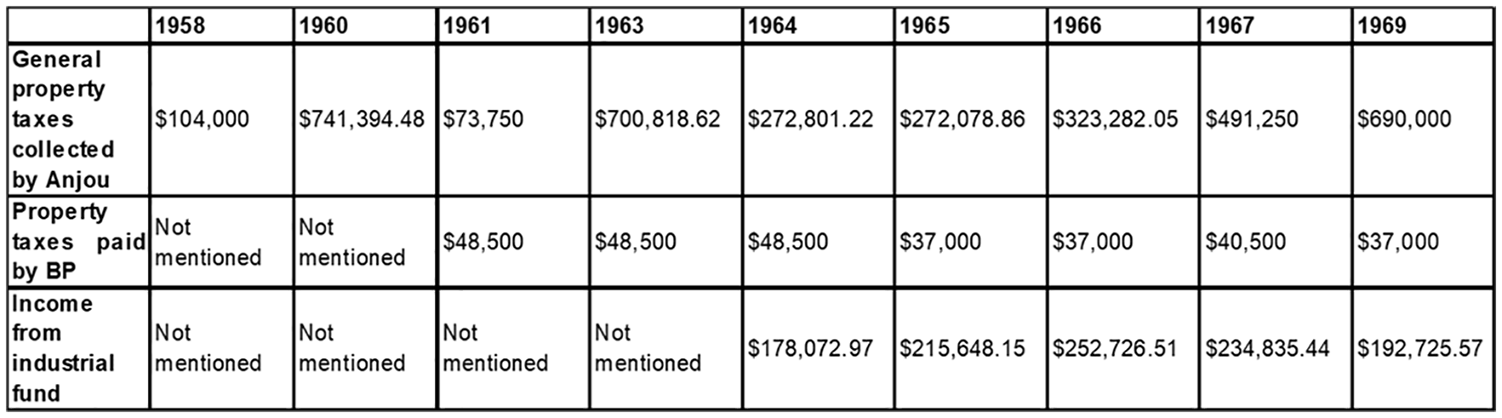
The role of British Petroleum property taxes in the general fiscal structure of Anjou.
Even though the archives consulted contain little information about the environmental repercussions of heavy industry operations, this factor was also responsible for tensions to some extent. The creation of a laboratory to study industrial air and water pollution in Ville d’Anjou by the Association industrielle de Laval, a group of heavy industry companies in east Montreal, could be viewed as a reaction to local protests that were part of post-1945 campaigns against industrial pollution. 74 For example, the Société des Hommes d’Affaires de l’Est (a businessmen’s association) complained about poor air quality that industry was partly responsible for. 75 The clearly defined spatial separation of functions in Anjou also testifies to an intention to keep industry far away from the green gardens of the municipality’s residential areas. To explain Anjou’s success on the eve of its tenth anniversary, Le Progrès de Ville d’Anjou declared “the town’s primary asset is its unique master plan that keeps the industrial zone far away from residential areas.” 76 In a nutshell, Anjou was not a monofunctional municipality but rather a hyperfunctional one—industry brought jobs, tax revenues, and a positive image for this young suburban municipality. However, Anjou deliberately distanced industry from parks, public services, and residential areas. According to its urban planners, the main thing was to keep the various urban functions spatially segregated. As Mayor Crépeault stated in 1963 at the opening of the Dominion Rubber plant adjacent to the BP refinery: “the residential areas will not be affected or inconvenienced at all because, in fact, they have not been by BP and all the other new industries in our municipality,” with the specific implication that this was because those industries complied with Anjou’s strict urban planning regulations. 77 The refinery and its neighboring industrial plant thus produced the asphalt, gasoline, and tires that supported the carbon-based mobility on which Anjou’s very existence was based, while the superhighways also partly separated and protected, the lifestyles of the municipality’s residents from those same industries’ environmental consequences. The idealized vision of residential suburbs with plenty of green space thereby masked the debt owed by Anjou and its residents to the municipality’s extractive and other polluting industries (Image 7).
Header of the journal Le Progrès de Ville d’Anjou, 1963. Archives de Ville d’Anjou.
Autonomy and Regional Attraction
In the spirit of the promoters of the suburban ideal, suburbia is not an extension of the urban core but rather an autonomous entity with a different identity and mode of functioning. That is why the distinction between city and suburb was crucial for Anjou’s political leadership. Ville d’Anjou is not Montreal, they continually proclaimed in their local newspaper and in their negotiations with the provincial government. However, unlike the first suburban communities that forged their ideal based on the notion of the village, 78 Anjou’s ambition was to achieve a kind of renewed and improved urbanism, as reflected in its name—Ville d’Anjou [Town of Anjou]—and attract regional and even international cultural, sports, and commercial activities to it. Yet most of these large projects were only possible because of Anjou’s integration into the Greater Montreal region. In fact, promoting the ideal of the autonomous suburb relegated Anjou to a kind of competition with the City of Montreal that undermined dialogue and impeded the municipality’s integration with metropolitan infrastructures. As a result, several major projects developed by the Anjou leadership in the 1960s, notably its integration into the Montreal subway system (“the Métro”), came to nothing.
As in many other suburban communities, the promotion of Anjou was based on a favorable comparison with the urban core—in this case, Montreal. In the pages of Le Progrès de Ville d’Anjou, Montreal was portrayed as a mismanaged and excessively large city where taxes were astronomically high. In contrast, Anjou was depicted as a planned, upstanding, and peaceful town where residents respectfully associated with each other. The widely promoted key argument was that anyone could have a detached house with a large lot in Anjou for a price and property taxes much lower than in Montreal.
To conserve these tax benefits, the Anjou leadership jealously defended their autonomy and fiercely opposed municipal annexation. Mayor Crépeault made many appearances to attack the annexationist ambitions of Montreal Mayor Jean Drapeau and his right-hand man Lucien Saulnier and continually pressured the Quebec government to ensure that the autonomy of the suburbs was respected. In this regard, it is important to know that during the 1960s, the City of Montreal pursued a campaign called “One island, one city” to annex all the suburban municipalities that made up the Island of Montreal. 79 In defense against this campaign during the 1962 provincial elections, the following exhortation appeared in Le Progrès de Ville d’Anjou: “We therefore say ‘VOTE RED,’ ‘VOTE BLUE, ‘VOTE UNION NATIONALE,’ ‘VOTE LIBERAL,’ but, above all, please ‘VOTE’ for East Montreal representatives who will strenuously protect VILLE D’ANJOU, the suburb where we live and which we love so much.” 80 A few months later, Crépeault made the fight against annexation the main theme of the municipal election and, in Fall 1963, not a week went by without Le Progrès de Ville d’Anjou attacking the annexation movement in one way or another. Then, once reelected, Crépeault helped create the Conseil de coordination intermunicipale [Intermunicipal coordination council], a group designed to give a voice to the suburbs in the management of Greater Montreal region affairs. 81 The discourse of Anjou’s political leadership thus continued the message of all the bourgeois suburb mayors in Quebec who, since the early twentieth century, had resisted annexation and organized themselves into lobbies to have their autonomy recognized by the provincial government. 82 It is important to note that, given the particular power of provinces in municipal affairs in Canada, many such debates play out at the provincial level. Thus, during this period, mayor Crépeault often went to the National Assembly of Quebec to fight against municipal annexations. This fight was eventually lost in 2002 when partisans of an equitable urban system led by Pierre Bourque, then mayor of Montreal, were able to convince provincial officials to proceed with amalgamating all the municipalities on the Island of Montreal (Image 8). 83
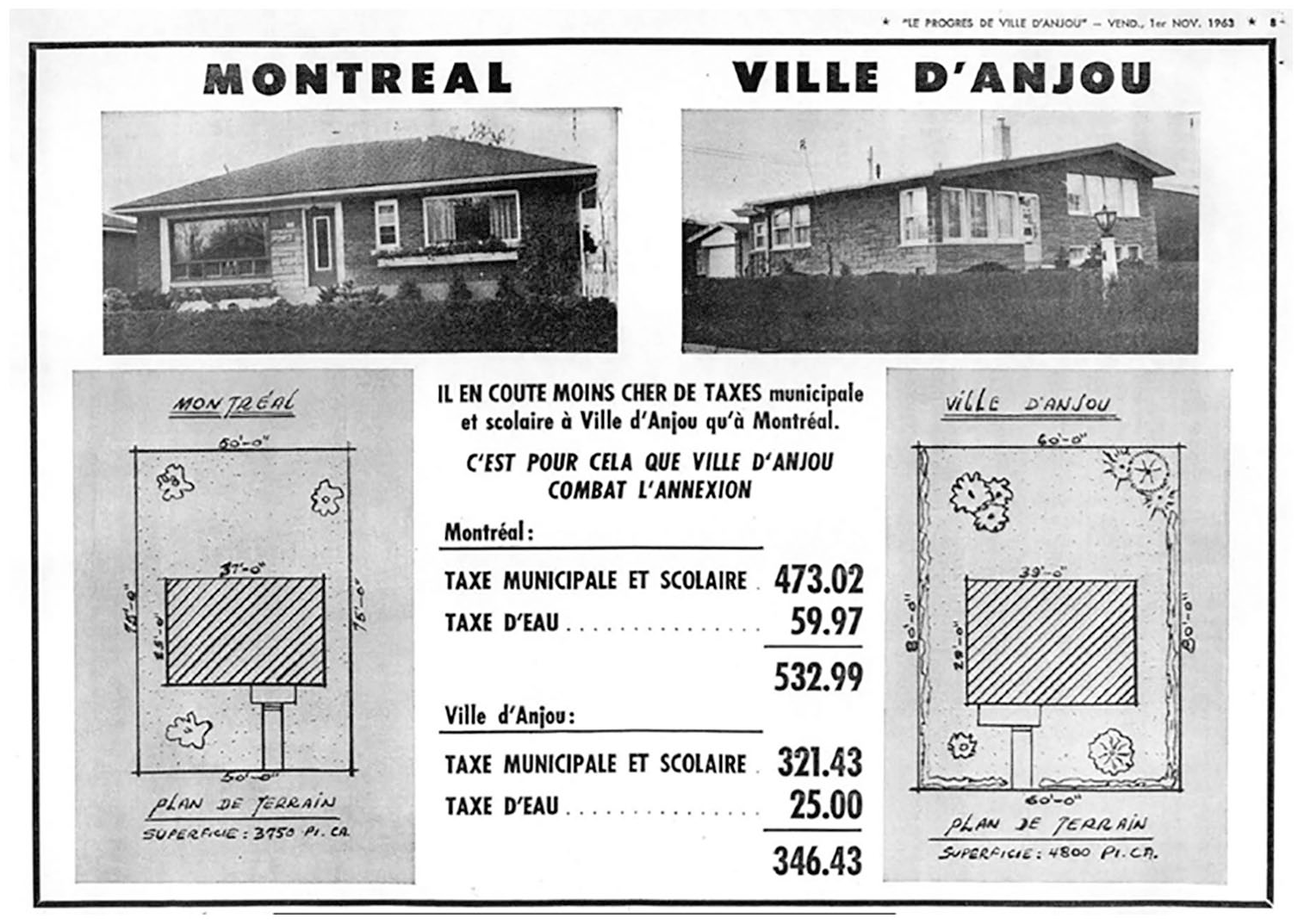
Comparative image showing the different tax rates between Montreal (left) and Ville d’Anjou (right). Le Progrès de Ville d’Anjou, November 1, 1963. Archives de Ville d’Anjou.
Although Anjou’s political leadership during the 1960s theoretically subscribed to intermunicipal coordination, they also pursued the idea of suburban autonomy to the extreme. In their view, the ideal suburb had every amenity and should be attractive in this regard and recognized as such. A suburb should therefore be both a full-fledged city with all modern services and its own appeal, while remaining a city different from the urban core—in other words, a new city that did not have the same problems of criminality, overpopulation, and congestion as the urban core. In keeping with this ideal, Le Progrès de Ville d’Anjou presented a series of proposals to make Anjou an internationally recognized town. For example, in 1961, Mayor Crépeault wrote personally to the president of the national broadcaster, CBC/SRC, to offer a twenty-acre piece of land for the Crown corporation’s new offices. 84 Two years later, he boasted that the Alouettes, Montreal’s Canadian football team, was thinking of building their new stadium in Anjou. 85 Then, in 1967, he demanded that the second Francophone university in Montreal be located in the east end of the Island of Montreal. 86 However, none of these projects came to fruition.
In tandem, as soon as the hosting of the 1967 International and Universal Exposition (Expo 67) was awarded to Montreal, Crépeault and his team scrambled to ensure that Anjou was included among the exposition sites. The municipality’s first salvo was a news release outlining the main advantages of Anjou and East Montreal: existing road, rail, and bus connections, and accommodation facilities. 87 The municipality then organized a free helicopter tour to show the population—and Montreal Mayor Drapeau, whom Crépeault personally invited 88 —that East Montreal would be an ideal site for the Expo. 89 Anjou then participated in setting up an East Montreal businessmen’s association to request that Expo 67 be held there 90 and organized a major exhibition to showcase its highly competent parks department. 91 In the end, Expo 67 was held on Saint Helen’s Island (immediately southeast of the Island of Montreal), and Anjou had to make do with only hosting a few scout campers on its territory. 92
On the contrary, Anjou could take pride in Les Galeries d’Anjou, a shopping center that was at the time of its opening in 1968 the largest in Quebec and the second largest in Canada. Pursuant to Anjou’s 1960 master plan, this shopping center was built on the eastern edge of the intersection of Metropolitan Boulevard and Highway 25. In subsequent years, the success of Les Galeries d’Anjou generated significant tax revenue for Anjou and served as a commercial magnet for the region. From the standpoint of Anjou’s political leadership, all these projects to make their municipality a regional hub were part and parcel of the autonomy-tinged discourse of a bourgeois suburb. They felt that Anjou’s multifunctional and attractive character was one way of being even more independent from Montreal. However, to external observers, what Anjou’s leaders were communicating seemed to be two quite different messages. On one hand, the municipality was claiming administrative autonomy and saw itself as an autonomous whole, whereas, on the other, the benefits of Anjou’s integration into the Montreal region were also being touted with the implicit recognition that Anjou was part of a larger whole. On some fronts, this tension was particularly overt.
For example, when the Métro construction project was announced in Montreal, Anjou immediately wanted to be part of it. In 1966, Crépeault even went so far as to say in his post-reelection speech that the extension of the Métro in the east end of the Island of Montreal was a priority. 93 So, why would one want the Métro to come to Anjou, if not to connect it more easily with the urban core and its population and services? In other words, wasn’t it because Anjou was part of a whole—a regional sub-hub (the term used in subsequent decades to demand better metropolitan integration and special treatment from the Quebec government) and not just a completely autonomous entity that wanted a Métro station?
Unfortunately for Anjou, Montreal Mayor Jean Drapeau and his team had no desire to offer services to autonomous suburbs to which many of the city’s residents, businesses, and industries were fleeing. On the contrary, the Mayor and his team proved to be extremely demanding and continually promoted annexation. In fact, due to the problems that commercial decentralization could cause, Mayor Drapeau knew that there was nothing to be gained by having a Métro station near Les Galeries d’Anjou. Following many heated negotiations with suburban mayors, Montreal simply went ahead, and the initial Métro lines were confined within the boundaries of Montreal proper, which retained exclusive management rights. 94 The lone exception was the Rive-Sud station in Longueuil, which was added to the Yellow Line connecting Montreal to Expo 67’s island site.
As on many other occasions, Crépeault turned to the Quebec government, declaring: “Longueuil has its Métro, Anjou and our nearest neighbours will have ours too. It’s not fanciful or utopian, and Premier Johnson has given his assurance.” 95 However, even though the extension of the Métro had been officially announced since the 1980s, Anjou residents continued to wait with some bitterness for their station.
From the late 1960s on, Mayor Crépeault used the Métro situation to demonstrate the short-sightedness and bad faith of the Montreal authorities and consequently the need for the Quebec government to intervene as a mediator. For example, he demanded that a water treatment issue not be handled like the Métro to force Montreal to work with the eastern Island of Montreal municipalities and ensure that a new water treatment plant met the needs of all concerned. He also recommended that the eastern municipalities—Saint-Léonard, Anjou, Montreal-Est, and Pointe-aux-Trembles—coordinate themselves better to construct a new cultural complex housing (i. e. a library and a performance hall)—another project that did not see the light of day.
Anjou’s stance that a suburban municipality could enjoy administrative autonomy while serving as a regional sub-hub in the Greater Montreal region was not inherently contradictory. This position had been upheld by several Montreal experts since the mid-twentieth century. 96 However, the historical loyalty of Anjou’s political leadership to the suburban ideal imposed a mind-set that constrained their ability to take action and, more importantly, perpetuated forms of intermunicipal competition, thereby polarizing dialogue among Greater Montreal area municipalities. The City of Montreal itself naturally had its own hobbyhorses—for one thing, constantly asserting that its own interests primarily lay in expanding its boundaries. However, by treating Anjou as a dangerous suburb likely to steal residents, businesses, industries, and their associated tax revenues away, the City of Montreal was only responding to what Anjou was saying.
Politicization and Depoliticization of the Suburb
Our main surprise in analyzing Anjou’s local newspapers was to discover the impressive amount of space devoted to opposition groups and partisan debate. Contrary to the idea that political opposition would be either absent or ignored in suburbia, the discourse of Anjou’s leadership in the 1960s made constant reference to malicious opposition groups that were putting obstacles in the way. Accordingly, anything at all to do with municipal life—from managing the police and fire departments or building a municipal garage to regulating the use of clothes lines or creating a bugle and majorette corps—seems to have been the subject of acrimonious debate, which seemed to jar with the stereotypical model of the homogeneous and peaceful bourgeois suburb. However, at no time in the pages of Le Progrès de Ville d’Anjou or in Mayor Crépeault’s public statements was there any positive view of either the opposition or public debate. On the idea that Anjou’s good reputation guaranteed its material prosperity, the municipality’s political leadership came up with an elaborate argument that portrayed criticism of the existing municipal government as an impediment to Anjou’s success—an argument that inherently reduced citizen participation to a plebiscite on the mayor’s ideas. In short, while Anjou’s political leadership did not ignore or conceal the existence of opposition groups, their conception of the ideal suburb automatically discredited those groups. Indeed, when the mayor spoke about the opposition, he always referred to their insolence and bad faith.
As seen above, Mayor Crépeault took up office in nebulous circumstances three days before the municipality of Anjou was incorporated. He was then reelected by acclamation the next year, 1957. However, during the first half of the 1960s, he faced an opposition structured around three groups: the Association des Citoyens d’Anjou and the Ligue municipale d’Anjou (joint publishers of the opposition newspaper Cité Nouvelle), and the Union des familles, a group concerned with school and school board issues (with Crépeault as school board chair). Although these were not formal political parties insofar as they did not have a clearly established participation structure and did not last long, partisanship still played a major role in the political discourse of Anjou’s leaders.
First, the identification of a particular idea with an opposition group was one way for the group in power to negate the opposition and thereby avoid democratic debate. Very often, rather than entering into technical considerations or discussions of values, the political leadership simply attacked the bad faith of the opposition in their defense of a given project against criticism. For example, instead of explaining the reasons for the cost of a municipal garage, Le Progrès de Ville d’Anjou wrote, “The forces of evil that receive their instructions from outside are preparing to do what it takes to sabotage the construction of the municipal garage!!!” 97 This language clearly says little about the technical aspects of the management of public services. On the contrary, it offers a dichotomous vision of political life in which those in power usually attack the bad faith of the opposition and simply evoke what purports to be the community’s best interest. In addition, treating the opposition in these terms was also a way for Mayor Crépeault to glorify himself in a scenario of unwarranted adversity. Le Progrès de Ville d’Anjou continually repeated the refrain that the opposition “was doing their utmost, but in vain, to put obstacles in the way every time a measure for the residents’ benefit was proposed.” 98 In contrast, it was argued that the Mayor was obliged to continually make an extra effort and apply more expertise to complete projects that would redound to the prosperity of the municipality and its residents.
In tandem with this profiling of the opposition in the newspaper, there was much maneuvering to silence them. For example, after the 1960 elections, Crépeault sued the Ligue municipale d’Anjou and ten members of the opposition for defamation, but later abandoned the suit. 99 Then, in October 1962, when opposition members were boycotting the municipal government and demanding a referendum on a borrowing bylaw concerning the transformation of certain lands and the purchase of recreational equipment, the response was that the proposed referendum was “motivated by the hate and selfishness of these professionals . . . They don’t like young people, and they don’t like trees either.” 100 Furthermore, holding the referendum was avoided by splitting the borrowing bylaw into two, with the mayor arguing that this would save both time and money. Le Progrès de Ville d’Anjou then published a “roll of dishonour”—a list of the names and addresses of the individuals who had requested the referendum. 101
The 1963 municipal elections were then one of the most intense periods of political warfare in Anjou’s history. Seeking to take advantage of growing dissatisfaction with Crépeault’s wheeling and dealing, the opposition presented itself as a group of upstanding and independent candidates. Crépeault responded by portraying them as supporters of annexation in the pay of Montreal elites jealous of Anjou’s prosperity. Le Progrès de Ville d’Anjou used expressions like “plots” and “the opposition’s disgraceful tactics,” calling them “the fake team” or “the fat cat’s team,” while asserting that Anjou’s prosperity was assured thanks to the various projects initiated by Crépeault: “Wealth and prosperity will come to Ville d’Anjou, and I challenge our opponents to prove the opposite.” 102 Several irregularities in the opposition’s ballots were also attacked. 103 However, the main objective was to show that the opposition was in favor of annexation and affiliated with outside forces. The opposition was challenged to state their position on this point and, a few weeks prior to the elections, Le Progrès de Ville d’Anjou headlined: “The independent candidates are the friends of the vultures that fly above Ville d’Anjou.” 104
Simultaneously, Crépeault increased his sorties to show that, contrary to what the opposition said, the municipality’s finances were in good shape. In particular, he organized a large press conference for the national media in downtown Montreal, with the stories that appeared in La Presse and the Montreal Star subsequently reproduced in Le Progrès de Ville d’Anjou. 105 Then, a few days prior to the elections, it was announced that the vote would be filmed and rebroadcast in closed circuits to ensure their security. “Once again, Anjou breaks new ground!” was the claim in Le Progrès de Ville d’Anjou, which was subsequently picked up by major newspapers. 106 And then, dramatically, on the eve of the vote, the opposition’s mayoral candidate was accused of making false statements, an accusation that was also repeated in the Montreal press. 107 In the end, Crépeault was easily reelected with 2,010 votes versus 620 for Hervé Chartrand, and all the elected councilors were in Crépeault’s camp.
There is, of course, a contextual aspect in terms of the form and content of the political discourse of Anjou’s leadership that goes well beyond its suburban setting. Having grown up during the era of populism and personality politics characteristic of Premier Duplessis’s regime, Crépeault employed a relatively common discourse that compared political leaders with heads of households. Using well-known rhetorical expressions, Le Progrès de Ville d’Anjou compared the municipality with a family that needed to trust its Leader, unlike unhappy children who would want to wash their family’s dirty laundry in public: “In Ville d’Anjou, the population has stuck together and trusted its Leader, as it should in any well-behaved family.”
108
And, on another occasion: You need a Leader to manage a city, an industry or sports team . . . A Leader that has vision . . . who earns respect and respects others . . . These talents will be lost if the Council is divided and stops supporting its Leader.
109
Aware of the affinity between Maurice Duplessis’s Union Nationale (a provincial political party associated with conservative values) and Mayor Crépeault’s team, the opposition banked in vain on the winds of change that blew through Quebec in 1960 in their efforts to clean up Anjou and “boot” Crépeault from town hall. 110 René Lévesque, a major figure of the Quiet Revolution in Quebec and a Liberal minister at the time, even came out in favor of opposition candidate Dr. Gérard Hamel. 111
However, these contextual elements should not lead us to overlook the place occupied by the suburban ideal in the discourse of Anjou’s political leadership and its role in stifling democratic debate. For Crépeault and his followers, portraying suburbia as peaceful, prosperous, and well-organized was essential to the municipality’s survival as an autonomous entity. In correspondence with the Mayor, urban planning director Campeau explained that a bad reputation based on false allegations could affect the municipality’s credit rating and seriously weaken its finances. “False rumours,” Campeau wrote, “are likely to give certain developers and their financial backers the mistaken impression that, sooner or later, taxes will have to be raised inordinately, or that a dangerous drop in the quality of public services will result.” 112 By placing the municipality in economic difficulty, a bad reputation could open the door to annexation. On the strength of this argument, Crépeault continually repeated that those who criticized his decisions and his management of public finances were “the worst possible publicity for the municipality” 113 and were playing the annexationists’ game. He also constantly appealed to Anjou residents to take pride in the municipality’s rapid development and ignore the opposition’s criticisms and other statements.
While many authors have shown how competition between cities tends to depoliticize municipal and local governments, 114 there seems to be something more specific to the discourses of suburban politics in Canada. Considering the provincial power to force municipal amalgamation, not only the prosperity of the municipality is in play in intermunicipal competition but also the municipality’s very existence. From the late nineteenth century on, the Quebec provincial government dealt with bankrupt suburbs by forcing their amalgamation with the City of Montreal. On the contrary, in Crépeault’s mind, if Anjou was to continue to exist, its suburban community had to appear peaceful and prosperous. The importance given to political autonomy and the opposition to annexation hence seems to intensify this will for a consensual and apolitical community.
This argument probably played a significant role in Crépeault’s subsequent reelections. Despite ongoing and even intensifying rumors of corruption at Anjou town hall, Crépeault was reelected by acclamation in 1966 (on the tenth anniversary of the municipality’s creation), and then again in 1969, at a time when Anjou was the subject of an investigation by the Municipal Commission of Quebec. Without going so far as to state categorically that the suburban ideal facilitates corruption, we can say that it was extensively exploited by Anjou’s political leadership to silence opposition and make residents identify with and feel proud of their municipality. In sum, the political discourse during the 1960s both promoted and demonized the opposition. Unlike what is generally thought, this municipality that wanted to be an ideal suburb was not at all free of political conflicts and struggles and the discourse of its leaders was not apolitical at all. However, portraying Anjou as an ideal suburb was one way for the municipality’s political elite to silence opposition and ultimately depoliticize the issues involving municipal government and urban development.
Conclusion
Most urban studies researchers now recognize that the relationship between city and suburb must be viewed in material terms as a continuum and not as a clear-cut separation. 115 Yet, acknowledging this continuum and the diversity of suburban forms should not prevent us from studying the influence of the suburban normative ideal on the actual forms of urban and suburban development.
In terms of timing, Ville d’Anjou’s boom years coincided with a growing interest in middle-class, single-family homes, which occurred later in the Montreal region than in Toronto. 116 From the outset possessed characteristics traditionally associated with both a suburb (isolated residential neighborhoods where automobile transportation was the order of the day) and a city (multifunctionality and a desire to become a regional magnet). For this reason, it is tempting to describe Anjou as a technoburb or an edge city. 117 While these descriptions may seem justified, we have tried to show that they must not minimize the power and impact of how certain stakeholders (for whom the distinction between city and suburb has remained crucial) portrayed their municipalities.
In this article, we have shown that Anjou’s initial leadership widely cultivated a stereotypical vision of suburbia in the context of extensive planning and sophisticated promotion relating to their municipality. We have demonstrated the importance and impact of how Anjou’s initial political leadership represented the municipality as a model suburb by analyzing concrete dynamics that show the stereotype’s adaptability and practical value. First, we have shown that, in the eyes of Anjou’s initial leadership, the suburban ideal did not exclude the presence of industry. On the contrary, this idea was reflected in Anjou by the implementation of a hyperfunctionalist urban plan that made considerable room for industry, but isolated it completely from the other sectors. This separation of functions enabled the municipal leaders to present industrial growth as a sign of prosperity that, far from diminishing their residents’ quality of life as it did in urban core neighborhoods where functions were mixed, allowed Anjou to offer quality services at a lower cost. Furthermore, in terms of intermunicipal dialogue within the Greater Montreal region, the representation of Anjou as an autonomous suburban community together with its desire to become a regional hub contributed to the perpetuation of a form of competition with Montreal that impeded Anjou’s integration into metropolitan infrastructures like the transit system. Despite the advantageous access to road infrastructures that Anjou enjoyed, access to the Métro was depicted by local elites not only as an end result but also as a rightful prerogative, given the municipality’s successful development. Last, in terms of democratic institutions, the promotion of the image of the peaceful, prosperous, and conflict-free suburb was used to discredit opposition groups and potentially facilitated acceptance of corruption to preserve the municipality’s reputation. The fierce defense of Anjou’s autonomy against annexation helped portray differences with Montreal as the only possible political conflict within the municipality.
In short, the ideal of the autonomous residential suburb left its mark on the development of Anjou by affecting several aspects—urban development decisions, political tensions in the metropolitan region, and modes of political communication, while also impacting potential urban development and political tactics in both Anjou and the Greater Montreal region.
By studying constant references to the stereotypical representation of the model bourgeois suburb as Fishman has synthesized it—in other words, as an ideal, exclusive, and politically autonomous residential environment characterized by nonpartisan consensus-based politics—we have shown its importance and malleability for political elites. This is useful for historians of the suburbs beyond the specific case of Montreal and Ville d’Anjou because it sheds new light on the force and meaning of the bourgeois suburb stereotype in the context of metropolitan and provincial dynamics where this ideal was constantly referred to and exploited. Indeed, the quest for suburban autonomy cannot be reduced to the reproduction of an old normative ideal by local political elites. What this example teaches us is the considerable extent to which the normative ideal was not only adapted but also made increasingly relevant because of how it was intermingled in metropolitan scales.
Like Don Mills, Anjou was planned on the basis of a vision of municipal autonomy that was apparently already obsolete by the 1950s, with the result that, like Don Mills, it was amalgamated with the urban center less than fifty years later. Nonetheless, this stereotypical representation of suburbia as an autonomous entity has had great impact on Ville d’Anjou in terms of materially affecting its development and the deployment of metropolitan infrastructure.
The history of representations can help us understand the complexity of contemporary metropolitan politics. We can learn that the most effective representation in metropolitan politics is not necessarily the one that corresponds most faithfully to the reality of (sub)urban development. Indeed, even if it does not correspond to the reality of regional interdependence and polycentricity, suburbia’s claim to autonomy has played—and continues to play—a major role in (sub)urban development. For that reason, it is crucial to understand where this ideal comes from, and how it has been used and adapted in local contexts.
Like Harris, we think scholars should pay more attention to the way stereotypes are created, used, and reproduced. 118 Experts, political leaders, property developers, and mass media are all important actors in this game, but their interest in the reproduction of a stereotypical image of suburbia differs. Moreover, the continued reliance on stereotypical suburban representation not only occurs at the local level, it is also part of broader conversations in which metropolitan and provincial politics participate. Further historical studies of the stereotypical representation of suburbia should clarify the logics underlying the actions of each type of stakeholder and how different political levels are entangled.
Footnotes
Acknowledgements
The authors would like to thank Claire Poitras, Gilles Sénécal and Harold Berubé for their generous discussion of an earlier draft of this article and the anonymous readers from the Journal of Urban History for their insightful comments. Warm thanks also to Sonia Brault and her colleagues from the Anjou Archives for their great help in granting us access to archival documents during a pandemic.
Author’s Note
Clarence Hatton-Proulx is now affiliated to Sorbonne Université.
Declaration of Conflicting Interests
The author(s) declared no potential conflicts of interest with respect to the research, authorship, and/or publication of this article.
Funding
The author(s) disclosed receipt of the following financial support for the research, authorship, and/or publication of this article: FRQSC Fonds de recherche du Québec - Société et culture, Subvention Soutien à la recherche pour la relève professorale de Sophie L. Van Neste, # 267637 and CRC Programme des Chaires de recherche du Canada # 950-232808
