




Abstract
This article offers a critical examination of the term mixed cities, concentrating mainly on its usage in Zionist and Israeli discourse. It posits that the term is uniquely reserved to denote Israel’s Jewish Arab urban spaces. Presented as bureaucratic and value-free, the term sharply contrasts with the anti-Arab reality of Israel’s mixed cities. The article traces the origin of the term to pre-State, Zionist discourse, which denounced Arab Jewish “mixing,” situating it between “pure” Zionist and “foreign” Palestinian Arab spaces. The article identifies four general forms of urban (anti-)mixing: pluralistic, racial, sovereign, and colonial. It locates Israel’s mixed cities within the latter two categories. Abandoning this ideologically charged trope and replacing it with Urban Studies concepts are proposed. The advantages of this perspective are demonstrated with a test-case analysis of Arab-Jewish cities in British Palestine (1918-1948) through the lens of Scott Bollens’s model for the study of ethno-national contested cities.
Keywords
In Israel, the term mixed cities (‘arim me’oravot) is uniquely reserved for defining urban spaces inhabited by a majority of Jews and “a considerable minority of Arabs.” 1 Understood as a matter-of-fact administrative portrayal of this multi-ethnic/bi-national reality, the term is widely used in every sphere of Israeli life, including in scholarly studies on Israel’s urbanity. While the general public and mainstream Israeli scholars accept the term as value-free, 2 critical scholars of Israel’s urban life, who have been challenging Israel’s hegemonic discourse and Weltanschauung, have long been puzzled by it. Well aware of the positive meaning of mixing when non-Israeli urban spaces are discussed, these scholars have had a hard time balancing this accepted understanding with the clear anti-Arab discriminatory reality of Israel’s “mixed cities.” As a result, they have come up with wide range of critical insights that challenge the validity of the term in characterizing Israel’s Jewish Arab urban space. 3 Despite this unease and the corrective insights, however, most scholars of Israeli urban life and history, including this author in a previous publication, have continued to employ this trope in their research and analysis. 4 Moreover, as will immediately be shown, the scholarly usage of the exact term “mixed cities” in Urban Studies is primarily reserved for the Arab Jewish urban space in Palestine/Israel 5 and for graduates of Israel’s discursive regime. Scholars of national contested urban spaces outside Palestine/Israel use other terms, such as divided, contested, polarized, and the like, to denote such spaces.
In this article, I argue that Israel’s mixed cities trope is not a value-free, bureaucratic concept, but rather an ideologically constructed term that reflects Zionist and Israeli ethno-national and settler-colonial worldview. I contend that the term is not a “popular” concept that emerged, deus ex machina, in Israel’s culture, nor was it first formulated in 1937 by the British authorities who ruled Palestine from 1918 to 1948, as scholars argue. 6 Rather, I claim that the term “mixed cities” was coined by the Zionist leadership in British Mandate Palestine as early as the mid-1920s. Driven by a burning national ideology and employing settler-colonial means and concepts, these leaders wished to carve for themselves and for their community an autonomous Jewish Zionist area that would be clear of the local Arab population. This space was designated a “pure Zionist” space, separated from the local Arabs, who were portrayed as “foreigners” and their domain as “foreign.” Yet, situated in between were Arab cities such as Jerusalem, Jaffa, or Haifa, within whose boundaries resided a significant Jewish minority. The pre-Israel Zionist community (known as the Yishuv) leadership and (following Antonio Gramsci 7 ) Yishuv “civil society” (intellectuals, the media, workers’ organizations, academics, and educators) perceived these Arab Jewish areas as “impure” and labeled them as “mixed cities.” Hence, in Zionist and Israeli discourse, “mixed cities” carries a distinctly negative connotation. It is akin to the negativity that colonial European regimes saw in “mixed” or “grey” native/European neighborhoods or areas. After the establishment of the State of Israel in 1948, the term and its negative meaning were incorporated into the state’s bureaucracy and hegemonic “civil religion.” 8 Thus, generations of Israeli citizens, both Arab and Jewish, whose worldview was shaped by the combined influence (again following Gramsci) of the state’s “political” and “civil societies,” consider the term a bureaucratic designation, unaware of its Zionist settler-colonial origins.
The article begins by presenting the unique hegemonic usage of the trope mixed cities in contemporary Israeli discourse and research. It then broadens the scope of the interrogation and identifies four major types of urban (anti-)“mixing” beyond Palestine/Israel: plural, sovereign, racial, and colonial/post-colonial. Returning to British Palestine before the establishment of the State of Israel, the article traces the origins of the trope to pre-1948 Zionist discourse and shows that, even before the establishment of Israel in 1948, its usage had already become hegemonic among the pre-Israel Zionist community. Upon the establishment of Israel, the trope was integrated into the state’s hegemonic discursive regime, influencing the way scholars perceive Jewish Arab urban space.
The article ends by re-examining Arab Jewish urban spaces in British Mandate Palestine (1918-1948) through the lens customarily used in research on urban ethno-national and settler-colonial divisions/mixings, and in doing so it thoroughly rejects the use of the term “mixed cities” and its frame of mind. It reveals a much richer and more dynamic, diverse, and conciliatory urban space than the one portrayed in mainstream Israeli historiography about the British Mandate period—an urban space that, in most cases, actually contributed to the lessening of the Zionist Palestinian conflict. The article concludes by calling for the continuous application of Urban Studies concepts and insights in analyzing pre- and post-1948 Arab Jewish urban spaces, as many scholars have already done, and for the abandonment of the ideologically constructed term “mixed cities” in discussions of the Palestine/Israel urban landscape. Taking British Mandate Palestine’s Arab Jewish urban area as an important example, the article re-emphasizes claims made by previous scholars that mainstream Urban Studies, and especially its Critical Urban Studies school, should expand its purview beyond the Global North. In national, colonial, racial, or post-colonial settings, terms such as “mixing” or “division” have fundamentally different—and sometimes even conflicting—meanings relative to the limited neo-Marxist or post-structural perspective through which the Critical Urban Studies school usually interprets urban centers. A more inclusive interpretative framework is needed.
The Exceptionalism of the Mixed Cities Trope
In a search for the words mixed cities in Hebrew (‘arim me’oravot) on Google on February 17, 2021, forty of the first forty results (100%) were about Israel’s Jewish Arab urban space. A comparable Google search for the term in Arabic (mudun mukhtalita), conducted on February 17, 2021, as well, yielded significantly similar results. Thirty-seven of the first forty-two results (88%) were about the hegemonic Israeli meaning of the term. This reflects the overwhelming acceptance of the Israeli meaning of the term even when Arabic is employed. Most of these entries were not scholarly; rather, they led not only to websites of municipal or third-sector organizations in Israel but also to official organizations outside Israel that used the Israeli term as a matter of fact in discussing Israel’s Arab Jewish urban landscape. Twenty-two of these forty-two entries (52.4%) came from Palestinian Arab Israeli organizations and one from a Palestinian Authority scholarly organization in the occupied West Bank (2.4%), while fourteen of the forty-two (33%) were Israeli Jewish sources. In a search for the exact phrase in Arabic (set within quotation marks), thirty-nine of the first forty entries (97.5%) that resulted were about the unique Israeli term. Only one entry, from a source in Beirut, discussed multi-cultural and multi-national Middle East cities as “mixed cities.”
A search for the phrase mixed cities in English, conducted on Google on June 14, 2020, unequivocally showed the significantly frequent usage of the term in its exceptional Israeli interpretation even if English is used. Of the first forty results, twenty-eight (70%) were about Jewish Arab cities in Israel. Most of these entries referred to quotidian matters and much less so to scholarly studies. Six (15%) denoted articles about the “Most Diverse Cities in America” and in the world. Four (10%) dealt with the notion of mixed use in city planning and various functions; one (2.5%) addressed Apartheid South Africa’s so-called “grey” inner cities areas. The last reference (2.5%) was to an article in the British newspaper The Guardian, written by the influential urban scholar Saskia Sassen, in which she enthusiastically characterized the “mixed city” as a social, ethnic, and cultural barricade to the ills of globalization. 9
A search for the term mixed cities in English as an exact phrase (set within quotation marks) produced similar results: thirty-six entries out of the first forty (90%) concerned Israel’s multi-ethnic/multi-national urban space. 10 These entries comprised many daily reports along with some references to scholarly studies, underlying the fact that this concept is widely used not only in research literature but mainly in discussing daily life in Israel.
Similar searches in leading journals of Urban Studies and in Google Scholar produced comparable results to the searches cited above. Thus, a search on Google Scholar on February 17, 2021, for the term mixed cities, found that fifteen of the first twenty results (75%) were about scholarly publications that discussed Jewish Arab urban space in Israel or in British Palestine. An exact search, set in quotation marks, produced even more significant results, as eighteen of the first twenty entries (90%) led to scholarly publications on Palestine/Israel’s Arab Jewish urban spaces.
Moreover, the above-mentioned searches unequivocally show that an overwhelming majority of scholars who employed the terms mixed cities or mixed towns in their studies of the Arab Jewish urban scene in Israel went through some of Israel’s formal and informal socialization systems. These include mainstream Israeli Jewish scholars as well as Arab scholars who were educated in Israel and critical Israeli Jewish scholars. Since most research on this urban space is conducted by these scholars, the unique employment of this term inadvertently creates an exceptional interpretative framework. As mentioned above, as a graduate of that hegemonic discursive regime myself, I have also used that term in a previous publication. Hence, the current critical look is also a self-critical examination of the power of hegemonic discourse on one’s own identity construction and scholarly work. 11
One way in which mixed cities was integrated into Israel’s hegemonic collective identity has been through the seemingly objective language of law and bureaucracy. 12 Israel’s Central Bureau of Statistics (CBS), which is an Israeli government office, includes the term “mixed localities” (yishuvim me’oravim) among its official terms and in its annual reports, defining it as a “localities that have a large majority of Jews, but also have a considerable minority of Arabs.” 13 In CBS publications, the phrase “mixed localities” appears frequently and as a matter of fact. The CBS recognizes nine communities, eight towns, and one rural community as “mixed localities.” Among the eight towns, one can find the more well-known Jewish Arab towns like Upper Nazareth (Nof HaGalil) and Acre, where all of their inhabitants are Israeli citizens and their Arab residents account for about 24 and 32 percent of these cities’ populations, respectively. However, the CBS also defines Jerusalem as a “mixed city.” After capturing Jordanian Arab Jerusalem in the 1967 war, Israel immediately abolished its municipality, extended the city’s municipal boundaries to include Jordanian Jerusalem and more than twenty Arab villages, and in 1980 passed the Jerusalem Law, declaring the extended municipal area a “united” Jerusalem and sovereign Israeli territory. Despite that, Israel granted the Arab residents of “united” Jerusalem, who currently account for about 38 percent of the city’s population permanent resident status only. Consequently, one has to conclude that for official Israel, its Arab residents are the ultimate “other,” whether they are citizens of the state or not. Israel also classifies its most international city, Tel Aviv (officially known as Tel Aviv-Jaffa), as a “mixed locality” even though its Arab residents account for only about 4 percent of the city’s population. In other words, Arabs in Tel Aviv do not constitute a “considerable minority” of the city as in Jerusalem, Acre, or Upper Nazareth, and, by CBS’s own definition, Tel Aviv should not have been classified as a “mixed locality.” 14 Finally, even the Arab Jewish community of Wahat al-Salam–Neve Shalom, which defines itself as a community “of Palestinian and Jewish citizens of Israel dedicated to building justice, peace and equality in the country and the region,” is characterized by the CBS as a “mixed (rural) locality.” 15 This, despite the fact that Wahat al-Salam–Neve Shalom purposely keeps an equal number of Jewish and Arab families among its membership.
Israel’s Supreme Court also used the term “mixed locality” as an “objective” and as a matter-of-fact term when it discussed the place of Arabs in communities with a Jewish majority. 16 While the Israeli official definition is “mixed localities,” the day-to-day term in Israel for these urban areas is mixed cities. It is therefore no surprise that official documents of Israel’s three branches of government, Israeli high school textbooks, and the Israeli mass media also use the term mixed cities often and self-evidently when describing towns in which both Arabs and Jews reside. 17
One may conclude, therefore, that despite the important work of many critical scholars in challenging Israel’s hegemonic discourse on a variety of issues, including Israel’s so-called “mixed cities,” the term itself continues, mainly inadvertently, to influence the way these urban areas—and consequently Arab Jewish relations in Israel in general—are perceived. In Gramscian terms, this is “an order in which a common social-moral language is spoken, in which one concept of reality is dominant, informing with its spirit all modes of thought and behaviour.” 18 This article offers a Gramscian “war of position” in challenging this dominant “concept of reality.”
Urban “Mixing” Outside Israel/Palestine
By its nature, an urban space is always split to some degree. Any urban space is divided into many spheres: geographically, ethnically, culturally, economically, socially, and so on. At the same time, cities and towns are also equipped with institutions and mechanisms that help them mitigate the divisive forces. A city’s legal and managerial boundaries and the administrative system under which it operates create an administrative, legal, budgetary, and enforcement “center” that maintains an ongoing dialogue with the forces of division that are inherent within the municipal boundaries. 19
Not all urban divisions are alike. Most studies of urban divisions are dominated by issues of social, economic, ethnic, or racial disputes, in what Gaffikin and Morrissey characterize as antagonism and dispute over issues of pluralism. However, two other sources of urban contestation have also been identified. One is an ethno-national division; a dispute over the sovereignty of the urban area. 20 Belfast, Sarajevo, Nicosia, and Jerusalem from 1949 to 1967 are the most prominent examples of this category. The second is the European colonial/post-colonial urban division type. Racism is present in both the pluralistic and the colonial forms of urban divisions. 21 Scholars have already pointed out the lack of attention given to the sovereign and the colonial types of urban divisions by the dominant approach in Urban Studies, the pluralistic approach, which also includes the influential, Critical Urban Studies school. 22
Interestingly, both the pluralistic and sovereign approaches use the same concepts, or metaphors, in their attempt to characterize the nature of the urban split, that is, “divided,” “segmented,” “polarized,” or “partitioned” cities. However, these terms denote fundamentally different forms of divisions. For the pluralistic school, the divisions are about class, wealth, race, or ethnic affiliation. These divisions have always taken place within specific municipal boundaries and have never led to an actual legal partition of the cities under discussion. In contrast, urban clashes over sovereignty—including racial-sovereignty conflicts within the colonial sphere—cut across class and wealth and many times force an actual legal, administrative, and tangible physical partition of urban spaces. In other cases, conflicts over the sovereignty of cities have led to the depopulation of rival ethno-national communities, as in Israel/Palestine during the 1948 war or, more recently, in former Yugoslavia. 23
In the pluralistic form of contested urban spaces and the scholarship associated with it, “mixing” has a clear, positive connotation. As expressed by urban planners, city officials, and scholars, mixing aims to mitigate urban social, economic, ethnic, or racial inequalities and exclusions. As thoroughly detailed by Sarkissian and other scholars who have studied these issues, since the second half of the nineteenth century, “mixing” in its various forms has been suggested as a remedy for cities’ social, cultural, and economic ills. Housing, social, ethnic/racial, neighborhood, or income mixing are solutions that have been suggested and implemented since the establishment of Bournville (UK) in 1879. The Garden City Movement, Jane Jacobs’s celebration of the diverse neighborhood as the epitome of urban life, the backlash from the 1960s onward against the destruction caused by the so-called “redevelopment” of city centers and old neighborhoods, exemplified in Germany by the successful struggle against the destruction of Kreuzberg’s old tenements and the emergence of the concept of die gemischte Stadt (the mixed city), are but some of the milestones marking this positive approach to “mixing.” As is well known, the positive understanding of mixing in “pluralistic” contexts is still part and parcel of Western (“Global North”) urban planning and research. Thus, a few years ago, the municipalities of Berlin and Vienna initiated study projects that envisioned these two major cities within the conceptual framework of a positive “mixed city.” The titles of these projects, Urbanen Mischung (Urban Mixtures) and Mischung: Possible! (Mixture: Possible!), cogently express this positive vision of urban mixing.
24
Moreover, for a prominent scholar like Saskia Sassen, the global city, for all its shortcomings, can also create new opportunities for fighting inequalities: A large, mixed city is a frontier zone where actors from different worlds can have an encounter for which there are no established rules of engagement, and where the powerless and the powerful can actually meet.
25
At the same time, numerous scholars of the pluralistic approach have also pointed out that despite the wide range use of the concept of “mixing” and its derivatives, its exact meaning remains unclear. Moreover, taking an accepted definition of the verb “to mix” as to “combine or put together to form one substance or mass,” most scholars stress the fact that social, ethnic, racial, or class mixing rarely takes place. 26
In colonial and racial urban landscapes, mixing acquired a totally different meaning than in the dominant Global North and the pluralistic school associated with it. For the European colonialists and U.S. racial segregationists, the “mixing of races” was not a positive goal but rather a fundamental danger and a dominant pillar of their segregation and racial policy. Colonial divisions were imposed by European colonial powers on existing urban areas, as well as by the new colonial cities they built for themselves and their armies. In many places, most notably in South Africa, racial segregation was an integral part of the colonial bifurcation, as well. Thus, in Apartheid South Africa, the infamous Group Areas Act created separate urban residential and business areas in which only one of the three racial groups of white, colored, or native (black) could occupy. Consequently, hundreds of thousands of non-whites were forcefully evicted from their homes and were relocated to their newly designated segregated areas. Despite that, in some places, especially in Johannesburg, market forces created a few shared-race neighborhoods that were known as “grey” areas. Their non-white residents and the white owners of their homes and apartments were under constant threat of eviction and fines. 27
On the other side of the Atlantic Ocean, the urban landscape of the United States is still highly segregated along racial lines, as it has been throughout the twentieth century. Powerful and groundbreaking studies and reports from the mid-1960s to the present show that U.S. urban racial segregation has always been structural, assisted, and implemented by all levels of U.S. governmental branches, including the judicial system. Coupled with anti-miscegenation laws, in these colonial and racial landscapes, urban “mixing” carried with it a threatening and negative meaning. The colonial and racial divisions did not disappear after formal colonization and segregation laws had been reversed, and their physical, social, and cultural structures impact post-colonial cities even today. 28
Finally, in the ethno-national context, “mixing” seems to carry flexible meanings. In the more well-known examples of conflicts over urban sovereignty—namely, in Belfast and in major cities of former Yugoslavia—integrated neighborhoods, friendly relationships, and even intermarriages were common before conflicts escalated. However, the intensification of national conflicts and the rise of high levels of violence led rival national communities to move into segregated areas and neighborhoods. In former Yugoslavia, a recurrent outcome of the ethno-national conflict has been the ethnic cleansing of opponent communities. Despite this, the research literature on Belfast and cities in former Yugoslavia, like Sarajevo, seems to indicate that shared (that is, “mixed”) neighborhoods and intermarriages are still regarded quite positively and as a goal to be achieved by many city officials and scholars. 29
A lesser known example of an ethno-national conflict in which urban mixing was negatively perceived and which preceded the Zionist usage of the term can be found in Austrian Bohemia. With the rise of Czech nationalism in the second half of the nineteenth century, a struggle over the cultural and symbolic control of districts inhabited by both German-speaking and Czech-speaking ethnic groups ensued. To determine which language would be taught in schools, the Habsburg monarchy used its decennial censuses to also inquire about an individual’s “language of everyday use” (Umgangssprache). Immediately, these censuses became a measure that not only determined the language of everyday use but also escalated opposing national affiliations. These cultural and administrative struggles were most intense in the northern and western parts of Bohemia, on its border with Germany, where the formerly predominant German-speaking citizens felt threatened by the growth of Czech-speaking immigrants. These regions, which later became known as the Sudetenland, were identified as Bohemia’s “language borders” (Sprachgrenzen). Based on these decennial censuses, a statistical and geographical system was established that classified districts, villages, and towns as “purely German,” “purely Czech,” or “mixed.” Districts, villages, and towns with more than 80 percent of their inhabitants belonging to one ethnic group were defined as either German or Czech. If one ethnic group composed 50 to 80 percent of the population, the area/village/town was classified as a “mixed district/town with German/Czech majority.” The scholarly research on the struggle over these Sprachgrenzen emphasizes the intensification of this struggle from the late nineteenth century on, and especially of the struggle of nationalists on both sides to control the “mixed” areas/towns demographically and administratively. In other words, these “mixed” areas were perceived negatively in relation to the ideal, “pure” Czech/German zones. It should be emphasized, however, that similar to Belfast or former Yugoslavia, racial classifications, like those present in South Africa and the United States, did not play a significant role in this struggle, which was fundamentally national. In fact, scholars emphasize the friendly daily encounters between Czechs and Germans and the many cases of intermarriages between the two groups. 30
Mixed Cities in Pre-1948 Zionist Discourse
So far, only a handful of scholars have attempted to explore the origins of the Israeli term mixed cities. These scholars concluded that the term was coined by the British authorities during the time Britain controlled Palestine as a League of Nations’ Mandatory Power (1918-1948). A 1937 report by the British Royal Commission that investigated the causes of the outbreak of the Arab Revolt (1936-1939) against British rule in Palestine used the term mixed towns. As a result, these scholars reached the conclusion that the term mixed towns, or mixed cities, was originally coined by the British to denote an urban space inhabited by both Arabs and Jews, and that from the British it reached the Zionist community, and thence Israel. 31
However, I shall contend that the term mixed cities (‘arim me’oravot) was not created by the British; rather, it was coined by the Zionist community—the Yishuv—in British Mandate Palestine as early as the mid-1920s, before the publication of the 1937 Royal Commission Report, reflecting Zionism’s national and settler-colonial worldview. Within a short time, the term became hegemonic in the Yishuv discourse. Only after a delay of almost fifteen years did the British begin using it, however reluctantly. Moreover, it should be stressed that before 1948 only Arab cities, such as Jerusalem, Haifa, and Jaffa, that were built before the rise of Zionism, had both Arab and Jewish residents within their boundaries. Zionists forbade the admission of Arabs into the new agricultural or urban settlements they built. For Palestinians, therefore, Jerusalem, Jaffa, Haifa, and any other Arab Jewish city were Arab—rather than “mixed”—cities. 32
From its inception in Europe at the end of the nineteenth century to this day, Zionism has defined itself as the national liberation movement of the Jews. It strives to ingather the Jewish exiles back to what it considers its ancient homeland and to (re)establish a national home for them there. At the same time, and to implement its national goal, Zionists and the Zionist Movement adopted the methods, worldview, and terminologies other European settlers used when they arrived in non-European territories—namely, of European settler colonialism. 33 Conceptually, while colonialism and settler colonialism have much in common, they also differ from each other in fundamental ways. Both are composed of non-native peoples who arrive in other peoples’ homeland. However, colonialism tends to be temporary in its nature and its purpose is to exploit the foreign land and its inhabitants for the benefit of the metropole. Settler colonialists, on the contrary, come to stay. Their main purpose is to establish a new homeland for themselves in the new country. Hence, they work to carve a separate spatial, demographic, social, and cultural space for their new homeland and its communities, distinct from the local or indigenous population, but one that would resemble the old home’s institutions and worldviews as much as possible. The United States, Canada, Australia, New Zealand, and South Africa are the well-known examples of modern settler colonialism. 34 It should be stressed, however, that recently scholars of settler colonialism have shown that many times the settlers’ projects did not achieve their ultimate goal. Instead, hybrid constructs came into being, in which the newcomers and the locals cooperated and shared spaces and activities. 35
No evidence has been found that would indicate a direct borrowing of the notion of mixed cities by the Zionists. It seems that it grew innately out of the meeting between their national and settler-colonial Weltanschauung and Palestine’s specific circumstances. 36
Zionist Mixed Cities
Significantly, even before the British occupation of Palestine in late 1917, the term mixed had received a negative meaning when applied to Arab Jewish relations. The hegemonic Zionist Labor Movement aggressively advocated for an exclusive Jewish labor market in which only Jews would be employed. Thus, it defined the domain of Arab (labor) as “foreign,” the exclusive Zionist (labor) as “pure” (or “clean”), and the undesirable and “tainted” intermediate labor market as negatively “mixed” (‘avodah me’orevet). 37 However, so long as the Ottomans governed the land, the urban space did not constitute an arena for national confrontation. Hence, before British rule commenced, the term mixed cities received no mention.
This state of affairs was radically transformed with the advent of the British Mandate and its goal of establishing a national home for the Jews in Palestine. Rather quickly, however, the British realized that they also needed to tend to the political concerns of Palestinian Arabs. The failed attempts to establish a legislative council for British Mandate Palestine, which was to include both Arabs and Jews, drove the British authorities to perceive elections to municipal councils, as well as their recurring operations, as setting the ground for a joint Arab Jewish existence. Until 1948, however, only two rounds of municipal elections were held in British Mandate Palestine, in 1927 and 1934. 38 The British divided the number of seats on the municipal councils proportionately according to the religious affiliation (Muslims, Christians, Jews) of those entitled to vote. In many respects, the British achieved their goal. Towns in which Jews and Arabs resided became spaces enabling exploration of possible Jewish Arab partnerships.
During the British Mandate period, a total of five cities—Jerusalem, Jaffa, Haifa, Tiberias, and Safed—were inhabited by a substantial number of both Jews and Arabs. 39 In all of these cities, the majority of Jews and Arabs lived in separate neighborhoods (as in other nationally divided cities, here too there were a few neighborhoods, located mainly on the borderline between the two communities’ respective areas of predominance, that both Arabs and Jews inhabited). Other urban areas in British Palestine were populated exclusively by either Jews or Arabs. Among these, the most prominent were Gaza, Lydda, Ramle, Tulkarm, Nablus, Bethlehem, Acre, and Nazareth on the side of the Arab Palestinians, and Tel Aviv, Petah-Tikva, and Netanya on the Jewish Zionist side (Map 1).
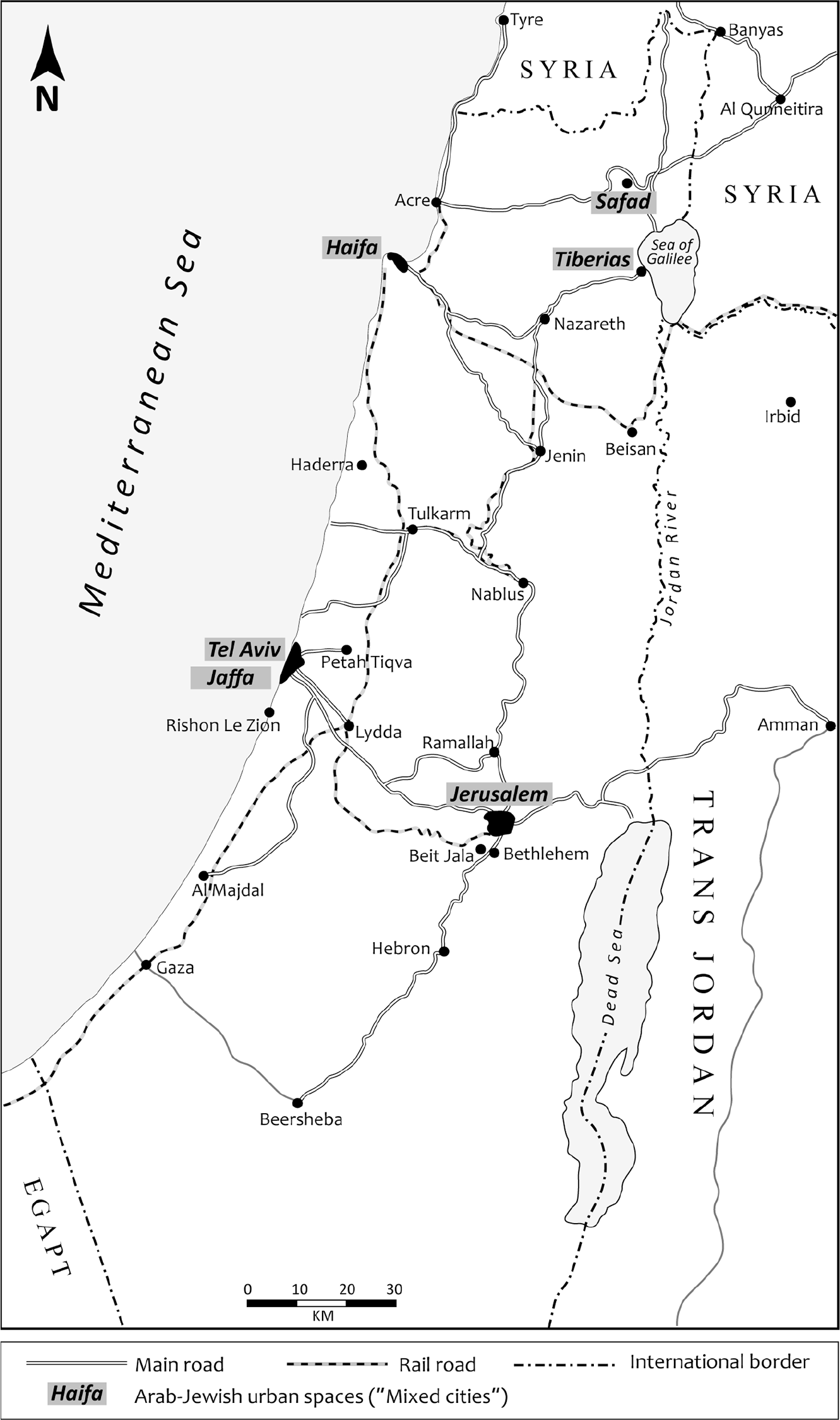
British Palestine Arab Jewish urban spaces, 1937.
The failure of the legislative council initiative led Zionist institutions to regard towns in which both Jews and Arabs resided as targets for increasing Zionist influence. To form an accepted strategy for achieving this target, a special entity was established by the Zionist authorities, the Jewish National Committee for Municipal Matters. The Municipal Committee was first convened in the summer of 1924. The committee’s debates, which appeared in a special publication, included the term mixed cities as a recognized and obvious designation. Arab residents of these cities were referred to as “non-Hebrew local residents” or “foreign manufacturers” and their neighborhoods as “foreign neighborhoods.” At the same time, they were also frequently referred to as “our neighbors.” From that point on, mixed cities, along with the term mixed municipalities, became an integral part of the Yishuv vocabulary and discourse. 40
The tripartite symbolic definition of the urban space as pure-mixed-foreign evolved within discussions in Zionist institutions and Zionist public life on how to prepare for the municipal elections slated for both 1927 and 1934. The term mixed cities, as a negative designator of urban municipalities populated by Arabs and Jews, became a customary expression. The Yishuv’s ultimate goal was a complete separation of the Zionist community from the “foreign” Palestinian Arab population and space.
Here I shall bring one hegemonic example regarding the use of the term mixed cities in the Yishuv’s discourse. It appeared in a special report prepared by the Jewish Agency, the main Zionist political institution, in anticipation of the upcoming 1934 municipal election, and was printed verbatim in Davar, the most influential newspaper of the Zionist Labor Movement, which controlled Zionist politics and Weltanschauung: The amended version of the proposal [for the 1934 municipal election law] was officially presented to the Executive of the Jewish Agency in November 1932 for its comments. A series of consultations were held on behalf of the Political Department of the Jewish Agency . . . The main issue dealt with by the Political Department was how to coordinate between the needs of the Jewish communities in mixed cities (‘arim me’oravot) on the one hand, and in areas of pure Jewish communities on the other . . . At the same time, it was necessary to let the Jews of Jerusalem and Haifa establish autonomous sub-municipalities within the crowded Jewish communities [in these cities]. In contrast, the primary interests of Tel Aviv and the large Moshavot [private Zionist agricultural colonies that were inhabited solely by Jews] centered on completely different issues. Their main purpose was to achieve the greatest possible freedom for Jewish municipal initiatives and to avoid any risk of lowering the Jewish local councils to the level of other towns in the country.
41
Thus, in addressing the proposed legislation for the upcoming 1934 municipal election, the main concern of the Yishuv’s leadership was to ensure maximum autonomy and control for both “pure” Zionist municipalities (Tel Aviv and the large private colonies) and the Jewish neighborhoods within the boundaries of Arab Jewish (“mixed”) cities. Tellingly, the terms mixed cities and pure Jewish communities are not explained, as these terms were already part and parcel of the Yishuv discourse, and it was taken for granted that the readers of Davar would not have any difficulties understanding their meaning. Notably, the term mixed cities also appeared in the English-language Zionist press before the publication of the Royal Commission report in 1937, whence it probably reached the British as well. The term was used in everyday contexts, for example, in announcements of Muslim, Christian, and Jewish holidays on which the branches of the British Barclays Bank would be closed in “all-Jewish towns, all Arab towns, and mixed cities.” 42
In other words, for most Zionists, the reality of a shared Arab Jewish urban area raised questions about the sovereignty of that space, not about mending ethnic differences within it. They did not advocate “mixing” in the pluralistic sense of urban mixing. Rather, they espoused an anti-mixing worldview, akin to the negative way “mixed” or “grey” urban areas were perceived by official Apartheid South Africa or by United States’s racial segregationists. Yet, in my reading of Zionist sources from the Mandate period, especially in comparison with Apartheid South Africa’s official texts or with current U.S. official documents and laws, which set “Standards for Maintaining, Collecting, and Presenting Federal Data on Race,” 43 the three categories denoting distinct urban spaces in Mandate Palestine alluded to the ethno-national identity of a city, rather than the racial identities of its inhabitants. This reading is consistent with observations made by both critical and mainstream scholars of Zionism regarding the Yishuv’s discourse on race. 44
It follows, therefore, that for the pre-1948 Yishuv leadership and its Gramscian civil society, as well as for official post-1948 Israel and its Gramscian civil society, the term “mixed cities” signifies an undesirable reality. Whereas ethnic, and even ethno-national, urban mixing is often perceived as positive, the discursive Zionist and Israeli regimes viewed Arab Jewish mixing, including urban mixing, as a decidedly negative phenomenon. It seems, therefore, that typologically the Zionist Israeli discourse on urban mixing is closer to the Austrian Bohemian framework than to the pluralistic interpretation of urban “mixing” customary in the field of Urban Studies.
The British and the Term Mixed Cities
A review of British sources—such as the various Palestine investigation commissions established by Britain, the annual reports of the Mandate government to the Permanent Mandates Commission of the League of Nations, in discussions of the Mandates Commission following these reports, and in the British census of 1931—reveals that prior to the 1937 Royal Commission Report, the British did not use the terms mixed cities or mixed towns. As a rule, when the British sought to describe the presence of Jewish and Arab populations in a shared urban space, they referenced the identity of the people residing in that space, not the identity of the space itself. For example, the report of the Shaw Commission that investigated the violence that erupted in 1929 (dubbed the “disturbances” of 1929) said, “Other important towns where the population consists of both Arabs and Jews are Hebron, 20 miles to the south of Jerusalem, Tiberias, on the western shore of the Sea of Galilee, and Safed.” 45 Now and then, the British used the term mixed as well, but again with regard to people rather than places, that is, “mixed races” or “mixed population.” These terms were utilized in the context of religious affiliation: Muslims, Christians, and Jews. 46 This is no surprise. In accordance with both the pluralistic and colonial manner in which Britain categorized urban areas under its control throughout the Empire, the Mandate government emphasized the population of these areas, as well. Moreover, even the 1937 Royal Commission expressed reservations about using the term mixed towns, just as it objected to the word “disturbances” in characterizing the Arab Revolt. 47 It follows, therefore, that the term mixed cities and the anti-mixing worldview it conveys were the creation of the pre-1948 Yishuv leadership and society, rather than the British authorities.
The Transition of the Term from Yishuv to the State of Israel
Like most modern nation-states, Israel, too, was established through war—namely, the 1948 Arab Israeli war, termed the War of Independence by Israel and the Nakba (catastrophe) by the Palestinians. During the 1948 war, about 700,000 Palestinians, who lived in the area that became Israel, either were expelled or escaped for temporary shelter but were never allowed to return. Most of their approximately 500 villages were destroyed, and these villages and their lands were taken over by Israel. In addition, about nine Arab cities, including Arab Jewish cities such as Haifa or Jaffa, were declared Israeli as well (Jaffa’s municipal area was ceded to Tel Aviv and the official name of the city became Tel Aviv-Jaffa). Jerusalem was divided between Jordan and Israel, and Arab neighborhoods in (Israeli-controlled) West Jerusalem as well as Jewish neighborhoods in (Jordanian-controlled) East Jerusalem were depopulated. Still, about 16 percent of the citizens of the newly formed State of Israel were Palestinian Arabs who remained within the boundaries of the new state. The majority of them, despite having received Israeli citizenship, were placed under military administration for eighteen years (1948-1966), and their liberty, freedom of movement, education, and employment opportunities were severely curtailed. In former Arab or Arab Jewish cities as well, a small number of the original Arab residents remained. However, they were forced to move into one area—their own ghetto, effectively—and in many cities their former neighborhoods were destroyed. Even during the war, and more rapidly in the coming few years, an influx of Jewish immigrants settled in these former Arab cities, quickly becoming a majority. Thus, the status and standing of the Arab residents of these cities were radically altered. They were transformed from a majority of the city’s population into a marginalized, discriminated against minority in their own homeland. 48
The Labor Movement continued to dominate the political and cultural arenas of the new state, which enabled it to dictate its hegemonic worldview to the growing Jewish population of Israel. The negativity associated with Arab Jewish sharing of the same space was transferred from the Yishuv to become a central tenet of the new state as well. Yet, the term mixed cities was transformed from a loaded, ideological trope to a seemingly objective, legal, and bureaucratic term, camouflaging its original negativity. As already mentioned, former Arab towns, along with pre-1948 Arab Jewish towns such as Jaffa or Haifa, were soon categorized by Israel’s CBS as “mixed localities.”
Jerusalem presents a special case. From 1948 to 1967, West Jerusalem was classified as a Jewish city because nearly all of its pre-1948 Palestinian Arab residents had become refugees. Israel’s military victory in the 1967 war, however, led to its occupation of the Jordanian West Bank, including East Jerusalem, and subsequently Jerusalem’s official classification in Israel once again changed. As mentioned at the outset of this article, Israel annexed the territory of Jordanian Jerusalem along with more than twenty neighboring villages and abolished the municipality of Jordanian Jerusalem. It incorporated these territories and their inhabitants within what it termed a “united” Jerusalem under Israeli municipal rule. This new, all-encompassing Jerusalem municipality was now designated a “mixed locality.” Significantly, the new Arab residents were not granted Israeli citizenship but, rather, the more precarious and easily revoked status of permanent residence.
While for official Israel, all Arab Jewish cities signify sites of potential ethno-national rivalry, from the perspective of the Arab inhabitants of these cities and from the perspective of many scholars, two different struggles can be identified. Arab citizens of Israel, non-governmental organizations (NGOs), Palestinian Arab scholars, and critical scholars, while identifying Israel’s settler-colonial motivation in its treatment of Arab urban areas, have mainly been conducting a pluralistic struggle for more equality within the accepted legal and political boundaries—a struggle for the right to the city and for increased participation in city life and culture. 49 In contrast, for most Arab residents of Jerusalem, and for most scholars of contemporary Jerusalem, the pluralistic struggle has an additional layer, that of an ethno-national one. 50
Arab Jewish Urban Space up to 1948—The Alternative Model
We established that the Zionist and Israeli term mixed cities is not a value-free or a simple administrative concept. Rather, it is an ideological construct imposed from above that perceives Arab Jewish urban sharing negatively. It therefore seems necessary to adopt a scholarly approach toward Arab Jewish urban space that completely avoids this term. Moreover, even from a research perspective, this term, pertaining to Israel, calls up the image of a generalized, static urban space, restricts specific discussion of urban diversity and its dynamic dimensions, assumes that the “mixed” situation is a negative state of affairs, and constitutes an impediment to comparative research.
Below I propose revisiting Arab Jewish urban areas before the establishment of Israel by using customary concepts and insights of Urban Studies, on one hand, and by completely avoiding the “mixed cities” perspective or trope, on the other. In contrast to the rich comparative approaches employed in the research on Israel’s (post-1948) Jewish Arab cities, only rarely are such comparative perspectives applied in discussing the Mandate period. In addition, whereas Israel’s Jewish Arab cities are contested along pluralistic lines, Mandatory Arab Jewish cities were mainly contested along sovereign, ethno-national lines.
The basic structure I propose is modeled after the typology of urban ethno-national divisions proposed by Scott Bollens. 51 Bollens suggests three major stages of such divisions: divided, polarized, and partitioned. The fundamental differential line between these divisions is the level of legitimacy given to the city’s political and legal regime.
Divided cities: In its moderate form, this stage is the normal situation in any urban space. In this regard, it is similar to pluralistic divisions. In its severe form, tension grows and periodic violent outbursts can occur. Yet, the legitimacy of the urban governance structure per se is still accepted.
Polarized cities: In this situation, the legitimacy of the municipal administration and its authority are constantly tested and contested, and the city’s regular functioning is often uncertain. The ethno-national conflict worsens and ordinary issues of city life, particularly the provision of municipal services, become the focus of bitter and acute ethnic-national disputes.
Partitioned cities: Here, when the basic issues at the heart of the national conflict—sovereignty, identity, recognition, belonging, and security—are not resolved, the conflict-ridden space is often partitioned. One way of partitioning the space, according to Bollens and other researchers of national and ethnic conflict, is ethnic cleansing. A more common method, which often encompasses ethnic cleansing as well, is splitting the urban space. Distinct examples of partitioned or ethnically cleansed cities are Berlin, Nicosia, Jerusalem from 1949 to 1967, and Sarajevo after the end of the war in Bosnia. 52
In addition, both Bollens and the Israeli political scientist and former Deputy Mayor of post-1967 Jerusalem, Meron Benvenisti, convincingly demonstrate a bilateral influence: clearly, the national conflict is reflected in the city. But, they argue, the city is also capable of significantly affecting the national conflict. The way in which municipal administrations manage the daily needs of the city’s divided urban population may have a significant impact on the intensity of the national conflict at large, particularly if the city occupies a central place on the national stage. 53 Finally, it should be stressed that Bollens’s model is not linear. Cities have the capacity to scale back to a less contentious situation once the overall ethno-national conflict subsides.
I argue that in British Mandate Palestine, each of the three major urban centers, Jerusalem, Haifa, and Jaffa, underwent the stages of divided and polarized cities, while the combined area of Jaffa and Tel Aviv underwent a partitioned phase as well. Consequently, each urban area also had a different impact on Zionist Palestinian conflict.
Before the establishment of the Mandate, these towns experienced a transition from what might be characterized as a closely shared urban space, when they were bound within their walls, to a divided/pluralistic category. In the closely shared phase, Arabs and Jews lived in close proximity to each other, and an important segment of the Jewish minority, those who came from other Arab and Muslim countries (known as Sephardim or Mizrahim), also shared a language, dress style, and other cultural norms with the Arab majority. Yet, these communities also differed in terms of religion, beliefs, and permissible social boundaries, particularly in relation to marriage. The change from a shared to a divided/pluralistic phase began with the construction of the German Templer colonies near these cities in the 1860s and 1870s and continued several years later, when members of the three main faiths, Muslims, Christians, and Jews, left to live outside the walled cities in their own respective neighborhoods. The Jewish neighborhoods built in those years outside the walls of Jerusalem, Jaffa, and Haifa were populated by non-Zionists. Once Zionist neighborhoods were also constructed, a dimension of national conflict was added to the fabric of urban Palestine. Consequently, once this division process began, most Jews, Christian Arabs, and Muslim Arabs began residing in separate neighborhoods. Any shared housing or neighborhood in Jerusalem, Haifa, or Jaffa was only a marginal phenomenon. However, the three towns responded differently to the conflictual national situation that unfolded within them.
By the late nineteenth century, Jerusalem’s residents and German Templers had already begun building religiously separate neighborhoods outside the city walls, transforming it from a closely shared city to a pluralistic/divided one. Following the establishment of the Mandate and given the main symbolic and administrative role that the British granted Jerusalem within the Mandate system, as well as the focus on the city as part of the symbolic and political struggle between the Zionist and Palestinian leaderships, Jerusalem deteriorated to the phase of a polarized city over the course of roughly a decade. While Palestinians and the entire Arab world saw Jerusalem (al-Quds in Arabic) as both a holy city and an Arab city, for Zionists it was a national symbol, however negatively “mixed.” Thus, from the moment Britain conquered Palestine and until it left the country in 1948, Zionists were engaged in constant struggle for control of Jerusalem’s municipality or the creation of their own independent municipality there—an aim that never materialized (Map 2).
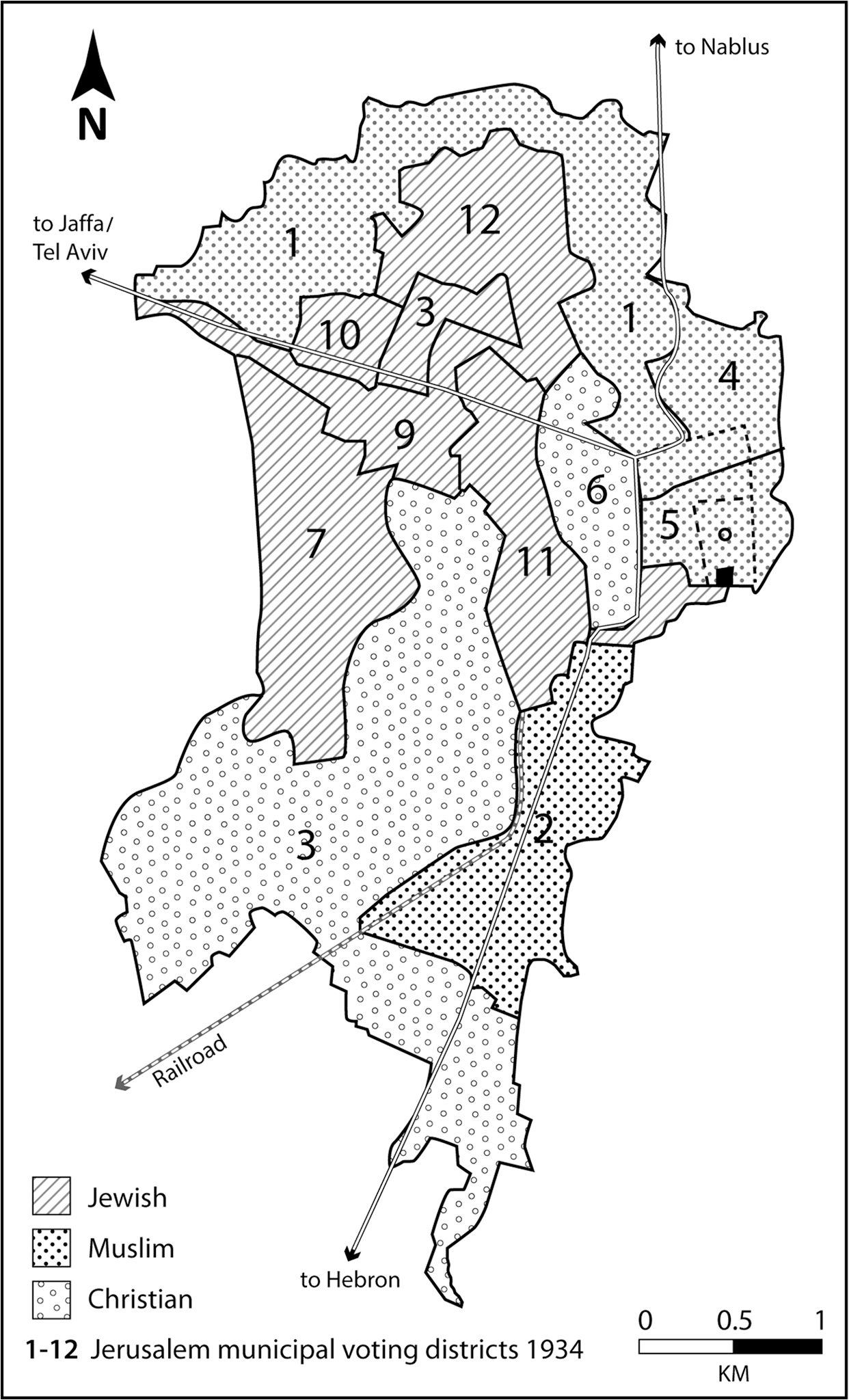
Jerusalem’s Arab and Jewish neighborhoods, 1934.
Throughout the entire Mandate period, Jerusalem remained a “polarized city.” Issues ranging from municipal services, tax collection, and voting rights for the municipal council and its control, to the symbolic hold on places sacred to the three major faiths, continued to strongly polarize the city and prevent it from functioning well as a municipal unit. Thus, toward the end of the Mandate, the British government was compelled to appoint a special council to manage the city. 54 Of the three dominant municipal centers, Jerusalem greatly contributed to the aggravation of the national conflict in British Mandate Palestine.
Haifa, in contrast, was for most of the Mandate period a symbol of possibilities for shared respect and cooperation, despite the conflict. As in Jerusalem, before the rise of Zionism, Jews and Arabs lived in close proximity, especially in the Sephardi neighborhood of Harat al-Yahud. The arrival of the German Templers, and the establishment of Christian Arab and Muslim Arab, as well as of Jewish Arab, neighborhoods outside the city’s walls at the turn of the nineteenth and beginning of the twentieth centuries signified the transition from a closely shared urban space into a pluralistic/divided one. However, as in Jerusalem, Zionist immigrants brought a decisive element of national rivalry and separation to the fast-growing city. From the onset, Zionists established their own neighborhoods, which were also separated from the non-Zionist Jewish ones, and strove to create a Jewish Zionist enclave within the municipality’s boundaries. This, and the growing national consciousness among the Arabs of Palestine, intensified the process of Palestinization among Arab residents of Haifa as well. However, Haifa’s strategic and financial centrality for the British and the Zionists, on one hand, and the existence of a sufficiently wide leadership stratum among the city’s Palestinian population, who objected to the radical national policies of the Palestinian leadership headed by Amin al-Husseini, on the other, were the main factors that limited national polarization in the city. Instead, a unique form of cooperation at the municipal level took place. As Tamir Goren has shown, the personality of Mayor Hasan Shuqri, one of al-Husseini’s opponents, also contributed to subduing the flames of national conflict in Haifa. Thus, following Bollens, we can characterize Haifa’s ethno-national situation during most of the Mandate period as divided. As the intensity of the national conflict grew, particularly during the Arab Revolt (1936-1939), Haifa also became a polarized city. Thus, the two non-Zionist Jewish neighborhoods that were located closest to the downtown Arab area of Haifa were abandoned and their residents fled to the uptown Zionist neighborhoods. But, as in Belfast, when the conflict waned, the unifying dimension overcame the dividing dimension. 55 Jews once again populated one of the non-Zionist downtown neighborhoods, and Arabs and Jews mingled in the downtown area, mainly for business and shopping purposes. Moreover, even during times of polarization, the legitimacy of Haifa’s municipality was not undermined, in contrast to the situation in Jerusalem. Haifa’s role as a center of moderation was not restricted to the city limits. Rather, it had a moderating effect on the entire country (Map 3). 56
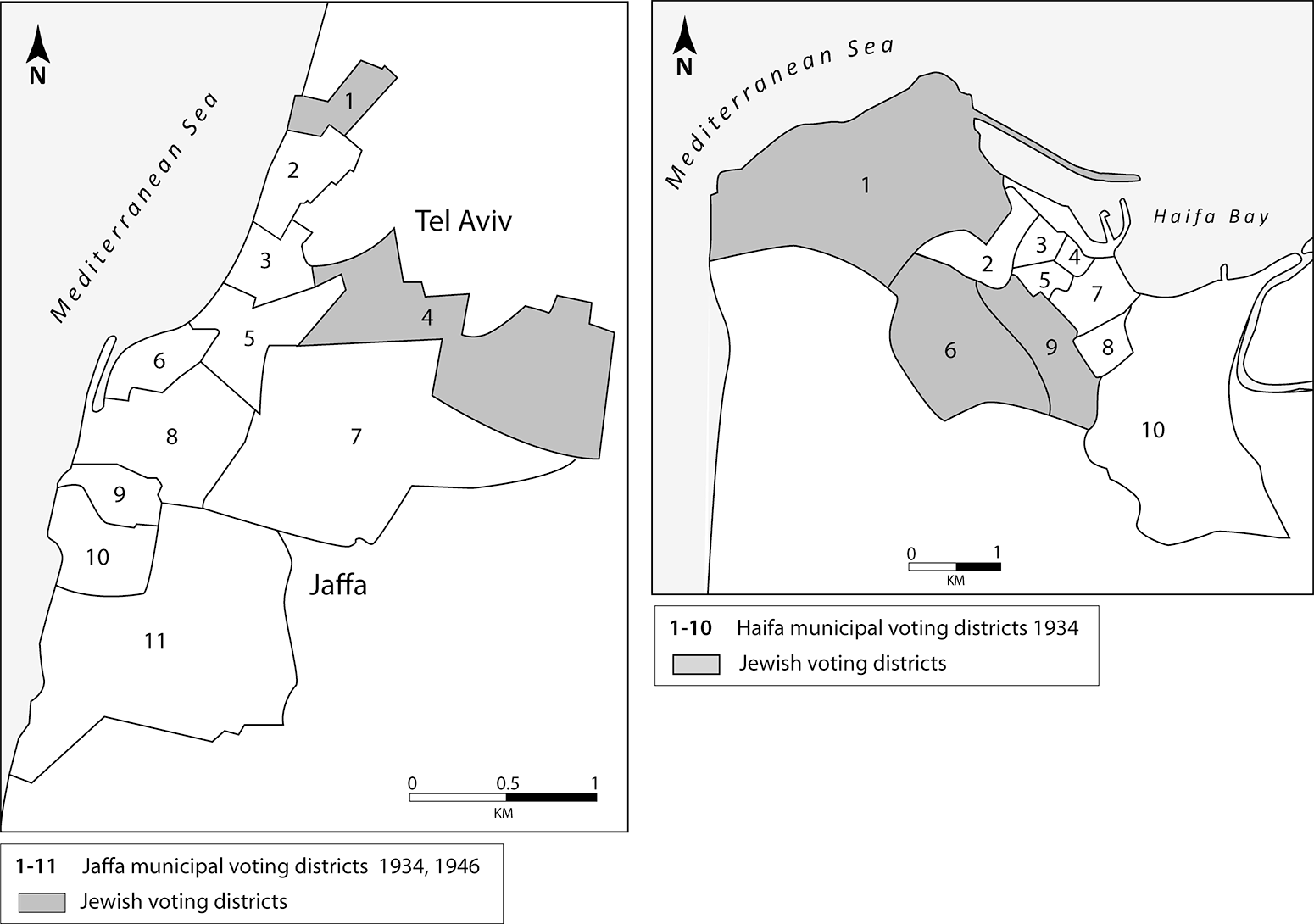
Haifa’s and Jaffa’s Arab and Jewish neighborhoods, 1934.
The combined urban space of Jaffa and Tel Aviv reflects a different process of development from that of Jerusalem and Haifa. Like the other two cities, Jaffa too began as a closely shared Arab Jewish urban space. The demolishing of Jaffa’s walls in 1879 led to the development of Arab suburbs to the north (Menashiyye) and south (‘Ajami and Jebaliyye). Subsequently, non-Zionist ultra-Orthodox and Sephardic Jews built many suburbs to the north of Jaffa. They saw themselves as an integral part of Jaffa, similar to the residents of newly developed non-Zionist Jewish neighborhoods in Jerusalem and Haifa. 57 Thus, we may characterize this phase as a divided/pluralistic stage.
The establishment of Tel Aviv in 1909 formed a Zionist and settler-colonial enclave within Jaffa’s urban fabric. From the beginning, Tel Aviv strove to separate itself from Jaffa and to create an autonomous, municipal Zionist entity. Like the Europeans who settled in non-European lands, the founders of Tel Aviv and its subsequent leaders and inhabitants also envisioned Tel Aviv as a modern European town to which Jaffa and the Arabs would have no access. In other words, in addition to being an exclusive national urban space, Tel Aviv may also be characterized as a colonial city. 58
Until receiving independent municipal status from the British in 1921, the fast-growing colonial neighborhood of Tel Aviv did not question the legitimacy of Jaffa’s municipality, to which it belonged and to whose authority it was subordinate. Economically, Tel Aviv was dependent on Jaffa and on its harbor, the most important harbor in the country until 1948, and on the commercial district in Jaffa that had developed near the harbor. Until 1921, Tel Aviv was a Jaffan ethno-national neighborhood within what Bollens characterized as a divided ethno-national urban space. Once it received the status of a township from the British, a municipal boundary was set between Tel Aviv and Jaffa. In describing the achievement of receiving township status, the leaders of Tel Aviv proudly declared in their official municipal newspaper that they made sure the township’s boundaries were delineated so that “no Arab” would be a resident of Tel Aviv. 59 Thus, in the territory encompassing Jaffa and Tel Aviv, two separate and legally recognized municipalities now existed. Each collected taxes, imposed policing, and provided municipal services separately. I contend that this space was in fact a partitioned urban space. At the same time, Tel Aviv continued to depend on Jaffa’s harbor and its commercial district. Thus, despite the legal, national, and cultural separation of the two cities, they were located in a combined urban space (Map 4).
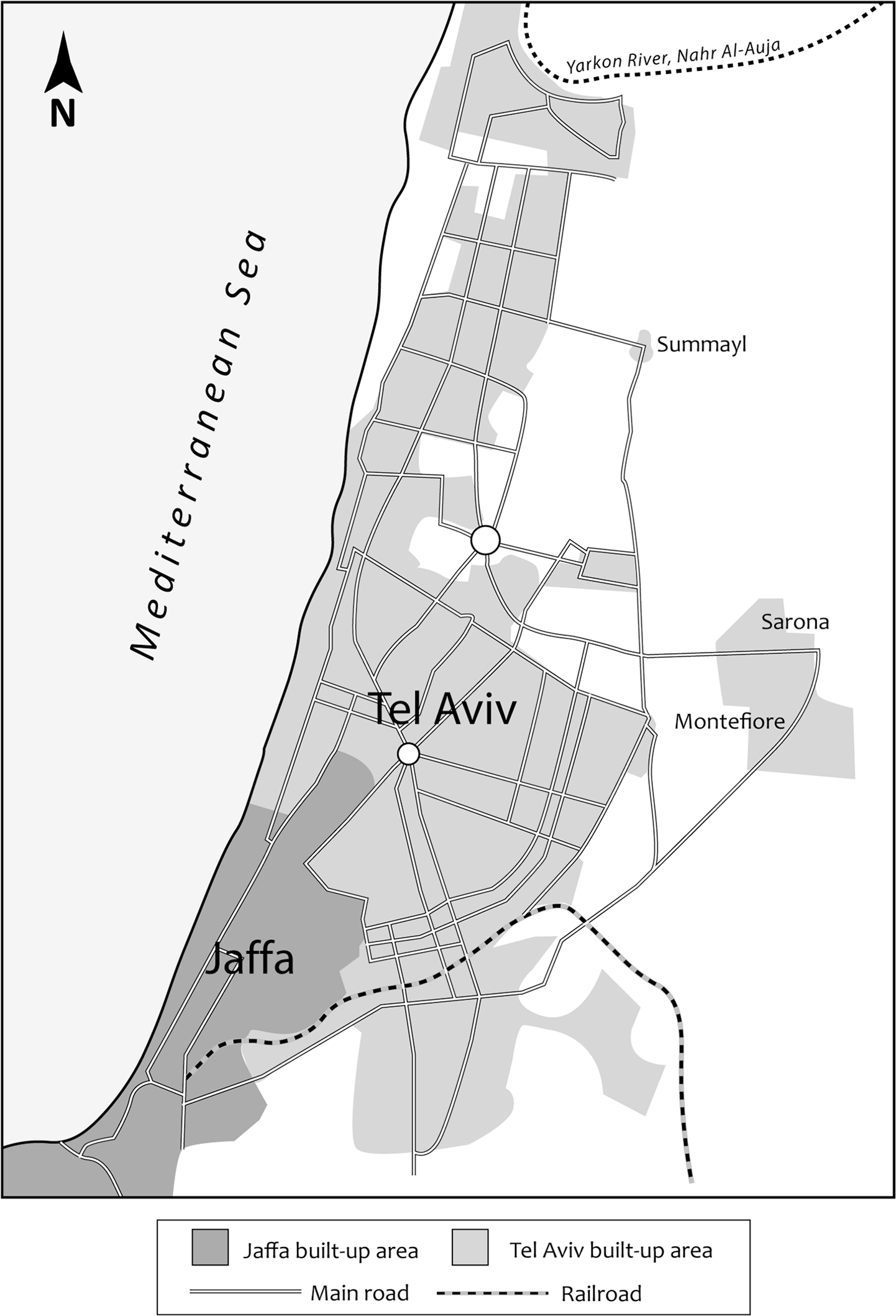
Jaffa and Tel Aviv combined urban space, 1936.
How did this partitioned space affect the national conflict in Palestine? There is an overall agreement among scholars of ethno-national contested urban spaces that in conditions of violence, when the flames of the conflict rage, separation is essential and positive. It creates protected spaces, ethnic and cultural coherence, facilitates defense, and raises morale. In contrast, opinions are split when there is a low level of violence and conflict. Scholars who have studied cities in conflict, from Belfast to the urban spaces of former Yugoslavia, claim that the demand for ethnic separation of conflicting populations and the separation itself have the effect of aggravating the conflict. The lack of real contact between the opposing ethnic/national groups or the demand for separation in itself increases distrust and suspicion between the populations, and facilitates the development of negative stereotypes of the other. 60
Tel Aviv was established during peaceful times and out of the Zionist passion for forming a new homeland for Zionist Jews. Moreover, from its inception in 1909 until the end of World War II, with the exception of the Arab Revolt, Tel Aviv experienced only minor incidents of violence. Therefore, one may argue, Tel Aviv’s separatist ideology, separatist town planning, and separatist geographical expansion had an adverse influence on the country’s national conflict since it established boundaries that became barriers for a better cooperation and dialogue with Jaffa and its Arab residents.
While Tel Aviv is praised in Israeli historiography as the embodiment of the Zionist dream, a dominant narrative in Zionist Israeli scholarship sketches Jaffa in somber and threatening colors, as a center of Jewish Zionist hatred that erupted whenever possible. 61 In addition, this narrative also argues that Jews fled Jaffa every time the national conflict reached the city and that, consequently, it was emptied of any Jewish presence. Concurrently, the same historiography also claims that Jaffa’s Jewish population grew steadily during the Mandate, comprising about a third of the city’s population from the late 1920s on, and hence defines it as a “mixed city.” 62
During the Mandate period, Palestinians regarded Jaffa, like any other city established before Zionism, as an Arab city. Palestinian historiography and literature portray Jaffa, the Palestinian “bride of the sea,” nostalgically and stress its central place in the modernization of Palestinian society and in its culture and economy. For contemporary Palestinians, as well as in Palestinian research and literature, Jaffa is regarded as an Arab Palestinian city. 63
However, by relinquishing Jaffa’s designation as either a “mixed city” or an Arab city and examining it through the lens of the proposed model, we can resolve some of the inner contradictions in the historiography. More importantly, Jaffa, like Haifa, emerges as being in a divided city/pluralistic phase during most of the Mandate years.
Despite the partition of the Jaffa-Tel Aviv urban space, a large number of Jews including Zionist Jews elected to remain within the municipal boundaries of Jaffa. Following a long-standing Arab and Muslim policy and tradition, the existence of other Abrahamic religious minorities within the Arab City had always been an unquestionable and welcome reality. 64 The longtime serving mayor of Jaffa, ‘Asim al-Sa’id, whose name is known only to a few (unlike his Tel Aviv counterparts), tried to maintain that legacy, despite the intensification of the national conflict in Palestine as the Mandate years came to a close.
While Tel Aviv blocked any option for Arabs to live there, Jaffa and al-Sa’id not only repeatedly welcomed Jews as residents of the city, they also took many steps to reach out to the city’s Jewish population. In contrast to the narratives perpetuated by the dominant Israeli historiography, it was precisely after one of the violence outbursts, dubbed the 1921 “disturbances,” that local Jewish residents and new immigrants decided to establish new Jewish neighborhoods within Jaffa’s jurisdiction, for example, the neighborhoods of Shapira and ‘Oved. It is obvious that the establishment of these new neighborhoods would not have been possible without the consent of the municipality of Jaffa and its Palestinian leaders. Jaffa’s Jewish population further grew with the establishment of the Florentin neighborhood within its boundaries in 1927. Where Tel Aviv was proud of borders that excluded all Arabs, Jaffa continued the long-standing Muslim and Ottoman tradition of accepting diverse populations within its territory.
‘Asim al-Sa’id implemented a series of symbolic and practical steps that buttressed the identity, the needs, the self-esteem, and the honor of the Jewish residents of Jaffa. These steps are currently recognized in conflict resolution and reconciliation research as essential for generating a solution to national-ethnic conflict. 65 From his very first days as mayor, immediately following the British occupation, Sa’id nominated a Jewish secretary to be in charge of communication with Jaffa’s Jewish population, including communicating with them in Hebrew. Over the years, Hebrew-speaking Jews were appointed to be in charge of a considerable portion of the services provided to neighborhoods inhabited by Jews. In the elections to the municipality of Jaffa in 1927, two Jews were elected as members of the city council. These were Meir Dizengoff, the legendary mayor of Tel Aviv, who at the time was voted out of the mayorship, and Haim Motro, representative of the neighborhoods inhabited by Sephardic Jews and those originating from Arab countries. To increase the contact between Jaffa’s Jewish population and the municipality’s operations, Sa’id appointed a Hebrew- and Arabic-speaking Jew as the special secretary to the municipality, and some of the municipality’s minutes were recorded in both Arabic and Hebrew. Dizengoff and Motro took an active part in the city’s committees and in the municipality’s operations. 66 Motro often expressed opinions that contradicted the policy of separation and segregation from Jaffa, led by both the Zionist and the Tel Aviv municipality leaders. He was in favor of enhanced contact between Jews and Arabs and of promoting understanding of Arab culture and stressed the danger of Zionist segregation from the wide region around Palestine. Hence, as noted by Allegra, Casagia, and Rokem, Jaffa’s leadership acted to integrate the city’s Jewish population within the municipality’s decision-making process. In this way as well, Jaffa seems to have helped reduce ethno-national conflicts within the city (Illustration 1).
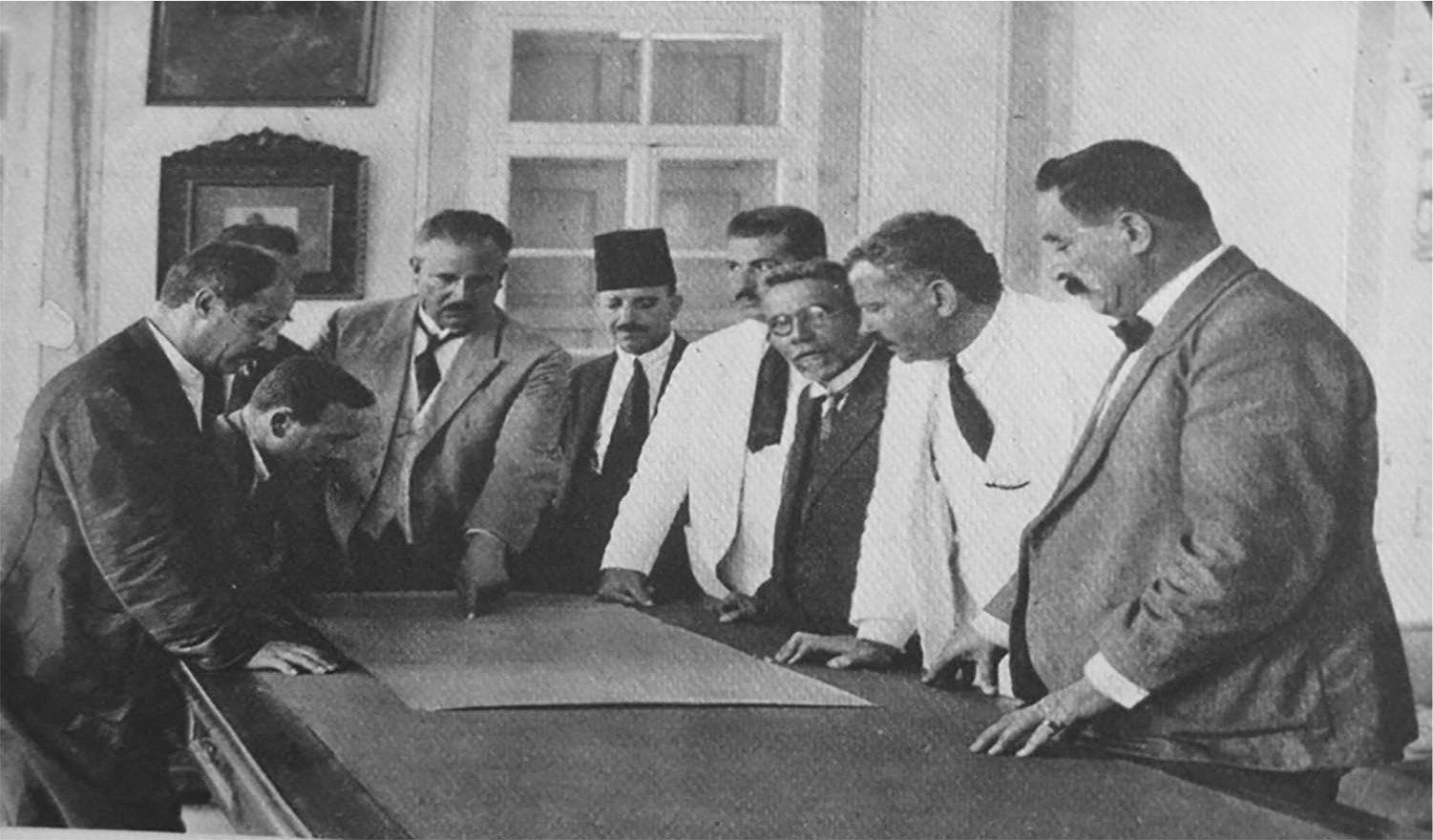
Jaffa municipal council, late 1920s.
Indeed, some members of Jaffa’s city council told Sa’id and Dizengoff that Tel Aviv, too, must introduce similar steps by using Arabic in its official publications and operations. They argued that Dizengoff was eligible for election to Jaffa’s city council by law, although he did not live in the city, because he owned a business in Jaffa and paid taxes there. The contention was that Arabs who live in Jaffa and pay taxes in Tel Aviv deserve similar recognition. This step was not implemented in the first Hebrew (i.e. Jewish Zionist) city. 67
Notably, the legal separation between Tel Aviv and Jaffa did not prevent the passage of people and commodities. Goren describes the full extent of these reciprocal visits in great detail. But while Jaffa encouraged acceptance of the “others,” Tel Aviv tried to block such efforts. Here, too, the latter policy was not conducive to reducing the tensions between the two populations and to improving mutual recognition. 68
Thus, during most of the Mandate years, Jaffa could be characterized as a divided/pluralistic city. Jews and Arabs primarily lived in separate neighborhoods (while on the borderlines of these neighborhoods, a more shared environment existed), belonged to different religions, and formed their families within the religion. Jews attended Jewish schools, many of which were located in Tel Aviv, and conducted business both in Jaffa and in Tel Aviv. At the same time, they chose to build their neighborhoods inside Jaffa and fully accepted the legitimacy and authority of Jaffa’s municipality. As in Haifa, in Jaffa as well, there were times, particularly during the years of the Arab Revolt, when a polarized state of affairs was imposed from the outside. However, as in Haifa, Jaffa too resumed to conduct itself as a divided/pluralistic city during World War II and until the winter of 1947, when the 1948 war erupted. Thus, in contrast to the dominant Israeli narrative, my claim is that during most of the Mandate period, Jaffa was a town whose conduct alleviated the conflict between Zionists and Palestinians. This emphasizes the discrepancy, worthy of a separate study, between Jaffa’s demonic image in hegemonic Israeli consciousness and historiography and the reality of close relations and collaboration between Arabs and Jews in the city, as evidenced by contemporary sources and new research.
Conclusion
This article, then, examines the genealogy of the term mixed cities, a prevalent trope that dominates Israeli popular, academic, and official discourse vis-à-vis Arab Jewish cities in Israel/Palestine. I argue that although the term is presented as a value-free bureaucratic concept, it is, in fact, a construct of the pre-Israel Zionist settler-colonial discursive regime, which posits shared Arab Jewish urban spaces as a negative phenomenon. Hence, the undesired “mixed” city is contrasted with the “pure” Zionist and the “foreign” Palestinian Arab urban space. Upon the establishment of the State of Israel, this national and settler-colonial concept was incorporated into the state’s bureaucratic and legal systems, as well as into the state’s newly constructed “civil religion,” making it a Gramscian hegemonic concept.
The research literature on Israel’s Jewish Arab cities is rich and innovative and employs multifaceted methodologies. However, the loaded definition of Israeli Jewish Arab cities as “mixed” creates conceptual confusion, prevents the employment of a fully comparative approach, and perpetuates a perplexing Israeli exceptionalism that scholars of Israel’s urbanism have struggled to overcome time and again. I propose that this ideologically charged trope be abandoned altogether when Arab Jewish urban areas are discussed. The advantages of this approach were demonstrated by revisiting Arab Jewish cities in British Mandate Palestine (1918-1948) and offering a revisionist analysis that employs Scott Bollens’s model for the study of ethno-national contested cities. Through this lens, a richer, dynamic, more tolerant, and more accurate urban reality may be observed. Yet, it is extremely unlikely that Israel will remove the concept of “mixed localities” or “mixed cities” from its official definition of Jewish Arab spaces. In the final analysis, these anti-mixing concepts stem from Israel’s ethno-national and settler-colonial ideological foundations. But scholars can make a difference in fostering a more inclusive reality by challenging that hegemonic construct through what Gramsci terms an intellectual “war of position.” Finally, by broadening the scope of my inquiry, I identified four typological forms of urban (anti-)“mixing,” along with the research approaches associated with them: pluralistic, racial, sovereign, and colonial. Taking British Mandate Palestine’s Arab Jewish urban area as an important example, the article re-emphasizes claims made by previous scholars that mainstream Urban Studies, and especially its Critical Urban Studies school, should expand its purview beyond the Global North. In national, colonial, racial, or post-colonial settings, terms such as “mixing” or “division” have fundamentally different—sometimes even conflicting—meanings relative to the limited neo-Marxist or post-structural perspective through which the Critical Urban Studies school usually interprets urban centers. A more inclusive interpretative framework is needed.
Footnotes
Acknowledgements
*I want to thank Professor Erez Tzfadia for reading an earlier draft of this paper and for his valuable comments and suggestions; I also want to thank the three anonymous readers of this manuscript for their thoughtful comments and suggestions that challenged me to improve, so I hope, my paper. My thanks are also extended to Professors Oded Heilbronner and Scott Ury for discussing with me pre-1914 Czech and Poland urban landscapes, respectively. Earlier drafts of my approach were presented at the workshop, Space and Time in Israel-Palestine, Brown University, which was organized by Professor Omer Bartov; and at the faculty seminar (Dewan), the Center for the Study of Relations between Jews, Christians, Muslims, the Open University of Israel, organized by Professor Mustafa Kabha. I want to thank Professors Bartov and Kabha for inviting me to present at these meetings and for the meetings’ participants for their comments and discussion. Finally, I want to thank Dr. Merav Datan for her very valuable suggestions and edits of this manuscript, and Ms. Roni Bluestein for preparing the maps for this paper.
Declaration of Conflicting Interests
The author(s) declared no potential conflicts of interest with respect to the research, authorship, and/or publication of this article.
Funding
The author(s) received no financial support for the research, authorship, and/or publication of this article.
